US1908246A - Bass mechanism for accordions - Google Patents
Bass mechanism for accordions Download PDFInfo
- Publication number
- US1908246A US1908246A US584518A US58451832A US1908246A US 1908246 A US1908246 A US 1908246A US 584518 A US584518 A US 584518A US 58451832 A US58451832 A US 58451832A US 1908246 A US1908246 A US 1908246A
- Authority
- US
- United States
- Prior art keywords
- levers
- slides
- valve
- bass
- valves
- Prior art date
- Legal status (The legal status is an assumption and is not a legal conclusion. Google has not performed a legal analysis and makes no representation as to the accuracy of the status listed.)
- Expired - Lifetime
Links
Images

Classifications
-
- G—PHYSICS
- G10—MUSICAL INSTRUMENTS; ACOUSTICS
- G10D—STRINGED MUSICAL INSTRUMENTS; WIND MUSICAL INSTRUMENTS; ACCORDIONS OR CONCERTINAS; PERCUSSION MUSICAL INSTRUMENTS; AEOLIAN HARPS; SINGING-FLAME MUSICAL INSTRUMENTS; MUSICAL INSTRUMENTS NOT OTHERWISE PROVIDED FOR
- G10D11/00—Accordions, concertinas or the like; Keyboards therefor
- G10D11/02—Actions
Definitions
- the present invention relates to accordions, and particularly to a novel mechanism for coupling the air valves so as to combine any number of them at will on sin-- be arranged for any key at any points of the keyboard to move one an the same group of valves by one key at two, three or more points of the board.
- the reeds can be fully utilized in all variations, the accompanying music rendered extremely powerful and varied and controlled by the keys so that the latter can be touched in the most convenient and 'eflicient manner.
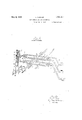
- Figure 1 is a top view of the bass action in the bass box, with some parts broken away; Fig. 2, a cross section of the bass box; and Fig. 3, a diagram of the most important parts of the action.
- Fig. 2 a top view of the bass action in the bass box, with some parts broken away; Fig. 2, a cross section of the bass box; and Fig. 3, a diagram of the most important parts of the action.
- Fig. 3 On the panel of the frame the bass levers band the accord levers 0 are disposed on a common wire shaft d.
- the valves e are closed by springs in the usual way and can be opened by the vertically directed lever arms.
- the novel arrangement of the wire shafts n which are known per se, makes it possible to space them so widely that no other existing construction can be compared to it and the air waves have the greatest possible freedom of motion while the bass box either has thesame or a smaller size.
- the vertical superposition oi the wire shafts a is, finally, advantageous for the reason that the levers 0 need only half their previous length and the as well as the shafts n can be made wea er than now.
- the levers 0 can be much shorter than the bass levers b, which, at equal key travel, would result in a considerable inequality in the valve stroke if the key pressure were transmitted to the lever arms g and h by means of intermediate members of the known type, such as slides and the like.
- press ack with the same slide throughout and the invention attains this object by keeping the two pressure fingers l on the slide In at a distance from one another which will compensate for the difference in len h of the lever arms. It isv therefore engage and two individually movable levers g and It arranged side by side at a different distance from the fulcrum.
- the lateral U-shaped bend of the fingers l permits central distribution of pressure on t e valve slide, smaller or lar er relative s acing of the lever arms 9 an h, unchecke passage with res ect to one or the other lever arm and ra i and easy adjustment of the fingers by compressing or spreading apart the U-shaped portion to provide or contact with the lever arms 9 and h.
- the slide 11 belng capable of separately moving one of the two valve levers.
- the slides 4' and k are bent at the point between the ledges or at least for the length coming into question for the catch so as .to be nearer the shafts n and the ever arms of the shafts concerned may be shorter thanthe lever arms for the key slides p on the same level, so that the catches g engage the longer lever arm 0 and the valve slides are driven by other and shorter lever arms 0.
- A has action in accordions comprising spaced air valves arranged in rows, springs for closing the said valves, levers of unequal length connected with the said valves, two perptesndicularly superposed layers of wire sha the shafts of said two layers being perpendicular above one another, valve slides perpendicular to-the said shafts and cou led with the said air valves and shafts, an keys controll' the said coupled members, each key opening simultaneously a plurality of valves.
- A has action in accordions comprising spaced air valves arranged in rows, springs for.closing the said valves levers of unequal length connected with sai valves and arranged in a series bearing on a com- 7 mon wire shaft, two layers of wire shafts,
- A' bass action in accordions compris-' ing spaced 'air valves arranged in rows springs for closing said valves, levers of unequal length connected with .said valves, valve slides, connected by s ring action to said has valve levers and avin pressure fingers, some of said slides simu taneously lifting a valve lever of both the front and rear rows, the difference in length of the valve levers being compensated by the perpendicular distance of said pressure fingers to lift both valves equall high.
- valve slides are each formed angularly withv a perpendicular relatively short shank.
- valve slides are each formed angularly with a perpendicular relatively short shank and the pressure fingers arranged on the said shanks are laterally bent in a U-shaped manner.
- valves arranged in two adjacent rows, accord levers and bass levers operatively connected to said valves, said two sets 0 levers being of difierent lengths, slides for operating said levers, and
Landscapes
- Physics & Mathematics (AREA)
- Engineering & Computer Science (AREA)
- Acoustics & Sound (AREA)
- Multimedia (AREA)
- Stringed Musical Instruments (AREA)
Description
May 9, 1933. E; HOHNER 1,998,243
BASS MECHANISM FOR ACCORDIQNS Filed Jan. 2, 1932 2 Sheets-Sheet l May 9, 1933a E. HOHNER BASS MECHANISM FOR ACCORDIONS I Filed Jan. 2, 1932 2 Sheets-Sheet Patented May 9, 1933 ERNST 303m TROSSIN'GEN, G
PATENT OFFICE BASS MECHANISM FOR ACCORDIONB hppHcaflon filed January 2, 1932,, Serial No. 584,518, and in Germany March 38, 1931..
The present invention relates to accordions, and particularly to a novel mechanism for coupling the air valves so as to combine any number of them at will on sin-- be arranged for any key at any points of the keyboard to move one an the same group of valves by one key at two, three or more points of the board. In this way the reeds can be fully utilized in all variations, the accompanying music rendered extremely powerful and varied and controlled by the keys so that the latter can be touched in the most convenient and 'eflicient manner. Various kinds-of actions aiming at the same objects as the invention are known already, but they are more or less imperfect, and their chief drawbacks are much noise, long key path involving much dead travel, heavy touch, interference with air motion by a practically complete masking of the air valves, too great weight, too large space requirements, too complex design, dificult manufacture by craftsmanship methods and therefore expensive, too many possibilities so of trouble and stoppage, excessive wear, great difiiculty in disassembling, too small and uneven key stroke,and, as a rule, primitive a pearance.
In t e bass action according to the inven tion the defects mentioned are eliminated by the peculiar construction and arrangement of the parts.
By way of example, the invention is illustrated in the accompanying drawing, in which Figure 1 is a top view of the bass action in the bass box, with some parts broken away; Fig. 2, a cross section of the bass box; and Fig. 3, a diagram of the most important parts of the action. Referring to the drawing: On the panel of the frame the bass levers band the accord levers 0 are disposed on a common wire shaft d. The valves e are closed by springs in the usual way and can be opened by the vertically directed lever arms. 9 or k by means of the slides v1 or It having the pressure fingers Z and being arranged on edge in the ledges m of the superposed frames in each of which a set of wiresh'afts n is provided in a horizontal layer and spaced in the widest possible way. The wire shafts n are fitted with the levers 0 connected with the valve slides 71 and It as well as with the key slide 7) by the transverse carrier 9 by the action of the force of the springs f for closw ing the valves. The travel of the key slides 19 is limited by their bend r hugging the ledges m and that of the slides i and k by their pressure finger Z which hugs the lever arms 9 and 7a of the levers b and a. To pre- 55 vent the slides from producing noise at their striking points, the latter are fitted with the felt coverings a and the vertical lever arms g and h are covered with the sleeves 25 made from cardboard, rubber or similar shockabsorbing material.
The novel arrangement of the wire shafts n, which are known per se, makes it possible to space them so widely that no other existing construction can be compared to it and the air waves have the greatest possible freedom of motion while the bass box either has thesame or a smaller size. The widely spaced wire shafts w afiord the added advanta e that the pin levers. o disposed one behin the other in the direction ot the slidesare no lon er in each others way and need not be cra ed or bent but can remain straight. The vertical superposition oi the wire shafts a is, finally, advantageous for the reason that the levers 0 need only half their previous length and the as well as the shafts n can be made wea er than now.
Dangerous deflections causing dead travel are avoided.
Since the valves e must be arranged intwo rows to accommodate the reeds, the levers 0 can be much shorter than the bass levers b, which, at equal key travel, would result in a considerable inequality in the valve stroke if the key pressure were transmitted to the lever arms g and h by means of intermediate members of the known type, such as slides and the like. To render an action really useful provision should be made for simultaneously raising valves in the fi st and second row by means of one and the same key while the valve stroke remains uniform res ndmgly deeper level.
, press ack with the same slide throughout, and the invention attains this object by keeping the two pressure fingers l on the slide In at a distance from one another which will compensate for the difference in len h of the lever arms. It isv therefore engage and two individually movable levers g and It arranged side by side at a different distance from the fulcrum. The lateral U-shaped bend of the fingers l permits central distribution of pressure on t e valve slide, smaller or lar er relative s acing of the lever arms 9 an h, unchecke passage with res ect to one or the other lever arm and ra i and easy adjustment of the fingers by compressing or spreading apart the U-shaped portion to provide or contact with the lever arms 9 and h.
The same applies to the valve slide i having only one pressure finger Z, the slide 11 belng capable of separately moving one of the two valve levers. To reduce the length of the levers g on the shafts n and the hei ht of the action as much as possible and sti get along with little key pressure, the slides 4' and k are bent at the point between the ledges or at least for the length coming into question for the catch so as .to be nearer the shafts n and the ever arms of the shafts concerned may be shorter thanthe lever arms for the key slides p on the same level, so that the catches g engage the longer lever arm 0 and the valve slides are driven by other and shorter lever arms 0.
It would of course be possible though less eflicient to attain the same object by means of straight slides i and k arranged at a corib e to simultaneously;
laim:--
1. A has action in accordions comprising spaced air valves arranged in rows, springs for closing the said valves, levers of unequal length connected with the said valves, two perptesndicularly superposed layers of wire sha the shafts of said two layers being perpendicular above one another, valve slides perpendicular to-the said shafts and cou led with the said air valves and shafts, an keys controll' the said coupled members, each key opening simultaneously a plurality of valves.
2. A has action in accordions comprising spaced air valves arranged in rows, springs for.closing the said valves levers of unequal length connected with sai valves and arranged in a series bearing on a com- 7 mon wire shaft, two layers of wire shafts,
said wire shafts of the two layers being perpendicular to one another, valve slides perpendicular to said shafts and cou led with said air a e and S aft and 0 C0!!- catches iscranked to trolling said coupled member-sf each key opening simultaneously aplura ity of said valves; I
3. A' bass action in accordions, compris-' ing spaced 'air valves arranged in rows springs for closing said valves, levers of unequal length connected with .said valves, valve slides, connected by s ring action to said has valve levers and avin pressure fingers, some of said slides simu taneously lifting a valve lever of both the front and rear rows, the difference in length of the valve levers being compensated by the perpendicular distance of said pressure fingers to lift both valves equall high.
4. A bass action accor ing to claim 3, in which the valve slides are each formed angularly withv a perpendicular relatively short shank.
5. A bass action according to claim 3, in which the valve slides are each formed angularly with a perpendicular relatively short shank and the pressure fingers arranged on the said shanks are laterally bent in a U-shaped manner. I
I 6. A bass action as per claim 3, in which pin levers are connected by catches with said wire shafts and valve and key slides,
the lever arm acting on the valve slides, be-
ing shorter than the one a'ctedon by the key slides.
7. In a bass action as per claim 3, in which catches connect pin levers attached to the wire shafts with valve and key slides, and the valve slide portion carrying the said catches is nearer to the axes of said pin levers than the key slide portion carrying the catches.
8. In a bass action according to claim 3, in which catches connect pin levers attached to the wire shafts with valve and key slides and the valve slide rtion carrying the b: nearer the axes of the pin levers, the bearing points and ends being on the same level as one ofthe rows of the respective key slides.
9. In a bass action accordin to claim 8, in which the free pressure en of the perpendicular arms of the valve levers are covered with a non-metallic and shock absorbing material.
10. In an accordion, the combination with valve slides and key slides, of wire shafts arranged in .two so rposed layers perpendicular to one anot er and means between said shafts and said slides -for operating said valve slides from said key slides.
11. In an accordion, bass 'levers and accord levers and a common wire shaft on which said levers are borne.
12. In an accordion, valves arranged in two adjacent rows, accord levers and bass levers operatively connected to said valves, said two sets 0 levers being of difierent lengths, slides for operating said levers, and
' pressure fingers on said slides for actuating said levers, said pressure fingers being 81-" ranged at such distance apart from one another as to compensate for the difference in length of said levers.
In testimony whereof I aflix my signature.
ERNST HOHNEB.
Applications Claiming Priority (1)
| Application Number | Priority Date | Filing Date | Title |
|---|---|---|---|
| DE1908246X | 1931-03-28 |
Publications (1)
| Publication Number | Publication Date |
|---|---|
| US1908246A true US1908246A (en) | 1933-05-09 |
Family
ID=7748762
Family Applications (1)
| Application Number | Title | Priority Date | Filing Date |
|---|---|---|---|
| US584518A Expired - Lifetime US1908246A (en) | 1931-03-28 | 1932-01-02 | Bass mechanism for accordions |
Country Status (1)
| Country | Link |
|---|---|
| US (1) | US1908246A (en) |
Cited By (5)
| Publication number | Priority date | Publication date | Assignee | Title |
|---|---|---|---|---|
| US2504538A (en) * | 1947-10-15 | 1950-04-18 | Kummer John | Accordion |
| US2556408A (en) * | 1946-12-19 | 1951-06-12 | Wurlitzer Co | Accordion bass section |
| US2932232A (en) * | 1953-08-17 | 1960-04-12 | Tony U Minervini | Accordion operating upon an electrical musical instrument |
| US2979980A (en) * | 1957-04-23 | 1961-04-18 | Traficante Inc | Movable convertor for the bass mechanism of an accordion |
| US3343438A (en) * | 1964-04-13 | 1967-09-26 | Giulietti Accordion Corp | Bass section of accordions |
-
1932
- 1932-01-02 US US584518A patent/US1908246A/en not_active Expired - Lifetime
Cited By (5)
| Publication number | Priority date | Publication date | Assignee | Title |
|---|---|---|---|---|
| US2556408A (en) * | 1946-12-19 | 1951-06-12 | Wurlitzer Co | Accordion bass section |
| US2504538A (en) * | 1947-10-15 | 1950-04-18 | Kummer John | Accordion |
| US2932232A (en) * | 1953-08-17 | 1960-04-12 | Tony U Minervini | Accordion operating upon an electrical musical instrument |
| US2979980A (en) * | 1957-04-23 | 1961-04-18 | Traficante Inc | Movable convertor for the bass mechanism of an accordion |
| US3343438A (en) * | 1964-04-13 | 1967-09-26 | Giulietti Accordion Corp | Bass section of accordions |
Similar Documents
| Publication | Publication Date | Title |
|---|---|---|
| US2951660A (en) | Method and means for controlling the jet thrust of an aircraft | |
| US2229315A (en) | Hinge | |
| US2596816A (en) | Hinge | |
| US1818661A (en) | Heating furnace | |
| US2616574A (en) | Device for separating sheetlike materials | |
| US888152A (en) | Automatic piano. | |
| US1590350A (en) | Color indicator for weft-replenishing looms | |
| US2180684A (en) | Double bass shift for accordions | |
| US2458653A (en) | Double valve for accordions and like musical instruments | |
| US2008240A (en) | Regulator | |
| US1615961A (en) | Musical instrument | |
| US92760A (en) | Adam storck | |
| US498912A (en) | Rise-and-fall jacquard mechanism | |
| US2114085A (en) | Accordion | |
| US1679616A (en) | Box motion for looms | |
| US93349A (en) | William r | |
| US1878892A (en) | Door mechanism | |
| US1840456A (en) | Saxophone | |
| GB364512A (en) | Improvements in or relating to servo-motor mechanism for the operation of carillons | |
| US1836111A (en) | Means for simultaneously operating the valves in internal combustion engines | |
| US1289449A (en) | Pianissimo device for pianos. | |
| US2646712A (en) | Harmonica | |
| US741884A (en) | Pneumatic action and coupler for organs. | |
| US1434171A (en) | Adjustable door control | |
| US1547471A (en) | Regenerator flow-box construction |