US1908240A - Process of dehydrating aqueous aliphatic acids and mixtures thereof - Google Patents
Process of dehydrating aqueous aliphatic acids and mixtures thereof Download PDFInfo
- Publication number
- US1908240A US1908240A US550397A US55039731A US1908240A US 1908240 A US1908240 A US 1908240A US 550397 A US550397 A US 550397A US 55039731 A US55039731 A US 55039731A US 1908240 A US1908240 A US 1908240A
- Authority
- US
- United States
- Prior art keywords
- water
- acid
- column
- mixture
- aqueous
- Prior art date
- Legal status (The legal status is an assumption and is not a legal conclusion. Google has not performed a legal analysis and makes no representation as to the accuracy of the status listed.)
- Expired - Lifetime
Links
- 239000000203 mixture Substances 0.000 title description 71
- 238000000034 method Methods 0.000 title description 47
- 125000001931 aliphatic group Chemical group 0.000 title description 22
- XLYOFNOQVPJJNP-UHFFFAOYSA-N water Substances O XLYOFNOQVPJJNP-UHFFFAOYSA-N 0.000 description 87
- KNKRKFALVUDBJE-UHFFFAOYSA-N 1,2-dichloropropane Chemical compound CC(Cl)CCl KNKRKFALVUDBJE-UHFFFAOYSA-N 0.000 description 70
- 239000002253 acid Substances 0.000 description 60
- QTBSBXVTEAMEQO-UHFFFAOYSA-N Acetic acid Chemical compound CC(O)=O QTBSBXVTEAMEQO-UHFFFAOYSA-N 0.000 description 36
- 238000004821 distillation Methods 0.000 description 32
- 239000011260 aqueous acid Substances 0.000 description 20
- 238000009835 boiling Methods 0.000 description 20
- XBDQKXXYIPTUBI-UHFFFAOYSA-N dimethylselenoniopropionate Natural products CCC(O)=O XBDQKXXYIPTUBI-UHFFFAOYSA-N 0.000 description 20
- 239000007788 liquid Substances 0.000 description 20
- 235000011054 acetic acid Nutrition 0.000 description 14
- 238000002156 mixing Methods 0.000 description 13
- VEXZGXHMUGYJMC-UHFFFAOYSA-M Chloride anion Chemical compound [Cl-] VEXZGXHMUGYJMC-UHFFFAOYSA-M 0.000 description 12
- 235000019260 propionic acid Nutrition 0.000 description 12
- 150000007513 acids Chemical class 0.000 description 11
- 230000018044 dehydration Effects 0.000 description 10
- 238000006297 dehydration reaction Methods 0.000 description 10
- IUVKMZGDUIUOCP-BTNSXGMBSA-N quinbolone Chemical compound O([C@H]1CC[C@H]2[C@H]3[C@@H]([C@]4(C=CC(=O)C=C4CC3)C)CC[C@@]21C)C1=CCCC1 IUVKMZGDUIUOCP-BTNSXGMBSA-N 0.000 description 10
- 239000000243 solution Substances 0.000 description 9
- 238000010533 azeotropic distillation Methods 0.000 description 6
- 238000010276 construction Methods 0.000 description 6
- 101100298225 Caenorhabditis elegans pot-2 gene Proteins 0.000 description 5
- 125000004432 carbon atom Chemical group C* 0.000 description 5
- 238000004519 manufacturing process Methods 0.000 description 5
- 229940095050 propylene Drugs 0.000 description 5
- QQONPFPTGQHPMA-UHFFFAOYSA-N propylene Natural products CC=C QQONPFPTGQHPMA-UHFFFAOYSA-N 0.000 description 5
- 125000004805 propylene group Chemical group [H]C([H])([H])C([H])([*:1])C([H])([H])[*:2] 0.000 description 5
- 230000000153 supplemental effect Effects 0.000 description 5
- 239000007864 aqueous solution Substances 0.000 description 4
- 230000007423 decrease Effects 0.000 description 4
- 238000010438 heat treatment Methods 0.000 description 4
- 239000012535 impurity Substances 0.000 description 4
- 239000012141 concentrate Substances 0.000 description 3
- 239000012809 cooling fluid Substances 0.000 description 3
- 239000000463 material Substances 0.000 description 3
- 238000000746 purification Methods 0.000 description 3
- 239000002023 wood Substances 0.000 description 3
- 241000861718 Chloris <Aves> Species 0.000 description 2
- 150000001243 acetic acids Chemical class 0.000 description 2
- 150000001875 compounds Chemical class 0.000 description 2
- 239000012530 fluid Substances 0.000 description 2
- 238000005192 partition Methods 0.000 description 2
- 150000004672 propanoic acids Chemical class 0.000 description 2
- 230000000630 rising effect Effects 0.000 description 2
- 238000000926 separation method Methods 0.000 description 2
- 230000008016 vaporization Effects 0.000 description 2
- ZEOVXNVKXIPWMS-UHFFFAOYSA-N 2,2-dichloropropane Chemical compound CC(C)(Cl)Cl ZEOVXNVKXIPWMS-UHFFFAOYSA-N 0.000 description 1
- 241001527902 Aratus Species 0.000 description 1
- 241000182988 Assa Species 0.000 description 1
- FERIUCNNQQJTOY-UHFFFAOYSA-N Butyric acid Chemical class CCCC(O)=O FERIUCNNQQJTOY-UHFFFAOYSA-N 0.000 description 1
- OKTJSMMVPCPJKN-UHFFFAOYSA-N Carbon Chemical compound [C] OKTJSMMVPCPJKN-UHFFFAOYSA-N 0.000 description 1
- 229920008347 Cellulose acetate propionate Polymers 0.000 description 1
- 241000196324 Embryophyta Species 0.000 description 1
- XBDQKXXYIPTUBI-UHFFFAOYSA-M Propionate Chemical compound CCC([O-])=O XBDQKXXYIPTUBI-UHFFFAOYSA-M 0.000 description 1
- 235000002492 Rungia klossii Nutrition 0.000 description 1
- 244000117054 Rungia klossii Species 0.000 description 1
- 125000004429 atom Chemical group 0.000 description 1
- 229910052799 carbon Inorganic materials 0.000 description 1
- 229920002678 cellulose Polymers 0.000 description 1
- 239000001913 cellulose Substances 0.000 description 1
- 229920002301 cellulose acetate Polymers 0.000 description 1
- 238000001311 chemical methods and process Methods 0.000 description 1
- 239000003795 chemical substances by application Substances 0.000 description 1
- 238000004040 coloring Methods 0.000 description 1
- 230000000052 comparative effect Effects 0.000 description 1
- 238000009833 condensation Methods 0.000 description 1
- 230000005494 condensation Effects 0.000 description 1
- 238000010924 continuous production Methods 0.000 description 1
- 239000012153 distilled water Substances 0.000 description 1
- 238000000605 extraction Methods 0.000 description 1
- 230000005484 gravity Effects 0.000 description 1
- VKYKSIONXSXAKP-UHFFFAOYSA-N hexamethylenetetramine Chemical compound C1N(C2)CN3CN1CN2C3 VKYKSIONXSXAKP-UHFFFAOYSA-N 0.000 description 1
- 238000009413 insulation Methods 0.000 description 1
- 235000015250 liver sausages Nutrition 0.000 description 1
- 244000005700 microbiome Species 0.000 description 1
- 150000002895 organic esters Chemical class 0.000 description 1
- 230000002250 progressing effect Effects 0.000 description 1
- 238000000197 pyrolysis Methods 0.000 description 1
- 238000011084 recovery Methods 0.000 description 1
- 229920006395 saturated elastomer Polymers 0.000 description 1
- 239000007921 spray Substances 0.000 description 1
- 238000003860 storage Methods 0.000 description 1
- 238000009834 vaporization Methods 0.000 description 1
- 239000002699 waste material Substances 0.000 description 1
Images


Classifications
-
- C—CHEMISTRY; METALLURGY
- C07—ORGANIC CHEMISTRY
- C07C—ACYCLIC OR CARBOCYCLIC COMPOUNDS
- C07C51/00—Preparation of carboxylic acids or their salts, halides or anhydrides
- C07C51/42—Separation; Purification; Stabilisation; Use of additives
- C07C51/43—Separation; Purification; Stabilisation; Use of additives by change of the physical state, e.g. crystallisation
- C07C51/44—Separation; Purification; Stabilisation; Use of additives by change of the physical state, e.g. crystallisation by distillation
- C07C51/46—Separation; Purification; Stabilisation; Use of additives by change of the physical state, e.g. crystallisation by distillation by azeotropic distillation
Definitions
- This invention relates to processes of removing water from aqueous aliphatic aclds and more particularly to processes for the dehydration of dilute solutions of acetlc,
- This invention hasras an object to provide a process of removing water from dilute solutions of acetic, propionic and other aliphatic acids or mixtures thereof.
- a furtherobject is to provide such a process which will be simple, inexpensive and yet applicable to solutions of any strength.
- a still further ob'ect is to' provide a process which is applicable, not only to relatively pure water solutions of acetic, propionic and other acids, but also to the production of concentrated acids from crude aqueous solutions, such as pyroligneous liquor obtained from wood distillation. It is also an object to provide a process for the concentration of aqueous so utions of acetic acid which contain in addition varying roportions of propionic acid and other hig er aliphatic acids.
- Another object is to provide a process in which the water which is finally removed carries away only a very small or ne ligible amount of acidwith it. Still another object is to provide such .a process in which the amountof heat required is kept as low as possible. It is also an object to provide a process in which distillation is the main factor thereby eliminating the trouble and cost of initial extraction steps. Other objects will appear hereinafter. v 7
- the fol lowing invention which comprises a distillatign process for removing water from aqueous aliphatic acids in which a particular water entraining organic li uid is employed.
- a particular water entraining organic li uid is employed.
- My process may be carried out in a fractionating column of known type, the distilled water and propylene chloride being condensed, allowed to settle into two layers, the ropylene chloride which forms the lower ayer being returned to the upper part of the column for reuse.
- the propylene chloride passes through a cycle wit out serious loss and can be used over and over in a continuous manner.
- the acid gradually becomes more concentrated as it descends in the column, since it has the highest boiling point of any of the components -undergoing distillation.
- the water and propylene chloride are driven oil from the acid as it descends and the pro ylene chloride as it passes upward through.
- c column in successive carries with it more and more water un there is distilled oil from the top plate of the column the azeotropic mixture of water and propylene chloride above referred to.
- any given unit of propylene chloride will carry away with it, as an azeotro ic mixture, more water than an equal unitol any of the withdrawing agents previously :o a H in the art for use in dehydrating ueous acetic or other aliphatic acids. It will apparent that, inasmuch as substantiall complete dehydration is the object of e process, at
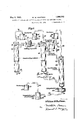
- Fig. 1 is a semi-diagrammatic side elevation of one form of apparatus in which my process may be carrie out, certain of the parts being exaggerated and portions of others broken awa for clarity.
- Fig. 2 is a simi ar view of another form of apparatus which may be used to carry out my Invention.
- Figs. 3, 4, 5 and 6 are charts showing the comparative effectiveness of water removal from various aqueous aliphatic acids by plain distillation as compared to azeotropic distillation with propylene chloride.
- Fig. 1 the numeral 1 represents a dis- P tillation column of well known construction, such as a column provided with a series of plates with bubble cap construction so that the vapors rising in the column are caused to pass through the liquid which is collected upon each plate. A portion ofthe column is broken away to show the construction of the plates in diagrammatic form.
- a column still of approximately 40- ducting vapors rising from the still pot into the column 1.
- a suitable draw-oil pipe 4 equipped with a valve is provided for the still pot 2 by means of which substantially .number 14 of the column, is
- the still pure acid may be withdrawn from the still pot as hereinafter further discussed.
- a valved inlet pipe 5 for the introduction into the column of aqueous acid from the acid supply tank 6, mounted preferably above the mlet pipe in order that the acid will flow into the column by means of gravity.
- a propylene chloride inlet 7 In the top portion of the column 1 and at a point above the uppermost plate in the column is provided a propylene chloride inlet 7.
- he supply pipe 9 is connected with a propylene chloride supply tank 10 for a urpose hereinafter described.
- the function of the supply line 8 will also be more fully discussed.
- a vapor outlet pipe 12 which is connected with the condenser 13 which may be cooled by any suitable medium such as water entering and leaving by the pipes 21 and 22, respectively.
- Any condensate accumulating in the condenser 13 is conducted by means of. a pipe 14 into the se arator 15, which separator is provided wit a baflle plate 16 extending to within a short distance of the bottom of the separator.
- the pipe 17 carries away water which separates out in the separator and the pipe 8 conducts propylene chloride which also separates out m the separator back to the head of the column for re-use therein.
- a vapor inlet 18 which connects t e supplemental still pot 19 with the column 1.
- a valved i line 20 is provided to conduct aqueous tank 6 to the pot 19 maybe of construction similar to the still 2 and ma also be rovided with an outlet for with rawing t erefrom such residual impurities as ma collect therein. It will be obvious that t e construction above described is merely diagrammatical and that the elements described are all well known to those skilled in this art and may be of such suitable construction as would be employed by any distillation engineer.
- the still pot 2 charged with the highl concentrated acid, such, for example, as g acial acetic acid in thecase of concentrating dilute solutions of acetic acid, and that a supply of the dilute acid undergoing concentratlon and ropylene chlori e be contained in the tanks 6 and acid from the acid supply 10, respectively.
- the aqueous acid is introduced slowly into the column 1 and heat applied to the still pot 2.
- the propylene chloride being the heavier of the two liquids, settles to the bottom and passes on to the battle 16 into the right-hand section of the separator, and is continuously drawn off there mm by means of the pipe 17 leading to the sewer.
- The. pipe 8 controlled by a valve returns the propylene chloride to the head of the column where by means of the inlet 7 it is re-introduced into the system.
- Fig. 2 shows diagrammatically a somewhat different form of apparatus for carrying out my invention which employs a plurality of shorter distillation columns in place of the sin le high column of Fig. 1.
- the supply tani: of aqueous acid 38 is connected by pipe 39, controlled by valve 40 with an intermediate portion (say about two-thirds of the way up) of a fractionating column 41 of one of the usual types, preferably though not necessarily forty plates high.
- a downward cur- .rent or spray of propylene chloride enters from nozzle or opening 42, which is connected with the horizontal transverse pipe 43.
- the base of the column is provided with the customary heating vessel '44, the heating fluid for which comes through pipes 45.
- the azeotropic mixture of the vapors of water and propylene chloride leaves the top of the column passing around pipe 43 into pipe 46 and from thence enters condenser 47, the cooling fluid of which circulates qthrough pipes 48.
- the distillate from 47 flows down into settling chamber 49, the latter being provided with a downwardly extending transverse partition 50, which is separated, however, from the bottom of the yessel.
- the pipe 51 from the condenser 47 likewise extends'well down into the Vessel 49. When the distillate reaches vessel 49, it separates into two layers, the water layer being uppermost and confined at one side of the par-tion 50, as shown in the drawings.
- the heating of this column 55 is done in the chamber 56, the heating fluid for which circulates through pipes 57.
- This condensed ropylene c ori e can be passed partly t rough pi 61 controlled by valve 62 into pipe 43 an nozzle 42 of the main fractionatin column, and partly through pipe 63 contro led by valve 64 into the nozzle or opening 65 at the to through pipes 68.
- the vapors of aqueous acid pass over through pipes 69 into the v final condenser 70 from which the concern trated acid can be drawn off and stored.
- the distillation in still 67 is not indispensable, but is preferable to remove some small amounts of coloring or polymerized bodies that may be formed during the other operations- Referring to the upper left-hand part of Fig. 2, the watery la er from the settling vessel 49 passes throug pipe 52 to the nozzle or opening 71 at the top of fractionating column 72, the latter being of any of the usual't s. Steam is blown into the column throug pipe 73 and hot water passes to waste through pipe 70', preferably to a heat interchanger,'not shown. The assa of the steam up the column 72 flas es 0 the small amount of propylene chloride which is present in the watery material descending from nozzle 71.
- the vapors of pro ylene chloride and water pass through pipe 74 into,co ndenser 75, the cooling fluid of which circulates through pipes 76.
- the propylene chloridefrom 75 passes throu h pipe 51 to the bottomor lower layer o the settling vessel 49 and thencereturns through the chloride through pipes 53 and 43 and nozzle 42.
- Figs. 1 and 2 are illustrative.
- the invention may be carried out with an ordinary balloon distillation flask and a condenser as a batch operation although that would not be economical on a commercial scale and does not result in the most efiicient dehydration of the aqueous acid.
- Fig. 1 a single distillation column, it is to be understood that in the interest of economy of space or for other considerations, it may be desirable to construct it in two or more sections placed one above or alongside of the other or in staggered relation.v
- Other. forms of apparatus and methods of carrying out the invention may be em loyed without departing from thespirit an scope thereof.
- Fi 3 shows the results obtained by simple istillation of aqueous acetic acid without the use of a water entraining liquid, the curve being obtained by plotting the percentage of water in the distillate against the percentage of water in the liquid in the still pot. Since the curve lies only very slightly shove the 45 line representing the same amount of water in the distillate and the liquid undergoing distillation, respectively, it will he ap arent that no matter what the strength 0 aqueous acid is, the percentage of water in the distillate obtained is only slightly greater, and it is, therefore, uneconomical to concentrate aqueous acid b plain distillation.
- Fig. 4 s ows the curve plotted under corresponding conditions using propylene chloride as the water entraining liquid in the dehydration of aqueous acetic acid, i. e., the abscissa represents the percentage of water in the aqueous acetic acid undergoing distillation in the presence of an amount of propylene chloride equal in weight to that of the aqueous acetic acid. It will be noted in this case that the curve lies substantially above the 45 line and clearly indicates the marked advantages to be obtained by azeotropic distillation with this particular water entraining liquid.
- Fig. 5 shows the same type of curve as that of Fig. 3 for the plain distillatlon of aqueous propionic acid. .Here again it .w1ll be a parent that no matter what the strength of t 1e aqueous propionic ac d is, the ercentage of water in the distillate obtained is only slightly greater than that of the liquid undergoing distillation, and that, in this case also, it will not be economical to concentrate the aqueous acid by plain distillation.
- Fig. 6 shows graphically the very marked advantage of the application of azeotro ic distillation of acquaous propionic aci employing propylene chloride as the water entraining l1qu1 the conditions being the same as those under which the curve of Fig. 4 was obtained.
- the curve in this case lies very markedly above the 45 line showing ahighly eflicient separation of water from the aqueous liquid.
- the process-of dehydrating an aqueous monobasic aliphatic acid of 2-4 carbon atoms which comprises mixing therewith slightly more than 8%, parts by weight of propylene chloride for every part by weight of water to be removed from the aqueous acid, distilling the mixture and removing therefrom in vapor form and at a temperature below the boiling point of water a constant boiling mixture of propylene chloride and water,- condensing the distillate, allow-- ing it to settle into two layers, returning the lower layer to the distillation mixture and continuously removing the dehydrated acid from said distillation mixture.
- the process of dehydrating propionic acid which comprises mixing therewith slightly more than 8 partsby weight of propylene chloride for every part by weight of water to be removed from the aqueous acid, distilling the mixture and removing therefrom in vapor form and at a temperature below the boiling point of water a constant boiling mixture of propylene chloride and water, condensing the distillate and allowing it to settle into two layers, returning the lower layer to the distillation mixture and continuously removing the dehydrated acid from said distillation mixture.
Landscapes
- Chemical & Material Sciences (AREA)
- Organic Chemistry (AREA)
- Crystallography & Structural Chemistry (AREA)
- Engineering & Computer Science (AREA)
- Oil, Petroleum & Natural Gas (AREA)
- Vaporization, Distillation, Condensation, Sublimation, And Cold Traps (AREA)
- Organic Low-Molecular-Weight Compounds And Preparation Thereof (AREA)
Description
y 9, 933- w. w. HARTMAN 1,908,240
PROCESS OF DEHYDRATING AQUEOUS ALIPHATIC ACIDS AND MIXTURES THEREOF Filed July 13, 1951 3 Sheets-Sheet 1 Fig.1. v
,QWM
May 9, 1933. w. w. HARTMAN 1,903,240
PROCESS OF DEHYDRATING AQUEOUS ALIPHATIC ACIDS AND MIXTURES THEREOF Filed July 13, 1951 3 SheetS-Sheet 2 ll/illiam uln EEM Patented May 9, 1933 UNITED STATES PATENT OFFICE WILLIAM WEAVER HAB'I'IAN, OF ROCHESTER, NEW YORK, ASSIGNOB 'I'O EASTHAN KODAK COMPANY, OI ROCHESTER, NEW YORK, A CORPORATION OF NEW YORK PROCESS OF DEHYDRATDTG AQUEOUS AIJ-PEATIC ACDSAND MIXTURES THEREOF Application fled July 13,
This invention relates to processes of removing water from aqueous aliphatic aclds and more particularly to processes for the dehydration of dilute solutions of acetlc,
ropionic and other aliphatic aclds or mixtures thereof.
Thisapplication is in part a contlnuatlon of m application Serial. No. 524,063, filed Mare 20, 1931.
The removal of water wholly or partially from aqueous aliphatic acids or mixtures thereof is a roblem of great technical importance. or .example, certain chemical processes, such as the manufacture of cellulose acetate or 'propionate, require large quantities of highly concentrated or anhydrous acids and after such processes are completed there is often left a large amount of dilute acid from which the water must be removed before the acid can be reemployedh It is obvious that to lesson the expense of such removal is highly desirable. Furthermore, in the initial stages of the production of these acids they are too diluted with water for most manufacturing processes. Taking the manufacture of acetic acid by the destructive distillation of wood as an example,
there is initially produced a dilute aqueous solution or mixture of acetic, PIOPIOIllC and other aliphatic acids together with various impurities, which is called pyrohgneous liquor. After separating out most of the impurities, the solution must be concentrated and it is'therefo're highly desirable that this be accomplished by a processwhich is simple and more inexpensive than those used heretofore.
Likewise, when the acids above referred to are produced by-the action of microorganisms, the are formed in dilute aqueous solutions which must be concentrated and in this case it is equally f desirable that the water he removed as simply and as cheaply as possible. Various processes for the concentration or dehydration of aliphatic acids have been devised, some of'which operate upon the principle of separation of the components mixed with the acid by rectification of distilled vapors, while others opcrate upon the principle of employing a 1981 Serial No. 550,897.
liquid with the aqueous acid which forms a constant boiling mixture with the water whereby it is entrained and carried away by va orization. However, until the invention escribed in U. S. Patent 1,804,745 to Clarke and Othmer, no process had been devised which would efliclently and substantially completely concentrate dilute aqueous solutions of acids of the general character under consideration without additional.- distillation operations being performed upon the azeotropic distillate. I
This invention hasras an object to provide a process of removing water from dilute solutions of acetic, propionic and other aliphatic acids or mixtures thereof. A furtherobject is to provide such a process which will be simple, inexpensive and yet applicable to solutions of any strength. A still further ob'ect is to' provide a process which is applicable, not only to relatively pure water solutions of acetic, propionic and other acids, but also to the production of concentrated acids from crude aqueous solutions, such as pyroligneous liquor obtained from wood distillation. It is also an object to provide a process for the concentration of aqueous so utions of acetic acid which contain in addition varying roportions of propionic acid and other hig er aliphatic acids. Another object is to provide a process in which the water which is finally removed carries away only a very small or ne ligible amount of acidwith it. Still another object is to provide such .a process in which the amountof heat required is kept as low as possible. It is also an object to provide a process in which distillation is the main factor thereby eliminating the trouble and cost of initial extraction steps. Other objects will appear hereinafter. v 7
These objects are accomplished by the fol lowing invention which comprises a distillatign process for removing water from aqueous aliphatic acids in which a particular water entraining organic li uid is employed. I have found that highly desirable results may be obtained by'mixing the a neous acid or acid mixture with propy ene chloride and distilling water and propylene tillation mixture,
guished from such processes by the fact that neither the acid nor the water in the impure aqueous mixture is extracted or dissolved to any a preciable extent by the or entrainmg liquid which 1s adde to the disbut on the contrary the liquid forms an azeotropic mixture with the water present, which mixture separates upon condensation into two distinct layers, one of water and the other of entraining liquid. My invention is further distinguished by the fact that the removal of water from the acid takes place'at a relatively low temperature and does not require extensive treatment of the distillate for recovery of the water entraining medium, as is generall the case when using high boiling extracting media.
In my application Serial No. 524,063 of which the present application is a continuation in part, there is disclosed a method for the dehydration of acetic acid by azeotropic distillation with propylene chloride. I have now discovered after expensive research that azeotropic distillation with propylene chloride may be effectively applied not only to the concentration of acetic acid, but also to the dehydration of propionic and butyric acids, either from their pure water solutions or mixtures thereof or from impure aqueous mixtures,-such as those obtained in the d structive distillation of wood.
My process may be carried out in a fractionating column of known type, the distilled water and propylene chloride being condensed, allowed to settle into two layers, the ropylene chloride which forms the lower ayer being returned to the upper part of the column for reuse. In the preferred embodiment of my process the propylene chloride passes through a cycle wit out serious loss and can be used over and over in a continuous manner.
I For a discussion of the requisites of an organic auxiliary liquid for use in the purification of an acid b azeotropic distillation, reference is made to S. Patent 1,804,745 to Clarke and Othmer. I have found that propylene chloride sses all of the required pro erties therein described, not only when u in the purification of acetic acid, but also purification of hi her aliphatic acids such as propionic and utyric. This compound is a colorless liquid having the structural formula:
Hill. l in 61 It is a'saturated compound and may be regarded as dichlor-propane. It has a boiling nic water point of 96.8 C. and is practically immiscile with water, the water dissolving only1 about 27% of it at 20 C. It forms wit water an azeotro ic mixture which boils at about 78 C. and ZGO mm. pressure, the mixture consisting of about 88% propylene chloride and 12% water, by volume, corresponding to a ratio of about 7% parts of propylene chloride by volume to one of water, or 8.3 parts by weight. It will, therefore, be seen that eve na ms by volume of'propylene chlori e w 'ch is distilled from the aqueous mixture will carry over approximately one part of water. As substantially none of the acetic, propionic or other acid under going treatment enters into the emotropic mixture which is formed, the desired acid is left behind in the column or other distillation vessel in a dehydrated condition.
If a distillation column is employed as the dehydrating apparatus, the acid gradually becomes more concentrated as it descends in the column, since it has the highest boiling point of any of the components -undergoing distillation. The water and propylene chloride are driven oil from the acid as it descends and the pro ylene chloride as it passes upward through. c column in successive carries with it more and more water un there is distilled oil from the top plate of the column the azeotropic mixture of water and propylene chloride above referred to. It is to be noted as one of the particular advantages of my invention that any given unit of propylene chloride will carry away with it, as an azeotro ic mixture, more water than an equal unitol any of the withdrawing agents previously :o a H in the art for use in dehydrating ueous acetic or other aliphatic acids. It will apparent that, inasmuch as substantiall complete dehydration is the object of e process, at
least a slight excem of propylene chloride over that required mixture with the water present at any given point should be kept at all points in the systemv at which distillation takes place or at least at'the point where the last vaporization of the azeotropic mixture occurs.
When using a fractionating column, there is substantially no acid, less than 0.5% in the watery la er of the distillate in the case of acetic aci and less than 2% in the case of propionic acid, and less than 5% acid with a mixture of these acids. Since distillationto .form an azeotropic length of the fractionatacid in the still pot varies, although in a continuous operation there will be practically 100% acid in the still pot and there will, of course, be a constant amount of acid in the watery layer of the distillate. It
will, of course, be apparent that when con-- c'entrating a mixture of acids, say, for example, acetic and propionic, there will be present in the water layer of the distillate minute amounts both acetic and propionic acids.
Several types of distillation apparatus may be usedin carrying out my invention in practice. For example, I may use any of the forms of ap aratus disclosed in U. S. Patent 1,804,745, but I prefer to use the apparatus disclosed in the drawings formin'g a part of the present application and touse a unitary and continuous process as distinguished rom a process in WhlCh 1t is necessary to perform separate and distinct operations on various portions of the acid mixture undergoing concentration. 7 In the accompanying drawings in which like reference characters refer to like Fig. 1 is a semi-diagrammatic side elevation of one form of apparatus in which my process may be carrie out, certain of the parts being exaggerated and portions of others broken awa for clarity. Fig. 2 is a simi ar view of another form of apparatus which may be used to carry out my Invention.
Figs. 3, 4, 5 and 6 are charts showing the comparative effectiveness of water removal from various aqueous aliphatic acids by plain distillation as compared to azeotropic distillation with propylene chloride.
In Fig. 1 the numeral 1 represents a dis- P tillation column of well known construction, such as a column provided with a series of plates with bubble cap construction so that the vapors rising in the column are caused to pass through the liquid which is collected upon each plate. A portion ofthe column is broken away to show the construction of the plates in diagrammatic form. For carrying out my process, I have found a column still of approximately 40- ducting vapors rising from the still pot into the column 1. A suitable draw-oil pipe 4 equipped with a valve is provided for the still pot 2 by means of which substantially .number 14 of the column, is
supplemental still pot 19. The still pure acid may be withdrawn from the still pot as hereinafter further discussed.
At a point approximately two thirds of the way up the column or, in other words, at a position corresponding approximately to plate 25, is provided a valved inlet pipe 5 for the introduction into the column of aqueous acid from the acid supply tank 6, mounted preferably above the mlet pipe in order that the acid will flow into the column by means of gravity. In the top portion of the column 1 and at a point above the uppermost plate in the column is provided a propylene chloride inlet 7. Two valved propylene chloride supply pipes, 8 and 9, connected with the inlet 7-are provided for the introduction of prop lene chloride into the top of the column. he supply pipe 9 is connected with a propylene chloride supply tank 10 for a urpose hereinafter described. The function of the supply line 8 will also be more fully discussed.
At the head of the column 1 is provided a vapor outlet pipe 12 which is connected with the condenser 13 which may be cooled by any suitable medium such as water entering and leaving by the pipes 21 and 22, respectively. Any condensate accumulating in the condenser 13 is conducted by means of. a pipe 14 into the se arator 15, which separator is provided wit a baflle plate 16 extending to within a short distance of the bottom of the separator. The pipe 17 carries away water which separates out in the separator and the pipe 8 conducts propylene chloride which also separates out m the separator back to the head of the column for re-use therein. At a point approximately one-third of the way up the column 1, or at a position approximately opposite plate rovided a vapor inlet 18 which connects t e supplemental still pot 19 with the column 1. A valved i line 20 is provided to conduct aqueous tank 6 to the pot 19 maybe of construction similar to the still 2 and ma also be rovided with an outlet for with rawing t erefrom such residual impurities as ma collect therein. It will be obvious that t e construction above described is merely diagrammatical and that the elements described are all well known to those skilled in this art and may be of such suitable construction as would be employed by any distillation engineer.
Assuming the plant to be newly construct ed, it is necessary, in order to lace it in operation that the still pot 2 charged with the highl concentrated acid, such, for example, as g acial acetic acid in thecase of concentrating dilute solutions of acetic acid, and that a supply of the dilute acid undergoing concentratlon and ropylene chlori e be contained in the tanks 6 and acid from the acid supply 10, respectively. Through the pipe 5,'the aqueous acid is introduced slowly into the column 1 and heat applied to the still pot 2. It may be stated at this point that in the case oi concentrating acetic or propionic acids or their impurities, an acid analyzing anywhere from 1% to 99% or more may be profitably and successfully concentrated by my process to as strong as 99.8% or more purity. At the same time a supply of propylene chloride is introduced into-the column 1 through the pipe 9. Upon starting the process, therefore, the plates of the lower two-thirds of the column will contain aqueous acid and the plates of the upper third of the column will contain propylene. chloride. This condition exists, however, only at the start of the )rocessas the processsoon comes to equilibrium and operates in a continuous manner.
Assuming that the process is to be operated continuously, the various operations are carried out as follows: Upon the top plate of the column there exists a constant boiling mixture of propylene chloride and water, it being necessary to maintain only upon the upper plate of the column a slight excess of propylene chloride. This constant boiling mixture of propylene chloride and water is vaporized by the heat supplied to the. column from the still pot 2 and the var por mixture of water and propylene chloride passes over through the pipe 12 into the condenser 13 wherein the vapor condenses into a liquid mixture of propylene chloride. and water which then passes through the pipe 14 into the separator 15.
In this separator the propylene chloride, being the heavier of the two liquids, settles to the bottom and passes on to the battle 16 into the right-hand section of the separator, and is continuously drawn off there mm by means of the pipe 17 leading to the sewer. The. pipe 8 controlled by a valve returns the propylene chloride to the head of the column where by means of the inlet 7 it is re-introduced into the system. The process being in continuous operation, it is necessary to introduce very little propylene chloride from the supply tank 10, inasmuch as it is used only to su iply the small amount of propylene chloride which may be lost in the system, such as through slight leakage or through being carried off by slight occlusion or solution in the water drawn off from the separator by the pi 1'4.
percentage of water in the aqueousacid decreases. If we proceed upwardly from the point at which the pipe 5 enters the column still, we will find that'the percentage of the desired acid contained in the mixture u on each plate will decrease until on the top pate substantially no acid exists in the mlxture. Also as we proceed upwardly in the upper plates of the column we will find that the percentage of water in thepropylene chloride mixture increases. 7
The converse of this is, of course, that as we proceed downwardly from the 11 permost plate of the column, the. ratio 0 water to propylene chloride very markedly decreases until at the lower plates of the column nothing but propylene chloride and concentrated acid exists up'onthese plates. Also as we proceed downwardly through the lower plates of the column, we will find that the ratio of propylene chloride to acid decreases until at the lowermost plate of the column it will be found that substantially pure concentrated acid exists. It will, therefore, be observed that this lower portion of the column 1 is made to perform the same function asthe additional or supplemental colmnn required in most processes of this general type. The substantially pure concentrated acid retluxes into the still pot 2 where the excess accumulating is drawn oil through the pipe 4. and conducted to storage or such use as may be intended.
If, instead of introducing the aqueous acid in liquid form by means of the pipe 5, it be desired: to employ the supplemental still pot 19, we may assume that the pipe line 5 is entirely shut off and the aqueous acid is conducted directly to the still pct 19. in the still pot l9-the aqueous acidiis' vaporized and the mixed vapors "of water and acid are conducted by means of the pipe 18 into the column 1 at a point approximately one-third the way up the column. acid and watervapors then travel up the column and meet the downwardly progressing stream or supply of propylene chloride. The water combining with the propylene chloride forms a constant boiling mixture which distills oil and passes in a vaporous state onto the next higher plate and soon up the column; the acid not vaporizing; passes down the column so that the cycle o'c-..
These curring when the supplemental still pot 19 is utilized is the same in principle as when" the aq'ueousacid is introduced into the c0l-- umn through the pipe 5 in liquid form, the difference being merely in the detail that the-composition of the mixture uponeach plate will vary slightlyduc to the fact that the water in liquid orvapor form, respectively, is introduced at a. different position in the "column. The pipe 18 may, of course, be provided with a suitablecheck valve in the event it may be desired to change from composition of the mixture in the column has substantially the same water content as that being introduced.
It is also possible to simultaneously introduce the aqueous acid in vapor form through the line 18 and in liquid form through the line 5 and operate the process in that manner. In any event, if operating the process by any of the methods indicated it is necessary merely that the operator control the 7 input of the various materials into thecolumn in such a way that substantiall pure concentrated acid issues from the ottom of the column and that a constant boiling mixture of propylene chloride and water exists upon the top plate of the column.
Fig. 2 shows diagrammatically a somewhat different form of apparatus for carrying out my invention which employs a plurality of shorter distillation columns in place of the sin le high column of Fig. 1. The supply tani: of aqueous acid 38 is connected by pipe 39, controlled by valve 40 with an intermediate portion (say about two-thirds of the way up) of a fractionating column 41 of one of the usual types, preferably though not necessarily forty plates high. At the top of this column a downward cur- .rent or spray of propylene chloride enters from nozzle or opening 42, which is connected with the horizontal transverse pipe 43. The base of the column is provided with the customary heating vessel '44, the heating fluid for which comes through pipes 45.
The azeotropic mixture of the vapors of water and propylene chloride leaves the top of the column passing around pipe 43 into pipe 46 and from thence enters condenser 47, the cooling fluid of which circulates qthrough pipes 48. The distillate from 47 flows down into settling chamber 49, the latter being provided with a downwardly extending transverse partition 50, which is separated, however, from the bottom of the yessel. The pipe 51 from the condenser 47 likewise extends'well down into the Vessel 49. When the distillate reaches vessel 49, it separates into two layers, the water layer being uppermost and confined at one side of the par-tion 50, as shown in the drawings.
From the ,vessel 49 the water layer passes through exit pipe 52 to further treating apparatus which will be described hereinafter. The lower layer of ropylene chloride passes beneath the partition and out through y normal circulatory path of the propylene pipe 53 to pipe 43 and thence downward through the nozzle 42 into the fractionating column 41. Thus the bulk of the propylene chloride passes throu h a cycle from nozzle 42 to column 41 and t ence through the following parts,'-46, 47, 51, 49, 53 and 43.-
There is, ofcourse, an excess of pro ylene chloride maintained at the various distillation points in the system, as previously detrolled by valve 55' to an intermediate portion of an auxiliary fractionating. column 55 of one of the known. types.
The heating of this column 55 is done in the chamber 56, the heating fluid for which circulates through pipes 57. Vapors of pro; pylene chloride 'p'ass from the top of the column through pipe 58to condenser- 59, the cooling fluid of which circulates throu pipes 60. This condensed ropylene c ori e can be passed partly t rough pi 61 controlled by valve 62 into pipe 43 an nozzle 42 of the main fractionatin column, and partly through pipe 63 contro led by valve 64 into the nozzle or opening 65 at the to through pipes 68. The vapors of aqueous acid pass over through pipes 69 into the v final condenser 70 from which the concern trated acid can be drawn off and stored. The distillation in still 67 is not indispensable, but is preferable to remove some small amounts of coloring or polymerized bodies that may be formed during the other operations- Referring to the upper left-hand part of Fig. 2, the watery la er from the settling vessel 49 passes throug pipe 52 to the nozzle or opening 71 at the top of fractionating column 72, the latter being of any of the usual't s. Steam is blown into the column throug pipe 73 and hot water passes to waste through pipe 70', preferably to a heat interchanger,'not shown. The assa of the steam up the column 72 flas es 0 the small amount of propylene chloride which is present in the watery material descending from nozzle 71. The vapors of pro ylene chloride and water pass through pipe 74 into,co ndenser 75, the cooling fluid of which circulates through pipes 76. The propylene chloridefrom 75 passes throu h pipe 51 to the bottomor lower layer o the settling vessel 49 and thencereturns through the chloride through pipes 53 and 43 and nozzle 42.
From the foregoing it will be apparent that my invention may be carried out in many forms of apparatus, of which Figs. 1 and 2 are illustrative. In fact, the invention may be carried out with an ordinary balloon distillation flask and a condenser as a batch operation although that would not be economical on a commercial scale and does not result in the most efiicient dehydration of the aqueous acid. Although there is shown in Fig. 1 a single distillation column, it is to be understood that in the interest of economy of space or for other considerations, it may be desirable to construct it in two or more sections placed one above or alongside of the other or in staggered relation.v Other. forms of apparatus and methods of carrying out the invention may be em loyed without departing from thespirit an scope thereof.
It will be understood that in all forms of apparatus the customary precautions for preventing heat losses by suitable insulation are observed, and the parts which contact with the acid are made of resistant materials customarily employed for that purpose. Furthermore, the process is prefer,
pheric.
The greatly improved results to be obtained by the use of my invention are graphically illustrated in Figs. 3, a, 5 and e. lt will he seen from these charts that azeotropic distillation with propylene chloride is especially edective in the dehydration of acetic, propionic, and other aliphatic acids.
Fig. 4 s ows the curve plotted under corresponding conditions using propylene chloride as the water entraining liquid in the dehydration of aqueous acetic acid, i. e., the abscissa represents the percentage of water in the aqueous acetic acid undergoing distillation in the presence of an amount of propylene chloride equal in weight to that of the aqueous acetic acid. It will be noted in this case that the curve lies substantially above the 45 line and clearly indicates the marked advantages to be obtained by azeotropic distillation with this particular water entraining liquid.
Fig. 5 shows the same type of curve as that of Fig. 3 for the plain distillatlon of aqueous propionic acid. .Here again it .w1ll be a parent that no matter what the strength of t 1e aqueous propionic ac d is, the ercentage of water in the distillate obtained is only slightly greater than that of the liquid undergoing distillation, and that, in this case also, it will not be economical to concentrate the aqueous acid by plain distillation.
Fig. 6, on the other hand, shows graphically the very marked advantage of the application of azeotro ic distillation of acquaous propionic aci employing propylene chloride as the water entraining l1qu1 the conditions being the same as those under which the curve of Fig. 4 was obtained. The curve in this case lies very markedly above the 45 line showing ahighly eflicient separation of water from the aqueous liquid.
The above results show conclusively that propylene chloride is highly efiective in the azeotropic dehydration of aliphatic made, including acetic, propionic and others. l have found, for example, thatthe process herein described is especially efiective in the dehydration of an aqueous acetic acid containing in addition varying amounts ot propionic acid and in some cases even other higher aliphatic acids, as would he the case of the crude acid mixture known as pyroligneous liquor. l have found that this feature of the invention is of particular value in concentrating aqueous acid solutions such as those produced in the manutace of mixed organic esters of cellulose, such as cellulose acetate propionate. 7
What ll claim as my invention, and desire to be secured by Letters Patent of the United States is:
l. The process of dehydrating aqueous rnonobasic aliphatic acid of M ca-rhea atoms which comprises mixing propylene chloride therewith and distilling water and propylene chloride from the mixture.
2. The process of dehydrating an aqueous nionohasic aliphatic acid of M carbon atoms which comprises mixing propylene chloride therewith and distilling therefrom,
a constant boiling mixture oi propylene chloride and water at a temperature below the boiling point of water.
3. The process of dehydrating an aquetoo till
ous monobasic aliphatic acid of '2-4 carbon ing mixture of propylene chloride and water from the a ueous mixture, condensing the distillate, allowing it to settle into two layers, and returning the lower propylene chloride layer to the mixture undergoing distillation. v
4. The process of dehydrating an aqueous monobasic aliphatic acid of 2-4 carbon atoms which comprises mixing therewith approximately 8 parts by weight of propylene chloride for every part by weight of water'to be removed from the aqueous acid, distilling therefrom a constant boiling mixt-ure of propylene chloride and water, condensing the distillate, allowing it to settle into two layers and returning the lower propylene chloride layer to the mixture undergoing distillation.
5. The process of dehydrating an aqueous monobasic aliphatic acid of 2-4 carbon atoms which comprises mixing therewith approximately 8 times as much propylene chloride by weight as there is water present in the, a ueous acid, distilling therefrom a. constant oiling mixture of propylene chloride and water, condensing the distillate, allowing it to settle into two layers, returning the lower propylene chloride layer to the mixture undergoing distillation, and removing the dehydrated acid from the lat ter mixture. v
6. The process-of dehydrating an aqueous monobasic aliphatic acid of 2-4 carbon atoms, which comprises mixing therewith slightly more than 8%, parts by weight of propylene chloride for every part by weight of water to be removed from the aqueous acid, distilling the mixture and removing therefrom in vapor form and at a temperature below the boiling point of water a constant boiling mixture of propylene chloride and water,- condensing the distillate, allow-- ing it to settle into two layers, returning the lower layer to the distillation mixture and continuously removing the dehydrated acid from said distillation mixture.
7. The process of dehydrating propionic acid which comprises mixing propylene chloride therewith and distilling water and propyilene chloride from the mixture.
8. he process of dehydrating propionic acid which comprises mixing propylene chloride therewith and distilling therefrom a constant boiling mixture of propylene chloride and water at a temperature below the boiling. point of water.
9. The process of dehydrating propionic acid which comprises mixing propylene chloride therewith, distilling a constant boiling mixture of propylene chloride and water from the aqueous mixture, condensing the distillate, allowing it to settle into two laytillation.
10. The process of dehydrating propionic acid which comprises mixing therewith approximately 8%, parts by weight of propy lene chloride for every part by weight of; water to be removed from the aqueous acid, a distilling therefrom a constantboiling mixture of propylene chloride and water, condensing the distillate, allowing it to settleinto two layers and returning the lower propylene chloride layer to the mixture undergoin distillation.
11. The prbcess of dehydrating propionic acid which cemprises mixing therewith approximately 8 ,f; times as much propylene chloride by weight as there is water resent in the aqueous acid,.distilling there rom a constant boiling mixture of propylene chloride and water, condensing the distillate, allowing it to settle into two 1a ers, returning the lower 1 ropylene chlorlde layer to the mixture un ergoing distillation, and removing the dehydrated acid. from the latter mixture.
'12. The process of dehydrating propionic acid which comprises mixing therewith slightly more than 8 partsby weight of propylene chloride for every part by weight of water to be removed from the aqueous acid, distilling the mixture and removing therefrom in vapor form and at a temperature below the boiling point of water a constant boiling mixture of propylene chloride and water, condensing the distillate and allowing it to settle into two layers, returning the lower layer to the distillation mixture and continuously removing the dehydrated acid from said distillation mixture.
13. The fprocessof dehydrating an aqueous mixture 0 acetic, propionic and other aliphatic monobasic acids of 2-4 carbon atoms which comprises mixing propylene chloride therewith'and distilling therefrom a constant boiling mixture of propylene chloride and water. I
14. The process of claim 13 which includes the additional steps of condensing the distillate, separating it into two layers and returning the lower propylene chloride layer to the mixture undergoing distillation.
Signed at Rochester, New York this 7th day of July, 1931.
WILLIAM WEAVER HARTMAN.
Priority Applications (1)
| Application Number | Priority Date | Filing Date | Title |
|---|---|---|---|
| US550397A US1908240A (en) | 1931-07-13 | 1931-07-13 | Process of dehydrating aqueous aliphatic acids and mixtures thereof |
Applications Claiming Priority (1)
| Application Number | Priority Date | Filing Date | Title |
|---|---|---|---|
| US550397A US1908240A (en) | 1931-07-13 | 1931-07-13 | Process of dehydrating aqueous aliphatic acids and mixtures thereof |
Publications (1)
| Publication Number | Publication Date |
|---|---|
| US1908240A true US1908240A (en) | 1933-05-09 |
Family
ID=24197005
Family Applications (1)
| Application Number | Title | Priority Date | Filing Date |
|---|---|---|---|
| US550397A Expired - Lifetime US1908240A (en) | 1931-07-13 | 1931-07-13 | Process of dehydrating aqueous aliphatic acids and mixtures thereof |
Country Status (1)
| Country | Link |
|---|---|
| US (1) | US1908240A (en) |
-
1931
- 1931-07-13 US US550397A patent/US1908240A/en not_active Expired - Lifetime
Similar Documents
| Publication | Publication Date | Title |
|---|---|---|
| US3230156A (en) | Purification of synthetic methanol by plural stage distillation | |
| US2071329A (en) | Method of recovering phthalic anhydride | |
| US2595805A (en) | Extractive distillation of closeboiling alcohols having partial immiscibility with water | |
| US2510806A (en) | Purification of crude aliphatic alcohols | |
| US2180006A (en) | Process for the separation and refining of amines | |
| US2275862A (en) | Extraction of lower aliphatic acids | |
| US1400849A (en) | Continuous process for the manufacture of esters | |
| US2333756A (en) | Process for the recovery of lower aliphatic acids from aqueous solutions | |
| US2695322A (en) | Separation of naphthenes from a saturated hydrocarbon mixture with the use of methylalcohol and water | |
| US2751337A (en) | Process for separation of acetone and methanol from complex mixtures | |
| US4229261A (en) | Process for separating water from organic multiple component mixtures by distillation | |
| US1933505A (en) | Process of purifying alcohols | |
| US3026254A (en) | Purification of furfural | |
| US3949063A (en) | Regeneration of a anthraquinone working solution by continuous multi-stage thin film distillation | |
| US2048178A (en) | Process for dehydrating organic compounds | |
| US2129684A (en) | Process and apparatus for removing water from aqueous aliphatic acids | |
| US1908239A (en) | Process of dehydrating aqueous acetic acid | |
| US2061810A (en) | Process of distilling alcohols | |
| US1939237A (en) | Process of dehydrating aqueous solutions containing propionic acid | |
| US1940699A (en) | Process and apparatus for con | |
| US2431554A (en) | Purification of vinyl acetate by distillation and scrubbing of the distillate | |
| US2171549A (en) | Process for azeotropic distillation of aliphatic acids | |
| US2049441A (en) | Process of operation for azeotropic distillation | |
| US2049440A (en) | Process of removing water from aqueous aliphatic acids | |
| US1912010A (en) | Direct rectifying process for the production of pure alcohol |