US185806A - Improvement in furnaces for decomposing steam - Google Patents
Improvement in furnaces for decomposing steam Download PDFInfo
- Publication number
- US185806A US185806A US185806DA US185806A US 185806 A US185806 A US 185806A US 185806D A US185806D A US 185806DA US 185806 A US185806 A US 185806A
- Authority
- US
- United States
- Prior art keywords
- steam
- pipe
- channels
- decomposing
- air
- Prior art date
- Legal status (The legal status is an assumption and is not a legal conclusion. Google has not performed a legal analysis and makes no representation as to the accuracy of the status listed.)
- Expired - Lifetime
Links
- 239000011449 brick Substances 0.000 description 10
- 238000002485 combustion reaction Methods 0.000 description 4
- 238000000354 decomposition reaction Methods 0.000 description 3
- 235000002918 Fraxinus excelsior Nutrition 0.000 description 2
- 239000002956 ash Substances 0.000 description 2
- 239000007789 gas Substances 0.000 description 2
- 238000004326 stimulated echo acquisition mode for imaging Methods 0.000 description 2
- ORILYTVJVMAKLC-UHFFFAOYSA-N Adamantane Natural products C1C(C2)CC3CC1CC2C3 ORILYTVJVMAKLC-UHFFFAOYSA-N 0.000 description 1
- OKTJSMMVPCPJKN-UHFFFAOYSA-N Carbon Chemical compound [C] OKTJSMMVPCPJKN-UHFFFAOYSA-N 0.000 description 1
- CURLTUGMZLYLDI-UHFFFAOYSA-N Carbon dioxide Chemical compound O=C=O CURLTUGMZLYLDI-UHFFFAOYSA-N 0.000 description 1
- MYMOFIZGZYHOMD-UHFFFAOYSA-N Dioxygen Chemical compound O=O MYMOFIZGZYHOMD-UHFFFAOYSA-N 0.000 description 1
- UFHFLCQGNIYNRP-UHFFFAOYSA-N Hydrogen Chemical compound [H][H] UFHFLCQGNIYNRP-UHFFFAOYSA-N 0.000 description 1
- RHZUVFJBSILHOK-UHFFFAOYSA-N anthracen-1-ylmethanolate Chemical compound C1=CC=C2C=C3C(C[O-])=CC=CC3=CC2=C1 RHZUVFJBSILHOK-UHFFFAOYSA-N 0.000 description 1
- 239000003830 anthracite Substances 0.000 description 1
- QVGXLLKOCUKJST-UHFFFAOYSA-N atomic oxygen Chemical compound [O] QVGXLLKOCUKJST-UHFFFAOYSA-N 0.000 description 1
- 229910052799 carbon Inorganic materials 0.000 description 1
- 239000003245 coal Substances 0.000 description 1
- 239000000571 coke Substances 0.000 description 1
- 229910001882 dioxygen Inorganic materials 0.000 description 1
- 238000010438 heat treatment Methods 0.000 description 1
- 239000000463 material Substances 0.000 description 1
- 239000001301 oxygen Substances 0.000 description 1
- 229910052760 oxygen Inorganic materials 0.000 description 1
- 239000003415 peat Substances 0.000 description 1
- 239000011148 porous material Substances 0.000 description 1
- 230000005855 radiation Effects 0.000 description 1
- 230000001105 regulatory effect Effects 0.000 description 1
- 230000000717 retained effect Effects 0.000 description 1
- 210000002105 tongue Anatomy 0.000 description 1
Images

Classifications
-
- C—CHEMISTRY; METALLURGY
- C10—PETROLEUM, GAS OR COKE INDUSTRIES; TECHNICAL GASES CONTAINING CARBON MONOXIDE; FUELS; LUBRICANTS; PEAT
- C10J—PRODUCTION OF PRODUCER GAS, WATER-GAS, SYNTHESIS GAS FROM SOLID CARBONACEOUS MATERIAL, OR MIXTURES CONTAINING THESE GASES; CARBURETTING AIR OR OTHER GASES
- C10J3/00—Production of combustible gases containing carbon monoxide from solid carbonaceous fuels
Definitions
- the object of this invention is to provide a simple and economical apparatus for decomposing steam, by passing' the same through an incandescent mass of carbonaceous matter.
- My invention consists in the combination of a furnace containinga decomposingchamber lined with fire-bricks, returnchannels running up and down in said lining-bricks, and opening into the space beneath the grate of the furnace; a pipe which embraces the furnace, and is provided with branch pipes, which communicate one with each of the return-channels; and two supply-pipes-one for air and.
- the letter A designates a furnace, which is provided with a grate, B.
- a decomposingchamber, A' which is lined with tire-bricks C.
- the grate is, by preference, made -basketshaped, or with a depression in its middle, so that the charge will have a tendency to work down toward the lowest portion of the grate, and that the ashes are free to discharge through the spaces between the grate-bars, leaving said spaces open for the. passage of air or steam.
- the ashes which pass through the grate-bars accumulate in the ash-chamber D, from which they are either raked out through doors in its sides, or from which they may be dumped through suitable doors in its bottom. When the furnace is in operation, all these doors must be firmly closed and luted, to prevent the escape of gases and the entrance of external air.
- channels or ducts E which, in the example shown in the drawing, are made in the form of returnchannels, ruiming up and down through the tire-bricks in vertical directions, the fire bricks containing said ducts or channels being retained in the proper relation toward each other by tongues and grooves, as shown in Figs. 1 and 3 ofthe drawing.
- One branch oteach ot' the return-channels opens beneath the grate B, while its other branch connects with a pipe, F, that extends all round the furnace, Iand is provided with a seriesof branch pipes, F, one for each ofthe return-channels.
- Each of these branch pipes is provided with a stop-cock, so that the communication between the pipe F and each ofthe return-channels E can be controlled.
- the pipe F connects, by means of a pipe, Gr, with a reservoir containing com pressed air, and, by means of a pipe, H, with a steam-generator. Both these pipes are provided with stop-cocks, so that they can be opened or closed at will.
- the top of the generating-chamber is closed by an arch, I, which is provided with three (more or less) openings, a b c, through which the charge is introduced. rI he opening b communicates with the chimney and with a pipe, d, the chimney serving to carry oi the gaseous products of combustion, while the products resulting from the decomposition of the steam are carried off through the pipe d.
- rBetween the outer wall J and fire-bricks C is a layer, K, of plaster-paris or other suitable material, to reduce the loss of heat by radiation.
- the furnace is charged with anthracite coal, peat, coke, or other carbonaceous matter; and after the charge has been ignited, the air-blast pipe Gr and all the branch pipes F are opened, and, by the action of the blast injected through the return-channels E beneath the grate, the charge is soon brought to a high state of combustion.
- the air in its passage through the return-channels E becomes highly heated, and the heat of the charge in the decomposing-chamber is rapidly raised to the highest possible point.
- the communication between the opening b and the chimney is open, and the gas-escape pipe d is closed.
- the air-pipe G is closed, and immediately thereafter, or as soon as all the oxygen of the air in the decomposing-chamber has been consumed, the communication between the opening b and the chimney is closed, and the steam-pipe H and the gas-es cape pipe d are opened.
- the steam thus admitted to the pipe F passes through the return-channels E, where it becomes superheated, and in this state it is caused to pass through the incandescent carbonaceous matter contained in the decomposing-chamber. 1n its passage through the incandescent mass the superheated steam becomes decomposed, the hydrogen gas contained therein being set free, while the oxygen gas enters into combination with the carbon contained in the decomposing-chamber, forming carbonic oxide.
- the gases thus evolved pass oi' through the pipe d, and they are finally puried and used for heating or illuminating purposes.
- the temperature ot' the charge in the decomposing-chamber is reduced, and when it has reached a red heat, the steam-pipe H and the gas-pipe d are closed, the communication between the opening b and the chimney is opened, and a fresh supply ot' air is injected through the return-channels, and after the charge has been again brought to a white heat, the air-pipe is closed and the steam-pipe is opened, and so on.
Landscapes
- Chemical & Material Sciences (AREA)
- Engineering & Computer Science (AREA)
- Combustion & Propulsion (AREA)
- Oil, Petroleum & Natural Gas (AREA)
- Organic Chemistry (AREA)
- Gasification And Melting Of Waste (AREA)
Description
` 2 Sheets-Shee'cl.A A.WEBER. FURNACES FOR DEGOMPOSING STEAM. No.185,806 Patented 13e.ze,18754 c d d @LBA wmlgses.
THE GRAPH IC C0. N.Y.
2 Sheets-Sheet 2.
A. WEBER.
FURNACES FOR DECOMPOSING STEAM.
Patented Dec. 26, 1876.
lmymtw v. (Lm Ww wwwa 5ms.
www
THE GRAPHIC C!)A NA.
UNITED STATES PATENT OEEIGE3 ADAM WEBER, OF NEW YORK, N. Y.
IMPROVEMENT IN FURNACES FOR DECOMPOSING STEAM.
Specification forming part of Letters Patent No. 185,806, dated December 26, 1876; application filed December 2, 1876.
To all ywhom 'it may concern:
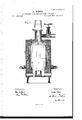
Be it known that I, ADAM WEBER, of the city, county, and State of New York, have invented a new and useful Improvement in Furnaces for Decomposing Steam, which improvement is fully set forth in the following specification, reference being had to the accompanying drawing, in which- Figure l represents a longitudinal vertical section. Fig. 2 is a horizontal section. Fig. 3 is a transverse vertical section.
Similar letters indicate corresponding parts.
The object of this invention is to provide a simple and economical apparatus for decomposing steam, by passing' the same through an incandescent mass of carbonaceous matter.
My invention consists in the combination of a furnace containinga decomposingchamber lined with lire-bricks, returnchannels running up and down in said lining-bricks, and opening into the space beneath the grate of the furnace; a pipe which embraces the furnace, and is provided with branch pipes, which communicate one with each of the return-channels; and two supply-pipes-one for air and. the other for steamboth connected to the pipe which embraces the furnace, all the pipes being provided with suitable stop-cocks, so that the supply of air or steam to each of the return;channels can be regulated, and that by injecting the heated air beneath the grate of the furnace the combustion of the charge in the decomposing-chamber is promoted, and by injecting the superheated steam beneath the grate said steam is compelled to pass through the entire charge of the decomposing-chamber, and its complete decomposition is insured.
In the drawing, the letter A designates a furnace, which is provided with a grate, B.
Above this grate is situated a decomposingchamber, A', which is lined with tire-bricks C. The grate is, by preference, made -basketshaped, or with a depression in its middle, so that the charge will have a tendency to work down toward the lowest portion of the grate, and that the ashes are free to discharge through the spaces between the grate-bars, leaving said spaces open for the. passage of air or steam. The ashes which pass through the grate-bars accumulate in the ash-chamber D, from which they are either raked out through doors in its sides, or from which they may be dumped through suitable doors in its bottom. When the furnace is in operation, all these doors must be firmly closed and luted, to prevent the escape of gases and the entrance of external air.
In the lire-bricks C, which form the lining of the heatingehamber A', are formed channels or ducts E, which, in the example shown in the drawing, are made in the form of returnchannels, ruiming up and down through the tire-bricks in vertical directions, the lire bricks containing said ducts or channels being retained in the proper relation toward each other by tongues and grooves, as shown in Figs. 1 and 3 ofthe drawing. One branch oteach ot' the return-channels opens beneath the grate B, while its other branch connects with a pipe, F, that extends all round the furnace, Iand is provided with a seriesof branch pipes, F, one for each ofthe return-channels. Each of these branch pipes is provided with a stop-cock, so that the communication between the pipe F and each ofthe return-channels E can be controlled. The pipe F connects, by means of a pipe, Gr, with a reservoir containing com pressed air, and, by means of a pipe, H, with a steam-generator. Both these pipes are provided with stop-cocks, so that they can be opened or closed at will.
The top of the generating-chamber is closed by an arch, I, which is provided with three (more or less) openings, a b c, through which the charge is introduced. rI he opening b communicates with the chimney and with a pipe, d, the chimney serving to carry oi the gaseous products of combustion, while the products resulting from the decomposition of the steam are carried off through the pipe d.
rBetween the outer wall J and lire-bricks C is a layer, K, of plaster-paris or other suitable material, to reduce the loss of heat by radiation.
The furnace is charged with anthracite coal, peat, coke, or other carbonaceous matter; and after the charge has been ignited, the air-blast pipe Gr and all the branch pipes F are opened, and, by the action of the blast injected through the return-channels E beneath the grate, the charge is soon brought to a high state of combustion.
As the temperature ot' the charge is raised, the air in its passage through the return-channels E becomes highly heated, and the heat of the charge in the decomposing-chamber is rapidly raised to the highest possible point. During this stage of the operation., the communication between the opening b and the chimney is open, and the gas-escape pipe d is closed. When the charge has become heated to a white heat, the air-pipe G is closed, and immediately thereafter, or as soon as all the oxygen of the air in the decomposing-chamber has been consumed, the communication between the opening b and the chimney is closed, and the steam-pipe H and the gas-es cape pipe d are opened. The steam thus admitted to the pipe F passes through the return-channels E, where it becomes superheated, and in this state it is caused to pass through the incandescent carbonaceous matter contained in the decomposing-chamber. 1n its passage through the incandescent mass the superheated steam becomes decomposed, the hydrogen gas contained therein being set free, while the oxygen gas enters into combination with the carbon contained in the decomposing-chamber, forming carbonic oxide. The gases thus evolved pass oi' through the pipe d, and they are finally puried and used for heating or illuminating purposes. By the action of the steam the temperature ot' the charge in the decomposing-chamber is reduced, and when it has reached a red heat, the steam-pipe H and the gas-pipe d are closed, the communication between the opening b and the chimney is opened, and a fresh supply ot' air is injected through the return-channels, and after the charge has been again brought to a white heat, the air-pipe is closed and the steam-pipe is opened, and so on.
It will be readily seen from this description that, by injecting air below the grate of the furnace, the combustion of the charge is materially' promoted, and the steam, being also injected beneath the grate, is compelled to pass through the entire charge, so that no part thereof is liable to escape without being decomposed. Furthermore, by running the heating-channels E up and down in vertical directions, I am enabled to connect each heating-channel by a separate branch pipe with the pipe F, which connects with the steam and air pipes, the air and the steam passing through said heating-channels are heated to a uniform temperature, the operation of the apparatus is rendered simple and economical, and a uniform product of decomposition is obtained. In practice the ducts or channels are enameled inside, to prevent leakage through the pores of the rebricks; or, if desired, metallic pipes may be placed into said channels.
I do not claim in this application the combination ot' heating-channels formed in the bricks which form the lining of the decomposing-chamber, and provided with openings leading into said decomposingchamber, with air and steam pipes, through which air and steam are alternately admitted to said heating-channels, since this combination forms the subject-matter of a separate application for a patent.
What I claim as new, and desire to secure by Letters Patent, is-
The combination of a furnace containing a decomposing-chamber lined with tire-bricks, return-channels ruiming up and down in said tire-bricks, and opening into the space beneath the grate ot' the furnace a pipe which embraces the-furnace, and is provided with branch pipes, which communicate with each of the returnchannels; and two supply-pipesone for air and the other for steam--both connected to the pipe which embraces the furnace, all constructed and operating substantially as and for the purpose set forth.
In testimony that l claim the foregoing I have hereunto set my hand and seal this 22d day ot' November, 1876.
ADAM WEBER. [L. 5.] Witnesses:
W. HAUFF, OTTO HUFELAND.
Publications (1)
| Publication Number | Publication Date |
|---|---|
| US185806A true US185806A (en) | 1876-12-26 |
Family
ID=2255213
Family Applications (1)
| Application Number | Title | Priority Date | Filing Date |
|---|---|---|---|
| US185806D Expired - Lifetime US185806A (en) | Improvement in furnaces for decomposing steam |
Country Status (1)
| Country | Link |
|---|---|
| US (1) | US185806A (en) |
-
0
- US US185806D patent/US185806A/en not_active Expired - Lifetime
Similar Documents
| Publication | Publication Date | Title |
|---|---|---|
| US389105A (en) | Apparatus for the manufacture of gas | |
| US330122A (en) | Illuminating gas | |
| US309251A (en) | Process of and apparatus for producing gas | |
| US197062A (en) | Improvement in processes and apparatus for the manufacture of gas | |
| US191808A (en) | Improvement in apparatus for the manufacture of illuminating-gas | |
| US570383A (en) | Gas-generating apparatus | |
| US330778A (en) | elliott | |
| US389106A (en) | Process of making gas | |
| US570382A (en) | Apparatus for manufacturing fuel-gas | |
| US289279A (en) | Leadley | |
| US263612A (en) | springer | |
| US378490A (en) | Beinhold boeklen | |
| US521479A (en) | Apparatus for generating gas | |
| US406819A (en) | And hugh mckay | |
| US414470A (en) | Gas-generating apparatus | |
| US300331A (en) | Process of and apparatus for manufacturing gas | |
| US301531A (en) | Apparatus for manufacturing gas | |
| US168904A (en) | Improvement in processes and apparatus for the manufacture of illuminating-gas | |
| US430807A (en) | Apparatus for the manufacture of gas | |
| US290926A (en) | Process of and apparatus for manufacturing gas | |
| US404205A (en) | Process of and apparatus for the manufacture of gas | |
| US776947A (en) | Gas-generator. | |
| US544151A (en) | Gas-manufacturing apparatus | |
| US472077A (en) | Apparatus for the manufacture of gas | |
| US300466A (en) | hanlon |