US1857771A - Variable feed mechanism for typewriter carriages - Google Patents
Variable feed mechanism for typewriter carriages Download PDFInfo
- Publication number
- US1857771A US1857771A US368489A US36848929A US1857771A US 1857771 A US1857771 A US 1857771A US 368489 A US368489 A US 368489A US 36848929 A US36848929 A US 36848929A US 1857771 A US1857771 A US 1857771A
- Authority
- US
- United States
- Prior art keywords
- racks
- carriage
- rack
- pinions
- pinion
- Prior art date
- Legal status (The legal status is an assumption and is not a legal conclusion. Google has not performed a legal analysis and makes no representation as to the accuracy of the status listed.)
- Expired - Lifetime
Links
- 230000001276 controlling effect Effects 0.000 description 56
- 230000000694 effects Effects 0.000 description 14
- 239000011435 rock Substances 0.000 description 4
- 238000006073 displacement reaction Methods 0.000 description 2
- 241000320892 Clerodendrum phlomidis Species 0.000 description 1
- 238000007689 inspection Methods 0.000 description 1
Images


Classifications
-
- B—PERFORMING OPERATIONS; TRANSPORTING
- B41—PRINTING; LINING MACHINES; TYPEWRITERS; STAMPS
- B41J—TYPEWRITERS; SELECTIVE PRINTING MECHANISMS, i.e. MECHANISMS PRINTING OTHERWISE THAN FROM A FORME; CORRECTION OF TYPOGRAPHICAL ERRORS
- B41J19/00—Character- or line-spacing mechanisms
- B41J19/18—Character-spacing or back-spacing mechanisms; Carriage return or release devices therefor
- B41J19/20—Positive-feed character-spacing mechanisms
- B41J19/32—Differential or variable-spacing arrangements
Definitions
- I provide carriage escapement mechanism having two sets of co-operating elements, namely one set of racks and one set of pinions.
- the pinions are all on the same shaft with the escapement wheel. They have the same number of teeth as the escapement wheel and are of different 1 diameters. Accordingly, when the largest pinion and its rack are active the letter spacing of'the carriage is greater than when the smaller pinions and their racks are active.
- Suitable selecting mechanism is provided to bring about a relative shifting between the racks and pinions to efiect a co-operative relation of any one of the racks and its corresponding pinion according to the desired let- 'ter spacing.
- the pinions are relatively stationary and the racks are unounted on the typewriter carriage, so that they maybe actuated to selectively engage, individually, with their respective pinions.
- I provide a finger-piece, on themachine frame. secured to a selector shaft by which any one of the racks may be brought into engagement with its'associ'ated pinion.
- the selector shaft has two movements, a rocking movement and a longitudinal movement. By rocking the shaft the feed racks 1929. Serial No. 368,489.
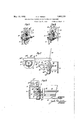
- Fig. 1 is a. vertical central section taken on the'line 11 of Fig. 3;
- Fig. 2 is a fragmentary front View, in section, taken on the line 22 of Fig. 1 and showing the parts including the selecting mechanism in its normal position; the machine being set for the greatest letter spacing;
- Fig. 3 is a top plan view of the machine, some of the parts being broken away;
- Fig. 4 is a detail rear view showing the pawl and ratchet of the escapement mechanism
- Fig. 5 is a detail view showing all of the racks lowered into engagement. with their respective pinions preparatory to selecting one of said racks;
- Fig. 6 is a view similar to Fig. 5 but showing the rack selected for the smallest letter spacing of the carriage;
- Fig. 7 is a fragmentary front view, similar to Fig. 2, but showing the parts operated to lower the racks as in Fig. 5;
- Fig. 8 is a fragmentary side view showing the selector shaft and the rack controlling device in positioncorresponding to 'Fig. 7.
- a machine known as the Varityper formerly known as the Hammond typewriter. It includes a main frame 10 (Fig. 1) to which is secured a guide rail 11 upon which a car- 'riage' 12 is mounted to travel back and forth transversely of the machine, the carriage being provided with a guide bar 13 which operates with the guide rail 11 through anti- 6 friction rollers or balls 14. The carriage is further guided by means of a bar 15 at its upper end.
- the carriage is urged in a letter feed direc tion by a carriage propelling means or spring drum 16 (Fig. 3) rotatably supported on a boss 17 of the main frame the spring drum being connected to the carriage by a draw is the same, but the llnear distances which band 18.
- Said escapement mechanism includes a toothed escapement' wheel 21 secured to a shaft 22 supported in bearings 23 and 24 on the main frame 10. Connected with the escapement wheel, in a manner hereinafter described, is a pinion element 25 including three pinions 26, 27 and 28 to be engaged by racks 26, 27 and 28 supported on the carriage 12.
- the racks are each provided with two arms 26", 27 and 28 respectively, at the ends thereof, said arms being pivoted on studs 29 secured 30 to the carriage.
- the pinion element 25 has a one-way driving connection with the escapement wheel 21, this connection including a pawl 34 (Figs. 3 and 4) pivoted at 34 on a flange 35 to the pinion'element 25, and a ratchet wheel 36 secured to the escapement shaft 22.
- a spring 37 holds ⁇ a tooth 38 of the pawl 34 in engagement with ,the teeth of the ratchet wheel 36.
- the escapement wheel is urged to rotate by the active rack through the me dium of the pinion element 25, pawl 34 and ratchet 36, the escapement wheel being nor mally held against rotation by a loose dog (not shown).
- the letter spacing of the v carriage may be effected upon the depression 55 of any one of the character keys or the space bar (not shown) which operate mechanism shown in the above mentioned application to actuate escapement mechanism.
- the ratchet 36 may be secured to the escapement shaft 22 in any convenient manner and the pinion element or unit 25 is rotatably' supported on said escapement shaft to permit rotation thereon-during the return of the carriage while the active rack remains in engagement with the pinion element, the pawl are controlled by escapement mechanismtheir pinions; there is, however, as herein--- 34 riding freely over the teeth of the ratchet 36 during such return movement of said carriage.
- the pinions 26, 2'7 and 28 are arranged ini step-like relation, they Vary in increasing diameters and they each have a different pitch, the pitch of each corresponding with that of its associated rack.
- Each pinion has the same number of teeth as the escapement the racks are fed by their pinions increase as the diameters of the pinions increase.
- a rack controlling element 50 provided with a frame 51 having ledges 52 and 53 on opposite sides of a slot 54 extending downwardly from an opening 55 in said frame.
- the rack controlling element is operated to lower all -of the racks into engagement with their pinions. Said element is then shifted tranversely of the racks to bring the slot 54 into register with the desired rack. The rack controlling element is then swung back to normal to lift the racks, registering with the ledges 52 and 53 to disengage them from their pinions, and leave the rack registering with the slot 54 in engagement avith its pinion.
- the rack controlling element 50 is actuated by a selector shaft 58 supported in lugs 59 and 60 on the main frame 10.
- the shaft 58 may be rocked by a finger piece 61 in a Clockwise direction (Fig. 2) against the action of a return spring 62.
- the shaft .58 has secured thereto at its rear end an arm 63 having a pin 64 engaging in a slot 65 of an actuating lever 66 supported on a pivot 66 of a bracket 67 supported on the shaft 58, said shaft rotating freely in the bracket 67 and the latter being held against rotation by a pin 68 extending into a slot 69 formed in a lug 70 of the main frame 10.
- the lever 66 when actuated in a counter-clockwise direction (Fig. 2) by the arm 63, swings the rack controlling element or lever 50 in the same direction about a pivot stud 71 on the bracket 67, through the medium of a pin 72 engaging in a cam slot 72, to. lower the frame 51 to effect the engagement of all of the racks with their respective pinions.
- the finger piece or handle 61 is moved lengthwise of a slot 77 in a plate 78 to slide the shaft 58 longitudinally back or forth in its bearings 59 and 60, thus carrying the rack controlling lever therewith, until the slot 54 registers with the desired rack.
- the finger piece is then swung back to normal to raise all but the selected one of the racks out of engagement with their pinions.
- connection between the selector shaft and the bracket 67 may include a screw 85 threaded into a collar 87 secured to said bracket 67; the end of the screw having a reduced portion 88 which extends into an annular groove 89 formed in the shaft 58.
- Slots 90, 91 and 92 are formed by teeth 90 and 91" which also preventaccidental, longitudinal displacement of the selector shaft 58. It will be understood that these teeth may be eliminated if desired, so far as the locking of the selector shaft is concerned, since it is locked by the active'rack as previously described. These teeth are desirable, however, to facilitate locating the handle 61 in its various selected positions.
- the handle 61 of the selector shaft 58 may normally engage in any one of the slots 90, 91 and 92 according to the setting of machine, and'may be held there by the spring 62.
- a Indices I0, 12 and 14 may be provided, one at each of the slots 92, 91 and 90,
- the release of the carriage may be effected to quickly manually locate it in any letter space position by any one of two release levers 100 supported at opposite ends of the carriage on the pivot studs 29.
- Each release lever is provided with a finger piece 101 by which it may be actuated in a clockwise direction (Fig. 1). about the stud 29, a projection 102 thereon engaging the arm 28 of the active rack 28? to raise said rack out of 'the carriage.
- Fig. 3 it will be seen that the projections 102 extend under all of the rack arnis, in other words, each release lever 100, through the medium of its projection 102, is common to all of the racks, so that any one of them may be released from the escapement mechanism to effect the release of the carriage.
- Each release lever 100 may be arrested in its normal position by a pin 103 thereon engaging the carriage frame 12.
- the machine includes the handle 61 which is normally held in one ofthe slots 90, 91 and 92 by the springs 62.
- the handle In order to vary the letter spacing, say, from ten to fourteen to the inch. the handle is first moved shaft 58 to actuate the arm 63 to actuate the ⁇ Vhile the handle is held against the stop 76 it is moved forwardly of the machine in the slot 77 until it registers with the slot 90, thus shifting the lever 50 to cause the slot or gate 54 of the frame 51 to register with the rack 26.
- the handle 61 is then allowed to swing into the slot 90,'opposite the index 14, under the action of the spring 62 to swing the rack controlling device 50 back to normal thus swinging the racks 27 and 28 out of engagement with their pinions, the rack 26 being left in engagement with its pinion due to the gate 54 in the rack controlling element as in Fig. 6.
- the letter spacing of the carriage is changed to fourteen spaces to the inch. W'hen twelve spaces to the inch are desired the handle is shifted to the slot 91.
- an actuating lever operated by the selector shaft a rack controlling lever operable by the actuating lever, said rack controlling lever being effective when operated by said actuating lever to move the racks into engagement with the pinions, the axial movement of the selector shaft being effective to change the position of the rack controlling lever with respect to the racks, the rack controlling lever being constructed while swinging back to normal to disengage all of the racks except the selected one from their pinions.
- a variable feed letter spacing mechanism including a plurality of racks, a plurality of gears one for each rack, each gear having a different pitch and pitch diameter, means to support said racks for independent movement .on the carriage and radially of the pinions, and a control mechanism to actuate the racks radially of the pinions for selectively engaging any one of said racks with its gear.
- a variable spacing carriage feed mechanism including three racks on said-carriage, three pinions each adapted to be engaged by one of the racks to vary the letter feed movement of the carriage, a
- said'escapement mechanism including an escapement wheel having teeth, a plurality of pinions, said pinions having different diameters and having the same number of teeth as the escapement wheel, racks on said carriage, one for each pinion, and means settablerelatively to the racks to select any one of them, said means being subsequently actuable to effect -01)- nism including a plurality of pinions, rackson-sa1d carriage, one for each pinion, and
- a carriage escapement mechanism for said carriage, said escapement mechanism including a plurality of pinions, racks on said carriage, one for each pinion, means to support said racks for individual movement on the carriage, springs tending to hold the racks in engagement with the pinions, selecting means to render any one of said racks effective with its pinion to vary the letter spacing of the carriage, and means cooperating with the selecting means to lock the inactive racks out of engagement with their pinions against the action of said springs.
- a carriage, escapement mechanism for said carriage including a plurality of pinions, racks on said carriage, one for each pinion, a main frame on which the carriagevtravels, rack controlling means supported on the main frame, devices on said rack -controlling means to engage said racks, and means to actuate said rack controlling means to cause simultaneous engagement of all of the racks with their pinions and to shift the controlling means and the devices thereon relatively to the racks, the rack controlling means being effective when operated after the shifting thereof to disengage all of the racks except the selected one from their pinions due to the location of the devices on the rack controlling lever.
- a carriage escapement mechanism for said carriage, said escapement mechanism including a plurality of pinions, racks on said carriage, one for .each pinion, to effect variable letter spacing of the carriage, and selecting means to effect a relative shifting between the racks and the pinions ac- 1 cording to the desired letter spacing and to engage all of the racks with their pinions prior to the shifting operation.
- a carriage,- escapement mechanism said escapement mechanism including a plurality of pinions, racks on said carriage, one for each pinion, selecting means, a main frame on which the carriage travels, a selector shaft on said main frame, a bracket on said t shaft, a rack controlling lever pivoted on said bracket, means connecting said rack controlling lever with theselector shaft so that the rack controlling lever may be actuated by the selector shaft to cause said racks to swing into engagement with the pinions, and means operable by the selector shaft to shift the controlling lever relatively to the racks to carry it out of engagement with the desired rack so that upon the return of said rack controlling lever to normal it leaves only the desired rack in engagement with its pinion.
- said escapement mechanism including a plurality of pinions, racks on said carriage to engage any one of the pinions, a main frame on which the carriage travels, selecting means including a rock shaft on the main frame, an arm on said rock shaft, a bracket, an actuating lever pivoted on said bracket and operable by said arm, a rack controlling lever pivoted on said bracket and operable by said actuating lever to cause all of said racks to engage their pinions, said rock shaft being movable axially to shift said bracket to position the controlling lever differently with respect to the racks so that upon the return of the controlling lever. to normal it swings all of the racks except the selected one out of engagement with their pinions, and means to guide the bracket on the main frame.
- a carriage escapement mechanism including a plurality of pinions of different pitch diameters, racks on said carriage movable into engagement with their pinions to vary the letter feed movements of the carriage, a single device to control said racks, and a plurality of elements to be engaged each by one of the racks to insure proper meshing relation of each rack with its pinion.
- variable feed mechanism for said carriage including a plurality of pinions, a plurality of racks, one for each pinion, means topivotally support the racks on said carriage for independent movement so that some of them may be swung towards and away from the pinions simultaneously in the same direction and leave the desired rack effective with its pinion according to the desired letter spacing, and means to actuate said racks.
- a carriage, variable feed mechanism for said carriage including a plurality of pinions,'a plurality'of racks, one for each pinion, one of said racks being effective at a time during the letter spacing of the carriage, means to support said racks on said carriage for. movement towards and away from saidpinions, rack actuating means cooperating with all of the racks except the effective one to effect engagement of the other racks with their pinions, and means to shift the rack actuating means relatively to the racks to carry it out of engagement with one of the other racks so that upon a subsequent return of the rack actuating means to normal it leaves only the selected rack in engagement with its pinion and render the other racks ineffective.
- variable feed mechanism carry it out of control of the rack corresponding to the desired letter spacing, and means on the rack actuating means effective upon its return to normal to swing all of the racks except the selected one out of engagement with their pinions.
- the combination of a carriage, carriage feed mechanism for said carriage including two sets of elements, namely. a set of pinions and a set of racks, there being one rack associated with each pinion and only one of the racks engaging with its pinion duringthe letter spacing movements of the carriage, means to shift the inactive elements of one set into engagement with the corresponding elements of the other set, and means to set the shifting means while the elements of both sets are in engagement. and means whereby the shifting means is effective upon its return to carry all of the elements of one set except the desired one out of engagement with the corresponding elements of the other set.
- variable feed mechanism for said carriage including pinions, racks on said carriage, one for each pinion, means to support the racks on said carriage for movement towards and away from the pinions, a
- cont-rolling element having a rack engaging portion with a slot therein, the inactive racks contacting with the engaging portion of the controlling element, the active rack extending through the slot into engagement with its pinion, and means to swing the controlling element to actuate the inactive racks to eflect engagement thereof with their pinions and to subsequently set the controlling element to cause the slot therein to register with the rack corresponding to the desired letter spacing so that upon the return of the controlling element to normal the selected rack is left in engagement with its pinion, the other racks being released from their pinionsby said controlling element.
- a carriage, carriage feed mechanism for said carriage including two sets of elements, namely, a set of pinions and a set of racks, there being one rack associated with each pinion and only one of the racks engaging with its pinion during the letter spacing movements of the carriage, a controlling device associated with the elements of one of said sets, said device having a slot therein, and means to shift the controlling device to register the slot with any one of the elements controlled thereby to effect engagement of only the registering element with its pinion.
- a carriage, carriage feed mechanism including settable elements to effect variable spacing of the carriage, a slidable selector shaft, a bracket supported to slide with said shaft, means to guide said bracket, an arm on said shaft, a lever pivoted on said bracket actuable by said arm, and a device to control said elements pivotally supported on said bracket and actuable by said lever.
- a carriage, carriage feed mechanism including settable elements to effect variable spacing of the carriage, a slidable selector shaft, a bracket supported on said shaft, means to connect said bracket with the shaft so that the shaft may rotate independently thereof and that the bracketmay be carried therewith during its sliding movement, means to guide said bracket, an arm on sai shaft, a lever pivoted on said bracket and actuable by said arm, and a' device to control said elements pivotally supported on said bracket and actuable by said lever.
- a carriage, carriage feed mechanism including settable racks on said carriage to effect variable spacing of the carriage, a main frame, a slidable selector shaft on said main frame, a bracket supported to slide with said shaft, means to guide said bracket, an arm on said shaft,ra lever pivoted on said bracket actuable by said arm, and a device to control said racks pivotally supported on said bracket and actuable b said lever.
- a carriage, carriage feed mechanism including a plurality of pinions of different diameters, a plurality of racks on the carriage, one for each pinion, means to pivotally support the racks, and means to swing all of said racks into engagement with their-pinions, and swing all but the desired rack out of engagement with the pinions to vary the letter spacing of the carriage.
- a carriage, variable feed escapement mechanism therefor including a plurality of pinions, a plurality of racks on said carriage one associated with each pinion, a rack selecting element extending transversely of the racks, said element having an aperture therein through which said racks extend, said element having also a narrow slot therein extending from the aperture to the exterior of said element, means to set the selecting element transversely of the racks to register the slot with the rack corresponding to the desired letter spacing, and means whereby the selecting element may be actuated to render all of the racks ineffective except the selected one.
- a carriage, variable feed escapement mechanism therefor including a plurality of pinions, a plurality of racks on said carriage one associated with eachpinion, a rack selecting element extending transversely of the racks, said element having an aperture therein through which said racks extend, said element having also a narrow slot therein extending from the aperture to the exterior of said element, and means, to support said selecting element for movement transversely of the racks to register the slot with any one of the racks and for subsequent movement to on the carriage one for each pinion, means to a (1 support the racks for movement independently of each othertowards and away from the pinions, and selecting means whereby all of the racks except the selected one may be moved out of engagement with their pinions.
- a carriage, variable feed escapement mechanism therefor including a plurality of pinions, a plurality of racks, means to pivotally support the racks on the carriage for independent movement towards and awa from the pinions, one of said racks being e ective at a time, rack controlling means whereby all of the inactive racks maybe brought into engagement with their pinions, and means to subsequently shift the rack controlling means with respect to the racks to select another rack, the rack controlling means being subsequently effective to move all of the racks except the selected one out of engagement with the pinions.
- a carriage, variable feed escapement mechanism therefor including a plurality of piniqns of different sizes, a plurality of racks on the carriage one for each pinion, means to support the racks for movement independently of each other towards and away from the pinions, an actuating element common to allof the racks, said element including a member extending transversely of the racks, two rack engaging portions on said member, there being a slot between said portions, and means to set said element transversely of the racks to register the slot with any one of the racks and to subsequently actuate said element to move all of the racks except the one registering with the slot out of engagement with their pinions.
- a carriage, variable feed escapement mechanism therefor including a plurality of pinions, a plurality of racks on said carriageone associated with each pinion, a rack selecting element extending transversely of the racks, said element having an aperture therein through which racks extend, said element having also a narrow slot therein extending fromthe aperture to the exterior of said element, means to set the selecting element transversely of the racks to register the slot with the rack corresponding to the desired letter spacing, means whereby the selecting element may be actuated to render all of theracks ineffective except the selected one, and means co-operating with the setting means to lock the selecting element in its set position transversely of the racks.
- a carriage, variable feed escapement mechanism therefor including a plurality of pinions, a plurality of racks, means to pivotally support the racks on the carriage for independent movement towards and away from the pinions, one of said racks being effective at a time, rack controlling means whereby all of the inactive racks may be brought into engagement with their pinions, means to subsequently shift the rack controlling means with respect to the racks to select anotherrack, the rack controlling means being subsequently effective to move all of the racks except the selected one out of engagement with'the pinions, and means to lock the rack controlling means against transverse movement of the racks.
- a carriage, variable feed escapement mechanism therefor including a plurality of pinions, a pluralityof racks, means to pivotally support the racks on the carriage for independent movement towards and away from the pinions, one of said racks being effective at a time, rack controlling means whereby all quently effective to move all of the racks except the selected one out of engagement with the pinions, means to assist in locating the rack controlling means while being shifted, and means to lock the rack controlling means subsequent to shiftin 33.
- the comb-inaif on the carriage one for each pinion means to support the racks for movement independently of each other towards and away from the pinions, selecting means whereby all of the racks except the selected one maybe moved out of engagement with their pinions, and means tov lock the controlling element in its shifted position.
- a carriage, carriage feed mechanism including a pinion unit, a plurality of racks, means tosupport the racks on the carriage for independent movement inplanes extending transversely of the axis of the pinion wit, and means whereby any one of the racks may be brought into co-operation with the pinion unit before an active rack is released therefrom.
- the rack controlling means may be brought into engagement with their pinions, means to subsequently shift the rack controlling means with respectto the racks to select another 5 rack, the rack controlling means being subse-
Landscapes
- Transmission Devices (AREA)
Description
May 10, 1932. o 1,857,771 VARIABLE FEED MECHANISM FOR TYPEWRITER CARRIAGES I Filed June 5, 1929 3 Sheets-Sheet 1' May 10, 1932. F. H. TREGO 1,857,771
VARIABLE FEED MECHANISM FOR TYPEWRITER CARRIAGES Filed June 5, 1929 s Sheets-Sheet 2 INVENTOR fiwa/r h! Tre F. H. TREGO May 10, 1932.
VARIABLE FEED MECHANISM FOR TYPEWRITER CARRIAGJEISv Filed June 5, 1929 3 Sheets-Sheet 5 A 0 m a Ma 2 2 6 5 W95 2% 7 4 7 02 2 9 f 4 "m m 9 d W Fran/r H Treqa BY ATTORNEY Patented May 10, 1932 UNITED STATES PATENT OFFICE FRANK H. TREGO, OF NEW YORK, N. Y., ASSIGN OR TO VARITYPER INCORPORATED, O!
NEW YORK, N. Y., A CORPORATION OF DELAWARE VARIABLE FEED MECHANISM FOR TYPEWRITER CARRIAGES Application filed June 5,
registration of previously typed characters with the printing point.
In carrying out the invention I provide carriage escapement mechanism having two sets of co-operating elements, namely one set of racks and one set of pinions. The pinions are all on the same shaft with the escapement wheel. They have the same number of teeth as the escapement wheel and are of different 1 diameters. Accordingly, when the largest pinion and its rack are active the letter spacing of'the carriage is greater than when the smaller pinions and their racks are active.
By providing the same number of teeth in the pinions as in-the escapement wheel they always register with each other angularly, and consequently the registration of previously typed characters with the printing I point is made possible.
Suitable selecting mechanism is provided to bring about a relative shifting between the racks and pinions to efiect a co-operative relation of any one of the racks and its corresponding pinion according to the desired let- 'ter spacing. As herein illustrated the pinions are relatively stationary and the racks are unounted on the typewriter carriage, so that they maybe actuated to selectively engage, individually, with their respective pinions. k r
In the form of the invention herein illustrated I provide a finger-piece, on themachine frame. secured to a selector shaft by which any one of the racks may be brought into engagement with its'associ'ated pinion. The selector shaft has two movements, a rocking movement and a longitudinal movement. By rocking the shaft the feed racks 1929. Serial No. 368,489.
are all caused to swing, through the medium of a rack controlling lever, into engagement with their pinions. Subsequently the selector shaft is moved longitudinally to shift the controlling device relatively to the racks to move it-out of control of the rack corresponding to the desired spacing after which the selector shaft is rocked back to normal.
. In rocking back to normal the selected rack isleftin engagement with its pinion; the other racks being swung, by the controlling device, out of engagement with their pinions to inactive positions. The racks are looked in their inactive positions against the action of suitablesprings.
Further features of the invention will hereinafter appear.
In the drawings,
Fig. 1 is a. vertical central section taken on the'line 11 of Fig. 3;
Fig. 2 is a fragmentary front View, in section, taken on the line 22 of Fig. 1 and showing the parts including the selecting mechanism in its normal position; the machine being set for the greatest letter spacing;
Fig. 3 is a top plan view of the machine, some of the parts being broken away;
Fig. 4 is a detail rear view showing the pawl and ratchet of the escapement mechanism; A
Fig. 5 is a detail view showing all of the racks lowered into engagement. with their respective pinions preparatory to selecting one of said racks;
Fig. 6 is a view similar to Fig. 5 but showing the rack selected for the smallest letter spacing of the carriage;
Fig. 7 is a fragmentary front view, similar to Fig. 2, but showing the parts operated to lower the racks as in Fig. 5; and
Fig. 8 is a fragmentary side view showing the selector shaft and the rack controlling device in positioncorresponding to 'Fig. 7.
Similar characters refer to similar parts throughout the several views.
I have shown my invention applied to a machine known as the Varityper, formerly known as the Hammond typewriter. It includes a main frame 10 (Fig. 1) to which is secured a guide rail 11 upon which a car- 'riage' 12 is mounted to travel back and forth transversely of the machine, the carriage being provided with a guide bar 13 which operates with the guide rail 11 through anti- 6 friction rollers or balls 14. The carriage is further guided by means of a bar 15 at its upper end.
The carriage is urged in a letter feed direc tion by a carriage propelling means or spring drum 16 (Fig. 3) rotatably supported on a boss 17 of the main frame the spring drum being connected to the carriage by a draw is the same, but the llnear distances which band 18.
The letter feed movements of the carriage designated generally by the numeral 20 which may be like that illustrated in my above mentioned application. Said escapement mechanism includes a toothed escapement' wheel 21 secured to a shaft 22 supported in bearings 23 and 24 on the main frame 10. Connected with the escapement wheel, in a manner hereinafter described, is a pinion element 25 including three pinions 26, 27 and 28 to be engaged by racks 26, 27 and 28 supported on the carriage 12. The racks are each provided with two arms 26", 27 and 28 respectively, at the ends thereof, said arms being pivoted on studs 29 secured 30 to the carriage. Springs 30, 31 and 32 connected to the rack arms 26, 27 and 28 and to a stud 33 of the carriage frame tend to hold the racks 26, 27 and 28 in engagement with after described, only one rack active at a time during the letter feed movements of the carriage. I The pinion element 25 has a one-way driving connection with the escapement wheel 21, this connection including a pawl 34 (Figs. 3 and 4) pivoted at 34 on a flange 35 to the pinion'element 25, and a ratchet wheel 36 secured to the escapement shaft 22. A spring 37 holds\a tooth 38 of the pawl 34 in engagement with ,the teeth of the ratchet wheel 36. It will thus be understood as the carriage is urged leftwardly in Fig. 3, by the spring drum, that the escapement wheel is urged to rotate by the active rack through the me dium of the pinion element 25, pawl 34 and ratchet 36, the escapement wheel being nor mally held against rotation by a loose dog (not shown). Thus the letter spacing of the v carriage may be effected upon the depression 55 of any one of the character keys or the space bar (not shown) which operate mechanism shown in the above mentioned application to actuate escapement mechanism.
The ratchet 36 may be secured to the escapement shaft 22 in any convenient manner and the pinion element or unit 25 is rotatably' supported on said escapement shaft to permit rotation thereon-during the return of the carriage while the active rack remains in engagement with the pinion element, the pawl are controlled by escapement mechanismtheir pinions; there is, however, as herein--- 34 riding freely over the teeth of the ratchet 36 during such return movement of said carriage.
The pinions 26, 2'7 and 28 are arranged ini step-like relation, they Vary in increasing diameters and they each have a different pitch, the pitch of each corresponding with that of its associated rack. Each pinion has the same number of teeth as the escapement the racks are fed by their pinions increase as the diameters of the pinions increase.
While the racks are not in use they are held in their inactive positions by a rack controlling element 50 provided with a frame 51 having ledges 52 and 53 on opposite sides of a slot 54 extending downwardly from an opening 55 in said frame. When the setting of the machine is to be changed, the rack controlling element is operated to lower all -of the racks into engagement with their pinions. Said element is then shifted tranversely of the racks to bring the slot 54 into register with the desired rack. The rack controlling element is then swung back to normal to lift the racks, registering with the ledges 52 and 53 to disengage them from their pinions, and leave the rack registering with the slot 54 in engagement avith its pinion.
It willbe understood that, although the racks are swung into and out of mesh with the pinions, the carriage is at no time released from the escapement mechanism during a rack selecting operation, because during such selecting operation the racks are first all brought into engagement with their pinions; therack controlling frame is then shifted to render all of the racks, except the selected one, inactive. i
The rack controlling element 50 is actuated by a selector shaft 58 supported in lugs 59 and 60 on the main frame 10. The shaft 58 may be rocked by a finger piece 61 in a Clockwise direction (Fig. 2) against the action of a return spring 62.
The shaft .58 has secured thereto at its rear end an arm 63 having a pin 64 engaging in a slot 65 of an actuating lever 66 supported on a pivot 66 of a bracket 67 supported on the shaft 58, said shaft rotating freely in the bracket 67 and the latter being held against rotation by a pin 68 extending into a slot 69 formed in a lug 70 of the main frame 10.
The lever 66 when actuated in a counter-clockwise direction (Fig. 2) by the arm 63, swings the rack controlling element or lever 50 in the same direction about a pivot stud 71 on the bracket 67, through the medium of a pin 72 engaging in a cam slot 72, to. lower the frame 51 to effect the engagement of all of the racks with their respective pinions.
To shift therack controlling element, to
select the rack corresponding to the desired letter spacing, the finger piece or handle 61 is moved lengthwise of a slot 77 in a plate 78 to slide the shaft 58 longitudinally back or forth in its bearings 59 and 60, thus carrying the rack controlling lever therewith, until the slot 54 registers with the desired rack. The finger piece is then swung back to normal to raise all but the selected one of the racks out of engagement with their pinions.
The connection between the selector shaft and the bracket 67 may include a screw 85 threaded into a collar 87 secured to said bracket 67; the end of the screw having a reduced portion 88 which extends into an annular groove 89 formed in the shaft 58. Thus it will bereadily understood that by means of this connection the shaft 58 is free to rock independently of the bracket during the rack lowering and rack releasing operation.
It will be understood that after each selecting operation one of the racks engages in the slot of the rack controlling .frame. Consequently said frame is locked, against accidental displacement transversely of the racks by the active rack.
Slots 90, 91 and 92 are formed by teeth 90 and 91" which also preventaccidental, longitudinal displacement of the selector shaft 58. It will be understood that these teeth may be eliminated if desired, so far as the locking of the selector shaft is concerned, since it is locked by the active'rack as previously described. These teeth are desirable, however, to facilitate locating the handle 61 in its various selected positions. The handle 61 of the selector shaft 58 may normally engage in any one of the slots 90, 91 and 92 according to the setting of machine, and'may be held there by the spring 62. a Indices I0, 12 and 14 may be provided, one at each of the slots 92, 91 and 90,
respectively, to facilitate the setting of the machine in accordance with the correspondmg number of letter spaces desired to each v inch of travel of the carriage.
To limit the movement of the racks 26*, 27 and 28 towards their pinions, in their active positions stops in the form of annular shoulders 95, 96 and 97 are provided. Shoulders 95 96 andv97 on the racks, extending lengthwise thereof, co-operate with the annular stops 95, 96 and 97, respectively, and maintain the proper meshing relation between the racks and pinions.
The release of the carriage may be effected to quickly manually locate it in any letter space position by any one of two release levers 100 supported at opposite ends of the carriage on the pivot studs 29. Each release lever is provided with a finger piece 101 by which it may be actuated in a clockwise direction (Fig. 1). about the stud 29, a projection 102 thereon engaging the arm 28 of the active rack 28? to raise said rack out of 'the carriage. By an inspection of Fig. 3 it will be seen that the projections 102 extend under all of the rack arnis, in other words, each release lever 100, through the medium of its projection 102, is common to all of the racks, so that any one of them may be released from the escapement mechanism to effect the release of the carriage. Each release lever 100 may be arrested in its normal position by a pin 103 thereon engaging the carriage frame 12.
Briefly the machine includes the handle 61 which is normally held in one ofthe slots 90, 91 and 92 by the springs 62. In order to vary the letter spacing, say, from ten to fourteen to the inch. the handle is first moved shaft 58 to actuate the arm 63 to actuate the \Vhile the handle is held against the stop 76 it is moved forwardly of the machine in the slot 77 until it registers with the slot 90, thus shifting the lever 50 to cause the slot or gate 54 of the frame 51 to register with the rack 26. The handle 61 is then allowed to swing into the slot 90,'opposite the index 14, under the action of the spring 62 to swing the rack controlling device 50 back to normal thus swinging the racks 27 and 28 out of engagement with their pinions, the rack 26 being left in engagement with its pinion due to the gate 54 in the rack controlling element as in Fig. 6. Thus the letter spacing of the carriage is changed to fourteen spaces to the inch. W'hen twelve spaces to the inch are desired the handle is shifted to the slot 91.
While certain preferred embodiments of the invention have been shown and described, it will be understood that changes in the form, arrangements, proportions, sizes and details .thereof may be made without departing from [handle for the selector shaft. a guideiplate for said handle to control the extent of rocking and axial movements of the selector shaft,
an actuating lever operated by the selector shaft, a rack controlling lever operable by the actuating lever, said rack controlling lever being effective when operated by said actuating lever to move the racks into engagement with the pinions, the axial movement of the selector shaft being effective to change the position of the rack controlling lever with respect to the racks, the rack controlling lever being constructed while swinging back to normal to disengage all of the racks except the selected one from their pinions.
2. In a typewriter, a variable feed letter spacing mechanism including a plurality of racks, a plurality of gears one for each rack, each gear having a different pitch and pitch diameter, means to support said racks for independent movement .on the carriage and radially of the pinions, and a control mechanism to actuate the racks radially of the pinions for selectively engaging any one of said racks with its gear.
3. In a typewriter, a variable spacing carriage feed mechanism including three racks on said-carriage, three pinions each adapted to be engaged by one of the racks to vary the letter feed movement of the carriage, a
- selecting element for the racks, and manual means to set said selecting element and then one for each pinion, and means whereby the selection of any rack may be effected while all of the racks engage their pinions, said means being subsequently actuable to disengage all of the racks except the selected one to vary the letter spacing of the carriage.
5. In a typewriting machine, the combinatlon of a carriage, escapement, mechamsm for said carriage, said'escapement mechanism including an escapement wheel having teeth, a plurality of pinions, said pinions having different diameters and having the same number of teeth as the escapement wheel, racks on said carriage, one for each pinion, and means settablerelatively to the racks to select any one of them, said means being subsequently actuable to effect -01)- nism including a plurality of pinions, rackson-sa1d carriage, one for each pinion, and
eration of onlyone of said racks with its pinion to vary the letter spacing of the carriage. v
6. In a typewriting machine, the combination of a carriage, escapement mechanism for said carriage, said escapement mechaselecting means for said racks, and means to actuate sald selectlng means-to first set it with respect to the racks and then effect engagement of only one of said racks with its pinion to vary the letter spacing of the carriage.
7. In a typewriting machine, the combination of a carriage, escapement mechanism for said carriage, said escapement mechanism including a plurality of pinions, racks on said carriage, one for each pinion, means to support said racks for individual movement on the carriage, springs tending to hold the racks in engagement with the pinions, selecting means to render any one of said racks effective with its pinion to vary the letter spacing of the carriage, and means cooperating with the selecting means to lock the inactive racks out of engagement with their pinions against the action of said springs.
8. In a typewriting machine, the combination of a carriage, escapement mechanism for said carriage, said escapement mechanism including a plurality of pinions, racks on said carriage, one for each pinion, a main frame on which the carriagevtravels, rack controlling means supported on the main frame, devices on said rack -controlling means to engage said racks, and means to actuate said rack controlling means to cause simultaneous engagement of all of the racks with their pinions and to shift the controlling means and the devices thereon relatively to the racks, the rack controlling means being effective when operated after the shifting thereof to disengage all of the racks except the selected one from their pinions due to the location of the devices on the rack controlling lever. I
9. In a typewriting machine, the combination of a carriage, escapement mechanism for said carriage, said escapement mechanism including a plurality of pinions, racks on said carriage, one for .each pinion, to effect variable letter spacing of the carriage, and selecting means to effect a relative shifting between the racks and the pinions ac- 1 cording to the desired letter spacing and to engage all of the racks with their pinions prior to the shifting operation.
10. Ina typewriting machine, the combination of a carriage,- escapement mechanism, said escapement mechanism including a plurality of pinions, racks on said carriage, one for each pinion, selecting means, a main frame on which the carriage travels, a selector shaft on said main frame, a bracket on said t shaft, a rack controlling lever pivoted on said bracket, means connecting said rack controlling lever with theselector shaft so that the rack controlling lever may be actuated by the selector shaft to cause said racks to swing into engagement with the pinions, and means operable by the selector shaft to shift the controlling lever relatively to the racks to carry it out of engagement with the desired rack so that upon the return of said rack controlling lever to normal it leaves only the desired rack in engagement with its pinion.
11. In a typewriting machine, the combination of a carriage, escapement mechanism,
said escapement mechanism including a plurality of pinions, racks on said carriage to engage any one of the pinions, a main frame on which the carriage travels, selecting means including a rock shaft on the main frame, an arm on said rock shaft, a bracket, an actuating lever pivoted on said bracket and operable by said arm, a rack controlling lever pivoted on said bracket and operable by said actuating lever to cause all of said racks to engage their pinions, said rock shaft being movable axially to shift said bracket to position the controlling lever differently with respect to the racks so that upon the return of the controlling lever. to normal it swings all of the racks except the selected one out of engagement with their pinions, and means to guide the bracket on the main frame.
12. In a typewriting machine, the combination of a carriage, escapement mechanism including a plurality of pinions of different pitch diameters, racks on said carriage movable into engagement with their pinions to vary the letter feed movements of the carriage, a single device to control said racks, and a plurality of elements to be engaged each by one of the racks to insure proper meshing relation of each rack with its pinion.
13. In a typewriting machine, the combination of a carriage, variable feed mechanism for said carriage including a plurality of pinions, a plurality of racks, one for each pinion, means topivotally support the racks on said carriage for independent movement so that some of them may be swung towards and away from the pinions simultaneously in the same direction and leave the desired rack effective with its pinion according to the desired letter spacing, and means to actuate said racks.
14. In a typewriting machine, the combination of a carriage, variable feed mechanism for said carriage including a plurality of pinions,'a plurality'of racks, one for each pinion, one of said racks being effective at a time during the letter spacing of the carriage, means to support said racks on said carriage for. movement towards and away from saidpinions, rack actuating means cooperating with all of the racks except the effective one to effect engagement of the other racks with their pinions, and means to shift the rack actuating means relatively to the racks to carry it out of engagement with one of the other racks so that upon a subsequent return of the rack actuating means to normal it leaves only the selected rack in engagement with its pinion and render the other racks ineffective.
1 5. In a typewriting machine, the combination of a carriage, variable feed mechanism carry it out of control of the rack corresponding to the desired letter spacing, and means on the rack actuating means effective upon its return to normal to swing all of the racks except the selected one out of engagement with their pinions.
16. In a typewriting machine, the combination of a carriage, carriage feed mechanism for said carriage including two sets of elements, namely. a set of pinions and a set of racks, there being one rack associated with each pinion and only one of the racks engaging with its pinion duringthe letter spacing movements of the carriage, means to shift the inactive elements of one set into engagement with the corresponding elements of the other set, and means to set the shifting means while the elements of both sets are in engagement. and means whereby the shifting means is effective upon its return to carry all of the elements of one set except the desired one out of engagement with the corresponding elements of the other set.
17. In a typewriting machine. the combination of a carriage, variable feed mechanism for said carriage including pinions, racks on said carriage, one for each pinion, means to support the racks on said carriage for movement towards and away from the pinions, a
cont-rolling element having a rack engaging portion with a slot therein, the inactive racks contacting with the engaging portion of the controlling element, the active rack extending through the slot into engagement with its pinion, and means to swing the controlling element to actuate the inactive racks to eflect engagement thereof with their pinions and to subsequently set the controlling element to cause the slot therein to register with the rack corresponding to the desired letter spacing so that upon the return of the controlling element to normal the selected rack is left in engagement with its pinion, the other racks being released from their pinionsby said controlling element.
18. In a typewriting machine, the combination of a carriage, carriage feed mechanism for said carriage including two sets of elements, namely, a set of pinions and a set of racks, there being one rack associated with each pinion and only one of the racks engaging with its pinion during the letter spacing movements of the carriage, a controlling device associated with the elements of one of said sets, said device having a slot therein, and means to shift the controlling device to register the slot with any one of the elements controlled thereby to effect engagement of only the registering element with its pinion.
19. In a typewriting machine, the combination of a carriage, carriage feed mechanism including a plurality of pinions to effect variable letter spacing of the carriage, a
' plurality of racks supported on the carriage,
one for each pinion, means to actuate the racks to effect co-operation of any one of the racks with its pinion, and carriage releasing means common to all of the racks to disengage the active rack from its pinion to release the carriage.
20. In a typewriting machine, the combination of a carriage, escapement mechanism, a plurality of racks supported on the carriage and to selectively engage the escapement mechanism to effect variable letter spacing of the carriage, and carriage releasing means common to all of the racks and effective to disengage the active rack from the escapement mechanism to release the carriage.
21. In a typewriting machine, the combination of a carriage, carriage feed mechanism including settable elements to effect variable spacing of the carriage, a slidable selector shaft, a bracket supported to slide with said shaft, means to guide said bracket, an arm on said shaft, a lever pivoted on said bracket actuable by said arm, and a device to control said elements pivotally supported on said bracket and actuable by said lever.
22. In a typewriting machine, the combination of a carriage, carriage feed mechanism including settable elements to effect variable spacing of the carriage, a slidable selector shaft, a bracket supported on said shaft, means to connect said bracket with the shaft so that the shaft may rotate independently thereof and that the bracketmay be carried therewith during its sliding movement, means to guide said bracket, an arm on sai shaft, a lever pivoted on said bracket and actuable by said arm, and a' device to control said elements pivotally supported on said bracket and actuable by said lever.
23. In a typewriting machine, the combination of a carriage, carriage feed mechanism including settable racks on said carriage to effect variable spacing of the carriage, a main frame, a slidable selector shaft on said main frame, a bracket supported to slide with said shaft, means to guide said bracket, an arm on said shaft,ra lever pivoted on said bracket actuable by said arm, and a device to control said racks pivotally supported on said bracket and actuable b said lever.
24. In a variable eed typewriting ma-v chine, the combination of a carriage, carriage feed mechanism including a plurality of pinions of different diameters, a plurality of racks on the carriage, one for each pinion, means to pivotally support the racks, and means to swing all of said racks into engagement with their-pinions, and swing all but the desired rack out of engagement with the pinions to vary the letter spacing of the carriage.
25. In a typewriting machine, the combination of a carriage, variable feed escapement mechanism therefor including a plurality of pinions, a plurality of racks on said carriage one associated with each pinion, a rack selecting element extending transversely of the racks, said element having an aperture therein through which said racks extend, said element having also a narrow slot therein extending from the aperture to the exterior of said element, means to set the selecting element transversely of the racks to register the slot with the rack corresponding to the desired letter spacing, and means whereby the selecting element may be actuated to render all of the racks ineffective except the selected one.
26. In a typewriting machine, the combination of a carriage, variable feed escapement mechanism therefor including a plurality of pinions, a plurality of racks on said carriage one associated with eachpinion, a rack selecting element extending transversely of the racks, said element having an aperture therein through which said racks extend, said element having also a narrow slot therein extending from the aperture to the exterior of said element, and means, to support said selecting element for movement transversely of the racks to register the slot with any one of the racks and for subsequent movement to on the carriage one for each pinion, means to a (1 support the racks for movement independently of each othertowards and away from the pinions, and selecting means whereby all of the racks except the selected one may be moved out of engagement with their pinions.
28. In a typewriting machine, the combination of a carriage, variable feed escapement mechanism therefor including a plurality of pinions, a plurality of racks, means to pivotally support the racks on the carriage for independent movement towards and awa from the pinions, one of said racks being e ective at a time, rack controlling means whereby all of the inactive racks maybe brought into engagement with their pinions, and means to subsequently shift the rack controlling means with respect to the racks to select another rack, the rack controlling means being subsequently effective to move all of the racks except the selected one out of engagement with the pinions.
29. In a typewriting machine, the combination of a carriage, variable feed escapement mechanism therefor including a plurality of piniqns of different sizes, a plurality of racks on the carriage one for each pinion, means to support the racks for movement independently of each other towards and away from the pinions, an actuating element common to allof the racks, said element including a member extending transversely of the racks, two rack engaging portions on said member, there being a slot between said portions, and means to set said element transversely of the racks to register the slot with any one of the racks and to subsequently actuate said element to move all of the racks except the one registering with the slot out of engagement with their pinions.
30. In a typewriting machine, the combination of a carriage, variable feed escapement mechanism therefor including a plurality of pinions, a plurality of racks on said carriageone associated with each pinion, a rack selecting element extending transversely of the racks, said element having an aperture therein through which racks extend, said element having also a narrow slot therein extending fromthe aperture to the exterior of said element, means to set the selecting element transversely of the racks to register the slot with the rack corresponding to the desired letter spacing, means whereby the selecting element may be actuated to render all of theracks ineffective except the selected one, and means co-operating with the setting means to lock the selecting element in its set position transversely of the racks.
31. In a typewriting machine, the combination of a carriage, variable feed escapement mechanism therefor including a plurality of pinions, a plurality of racks, means to pivotally support the racks on the carriage for independent movement towards and away from the pinions, one of said racks being effective at a time, rack controlling means whereby all of the inactive racks may be brought into engagement with their pinions, means to subsequently shift the rack controlling means with respect to the racks to select anotherrack, the rack controlling means being subsequently effective to move all of the racks except the selected one out of engagement with'the pinions, and means to lock the rack controlling means against transverse movement of the racks.
32. In a typewriting machine, the combination of a carriage, variable feed escapement mechanism therefor including a plurality of pinions, a pluralityof racks, means to pivotally support the racks on the carriage for independent movement towards and away from the pinions, one of said racks being effective at a time, rack controlling means whereby all quently effective to move all of the racks except the selected one out of engagement with the pinions, means to assist in locating the rack controlling means while being shifted, and means to lock the rack controlling means subsequent to shiftin 33. In a typewriting machine, the comb-inaif on the carriage one for each pinion, means to support the racks for movement independently of each other towards and away from the pinions, selecting means whereby all of the racks except the selected one maybe moved out of engagement with their pinions, and means tov lock the controlling element in its shifted position. v
34:. In a typewriting machine, the combination of a carriage, escapement mechanism therefor, said escapement mechanism including two pinions, two racks one for each pinion, one of said racks being active at a time, means to support the racks on the carriage for individual movement towards and away from their pin-ions, rack controlling means whereby the inactive rack maybe brought into co-operation with its pinion, and means to subsequently shift the rack controlling I means so that upon a subsequent movement of the rack controlling means the former active rack may be rendered inactive and the other rack may be left in engagement with its pinion.
35. In a typewriting machine, the combination of a carriage, carriage feed mechanism including a pinion unit, a plurality of racks, means tosupport the racks on the carriage for independent movement inplanes extending transversely of the axis of the pinion wit, and means whereby any one of the racks may be brought into co-operation with the pinion unit before an active rack is released therefrom.
\ FRANK H. TREGO.
of the inactive racks may be brought into engagement with their pinions, means to subsequently shift the rack controlling means with respectto the racks to select another 5 rack, the rack controlling means being subse-
Priority Applications (1)
| Application Number | Priority Date | Filing Date | Title |
|---|---|---|---|
| US368489A US1857771A (en) | 1929-06-05 | 1929-06-05 | Variable feed mechanism for typewriter carriages |
Applications Claiming Priority (1)
| Application Number | Priority Date | Filing Date | Title |
|---|---|---|---|
| US368489A US1857771A (en) | 1929-06-05 | 1929-06-05 | Variable feed mechanism for typewriter carriages |
Publications (1)
| Publication Number | Publication Date |
|---|---|
| US1857771A true US1857771A (en) | 1932-05-10 |
Family
ID=23451442
Family Applications (1)
| Application Number | Title | Priority Date | Filing Date |
|---|---|---|---|
| US368489A Expired - Lifetime US1857771A (en) | 1929-06-05 | 1929-06-05 | Variable feed mechanism for typewriter carriages |
Country Status (1)
| Country | Link |
|---|---|
| US (1) | US1857771A (en) |
Cited By (3)
| Publication number | Priority date | Publication date | Assignee | Title |
|---|---|---|---|---|
| DE1132156B (en) * | 1955-07-23 | 1962-06-28 | Olivetti & Co Spa | Locking device for a device for limiting the tabulation or backward movement of the carriage on typewriters and similar machines |
| US3263790A (en) * | 1964-08-17 | 1966-08-02 | Dymo Industries Inc | Variable spacer arrangement for embossing tool |
| US3912067A (en) * | 1973-09-27 | 1975-10-14 | Hermes Precisa International | Typewriter spacing selection and control mechanism |
-
1929
- 1929-06-05 US US368489A patent/US1857771A/en not_active Expired - Lifetime
Cited By (3)
| Publication number | Priority date | Publication date | Assignee | Title |
|---|---|---|---|---|
| DE1132156B (en) * | 1955-07-23 | 1962-06-28 | Olivetti & Co Spa | Locking device for a device for limiting the tabulation or backward movement of the carriage on typewriters and similar machines |
| US3263790A (en) * | 1964-08-17 | 1966-08-02 | Dymo Industries Inc | Variable spacer arrangement for embossing tool |
| US3912067A (en) * | 1973-09-27 | 1975-10-14 | Hermes Precisa International | Typewriter spacing selection and control mechanism |
Similar Documents
| Publication | Publication Date | Title |
|---|---|---|
| US2542658A (en) | Garbell | |
| US2905303A (en) | Escapement pawl control | |
| US2668659A (en) | Swanson | |
| US1918299A (en) | Variable feed mechanism for typewriter carriages | |
| US1973314A (en) | Typewriting machine | |
| US2385036A (en) | Typewriting machine | |
| US2294722A (en) | Typewriting machine | |
| US2655311A (en) | Automatic clear sign printing | |
| US2208806A (en) | Typewriting and like machine | |
| US1832791A (en) | Calculating machine | |
| US2808143A (en) | Tabular stop justifying and setting mechanism | |
| US2288916A (en) | Calculating machine | |
| US2048568A (en) | Computing machine | |
| GB666766A (en) | Improvements relating to typewriting machines | |
| US2707076A (en) | H sharpe | |
| US2079130A (en) | Apparatus for enciphering and deciphering messages | |
| US2459469A (en) | Typewriting and accounting machine | |
| US1488124A (en) | Typewriting machine | |
| US2773647A (en) | Grand total accumulating mechanism | |
| US1964748A (en) | Tabulating mechanism for typewriting machines | |
| GB672633A (en) | Improvements in and relating to typewriters | |
| US1345877A (en) | Combined typewriting and computing machine | |
| US3112873A (en) | K caspari | |
| US927838A (en) | Variable automatic spacing mechanism for combined type-writing and adding machines. | |
| US1964751A (en) | Carriage release mechanism for typewriting machines |