US1857083A - Color photography - Google Patents
Color photography Download PDFInfo
- Publication number
- US1857083A US1857083A US450350A US45035030A US1857083A US 1857083 A US1857083 A US 1857083A US 450350 A US450350 A US 450350A US 45035030 A US45035030 A US 45035030A US 1857083 A US1857083 A US 1857083A
- Authority
- US
- United States
- Prior art keywords
- sound
- image
- track
- triangle
- negative
- Prior art date
- Legal status (The legal status is an assumption and is not a legal conclusion. Google has not performed a legal analysis and makes no representation as to the accuracy of the status listed.)
- Expired - Lifetime
Links
- 238000000034 method Methods 0.000 description 11
- 239000000839 emulsion Substances 0.000 description 7
- XLYOFNOQVPJJNP-UHFFFAOYSA-N water Substances O XLYOFNOQVPJJNP-UHFFFAOYSA-N 0.000 description 5
- 150000003839 salts Chemical class 0.000 description 4
- GEHJYWRUCIMESM-UHFFFAOYSA-L sodium sulfite Chemical compound [Na+].[Na+].[O-]S([O-])=O GEHJYWRUCIMESM-UHFFFAOYSA-L 0.000 description 4
- KRKNYBCHXYNGOX-UHFFFAOYSA-N citric acid Chemical compound OC(=O)CC(O)(C(O)=O)CC(O)=O KRKNYBCHXYNGOX-UHFFFAOYSA-N 0.000 description 3
- KMUONIBRACKNSN-UHFFFAOYSA-N potassium dichromate Chemical compound [K+].[K+].[O-][Cr](=O)(=O)O[Cr]([O-])(=O)=O KMUONIBRACKNSN-UHFFFAOYSA-N 0.000 description 3
- QIGBRXMKCJKVMJ-UHFFFAOYSA-N Hydroquinone Chemical compound OC1=CC=C(O)C=C1 QIGBRXMKCJKVMJ-UHFFFAOYSA-N 0.000 description 2
- HEMHJVSKTPXQMS-UHFFFAOYSA-M Sodium hydroxide Chemical compound [OH-].[Na+] HEMHJVSKTPXQMS-UHFFFAOYSA-M 0.000 description 2
- QAOWNCQODCNURD-UHFFFAOYSA-L Sulfate Chemical compound [O-]S([O-])(=O)=O QAOWNCQODCNURD-UHFFFAOYSA-L 0.000 description 2
- 238000004519 manufacturing process Methods 0.000 description 2
- 229910052751 metal Inorganic materials 0.000 description 2
- 239000002184 metal Substances 0.000 description 2
- IOLCXVTUBQKXJR-UHFFFAOYSA-M potassium bromide Chemical compound [K+].[Br-] IOLCXVTUBQKXJR-UHFFFAOYSA-M 0.000 description 2
- -1 potassium ferricyanide Chemical compound 0.000 description 2
- 235000010265 sodium sulphite Nutrition 0.000 description 2
- 229910021653 sulphate ion Inorganic materials 0.000 description 2
- 238000011282 treatment Methods 0.000 description 2
- 241000282832 Camelidae Species 0.000 description 1
- 229920002160 Celluloid Polymers 0.000 description 1
- 239000002253 acid Substances 0.000 description 1
- SWLVFNYSXGMGBS-UHFFFAOYSA-N ammonium bromide Chemical compound [NH4+].[Br-] SWLVFNYSXGMGBS-UHFFFAOYSA-N 0.000 description 1
- VBIXEXWLHSRNKB-UHFFFAOYSA-N ammonium oxalate Chemical compound [NH4+].[NH4+].[O-]C(=O)C([O-])=O VBIXEXWLHSRNKB-UHFFFAOYSA-N 0.000 description 1
- 238000004040 coloring Methods 0.000 description 1
- 238000005520 cutting process Methods 0.000 description 1
- SOCTUWSJJQCPFX-UHFFFAOYSA-N dichromate(2-) Chemical compound [O-][Cr](=O)(=O)O[Cr]([O-])(=O)=O SOCTUWSJJQCPFX-UHFFFAOYSA-N 0.000 description 1
- 235000021384 green leafy vegetables Nutrition 0.000 description 1
- 238000007654 immersion Methods 0.000 description 1
- 229920000126 latex Polymers 0.000 description 1
- 238000010422 painting Methods 0.000 description 1
- 230000001105 regulatory effect Effects 0.000 description 1
- 238000009877 rendering Methods 0.000 description 1
- 230000000979 retarding effect Effects 0.000 description 1
- 230000035945 sensitivity Effects 0.000 description 1
- 239000001509 sodium citrate Substances 0.000 description 1
- NLJMYIDDQXHKNR-UHFFFAOYSA-K sodium citrate Chemical compound O.O.[Na+].[Na+].[Na+].[O-]C(=O)CC(O)(CC([O-])=O)C([O-])=O NLJMYIDDQXHKNR-UHFFFAOYSA-K 0.000 description 1
- 235000011121 sodium hydroxide Nutrition 0.000 description 1
- DHCDFWKWKRSZHF-UHFFFAOYSA-N sulfurothioic S-acid Chemical compound OS(O)(=O)=S DHCDFWKWKRSZHF-UHFFFAOYSA-N 0.000 description 1
- 238000005406 washing Methods 0.000 description 1
Images
Classifications
-
- G—PHYSICS
- G09—EDUCATION; CRYPTOGRAPHY; DISPLAY; ADVERTISING; SEALS
- G09D—RAILWAY OR LIKE TIME OR FARE TABLES; PERPETUAL CALENDARS
- G09D1/00—Railway or like time or fare tables; Indicating or reading aids therefor
-
- Y—GENERAL TAGGING OF NEW TECHNOLOGICAL DEVELOPMENTS; GENERAL TAGGING OF CROSS-SECTIONAL TECHNOLOGIES SPANNING OVER SEVERAL SECTIONS OF THE IPC; TECHNICAL SUBJECTS COVERED BY FORMER USPC CROSS-REFERENCE ART COLLECTIONS [XRACs] AND DIGESTS
- Y10—TECHNICAL SUBJECTS COVERED BY FORMER USPC
- Y10S—TECHNICAL SUBJECTS COVERED BY FORMER USPC CROSS-REFERENCE ART COLLECTIONS [XRACs] AND DIGESTS
- Y10S430/00—Radiation imagery chemistry: process, composition, or product thereof
- Y10S430/135—Cine film
Definitions
- rIhis invention relates to sound, particularing the position-in the emulsion of the irst ly the recordat'ion of sound, and especially developed image
- Fig. 8 is a schematic view such recordation upon a photographic film. illustrating the print, Fig. 6, after being It is well understood by those skilled in toned
- Fig. 9 is a schematicview illustraty photography that sound waves may be transing the print, Fig. 8, after the second devel- 55 formed into light waves which may be caused opment
- Fig. 10 is a cross-sectional View on to so act upon a photographic' film that a t-lie line X-X of Fig.
- Fig. 11 is a cross-sectional View on the a beam of light that the light may be trans ⁇ line XI-XI of Fig. 9, illustrating the posi- 60 formed, as it were, back into a sound corretion in the emulsion of the developed soundsponding to the original sound. track;
- Fig. 12 is a schematic representation The ordinary photographic film record of of Fig. 9 after being toned. a sound is not' as sharp as desired.
- track upon a photographic film may be renthis example not only illustrates my method dered sharper and the whole image more inof intensifying and rendering clearer the tense so that a greater range' of volume of sound-track but also illustrates vhow such a more sharply diii'erentiated sounds may be method may be used in conjunction withthe 7 obtained b the use of the film. method for making a colored photograph.
- Fig. 1 is represented as a rectangle of practicing the method progresses and the divided by two diagonal lines forming four novel features thereof will be particularly triangles.
- One triangle 1, is colored red;
- Fig. 2 As the ileieilslikewiseltudliasilglnatve rdilrespeoiidiilic ejliirts rfid (3010,; slection negative Fig' Qts a' nega'- 85 throughout the several views, and nwhich: gemviti nullllltllrsligd
- Figure 1 is a schematic representation of a Y subject;
- Fig. 2 is a schematic representation Wlll be black; the triangle 2 will be black; the
- tlt'angle 3Wlll be Whltei and the tl'langle-4 40 tive of the reds in the subject, Fig. 1; Fig. 3 lll be Whllle- Th? nlsllefl green C0101 Selec- 90 is a green color selection negative representa- P10. lleatwea delglltel as a WllOl" by 6, tive of the greens in the subject, Fig, 1; Figgh ls .lllustratedby Fig.
- the 4 is a schematic illustration showing the po- IlaIlgle l Wlll b e White; the triangle 2 will sition of the positive print stock and negabe black; the trlangle- 3 w111 be black; and tives during the printing;
- Fig. 5 is a schematthe trlangle 4; Wlllte; Each 0f tlle Color Se' 95 ic representation of sound record negative; letlOIl IlocatinglVeS, F1gS- 2 and 3, also ShOW p Fig. 6. is a schematic representation of the blank spaces, one designated 12 the other 13. Positive print after the surface image has ⁇ These blank spaces merely represent that porbeen developed; Fig.
- a suitable toning solution would be as follows 3 grams ferrie ammonium oXalate, 3 grams potassium ferricyanide, 3 grams citric acid, 500 ccs. water.
- the toning bath would be allowed to act for such a time as would give 'a desired density of color.
- the print would then appeal' as shown in Fig. 8. Too great acidity in this bath is to be avoided.
- the film After a thorough wash the film is placed in a bath as follows: 10 grams potassium bichromate, 10 'grams ammonium bromide, 1000 ccs'. water.
- the bichromate clearing bath would be allowed to act for about 10 minutes and then the print would be thoroughly washed. This clearing bath tends to restore the sensitivity to developer of undeveloped exposed silver salts which-may lhave been rendered undevelopable by previous treatments.-
- the developer used would be a vslow working developer. One designed to bring out the interior image to the fullest extent.
- a suitable developer would be as follows: 5 grams diamidophenol, 60 grams sodium sulphite, 5 ccs. latic acid, 1000 ccs. water.
- the sound-track image rendered black by the second development is shown in Fig. 9 at 15 and in cross-section in Fig. 11.
- the print will then be toned by the use of any suitable toning solution such as: 50 grams sodium citrate, 10 grams cupric sulphate, 5 grams potassium ferricyanide, 1000 ccs. water.
- any suitable toning solution such as: 50 grams sodium citrate, 10 grams cupric sulphate, 5 grams potassium ferricyanide, 1000 ccs. water.
- the colored sound image 15 will bemuch more effective than the ordinary black and white sound-track image, in that, it will be more intense and sharper in cutting off the light so' that the resulting sound produced Will be of greater volume-and sharper, that is, less overlapping and undesired prolongation of sound.
- the new method for improving the quality of sound-track on photography ilni has been illustrated and described inthis application in connection with a method of forming a color photograph, nevertheless, it must be understood that the sound-track alone may be treated by the cupric sulphate 'containing toning solution in order to improve its quality without coloring either one or both ofthe subject ilnages, as by immersion of the film sidewise to a. depth just sufficient to cover the sound-track area lll-or any other suitable or appropriate method as by painting the sound-track Witha toning solution by means of a small camels hair brush and Jfollowing this treatment with the necessary fixing solutions and Washes.
- variable area sound-track is not meant' to exclude a variable density sound-track from the domain of the principle of his invention by describing the ste ps of a novel process which result in a novel product, nevertheless, it is to be understood that the particular manipulation described and the product formed do not exhaust the possible manipulations and products lying within the domain of the invention.
- the method of making a combined sound and color photograph which comprises, first, making a red color selection negative and a.
Landscapes
- Physics & Mathematics (AREA)
- General Physics & Mathematics (AREA)
- Engineering & Computer Science (AREA)
- Theoretical Computer Science (AREA)
- Silver Salt Photography Or Processing Solution Therefor (AREA)
Description
My 3, 1932-. i 1 v.1. B. HAF-ams, JR a 1,857,083
' COLOR PHOTOGRAPHY Y Filed May 7, 1930 COLOR Safer/anim y SUBJECT' TTT E' IEW CMO/Y Ffa-- SOV/V0 RECORD NEHT/VE J (Wgoawf Patented May 3, 1932 l l* UNITED` STATES PAT-ENT OFFICE l :rosErH is. HARRIS, JR., or Los ANGELES, cALiFonNrA l l coLoR PHOTOGRAPHY l Application flied may '1, i930. serial Na. 450,350.
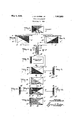
rIhis invention relates to sound, particularing the position-in the emulsion of the irst ly the recordat'ion of sound, and especially developed image; Fig. 8 is a schematic view such recordation upon a photographic film. illustrating the print, Fig. 6, after being It is well understood by those skilled in toned; Fig. 9 is a schematicview illustraty photography that sound waves may be transing the print, Fig. 8, after the second devel- 55 formed into light waves which may be caused opment; Fig. 10 is a cross-sectional View on to so act upon a photographic' film that a t-lie line X-X of Fig. 9, illustrating the porecord may be obtained which may then, by stion in the emulsion ofthe second developed suitable apparatus, be caused to so act upon image; Fig. 11 is a cross-sectional View on the a beam of light that the light may be trans` line XI-XI of Fig. 9, illustrating the posi- 60 formed, as it were, back into a sound corretion in the emulsion of the developed soundsponding to the original sound. track; Fig. 12 is a schematic representation The ordinary photographic film record of of Fig. 9 after being toned. a sound is not' as sharp as desired. In order to explain and illustrate my meth- A principal object of applicants invention od I have shown it used in conjunction with 55 l is a method .by which the so called soundthe formati-on of a colored photograph, as
track upon a photographic film may be renthis example not only illustrates my method dered sharper and the whole image more inof intensifying and rendering clearer the tense so that a greater range' of volume of sound-track but also illustrates vhow such a more sharply diii'erentiated sounds may be method may be used in conjunction withthe 7 obtained b the use of the film. method for making a colored photograph.
Other o jects and advantages will appear The subject selected for reproduction, and
as the description ofthe best known mode shown by Fig. 1, is represented as a rectangle of practicing the method progresses and the divided by two diagonal lines forming four novel features thereof will be particularly triangles. One triangle 1, is colored red;
pointed outgi'n theappenlded claims. another 2, is white; another, 3, is colored' In describing thel invention in detail, and green; and the fourth, 4,13 black 3 Partlclllar Physlcal Product, resulting from The first step in carrying out applicants the PPllCatlOll 0f the method Selected t0 ll" process is to secure two color selection nega- 0 lustrate the.nvent0i1 referme? is had to the tives of the subject, Fig. l. This is done in the accompanymg dlfawmgs Whirem has been 11' usual and well known manner. The finished lustiated la partlcular-physlcal 'Prf-)dupt re' red color selection negative designated as a sltl-ng rqm thedpraitlc al-(l aplllhcalon o whole by 5, is illustrated by Fig. 2. As the ileieilsiileltudliasilglnatve rdilrespeoiidiilic ejliirts rfid (3010,; slection negative Fig' Qts a' nega'- 85 throughout the several views, and nwhich: gemviti nullllltllrsligd Figure 1 is a schematic representation of a Y subject; Fig. 2 is a schematic representation Wlll be black; the triangle 2 will be black; the
of a red color selection negative representa. tlt'angle 3Wlll be Whltei and the tl'langle-4 40 tive of the reds in the subject, Fig. 1; Fig. 3 lll be Whllle- Th? nlsllefl green C0101 Selec- 90 is a green color selection negative representa- P10. lleatwea delglltel as a WllOl" by 6, tive of the greens in the subject, Fig, 1; Figgh ls .lllustratedby Fig. In this negative, the 4 is a schematic illustration showing the po- IlaIlgle l Wlll b e White; the triangle 2 will sition of the positive print stock and negabe black; the trlangle- 3 w111 be black; and tives during the printing; Fig. 5 is a schematthe trlangle 4; Wlllte; Each 0f tlle Color Se' 95 ic representation of sound record negative; letlOIl IlegtlVeS, F1gS- 2 and 3, also ShOW p Fig. 6. is a schematic representation of the blank spaces, one designated 12 the other 13. positive print after the surface image has` These blank spaces merely represent that porbeen developed; Fig. 7 is a' cross-sectional tion of-the width of a standard motion picview on the line VII-VII oit Fig. 6,il1ustr at ture photograph lm which is set asidefor 10 the sound-track, and blanked out on eX-l light retarding dye. By using said positive film stock and properly regulating the printing lights 8 and 9, two registered independent images may be simultaneously formed in the emulsions 10 and 10. One image, that formed from negative 6 would, as indicated in dotted lines in Fig. 4, and designated 11,
lie substantially adjacent the transparent, generally, celluloid carrier 12, and would be in the emulsion 10; the other image, indicated by dotted lines 13, would lie in the emulsion 10. These substantially separated positions of the two images can, of course, be obtained as well by successive printing.
After the completion of the printing of the latent images in the positive stock A7, it is again put through a printer in contact with the sound record negative, Fig. 5, with the sound record negative occupying the position correspinding to that occupied by the green color selection negative, Fig. 6, as shown in Fig. 4, so that a latentimageof the sound record would be formed in the positive print stock 7 in a plane corresponding to thelatent image 11 of Fig. 4. This latent image would only be formed in thatv area designated 14 in Fig. 6, that is, the soundtrack area and in order to render this soundtrack area free for the sound-track when the printing Fig. 4, is done, this area would beV blanked out by suitable and appropriate means in the printer so that neither light 8 or 9 could act thereon and when the printing is done from sound record negative, Fig. 5, theportion other than the sound track area i would be blanked out so that lights 8 or 9 could not act upon the area of the positive stock which is to bear the subject image, all of which is well understood and common practice.
When the latent images have been formed in the positive 7i it will then be developed.
This development will be so arranged that the image 13 will be first developed without action on the interior image 11. -In order to so ldo applicant prefers to use a developer asffollows 18 'grams hydroquinone, 100 grams sodium sulphite, 4% grams potassium bromide, 18 grams sodium hydrate, 1000 ccs. water. Y
This developer will give rapidly a satisfactory black-and white image from the image 13, so that the print, Fig. 6, after development will appear white in triangle 1; white in triangle 2; black in triangle 3; and black in triangle 4 and the developed image giving the blacks will be as shown at 13, in Fig. 7.
The positive stock is next washed and then tone-d. A suitable toning solution would be as follows 3 grams ferrie ammonium oXalate, 3 grams potassium ferricyanide, 3 grams citric acid, 500 ccs. water.
The toning bath would be allowed to act for such a time as would give 'a desired density of color. The print would then appeal' as shown in Fig. 8. Too great acidity in this bath is to be avoided.
After a thorough wash the film is placed in a bath as follows: 10 grams potassium bichromate, 10 'grams ammonium bromide, 1000 ccs'. water.
The bichromate clearing bath would be allowed to act for about 10 minutes and then the print would be thoroughly washed. This clearing bath tends to restore the sensitivity to developer of undeveloped exposed silver salts which-may lhave been rendered undevelopable by previous treatments.-
After Washing, the print would be subjected to a second development. The developer used would be a vslow working developer. One designed to bring out the interior image to the fullest extent. A suitable developer would be as follows: 5 grams diamidophenol, 60 grams sodium sulphite, 5 ccs. latic acid, 1000 ccs. water.
After the developeris allowed to act the proper time to fully develop the latent image formed adjacent the carrier, that is, in the emulsion 10, the film is thoroughly washed and fixed inv a thiosulfate bath and then washed. The print will then4 appear as shown in Fig. 9, in which: triangle 1 will be black; triangle 2 will be white; triangle 3 will be blue; and triangle 4 will contain both blue and black; The position of the black image of Fig. 9 is shown by Fig. 10 in which 11 indicates the image developed by the second development. T his image is adjacent the carrier 12. Y x
The sound-track image rendered black by the second development is shown in Fig. 9 at 15 and in cross-section in Fig. 11.
The print will then be toned by the use of any suitable toning solution such as: 50 grams sodium citrate, 10 grams cupric sulphate, 5 grams potassium ferricyanide, 1000 ccs. water.
. After the print is washed and dried it will then appear as shown in Fig. 12 in which: triangle 1 will be red, triangle 2, white; triangle 3, blue;"triangle 4, blue and red which by transmitted light would be black; and sound-track 15 would be red.
When the positive Fig. 12 is projected in the usual manner in a projection machine provided with a sound head, that is, means for passing light through the sound-track 15 to be transformed into sound, the colored sound image 15 will bemuch more effective than the ordinary black and white sound-track image, in that, it will be more intense and sharper in cutting off the light so' that the resulting sound produced Will be of greater volume-and sharper, that is, less overlapping and undesired prolongation of sound.
Although the new method for improving the quality of sound-track on photography ilni has been illustrated and described inthis application in connection with a method of forming a color photograph, nevertheless, it must be understood that the sound-track alone may be treated by the cupric sulphate 'containing toning solution in order to improve its quality without coloring either one or both ofthe subject ilnages, as by immersion of the film sidewise to a. depth just sufficient to cover the sound-track area lll-or any other suitable or appropriate method as by painting the sound-track Witha toning solution by means of a small camels hair brush and Jfollowing this treatment with the necessary fixing solutions and Washes.
It is, of course, to be understood that the showing and description of a, variable area sound-track is not meant' to exclude a variable density sound-track from the domain of the principle of his invention by describing the ste ps of a novel process which result in a novel product, nevertheless, it is to be understood that the particular manipulation described and the product formed do not exhaust the possible manipulations and products lying within the domain of the invention.
What I claim as new and desire to secure by Letters Patent of the United States, is:
l. The method of making a combined sound and color photograph whiclrcomprises, first, making a red color selection negative and a green color selection negative, and a sound record negative, then `forming, in positive stock, a latent image from the red color selection negative adjacent the emulsion face of the positive stock, and a, latent image from the green color selection negative and a latent sound record from the sound record negative, both adjacent the carrier of the positive stock, then developing the latent yimage adjacent the -face of the emulsion and toning, with a metal salt, the developed image, then clearing with a potassium bichromate bath, then developing the latent sound record and that the latent image adjacent the carrier, then fixing, then toning` the last developed images with a metal salt toning solution.
2. The method of making a combined sound and color photograph which comprises, first, making a red color selection negative and a.
green color selection negative, and a sound developer the latent image adjacent the face' of the emulsion and toning the developed image With a ferrie salt, then clearing with a potassium bichromate bath, then developing with diamidophenol the latent sound record and the latent image ladjacent the carrier,
then fixing, then toning the last developed images with a cupric salt toning solution.
JOSEPH B. HARRIS, JR.
Priority Applications (1)
| Application Number | Priority Date | Filing Date | Title |
|---|---|---|---|
| US450350A US1857083A (en) | 1930-05-07 | 1930-05-07 | Color photography |
Applications Claiming Priority (1)
| Application Number | Priority Date | Filing Date | Title |
|---|---|---|---|
| US450350A US1857083A (en) | 1930-05-07 | 1930-05-07 | Color photography |
Publications (1)
| Publication Number | Publication Date |
|---|---|
| US1857083A true US1857083A (en) | 1932-05-03 |
Family
ID=23787744
Family Applications (1)
| Application Number | Title | Priority Date | Filing Date |
|---|---|---|---|
| US450350A Expired - Lifetime US1857083A (en) | 1930-05-07 | 1930-05-07 | Color photography |
Country Status (1)
| Country | Link |
|---|---|
| US (1) | US1857083A (en) |
Cited By (1)
| Publication number | Priority date | Publication date | Assignee | Title |
|---|---|---|---|---|
| US2456955A (en) * | 1944-06-02 | 1948-12-21 | Eastman Kodak Co | Photographic processes and lightsensitive elements therefor |
-
1930
- 1930-05-07 US US450350A patent/US1857083A/en not_active Expired - Lifetime
Cited By (1)
| Publication number | Priority date | Publication date | Assignee | Title |
|---|---|---|---|---|
| US2456955A (en) * | 1944-06-02 | 1948-12-21 | Eastman Kodak Co | Photographic processes and lightsensitive elements therefor |
Similar Documents
| Publication | Publication Date | Title |
|---|---|---|
| DE678456C (en) | Process for the production of photographic or cinematographic images with and without sound recordings, in which dye images are combined with a silver image | |
| GB581772A (en) | Improvements in photographic processes | |
| US1966330A (en) | Process for making two-color subtractive photographic prints on double-coated film | |
| GB517416A (en) | Improvements in and relating to the photographic reproduction of coloured objects | |
| US2241519A (en) | Photographic material | |
| US1674174A (en) | Color photography | |
| US2218001A (en) | Process for making colored prints | |
| US2226339A (en) | Three-color film and method of making same | |
| US1516824A (en) | Color photography | |
| US1787201A (en) | Combined black and white and colored image photography | |
| US2009689A (en) | Method of producing films in natural color | |
| US2330796A (en) | Cinematography | |
| US2339951A (en) | Color photography | |
| US2430565A (en) | Positive sound track in multilayer film | |
| US2336902A (en) | Photographic material for color photography | |
| US1166123A (en) | Photographic process. | |
| US1712439A (en) | Color photograph and method of producing same | |
| US2327304A (en) | Color photography | |
| US1633652A (en) | Photographic transparency and method of coloring same | |
| DE747892C (en) | Process for the production of color photographs by the three-color process on paper or other material with the aid of the staining process | |
| US1674175A (en) | Color photography | |
| US2320005A (en) | Process and article for use in the manufacture of combined picture and sound films | |
| AT136382B (en) | Process for reproducing transparencies in natural colors. | |
| US2328368A (en) | Color photography and cinematography | |
| US1848714A (en) | Color photography |