US1857038A - Counting card - Google Patents
Counting card Download PDFInfo
- Publication number
- US1857038A US1857038A US530103A US53010331A US1857038A US 1857038 A US1857038 A US 1857038A US 530103 A US530103 A US 530103A US 53010331 A US53010331 A US 53010331A US 1857038 A US1857038 A US 1857038A
- Authority
- US
- United States
- Prior art keywords
- slips
- pupil
- counting
- card
- counting card
- Prior art date
- Legal status (The legal status is an assumption and is not a legal conclusion. Google has not performed a legal analysis and makes no representation as to the accuracy of the status listed.)
- Expired - Lifetime
Links
- 210000001747 pupil Anatomy 0.000 description 29
- 238000000034 method Methods 0.000 description 11
- 241000220225 Malus Species 0.000 description 2
- 235000021016 apples Nutrition 0.000 description 2
- 239000003086 colorant Substances 0.000 description 2
- 238000010276 construction Methods 0.000 description 2
- 230000003340 mental effect Effects 0.000 description 2
- 241000566613 Cardinalis Species 0.000 description 1
- 241000183024 Populus tremula Species 0.000 description 1
- HUTDUHSNJYTCAR-UHFFFAOYSA-N ancymidol Chemical compound C1=CC(OC)=CC=C1C(O)(C=1C=NC=NC=1)C1CC1 HUTDUHSNJYTCAR-UHFFFAOYSA-N 0.000 description 1
- 230000001174 ascending effect Effects 0.000 description 1
- 239000011111 cardboard Substances 0.000 description 1
- 230000000694 effects Effects 0.000 description 1
- 210000003128 head Anatomy 0.000 description 1
- 238000003780 insertion Methods 0.000 description 1
- 230000037431 insertion Effects 0.000 description 1
- 239000000203 mixture Substances 0.000 description 1
Images
Classifications
-
- G—PHYSICS
- G09—EDUCATION; CRYPTOGRAPHY; DISPLAY; ADVERTISING; SEALS
- G09B—EDUCATIONAL OR DEMONSTRATION APPLIANCES; APPLIANCES FOR TEACHING, OR COMMUNICATING WITH, THE BLIND, DEAF OR MUTE; MODELS; PLANETARIA; GLOBES; MAPS; DIAGRAMS
- G09B19/00—Teaching not covered by other main groups of this subclass
- G09B19/02—Counting; Calculating
Definitions
- the invention relates to an education device known as a counting cardvfor teaching arithmetic to children.
- the main object of the counting card is to help the teacher carry out the initial steps of teaching arithmetic as a true educational process and not as a mere method of teaching the pupil to reach fixed conclusions.
- the special purpose of the counting card is to help children learn'to understand through their own self-activity the process. of counting and calculating with numbers from 1 to 20.
- the counting card helps to develop in the mind of the child the mostimportant attribute of a number concept; namely, ⁇ its serial nature. During the stage of counting from l to l the counting card imparts to the child a mental picture of the number scale. Children cannot calculate unless they have a mental picture of the number scale. By means of the counting card we arel able to provide a transitional stage from counting to calculating. 7e establish this connection by adding and subtracting, first in single steps by means of ordinals. The counting card helps the pupil to understand the actual process of adding and subtracting. In working addition ⁇ and subtraction with the help of the counting card the pupil is able to' recognize the problem, the solution and the answer.l
- slips representing units which are movable, separable and printed in two colors are movable, separable and printed in two colors.
- the pupil is introduced to thel planl of the structure of our decimal system. In this way the pupil is taught to view 10 as a new unit for counting and calculating.
- the counting card helps to separate and complete every number from l to l0 and helps the child to und-erstand and memorize all the addition and subtracting combinations.
- the construction of the counting card has by the insertion of an additional mark or sign. y-Tn this way each group of five is subdivided into three parts,'one middle member and two side members of two units each. As a result of this construction of the card, the place of eachunit from l to 10 can be perceived at a glance. f
- the pupils first become acquainted with the counting card they'pbecome con-v scious of the above special characteristics.
- the teacher yhelps the pupil in this way: She draws attentionto the first group ofthefive slips and points out the place of one at theY beginning and i'ive at'the end of the group. Three is in the middleand two is atthe left and four to the right ofthree. ⁇
- the teacherk seventh by their places'at the left of lthree and eight; and the' fourth vand the ninth at the right of three and eight respectively; the fifth and tenth by their places at the end of the two groups of live.
- the counting card is a device for grouping dots in such a way that their total may be clearly recognized without counting.
- this counting device which is a distinct, concrete, linear series, is an important step in the development of the number scale in the ab'- stract...V
- it helps'the pupil to an insight into the actual process' of calculation.v
- One of its most important functions is to give tothe pupil an insight into the meaning of arithmeticlal operation,l hence its easily divisible and movable parts.
- it introduces the pupil, by gradual steps to our decimal system, one of the main cliaracteristics of which is the comprehension of tenV definite'units as one unity ofla higher 'order'. f
- the counting card helpsl the pupill at every stage where yobjective vis neededf i f
- the employment of the counting card is not but is also indispensible in teaching addition and substraction.
- the counting card is used solely as a device to help the pupil to think out the process and to get an insight into the process. Ultimately the pupils learn to get along without the counting card.
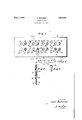
- Figure 1 is a front 'view of the counting card.
- Figure 2 is a section on line 2 2 of Figure 1.v
- Figure 3 is a detached view of oneof the slips.
- FIG. 4 is a detail showing the slots.
- numeral 1 designates the backing of the counting card.
- Said backing is preferably made from a sheet of'carcbboard or the like, folded over at the horizontal scores 2 and 3 alldforming two wall members 4 and 5.
- the two ends 6 and 7 ofthe wall members are glued togetherat the bottom.v
- Cut in the front wall member 4 are two parallelrows of slots'comprising ten in each row.
- Each of theslot-s is cut in the form of a semi-circle. Said slots are numbered for the purpose of the specification 8, 9, 10, 11, 12,
- v 13, 14, 15,16 and 17.Y These slots are adapted to hold tabs or slips 18, 19, 20, 21, 22, 23, 24, 25, 26 and 27. In actual practice no numbers appear on the device.
- the slips are made of card-board and comprise an enlarged circular head which protrudes abovey the slots and a reduced tapered shank portion which enters the slots. The slip when ⁇ inserted into the semi-circular slotforms a colored circle which protrudes the outside surface of the bars are circles 32 and 33 spaced substantially the saineas the slips.
- the slips 8 to 12, inclusive, and 13 to 17, inclusive are sepyarated by a comparatively wide space 34 Y elements ofwhich higher numbers are v composed.
- AThe art of calculation consists of which is wider than the spaces between the Arest of the slips.
- the slips 10 and 15 are positioned higher than the rest ofthe slips and above the said slips 10 and 15 are marks 35 and 36 to makethem stand out boldly.
- YThe slips Yare supposed to representk the .series of numbers 1 to 10. These numbers voccupy a very important place in our decimal system of numeration because they are breaking up the series and recombining some Y of its members, inother words, itc'onsists of Y- ascending and descending the number scale.
- the pupil may be introduced to the second decade in two ways (1) He may add Slljcce's-A sively 1 to each number, beginning with'a ten, and in this way continue thefnum'ber series beyond ten: 10 plus 1.'equals 1j 1',' 11 plus 1 equals 12, 12 plus 1 equals 13, '13 plus 1 equals 14, etc. Counting is then stil'l'the Or (2) he may consider ten as a higher unit and develop each new number of the second decade by adding successively to its collectiveV unit,'ten every member of the primary series from 1 to 105 thus, 10 plus 1 equals 1l, 10 plus 2 equals 12, 10 plus 3 equals 13, 10 plus 4 equals 14, 10 plus 5 equals 15, 10 plus 6 equals 16, etc.
- each new number ⁇ from 11 ⁇ to 2Q is conceived as possessing an attribute which the first ten cardinals lack; namely, each num@x ber is made up of a vdecade and one or more units; That is the essence of the decimal system.
- the counting card renders a valuable service.
- the pupil comprehends num'f bersV fromA ten to twenty7
- the pupil sees objec- Y tively the merging of the number scale and the decimal system of numeration into one.
- we use the counting card to help the pupil see that the basic operations are carried over to the second decade. For instance, we wish the pupil to see that 16 plus 3 equals 19, because 6 plus 3 equals 9.
- the teacher shows the pupil that 16 is built from 10 and 6 units; therefore, in order to add 3 units to 16, we simply let the 6 units grow into 9 units by adding to them 3 units, the ten-group remaining unchanged.
- the pupil must soon learn to transfer the basic operations thoughtfully and without any objective aids.
- the success of addition and subtraction within the higher decades depends on getting the y pupil to work thoughtfully with the second decade rather than merely using objective aids to get answers without insight into the process of the transfer of basic operations.
- movable slips associated with said backing means to support said slips in said backing, said slips arranged in two parallel rows comprising ten slips in each row and divided into groups of five, the space between each group being larger than'the space between the rest of the slips, the first, second, fourth, fifth, sixth, seventh, ninth and tenth slip being on a straight line, the third and eighth slip of each row being arranged higher than the rest of the slips.
- a device of the class described the combination of a backing, of a series of removable slips associated with said backing, means to support said slips in said backing, said slips arranged in two parallel rows comprising ten slips in each row and divided-into beinglargerthan the space between the rest of the slips, the slips yon the upper row being groups of five, the space between each group of a different color than the slips on the lower y Y row.
- the counting card is deliberately planned to help the pupil to remember the number scale with clearness and certainty. 'The pupil substitutes this number scale for the groups of concrete objects to be added or subtracted and thus takes an important step toward the power to perform the arithmetical processes mentally, i. e., without the help of objects.
- the counting card places in the hand of every pupil a concrete picture of the number scale.
- slips means to support said slips in said backing, said slips arranged in two parallel rows comprising ten slips in each row, the first, second, fourth, fifth, sixth, seventh, ninth and tenth slip being on a straight line, the third and eighth slip of each row being arranged higher than the rest of the slips.
- a device of the class described the combinationof a backing, of-a series of ten removable slips in a row associated with said backing, means to support said slips in said backing, the first, second, fourth, fifth, sixth,
Landscapes
- Business, Economics & Management (AREA)
- Engineering & Computer Science (AREA)
- Entrepreneurship & Innovation (AREA)
- Physics & Mathematics (AREA)
- Educational Administration (AREA)
- Educational Technology (AREA)
- General Physics & Mathematics (AREA)
- Theoretical Computer Science (AREA)
- Electrically Operated Instructional Devices (AREA)
Description
S. BADANES COUNTING GARD Filed Apri1 14, 1931 I'N VEN TOR. 6a/MZ aaanea Patented May 3, 1932 .UITED- STATES SAUL BADANES, OF BROOKLYN, YORK COUNTING CARD Application filed April 14, 19x31. Serial No. 530,103.
The invention relates to an education device known as a counting cardvfor teaching arithmetic to children.
The main object of the counting card is to help the teacher carry out the initial steps of teaching arithmetic as a true educational process and not as a mere method of teaching the pupil to reach fixed conclusions. The special purpose of the counting card is to help children learn'to understand through their own self-activity the process. of counting and calculating with numbers from 1 to 20.
First the counting card helps to develop in the mind of the child the mostimportant attribute of a number concept; namely, `its serial nature. During the stage of counting from l to l the counting card imparts to the child a mental picture of the number scale. Children cannot calculate unless they have a mental picture of the number scale. By means of the counting card we arel able to provide a transitional stage from counting to calculating. 7e establish this connection by adding and subtracting, first in single steps by means of ordinals. The counting card helps the pupil to understand the actual process of adding and subtracting. In working addition `and subtraction with the help of the counting card the pupil is able to' recognize the problem, the solution and the answer.l
This is made possible by slips representing units which are movable, separable and printed in two colors.
Second with the help of theten-slip and single slips the pupil is introduced to thel planl of the structure of our decimal system. In this way the pupil is taught to view 10 as a new unit for counting and calculating.
The counting card helps to separate and complete every number from l to l0 and helps the child to und-erstand and memorize all the addition and subtracting combinations.
The construction of the counting card has by the insertion of an additional mark or sign. y-Tn this way each group of five is subdivided into three parts,'one middle member and two side members of two units each. As a result of this construction of the card, the place of eachunit from l to 10 can be perceived at a glance. f
lhen the pupils first become acquainted with the counting card they'pbecome con-v scious of the above special characteristics. The teacher yhelps the pupil in this way: She draws attentionto the first group ofthefive slips and points out the place of one at theY beginning and i'ive at'the end of the group. Three is in the middleand two is atthe left and four to the right ofthree.` The teacherk seventh by their places'at the left of lthree and eight; and the' fourth vand the ninth at the right of three and eight respectively; the fifth and tenth by their places at the end of the two groups of live. V
The advantages in using the countingk card maybe summedup as follows: First, the counting card is a device for grouping dots in such a way that their total may be clearly recognized without counting. Second,' this counting device, which is a distinct, concrete, linear series, is an important step in the development of the number scale in the ab'- stract...V Third, it helps'the pupil to an insight into the actual process' of calculation.v One of its most important functions is to give tothe pupil an insight into the meaning of arithmeticlal operation,l hence its easily divisible and movable parts. Finally, it introduces the pupil, by gradual steps to our decimal system, one of the main cliaracteristics of which is the comprehension of tenV definite'units as one unity ofla higher 'order'. f
Thus the counting card helpsl the pupill at every stage where yobjective vis neededf i f The employment of the counting card is not but is also indispensible in teaching addition and substraction. The counting card is used solely as a device to help the pupil to think out the process and to get an insight into the process. Ultimately the pupils learn to get along without the counting card.
For a more general understanding of the invention attention is now calledto the drawings. Y i
In the drawings Figure 1 is a front 'view of the counting card. Y
Figure 2 is a section on line 2 2 of Figure 1.v
Figure 3 is a detached view of oneof the slips.
Figure 4 is a detail showing the slots.
Referring now to the drawings in detail, numeral 1 designates the backing of the counting card. Said backing is preferably made from a sheet of'carcbboard or the like, folded over at the horizontal scores 2 and 3 alldforming two wall members 4 and 5. The two ends 6 and 7 ofthe wall members are glued togetherat the bottom.v
' Cut in the front wall member 4 are two parallelrows of slots'comprising ten in each row. Each of theslot-s is cut in the form of a semi-circle. Said slots are numbered for the purpose of the specification 8, 9, 10, 11, 12,
i As will be noted in Figure 1, the slips 8 to 12, inclusive, and 13 to 17, inclusive, are sepyarated by a comparatively wide space 34 Y elements ofwhich higher numbers are v composed. AThe art of calculation consists of which is wider than the spaces between the Arest of the slips. Also the slips 10 and 15 are positioned higher than the rest ofthe slips and above the said slips 10 and 15 are marks 35 and 36 to makethem stand out boldly.
YThe slips Yare supposed to representk the .series of numbers 1 to 10. These numbers voccupy a very important place in our decimal system of numeration because they are breaking up the series and recombining some Y of its members, inother words, itc'onsists of Y- ascending and descending the number scale.Y
rinode of forming numbers.
In practice all the clips are removed and the pupil is taught to count, for instance, by iirst putting one slip in place representing the numeral 1. Then one or two additional slips are put in place and the result added. After that a few more slips are placed in the slots and the whole amount ascertained. By using a variety of figures a great number of problems may be performed. Also the child may be taught to substract in the like manner. As the middle members or slips 10 and 15 stand out boldly yfrom the other four units by their raised positions and the addition of the marks .35 and 36 above them, the place of each unit from 1 to 10 can be perceived at a glance. The children may be taught to associate the slips with other objects and various calculations of the said objects may be done on the card. For instance a question may be asked A boy picked five apples from a tree and three apples from another tree. How many did4 he pickZ In SOlVing this problem the pupil refers to the slips 'on the card and obtains the answer 8.
In beginning to study numbers above 10, the pupil crosses the first threshold ofthe decimal system of enumeration. They are here introduced to a new idea; namely, that of a series of ten units as a single unit group. They are to learn that the rcontents of each number from now on is determined not only by its place in the series, but also by its place in our number system. This knowledgethe pupils need in orderto be able to perform calculations with numbers above ten, espe cially with large numbers.
The pupil may be introduced to the second decade in two ways (1) He may add Slljcce's-A sively 1 to each number, beginning with'a ten, and in this way continue thefnum'ber series beyond ten: 10 plus 1.'equals 1j 1',' 11 plus 1 equals 12, 12 plus 1 equals 13, '13 plus 1 equals 14, etc. Counting is then stil'l'the Or (2) he may consider ten as a higher unit and develop each new number of the second decade by adding successively to its collectiveV unit,'ten every member of the primary series from 1 to 105 thus, 10 plus 1 equals 1l, 10 plus 2 equals 12, 10 plus 3 equals 13, 10 plus 4 equals 14, 10 plus 5 equals 15, 10 plus 6 equals 16, etc. The second method is by far preferable because the pupil must grasp the decimal composition of numbers. In the second way only, then, each new number `from 11`to 2Q is conceived as possessing an attribute which the first ten cardinals lack; namely, each num@x ber is made up of a vdecade and one or more units; That is the essence of the decimal system.
Here the counting cardrenders a valuable service. By means of -theo'ne-ten slip ofthe counting'card, the pupil comprehends num'f bersV fromA ten to twenty7| not onlyas of a series, but asa plurality'inade up ofia ten and an already familiar number; 14 is not only 1 after 13, but it is also 10 plus 4. By means of the counting card, the pupil sees objec- Y tively the merging of the number scale and the decimal system of numeration into one. In the same manner we use the counting card to help the pupil see that the basic operations are carried over to the second decade. For instance, we wish the pupil to see that 16 plus 3 equals 19, because 6 plus 3 equals 9. With thek help of the counting card, the teacher shows the pupil that 16 is built from 10 and 6 units; therefore, in order to add 3 units to 16, we simply let the 6 units grow into 9 units by adding to them 3 units, the ten-group remaining unchanged. The pupil must soon learn to transfer the basic operations thoughtfully and without any objective aids. The success of addition and subtraction within the higher decades depends on getting the y pupil to work thoughtfully with the second decade rather than merely using objective aids to get answers without insight into the process of the transfer of basic operations.
It will thus be seen thatI have provided movable slips associated with said backing, means to support said slips in said backing, said slips arranged in two parallel rows comprising ten slips in each row and divided into groups of five, the space between each group being larger than'the space between the rest of the slips, the first, second, fourth, fifth, sixth, seventh, ninth and tenth slip being on a straight line, the third and eighth slip of each row being arranged higher than the rest of the slips.
4.'In a device of the class described, the combination of a backing, of a series of removable slips associated with said backing, means to support said slips in said backing, said slips arranged in two parallel rows comprising ten slips in each row and divided-into beinglargerthan the space between the rest of the slips, the slips yon the upper row being groups of five, the space between each group of a different color than the slips on the lower y Y row.
In testimony whereof I affix my si ature.
SAUL BADA ES.
an apparatus for amethod of teaching Y children the thoughtful process of counting. The counting card is deliberately planned to help the pupil to remember the number scale with clearness and certainty. 'The pupil substitutes this number scale for the groups of concrete objects to be added or subtracted and thus takes an important step toward the power to perform the arithmetical processes mentally, i. e., without the help of objects. The counting card places in the hand of every pupil a concrete picture of the number scale.
It is constructed so as Vto make each unit from 1 to 10 not only visible and movable but also visible at a glance. rI`he exercises in separating, comparison, and completion further help the pupil to work conceptually with numbers.
Having described my invention1` I claim, 1. In a device of the class described, the 'combination of a backing, of a series of removable slips associated with saidbacking,
means to support said slips in said backing, said slips arranged in two parallel rows comprising ten slips in each row, the first, second, fourth, fifth, sixth, seventh, ninth and tenth slip being on a straight line, the third and eighth slip of each row being arranged higher than the rest of the slips.
2. VIn a device of the class described, the combinationof a backing, of-a series of ten removable slips in a row associated with said backing, means to support said slips in said backing, the first, second, fourth, fifth, sixth,
seventh, ninth and tenth slip being on a` straight line, the third and eighth of said slips being arranged higher than the rest.
3. Ina deviceof the class described, the
combination of a backing, of a series `of re-
Priority Applications (1)
| Application Number | Priority Date | Filing Date | Title |
|---|---|---|---|
| US530103A US1857038A (en) | 1931-04-14 | 1931-04-14 | Counting card |
Applications Claiming Priority (1)
| Application Number | Priority Date | Filing Date | Title |
|---|---|---|---|
| US530103A US1857038A (en) | 1931-04-14 | 1931-04-14 | Counting card |
Publications (1)
| Publication Number | Publication Date |
|---|---|
| US1857038A true US1857038A (en) | 1932-05-03 |
Family
ID=24112454
Family Applications (1)
| Application Number | Title | Priority Date | Filing Date |
|---|---|---|---|
| US530103A Expired - Lifetime US1857038A (en) | 1931-04-14 | 1931-04-14 | Counting card |
Country Status (1)
| Country | Link |
|---|---|
| US (1) | US1857038A (en) |
-
1931
- 1931-04-14 US US530103A patent/US1857038A/en not_active Expired - Lifetime
Similar Documents
| Publication | Publication Date | Title |
|---|---|---|
| US2494469A (en) | Educational toy | |
| US6758675B2 (en) | Base ten primary teaching kit | |
| US3813471A (en) | Spell and learn educational toy | |
| US4233757A (en) | Mathematics device | |
| US3374558A (en) | Educational peg board | |
| US367223A (en) | Illustrated number-card | |
| US2654164A (en) | Abacus | |
| US1857038A (en) | Counting card | |
| US2654963A (en) | Educational device | |
| US4560354A (en) | Device for teaching decimal math | |
| US1941733A (en) | Counting and calculating card | |
| US4424039A (en) | Mathematics teaching device | |
| US3478446A (en) | Educational and recreational lesson aid pixx games with pegboards | |
| US1977842A (en) | Counting and calculating device | |
| Gunderson | Thought-patterns of young children in learning multiplication and division | |
| CA1101663A (en) | Teaching aid device for teaching the basic principles of arithmetic | |
| US1483916A (en) | Educational appliance | |
| US3430363A (en) | Device for teaching arithmetic and particularly the decimal number system | |
| US1664808A (en) | Teaching device | |
| US2884714A (en) | Educational device for teaching spelling and arithmetic | |
| US2714261A (en) | Educational devices for teaching mathematics | |
| US1438153A (en) | Clock dial | |
| DE540876C (en) | Reading teaching aids | |
| US1730418A (en) | Apparatus for teaching mathematics | |
| US357889A (en) | James b |