US1856867A - Window - Google Patents
Window Download PDFInfo
- Publication number
- US1856867A US1856867A US383359A US38335929A US1856867A US 1856867 A US1856867 A US 1856867A US 383359 A US383359 A US 383359A US 38335929 A US38335929 A US 38335929A US 1856867 A US1856867 A US 1856867A
- Authority
- US
- United States
- Prior art keywords
- air
- panes
- spaces
- window
- dehydrating
- Prior art date
- Legal status (The legal status is an assumption and is not a legal conclusion. Google has not performed a legal analysis and makes no representation as to the accuracy of the status listed.)
- Expired - Lifetime
Links
- 239000000463 material Substances 0.000 description 11
- 238000010276 construction Methods 0.000 description 5
- 239000011521 glass Substances 0.000 description 3
- 238000005086 pumping Methods 0.000 description 3
- UXVMQQNJUSDDNG-UHFFFAOYSA-L Calcium chloride Chemical compound [Cl-].[Cl-].[Ca+2] UXVMQQNJUSDDNG-UHFFFAOYSA-L 0.000 description 2
- 229910001628 calcium chloride Inorganic materials 0.000 description 2
- 239000001110 calcium chloride Substances 0.000 description 2
- 239000004568 cement Substances 0.000 description 2
- 238000009833 condensation Methods 0.000 description 2
- 230000005494 condensation Effects 0.000 description 2
- 229910052751 metal Inorganic materials 0.000 description 2
- 239000002184 metal Substances 0.000 description 2
- 230000009972 noncorrosive effect Effects 0.000 description 2
- 239000000126 substance Substances 0.000 description 2
- WYUYEJNGHIOFOC-VVTVMFAVSA-N 2-[(z)-1-(4-methylphenyl)-3-pyrrolidin-1-ylprop-1-enyl]pyridine;hydrochloride Chemical compound Cl.C1=CC(C)=CC=C1C(\C=1N=CC=CC=1)=C\CN1CCCC1 WYUYEJNGHIOFOC-VVTVMFAVSA-N 0.000 description 1
- 230000009286 beneficial effect Effects 0.000 description 1
- BFPSDSIWYFKGBC-UHFFFAOYSA-N chlorotrianisene Chemical compound C1=CC(OC)=CC=C1C(Cl)=C(C=1C=CC(OC)=CC=1)C1=CC=C(OC)C=C1 BFPSDSIWYFKGBC-UHFFFAOYSA-N 0.000 description 1
- 230000008602 contraction Effects 0.000 description 1
- 230000018044 dehydration Effects 0.000 description 1
- 238000006297 dehydration reaction Methods 0.000 description 1
- 230000001627 detrimental effect Effects 0.000 description 1
- 238000001035 drying Methods 0.000 description 1
- 238000009434 installation Methods 0.000 description 1
- 238000009413 insulation Methods 0.000 description 1
- 238000012423 maintenance Methods 0.000 description 1
- 239000003973 paint Substances 0.000 description 1
Images
Classifications
-
- E—FIXED CONSTRUCTIONS
- E06—DOORS, WINDOWS, SHUTTERS, OR ROLLER BLINDS IN GENERAL; LADDERS
- E06B—FIXED OR MOVABLE CLOSURES FOR OPENINGS IN BUILDINGS, VEHICLES, FENCES OR LIKE ENCLOSURES IN GENERAL, e.g. DOORS, WINDOWS, BLINDS, GATES
- E06B3/00—Window sashes, door leaves, or like elements for closing wall or like openings; Layout of fixed or moving closures, e.g. windows in wall or like openings; Features of rigidly-mounted outer frames relating to the mounting of wing frames
- E06B3/54—Fixing of glass panes or like plates
- E06B3/64—Fixing of more than one pane to a frame
Definitions
- This invention relates to windows, with occurs when there is appreciable variation inthe temperatures on the inside and outside of the window, and cannot be removed in the normal case, especially in those installations where the panes are set tightly in the surrounding frame work.
- the structure to which the invention pertains is one in which insulation of the displayed goods from the heat of the atmosphere outside of the case is of greatimportance, but even more important is lthe ease and facility with which the customer ⁇ may observe the displayed contents of the case.
- the presence .of moisture in the entrapped air between the spaced panes of the window in the chamber formed Vby the panes and the frame causes condensation on an inner surface of one or more panes, thus obscuring the customers vision.
- the presence of moisture in the entra'pped air has a further detrimental influence in that the thermal conductivity of the entrapped air rises with the moisture content.
- the eiective dehydration of the entrapped air is desirable and has been attempted by others from time to time, with but small benefit owing to condi? tions which have not been fully appreciated in the past.
- the objects of this invention are; to improve the construction of windows; to provide means for dehydrating air passing into the space between panes; to provide a window having multiple spaces between window panes with means equalizing the pressures in said spaces; to provide means for drying air conined between panes of glass actuated by natural forces acting upon said air to prevent the moisture content of the air lled space from approaching saturation, regardless of the temperature of the walls delineating such space; to improve the thermal insulating' value of multi-pane windows; to improve the construction of refrigerating show cases; and to obviate the disadvantageous features attaching to previous constructions.-
- a window construction including multiple spaced panes having twosubstantially parallel air spaces, a
- passage is provided communicating with the two air spaces, so that the pressures in the said spaces are kept equalized regardless of relative temperature variations and providing in the channel dehydrating means past, or-through, which, air from the spaces is caused to pass, and give up its moisture, and preferably also providedl ⁇ with ineans for removing and renewing the charge of dehydrating material when it loses its etiiciency.
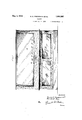
- Fig. 1 represents a front elevation of a refrigerating show case according to this invention, with' the dehydrating ytrough and the communicating channelin which it is disposed, indicated indotted lines at the lower end of the window,
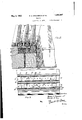
- Fig. 2 represents a fragmentary vertical section on a larger scale, through the window frame, the' spacedanes and the dehydrating trough, showing -t e assembly, and
- Fig. 3 represents a fragmentary horizon.
- the window construction includes an internal pane of glass (10) the'intermediate pane (11) in substantial parallelism therewith, but spaced therefrom to form an air chamber (12), anexternal pane 13) -spaced from and substantially lparallel with the intermediate pane (11) and n in the show case toa point within the vertical lower limits of the external pane (13).
- the several panes are spaced and-made as nearly air tight as possible in any conventional manner, as by means of-,spacing or partin strips (18) carrying the longitudinal exten ing compressionA members (20).
- the framework containing the panes com rises the structure of the show case surrou n ing the4 panes, including the spacing strips and compression ⁇ members, or
- vertical openings or slots (21)- are provi the recess (17) in the suplporting strip (16) at the bottom, and with t e respective spaces orl chambers (12) and (14), between the pancs, .at the upper ends.
- Thevertical openings may be closed at thel upper ends vfor neatness b metal strip (22 offany A'desired form, size,
- the recess (17) is t en closed by a block or pliig of insulating mate ⁇ rial, such ascork (26) pushed in through or from the inside of thecase, which may be caused to have an air tight seal with the inner surface (9) of the 'case byl a plastic cement rosive metal or paint or the like (28).
- a block or pliig of insulating mate ⁇ rial such ascork (26) pushed in through or from the inside of thecase, which may be caused to have an air tight seal with the inner surface (9) of the 'case byl a plastic cement rosive metal or paint or the like (28).
- the recess (17) and slots (21) and openings 19) form a channel continuous from space 12 to space (14), and which is disposed in the framework surrounding the panes and is subwhich in time may be covered for v ecorative purposes, by a sheet of non-cor-4 stantially sealed oft' from contact with the atmosphere in any direction.
- means including a channel for equalizin'g the pressures between the spaces, one surface delineating the channel comprising dehydrating material ,to
Landscapes
- Engineering & Computer Science (AREA)
- Civil Engineering (AREA)
- Structural Engineering (AREA)
- Securing Of Glass Panes Or The Like (AREA)
Description
May 3, 1932.- I
R. E, FREDERICK ET AL 2 Sheets-Sheet 1 2 gnam/tou May3, 1932- R. E. FREDERICK E-r Al. 1,356,867
WINDOW Filed Aug. 3, 1929 2 sheets-sheet 2 F' v fom/vo E F/'PEoEk/c/r aw( f (6.3' /V/LLMM E. HILL Patented May 3, l1932 UNITED STATES PATENT oFFlc HILL, OF PHILADELPHIA, PEN'NSYVITANIA,- T REUBEN E. OTTENHEIMER, 0F BALTI- 'wmnow t Application filed August 3i, 1929. Serial No. 383,359.
This invention relates to windows, with occurs when there is appreciable variation inthe temperatures on the inside and outside of the window, and cannot be removed in the normal case, especially in those installations where the panes are set tightly in the surrounding frame work.
Although the invention is of broaldapplication, it will be discussed with relation to the multiple pane windows of a rerigerating, or other, show case.
The structure to which the invention pertains, is one in which insulation of the displayed goods from the heat of the atmosphere outside of the case is of greatimportance, but even more important is lthe ease and facility with which the customer`may observe the displayed contents of the case.
As noted previously, the presence .of moisture in the entrapped air between the spaced panes of the window in the chamber formed Vby the panes and the frame causes condensation on an inner surface of one or more panes, thus obscuring the customers vision. The presence of moisture in the entra'pped air has a further detrimental influence in that the thermal conductivity of the entrapped air rises with the moisture content. For many reasons, therefore, the eiective dehydration of the entrapped air is desirable and has been attempted by others from time to time, with but small benefit owing to condi? tions which have not been fully appreciated in the past. I t must be appreciated that up to the present it has been impossibleto set the spaced panes of glassin their openings with an absolutely air tight seal, on a commercially feasible basis or scale. Moreover, it willbe appreciated that as an incident to variations in relative temperatures (i. e. inside of the refrigerating case, and the tem- Achannel or the temperatures peratures of the atmosphere surrounding the case externally), the entrapped air in the air chambers between the several panes will be caused to expand or contract. In view of this fact, and even assuming that the air initially filling the space between the' panes is completely dried beforehand, it will be evident that the expansion and contraction noted will e'ect a pumping action, gradually forcing dried air out of the air chambers between the panes, and then sucking moisture laden air in to take its place. The pumping action may be and usually is, very slow but the seepage incident thereto is fairly constant, and it is not long before the air chambers vare laden with moisture which condenses upon the cold surfaces ofthe panes when the dew point of the entrapped air is reached.
Among the objects of this invention are; to improve the construction of windows; to provide means for dehydrating air passing into the space between panes; to provide a window having multiple spaces between window panes with means equalizing the pressures in said spaces; to provide means for drying air conined between panes of glass actuated by natural forces acting upon said air to prevent the moisture content of the air lled space from approaching saturation, regardless of the temperature of the walls delineating such space; to improve the thermal insulating' value of multi-pane windows; to improve the construction of refrigerating show cases; and to obviate the disadvantageous features attaching to previous constructions.-
In carrying out the invention ferred form, a window construction is'provided, including multiple spaced panes having twosubstantially parallel air spaces, a
passage is provided communicating with the two air spaces, so that the pressures in the said spaces are kept equalized regardless of relative temperature variations and providing in the channel dehydrating means past, or-through, which, air from the spaces is caused to pass, and give up its moisture, and preferably also providedl `with ineans for removing and renewing the charge of dehydrating material when it loses its etiiciency.
in a pre- SES lIn the accompanying'drawings: l
Fig. 1 represents a front elevation of a refrigerating show case according to this invention, with' the dehydrating ytrough and the communicating channelin which it is disposed, indicated indotted lines at the lower end of the window,
Fig. 2 represents a fragmentary vertical section on a larger scale, through the window frame, the' spacedanes and the dehydrating trough, showing -t e assembly, and
Fig. 3 represents a fragmentary horizon.
i tal section looking down upon the perforated spacing strips between 4the panes to show the communicating passages between the air chambers delineated by the panes of glass.
In the preferred form the window construction includes an internal pane of glass (10) the'intermediate pane (11) in substantial parallelism therewith, but spaced therefrom to form an air chamber (12), anexternal pane 13) -spaced from and substantially lparallel with the intermediate pane (11) and n in the show case toa point within the vertical lower limits of the external pane (13). The several panes are spaced and-made as nearly air tight as possible in any conventional manner, as by means of-,spacing or partin strips (18) carrying the longitudinal exten ing compressionA members (20). For descriptive purposes the framework containing the panes com rises the structure of the show case surrou n ing the4 panes, including the spacing strips and compression` members, or
their equivalents. At desired points in the spacing strips' 18) vertical openings or slots (21)- are provi the recess (17) in the suplporting strip (16) at the bottom, and with t e respective spaces orl chambers (12) and (14), between the pancs, .at the upper ends. Thevertical openings may be closed at thel upper ends vfor neatness b metal strip (22 offany A'desired form, size,
orsliape, but preferably ofinvertedsubstana non-corrosive polished tially U-shape, as disclosed, having tions or o mugs (19) and tace A stri s- (18 An open* moaithedrece tacle (23 of noncorrosive material and fille with a dehydrating substance 24) such as calcium chloride, is inserted aterally int the rforaed, which communicate withv to the openings in the respective strips (18). In order to hold the loose calcium chloride in position during shipment, a reticulatedor mesh material sheet (25) may be imposed upon the upper surface of the dehydrating material (24). The receptacle being p ro ern ly disposed as shown, the recess (17) is t en closed by a block or pliig of insulating mate` rial, such ascork (26) pushed in through or from the inside of thecase, which may be caused to have an air tight seal with the inner surface (9) of the 'case byl a plastic cement rosive metal or paint or the like (28).
With the' structure substantially as described above, itwill beiobserved that the recess (17) and slots (21) and openings 19) form a channel continuous from space 12 to space (14), and which is disposed in the framework surrounding the panes and is subwhich in time may be covered for v ecorative purposes, by a sheet of non-cor-4 stantially sealed oft' from contact with the atmosphere in any direction.
It will be understood that with a low. temperature in contact with pane (10) and a higher temperature on pane (13) there will be a differential expansion of the air inthe chambers or spaces- (14) and (12) respectively, such a's to cause expandedair from spaces (14) t pass through4 the lower opening across the `surface of the dehydrating substance andinto space or chamber (12) in which case the space or chamber (12) is a reservoir fromwhich air passes into the space (1 4) through the recess 17) and ports (19) thus equalizing the pressures in the said spaces and simultaneously dryingthe air pass- Y ing between the chambers. Upon further variations in relative temperature, there will be further differential-variations in pressures resulting in a further passage of air across.
.thedehydrating material in its passage to the fo'tlierchamber.` While it is recognized thatequalization of the pressures might still present pressures in each chamber, either higher or lower than theA only approximately air tight joints will withstand without seepage,yet for all practical purposes it may be Vconsidered that the mere equalization alone substantially maintains the initial charges of entrapped air between the anes. This factor alone, withoutthe use o the dehydrating material, is'effective for long periods against I raising the moisture content to a point such as to obscure -vision through condensation,
v if the initially entrapped air was reasonably rven: thou h the resultant equalized pressures might moisture laden air into the confined spaces,
still the naturalf circulation incidentV to expansion andcontr'action as noted, will very quickly remove enough moisture Aas to render 0 the'contained'airhuiciently drvas toV maine5 recess (17 to positionsibeneath the Vertical tain the thermal eiciency of the insulating suchas to cause seepage of spaces, and, of course, with a maintenance of i clear vision.
lt will be understood that the initial charge of dehydrating material will last for anv indeinitely long period, and that upon its reaching a state of saturation, it is a relatively simple matter to remove plate (28) and the plastic cement (27) pull out the plug (26) giving access to the contained receptaclel which may he removed, to insert a new charge in its place, which is subsequently ire-sealed in position.
lt is to be noted that with the dehydrating material substantially sealed in a space com 'municating with the entrapped air, highly beneficial results may be secured even without the equalizationof pressures in a plurality of chambers. Owing to the existence of convection currents in the entrapped air, incident to variations in external temperatures, the entrapped' air will he caused to circ culate in the connes of its space, thus passy ing over the dehydrating material and constantl tending to maintain its dryness, even though but a single air chamber is provided, and even though there may still he a pumping action incident to variations in temperatures. lt Will simply mean a more frequent renewal of the dehydrating material.. Such a constructionfand function-is contemplated in this invention.
lt is to be noted that the improvement recited, is of very low cost, is unobstrusive, and
is highly e'ective for the purposes intended; lt Will be clear that although the construe1 tion disclosed isy preferred, yetmany modications will occur to those skilled in the art Without departing from the spirit andsco e of the invention, and all of which are to. construed as Within the spirit of the invention as recited in the appended claim. We claim as our'invention:
In a refrigerating case having a plurality of spaces between the panes, means including a channel for equalizin'g the pressures between the spaces, one surface delineating the channel comprising dehydrating material ,to
dehydrate the air passing therethrough.
Signed atY Philadelphia, county of Philadelphia, and State of Pennsylvania, this=2nd vday of July, 1929.
ROLAND E. FREDERICK.
E. HILL. i
Priority Applications (1)
| Application Number | Priority Date | Filing Date | Title |
|---|---|---|---|
| US383359A US1856867A (en) | 1929-08-03 | 1929-08-03 | Window |
Applications Claiming Priority (1)
| Application Number | Priority Date | Filing Date | Title |
|---|---|---|---|
| US383359A US1856867A (en) | 1929-08-03 | 1929-08-03 | Window |
Publications (1)
| Publication Number | Publication Date |
|---|---|
| US1856867A true US1856867A (en) | 1932-05-03 |
Family
ID=23512752
Family Applications (1)
| Application Number | Title | Priority Date | Filing Date |
|---|---|---|---|
| US383359A Expired - Lifetime US1856867A (en) | 1929-08-03 | 1929-08-03 | Window |
Country Status (1)
| Country | Link |
|---|---|
| US (1) | US1856867A (en) |
Cited By (2)
| Publication number | Priority date | Publication date | Assignee | Title |
|---|---|---|---|---|
| US2465163A (en) * | 1944-09-23 | 1949-03-22 | Niles Bement Pond Co | Corrosion prevention |
| US20120243068A1 (en) * | 2011-03-25 | 2012-09-27 | J Touch Corporation | Electrochromic apparatus |
-
1929
- 1929-08-03 US US383359A patent/US1856867A/en not_active Expired - Lifetime
Cited By (2)
| Publication number | Priority date | Publication date | Assignee | Title |
|---|---|---|---|---|
| US2465163A (en) * | 1944-09-23 | 1949-03-22 | Niles Bement Pond Co | Corrosion prevention |
| US20120243068A1 (en) * | 2011-03-25 | 2012-09-27 | J Touch Corporation | Electrochromic apparatus |
Similar Documents
| Publication | Publication Date | Title |
|---|---|---|
| US2877515A (en) | Insulated metal-framed window sash | |
| US2011557A (en) | Window structure | |
| US2928144A (en) | Frame structures | |
| US2625717A (en) | Multiple sheet glazing unit | |
| US2281071A (en) | Window construction | |
| US2332060A (en) | Window | |
| US1856867A (en) | Window | |
| US2945269A (en) | Double pane window structure | |
| US1605583A (en) | Double-glazed window | |
| US2003982A (en) | Window construction | |
| US2202694A (en) | Double glazed window | |
| US1915704A (en) | Showcase refrigerator | |
| US2304757A (en) | Refrigerator construction | |
| US1893525A (en) | Antifogging device | |
| US2278694A (en) | Double glass windowpane | |
| US1965461A (en) | Dehydrator for refrigerators | |
| US2257948A (en) | Means for preventing moisture condensation upon refrigerator windows | |
| US2102972A (en) | Sign | |
| US3091006A (en) | Windows | |
| US1877685A (en) | Refrigerator | |
| US2933780A (en) | Multiple pane window units | |
| US2117581A (en) | Air change means for window glass insulation systems | |
| US2088738A (en) | Double glazed window | |
| CN206000361U (en) | Be conducive to sealing the bridge-cut aluminum section bar of waterproof | |
| US1956102A (en) | Antifogging device for glass-walled refrigeration chambers |