US1856801A - Distilling petroleum residuum - Google Patents
Distilling petroleum residuum Download PDFInfo
- Publication number
- US1856801A US1856801A US699459A US69945924A US1856801A US 1856801 A US1856801 A US 1856801A US 699459 A US699459 A US 699459A US 69945924 A US69945924 A US 69945924A US 1856801 A US1856801 A US 1856801A
- Authority
- US
- United States
- Prior art keywords
- chamber
- residues
- combustion
- products
- vaporous
- Prior art date
- Legal status (The legal status is an assumption and is not a legal conclusion. Google has not performed a legal analysis and makes no representation as to the accuracy of the status listed.)
- Expired - Lifetime
Links
- 239000003208 petroleum Substances 0.000 title description 8
- 239000003921 oil Substances 0.000 description 30
- 238000009835 boiling Methods 0.000 description 17
- 238000002485 combustion reaction Methods 0.000 description 16
- 239000000571 coke Substances 0.000 description 14
- 238000004519 manufacturing process Methods 0.000 description 13
- 238000004939 coking Methods 0.000 description 10
- 239000007789 gas Substances 0.000 description 10
- 238000000034 method Methods 0.000 description 6
- 230000000694 effects Effects 0.000 description 5
- 238000010438 heat treatment Methods 0.000 description 5
- 239000000567 combustion gas Substances 0.000 description 4
- 238000001816 cooling Methods 0.000 description 4
- 238000004821 distillation Methods 0.000 description 4
- 239000000463 material Substances 0.000 description 4
- 239000000203 mixture Substances 0.000 description 4
- 238000005507 spraying Methods 0.000 description 4
- 239000011449 brick Substances 0.000 description 3
- 239000011261 inert gas Substances 0.000 description 3
- 239000007921 spray Substances 0.000 description 3
- IJGRMHOSHXDMSA-UHFFFAOYSA-N Atomic nitrogen Chemical compound N#N IJGRMHOSHXDMSA-UHFFFAOYSA-N 0.000 description 2
- CURLTUGMZLYLDI-UHFFFAOYSA-N Carbon dioxide Chemical compound O=C=O CURLTUGMZLYLDI-UHFFFAOYSA-N 0.000 description 2
- 239000010779 crude oil Substances 0.000 description 2
- 239000000446 fuel Substances 0.000 description 2
- 239000000295 fuel oil Substances 0.000 description 2
- 239000007788 liquid Substances 0.000 description 2
- 239000011295 pitch Substances 0.000 description 2
- 238000000197 pyrolysis Methods 0.000 description 2
- 238000001256 steam distillation Methods 0.000 description 2
- 239000004215 Carbon black (E152) Substances 0.000 description 1
- UGFAIRIUMAVXCW-UHFFFAOYSA-N Carbon monoxide Chemical compound [O+]#[C-] UGFAIRIUMAVXCW-UHFFFAOYSA-N 0.000 description 1
- 241000276489 Merlangius merlangus Species 0.000 description 1
- 229910002092 carbon dioxide Inorganic materials 0.000 description 1
- 239000001569 carbon dioxide Substances 0.000 description 1
- 238000010924 continuous production Methods 0.000 description 1
- 238000000354 decomposition reaction Methods 0.000 description 1
- 238000005485 electric heating Methods 0.000 description 1
- 239000004744 fabric Substances 0.000 description 1
- 239000003546 flue gas Substances 0.000 description 1
- 239000008246 gaseous mixture Substances 0.000 description 1
- 230000005484 gravity Effects 0.000 description 1
- 229930195733 hydrocarbon Natural products 0.000 description 1
- 150000002430 hydrocarbons Chemical class 0.000 description 1
- 238000002347 injection Methods 0.000 description 1
- 239000007924 injection Substances 0.000 description 1
- 239000002184 metal Substances 0.000 description 1
- 229910001120 nichrome Inorganic materials 0.000 description 1
- 229910052757 nitrogen Inorganic materials 0.000 description 1
- 239000002245 particle Substances 0.000 description 1
- 239000003209 petroleum derivative Substances 0.000 description 1
- 239000011819 refractory material Substances 0.000 description 1
- 239000007787 solid Substances 0.000 description 1
- XLYOFNOQVPJJNP-UHFFFAOYSA-N water Substances O XLYOFNOQVPJJNP-UHFFFAOYSA-N 0.000 description 1
Images
Classifications
-
- C—CHEMISTRY; METALLURGY
- C10—PETROLEUM, GAS OR COKE INDUSTRIES; TECHNICAL GASES CONTAINING CARBON MONOXIDE; FUELS; LUBRICANTS; PEAT
- C10G—CRACKING HYDROCARBON OILS; PRODUCTION OF LIQUID HYDROCARBON MIXTURES, e.g. BY DESTRUCTIVE HYDROGENATION, OLIGOMERISATION, POLYMERISATION; RECOVERY OF HYDROCARBON OILS FROM OIL-SHALE, OIL-SAND, OR GASES; REFINING MIXTURES MAINLY CONSISTING OF HYDROCARBONS; REFORMING OF NAPHTHA; MINERAL WAXES
- C10G9/00—Thermal non-catalytic cracking, in the absence of hydrogen, of hydrocarbon oils
- C10G9/34—Thermal non-catalytic cracking, in the absence of hydrogen, of hydrocarbon oils by direct contact with inert preheated fluids, e.g. with molten metals or salts
- C10G9/36—Thermal non-catalytic cracking, in the absence of hydrogen, of hydrocarbon oils by direct contact with inert preheated fluids, e.g. with molten metals or salts with heated gases or vapours
-
- C—CHEMISTRY; METALLURGY
- C10—PETROLEUM, GAS OR COKE INDUSTRIES; TECHNICAL GASES CONTAINING CARBON MONOXIDE; FUELS; LUBRICANTS; PEAT
- C10G—CRACKING HYDROCARBON OILS; PRODUCTION OF LIQUID HYDROCARBON MIXTURES, e.g. BY DESTRUCTIVE HYDROGENATION, OLIGOMERISATION, POLYMERISATION; RECOVERY OF HYDROCARBON OILS FROM OIL-SHALE, OIL-SAND, OR GASES; REFINING MIXTURES MAINLY CONSISTING OF HYDROCARBONS; REFORMING OF NAPHTHA; MINERAL WAXES
- C10G7/00—Distillation of hydrocarbon oils
-
- C—CHEMISTRY; METALLURGY
- C10—PETROLEUM, GAS OR COKE INDUSTRIES; TECHNICAL GASES CONTAINING CARBON MONOXIDE; FUELS; LUBRICANTS; PEAT
- C10G—CRACKING HYDROCARBON OILS; PRODUCTION OF LIQUID HYDROCARBON MIXTURES, e.g. BY DESTRUCTIVE HYDROGENATION, OLIGOMERISATION, POLYMERISATION; RECOVERY OF HYDROCARBON OILS FROM OIL-SHALE, OIL-SAND, OR GASES; REFINING MIXTURES MAINLY CONSISTING OF HYDROCARBONS; REFORMING OF NAPHTHA; MINERAL WAXES
- C10G9/00—Thermal non-catalytic cracking, in the absence of hydrogen, of hydrocarbon oils
- C10G9/34—Thermal non-catalytic cracking, in the absence of hydrogen, of hydrocarbon oils by direct contact with inert preheated fluids, e.g. with molten metals or salts
- C10G9/36—Thermal non-catalytic cracking, in the absence of hydrogen, of hydrocarbon oils by direct contact with inert preheated fluids, e.g. with molten metals or salts with heated gases or vapours
- C10G9/38—Thermal non-catalytic cracking, in the absence of hydrogen, of hydrocarbon oils by direct contact with inert preheated fluids, e.g. with molten metals or salts with heated gases or vapours produced by partial combustion of the material to be cracked or by combustion of another hydrocarbon
Definitions
- This invention relates to the production of useful hydrocarbon oil products from heavy residual pitches derived, for example, by the steam distillation of crude petroleum oils.
- the present invention is particularly use ful in the handling of the heavy pitch residues resulting from a continuous steam distillation of crude or reduced crude oils to bot toms con-responding, for example, to about 15% or less than 15% on oils of the character of Mid Continent crude oils.
- Such residues are normally very viscous or solid at ordinary temperatures, have a flash point above 500 F, and their further decomposition by destructive distillation is attended by many practical diificulties.
- the coking or dry distillation of such residues is efl'ectively and economically accomplished by a continuous process.
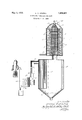
- the invention will be more fully understood by the reference to the accompanying drawing, in which is shown somewhat diagrammatically, and partly in section, apparatus suitable for carrying the invention into eifect.
- the numeral 5 indicates a supply pipe, by means of which the residue to be treated is brought into the apparatus, being preferably preheated.
- the supply pipe 5 enters the chamber of a combustion furnace 6, which may suitably have a cylindrical masonry or fire brick Wall section 7 through which extend numerous spaced openings 8.
- a jacket 9 Surrounding the masonry wall section is a jacket 9, an inflammable as mixture being introduced into this ja ket through a pipe 10.
- the perforated wall section 7 is lined by broken refractory material, for example, broken fire brick, providing a perforate refractory lining, this lining 11 being held in position by a lining of a grid or perforated sheet, of a suitable resistant metal, e. g.
- the brick section 7, lining 11 and gauze 12 collectively provide the defining wall of the aforesaid chamber of the combustion furnace 6.
- the inflammable mixture introduced .at 10 passes through the perforations 8 in the wall of the furnace and undergoes surface or flameless combustion in the refractory lining 11, the rate of supply being preferably so controlled as to keep the zone of combustion as near as possible to the inner surface of this layer of material.
- the gaseous mixture may be ignited in any suitable manner, such as by introducing a flaming torch through the flue 23 to the interior of the chamber and through a suitable opening in the screen 12.
- the mixture of combustible gases may then be introduced through the line 10, the velocity of the mixture being such that surface combustion will occur in the small spaces in the lining 11.
- the lining 12 in the form of a suitable metallic grid may be employed as an electric heating element and an inert gas, such as flue gas, nitrogen, carbon dioxide, superheated steam or the like may be forced in from the jacket 9.
- the preheated oil, introduced through the pipe 5, is broken up or atomized by the spray head 13, and in a finely subdivided form, is brought to a high temperature, say 800 to 1000 F., by the heat applied and is likewise intermixed with the combustion gases entering the space within the furnace lining 12.
- Vapors and condensate pass out of the vapor passage 18 through pipe 20 and pass through a suitable condenser 21, which may be water cooled if desired. From the condenser 21 the products pass into a riser or gas separator 22, condensates passing out through pipe 23 and uncondensed gases being withdrawn from the top.
- a portion thereof may be diverted, for example, through an outlet 23, directly through the stack (not shown)
- the distillation of the finely subdivided residuum is very rapid and the coke formed as a result ofiits distillation is in finely divided form, the greater portion thereof separating out in a separator 15.
- the residuum handled may be, for example, a 14 B. Mid Continent crude residuum having a flash point of about 525 F.
- the oil preheated, for example, to a temperature of about 600 F., is sprayed into the furnace through the pipe 5 and the nozzle 13.
- the combustion chamber is heated by inflammable gas introduced through the pipe 10, inert combustion gas being mixed with the finely divided oil in the interior of the furnace within the lining 12 and passing out through the vapor passage 14, where a temperature of 1000 to 1100 F. is produced.
- Liquid distillate products are formed to the extent of about to these products having a Viscosity of about 128 sec. Saybolt at 210 F. and a Baum gravity of 18 to'20.
- An average product shows an initial boiling point of 380 to 400 F. and approximately 80% off at 750 F.
- the method of distilling anddecomposing heavy petroleum residues for the production of coke and lower boiling oils therefrom which comprises spraying such residues in finely divided form through a coking chamber having a perforated wall, internally heating the body of the perforated wall of the chamber, introducing inert gases into the chamber through the perforations in said heated wall into the chamber, whereby the gases are heated and impart heat to the oil residues therein suflicient to effect coking of the individual finely divided portions of such residue and the production of lower boiling oils in vaporous form, passin the finely divided coke and vaporous pro ucts to an independent, separate, unheated chamber, separately withdrawing the vaporous products from said second chamber, and cooling the vapors to condense low boiling oils therefrom.
- the method of distilling and decomposing heavy petroleum residues for the production of coke and lower boiling oils therefrom which comprises spraying such residues in finely divided form through a chamber, effecting combustion of fuel within combustion spaces comprising a material part of the area of the body of the wall of said chamber, introducing the gases produced by such oombustion into said chamber, whereby the gases impart heat to the oil residues therein sufficient to effect coking of the individual finely divided portions of such residues and the production of low boiling oils in vaporous form, passing the finely divided coke and vaporous products to an independent, separate, unheated chamber, separately with drawing the vaporous products from said second chamber, and cooling said vapors to condense low-boiling oils therefrom.
- the method of distilling and decomposing petroleum residues for the production of coke and low boiling oils therefrom which comprises spraying such residues in finely divided form through a chamber, introducing highly heated gaseous products of combustion into said chamber through perforations distributed over substantially the en tire interior area of the walls of said chamber to heat said finely divided residues to between about 800 F. and about 1200 F. and effect a coking of such residues and the production of low boiling oils in vaporous form, passing the coke and vaporous products to an independent, separate, unheated chamber, separately withdrawing the vaporous products from said chamber, and cooling said vapors to condense low boiling oils therefrom.
- the method of distilling and decomposing heavy petroleum residues for the production of coke and low boiling oils therefrom which comprises spraying such residues in finely divided form through a chamber, effecting combustion of fuel within the body of the wall of said chamber and introducing into the chamber the highly heated gaseous products of combustion through minute perforations occupying a substantial part of the inner aea of said walls, to heat said finely divided residues to between about 800 F. and 1200 F. to effect coking of the said residue and the production of low boiling oils in vaporous form, passing the coke and vaporous products to an independent separate unheated chamber, separately withdrawing the vaporous products fom said second chamher, and cooling said vapors to condense lower boiling oils therefrom.
- a chamber havin a perforate wall, means for assing finely su -divided oil residues throug said chamber, means for internally heating the body of the perforated wall of said chamber, means for forcing heated inert gases into said chamber through the perforations in the wall of the said chamber whereby the gases impart heat to the oil residues within the said chamber to effect coking of the finely divided par ticles of residues passing therethrough and the production of lower boiling oils in vaporous form, an independent unheated separating chamber, means for passing the finel divided coked residues and vaporous pro ucts from said coking chamber to said separating chamber, means for separately withdrawing vaporous petroleum products from said separating chamber, and means for condensing said Withdrawn vaporous products.
- a coking chamber provided with a plurality of combustion spaces in a material part of the inner area of its wall which communicates with the interior of said chamber, means for passing finely sub-divided oil residues through said chamber, means for supplying suitable combustible material into said combustion spaces to produce combustion therein, whereby the products of combustion flow from said combustion spaces into the chamber and impart heat to the oil residues passing therethrough to efiect coking of said residue and the production of lower boiling oils in vaporous form, an independent unheated separating chamber, means for passing the coked residues and said vaporous products to said separating chamber, means for separately withdrawing vaporous products from said separating chamber, and means for condensing the withdrawn vaporous products.
Landscapes
- Chemical & Material Sciences (AREA)
- Oil, Petroleum & Natural Gas (AREA)
- Engineering & Computer Science (AREA)
- Chemical Kinetics & Catalysis (AREA)
- General Chemical & Material Sciences (AREA)
- Organic Chemistry (AREA)
- Physics & Mathematics (AREA)
- Thermal Sciences (AREA)
- Combustion & Propulsion (AREA)
- Production Of Liquid Hydrocarbon Mixture For Refining Petroleum (AREA)
Description
H. V. ATWELL May 3, 1932.
DISTILLING PETROLEUM RESIDUUM Filed March 15, 1924 Patented May 3, 1932 UNITED STATES PATENT OFFICE HAROLD V. ATWELL, OF WRITING, INDIANA, ASSIGNOR T'O STANDARD OIL COMPANY, OF WHITING, INDIANA, A CORPORATION OF INDIANA DISTILLING PETROLEUM RESIDUUM Application filed March 15, 1924. Serial No. 699,459.
This invention relates to the production of useful hydrocarbon oil products from heavy residual pitches derived, for example, by the steam distillation of crude petroleum oils.
The present invention is particularly use ful in the handling of the heavy pitch residues resulting from a continuous steam distillation of crude or reduced crude oils to bot toms con-responding, for example, to about 15% or less than 15% on oils of the character of Mid Continent crude oils. Such residues are normally very viscous or solid at ordinary temperatures, have a flash point above 500 F, and their further decomposition by destructive distillation is attended by many practical diificulties. In the specific embodiment of this invention hereinafter fully disclosed, the coking or dry distillation of such residues is efl'ectively and economically accomplished by a continuous process. The invention will be more fully understood by the reference to the accompanying drawing, in which is shown somewhat diagrammatically, and partly in section, apparatus suitable for carrying the invention into eifect.
Referring more particularly to the draw ing, the numeral 5 indicates a supply pipe, by means of which the residue to be treated is brought into the apparatus, being preferably preheated. The supply pipe 5 enters the chamber of a combustion furnace 6, which may suitably have a cylindrical masonry or fire brick Wall section 7 through which extend numerous spaced openings 8. Surrounding the masonry wall section is a jacket 9, an inflammable as mixture being introduced into this ja ket through a pipe 10. The perforated wall section 7 is lined by broken refractory material, for example, broken fire brick, providing a perforate refractory lining, this lining 11 being held in position by a lining of a grid or perforated sheet, of a suitable resistant metal, e. g. nichrome, etc., gauze or cloth 12. The brick section 7, lining 11 and gauze 12 collectively provide the defining wall of the aforesaid chamber of the combustion furnace 6. The inflammable mixture introduced .at 10 passes through the perforations 8 in the wall of the furnace and undergoes surface or flameless combustion in the refractory lining 11, the rate of supply being preferably so controlled as to keep the zone of combustion as near as possible to the inner surface of this layer of material. The gaseous mixture may be ignited in any suitable manner, such as by introducing a flaming torch through the flue 23 to the interior of the chamber and through a suitable opening in the screen 12. The mixture of combustible gases may then be introduced through the line 10, the velocity of the mixture being such that surface combustion will occur in the small spaces in the lining 11. It is readily apparent that other heating means than that above described may be employed; thus the lining 12 in the form of a suitable metallic grid, may be employed as an electric heating element and an inert gas, such as flue gas, nitrogen, carbon dioxide, superheated steam or the like may be forced in from the jacket 9. The preheated oil, introduced through the pipe 5, is broken up or atomized by the spray head 13, and in a finely subdivided form, is brought to a high temperature, say 800 to 1000 F., by the heat applied and is likewise intermixed with the combustion gases entering the space within the furnace lining 12. The passage of the gases through this furnace lining prevents adherence of coke thereto. The coke and products of distillation, together with ad mixed combustion gases, pass through theshort conduit 14 into the settling chamber 15, which is diagrammatically shown, and may be constructed as any suitable effective form of separator. Coke deposited in this separating chamber collects in its conical lower portion 16, a baflie 17 being provided to prevent its passage through the vapor exit 18. Vapors and gases pass out through the vapor pipe 18, condensate or entrained liquid deposited therein bcing drawn off through the draw-off pipe 19, for example, for examination or testing. Vapors and condensate pass out of the vapor passage 18 through pipe 20 and pass through a suitable condenser 21, which may be water cooled if desired. From the condenser 21 the products pass into a riser or gas separator 22, condensates passing out through pipe 23 and uncondensed gases being withdrawn from the top.
In carrying out the process, it has been found convenient to control the heating in the furnace or heating chamber by the temperature conditions prevailing at its exit, that is, in the passage 14 or substantially at the inlet to the chamber 15. It has been found that satisfactory yields of distillation products may be obtained when this temperature is from 800 to 1200 F. The oil may suitably be preheated before injection into the furnace 6 to a temperature of 500 to 700 F. The atomizing or spray nozzle 13 is so constructed that the column of spray thrown by it does not impinge upon the interior Walls of the furnace, that is, upon the lining 12. If it is not desired to employ the entire body of combustion gases in the manner described, a portion thereof may be diverted, for example, through an outlet 23, directly through the stack (not shown) The distillation of the finely subdivided residuum is very rapid and the coke formed as a result ofiits distillation is in finely divided form, the greater portion thereof separating out in a separator 15.
The following example illustrates a method of carrying out the present invention. The residuum handled may be, for example, a 14 B. Mid Continent crude residuum having a flash point of about 525 F. The oil, preheated, for example, to a temperature of about 600 F., is sprayed into the furnace through the pipe 5 and the nozzle 13. The combustion chamber is heated by inflammable gas introduced through the pipe 10, inert combustion gas being mixed with the finely divided oil in the interior of the furnace within the lining 12 and passing out through the vapor passage 14, where a temperature of 1000 to 1100 F. is produced. Liquid distillate products are formed to the extent of about to these products having a Viscosity of about 128 sec. Saybolt at 210 F. and a Baum gravity of 18 to'20. An average product shows an initial boiling point of 380 to 400 F. and approximately 80% off at 750 F.
I claim:
1. The method of distilling anddecomposing heavy petroleum residues for the production of coke and lower boiling oils therefrom, which comprises spraying such residues in finely divided form through a coking chamber having a perforated wall, internally heating the body of the perforated wall of the chamber, introducing inert gases into the chamber through the perforations in said heated wall into the chamber, whereby the gases are heated and impart heat to the oil residues therein suflicient to effect coking of the individual finely divided portions of such residue and the production of lower boiling oils in vaporous form, passin the finely divided coke and vaporous pro ucts to an independent, separate, unheated chamber, separately withdrawing the vaporous products from said second chamber, and cooling the vapors to condense low boiling oils therefrom.
2. The method of distilling and decomposing heavy petroleum residues for the production of coke and lower boiling oils therefrom, which comprises spraying such residues in finely divided form through a chamber, effecting combustion of fuel within combustion spaces comprising a material part of the area of the body of the wall of said chamber, introducing the gases produced by such oombustion into said chamber, whereby the gases impart heat to the oil residues therein sufficient to effect coking of the individual finely divided portions of such residues and the production of low boiling oils in vaporous form, passing the finely divided coke and vaporous products to an independent, separate, unheated chamber, separately with drawing the vaporous products from said second chamber, and cooling said vapors to condense low-boiling oils therefrom.
3. The method of distilling and decomposing petroleum residues for the production of coke and low boiling oils therefrom, which comprises spraying such residues in finely divided form through a chamber, introducing highly heated gaseous products of combustion into said chamber through perforations distributed over substantially the en tire interior area of the walls of said chamber to heat said finely divided residues to between about 800 F. and about 1200 F. and effect a coking of such residues and the production of low boiling oils in vaporous form, passing the coke and vaporous products to an independent, separate, unheated chamber, separately withdrawing the vaporous products from said chamber, and cooling said vapors to condense low boiling oils therefrom.
4. The method of distilling and decomposing heavy petroleum residues for the production of coke and low boiling oils therefrom, which comprises spraying such residues in finely divided form through a chamber, effecting combustion of fuel within the body of the wall of said chamber and introducing into the chamber the highly heated gaseous products of combustion through minute perforations occupying a substantial part of the inner aea of said walls, to heat said finely divided residues to between about 800 F. and 1200 F. to effect coking of the said residue and the production of low boiling oils in vaporous form, passing the coke and vaporous products to an independent separate unheated chamber, separately withdrawing the vaporous products fom said second chamher, and cooling said vapors to condense lower boiling oils therefrom.
5. In apparatus for distilling and decomposing heavy oil residues for the production of coke and lower boiling oils, a chamber havin a perforate wall, means for assing finely su -divided oil residues throug said chamber, means for internally heating the body of the perforated wall of said chamber, means for forcing heated inert gases into said chamber through the perforations in the wall of the said chamber whereby the gases impart heat to the oil residues within the said chamber to effect coking of the finely divided par ticles of residues passing therethrough and the production of lower boiling oils in vaporous form, an independent unheated separating chamber, means for passing the finel divided coked residues and vaporous pro ucts from said coking chamber to said separating chamber, means for separately withdrawing vaporous petroleum products from said separating chamber, and means for condensing said Withdrawn vaporous products.
6. In apparatus for distilling and decomposing heavy oil residues for the production of coke and lower boiling oils, a coking chamber provided with a plurality of combustion spaces in a material part of the inner area of its wall which communicates with the interior of said chamber, means for passing finely sub-divided oil residues through said chamber, means for supplying suitable combustible material into said combustion spaces to produce combustion therein, whereby the products of combustion flow from said combustion spaces into the chamber and impart heat to the oil residues passing therethrough to efiect coking of said residue and the production of lower boiling oils in vaporous form, an independent unheated separating chamber, means for passing the coked residues and said vaporous products to said separating chamber, means for separately withdrawing vaporous products from said separating chamber, and means for condensing the withdrawn vaporous products.
HAROLD V. ATWELL.
Priority Applications (1)
| Application Number | Priority Date | Filing Date | Title |
|---|---|---|---|
| US699459A US1856801A (en) | 1924-03-15 | 1924-03-15 | Distilling petroleum residuum |
Applications Claiming Priority (1)
| Application Number | Priority Date | Filing Date | Title |
|---|---|---|---|
| US699459A US1856801A (en) | 1924-03-15 | 1924-03-15 | Distilling petroleum residuum |
Publications (1)
| Publication Number | Publication Date |
|---|---|
| US1856801A true US1856801A (en) | 1932-05-03 |
Family
ID=24809421
Family Applications (1)
| Application Number | Title | Priority Date | Filing Date |
|---|---|---|---|
| US699459A Expired - Lifetime US1856801A (en) | 1924-03-15 | 1924-03-15 | Distilling petroleum residuum |
Country Status (1)
| Country | Link |
|---|---|
| US (1) | US1856801A (en) |
Cited By (1)
| Publication number | Priority date | Publication date | Assignee | Title |
|---|---|---|---|---|
| US2546042A (en) * | 1948-12-31 | 1951-03-20 | Phillips Petroleum Co | Process and apparatus for catalytic conversion of hydrocarbons |
-
1924
- 1924-03-15 US US699459A patent/US1856801A/en not_active Expired - Lifetime
Cited By (1)
| Publication number | Priority date | Publication date | Assignee | Title |
|---|---|---|---|---|
| US2546042A (en) * | 1948-12-31 | 1951-03-20 | Phillips Petroleum Co | Process and apparatus for catalytic conversion of hydrocarbons |
Similar Documents
| Publication | Publication Date | Title |
|---|---|---|
| US2342862A (en) | Activated coke | |
| US2456796A (en) | Hydrocarbon coking | |
| US2599981A (en) | Carbon black | |
| US2561420A (en) | Continuous hydrocarbon conversion process and apparatus | |
| US2432503A (en) | Heater | |
| US3211532A (en) | Carbon black furnace | |
| JPH01301786A (en) | Continuous fluidization for improving quality of raw material containing heavy hydrocarbon | |
| US2659663A (en) | Process for producing carbon black | |
| US2413407A (en) | Method of cracking hydrocarbons in the presence of a diluent gas | |
| US2489628A (en) | Cracking process for the production of olefins from hydrocarbons | |
| US2366055A (en) | Coking process | |
| US1825374A (en) | Method of coking petroleum residues from the distillation of petroleum oils | |
| US2848381A (en) | Gas-solids separation in high temperature coking | |
| US2789148A (en) | Conversion of hydrocarbons | |
| US2605177A (en) | Manufacture of combustible gas | |
| US3073875A (en) | Process for preparation of acetylene | |
| US3411885A (en) | Apparatus and process for producing carbon black | |
| US2428666A (en) | Catalytic conversion of hydrocarbons | |
| US1907029A (en) | Method of cracxing petroleum vapors | |
| US1459156A (en) | Distillation and cracking of mineral oils and other hydrocarboncontaining material | |
| US2870087A (en) | Cracking process | |
| US1714198A (en) | Apparatus for treating oils | |
| US1973471A (en) | Cracking of hydrocarbon oils | |
| US1002570A (en) | Treatment of petroleum. | |
| US1455376A (en) | Process of converting oils |