US1856749A - Vibrating film for acoustic devices - Google Patents
Vibrating film for acoustic devices Download PDFInfo
- Publication number
- US1856749A US1856749A US446603A US44660330A US1856749A US 1856749 A US1856749 A US 1856749A US 446603 A US446603 A US 446603A US 44660330 A US44660330 A US 44660330A US 1856749 A US1856749 A US 1856749A
- Authority
- US
- United States
- Prior art keywords
- films
- vibrating
- sound
- air
- film
- Prior art date
- Legal status (The legal status is an assumption and is not a legal conclusion. Google has not performed a legal analysis and makes no representation as to the accuracy of the status listed.)
- Expired - Lifetime
Links
Images
Classifications
-
- H—ELECTRICITY
- H04—ELECTRIC COMMUNICATION TECHNIQUE
- H04R—LOUDSPEAKERS, MICROPHONES, GRAMOPHONE PICK-UPS OR LIKE ACOUSTIC ELECTROMECHANICAL TRANSDUCERS; ELECTRIC HEARING AIDS; PUBLIC ADDRESS SYSTEMS
- H04R7/00—Diaphragms for electromechanical transducers; Cones
- H04R7/02—Diaphragms for electromechanical transducers; Cones characterised by the construction
- H04R7/04—Plane diaphragms
- H04R7/06—Plane diaphragms comprising a plurality of sections or layers
- H04R7/08—Plane diaphragms comprising a plurality of sections or layers comprising superposed layers separated by air or other fluid
-
- H—ELECTRICITY
- H04—ELECTRIC COMMUNICATION TECHNIQUE
- H04R—LOUDSPEAKERS, MICROPHONES, GRAMOPHONE PICK-UPS OR LIKE ACOUSTIC ELECTROMECHANICAL TRANSDUCERS; ELECTRIC HEARING AIDS; PUBLIC ADDRESS SYSTEMS
- H04R1/00—Details of transducers, loudspeakers or microphones
- H04R1/20—Arrangements for obtaining desired frequency or directional characteristics
- H04R1/22—Arrangements for obtaining desired frequency or directional characteristics for obtaining desired frequency characteristic only
- H04R1/28—Transducer mountings or enclosures modified by provision of mechanical or acoustic impedances, e.g. resonator, damping means
- H04R1/2807—Enclosures comprising vibrating or resonating arrangements
- H04R1/283—Enclosures comprising vibrating or resonating arrangements using a passive diaphragm
- H04R1/2834—Enclosures comprising vibrating or resonating arrangements using a passive diaphragm for loudspeaker transducers
Definitions
- VIBRATING FILM FOR ACOUSTIC DEVICES Filed April 23. 1930 Patented May 3, 1932 UNITED STATES FERNAND LESIEURE DESBBIERE, OF MARSEILLE, FRANCE VIBRATING FILM FOR ACOUSTIC DEVICES Application filed April 23, 1930, Serial No. 446,603, and in Germany May 15, 1929.
- the present invention relates to acoustic devices and has for its principal object the provision of means for improving the tone of sounds emitted by any acoustic mach nes, phonograph, loud speaker, sound amplifier for wireless or so-called p1ck-up,te lepnone receiver, telephone emitter or the like and giving to every sound wave even to weak ones, emitted at the same time as the principal sound, power enough to be heard, by the effect of reaction and resonance.
- the device is not intended for submarine use.
- the aforesaid object is obtained by the employment of a plurality of films arranged so as to close tightly the sound emisslon openings of any desired acoustic device between the atmosphere and the sound producer, the films being thin flexible fiat air-tight and easily vlbrating and being made of non-sonorous material and arranged parallel to one another.
- A11 at atmospheric pressure is tlghtly enclosed between the said films.
- the innermost film is caused to vibrate by variations of the pressure of air located between itself and the sound producing member in a closed space which is also at atmospheric pressure, without any mechanical impulse from the sand piece.
- the said films are made of any eas ly vibrating material, for instance celluloid, thin metal, leather, paper and so on, but the materials must be air-tight.
- the films vibrate only by changes of their plane surface produced by changes of pressure of enclosed air between the films themselves and, as aforesaid, between the innermost one and the sound producing member in an enclosed space.
- the rings on which the films are mounted are arranged so as to leave a space between the said films, and must be asrigid as possible.
- the oblique sound waves emitted for example, by the vibrating cone of a sound amplifier or transmitted by a horn of any shape which would have crossed each other outside of the acoustic device are caught by the innermost film and changed into parallel ones by transmission to the other films thus improving the tone without any loss of power.
- the said films may be used in any number, according to the shape and use of the acoustic device.
- the films are intended for the reproduction of music they are preferably made of different thicknesses so that the overtones which are, as is known, always produced by such films in addition to the fundamental tone during their resonant vibration extend over difierent ranges of sound.
- the innermost one may produce, in addition to the fundamental tone, overtones extendmg over a given definite range of 2 octaves
- the middle one may produce, in addition to the fundamental tone, overtones extending over 05 a second different range of 2 octaves
- the outer one may produce, in addition to the fundamental tone, overtones extending over a third and again different range of 2 octaves, so that the total range over which the overtones produced extends amounts to 7 octaves.
- the films are all adapted to produce and transmit properly the fundamental tone, but that the ranges of overtones added to the latter in its passage through the films vary according to the thickness and other dimensions thereof.
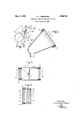
- Fig. 1 is a longitudinal section through a horn fitted with vibrating films and adapted for use in phonographs, gramophones, pickup devices or wireless apparatus.
- Fig. 2 is a longitudinal section of an acoustic device, known as a sound amplifier, for wireless or pick-up apparatus fitted with vibrating films and provided with an electro-magnetic or magneto dynamic or electrodynamic motor causing a cone to vibrate.
- a sound amplifier for wireless or pick-up apparatus fitted with vibrating films and provided with an electro-magnetic or magneto dynamic or electrodynamic motor causing a cone to vibrate.
- Fig. 3 is a perspective view of the sound amplifier shown in Fig. 2, the same reference numerals being used as inthis last-named figure, and
- Fig. 4 shows a longitudinal section and a front view of an electrostatic acoustic device fitted with films.
- reference numeral 2 denotes a horn of any suitable form or shape for use in phonographs, gramophones, pick-up devices and wireless apparatus.
- the sound waves are received from a phonograph or the like or are produced by an electro-magnetic motor as used for wireless and .pick-up.
- the large opening of the horn is entirely closed by the vibrating films 3, 4 and 5, set on rigid rings 6 and spaced by them. Those rings are fixed on the aperture of the horn by any known and suitable means, for example by means of an indiarubber ring 7
- the films are preferably of different thickness as before stated for musical purposes.
- the motor 10 fixed on a base 11 attached to the box 8 acts on a vibrating or moving cone 9 which transmits by variations of air pressure in a closed space, the sound waves to the vibrating films 3, 4 and 5, spaced by the rigid rings 6 fixed on the box 8 in such manner that no air may static acoustic device of known construction, the body 8 of the device contalns a magnetic and very thin film 13 placed between two metallic gratings 14 and 15 polarized by a strong electric current, the variations of which cause vibrations of the film 1-3.
- the vibrating non-magnetic films 3, 4 and 5 are placed outside of the gratings and the sound emission openings are tightly closed by them; the films are held in position and spaced by nonvibrating rings 6 which allow of no escape of air.
- Two non-vibrating discs 12 made of loose or perforated material giving free ac cess to the air may be placed outside of each set of vibrating films to protect them.
- a sound reproducing device a sound emitting member co-operating with said sound reproducing device; a plurality of thin flexible fiat air-tight easily vibrating films made of non-sonorous material which are arranged parallel to one another at the extreme sound emitting end of said sound emitting member and the outermost one of which is in t1 contact with the atmosphere; a plurality of non-vibrating rings on which said films are mounted and by which said films are spaced so as to form closed spaces between them: whereby the innermost one of said films is caused to vibrate by variations of the pressure of the air contained in the sound emitting member and the remaining films are caused to vibrate by variations of the air pressure in the closed spaces, said films be ing final producers of sounds.
- acoustic device the combination of: a plurality of thin flexible fiat air-tight easily vibrating films made of non-sonorous material and arranged parallel to one another; a plurality of non-vibrating rings on which said films are mounted and by which said films are spaced so as to form closed spaces between them; a box in which said films are arranged; a sound amplifier enclosed in said box; and a vibrating cone on said sound amplifier; whereby said films are caused to vibrate by variations of the air pressure in the closed spaces and the innermost film is also caused to vibrate by variations of the pressure of the air located between said innermost film and said vibrating cone, said films being final producers of sounds.
- acoustic device the combination of: a plurality of thin flexible fiat air-tight easily vibrating films made of non-sonorous material and arranged parallel to one another; a plurality of non-vibrating rings on which said films are mounted and by which said films are spaced so as to form closed spaces between them; a box in which said films are arranged; and an electrostatic acoustic apparatus arranged in said box and closed at its sound openings by said films; whereby said films are caused to vibrate by variations of the air pressure in the closed spaces and the innermost film is also caused to vibrate by variations of the pressure of the air enclosed between said innermost film and the walls of said box, said films being final producers of sounds.
- acoustic device the combination of: a plurality of thin flexible fiat air-tight easily vibrating films made of non-sonorous material and arranged parallel to one another; a plurality of non-vibrating rings on which said films are mounted and by which said films are spaced so as to form closed spaces between them; a closed acoustic chamber at the extreme end of which said films are arranged so that the outermost film is in contact with the atmosphere; and a sound producing member associated with said closed chamber; whereby said films are caused to vibrate by variations of the air pressure in the closed spaces and the film located nearest to said sound producing member is also caused to vibrate by variations of air pressure in said closed chamber without receiving any mechanical impulse from said sound producing member, said films being final producers of sounds.
Landscapes
- Engineering & Computer Science (AREA)
- Physics & Mathematics (AREA)
- Acoustics & Sound (AREA)
- Signal Processing (AREA)
- Health & Medical Sciences (AREA)
- Otolaryngology (AREA)
- Multimedia (AREA)
- Audible-Bandwidth Dynamoelectric Transducers Other Than Pickups (AREA)
Description
y 3, 1932 F. L. DESBRIERE 1,856,749
VIBRATING FILM FOR ACOUSTIC DEVICES Filed April 23. 1930 Patented May 3, 1932 UNITED STATES FERNAND LESIEURE DESBBIERE, OF MARSEILLE, FRANCE VIBRATING FILM FOR ACOUSTIC DEVICES Application filed April 23, 1930, Serial No. 446,603, and in Germany May 15, 1929.
The present invention relates to acoustic devices and has for its principal object the provision of means for improving the tone of sounds emitted by any acoustic mach nes, phonograph, loud speaker, sound amplifier for wireless or so-called p1ck-up,te lepnone receiver, telephone emitter or the like and giving to every sound wave even to weak ones, emitted at the same time as the principal sound, power enough to be heard, by the effect of reaction and resonance. The device is not intended for submarine use. The aforesaid object is obtained by the employment of a plurality of films arranged so as to close tightly the sound emisslon openings of any desired acoustic device between the atmosphere and the sound producer, the films being thin flexible fiat air-tight and easily vlbrating and being made of non-sonorous material and arranged parallel to one another. A11 at atmospheric pressure is tlghtly enclosed between the said films. The innermost film is caused to vibrate by variations of the pressure of air located between itself and the sound producing member in a closed space which is also at atmospheric pressure, without any mechanical impulse from the sand piece. The said films are made of any eas ly vibrating material, for instance celluloid, thin metal, leather, paper and so on, but the materials must be air-tight.
The films vibrate only by changes of their plane surface produced by changes of pressure of enclosed air between the films themselves and, as aforesaid, between the innermost one and the sound producing member in an enclosed space. The rings on which the films are mounted are arranged so as to leave a space between the said films, and must be asrigid as possible. Thus it is only the films that transmit the sounds to the atmosphere and it must be remarked that the oblique sound waves emitted, for example, by the vibrating cone of a sound amplifier or transmitted by a horn of any shape which would have crossed each other outside of the acoustic device are caught by the innermost film and changed into parallel ones by transmission to the other films thus improving the tone without any loss of power.
The said films may be used in any number, according to the shape and use of the acoustic device. When the films are intended for the reproduction of music they are preferably made of different thicknesses so that the overtones which are, as is known, always produced by such films in addition to the fundamental tone during their resonant vibration extend over difierent ranges of sound.
F or instance, when three films are employed, so the innermost one may produce, in addition to the fundamental tone, overtones extendmg over a given definite range of 2 octaves, the middle one may produce, in addition to the fundamental tone, overtones extending over 05 a second different range of 2 octaves, and the outer one may produce, in addition to the fundamental tone, overtones extending over a third and again different range of 2 octaves, so that the total range over which the overtones produced extends amounts to 7 octaves. It will be understood that the films are all adapted to produce and transmit properly the fundamental tone, but that the ranges of overtones added to the latter in its passage through the films vary according to the thickness and other dimensions thereof. The invention will now be more specifically described with reference to the arcompanying drawings, which are given as an example of some of the applications of the invention, and in which:
Fig. 1 is a longitudinal section through a horn fitted with vibrating films and adapted for use in phonographs, gramophones, pickup devices or wireless apparatus.
Fig. 2 is a longitudinal section of an acoustic device, known asa sound amplifier, for wireless or pick-up apparatus fitted with vibrating films and provided with an electro-magnetic or magneto dynamic or electrodynamic motor causing a cone to vibrate.
Fig. 3 is a perspective view of the sound amplifier shown in Fig. 2, the same reference numerals being used as inthis last-named figure, and
Fig. 4 shows a longitudinal section and a front view of an electrostatic acoustic device fitted with films.
Referring to Fig. 1 of the drawings, the
reference numeral 2 denotes a horn of any suitable form or shape for use in phonographs, gramophones, pick-up devices and wireless apparatus. At the small end of the horn the sound waves are received from a phonograph or the like or are produced by an electro-magnetic motor as used for wireless and .pick-up. The large opening of the horn is entirely closed by the vibrating films 3, 4 and 5, set on rigid rings 6 and spaced by them. Those rings are fixed on the aperture of the horn by any known and suitable means, for example by means of an indiarubber ring 7 The films are preferably of different thickness as before stated for musical purposes.
Referring to Figs. 2 and 3, the motor 10 fixed on a base 11 attached to the box 8 acts on a vibrating or moving cone 9 which transmits by variations of air pressure in a closed space, the sound waves to the vibrating films 3, 4 and 5, spaced by the rigid rings 6 fixed on the box 8 in such manner that no air may static acoustic device of known construction, the body 8 of the device contalns a magnetic and very thin film 13 placed between two metallic gratings 14 and 15 polarized by a strong electric current, the variations of which cause vibrations of the film 1-3. The vibrating non-magnetic films 3, 4 and 5 are placed outside of the gratings and the sound emission openings are tightly closed by them; the films are held in position and spaced by nonvibrating rings 6 which allow of no escape of air. Two non-vibrating discs 12 made of loose or perforated material giving free ac cess to the air may be placed outside of each set of vibrating films to protect them.
I claim: 7
1. In an acoustic device, the combination of: a sound reproducing device; a sound emitting member co-operating with said sound reproducing device; a plurality of thin flexible fiat air-tight easily vibrating films made of non-sonorous material which are arranged parallel to one another at the extreme sound emitting end of said sound emitting member and the outermost one of which is in t1 contact with the atmosphere; a plurality of non-vibrating rings on which said films are mounted and by which said films are spaced so as to form closed spaces between them: whereby the innermost one of said films is caused to vibrate by variations of the pressure of the air contained in the sound emitting member and the remaining films are caused to vibrate by variations of the air pressure in the closed spaces, said films be ing final producers of sounds.
2. In an acoustic device, the combination of: a plurality of thin flexible fiat air-tight easily vibrating films made of non-sonorous material and arranged parallel to one another; a plurality of non-vibrating rings on which said films are mounted and by which said films are spaced so as to form closed spaces between them; a box in which said films are arranged; a sound amplifier enclosed in said box; and a vibrating cone on said sound amplifier; whereby said films are caused to vibrate by variations of the air pressure in the closed spaces and the innermost film is also caused to vibrate by variations of the pressure of the air located between said innermost film and said vibrating cone, said films being final producers of sounds.
3. In an acoustic device, the combination of: a plurality of thin flexible fiat air-tight easily vibrating films made of non-sonorous material and arranged parallel to one another; a plurality of non-vibrating rings on which said films are mounted and by which said films are spaced so as to form closed spaces between them; a box in which said films are arranged; and an electrostatic acoustic apparatus arranged in said box and closed at its sound openings by said films; whereby said films are caused to vibrate by variations of the air pressure in the closed spaces and the innermost film is also caused to vibrate by variations of the pressure of the air enclosed between said innermost film and the walls of said box, said films being final producers of sounds.
4. In an acoustic device, the combination of: a plurality of thin flexible fiat air-tight easily vibrating films made of non-sonorous material and arranged parallel to one another; a plurality of non-vibrating rings on which said films are mounted and by which said films are spaced so as to form closed spaces between them; a closed acoustic chamber at the extreme end of which said films are arranged so that the outermost film is in contact with the atmosphere; and a sound producing member associated with said closed chamber; whereby said films are caused to vibrate by variations of the air pressure in the closed spaces and the film located nearest to said sound producing member is also caused to vibrate by variations of air pressure in said closed chamber without receiving any mechanical impulse from said sound producing member, said films being final producers of sounds.
In testimony whereof I have signed my name to this specification.
FERNAND LESIEURE DESBRIERE.
Applications Claiming Priority (1)
| Application Number | Priority Date | Filing Date | Title |
|---|---|---|---|
| DE1856749X | 1929-05-15 |
Publications (1)
| Publication Number | Publication Date |
|---|---|
| US1856749A true US1856749A (en) | 1932-05-03 |
Family
ID=7746267
Family Applications (1)
| Application Number | Title | Priority Date | Filing Date |
|---|---|---|---|
| US446603A Expired - Lifetime US1856749A (en) | 1929-05-15 | 1930-04-23 | Vibrating film for acoustic devices |
Country Status (1)
| Country | Link |
|---|---|
| US (1) | US1856749A (en) |
Cited By (5)
| Publication number | Priority date | Publication date | Assignee | Title |
|---|---|---|---|---|
| US3080785A (en) * | 1958-08-25 | 1963-03-12 | Atuk Corp | Electroacoustic tone modifying systems for stringed musical instruments |
| US3202773A (en) * | 1962-01-24 | 1965-08-24 | Leonard H King | Electromagnetically damped speaker system |
| US4010821A (en) * | 1975-05-02 | 1977-03-08 | Quillmann Leo Heinz | Omnidirectional sympathetically driven sound reproduction device |
| US4511768A (en) * | 1982-10-29 | 1985-04-16 | Motorola, Inc. | Mounting arrangement for altering a microphone's frequency response |
| FR2889022A1 (en) * | 2005-05-12 | 2007-01-26 | Franck Tresse | Sound wave smoothing method for loud speaker, involves placing film in front of membrane of loud speaker whose aft wave is dissipated in ambient space, where film covers front side of loud speaker |
-
1930
- 1930-04-23 US US446603A patent/US1856749A/en not_active Expired - Lifetime
Cited By (5)
| Publication number | Priority date | Publication date | Assignee | Title |
|---|---|---|---|---|
| US3080785A (en) * | 1958-08-25 | 1963-03-12 | Atuk Corp | Electroacoustic tone modifying systems for stringed musical instruments |
| US3202773A (en) * | 1962-01-24 | 1965-08-24 | Leonard H King | Electromagnetically damped speaker system |
| US4010821A (en) * | 1975-05-02 | 1977-03-08 | Quillmann Leo Heinz | Omnidirectional sympathetically driven sound reproduction device |
| US4511768A (en) * | 1982-10-29 | 1985-04-16 | Motorola, Inc. | Mounting arrangement for altering a microphone's frequency response |
| FR2889022A1 (en) * | 2005-05-12 | 2007-01-26 | Franck Tresse | Sound wave smoothing method for loud speaker, involves placing film in front of membrane of loud speaker whose aft wave is dissipated in ambient space, where film covers front side of loud speaker |
Similar Documents
| Publication | Publication Date | Title |
|---|---|---|
| US2318417A (en) | Artificial reverberation system | |
| US3733425A (en) | Pick up device for stringed instrument | |
| CN110036649B (en) | sound device | |
| WO1989012373A1 (en) | Multidimensional stereophonic sound reproduction system | |
| US3821475A (en) | Sound enhancement speaker enclosure | |
| US3236958A (en) | Loudspeaker system | |
| US1801521A (en) | Loud-speaker horn | |
| US1832832A (en) | Sound reproducing means | |
| US1962055A (en) | Sound reproducing apparatus | |
| US3365021A (en) | Speaker enclosure | |
| US1960449A (en) | Acoustic apparatus | |
| US1819499A (en) | Telephone receiver | |
| US1760647A (en) | Electrical pick-up | |
| US1643284A (en) | Sound amplifier | |
| US1767777A (en) | Loud-speaker | |
| US1934932A (en) | Sound amplifier | |
| US1083788A (en) | Loud-speaking telephone-receiver. | |
| US1769438A (en) | Acoustical device | |
| US1836075A (en) | Stacked spiral resonator | |
| US1955800A (en) | Acoustic device | |
| US1899929A (en) | Sound amplifying device | |
| US1887629A (en) | Sound reproducing apparatus | |
| US842707A (en) | Attachment to horns for sound-reproducing instruments. | |
| US1841658A (en) | Sound amplifier | |
| US1913451A (en) | Acoustic apparatus |