US1854974A - Silencer - Google Patents
Silencer Download PDFInfo
- Publication number
- US1854974A US1854974A US505382A US50538230A US1854974A US 1854974 A US1854974 A US 1854974A US 505382 A US505382 A US 505382A US 50538230 A US50538230 A US 50538230A US 1854974 A US1854974 A US 1854974A
- Authority
- US
- United States
- Prior art keywords
- rings
- spaces
- silencer
- base
- outer ends
- Prior art date
- Legal status (The legal status is an assumption and is not a legal conclusion. Google has not performed a legal analysis and makes no representation as to the accuracy of the status listed.)
- Expired - Lifetime
Links
- 230000003584 silencer Effects 0.000 title description 17
- 230000007423 decrease Effects 0.000 description 8
- 230000004048 modification Effects 0.000 description 4
- 238000012986 modification Methods 0.000 description 4
- 230000001154 acute effect Effects 0.000 description 2
- DTAPQAJKAFRNJB-UHFFFAOYSA-N Promecarb Chemical compound CNC(=O)OC1=CC(C)=CC(C(C)C)=C1 DTAPQAJKAFRNJB-UHFFFAOYSA-N 0.000 description 1
- 230000006978 adaptation Effects 0.000 description 1
- 239000012080 ambient air Substances 0.000 description 1
- 238000010276 construction Methods 0.000 description 1
- 230000007717 exclusion Effects 0.000 description 1
- 230000001788 irregular Effects 0.000 description 1
- 239000007787 solid Substances 0.000 description 1
Images
Classifications
-
- F—MECHANICAL ENGINEERING; LIGHTING; HEATING; WEAPONS; BLASTING
- F41—WEAPONS
- F41A—FUNCTIONAL FEATURES OR DETAILS COMMON TO BOTH SMALLARMS AND ORDNANCE, e.g. CANNONS; MOUNTINGS FOR SMALLARMS OR ORDNANCE
- F41A21/00—Barrels; Gun tubes; Muzzle attachments; Barrel mounting means
- F41A21/30—Silencers
Definitions
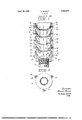
- Fig. 1 is an axial section
- i Fig. 2 is an end elevation of the silencer.
- the siencer is built up from aiset of rings and an annular base. 24 which is secured to the zhreaded end of a muzzle 11. Obviously I am not limited to this mode of securing the ;ilencer, nor am I limited to its adaptation :o fire arms.
- the rings 10 and the base 24 are spaced and arranged in coaxial relation to each other and to the axis of the muzzle 11.
- Each ring 10 has a central opening 12 and the base 24 has a central opening the diameter of which openings is at least equal to the inside diameter of the muzzle 11. If the openings 12, 25 have equal diameter throughout the set they make up a cylinder 15, as shown in dotted lines in Fig. 1, and if their diameter increases toward the outer end of the silencer they make up a taper 16, as also shown in dotted lines in Fig. 1.
- the front faces 13 of the rings 10 and the face 13' of the base 24 as well as the rear faces 14 of the rings 10 are shown with a regular curvature but, if desired, may be broken or otherwise irregular, and the front faces 13 or 13' are so shaped with respect to that of the muzzle 11, that is, the area of a cylinder the height of which is equal to the height of the space 18 in axial direction, and which is coaxial to the rings 10, must not be less than the free sectional area of the muzzle 11 at any point of the space 18.
- the area of the cylinders must at least be constant from the inner to the outer perimeter of the rings 10, and larger than the free sectional area of the muzzle.
- the cylinder at the inner perimeter of a ring 10 is higher than that at its outer perimeter but the radius of the outer cylinder is larger than that of the inner cylinder so that its area maybe equal to, or larger than, the area of the inner cylinder.
- any suitable means may be provided for holding the rings and the base assembled.
- three strips 19 are provided and hinged to the base 24 at 23.
- I may provide any other number of strips.
- the strips are provided with inwardly projecting lugs 20 for engaging the end faces of thebase and the rings,'and with shorter lugs 21 for engaging the end faces of the recesses 17, if any. Screws 22 secure the strips to the rings. By these means the rings are held in the proper spaced relation to each other, and the strips are reliably attached to the rings.
- the flow of gas from the muzzlell is divided into as many subsidiary flows as spaces 18 are provided.
- the cleflected gas expands in the spaces 18, and its inertia is reduced in proportion so that the impact on the ambient air is weakened and the sound is deadened.
- the deadening is a function of the number of rings 10, and of the free area at the outer ends of the spaces 18.
- So many rings may be provided that the entire Volume of gas discharged from the muzzle 11 at a time is conducted away through the spaces 18.
- the ring at the outer end of the set may be solid with a silencer of this type.
- a silencer comprising a set of coaxially superposed rings with plain inner and outer faces and means for connecting said rings to a pipe in coaxial relation. said rings being so shaped and spaced with respect to each other that the radial section of the spaces between the rings decreases toward the outer ends of said spaces, with said outer ends opening freely into the atmosphere.
- a silencer comprising a set of coaxially superposed rings with plain inner and outer faces and means for connecting said rings to a pipe in coaxial relation.
- said rings being so shaped and spaced with respect to each other that the radial section of the spaces between the rings decreases toward the outer ends of said spaces, with said outer ends opening freely into the atmosphere and that the resulting stream lines of flow in the spaces extend at an acute angle to the common axis of said rings, and in the direction of the flow.
- a silencer comprising a set of coaxially superposed rings with plain inner and outer faces and means for connecting said rings to a pipe in. coaxial relation, said rings being so shaped and spaced with respect to each other that the radial section of the spaces between the rings decreases toward the outer ends of said spaces, with said outer ends opening freely into the atmosphere while the smallest area of a cylinder coaxial to said rings, the height of which cylinder is equal to that of said radial section, is larger than the free sectional area of said pipe.
- a silencer comprising a set of coaxially superposed rings with plain inner and outer faces and means for connecting said rings to a pipe in coaxial relation, said rings being so shaped and spaced with respect to each other that the radial section of the spaces between the rings decreases toward the outer 'ends of said spaces, with said outer ends opening freely into the atmosphere, and means for connecting said rings to each other in spaced relation.
- a silencer comprising a set of coaxially superposed rings and means for connecting said rings to a pipe in coaxial relation, said rings being so shaped and spaced with respect to each other that the radial section of the spaces between the rings decreases toward the outer ends of said spaces, strips pivoted to one of said rings, spacing means on said strips adapted to engage the other rings, and means for holding said strips in position with respect to said rings.
- a silencer comprising a base adapted to be fitted on a pipe and a set of coaxially superposed rings with plain inner and outer faces secured to said base, said rings and said base being so shaped and spaced with respect to each other that the radial section of the spaces between the rings decreases toward the outer ends of said spaces, with said outer ends opening freely into the atmosphere.
- a silencer comprising a base adapted to be fitted on a pipe, strips hinged to said base, spacing lugs on said strips, and a set of coaxially superposed rings arranged to be engagedby said lugs and to be held in coaxial relation to said base, said rings and said base being so shaped and held in such spaced relation wth respect to each other. by said lugs that the radial section of the spaces between the rings decreases toward the outer ends of said spaces.
Landscapes
- Engineering & Computer Science (AREA)
- General Engineering & Computer Science (AREA)
- Exhaust Silencers (AREA)
Description
April 19, 1932. s. BERNAT 1,854,974
SILENCER Filed Dec. 29. 1930 ateinted Apr. 19, 1932' SAMUEL BERNA'I, OF UZEOBOD, CZECHOSLOVAKIA.
I SILENCER Application filed December 29, 1980, Serial No. 505,382, and in Czechoslovakia February 8, 1930.
To this end 'I provide a set of rings in oaxial relation to each other and to the axis f the pipe or barrel to which the silencer is pplied which are so shaped, arranged and paced with respect to each other that the adial section of the spaces between the rings lecreases toward the outer ends of such paces.
Silencers are based on the fact that the mpact of the escaping gas on the ambient ,ir'generates the sound and that the'intensity f the sound is directly proportional to the nertia of the outflowing gas. By reducing he inertia the sound is deadened.
Silencers in which the inertia of the gas s reduced by breaking up the flow of gas nto a plurality of subsidiary flows, have aleady been suggested, but were not satisfacory on account of their high cost, high veight and rapid Wear. Silencers which do iot involve these disadvantages, will not ef- Fect satisfactory deadening of the sound.
In the drawings aflixed to this specificaion and forming part thereof a silencer em- )odying my invention is illustrated diagramnatically by way of example.
In the drawings Fig. 1 is an axial section, and i Fig. 2 is an end elevation of the silencer.
Referring now to the drawings, the siencer is built up from aiset of rings and an annular base. 24 which is secured to the zhreaded end of a muzzle 11. Obviously I am not limited to this mode of securing the ;ilencer, nor am I limited to its adaptation :o fire arms.
The rings 10 and the base 24 are spaced and arranged in coaxial relation to each other and to the axis of the muzzle 11. Each ring 10 has a central opening 12 and the base 24 has a central opening the diameter of which openings is at least equal to the inside diameter of the muzzle 11. If the openings 12, 25 have equal diameter throughout the set they make up a cylinder 15, as shown in dotted lines in Fig. 1, and if their diameter increases toward the outer end of the silencer they make up a taper 16, as also shown in dotted lines in Fig. 1.
The front faces 13 of the rings 10 and the face 13' of the base 24 as well as the rear faces 14 of the rings 10 are shown with a regular curvature but, if desired, may be broken or otherwise irregular, and the front faces 13 or 13' are so shaped with respect to that of the muzzle 11, that is, the area of a cylinder the height of which is equal to the height of the space 18 in axial direction, and which is coaxial to the rings 10, must not be less than the free sectional area of the muzzle 11 at any point of the space 18. In other words, while the radial section of the space 18 decreases with increasing distance from the axis, the area of the cylinders must at least be constant from the inner to the outer perimeter of the rings 10, and larger than the free sectional area of the muzzle. Thus, the cylinder at the inner perimeter of a ring 10 is higher than that at its outer perimeter but the radius of the outer cylinder is larger than that of the inner cylinder so that its area maybe equal to, or larger than, the area of the inner cylinder.
18' are lines indicating the resulting flow in the spaces 18 and it will appear-that the flow lines include an acute angle with the axis 11' of the muzzle and the silencer and point in the direction of the flow.
Any suitable means may be provided for holding the rings and the base assembled. In the present instance, three strips 19 are provided and hinged to the base 24 at 23. Obviously I may provide any other number of strips. The strips are provided with inwardly projecting lugs 20 for engaging the end faces of thebase and the rings,'and with shorter lugs 21 for engaging the end faces of the recesses 17, if any. Screws 22 secure the strips to the rings. By these means the rings are held in the proper spaced relation to each other, and the strips are reliably attached to the rings.
In operation the flow of gas from the muzzlell is divided into as many subsidiary flows as spaces 18 are provided. The cleflected gas expands in the spaces 18, and its inertia is reduced in proportion so that the impact on the ambient air is weakened and the sound is deadened. Obviously the deadening is a function of the number of rings 10, and of the free area at the outer ends of the spaces 18.
So many rings may be provided that the entire Volume of gas discharged from the muzzle 11 at a time is conducted away through the spaces 18. In the case of an exhaust pipe the ring at the outer end of the set may be solid with a silencer of this type.
While the sound is deadened very effectively in my silencer, there is no back-pressure. This is important under all conditions, and particularly for machine guns to which the existing silencers could not be adapted on account of their considerable back-pressure.
wish it to be understood that I do not desire to be limited to the exact details of construction shown and described for obvious modifications will occur to a person skilled in the art.
In the claims aflixed to this specification no selection of any particular modification of the invention is intended to the exclusion of other modifications thereof and the right to subsequently make claim to any modification not covered by these claims is expressly reserved.
I claim:
1. A silencer comprising a set of coaxially superposed rings with plain inner and outer faces and means for connecting said rings to a pipe in coaxial relation. said rings being so shaped and spaced with respect to each other that the radial section of the spaces between the rings decreases toward the outer ends of said spaces, with said outer ends opening freely into the atmosphere.
2. A silencer comprising a set of coaxially superposed rings with plain inner and outer faces and means for connecting said rings to a pipe in coaxial relation. said rings being so shaped and spaced with respect to each other that the radial section of the spaces between the rings decreases toward the outer ends of said spaces, with said outer ends opening freely into the atmosphere and that the resulting stream lines of flow in the spaces extend at an acute angle to the common axis of said rings, and in the direction of the flow.
3. A silencer comprising a set of coaxially superposed rings with plain inner and outer faces and means for connecting said rings to a pipe in. coaxial relation, said rings being so shaped and spaced with respect to each other that the radial section of the spaces between the rings decreases toward the outer ends of said spaces, with said outer ends opening freely into the atmosphere while the smallest area of a cylinder coaxial to said rings, the height of which cylinder is equal to that of said radial section, is larger than the free sectional area of said pipe.
4. A silencer comprising a set of coaxially superposed rings with plain inner and outer faces and means for connecting said rings to a pipe in coaxial relation, said rings being so shaped and spaced with respect to each other that the radial section of the spaces between the rings decreases toward the outer 'ends of said spaces, with said outer ends opening freely into the atmosphere, and means for connecting said rings to each other in spaced relation.
A silencer comprising a set of coaxially superposed rings and means for connecting said rings to a pipe in coaxial relation, said rings being so shaped and spaced with respect to each other that the radial section of the spaces between the rings decreases toward the outer ends of said spaces, strips pivoted to one of said rings, spacing means on said strips adapted to engage the other rings, and means for holding said strips in position with respect to said rings.
6. A silencer comprising a base adapted to be fitted on a pipe and a set of coaxially superposed rings with plain inner and outer faces secured to said base, said rings and said base being so shaped and spaced with respect to each other that the radial section of the spaces between the rings decreases toward the outer ends of said spaces, with said outer ends opening freely into the atmosphere.
7. A silencer comprising a base adapted to be fitted on a pipe, strips hinged to said base, spacing lugs on said strips, and a set of coaxially superposed rings arranged to be engagedby said lugs and to be held in coaxial relation to said base, said rings and said base being so shaped and held in such spaced relation wth respect to each other. by said lugs that the radial section of the spaces between the rings decreases toward the outer ends of said spaces. a
In testimony whereof I aflix my signature.
SAMUEL BERNAT.
Applications Claiming Priority (1)
| Application Number | Priority Date | Filing Date | Title |
|---|---|---|---|
| CS1854974X | 1930-02-08 |
Publications (1)
| Publication Number | Publication Date |
|---|---|
| US1854974A true US1854974A (en) | 1932-04-19 |
Family
ID=5458482
Family Applications (1)
| Application Number | Title | Priority Date | Filing Date |
|---|---|---|---|
| US505382A Expired - Lifetime US1854974A (en) | 1930-02-08 | 1930-12-29 | Silencer |
Country Status (1)
| Country | Link |
|---|---|
| US (1) | US1854974A (en) |
Cited By (11)
| Publication number | Priority date | Publication date | Assignee | Title |
|---|---|---|---|---|
| US3603202A (en) * | 1969-06-16 | 1971-09-07 | Edward L Moragne | Muzzle brake |
| US3714864A (en) * | 1971-03-03 | 1973-02-06 | Us Army | Muzzle attachment for reducing the recoil and blast effect of guns |
| US5325759A (en) * | 1993-04-19 | 1994-07-05 | Warner Joseph G | Flash suppressor |
| US6216578B1 (en) * | 1997-05-30 | 2001-04-17 | Giat Industries | Muzzle brake for weapon barrel |
| US7047862B1 (en) * | 2003-05-09 | 2006-05-23 | The United States Of America As Represented By The Secretary Of The Navy | MK38 small caliber dearmer aiming device |
| US7581482B1 (en) * | 2005-07-28 | 2009-09-01 | The United States Of America As Represented By The Secretary Of The Army | Supersonic turning vane |
| US8087337B1 (en) * | 2009-03-03 | 2012-01-03 | Cary William R | Recoil compensation and climb arrester |
| US20120180624A1 (en) * | 2011-01-14 | 2012-07-19 | Troy Stephen P | Firearm suppressor |
| FR2989773A1 (en) * | 2012-04-24 | 2013-10-25 | Tda Armements Sas | NOISE ATTENUATOR FOR MORTAR |
| US20140157640A1 (en) * | 2012-12-11 | 2014-06-12 | Daniel Joseph Whelan | Firearm With Integrated Suppressor |
| US20150253099A1 (en) * | 2012-01-16 | 2015-09-10 | Silencerco, Llc | Baffles for firearm noise suppressor |
-
1930
- 1930-12-29 US US505382A patent/US1854974A/en not_active Expired - Lifetime
Cited By (15)
| Publication number | Priority date | Publication date | Assignee | Title |
|---|---|---|---|---|
| US3603202A (en) * | 1969-06-16 | 1971-09-07 | Edward L Moragne | Muzzle brake |
| US3714864A (en) * | 1971-03-03 | 1973-02-06 | Us Army | Muzzle attachment for reducing the recoil and blast effect of guns |
| US5325759A (en) * | 1993-04-19 | 1994-07-05 | Warner Joseph G | Flash suppressor |
| US6216578B1 (en) * | 1997-05-30 | 2001-04-17 | Giat Industries | Muzzle brake for weapon barrel |
| US7047862B1 (en) * | 2003-05-09 | 2006-05-23 | The United States Of America As Represented By The Secretary Of The Navy | MK38 small caliber dearmer aiming device |
| US7600461B1 (en) * | 2005-07-28 | 2009-10-13 | The United States Of America As Represented By The Secretary Of The Army | Muzzle brake for cannon |
| US7581482B1 (en) * | 2005-07-28 | 2009-09-01 | The United States Of America As Represented By The Secretary Of The Army | Supersonic turning vane |
| US8087337B1 (en) * | 2009-03-03 | 2012-01-03 | Cary William R | Recoil compensation and climb arrester |
| US20120180624A1 (en) * | 2011-01-14 | 2012-07-19 | Troy Stephen P | Firearm suppressor |
| US9476661B2 (en) * | 2011-01-14 | 2016-10-25 | Stephen P. Troy | Firearm suppressor |
| US20150253099A1 (en) * | 2012-01-16 | 2015-09-10 | Silencerco, Llc | Baffles for firearm noise suppressor |
| FR2989773A1 (en) * | 2012-04-24 | 2013-10-25 | Tda Armements Sas | NOISE ATTENUATOR FOR MORTAR |
| WO2013160330A1 (en) * | 2012-04-24 | 2013-10-31 | Tda Armements S.A.S | Noise attenuator for a mortar |
| US20140157640A1 (en) * | 2012-12-11 | 2014-06-12 | Daniel Joseph Whelan | Firearm With Integrated Suppressor |
| US9482483B2 (en) * | 2012-12-11 | 2016-11-01 | Daniel Joseph Whelan | Firearm with integrated suppressor |
Similar Documents
| Publication | Publication Date | Title |
|---|---|---|
| EP3561437B1 (en) | Suppressor for a firearm | |
| US10267586B1 (en) | Suppressor for a firearm | |
| US11561059B2 (en) | Firearm sound suppressor baffles | |
| RU2765508C2 (en) | Firearm silencer system | |
| US2514996A (en) | Flash eliminator and silencer for firearms | |
| US1111202A (en) | Silencer construction for firearms. | |
| US1259251A (en) | Firearm attachment. | |
| US20150285575A1 (en) | Firearm Silencer with a Replacement Core | |
| US2143596A (en) | Recoil absorber for firearms | |
| US20150354422A1 (en) | Porous Matrix Sound Suppressor | |
| US20170299316A1 (en) | Muzzle brake | |
| US1173687A (en) | Firearm. | |
| US2453121A (en) | Gas porting device for shotguns | |
| US2375617A (en) | Gun silencer | |
| US2325905A (en) | Suppressor | |
| JP2017020682A5 (en) | ||
| EP3382318B1 (en) | Silencer for a shotgun | |
| US2444910A (en) | Muzzle brake for guns | |
| US1390658A (en) | Recoil neutralizer and muffler | |
| US3125928A (en) | Bartels | |
| US5361677A (en) | Flash suppressor | |
| US1140578A (en) | Noiseless gun. | |
| US4928573A (en) | Silencer for saboted projectiles | |
| JPS58138997A (en) | Caliber brake | |
| US3478841A (en) | Silencer for firearms discharging gasses at supersonic velocity |