US1854400A - Flat ribbed picot top for hosiery - Google Patents
Flat ribbed picot top for hosiery Download PDFInfo
- Publication number
- US1854400A US1854400A US566985A US56698531A US1854400A US 1854400 A US1854400 A US 1854400A US 566985 A US566985 A US 566985A US 56698531 A US56698531 A US 56698531A US 1854400 A US1854400 A US 1854400A
- Authority
- US
- United States
- Prior art keywords
- picot
- stitches
- hosiery
- needle
- knitting
- Prior art date
- Legal status (The legal status is an assumption and is not a legal conclusion. Google has not performed a legal analysis and makes no representation as to the accuracy of the status listed.)
- Expired - Lifetime
Links
- 229940012982 picot Drugs 0.000 title description 24
- 238000009940 knitting Methods 0.000 description 16
- 239000004744 fabric Substances 0.000 description 9
- 238000000034 method Methods 0.000 description 4
- NWONKYPBYAMBJT-UHFFFAOYSA-L zinc sulfate Chemical compound [Zn+2].[O-]S([O-])(=O)=O NWONKYPBYAMBJT-UHFFFAOYSA-L 0.000 description 1
Images

Classifications
-
- D—TEXTILES; PAPER
- D04—BRAIDING; LACE-MAKING; KNITTING; TRIMMINGS; NON-WOVEN FABRICS
- D04B—KNITTING
- D04B1/00—Weft knitting processes for the production of fabrics or articles not dependent on the use of particular machines; Fabrics or articles defined by such processes
- D04B1/10—Patterned fabrics or articles
Definitions
- a further object of the invention is to provide a stocking top having all'the attributes of the conventional stocl zing top so far as the strength, etc., are concerned, but one in which the fabric comprising the same will resemble a ribbed top made on a ribbing machine, and
- the stocking top is knit with certain'of the knitting needles omitted so as to formgroups of stitches, and the picot edge is provided by omitting one needle corresponding to the omitted needle in the fabric, and an adjacent needle in each group.
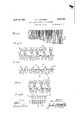
- Figure 1 is a side view showing a stocking top in which the stitches are grouped, with omitted stitches between each three knitted stitches,
- Figure 2 is a fragmentary view showing the manner of knitting for providing the picot edge
- Figure 3 is a similar view, showing the picot edge formed, t
- Figure 1 is a fragmentary side view of the stocking top, showing the stitches grouped in 3s, 4s and 2s,
- Figure 5 is a fragmentary broken view showing the stitching for forming the picot p, 7
- Figure 6- is a like view showing the 'picot top formed.
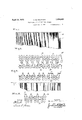
- Figure 7 is a view similar to Figure 4, and shows stitches grouped to form panel effects
- Figure 8 is a fragmentary view showing e the picotstitches used in Figure ,7,
- Figure 9 is a fragmentary view showing the fabric folded through the transverse stitches to provide the Picot edge
- Figure 10 is a View similar to Figures 4 stitches
- Figure 12 is another view of the same, showing the picot formed,v
- Figure 13 is a fragmentary diagrammatic view, showing the relation of the transfer needles to the knitting needles for forming the top shown in Figure 10,
- Figure 14 is a like view showing the relaand Figure 15 is a like view showing the relation of needles for forming the top shown in Figure 4:.
- the stitches 21 are formed in groups of three, with a space22 between'each group.
- This spacei is provided by omitting one of the knitting needles so that the thread will knit across the space where said needles would ordinarily be, and in doing so, will provide the cross stitches 23 as shown in Figures 2', 3, 5, 6, 8, 9, 11 and 12.
- the threads in the spaces being horizontally disposed, while the grouped stitches show completely knit fabric portions, will there is no stitching in that position to be taken by the transfer needle and transferred to the adjacent stitch.
- the needle which lies adjacent to said omitted needle, or to the left of the space indicated would also be omitted as the right hand stitch 26 from the needle of each group has no stitch to which it can be transferred.
- the transfer bar must be omitted for every omitted knitting needle.
- the transfer bar 24 will likewise have two needles omitted for each rib, that is to say, one needle in the transfer bar corresponding to the omitted knitting needles, will be omitted, and the needle immediately to the left of the same, or the needle corresponding to the right hand stitch of each group of the fabric.
- the picot edge produced by the grouping of Figure 1 is formed as shown in Figure 2 and results in a picot 27, shown in Figure 8. This is a double flat top peak with considerable space 28 between each of the pairs.
- the picot will comprise a single high peak 29 such as shown in Figures 6 and 12.
- the picot is formed in fabric having four stitches to the group, it provides double high peaks 30 with considerable spaces 31 between the same, as shown in Figure 6.
- the stocking top produced by this invention may, of course, be formed with groupings of stitches as desired to produce the ribbed or panel effect and the stocking top, when so formed, may be transferred to a footing machine of the seamless type, may be stitched to the top of a full fashioned body, or may be transferred to another full fashioned machine having a complete amount of knitting needles for knitting the leg and foot thereon.
- the picot edge produced by this omitted stitch combination presents a unique and imaeeaeoo needles to provide groups to resemble ribs, and forming a picot edge by omitting two of the needles from each group on the transfer bar and folding transversely on the transferred stitches.
- the method of forming fiat ribbed picot edge tops for hosiery comprising the steps of knitting the top by omitting knitting needles to provide groups of varied numbers of stitches to resemble ribs of uneven width, and forming a picot edge by omitting two of the needles from each group on the transfer bar and folding transversely on the transferred stitches.
- the method of forming fiat ribbed picot edge tops for hosiery comprising the steps of knitting the top by omitting knitting needies to provide groups to resemble ribs. and omitting from the transfer bar the needle corresponding to the omitted knitting needle, and the needle adjacent to same for forming picot stitching.
- a flat ribbed top for hosiery comprising grouped stitches separated by omitted stitches, and picots formed in the several groups with spaces corresponding to the omitted stitches.
- a flat ribbed top for hosiery characterized by grou ed stitches, each roup separated by an omitted stitch provi ing a space between groups, and picots formed 1n fabric with breaks corresponding to the omitted stitches.
- a flat ribbed top for hosiery characterized by groups of varied numbers of stitches, each group separated by an omitted stitch providing a space between groups, and picots formed in fabric with breaks corresponding to the omitted stitches.
Landscapes
- Engineering & Computer Science (AREA)
- Textile Engineering (AREA)
- Socks And Pantyhose (AREA)
- Knitting Of Fabric (AREA)
Description
' April 19, 1932. G. E. FICHTNER FLAT RIBBED PI COT TOP FOR HOSIERY 3 Sheets-Sheet 2 Filed 001:. 5, 19.31
INVENTOR E E or q 2353 1 th tner mnunun H H H1 HI H1 W l! HI I l I I! HHHIIIIHIIHIIIW WITNESS:
April 19, 1932. G. E. FICHTNER Mu v 2 QHU Q Q VU :11" E E T1chiI 1Er I H13 ATTORNEY Patented Apr. 19, 1932 UNITED STATES PATENT OFFICE GEORGE E. FICHTNER, F BOONTON, NEW JERSEY, ASSIGNOR TO BOONTON FULL FASHION HOSIERY MILLS, OF BOONTON', NEW JERSEY, A CORPORATION OF NEW JERSEY FLAT RIBIBED PICOT TOP FOR HO SIERY Application filed October 5, 1931. Serial No. 566,985.
' new form of stocking top.
A further object of the invention is to provide a stocking top having all'the attributes of the conventional stocl zing top so far as the strength, etc., are concerned, but one in which the fabric comprising the same will resemble a ribbed top made on a ribbing machine, and
I provided with a novel picot'edge.
According to the invention, the stocking top is knit with certain'of the knitting needles omitted so as to formgroups of stitches, and the picot edge is provided by omitting one needle corresponding to the omitted needle in the fabric, and an adjacent needle in each group.
The drawings illustrate an embodiment of the invention and the views therein are as follows.
Figure 1 is a side view showing a stocking top in which the stitches are grouped, with omitted stitches between each three knitted stitches,
Figure 2 is a fragmentary view showing the manner of knitting for providing the picot edge,
Figure 3 is a similar view, showing the picot edge formed, t
Figure 1 is a fragmentary side view of the stocking top, showing the stitches grouped in 3s, 4s and 2s,
Figure 5 is a fragmentary broken view showing the stitching for forming the picot p, 7
Figure 6- is a like view showing the 'picot top formed.
Figure 7 is a view similar to Figure 4, and shows stitches grouped to form panel effects,
Figure 8 is a fragmentary view showing e the picotstitches used in Figure ,7,
Figure 9 is a fragmentary view showing the fabric folded through the transverse stitches to provide the Picot edge,
Figure 10 is a View similar to Figures 4 stitches,
and 7 and shows groupings of two and four Figure 11 is a view of the picot stitching of Figure 10, V a
Figure 12 is another view of the same, showing the picot formed,v
Figure 13 is a fragmentary diagrammatic view, showing the relation of the transfer needles to the knitting needles for forming the top shown in Figure 10,
Figure 14 is a like view showing the relaand Figure 15 is a like view showing the relation of needles for forming the top shown in Figure 4:.
As illustrated in the drawings and particularly in Figure 1, the stitches 21 are formed in groups of three, with a space22 between'each group. This spaceiis provided by omitting one of the knitting needles so that the thread will knit across the space where said needles would ordinarily be, and in doing so, will provide the cross stitches 23 as shown in Figures 2', 3, 5, 6, 8, 9, 11 and 12. The threads in the spaces being horizontally disposed, while the grouped stitches show completely knit fabric portions, will there is no stitching in that position to be taken by the transfer needle and transferred to the adjacent stitch.
For almost the same reason, the needle which lies adjacent to said omitted needle, or to the left of the space indicated would also be omitted as the right hand stitch 26 from the needle of each group has no stitch to which it can be transferred.
It follows, therefore, that two needles in tion for forming the top shown in Figure 7,
the transfer bar must be omitted for every omitted knitting needle.
It follows also, that in Figures 13 and 14, the transfer bar 24: will likewise have two needles omitted for each rib, that is to say, one needle in the transfer bar corresponding to the omitted knitting needles, will be omitted, and the needle immediately to the left of the same, or the needle corresponding to the right hand stitch of each group of the fabric.
The picot edge produced by the grouping of Figure 1 is formed as shown in Figure 2 and results in a picot 27, shown in Figure 8. This is a double flat top peak with considerable space 28 between each of the pairs. Where the fabric is formed with two stitches in each group, the picot will comprise a single high peak 29 such as shown in Figures 6 and 12. Where the picot is formed in fabric having four stitches to the group, it provides double high peaks 30 with considerable spaces 31 between the same, as shown in Figure 6.
The stocking top produced by this invention may, of course, be formed with groupings of stitches as desired to produce the ribbed or panel effect and the stocking top, when so formed, may be transferred to a footing machine of the seamless type, may be stitched to the top of a full fashioned body, or may be transferred to another full fashioned machine having a complete amount of knitting needles for knitting the leg and foot thereon.
The picot edge produced by this omitted stitch combination presents a unique and imaeeaeoo needles to provide groups to resemble ribs, and forming a picot edge by omitting two of the needles from each group on the transfer bar and folding transversely on the transferred stitches. L
5. The method of forming fiat ribbed picot edge tops for hosiery, comprising the steps of knitting the top by omitting knitting needles to provide groups of varied numbers of stitches to resemble ribs of uneven width, and forming a picot edge by omitting two of the needles from each group on the transfer bar and folding transversely on the transferred stitches.
6. The method of forming fiat ribbed picot edge tops for hosiery comprising the steps of knitting the top by omitting knitting needies to provide groups to resemble ribs. and omitting from the transfer bar the needle corresponding to the omitted knitting needle, and the needle adjacent to same for forming picot stitching.
7. The method of forming fiat ribbed picot edge tops for hosiery comprising the steps of knitting the top by omitting knltting needles to provide groups to resemble ribs, and omitting from the transfer bar the needle corresponding to the omitted knitting needle, and the needle to the left of the same for forming picot stitching. I
In testimony whereof I have signed my name to this specification.
GEORGE E. FICHTNER.
pressive article which has found great favor with the public. 7
Of course, the stocking top illustrated, may be modified and changed as to groupings, and'in various other ways without departing from the invention herein set forth and hereafter claimed.
The invention is hereby claimed as fol- 1. A flat ribbed top for hosiery comprising grouped stitches separated by omitted stitches, and picots formed in the several groups with spaces corresponding to the omitted stitches.
2. A flat ribbed top for hosiery characterized by grou ed stitches, each roup separated by an omitted stitch provi ing a space between groups, and picots formed 1n fabric with breaks corresponding to the omitted stitches.
3. A flat ribbed top for hosiery characterized by groups of varied numbers of stitches, each group separated by an omitted stitch providing a space between groups, and picots formed in fabric with breaks corresponding to the omitted stitches.
4. The method of forming flat ribbed picot v edge tops for hosiery, comprising the steps of kmttmg the top by omitting knitting
Priority Applications (1)
| Application Number | Priority Date | Filing Date | Title |
|---|---|---|---|
| US566985A US1854400A (en) | 1931-10-05 | 1931-10-05 | Flat ribbed picot top for hosiery |
Applications Claiming Priority (1)
| Application Number | Priority Date | Filing Date | Title |
|---|---|---|---|
| US566985A US1854400A (en) | 1931-10-05 | 1931-10-05 | Flat ribbed picot top for hosiery |
Publications (1)
| Publication Number | Publication Date |
|---|---|
| US1854400A true US1854400A (en) | 1932-04-19 |
Family
ID=24265280
Family Applications (1)
| Application Number | Title | Priority Date | Filing Date |
|---|---|---|---|
| US566985A Expired - Lifetime US1854400A (en) | 1931-10-05 | 1931-10-05 | Flat ribbed picot top for hosiery |
Country Status (1)
| Country | Link |
|---|---|
| US (1) | US1854400A (en) |
-
1931
- 1931-10-05 US US566985A patent/US1854400A/en not_active Expired - Lifetime
Similar Documents
| Publication | Publication Date | Title |
|---|---|---|
| US2289302A (en) | Elastic knitted fabric | |
| US2349746A (en) | Elastic top stocking | |
| US4079602A (en) | Limited stretch double knit fabric | |
| US2347005A (en) | Knitted fabric and method | |
| GB415928A (en) | Improvements in or relating to the production of warp knitted fabrics on a warp machine having one row of needles | |
| KR100249120B1 (en) | Refractory method of rib letter | |
| US2018275A (en) | Knitted fabric construction | |
| US3003343A (en) | Knit simulated lace | |
| US2021598A (en) | Knitted lace fabric and articles | |
| US3561234A (en) | Fine gauge double knit fabric | |
| US2136367A (en) | Flat knit fabric | |
| US2257719A (en) | Knitted fabric and method | |
| US2313294A (en) | Manufacture of stockings | |
| US4490995A (en) | Right-left knitted pile fabric | |
| US2215286A (en) | Process of knitting | |
| US2030459A (en) | Milanese cloth | |
| US2305218A (en) | Knitted selvage construction and method therefor | |
| US3124948A (en) | Levin | |
| US3043123A (en) | Full-fashioned girdle and method of making same | |
| US3581325A (en) | Knitting method | |
| US2380768A (en) | Knitted fabric with elastic selvage | |
| US2376246A (en) | Knitting method and product thereof | |
| US2853865A (en) | Stocking and method of making the same | |
| US2493675A (en) | Sweater construction | |
| US3537281A (en) | Sock construction |