US1854300A - Method of and apparatus for carbonizing coal - Google Patents
Method of and apparatus for carbonizing coal Download PDFInfo
- Publication number
- US1854300A US1854300A US78305A US7830525A US1854300A US 1854300 A US1854300 A US 1854300A US 78305 A US78305 A US 78305A US 7830525 A US7830525 A US 7830525A US 1854300 A US1854300 A US 1854300A
- Authority
- US
- United States
- Prior art keywords
- coal
- chamber
- gas
- fuel
- carbonizing
- Prior art date
- Legal status (The legal status is an assumption and is not a legal conclusion. Google has not performed a legal analysis and makes no representation as to the accuracy of the status listed.)
- Expired - Lifetime
Links
Images
Classifications
-
- C—CHEMISTRY; METALLURGY
- C10—PETROLEUM, GAS OR COKE INDUSTRIES; TECHNICAL GASES CONTAINING CARBON MONOXIDE; FUELS; LUBRICANTS; PEAT
- C10B—DESTRUCTIVE DISTILLATION OF CARBONACEOUS MATERIALS FOR PRODUCTION OF GAS, COKE, TAR, OR SIMILAR MATERIALS
- C10B49/00—Destructive distillation of solid carbonaceous materials by direct heating with heat-carrying agents including the partial combustion of the solid material to be treated
- C10B49/02—Destructive distillation of solid carbonaceous materials by direct heating with heat-carrying agents including the partial combustion of the solid material to be treated with hot gases or vapours, e.g. hot gases obtained by partial combustion of the charge
- C10B49/04—Destructive distillation of solid carbonaceous materials by direct heating with heat-carrying agents including the partial combustion of the solid material to be treated with hot gases or vapours, e.g. hot gases obtained by partial combustion of the charge while moving the solid material to be treated
- C10B49/08—Destructive distillation of solid carbonaceous materials by direct heating with heat-carrying agents including the partial combustion of the solid material to be treated with hot gases or vapours, e.g. hot gases obtained by partial combustion of the charge while moving the solid material to be treated in dispersed form
-
- Y—GENERAL TAGGING OF NEW TECHNOLOGICAL DEVELOPMENTS; GENERAL TAGGING OF CROSS-SECTIONAL TECHNOLOGIES SPANNING OVER SEVERAL SECTIONS OF THE IPC; TECHNICAL SUBJECTS COVERED BY FORMER USPC CROSS-REFERENCE ART COLLECTIONS [XRACs] AND DIGESTS
- Y10—TECHNICAL SUBJECTS COVERED BY FORMER USPC
- Y10S—TECHNICAL SUBJECTS COVERED BY FORMER USPC CROSS-REFERENCE ART COLLECTIONS [XRACs] AND DIGESTS
- Y10S48/00—Gas: heating and illuminating
- Y10S48/04—Powdered fuel injection
Definitions
- the apparatus herein shown is intended for the treatment of coaly in a finely divided state.
- finely divided coal We mean coal which has been crushed so that no particle Will fail to pass through a forty, sixty or eightymesh screen for the maximum size; that is to say, a screen having forty, sixty or eighty meshes to the inch, While the minimum size may be infinitesimal, say, capable of passing through a tWo-hundred-mesh screen or smaller.
- the vapor moreover, has a free escape from the particle, inasmuch as the latter is so small t 'mersing the same in a completel surroundingl andv contacting heating medium, We are able to control the degree of heat to exactly that required for the maximum production of oily or other valuable distillation product-s. At the same time We avoid the premature condensation of these oily vapors, due to their encountering cooler material. The redistillation of such prematurely condensed ingredients results in products that are undesirable, just as does the encounter of the vapors with material that is too highly heated.
- the apparatus shown in the accompanying drawing is adapted for practicing a method of heating finely divided particles of coal by immersing the same in a heated atmosphere, this atn'losphere consisting of some suitable gas that will not combine in any Way with the coal, namely, a neutral or reducing gas.
- this atn'losphere consisting of some suitable gas that will not combine in any Way with the coal, namely, a neutral or reducing gas.
- a neutral or reducing gas for this purpose in practice it will be preferable to employ the gas which results from vthe medium to said space.
- the coal in finely divided state, is introduced by means of a duct l, into a current of hot gas that is discharged through a nozzle 2 into the interior of a carbonizing chamber 3, the wall 4 of which is maintained at a temperature somewhat above the boiling point of the vapors which it is desired to extract.
- any preferred means may be employed to heat the chamber wall 4, as, for example, by surrounding said chamber by awall 5 so as to provide between said walls an annular space 6, and supplying a suitable heating
- the chamber 3 is of sufficient height so that the particles of coal carried upward therein by the current of gas discharged from the nozzle 2 shall remain suspended long enough to be carbonized to
- the coal-laden stream of gas, after striking the upper end wall of the chamber 3, follows the side walls thereof downwardly, the gas and the vaporized con-I stituents ⁇ of the coal escapin through aper- .tures 7 into a manifold 8.
- l portion of the gases and vapors are led to the condensing and distilling apparatus 9 while another portion is withdrawn by a fan l0 and returned through the pipe 11 and nozzle 2 to the chamber 3.
- the particles of carbonized residue ⁇ collect in the hopper-like bottom 12 of the chamber 3, from which they may, from time to time, be Withdrawn.
- a suitable filter, or electrostatic device, for precipitating the residual dust in the gases may be em- It wil be seen that a portion of the gaseous products travel in a closed circuit.
- the coal is in such a state of subdivision that the particles are i heated practically uniformly and instanta neously throughout, there being a free escape for the vapors formed, and the latter being 'at no time subjected to temperatures higher than their boiling points before escaping from the solid particles.
- all of the objectionable results attendant upon previous methods of coal distillation are overcome, and a practically complete, or maximum, extraction of volatile constituents is obtained without material alteration in the character of these'. constituents.
- Other modes of applying the principle of our invention may be employed instead of the one explained, without departing from the scope of the' invention as set forth in the appended claims.
- a process of carbonizing finely subdivided solid carbonizable fuel which comprises suspending the nely subdivided fuel in a gas substantially free from oxygen andiat a tem# perature necessary for carbonization of the fuel, causing the fuel-laden gas and the fuel to travel in an upward direction and then in a counter-direction about the upward stream, then separating the carbonized fuel thus produced from the travelling gaseous products in finely subdivided state after the downward travel, and causing a portion of the said gaseous products to continue to travel in a closed circuit to receivev fresh fuel, another portion of the condensible products of carbonization being removed from the apparatus.
- a vertical retort closed at its upper end, a heating chamber surrounding said retort, a vertical gas nozzle in the lower end of said retort and opening upwardly, a coal feed duct opening upwardly in said nozzle, means in the upper end of said, ⁇ retort for Idefiecting an upward current of fuel laden gases, means for receiving carbonized fuel below said nozzle and communicatinglwith said retort at the lower end thereof, and means for drawing off volatilized products from said retort.
- a vertical carbonizing chamber closed at its upper end, a heating chamber enveloping said carbonizing chamber, the lower end of said carbonizing chamber being formed with a collectin chamber for collecting the carbonized resi ue, a manifold about said collecting chamber and communicating through peripherally spaced openings with said collecting chamber, a nozzle extending vertically in said collecting chamber and into the lower end of said carbonizing chamber, said nozzle opening upwardly and being connected to said manifold, means for inducing a flow of gas from said manifold to said nozzle, and a fuel supply pipe opening upwardly in said nozzle.
Landscapes
- Chemical & Material Sciences (AREA)
- Engineering & Computer Science (AREA)
- Oil, Petroleum & Natural Gas (AREA)
- Combustion & Propulsion (AREA)
- Dispersion Chemistry (AREA)
- Chemical Kinetics & Catalysis (AREA)
- General Chemical & Material Sciences (AREA)
- Materials Engineering (AREA)
- Organic Chemistry (AREA)
- Solid Fuels And Fuel-Associated Substances (AREA)
- Carbon And Carbon Compounds (AREA)
Description
April 19, 1932. F. c. GREENEET AL. ,854300 METHOD OF AND APPARATUS FOR CARBONIZING COAL Original Filed Ju-ne 26, 1917 me/Lf C @remi/; Irvzyvzg F Lafuma@ @om @AA-@M Patented Apr. 19, 1932 UNITED STATES,
FRANK C. GREENE, OF 'WAUKEGAIL ILLINOIS, AND IRVING F. LAUCKS, OF SEATTLE,
PATENT OFFICE WASHINGTON, ASSIGNORS TO OLD BEN COAL CORPORATION, OF CHICAGO, ILLINOIS,
A CORPORATION OF DELAWARE METHOD OF AND APPARATS FOR CARBONIZING COAL Original application filed `Tune 26, 1917, Serial No. 176,948. Divided and this application illed December 30, 1925. Serial No. 78,305.
This application is a division of our application Serial No. 176,948 filed June 26, 1917. The invention herein disclosed has particular reference to the carbonization of coal While in suspension in a heated gaseous medium.
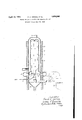
The accompanying drawing is a vertical central sectional View of an apparatus embodying the features of our invention.
The apparatus herein shown is intended for the treatment of coaly in a finely divided state. By finely divided coal We mean coal which has been crushed so that no particle Will fail to pass through a forty, sixty or eightymesh screen for the maximum size; that is to say, a screen having forty, sixty or eighty meshes to the inch, While the minimum size may be infinitesimal, say, capable of passing through a tWo-hundred-mesh screen or smaller.
`We have found that when relatively larger pieces of coal, even of the smaller sizes as prepared' for the market, are heated, the oily matters on the outside of the pieces escape as soon as their boiling point is reached, leaving carbonized residue behind. The heat gradually penetrates into the interior of the piece, but the rate of such penetration is very slow, since the coal is not a good conductor of heat in the first place, and in the secondplace the carbonized residue formed on its exterior is a still poorer conductor. Accordingly such outside portion, from which the vapors have already escaped, becomes highly heated long before the interior of the piece has reached the temperature at Which the oily constituents begin to boil oit'. When the boiling point of these is reached, and they va-A porize, before they can escape they must pass through the outer layers of carbonized residue which, as previously stated, are highly heated, in fact are heated by this time above the point at which the vapors in question decompose. The distillation, accordingly, assumes a destructive aspect, such vapors depositing free carbon and yielding a large amount of gas with a corresponding decrease in the yield of valuable oils.
When, however, a finely divided particle of coal of the size prescribed above is heated, practically all parts of such particle are heated at the same time and to the same degree. In fact the degree of iineness is regulated by this consideration, viz., that the particles shall be so small that When exposed to a hea-ting medium the temperature of the entire particle is practically simultaneously raised. Consequently when the boiling point of any oily matters which are contained in the particle is reached, such matters vaporize and go off practically the same as they would if they were in liquid condition at the start. The vapor, moreover, has a free escape from the particle, inasmuch as the latter is so small t 'mersing the same in a completel surroundingl andv contacting heating medium, We are able to control the degree of heat to exactly that required for the maximum production of oily or other valuable distillation product-s. At the same time We avoid the premature condensation of these oily vapors, due to their encountering cooler material. The redistillation of such prematurely condensed ingredients results in products that are undesirable, just as does the encounter of the vapors with material that is too highly heated.
The apparatus for crushing thel coal into the finely divided state required for use in our process, need not, of course, be described, there being various forms of Crushers and grinding mills available for this purpose.
The apparatus shown in the accompanying drawing is adapted for practicing a method of heating finely divided particles of coal by immersing the same in a heated atmosphere, this atn'losphere consisting of some suitable gas that will not combine in any Way with the coal, namely, a neutral or reducing gas. For this purpose in practice it will be preferable to employ the gas which results from vthe medium to said space.
the desired extent.
ployed, as need not be'described in detail.
retorting of the coal itself, that is, part of the gas produced from the heating of one portion of the coal will be used to heat other coal.
The coal, in finely divided state, is introduced by means of a duct l, into a current of hot gas that is discharged through a nozzle 2 into the interior of a carbonizing chamber 3, the wall 4 of which is maintained at a temperature somewhat above the boiling point of the vapors which it is desired to extract. Any preferred means may be employed to heat the chamber wall 4, as, for example, by surrounding said chamber by awall 5 so as to provide between said walls an annular space 6, and supplying a suitable heating The chamber 3 is of sufficient height so that the particles of coal carried upward therein by the current of gas discharged from the nozzle 2 shall remain suspended long enough to be carbonized to The coal-laden stream of gas, after striking the upper end wall of the chamber 3, follows the side walls thereof downwardly, the gas and the vaporized con-I stituents` of the coal escapin through aper- .tures 7 into a manifold 8. l portion of the gases and vapors are led to the condensing and distilling apparatus 9 while another portion is withdrawn by a fan l0 and returned through the pipe 11 and nozzle 2 to the chamber 3. The particles of carbonized residue` collect in the hopper-like bottom 12 of the chamber 3, from which they may, from time to time, be Withdrawn. If desired, a suitable filter, or electrostatic device, for precipitating the residual dust in the gases, may be em- It wil be seen that a portion of the gaseous products travel in a closed circuit.
As hereinbefore stated, the coal is in such a state of subdivision that the particles are i heated practically uniformly and instanta neously throughout, there being a free escape for the vapors formed, and the latter being 'at no time subjected to temperatures higher than their boiling points before escaping from the solid particles. In this way all of the objectionable results attendant upon previous methods of coal distillation are overcome, and a practically complete, or maximum, extraction of volatile constituents is obtained without material alteration in the character of these'. constituents. There will accordingly be a minimum amount of gas, and a preponderant quantity of liquid obtained by the dis tillation of the coal in the fashion described. Other modes of applying the principle of our invention may be employed instead of the one explained, without departing from the scope of the' invention as set forth in the appended claims.
We claim asour invention: y 1. A process of carbonizing finely subdivided solid carbonizable fuel which comprises suspending the nely subdivided fuel in a gas substantially free from oxygen andiat a tem# perature necessary for carbonization of the fuel, causing the fuel-laden gas and the fuel to travel in an upward direction and then in a counter-direction about the upward stream, then separating the carbonized fuel thus produced from the travelling gaseous products in finely subdivided state after the downward travel, and causing a portion of the said gaseous products to continue to travel in a closed circuit to receivev fresh fuel, another portion of the condensible products of carbonization being removed from the apparatus.
2. The process of carbonizing finely divided solid carbonizable fuel which comprises expanding a current of heated gases which will not support combustion into avertical chamber, .causing said current to induce a feed of finely divided coal into said current, causing the fuel laden current to -travel upwardly and centrally through said chamber and -then downwardly and along the side walls of said chamber, heating the exterior of said chamber to heat the suspended coal particles to a temperature necessary for carbonization, and separating the carbonized fuel thus produced from the traveling gaseous products.
3. In an apparatus for producing carbonized coal in a finely divided state, in combination, a vertical retort closed at its upper end, a heating chamber surrounding said retort, a vertical gas nozzle in the lower end of said retort and opening upwardly, a coal feed duct opening upwardly in said nozzle, means in the upper end of said,` retort for Idefiecting an upward current of fuel laden gases, means for receiving carbonized fuel below said nozzle and communicatinglwith said retort at the lower end thereof, and means for drawing off volatilized products from said retort.
4. In an apparatus for producing carbonized coal in a finely divided state, in combination, a vertical carbonizing chamber closed at its upper end, a heating chamber enveloping said carbonizing chamber, the lower end of said carbonizing chamber being formed with a collectin chamber for collecting the carbonized resi ue, a manifold about said collecting chamber and communicating through peripherally spaced openings with said collecting chamber, a nozzle extending vertically in said collecting chamber and into the lower end of said carbonizing chamber, said nozzle opening upwardly and being connected to said manifold, means for inducing a flow of gas from said manifold to said nozzle, and a fuel supply pipe opening upwardly in said nozzle.
5. In an apparatus for carbonizing coal in a finely divided state, in combination, a vertical carbonizing chamber closed at its upper bonizing chamber, the lower end of said carsaid manifold communicatingv
Priority Applications (1)
| Application Number | Priority Date | Filing Date | Title |
|---|---|---|---|
| US78305A US1854300A (en) | 1917-06-26 | 1925-12-30 | Method of and apparatus for carbonizing coal |
Applications Claiming Priority (2)
| Application Number | Priority Date | Filing Date | Title |
|---|---|---|---|
| US17694817A | 1917-06-26 | 1917-06-26 | |
| US78305A US1854300A (en) | 1917-06-26 | 1925-12-30 | Method of and apparatus for carbonizing coal |
Publications (1)
| Publication Number | Publication Date |
|---|---|
| US1854300A true US1854300A (en) | 1932-04-19 |
Family
ID=26760369
Family Applications (1)
| Application Number | Title | Priority Date | Filing Date |
|---|---|---|---|
| US78305A Expired - Lifetime US1854300A (en) | 1917-06-26 | 1925-12-30 | Method of and apparatus for carbonizing coal |
Country Status (1)
| Country | Link |
|---|---|
| US (1) | US1854300A (en) |
Cited By (6)
| Publication number | Priority date | Publication date | Assignee | Title |
|---|---|---|---|---|
| DE746918C (en) * | 1936-12-15 | 1944-08-30 | Herbert Pitz Dipl Ing | Method and device for the heat treatment of fine-grain or dust-like substances, in particular fuels |
| US2702269A (en) * | 1950-10-27 | 1955-02-15 | Ruetgerswerke Ag | Coking or cracking of oils, pitches, and the like |
| US2709152A (en) * | 1949-12-03 | 1955-05-24 | Koppers Co Inc | Process for producing finely divided coke from bituminous fuels |
| US2768937A (en) * | 1952-05-08 | 1956-10-30 | Henry F H Wigton | Distillation of volatile matters of carbonaceous materials |
| US2793175A (en) * | 1953-09-17 | 1957-05-21 | Petit Daniel | Low temperature distillation oven |
| DE968423C (en) * | 1948-12-07 | 1958-02-13 | Koppers Co Inc | Method and device for producing fine-grain coke from bituminous fuels |
-
1925
- 1925-12-30 US US78305A patent/US1854300A/en not_active Expired - Lifetime
Cited By (6)
| Publication number | Priority date | Publication date | Assignee | Title |
|---|---|---|---|---|
| DE746918C (en) * | 1936-12-15 | 1944-08-30 | Herbert Pitz Dipl Ing | Method and device for the heat treatment of fine-grain or dust-like substances, in particular fuels |
| DE968423C (en) * | 1948-12-07 | 1958-02-13 | Koppers Co Inc | Method and device for producing fine-grain coke from bituminous fuels |
| US2709152A (en) * | 1949-12-03 | 1955-05-24 | Koppers Co Inc | Process for producing finely divided coke from bituminous fuels |
| US2702269A (en) * | 1950-10-27 | 1955-02-15 | Ruetgerswerke Ag | Coking or cracking of oils, pitches, and the like |
| US2768937A (en) * | 1952-05-08 | 1956-10-30 | Henry F H Wigton | Distillation of volatile matters of carbonaceous materials |
| US2793175A (en) * | 1953-09-17 | 1957-05-21 | Petit Daniel | Low temperature distillation oven |
Similar Documents
| Publication | Publication Date | Title |
|---|---|---|
| US2342862A (en) | Activated coke | |
| GB617284A (en) | Process for producing volatile hydrocarbons from hydrocarbonaceous solids | |
| US1854300A (en) | Method of and apparatus for carbonizing coal | |
| US1937552A (en) | Process and apparatus for carbonizing powdered coal | |
| US1893913A (en) | Process and apparatus for the roasting or calcination of pulverulent matters | |
| US1916900A (en) | Method of low temperature distillation | |
| US1907569A (en) | Process of preparing coal for carbonization | |
| US1447297A (en) | Process for the combined solvent and destructive distillation treatment of oil containing earthy material | |
| US1748178A (en) | Rotary retort | |
| US3177128A (en) | Apparatus for producing carbon by direct heating with recycled volatile by-products | |
| US2637683A (en) | Distillation of solid carbonaceous materials | |
| US2127542A (en) | Electrical carbonization of coal | |
| US1467758A (en) | Process of producing hydrocarbon materials | |
| USRE17181E (en) | moewen | |
| US1825374A (en) | Method of coking petroleum residues from the distillation of petroleum oils | |
| US1675315A (en) | Process of continuously distilling carbonaceous fuel | |
| US1495776A (en) | Process of making gas | |
| US2026923A (en) | Method of operating retorts to produce coke, gas, and oil | |
| US1716667A (en) | Process of producing water gas and extracting oil from oil shale | |
| US2162763A (en) | Active carbon production | |
| US1481140A (en) | Method of and apparatus for carbonization or destructive distillation | |
| DE344704C (en) | Process for coking pulverized coal | |
| US1773839A (en) | Treatment of shale | |
| US2148355A (en) | Method for producing carbon black | |
| US1975396A (en) | Coal carbonizing apparatus |