US1853799A - Accordion - Google Patents
Accordion Download PDFInfo
- Publication number
- US1853799A US1853799A US437009A US43700930A US1853799A US 1853799 A US1853799 A US 1853799A US 437009 A US437009 A US 437009A US 43700930 A US43700930 A US 43700930A US 1853799 A US1853799 A US 1853799A
- Authority
- US
- United States
- Prior art keywords
- plate
- silencer
- reed
- hand
- accordion
- Prior art date
- Legal status (The legal status is an assumption and is not a legal conclusion. Google has not performed a legal analysis and makes no representation as to the accuracy of the status listed.)
- Expired - Lifetime
Links
- 235000014676 Phragmites communis Nutrition 0.000 description 88
- 230000007246 mechanism Effects 0.000 description 75
- 230000003584 silencer Effects 0.000 description 74
- 230000007935 neutral effect Effects 0.000 description 14
- 230000030279 gene silencing Effects 0.000 description 7
- 230000008859 change Effects 0.000 description 4
- 239000011435 rock Substances 0.000 description 4
- 244000273256 Phragmites communis Species 0.000 description 3
- 230000009471 action Effects 0.000 description 2
- 238000010276 construction Methods 0.000 description 2
- 102000004726 Connectin Human genes 0.000 description 1
- 108010002947 Connectin Proteins 0.000 description 1
- 241000219289 Silene Species 0.000 description 1
- 230000000694 effects Effects 0.000 description 1
- 239000007787 solid Substances 0.000 description 1
Images
Classifications
-
- G—PHYSICS
- G10—MUSICAL INSTRUMENTS; ACOUSTICS
- G10D—STRINGED MUSICAL INSTRUMENTS; WIND MUSICAL INSTRUMENTS; ACCORDIONS OR CONCERTINAS; PERCUSSION MUSICAL INSTRUMENTS; AEOLIAN HARPS; SINGING-FLAME MUSICAL INSTRUMENTS; MUSICAL INSTRUMENTS NOT OTHERWISE PROVIDED FOR
- G10D11/00—Accordions, concertinas or the like; Keyboards therefor
- G10D11/02—Actions
Definitions
- This invention relates to improvements in accordions.
- the mechanism may be operated at any point on the key-board without removing the hand y from the keys of the accordion.
- Another object of the invention is to provide a hand plat-e slidable alongside the edge of the key-board of the accordion, and provided with longitudinally spaced projections to be engaged by the hand of the player at c any point of the key board; the hand plate being so connected to a slidable reed block silencer, that the silencer is moved either into or out of the reed block by the movement of v the hand plate, in one and the same direction;
- the hand plate being automatically returned mechanism, thus leaving the silencer in position in spite of the return movementor" the plate.
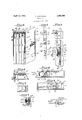
- FIG. 1 is a perspective view of an end of the accordion, showing the bottom face of the key-board and the reed boxes, the bellows being removed.
- Fig. 2 is a face view of the hand plate as mounted on the edge of the key-board.
- Fig. 3 is a fragmental View of the keyboard end of the accordion, showing the silencer actuating mechanism.
- Fig. at is a sectional view of the one way operative connection between the shaft of the silencer actuating mechanism and the rack and pinion mechanism that is operated by the hand plate, the section being taken on the line 4-4 of Fig. 3.
- Fig. 5 is a sectional view of the eccentric silencer actuator, the section being taken on the line 55 of Fig. 3.
- Fig. 6 is a i'ragmental sectional view of the silencer in the reed block, the section being taken on the line 66 of Fig. 1.
- Fig. 7 is a fragmental sectional plan view showing the crank pin operating the silencer, the section being taken on the line 7-7 of Fig. 6;
- Fig. 8 is a sectional View of the connection of the silencer actuating eccentric to the rack operated disc, the section being taken on the line 88 of Fig. 3.
- a silencer in an accordion is to render silent the reeds in one or more of the reed blocks of an accordion, by closing the air passages leading into the said reed block.
- the air openings of the reed block are to be covered or uncovered at will.
- Such silencing is used particularly in the accordion in connection with one of the reed blocks that produces a sound an octave lower than the oth r reed blocks.
- I provide a silencer actuating mechanism, the operation of which does not require the removal of the hand from the keys of the accordion, and which is operated by hand movements in the same direction, regardless whether the silencer is to be moved into or out of the reed block. After each actuation of the silencer the outer operating mechanism is automatically returned to its original position, leaving the silencer in the adjusted position, and the subsequent manipulations of the outer operating mechanism are all performed in one direction only.
- a silencer plate 11 is utilized.
- the silencer plate is slidable in a longitudinal slot 12 at the air openings 9 and has apertures 13 thereon disposed to register with the air openings 9, when the silencer 11 is partly withdrawn from the slot 12. lVhen the silencer 11 is moved into the slot 12 of the respective reed block 8, then the apertures 14 are advanced into the closed 3 spaces between the adjacent air openings 9,
- the silencer 11 is moved into and out of the reed block 8 by a silencer actuating mechanism 16, which in turn is operated by an operating mechanism 17.
- the two groups of mechanisms 16 and 17 are so connected to each other that the operating mechanism 17 is operative only in one direction, and is antomatically returned in the other direction without engaging the actuating mechanism in this latter direction.
- the operating mechanism 17 is connected to the inner face of a hand plate 18 which is slidable alongside the longitudinal edge 19 of the keyboard 7.
- the silencer 11 is moved either into or out of the reed block 8 whenever-the hand plate 18 is moved downwardly, viewing F 1g. 1 of the drawings.
- the hand plate 18 is slightly shorter than the edge 19, however it extends substantially the entire length of the row of keys on the key-board, so that it may be engaged by the hand or palm of the player, at any point of the length of the key-board.
- a plurality of longitudinally spaced transverse projections or ribs 21 are provided on the outer faces of the hand plate 18. which are readily engageable by the hand.
- the hand plate 18 is guided and held on the keyboard edge 19 by means of pins 22 extending from the inner face of the hand plate 18 into longi tudinal guide slots 23 in the edge 19.
- the operating mechanism 17 includes a shaft'24 rotatably supported within the keyboard 7 and extends transversely from the outer edge 19 to the interior of the accordion.
- a crank lever 26 On the outer end of the shaft 24 is a crank lever 26, the free end of which abuts against a pin 25 extending from the rear or under face of the hand plate 18, so that the reciprocating movement of the hand plate 18 is conveyed thru the lever 26 and is converted into rotary motion of the shaft 24 and transmitted to another crank lever 27 on the inner end of the shaft 24, and vice versa.
- a right angle bracket 28 is secured on the inner face of the inner end of the key-board 7. In this bracket 28 is rotatably supported a stub shaft 29, on which in turn is rotatable an annular disc 31.
- a pinion 32 On the face of the disc 31 adjacent the key-board 17 is fixed a pinion 32, with which is meshed a rack 33, the latter being guided and held in meshing position by means of a flange 34 of the bracket 28.
- the rack 33 reciprocates parallel to the key-board 7. From an end of the rack 33 projects at right angles, a U- shaped hook 36 with which the free end of the lever 27 is engaged.
- a coil spring 37 To the other end of the rack 33 is attached an end of a coil spring 37, the other end of which latter is secured to the key-board 7.
- the levers 26 and 27 extend at substantially 180 relatively to each other, therefore when the hand plate 18 is moved downwardly, view ing Fig.
- the rack 33 is moved oppositely, or upwardly by the lever 27.
- the rack 33 is moved by the hand plate 18 against the action of the spring 37, and during its movement it rotates the pinion 32 and the disc 31 therewith. WVhen the hand plate 18 is released the spring 37 urges the rack 33 back to its original position, whereby the plate 18 is returned to its starting position, and the disc 31 is rotated in the opposite direction.
- the disc 31 is connected to the shaft 29 by means of a pawl 38 and a ratchet wheel 39, the latter being keyed to the shaft 27.
- the pawl 38 is pivoted on the face of the disc and is urged against the periphery of the wheel 39 by means of a spring 41.
- the ratchet wheel 39 is formed in the shape of a cam with two diametrically opposite teeth to be engaged by the pawl 38.
- the silencer actuating mechanism 16 is operated through the shaft 29, therefore it is actuated only when the disc is rotated in said contra-clockwise direction. In other words, movement is transferred to the actuating mechanism 16 only when the hand plate 18 is moved downwardly, viewing Fig. 1, during the return movement of the hand plate 18, the shaft 29 is not rotated, and the actuating mechanism 16 remains in its adjusted position.
- the shaft 29 is rotated always in the same direction, but the silencer 11 must be moved successively in opposite directions.
- an eccentric a2 is lined on the shaft 29, to the eccentric band d8 of which is attached a connecting rod 4s.
- the free end of the connecting rod 1 1 is pivotally secured to the free end of a lever 46 extending at right angles to a crank pin 45?, which is journaled in bearings 48 on the inner of the end plate 6 of the accordion.
- the connecting rod e c 7 alongside one of the end reed blocks 8 substantially in parallelism therew L l of the block, while the crank uin 17 posed across opposite ends of the blo substantially at right angles to the rod L
- the outer end of the silencer 11 is formed in a Ushaped hook e9 to engage the cr lk of the pin 17 and be reciprocated thereby as the pin 47 is rocked. his the eccentric rotated the connecting rod 1- 1 is reciprocated to rock the pin 17 and slide the silencer 11 into and out of the slot 12 in the respective reed block 8. It is to he noted the mechanisms are so adjusted that the rod i, stopped at the ends of its respective up and down strokes, viewing Fig. 1.
- the length of the longitudinal slot 28 is such that it limits the down movement of the hand plate 18, to a stroke corresponding to a half revolution of the disc 31, so that the eccentric 12 is moved 180, from the full line position to the dotted line position shown in Fig. 5.
- Each of the successive full manipulations of the plate 18 in one direction always accomplishes a full stroke of the rod 4%, resultingin the proper movement of the silencer 11 to cover or uncover the air openings 9.
- the automatic re turning of the hand plate 18 by the action of the spring 37 leaves the position of the silencer 11 unaffected. Hence the player of the accordion noes not have to move the hand plate back and forth.
- the hand plate 18 may be readily engaged and operated by a slight hand movement alongside the edge of the key-board at any point relatively to the row of keys, without necessitating the removal of the hand from the key
- the afore-described silencer or dampener mechanism is connected to one set of reed blocks 8. In some instances it is desirable to dampen or silence another set of reeds. In order to allow the independent silencing of the different sets of reed blocks, I provide another silencing mechanism denoted in its entirety by the numeral 51, which operates silencers 11 in the second set of reed blocks 8.
- the mechanism 51 is similar to the first described mechanism except that the shaft 21 thereof has a crank lever 26 on the outer end thereof extending at substantially right angles to the crank lever 26. A. pin 25 on the inner face of the plate 18 abuts against the lever 26 only when the plate 18 is moved upwardly, beyond the return or release position of the first crank lever 26.
- the opera ing mechanism 51 includes all the clements described in connection with the first described mechanism, and operates similarly, except that the pawl 88 and ratchet 29 in the second mechanism, are reversed, that is, arranged to be operated by the shaft 24 when the latter is rotated in a direction opposite to the operative direction of the shaft 2d.
- a single movement in one direction operates only one set of silencers, after which the plate 18 is automatically returned to its neutral position by the respective operating mechanism; and a single movement of the plate 18 in the opposite direction operates only the other set of silencers, the plate 18 being automatically returned to its neutral position by the other operating mechanism.
- each silencer is actuated by a single movement, always in the same direction for the same silencer and by moving the plate 18 into its opposite extreme position, both oi silencers are operated, and the released plate 18 is returned to its neutral position by the last actuated operated mechan1sm.
- said operating means comprising a crank transversely disposed in the key-board having an end thereof connected to the hand plate, a rack and pinion mechanism on the inside of the key-board adapted to engage the actuating mechanism when moved in one direction by the hand plate, and resilient means to automatically return the said rack and pinion mechanism and said hand plate into inoperative position independently of the actuating mechanism.
- a silencer slidable over the air openings to silence one of the reed blocks
- an actuating mechanism connected to the silencer to slide the same to cover and uncover said openings
- each or said me ch anisins being adapted to automatically return the plate to its neutral position after each operation.
- each of said mechanisms be ing adapted to automatically return the plate to its neutral position after each operation, said means of connection being disposed entirely within the keyboard, and means on the said edge of the keyboard slidably engaged with the plate to slidably hold the plate on said edge.
- a silencer slidable successively in opposite directions over the air openings to cover and uncover the same; means comprising a single continuous connection to actuate said silencer; and a plate slidably mounted adjacent the edge of the keyboard and operatively connected to the angle continuous connection for sliding the silencer, said plate being movable successively alon the length of the keyboard in the same direction from a predetermined position of rest to actuate the silencer.
- a hand plate adjacent the keyboard of said accordion extended substantially the full length thereof, having a two stroke backward and forward movement, and a, single continuous connection between the reed block slide and hand plate, adapted to be actuated by the hand plate to effect a one stroke movement of the reed block slide.
Landscapes
- Physics & Mathematics (AREA)
- Engineering & Computer Science (AREA)
- Acoustics & Sound (AREA)
- Multimedia (AREA)
- Input From Keyboards Or The Like (AREA)
Description
April 12, 1932; CAGNAZZO 1,853,799
ACCORDION Filed March 19, 1930 INVENTOR, 1 540 C46; 4220 Patented Apr. 12, 1932 UNITED STATES PATENT OFFICE ANGELO CAGNAZZO, OF SAN FRANCISCO, CALIFORNIA ACCORDION Application filed March 19, 1930. Serial No. 437,009.
This invention relates to improvements in accordions.
It is one of the objects of the invention to provide a silencer mechanism tosilence one of the reed blocks of an accordion, or render it operative at will, the mechanism being adapted to be actuated by a comparatively short hand stroke of the player, longitudinally to the key-board and always in the same If direction, regardless whether the reed block is being silen'cec, or opened; furthermore, the
mechanism may be operated at any point on the key-board without removing the hand y from the keys of the accordion.
if Another object of the invention is to provide a hand plat-e slidable alongside the edge of the key-board of the accordion, and provided with longitudinally spaced projections to be engaged by the hand of the player at c any point of the key board; the hand plate being so connected to a slidable reed block silencer, that the silencer is moved either into or out of the reed block by the movement of v the hand plate, in one and the same direction;
the hand plate being automatically returned mechanism, thus leaving the silencer in position in spite of the return movementor" the plate.
Other objects and advantages are to provide an accordion that will be superior in point of simplicity, inexpcnsivencss of construction, positiveness of operation, and facility and convenience in use and general efliciency.
In this specification and the annexed drawings, the invention is illustrated. in the form considered to be the best, but it is to be understood that the invention is not limited to such form, because it may be embodied in other forms; and it is also to be understood that in and by the claims following the description, it is desired to cover the invention in whatsoever form it may be embodied.
The invention is clearly illustrated in th accompanying drawings, wherein Fig. 1 is a perspective view of an end of the accordion, showing the bottom face of the key-board and the reed boxes, the bellows being removed.
Fig. 2 is a face view of the hand plate as mounted on the edge of the key-board.
Fig. 3 is a fragmental View of the keyboard end of the accordion, showing the silencer actuating mechanism.
Fig. at is a sectional view of the one way operative connection between the shaft of the silencer actuating mechanism and the rack and pinion mechanism that is operated by the hand plate, the section being taken on the line 4-4 of Fig. 3.
Fig. 5 is a sectional view of the eccentric silencer actuator, the section being taken on the line 55 of Fig. 3.
Fig. 6 is a i'ragmental sectional view of the silencer in the reed block, the section being taken on the line 66 of Fig. 1.
Fig. 7 is a fragmental sectional plan view showing the crank pin operating the silencer, the section being taken on the line 7-7 of Fig. 6; and
Fig. 8 is a sectional View of the connection of the silencer actuating eccentric to the rack operated disc, the section being taken on the line 88 of Fig. 3.
The function of a silencer in an accordion is to render silent the reeds in one or more of the reed blocks of an accordion, by closing the air passages leading into the said reed block. For this purpose the air openings of the reed block are to be covered or uncovered at will. Such silencing is used particularly in the accordion in connection with one of the reed blocks that produces a sound an octave lower than the oth r reed blocks. Some of the previous attempts to operate a silencer for this reed block, have provided actuating mechanisms which necessitate the removal of the hand from the keys, others need a hand stroke in one direction to cause the covering of the air openings of the reed block, and the movement of the hand in the opposite direction to cause the uncovering of said openings. The removal of the hand from the keyboard results in losing time and count in the music. The back and forth movement of the hand results in confusion and loss of time,
because the player is usually unable to keep in mind the last position of the actuating mechanism, and of the direction of the next stroke to operate the silencer.
In the construction hereinafter described, I provide a silencer actuating mechanism, the operation of which does not require the removal of the hand from the keys of the accordion, and which is operated by hand movements in the same direction, regardless whether the silencer is to be moved into or out of the reed block. After each actuation of the silencer the outer operating mechanism is automatically returned to its original position, leaving the silencer in the adjusted position, and the subsequent manipulations of the outer operating mechanism are all performed in one direction only.
In carrying out my invention I make use of the end plate 6 of the accordion, from an edge of which angularly extends the usual key-board 7, on which in turn are located the accordion keys in the customary manner. On the inner face of the end plate 6 are mounted reed blocks 8 containing the vibrating reeds. A flow of air passes thru openings 9, when ever the usual bellows of the accordion is manipulated.
In order to render a reed block silent, or inoperative the air openings 9 thereof are to be covered. For this purpose a silencer plate 11 is utilized. The silencer plate is slidable in a longitudinal slot 12 at the air openings 9 and has apertures 13 thereon disposed to register with the air openings 9, when the silencer 11 is partly withdrawn from the slot 12. lVhen the silencer 11 is moved into the slot 12 of the respective reed block 8, then the apertures 14 are advanced into the closed 3 spaces between the adjacent air openings 9,
and the solid portions of the silencer 11 cover the openings 9 to prevent the passage of air therethrough, whereby the respective reed block 8 is rendered inoperative.
The silencer 11 is moved into and out of the reed block 8 by a silencer actuating mechanism 16, which in turn is operated by an operating mechanism 17. The two groups of mechanisms 16 and 17 are so connected to each other that the operating mechanism 17 is operative only in one direction, and is antomatically returned in the other direction without engaging the actuating mechanism in this latter direction. The operating mechanism 17 is connected to the inner face of a hand plate 18 which is slidable alongside the longitudinal edge 19 of the keyboard 7. The silencer 11 is moved either into or out of the reed block 8 whenever-the hand plate 18 is moved downwardly, viewing F 1g. 1 of the drawings.
The hand plate 18 is slightly shorter than the edge 19, however it extends substantially the entire length of the row of keys on the key-board, so that it may be engaged by the hand or palm of the player, at any point of the length of the key-board. To facilitate the manipulation of the hand plate 18 a plurality of longitudinally spaced transverse projections or ribs 21 are provided on the outer faces of the hand plate 18. which are readily engageable by the hand. The hand plate 18 is guided and held on the keyboard edge 19 by means of pins 22 extending from the inner face of the hand plate 18 into longi tudinal guide slots 23 in the edge 19.
The operating mechanism 17 includes a shaft'24 rotatably supported within the keyboard 7 and extends transversely from the outer edge 19 to the interior of the accordion. On the outer end of the shaft 24 is a crank lever 26, the free end of which abuts against a pin 25 extending from the rear or under face of the hand plate 18, so that the reciprocating movement of the hand plate 18 is conveyed thru the lever 26 and is converted into rotary motion of the shaft 24 and transmitted to another crank lever 27 on the inner end of the shaft 24, and vice versa. A right angle bracket 28 is secured on the inner face of the inner end of the key-board 7. In this bracket 28 is rotatably supported a stub shaft 29, on which in turn is rotatable an annular disc 31. On the face of the disc 31 adjacent the key-board 17 is fixed a pinion 32, with which is meshed a rack 33, the latter being guided and held in meshing position by means of a flange 34 of the bracket 28. It is to be noted that the rack 33 reciprocates parallel to the key-board 7. From an end of the rack 33 projects at right angles, a U- shaped hook 36 with which the free end of the lever 27 is engaged. To the other end of the rack 33 is attached an end of a coil spring 37, the other end of which latter is secured to the key-board 7. It is to be noted that the levers 26 and 27 extend at substantially 180 relatively to each other, therefore when the hand plate 18 is moved downwardly, view ing Fig. 1, the rack 33 is moved oppositely, or upwardly by the lever 27. The rack 33 is moved by the hand plate 18 against the action of the spring 37, and during its movement it rotates the pinion 32 and the disc 31 therewith. WVhen the hand plate 18 is released the spring 37 urges the rack 33 back to its original position, whereby the plate 18 is returned to its starting position, and the disc 31 is rotated in the opposite direction.
The disc 31 is connected to the shaft 29 by means of a pawl 38 and a ratchet wheel 39, the latter being keyed to the shaft 27. The pawl 38 is pivoted on the face of the disc and is urged against the periphery of the wheel 39 by means of a spring 41. It is to be noted that the ratchet wheel 39 is formed in the shape of a cam with two diametrically opposite teeth to be engaged by the pawl 38. when the disc 31 is rotated in contra-clockwise direction, viewing Fig. 4. When the disc 31 is rotated in the opposite direction the pawl 31 slips or rides on the periphery of the wheel 89 without rotating the same. The silencer actuating mechanism 16 is operated through the shaft 29, therefore it is actuated only when the disc is rotated in said contra-clockwise direction. In other words, movement is transferred to the actuating mechanism 16 only when the hand plate 18 is moved downwardly, viewing Fig. 1, during the return movement of the hand plate 18, the shaft 29 is not rotated, and the actuating mechanism 16 remains in its adjusted position.
The shaft 29 is rotated always in the same direction, but the silencer 11 must be moved successively in opposite directions. In order to operate the silencer 11 successively in 01- posite directions, an eccentric a2 is lined on the shaft 29, to the eccentric band d8 of which is attached a connecting rod 4s. The free end of the connecting rod 1 1 is pivotally secured to the free end of a lever 46 extending at right angles to a crank pin 45?, which is journaled in bearings 48 on the inner of the end plate 6 of the accordion. be noted that the connecting rod e c 7 alongside one of the end reed blocks 8 substantially in parallelism therew L l of the block, while the crank uin 17 posed across opposite ends of the blo substantially at right angles to the rod L The outer end of the silencer 11 is formed in a Ushaped hook e9 to engage the cr lk of the pin 17 and be reciprocated thereby as the pin 47 is rocked. his the eccentric rotated the connecting rod 1- 1 is reciprocated to rock the pin 17 and slide the silencer 11 into and out of the slot 12 in the respective reed block 8. It is to he noted the mechanisms are so adjusted that the rod i, stopped at the ends of its respective up and down strokes, viewing Fig. 1. The length of the longitudinal slot 28 is such that it limits the down movement of the hand plate 18, to a stroke corresponding to a half revolution of the disc 31, so that the eccentric 12 is moved 180, from the full line position to the dotted line position shown in Fig. 5. Each of the successive full manipulations of the plate 18 in one direction, always accomplishes a full stroke of the rod 4%, resultingin the proper movement of the silencer 11 to cover or uncover the air openings 9. The automatic re turning of the hand plate 18 by the action of the spring 37 leaves the position of the silencer 11 unaffected. Hence the player of the accordion noes not have to move the hand plate back and forth. Furthermore, the hand plate 18 may be readily engaged and operated by a slight hand movement alongside the edge of the key-board at any point relatively to the row of keys, without necessitating the removal of the hand from the key The afore-described silencer or dampener mechanism is connected to one set of reed blocks 8. In some instances it is desirable to dampen or silence another set of reeds. In order to allow the independent silencing of the different sets of reed blocks, I provide another silencing mechanism denoted in its entirety by the numeral 51, which operates silencers 11 in the second set of reed blocks 8. The mechanism 51 is similar to the first described mechanism except that the shaft 21 thereof has a crank lever 26 on the outer end thereof extending at substantially right angles to the crank lever 26. A. pin 25 on the inner face of the plate 18 abuts against the lever 26 only when the plate 18 is moved upwardly, beyond the return or release position of the first crank lever 26. The opera ing mechanism 51 includes all the clements described in connection with the first described mechanism, and operates similarly, except that the pawl 88 and ratchet 29 in the second mechanism, are reversed, that is, arranged to be operated by the shaft 24 when the latter is rotated in a direction opposite to the operative direction of the shaft 2d.
Consequently when the plate 18 is moved downwardly, viewing Fig. 1, the shaft 24 is rotated to operate one set of silencers, but the pin 25 moves away from the crank lever 26" leaving the latter free and inoperative. When the plate 18 is automatically returned to its neutral position, then the crank lever 26 is turned by the pin 25, but the pin 25 merely moves into abutting relation to the crank lever 26. On the other hand, when the plate 18 is moved upwardly from its neutral or released position, the pin 25 turns the crank lever 26 to actuate the other set of silencers, at the same time the pin 25 is moving away inoperatively from the crank lever 26. Thus a single movement in one direction operates only one set of silencers, after which the plate 18 is automatically returned to its neutral position by the respective operating mechanism; and a single movement of the plate 18 in the opposite direction operates only the other set of silencers, the plate 18 being automatically returned to its neutral position by the other operating mechanism. In this manner each silencer is actuated by a single movement, always in the same direction for the same silencer and by moving the plate 18 into its opposite extreme position, both oi silencers are operated, and the released plate 18 is returned to its neutral position by the last actuated operated mechan1sm.
Having thus described this invention, what I claim and desire to secure by Letters Patcut is:
1. The combination with an accordion having reed blocks with air openings thereon, and a key-board, of a hand plate slidable alongside the longitudinal edge of the keyboard, a silencer slidable over the air openings to silence one of the reed blocks; an actuating mechanism connected to the silencer to slide the same to cover and uncover said openings; and means extended thru the key-board and connected to the plate, to operate the actuating mechanism in either direction by the sliding of the plate in one direction and to automatically return the plate in the other direction without operating the actuating mechanism.
2. The combination with an accordion having reed blocks with air openings thereon, and a key-hoard, of a hand plate slidable along side the longitudinal edge of the key-board, a silencer slidable over the air openings to silence one of the reed blocks; an actuating mechanism connected to the silencer to slide the same to cover and uncover said openings; and means extended thru the key-board and connected to the plate to operate the actuating mechanism successively in opposite directions by successive movement of the plate in one direction and to automatically return the hand plate from its operative position after each actuation, Without operating the actuating mechanism.
3. The combination with an accordion having reed blocks with air openings on each reed block, and a key board, of a hand plate slidable alongside the longitudinal edge of the key-board, being slightly shorter than the said longitudinal edge, a plurality of spaced transverse projections extending outwardly from the slide handle to be engaged by the hand of the player, a silencer slidable over the openings of one of the reed blocks to render said reed block inoperative; means connecting the silencer to the hand plate to move the silencer into or out of silencing position upon the sliding of the plate in one direction, and means to automatically move the hand plate in the opposite direction, when the same is released, without moving the si lencer.
4; The combination with an accordion having reed blocks with air openings on each reed block, and a key-board, of a hand plate slidable alongside the longitudinal edge of the key-board, being slightly shorter than the said longitudinal edge, a plurality of spaced transverse projections extending outwardly from the slide handle to be engaged by the hand oi" the player, a silencer slidable over the openings of one of the reed blocks to render said reed block inoperative; a silencer actuating mechanism; and means to operatively connect the actuating mechanism to the hand plate, when the same is moved in one direction, and to automatically move the plate in the released position thereof independently of the actuating mechanism.
5. The combination with an accordion having reed blocks with air openings thereon, and a key-board, of a hand plate slidable successively in the same direction from a normal position of rest alongside the longitudinal edge of the key-board, a silencer slidable in opposite directions to cover and uncover the air openings in one of the reed blocks; a single continuous actuating mechanism connected to the hand plate and to the silencer to slide the silencer to cover the air openings when the hand plate is moved in one direction from a normal position and to uncover the openings when moved in the same direction from said normal position, said hand plate being flat and parallel ith the said edge of the keyboard; and a plurality of longitudinally spaced projections extended outwardly from the hand plate to be engaged at will by the hand of the player.
6. The combination with an accordion having reed blocks with air openings on each reed bloch, and a key-board, of a hand plate slidable alongside the longitudinal edge of the key-board, being slightly shorter than the said longitudinal edge, a plurality of s accd transverse projections extending outwardly from the slide handle to be engaged by the hand of the player, a silencer slidable over the openings of one of the reed blocks to render said reed block inoperative, said opei ting means comprising a crank transiy disposer in the key-board having an end thereof connected to the hand plate, a 1 'l pinion mechanism on the inside of the y-board adapted to engage the actuatmechanism when moved in one direction oy the hand plate, and resilient means to automatically return the said rack and pinion mechanism and said hand plate into inoperative position independently of the actuating mechanism.
7. The combination with an accordion having reed blocks with air openings thereon, and a key-board, of a hand plate slidable alongside the longitudinal edge of the keyboard, a silencer slidable over the air openings to silence one of the reed blocks; an actuating mechanism connected to the silencer to slide the same to cover and uncover said openings; means extended thru the keyboard. and connected to the plate to operate the actuating mechanism in either direction by the sliding of the plate in one direction and to automatically return the plate in the other direction without operating the actuating mechanism, said operating means comprising a crank transversely disposed in the key-board having an end thereof connected to the hand plate, a rack and pinion mechanism on the inside of the key-board adapted to engage the actuating mechanism when moved in one direction by the hand plate, and resilient means to automatically return the said rack and pinion mechanism and said hand plate into inoperative position independently of the actuating mechanism.
8. The combination with an accordion having reed blocks with air openings thereon,
and a key-board, of a hand. plate slidable alongside the longitudinal edge of the keyboard, a silencer slidable over the air openings to silence one of the reed blocks; an actuating mechanism connected to the silencer to slide the same to cover and uncover said openings; means extended thru the keyboard and connected to the plate to operate the actuating mechanism in either direction by the sliding of the plate in one direction and to automatically r turn the plate in the other direction, without operating the actuating mechanism, said actuating mechanism comprising a crank pin journaled above the reed blocks and engaged with the silencer to move the same; a connecting rod connected to the crank pin to rotate the same, and an cecentric to reciprocate the connectin rod, said eccentric being turned a halt a revolution everytimethe hand plate is slid in one direction and remaining stationary when the hand plate is released and returned in the other direction.
9. In an accordion having reed blocks with air openings thereon and a key-board; a hand plate slidable alongside the longitudinal edge of the key-board, a silencer slidable over the air openings to silence one of the blocks, a crank pin journaled adjacent the reed blocks to move the silencer into and out 03": silencing position; an eccentric adjacent the side of one of the reed blocks connected to the crank pin to rock the pin succesriively in opposite directions; operating means connecting the eccentric to the hand plate to tur' the eccentric as the hand plate is slid in one direction, and to release said eccentric the hand plate is returned in inoperative position in the other direction; and resilient means to automatically return said operating means and said hand plate to the inoperative position.
'10. In an accordion having reed blocks with air openings thereon and a key-board; a hand plate slidable alongside the longitudinal edge of the keyboard, a silencer slidable over the air openings to silence one of the reed blocks, a crank pin journaled adj acent the reed blocks to move the silencer into and out of silencing position; an eccentric at jacent the side of one of the reed blocks connected to the crank pin to rock the pin suciessively in opposite directions a crank transversely journaled in the key-board having 11 end thereof connected to the hand plate, a rack slidable on the inner end of the keyboard and being connected to the other end of the crank; a rotary disc mounted on the inside of the key-board, a pinion lined concentrically on the disc meshing with the rack, a ratchet wheel on the shaft of the eccentric, and a pawl pivoted on a face of the disc to engage said ratchet wheel when the disc rotated in one direction by the sliding oi the plate, and resilient means to automatically return said rack and said hand plate into a released position rotating the disc in the opposite direction freely from said ratchet.
11. In an accordion having reed blocks with air openings thereon and a key-board; a hand plate slidable alongside the longitudina l edge f the keyboard, a silencer slidable over the air openings to silence one of the reed blocks, a crank pin urnaled adjacent the reed blocks to move the silencer into and out silencing position; an eccentric adjacent the side of one of tee reed blocks connected to the crank pin to rock the pin successively in opposite directions; a crank transrersely iournaled in the key-board having an end thereof connecteo to the hand plate, a rack slidable on the inner end of the key-board and being connected to the other end of the crank; a rotary disc mounted on the inside of the key-hoard, a pinion fixed concentrically on the disc meshing with the rack; coacting elements on the disc and on the eccentric to cause the turning of the eccem-ric as the disc is rotated in one direction by the sliding of the hand plate, and to allow the tree rotation of the disc in the other direction as the rack and the hand plate are returned in the opposite direction; and resilient means to automatically return said rack and said hand plate to the starting position thereof after each actuation of the silencer.
li The combination with an accordion having reed blocks "ith air openings thereon and a key board, or" a hand plate slidahle on an edge of the keyboard; a silencer slidablc over the air openings of one of the reed blocks, a second silencer slidable over the air openings of another reed block, an actuating mechanism connected to the first silencer to s ide the same to cover and uncover the respective openings; a second actuating mechanism connected to the second silencer to slide the same to cover and uncover the openings of the second rec l bl, and means. tor each actuatmechanism, extended thru the keyboai a to connect the respective actuatin mechanism to the plate, to operate only one or said mechanisms every time the plate is moved in one direction from its neutral position, and to opcrate only the other mechanism every time the plate is moved in the opposite direction beyond its neutral position, each or said me ch anisins being adapted to automatically return the plate to its neutral position after each operation.
13. The combination with. accordion *i reed blocks with air openings thereon d a :eyboard, 01" a hand plate sridable on longitudinal edge of the ke board alone;- ide the keys of the keyboard, a silencer slidxble over the air openings 0t one of t .Jlocks, seconc silencer slidable over openings of another reed block, an actuatin mechanism connected to the first silencer to slide the same to cover and uncover the respective openings; a second actuating mechanism connected to the second reed block; and means, for each actuating mechanism extended thru the keyboard to connect the respective actuating mechanism to the plate, to operate only one of said mechanisms every time the plate is moved in one direction from its neutral position, and to operate only the other mechanism every time the plate moved in the opposite direction beyond its neutral position, each of said mechanisms being adapted to automatically return the plate to its neutral position after each operation.
14. The combination with an accordion having reed blocks with air openings there on and a keyboard, of a hand plate slidable on a longitudinal edge of the keyboard alongside the keys of the keyboard, a silencer slidable over the air openings of one of the reed blocks, a second silencer slidable over the air openings of another reed block, an actuating mechanism connected to the first silencer to slice the same to cover and uncover the respective openings; a second actuating mechanism connected to the second reed block; means, for each actuating mechanism extended thru the keyboard to connect the respective actuating mechanism to the place, to operate only one of said mechanisms every time the plate is moved in one direction from its neutral. position, and to operate only the other mechanism every time the plate is moved in the opposite direction beyond its neutral position, each of said mechanisms be ing adapted to automatically return the plate to its neutral position after each operation, said means of connection being disposed entirely within the keyboard, and means on the said edge of the keyboard slidably engaged with the plate to slidably hold the plate on said edge.
15. In combination with an accordion hav ing a reed block with air openings therein; a silencer slidable successively in opposite directions over the air openings to cover and uncover the same; means comprising a single continuous connection to actuate said silencer; and a plate slidably mounted adjacent the edge of the keyboard and operatively connected to the angle continuous connection for sliding the silencer, said plate being movable successively alon the length of the keyboard in the same direction from a predetermined position of rest to actuate the silencer.
16. In combination with a reed block of an accordion, of a slide reciprocatable successively in opposite directions on the reed block to change the octave thereof; means comprising a single continuous connection to move said slide; and a hand plate adjacent the keyboard of said accordion reciproccatable along the length of the key board successively, in the same direction to actuate said slide thru said single continuous connection.
17. In combination with a pair of reed blocks of an accordion, of a slide reciprocatable successively, in opposite directions on each reed block to change the octave of each block; means comprising a single continuous connection to move each slide; and a hand plate adjacent the keyboard of said accordion reciprocatable along the length of the keyboard, successively, in one direction from a set position of rest, and in an opposite direction from said set position of rest to actuate the respective reed block slides thru said means.
18. In combination with a reed block of an accordion, of a slide reciprocatable successively, in opposite directions 011 the reed block to change the octave thereof; means comprising a single continuous connection to move said slide; and a hand plate adjacent the keyboard of said accordion and extended substantially the full length thereof reciprocatable along the length of the keyboard, successively, in the same direction to actuate said slide thru said means.
19. In combination with a pair of reed blocks of an accordion, of a slide reciprocatable, successively, in opposite directions on each reed block to change the octave of each block; means comprising a single continuous connection to move each slide; and a hand plate adjacent the keyboard of said accordion and extendel substantially the full length thereof, reciprocatable along the length of the keyboard, successively, in one direction from a set position of rest and in an opposite direction from said set position of rest to actuate the respective reed block slides thru said means.
20. In combination with an accordion having a keyboard thereon and a reed block therein, of a slide having a one stroke backward or forward movement on the reed block to cover or uncover the reed block openings when moved; a hand plate adjacent the keyboard of said accordion extended substantially the full length thereof, having a two stroke backward and forward movement, and a, single continuous connection between the reed block slide and hand plate, adapted to be actuated by the hand plate to effect a one stroke movement of the reed block slide.
In testimony whereof, I have hereunto set my hand at San Francisco, California, this 14th day of March, 1930.
ANGELO CAGNAZZO.
Priority Applications (1)
| Application Number | Priority Date | Filing Date | Title |
|---|---|---|---|
| US437009A US1853799A (en) | 1930-03-19 | 1930-03-19 | Accordion |
Applications Claiming Priority (1)
| Application Number | Priority Date | Filing Date | Title |
|---|---|---|---|
| US437009A US1853799A (en) | 1930-03-19 | 1930-03-19 | Accordion |
Publications (1)
| Publication Number | Publication Date |
|---|---|
| US1853799A true US1853799A (en) | 1932-04-12 |
Family
ID=23734689
Family Applications (1)
| Application Number | Title | Priority Date | Filing Date |
|---|---|---|---|
| US437009A Expired - Lifetime US1853799A (en) | 1930-03-19 | 1930-03-19 | Accordion |
Country Status (1)
| Country | Link |
|---|---|
| US (1) | US1853799A (en) |
-
1930
- 1930-03-19 US US437009A patent/US1853799A/en not_active Expired - Lifetime
Similar Documents
| Publication | Publication Date | Title |
|---|---|---|
| US1662076A (en) | Trumpet | |
| US845998A (en) | Piccolo or other musical instrument. | |
| US2136112A (en) | Accordion shift mechanism | |
| US739396A (en) | Electric attachment for pianos. | |
| US2798400A (en) | Accordion bass chord converter | |
| US1814472A (en) | Organ control | |
| US1397559A (en) | Printing and calculating machine | |
| US1234061A (en) | Photographic shutter. | |
| US1074563A (en) | Piano-playing mechanism. | |
| US1725707A (en) | Combination stop mechanism for organs and the like | |
| US2051620A (en) | Accordion shift mechanism | |
| US1753092A (en) | Handle-controlled slot closure | |
| US1407814A (en) | Supervisory mechanism | |
| US1049929A (en) | Key-operated mechanism for actuating, recording, or indicating apparatus or the like. | |
| US1333277A (en) | Printing cut-out for adding-machines | |
| US1725706A (en) | Combination stop mechanism for organs and the like | |
| US1563763A (en) | luttropp | |
| US1091666A (en) | Camera-shutter. | |
| US1358877A (en) | Lock | |
| US1770004A (en) | Attachment for musical instruments | |
| US847798A (en) | Self-playing piano. | |
| USRE21395E (en) | Selective shift fob accordions | |
| US489887A (en) | Pipe-organ stop-action | |
| US519925A (en) | Cash register and indicator | |
| US1210463A (en) | Telephone-recorder. |