US1853688A - Apparatus for converting hydrocarbons - Google Patents
Apparatus for converting hydrocarbons Download PDFInfo
- Publication number
- US1853688A US1853688A US316591A US31659128A US1853688A US 1853688 A US1853688 A US 1853688A US 316591 A US316591 A US 316591A US 31659128 A US31659128 A US 31659128A US 1853688 A US1853688 A US 1853688A
- Authority
- US
- United States
- Prior art keywords
- temperature
- bodies
- converter
- resistor
- hydrocarbons
- Prior art date
- Legal status (The legal status is an assumption and is not a legal conclusion. Google has not performed a legal analysis and makes no representation as to the accuracy of the status listed.)
- Expired - Lifetime
Links
- 229930195733 hydrocarbon Natural products 0.000 title description 31
- 150000002430 hydrocarbons Chemical class 0.000 title description 30
- 238000000034 method Methods 0.000 description 17
- 239000007789 gas Substances 0.000 description 15
- 238000006243 chemical reaction Methods 0.000 description 14
- 239000004215 Carbon black (E152) Substances 0.000 description 9
- 239000000463 material Substances 0.000 description 9
- 239000003921 oil Substances 0.000 description 9
- OKTJSMMVPCPJKN-UHFFFAOYSA-N Carbon Chemical compound [C] OKTJSMMVPCPJKN-UHFFFAOYSA-N 0.000 description 6
- 229910052799 carbon Inorganic materials 0.000 description 6
- 238000010438 heat treatment Methods 0.000 description 6
- 238000005336 cracking Methods 0.000 description 4
- 239000004020 conductor Substances 0.000 description 3
- 239000000203 mixture Substances 0.000 description 3
- 239000002994 raw material Substances 0.000 description 3
- XEEYBQQBJWHFJM-UHFFFAOYSA-N Iron Chemical compound [Fe] XEEYBQQBJWHFJM-UHFFFAOYSA-N 0.000 description 2
- 238000009835 boiling Methods 0.000 description 2
- 230000000694 effects Effects 0.000 description 2
- 230000005611 electricity Effects 0.000 description 2
- 229910052739 hydrogen Inorganic materials 0.000 description 2
- 239000001257 hydrogen Substances 0.000 description 2
- 230000001788 irregular Effects 0.000 description 2
- 239000007788 liquid Substances 0.000 description 2
- 239000002184 metal Substances 0.000 description 2
- 229910052751 metal Inorganic materials 0.000 description 2
- CURLTUGMZLYLDI-UHFFFAOYSA-N Carbon dioxide Chemical compound O=C=O CURLTUGMZLYLDI-UHFFFAOYSA-N 0.000 description 1
- UFHFLCQGNIYNRP-UHFFFAOYSA-N Hydrogen Chemical compound [H][H] UFHFLCQGNIYNRP-UHFFFAOYSA-N 0.000 description 1
- NINIDFKCEFEMDL-UHFFFAOYSA-N Sulfur Chemical compound [S] NINIDFKCEFEMDL-UHFFFAOYSA-N 0.000 description 1
- 230000015572 biosynthetic process Effects 0.000 description 1
- 239000003795 chemical substances by application Substances 0.000 description 1
- 239000003245 coal Substances 0.000 description 1
- 239000000470 constituent Substances 0.000 description 1
- 238000010276 construction Methods 0.000 description 1
- 230000007812 deficiency Effects 0.000 description 1
- 230000008030 elimination Effects 0.000 description 1
- 238000003379 elimination reaction Methods 0.000 description 1
- 239000002360 explosive Substances 0.000 description 1
- -1 gra hite Substances 0.000 description 1
- 150000002431 hydrogen Chemical class 0.000 description 1
- 239000012535 impurity Substances 0.000 description 1
- 230000006698 induction Effects 0.000 description 1
- 229910052742 iron Inorganic materials 0.000 description 1
- 239000012811 non-conductive material Substances 0.000 description 1
- 238000003825 pressing Methods 0.000 description 1
- 230000002265 prevention Effects 0.000 description 1
- 239000010453 quartz Substances 0.000 description 1
- 230000001105 regulatory effect Effects 0.000 description 1
- VYPSYNLAJGMNEJ-UHFFFAOYSA-N silicon dioxide Inorganic materials O=[Si]=O VYPSYNLAJGMNEJ-UHFFFAOYSA-N 0.000 description 1
- 239000011343 solid material Substances 0.000 description 1
- 239000000126 substance Substances 0.000 description 1
- 229910052717 sulfur Inorganic materials 0.000 description 1
- 239000011593 sulfur Substances 0.000 description 1
Images
Classifications
-
- C—CHEMISTRY; METALLURGY
- C10—PETROLEUM, GAS OR COKE INDUSTRIES; TECHNICAL GASES CONTAINING CARBON MONOXIDE; FUELS; LUBRICANTS; PEAT
- C10G—CRACKING HYDROCARBON OILS; PRODUCTION OF LIQUID HYDROCARBON MIXTURES, e.g. BY DESTRUCTIVE HYDROGENATION, OLIGOMERISATION, POLYMERISATION; RECOVERY OF HYDROCARBON OILS FROM OIL-SHALE, OIL-SAND, OR GASES; REFINING MIXTURES MAINLY CONSISTING OF HYDROCARBONS; REFORMING OF NAPHTHA; MINERAL WAXES
- C10G9/00—Thermal non-catalytic cracking, in the absence of hydrogen, of hydrocarbon oils
- C10G9/42—Thermal non-catalytic cracking, in the absence of hydrogen, of hydrocarbon oils by passing the material to be cracked in thin streams or as spray on or near continuously heated surfaces
Definitions
- My invention relates to an apparatus for converting hydro-carbons and it particularly relates to an apparatus for converting hydrocarbons into products, of which one part will boil at a higher and another part will boil at a lowerpoint than the applied raw mate-' rial.
- the hydro-can bons to be converted are uniformly exposed conductors of electricity. It is primarily their uniform shape and hollow construction which plays an essential. part in the present invention for though I am aware that resistance bodies have been used for similar pur poses, the resistors of the prior art have not given satisfactory results.
- the temperature of the electrically heated zone was very high and it was therefor often assumed that the heat would soon spread evenly through the mass; moreover, it was often held in view of the high temperature that a number of degrees more or less were of no material influence on the outcome of the reaction; and if an occasional measurment of the temperature showed substantially the temperature necessary for the operation of the process, everything was considered in order.
- any suitable metal not seriously afiected by the hydrocarbons or its impurities, such as sulfur, or any other material, like gra hite, coal and the like may be used for ma ing up the resistors in their respective size and thickness.
- the receptaole At the upper and lower end of the receptaole there are provided electrodes of various shapes, such as perforated plates, sieves, or the like, suitably connected with the current.
- a converter In the same receptacle, henceforth simply called a converter, is introduced the raw material to be treated and the generated prod nets are recovered partly as liquid, partly as vapor.
- tor is infinitely larger and to heat the same to the desired temperature an amount of electric current is necessary that both technically and economically a process operated under such conditions is bound to result in failure.
- the converter can be considered to consist of an enormous complex of miniature heating.
- each individual resistor of a definite uniform shape, size and thickness practically a solid material
- the action of the heat, radiating from the surface of the resistors causes the hydrocarbons to move violently and in doing so constantly strike against other radiators to thereby gradually complete their conversion.
- the gas circulation fulfills also another purpose, namely the prevention and elimination of a carbon deposit on the resistor surfaces.
- Many hydro-carbons are liable to cause. a deposit ,of carbon if they are not hydrogenized. This deposit is apt to appear in those parts of the converter where the conversion has not yet proceeded sufficiently and where there is consequently little opportunity for hydrogenization on account of lack of hydrogen. For that reason the gas circulation is also recommended to keep the resistor surfaces free from carbon deposits.
- the shape of the converter is not essential and that I'may give to the same any suitable form, but a columnlike shape has been found very useful. Whether I introduce the hydro-carbons at the top or at the bottom of the onverter and whether I arrange the condui s for the moving gases so that the same is pressed or sucked through the apparatus is immaterial inasmuch as all these technical details are within the routine of the chemical engineer and can be arranged as theconvenience of the situation requires.
- the generated hydro-carbons which eon- The heavier hydro-carbons, which are produced by the process and which have a boiling point higher than the temperature of the process, flow to the lower part of the converter from where they can be removed through the outlet 35.
- I can combine any number of converters with each other and that I may heat each single converter to a different temperature.
- the cracking element comprises a container filled with conductive bodies of substantially uniform size, shape and thick: ness and having maximum exposed inner and outer surfaces packed so as to make continuous contact throughout, the process comprising the passing of the hydrocarbon oil through such bodies so as to obtain a continuous broken filming thereof, simultaneously I conducting an electrical current through said bodies was to heat them to a cracking temperature to obtain lower boiling hydrocarbons, vcontinuously withdrawing cracked vapors and gases from the top of said apparatus and withdrawing residual oil from the bottom thereof.
Landscapes
- Chemical & Material Sciences (AREA)
- Oil, Petroleum & Natural Gas (AREA)
- Physics & Mathematics (AREA)
- Thermal Sciences (AREA)
- Engineering & Computer Science (AREA)
- Chemical Kinetics & Catalysis (AREA)
- General Chemical & Material Sciences (AREA)
- Organic Chemistry (AREA)
- Physical Or Chemical Processes And Apparatus (AREA)
Description
APPARATUS FOR CONVERTING HYDROCARBONS Filed Nov. 1, 1928 atented Apr. 12, 1932 @hli? TAS ar er aria LOUTS GEORG LEFFER, OF KAPELLEN-WEVELIN'GHOVEN, GY
APPARATUS NR CONVERTING- HYDROCARBONS Application filed November 1, 1928, Serial No. 36,591, and in Germany November 5, 1927.
My invention relates to an apparatus for converting hydro-carbons and it particularly relates to an apparatus for converting hydrocarbons into products, of which one part will boil at a higher and another part will boil at a lowerpoint than the applied raw mate-' rial.
It is another object of the invention to provide an apparatus'which can be so regulated that no carbon will become free during-the conversion and that the applied raw mate rial, for instance such as residue oils, will entirely-be converted during'the process into hydrocarbon oil of good anti-knocking properties.
It is another object-of the invention to provide an apparatus in which the conversion takes place at a lower temperature than that maintained in the apparatus of this type known up to now, and that the conversion may be carried out not only at atmospheric pressure but also above as well as below the same.
These and other objects of the invention, which will become more apparent in the way the description proceeds, are obtained by passing the material to be converted over a very large, electrically heated surface so that in a peculiar way very thin layers of the raw material are exposed to a uniform and constant supply of heat. The manner of passing the hydro carbons to be converted through the heated zone allows to retain them there sufliciently long until the desired conversion has taken lace. The conversion may be carried out without applying pressure. In passing the hydro-carbons through the heated zone a moving agent is applied which will car off the formed light hydro carbons immediately after their formation in the reaction zone.
rated during the process and can be collected immediately as merchantable products.
' According to my process the hydro-can bons to be converted are uniformly exposed conductors of electricity. It is primarily their uniform shape and hollow construction which plays an essential. part in the present invention for though I am aware that resistance bodies have been used for similar pur poses, the resistors of the prior art have not given satisfactory results.
In all the resistors of the prior art it has been overlooked to give attention to this uniformity in the make up and shape of these resistors; often one has tried to produce an electrically heated zone by introducin more or less big lumps of electrically conductive material, which, though to a great extent of one conductive element, nevertheless was very heterogeneous in its composition; often it contained in its mass nests of material greatl difierent in conductivity so that zones were ormed either lower or higher in temperature because the material of that particular zone was, respectively, either a better or poorer conductor of electricity than the surrounding material.
Usually the temperature of the electrically heated zone was very high and it was therefor often assumed that the heat would soon spread evenly through the mass; moreover, it was often held in view of the high temperature that a number of degrees more or less were of no material influence on the outcome of the reaction; and if an occasional measurment of the temperature showed substantially the temperature necessary for the operation of the process, everything was considered in order.
The situation is, however, by no means so simple. I have found that in the prior art one has completely overlooked to consider the efiect which is exerted on the temperature of f the conversion zone if the resistor bodies are of haphazard, irregular form becausethen the heating effect is often anything else but suitable for the purpose of converting hydrocarbons.
Much of the resistor material of the prior I tions, there was formerly no explanation and often variations in the composition of the applied oil were held responsible.
On" the ground of observations in many years practice I have found that great differences in temperature may exist in the electrically heated conversion zones and that the difficulties in the nature and quantity of the products are only due to such difi'erences in temperature. e
I found that even a relatively small percentage of for instance oval shaped bodies in a zone, formed of bodies having haphazard shapes, is sulficient to prevent a zone of an even temperature in all its parts. I found that such oval bodies contact at their pointed ends with the adjoining bodies; they become, therefore, extremely highly heated at the points of contact on account of the narrow cross-section at these points while the relatively thick middle part of the body easily, conducts the electric current and therefore is left much below the temperature required for the proper operation of the process. It is evident that such an unevenly heated resistor body causes to go on as many different reactions with the hydrocarbon gas as there are zones of different temperature on the resistor body. To bring about such an undesirable result it is by no means necessary that the.
whole conversion zone is made up of such irregularly sized and sha ed resistor bodies, a rather low percentage 0 the same is perfectly sufficient to turn. the results very unfavorably. As to the size of my resistor bodies I wish to say that the drawing shows the same in. a somewhat enlarged size; in a converter of small dimensions the resistor bodies have approximately one half the size shown in the drawing. It is understood, of course, that in converters of considerable dimensions, as applied in actual practice, the size of the resistor bodies must be enlarged in order to make it possible that the bodies in the lower z'ones may carry the burden of the whole column.
This does not means that the thickness of the sheet isincreased in the same proportion, this dimension being left practically unchanged so as to bring about as soon as possible the elevation of its temperature by the resistance the sheet of resistor material gives even to a current of very low strength. The resistor material is secondary to the factor of thickness and equal size of the resistor, any suitable metal, not seriously afiected by the hydrocarbons or its impurities, such as sulfur, or any other material, like gra hite, coal and the like may be used for ma ing up the resistors in their respective size and thickness.
At the upper and lower end of the receptaole there are provided electrodes of various shapes, such as perforated plates, sieves, or the like, suitably connected with the current. In the same receptacle, henceforth simply called a converter, is introduced the raw material to be treated and the generated prod nets are recovered partly as liquid, partly as vapor.
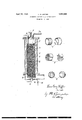
The accompanying drawing shows diagrammatically the converter used in my process and some of the shapes-which the resistance bodies may have.
5 is a cylindrical receptacle of electrically non-conductive material 7, for instance such as quartz, surrounded by an iron mantle 8 and filled with the said resisters, or bodies 6,
which by way of example I choose to have the shape of hollow cylinders each of which is of the same diameter, height and thickness of the Walls. At the upper and lower end of this converter 5 there are sieve- like electrodes 10 and 13 connected with the current at 11 and 15. After the current was turned on and the converter 5 has arrived at the temperature at which I intend to operate my process, I introduce the hydro-carbon, to be treated, in the form of oil or as vapor at 4 in the usual way; the generated products are conducted ofi' through exit 18 to a dephlegmator and cooler (not shown). The heavier liquid constituents of the obtained products collect at the bottom and can be removed through 35. In starting the process I introduce by the aid of a pump (not shown) some gas, for instance hydrogen, carbon-di oxide or some other gas, incapable of produc ing an explosive mixture with the hydrocarbon vapors, for the purpose of eliminating the air out of the apparatus, or I produce purposely gas out of the introduced hydrocarbon in such a quantity that it fills the whole apparatus any surplus of the gas I conduct to a gasholder (not shown) which communicates with the converter so, as to keep the same during the process under a uniform gas pressure; thetravel of the gas to the gasholder and from the same to the converter causes the products created in the latter to move, or travel, upwardly. 1
I have already pointed out above that my resistor bodies are hollow and for this reason they are made of carbon or of any suitable ing point which is higher than the highest temperature applied in the operation of my process. Moreover, as the increase in the temperature of an electrically heated metal is relative to the decrease of its thickness, or
tor is infinitely larger and to heat the same to the desired temperature an amount of electric current is necessary that both technically and economically a process operated under such conditions is bound to result in failure.
I have already explained the technical shortcomings which even an enormous supply of electric energy would not overcome. Because there is no successful stopping of the technical deficiencies. of the apparatus for converting hydrocarbons ifthe same includes resistors of a haphazard irregular size and shape, the operation of such a defectively constructed apparatus is all the more hopeless from the economical standpoint.
In this point the relation of the resistors of the prior art to my new type applied in my process is rather close to the relation existing between the heavy filaments in the first electric lamps and the fine carbon thread ultimately applied by Edison which ultimately made his electric lamp the only one economically possible.
Similarly my regularly sized and shaped resistors solve the problem of electrically heating a converter for the purposes of cracking hydrocarbons, because there is such a tremendous saving in electric energy in heating the equally thin walls of the resistors in the converter, but in addition hereto the flow of the electric current is equally distributed over the resistors, so that every square inch of the same is supplied with the same amount of heat as any other like unit of the surface of the resistor, and finally the film of hydrocarbons passing the resistors is acted upon exactly as at any other at any unit of the surface of the resistors at any part within the converter.
The converter can be considered to consist of an enormous complex of miniature heating.
zones formed by each individual resistor of a definite uniform shape, size and thickness practically a solid material), the action of the heat, radiating from the surface of the resistors, causes the hydrocarbons to move violently and in doing so constantly strike against other radiators to thereby gradually complete their conversion.
It is evident from the above that in this intensive method of heating the hydrocarbons there is a definite relation between the velocity and density of the hydrocarbons and the quantity of heat radiating from the resistor surface.
It is in the event that hydrocarbon vapors are too dense and pass too slowly through the converter, thus becoming liable to be too far decomposed, that I draw on the gas from the gas holder and admix it to the vapors in order to facilitate their passage through the numerous reaction zones with the velocity corresponding to the predetermined converting temperature. As the gas holder is in free communication with the whole system, the pressure remains constant and it is not disturbed by the gas circulation.
The gas circulation fulfills also another purpose, namely the prevention and elimination of a carbon deposit on the resistor surfaces. Many hydro-carbons are liable to cause. a deposit ,of carbon if they are not hydrogenized. This deposit is apt to appear in those parts of the converter where the conversion has not yet proceeded sufficiently and where there is consequently little opportunity for hydrogenization on account of lack of hydrogen. For that reason the gas circulation is also recommended to keep the resistor surfaces free from carbon deposits.
It is further understood that the shape of the converter is not essential and that I'may give to the same any suitable form, but a columnlike shape has been found very useful. Whether I introduce the hydro-carbons at the top or at the bottom of the onverter and whether I arrange the condui s for the moving gases so that the same is pressed or sucked through the apparatus is immaterial inasmuch as all these technical details are within the routine of the chemical engineer and can be arranged as theconvenience of the situation requires.
According to the nature of the hydrocarbons to be converted I prefer to operate the process at varying temperatures; if, for instance I want to convert a hydro-carbon distilling at260 C., I maintain the converting temperature at about 360 C. for an oil distilling at 420C. at about 440 C. and I found that a-temperature range. of from 360-440 C. appears suflicient to treat the various kinds of oil of the market.
The generated hydro-carbons, which eon- The heavier hydro-carbons, which are produced by the process and which have a boiling point higher than the temperature of the process, flow to the lower part of the converter from where they can be removed through the outlet 35.
It is understoodthat I can combine any number of converters with each other and that I may heat each single converter to a different temperature.
When I speak of electrically heating the resistance bodies it is understood that I may effect this also by induction current, which change is within, the skill of the electrical engineer and therefore is here not further gone into.
Having described my invention, what I claim as new and desire to secure by Letters Patent is: i
In a hydrocarbon oil cracking apparatus in which the cracking element comprises a container filled with conductive bodies of substantially uniform size, shape and thick: ness and having maximum exposed inner and outer surfaces packed so as to make continuous contact throughout, the process comprising the passing of the hydrocarbon oil through such bodies so as to obtain a continuous broken filming thereof, simultaneously I conducting an electrical current through said bodies was to heat them to a cracking temperature to obtain lower boiling hydrocarbons, vcontinuously withdrawing cracked vapors and gases from the top of said apparatus and withdrawing residual oil from the bottom thereof.
. In testimony whereof I have signed'my name to this specification.
LOUIS GEORG LEFFER.
Applications Claiming Priority (1)
| Application Number | Priority Date | Filing Date | Title |
|---|---|---|---|
| DE1853688X | 1927-11-05 |
Publications (1)
| Publication Number | Publication Date |
|---|---|
| US1853688A true US1853688A (en) | 1932-04-12 |
Family
ID=7746114
Family Applications (1)
| Application Number | Title | Priority Date | Filing Date |
|---|---|---|---|
| US316591A Expired - Lifetime US1853688A (en) | 1927-11-05 | 1928-11-01 | Apparatus for converting hydrocarbons |
Country Status (1)
| Country | Link |
|---|---|
| US (1) | US1853688A (en) |
Cited By (4)
| Publication number | Priority date | Publication date | Assignee | Title |
|---|---|---|---|---|
| US2462669A (en) * | 1942-02-03 | 1949-02-22 | Colgate Palmolive Peet Co | Process and apparatus for photocatalytic reactions |
| US2982622A (en) * | 1958-09-02 | 1961-05-02 | Exxon Research Engineering Co | Hydrocarbon conversion process |
| US3006838A (en) * | 1958-09-08 | 1961-10-31 | Shawinigan Chem Ltd | Electrothermic fluidized bed apparatus |
| US4795617A (en) * | 1984-01-16 | 1989-01-03 | Hare Louis R O | Electroluminescent chemical activation system |
-
1928
- 1928-11-01 US US316591A patent/US1853688A/en not_active Expired - Lifetime
Cited By (4)
| Publication number | Priority date | Publication date | Assignee | Title |
|---|---|---|---|---|
| US2462669A (en) * | 1942-02-03 | 1949-02-22 | Colgate Palmolive Peet Co | Process and apparatus for photocatalytic reactions |
| US2982622A (en) * | 1958-09-02 | 1961-05-02 | Exxon Research Engineering Co | Hydrocarbon conversion process |
| US3006838A (en) * | 1958-09-08 | 1961-10-31 | Shawinigan Chem Ltd | Electrothermic fluidized bed apparatus |
| US4795617A (en) * | 1984-01-16 | 1989-01-03 | Hare Louis R O | Electroluminescent chemical activation system |
Similar Documents
| Publication | Publication Date | Title |
|---|---|---|
| US2393636A (en) | Conversion of hydrocarbons with suspended catalysts | |
| US2342862A (en) | Activated coke | |
| US2421616A (en) | Catalytic treatment of hydrocarbon oils | |
| US3254957A (en) | Process for producing hydrogen and coke | |
| US3238116A (en) | Coke binder oil | |
| GB1178528A (en) | Combined Preparation of Electrode Binder Pitch and Carbon Black Feedstock | |
| US1873783A (en) | Process of treating oil | |
| US2862871A (en) | Fluid coking process and apparatus | |
| US2789085A (en) | Preparation and desulfurization of petroleum coke | |
| US3314767A (en) | Electro-fluid reactor for high temperature gasification process | |
| US3007849A (en) | Stepwise desulfurization of fluid coke particles with steam and hydrogen | |
| US2322019A (en) | Art of treating hydrocarbons | |
| US1274797A (en) | Process of producing aluminum nitrid. | |
| US1418713A (en) | Process of and apparatus for cracking oils | |
| US2301322A (en) | Chemical process | |
| SU448650A3 (en) | Method for producing needle coke | |
| US1219797A (en) | Art of producing aluminum carbid. | |
| US2432934A (en) | Method and apparatus for catalytic reactions | |
| US2185070A (en) | Process of hydrogenating hydrocarbon oils | |
| US2296386A (en) | Chemical process | |
| US1893774A (en) | Process of manufacturing lubricating oil | |
| US2824046A (en) | Conversion of hydrocarbons | |
| US2323206A (en) | Catalytic cracking process | |
| US1407340A (en) | Process of treating mineral oil for the production of gasoline | |
| US1993756A (en) | Method of processing coal |