US185343A - Improvement in car brakes and starters - Google Patents
Improvement in car brakes and starters Download PDFInfo
- Publication number
- US185343A US185343A US185343DA US185343A US 185343 A US185343 A US 185343A US 185343D A US185343D A US 185343DA US 185343 A US185343 A US 185343A
- Authority
- US
- United States
- Prior art keywords
- car
- starters
- friction
- improvement
- cone
- Prior art date
- Legal status (The legal status is an assumption and is not a legal conclusion. Google has not performed a legal analysis and makes no representation as to the accuracy of the status listed.)
- Expired - Lifetime
Links
- 239000007858 starting material Substances 0.000 title description 6
- 210000003746 feather Anatomy 0.000 description 2
Images
Classifications
-
- F—MECHANICAL ENGINEERING; LIGHTING; HEATING; WEAPONS; BLASTING
- F02—COMBUSTION ENGINES; HOT-GAS OR COMBUSTION-PRODUCT ENGINE PLANTS
- F02N—STARTING OF COMBUSTION ENGINES; STARTING AIDS FOR SUCH ENGINES, NOT OTHERWISE PROVIDED FOR
- F02N5/00—Starting apparatus having mechanical power storage
- F02N5/02—Starting apparatus having mechanical power storage of spring type
Definitions
- the object of this invention is to produce a simple and efficient mechanism for stopping a street-car, and for storing up the power required in stopping for use again in starting the car.
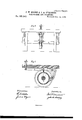
- S is the axle of the car.
- the wheels b and b are hung loosely on this axle.
- the hubbed wheels a and a are attached to the shaft by means of a feather, so as to revolve with it, but are loose, so that they can be moved in line with the axle by means of the forked lever or clutchyokel l.
- the peripheries of a and a are conical, and, when in contact with a similar angleface on the inside of the wheels I) and 1), form a conical friction-clutch, which causes all the wheels to revolve together.
- a spring is coiled around the axle, one end of which is attached to each wheel.
- These wheels have on their circumferences an annular groove, in which is placed the bands d and d, which, in connection with the lever 6, forms a band-brake, operated by pressure upon the foot-plate and spindle is.
- Fig. 4 shows this brake arrangement alone, the fulcrum of the lever placed on a horizontal line with the axle, and having a spiral spring, 1), whose oflice it is to take the weight of the band off the wheel when not in use.
- the clutch-yokes l and l are operated through the medium of the arm 9, shaft t', and threaded spindle 0, or any equivalent device, the
- cone-friction ab and baud-friction d are then used to stop the car, (from the other platform.) instead of the cone tt' b nnl bend d, as in the former cases.
Landscapes
- Engineering & Computer Science (AREA)
- Chemical & Material Sciences (AREA)
- Combustion & Propulsion (AREA)
- Mechanical Engineering (AREA)
- General Engineering & Computer Science (AREA)
- Braking Arrangements (AREA)
Description
fnVeniars:
Min 16 asses.- $9M.
TH E GRAPHIC ID-ELY w 2 Sheets- -sheet Z.
J. W. MOORE & J. A. SVEDBERG. CAR BRAKES AND STARTERS.
Np 185,343, Patented Dac.12,1878.
b all;
Wz'inesses: fnVeniors:
JOHN W. MOORE AND JOHN A. SVEDBERG, OF WASHINGTON, D. O.
IMPROVEMENT IN CAR BRAKES AND STARTERS.
Specification forming part of Letters Patent No. 185,343, dated December 12, 1876; application filed September 28, 1876.
To all whom it may concern:
Be it known that we, JOHN W. MOORE and JOHN A. SVEDBERG, of Washington, District of Columbia, have invented certain new and useful Improvements in Car Starters and Brakes; and we do hereby declare that the following is a full, clear, and exact description thereof, which will enable others skilled in the art to which it appertains to make and use the same, reference being had to the accompanying drawings, and to the letters of reference marked thereon, which form a part of this specification.
The object of this invention is to produce a simple and efficient mechanism for stopping a street-car, and for storing up the power required in stopping for use again in starting the car.
S is the axle of the car. The wheels b and b are hung loosely on this axle. The hubbed wheels a and a are attached to the shaft by means of a feather, so as to revolve with it, but are loose, so that they can be moved in line with the axle by means of the forked lever or clutchyokel l. The peripheries of a and a are conical, and, when in contact with a similar angleface on the inside of the wheels I) and 1), form a conical friction-clutch, which causes all the wheels to revolve together. Between the wheels I) and b a spring is coiled around the axle, one end of which is attached to each wheel. These wheels have on their circumferences an annular groove, in which is placed the bands d and d, which, in connection with the lever 6, forms a band-brake, operated by pressure upon the foot-plate and spindle is.
Fig. 4 shows this brake arrangement alone, the fulcrum of the lever placed on a horizontal line with the axle, and having a spiral spring, 1), whose oflice it is to take the weight of the band off the wheel when not in use.
,The clutch-yokes l and l are operated through the medium of the arm 9, shaft t', and threaded spindle 0, or any equivalent device, the
at and b are brought into contact and 1) commences to revolve. The foot of the operatoris placed upon the plate k, which holds the wheel I) fixed and connects it with the body of the car. As the end of the spring 0 is fastened to the revolving wheel I), and the other end to the fixed wheel b, it follows that the spring will be wound up till it stops the car. The operator then places his other foot on the plate It, tightening the band d, and thus holding the wheel I) firmly. He then turns the handle h in adirection opposite to that by which he connected the cone-friction a 1) till these wheels are disconnected and a and b are connected. The car in this position is ready to start, and upon the signal to do so the pressure is removed from the foot-pad 7c, and the whole force of the spring accumulated in stopping the car is now exerted in assisting its forward movement. When the car has started and the spring unwound, the operator removes his foot from the button 70, and, disconnecting a and b, connects a and b, and is again ready to stop.
When it is desired simply to check the car, the cone-friction a. b being connected and ready at any moment to stop, the driver places his foot upon the button It and presses with greater or less weight, as he wishes to check the speed more or less; or, should he wish to check or stop the car without operating the spring, (and accumulating the force,) the conefriction to I) being connected, he can, with his foot, press down upon is, bringing the bandfriction d in operation directly on the surface of b. This is' more clearly represented in Figs. 3 and 4, where the cone-friction is dispensed with and the band-brake alone represented.
Should the car have reached the end of its route, and it be desired tostart the car in the opposite direction to that in which it was running before, the cone-friction a b being connected, and the spring 0 wound up by placing the foot on button It, the button It is also pressed, (to prevent the car from starting back,) and the cone-friction a b allowed to remain in connection till such time as required to start the car in the backward direction, when the foot, or pressure, is taken from k, and the car moves in the direction from which ters Patent, is
it came. The cone-friction ab and baud-friction d are then used to stop the car, (from the other platform.) instead of the cone tt' b nnl bend d, as in the former cases.
Having thus described our invention, what we claim as new, and desire to secure by Let- 1. In a ear-starter, the cone-friction a, b, a being attached to the axle by means of one or more feathers, so as to revolve with the axle and move in line therewith, and I) being loose upon the axle.
2. In a car'starter, the combination of the cone-friction, substantially as described, with the band-brake d, operated by the lever e and rod and button 70.
3. In a ear-starter, the combination of the JNO. W MOORE.
JOHN A. SVEDBERG. Witnesses:
A. G. HEYLMAN, J. TYLER POWELL.
Publications (1)
| Publication Number | Publication Date |
|---|---|
| US185343A true US185343A (en) | 1876-12-12 |
Family
ID=2254749
Family Applications (1)
| Application Number | Title | Priority Date | Filing Date |
|---|---|---|---|
| US185343D Expired - Lifetime US185343A (en) | Improvement in car brakes and starters |
Country Status (1)
| Country | Link |
|---|---|
| US (1) | US185343A (en) |
-
0
- US US185343D patent/US185343A/en not_active Expired - Lifetime
Similar Documents
| Publication | Publication Date | Title |
|---|---|---|
| US447780A (en) | Gar brake and starter | |
| US144260A (en) | Improvement in car-starters | |
| US299539A (en) | Car-starter | |
| US594946A (en) | Controller for motors and brakes of electric cars | |
| US377094A (en) | Car brake and starter | |
| US87524A (en) | Improved car-starter | |
| US485125A (en) | Vehicle starter | |
| US190930A (en) | Improvement in car-starters | |
| US309314A (en) | Levi w | |
| US301096A (en) | Car-brake | |
| US358642A (en) | Car-starter | |
| US149427A (en) | Improvement in car-starters | |
| US809341A (en) | Vehicle-brake. | |
| US601450A (en) | Car-brake | |
| US187111A (en) | Improvement in car-starters | |
| US609766A (en) | Tmc morris peters co | |
| US270300A (en) | Car-brake | |
| US193435A (en) | Improvement in car brakes and starters | |
| US438694A (en) | Car brake and starter | |
| US411594A (en) | hooker- | |
| US343594A (en) | William montgomery | |
| US173376A (en) | Improvement in car-starters | |
| US689762A (en) | Brake. | |
| US793378A (en) | Vehicle attachment. | |
| US162572A (en) | Improvements car-starters |