US1853432A - Buttonhole sewing machine - Google Patents
Buttonhole sewing machine Download PDFInfo
- Publication number
- US1853432A US1853432A US475198A US47519830A US1853432A US 1853432 A US1853432 A US 1853432A US 475198 A US475198 A US 475198A US 47519830 A US47519830 A US 47519830A US 1853432 A US1853432 A US 1853432A
- Authority
- US
- United States
- Prior art keywords
- buttonhole
- cord
- sewing
- throat
- sewing machine
- Prior art date
- Legal status (The legal status is an assumption and is not a legal conclusion. Google has not performed a legal analysis and makes no representation as to the accuracy of the status listed.)
- Expired - Lifetime
Links
Images

Classifications
-
- D—TEXTILES; PAPER
- D05—SEWING; EMBROIDERING; TUFTING
- D05B—SEWING
- D05B3/00—Sewing apparatus or machines with mechanism for lateral movement of the needle or the work or both for making ornamental pattern seams, for sewing buttonholes, for reinforcing openings or for fastening articles, e.g. buttons, by sewing
- D05B3/06—Sewing apparatus or machines with mechanism for lateral movement of the needle or the work or both for making ornamental pattern seams, for sewing buttonholes, for reinforcing openings or for fastening articles, e.g. buttons, by sewing for sewing buttonholes
- D05B3/08—Sewing apparatus or machines with mechanism for lateral movement of the needle or the work or both for making ornamental pattern seams, for sewing buttonholes, for reinforcing openings or for fastening articles, e.g. buttons, by sewing for sewing buttonholes for buttonholes with eyelet ends
-
- D—TEXTILES; PAPER
- D05—SEWING; EMBROIDERING; TUFTING
- D05B—SEWING
- D05B73/00—Casings
- D05B73/04—Lower casings
- D05B73/12—Slides; Needle plates
-
- D—TEXTILES; PAPER
- D05—SEWING; EMBROIDERING; TUFTING
- D05D—INDEXING SCHEME ASSOCIATED WITH SUBCLASSES D05B AND D05C, RELATING TO SEWING, EMBROIDERING AND TUFTING
- D05D2303/00—Applied objects or articles
- D05D2303/08—Cordage
Definitions
- This invention relates to buttonhole sewing machines.
- Buttonhole sewing machines are commonly constructed to lay a cord around the edge of the buttonhole beneath the buttonhole stitches as the latter are formed, and the present invention relates particularly to the means for guiding the cord and has for its object to provide a novel means for guiding or controlling the cord which is equally applicable to but tonhole sewing machines that are designed to cut the buttonhole before the sewing as to buttonhole sewing machines that are designed to cut the buttonhole after the sewing.
- a buttonhole sewing machine is set or adjusted for sewing a buttonhole which is to be out after the sewing is completed it is common practice to adjust the stitch-forming mechanism so that the depth stitch will be at a lesser distance from the center lineof the buttonhole than where the sewing machine is set and adjusted for sewing abuttonhole after thebuttonhole slit has been cut.
- the alternate thrusts of the needle are through the buttonhole slit and the other thrusts are through the work at a distance from said slit, this distance being further from the center line of the buttonhole than in the case of a buttonhole sewing machine which is adjusted for sewing the buttonhole before the slit. is out.
- the cord should be laid near the outer edge of the line of stitching which requires that. the guide for the cord should be positioned differently in a buttonhole sewing machine that is designed to cut the buttonhole after the stitching has been completed from what it is in a buttonhole sewing machine designed to cut the buttonhole before the stitching is made.
- the present invention aims to provide a novel cord-guiding device which can be used with either of said types of buttonhole sewing machine. This is provided for by making a cord-guiding device so that it can be adjusted laterally with reference to the center line of thebuttonhole thereby to enable it to lay the cord at difierent distances fromsaid center line depending on whether the sewing machine is operating as a cut before or cut after machine.
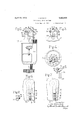
- Fig.1 is a side viewofa buttonhole sewing machine embodying my invention
- Fig. Q is a side viewof theturret carrying the under thread mechanism and which also carries my improved cord-guiding device which in the present embodiment is associated with the throat;
- Fig. 3 shows the manner of adjusting the Fig. 7 is a similar view showing the manner in which the cord is laid wherethe buttonhole is out before the sewing is completed;
- Fig. 8 is an enlarged section on the line 8-8, Fig. 3.
- the sewing machine also includes a buttonhole cutter of usual type including a cutting element 9 carried by a lever 10 pivoted at 11, said lever being actuated by a cam hump 12 carried by the main cam 13 from which the operations I have shown generally a buttonhole sewlng machine which is provided with ing a cord to the buttonhole as the sewing proceeds, and in forming the buttonhole the buttonhole stitches overlie and cover the cord.
- the means for guiding thefcord is associated with the usual'throat plate 14 which is carried by the turret 7 and on which the work is supported atthe sewing point, saidthroat being formed with the usualsewing opening 15 through which the needle 3 reciprocates;
- This throat is provided with a cord-guide ing aperture 16 which extends laterally from the outside of the throat to the sewing opening and through which the, cord 17 extends.
- V This aperture constitutes means forguiding thefcord as it is delivered to the work and determines the position of the. cord relative to the center line of the buttonhole?
- thethroat 14 with its cord-guiding aperture 16 is capable of adjustment laterally so' as to provide for laying the cord 17 nearer to or further from the center line of the buttonhole depending upon whether the sewing machine is operating as a cutafter or out before machine, that is, a machine which "cuts the buttonhole after it is sewed or cuts it before it is sewed.
- Figs. 6 and 7 illustrate the sewing of these two types of buttonholes.
- Fig. 6 shows the position of the cord in a buttonhole-which is out after the sewing is completed while
- Fig. '7' illustrates the position in a. button- .hole which is out before the sewing is com- 'menced.
- the buttonhole stitches which are formed are indicated at '18, the
- the throat 14 is adjusted laterally to place thethread-guiding aperture 16 at a greater distance from the center line of the button hole as indicated in Fig. 7 and this will provide for laying the cord 17 near the outer edge 21 of the line of stitches.
- Vhile various ways maybe provided for adjusting this throat I have herein shown a simple construction.
- the throat 14 carried on the oflset end 22 of a stem 23 which lies against the face 24: oft-he turret and is clamped thereto by a clamping screw 25.
- the throat is held in its vertical position by means of a supporting pin 26 which rises from the turret and on which the offset portion 22ofthe stem rests.
- the stem 23 is slotted as shown at 27 and the lower end of the slot embraces a positioning pin 28 extending from the portion 24: of the turret.
- the clamping screw'25 extends through the slot at the upper end. Saidclamping screw is of smaller diameter than the width of the slot but the positioning pin 28 fills the slot. This provides for a slight lateral shifting movement of the throat about the pin 28 as acenter.
- the turret is provided with a fixed stop 29 which limits the swinging movement of the stem 23 in one direction and it is provided with an adjustable stop 30 which limits the swinging movement in the opposite direction. Then the stem is in engagement with the fixed stop 29 as shown in ig. 2 the cordguiding aperture 16 will be properly positioned to lay the cord for a buttonhole which is to be cut after the sewing is completed as shown in Fig. 6. On the'other hand, when the throat is adjusted laterally to the left, Fig. 2, against the stop 30 as shown in Fig.
- the thread-guiding aperture will be properly positioned for laying the cord for a buttonhole which isto be out before the sewing commences;
- the throat will be held in either adjusted position by the action of the clamping screw 25 which clamps the stem firmly against the face 24 in either position.
- the stop 30 is shown as an adjustable stop, it being in the form of an eccentric which is mounted on a clamping screw 31 that screws into the turret. By loosening the screw 31 the eccentric 30 can be turned about the screw thereby to adjust its position and when it is in the proper adjusted position it may be held therein by tightening the screw 31.
- the exact adjustment of the stop 30 will depend somewhat on the character of the goods which is being sewed. In coarse knit goods or loosely woven goods a greater adj ustment of the throat is desirable than with more firmly woven goods. However, after the stop 30 has been adjusted for any character of goods then the throat can be adjusted for the out before or cut after operation by simply loosening the clamping screw 25 and shifting the stem against the stop 30 for the cut before operation, and against the stop 29 for the out after operation. It will be noted that the sewing opening 15 is in the form of a slot and that the adjustment of the throat plate is in the direction of the length of the slot.
- Vhile I have illustrated herein a selected embodiment of the invention I do not wish to be limited to the constructional features shown. Furthermore, while I have herein shown the cord-guiding element as forming part of the throat yet it is not essential that this element should be part of the throat as the invention contemplates broadly the idea of an adjustable cord-guiding means to provide for laying the cord for either the cut before or out after operation.
- a throat plate having means to guide a cord and lay it around the buttonhole as the stitching progresses, said throat plate with its guiding means being adjustable laterally of the center line of the buttonhole slit, whereby the cord may be laid closer to or further from said center line.
- a cord-guiding element stationarily mounted on the turret and adapted to lay a cord around the buttonhole as the stitching proceeds, said element being adjustable laterally with respect to the center line of the buttonhole and means to clamp said cord-guiding element in adj usted position.
- the combination with stitch-forming mechanism including a needle operating above the work and under thread mechanism, of a turret beneath the work carrying the under thread mechanism, a throat mounted on the turret and having a cord-guiding aperture, said throat being adjustable on the turret laterally with respect to the center line of the buttonhole.
- the combination with stitch-forming mechanism including a needle operating above the: work and under thread mechanism, of a turret beneath the work carrying the under'thread mechanism, and a throat plate mounted on
Landscapes
- Engineering & Computer Science (AREA)
- Textile Engineering (AREA)
- Sewing Machines And Sewing (AREA)
Description
April 1932- J. KIEWICZ 1,853,432
BUTTONHOLE SEWING MACHINE Filed Aug. 14, 1930 2 SheetsSheet l \nvenTor. Ooh n K i ewic g Afiys.
Fig.1.
A ril 12, 1932. KEW 1,853,432
BUTTONHOLE SEWING MACHINE Filed Aug. 14, 1930 2 Sheets-Sheet 2 \mvenToT. \John Kiewicg g m WXW Patented Apr. 12, 1932 units 'ETES PATENT OFFICE JOHN KIEWIGZ, 0F BOSTON, MASSACHUSETTS, ASSIGNOR TO THE REECE BUTTON HOLE MACHINE COMPANY, OF BOSTON, MASSACHUSETTS, A CORPORATION OF MADTE. V
BUTTONHOLE snwnvs MACHINE Application filed August 14, 1930.. Serial No. 475,198.
This invention relates to buttonhole sewing machines.
Buttonhole sewing machines are commonly constructed to lay a cord around the edge of the buttonhole beneath the buttonhole stitches as the latter are formed, and the present invention relates particularly to the means for guiding the cord and has for its object to provide a novel means for guiding or controlling the cord which is equally applicable to but tonhole sewing machines that are designed to cut the buttonhole before the sewing as to buttonhole sewing machines that are designed to cut the buttonhole after the sewing.
Where a buttonhole sewing machine is set or adjusted for sewing a buttonhole which is to be out after the sewing is completed it is common practice to adjust the stitch-forming mechanism so that the depth stitch will be at a lesser distance from the center lineof the buttonhole than where the sewing machine is set and adjusted for sewing abuttonhole after thebuttonhole slit has been cut. In the lattercase the alternate thrusts of the needle are through the buttonhole slit and the other thrusts are through the work at a distance from said slit, this distance being further from the center line of the buttonhole than in the case of a buttonhole sewing machine which is adjusted for sewing the buttonhole before the slit. is out. In either case, it is desirable that the cord should be laid near the outer edge of the line of stitching which requires that. the guide for the cord should be positioned differently in a buttonhole sewing machine that is designed to cut the buttonhole after the stitching has been completed from what it is in a buttonhole sewing machine designed to cut the buttonhole before the stitching is made.
Heretofore it has been the common practice to employ a special cord-guiding means for each of the above-mentioned types of button hole sewing machines. I
The present invention, however, aims to provide a novel cord-guiding device which can be used with either of said types of buttonhole sewing machine. This is provided for by making a cord-guiding device so that it can be adjusted laterally with reference to the center line of thebuttonhole thereby to enable it to lay the cord at difierent distances fromsaid center line depending on whether the sewing machine is operating as a cut before or cut after machine.
In order togive an understanding of the invention 1 haveillustrated in the drawings a selected embodiment thereofwhich will now be described after which the novel features will be pointed out in the appended claims.
Fig.1 is a side viewofa buttonhole sewing machine embodying my invention;
Fig. Qis a side viewof theturret carrying the under thread mechanism and which also carries my improved cord-guiding device which in the present embodiment is associated with the throat;
Fig. 3 shows the manner of adjusting the Fig. 7 is a similar view showing the manner in which the cord is laid wherethe buttonhole is out before the sewing is completed;
Fig. 8 is an enlarged section on the line 8-8, Fig. 3.
In Fig. 1
the usual work-holding means herein shown in the form of work clamps 1 adapted to clamp the work against clamp plates 2 and which is also provided with the usual. stitchformingmechanism, the latter including a needle 3 carried by a needlebar 4 which reciprocates in the head 5, and the under thread manipulating mechanism in the form of loopers 6 which are 'mountedon a turret 7 that is-situated beneath the bed'8. The sewing machine also includes a buttonhole cutter of usual type including a cutting element 9 carried by a lever 10 pivoted at 11, said lever being actuated by a cam hump 12 carried by the main cam 13 from which the operations I have shown generally a buttonhole sewlng machine which is provided with ing a cord to the buttonhole as the sewing proceeds, and in forming the buttonhole the buttonhole stitches overlie and cover the cord. In the present construction the means for guiding thefcord is associated with the usual'throat plate 14 which is carried by the turret 7 and on which the work is supported atthe sewing point, saidthroat being formed with the usualsewing opening 15 through which the needle 3 reciprocates;
This throat is provided with a cord-guide ing aperture 16 which extends laterally from the outside of the throat to the sewing opening and through which the, cord 17 extends.
V This aperture constitutes means forguiding thefcord as it is delivered to the work and determines the position of the. cord relative to the center line of the buttonhole? In accordance with my present invention thethroat 14 with its cord-guiding aperture 16 is capable of adjustment laterally so' as to provide for laying the cord 17 nearer to or further from the center line of the buttonhole depending upon whether the sewing machine is operating as a cutafter or out before machine, that is, a machine which "cuts the buttonhole after it is sewed or cuts it before it is sewed. v
Figs. 6 and 7 illustrate the sewing of these two types of buttonholes. Fig. 6 shows the position of the cord in a buttonhole-which is out after the sewing is completed while Fig. '7' illustrates the position in a. button- .hole which is out before the sewing is com- 'menced. In Fig. 6 the buttonhole stitches which are formed are indicated at '18, the
. fulllines showing a partially completed hole of the stitc the'line of sti't buttonhole.
and the dotted lines indicating the outline es upon completion of the buttonhole.
The throat with its sewing Opening 15 which-is situated underneath the work, is shown in dotted lines and this figure also shows in dottedlinesthe approximate position of the cord 17. Where thebuttonhole isO l which is to be out after thesewing is completed the throat willbe adjusted, into substantially the position shown in Fig. '6
relative to the centerlin'e 2O o-f the button- .hole-and in this position the cord 17 will be laid slightly nearer the outer edge 21 of hes than the center of the This adjustment is made partly because since the buttonhole is out before the sewing begins said buttonhole will tend to separate slightly as shown in Fig. 7, and partly because where the buttonhole slit is cut first it is desirable to use a longer stitch so that the needle will penetrate the goods further from the center line of the buttonhole in order'to avoid any possibility of the fabric fraying. This is especially true if the fabric is of a loose weave or is a knitted fabric.
For sewing a buttonhole which is cut first the throat 14 is adjusted laterally to place thethread-guiding aperture 16 at a greater distance from the center line of the button hole as indicated in Fig. 7 and this will provide for laying the cord 17 near the outer edge 21 of the line of stitches.
Vhile various ways maybe provided for adjusting this throat I have herein shown a simple construction. The throat 14 carried on the oflset end 22 of a stem 23 which lies against the face 24: oft-he turret and is clamped thereto by a clamping screw 25. The throat is held in its vertical position by means of a supporting pin 26 which rises from the turret and on which the offset portion 22ofthe stem rests. r
The stem 23 is slotted as shown at 27 and the lower end of the slot embraces a positioning pin 28 extending from the portion 24: of the turret. The clamping screw'25 extends through the slot at the upper end. Saidclamping screw is of smaller diameter than the width of the slot but the positioning pin 28 fills the slot. This provides for a slight lateral shifting movement of the throat about the pin 28 as acenter.
The turret is provided with a fixed stop 29 which limits the swinging movement of the stem 23 in one direction and it is provided with an adjustable stop 30 which limits the swinging movement in the opposite direction. Then the stem is in engagement with the fixed stop 29 as shown in ig. 2 the cordguiding aperture 16 will be properly positioned to lay the cord for a buttonhole which is to be cut after the sewing is completed as shown in Fig. 6. On the'other hand, when the throat is adjusted laterally to the left, Fig. 2, against the stop 30 as shown in Fig. 3, then the thread-guiding aperture will be properly positioned for laying the cord for a buttonhole which isto be out before the sewing commences; The throatwill be held in either adjusted position by the action of the clamping screw 25 which clamps the stem firmly against the face 24 in either position.
The stop 30 is shown as an adjustable stop, it being in the form of an eccentric which is mounted on a clamping screw 31 that screws into the turret. By loosening the screw 31 the eccentric 30 can be turned about the screw thereby to adjust its position and when it is in the proper adjusted position it may be held therein by tightening the screw 31.
The exact adjustment of the stop 30 will depend somewhat on the character of the goods which is being sewed. In coarse knit goods or loosely woven goods a greater adj ustment of the throat is desirable than with more firmly woven goods. However, after the stop 30 has been adjusted for any character of goods then the throat can be adjusted for the out before or cut after operation by simply loosening the clamping screw 25 and shifting the stem against the stop 30 for the cut before operation, and against the stop 29 for the out after operation. It will be noted that the sewing opening 15 is in the form of a slot and that the adjustment of the throat plate is in the direction of the length of the slot.
Vhile I have illustrated herein a selected embodiment of the invention I do not wish to be limited to the constructional features shown. Furthermore, while I have herein shown the cord-guiding element as forming part of the throat yet it is not essential that this element should be part of the throat as the invention contemplates broadly the idea of an adjustable cord-guiding means to provide for laying the cord for either the cut before or out after operation.
I claim.
1. In a buttonhole sewing machine, the combination with stitch-forming mechanism, of a throat plate having means to guide a cord and lay it around the buttonhole as the stitching progresses, said throat plate with its guiding means being adjustable laterally of the center line of the buttonhole slit, whereby the cord may be laid closer to or further from said center line. Y r
2. In a buttonhole sewing machine, th combination with stitch-forming mechanism, of a throat having a sewing opening and also a cord-guiding aperture, and means supporting the throat for adjustment laterally with respect to the center line of the buttonhole.
3. In a buttonhole sewing machine, the combination with stitch-forming mechanism, of a turret beneath the work on which under thread mechanism is supported, a cord-guiding element stationarily mounted on the turret and adapted to lay a cord around the buttonhole as the stitching proceeds, said element being adjustable laterally with respect to the center line of the buttonhole and means to clamp said cord-guiding element in adj usted position.
4. In a buttonhole sewing machine, the combination with stitch-forming mechanism including a needle operating above the work and under thread mechanism, of a turret beneath the work carrying the under thread mechanism, a throat mounted on the turret and having a cord-guiding aperture, said throat being adjustable on the turret laterally with respect to the center line of the buttonhole.
5. In a buttonhole sewing machine, the combination with stitch-forming mechanism including a needle operating above the: work and under thread mechanism, of a turret beneath the work carrying the under'thread mechanism, and a throat plate mounted on
Priority Applications (1)
| Application Number | Priority Date | Filing Date | Title |
|---|---|---|---|
| US475198A US1853432A (en) | 1930-08-14 | 1930-08-14 | Buttonhole sewing machine |
Applications Claiming Priority (1)
| Application Number | Priority Date | Filing Date | Title |
|---|---|---|---|
| US475198A US1853432A (en) | 1930-08-14 | 1930-08-14 | Buttonhole sewing machine |
Publications (1)
| Publication Number | Publication Date |
|---|---|
| US1853432A true US1853432A (en) | 1932-04-12 |
Family
ID=23886602
Family Applications (1)
| Application Number | Title | Priority Date | Filing Date |
|---|---|---|---|
| US475198A Expired - Lifetime US1853432A (en) | 1930-08-14 | 1930-08-14 | Buttonhole sewing machine |
Country Status (1)
| Country | Link |
|---|---|
| US (1) | US1853432A (en) |
-
1930
- 1930-08-14 US US475198A patent/US1853432A/en not_active Expired - Lifetime
Similar Documents
| Publication | Publication Date | Title |
|---|---|---|
| US1387619A (en) | Sewing-machine | |
| US1853432A (en) | Buttonhole sewing machine | |
| US1528499A (en) | Pocket-stitching machine | |
| US2345943A (en) | Article attaching machine | |
| GB450009A (en) | Button sewing machine | |
| US2920590A (en) | Needle carrier for blindstitch machines | |
| US2297061A (en) | Thread-controlling mechanism for overedge sewing machines | |
| US3557727A (en) | Throat plate for double chainstitch sewing machines | |
| US1787928A (en) | Sewing machine | |
| US1999145A (en) | Article-attaching machine | |
| US3476065A (en) | Sewing machine for attaching bindings on the edges of fabrics by means of chainstitch seams blind on one side of the binding | |
| US2040260A (en) | Buttonhole sewing machine | |
| US1463325A (en) | Sewing machine | |
| US2940406A (en) | Two thread chain stitch sewing machine | |
| US3044427A (en) | Sewing machines with improved loop deflector | |
| US1941620A (en) | Buttonhole sewing machine | |
| US2553514A (en) | Hemstitching attachment for sewing machines | |
| US1332511A (en) | Sewing-machine | |
| US1406180A (en) | Sewing machine | |
| US2283073A (en) | Sewing machine | |
| US1276393A (en) | Multiple-needle guard. | |
| US1490928A (en) | Sewing machine | |
| US1170009A (en) | Cloth-guide for sewing-machines. | |
| US1326669A (en) | of boston | |
| US1324541A (en) | clark |