US1852654A - Pressure device for dispensing fluids, grease, and the like - Google Patents
Pressure device for dispensing fluids, grease, and the like Download PDFInfo
- Publication number
- US1852654A US1852654A US444391A US44439130A US1852654A US 1852654 A US1852654 A US 1852654A US 444391 A US444391 A US 444391A US 44439130 A US44439130 A US 44439130A US 1852654 A US1852654 A US 1852654A
- Authority
- US
- United States
- Prior art keywords
- flange
- base
- casing
- grease
- pressure
- Prior art date
- Legal status (The legal status is an assumption and is not a legal conclusion. Google has not performed a legal analysis and makes no representation as to the accuracy of the status listed.)
- Expired - Lifetime
Links
- 239000004519 grease Substances 0.000 title description 14
- 239000012530 fluid Substances 0.000 title description 7
- 238000010276 construction Methods 0.000 description 7
- 230000000694 effects Effects 0.000 description 2
- 230000037431 insertion Effects 0.000 description 2
- 238000003780 insertion Methods 0.000 description 2
- 238000007789 sealing Methods 0.000 description 2
- 238000000926 separation method Methods 0.000 description 2
- 208000036366 Sensation of pressure Diseases 0.000 description 1
- 230000003190 augmentative effect Effects 0.000 description 1
- 230000015572 biosynthetic process Effects 0.000 description 1
- 230000006835 compression Effects 0.000 description 1
- 238000007906 compression Methods 0.000 description 1
- 230000005494 condensation Effects 0.000 description 1
- 238000009833 condensation Methods 0.000 description 1
- 230000001066 destructive effect Effects 0.000 description 1
- 230000033001 locomotion Effects 0.000 description 1
- 239000002674 ointment Substances 0.000 description 1
- 230000008520 organization Effects 0.000 description 1
- XLYOFNOQVPJJNP-UHFFFAOYSA-N water Substances O XLYOFNOQVPJJNP-UHFFFAOYSA-N 0.000 description 1
Images

Classifications
-
- F—MECHANICAL ENGINEERING; LIGHTING; HEATING; WEAPONS; BLASTING
- F16—ENGINEERING ELEMENTS AND UNITS; GENERAL MEASURES FOR PRODUCING AND MAINTAINING EFFECTIVE FUNCTIONING OF MACHINES OR INSTALLATIONS; THERMAL INSULATION IN GENERAL
- F16N—LUBRICATING
- F16N19/00—Lubricant containers for use in lubricators or lubrication systems
Definitions
- My invention further relates to a device having a pressure chamber so arranged and constructed that it may accommodate a plurality of containers.
- My invention further relates to a device having a pressure chamber so arranged and constructed that it may be hermetically sealed and also be provided with means for raising pressure within the same to a point above the pressure of the surrounding atmosphere.
- My invention still further relates to the provision of means for indicating pressure raised within the chamber of the device and also relates to the provision of a safety, device to prevent such pressure becoming greater than that for which the chamber is constructed.
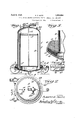
- Fig. 1 1s a View 1n central sectlon of a device embodylng my invention
- Fig. 2 is a plan view of the top of the pres sure chamber showing the split rings that are designed to lock the casing into the base of the chamber.
- Fig. 2 is a side elevation of thelocking wedge for the outer split ring.
- Fig. 3 is a fragmentary view in section of my novel pressure chamber on an'enlarged scale, the section being taken on line 3-3 p of Fig. 2.
- Figs. 4, 5, 6, 7 and 8 are fragmentary sectional views, on an enlarged scale, showing modified forms of locking devices for my novel pressure device.
- 1 designates the pressure device embodying my invention and comprising a generally cylindrical body or casing member 2 having an integral, domeshaped, upper part or closure 3 and a bottom, annular, outwardly and upwardly turned flange 4.
- 5 designates a separate, detachable concaved or dished base or bottom which is provided with the annular, inwardly and upwardly deflected flange 6 which is of a greater diameter than the bottom flange 4 of the cylindrical member 2.
- a rubber gasket 9 which when compressed is provided with a shoulder 10 intermediate the end of the flange 4 and the flange 6, the purpose of said ring being to produce an air-tight seal, as will be apparent in Figs. 1 and 3.
- 11 designates a supporting ring which is placed upon the concaved base 5 and which serves to support the grease drum 12 in the manner best shown in My novel pressure device is provided with the wheels or rollers 13 and 14 of any suitable construction which are provided for convenience of locomotion.
- 15 designates an inlet conduit leading from a source of compressed air and controlled by suitable check valve (not shown), and 16 designates a conventional air gauge for inducating the pressure developed.
- the grease drum 12 is provided with an upper opening 17 through which passes the exit pipe or conduit 18 which is preferably fixed at 19 in the top 3 and is controlled by the valve 20.
- the inner split wedging or clamping ring 7 is split at 21 and the outer ring is split at the point 22 and provided with the small wedge 23, whereby the insertion or wedging of said split rings to lock and seal the top and base is greatly facilitated, since in practice after I position the outer split ring 8 I place in position the inner split rin 7.
- the small section 23 fills the gap forme by the expansion of the outer ring 8 against the inner face of the flange 6.
- the inner split ring 7 is next inserted between the outer ring 8, and the bottom of the casing 2, and driven in tight until it rests on the flange 4, as best seen in Fig. 3.
- the inner ring 7 being tapered, causes the ring 8 which is tapered in theopposite direction to be driven downwardly, carrying the flange 4 downwardly also, which compresses the rubber gasket 9 between the flange 4 and the base 5, thus forming an air tight seal between said base and flange.
- Compressed air is next introduced through the inlet 15 to the desired pressure indicated by the gauge 16, which tends still further to compress the rubber gasket 9 in its wedge shaped pocket, making the seal still tighter.
- the pressure which seeks to separate the casing from its base causes the rings 7 and 8 to be wedged still tighter between the lower portion of the easing and the flange 6, thus'ensuring a positive look at the closure of the pressure chamber.
- the pressure on the surface of the grease or fluid in the drum 12 forces the contents thereof upwardly through the exit pipe 18 and valve 20 to the point of use.
- I provide the bottom flange 4 of the cylindrical member 2 with the pendant flange 27, and I provide an auxiliary ring 28 for supporting the outer end of the flange 4.
- I employ a wedge-shaped rubber gasket 29 the outer end of which contacts against the auxiliary supporting rin e 28.
- Fig. 7 I have illustrated the bottom flange 4 of the cylindrical member 2 as being substantially horizontal, the rubber gasket used in this construction being substantially the same as that employed in the construction illustrated in Fig. 1.
- Fig. 8 I have shown the casing member 2 as relatively short and provided with a lower top or closure member 3, the constructions of the other elements 4, 6, 7, 8 and 9 being the same as those elements already described.
- y invention is especially adapted to facilitate the dispensing of oil, grease or similar commodities from their original packages, either to grease guns of the conventional type or to any other desired point or receptacle and the dispensing operation is effected in a cleanly and expeditious manner without the employment of spoons, paddles or the like.
- the grease, oil and the like is dispensed to the desired point without the formation of air bubbles as is evident.
- a suitable relief valve 30 may be employed to relieve any undue or excess pressure in the casing 2, and that a valved drain pipe 31 may be connected with base 5 as indicated in Fig. 1, for draining off any drip or water of condensation from the drum- 12, the concavity of said base obviously facilitating its draining and the outer annular portion of said base in conjunction with the flange 4, forming a wedge shaped pocket for the gasket 9.
- a base having an outer, annular, inwardly and upwardly deflected flange, a casing closed at its top and open at its bottom and having a lower, terminal, outwardly deflected flange positioned within said base flange and forming with the outer portion of said base a wedge shaped pocket, a yielding wedge shaped gasket contained in said pocket, and a plurality of wedge shaped split rings adapted to rest on said casing flange, and positioned between said base flange and the lower portion of said casing.
- a device of the character stated comprising a closed casing in two parts, flanges on both parts, the flange on one part being of lesser diameter than the flange on the other part, so that the smaller flange may occupy a position inside the larger flange, there being a wedge shaped space bounded by said flanges and one of said parts, a plurallty of split rings assembled within said wedge shaped space, the cross-section of said rings when assembled being substantially the same as the cross-section of said wedge shaped space, and a flexible member compressed between the two parts of the casing so as to affect an air tight seal between them.
- a device of the character stated comprising a casing closed at its upper end and provided with an outwardly turned bottom flange at its lower open end, a base provided with an upwardly and inwardly turned flange, a resilient member between said outwardly turned flange and said base, a plurality of contacting split rings positioned between said casing and said inwardly turned flange, said rings when assembled forming a wedge shaped locking member between said casing and said inwardly turned flange to prevent the separation of said casing from said base, said resilient member forming an air tight seal between said casing and said base.
- a device of the character stated comprising an outer casing closed at its upper end and provided with an outwardly turned flange at its lower open end, a base provided with a flange inclined upwardly and inwardly towards the center of said base, a resilient member between said outwardly turned flange and said base, an outer wedge shaped split ring coacting with said outwardly turned flange and with said inwardly inclined base flange and an inner wedge shaped split ring coacting with said casing and with said other split ring, said split rings when assembled in position forming a wedge shaped locking member between said casing and said inward ly inclined base flange to prevent the separation of said casing from said base, said resilient member forming an air tight seal between said casing and said base.
- a dished base having an outer, annular, upwardly extend ing portion merging into an outer, annular, upwardly converging, inwardly inclined flange, an upper, closed casing open at its bottom and having an outwardly extending terminal flange of less diameter than said base flange, a yielding gasket intermediate said casing flange and base and split, Wedge shaped, locking rings intermediate said casing and base flange.
Landscapes
- Engineering & Computer Science (AREA)
- General Engineering & Computer Science (AREA)
- Mechanical Engineering (AREA)
- Closures For Containers (AREA)
Description
A. E. HUTT 1,852,654 PRESSURE DEVICE FOR DISPENSING FLUIDS, GREASE, AND THE LIKE April 5, 1932.
Filed April 15, 193Q 2 Sheets-Sheet 1 INVENTOR: flab RTE #077,
ATTORNEYS? A. E. HUTT April 5, 1932.
PRESSURE DEVICE FOR DISPENSING FLUIDS, GREASE, AND THE LIKE 2 Sheets-Sheet 2 Filed April 15. 1930 ATTORNEYS.
Patented Apr. 5, 1932 UNITED STATES P'A'TEITI' OFFICE ALBERT E. HUTT, OF NEW ROCHELLE, NEW YORK PRESSURE DEVICE FOR DISPENSING FLUIDS, GREASE, AND THE LIKE Application filed April 15,
as usually sold in such manner that when pressure is raised within the chamber of the device it will be exerted alike upon the outside as Well as upon the inside of such con tainer, so that while the contents of the container will be forced to the outside of the pressure chamber through a pipe provided for that purpose, the container itself will not have to withstand the destructive force of said pressure as it would have to do if the pressure were introduced on the inside of such container only.
My invention further relates to a device having a pressure chamber so arranged and constructed that it may accommodate a plurality of containers.
My invention further relates to a device having a pressure chamber so arranged and constructed that it may be hermetically sealed and also be provided with means for raising pressure within the same to a point above the pressure of the surrounding atmosphere.
My invention still further relates to the provision of means for indicating pressure raised within the chamber of the device and also relates to the provision of a safety, device to prevent such pressure becoming greater than that for which the chamber is constructed.
found in practice to give satisfactory and reliable results, although it is to be understood that the various instrumentalities of which my invention consists can be vari- 1930. Serial No. 444,391.
ously arranged and organized and that my invention is not limited to the precise arrangement and organization of the instrumentalities as herein shown and described.
The nature, characteristic features and scope of the invention will be more fully understood from the following description taken in connection with the accompanying drawings forming part hereof, and in which:
Fig. 1 1s a View 1n central sectlon of a device embodylng my invention;
Fig. 2 is a plan view of the top of the pres sure chamber showing the split rings that are designed to lock the casing into the base of the chamber. Fig. 2 is a side elevation of thelocking wedge for the outer split ring.
Fig. 3 is a fragmentary view in section of my novel pressure chamber on an'enlarged scale, the section being taken on line 3-3 p of Fig. 2.
Figs. 4, 5, 6, 7 and 8 are fragmentary sectional views, on an enlarged scale, showing modified forms of locking devices for my novel pressure device.
Referring to the drawings, in which similar numerals of reference indicate corresponding parts, and with particular attention to Figs. 1 and 2, 1 designates the pressure device embodying my invention and comprising a generally cylindrical body or casing member 2 having an integral, domeshaped, upper part or closure 3 and a bottom, annular, outwardly and upwardly turned flange 4. 5 designates a separate, detachable concaved or dished base or bottom which is provided with the annular, inwardly and upwardly deflected flange 6 which is of a greater diameter than the bottom flange 4 of the cylindrical member 2. 7 and 8 designate oppositely tapered annular split locking rings which are wedged between the bottom end of the cylindrical member 2 and the upwardly and inwardly turned flange 6 of the concaved bottom 5 and which rest on the upwardly and outwardly turned flange 4 of the cylindrical member 2 (see Fi s. 1 and 3) the outer split ring 8 being first placed in position and subsequently clamped or wedged tightly in place by the forced insertion of the inner split ring 7 to produce a tight joint. Intermediate the bottom flange 4 of the cylindrical member 2 and the juxtaposed portion of the concaved base 5 I insert a rubber gasket 9 which when compressed is provided with a shoulder 10 intermediate the end of the flange 4 and the flange 6, the purpose of said ring being to produce an air-tight seal, as will be apparent in Figs. 1 and 3. 11 designates a supporting ring which is placed upon the concaved base 5 and which serves to support the grease drum 12 in the manner best shown in My novel pressure device is provided with the wheels or rollers 13 and 14 of any suitable construction which are provided for convenience of locomotion. 15 designates an inlet conduit leading from a source of compressed air and controlled by suitable check valve (not shown), and 16 designates a conventional air gauge for inducating the pressure developed. The grease drum 12 is provided with an upper opening 17 through which passes the exit pipe or conduit 18 which is preferably fixed at 19 in the top 3 and is controlled by the valve 20. The inner split wedging or clamping ring 7 is split at 21 and the outer ring is split at the point 22 and provided with the small wedge 23, whereby the insertion or wedging of said split rings to lock and seal the top and base is greatly facilitated, since in practice after I position the outer split ring 8 I place in position the inner split rin 7. The small section 23 fills the gap forme by the expansion of the outer ring 8 against the inner face of the flange 6.
he operation is as follows In assembling my novel device I first place in position the rubber ring or gasket 9 and then place the drum or container of grease or other fluid or semi-fluid 12 on the supporting ring 11 which is carried by the dished base 5. I then place the outer casing 2, carrying the downwardly extending pipe 18, over the grease drum 12 with the lower end of the pipe 18 in proximity to the bottom of the grease drum 12-, so that the flange 4 rests on the gasket 9. I then place the outer split ring 8 over the casing 2 andcompress it until it passes inside the flange 6 after which it is allowed to expand until its outer surface engages the inner face of the flange 6. The section 23 (see Fig. 2) is then placed in position to fill the gap caused by such expansion.
The inner split ring 7 is next inserted between the outer ring 8, and the bottom of the casing 2, and driven in tight until it rests on the flange 4, as best seen in Fig. 3. The inner ring 7 being tapered, causes the ring 8 which is tapered in theopposite direction to be driven downwardly, carrying the flange 4 downwardly also, which compresses the rubber gasket 9 between the flange 4 and the base 5, thus forming an air tight seal between said base and flange. Compressed air is next introduced through the inlet 15 to the desired pressure indicated by the gauge 16, which tends still further to compress the rubber gasket 9 in its wedge shaped pocket, making the seal still tighter. The pressure which seeks to separate the casing from its base causes the rings 7 and 8 to be wedged still tighter between the lower portion of the easing and the flange 6, thus'ensuring a positive look at the closure of the pressure chamber. The pressure on the surface of the grease or fluid in the drum 12 forces the contents thereof upwardly through the exit pipe 18 and valve 20 to the point of use.
The oppositely tapering walls of the rings 7 and 8, in con unction with the upward con vergence of the flange 6 of the base 5, effects an extremely tight joint which results in considerable compression-upon the bottom gasket 9, thereby insuring a perfectly air-tight seal. The internal pressure causes further compression of the gasket 9 in the pocket formed between the outwardly converging walls 4 and 5 by reason of the juxtaposed contacting surfaces, thereby further insuring the air-tight character of said seal.
In Figures 4 and 6 I have shown a modified form of my construction wherein the flange 4 is shown as being substantially horizontal and having its outer end bevelled or tapered as at 25 in which construction I employ a correspondingly tapered rubber gasket 26.
In Fig. '5 I provide the bottom flange 4 of the cylindrical member 2 with the pendant flange 27, and I provide an auxiliary ring 28 for supporting the outer end of the flange 4. In this construction I employ a wedge-shaped rubber gasket 29 the outer end of which contacts against the auxiliary supporting rin e 28.
In Fig. 7 I have illustrated the bottom flange 4 of the cylindrical member 2 as being substantially horizontal, the rubber gasket used in this construction being substantially the same as that employed in the construction illustrated in Fig. 1.
In Fig. 8 I have shown the casing member 2 as relatively short and provided with a lower top or closure member 3, the constructions of the other elements 4, 6, 7, 8 and 9 being the same as those elements already described.
It will be apparent that in all the embodiments of my invention I provide a pocket for the locking rings 7 and 8 which has an outer upwardly converging annular wall and that by reason of" the coaction of the wedge shaped rings with the contiguous walls of the casing 2 and flange 6 a very effective locking action is obtained when the parts are assembled inthe manner already described. It will also be apparent that in all the embodiments of my invention a wedge shaped pocket is. formed for the reception of the wedge shaped gasket 9 and that in every instance any increase of pressure in the caslng 2 will tend to augment the sealing action of the wedgeshiped gasket 9.
y invention is especially adapted to facilitate the dispensing of oil, grease or similar commodities from their original packages, either to grease guns of the conventional type or to any other desired point or receptacle and the dispensing operation is effected in a cleanly and expeditious manner without the employment of spoons, paddles or the like. In addition the grease, oil and the like is dispensed to the desired point without the formation of air bubbles as is evident. While I have described certain features of my invention as being preferably applicable to dispensing devices of this general character, it will be apparent that the clamping or locking features of my invention are equally well adapted to effect a hermetical seal of any two detachable members which may require the quick dismantling and reassembling for any purpose, and wherein it is desired to produce a hermetical seal the effectiveness of which will be augmented as-the internal pressure increases.
It will be understood that a suitable relief valve 30 may be employed to relieve any undue or excess pressure in the casing 2, and that a valved drain pipe 31 may be connected with base 5 as indicated in Fig. 1, for draining off any drip or water of condensation from the drum- 12, the concavity of said base obviously facilitating its draining and the outer annular portion of said base in conjunction with the flange 4, forming a wedge shaped pocket for the gasket 9.
It is well known that grease drums and the like are relatively heavy, and as many garages are not equipped with hoisting means, it is desirable that such drums be capable of being installed in the dispensing device with a minimum of handling. It is for this reason that I have provided my novel pressure chamber with the novel locking and sealing devices in proximity to the garage floor or base of the apparatus, so that upon the removal of the casing 2, the drum 12 or the like can be readily tipped or canted upon the base 5, without unnecessary lifting or handling and upon the casing 2 being replaced, the locking rings 7 and 8 can be readily manipulated and replaced by the attendant with a minimum amount of labor as is evident.
I am aware that the invention may be embodied in other specific forms without departing from the spirit or essential attributes thereof, and I therefore desire the present embodiment to be considered in all respects as illustrative and not restrictive, reference being had to the appended claims rather than to the foregoing description to indicate the scope of the invention.
Having thus described my invention what I claim as new and desire to secure by Letters Patent, is
1. In a device of the character stated, a base having an outer, annular, inwardly and upwardly deflected flange, a casing closed at its top and open at its bottom and having a lower, terminal, outwardly deflected flange positioned within said base flange and forming with the outer portion of said base a wedge shaped pocket, a yielding wedge shaped gasket contained in said pocket, and a plurality of wedge shaped split rings adapted to rest on said casing flange, and positioned between said base flange and the lower portion of said casing.
2. A device of the character stated comprising a closed casing in two parts, flanges on both parts, the flange on one part being of lesser diameter than the flange on the other part, so that the smaller flange may occupy a position inside the larger flange, there being a wedge shaped space bounded by said flanges and one of said parts, a plurallty of split rings assembled within said wedge shaped space, the cross-section of said rings when assembled being substantially the same as the cross-section of said wedge shaped space, and a flexible member compressed between the two parts of the casing so as to affect an air tight seal between them.
3. A device of the character stated comprising a casing closed at its upper end and provided with an outwardly turned bottom flange at its lower open end, a base provided with an upwardly and inwardly turned flange, a resilient member between said outwardly turned flange and said base, a plurality of contacting split rings positioned between said casing and said inwardly turned flange, said rings when assembled forming a wedge shaped locking member between said casing and said inwardly turned flange to prevent the separation of said casing from said base, said resilient member forming an air tight seal between said casing and said base. 7
4. A device of the character stated, comprising an outer casing closed at its upper end and provided with an outwardly turned flange at its lower open end, a base provided with a flange inclined upwardly and inwardly towards the center of said base, a resilient member between said outwardly turned flange and said base, an outer wedge shaped split ring coacting with said outwardly turned flange and with said inwardly inclined base flange and an inner wedge shaped split ring coacting with said casing and with said other split ring, said split rings when assembled in position forming a wedge shaped locking member between said casing and said inward ly inclined base flange to prevent the separation of said casing from said base, said resilient member forming an air tight seal between said casing and said base.
5. In a dispensing device, a dished base having an outer, annular, upwardly extend ing portion merging into an outer, annular, upwardly converging, inwardly inclined flange, an upper, closed casing open at its bottom and having an outwardly extending terminal flange of less diameter than said base flange, a yielding gasket intermediate said casing flange and base and split, Wedge shaped, locking rings intermediate said casing and base flange.
ALBERT E. HUTT.
Priority Applications (1)
| Application Number | Priority Date | Filing Date | Title |
|---|---|---|---|
| US444391A US1852654A (en) | 1930-04-15 | 1930-04-15 | Pressure device for dispensing fluids, grease, and the like |
Applications Claiming Priority (1)
| Application Number | Priority Date | Filing Date | Title |
|---|---|---|---|
| US444391A US1852654A (en) | 1930-04-15 | 1930-04-15 | Pressure device for dispensing fluids, grease, and the like |
Publications (1)
| Publication Number | Publication Date |
|---|---|
| US1852654A true US1852654A (en) | 1932-04-05 |
Family
ID=23764676
Family Applications (1)
| Application Number | Title | Priority Date | Filing Date |
|---|---|---|---|
| US444391A Expired - Lifetime US1852654A (en) | 1930-04-15 | 1930-04-15 | Pressure device for dispensing fluids, grease, and the like |
Country Status (1)
| Country | Link |
|---|---|
| US (1) | US1852654A (en) |
-
1930
- 1930-04-15 US US444391A patent/US1852654A/en not_active Expired - Lifetime
Similar Documents
| Publication | Publication Date | Title |
|---|---|---|
| US2117807A (en) | Gasket closure | |
| US4660355A (en) | Vacuum adapter for metal-lid canning jars | |
| US2091737A (en) | Liquid dispenser | |
| US2445802A (en) | Container closure | |
| US2704621A (en) | soffer | |
| US2700774A (en) | Combined metal ring and rubber gasket | |
| IE44623B1 (en) | Improvements in pressurised dispensers | |
| US2674390A (en) | Joint or closure | |
| US1364814A (en) | Packing-ring | |
| US1852654A (en) | Pressure device for dispensing fluids, grease, and the like | |
| US1767680A (en) | Pressure device in dispensing fluids and semifluids | |
| US3468451A (en) | Container with disposable liner | |
| US2128128A (en) | Sealing device | |
| US2294858A (en) | High pressure fluid container | |
| US2157039A (en) | Piston construction | |
| US3223425A (en) | Slush pump piston rod packing assembly and packing | |
| US1519111A (en) | Pipe coupling | |
| US2628633A (en) | Safety valve | |
| US2094629A (en) | Rubber gasket coupling | |
| US1963675A (en) | Method of obtaining an autoclave closure for vessels of all kinds | |
| US1770480A (en) | Beverage container | |
| US2309856A (en) | Safety device for pressure vessels and the like | |
| US1610390A (en) | Heat-insulated container | |
| US2096686A (en) | Tap bushing and seal therefor | |
| US2291763A (en) | Manhole structure |