US1852581A - Coating composition and process of making same - Google Patents
Coating composition and process of making same Download PDFInfo
- Publication number
- US1852581A US1852581A US452588A US45258830A US1852581A US 1852581 A US1852581 A US 1852581A US 452588 A US452588 A US 452588A US 45258830 A US45258830 A US 45258830A US 1852581 A US1852581 A US 1852581A
- Authority
- US
- United States
- Prior art keywords
- crystal
- lacquer
- layer
- coating composition
- composition
- Prior art date
- Legal status (The legal status is an assumption and is not a legal conclusion. Google has not performed a legal analysis and makes no representation as to the accuracy of the status listed.)
- Expired - Lifetime
Links
- 239000008199 coating composition Substances 0.000 title description 15
- 238000000034 method Methods 0.000 title description 10
- 239000013078 crystal Substances 0.000 description 68
- 239000004922 lacquer Substances 0.000 description 60
- 230000015572 biosynthetic process Effects 0.000 description 16
- 238000005755 formation reaction Methods 0.000 description 16
- 230000037452 priming Effects 0.000 description 16
- 229920002678 cellulose Polymers 0.000 description 15
- 239000000203 mixture Substances 0.000 description 15
- 239000001913 cellulose Substances 0.000 description 14
- 239000000463 material Substances 0.000 description 11
- 239000011248 coating agent Substances 0.000 description 10
- 238000000576 coating method Methods 0.000 description 10
- 238000004040 coloring Methods 0.000 description 7
- 229920002301 cellulose acetate Polymers 0.000 description 6
- 238000001035 drying Methods 0.000 description 6
- 239000002904 solvent Substances 0.000 description 6
- 239000000049 pigment Substances 0.000 description 5
- 239000000126 substance Substances 0.000 description 5
- 239000002023 wood Substances 0.000 description 5
- 239000000843 powder Substances 0.000 description 4
- 150000001875 compounds Chemical class 0.000 description 3
- RYGMFSIKBFXOCR-UHFFFAOYSA-N Copper Chemical compound [Cu] RYGMFSIKBFXOCR-UHFFFAOYSA-N 0.000 description 2
- UFWIBTONFRDIAS-UHFFFAOYSA-N Naphthalene Chemical compound C1=CC=CC2=CC=CC=C21 UFWIBTONFRDIAS-UHFFFAOYSA-N 0.000 description 2
- 239000000020 Nitrocellulose Substances 0.000 description 2
- 238000005299 abrasion Methods 0.000 description 2
- 239000002184 metal Substances 0.000 description 2
- 229920001220 nitrocellulos Polymers 0.000 description 2
- YGSDEFSMJLZEOE-UHFFFAOYSA-N salicylic acid Chemical compound OC(=O)C1=CC=CC=C1O YGSDEFSMJLZEOE-UHFFFAOYSA-N 0.000 description 2
- 229910000906 Bronze Inorganic materials 0.000 description 1
- 230000003796 beauty Effects 0.000 description 1
- 239000010974 bronze Substances 0.000 description 1
- 239000000470 constituent Substances 0.000 description 1
- KUNSUQLRTQLHQQ-UHFFFAOYSA-N copper tin Chemical compound [Cu].[Sn] KUNSUQLRTQLHQQ-UHFFFAOYSA-N 0.000 description 1
- 230000000694 effects Effects 0.000 description 1
- 238000001704 evaporation Methods 0.000 description 1
- 230000008020 evaporation Effects 0.000 description 1
- 239000003292 glue Substances 0.000 description 1
- 239000010985 leather Substances 0.000 description 1
- 239000003960 organic solvent Substances 0.000 description 1
- FJKROLUGYXJWQN-UHFFFAOYSA-N papa-hydroxy-benzoic acid Natural products OC(=O)C1=CC=C(O)C=C1 FJKROLUGYXJWQN-UHFFFAOYSA-N 0.000 description 1
- 229920003023 plastic Polymers 0.000 description 1
- 229920005989 resin Polymers 0.000 description 1
- 239000011347 resin Substances 0.000 description 1
- 230000000979 retarding effect Effects 0.000 description 1
- 229960004889 salicylic acid Drugs 0.000 description 1
- 230000008023 solidification Effects 0.000 description 1
- 238000007711 solidification Methods 0.000 description 1
- 238000009834 vaporization Methods 0.000 description 1
- 230000008016 vaporization Effects 0.000 description 1
- 239000002966 varnish Substances 0.000 description 1
- XLYOFNOQVPJJNP-UHFFFAOYSA-N water Substances O XLYOFNOQVPJJNP-UHFFFAOYSA-N 0.000 description 1
Images
Classifications
-
- B—PERFORMING OPERATIONS; TRANSPORTING
- B05—SPRAYING OR ATOMISING IN GENERAL; APPLYING FLUENT MATERIALS TO SURFACES, IN GENERAL
- B05D—PROCESSES FOR APPLYING FLUENT MATERIALS TO SURFACES, IN GENERAL
- B05D5/00—Processes for applying liquids or other fluent materials to surfaces to obtain special surface effects, finishes or structures
- B05D5/06—Processes for applying liquids or other fluent materials to surfaces to obtain special surface effects, finishes or structures to obtain multicolour or other optical effects
-
- Y—GENERAL TAGGING OF NEW TECHNOLOGICAL DEVELOPMENTS; GENERAL TAGGING OF CROSS-SECTIONAL TECHNOLOGIES SPANNING OVER SEVERAL SECTIONS OF THE IPC; TECHNICAL SUBJECTS COVERED BY FORMER USPC CROSS-REFERENCE ART COLLECTIONS [XRACs] AND DIGESTS
- Y10—TECHNICAL SUBJECTS COVERED BY FORMER USPC
- Y10T—TECHNICAL SUBJECTS COVERED BY FORMER US CLASSIFICATION
- Y10T428/00—Stock material or miscellaneous articles
- Y10T428/31—Surface property or characteristic of web, sheet or block
-
- Y—GENERAL TAGGING OF NEW TECHNOLOGICAL DEVELOPMENTS; GENERAL TAGGING OF CROSS-SECTIONAL TECHNOLOGIES SPANNING OVER SEVERAL SECTIONS OF THE IPC; TECHNICAL SUBJECTS COVERED BY FORMER USPC CROSS-REFERENCE ART COLLECTIONS [XRACs] AND DIGESTS
- Y10—TECHNICAL SUBJECTS COVERED BY FORMER USPC
- Y10T—TECHNICAL SUBJECTS COVERED BY FORMER US CLASSIFICATION
- Y10T428/00—Stock material or miscellaneous articles
- Y10T428/31504—Composite [nonstructural laminate]
- Y10T428/31844—Of natural gum, rosin, natural oil or lac
- Y10T428/31848—Next to cellulosic
Definitions
- This invention relates, generally, to compositions for coating or covering surfaces of objects; and the invention has reference, more particularly, to the process of making a novel coating composition of the crystal type-and to the composition produced by such process.
- crystal lacquers for coating or covering surfaces, such as the surfaces of furniture and the like.
- These crystal lacquers comprise J a suitable lacquer base with crystalline compounds dissolved within such base.
- the crystalline compound contained ⁇ therewithin is precipi- .15 tated in crystalline form, giving the surface of the article to which it is applied, a pleasing appearance.
- crystal lac- Qquers when dry, present a surface which is rough and unevenV owing to the presence of fissures or cracks extending between adj acent crystals. Owing to this undesired roughness and also the tendency of the surface to become chipped or injured by abrasion, such crystal lacquers cannot be used z5 for fine furniture .or in other uses where a smooth finish is desired.
- the principal object of the present invention is to provide a novel crystal coating composition and a process for making the same, which composition has a smooth lustrous finish without surface irregularities and which is ada ted for use on the finest of furniture and t e like.
- Another object of the present invention lies in the provision of a novel coating composition of the crystal type which is adapted to be finished in any color combination desired, and in which any desired system or systems of crystal formation may be obtained.
- A. third object of the present invention is to provide a crystal coating composition and method of producing the same which enables y the size ofthe c stals present in the composition to be varieldyat will, and which composition is highly stable and wear resistant, the said coating having means for protecting the crystal formations from direct abrasion.
- Still another object of the present invention is to provide a novel coating composition of the above character which is equally 1930.
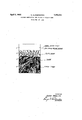
- the invention is illustrated in the accom ⁇ panying drawing, in which the single figure illustrates an article provided with the novel coating composition of the present invention, the said novel composition being illustratedV with parts broken away to better show the formation thereof.
- the novel composition is made up 'of a plurality of layers. These layers consist, initiall of a priming or sealer coat which is applied directly to the surface to be coated.
- This priming coat may be pigmented or may have a bronze powder intermixed therein, thereby causingithe priming coat to have any desired color.
- a coat of crystal lacquer which, when dried, presents a sur-V face which is divided into a plurality of crystalline formations, typical of crystal lacquers, the said crystalline formations being separated or defined by fissures running therebetween.
- Thisl surface is then rubbed or smutted with a suitable colored material whi ch, becoming lodged in the crystal fissures, acts to clearly define the crystal borders and enhance the beauty of the surface.
- One or more lacquer layers are then applied to the' surface, the said layers being of a nature to dissolve off the higher portions of the crystalsand to act as a body to lill up the fissures so as to thereby produce a final composition surface whichis'absolutely true and smooth, the said surface having a high gloss, especially if buii'ed. y
- the priming or sealer coat 1 y7hich is first applied to the article ispreiferably of cellulose acetate lacquer.
- This cellulose acetate lacquer may beapplied in either clear transparent condition, as when applying the composition to wood should it be desired that the grain of the wood shall showthrough the composition, or this priming coat may be colored as by the use of a bronze powder or pigment mixed or ground into the cellulose acetate lacquer. As is well known to those skilled in the art, these bronze powders may be obtained in any color desired.
- This priming coat of cellulose acetate lacquer will dry in the open air in about an hours time.
- a coat of clear crystal lacquer 2 (such as that disclosed in German patent to Rieder #266,265, Oct. 20, 1913) is then applied upon the priming coat.
- the clear crystal lacquer dries, the crystalline substance contained therein, such a-s naphthalene, salicylic acid or other suitable compound, reaches supersaturation due to the vaporization of solvents from the crystal lacquer coating.
- the crystalline substance thereupon crystallizes out 1n definite crystalline form. Further drying of Ithe crystal lacquer results in the complete 25 evaporation of solvents and in ⁇ the solidification of the resins, cellulose ester and plastic'- izers used in the lacquer and causes the crystalline substance to assume a definite fixed arrangement of crystal formation.
- any type of crystal formation may be obtained and the crystal formation may be varied at will by use of suitable organic solvents forming a constitutent part of the crystal lacquer vehicle. It is possible to obtain various crystal'- line systems from a single crystalline substance by suitably varying the constituent solvents. Also, by varying the rapidity of drying of the crystal lacquer, the size of the crystals formed vmay be correspondingly varied For example, by retarding the drying, the size of the crystals will be increased and vice versa. Since the crystal lacquer vis transparent and is supplied to the base l hav'- ing uniform color, the crystal formations are not well defined as shown by the layer 2 in the drawing. The crystal lacquer layer 2 dries in about an hour or two in the open air.
- the crystal lacquer layer 2 when dried, is rubbed or smutted-with a pigment or metallic powder, or a combination of the two, the said pigment or powder being ground in a suitable vehicle, such as japan (clear varnish), glue size, water soluble gum and other clear vehicles containing no nitrocellulose solvents, thereby producing the surface indicated by the reference numeral 3 in the drawing.
- a suitable vehicle such as japan (clear varnish), glue size, water soluble gum and other clear vehicles containing no nitrocellulose solvents
- the pigment or metallic powder may be of any color desired
- This cellulose lac quer by so dissolving off the higher or raised portions of thecrystals and filling interstices causes the entire surface to become smooth, and even, so that the finished composition has a smooth glass-like surface.
- This surface if desired, may be given avery high lustrous finish by rubbing or bufling the same.
- the cellulose lacquer used in producing ⁇ layer 4 will be of a type commonly used for thel material upon which the novel coating com-l position of this invention is applied. For example, if the coating composition is applied to wood, the clear or translucent cellulose lacquer forming layer 4 would be of a type, such as would ordinarily be used on wood. Likewise when the novel coating composition is applied to metal or leather, cellulose lacquers or dopes commonly used on these surfaces would be applied.
- the novel coating composition of this invention as thus applied to the surface presents a beautiful and attractive appearance, as indicated by viewing layer 4 in the drawing.
- the said coating may have any desired. color combinations and any desired crystal formations or size of crystals.
- the drawing illustrates, by way of example, crystals of the monoclinic system, but it is to be understood that any crystalline system may be obtained' by using a suitable crystal substance in the crystal lacquer and by the proper combination of solvents, as is known to those skilled in the art. Although preferably cellulose acetate lacquer is used as a priming coat, it
- incassi ers comprising the application of a layer of l0 lose lacquer acting to dissolve ofi' the higher crystal lacquer to a base, rubbing the crystal lacquer layer with a coloring material, and subsequently applying a layer of cellulose lacquer upon the rubbed surface, the said celluparts of the crystal lacquer layer and to lill up the fissures between the crystals, thereby producing, upon drying, a smooth exterior surface.
- rlhe process' of producing a surface coating comprising initially applying a priming coat to the surface to be coated, then applying a layer of 'clear crystal lacquer to the priming coat, applying coloring material to the crystal lacquer surface to give definition to the crystal formation thereof, and then applying cellulose lacquer to the thus treated surface to dissolve olf the higher' parts of the crystal lacquer surface and to iill up the fissures thereof, thereby producing a smooth exterior surface.
- the process of producing a surface coating comprising initially applying a priming coat of cellulose acetate lacquer to the surface to be coated, then applying a layer of clear crystal lacquer to the priming coat, s'mutting the crystal lacquer surface with a coloring material to give definition to the crystal formation thereof, and then applying cellulose lacquer to the thus treated crystal lacquer surface to dissolve oiiz' the higher parts of the crystals and to lill the interstices, thereby plurality of superimposed laycrystal lacquer having its crystal formation treated with coloring material to give denition to the crystals thereof, in combination with an overlying application of cellulose lacquer, Whereby the higher parts of the crystal lacquer layer are dissolved away and leveled so that the exposed surface of t-he coating composition is uniformly smooth.
- An object comprising a supporting base, a layer of crystal lacquer adheredto said base and having its crystal formations treated with a coloring material to give definition to the crystals thereof, in combination with an overlying application of cellulose lacquer, whereby the higher parts of the crystal lacquer layer are dissolved away and leveled so that the exposed surface of the coating composition is uniformly smooth.
Landscapes
- Paints Or Removers (AREA)
- Application Of Or Painting With Fluid Materials (AREA)
Description
April 5 1932 G.KL|NKENSTE|N 1,852,581
COATING COMPOSITION AND PROCESS OF MAKING SAME Filed May 15". 1930 ATTORNEY.
'Patented Apr. 5, 1932 UNITED STATES PATENT oFF-lcs GUSTAVE KLINKENSTEIN, F NEWARK, NEW JERSEY, ASSIGNOR TO MAAS &'WALD STEIN C0., OF NEWARK, NEW JERSEY, A CORPORATION 0F NEW JERSEY COATING' COMPOSITION AND PROCESS OF MAKING SAME Application led May 15,
This invention relates, generally, to compositions for coating or covering surfaces of objects; and the invention has reference, more particularly, to the process of making a novel coating composition of the crystal type-and to the composition produced by such process.
Heretofore, some use has been made of crystal lacquers for coating or covering surfaces, such as the surfaces of furniture and the like. These crystal lacquers comprise J a suitable lacquer base with crystalline compounds dissolved within such base. Upon the drying of the lacquer, the crystalline compound contained `therewithin is precipi- .15 tated in crystalline form, giving the surface of the article to which it is applied, a pleasing appearance.. However, such crystal lac- Qquers, when dry, present a surface which is rough and unevenV owing to the presence of fissures or cracks extending between adj acent crystals. Owing to this undesired roughness and also the tendency of the surface to become chipped or injured by abrasion, such crystal lacquers cannot be used z5 for fine furniture .or in other uses where a smooth finish is desired.
The principal object of the present invention is to provide a novel crystal coating composition and a process for making the same, which composition has a smooth lustrous finish without surface irregularities and which is ada ted for use on the finest of furniture and t e like.
Another object of the present invention lies in the provision of a novel coating composition of the crystal type which is adapted to be finished in any color combination desired, and in which any desired system or systems of crystal formation may be obtained.
A. third object of the present invention is to provide a crystal coating composition and method of producing the same which enables y the size ofthe c stals present in the composition to be varieldyat will, and which composition is highly stable and wear resistant, the said coating having means for protecting the crystal formations from direct abrasion.
Still another object of the present invention is to provide a novel coating composition of the above character which is equally 1930. Serial No. 452,588.
applicable to all types of surfaces whether metal, wood or fibrous and etc.
Other objects of this invention, not at this time more particularly enumerated, will be clearly understood from the following detailed description of the same.
The invention is illustrated in the accom` panying drawing, in which the single figure illustrates an article provided with the novel coating composition of the present invention, the said novel composition being illustratedV with parts broken away to better show the formation thereof.
In accordance with the principles of the present invention, the novel composition is made up 'of a plurality of layers. These layers consist, initiall of a priming or sealer coat which is applied directly to the surface to be coated. This priming coat may be pigmented or may have a bronze powder intermixed therein, thereby causingithe priming coat to have any desired color. Upon this priming coat is imposed a coat of crystal lacquer which, when dried, presents a sur-V face which is divided into a plurality of crystalline formations, typical of crystal lacquers, the said crystalline formations being separated or defined by fissures running therebetween. f Thisl surface is then rubbed or smutted with a suitable colored material whi ch, becoming lodged in the crystal fissures, acts to clearly define the crystal borders and enhance the beauty of the surface. One or more lacquer layers are then applied to the' surface, the said layers being of a nature to dissolve off the higher portions of the crystalsand to act as a body to lill up the fissures so as to thereby produce a final composition surface whichis'absolutely true and smooth, the said surface having a high gloss, especially if buii'ed. y
Referringnow to the drawing, the single figure illustrates an article provided with an illustrative example of the composition, of this invention, the said composition being broken away in successive layers to` illustrate the steps in the formation thereof. The priming or sealer coat 1 y7hich is first applied to the article ispreiferably of cellulose acetate lacquer. This cellulose acetate lacquer may beapplied in either clear transparent condition, as when applying the composition to wood should it be desired that the grain of the wood shall showthrough the composition, or this priming coat may be colored as by the use of a bronze powder or pigment mixed or ground into the cellulose acetate lacquer. As is well known to those skilled in the art, these bronze powders may be obtained in any color desired. This priming coat of cellulose acetate lacquer will dry in the open air in about an hours time.
A coat of clear crystal lacquer 2 (such as that disclosed in German patent to Rieder #266,265, Oct. 20, 1913) is then applied upon the priming coat. As the clear crystal lacquer dries, the crystalline substance contained therein, such a-s naphthalene, salicylic acid or other suitable compound, reaches supersaturation due to the vaporization of solvents from the crystal lacquer coating. The crystalline substance thereupon crystallizes out 1n definite crystalline form. Further drying of Ithe crystal lacquer results in the complete 25 evaporation of solvents and in` the solidification of the resins, cellulose ester and plastic'- izers used in the lacquer and causes the crystalline substance to assume a definite fixed arrangement of crystal formation. Any type of crystal formation may be obtained and the crystal formation may be varied at will by use of suitable organic solvents forming a constitutent part of the crystal lacquer vehicle. It is possible to obtain various crystal'- line systems from a single crystalline substance by suitably varying the constituent solvents. Also, by varying the rapidity of drying of the crystal lacquer, the size of the crystals formed vmay be correspondingly varied For example, by retarding the drying, the size of the crystals will be increased and vice versa. Since the crystal lacquer vis transparent and is supplied to the base l hav'- ing uniform color, the crystal formations are not well defined as shown by the layer 2 in the drawing. The crystal lacquer layer 2 dries in about an hour or two in the open air.
The crystal lacquer layer 2 when dried, is rubbed or smutted-with a pigment or metallic powder, or a combination of the two, the said pigment or powder being ground in a suitable vehicle, such as japan (clear varnish), glue size, water soluble gum and other clear vehicles containing no nitrocellulose solvents, thereby producing the surface indicated by the reference numeral 3 in the drawing. It
' will be noted that this smutting brings out the crystalline outline and clearly defines the borders of the crystals. The pigment or metallic powder may be of any color desired,
' and of similar or contrasting sha-des with respect to the color combination of the priming coat. Nitrocellulose solvents cannot be used as the vehicle of the pigment used in the smutting'operation because to do so would cause One or more coats of clear or translucent cellulose lacquer is now applied upon the smutted surface 3, producing the finished composition surface 4. The coat or coats of cellulose lacquer dissolves ofll the higher portions of the crystal structure of layer 3 and fills up the fissures of this layer, but does not effect the crystalline outlines brought out by the smutting operation. This cellulose lac quer by so dissolving off the higher or raised portions of thecrystals and filling interstices causes the entire surface to become smooth, and even, so that the finished composition has a smooth glass-like surface. This surface, if desired, may be given avery high lustrous finish by rubbing or bufling the same. The cellulose lacquer used in producing `layer 4 will be of a type commonly used for thel material upon which the novel coating com-l position of this invention is applied. For example, if the coating composition is applied to wood, the clear or translucent cellulose lacquer forming layer 4 would be of a type, such as would ordinarily be used on wood. Likewise when the novel coating composition is applied to metal or leather, cellulose lacquers or dopes commonly used on these surfaces would be applied.
The novel coating composition of this invention as thus applied to the surface, presents a beautiful and attractive appearance, as indicated by viewing layer 4 in the drawing. The said coating may have any desired. color combinations and any desired crystal formations or size of crystals. The drawing illustrates, by way of example, crystals of the monoclinic system, but it is to be understood that any crystalline system may be obtained' by using a suitable crystal substance in the crystal lacquer and by the proper combination of solvents, as is known to those skilled in the art. Although preferably cellulose acetate lacquer is used as a priming coat, it
'is merely necessary that a primer be used of crystal lacquer'to a` base, applying coloring material to the crystal lacquer/surface to give definition to the crystal formation thereof, and then applying a layer of cellulose'lacquer to the thus treated surface 4to` dissolve off the higher parts of the crystal'lacquer surfaceL and to fill up the fissures thereof,l
incassi ers comprising the application of a layer of l0 lose lacquer acting to dissolve ofi' the higher crystal lacquer to a base, rubbing the crystal lacquer layer with a coloring material, and subsequently applying a layer of cellulose lacquer upon the rubbed surface, the said celluparts of the crystal lacquer layer and to lill up the fissures between the crystals, thereby producing, upon drying, a smooth exterior surface.
3. The process of producing a crystal coating composition having a plurality of superimposed layers, the steps which comprise the application of a layer of crystal lacquer to a base, rubbing the crystal lacquer When dried with a coloring material dispersed in a vehicle, and subsequently applying a layer of cellulose lacquer upon the rubbed surface, the said cellulose lacquer acting to dissolve off the higher parts of the crystal lacquer layer and to fill up the fissures between the crystals, thereby producing, Y upon drying, a crystal coating composition with a smooth exterior surface.
4. rlhe process' of producing a surface coating comprising initially applying a priming coat to the surface to be coated, then applying a layer of 'clear crystal lacquer to the priming coat, applying coloring material to the crystal lacquer surface to give definition to the crystal formation thereof, and then applying cellulose lacquer to the thus treated surface to dissolve olf the higher' parts of the crystal lacquer surface and to iill up the fissures thereof, thereby producing a smooth exterior surface.
5. The process of producing a surface coating comprising initially applying a priming coat of cellulose acetate lacquer to the surface to be coated, then applying a layer of clear crystal lacquer to the priming coat, s'mutting the crystal lacquer surface with a coloring material to give definition to the crystal formation thereof, and then applying cellulose lacquer to the thus treated crystal lacquer surface to dissolve oiiz' the higher parts of the crystals and to lill the interstices, thereby plurality of superimposed laycrystal lacquer having its crystal formation treated with coloring material to give denition to the crystals thereof, in combination with an overlying application of cellulose lacquer, Whereby the higher parts of the crystal lacquer layer are dissolved away and leveled so that the exposed surface of t-he coating composition is uniformly smooth.
In testimony that I claim the invention set forth above l have hereunto set my hand this 113th day of May, 1930.
GUSTAVE KLINKEN STEIN.
producing a smooth exterior coating surface.
6. An object comprising a supporting base, a layer of crystal lacquer adheredto said base and having its crystal formations treated with a coloring material to give definition to the crystals thereof, in combination with an overlying application of cellulose lacquer, whereby the higher parts of the crystal lacquer layer are dissolved away and leveled so that the exposed surface of the coating composition is uniformly smooth.
7. An object -comprising a base, priming material on said base, a layer oficrystal lacquer on said priming material, said layer ofv
Priority Applications (1)
| Application Number | Priority Date | Filing Date | Title |
|---|---|---|---|
| US452588A US1852581A (en) | 1930-05-15 | 1930-05-15 | Coating composition and process of making same |
Applications Claiming Priority (1)
| Application Number | Priority Date | Filing Date | Title |
|---|---|---|---|
| US452588A US1852581A (en) | 1930-05-15 | 1930-05-15 | Coating composition and process of making same |
Publications (1)
| Publication Number | Publication Date |
|---|---|
| US1852581A true US1852581A (en) | 1932-04-05 |
Family
ID=23797065
Family Applications (1)
| Application Number | Title | Priority Date | Filing Date |
|---|---|---|---|
| US452588A Expired - Lifetime US1852581A (en) | 1930-05-15 | 1930-05-15 | Coating composition and process of making same |
Country Status (1)
| Country | Link |
|---|---|
| US (1) | US1852581A (en) |
Cited By (1)
| Publication number | Priority date | Publication date | Assignee | Title |
|---|---|---|---|---|
| US3066040A (en) * | 1959-01-26 | 1962-11-27 | Duro Test Corp | Method of producing crystal pattern and the product |
-
1930
- 1930-05-15 US US452588A patent/US1852581A/en not_active Expired - Lifetime
Cited By (1)
| Publication number | Priority date | Publication date | Assignee | Title |
|---|---|---|---|---|
| US3066040A (en) * | 1959-01-26 | 1962-11-27 | Duro Test Corp | Method of producing crystal pattern and the product |
Similar Documents
| Publication | Publication Date | Title |
|---|---|---|
| US2562726A (en) | Crematory urn | |
| US1576205A (en) | Candle | |
| US1922548A (en) | Surface ornamenting composition and method of preparing and applying the same | |
| US2261578A (en) | Decorated transparent article | |
| US1410344A (en) | Process for producing color effects | |
| US2373211A (en) | Method of producing marbleized wrinkle finishes | |
| US2016314A (en) | Crystal lacquer coating and method of making same | |
| US1962480A (en) | Method of ornamenting objects | |
| US2154633A (en) | Surface ornamentation | |
| US401441A (en) | Philip g | |
| US857406A (en) | Head for hat-pins and the like. | |
| US621360A (en) | Means for protecting surfaces of glass during manufacture into mirrors | |
| US1860000A (en) | Covering for articles of wood and similar materials | |
| US829753A (en) | Process of ornamenting surfaces with granular substances. | |
| US506394A (en) | Smith | |
| US1178361A (en) | Ornamented rubber ball. | |
| US2319886A (en) | Method and composition for producing crystalline coatings | |
| US2901378A (en) | Process of finishing a wood core | |
| US1436666A (en) | Process of making an ornamental finish | |
| US2768093A (en) | Method of applying a decorative coating to a surface | |
| GB1087353A (en) | A process for producing a transparent original | |
| US1789153A (en) | Ornamental plaque and the like | |
| US1711330A (en) | Surface ornamentation | |
| US2069470A (en) | Process of finishing surfaces in simulation of napped cloth | |
| US603216A (en) | Otto zeh |