US1852388A - Apparatus for the utilization of solid carbon dioxide - Google Patents
Apparatus for the utilization of solid carbon dioxide Download PDFInfo
- Publication number
- US1852388A US1852388A US371603A US37160329A US1852388A US 1852388 A US1852388 A US 1852388A US 371603 A US371603 A US 371603A US 37160329 A US37160329 A US 37160329A US 1852388 A US1852388 A US 1852388A
- Authority
- US
- United States
- Prior art keywords
- carbon dioxide
- container
- gas
- solid carbon
- outlets
- Prior art date
- Legal status (The legal status is an assumption and is not a legal conclusion. Google has not performed a legal analysis and makes no representation as to the accuracy of the status listed.)
- Expired - Lifetime
Links
- CURLTUGMZLYLDI-UHFFFAOYSA-N Carbon dioxide Chemical compound O=C=O CURLTUGMZLYLDI-UHFFFAOYSA-N 0.000 title description 47
- 229910002092 carbon dioxide Inorganic materials 0.000 title description 23
- 239000001569 carbon dioxide Substances 0.000 title description 23
- 239000007787 solid Substances 0.000 title description 17
- 210000003141 lower extremity Anatomy 0.000 description 6
- 239000011810 insulating material Substances 0.000 description 4
- 239000003507 refrigerant Substances 0.000 description 4
- 210000001364 upper extremity Anatomy 0.000 description 4
- 229910000831 Steel Inorganic materials 0.000 description 2
- 230000001105 regulatory effect Effects 0.000 description 2
- 239000010959 steel Substances 0.000 description 2
- 238000010521 absorption reaction Methods 0.000 description 1
- 235000011089 carbon dioxide Nutrition 0.000 description 1
- 239000000835 fiber Substances 0.000 description 1
- 239000007788 liquid Substances 0.000 description 1
- 239000000155 melt Substances 0.000 description 1
- 238000005057 refrigeration Methods 0.000 description 1
- 235000014214 soft drink Nutrition 0.000 description 1
- XLYOFNOQVPJJNP-UHFFFAOYSA-N water Substances O XLYOFNOQVPJJNP-UHFFFAOYSA-N 0.000 description 1
Images
Classifications
-
- F—MECHANICAL ENGINEERING; LIGHTING; HEATING; WEAPONS; BLASTING
- F25—REFRIGERATION OR COOLING; COMBINED HEATING AND REFRIGERATION SYSTEMS; HEAT PUMP SYSTEMS; MANUFACTURE OR STORAGE OF ICE; LIQUEFACTION SOLIDIFICATION OF GASES
- F25D—REFRIGERATORS; COLD ROOMS; ICE-BOXES; COOLING OR FREEZING APPARATUS NOT OTHERWISE PROVIDED FOR
- F25D3/00—Devices using other cold materials; Devices using cold-storage bodies
- F25D3/12—Devices using other cold materials; Devices using cold-storage bodies using solidified gases, e.g. carbon-dioxide snow
Definitions
- My invention has to do with apparatus designed to facilitate the use of carbon dioxide received initially as a solid.
- This gas has a wide use in the carbonation of What are 5 commonly known as soft drinks. It is ordinarily distributed for this purpose compressed to a liquid in steel cylinders which, to have the strength necessary to resist the internal pressure of the gas, must be of a heavy to weight. The cost of delivering and of returning these cylinders from which the gas has been exhausted to atmospheric pressure adds very materially to the price which must be charged for the gas. 1
- the apparatus disclosed by the accompanying drawing is designed to permit the use of solidified carbon dioxide compressed in suitable form as a refrigerant and at the same time conserve the gas given off when it melts to be used for carbonation (or other purposes) or where refrigeration is not needed to permit the delivery to the consumer of the solidified carbon dioxide enclosed merely in a fibre con tainer of light weight and of small cost so that its return to the plant will be a matter of no consequence, and its subsequent transfer to a suitable tank or container from which it may be drawn as needed.
- a steel container A preferably of cylindrical form and surrounded by a jacket of insulating material.
- B is a pipe coil of any desired design which may be placed in or adjacent to a refrigerator box, "U. D is a gas storage tank which will be of a strength sufficient to retain the gas under a pressure considerably in excess of atmospheric.
- 1 is a removable lid in the upper part of A, which may be strongly and tightly clamped to it by suitable means;
- the manner of use can be readily understood.
- the frozen carbon dioxide will be formed into cylinders of a diameter slightly less than the interior diameter of A, or of any dimensions corresponding to other dimensions given to the containing chamber.
- A is filled with gas, possibly with a small residue of solid carbon dioxide, it is refilled by closing valves 6 and 7 and opening valve 3 on 2 to relieve the pressure.
- Lid 1 is then unclamped and opened; the cylinder of solidified carbon dioxide introduced; the lid is reclamped and valve 3 closed; valve 7 is opened; valve 6 partially opened.
- a pressure resisting container In apparatus for the utilization of solid carbon dioxide, a pressure resisting container, heat insulating materials surrounding the container, means ofintroducing solid carbon dioxide into the container, means of reducing the pressure within the container, outlets in of pipes and downward through the container, a closable outlet for withdrawing evolved gas from the system of pipes.
Landscapes
- Engineering & Computer Science (AREA)
- Chemical & Material Sciences (AREA)
- Chemical Kinetics & Catalysis (AREA)
- Combustion & Propulsion (AREA)
- Physics & Mathematics (AREA)
- Mechanical Engineering (AREA)
- Thermal Sciences (AREA)
- General Engineering & Computer Science (AREA)
- Filling Or Discharging Of Gas Storage Vessels (AREA)
- Carbon And Carbon Compounds (AREA)
Description
April 5, 1932. w. D. w|| cox 1,852,338
APPARATUS FOR THE UTILIZATION OF SOLID CARBON DIOXIDE Filed June 17. 1929 2152.214... OWQQCL @twwks: MW
Patented Apr. 5, 1932 UNITED STATES WILLIAM D. WILCOX, OF IDAHO FALLS, IDAHO APPARATUS FOR THE UTILIZATION OF SOLID CARBON DIOXIDE Application filed June 17,
My invention has to do with apparatus designed to facilitate the use of carbon dioxide received initially as a solid. This gas has a wide use in the carbonation of What are 5 commonly known as soft drinks. It is ordinarily distributed for this purpose compressed to a liquid in steel cylinders which, to have the strength necessary to resist the internal pressure of the gas, must be of a heavy to weight. The cost of delivering and of returning these cylinders from which the gas has been exhausted to atmospheric pressure adds very materially to the price which must be charged for the gas. 1
More recently there has developed a considerable use of carbon dioxide as a refrigerant. It is lowered in temperature until it becomes a snow. It is then compressed into a solid block. Used as a refrigerant it has W the advantage as compared with water ice that as it absorbs heat it becomes a gas, and passes ofl as such, for which reason it has been given the name of dry ice.
The apparatus disclosed by the accompanying drawing is designed to permit the use of solidified carbon dioxide compressed in suitable form as a refrigerant and at the same time conserve the gas given off when it melts to be used for carbonation (or other purposes) or where refrigeration is not needed to permit the delivery to the consumer of the solidified carbon dioxide enclosed merely in a fibre con tainer of light weight and of small cost so that its return to the plant will be a matter of no consequence, and its subsequent transfer to a suitable tank or container from which it may be drawn as needed.
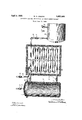
In the drawing is a steel container A, preferably of cylindrical form and surrounded by a jacket of insulating material. B is a pipe coil of any desired design which may be placed in or adjacent to a refrigerator box, "U. D is a gas storage tank which will be of a strength sufficient to retain the gas under a pressure considerably in excess of atmospheric.
1 is a removable lid in the upper part of A, which may be strongly and tightly clamped to it by suitable means;
2 is a gas discharge pipe which is used to 1929. Serial No. 371,603.
relieve the pressure in A, prior to removing the lid as a preliminary to the introduction of solidified carbon dioxide;
3 is a valve opening and closing discharge pipe 2;
4 and 5 are outlets from A connecting it with B and D, one of which will be in the upper part of A, one near the bottom;
6 and 7 are valves closing these outlets;
8 is a discharge pipe by which gas may be withdrawn for use;
9 is a valve on this outlet;
10 is a pipe'connection between B and D;
11 is a valve on this pipe;
12 is a safety or relief valve by which the carbon dioxide may be released, should the pressure of the gas in D rise above that which it is designed to safely support.
The manner of use can be readily understood. The frozen carbon dioxide will be formed into cylinders of a diameter slightly less than the interior diameter of A, or of any dimensions corresponding to other dimensions given to the containing chamber. Assuming A to be filled with gas, possibly with a small residue of solid carbon dioxide, it is refilled by closing valves 6 and 7 and opening valve 3 on 2 to relieve the pressure. Lid 1 is then unclamped and opened; the cylinder of solidified carbon dioxide introduced; the lid is reclamped and valve 3 closed; valve 7 is opened; valve 6 partially opened.
It is apparent that as the temperature of the gas in B rises through the absorption of heat, it will pass through into A and into contact with the cylinder of solid carbon dioxide and being cooled and causing a further evolution of cold gas from the cylinder, will pass down and into B through outlet 5. By regulating the size of the opening of valve 6, a considerable control may be exercised over the rate of gas evolution from A. An automatic device may readily be placed on 4 to control either the temperature of the gas in B, or to maintain a constant pressure, there being a rate of withdrawal through 8 not less than the rate of gas evolution due to impact of heat through the insulated walls of A.
It need hardly be said that where no use for a refrigerant exists, B and C may be eliminated, leaving only a mere pipe connection between 4 and 5 to permit a circulation of gas, and the pipe to storage tank D by which the gas evolved more rapidly than it is withdrawn through 8 for use may be stored. There are very many situations where such apparatus being installed, the carbon dioxide can be delivered in solid form with a great reduction in handling costs between the plant where produced and the place of consumption and both the refrigerating value due to its extremely'low temperature and its value as a gas fully utilized.
What I claim as new and desire to protect by the issuance to me of Letters Patent is:
1. In apparatus for the utilization of solid carbon dioxide, the combination of an insulated container, an opening therein with closable means for introducing solid carbon dioxide into the container, closable outlets at the upper and lower extremities of the container, an exterior connection between these outlets, a storage tank, means for passing gas from the container into the storage tank, means of withdrawing gas from the apparatus. g 2. In apparatus of the sort described, the combination of a'press'ure resistant container, heat insulating materials surrounding the container, a lid thereto, means of firmly closing the lid, a discharge pipe from the container to the air, means of opening and closing the discharge pipe, outlets from the upper and lowere'xtremities of the container, means of opening and closing these outlets and of varying thedegree of opening therein a refrigerating coil having its terminals oined to these outlets, a discharge pipe from the coil and means of opening and closing the discharge pipe.
3. In apparatus of the sort described, the combination of a pressure resistant container, heat insulating materials surrounding the container, a lid thereto, means of firmly closing the lid, a discharge pipe from the contalner, means of opening and closing the discharge pipe, outlets from the upper and lower extremities of the container, means of opening and closing these outlets, a system of pipes having its terminals connected with these outlets, a storage tank, a pipe connecting the system of pipes with the storage tank, a closable outlet from the pipe system.
4. In apparatus for the utilization of solid carbon dioxide, a pressure resisting container, heat insulating materials surrounding the container, means ofintroducing solid carbon dioxide into the container, means of reducing the pressure within the container, outlets in of pipes and downward through the container, a closable outlet for withdrawing evolved gas from the system of pipes.
5. In apparatus for the utilization of solid carbon dioxide, the combination of an insulated container, a firmly closable lid upon the container for the introduction of solid carbon dioxide, a system of pipes having its terminals connected to and opening into the upper and lower extremities of the container, means of closing and regulating the size of these openings, means of causing evolved gas to circulate through the system of pipes from the opening in the lower extremity of the container and down through the container, means of withdrawing evolved gas from the system of pipes.
6. In apparatus for the utilization of solid carbon dioxide, the combination of an insulated pressure resisting container, means of introducing solid carbon dioxide into the container, means of reducing the pressure within the container, outlets from the upper and lower extremities of the container, means of closing and varying the size of these outlets,
a closed circuit of pipes having its terminals connected with these outlets, means of with drawing evolved gas from this circuit.
' In testimony whereof, I have aflixed my signature.
WILLIAM D. WILCOX.
upper end lower extremities of the container,
means of opening and closing these outlets, and of varying their size, a system of plpes having its terminals connected to these 0 enings, means of circulating gas evolved rom the solid carbon dioxide through the system
Priority Applications (1)
| Application Number | Priority Date | Filing Date | Title |
|---|---|---|---|
| US371603A US1852388A (en) | 1929-06-17 | 1929-06-17 | Apparatus for the utilization of solid carbon dioxide |
Applications Claiming Priority (1)
| Application Number | Priority Date | Filing Date | Title |
|---|---|---|---|
| US371603A US1852388A (en) | 1929-06-17 | 1929-06-17 | Apparatus for the utilization of solid carbon dioxide |
Publications (1)
| Publication Number | Publication Date |
|---|---|
| US1852388A true US1852388A (en) | 1932-04-05 |
Family
ID=23464629
Family Applications (1)
| Application Number | Title | Priority Date | Filing Date |
|---|---|---|---|
| US371603A Expired - Lifetime US1852388A (en) | 1929-06-17 | 1929-06-17 | Apparatus for the utilization of solid carbon dioxide |
Country Status (1)
| Country | Link |
|---|---|
| US (1) | US1852388A (en) |
Cited By (1)
| Publication number | Priority date | Publication date | Assignee | Title |
|---|---|---|---|---|
| US3203192A (en) * | 1960-11-29 | 1965-08-31 | Conch Int Methane Ltd | Cooling a gaseous mixture with a solid contaminant in vapor carrier |
-
1929
- 1929-06-17 US US371603A patent/US1852388A/en not_active Expired - Lifetime
Cited By (1)
| Publication number | Priority date | Publication date | Assignee | Title |
|---|---|---|---|---|
| US3203192A (en) * | 1960-11-29 | 1965-08-31 | Conch Int Methane Ltd | Cooling a gaseous mixture with a solid contaminant in vapor carrier |
Similar Documents
| Publication | Publication Date | Title |
|---|---|---|
| DE676863C (en) | Procedure for storage of liquid acetylene | |
| US2650478A (en) | Method and apparatus for shipping and storing combustible gases | |
| US3030780A (en) | Refrigerated container for liquefied gases | |
| US2670605A (en) | System and method for charging carbon dioxide containers | |
| US2479840A (en) | Process and apparatus for refrigeration | |
| US3810365A (en) | Method of distributing carbon dioxide | |
| US2810265A (en) | Means for storing and transporting cold low boiling liquids | |
| US4129432A (en) | Expendable refrigeration system | |
| US2001040A (en) | Beer dispensing equipment | |
| US2966040A (en) | Tank for the storage and transportation of a low boiling liquid | |
| US4766732A (en) | Chamber refrigerated by solid carbon dioxide | |
| US2812643A (en) | Container | |
| US2328647A (en) | Method and apparatus for storing gaseous materials in the liquid phase | |
| US2775099A (en) | Self-contained ice making unit | |
| CA1072440A (en) | Method of distributing carbon dioxide | |
| AT129428B (en) | Household refrigerator. | |
| US3097498A (en) | Apparatus for handling liquefied cases | |
| US1876047A (en) | Apparatus and process for preserving liquid carbon dioxide | |
| US2983409A (en) | Means for the storage and transportation of a liquefied gas | |
| US2097685A (en) | Refrigerating system | |
| US2830444A (en) | Apparatus for storing and utilizing volatile hydrocarbons and the like | |
| US2522342A (en) | Apparatus for firing dehydrating plants and for cooling the product | |
| US1998629A (en) | Process of and apparatus for transferring liquefied gases | |
| US3041841A (en) | Storage means for a liquefied gas | |
| US2566301A (en) | Portable refrigeration box |