US1852238A - Shoe - Google Patents
Shoe Download PDFInfo
- Publication number
- US1852238A US1852238A US439331A US43933130A US1852238A US 1852238 A US1852238 A US 1852238A US 439331 A US439331 A US 439331A US 43933130 A US43933130 A US 43933130A US 1852238 A US1852238 A US 1852238A
- Authority
- US
- United States
- Prior art keywords
- heel
- welt
- shoe
- inseam
- sole
- Prior art date
- Legal status (The legal status is an assumption and is not a legal conclusion. Google has not performed a legal analysis and makes no representation as to the accuracy of the status listed.)
- Expired - Lifetime
Links
- 239000000463 material Substances 0.000 description 11
- 238000010276 construction Methods 0.000 description 10
- 239000000945 filler Substances 0.000 description 4
- 239000000853 adhesive Substances 0.000 description 3
- 230000001070 adhesive effect Effects 0.000 description 3
- 239000010985 leather Substances 0.000 description 2
- 230000008439 repair process Effects 0.000 description 2
- 230000000386 athletic effect Effects 0.000 description 1
- 239000004568 cement Substances 0.000 description 1
- 230000000694 effects Effects 0.000 description 1
Images
Classifications
-
- A—HUMAN NECESSITIES
- A43—FOOTWEAR
- A43B—CHARACTERISTIC FEATURES OF FOOTWEAR; PARTS OF FOOTWEAR
- A43B13/00—Soles; Sole-and-heel integral units
- A43B13/14—Soles; Sole-and-heel integral units characterised by the constructive form
- A43B13/18—Resilient soles
- A43B13/187—Resiliency achieved by the features of the material, e.g. foam, non liquid materials
Definitions
- the invention relates to shoes and more particularly to Goodyear welt shoes having sewed heel seats.
- the general object of the invention is to rovide a cushion spring-heel construction for Goodyear welt shoes having sewed heel seats, which may be expeditiously incorporated in shoes of this type without any change in the factory equipment and which does not materially increase the cost of the shoe, but produces a far more comfortable and healthful shoe than the usual constructions and one which is especially suitable for childrens use and for so-calle-d athletic shoes.
- the present invention embodies certain improvements over that of my prior application, Serial No. 383,610, filed August 5, 1929, which tend to simplify the cushion construction and its associated parts and in which an additional outer sole member is provided at the heel so that if the outer sole wears through this additional sole will protect the cushion until repairs can be made.
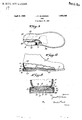
- FIG. 1 is a bottom plan View of a shoe embodying the invention, parts of the outer sole being broken away;
- Fig. 2 is a side elevation view of the shoe, parts' being broken away and parts being shown in section;
- Fig. 3 is a detail sectional view taken on the line 3 3 of Fig. 2.
- this invention relates to Goodyear Welt shoes in which the heel seat is sewed and in which no nails are used in attaching the heel to the heel seat and, as such, the shoe includes the usual upper 8, which may have a lining 9 and counter 10 associated therewith, these parts being secured in the usual manner to the flange 11 of the insole 12 and to the welt 13 by the inseam stitching 14, the welt 13 extending' about the entire shoe.
- a cushion heel member alone or a combined heel and shank member is interposed between the inner and outer soles.
- a piece of soft cushioning material 16 is formed to provide a heel portion and a flexible shank portion 17 and it will be noted from Figs. 2 and 3 that the heel portion includes a cushion part 18 which extends up into the space formed between the inseam ridges 15 and the bottom of the insole and takes the place of the usual bottom filler and includes the part 19, which forms a spring-heel port-ion, said part having its outer edges 20 tapering inwardly from the inseam ridge to the bottom 21.
- This piece 16 is preferably placed in position after the inseaming operation and secured against the insole and inseam ridge by suitable cement and the space at the ball and toe portions of the shoe is lled with the usual bottom filler 22.
- the heel construction is completed by affixing to the spring heel part 19 a member 23 of stiffer material, such as leather or denser rubber, such as is used in heels, said member 23 forming a marginal or enclosing frame for the part 19 and extending around the heel beneath the welt 13 and initially secured to the welt by suitable adhesive, the inner edges of said member being tapered to abut the tapered sides or edge 20 of the heel part 19.
- a member 23 of stiffer material such as leather or denser rubber, such as is used in heels
- an outer heel, sole or lift 24 is secured to said frame by suitable adhesive and is then secured to the bottom of the cushion heel 19 or said sole 24 may be secured by adhesive to said heel and frame.
- outsole 25 is secured to the shoe by stitching 26 extending through the welt and outsole at the front and shank portions of the shoe and extending through the welt 13, the frame 23, sole member 24 and outer sole at the heel portion of the shoe, as shown in Figs. 2 and 3.
- the outer heel sole 24 will protect the cushion and its marginal frame until repairs can be made and also some saving in cushioning material, is effected by the form of the cushion heel part herein shown.
- a separate stiE marginal frame member 23 which underlies the inseam ridges and yet having this marginal frame member and the soft rubber member provided with engaged and correspondinglybeveled surfaces and also by virtue ofthe engagement of the upper marginal portion of the soft rubber member with the inseam ridges, the structure of the shoe is rendered strong and durable and yet the required cushioning effect is had.
- the yielding lateral pressure exerted by the soft rubber member permits flexion or yielding of the inseam ridges and yet this desirable action is had with a very secure structural espifn of the upper, welt and inner and outer so es.
- a spring-heel construction interposed between the inner and outer soles comprising a soft rubber member, a separate stitch-receiving marginal frame member of ⁇ relatively stiffer material surrounding said soft rubber member and extending beneath the welt, and an outer heel sole interposed between the main outer sole and said springheel portion and secured thereto.
- a springheel construction interposed between the inner and outer soles and comprising a soft rubber member having an outer tapered edge, and a separate stitch-receiving marginal frame member of relatively stifier material extending around and having a tapered edge abutting the edge of the cushion member and extending beneath the Welt.
- a cushioned spring-heel construction comprising a soft rubber member interposed between the inner and outer soles, a Stitch-receiving marginal frame member of U-shaped form and of relatively stiffer material extending around the soft rubber member and interposed betwen and stitched to the welt and the outer sole, said marginal frame member and said soft rubber member having thecilr adjacent edges correspondingly bevele 4.
- a cushioned spring-heel construction comprising a stitchreceiving marginal frame member of relatively stiff material interposed between and stitched t0 the Welt and to the outer sole, and a soft rubber member interposed between the inner and outer 'soles and having its entire edge portion located inwardly of the inseam ridges.
- a cushioned spring-heel construction comprising a stitchreceiving marginal frame member of relatively stif material interposed between and stitched to the welt and to the outer sole, and a soft rubber member interposed between the inner and outer soles and having its entire edge portion located inwardly of the inseam ridges, at least a portion of the soft rubber member engaging the inner faces of the inseam ridges and exerting a lateral yielding pressure thereon.
Landscapes
- Chemical & Material Sciences (AREA)
- Engineering & Computer Science (AREA)
- Materials Engineering (AREA)
- Footwear And Its Accessory, Manufacturing Method And Apparatuses (AREA)
Description
36.y BTSg SHOES L LEGGINS. y
/7 Search Roo April 5, 1932, .1. F. cslmn'scm 1,852,238
snor:
Filed March 27. 1930 F/rriy.' 1
/////l/////////// MAW/1%.
Patented Apr. 5, 1932 UNITED STATES PATENT OFFICE JAMES F. GILKERSON, OF MILWAUKEE, WISCONSIN SHOE The invention relates to shoes and more particularly to Goodyear welt shoes having sewed heel seats.
The general object of the invention is to rovide a cushion spring-heel construction for Goodyear welt shoes having sewed heel seats, which may be expeditiously incorporated in shoes of this type without any change in the factory equipment and which does not materially increase the cost of the shoe, but produces a far more comfortable and healthful shoe than the usual constructions and one which is especially suitable for childrens use and for so-calle-d athletic shoes. More particularly, the present invention embodies certain improvements over that of my prior application, Serial No. 383,610, filed August 5, 1929, which tend to simplify the cushion construction and its associated parts and in which an additional outer sole member is provided at the heel so that if the outer sole wears through this additional sole will protect the cushion until repairs can be made.
The invention further consists in the several features hereinafter set forth and more particularly defined by claims at the conclusion hereof.
In the drawings Fig. 1 is a bottom plan View of a shoe embodying the invention, parts of the outer sole being broken away;
Fig. 2 is a side elevation view of the shoe, parts' being broken away and parts being shown in section;
Fig. 3 is a detail sectional view taken on the line 3 3 of Fig. 2.
As previously noted, this invention relates to Goodyear Welt shoes in which the heel seat is sewed and in which no nails are used in attaching the heel to the heel seat and, as such, the shoe includes the usual upper 8, which may have a lining 9 and counter 10 associated therewith, these parts being secured in the usual manner to the flange 11 of the insole 12 and to the welt 13 by the inseam stitching 14, the welt 13 extending' about the entire shoe.
Usually in shoes of this type the space formed between the inseam ridge 15 and the bottom of the insole is filled with the usual -bottom filler, a relatively sti' and thick leather spring-heel is disposed over the heel seat and extends across under the welt and the outsole is secured to the shoe by stitching it to the welt at the toe and shank portions of the shoe and by stitching it to the spring-heel and the welt at the heel seat portlon of the shoe, which provides a spring-heel shoe without any special cushioning properties, as neither the bottom tiller nor the spring-heel possess such properties.
According to the present invention, after the inseaming operation, either a cushion heel member alone or a combined heel and shank member is interposed between the inner and outer soles.
Referring to the drawings, a piece of soft cushioning material 16, preferably molded sponge rubber, is formed to provide a heel portion and a flexible shank portion 17 and it will be noted from Figs. 2 and 3 that the heel portion includes a cushion part 18 which extends up into the space formed between the inseam ridges 15 and the bottom of the insole and takes the place of the usual bottom filler and includes the part 19, which forms a spring-heel port-ion, said part having its outer edges 20 tapering inwardly from the inseam ridge to the bottom 21. While the entire edge portion of the soft rubber member is located inwardly of the inseam rid es, the upper marginal portion of this mem er engages the inner surfaces of the inseam ridges and hence a yielding lateral pressure is exerted thereon. This piece 16, as such, is preferably placed in position after the inseaming operation and secured against the insole and inseam ridge by suitable cement and the space at the ball and toe portions of the shoe is lled with the usual bottom filler 22.
The heel construction is completed by affixing to the spring heel part 19 a member 23 of stiffer material, such as leather or denser rubber, such as is used in heels, said member 23 forming a marginal or enclosing frame for the part 19 and extending around the heel beneath the welt 13 and initially secured to the welt by suitable adhesive, the inner edges of said member being tapered to abut the tapered sides or edge 20 of the heel part 19.
Preferably, before securing the frame 23 in place, an outer heel, sole or lift 24 is secured to said frame by suitable adhesive and is then secured to the bottom of the cushion heel 19 or said sole 24 may be secured by adhesive to said heel and frame.
With the parts thus assembled the usual outsole 25 is secured to the shoe by stitching 26 extending through the welt and outsole at the front and shank portions of the shoe and extending through the welt 13, the frame 23, sole member 24 and outer sole at the heel portion of the shoe, as shown in Figs. 2 and 3.
Where the flexible shank portion is omitted, the space shown occupied thereby is filled in the same manner as the forepart of the shoe, with bottom filler.
With the above construction, should the heel portion of the outer sole wear through, the outer heel sole 24 will protect the cushion and its marginal frame until repairs can be made and also some saving in cushioning material, is effected by the form of the cushion heel part herein shown. By employing a separate stiE marginal frame member 23 which underlies the inseam ridges and yet having this marginal frame member and the soft rubber member provided with engaged and correspondinglybeveled surfaces and also by virtue ofthe engagement of the upper marginal portion of the soft rubber member with the inseam ridges, the structure of the shoe is rendered strong and durable and yet the required cushioning effect is had. The yielding lateral pressure exerted by the soft rubber member permits flexion or yielding of the inseam ridges and yet this desirable action is had with a very secure structural organizatifn of the upper, welt and inner and outer so es.
I desire it to be understood that this invention is not to be limited to any particular form or arrangement of parts except insofar as such limitations are specified in theclaims.
What I claim as my invention is:
1. In a Goodyear welt shoe having sewed heel seats with the usual welt, inner and outer soles, a spring-heel construction interposed between the inner and outer soles comprising a soft rubber member, a separate stitch-receiving marginal frame member of` relatively stiffer material surrounding said soft rubber member and extending beneath the welt, and an outer heel sole interposed between the main outer sole and said springheel portion and secured thereto.
2. In a Goodyear welt shoe having inner and outer soles and a welt inseamed to the upper materials at the heel seam, a springheel construction interposed between the inner and outer soles and comprising a soft rubber member having an outer tapered edge, and a separate stitch-receiving marginal frame member of relatively stifier material extending around and having a tapered edge abutting the edge of the cushion member and extending beneath the Welt.
3. In a Goodyear welt shoe having sewed heel seats with the usual welt and inner and outer soles, a cushioned spring-heel construction comprising a soft rubber member interposed between the inner and outer soles, a Stitch-receiving marginal frame member of U-shaped form and of relatively stiffer material extending around the soft rubber member and interposed betwen and stitched to the welt and the outer sole, said marginal frame member and said soft rubber member having thecilr adjacent edges correspondingly bevele 4. In a Goodyear welt shoe having inner and outer soles and a welt inseamed to the upper materials at the heal seat, a cushioned spring-heel construction comprising a stitchreceiving marginal frame member of relatively stiff material interposed between and stitched t0 the Welt and to the outer sole, and a soft rubber member interposed between the inner and outer 'soles and having its entire edge portion located inwardly of the inseam ridges.
5. In a Goodyear Welt shoe having inner and outer soles and a welt inseamed to the upper materials at the heel seat, a cushioned spring-heel construction comprising a stitchreceiving marginal frame member of relatively stif material interposed between and stitched to the welt and to the outer sole, and a soft rubber member interposed between the inner and outer soles and having its entire edge portion located inwardly of the inseam ridges, at least a portion of the soft rubber member engaging the inner faces of the inseam ridges and exerting a lateral yielding pressure thereon.
In testimony whereof I aiiix 1n signature.
JAMES F. GILI ERSON.
ICS
Priority Applications (1)
| Application Number | Priority Date | Filing Date | Title |
|---|---|---|---|
| US439331A US1852238A (en) | 1930-03-27 | 1930-03-27 | Shoe |
Applications Claiming Priority (1)
| Application Number | Priority Date | Filing Date | Title |
|---|---|---|---|
| US439331A US1852238A (en) | 1930-03-27 | 1930-03-27 | Shoe |
Publications (1)
| Publication Number | Publication Date |
|---|---|
| US1852238A true US1852238A (en) | 1932-04-05 |
Family
ID=23744266
Family Applications (1)
| Application Number | Title | Priority Date | Filing Date |
|---|---|---|---|
| US439331A Expired - Lifetime US1852238A (en) | 1930-03-27 | 1930-03-27 | Shoe |
Country Status (1)
| Country | Link |
|---|---|
| US (1) | US1852238A (en) |
Cited By (5)
| Publication number | Priority date | Publication date | Assignee | Title |
|---|---|---|---|---|
| US2913837A (en) * | 1958-04-11 | 1959-11-24 | Holland Racine Shoes Inc | Shoe heel construction |
| US3011272A (en) * | 1959-06-12 | 1961-12-05 | Goldenberg Michael | Bowling shoes |
| US4391048A (en) * | 1979-12-21 | 1983-07-05 | Sachs- Systemtechnik Gmbh | Elastic sole for a shoe incorporating a spring member |
| US5642575A (en) * | 1995-08-25 | 1997-07-01 | Norton; Edward J. | Midsole construction |
| US6637131B2 (en) * | 2001-12-28 | 2003-10-28 | Tsui-Fang Lee | Waterproof shoe |
-
1930
- 1930-03-27 US US439331A patent/US1852238A/en not_active Expired - Lifetime
Cited By (5)
| Publication number | Priority date | Publication date | Assignee | Title |
|---|---|---|---|---|
| US2913837A (en) * | 1958-04-11 | 1959-11-24 | Holland Racine Shoes Inc | Shoe heel construction |
| US3011272A (en) * | 1959-06-12 | 1961-12-05 | Goldenberg Michael | Bowling shoes |
| US4391048A (en) * | 1979-12-21 | 1983-07-05 | Sachs- Systemtechnik Gmbh | Elastic sole for a shoe incorporating a spring member |
| US5642575A (en) * | 1995-08-25 | 1997-07-01 | Norton; Edward J. | Midsole construction |
| US6637131B2 (en) * | 2001-12-28 | 2003-10-28 | Tsui-Fang Lee | Waterproof shoe |
Similar Documents
| Publication | Publication Date | Title |
|---|---|---|
| US2502774A (en) | Cushioned shoe | |
| US5311677A (en) | Shoe having impact absorption means | |
| US2198338A (en) | Footwear | |
| US1785410A (en) | Cushioned shoe | |
| US2037970A (en) | Cushion shoe | |
| US1976389A (en) | Shoe | |
| US2817163A (en) | Cushioned shoe construction | |
| US2111620A (en) | Shoe | |
| US2157818A (en) | Shoe | |
| US2199853A (en) | Shoe construction | |
| US1942001A (en) | Shoe | |
| US1751990A (en) | Shoe | |
| US2300739A (en) | Insole | |
| US1898033A (en) | Shoe and the method of making same | |
| US2322532A (en) | Boot or shoe | |
| US1751991A (en) | Cushion shoe | |
| US1807401A (en) | Shoe | |
| US2074121A (en) | Shoe | |
| US2276949A (en) | Shoe | |
| US2177156A (en) | Shoe insole | |
| US2171414A (en) | Shoe | |
| US1919862A (en) | Shoe | |
| US1968290A (en) | Cushion shoe | |
| US1215450A (en) | Rubber-sole shoe. | |
| US2098235A (en) | Cushion shoe |