US1851961A - Producing hydrogen peroxide - Google Patents
Producing hydrogen peroxide Download PDFInfo
- Publication number
- US1851961A US1851961A US161787A US16178727A US1851961A US 1851961 A US1851961 A US 1851961A US 161787 A US161787 A US 161787A US 16178727 A US16178727 A US 16178727A US 1851961 A US1851961 A US 1851961A
- Authority
- US
- United States
- Prior art keywords
- solution
- hydrogen peroxide
- chamber
- distilling
- producing hydrogen
- Prior art date
- Legal status (The legal status is an assumption and is not a legal conclusion. Google has not performed a legal analysis and makes no representation as to the accuracy of the status listed.)
- Expired - Lifetime
Links
- MHAJPDPJQMAIIY-UHFFFAOYSA-N Hydrogen peroxide Chemical compound OO MHAJPDPJQMAIIY-UHFFFAOYSA-N 0.000 title description 66
- 239000000243 solution Substances 0.000 description 61
- 229960002163 hydrogen peroxide Drugs 0.000 description 32
- 238000000034 method Methods 0.000 description 25
- QAOWNCQODCNURD-UHFFFAOYSA-N Sulfuric acid Chemical compound OS(O)(=O)=O QAOWNCQODCNURD-UHFFFAOYSA-N 0.000 description 22
- 230000008569 process Effects 0.000 description 19
- 238000010438 heat treatment Methods 0.000 description 14
- JRKICGRDRMAZLK-UHFFFAOYSA-L persulfate group Chemical group S(=O)(=O)([O-])OOS(=O)(=O)[O-] JRKICGRDRMAZLK-UHFFFAOYSA-L 0.000 description 11
- 238000004821 distillation Methods 0.000 description 10
- 229910052751 metal Inorganic materials 0.000 description 10
- 239000002184 metal Substances 0.000 description 10
- QVGXLLKOCUKJST-UHFFFAOYSA-N atomic oxygen Chemical compound [O] QVGXLLKOCUKJST-UHFFFAOYSA-N 0.000 description 8
- 239000001301 oxygen Substances 0.000 description 8
- 229910052760 oxygen Inorganic materials 0.000 description 8
- 150000002739 metals Chemical class 0.000 description 6
- 229910000831 Steel Inorganic materials 0.000 description 5
- 229910045601 alloy Inorganic materials 0.000 description 5
- 239000000956 alloy Substances 0.000 description 5
- 230000001174 ascending effect Effects 0.000 description 5
- 239000007788 liquid Substances 0.000 description 5
- 239000010959 steel Substances 0.000 description 5
- VYZAMTAEIAYCRO-UHFFFAOYSA-N Chromium Chemical compound [Cr] VYZAMTAEIAYCRO-UHFFFAOYSA-N 0.000 description 4
- 229910052804 chromium Inorganic materials 0.000 description 4
- 239000011651 chromium Substances 0.000 description 4
- 239000001257 hydrogen Substances 0.000 description 4
- 229910052739 hydrogen Inorganic materials 0.000 description 4
- 150000003467 sulfuric acid derivatives Chemical class 0.000 description 4
- 239000000788 chromium alloy Substances 0.000 description 3
- XLYOFNOQVPJJNP-UHFFFAOYSA-N water Substances O XLYOFNOQVPJJNP-UHFFFAOYSA-N 0.000 description 3
- UFHFLCQGNIYNRP-UHFFFAOYSA-N Hydrogen Chemical compound [H][H] UFHFLCQGNIYNRP-UHFFFAOYSA-N 0.000 description 2
- XEEYBQQBJWHFJM-UHFFFAOYSA-N Iron Chemical compound [Fe] XEEYBQQBJWHFJM-UHFFFAOYSA-N 0.000 description 2
- PXHVJJICTQNCMI-UHFFFAOYSA-N Nickel Chemical compound [Ni] PXHVJJICTQNCMI-UHFFFAOYSA-N 0.000 description 2
- 239000002253 acid Substances 0.000 description 2
- ROOXNKNUYICQNP-UHFFFAOYSA-N ammonium persulfate Chemical compound [NH4+].[NH4+].[O-]S(=O)(=O)OOS([O-])(=O)=O ROOXNKNUYICQNP-UHFFFAOYSA-N 0.000 description 2
- BFNBIHQBYMNNAN-UHFFFAOYSA-N ammonium sulfate Chemical compound N.N.OS(O)(=O)=O BFNBIHQBYMNNAN-UHFFFAOYSA-N 0.000 description 2
- 229910052921 ammonium sulfate Inorganic materials 0.000 description 2
- 235000011130 ammonium sulphate Nutrition 0.000 description 2
- 239000003054 catalyst Substances 0.000 description 2
- 230000003197 catalytic effect Effects 0.000 description 2
- 229910010293 ceramic material Inorganic materials 0.000 description 2
- VNNRSPGTAMTISX-UHFFFAOYSA-N chromium nickel Chemical compound [Cr].[Ni] VNNRSPGTAMTISX-UHFFFAOYSA-N 0.000 description 2
- 238000000354 decomposition reaction Methods 0.000 description 2
- 238000005868 electrolysis reaction Methods 0.000 description 2
- 229910001385 heavy metal Inorganic materials 0.000 description 2
- 150000002431 hydrogen Chemical class 0.000 description 2
- 238000004519 manufacturing process Methods 0.000 description 2
- 239000000463 material Substances 0.000 description 2
- 238000002844 melting Methods 0.000 description 2
- 230000008018 melting Effects 0.000 description 2
- 150000002978 peroxides Chemical class 0.000 description 2
- 239000000126 substance Substances 0.000 description 2
- 206010020772 Hypertension Diseases 0.000 description 1
- 230000009471 action Effects 0.000 description 1
- 229910001870 ammonium persulfate Inorganic materials 0.000 description 1
- 239000007864 aqueous solution Substances 0.000 description 1
- 238000003421 catalytic decomposition reaction Methods 0.000 description 1
- 239000000567 combustion gas Substances 0.000 description 1
- 230000001276 controlling effect Effects 0.000 description 1
- 125000004122 cyclic group Chemical group 0.000 description 1
- 230000003247 decreasing effect Effects 0.000 description 1
- 238000010790 dilution Methods 0.000 description 1
- 239000012895 dilution Substances 0.000 description 1
- 238000005485 electric heating Methods 0.000 description 1
- 230000006872 improvement Effects 0.000 description 1
- 229910052742 iron Inorganic materials 0.000 description 1
- 230000004048 modification Effects 0.000 description 1
- 238000012986 modification Methods 0.000 description 1
- 230000007935 neutral effect Effects 0.000 description 1
- 229910052759 nickel Inorganic materials 0.000 description 1
- 239000010970 precious metal Substances 0.000 description 1
- 230000001105 regulatory effect Effects 0.000 description 1
- 239000007787 solid Substances 0.000 description 1
- 229910052715 tantalum Inorganic materials 0.000 description 1
- GUVRBAGPIYLISA-UHFFFAOYSA-N tantalum atom Chemical compound [Ta] GUVRBAGPIYLISA-UHFFFAOYSA-N 0.000 description 1
- 239000002699 waste material Substances 0.000 description 1
Images
Classifications
-
- C—CHEMISTRY; METALLURGY
- C01—INORGANIC CHEMISTRY
- C01B—NON-METALLIC ELEMENTS; COMPOUNDS THEREOF; METALLOIDS OR COMPOUNDS THEREOF NOT COVERED BY SUBCLASS C01C
- C01B15/00—Peroxides; Peroxyhydrates; Peroxyacids or salts thereof; Superoxides; Ozonides
- C01B15/01—Hydrogen peroxide
- C01B15/03—Preparation from inorganic peroxy compounds, e.g. from peroxysulfates
Definitions
- This invention relates to the production of hydrogen peroxide, more especially from persulfates. All the methods hitherto known start from solid persulfates, no method being hitherto known for obtaining hydrogen eroxide from aqueous solutions of persulates in a practical way. This may be due to the fact that during the distillation crys: talline masses are deposited upon several parts of the distilling apparatus whereby the output may be lessened.
- chromium-nickel alloys containing for instance 15 per cent of. chromium and 85 per cent of nickel, preferably obtained be most advantageously used for making cathodes, the chromium-nickel cathodes being sufficiently durable and cheap and showing little hypertension.
- Chromium-nickel alloys containing a small percentage of other metals are also adapted for the purpose in question. Also pure chromium or another metal well plated with chromium have proved successful.
- the li uid rises to the top commingled with and w irled up by va or. While the collected vapor consisting o steam andhydrogen peroxide is passed to the condenser, the residue flows off at the top.
- the method described thus allows of obtaining the hydrogen peroxide with satisfactory output from the solutions coming from the electrolysis even if they contain catalytic matter.
- the peroxide may, of course, be distilled from solutions obtained in another way.
- Another in itself well-known method consists in letting the solutions flow along the walls of the tube from top to bottom; but
- distilling apparatus of the kind described may be made of heavy metals provided they are chemically resistant against the solutions here coming into consideration.
- the apparatus when using a metal or metals for constructing the apparatus for carrying out the herein described process, the apparatus may be constructed so as to be by far better adapted for the thermical and chemical conditions than by using, for instance, ceramic material, and furthermore essential advantages as to practical working are obtained.
- As constructing material especially the precious metals and their substitutes are suitable, for instance siliconiron alloys.
- the apparatus required for carrying out my process may be heated with steam, hot liquids, waste combustion gases or' the like and the heating may be effected from without or within.
- Internal heating may, for instance be effected by means of a pipe surroundedby the solution, the said pipe shutting off the evacuated distilling space and the heated medium flowing through its interior.
- a further considerable improvement is attainedby introducing water into the solution at one or more points during the distillation. This may be explained by the fact that towards the end of the distillation the temperature and therewith the decomposition is considerably increased in consequence of the increased concentration, whereas by adding a relatively small amount of water the concentration and the temperature are kept within the critical limits.
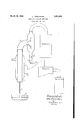
- the 0 yielding solution to be distilled may be contained in a bowl a.
- the solution is sucked up through a capillary pipe I) into a tube 0 surrounded, for instance, by a heating jacket cl.
- the tube a is connected at its top end with a receiver e having two tubulures f, 9, one of which (f) communicates with the vacuum pump, the other (g) being arranged to carry oil the residue from the distillation.
- Arrow h indicates the way of the vapors, and arrow i the way of the residue fronD the distillation.
Landscapes
- Chemical & Material Sciences (AREA)
- Organic Chemistry (AREA)
- Inorganic Chemistry (AREA)
- Vaporization, Distillation, Condensation, Sublimation, And Cold Traps (AREA)
- Organic Low-Molecular-Weight Compounds And Preparation Thereof (AREA)
Description
March 29, 1932. L, LOWENSTEIN 1,351,961
PRODUCING HYDROGEN PEROXIDE Filed Jan. 18, 1927 Condenser ifeccirerfor- Zesiclue Kcccvcr fnvenfor:
Patented Mar. 29,1932
UNITED STATES LEO IbWENSTEIN, OF IBERLIN-LICHTEBFELDE, GERMANY, ASSIGNOB I O FIRM J. D.
PATENT OFFICE RIEDEL AKTIENGESELLSCHAFT, OF BEBLIN-BBITZ, GERMANY PRODUCING HYDROGEN PEROXIDE Application filed January 18, 1927, Serial No. 161,787, and in Germany June 2, 1922.
This invention relates to the production of hydrogen peroxide, more especially from persulfates. All the methods hitherto known start from solid persulfates, no method being hitherto known for obtaining hydrogen eroxide from aqueous solutions of persulates in a practical way. This may be due to the fact that during the distillation crys: talline masses are deposited upon several parts of the distilling apparatus whereby the output may be lessened.
Now I have found that the above-mentioned difiiculties do not arise if sulfuric acid is added to the persulfate solutions in excess over the calculated amount preferably, for instance 1.3 molecules of sulfuric acid per one molecule of persulfate. Furthermore, if the solution contains sulfates besides the persulfate, which is, for instance, the case when solutions produced from sulfates by electrolysis are employed, a further amount of sulfuric acid must be added so as to produce acid sulfates. A further addition of sulfuric acid may be necessitated by the particular kind of the distilling vessel. Moreover, in some cases, revious dilution with water is advisable. hen operating in the described manner, the solution remains liquid up to the end of the distillation, and thus the problem of producing hydrogen peroxide from persulfate solutions with a satisfactoryoutput is now solved.
By further developing the above ideas I have found a method for obtaining hydrogen peroxide in a cyclic process. Firstly when electrolyzing the sulfates the quantities of the sulfuric acid contained in the anode and cathode chambers and the time of their staying therein is regulated in such a manner that the solution-leaving the anode chamber contains more than one molecule of sulfuric acid per each molecule of persulfate and sulby melting 1n vacuo, ma
2.9 moles of sulfuric acid per liter flows to the cathode chamber, good results are obtained by leaving this solution in the cathode chamber, until it contains 1.5 moles of ammonium sulfate and 2.1 molesv of sulfuric acid per liter, and finally distillin the solution introduced into the anode c amber as soon as it has been brought therein to a concentration of'1.1 moles of ammonium persulfate, 0.15 moles of ammonium sulfate, and 1.8 moles of sulfuric acid per liter.
For better comprehension I have illustrated a distilling apparatus adapted for carrying out my invention by way of example in the annexed drawing.
Of course, in carrying out the process 'according to my invention the material used for the cathode is of great importance. I have found that chromium-nickel alloys, containing for instance 15 per cent of. chromium and 85 per cent of nickel, preferably obtained be most advantageously used for making cathodes, the chromium-nickel cathodes being sufficiently durable and cheap and showing little hypertension. Chromium-nickel alloys containing a small percentage of other metals are also adapted for the purpose in question. Also pure chromium or another metal well plated with chromium have proved successful.
As to the distillation of the persulfate solutions containing sulfuric acid, we know that. it is very diflicult to carr through the distillation of solutions not a solutely free from catalysts, owing to the fact that in this case decompositions take place during the distillation, whereby the output is considerably decreased. This inconvenience makes its influence felt the more the greater the .quantities are which are to be treated. Now I have found that solutions of this kind although they are not at all free from catalysts can be distilled with good results by carrying out the distillation in tubes in the following manner The solution is aspirated from below into a sufficiently narrow, vertical or inclined tube (or a system of tubes) heated from without and communicating at its top end with a vacuum ump. A pressure of 20 to 40 millimeters, or instance, gives good results. The li uid rises to the top commingled with and w irled up by va or. While the collected vapor consisting o steam andhydrogen peroxide is passed to the condenser, the residue flows off at the top. The method described thus allows of obtaining the hydrogen peroxide with satisfactory output from the solutions coming from the electrolysis even if they contain catalytic matter. In the same manner the peroxide may, of course, be distilled from solutions obtained in another way. Another in itself well-known method consists in letting the solutions flow along the walls of the tube from top to bottom; but
' the first-mentioned method is to be preferred.
Finally another modification of my process consists in pouring the solutions to be distilled upon heated moving surfaces. For this purpose known devices may be employed as, for instance, rotary tubes heated from without or drying-drums or the like.
For constructing the tubular distilling apparatus, I may use, for instance, ceramic material which up-to-date almost exclusively came into consideration, especially as far as substances were to be distilled from acid solutions. Tantalum has also been proposed for the purpose in question. As for the rest, one had hitherto believed that heavy metals were impracticable for this purpose owing to the catalytic decomposition of the active oxygen brought'about by the contact of the metals with the peroxidized solutions.
Now I have found that distilling apparatus of the kind described may be made of heavy metals provided they are chemically resistant against the solutions here coming into consideration. Of course, when using a metal or metals for constructing the apparatus for carrying out the herein described process, the apparatus may be constructed so as to be by far better adapted for the thermical and chemical conditions than by using, for instance, ceramic material, and furthermore essential advantages as to practical working are obtained. As constructing material especially the precious metals and their substitutes are suitable, for instance siliconiron alloys. These metals or alloys have proved to be serviceable under the conditions here coming into consideration, just as well as they have proved to be serviceable in the manufacture of sulfuric acid, but also chromium-nickel steel having thecomposition of the well-known V2A steel has proved to be adapted for the purpose. In this case, it is true, the contents of active oxygen in the solution under treatment must not fall below a certain value, the limit being, for instance, 0.1 to 0.05 p. ct. with different sorts of alloys.
' Still more advantageous is the use of pure chromium-nickel alloys roduced according to the well-known metfiod by melting in vacuo. These alloys are to a sufficient degree, even in absence of active oxygen,'diflicultly soluble in the solutions coming into contact with them. Even a small percentage of iron or other metal does not render the before-mentioned alloys useless for the purpose in question. 1
The apparatus required for carrying out my process may be heated with steam, hot liquids, waste combustion gases or' the like and the heating may be effected from without or within. Internal heating may, for instance be effected by means of a pipe surroundedby the solution, the said pipe shutting off the evacuated distilling space and the heated medium flowing through its interior.
It is also possible to realize an electric heating by means of the above-mentioned metals in spite of their catalytic action on active oxygen; the walls of the distilling vessel or helixes or sheet metal lying in the liquid or the like may form the heating resistances in this case.
When distilling out of pipes I have found it essential to convey the liquid to the several distilling apparatus uniformly. This is especially important and, at the same time, difficult when using a great number of tubes or other distilling elements, however a uniform supply is easily obtainable by using capilliary tubes and placing the same in front of the several apparatus so that the liquid is directly drawn in through the said capilliary tubes by'the action of the vacuum. Should the pressure be subjected to variations the supply through a capillary tube having a length a several centimeters nevertheless re-. mains practically constant. Thus, for instance, by employing a capillary an increase of the distilling output of about 15 p. ct. was attained as compared with the output attained by controlling the supply by means of a cock. As well as the above mentioned products, also metals coated with chromium are adapted for the same purpose.
A further considerable improvement is attainedby introducing water into the solution at one or more points during the distillation. This may be explained by the fact that towards the end of the distillation the temperature and therewith the decomposition is considerably increased in consequence of the increased concentration, whereas by adding a relatively small amount of water the concentration and the temperature are kept within the critical limits.
Referring now to the drawing which shows I an apparatus for distillin neutral hydrogen peroxide solutions, the 0 yielding solution to be distilled may be contained in a bowl a. The solution is sucked up through a capillary pipe I) into a tube 0 surrounded, for instance, by a heating jacket cl. The tube a is connected at its top end with a receiver e having two tubulures f, 9, one of which (f) communicates with the vacuum pump, the other (g) being arranged to carry oil the residue from the distillation. Arrow h indicates the way of the vapors, and arrow i the way of the residue fronD the distillation.
I-claim:
1. The process of producing hydrogen peroxide from a solution, yielding hydrogen eroxide on heating, in a vertical externally iieated distilling chamber having a capillary tube mounted in a receptacle containing the solution to be distilled and extending upwardly into the bottom of the said chamber, the latter having a branched oiftake pipe connected to vacuum means, comprising drawing the said solution up through the capillary tube into the chamber wherein it is subjected to the heat of the chamber and distilled, drawing off the evolved vapors and residual at the top of the tube by the suction applied thereto, and separately collecting the hydrogen roxide from the residual.
2. The process of producing hydrogen peroxide from a solution, yielding hydrogen peroxide on heating, in a vertical externally heated distilling chamber having a capillary tube mounted in a receptacle containing the solution to be distilled and extending upwardly into the bottom of the said chamber, the latter having a branched ofitake pipe connected to vacuummeans, and the parts to be exposed to the solution and its vapors being made of non-rusting steel, comprising drawin the said solution up through the capillary tube into the chamber wherein it is subjected to the heat of the chamber and distilled, draw ing ofi the evolved vapors and residual at the top of the tube by the suction applied thereto, the percentage of active oxygen in the solution being kept above 0.05 per cent, and separately collecting the hydrogen peroxide from the residual.
3. The process of producing hydrogen peroxide from a solution, yielding hydrogen peroxide on heating, in a vertical externally heated distilling chamber having a branched ofitake pipe connected to vacuum means, com prising sucking the solution into the distilling chamber from its bottom, and separately withdrawing the vapors and the residual at its to 4. The process of producing hydrogen peroxide from a solution, yielding hydrogen peroxide on heating, in a vertical externally heated distilling chamber having a branched ofitake pipe connected to vacuum means, the parts to be exposed'to the solution and its vapors being made of non-rusting steel comprlsing sucking the solution into the distilling chamber from its bottom, the rcentage of active oxygen in the solution eing kept above 0.05 per cent, and separately withdrawing the vapors and theresidual at its top.
5. The process of producing hydrogen peroxide from a solution, yielding hydrogen peroxide on heating, in a vertical externally heated distilling chamber having a branched ofltake pipe connected to vacuum means, comprisingsucking the solution in the form of capillary .jets, into the distilling chamber from its bottom, and separately withdrawing the vapors and the residual at its top.
6. The process of producing hydrogen peroxide from an acidulated persulfate solution in a vertical externally heated distilling chamber having a branched ofl'take pipe connected to vacuum means, comprising sucking the solution into the distilling chamber from its bottom, and withdrawing the vapors and the residual at its top.
7. The process of producing hydrogen peroxide from an acidulated persulfate solution in a vertical externally heated distilling chamber having a branched ofitake pipe connected to vacuum means, comprising sucking the solution in the form of'capillary jets, into the distilling chamber from its bottom, and separately withdrawing the vapors and the residual at its top.
8. The process of producing hydrogen peroxide from a solution, yielding hydrogen peroxide in heating, in an externally heated distilling chamber having a capillary tube mounted in a receptacle containing the solution to be distilled and extending upwardly into the bottom of the said chamber, the latter having a branched ofitake pipe connected to vacuum means, comprising drawing the said solution in an ascending column up through the capillary tube into the chamber wherein it is subjected to the heat of the chamber and distilled. drawing evolved vapors and residual at the top of the chamber by the suction applied thereto, and separately collecting the hydrogen peroxide from the residual.
9. The process of producing hydrogen peroxide from a solution, yielding hydrogen peroxide on heating. in an externally heated off the distilling chamberhaving a capillary tube f mounted in a receptacle containing the solu- 1 chamber by the suction applied thereto, the percentage of active oxygen in the solution being kept above 0.1 per cent, and separately collecting the hydrogen peroxide from the residual.
10. The process of producing hydrogen peroxide from a solution, yielding hydrogen peroxide on heating, in an externally heated distilling chamber having a branched ofitake connected to vacuum means, comprising sucking the solution in an ascending column into the distilling chamber from its bottom, and separately withdrawing the vapors and the residual at its top.
11. The process of producing hydrogenperoxide from a solution, yielding hydrogen peroxide on heating, in an externally heated distilling chamber having a branched ofitake pipe connected to vacuum means, the parts to be. exposed to the solution in an ascending column and its vapors being made of nonrusting steel; comprising sucking the solution into the distilling chamber from its bottom, the percentage of active oxygen in the solution being kept above 0.05 per cent, and separately withdrawing the vapors and the residual at its top.
12. The process of producing hydrogen peroxide from a solution, yielding hydrogen peroxide on heating, in an ascending externally heated distilling chamber having a branched oiftake connected to vacuum means, comprising sucking the solution in the form of capillary jets, into the distillingchamber from its bottom, and separately withdrawing the vapors and the residual at its top'.
13. The process of producing hydrogen peroxide from an acidulated persulfate solution in an externally heated distilling chamher having a branched offtake pipe connected to vacuum means, comprising sucking the soluton in an ascending stream into the distilling chamber from its bottom, and withdrawing the vapors and the residual at its top.
14. The process of producing hydrogen peroxidefrom an acidulated persulfa-te solution in an externally heated distilling chamber having a branched ofitake pipe connected to vacuum means, comprising sucking the solution n the form of capillary jets, into the distilling chamber fromits bottom, and
separately withdrawing the vapors and the residual at its top.
In testimony whereof I affix mylsignature.
LEO LoWENsTEIN.
CERTIFICATE OF CORRECTION.
Patent No. 1,851,961. March 29, 1932.
me towenstem,
It is hereby certified that the name of the assignee in the above numbered patent was erroneously described and specified as "firm I. DREEDEL AKTIEN- GESELLSCHAFTJ' whereas said name as firm J. 'D. RIEDEL E. de HAEN AKTIENGESELLSCHAFT as shown by the should have been described and specified records of assignments in thisottice; and that the said Letters Patent shouldhe read with this correction therein that the same may conform to the record of the case in the Patent Otfice.
Signed and sealed this 6th day of September, A. D. 1932.
J. Moore,
(Seal) v 1 Acting Commissioner of Patents.
Applications Claiming Priority (1)
| Application Number | Priority Date | Filing Date | Title |
|---|---|---|---|
| DE1851961X | 1922-06-02 |
Publications (1)
| Publication Number | Publication Date |
|---|---|
| US1851961A true US1851961A (en) | 1932-03-29 |
Family
ID=7746061
Family Applications (1)
| Application Number | Title | Priority Date | Filing Date |
|---|---|---|---|
| US161787A Expired - Lifetime US1851961A (en) | 1922-06-02 | 1927-01-18 | Producing hydrogen peroxide |
Country Status (1)
| Country | Link |
|---|---|
| US (1) | US1851961A (en) |
Cited By (3)
| Publication number | Priority date | Publication date | Assignee | Title |
|---|---|---|---|---|
| US2491732A (en) * | 1946-05-17 | 1949-12-20 | Du Pont | Method of vaporizing hydrogen peroxide |
| US2520870A (en) * | 1945-04-17 | 1950-08-29 | Laporte Chemical | Purification of hydrogen peroxide |
| US4846935A (en) * | 1986-05-15 | 1989-07-11 | Degussa Aktiengesellschaft | Concentration of volatile compounds from solid or liquid material |
-
1927
- 1927-01-18 US US161787A patent/US1851961A/en not_active Expired - Lifetime
Cited By (3)
| Publication number | Priority date | Publication date | Assignee | Title |
|---|---|---|---|---|
| US2520870A (en) * | 1945-04-17 | 1950-08-29 | Laporte Chemical | Purification of hydrogen peroxide |
| US2491732A (en) * | 1946-05-17 | 1949-12-20 | Du Pont | Method of vaporizing hydrogen peroxide |
| US4846935A (en) * | 1986-05-15 | 1989-07-11 | Degussa Aktiengesellschaft | Concentration of volatile compounds from solid or liquid material |
Similar Documents
| Publication | Publication Date | Title |
|---|---|---|
| US2491732A (en) | Method of vaporizing hydrogen peroxide | |
| US1557154A (en) | Manufacture of benzoyl chloride | |
| Pearson et al. | The behaviour of metals, particularly lead and bismuth, in atomic hydrogen, and attempts to prepare atomic hydrogen from hydrides | |
| US1656813A (en) | Producing gasoline from natural gases | |
| US1733721A (en) | Carnie b | |
| US623693A (en) | Process of and apparatus for making caustic alkalies | |
| US2762850A (en) | Vinyl chloride production | |
| US2581518A (en) | Oxidation of nitrogen oxide fumes | |
| US928844A (en) | Manufacture, concentration, and simultaneous purification of sulfuric acid. | |
| US200168A (en) | Improvement in processes of- manufacturing oils from organic substances | |
| US2169128A (en) | Method of producing hydrogen peroxide from solutions | |
| US1924954A (en) | Apparatus for obtaining hydrogen peroxide by distillation | |
| US2081097A (en) | Manufacture of hydrogen peroxide | |
| US3338745A (en) | Method for cleaning evaporator tubes | |
| US1974747A (en) | Manufacture of arsenic acid | |
| US653745A (en) | Method of making reagents for purifying water. | |
| US1096085A (en) | Electrolytic process and apparatus. | |
| US2091986A (en) | Production of lower alkyl chlorides | |
| US2278605A (en) | Method of manufacturing hydrogen peroxide | |
| US3373096A (en) | Electrolytic preparation of chlorine pentafluoride | |
| US82309A (en) | Improvement in the manufacture of beomine feom bittern | |
| US2067364A (en) | Manufacture of hydrogen peroxide | |
| US1470656A (en) | Process for the production of ethyl chloride | |
| US1116176A (en) | Process of obtaining the tin from waste tinned metal. | |
| US1310743A (en) | Heetey dbeyfus |