US1851744A - Calculating apparatus - Google Patents
Calculating apparatus Download PDFInfo
- Publication number
- US1851744A US1851744A US320130A US32013028A US1851744A US 1851744 A US1851744 A US 1851744A US 320130 A US320130 A US 320130A US 32013028 A US32013028 A US 32013028A US 1851744 A US1851744 A US 1851744A
- Authority
- US
- United States
- Prior art keywords
- scale
- hypotenuse
- equation
- value
- equations
- Prior art date
- Legal status (The legal status is an assumption and is not a legal conclusion. Google has not performed a legal analysis and makes no representation as to the accuracy of the status listed.)
- Expired - Lifetime
Links
Images

Classifications
-
- G—PHYSICS
- G06—COMPUTING OR CALCULATING; COUNTING
- G06G—ANALOGUE COMPUTERS
- G06G1/00—Hand-manipulated computing devices
- G06G1/14—Hand-manipulated computing devices in which a straight or curved line has to be drawn from given points on one or more input scales to one or more points on a result scale
Definitions
- This invention pertains to calculating apparatus of that type in which certain mathematical quantities are determined'by the adjustment or manipulation of a mechanical element or elements and relates more particu- 5 but the solution of such equations, if possible at all, is slow and laborious when performed by usual methods. lt is possible to solve certain cubic equations by the application o Cardans formi-aia, certain other cubics, g@ biquadratics, and higher equations may be solved by methods of approximation 4familiar to mathematicians, but the time consumed in such methods and the possibility of error in long and complicated calculations is such that 25 the average engineer looks upon the whole subject with dread.
- gebraic equation of three positive terms may be considered as deinitely related toa corresponding right triangle.
- the area represented by the single term on one side of the equation must be equal to the sums of the areas represented by the terms at the other side.
- the square upon the hypotenuse of a right triangle is equal to the sum of the squares upon the other sides.
- any equation of the form m'lp-l-a when m and p are any known, rational, positive integers (including unity, and with m greater than p) and the value a being any known positive rational quantity, may be represented as a right triangle.
- a right triangle be constructed to any desired scale having this value of JE as one side, for example its vertical side, and with its base and hypotenuse representlng values of respectively. Then measuring from the upper end of the hypotenuse lay oli on the hypotenuse a distance equal to unity of the scale greater than unity be chosen, marking the end of this unity segment. Likewise on the base mark o a distance from its junction with the vertical side a segment also representing unity of the selected scale, this distance representing the end of the unity segment of the hypotenuse when ,/E, o. Now solve the equation for vaines of 1/5 between 0 and the rst chosen value of andnote the points at which the end of the unity segment of the hypotenuse of the sev-- eral resulting triangles is found.
- the hypotenuse of the triangle becomes 0n the hypotenuse of such a triangle there is marked oli' a unity segment, measured from the lower end of the hypotenuse (or a segthis marked point on the hypotenuse falls on the base of the triangle at a distance from the right angle.
- the locus of this point may be plotted, and a smooth curve drawn representing the position of this point for all intermediate values of a.
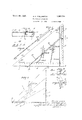
- Fig. l is' a plan view of one desirable form' of my nnproved apparatus embodying a rigid base and mechanically guided elements for ⁇ Figs. 7 and ⁇ 8 are diagrams similar to Figs.
- Fig. 9 is a view similar to Fig. 5, illustrating the'method of determining thelocus curvefor an equation of the form aim-twice;
- Fig. 10 is a diagrammatic plan View, to small scale, illustrating the provision of interchangeable guide elements;
- Fig. 11 is a view illustrating the upper and under sides of a preferred form of hypotenuse bar used in the apparatus of Fig. 1.
- an appropriate supporting element for example a sheet of paper, celluloid,
- the values mm, w1 and a have been represented as areas E', F and G respectively, similarly to the illustration of Fig. 3, but here the sum of the two unknown terms equals the known term a. Accordingly, in constructing the triangle T (Fig. 8) the area G must form the hypotenuse and the areas E and F', the sides, so that the hypotenuse of the triangle T is represented by the value of and the sides by the values respectively. n
- This instrument comprisesy a rigid base 1 of wood or other suitable material.
- the b ase may be of generally right triangular form having the edges 2 and 3 meeting at the right angle 4, and having the hypotenuse edge 5.
- Parallel with the edges 2 and 3,
- These scales may be' printed, engraved, or otherwise impressed on the base itself, or upon sheet material, for example, Celluloid, glass, or steel fixedly attached to the base.
- the scales are graduated from 0 points adjacent to the right angle 4, the raduations being of any practical degree ofgfneness which may be desired. For example, if the base be of such size as to permit the employment of a scale wherein 10 inches represents unity,
- the total length of the scale on the edge 2.iS referably 14.142 inches, and that on the e ge 3 should be of equal or greater length, both scales being graduated in the same units.
- I provide the base 1 with slots or grooves 7 and 8 (Fig. 2) for the reception of the opposite edges of a slide or cursor 9 similar to that employed upon a slide rule.
- This slider is free to move parallel to the edge 2 of the base but is retained in position by the engagement of its inturned edges with the grooves in the base.
- the slider 9 preferably has an aperture covered with a glass or other transparent panel v10 having a crosshair or reference line which may be brought into accurate registry with any selected graduation of the scale S1.
- This bar may be made of any suitable, preferably rigid, material, for ⁇ example wood, Y,
- I provide the hypotenuse bar 12 with a second index element, shown as a guide pin 13 adapted to engage aguide groove I-I in the base.
- This groove is milled or otherwise cui: into the substance of the base, being of such width that the pin 13 may fit snugly therein without lost motion and with its axis in the locus curve, but permitting free movement of the pin lengthwise of the groove.
- I contemplate forming it in an independent member which is then mounted on the base.
- I may employ simply a rib of thin material, for example steel, h aving -the configuration of the proper locus curve and secured to the base in any desirable manner,- and in such case the pin or follower' member 13 may be slotted or otherwise shaped for cooperation with such rib.
- I may substitute a fine pointed tracer for the guide pin 13, omitting the groove or other physical guide member altogether, and providing the base merely with an accurately drawn locus curve to which the tracer pin may be adjusted manually by observation.
- the lower part at least of the bar 12 is graduated to form a scale S8 having the same units as the fixed scales S1 and S2, the 0 point of this scale Ss being atthe point 11.
- the base 1 may be provided with a series of grooves H corresponding to locus curves for a series of equations having increasing upper limits of the value of a, and thus the instrument may readily be adapted to solve any equation of the @general class without necessitating changes in scale or proportion recipes of parts, itebeing simply necessary to shift the pin 13 from one groove to another, the grooves being properl marked, if desired, to
- the base 1 is provided with a groove H, whose center line coincides with a locus curve such as the curve p, p2 of Fig. 9, the particular groove shown being adapted for use in solving equations wherein the value of a lies between (JE-n2 and 2.
- the value A for the particular equation is found on the scale S1, and this point is moved along the edge of the'ixed scale Si2 (the pin 13B being disposed within the groove H) until the 0 point of scale S'1 or, more accurately speaking, the hair line onthe slider coincides with the edge of the fixed scale S1.
- vWhen thus disposed, the value is found on the scale S2, and the value on the scale S1.
- the base may be provided with other curves similar to the curve Hf forN use with lequations in which a has a hi her value than 2, such curves being found by t emethod above described in'v the discussion on Fig. 9.
- the follower member 13 or 13a when the follower member 13 or 13a is adapted mechanically to follow the locus curve, as by entering a groove or engaging a rib, I may provide the groove or grooves in a member la (Fig. 2) independent of the base proper and adapted to be mounted removably thereon.
- the grooves may be formed in metal plates 29 (Fig. l0) of suitable thickness and having positioning screws 30 or other elements whereby they may be accurately mounted upon the base proper, vand a set of such grooved plates may be provided with each instrument.
- each locus curve sheet 20 may have printed directly thereon the scales s1 and s2 corresponding to the scalesY 'S1 and S2 above described.
- a movable hypotenuse 13b whichy may consist simply of a strip of suitable stiff sheet material, for example paper, or may be in the form of a rigid, preferably bevel edged ruler of wood, Celluloid, metal, or the like, having the scales s3, s4 marked thereon.
- Apparatus for use in solving algebraic equations of the general form mmimp a comp'rising afixed scale upon which values of 1/5@ may be read, an index member movable along said scale to indicate values of prising a support having thereon fixed graduated scales disposed at right angles to one another -and adapted to constitute Athe legs of any of a series of right triangles, a guide element upon the support, a movable member adapted to form the hypotenuse of any of said series of triangles, and spaced index elements on said movable member which are adapted respectively to register with one of said fixed scales and with the guide element.
- Apparatus for solving algebraic equations of orders higher than 4two comprising a plurality of fixed ⁇ graduated scales, and a movable member also having a graduated scale, the several scales being assigned to predetermined terms of the equation, and guide means so determining the position of gebraic equations containing a single un-' said movable member for all values (within predetermined limits) of the constant term of the equation, that at the intersections of the movable member with said fixed scales the values of predetermined powers of the corrlesponding terms of the equation may be rea 6.
- Apparatus for solving algebraic equations of the general form :am 1 a comprising a pair of fixed graduated scales and a movable member also having a graduated scale, the several scales being assigned to the terms wf and a respectively, and guide means so determining the position of said movable member for all values of a within predetermined limits, that at the intersections of the movable member with the fixed scales the values 1hr-m, 1/:7 and 1/5 may be read directly.
- Apparatus for solving three-term allmown quantity and a constant term comprising a movable member having spaced index points, a fixed scale along which one of said index points is moved until it coincides with a value representing the square-root of the constant term, a second fixed scale, and means with which the second index point registers and which determines the point of intersection of the movable element with the second fixed scale, said intersection point denoting the value of the square-root ofl a power of the unknown term.
- Apparatus for solving algebraic equations ofthe general form mimp a Comprising a support having thereon fixed graduated scales disposed at-right angles to one another and adapted to constitute the legs of any of a series of right triangles whose three sidesl are in proportion, respectively, to the squareroots of the three terms of the equation, a normallv fixed guide element on the support,
- said guide element being the locus of the end, of a unity segment, measuredfrom one end of the hypotenuse, for all values of the a term ofthe' equation between predetermined limits, 'and index elements on said movable member adapted respectively to register with one of said ,fixed scales and with the guidel element.
- Means provided with a' guide element for use in apparatus according to claim 4, said guide element having the characteristics of a curve constituting the locus of a 4oint at unity distance from one end of the 'ypotenuse of a right triangle whose three sides are 'represented by 4 J, @and 1/5 (the latter quantities being related by the equation4 mmiwp a) as the value a varies between certain fixed limits.
- Means provided with a guide element for use in apparatus accordin to claim 4, 5 said guide element having the ciiaracteristics of a curve constituting the locus of a point at unity distance from one end of the hypotenuse of a right triangle whose hypotenuse o and legs are represented by Jam, 1/ac17 and #d respectively, (the Aquantities mi and a being related by the equation m- a) as the value a varies between 0 and 2.
- Apparatus for use in solving algebraic equations of the generaliorm wmi wp a com prising a support, a slider movable in a predetermined path along said support, a fixed graduated scale for determining the position of the slider, a second fixed scale at right angles to the first, a hypotenuse bar pivotally "connected to theslider, an index pin on the hypotenuse bar, said pin entering and being guided by a groove in a normally rfixed part 95 of the support, the groove being so shaped that as the slider is moved along its scale the intersection of the bar with the second fixed scale at all times denotes the square-root of determined path along said support, a fixed graduated scale for determining the position of the slider, a second fixed scale at right angles to the first, a hypotenuse bar pivotally connected to the slider, said bar having scale graduations upon its opposite f'aces and being reversible to permit each face to be used, an index element disposable at either of two predetermined distances from the pivotal axis
Landscapes
- Engineering & Computer Science (AREA)
- Theoretical Computer Science (AREA)
- Physics & Mathematics (AREA)
- Computer Hardware Design (AREA)
- General Physics & Mathematics (AREA)
- Length-Measuring Instruments Using Mechanical Means (AREA)
Description
E932. E. R. WELUNGTQN Marcia CALCULAIING APPARATUS Filed Nov. 17, 1928 2 Sheets-5h59?,
Nimh 29, 1932. B R WELLmG-TON lmfg-f@ CALCULATING APPARATUS Filed NOV. 17, 1928 2 Shee'llS-Shee 2 IWF...
www:
\\ IIII'IIIIIIIIIIIIIIIIIAIIIIIIIIIIIIIIIIYII Qu A A \1 H4461 IIIIIIIII M C):
esente Mm. 2e, i932 :BARRETT R. WEELINGTN, 0F TRDY, NEW 'YORK ALCULATING APPARATUS Application filed November i7, i928. Serial No. 320,130.
This invention pertains to calculating apparatus of that type in which certain mathematical quantities are determined'by the adjustment or manipulation of a mechanical element or elements and relates more particu- 5 but the solution of such equations, if possible at all, is slow and laborious when performed by usual methods. lt is possible to solve certain cubic equations by the application o Cardans formi-aia, certain other cubics, g@ biquadratics, and higher equations may be solved by methods of approximation 4familiar to mathematicians, but the time consumed in such methods and the possibility of error in long and complicated calculations is such that 25 the average engineer looks upon the whole subject with dread.
l have now discovered that by relating the terms of certain algebraic equations to a proper geometrical figure, and by the provision of 3@ simple mechanical means based upon such relation, it is possible to obtain the roots of equations of-the higher powers with the greatest ease and in many cases where it is substantially impossible to do so by purely mathematical methods.
Many of the higher power equations can, by substitution or other conversion methods, be reduced to the form mmiP=a,-where a: represents a. single unknown quantity, mand p are known, rational, positive exponents of w, and a is a known constant.
For convenience, I will rs't describe the general principle underlying my invention with relation toy an equation of the form m=p+a and will thereafter describe certain desirable means for use in the application of the principle to this and other forms of equation. This underlying theory or principle of my invention, which l believe has not 5o heretofore been recognized, or lat least has not' been put to any practical use, is that any al.
gebraic equation of three positive terms may be considered as deinitely related toa corresponding right triangle. Thus, if each term oi the equation be considered to represent a certain area, the area represented by the single term on one side of the equation must be equal to the sums of the areas represented by the terms at the other side. ln accordance with the PythagoreanA theory of geometry,l the square upon the hypotenuse of a right triangle is equal to the sum of the squares upon the other sides. Therefore, if the supposed areas representing the algebraic equa-tion under discussion be considered as constituting the squares on the hypotenuse and sides respectively of a right triangle, it follows that the square-root of each individual term of the equation may be regarded as representing the length of one side of the triangle, the squareroot-of the single term at one side of the equation representing the hypotenuse, and the square-roots of the other terms representing the legs, respectively. Hence any equation of the form m'lp-l-a, when m and p are any known, rational, positive integers (including unity, and with m greater than p) and the value a being any known positive rational quantity, may be represented as a right triangle.
A little consideration will show that than the side while 'if equals unity, then mp=1 or ==l and thus making the-.hypotenuse equal to the side,4
both of which results are evidently impossible. Now let some value assumed for ,4
and a right triangle be constructed to any desired scale having this value of JE as one side, for example its vertical side, and with its base and hypotenuse representlng values of respectively. Then measuring from the upper end of the hypotenuse lay oli on the hypotenuse a distance equal to unity of the scale greater than unity be chosen, marking the end of this unity segment. Likewise on the base mark o a distance from its junction with the vertical side a segment also representing unity of the selected scale, this distance representing the end of the unity segment of the hypotenuse when ,/E, o. Now solve the equation for vaines of 1/5 between 0 and the rst chosen value of andnote the points at which the end of the unity segment of the hypotenuse of the sev-- eral resulting triangles is found. It will be noted that all of these points representing the lower end of the unity se ent of the hypotenuse may be connected y a smooth curve which forms the locus of the lower end of the unityfsegment ofthe hypotenuse lfor all values o between 0 and the value first selected.
Thus, by providing a right triangle having its sides q/, and 1f@ ixed relatively and properly graduated, and biyl providing a movable hypotenuse, prefera y also graduated, and having as described plotted the locus curve of the lower end of the unlty segment of the hypotenuse, :it is simply necessary, in solving any given equa-` tion for a1, to determine the valuel of 1/3 4 for the particular case, place the O graduation of the hypotenuseat the point corresponding to the determined value of on the graduated vertical side of the triangle,
If, as is common in equations of this general class, m-p=2, (for example, if m=3 and' 12:1) the expression gives w directly. Such a divisional determination of the value of the root is particularly valuable since it minimizes small errors in each individual reading and the resulting value of may readily be checked with the reading of on the base. At certain points hereinafter l shall refer to the expressions J5 etc., as powers of the corresponding terms of the equation with the understanding that by powers I intend to include fractional' powers.
Since the value 1/ E may in practice vary from O up to any nite quantity, it is manifestly out of the question to provide a readable scale to which all such values could be referred, and accordingly I have, for convenience, chosen to use a triangle wherein the -J side equals Choosing units of proper magnitude to provide a trlangle of convenient imensions and accuracy, I may then convert any equation wherein y 1/5, is greater than J5 into proper form for'use according to the following prooedurel: Assuming that the value a lies between 2 and a higher limit lc, and considering the extreme case where '"=a3P+c, the equation may be divided by the lower limiting value 2,-so choosing k that las or 75:4. The graphic representation of the equation then becomes Such higher limits, based upon an original limit of U1 1/2; form a geometrical series 2; 4; 8; 16; etc.
Considering an equation Aof the form .rm+mf=;, it follows from the above discussion that in the corresponding triangle,
. i/ must represent the hypotenuse,
-r/:v-m and being the long and short legs respectively, except when is less than unity, when Mac-m and a/ become the short and long'legs respectively. It; for example, be given the valueofunity and 11:2, then the hypotenuse of the triangle becomes 0n the hypotenuse of such a triangle there is marked oli' a unity segment, measured from the lower end of the hypotenuse (or a segthis marked point on the hypotenuse falls on the base of the triangle at a distance from the right angle. For intermediate ment values, the locus of this point may be plotted, and a smooth curve drawn representing the position of this point for all intermediate values of a. Having prepared such a locus curve, I now make a movable hypotenuse provided with suitable graduations, the base and vertical side of the triangle also being graduated, and I provide the movable hypotenuse with an index point denoting the lower end of the segment. For any equation of the type under consideration, and where the value of a lies between -the index point on the hypotenuse is placed on the locus curve, the point on the hypotenuse representing A measured from the upper end of the hypotenuse7 is caused to coincide with the graduated base of the triangle, and the value for 1W and 1/5;
may now be read directly on the vertical and horizontal sides respectively of the triangle. For equations in which the value of a is greater than 2, other locus curves may be prepared in a similar manner, and by division of the equation as previously described and with an original upper limit of successive upper limiting values of a are found to follow the geometrical progression 2; 4; 8; etc.
`While in the above discussion I have frequentlymade reference to the value a=2 as a convenient upper limit of the value of a, this is purely arbitrary, since the value of a may equal any selected positive integer convenient for the purpose, and successive upper limits will follow corresponding geometrical progressions.
By known methods of algebraic reduction,-cubics of the form y3iby2icy=d may be reduced to the form a3 i ez: f, and an equation of the latter form may readily be reduced to the'form 3i=a- In complete biquadratic equations of the form a4iez=f may be reduced to the form 4iw=a and similar reductions may be made in the case of other powers, such reductions permittin the application of the above-described principles and the use of my apparatus in deriving the roots, all with great saving in time and increased accuracy in result.
In the accompanying drawings I have illustrated certain desirable types of apparatus embodying the principles of my invention and have indicated diagrammatically some of the relations above referred to, but I wish LCi metal, or other desirable material, draw a right triangle K L M, having its right angle it to be understood that the apparatus herein specifically disclosed is merely by way of example and that apparatus of other specific forms may be provided in accordance with the principle of the invention without departing from the spirit'of the invention.
In the drawings,
Fig. l is' a plan view of one desirable form' of my nnproved apparatus embodying a rigid base and mechanically guided elements for` Figs. 7 and`8 are diagrams similar to Figs.
3 and 4 but illustrating the application of my principle to equations of the form m+m=a;
Fig. 9 is a view similar to Fig. 5, illustrating the'method of determining thelocus curvefor an equation of the form aim-twice; Fig. 10 is a diagrammatic plan View, to small scale, illustrating the provision of interchangeable guide elements; and
. Fig. 11 is a view illustrating the upper and under sides of a preferred form of hypotenuse bar used in the apparatus of Fig. 1.
Referring to the drawings and particularly to Figs. 3 and 4, I have illustrated the equation m=p+a as representing an equality of areas, where the area E equals the sum of the areas F and G. Considering these areas as squares, they may be assembled according to the Pythagorean theorem, as shown in Fig. 4, so as to define a triangle T whose hypotenuse and sides are represented by the quantities m=m11+a where values of a lie between 0 and a certain selected upper limit, for example 2, and let it be assumed that 1f=a.
First, upon an appropriate supporting element, for example a sheet of paper, celluloid,
at L', making the length of the sides K L and L M each equal to the square-root of the selected upper limiting value of a. In the sents the equation mm m11 -l- 2.
v speciic case illustrated this length of K L sirable.
.Having constructed this triangle to the desired scale, theJ sides L K and L M are graduated, the O point being at L for each scale. Upon the hypotenuse I now accurately mark the index point P at the lower end of a segment of unity length measured from the upper end of the hypotenuse. The triangle constructed as above described evidently repre- 85 Considering the case where mm =11l 0, that is to say, when the side K L of the triangle is of 0 length, the index point P of the hypotenuse will fall at the point P1 on base M L at unity distance from the point L. Now taking the m=mp+ a, substituting various values for a intermediate 2 and 0, and solving for by known methods, a series of positions P2,
.P33 etc., of the index point of the hypotenuses of the corresponding triangles may be plotted. A line is now drawn connecting the points P, P2, P3, etc., and it is found that this line forms a smoothcurve, evidently following a.J definite algebraic equation related to the original equation, although I have not thus far 10o determined its mathematical form. The smooth curve P P1 forms the locus of the in'- dex point on the hypotenuse for all values of a between O and 2. By employing larger upper limits for a, the length of the curve P P1 lo! may be extended indefinitely, but for con-V venience I prefer to use the upper limit suggested land proceed .as follows for higher values.
For solving equations by the use of the same 11,- triangle and hypotenuse when the value of a A lies between 2 and an upper limit 7c, I proceed as follows: Assuming the limiting case where mm.=P-l-c, I divide the equation by 2 and so' select the Value of 1 which Aforms the upper 115 limit that the or c= 4. The equation thus reduced may now 120 be represented by the .same triangle K L M,
the vertical side K L remaining of the original value Y Lettres and the hypothenuse represents the value of Taking now the limiting cases where wm=p+4 and fcm=pl2 respectively, and marking the position of the index point P of the hypotenuse in each instance and then solving for several intermediate values of the a term to determine other points, it is possible to draw a sector P4, P5 (Fig. 5) of the original locus curve but displaced downwardly from its normal position. Similarly for values of a greater than 4 and less than 8, another displaced sector P6, PT of the locus curve may be drawn, and in the same way other portions of the locus curve may be provided for further values of a.
I have above referred to the general procedure in determining the locus curve for l equations of the form mr-a, but now I will describe that employed in plotting the locus curve for an equation of the form m-lm1=a.
Referring to Figs. 7 and 8, the values mm, w1 and a have been represented as areas E', F and G respectively, similarly to the illustration of Fig. 3, but here the sum of the two unknown terms equals the known term a. Accordingly, in constructing the triangle T (Fig. 8) the area G must form the hypotenuse and the areas E and F', the sides, so that the hypotenuse of the triangle T is represented by the value of and the sides by the values respectively. n
Referring now to Fig. 9, I assume a limiting value of a=2 and that the value of is unity. I then -construct a right triangle K LM wherein the hypotenuse equals measured from the upper end of the hypotenuse). Constructing a series of triangles with successively smaller values of a, the point K gradually approaches the point L until at the final value of zT-:0.414, the hypotenuse coincides with the base and the index point of the hypotenuse falls at the place p2. Intermediate values of a give other points p2, p3, etc. representing intermediate positions of the index point of the hypotenuse. A smooth curve drawn through these points forms the locus of the index point of the hypotenuse for all values of a between 2 and 0.414.
To use the same triangle for solving equations in which the value of a is greater than 2, it is possible to construct displaced segments p4, p5, etc., of the locus curve by iirst dividing the equation as above described with respect to equation m=la, choosing the limits in the same manner.
Referring now to Fig. l, I have illustrated an instrument for use in solving equations of the above types as hereinafter more fully described. This instrument comprisesy a rigid base 1 of wood or other suitable material.
Conveniently the b ase may be of generally right triangular form having the edges 2 and 3 meeting at the right angle 4, and having the hypotenuse edge 5. Parallel with the edges 2 and 3, Iarrange accurately graduated scales S1 and S2 on the upper surface of the base. These scales may be' printed, engraved, or otherwise impressed on the base itself, or upon sheet material, for example, Celluloid, glass, or steel fixedly attached to the base. The scales are graduated from 0 points adjacent to the right angle 4, the raduations being of any practical degree ofgfneness which may be desired. For example, if the base be of such size as to permit the employment of a scale wherein 10 inches represents unity,
it is readily possible to graduate it to thousandths of an inch. Upon such a scale, in accordance with my proposed procedure, the total length of the scale on the edge 2.iS referably 14.142 inches, and that on the e ge 3 should be of equal or greater length, both scales being graduated in the same units.
Preferably I provide the base 1 with slots or grooves 7 and 8 (Fig. 2) for the reception of the opposite edges of a slide or cursor 9 similar to that employed upon a slide rule. This slider is free to move parallel to the edge 2 of the base but is retained in position by the engagement of its inturned edges with the grooves in the base. The slider 9 preferably has an aperture covered with a glass or other transparent panel v10 having a crosshair or reference line which may be brought into accurate registry with any selected graduation of the scale S1. The slider 9, as shown, v
This bar may be made of any suitable, preferably rigid, material, for` example wood, Y,
metal or the like, and is providedv withall journal opening at its upper end for the reception of the pin 11, such pin or opening constituting what is hereinafter referred to as an index element of the bar. At a point,
distant from the axis of this opening equal to unity of the scale, I provide the hypotenuse bar 12 with a second index element, shown as a guide pin 13 adapted to engage aguide groove I-I in the base. The center line of this guide groove is initially laid out by the .method above described with reference to Fig. as the locus curve corresponding to an equation of the form m=p+a for values of a lying between the fixed limits 0 and 2.
This groove is milled or otherwise cui: into the substance of the base, being of such width that the pin 13 may fit snugly therein without lost motion and with its axis in the locus curve, but permitting free movement of the pin lengthwise of the groove. Instead of cuty ting the groove into the base, I contemplate forming it in an independent member which is then mounted on the base. Moreover, in place of a groove, I may employ simply a rib of thin material, for example steel, h aving -the configuration of the proper locus curve and secured to the base in any desirable manner,- and in such case the pin or follower' member 13 may be slotted or otherwise shaped for cooperation with such rib. As a further alternative, I may substitute a fine pointed tracer for the guide pin 13, omitting the groove or other physical guide member altogether, and providing the base merely with an accurately drawn locus curve to which the tracer pin may be adjusted manually by observation.
The lower part at least of the bar 12 is graduated to form a scale S8 having the same units as the fixed scales S1 and S2, the 0 point of this scale Ss being atthe point 11.
In'using the instrumentthus provided, it
is simply necessary, in solving an equation of the form '"=m1+a, for the .value of to determine the value of then to place the hair line of the lslider 9 on the corresponding reading of the scale S1, and to read directly from the scale S2 the correspending value at the intersection of the scales S8 and vS2. Since the vvalue d?, may also be read on the scale S3, the correctness of the reading may readily be checked, and in case mp=2, the reading upon'the lscale S8 may be divided by the lreading upon the scale S2, giving directly the value of i The base 1 may be provided with a series of grooves H corresponding to locus curves for a series of equations having increasing upper limits of the value of a, and thus the instrument may readily be adapted to solve any equation of the @general class without necessitating changes in scale or proportion recipes of parts, itebeing simply necessary to shift the pin 13 from one groove to another, the grooves being properl marked, if desired, to
indicate the limits o a to which they corpin 11 and causing the pin to enter the opening 11a at the end of the member 121.
As disclosed in Fig. 1 the base 1 is provided with a groove H, whose center line coincides with a locus curve such as the curve p, p2 of Fig. 9, the particular groove shown being adapted for use in solving equations wherein the value of a lies between (JE-n2 and 2.
To facilitate direct reading, I prefer to l graduate the scale S1 on the movable hypotenuse or index member, beginning with zero at icjhe point 111,` the total length of the scale S1 emg the follower pin or tracer being located at i the point x p A0.4.14 (or J-n.
In use, the value A for the particular equation is found on the scale S1, and this point is moved along the edge of the'ixed scale Si2 (the pin 13B being disposed within the groove H) until the 0 point of scale S'1 or, more accurately speaking, the hair line onthe slider coincides with the edge of the fixed scale S1. vWhen thus disposed, the value is found on the scale S2, and the value on the scale S1. `By division of one value by the other, the value ofA may be found directly whenevermp=2.
Obviously the base may be provided with other curves similar to the curve Hf forN use with lequations in which a has a hi her value than 2, such curves being found by t emethod above described in'v the discussion on Fig. 9.
It lis clear that my method and apparatus may be applied to the solution of equations of other forms than those specifically conreame@ sidered, and if, as above suggested, the follower member 13 be merely a needle point which may be set manually to register with the locus curve, I contemplate that the curves may be provided upon a sheet or chartinde'- pendent of the base and adapted to be movably mounted in accurate position thereon. In such eventa set of curve sheets may be provided with each instrument, each sheet having locus curves corresponding to a certain type of equation. In the same way, when the follower member 13 or 13a is adapted mechanically to follow the locus curve, as by entering a groove or engaging a rib, I may provide the groove or grooves in a member la (Fig. 2) independent of the base proper and adapted to be mounted removably thereon. For example, if the base be of wood, the grooves may be formed in metal plates 29 (Fig. l0) of suitable thickness and having positioning screws 30 or other elements whereby they may be accurately mounted upon the base proper, vand a set of such grooved plates may be provided with each instrument.
Among the equations for which such locus curves may readily be formed by the method above described, are the following w3 w2= a 3+2=a; 4-x=a; m4-l=a; :v43=a; *+3=a; m5-m=a; 5+=a; 52=a; m5l2=a; 53=a; wml-Mia; m5- a:4=a; m5 -l- 4=a; and since equations of many other forms may be converted into three term equations of the above general class, this method and the instrument (or instruments based upon the same general principle) is of wide utility.
Instead of the apparatus of Fig. 1, I may. if desired, provide a simpler embodiment, as shown in Fig. 6, wherein each locus curve sheet 20 may have printed directly thereon the scales s1 and s2 corresponding to the scalesY 'S1 and S2 above described. With these sheets I provide a movable hypotenuse 13b whichy may consist simply of a strip of suitable stiff sheet material, for example paper, or may be in the form of a rigid, preferably bevel edged ruler of wood, Celluloid, metal, or the like, having the scales s3, s4 marked thereon. Preferably in this case the scale s8 corresponds to the scale S3 above described and is`used in cooperation with curves of the series g for solving equations of the form '-a11=a. On the other edge of the member 13b, the scale s4, corresponding to the scale SiabovrJ described, may be employed, by reversing the member 13b, in connection with locus curves of the series g2 for solving equations of the Jform m+p=a- Sincek flexible sheets 20,may be made of large dimensions and may readily be rolled up for storage, this form of apparatus may be desirable in certain instances, particularly where it is requisite to use a ascale reading to many decimal places.
In the above discussion I have employed the general forms of equations wm+ 12=a and m-mp=a, since, as above stated, the method and apparatus is useful in solving equations of this general family, but probably the apparatus will find its greatest utility in the solution of cubic equations of the specific forms 3+x=a and m37-=a.
While I have described certain desirable physical embodiments of my invention, I wish it to be understood that the invention is not necessarily limited to the described construction, but that changes in size, proportion and relative arrangements of parts as well as the substitution of equivalents fall within the scope of the claims.
I claim:
1. Apparatus for use in solving algebraic equations of the general form :rmi mp= a comprising a fixed element and a relatively movable element whose position with reference to the fixed element denotes a power of one term of the equation, and means for determining the position of said movable element for any given value of the a term between predetermined limits.
2. Apparatus for` use in solving algebraic equations of the general ferm @ami P=a comprising a fixed and a movable element whose point of intersection denotes 1/1?. and means for determining the position of said mo'vable element for any value of a be'- tween predetermined limits.
3. Apparatus for use in solving algebraic equations of the general form mmimp=a comp'rising afixed scale upon which values of 1/5@ may be read, an index member movable along said scale to indicate values of prising a support having thereon fixed graduated scales disposed at right angles to one another -and adapted to constitute Athe legs of any of a series of right triangles, a guide element upon the support, a movable member adapted to form the hypotenuse of any of said series of triangles, and spaced index elements on said movable member which are adapted respectively to register with one of said fixed scales and with the guide element.
5. Apparatus for solving algebraic equations of orders higher than 4two comprising a plurality of fixed `graduated scales, and a movable member also having a graduated scale, the several scales being assigned to predetermined terms of the equation, and guide means so determining the position of gebraic equations containing a single un-' said movable member for all values (within predetermined limits) of the constant term of the equation, that at the intersections of the movable member with said fixed scales the values of predetermined powers of the corrlesponding terms of the equation may be rea 6. Apparatus for solving algebraic equations of the general form :am 1 =a comprising a pair of fixed graduated scales and a movable member also having a graduated scale, the several scales being assigned to the terms wf and a respectively, and guide means so determining the position of said movable member for all values of a within predetermined limits, that at the intersections of the movable member with the fixed scales the values 1hr-m, 1/:7 and 1/5 may be read directly.
7. Apparatus for solving three-term allmown quantity and a constant term, said apparatus comprising a movable member having spaced index points, a fixed scale along which one of said index points is moved until it coincides with a value representing the square-root of the constant term, a second fixed scale, and means with which the second index point registers and which determines the point of intersection of the movable element with the second fixed scale, said intersection point denoting the value of the square-root ofl a power of the unknown term.
8. Apparatus for solving algebraic equations ofthe general form mimp=a Comprising a support having thereon fixed graduated scales disposed at-right angles to one another and adapted to constitute the legs of any of a series of right triangles whose three sidesl are in proportion, respectively, to the squareroots of the three terms of the equation, a normallv fixed guide element on the support,
said guide element being the locus of the end, of a unity segment, measuredfrom one end of the hypotenuse, for all values of the a term ofthe' equation between predetermined limits, 'and index elements on said movable member adapted respectively to register with one of said ,fixed scales and with the guidel element. y
9. Apparatus for use in computing roots of algebraic equations of the form mip=a, or equations which may be reduced to said form, comprising a supporting element having fixed graduated scales disposed at right angles to each` other, a guide curve on 'the supporting element, and a movable graduated member adapted to form the hypotenuse i of any of a series of right triangles of which said scales constitute the legs said guide curve being so constructed and arranged that when a predetermined point of the movable member is placed in registry therewith, and
a second predetermined point of said member is placed at a selected point of the other fixed scale, the three sides of the resulting triangle will bein proportion to W, and 1/5,
respectively. l
with a value representing a power of the l constant of the given equation,'a normally fixed guide element with which the other index point of the movable member registers, and a second scale upon which a power of the unknown quantity of the equation may be read at the intersection of said latter scale and the movable member.
11. 4Apparatus for use in computing roots of algebraic equations of the form mmi1=a, or equations which may be reduced to said form, comprising a supporting element having fixed graduated scales disposed at right angles to each other, guide curves on the supporting element, and an elongate movable member havingl two sets of graduations thereon for use in solving equations wherein the sign of w1 is minus or plus respectively, said member being adapted to form the hypotenuse of any of a series of triangles of which the fixed scales are the legs, the guide curves constituting the loci of points at apredetermined distance from the end of one or the other scale on the movable member for all such triangles as a varies between predetermined limits.
12. Means provided with a' guide element for use in apparatus according to claim 4, said guide element having the characteristics of a curve constituting the locus of a 4oint at unity distance from one end of the 'ypotenuse of a right triangle whose three sides are 'represented by 4 J, @and 1/5 (the latter quantities being related by the equation4 mmiwp=a) as the value a varies between certain fixed limits.
13. Means provided with a pluralityof guide elements for use in apparatus according to claim 4, said guide elements eachhaving the characteristics of the locus of a point at vim unity distance from one end of the hypotenuse of a right triangle having the three sides .fran/aand@ tween fixed' limits, said guide elements cor` respondmg respectively to successlve series of values of ain which the upper limits of the several series are in geometrical progression. 1 4. Means provided with a guide element for use in apparatus accordin to claim 4, 5 said guide element having the ciiaracteristics of a curve constituting the locus of a point at unity distance from one end of the hypotenuse of a right triangle whose hypotenuse o and legs are represented by Jam, 1/ac17 and #d respectively, (the Aquantities mi and a being related by the equation m-=a) as the value a varies between 0 and 2.
l5. Apparatus for use in solving algebraic equations of the general form mi zvp=a comprising a support, a slider movable in a predetermined path along said support, a fixed graduated scale for determining the position of the slider, a second fixed scale at right angles to the first, a hypotenus bar connected to the slider, and means for so guiding the movable hynotenuse bar, as the slider is moved along its scale, that the intersection of the bar withl the other fixed scale and the position of the slider upon its scale denote, respectively, the square-roots of predetermined terms of the equation.
16. Apparatus for use in solving algebraic quations of the general form mi azp=a comprising a support, a slider movable in a predetermined path along said support, a fixed graduated scale for determining the position of the slider, a second fixed scale at right angles to the first, a hypotenuse bar pivotally connected to the slider, an index element on the hypotenuse bar, and guide means with which said index element registers, thereby so determining the position of the hypotenuse bar for any given position of the slider that the intersection of the bar with the second scale and the position of the slider on the first scale denote, respectively, the square-roots of two of the terms of the equation.
17. Apparatus for use in solving algebraic equations of the generaliorm wmi wp: a com prising a support, a slider movable in a predetermined path along said support, a fixed graduated scale for determining the position of the slider, a second fixed scale at right angles to the first, a hypotenuse bar pivotally "connected to theslider, an index pin on the hypotenuse bar, said pin entering and being guided by a groove in a normally rfixed part 95 of the support, the groove being so shaped that as the slider is moved along its scale the intersection of the bar with the second fixed scale at all times denotes the square-root of determined path along said support, a fixed graduated scale for determining the position of the slider, a second fixed scale at right angles to the first, a hypotenuse bar pivotally connected to the slider, said bar having scale graduations upon its opposite f'aces and being reversible to permit each face to be used, an index element disposable at either of two predetermined distances from the pivotal axis of the bar, and normally fixed guide means on the support with which the index point of the bar registers in all positions of the slider, said guide means being so constructed and arranged that the intersection of the scale upon either face of' the bar with the second fixed scale denotes the square-root of one term of the equation and the osition of the slider denotes the correspon ing value of the square-root of another term of the equation, the scales on the opposite faces of the bar being used in solving equations in which the sign of the x1 term is minus and plus respectively.
19. Apparatus for use in solving algebraic equations of the general form m+p=a comprising a support, a slider movable in a predetermined path along said support, a fixed graduated scale for determining the position of the slider, a second fixed scale at right angles to the first, a hypotenuse bar pivotally connected to the slider, an index element on the hypotenuse bar, a plurality of interchangeable members adapted selectively to be mounted upon the support, each of said interchangeable members being provided with a guide element corresponding to a selected range of values of the term a of the equation, said guide element being so shaped that when the index element of the bar is registered therewith, the intersection of the bar with the second fixed scale denotes the square-root of one term of the equation and the position of the slider on its scale denotes the corresponding valve of the square-root of another term of the equation.
20. Apparatus for use in solving algebraic equations of the general form @emi =a comprising a support, a slider guided to move in a predetermined path along said'support, a fixed graduated scale for determining the position of the slider, a second fixed scale, a pivot element carried by the slider, a pair of interchangeable bars selectively engageable with the pivot element to swing about the latter as an axis, one of said bars having an index element at -unity distance from the p-iv- `otal axis and the other having an index pointv at a distance from the pivotal axis, and normally fixed guide means on the support with which the' index oint of the selected bar registers in all positions of the slider, said guide means being so constructed and arranged that the ica E weies intersection of the bar with the second xed scale denotes the square-root of one term of the equation and the position of the slider denotes the corresponding value of the 5 square-root of another term of the equation, seid bars being used respectively in solving such equations in which the sign of the m1 term is minus and plus, respectively.
Signed by me at Troy, Rensselaer County, n@ N. Y., this 9th day of November, 1928.
BARRETT R. WELLINGTON.
eef
Priority Applications (1)
| Application Number | Priority Date | Filing Date | Title |
|---|---|---|---|
| US320130A US1851744A (en) | 1928-11-17 | 1928-11-17 | Calculating apparatus |
Applications Claiming Priority (1)
| Application Number | Priority Date | Filing Date | Title |
|---|---|---|---|
| US320130A US1851744A (en) | 1928-11-17 | 1928-11-17 | Calculating apparatus |
Publications (1)
| Publication Number | Publication Date |
|---|---|
| US1851744A true US1851744A (en) | 1932-03-29 |
Family
ID=23245005
Family Applications (1)
| Application Number | Title | Priority Date | Filing Date |
|---|---|---|---|
| US320130A Expired - Lifetime US1851744A (en) | 1928-11-17 | 1928-11-17 | Calculating apparatus |
Country Status (1)
| Country | Link |
|---|---|
| US (1) | US1851744A (en) |
Cited By (5)
| Publication number | Priority date | Publication date | Assignee | Title |
|---|---|---|---|---|
| US2846143A (en) * | 1954-12-30 | 1958-08-05 | Standard Oil Co | Mechanical calibration chart |
| US5383276A (en) * | 1993-06-10 | 1995-01-24 | Izumi; John Y. | Angle trisector |
| US20070239551A1 (en) * | 2006-03-30 | 2007-10-11 | Zeller Michelle G | Method and apparatus for a product ordering system |
| US20080034942A1 (en) * | 2005-12-06 | 2008-02-14 | Miller Steven R | Pythagorean Fret Placement |
| US20150168119A1 (en) * | 2013-12-18 | 2015-06-18 | FWD Tools, LLC | Carpenter's Tape Measure Having Function Indicia |
-
1928
- 1928-11-17 US US320130A patent/US1851744A/en not_active Expired - Lifetime
Cited By (7)
| Publication number | Priority date | Publication date | Assignee | Title |
|---|---|---|---|---|
| US2846143A (en) * | 1954-12-30 | 1958-08-05 | Standard Oil Co | Mechanical calibration chart |
| US5383276A (en) * | 1993-06-10 | 1995-01-24 | Izumi; John Y. | Angle trisector |
| US20080034942A1 (en) * | 2005-12-06 | 2008-02-14 | Miller Steven R | Pythagorean Fret Placement |
| US7795517B2 (en) * | 2005-12-06 | 2010-09-14 | Steven Richard Miller | Pythagorean fret placement |
| US20070239551A1 (en) * | 2006-03-30 | 2007-10-11 | Zeller Michelle G | Method and apparatus for a product ordering system |
| US20150168119A1 (en) * | 2013-12-18 | 2015-06-18 | FWD Tools, LLC | Carpenter's Tape Measure Having Function Indicia |
| US9651348B2 (en) * | 2013-12-18 | 2017-05-16 | FWD Tools, LLC | Carpenter's tape measure having function indicia |
Similar Documents
| Publication | Publication Date | Title |
|---|---|---|
| US1708551A (en) | Instrument for drafting | |
| US3837569A (en) | Metric conversion ruler | |
| US1713025A (en) | Logarithmic and semilogarithmic coordinator | |
| US2892586A (en) | Mathematical instrument for dividing angles into equal parts and for performing related mathematical operations | |
| US2505149A (en) | Trigonometric calculator | |
| US2403614A (en) | Calculating instrument | |
| US3014646A (en) | Mechanical coordinate converter, triangle solver and multiplier | |
| US3654438A (en) | Hexadecimal/decimal calculator | |
| US3083901A (en) | Computers | |
| US1745188A (en) | Drawing instrument | |
| US1888305A (en) | Vernier scale guard measuring device | |
| US1965062A (en) | Calculating device | |
| US3449052A (en) | Optical vernier interpolator | |
| US1965017A (en) | Calculating device | |
| US2547955A (en) | Vectorial and mathematical calculator | |
| US2334404A (en) | Apparatus for solving problems | |
| US2564991A (en) | Calculator | |
| US1989223A (en) | Graphic calculating device | |
| US2073281A (en) | Draftsman's plotter | |
| US3716702A (en) | Multi-parameter converting slide rule | |
| US2163032A (en) | Calculating device | |
| US2998916A (en) | Two-dimension slide rule | |
| SU911544A1 (en) | Computing device | |
| US2385948A (en) | Slide rule | |
| US3733470A (en) | Slide rule of general use of pocket size |