US1850122A - Arch supporter - Google Patents
Arch supporter Download PDFInfo
- Publication number
- US1850122A US1850122A US341280A US34128029A US1850122A US 1850122 A US1850122 A US 1850122A US 341280 A US341280 A US 341280A US 34128029 A US34128029 A US 34128029A US 1850122 A US1850122 A US 1850122A
- Authority
- US
- United States
- Prior art keywords
- arch
- foot
- arches
- supporter
- shoe
- Prior art date
- Legal status (The legal status is an assumption and is not a legal conclusion. Google has not performed a legal analysis and makes no representation as to the accuracy of the status listed.)
- Expired - Lifetime
Links
- 210000002683 foot Anatomy 0.000 description 21
- 208000004067 Flatfoot Diseases 0.000 description 10
- 210000003205 muscle Anatomy 0.000 description 6
- 206010061159 Foot deformity Diseases 0.000 description 4
- 210000001872 metatarsal bone Anatomy 0.000 description 3
- 210000000988 bone and bone Anatomy 0.000 description 2
- 241001016288 Sesamoides Species 0.000 description 1
- 210000003423 ankle Anatomy 0.000 description 1
- 230000015572 biosynthetic process Effects 0.000 description 1
- 150000001875 compounds Chemical class 0.000 description 1
- 238000010586 diagram Methods 0.000 description 1
- 230000003467 diminishing effect Effects 0.000 description 1
- 210000001255 hallux Anatomy 0.000 description 1
- 239000010985 leather Substances 0.000 description 1
- 239000000463 material Substances 0.000 description 1
- 235000013372 meat Nutrition 0.000 description 1
- 235000020004 porter Nutrition 0.000 description 1
- 102000012498 secondary active transmembrane transporter activity proteins Human genes 0.000 description 1
- 108040003878 secondary active transmembrane transporter activity proteins Proteins 0.000 description 1
- 210000003371 toe Anatomy 0.000 description 1
Images
Classifications
-
- A—HUMAN NECESSITIES
- A43—FOOTWEAR
- A43B—CHARACTERISTIC FEATURES OF FOOTWEAR; PARTS OF FOOTWEAR
- A43B7/00—Footwear with health or hygienic arrangements
- A43B7/14—Footwear with health or hygienic arrangements with foot-supporting parts
- A43B7/1405—Footwear with health or hygienic arrangements with foot-supporting parts with pads or holes on one or more locations, or having an anatomical or curved form
- A43B7/141—Footwear with health or hygienic arrangements with foot-supporting parts with pads or holes on one or more locations, or having an anatomical or curved form having an anatomical or curved form
-
- A—HUMAN NECESSITIES
- A43—FOOTWEAR
- A43B—CHARACTERISTIC FEATURES OF FOOTWEAR; PARTS OF FOOTWEAR
- A43B7/00—Footwear with health or hygienic arrangements
- A43B7/14—Footwear with health or hygienic arrangements with foot-supporting parts
- A43B7/1405—Footwear with health or hygienic arrangements with foot-supporting parts with pads or holes on one or more locations, or having an anatomical or curved form
- A43B7/1415—Footwear with health or hygienic arrangements with foot-supporting parts with pads or holes on one or more locations, or having an anatomical or curved form characterised by the location under the foot
- A43B7/142—Footwear with health or hygienic arrangements with foot-supporting parts with pads or holes on one or more locations, or having an anatomical or curved form characterised by the location under the foot situated under the medial arch, i.e. under the navicular or cuneiform bones
-
- A—HUMAN NECESSITIES
- A43—FOOTWEAR
- A43B—CHARACTERISTIC FEATURES OF FOOTWEAR; PARTS OF FOOTWEAR
- A43B7/00—Footwear with health or hygienic arrangements
- A43B7/14—Footwear with health or hygienic arrangements with foot-supporting parts
- A43B7/1405—Footwear with health or hygienic arrangements with foot-supporting parts with pads or holes on one or more locations, or having an anatomical or curved form
- A43B7/1415—Footwear with health or hygienic arrangements with foot-supporting parts with pads or holes on one or more locations, or having an anatomical or curved form characterised by the location under the foot
- A43B7/1425—Footwear with health or hygienic arrangements with foot-supporting parts with pads or holes on one or more locations, or having an anatomical or curved form characterised by the location under the foot situated under the ball of the foot, i.e. the joint between the first metatarsal and first phalange
-
- A—HUMAN NECESSITIES
- A43—FOOTWEAR
- A43B—CHARACTERISTIC FEATURES OF FOOTWEAR; PARTS OF FOOTWEAR
- A43B7/00—Footwear with health or hygienic arrangements
- A43B7/14—Footwear with health or hygienic arrangements with foot-supporting parts
- A43B7/1405—Footwear with health or hygienic arrangements with foot-supporting parts with pads or holes on one or more locations, or having an anatomical or curved form
- A43B7/1415—Footwear with health or hygienic arrangements with foot-supporting parts with pads or holes on one or more locations, or having an anatomical or curved form characterised by the location under the foot
- A43B7/1435—Footwear with health or hygienic arrangements with foot-supporting parts with pads or holes on one or more locations, or having an anatomical or curved form characterised by the location under the foot situated under the joint between the fifth phalange and the fifth metatarsal bone
-
- A—HUMAN NECESSITIES
- A43—FOOTWEAR
- A43B—CHARACTERISTIC FEATURES OF FOOTWEAR; PARTS OF FOOTWEAR
- A43B7/00—Footwear with health or hygienic arrangements
- A43B7/14—Footwear with health or hygienic arrangements with foot-supporting parts
- A43B7/1405—Footwear with health or hygienic arrangements with foot-supporting parts with pads or holes on one or more locations, or having an anatomical or curved form
- A43B7/1415—Footwear with health or hygienic arrangements with foot-supporting parts with pads or holes on one or more locations, or having an anatomical or curved form characterised by the location under the foot
- A43B7/144—Footwear with health or hygienic arrangements with foot-supporting parts with pads or holes on one or more locations, or having an anatomical or curved form characterised by the location under the foot situated under the heel, i.e. the calcaneus bone
-
- A—HUMAN NECESSITIES
- A43—FOOTWEAR
- A43B—CHARACTERISTIC FEATURES OF FOOTWEAR; PARTS OF FOOTWEAR
- A43B7/00—Footwear with health or hygienic arrangements
- A43B7/14—Footwear with health or hygienic arrangements with foot-supporting parts
- A43B7/1405—Footwear with health or hygienic arrangements with foot-supporting parts with pads or holes on one or more locations, or having an anatomical or curved form
- A43B7/1415—Footwear with health or hygienic arrangements with foot-supporting parts with pads or holes on one or more locations, or having an anatomical or curved form characterised by the location under the foot
- A43B7/1445—Footwear with health or hygienic arrangements with foot-supporting parts with pads or holes on one or more locations, or having an anatomical or curved form characterised by the location under the foot situated under the midfoot, i.e. the second, third or fourth metatarsal
-
- A—HUMAN NECESSITIES
- A43—FOOTWEAR
- A43B—CHARACTERISTIC FEATURES OF FOOTWEAR; PARTS OF FOOTWEAR
- A43B7/00—Footwear with health or hygienic arrangements
- A43B7/14—Footwear with health or hygienic arrangements with foot-supporting parts
- A43B7/22—Footwear with health or hygienic arrangements with foot-supporting parts with fixed flat-foot insertions, metatarsal supports, ankle flaps or the like
Definitions
- My inventionl relates tto/Supper@ for the human foot, rof the; kind inserted andxworn S. archisup.-
- esecond Obi et ist@ provide a lereahch may. bearpledtoashee-by massief ,which the normal archio: e feet may bettedfte a Part-c11larsh9e having, arch; which we uldv- 20notvr otherwise he suitable to ⁇ that foot.; g Bylj, Hies 0f my device; aflShOefirithfhisllerch Jardin @nerf maythns Vbe Worn itha foot:
- arch ⁇ supporter is'adapted -to function with both fallen arches and permanent flat foot conditions, in the one case operating as a'cor- ⁇ rective means for restoration Vof Vthe arclito "normal, and in the other Aserving to give suiii-V cient support to the foot to enable one to wear a shoe with the usual form of yarch without bringing undue pressure to bear at any point n and with vminimum restriction of the circuiation.
- My invention may be used with a shoe having an ordinary height of arch, to enable one with a normally low arch foot, to wear such a shoe
- My invention comprises a'fienible ⁇ baselextending longitudinally when iii position in the shoe.v Y In this is formed oneV or more trans-- verse passages in which may beinse'rted adjustmentV lifts, ⁇ adapted to uextend .there-V through and varying inthiclness at different cross sections, to coact with Vthe flexible ⁇ baseto build up the arch ⁇ supporter to function within the scope of the foregoing cases.
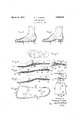
- Fig. l represents a human mal arch.
- Fig. 2. is a similar view in ⁇ which a fallen arch or permanent flat foot condition is shown.
- FIG. 3 is a diagram of the foot in which the several arches are indicated;
- Fig. l is a sectional elevation of my arch supporter as used for fallen arches.
- Fig. 5 isafs'ection on line 5 5
- Figa. Fig. 6 is a sectional elevation in which 'my arch supporteris shown as applicable to the condition ofrlat foot. y
- F ig. 7" is a similar view showing the arch foot with a nor! i Vsupporter as used with a low arch yfoot to line
- Fig. 8 is an inverted plan view of my arch supporter.
- Fig. 9 is a plan view of a filling lift.
- Fig. 10 is an end elevation of a lift such as would be Vused with fallen arches or flat foot.
- VFig.V 11 is a similar view of a lift Lsuch as would be-used for compensating purposes.
- l/Vhile I prefer the form of base formed from two elements, it may also be formed of,V
- the overlapping porton 21 is embodied, and may be skived to Vapproximately an edgef where it engages the upper of the shoe.
- Fig. 5 I have indicated this condition, 2fi" ⁇ rep ⁇ resenting the innersoleV Yand 24 the contiguous portion of the upper.
- the passage described is adapted to receive lifts 25 ofthe required: forni and in suiiicient' number for the purpose for which the arch supporter is to be used.
- the longitudinal limits of the passage approximate therlines of the transverse and anterior metatarsal arches respectively as at 26-27, and inthe'wedge shaped passage thus formed, the insertable lifts 25, of corresponding outmay be introduced.
- lifts vary in thiclness, diminishing on the median line 28 from the widest part 29 of the wedge toward the narrowest, 30.
- the lifts are varied in thickness according as they arel to be used as a corrective means for fallen arches, or to form a compensating means Vwhen a high arch shoe is worn with a normally low arched foot.
- the thickness of the lifts may be variedfor the purpose of furnishing'suppo-rt for Weak ankle muscles and thus prevent unequal wear on the sides of the heel.
- the lift is formed in section as inv Fig.rl0, with a lateral section taper,- ing in thickness toward the edges 31,32.
- the lift isbeveled from a ice relatively thick section near the lateral limits to a thin section at the median line.
- Fig. 11 enlarge the extreme longitudinal limits of the passages' to provide space to insert lifts in each passage to secure the results shown in Fig. 6.
- the form of lift shown in Fig. 11 may however be used in connection with an arch supporter having a single ypassage for use with a medium arched shoe and an ordinary case of flat foot.
- the lifts extend laterally of the base and support both longitudinal arches, as well as the transverse ,v and ,interior metatarsal arches, the beveled sectionsof thelifts c'oacting with the walls; of the passage to conform both with the sole of the footand with the arch of .the shoe worn.
Landscapes
- Health & Medical Sciences (AREA)
- Epidemiology (AREA)
- General Health & Medical Sciences (AREA)
- Public Health (AREA)
- Footwear And Its Accessory, Manufacturing Method And Apparatuses (AREA)
Description
March 22, 1932. F AY, THOMAS 1,850,122
ARCH SUPPORTER Filed Feb. 20, 1929 Patented 'Mar; 22, 1932 rnerrknnr n. 'rrioizrns; or Mannen MAssAczaUsrz'r'rs *Anseeuw-DER ppnmimi:y mea rebruery ao, 1929.5seria1 Anaealrso.`
My inventionl relates tto/Supper@ for the human foot, rof the; kind inserted andxworn S. archisup.-
with fshees and, commenlyfknewnaa porters,
'5, 1 vMy invention difiere fremftheililalrxnnf arch. Suppcrters; as `will .behereneter l, y
-- f Will be sufficient to take care. of thefother Y he object of; my .nvention is t0 Provide a denic@ by ymans 0f Wheh corrective. means.. lamer be Lapplied te the ytoet and, weak. Qr-
' strained muscles andY ,Similar ebnelmal-ites treated, -forthepurposeOirestefng the bones and, muscles t0; anormal @edition ser 4for' 1relieyingconditions When permanent, as inthe 15 ,case of flat foot.
esecond Obi et ist@ provide a lereahch may. bearpledtoashee-by massief ,which the normal archio: e feet may bettedfte a Part-c11larsh9e having, arch; which we uldv- 20notvr otherwise he suitable to \that foot.; g Bylj, Hies 0f my device; aflShOefirithfhisllerchienne @nerf maythns Vbe Worn itha foot:
- nially low arch, or viceversa.:
f /In th fspeteiisherewi 21st-fof fla-tiefst is differentiated tuteurv that .ef fellf The Se weofihehumanencheres# res'peCiiYly s. the innerflongitu; nal anl outer -longitudinal arches,y ezdjen'oli'ngffrespec-y tively Yfrom theheel-bone or es ycalcistothe sesainoids of the iirstfaiid' meat salsg* 3F :the .transverse arch ,and @he anterior Atarsal arches, ez'ztendiiiglaterally.V
arch o'fthe, footwhich isa-dante to yield as 9 body, Vary in relaties ftefthe' penent' arches.
jarA duf/ 1:0 .walking 'and tref-fQbrmtsc1` exercised to maintainvtheir'norinal of',l the` exercise required Jfor A the" r e tivny,andfa 'condition is Sioen Y port to the transverse arches.
actionris transferred tothe other lfoot.
@tarif l i ticular set of foot muscles. These arches merge land fomthecorrip onnd,
v n sili'encegbutitfor anyreasonjthe,musclesycane-- Thesey arches thus operatdto vushpnmentflthbones theteot nhichceusesa lengtheningvftheifet arde fel-line of' the l arch. This yconditionyis. subjectto correctiye s treatment which mayeresteretlie toner Q- the *lfvrherlittlelif arlycaetiritysoffte@ @sedes is possible, other than in those of the greatiftoe." i In the usual form of archsupporterrparticular attention is given to. the supporter. theijn-` arches. On this basisarch supporters `lig-aye been used Which have ypockets formed there- 4 inrin which filling material or separate lifts,-16g" of sole leather may be inserted. These, While 'Y supportingthe inner longitudinal arch; dolnot extend laterally to support the outeny longiM tudinalA arch', and provide only` a partialsup- Y 65 The need forthe proper sulrilfportr ofthelouter longitudinal andthe' transver arches asv Welldas the inner longitudinal arch will. beevidnt if vit is Censidred that' in- Wellens: the Weight of the body is supported progress-yvr sively, rstby theheeh thenby the outerlongitudinal arch; thence transferring through the medium otthetransverse .arches totheinner longitudinal arch,v and i'inallyto the great toe as the stride vis completed,y and thesa-me With theusual type of'arch supp.orterlag thesupport is mainly applied to theliriiierglonfk gitudinal arch,V the i'oot is'thrown off balance,y the circulation is retarded,k and part of .the muscles subjectedto undue strainlwhile others are insufhciently exercised; arch beingadapted to'hewadjusted to support all the arches, -assists in retaining the balance of the foot, andV relieves undue strainon any par- When themliSCll-z lar.v connectionsto the `Icones 'of the.y foot` are .in normal vconditionand .subjecttonormalfreef domA of action to enable theml to exercisev fuectiehitheardresret-ainther form anda 11ewith comfort.
strength to support the weight of the body,`
the bones ofthe foot assume a permanent relocation and a condition known as flat foot results. In the usualV model ofshoe,
there is provided a built in arch varying ine form and height with the particular model,
which while partially supportingthc arches, still permits free exercise of the foot muscles.
When the condition of flat foot exists,-
this type of shoe cannot be worn withcomfort,
and special foot wear is necessary for the par! v ticular case, orlin lieu, a shoe with ilexible arch,- or one without arch is necessary. My-
arch` supporter :is'adapted -to function with both fallen arches and permanent flat foot conditions, in the one case operating as a'cor- `rective means for restoration Vof Vthe arclito "normal, and in the other Aserving to give suiii-V cient support to the foot to enable one to wear a shoe with the usual form of yarch without bringing undue pressure to bear at any point n and with vminimum restriction of the circuiation. `As the height of the normal arch of the foot differs according to'tlie'individual, `my
invention may be used with a shoe having an ordinary height of arch, to enable one with a normally low arch foot, to wear such a shoe My invention comprises a'fienible` baselextending longitudinally when iii position in the shoe.v Y In this is formed oneV or more trans-- verse passages in which may beinse'rted adjustmentV lifts,` adapted to uextend .there-V through and varying inthiclness at different cross sections, to coact with Vthe flexible `baseto build up the arch `supporter to function within the scope of the foregoing cases.
In the accompanying specifications and claim, and the drawings forming a part the-reof, have described and illustrated my invention. y
In the drawings, Fig. l represents a human mal arch.
Fig. 2. is a similar view in `which a fallen arch or permanent flat foot condition is shown.
""Fig. 3 is a diagram of the foot in which the several arches are indicated;
Fig. l is a sectional elevation of my arch supporter as used for fallen arches. Fig. 5 isafs'ection on line 5 5, Figa. Fig. 6 is a sectional elevation in which 'my arch supporteris shown as applicable to the condition ofrlat foot. y
F ig. 7" is a similar view showing the arch foot with a nor! i Vsupporter as used with a low arch yfoot to line Fig. 8 is an inverted plan view of my arch supporter.
. Fig. 9 is a plan view of a filling lift.
Fig. 10 is an end elevation of a lift such as would be Vused with fallen arches or flat foot.
VFig.V 11 is a similar view of a lift Lsuch as would be-used for compensating purposes.
In the drawings I have shown a preferred form of my invention in which I use a pair of' iieXible'base'v'elementg 20-21 stitched at -22-23`to form a lateral passage therebetween, open at both ends, and converging toward the side corresponding with the outer longitudinal arch of the foot.
Thestitching is continued around the heel and toe portions of the base, and the upper element 2lof the base isl formed tooverlap the lower element 20. In a shoe as usually" constructed, the junction of the upper with the innervsole forms a seam as at 24, Fig. 5,
resulting often in the formation of callouses on the sole of the foot where it overlaps the inner sole. The additional thickness of 'the arch supporter base as it is usually made, aggravates this tendency, but in my invention the overlapping upper element overlaps and bridges this seam and cushions the sole of the foot where it would otherwise mould along theseam and from the callous.
l/Vhile I prefer the form of base formed from two elements, it may also be formed of,V
a single element to include the passage -described. In either case the overlapping porton 21 is embodied, and may be skived to Vapproximately an edgef where it engages the upper of the shoe. In Fig. 5 I have indicated this condition, 2fi"`rep`resenting the innersoleV Yand 24 the contiguous portion of the upper. The passage described is adapted to receive lifts 25 ofthe required: forni and in suiiicient' number for the purpose for which the arch supporter is to be used. The longitudinal limits of the passage approximate therlines of the transverse and anterior metatarsal arches respectively as at 26-27, and inthe'wedge shaped passage thus formed, the insertable lifts 25, of corresponding outmay be introduced. These lifts vary in thiclness, diminishing on the median line 28 from the widest part 29 of the wedge toward the narrowest, 30. Transversely the lifts are varied in thickness according as they arel to be used as a corrective means for fallen arches, or to form a compensating means Vwhen a high arch shoe is worn with a normally low arched foot. In addition, the thickness of the lifts may be variedfor the purpose of furnishing'suppo-rt for Weak ankle muscles and thus prevent unequal wear on the sides of the heel.
` In the first case, the lift is formed in section as inv Fig.rl0, with a lateral section taper,- ing in thickness toward the edges 31,32. In the second case the liftisbeveled from a ice relatively thick section near the lateral limits to a thin section at the median line. For
the support of weak anklemuscles, thek lon itudinal and the lateral thickness ofthe li `would necessarily depend on the degree of` correction required. F or cases of flat foot, I prefery to use a modication of my arch supporter,'in which I 'f form two passages `:by
means of an extra line of stitching, 33, on or near the'lateral median line of the base. L
In this form I enlarge the extreme longitudinal limits of the passages' to provide space to insert lifts in each passage to secure the results shown in Fig. 6. The form of lift shown in Fig. 11 may however be used in connection with an arch supporter having a single ypassage for use with a medium arched shoe and an ordinary case of flat foot. In each case the lifts extend laterally of the base and support both longitudinal arches, as well as the transverse ,v and ,interior metatarsal arches, the beveled sectionsof thelifts c'oacting with the walls; of the passage to conform both with the sole of the footand with the arch of .the shoe worn. While the size and form of the arch supporter base and the Y corresponding lifts may be varied according u to the particular foot and shoe, my invention is susceptible of standardization for vuse'with different models and sizes of. shoey andv for different conditions of 'the footV within the Scope ofk this specicationf In Figs. 1 and 2 they-0S calais is yii1 iiaa i at a and the sesamoid at b showing the limits .ofV the inner longitudinalarch;` the arch of the average shoe is indicated at c Fig. l and the corresponding portion 'as applicable toa flat foot is indicated at d Fi 2.4 *Inf Fig. 3 the relative positions of the our component arches areindicated, Afshowing diagrammatically the inner longitudinal and B.` the outer longitudinal arches, C showing the transverse arch and D the anterior metatar-V sal arches, all merging as explained to form the compound arch .of the foot.
VHaving thus described vmy invention kI1 claim Y In an arch supporter of the character described, in combination with a flexible member having a lateral passage extending therethrough, filling lifts tapered in theirlength,
each having'a truncated wedge section on itsM median line and laterally tapered therefrom, and adaptable to be inserted in and through the passage formed inthe flexible member and c adjustable to support both longitudinal?, arches, and to coact with'the walls of the passage in the flexible member, to conform with, and to support bothgthe transverse' and P y the anterior metatarsal arches.
FRANKLIN' A.v THOMAS.
Priority Applications (1)
| Application Number | Priority Date | Filing Date | Title |
|---|---|---|---|
| US341280A US1850122A (en) | 1929-02-20 | 1929-02-20 | Arch supporter |
Applications Claiming Priority (1)
| Application Number | Priority Date | Filing Date | Title |
|---|---|---|---|
| US341280A US1850122A (en) | 1929-02-20 | 1929-02-20 | Arch supporter |
Publications (1)
| Publication Number | Publication Date |
|---|---|
| US1850122A true US1850122A (en) | 1932-03-22 |
Family
ID=23336934
Family Applications (1)
| Application Number | Title | Priority Date | Filing Date |
|---|---|---|---|
| US341280A Expired - Lifetime US1850122A (en) | 1929-02-20 | 1929-02-20 | Arch supporter |
Country Status (1)
| Country | Link |
|---|---|
| US (1) | US1850122A (en) |
Cited By (3)
| Publication number | Priority date | Publication date | Assignee | Title |
|---|---|---|---|---|
| US4665576A (en) * | 1984-08-30 | 1987-05-19 | Limbach Robert C | Ski boot and boot canting method |
| US20160192732A1 (en) * | 2013-08-22 | 2016-07-07 | Lenthe & Licht Kg | Forefoot cushion, computer program product for providing the forefoot cushion and method for providing the forefoot cushion |
| US20220117353A1 (en) * | 2019-01-24 | 2022-04-21 | Tyfo Sports Limited | Insole apparatus and method of manufacture thereof |
-
1929
- 1929-02-20 US US341280A patent/US1850122A/en not_active Expired - Lifetime
Cited By (4)
| Publication number | Priority date | Publication date | Assignee | Title |
|---|---|---|---|---|
| US4665576A (en) * | 1984-08-30 | 1987-05-19 | Limbach Robert C | Ski boot and boot canting method |
| US20160192732A1 (en) * | 2013-08-22 | 2016-07-07 | Lenthe & Licht Kg | Forefoot cushion, computer program product for providing the forefoot cushion and method for providing the forefoot cushion |
| US20220117353A1 (en) * | 2019-01-24 | 2022-04-21 | Tyfo Sports Limited | Insole apparatus and method of manufacture thereof |
| US12324486B2 (en) * | 2019-01-24 | 2025-06-10 | Tyfo Sports Limited | Insole apparatus and method of manufacture thereof |
Similar Documents
| Publication | Publication Date | Title |
|---|---|---|
| US2531763A (en) | Ski boot | |
| US2426735A (en) | Stabilizing insert for shoes | |
| US1577203A (en) | Arch support | |
| US1286787A (en) | Athletic shoe. | |
| US1093608A (en) | Arch and heel support and insole. | |
| US2182843A (en) | Shoe | |
| US1976441A (en) | Cushion foot and arch support | |
| US1845031A (en) | Orthopedic shoe | |
| US1753415A (en) | Shoe with instep pads | |
| US1727244A (en) | Shoe construction | |
| US3077886A (en) | Shoe sole construction | |
| US2217882A (en) | Insole | |
| US2016215A (en) | Orthopedic shoe heel | |
| US2468264A (en) | Foot support | |
| US2160238A (en) | Corrective footwear | |
| US1397095A (en) | Ankle-supporter | |
| US1624266A (en) | Ankle brace | |
| US1058561A (en) | Shoe construction. | |
| US982664A (en) | Foot glove-brace. | |
| US1798807A (en) | Orthopedic shoe | |
| US1270003A (en) | Combination arch-support. | |
| US1729725A (en) | Insertion sole for boots and shoes | |
| US1596146A (en) | Foot-treatment appliance | |
| US1852660A (en) | Arch restorer | |
| US2135504A (en) | Orthopedic shoe |