US1753623A - Pieces of furniture capable of being superposed - Google Patents
Pieces of furniture capable of being superposed Download PDFInfo
- Publication number
- US1753623A US1753623A US230130A US23013027A US1753623A US 1753623 A US1753623 A US 1753623A US 230130 A US230130 A US 230130A US 23013027 A US23013027 A US 23013027A US 1753623 A US1753623 A US 1753623A
- Authority
- US
- United States
- Prior art keywords
- legs
- pieces
- furniture
- seat
- superposed
- Prior art date
- Legal status (The legal status is an assumption and is not a legal conclusion. Google has not performed a legal analysis and makes no representation as to the accuracy of the status listed.)
- Expired - Lifetime
Links
Images



Classifications
-
- A—HUMAN NECESSITIES
- A47—FURNITURE; DOMESTIC ARTICLES OR APPLIANCES; COFFEE MILLS; SPICE MILLS; SUCTION CLEANERS IN GENERAL
- A47C—CHAIRS; SOFAS; BEDS
- A47C3/00—Chairs characterised by structural features; Chairs or stools with rotatable or vertically-adjustable seats
- A47C3/04—Stackable chairs or nesting chairs
Definitions
- the present invention has for object pieces of furniture having legs and provided or not with backs, the pieces of furniturebeing so devised that any number of them can be superposed and can be assembled together so as to present the minimum of cumbersomeness.
- the pieces of furniture in accordance with the invention resent the following features: 1'.
- the sur ace adapted to constitute the seat of a chair, of an armchair, or the top of a piece of furniture is provided with front and rear legs, so arranged as to formtogether a certain angle and to project outside the sides of the seat which is thus offset forthe purose of permitting the easy and exact asseml ilage and without wedging of the legs on or in similarly arranged and shaped legs of other ieces of furniture of the same shape and of the same dimensions;
- the latter is integral with the front legs or.
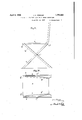
- Fig. 4 is a perspective view showing two posed seats in accordance with this superposed seats similar to that shown in Figs. 1 to 3. l
- Y Figs. 5, 6 and 7, illustrate in side view, plan view and front view respectively another form of construction.
- Fig. 8 is a perspective view of two super- Figs. 12 to 14, illustrate a modification.
- the pieces of furniture which can be superosed and assembled in accordance with the invention com rise a plane horizontal surface a'adapte to constitute either the seat of a chair, armchair, sofa or the top of any ieceiof furniture; stool, table counter, formstance.”
- ThlS surface a whlch in the various forms of construction illustrated in Figs. 1 lKLll,
- the legs 6 and c are, in each pair, formed by means of a single bar of metal, wood or any other 1 suitable material, bent at a certain point of its length and secured at '6 at the front end of the seat a at the top of the angle formedby' the-legs b, c. 3
- the front legs b, b are vertical and the rear legsc, a,-which are in the same plane as the legs b, areinclined,as clearly shown in Fig. 1 and are at a certain distance from the lateral sides of the seat a, which, as illustrated in Fig. .2, is cutaway at a, a beyond the point b where the legs 6, b are secured;
- This seat a is connected, at the rear, t fihe two legs a, 0 through the medium of two bars d, d which, secured to the said seat at dand on the inside of the legs 0 at 01 extend be yond the seat and form the back of the chair.
- the two front legs are constituted by a single bar I), which secured at b on the two lateral sides of'the seat a, extends above the latter in a part b suitably "bent for forming the hoop of the 'back.
- Eachleg b is arranged, as shown in Fig. 6, p in a vertical plane external to the seat a to which it is secured in an inclined position and it is connected, at a point 0 of its inner face, to the corresponding rear leg 0 which is also secured at c at the rear of the seatga, in the bottom of the notches a of the latter, as clearl shown in Fig. 6..
- the legsrare not necessarily rectilinear and can havethe shape of parabola or of any other curve permitting the assemblage.
- top of the angle formed by'thelegs instead of being acute or rounded, as illustrated in 1 the drawing, can have any desired shape.
- Fig. 1 it will be seen that the legs of an i "arm-chair can, for instance, have the shape shown in dotted lines and can be connectedby arm-rests e to the back g.
- the armchair is obtained by horizontally extending the upper end of the legs 0, as illustrated in'dotted lines in this figure.
- Pieces of furniture capable of being suprising a panel forming the top ofthe pieces of furniture,.-a front leg and arear 1e integral with each other, secured on eac of two of the opposite sides of the top, each of other and extending above said top, the pairs of legs lying in planes parallel to each other.
- Pieces of furniture capable of being superposed and fitting. into each other, comprising: a panel adapted to form the seat of a cha1r, two pairs of legs integral with each W4 other in each pair, and formed at an angle to each other and secured on two of the opposite sides of the seat, the'pairs of legs 1ying in planes parallel'to each other,-a back comprising two posts integral with one of the pairs of legs of the chair.
- Pieces of furniture capable of being superposed and fitting into each other, comprising: a panel adapted to form the seat of an archair,'two pans of le s integral with each other in each pair, and ormed at an angle to each other and secured on two of the opposite sides of the seat, the pairs of legs lying in planes parallel to each 0ther,-a back comprising two posts integral with one of the. pairs of legs,and an arm-rest connected to the back and to the other pair of legs of the arm-chair.
Landscapes
- Special Chairs (AREA)
Description
April 8, 1930. J. H. .PORCHE 1,753,623
PIECES OF FURNITURE CAPABLE OF BEING SUPERPOSED Filed 001;. 31, 1927 6 Sheets-Sheet 1 //V /V Tag April 8, 1930.
J. H. ,PORCHE PIECES OF FURNITURE CAPABLE OF BEING SUPERPOSED Filed Oct. 51, 1927 6 Sheets-Sheet 2 vezvro K Maw April 8, 1930. J. H. PORCHE 1,753,623
PIECES OF FURNITURE CAPABLE OF BEING SUPERPOSED I Filed 001;. 31, 1927 6 Sheets-Sheet 5 Fig.5.
April 3 J. H PORCHE 1,753,623
PIECES OF FURNITURE CAPABLE OF BEING SUPERPOSED Filed Oct. 31, 1927 e Sheets-Sheet 4 //VVEN TOR April 8, 1930. J. H. PoRcHE: 3
. PIECES OF FURNITURE CAPABLE OF BEING SUPERPOSED Filed Oct. 31, 1927 6 Sheets-Sheet 5 Fig.9
K I I I J. H. pcrchi April 8, 1930. J. H. PORCHE 131531523 PIECES OF FURNITURE CAPABLE OF BEING SUPERPOS ED B I Filed Oct. 31, 1927 e Sheets-Sheet e Ei u.
s furniture which exactly fit into each other Patented Apr. 8, 1930 UNITED-STATES PATENT OFFICE I JULIE)! HENRI POBGH'E, OI PARIS, FRANCE, ASSIGNOR 1'0 BOCIETE DES MEUBLES BUPERPOBAIBLES, SOOIETE 'A BESPONBABILITE LIMITEE, 0F GENNEVILLIERS, SEIN'E,
TRANCE PIECES 01' FURNITURE CAPABLE OF BEING'SUIBERPOSED Application flled'october 31, 1987. Serial N0. 2 0,180, and in France July 2, 1921. i
The present invention has for object pieces of furniture having legs and provided or not with backs, the pieces of furniturebeing so devised that any number of them can be superposed and can be assembled together so as to present the minimum of cumbersomeness.
The pieces of furniture in accordance with the invention resent the following features: 1'. The sur ace adapted to constitute the seat of a chair, of an armchair, or the top of a piece of furniture is provided with front and rear legs, so arranged as to formtogether a certain angle and to project outside the sides of the seat which is thus offset forthe purose of permitting the easy and exact asseml ilage and without wedging of the legs on or in similarly arranged and shaped legs of other ieces of furniture of the same shape and of the same dimensions;
2. When the piece of furniture has a back,
the latter is integral with the front legs or.
with the rear legs and the posts or uprights of this back are:
ner ace of the rear legs and are thus offset relatively to the said legs; I 1 (b') or formed b extensions of the front legs the rear legs eing, in this case, ofl'set relatively to the front legs. V
By the particular arrangement given to the legs and by the displacementor set-ofl given to the various constituent elements of the piece of'furniture the latter can be conveniently placed .on other similar pieces of invention will be described hereinafter, by Way of example only, .with reference to the access an i g drawing in which a Fig: L gh nd 8 illustrate inside view, plan view and rear view respectively a first form i of construction;
. Fig. 4 is a perspective view showing two posed seats in accordance with this superposed seats similar to that shown in Figs. 1 to 3. l
Y Figs. 5, 6 and 7, illustrate in side view, plan view and front view respectively another form of construction.
Fig. 8 is a perspective view of two super- Figs. 12 to 14, illustrate a modification.
As shown in the accompanying drawing, the pieces of furniture which can be superosed and assembled in accordance with the invention com rise a plane horizontal surface a'adapte to constitute either the seat of a chair, armchair, sofa or the top of any ieceiof furniture; stool, table counter, formstance."
ThlS surface a whlch, in the various forms of construction illustrated in Figs. 1 lKLll,
constitutes the seat of chairs or armchairs, is provided, on each of its twol'ateral sides,
7 with two legs b, 0 which, according to the (ag either secured at their base onthe' inpresent invention are situated in a vertical athird armor plane outside the lateral sides of the seat a and are arranged so as to form together a certain angle.
In the exampleshown in Figs. 1 to 4, the legs 6 and c are, in each pair, formed by means of a single bar of metal, wood or any other 1 suitable material, bent at a certain point of its length and secured at '6 at the front end of the seat a at the top of the angle formedby' the-legs b, c. 3
The front legs b, b are vertical and the rear legsc, a,-which are in the same plane as the legs b, areinclined,as clearly shown in Fig. 1 and are at a certain distance from the lateral sides of the seat a, which, as illustrated in Fig. .2, is cutaway at a, a beyond the point b where the legs 6, b are secured;
This seat a is connected, at the rear, t fihe two legs a, 0 through the medium of two bars d, d which, secured to the said seat at dand on the inside of the legs 0 at 01 extend be yond the seat and form the back of the chair.
Referring to Figs. 2 and 4, it will'be clearly seen that, owing to the offset arrangement of'the seat a, of the posts or'uprights d of the "5.5 inside of the legs 6.
back and of the'legs b' and c, the angle formed by these latter is in a plane outside that of 'the other constituentelements of the chair and that in these conditions it is possible, as
clearly shown in Fig. 4, to superpose any number of these chairs, the legs I; and 0, seats a and backs d of which assemble together with;the minimum of play, on the corresponding parts of the other chairs, and to thus form piles of pieces of furniture comprising, for a given height, the maximum number of these pieces of furniture.
In .the form of construction above described the bisector of the angle formed by the legs I) and c is inclined, so that the axis of the pile of super osed chairs is oblique.
In the form 0 construction illustrated in Figs. 5 to 8, the two front legs are constituted by a single bar I), which secured at b on the two lateral sides of'the seat a, extends above the latter in a part b suitably "bent for forming the hoop of the 'back.
Eachleg b is arranged, as shown in Fig. 6, p in a vertical plane external to the seat a to which it is secured in an inclined position and it is connected, at a point 0 of its inner face, to the corresponding rear leg 0 which is also secured at c at the rear of the seatga, in the bottom of the notches a of the latter, as clearl shown in Fig. 6..
Re erring to Fi 5,- it willbe, understood that the bisector o the angle-formed by the e s b "andc isvertical and by referring to Fig. 6, it will be seen that the various elements a, c, b are displacedrelatively to each other in such a manner that when the chairs of the arrangement described are superposed as illustrated in Fig. 8, the axis of the pile obtained is vertical and that the cumber- 40 somenes is thus reduced to the strict minimum. I 4 I In this form ofconstru'ction the legs 6 and 0 might not be extended above the seat and might. be secured to the latter by their upper en I In the modificationillustrated in Fig s9 to r 11, the two legs 6, c are crossed and connected together at 0 The two legs I) are outside and secured at b at the front of the seat a, whilst the two legs 0 secured at c at the rear of the seat a in the bottom of the notches a? extend above,
the said seat for forming the posts or uprights of the back and are arranged on the In this arrangement is thus again found "the displacement already described between the seat, the legs and the back, so that this chaircan be assembled with other similar I 7 chairs in the same conditions as the firstfones.
535 seen, for instance, that the surface (1 might perposedfand fitting into each other, coinsuch pairs of legs disposed angularly to each constitute the top of a table, bench or any a other piece of furniture without a back.
In this case the displacement between the two pairs of legs I) and c and the surface u might be realized by means of arms d, d secured on the inside of the legs and at the exterior of the surface a, these arms'being independent of each other as illustrated in full lines inFig. 12, or formed by a bent member, as shown in dotted lines in the same figure. p
Likewise, it would be possible, byextending two of the arms d, as indicated in dotted lines, to constitute a chair different from those described.
v The arrangements .described are of course given by wa of example only, the forms,
materials an dimensions of the constituent elements as well as the details of execution can be modified without departing thereby from the principle of the invention. Likewise, thematerials used. can .be of various kinds: wood,'metal, cast or moulded materials,etc. 1
The legsrare not necessarily rectilinear and can havethe shape of parabola or of any other curve permitting the assemblage. The
top of the angle formed by'thelegs instead of being acute or rounded, as illustrated in 1 the drawing, can have any desired shape.
Moreover, by adding arm-rests to the chairs described with reference to Figs. 1 to 4 and to Figs. 5 to 8, it is easy to obtain armchairs presenting the same features asthe said chairs. I
- In Fig. 1 it will be seen that the legs of an i "arm-chair can, for instance, have the shape shown in dotted lines and can be connectedby arm-rests e to the back g.
In Fig. 5, the armchair is obtained by horizontally extending the upper end of the legs 0, as illustrated in'dotted lines in this figure.
Finally, it would be possible by juxtaposing several armchairs in accordance with the invention to obtain 'a stall in which the seats would be separated from each other by the legs common to two adjacent seats. Y
1. Pieces of furniture capable of being suprising a panel forming the top ofthe pieces of furniture,.-a front leg and arear 1e integral with each other, secured on eac of two of the opposite sides of the top, each of other and extending above said top, the pairs of legs lying in planes parallel to each other.
2. Pieces of furniture capable of being superposed and fitting. into each other, comprising: a panel adapted to form the seat of a cha1r, two pairs of legs integral with each W4 other in each pair, and formed at an angle to each other and secured on two of the opposite sides of the seat, the'pairs of legs 1ying in planes parallel'to each other,-a back comprising two posts integral with one of the pairs of legs of the chair.
3. Pieces of furniture capable of being superposed and fitting into each other, comprising: a panel adapted to form the seat of an archair,'two pans of le s integral with each other in each pair, and ormed at an angle to each other and secured on two of the opposite sides of the seat, the pairs of legs lying in planes parallel to each 0ther,-a back comprising two posts integral with one of the. pairs of legs,and an arm-rest connected to the back and to the other pair of legs of the arm-chair.
The foregoing, specification of my pieces of furniture capable of being superposed? signed by me' this 13th day of October, 1927.
JULIEN HENRI PORCHE.
Applications Claiming Priority (1)
| Application Number | Priority Date | Filing Date | Title |
|---|---|---|---|
| FR1753623X | 1927-07-02 |
Publications (1)
| Publication Number | Publication Date |
|---|---|
| US1753623A true US1753623A (en) | 1930-04-08 |
Family
ID=9680763
Family Applications (1)
| Application Number | Title | Priority Date | Filing Date |
|---|---|---|---|
| US230130A Expired - Lifetime US1753623A (en) | 1927-07-02 | 1927-10-31 | Pieces of furniture capable of being superposed |
Country Status (1)
| Country | Link |
|---|---|
| US (1) | US1753623A (en) |
Cited By (5)
| Publication number | Priority date | Publication date | Assignee | Title |
|---|---|---|---|---|
| US2566818A (en) * | 1950-02-10 | 1951-09-04 | Babit David | Multipurpose furniture |
| US2964092A (en) * | 1957-08-27 | 1960-12-13 | Sebel D & Co Ltd | Chairs |
| US3236559A (en) * | 1963-12-13 | 1966-02-22 | Hans J Kaufman | Stacking chair with arms |
| US20060071515A1 (en) * | 2004-10-01 | 2006-04-06 | Mills Robert J | Stackable chair-desk frame |
| US10010178B2 (en) * | 2015-11-05 | 2018-07-03 | Mity-Lite, Inc. | Stacking chair |
-
1927
- 1927-10-31 US US230130A patent/US1753623A/en not_active Expired - Lifetime
Cited By (6)
| Publication number | Priority date | Publication date | Assignee | Title |
|---|---|---|---|---|
| US2566818A (en) * | 1950-02-10 | 1951-09-04 | Babit David | Multipurpose furniture |
| US2964092A (en) * | 1957-08-27 | 1960-12-13 | Sebel D & Co Ltd | Chairs |
| US3236559A (en) * | 1963-12-13 | 1966-02-22 | Hans J Kaufman | Stacking chair with arms |
| US20060071515A1 (en) * | 2004-10-01 | 2006-04-06 | Mills Robert J | Stackable chair-desk frame |
| US7059670B2 (en) | 2004-10-01 | 2006-06-13 | Virco Mgmt. Corporation | Stackable chair-desk frame |
| US10010178B2 (en) * | 2015-11-05 | 2018-07-03 | Mity-Lite, Inc. | Stacking chair |
Similar Documents
| Publication | Publication Date | Title |
|---|---|---|
| US3025105A (en) | Chairs | |
| US2473895A (en) | Chair | |
| GB1079556A (en) | Chairs | |
| US2693846A (en) | Convertible ottoman | |
| US1419647A (en) | Article of furniture | |
| US3246927A (en) | Stack chair | |
| US3316016A (en) | Stack chair | |
| US2333073A (en) | Chair | |
| US3351378A (en) | Chair | |
| US1189053A (en) | Wheeled-chair support. | |
| US1758826A (en) | Nested chair | |
| US3482870A (en) | Chair or like furniture | |
| US2882958A (en) | Knockdown chair | |
| US1480905A (en) | Chair | |
| US2566818A (en) | Multipurpose furniture | |
| US1664103A (en) | Chair | |
| US2606595A (en) | Resiliently supported tilting chair | |
| US3084975A (en) | Article of furniture | |
| US2293323A (en) | Spring seat construction | |
| US1691053A (en) | Tablet armchair | |
| US2540206A (en) | Chair | |
| US2449747A (en) | Lounge chair | |
| US2516712A (en) | Reclining chair with stationary arms | |
| USD225923S (en) | ||
| GB524397A (en) | Improvements relating to chairs, tables and like articles of furniture |