US1663409A - Cane stripping and topping- machine - Google Patents
Cane stripping and topping- machine Download PDFInfo
- Publication number
- US1663409A US1663409A US1663409DA US1663409A US 1663409 A US1663409 A US 1663409A US 1663409D A US1663409D A US 1663409DA US 1663409 A US1663409 A US 1663409A
- Authority
- US
- United States
- Prior art keywords
- stalks
- cane
- conveyors
- conveyor
- stripping
- Prior art date
- Legal status (The legal status is an assumption and is not a legal conclusion. Google has not performed a legal analysis and makes no representation as to the accuracy of the status listed.)
- Expired - Lifetime
Links
- 239000007787 solid Substances 0.000 description 26
- 239000010813 municipal solid waste Substances 0.000 description 17
- 238000005520 cutting process Methods 0.000 description 8
- 238000010276 construction Methods 0.000 description 4
- 239000000428 dust Substances 0.000 description 3
- 238000005192 partition Methods 0.000 description 3
- 239000011343 solid material Substances 0.000 description 3
- 230000000694 effects Effects 0.000 description 2
- 235000011389 fruit/vegetable juice Nutrition 0.000 description 2
- 238000003306 harvesting Methods 0.000 description 2
- 239000000463 material Substances 0.000 description 2
- 241000427324 Glinus Species 0.000 description 1
- 241000845077 Iare Species 0.000 description 1
- 208000036366 Sensation of pressure Diseases 0.000 description 1
- 238000010009 beating Methods 0.000 description 1
- 230000001680 brushing effect Effects 0.000 description 1
- 238000005352 clarification Methods 0.000 description 1
- 238000004140 cleaning Methods 0.000 description 1
- 238000002485 combustion reaction Methods 0.000 description 1
- IDLFZVILOHSSID-OVLDLUHVSA-N corticotropin Chemical compound C([C@@H](C(=O)N[C@@H](CO)C(=O)N[C@@H](CCSC)C(=O)N[C@@H](CCC(O)=O)C(=O)N[C@@H](CC=1NC=NC=1)C(=O)N[C@@H](CC=1C=CC=CC=1)C(=O)N[C@@H](CCCNC(N)=N)C(=O)N[C@@H](CC=1C2=CC=CC=C2NC=1)C(=O)NCC(=O)N[C@@H](CCCCN)C(=O)N1[C@@H](CCC1)C(=O)N[C@@H](C(C)C)C(=O)NCC(=O)N[C@@H](CCCCN)C(=O)N[C@@H](CCCCN)C(=O)N[C@@H](CCCNC(N)=N)C(=O)N[C@@H](CCCNC(N)=N)C(=O)N1[C@@H](CCC1)C(=O)N[C@@H](C(C)C)C(=O)N[C@@H](CCCCN)C(=O)N[C@@H](C(C)C)C(=O)N[C@@H](CC=1C=CC(O)=CC=1)C(=O)N1[C@@H](CCC1)C(=O)N[C@@H](CC(N)=O)C(=O)NCC(=O)N[C@@H](C)C(=O)N[C@@H](CCC(O)=O)C(=O)N[C@@H](CC(O)=O)C(=O)N[C@@H](CCC(O)=O)C(=O)N[C@@H](CO)C(=O)N[C@@H](C)C(=O)N[C@@H](CCC(O)=O)C(=O)N[C@@H](C)C(=O)N[C@@H](CC=1C=CC=CC=1)C(=O)N1[C@@H](CCC1)C(=O)N[C@@H](CC(C)C)C(=O)N[C@@H](CCC(O)=O)C(=O)N[C@@H](CC=1C=CC=CC=1)C(O)=O)NC(=O)[C@@H](N)CO)C1=CC=C(O)C=C1 IDLFZVILOHSSID-OVLDLUHVSA-N 0.000 description 1
- 230000013872 defecation Effects 0.000 description 1
- -1 leaves Substances 0.000 description 1
- 238000000034 method Methods 0.000 description 1
- 108010021724 tonin Proteins 0.000 description 1
Images
Classifications
-
- A—HUMAN NECESSITIES
- A01—AGRICULTURE; FORESTRY; ANIMAL HUSBANDRY; HUNTING; TRAPPING; FISHING
- A01D—HARVESTING; MOWING
- A01D45/00—Harvesting of standing crops
- A01D45/10—Harvesting of standing crops of sugar cane
Definitions
- My present invention relates to apparatus for removing the dead and green leaves, and any mud or other solid matter adhering to the cane stalks from the cane, after it has been cut and before it is delivered to the crusher or mill to be ground; and it also consists in means for severing the green ends of the stalks from the sweeter or riper portions of the stalks before the stalks go to the crusher or mill.
- the upper end of the stalk usually carries tufts of long green leaves, and these are ordinarily cut oil with the green upper end of the stalk before the stalks are loaded on the car or wagon for transportation to the mill.
- these dried and green leaves are stripped from the cane stalks and the stalks themselves are brushed clear of mud or other solid matter, and then the stripped green portion of the stalk is cut off at the desired point from the tip of the stalk, so that only the sweeter portions of the stalk are carried to the mill, while the greener portions of the stalk so eliminated may be gathered together for use as stock feed or for other purposes.
- My invention comprisesvmeans for stripping the leaves and other solid matter from the stalk; and then topping the stalk as before described, with the use of rotary saws; andv also in means for holding the stalks firmly in place during the cutting operation.
- the invention comprises a portable apparatus, which may be mounted upon wheels, skids, caterpillar tractors or any other convenient transporting means.
- a portable apparatus which may be mounted upon wheels, skids, caterpillar tractors or any other convenient transporting means.
- Such means not being necessarily a part of my invention and their use being optional, I have shown the form of support diagrammatically, that is, in the form of skids, which may be drawn along the ground or mounted upon wheels, as desired.
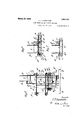
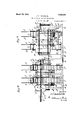
- Figure 1 is a plan view showing the apparatus in the simplest form, that is, without the addition. of the means for taking care of crooked cane;
- Figure 2 is a side elevation of the device shown in F ig. 1, as seen from the upper side of said figure;
- Figure 3 is a side elevation as seen from the opposite side of Fig. 1 from that shown in Fig. 2;
- Figure l shows a central vertical section aiong the line 4 4 of Fig. 1, and looking in the direction of the arrows;
- Figure 5 is a rear view of the apparatus shown in Fig. 1 as seen from the right of said figure;
- Figure 6 shows a transverse section along the line 6-b of Fig. 3 and looking in the direction of the arrows;
- Figure 7 is another transverse section aiong the line 7-7 of Fig. 3, and looking in the direction of the arrows;
- Figure 8 shows a transverse section along the line 88 of Figure 3, and looking in the direction of the arrows;
- Figure 9 shows a section along the line 9-9 of Figure 3 and looking in the direction of the arrows;
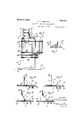
- Figures 10 to 13 are fragmentary sectional views showing the arrangement of the saws and the swinging doors for holding the cane stalks a ainst the saws during the cut-- ting operation.
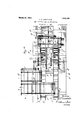
- Figure 14 shows a plan View of the apparatus already shown, with the further addition of means for cutting the stalk in two pieces, which would be desirable in treating Figs. 1, 2, and 3.
- Figure 15 is a side view of the device shown in Fig. 14-, as seen from the upper side of said figure;
- Figure 16 is a frontelevation of. the construction shown in Fig. 14, as seen from the left of said figure;
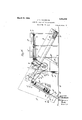
- Figure 17 is a rear elevation of the construction shown in .iFig. 1 1,..us seen afrom thesrightcofsaid figure.
- AX represents longitudinal :beams shown till the zform of skids -.cozrnecte.d by ucrossbars A, 'the whole .foi'iningh ihase-fnanie-or platform,
- Vertical supporting frames A may :be 1 connected .to ltllQ base- ;frame many convenient'way, for supporting limit the iinvention to the details of this base fraine but only to the parts mounted thereon.
- the conveyor belt Ci Ciisa feedinguarrangement comprising a a short- 1 conveyor D passing over the driven drum Dsand the idler drum CD and the latterjdriun is normally pressed dowi'iward-by the'springs zFi, which acton the ends of the shaft (Z of the drum CD and tond to effect a ;g, ;1.'i1;Jping :u'raugeinent between the-conveyoriC and the short conveyor D, wheroby'thccane is gripped, as will be hereinafter described.
- transverse strip B which serves to guide ithc can-e to I the beater H.
- This beater rotates inthe direction of the arrow, see Fig. 4, and carries on its surface a series of staggered fingers h, which may be” made of rawhidepwalnus hide or other durable flexible material.
- slats are spaced iapartrtozregister with the long slats m of the upper conveyor, and .these shorter slats vm iare propelled .by athe sprocket chains M oirtliesproeket wheels .Mi alsocarried by theshaft L. .This shaft L ispdrivenby .thebevehgears L and L as will be hereinafteranore .fully described. .105
- the bevel. gear L is mounted on the driven shaft L and carries a beveLgean-L, which meshes withthebevel gear N on the shaft- N earryingthe rotary saw N
- vThesidewallB is extended forwards parallel with the sidewall B of the conveyor trough,-as showninFig. 1, and is provided with "in downwardly depending door 0, shown-most clearlyin Fig. 3, whichnis normally. pressed downwards to the closedposition,.--as bythe spring hingesO', seeFig. 3.
- This door yields,.to-perinit the cane to pass in onedirectionybut holdsth'eeane stalks against the saw inthe cuttingoperation,as willbe hereinaftenmore fully described.
- The-several moving parts hereinbefore described are driven in any convenient way, as from the internal combustion engine 1" driving ashaft Pf, which carries on one side hll of theapparatus a sprocket P, see Fig. 3, which drives a sprocket chain Q passing over the various sprocket wheels C, D", the idler I, the sprocket 1 and the sprocket L whereby the single sprocket chain will drive both the conveyors C and D, the feed rollers I and I and the two conveyors M and M and the saw N the parts being so arranged that these various devices will be driven at the desired speed.
- the main shaft P On the opposite side of the apparatus from the sprocket P, the main shaft P is extended, as shown in Figs. 1 and 2, and carries a large pulley R, driving the belts R and R, driving respectively at a high rate of speed the brush G and the beater H.
- the apparatus is transported to the proper place in the field, Where the cut cane can be conveniently brought to it.
- the cane has been cutat about the surface of the ground in the field in the usual way, as by hand, and is brought to the apparatus herein described, with the dead leaves or trash and green leaves at the top still adhering thereto, as well as with any mud or dust or other foreign matter that may be deposited on the cut stalks in the field or in transit.
- the stalks so gripped are fed top first to the brush G and the feed roller F, and this rapidly rotating brush G tears the larger portion of the trash from the cane and at the same time cleans off most of the dust or mud or other solid matter that adheres to the stalks; and the cane stalks, continuing their travel, will pass over the beater H, whose thongs it will pass between the stalks and continue the stripping action by tearing off the leaves and knocking off any solid matter that may adhere to the stalks; and the stalks, then completely stripped of leaves and adhering solid matter, will pass between the rollers I and I, and will fall top-foremost over the partition B
- the stalks will fall between the slats m of the upper conveyor M and m of the lower conveyor M", and the green tops will rest on the shelf K, Whose distance from the saw N has been predetermined, so as to determine the length of the green top that is to be separated from the stalk before the stalk goes to the mill.
- the longer portions intended for the mill are carried by the longer conveyor M, see Fig. 5, to a suitable receptacle, such as a conveyor, cart, car or the like, not shown, whence they may be delivered to the mill.
- the shorter conveyor M carries the green tops a shorter distance, where they may be delivered to another receptacle and carried off either for stock feed or for any other purpose, as may be desired.
- the cut cane bearing the trash, foreign matter, green leaves, and green tops are fed to the machine, and that the leaves, green or dead, are stripped from the stalks, as also the solid matter adhering thereto, that the predetermined length is cut from the tops of the stalks and that this short length is separated from the longer length, which is intended to be carried to the mill, and thus the operation of cleaning the stalks and cutting off the tops thereof is continuously effected, as long as cane supplied to the apparatus.
- the cane stalks are supposed to be supplied whole to the machine, there to be stripped of trash, leaves, and solid matter and to be topped as hereinbefore described, and this operation will be satisfactorily performed on the general run of cane, but in order to provide an attachment for taking care of crooked cane, I provide an arrange ment, in which the lower part of the stalk is severed before the stalk reaches the topping stage, and the lower and riper part so cut off is stripped and cleaned and prepared for delivery to the mill. while the upper part of the stalk so severed is subjected to the same treatment as the whole stalks already described in connection with Figs. 1 to 13.
- the upper ends of the stalks are operated upon in the apparatus in the manner already described.
- the lower portions of the stalks so severed are delivered by tliedonger slatted conveyor U to the conveyor (3*; and such portions of the stalks,.afterbeing subjected to the brushing and beating action already described,1fall onto the transverse conveyorli I, which delivers the longerstalks to the car, cart or other conveyor for 'feediug to i the crusher or mill.
- the lowerportions o'fathe original stalks are thus assembled with thelonger cut-oflt por- 'tions o'lftheupper portions 'ot'the stalks, while 'the short tops are cut otl as before, and separately delivered as hereinbetore described.
- the apparatus is precisely similar tothat alreadydescribed, except. that there are two conveyors, on which the cane stalks are treated, the portions of thestalk carried by one conveyor a rc'topped, while'the portionsof thestalks carried by thecother conveyor are not, and the stalks: are automatically severed into two ust described.
- topping 'inay be effected :bylowering theshelt K to the proper position, which might be considerably lower than the norinalposition of the sheltwhenripeunfrozen cane was being topped.
- :QLA l11flCl1l110fO1 stri iiping and topping cane stalks comprising a conveyor adapted to ;receive'the stalks placed thereon longitudinally, an inclinedchutc, adapted to re ccive the cane stalks from said conveyor, conveyors moving transversely of said chute, a rotary saw projecting,- through said chute between said conveyors torstwering the tops :troni'the main body of the stalks, and means for holdnig the stalks against said saw, with mechanical 11163115 for separating the tops from the main body of said stalks.
- "3..A.machine for stripping and topping ltll) lib cane stalks comprising an upwardly inclined conveyor adapted to receive the stalks placed thereon longitudinally, means for stripping the leaves and adhering solid mat ter from the stalks, an inclined chute, adapted to receive the stripped cane stalks from said conveyor, conveyors moving transversely of said chute, a rotary saw projecting through said chute between said conveyors for severing the tops from the main body of the stalks, and means for holding the stalks against said saw.
- a machine for stripping and topping cane stalks comprising an upwardly inclined conveyor adapted to receive the stalks placed thereon longitudinally, means for stripping the leaves and adhering solid matter from the stalks, an inclined chute, adapted to receive the stripped cane stalks from said conveyor, a vertically adjustable shelfadapted to engage the tops of the stripped stalks, conveyors moving transversely of said chute, a rotary saw projecting through said chute between said conveyors for severing the tops from the main body of the stalks, and means for holding the stalks against said saw.
- a machine for stripping and topping cane stalks comprising an upwardly inclined conveyor adapted to receive the stalks placed thereon longitudinally, means for stripping the leaves and adhering solid matter from the stalks, an inclined chute, adapted to receive the stripped cane stalks from said conveyor, conveyors moving transversely of said chute, a rotary saw projecting through said chute between said conveyors for severing the tops from the main body of the stalks, and means for holding the stalks against said saw, with mechanical means for removing the to s separately from the main body of said sta ks.
- a machine for stripping and topping cane stalks comprising an upwardly inclined conveyor adapted to receive the stalks placed thereon longitudinally, means for stripping the leaves and adhering solid matter from the stalks, an inclined chute, adapted to receive the stripped cane stalks from said conveyor, a vertically adjustable shelf adapted to engage the tops of the stripped stalks, conveyors moving transversely of said chute, a rotary saw projecting through said chute between said conveyors for severing the tops from the main body of the stalks, and means for holding the stalks against said saw, with mechanical means for removing the tops separately from the main body of said stalks.
- a machine for stripping and topping cane stalks comprising two upper conveyors of unequal length adapted to receive the cane stalks transversely thereon, with means located between said conveyors for severing the stalks into two segments while carried by said conveyors, two lower conveyors adapted to respectively receive the stalk segments in a longitudinal direction from the upper conveyors, means for stripping the stalks of green leaves, trash and other solid matter, and means for topping the stripped stalks.
- a machine for stripping and topping cane stalks comprising two upper conveyors of unequal length adapted to receive the cane stalks transversely thereon, with means located between said conveyors for severing the stalks into two segments while carried by said conveyors, two lower conveyors adapted to respectively receive the stalk segments in a longitudinal direction from the upper conveyors, yielding gripping means near the end of each of said lower conveyors for gripping said stalks, means for stripping the stalks of green leaves, trash and other solid matter when so gripped, and means for topping the stripped stalks.
- a machine for stripping and topping cane stalks comprising two upper conveyors of unequal length adapted to receive the cane stalks transversely thereon, with means located between said conveyors for severing the stalks into two segments while carried by said conveyors, two lower conveyors adapted to respectively receive the stalk segments in a longitudinal direction from the upper conveyors, yielding gripping means near the end 01 each of said lower conveyors for gripping said stalks, means for stripping the stalks of green leaves, trash and other solid matter when so gripped, an in clined chute, adapted to receive the cane stalks, an adjustable shelf projecting from said chute to engage the tops of the stripped stalks, conveyors moving transversely of said chute, a rotary saw projecting through said chute between said last mentioned conveyors for severing the tops from the main body of the stalks, means for holding the stalks carried by said last mentioned conveyors against said saw, and means for separately delivering the main body of said stalks as severed by said saw and the shorter portions or tops of said stalk
- a machine for stripping and topping cane stalks comprising two upper convey ors of unequal length adapted to receive the cane stalks transversely thereon, with means located between said conveyors for severing the stalks into two segments while carried by said conveyors, two lower conveyors adapted to respectively receive the stalk seg 'ments in a longitudinal direction from the upper conveyors, means for stripping the stalks of green leaves, trash and other solid matter, an inclined chute, adapted to receive the stripped cane stalks, an adjustable shelf projecting from said chute to engage the tops of the stripped stalks, a pair of conveyors moving transversely of said chute, a rotary saw projecting through said chute between said last mentioned conveyors for sew ering the tops from the main body of the stalks, means or holding said stalks carried by said last mentioned conveyors against said saw, and means for separately delhxering the main hody ot said stall-ts as severed hysaid saw and the shorter portions; or tops of said stalks.
- a machine tor stripping and topping, cane stalks comprising two upper convey orso'f unequal length adapted to receive the cane stalks transve I thereon, with means located between said conveyors tor severing the stalks into two segments while carried by said conveyors, two lower conveyors adapted to respectively receive the i talk segments in a longitudinal direction From the upper conveyors, yielding); gripping; means near the end of each of said lower conveyors for gripping said stalks, means lor stripping the stalks ol green leaves, tra' h and other solid matter when so grip ed, an inclinedv chute, adapted to receive the cane stalks, an adjustahle shol't projecting lroin said. chute to engage the tops oi?
- a machine'tor stripping and topping cane stalks comprisu an upwardly inclined conveyor adapted to receive the stalks placed thereon longitudinally, yielding gripping men s near the upper end of said conveyor for-grippingsaid stalks, means "for stripping the stalks o'li green leaves, trash and other solid matter while held in said gripping,"
- a maehii'ie :tor stripping and topping cane stalks comprising an upwardly inclined conveyor adapted to receive the stalks placed thereon longitudinally, yielding grip ping means near the end oil? said conveyor r01- grippinp; said stalks, a rotary brush located near the end of said conveyor for stripping the stalks o'l green leaves, tra:-h and other solid matter, a rotary heater provided with a plurality of thongs adapted to strike and clean said stalks of solid material adhering; tl. xeto, an inclined chute, adapted to receive the cane stalks from said heater, with means for severing the tops front the main body of the stalks, while on said chute.
- a machine for stripping and topping cane stalks comprisingi'a'. conveyor adapted to receive the" stalks plaoedi thereonlongitudinally, yielding gripping means at the end of said conveyor for gripping: said stalks, rotarybrush located nearthe end of" F-iilltl conveyor tor stripping.
- the stalks ot greenleaves, trash an'chother solidimatter a rotary heater provided with: a plurality of thongs adapted to strike and clean said' stalks of solid material a dherinp;thereto; and: means for severing thetops in the stalks trom the main body therot.
- a machine tor stripping: and topping cane stalks comprising. a conveyor adapted to receive the stalksplaced thereon longitudinally, yielding gripping'meansat the end of said cimveyor tor p rippingzsaid stalks, a rotary liruslt located near the end of. said conveyor tor striippingrthestalks of green leaves, trash and other solidmattcr, arotary beatenprovided. with a plurality of thongs adapted to strike and clean said stalks otsolid n'iateriah adhering.
- a machine for stripping; andztoppingv cane stalks comprising. a: conveyor adapted to receive the stalks placed thereon longitndinally, yielding gripping: means at the end. of said conveyor for gripping; said stalks, a rotary hrushlocated near the end of said conveyor" for stripping the stalks of green leaves, trash and other solid: matter, a rotary heater providedwith a plurality of thongs adapted to strikeand cleanv said stalks oi solidv material adhering: thereto,
- a machine"for'stripping and topping, cane stalxs comprising an upwardly in-- clined conveyor adapted to receive-the stalks placed thereon longitudinally a shorter c0n-- veyor mounted above" the first mentioned conveyor for gripping.
- a rotary brush located near the end of said conveyor for stripping the stalks of green leaves, trash and other solid matter
- a rotary beater provided with a plurality of thongs adapted to strike and clean said stalks of solid material adhering thereto, feed rollers for drawing said stalks past said beater, an inclined chute, adapted to receive the stripped cane stalks from said feed rollers, means for holding the stalks on said chute, means for severing the tops from the main body of the stalks while held on said chute, and means for separately delivering the main body of said stalks as severed by said saw and the shorter portions or tops of said stalks.
- a machine for stripping and topping cane stalks comprising an upwardly inclined conveyor adapted to receive the stalks placed thereon longitudinally, means for stripping the stalks of green leaves, trash and other solid matter while on said conveyor, an inclined chute, adapted to receive the cane stalks from the upper end of said conveyor, conveyors provided with transverse slats moving transversely of said chute, a rotary saw projecting through said chute between said last mentioned conveyors for severing the tops from the main body of the stalks, means for holding said stalks carried by said conveyors against said saw, and means for separately delivering the main body of said stalks as severed by said saw and the shorter portions or tops of said stalks.
- a machine for stripping and topping cane stalks comprising two upper conveyors of unequal length adapted to receive the cane stalks transversely thereon, with means located between said conveyors for severing the stalks into two segments while carried by said conveyors, two lower conveyors moving at right angles to the first conveyors and adapted to respectively receive the stalk segments in a longitudinal direction from the upper conveyors, means for stripping the stalks of green leaves, trash and other solid matter while carried by said lower conveyors, and means for severing the tops from the stripped stalks.
- a machine for stripping and topping cane stalks comprising two upper conveyors of unequal length adapted to receive the cane stalks transversely thereon, with means located between said conveyors for severing the stalks into two segments while carried by said conveyors, two lower conveyors moving at right angles to the first conveyors and adapted to respectively receive the stalk segments in a longitudinal direction from the upper conveyors, means for stripping the stalks of green leaves, trash and other solid matter while carried by said lower conveyors, and means for severing the tops from the stripped stalks with means for separating said severed tops from the other severed portions of the stalks.
Landscapes
- Life Sciences & Earth Sciences (AREA)
- Environmental Sciences (AREA)
- Apparatuses For Bulk Treatment Of Fruits And Vegetables And Apparatuses For Preparing Feeds (AREA)
Description
March 20, 1928.
. 1,663,409 J. T. LANDAICHE CANE STRI PPING .AND TOPPING MACHINE Filed Febf24. 1927, 9 s t -she t 1 J. TJLANDAICHE CANE STRIPPING AND TOPPING MACHINE March 20, 1928.
Filed Feb. 24. 192'?v 9 Sheets-Sheet 2 March 20, 1928. 7 1,663,409
J. 'r. LANDAICHE' CANE STRIPPING AND TOPPING MACHINE J. T. LANDAICHE CANE STRIPPING AND TOPPINC- MACHINE March 20, 1928.
9 Sheets-Sheet 4 Filed Feb. 24, 1927 March 20, 1928. 1,663,409
1. T LANDAICHE CANE STRIPPIENG AND TOPPING MACHINE Filed Feb. 24, 1927 9 h t h t v5 March 20, 1928 J. T. LANDAICHE CANE STRIPPING AND TOPPING MACHINE Filed Feb. 24,, 1927 9 sheets sheet 6 4 l 5 FE 0a 2 m F I r 1 o F L m m M i x l M an March 20, 1-928. 1,663,409 J. T. LANDAICHE.
CANE STRIPPING AND TOPPING MACHINE Filed Feb.- 24-, 1927 9 SheetsQShet 7 Efs March 26, 1928.
1,663,409 J. T. LANDAICHE CANE STRIPPING AND T OPPING MACHINE Filed Feb. 24. 1927 9 Sheets-Sheet 8 March 20, 1928. 1,663L409 J. T. LANDAICHE CANE STRIPPING AND TOPPING MACHINE Filed Feb. 24, 19.27 9 Sheets-Sheet 9 Patented Mar. 20, 1928.
UNITED STATES JOSEPH THOMAS LANDAICI-IE, OF THIBODAUX, LOUISIANA.
CANE STRIPPING AND TOEZING MACHINE.
Application filed February 24, 1927.
My present invention relates to apparatus for removing the dead and green leaves, and any mud or other solid matter adhering to the cane stalks from the cane, after it has been cut and before it is delivered to the crusher or mill to be ground; and it also consists in means for severing the green ends of the stalks from the sweeter or riper portions of the stalks before the stalks go to the crusher or mill.
In harvesting cane, there are generally a number of dead dried leaves, which frequently stick close to the stalk and are with difficulty removed therefrom in the ordinary method of cutting and stripping by hand, and these dried leaves, when they pass through the crusher and mill are apt to absorb and carry off part of the sweet juice. with the resultant lack of efliciency in the mill, and furthermore, these dried leaves are apt to carry along with them mud or dust or other solid matter, which tends to discolor the juice and otherwise impair the clarification or defecation of the juice extracted from the cane.
Furthermore, in harvesting the cane, the upper end of the stalk usually carries tufts of long green leaves, and these are ordinarily cut oil with the green upper end of the stalk before the stalks are loaded on the car or wagon for transportation to the mill.
According to my present invention, these dried and green leaves are stripped from the cane stalks and the stalks themselves are brushed clear of mud or other solid matter, and then the stripped green portion of the stalk is cut off at the desired point from the tip of the stalk, so that only the sweeter portions of the stalk are carried to the mill, while the greener portions of the stalk so eliminated may be gathered together for use as stock feed or for other purposes.
My invention comprisesvmeans for stripping the leaves and other solid matter from the stalk; and then topping the stalk as before described, with the use of rotary saws; andv also in means for holding the stalks firmly in place during the cutting operation.
Since the stalks of cane are often quite crooked, especially where the cane has been blown down and has bent upwards again, I also provide means whereby the talks may be cut into comparatively straight lengths, and in which the upper portions of the stalk, which are not so apt to be crooked as the Serial No. 170,620.
lower, are more conveniently operated upon 1n the manner ordinarily practicable with straight stalks.
The invention comprises a portable apparatus, which may be mounted upon wheels, skids, caterpillar tractors or any other convenient transporting means. Such means not being necessarily a part of my invention and their use being optional, I have shown the form of support diagrammatically, that is, in the form of skids, which may be drawn along the ground or mounted upon wheels, as desired.
My invention will be more fully understood after reference to the accompanying drawings, in which like parts are indicated b y similar reference symbols throughout the several views, and in which:
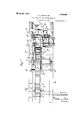
Figure 1 is a plan view showing the apparatus in the simplest form, that is, without the addition. of the means for taking care of crooked cane;
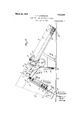
Figure 2 is a side elevation of the device shown in F ig. 1, as seen from the upper side of said figure;
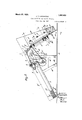
Figure 3 is a side elevation as seen from the opposite side of Fig. 1 from that shown in Fig. 2;
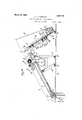
Figure l shows a central vertical section aiong the line 4 4 of Fig. 1, and looking in the direction of the arrows;
Figure 5 is a rear view of the apparatus shown in Fig. 1 as seen from the right of said figure;
Figure 6 shows a transverse section along the line 6-b of Fig. 3 and looking in the direction of the arrows;
Figure 7 is another transverse section aiong the line 7-7 of Fig. 3, and looking in the direction of the arrows;
Figure 8 shows a transverse section along the line 88 of Figure 3, and looking in the direction of the arrows;
Figure 9 shows a section along the line 9-9 of Figure 3 and looking in the direction of the arrows;
Figures 10 to 13 are fragmentary sectional views showing the arrangement of the saws and the swinging doors for holding the cane stalks a ainst the saws during the cut-- ting operation.
Figure 14 shows a plan View of the apparatus already shown, with the further addition of means for cutting the stalk in two pieces, which would be desirable in treating Figs. 1, 2, and 3.
crooked cane. In this construction, there are separate eonveyorsfor the,twoz'portions of cut stalk;
Figure 15 is a side view of the device shown in Fig. 14-, as seen from the upper side of said figure;
Figure 16 is a frontelevation of. the construction shown in Fig. 14, as seen from the left of said figure; and
Figure 17 is a rear elevation of the construction shown in .iFig. 1 1,..us seen afrom thesrightcofsaid figure.
Referring first to the constructionshown in Figs. 1 to 13, inclusive, AX represents longitudinal :beams shown till the zform of skids -.cozrnecte.d by ucrossbars A, 'the whole .foi'iningh ihase-fnanie-or platform,
on "which the roperative parts 10f i the inachine are ,mounted. Vertical supporting frames A :may :be 1 connected .to ltllQ base- ;frame many convenient'way, for supporting limit the iinvention to the details of this base fraine but only to the parts mounted thereon.
B and B represent the side walls ofsayeonyeyori trough; the bottom of which is formed byitheendless.eonveyoribelt- C, which conveyor belt passes over the driven dnum 'C and the idler drum 'WlllChltlttQl'l is mounted on a shaft 0,:andvsaid. shafhisntnder tension by theitensioningideviceC shown in This tensioning device comprises an adjusting screw (3 which pressesoutwardsJon thebearing 0.,;of the shaft 0, and thus keeps the conveyor: belt C :under tllU-llGSll'Gflil'GIlSlOIl. This conveyor belt is driven inthe direction of the; arrows,
as will be hereinafter.described.
Above the conveyor belt Ciisa feedinguarrangement comprising a a short- 1 conveyor D passing over the driven drum Dsand the idler drum CD and the latterjdriun is normally pressed dowi'iward-by the'springs zFi, which acton the ends of the shaft (Z of the drum CD and tond to effect a ;g, ;1.'i1;Jping :u'raugeinent between the-conveyoriC and the short conveyor D, wheroby'thccane is gripped, as will be hereinafter described.
These springs will permit the upper conveyor belt to yield,as-the1feed of canebetween'the two conveyorsincreases, as will 'be hereinafter more fully described.
Beyond the drums C and-D 1 provideau idler roller'F,-whiehserveswas a feed roller and above which is arbruslr G, which rotates in the direction of the arrow, see :Fig. 4. This is a cylindrical wire-brush :tlllfli-SQTVQS not only to clean the cane bHtfilSOTHS a feed roller.
Beyondthe'roller -F is a transverse strip B", which serves to guide ithc can-e to I the beater H. This beater rotates inthe direction of the arrow, see Fig. 4, and carries on its surface a series of staggered fingers h, which may be" made of rawhidepwalnus hide or other durable flexible material.
Beyond the beater H are the feed rollers I and l, whiclrare ClI'lVCIl'lll the direction of thearrows,..as shown in Fig. 1-, and between these the stripped cane stalks are fed over the.transverse,partition B of the framework, which is inclined sharply downwards, as shown in Fig.4, and with theside walls .B andrBt, :forms a chute for the stripped ion being actuated by. the hand crank .K, :as
shown most clearly iniFigs.--4.-.and 5.
'Iravellingacrossthe partition .13 is .a slatted conveyor. M, see .Figs. 1, .41, 5Handi6. This conveyor i is provided with --seriesof slats. m spaced:apartiand carried. by. the conveyor chains .M, which are driven by the sproeketwlaeels M onthe shaft L. .lie-low this conveyor ,M i is a similar conveyor. M9, having.- shorter slats m, (which. shorter. slats are spaced iapartrtozregister with the long slats m of the upper conveyor, and .these shorter slats vm iare propelled .by athe sprocket chains M oirtliesproeket wheels .Mi alsocarried by theshaft L. .This shaft L ispdrivenby .thebevehgears L and L as will be hereinafteranore .fully described. .105
The bevel. gear L is mounted on the driven shaft L and carries a beveLgean-L, which meshes withthebevel gear N on the shaft- N earryingthe rotary saw N vThesidewallB is extended forwards parallel with the sidewall B of the conveyor trough,-as showninFig. 1, and is provided with "in downwardly depending door 0, shown-most clearlyin Fig. 3, whichnis normally. pressed downwards to the closedposition,.--as bythe spring hingesO', seeFig. 3. This door yields,.to-perinit the cane to pass in onedirectionybut holdsth'eeane stalks against the saw inthe cuttingoperation,as willbe hereinaftenmore fully described.
:It will be noted from r5 that the slatted conveyor M islonger. than the slatted conveyor M9,?for. the reason that it is desired to separate theshort severed portions oft-the stalk-fromthelonger, as will be hereinafter more fully described.
The-several moving parts hereinbefore described are driven in any convenient way, as from the internal combustion engine 1" driving ashaft Pf, which carries on one side hll of theapparatus a sprocket P, see Fig. 3, which drives a sprocket chain Q passing over the various sprocket wheels C, D", the idler I, the sprocket 1 and the sprocket L whereby the single sprocket chain will drive both the conveyors C and D, the feed rollers I and I and the two conveyors M and M and the saw N the parts being so arranged that these various devices will be driven at the desired speed.
In order to secure the proper direction of rotation of the two feed rollers I and I, their shafts carry respectively the gears i and 1', shown at the left of Fig. 2.
On the opposite side of the apparatus from the sprocket P, the main shaft P is extended, as shown in Figs. 1 and 2, and carries a large pulley R, driving the belts R and R, driving respectively at a high rate of speed the brush G and the beater H.
The operation of the apparatus, as thus described m detail, is as follows:
The apparatus is transported to the proper place in the field, Where the cut cane can be conveniently brought to it. We will assume that the cane has been cutat about the surface of the ground in the field in the usual way, as by hand, and is brought to the apparatus herein described, with the dead leaves or trash and green leaves at the top still adhering thereto, as well as with any mud or dust or other foreign matter that may be deposited on the cut stalks in the field or in transit.
These stalks so cut are placed on the conveyor C with their tops carrying the green leaves upwards, that is, directed towards the short conveyor D. As these green tops reach the short conveyor D, they are gripped between the conveyors D and C, under pres sure of the springs E. This gripping effect will automatically adjust itself, according to the thickness of the feed of the caneon the conveyor C.
The stalks so gripped are fed top first to the brush G and the feed roller F, and this rapidly rotating brush G tears the larger portion of the trash from the cane and at the same time cleans off most of the dust or mud or other solid matter that adheres to the stalks; and the cane stalks, continuing their travel, will pass over the beater H, whose thongs it will pass between the stalks and continue the stripping action by tearing off the leaves and knocking off any solid matter that may adhere to the stalks; and the stalks, then completely stripped of leaves and adhering solid matter, will pass between the rollers I and I, and will fall top-foremost over the partition B The stalks will fall between the slats m of the upper conveyor M and m of the lower conveyor M", and the green tops will rest on the shelf K, Whose distance from the saw N has been predetermined, so as to determine the length of the green top that is to be separated from the stalk before the stalk goes to the mill. In order to hold the stalks against the saw during the cutting operation, these stalks are fed under the spring pressed door 0, which will hold the stalks down between the slats m and m while the saw is cutting off the green portion of the stalk. After the stalk has been severed, as thus described, the longer portions intended for the mill, are carried by the longer conveyor M, see Fig. 5, to a suitable receptacle, such as a conveyor, cart, car or the like, not shown, whence they may be delivered to the mill. The shorter conveyor M carries the green tops a shorter distance, where they may be delivered to another receptacle and carried off either for stock feed or for any other purpose, as may be desired. I have not shown either the receptacle forcarrying off the long stalks in Fig. 5, or for carrying off the cut-off tops, as any suitable device might be used for this purpose, and it is not deemed necessary to complicate the drawings by illustrating immaterial details, which will be obvious to anyone skilled in the art.
I have shown in section at S in Figs. 10 to 13, a single stalk of cane, merely to illustrate how the apparatus operates, but in practice a large number of stalks can be operated upon at the same time, and it would merely add confusion to the drawings to i1- lustrate these.
Thus, it will be seen that in the operation of my invention, the cut cane bearing the trash, foreign matter, green leaves, and green tops, are fed to the machine, and that the leaves, green or dead, are stripped from the stalks, as also the solid matter adhering thereto, that the predetermined length is cut from the tops of the stalks and that this short length is separated from the longer length, which is intended to be carried to the mill, and thus the operation of cleaning the stalks and cutting off the tops thereof is continuously effected, as long as cane supplied to the apparatus.
In the foregoing description of my apparatus, the cane stalks are supposed to be supplied whole to the machine, there to be stripped of trash, leaves, and solid matter and to be topped as hereinbefore described, and this operation will be satisfactorily performed on the general run of cane, but in order to provide an attachment for taking care of crooked cane, I provide an arrange ment, in which the lower part of the stalk is severed before the stalk reaches the topping stage, and the lower and riper part so cut off is stripped and cleaned and prepared for delivery to the mill. while the upper part of the stalk so severed is subjected to the same treatment as the whole stalks already described in connection with Figs. 1 to 13.
It will be noted that when cane grows unost luxuriantly, it is aptto 'herblowns'down and that as a'rulethe crooked canes are'the 'longercanes, while the shorter .cane stalks rareuaptto remain strz ight oripractically so, ,until they are harvested. It will also be noted that :atter :being 'blown down, the upper ends ot'the canestalkstend to grow up straightand ifthese stalks are severed anywhere near the bend, the two portions may be conveniently rtrcated in my apparatus, asbetfore described.
lni'l igs. 1.4 to 17,.inclusive, I have shown an arrangen'ient especially adapted to.take ca re oi. long crooked cane, iii-which the stalks aresevered and the lower riper portions are "fed .to the mill after being stripped and cleaned, as hcreinbefore described, While the upper portions are not only stripped and cleaned as hereinbei'ore described, :but also topped, and the green portions separated from theiriper portions, and all of this is effected by simply ft'eeding the stalks as a uvhole to the apparatus, where theseparatioincleaning, etc. are performed.
Inithese :Figs. 14 to l7,'the apparatus acts on the upper ends ofithc stalksprecisely in the uranncr already described with reference to the singleistal ks, but in order to separate the stalks initially into two :pieces, '1 provide a platform :1, over which move thetwo conveyors U and U, having slats u and u. Extending across these two slatted conveyors U and U is a door 0 with spring hinges 0' similar to :the constr.uction already described'with reference to the hinged door 0. This doorpresses the cane downbetween the sluts in and u into engagement with the saw PN, and the upper endsofthe stalkscarryiug thetopsiare delivered tothe conveyor C. theconveyor'U' being shorter than the conveyor U. After being deliveredto the conveyor-Q'the upper ends of the stalks are operated upon in the apparatus in the manner already described. The lower portions of the stalks so severed are delivered by tliedonger slatted conveyor U to the conveyor (3*; and such portions of the stalks,.afterbeing subjected to the brushing and beating action already described,1fall onto the transverse conveyorli I, which delivers the longerstalks to the car, cart or other conveyor for 'feediug to i the crusher or mill. Iii-other words, the lowerportions o'fathe original stalksare thus assembled with thelonger cut-oflt por- 'tions o'lftheupper portions 'ot'the stalks, while 'the short tops are cut otl as before, and separately delivered as hereinbetore described. In'other words, the apparatus is precisely similar tothat alreadydescribed, except. that there are two conveyors, on which the cane stalks are treated, the portions of thestalk carried by one conveyor a rc'topped, while'the portionsof thestalks carried by thecother conveyor are not, and the stalks: are automatically severed into two ust described.
a ms-ace iortions before :the tonin o eration as dVith short stubbycane stalks'thecunripe .portionis aptto bc'very much shorterthan where the cane is tall, and otluxuriant .growth, or1not-ripe; and this difference is more orless'betwecn two fields on the same plantation; and the apparatus can be very readily adjusted. tocut short lengths otf the tops 01 short cane stalks, orlonger lengths oh the tops of longer cane stalks, by sin'iply raising or lowering'theshelitK, and setting it the proper distance below the saw N2.
This may bequickly done, when desired,,so
that in general the proper length of" top may bcscvered 'trom'the main body of the stalk,
beiorczthis main body is'lied to the mill.
Where the eyes of the cane stalks have beeirkilledyas by'frost, thetops of the stalks are apt to turn sour, andinsuch cases, the
-.-,st-al:l :s-should be topped lower down; and
such topping 'inay :be effected :bylowering theshelt K to the proper position, which might be considerably lower than the norinalposition of the sheltwhenripeunfrozen cane was being topped.
This raising or lowering the shclitlliwould cil'ect the same purpose whether the form ctapparatusshown in Figs. l'to 13, or that shown in Figs. 14: to 17, were employed.
While I-have shown the invention in the pre'lerred'iorn'i, it will be obvious that variouschanges mig'htbezmadein the construction, combination and arrangement o't parts,
which could be usedwithoute departing from auiotarysawprojccting throu h said chute between said conveyors for severing the tops i'fIOlllTtl'lB' main body oi? the stalks. and means "for holding the stalks against said saw.
:QLA l11flCl1l110fO1 stri iiping and topping cane stalks,comprising a conveyor adapted to ;receive'the stalks placed thereon longitudinally, an inclinedchutc, adapted to re ccive the cane stalks from said conveyor, conveyors moving transversely of said chute, a rotary saw projecting,- through said chute between said conveyors torstwering the tops :troni'the main body of the stalks, and means for holdnig the stalks against said saw, with mechanical 11163115 for separating the tops from the main body of said stalks.
"3..A.machine for stripping and topping ltll) lib cane stalks, comprising an upwardly inclined conveyor adapted to receive the stalks placed thereon longitudinally, means for stripping the leaves and adhering solid mat ter from the stalks, an inclined chute, adapted to receive the stripped cane stalks from said conveyor, conveyors moving transversely of said chute, a rotary saw projecting through said chute between said conveyors for severing the tops from the main body of the stalks, and means for holding the stalks against said saw.
4. A machine for stripping and topping cane stalks, comprising an upwardly inclined conveyor adapted to receive the stalks placed thereon longitudinally, means for stripping the leaves and adhering solid matter from the stalks, an inclined chute, adapted to receive the stripped cane stalks from said conveyor, a vertically adjustable shelfadapted to engage the tops of the stripped stalks, conveyors moving transversely of said chute, a rotary saw projecting through said chute between said conveyors for severing the tops from the main body of the stalks, and means for holding the stalks against said saw.
5. A machine for stripping and topping cane stalks, comprising an upwardly inclined conveyor adapted to receive the stalks placed thereon longitudinally, means for stripping the leaves and adhering solid matter from the stalks, an inclined chute, adapted to receive the stripped cane stalks from said conveyor, conveyors moving transversely of said chute, a rotary saw projecting through said chute between said conveyors for severing the tops from the main body of the stalks, and means for holding the stalks against said saw, with mechanical means for removing the to s separately from the main body of said sta ks.
6. A machine for stripping and topping cane stalks, comprising an upwardly inclined conveyor adapted to receive the stalks placed thereon longitudinally, means for stripping the leaves and adhering solid matter from the stalks, an inclined chute, adapted to receive the stripped cane stalks from said conveyor, a vertically adjustable shelf adapted to engage the tops of the stripped stalks, conveyors moving transversely of said chute, a rotary saw projecting through said chute between said conveyors for severing the tops from the main body of the stalks, and means for holding the stalks against said saw, with mechanical means for removing the tops separately from the main body of said stalks.
7. A machine for stripping and topping cane stalks, comprising two upper conveyors of unequal length adapted to receive the cane stalks transversely thereon, with means located between said conveyors for severing the stalks into two segments while carried by said conveyors, two lower conveyors adapted to respectively receive the stalk segments in a longitudinal direction from the upper conveyors, means for stripping the stalks of green leaves, trash and other solid matter, and means for topping the stripped stalks.
8. A machine for stripping and topping cane stalks, comprising two upper conveyors of unequal length adapted to receive the cane stalks transversely thereon, with means located between said conveyors for severing the stalks into two segments while carried by said conveyors, two lower conveyors adapted to respectively receive the stalk segments in a longitudinal direction from the upper conveyors, yielding gripping means near the end of each of said lower conveyors for gripping said stalks, means for stripping the stalks of green leaves, trash and other solid matter when so gripped, and means for topping the stripped stalks.
9. A machine for stripping and topping cane stalks, comprising two upper conveyors of unequal length adapted to receive the cane stalks transversely thereon, with means located between said conveyors for severing the stalks into two segments while carried by said conveyors, two lower conveyors adapted to respectively receive the stalk segments in a longitudinal direction from the upper conveyors, yielding gripping means near the end 01 each of said lower conveyors for gripping said stalks, means for stripping the stalks of green leaves, trash and other solid matter when so gripped, an in clined chute, adapted to receive the cane stalks, an adjustable shelf projecting from said chute to engage the tops of the stripped stalks, conveyors moving transversely of said chute, a rotary saw projecting through said chute between said last mentioned conveyors for severing the tops from the main body of the stalks, means for holding the stalks carried by said last mentioned conveyors against said saw, and means for separately delivering the main body of said stalks as severed by said saw and the shorter portions or tops of said stalks.
10. A machine for stripping and topping cane stalks, comprising two upper convey ors of unequal length adapted to receive the cane stalks transversely thereon, with means located between said conveyors for severing the stalks into two segments while carried by said conveyors, two lower conveyors adapted to respectively receive the stalk seg 'ments in a longitudinal direction from the upper conveyors, means for stripping the stalks of green leaves, trash and other solid matter, an inclined chute, adapted to receive the stripped cane stalks, an adjustable shelf projecting from said chute to engage the tops of the stripped stalks, a pair of conveyors moving transversely of said chute, a rotary saw projecting through said chute between said last mentioned conveyors for sew ering the tops from the main body of the stalks, means or holding said stalks carried by said last mentioned conveyors against said saw, and means for separately delhxering the main hody ot said stall-ts as severed hysaid saw and the shorter portions; or tops of said stalks.
11. A machine tor stripping and topping, cane stalks, comprising two upper convey orso'f unequal length adapted to receive the cane stalks transve I thereon, with means located between said conveyors tor severing the stalks into two segments while carried by said conveyors, two lower conveyors adapted to respectively receive the i talk segments in a longitudinal direction From the upper conveyors, yielding); gripping; means near the end of each of said lower conveyors for gripping said stalks, means lor stripping the stalks ol green leaves, tra' h and other solid matter when so grip ed, an inclinedv chute, adapted to receive the cane stalks, an adjustahle shol't projecting lroin said. chute to engage the tops oi? the stripped stalks, conveyors moving transversely o it said chute, a rotary saw n'ojecting through said clnite between said last l'llclltlmlctl coiiveyors tor severing the tops from the main body oi the stalks, means for holdii'ip the stalks carried by said last mentioned conveyors against rid saw, and means For separately delivering the main body o'l said stalks as severed by said saw and the shorter portions or tops o't said stalks.
12. A machine'tor stripping and topping cane stalks, comprisu an upwardly inclined conveyor adapted to receive the stalks placed thereon longitudinally, yielding gripping men s near the upper end of said conveyor for-grippingsaid stalks, means "for stripping the stalks o'li green leaves, trash and other solid matter while held in said gripping,"
means, a inclined chute extending downwardly from said =tripping means, adapted to receive the cane stalks, conveyors moving transversely o'l" said chute, and means for severing; the tops 't'roin the main body ot the stalks.
A maehii'ie :tor stripping and topping cane stalks, comprising an upwardly inclined conveyor adapted to receive the stalks placed thereon longitudinally, yielding grip ping means near the end oil? said conveyor r01- grippinp; said stalks, a rotary brush located near the end of said conveyor for stripping the stalks o'l green leaves, tra:-h and other solid matter, a rotary heater provided with a plurality of thongs adapted to strike and clean said stalks of solid material adhering; tl. xeto, an inclined chute, adapted to receive the cane stalks from said heater, with means for severing the tops front the main body of the stalks, while on said chute.
14. A machine for stripping and topping cane stalks, comprisingi'a'. conveyor adapted to receive the" stalks plaoedi thereonlongitudinally, yielding gripping means at the end of said conveyor for gripping: said stalks, rotarybrush located nearthe end of" F-iilltl conveyor tor stripping. the stalks ot greenleaves, trash an'chother solidimatter a rotary heater provided with: a plurality of thongs adapted to strike and clean said' stalks of solid material a dherinp;thereto; and: means for severing thetops in the stalks trom the main body therot.
A machine tor stripping: and topping cane stalks, comprising. a conveyor adapted to receive the stalksplaced thereon longitudinally, yielding gripping'meansat the end of said cimveyor tor p rippingzsaid stalks, a rotary liruslt located near the end of. said conveyor tor striippingrthestalks of green leaves, trash and other solidmattcr, arotary beatenprovided. with a plurality of thongs adapted to strike and clean said stalks otsolid n'iateriah adhering. thereto, and ll'lqillls tor severing: the/tops in=the stalkslrom the main hotly thcreot, with meanstor separately distril'iuting the severed tops of thehody portions of the stalks.
16. A machine for stripping; andztoppingv cane stalks, comprising. a: conveyor adapted to receive the stalks placed thereon longitndinally, yielding gripping: means at the end. of said conveyor for gripping; said stalks, a rotary hrushlocated near the end of said conveyor" for stripping the stalks of green leaves, trash and other solid: matter, a rotary heater providedwith a plurality of thongs adapted to strikeand cleanv said stalks oi solidv material adhering: thereto,
'leedirollcrs for. drawing saidastalkspast said heater, an inclined: chute, adapted to: receive the cane stalks fromisaid feed rollers, means for severingrthc tops i'ronr themain body of the stalks while on said chute, and means for separately. deliveningxthe'main body of said severed stalks andr'the: shorten portions or tops of said stalks;
17 A machine"for'stripping and topping, cane stalxs, comprising an upwardly in-- clined conveyor adapted to receive-the stalks placed thereon longitudinally a shorter c0n-- veyor mounted above" the first mentioned conveyor for gripping. said; stalks a: rotary brush located near the end of: said: conveyor tor stripping the stalks of; greenileaves, trash: and other solid: matter, am inclined chute, adapted to receive 1 the stripped? cane stalks, conveyors mo vingz't ransversely of said chute, a rotary saw projecting through said: chute? between said conveyors, means forholding the stri pped. stalks on said" chute, and: meansl'or severing the topsHomthemetinbody of: the stalks while held on. said: chute;
18. A: machine forstrippi'ng; and: topping cane stalks, comprising an upwardly incli ned conveyor? adaptedrto receive: the stalks:
placed thereon longitudinally, yielding gripping means near the end of said conveyor for gripping said stalks, a rotary brush located near the end of said conveyor for stripping the stalks of green leaves, trash and other solid matter, a rotary beater provided with a plurality of thongs adapted to strike and clean said stalks of solid material adhering thereto, feed rollers for drawing said stalks past said beater, an inclined chute, adapted to receive the stripped cane stalks from said feed rollers, means for holding the stalks on said chute, means for severing the tops from the main body of the stalks while held on said chute, and means for separately delivering the main body of said stalks as severed by said saw and the shorter portions or tops of said stalks.
19. A machine for stripping and topping cane stalks, comprising an upwardly inclined conveyor adapted to receive the stalks placed thereon longitudinally, means for stripping the stalks of green leaves, trash and other solid matter while on said conveyor, an inclined chute, adapted to receive the cane stalks from the upper end of said conveyor, conveyors provided with transverse slats moving transversely of said chute, a rotary saw projecting through said chute between said last mentioned conveyors for severing the tops from the main body of the stalks, means for holding said stalks carried by said conveyors against said saw, and means for separately delivering the main body of said stalks as severed by said saw and the shorter portions or tops of said stalks.
20. A machine for stripping and topping cane stalks, comprising two upper conveyors of unequal length adapted to receive the cane stalks transversely thereon, with means located between said conveyors for severing the stalks into two segments while carried by said conveyors, two lower conveyors moving at right angles to the first conveyors and adapted to respectively receive the stalk segments in a longitudinal direction from the upper conveyors, means for stripping the stalks of green leaves, trash and other solid matter while carried by said lower conveyors, and means for severing the tops from the stripped stalks.
21. A machine for stripping and topping cane stalks, comprising two upper conveyors of unequal length adapted to receive the cane stalks transversely thereon, with means located between said conveyors for severing the stalks into two segments while carried by said conveyors, two lower conveyors moving at right angles to the first conveyors and adapted to respectively receive the stalk segments in a longitudinal direction from the upper conveyors, means for stripping the stalks of green leaves, trash and other solid matter while carried by said lower conveyors, and means for severing the tops from the stripped stalks with means for separating said severed tops from the other severed portions of the stalks.
JOSEPH THOMAS LANDAICHE.
Publications (1)
| Publication Number | Publication Date |
|---|---|
| US1663409A true US1663409A (en) | 1928-03-20 |
Family
ID=3414743
Family Applications (1)
| Application Number | Title | Priority Date | Filing Date |
|---|---|---|---|
| US1663409D Expired - Lifetime US1663409A (en) | Cane stripping and topping- machine |
Country Status (1)
| Country | Link |
|---|---|
| US (1) | US1663409A (en) |
Cited By (1)
| Publication number | Priority date | Publication date | Assignee | Title |
|---|---|---|---|---|
| US3512564A (en) * | 1967-11-16 | 1970-05-19 | Roberto Henderson Kerhan | Process and machine for conditioning sugar cane prior to their processing in the sugar factory |
-
0
- US US1663409D patent/US1663409A/en not_active Expired - Lifetime
Cited By (1)
| Publication number | Priority date | Publication date | Assignee | Title |
|---|---|---|---|---|
| US3512564A (en) * | 1967-11-16 | 1970-05-19 | Roberto Henderson Kerhan | Process and machine for conditioning sugar cane prior to their processing in the sugar factory |
Similar Documents
| Publication | Publication Date | Title |
|---|---|---|
| SU1409116A3 (en) | Method and harvesting apparatus for harvesting long-stem crops | |
| US2447122A (en) | Hop picking machine | |
| US2703953A (en) | Peanut harvesting and separating machine | |
| US3828536A (en) | Sugar cane loader-cleaner machine | |
| US2671301A (en) | Cranberry harvester | |
| US2656667A (en) | Seed harvester having flexible stripping means | |
| US2729049A (en) | Pickup with belt stripping means | |
| US2782581A (en) | Foliage stripping finger for cane harvesters | |
| US1722717A (en) | Corn harvester | |
| US1710611A (en) | Harvester | |
| US2903835A (en) | Cotton stripping machine | |
| US2476336A (en) | Apparatus for cutting the tops from beets | |
| US2037300A (en) | Combined pea harvester and huller | |
| JPH0342041B2 (en) | ||
| CN117441483A (en) | A kind of mulberry leaf harvester | |
| US2383228A (en) | Method and apparatus for preparing asparagus or the like | |
| US1948905A (en) | Machine for splitting abaca stalks | |
| US1662736A (en) | Harvester thrasher | |
| US1694817A (en) | Beet cleaner | |
| US1348139A (en) | Stem-picker | |
| US1808113A (en) | Cane harvesting apparatus | |
| US1469744A (en) | Process of and apparatus for preparing cane for extraction | |
| US1424989A (en) | Cane stripper | |
| US1295331A (en) | Cane-harvesting machine. | |
| US1698670A (en) | Cane harvester |