US1663129A - Weighing method - Google Patents
Weighing method Download PDFInfo
- Publication number
- US1663129A US1663129A US39260A US3926026A US1663129A US 1663129 A US1663129 A US 1663129A US 39260 A US39260 A US 39260A US 3926026 A US3926026 A US 3926026A US 1663129 A US1663129 A US 1663129A
- Authority
- US
- United States
- Prior art keywords
- indicator
- containers
- chart
- zero
- weight
- Prior art date
- Legal status (The legal status is an assumption and is not a legal conclusion. Google has not performed a legal analysis and makes no representation as to the accuracy of the status listed.)
- Expired - Lifetime
Links
Images
Classifications
-
- G—PHYSICS
- G01—MEASURING; TESTING
- G01G—WEIGHING
- G01G1/00—Weighing apparatus involving the use of a counterweight or other counterbalancing mass
Definitions
- This invention discloses a new and improved method of using a certain type of automatic weighing scale to accomplish results which have heretofore been accomplished by other methods.
- drugs or food-stulfs it is customary to market 'the goods in even weight packages.
- the containers themselves vary in weight, but the net weight of the goods or commodity in each container must be accurate and uniform regardless of the variations of weight of the empty containers or packages.
- Another method which has been used with free flowing granular materials is to'automatically weigh the material in a hopper and then dump or pour it from the hopper into the container.
- This method is rapid but is subject to inaccuracies of weight due to variations in. the density or consistency of the material being handled and to obstruction of the gates or passages through which the material flows to the weigh hopper.
- This latter method also has the great disadvantage of not disclosing to the operator the weight of each package, wherefore hidden inaccuracies may occur which are not found until too late to rectify.
- My method contemplates the use of an even balance automatic scale with a tare beam.
- the method provides the same accuracy as the method first described above with much of the speed of the second method. It also affords the operator a visual indication of the net weight in each container and thus avoids the great objection to the second method. Instead of having to set the tare poise for every separate package my method enables the operator to fill a plu rality of packages with a single setting of the tare beam, as will appear.
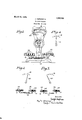
- Fig. 1 shows an automatic scale of a type suitable for use with my method.
- FIG. 4 shows a. modified form of chart.
- Thescale is of the even balance or equal arm type having two similar platforms or goods pans 10 and 12, a tare beain'lat provided with a poise 16, a graduated chart 18 and an indicator 20 cooperating with the chart.
- the chart is shown graduated to 100' units of weight which may be grams.
- the indicator normally points to zero on the chart when there are no goods on either platform or when both platforms carry the same loads.
- a plurality of empty containers 22 are placed on each of thepans 10 and 12.
- the same number of containers is placed on each pan, but that is not essential.
- the containers need not be of uniform weight.
- indicator 20 will probably not point to zero, and the next step in the process is to adjust tare poise 16 on beam 14 so that the indicator is at zero, and then the filling of the containers may begin.
- one of the containers on pan 10 is filled as at 24 which draws indicator 20 to the right until it points to 75 on chart 18, as in Fig. 2. W'e then know that that particular package contains 75 grams because the fact isindicated on the chart.
- one of the containers 26 on pan 12 is filled until the indicator is brought back to zero as in Fig. 3, and we know that package 26 contains 7 grams of commodity because indicator 20 has moved through an arc,indi-- eating 75 grams on chart 18.
- the operation is continued by filling packages alternately on pans 10 and 12 until all the packages on one of the pans are filled.
- weights of the containers themselves are not factors in the operation, that only one setting of the tare beam is necessary for a plurality of net weighments, and that each weighment is iiidicated on the chart.
- a container in either pan 10 or 12 may be first filled. This will draw the indicator to a point to the right or left of zero. If the indicator moves first to the left the filling of a package on the right platform will bring the indicator back to zero, and filling another package on the right will move the indicator to the predetermined point at the right of zero. Then the filling of a package on the left pan will bring the pointer to zero and the filling of a second package on the left will again move he indicator to the proper predetermined graduation on the left side of the chart.
- the zero mark on the chart is used as a convenient guide in visually noting the travel of the indicator, but to carry out my invention it is not absolutely necessary that the indicator be brought to zero by the tare beam or otherwise.
- the process may be carried out by noting the location of the indicator when the scale platforms are loaded with empty containers and then seeing that the indicator always travels the same proper distance to right or left which will insure all containers always receiving the same net weight of the commodity.
- I claim 1 The method of apportioning equal parts by weight of a commodity into a plurality of unequal weight containers. which consists of first placing a plurality of empty containers upon each platform of an even balance automatic scale, and then filling single containers on each platform alternately while gauging each filling operation by an observed displacement of the scale indicator which is equal for successive filling operations.
- the method of apportioning equal parts by weight of a commodity into a plurality of unequal weight containers which consists of first placing a plurality of empty containers upon each platform of an even balance automatic scale, next adjusting the scale indicator to zero. then filling a single container on one platform until the indi cater is displaced a predetermined distance from zero, then filling a single container on the other platform until the indicator is brought back to zero, and then repeating the above filling operation on alternate platforms.
- the method of apportioning equal parts by weight of a commodity into a plurality of unequal weight containers which consists of first placing plurality of empty containers upon each platform of an even balance automatic scale, and then filling single containers on one platform or the other while gauging each filling operation by an observed displacement of the scale indicator in one direction or the other, said indicator displacements being equal for successive operations.
Landscapes
- Physics & Mathematics (AREA)
- General Physics & Mathematics (AREA)
- Packages (AREA)
Description
March 20, 1928. 1,663,129
J. HOPKINSON WEIGHING METHOD Filed Feb. 19. 1926 I4 Qvweutoz 33 0 6 flbtovnm s O E Patented Mar. 20, 1928.
UNITED STATES JOSEPH HOPKINSON, 0F DAYTON, OHIO, ASSIGNOR TO DAYTON SCALE COMPANY, OF
PATEN FF C DAYTON, onro, A CORPORATION on NEW JERSEY.
WEIGHING METHOD.
Application filed February 19, 1826, SerialNo. 89,260, and in Germany October 23, 1925.
This invention discloses a new and improved method of using a certain type of automatic weighing scale to accomplish results which have heretofore been accomplished by other methods. In some industries, for instance, drugs or food-stulfs,it is customary to market 'the goods in even weight packages. The containers themselves vary in weight, but the net weight of the goods or commodity in each container must be accurate and uniform regardless of the variations of weight of the empty containers or packages. i
One method of accomplishing the above result has been to use an ordinary scale pro-, vided with a tare beam. Then each empty container is balanced by adjusting the tare poise until the scale indicator points to zero, after which the desired'net weight of goods is weighed into the package. This method is accurate, but slow and tedious as it re quires manipulation of the tare device for each package.
Another method which has been used with free flowing granular materials is to'automatically weigh the material in a hopper and then dump or pour it from the hopper into the container. This method is rapid but is subject to inaccuracies of weight due to variations in. the density or consistency of the material being handled and to obstruction of the gates or passages through which the material flows to the weigh hopper. This latter method also has the great disadvantage of not disclosing to the operator the weight of each package, wherefore hidden inaccuracies may occur which are not found until too late to rectify.
My method contemplates the use of an even balance automatic scale with a tare beam. The method provides the same accuracy as the method first described above with much of the speed of the second method. It also affords the operator a visual indication of the net weight in each container and thus avoids the great objection to the second method. Instead of having to set the tare poise for every separate package my method enables the operator to fill a plu rality of packages with a single setting of the tare beam, as will appear.
In the drawings,
Fig. 1 shows an automatic scale of a type suitable for use with my method.
Figs. 2 and are diagrammatic views illustrating different steps of the process.
'Fig. 4 shows a. modified form of chart.
Thescale is of the even balance or equal arm type having two similar platforms or goods pans 10 and 12, a tare beain'lat provided with a poise 16, a graduated chart 18 and an indicator 20 cooperating with the chart. I
For illustrative purposes the chart is shown graduated to 100' units of weight which may be grams. The indicator normally points to zero on the chart when there are no goods on either platform or when both platforms carry the same loads.
In carrying out my method a plurality of empty containers 22 are placed on each of thepans 10 and 12. Preferably the same number of containers is placed on each pan, but that is not essential. The containers need not be of uniform weight. When the scale pans 10 and 12 have been loaded with empty containers, indicator 20 will probably not point to zero, and the next step in the process is to adjust tare poise 16 on beam 14 so that the indicator is at zero, and then the filling of the containers may begin. Assuming that goods to weigh '75 grams are to be placed in each package, one of the containers on pan 10 is filled as at 24 which draws indicator 20 to the right until it points to 75 on chart 18, as in Fig. 2. W'e then know that that particular package contains 75 grams because the fact isindicated on the chart. Next, one of the containers 26 on pan 12 is filled until the indicator is brought back to zero as in Fig. 3, and we know that package 26 contains 7 grams of commodity because indicator 20 has moved through an arc,indi-- eating 75 grams on chart 18. The operation is continued by filling packages alternately on pans 10 and 12 until all the packages on one of the pans are filled.
It will be noted that the weights of the containers themselves are not factors in the operation, that only one setting of the tare beam is necessary for a plurality of net weighments, and that each weighment is iiidicated on the chart.
In one modification of the process chart 20 has its zero at the middle and is 'raduated both ways from'the middle (Fig. 4). \Vith such a chart a container in either pan 10 or 12 may be first filled. This will draw the indicator to a point to the right or left of zero. If the indicator moves first to the left the filling of a package on the right platform will bring the indicator back to zero, and filling another package on the right will move the indicator to the predetermined point at the right of zero. Then the filling of a package on the left pan will bring the pointer to zero and the filling of a second package on the left will again move he indicator to the proper predetermined graduation on the left side of the chart. When the Zero is at the middle of the chart, as above described, two packages may, if desired, be filled on one pan and then two on the other pan, whereas with the zero at the end. of the chart as in the drawings, containers must be filled on the two scale pans alternately.
I have described the preferred method of carrying out my invention but it should be understood that modifications of the method may be used. F or instance, if the weight of the individual filled package is small compared to the chart capacity, several of the packages on one platform may be filled one at a time and then several on the other platform, so long as the individual fillings are so distributed between the two platforms as to keep the indicator on a graduated portion of the chart, and so long as the fillings of all packages are gauged by equal displacements of the indicator.
The zero mark on the chart is used as a convenient guide in visually noting the travel of the indicator, but to carry out my invention it is not absolutely necessary that the indicator be brought to zero by the tare beam or otherwise. The process may be carried out by noting the location of the indicator when the scale platforms are loaded with empty containers and then seeing that the indicator always travels the same proper distance to right or left which will insure all containers always receiving the same net weight of the commodity.
I claim 1. The method of apportioning equal parts by weight of a commodity into a plurality of unequal weight containers. which consists of first placing a plurality of empty containers upon each platform of an even balance automatic scale, and then filling single containers on each platform alternately while gauging each filling operation by an observed displacement of the scale indicator which is equal for successive filling operations.
2. The method of apportioning equal parts by weight of a commodity into a plurality of unequal weight containers. which consists of first placing a plurality of empty containers upon each platform of an even balance automatic scale, next adjusting the scale indicator to zero. then filling a single container on one platform until the indi cater is displaced a predetermined distance from zero, then filling a single container on the other platform until the indicator is brought back to zero, and then repeating the above filling operation on alternate platforms.
3. The method of apportioning equal parts by weight of a commodity into a plurality of unequal weight containers. which consists of first placing plurality of empty containers upon each platform of an even balance automatic scale, and then filling single containers on one platform or the other while gauging each filling operation by an observed displacement of the scale indicator in one direction or the other, said indicator displacements being equal for successive operations.
In testimony whereof I hereunto aflix my signature.
JOSEPH HOPKIN SON
Applications Claiming Priority (1)
| Application Number | Priority Date | Filing Date | Title |
|---|---|---|---|
| DE1663129X | 1925-10-23 |
Publications (1)
| Publication Number | Publication Date |
|---|---|
| US1663129A true US1663129A (en) | 1928-03-20 |
Family
ID=7738621
Family Applications (1)
| Application Number | Title | Priority Date | Filing Date |
|---|---|---|---|
| US39260A Expired - Lifetime US1663129A (en) | 1925-10-23 | 1926-02-19 | Weighing method |
Country Status (1)
| Country | Link |
|---|---|
| US (1) | US1663129A (en) |
Cited By (4)
| Publication number | Priority date | Publication date | Assignee | Title |
|---|---|---|---|---|
| US3189109A (en) * | 1962-08-22 | 1965-06-15 | Blaw Knox Co | Weight compensating system for automatic net weighers |
| US3189108A (en) * | 1962-08-22 | 1965-06-15 | Blaw Knox Co | Weight compensating method for automatic net weighers |
| US3196963A (en) * | 1963-12-23 | 1965-07-27 | Pure Oil Co | Electrokinetic weighing apparatus |
| US3260321A (en) * | 1964-04-21 | 1966-07-12 | Fairbanks Morse Inc | Dual capacity scale with disengageable counterweight on load transmission rod |
-
1926
- 1926-02-19 US US39260A patent/US1663129A/en not_active Expired - Lifetime
Cited By (4)
| Publication number | Priority date | Publication date | Assignee | Title |
|---|---|---|---|---|
| US3189109A (en) * | 1962-08-22 | 1965-06-15 | Blaw Knox Co | Weight compensating system for automatic net weighers |
| US3189108A (en) * | 1962-08-22 | 1965-06-15 | Blaw Knox Co | Weight compensating method for automatic net weighers |
| US3196963A (en) * | 1963-12-23 | 1965-07-27 | Pure Oil Co | Electrokinetic weighing apparatus |
| US3260321A (en) * | 1964-04-21 | 1966-07-12 | Fairbanks Morse Inc | Dual capacity scale with disengageable counterweight on load transmission rod |
Similar Documents
| Publication | Publication Date | Title |
|---|---|---|
| JPS6366592B2 (en) | ||
| US5646375A (en) | Symmetrical load cells for use in conjuction with rotary machines | |
| JPS6161004A (en) | Continuous measuring method of continuous body | |
| US2699329A (en) | Counterweight for testing the scales of egg-grading machines | |
| US3474874A (en) | Weighing system | |
| US1885356A (en) | Method of weighing | |
| US20180058912A1 (en) | Weight measurement by flexure support | |
| US2316230A (en) | Dispensing scale with a needle moving over a scale and instantaneously indicating the weight in units | |
| US2484324A (en) | Three-bucket counting scale | |
| JPH0249448B2 (en) | ||
| US2130821A (en) | Weighing apparatus | |
| US3506078A (en) | Beam structure for multiple weighing systems | |
| US659830A (en) | Weighing and counting machine. | |
| US1136694A (en) | Percentage-scale. | |
| US1697942A (en) | Weighing scale | |
| US1896255A (en) | Le roy s | |
| US400400A (en) | gtjillaumin | |
| US396285A (en) | Xeill | |
| US1808799A (en) | Weighing batcher | |
| US1706976A (en) | Weighing scale | |
| US251087A (en) | Scale for weighing bushels | |
| US235723A (en) | Averaging-machine | |
| US588857A (en) | Inpaugh | |
| US673213A (en) | Computing-scale. | |
| US6194A (en) | Improvement in steelyards for weighing |