US1571994A - Process for the constructive conversion of hydrocarbons - Google Patents
Process for the constructive conversion of hydrocarbons Download PDFInfo
- Publication number
- US1571994A US1571994A US588848A US58884822A US1571994A US 1571994 A US1571994 A US 1571994A US 588848 A US588848 A US 588848A US 58884822 A US58884822 A US 58884822A US 1571994 A US1571994 A US 1571994A
- Authority
- US
- United States
- Prior art keywords
- gas
- oil
- temperature
- hydrogen
- hydrocarbons
- Prior art date
- Legal status (The legal status is an assumption and is not a legal conclusion. Google has not performed a legal analysis and makes no representation as to the accuracy of the status listed.)
- Expired - Lifetime
Links
Images


Classifications
-
- C—CHEMISTRY; METALLURGY
- C10—PETROLEUM, GAS OR COKE INDUSTRIES; TECHNICAL GASES CONTAINING CARBON MONOXIDE; FUELS; LUBRICANTS; PEAT
- C10G—CRACKING HYDROCARBON OILS; PRODUCTION OF LIQUID HYDROCARBON MIXTURES, e.g. BY DESTRUCTIVE HYDROGENATION, OLIGOMERISATION, POLYMERISATION; RECOVERY OF HYDROCARBON OILS FROM OIL-SHALE, OIL-SAND, OR GASES; REFINING MIXTURES MAINLY CONSISTING OF HYDROCARBONS; REFORMING OF NAPHTHA; MINERAL WAXES
- C10G47/00—Cracking of hydrocarbon oils, in the presence of hydrogen or hydrogen- generating compounds, to obtain lower boiling fractions
- C10G47/22—Non-catalytic cracking in the presence of hydrogen
Definitions
- This invention pertains to a process for the constructive conversion of hydrocarbons.
- the purpose is the conversion of the oil and l other materials treated into a hydrocarbon product of the type and gravity selected and predetermined.
- the materials used are crude petroleum or its heavy-gravity fractions, in conjunction with natural gas, overly rarcfied resultants of fractional distillation ⁇ artificial gases, preferably water gas or hydrogen, derived as ay product from superheated steam in contact with suitable metallic oxidizing reagents, or otherwise. Any of these may be used in combination, and with or without the addition of water or steam.
- the process contemplates operation with or without pressure, but a method is submitted for determining the proper coefficients of pressure and temperature requirer ments, dependent upon analysis of the-oil to be treated.
- the required heat for the operation is supplied preferably by superheating the gaseous material employed.
- the preferred method for accomplishing these results includes any kind of means for causing the various hydrocarbon compounds to'be hydrogenized at or above their points of molecular instability, and for withdrawing such part of the treated mass as has attained desired hydrogenization. The process continues treatment of the residue until total desired hydrogenization of the entire mass is effected.
- the process contemplates the vaporization of each differentiated compound of the oil mass, as its respective boiling-point temperature is attained, the amount of pressure utilized being sufficient to raise the boiling point to equal or exceed the temperature of molecular instability, whereby hydrogenization and molecular readjustment occur.
- any condition ot pressure and temperature, maintained in a suitable apparatus has its coetiicient in one of the series as the perfect balance for the condition developed. It will be found that the higher the temperature, the more raretied the coeiiciental compound. IVith properly adjusted conditions. and an available supply ot' needed elementsv ati'orded, equilibrium prevails, and the products are parafiine; disarrangemaschinenceit ot' these conditions produces the conglomerate of overraretication, carbon fixation, and heavy oletine percentages.
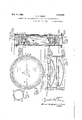
- Figure 1 is a diagrammatic View, mostly in cross-section, ot' an apparatus operative by the process and method presented herein.
- Figure 2 is a vertical section, showing part of the generator and tilmenting plates.
- Figure P is a plan'view, partly in horizontal section, looking down on the construc- -tioii shown in Figure 2.
- Figure i is a section on a smaller scale, showing the manner of assembling the fireclay wall sections.
- Figure 5 is a view, partly in section and partly in elevation, showing the entire geneiator.
- Figure 6 isa view, partly in cross-section and partly in elevation, showing the general assemblage of an apparatus for using water gas and crude petroleum, or its heavier fractions, for the manufacture conjointly ot' an enriched water gas product and a liquid hydrocarbon combustion fuel.
- the heater, A is supplied with any hydrogeucontaining gas, for instance natural gas, by means ot' the centrally located compressor, 2, at desired pressure.
- the gas is delivered at the top of the heater through the pipe, 3, and passes down through the coil system as shown.
- the small compressor, 4, to the left, is utilized for delivering water at a point adjacent to the delivery point of the gas within the top part of the heater, A, as shown. It the operation is conducted without the use of steam, the supply is closed in any suit-able manner by pets cock, for instance, as shown. There is generated a temperature, corrected to the pressure used, exceeding the degree of heat required for vaporizing the heavy hydrocarbons contained in the oil to be introduced into the apparatus for treatment.
- the exit pipe, 5, passes from the bottom-most part of the heater, A, and gives exit to the superheated gas under the pressure maintained.
- the exit pipe, 5, is controlled with a cut-otl valve, 6, and a combined, one-way valve and regulative pressure valve cock, 7, of any suitable character.
- the filmenting member, 8 is constructed of any suitable substantial material. It may be made of tire-clays, terra cotta, carborundum, metals, or other suitable materials. It may be of solid or hollow construction. In the design shown, it is hollow and of cast iron construction. It is equipped with a small hole, 30, centrally located in the dish-shaped side, 3l, to allow for equalization of ressureconditions.
- the member is cast in two pieces, such as are formed by a plane passing through the circumference and the center of' both the top and the lower dish shaped side.
- the two halves after being cast, are welded together at their like edges, constituting thereby the hollow, enclosed, dish-shaped figure, represented in the drawing by 8.
- a circular disk member 9, constructed of any suitable substantial material. In the design submitted, it is of cast iron.
- the disk is equipped with a central opening, 33, of such size as operating conditions require.
- This circular disk is of larger diameter than that ot the dish-shaped or filmenting part, sufficient to allou1 the circular-disk part to extend over and rest upon the insulating material, 34, within t-he shell, 35.
- Circular disk, 9. and the dish-shaped filmenting member, 8, are attached one to the other, having the intervening space, 36, of any suitable amount for working condition.
- the connection is made by any suitable means utilizing any material or materials.
- three metal blocks 37,lv for instance 8% X2 2 are placed on the-top of the dish-shaped member, 8, so that a line bi-sccting the length ot the blocks will coincide with a radius ot the upper or flat circular side ot' the dish-shaped part, 8, the three blocks being equidistant one from the other.
- the blocks are welded to the top surface of the dish-shaped member, and to the bottom surface ot the circular disk, 9.
- the insulating Wall, 34 may bc made in a number of pieces, four, for instance, as shown in Figure 4;.
- the circular disk, 9, When placed in position within the generator, and properly cemented together, the circular disk, 9, may rest upon the top surface so formed. The circular disk does not touch the shell of the generator.
- the top surface, 32, of the dish-shaped nicnilrer is lerel and parallel with the circular disk, 9.
- the oil When the oil, thus filmed, attains the circumference or rim of the top surface and flows onward, it does not fall downward, but, by adhesion, clings to the lower surface, 3l, ot the dish-shaped member.
- the member supports a fine Hlm of oil covering the surfaces on top and on bottom.
- Het, gas, entering from the central hole in the lower plate, 9, Figure 2 sustains intimate contact with thc oil film encasing the dish-shaped section, 8.
- Maximum intercourse follows, as the only course open for the gas to follow is around the edges and over the top surface 'ot the dish-shaped member.
- the only impediments encountered are the three 8 2 2 bars. 37, ioining the parts of the member.
- the function of this member is to produce maximum intimacy of Contact between the oil and gas.
- Heated hydrogen-containing gas is introduced into generator B, at the lower intake, 5, and proceeds constantly upward passing alternately through the central openings, 33,
- Crude petroleum is a conglomerate mass. lt is not homogeneous, but is a mixture of many hydrocarbon compounds. Each con-l stituent possesses distinctive characteristics, varying one from the other in boiling point, specific gravity. density, and temperature of non-stability. The mass is rendered further complex by carrying through absorption the most rarefied of gases, and by suspension some of the heaviest of the hydrocarbon group. Any laboratory analysis presents the large rangeof these differences.
- the condition developed is, that the oil" introduced t0 treatment on its -downward journey is subjected to ever-increasing gradation of temperature, and the gas in its ascendency is subjected to ever-decreasing temperature.
- the oil thus experiences a gradual, yet ever-increasing temperature. 'When any one of the differentiated hydrocarbons of the oil encounters its boiling point temperature, it is vaporized, and as a vapor is relieved from further heat condi- 'ments and insu'licient for others.
- the last shown table includes a list of pressure coefficients by which the boiling temperatures of the compounds are elevated to the temperature of instability.
- Pressure is regulated to raise the boiling point of the lightest compound to its temperature of instability, so that the vapor is unstable. This heat Will exceed t-lie instability tempeiature of all other fractions of the oil, rendering them unstable.
- the pressurefcondition is established by the pounds per inch needed to cause the lightest' compound to unstabilize before vaporizing.
- the temperature condition is established by ascertaining a new boiling point forV the compound requiring the greatest heat tol vaporize, under pressure conditions thus established.
- the oil mass starts downward Ytroni its inlet, ltl. maintaining a state ot' line lilmentation in the presence ola the superheated gases introduced ai the eas intatte. I, at the bottoni ol the generator.
- Each successivelvT heavier compound attains greater penetration ot the generator. Attainment ot' each respective boiling' point temperature vaporizes the particular coinpound, and insures its release :trom temperature in excess ot that required. As a vapor, the oil rises to cooler zones. The results, successively. are instability, vaporization, and hydrogenization.
- Such vapors can only be. gasoline vapors of the preselected, average grade, or lighter elements, with lower boiling points.
- any of the oilvintroduced' may be composed of such heavy constituents and impurities as not to vaporize
- a tank, 16, below for containing such liquid. The same is drained through the pipe, 17, and cut-off valve, 18.y ln the event of it being desired to produce gas released from pressure, supplementedby water, as4 the agencies.
- the vaporous products delivered into pipe, 14, are refrigerated to atmosphere or below, so that the vapors are converted into a liquid to the extent of their capacity to assume such form. They are delivered at the terminus, 20, in the collecting tank, D.
- the gas ⁇ having discharged its refrigeration functions, is then conducted from exit 22, to the gas holder, of ordinaryconstruction,v not necessary to be shown.
- water may be supplied to the tank, C, through pipe 23, tindingexit through pipe 24.
- the container, D, Figure 1 the fourth element, scarcely needs description, as it consists simply of a tank constructed for the purpose, amply strong to withstand therequired pressures. It is equipped with double discharge valves, 25-26, as in case steam has been used 1n the operation, quan- ⁇ tities of water will .settle to the bottom.
- the container, D, Figure 1 the fourth element, scarcely needs description, as it consists simply of a tank constructed for the purpose, amply strong to withstand therequired pressures. It is equipped with double discharge valves, 25-26, as in case steam has been used 1n the operation, quan- ⁇ tities of water will .settle to the bottom.
- the compressor, 2 receives its gas supply from megas-holder (not illustrated).
- any hydrogreircontaining gas for instance, natural ⁇ trasforerly raretied products o't' tractional distillation, or other refinery processes; artificial gas, particularly water gas, containing upwards of titty per cent, by volume. in hydrogen; free hydrogen as a, derivatiye. ⁇ for instance, ot sul'ierheated steam in contact with metallic, oxidizing reagents, or otherwise.
- the remaining parts of the apparatus consisting ot gas super-heater. condensation coils. reception tank for product delivered ⁇ and gras-holder, are merely adjuncts ne ⁇ ersarv to the operation ot' the generator, and may be o't ⁇ any suitable type.
- cracking' is a term applied to a process involving' an active state ot' a heated oil mass, in which pronounced disis in progress. l ⁇ he scope ot the nord, in some instances, has been cnlarped to include the products et the procrare carbon depositing', and lower speeitic gravity the residue. 'the procese submitted is not cracking.
- the cracking proce f is the disineinherment ot the heavy tor the hydroeenization etfthe lighter, the actire agency lying in the disineniberment in cracking. .tu the procesa iu'eseuted. .hydrogenization is otherwise provided to the unstable molecule1 and the essence is not to craclt ⁇ instability,
- Generator B is incorporated between the gas generator and superheater of the ordinary sets, U. G. I.-Wilkinson and ⁇ others.
- the heated gas from the gas generator is delivered at the bottom of generator- B, and the oil to be used for enrichment purposes at the top, through pipe 10. No pressure is required.
- the vaporized oil and gas intro'- quizd enter the superheater of the set through pipe 14, Where fixation occurs.
- fvhydrogen-containi11g gas as used herein means a gas or vapor in which hydrogen is occurrent either in a free state or in chemical combination.
- the process presented will bereterred lo iu the claim as constructive conversion be cause by its use hydrocarbon compounds are converted into others by a constructive,
- carbon deposit as used means carbon as deposited bv molecular dismemberment or cracking of the hydrocarbon compounds.
- Y Y In the phrase a process for the constructive conversion of hydrocarbons of higher boiling points and hydrogen containing gases into liquid hydrocarbons of lower boiling points the Words hydrocarbons of higher boiling points and hydrocarbons ot lower boiling points, both refer to hydrocarbons which are liquid at atmospheric pressure and temperature.
- substantially homogeneous product does not mean that the compounds of the hydrocarbon product shall have the same boiling points.
- I refer to Asuch a product as commercial gasoline as a substantially homogeneous product, although some of its constituent compounds have boiling points as low as approximately 100O and others as high as approximately 280. y
- the thickness of'vthe oil ilmsin the apparatus will be determined by the viscosity of the oil. as will readily ⁇ be understood.
- exits are provided in the upper part for the gaseous, and inthe lower part for the liquid materi- ⁇ -als.
- the process described herein and the apparatus as shown in ⁇ Figures l, 2, 3, 4, and f5 maybe operated for the purpose of manu- ECuring, in a single operation, both a heat- Iin and illuminating gas for commercial use, 'an aliqiiid hydrocarbon of predetermined character.
- Filmed oil and heated gas are afforded contact in the carburetor, and the resultant 4vapors and gases are conveyed to a super- .-.heater for fixation.
- clement E is a water-gas generator, of any type. consisting of a steel shell, 30, insulated with any suitable material, 3l, having a tire-grate, 32.
- the charge of coal, or coal and coke, is deposited on grate 32, and ignited, and air in coinparatlvely large volume is forced through opening, 67, causing a rapid and hot burning of the coalcharge.
- Pipe 33 conveys the exhaust heat from the water-gas generator, E, into and through superheater F, and thence through stack 34.
- Superheater F is a shell made of steel, or other suitable material,35, with suitable insulation, 36.
- the interior of F is filled with checker-brick or brokentile, or vwith other suitable material for heat absorption.
- valve 38 is closed.
- the steam passing through the ignited coal, or coaland colte gives up its oxygen to the carbon present, producing a gaseous result
- Inlet 4l is provided for reversing the steaming charge.
- steam-inlet 37 is closed, and steam-inlet 4,1 is open, causing the steam to proceed downward through the fire-bed and through exit pipes 42, and 40, into the bottoni-most part of element B.
- Stop-cocks 43 opened and closed for directing the water gas produced through pipe 40, dependent upon whether the steam-charge is delivered above or below the grate, u Element B consists of an outer shell, 45, insulated with any suitable material, 46, and filled within with any suitable means for oil filming: chcckcr-briclrl broken tile, or otherwise, but preferably-with a vertical series of dish-shaped members, as described in Figures i2, 3, 4. and 5.
- Oil suppliei'lthrough inlet-pipe, 10 is thus counter-flowed within element B against the heated water-gas delivered through pipe 40.
- element B The hottest part of element B is at the bottom. the coolest pait at the top, hence as the oil delivered through pipe l() progresses downward, constantly acquiring additional ten'ipcraturc, its respective constituting hydrocarbon compounds are vaporized as the required hoiling-l'ioint temperatures are encountered. Thus, there is delivered atv the bottom of a dephlegmating device, element G, the emanating hydrocarbon gases and vapors.
- Element G consists of a coil, 47, of suitable material, containing within, the gaseous material emanating through pipe 1l, element B. -the coil being surrounded with vapor state at the regulative exit temperature, return downward through coil, 47, ele- 39 and 40, into the bot-- and 44 are respectively ment G, and thence into element B, where revaporization occurs. All such compounds as maintain a state as gas or vapor at the selected exit-'temperature established in. element G, pass through pipe 48, into coil 49, element H.
- ⁇ Element H is a condenser, consisting of an outer shell, 50, and containing coil 49, made of any suitable material, the coil being surrounded by relatively cool liquid.
- Element I is a receiving tank for the liquid and gaseous ⁇ resultants of the dephlegmator, G, and condenser, H. It consists of a shell, 52, of any suitable material.
- the gaseous material thusascends through the heated checker-brick construction, where gas fixation occurs, and the gas is discharged as a permanent gas through pipe 54, which conducts the gaseous product, through suitable scrubbing and-purifying tanks, and refrigeration apparatus, to a gas-holder of any suitable construction, not shown in the drawing.
- Valve 55, element F. is closed when ignition is in progress of the coal-charge on grate 32, Figure E, or blowing period, and is automatically7 opened during the steaming or gas-making period.
- the liquid material deposited in the bottom of receiving tank, I. is delivered through pipe 56, by use of a small pump. 68. into the top of the condensing member, H.
- Thel liquid fills the space 1n condenser H inter-- vening between lthe encompassed coil and the walls of the member.
- the liquid then flows over through pipe 57, into the dephlegmating member; Gr.
- the liquid.thus contained within members G and H is redistilled, ,and as a vapor passes through pipe 58 into condenser K, through coil 59, and finds exit at the coil terminal, 60, from which it is conducted to storage tanks.
- the cooling vmedium employed in condenser K is water, which is supplied at opening, 62, and afforded egress through opening, 61
- a supplementary water-cooler-condenser may be added below and as a continuation of Element H, Figure 6.
- a second water-gas generator, element E, Figure 6 may be installed, and the two so operated that while one blows, the other steam's, effecting thereby 'non-intermittent delivery of water-gas.
- the delivery of superheated gas from element E, to element B may be supplemented by passing gas from the as-container (not shown) through a super eater, and yintroducing the gas into element B.
- Any suitable method for preheating the oil introduced, or increasing available tem'- peratures by any suitable means, and for scrubbmg, purifying or redistilling of any of the products, may be employed.
- Boil-Over 400-500, 20%; 500-G00, 42%; 600-700, 30%.'
- a process conjo-ntly enriching Water-gas, and reducing the specific gravity of liquid hydrocarbons, which consists in counterflowing relatively cool liquid hydrocarbons, against heated water-gas, in intimate contact, Within a conined space, and so regulating conditions of temperature and pressure that part of the water-gas is caused to combine with the liquid hydrocarbons, and parts of the liquid hydrocarbons are caused to combine with the hydrogen of the Water-gas, thus increasing the ratio of hydrogen in the liquid hydrocarbons, and causing the introduction of carbon in chemical union with hydrogen into the artificial gas, and so conditioning the operation that the enriched gas and the vaporized, hydrogenized liquid hydrocarbons may be withdrawn, passed through a condenser, whereby the liquid hydrocarbon vapors are liquid from the enriched water-gas, and both products made available.
- a process for conjoingly enriching water-gas, and converting petroleum fractions heavier than the gasoline series, into hydrocarbons of reduced gravity, which Iccnsists in introducing crude petroleum' or its heavier fractions, and het. water-gas, into a materials are With-I coniined space, in which the o'l experiences constantly increasing temperature, and the gas and vapors experience constantly decreasing teniperatures, and establishlng a state of sufficient molecular instability to permit hydrogen to enter into the Vliquid hydrocarbon, and hydrocarbons to combine with the hydrogen of the water-gas, and so conditioning exlt requirements that onl5Y gases and vapors possessing boiling points less than a selected' exit temperature, may escape.
- a process for conjointly enriching water-gas, and manufacturing gasoline which consists in commingling in a confined space, hydrocarbons in liquid and vapor states, and Water-gas, filming the liquid hydrocarbons and administering heat thereto through the medium of hot Water-gas, under regulations of temperature and pressure so that suiiicient molecular instability is established for part of the hydrogen contained in the Water-gas to combine with the introduced liquid hydrocarbons," and part of the introduced-liquid hydrocarbons to combine vvith the hydrogen of the Water-gas, and preventing cracking or dismemberment of the liquid hydrocarbons through' their intimate contact With the hydrogen of the gas, and so regulating exit conditions that only a predetermined grade of gasoline vapor, and the enriched Water-gas, may escape. 6.
- a process for adding hydrocarbons to a hydrogen-containing gas ⁇ and adding hydrogen to liquid hydrocarbons of higher boiling ,.points which consists in establishing within a confinedspace a counterlow of heated hydrogen-containing gas, againstv relatively cool oil filmed to lIineness, so that the oil lflows into increasing temperatures and the gas and vapors into decreasing temperatures, yand through regulation of heat.
- a process for adding hydrocarbons to a hydrogen-containing gas, and adding hydrogen to liquid hydrocarbons of higher boiling points which consists in bringing together in a confined space, an oil, a hydrogen-containing gas, and hydrocarbon vapors, so that intimate contact is established between the oil and the gaseous material, and counterflowing the gas and oil, with heat and pressure conditions so adjusted that the oil in liquid form experiences constantly increasing temperature, and the gas and vapors experience constantly decreasing temperature, the degree of heat and the amount of pressure being so adjusted and supplied that the boiling points ot the liquid compounds are retarded to equal or exceed a temperature at which inter-atomic activity is sutliciently accelerated to cause molecular readjustment and the addition of hydrogen to the liquid hydrocarbons, and the addition of hydrocarbons to the hydrogen-containing gases, without permitting dismemberment or cracking of the oil compounds, and then withdrawing the enriched gas and substantially homogeneous hydrocarbon vapors.
- a process for adding hydrocarbons to a hydrogen-containing gas, and adding hydrogen to liquid hydrocarbons of higher boiling points which lconsists in establishing in a confined space, the presence of hydrogen-containing gaseous material, and non-gaseous hydrocarbons, and successively and continuously heating each compound of the non-gaseous hydrocarbons to a temperature ot molecular instability by regulation ot' heat and pressure conditions, and maintaining intimate contact between the gaseous and non-gaseous materials, so that sufficient temperature is attained, Without molecular dismemberment or cracking of the oil, to effect the incorporation of hydrogen into the non-gaseous material, and the incorporation of hydrocarbons into the gas, by establishing sutiicient molecular instability to permit molecular readjustment, thus lowering the boiling points ot' the non-gaseous compounds and increasing the thermal value of the gas, and causing through resultant vaporization of the oil,'contact by the oil vapors with decreasing temperature, and so conditioning the operation that substantially the entire volatile, non
- a process for converting liquid hydrocarbons and hydrogen, into liquid hydrocarbons of'reduced boiling points and gaseous hydrocarbons which consists in 'establishing intimate contact, within a confined space, between liquid hydrocarbons and hydrogen, under such heat and pressure conditions as to cause a state of sutlicient molecular instability as to canse part of the hydrogen to combine with the liquid hydrocarbon compounds, and part of the li uid hydrocarbons to combine with the hyt rogen, through resultant molecular readjustment, in such manner that the molecules constituting the liquid hydrocarbons are notpermitted to become dismembered or cracked, and exit conditions so regulated that escape is denied exceptin@r to gases and vapors not exceeding in boi ing points a predetermined temperature.
Landscapes
- Chemical & Material Sciences (AREA)
- Oil, Petroleum & Natural Gas (AREA)
- Engineering & Computer Science (AREA)
- Chemical Kinetics & Catalysis (AREA)
- General Chemical & Material Sciences (AREA)
- Organic Chemistry (AREA)
- Production Of Liquid Hydrocarbon Mixture For Refining Petroleum (AREA)
Description
Feb 9 1926.
` H. R. BERRY PRocEss FORr THE coNsTRUcTIvE CONVERSION oF HYDRocARBoNs VFiled sept. 18. 1922 {Reis-sheet 1 kt@ we@ VEN TOR.
MU amd-Lw A TTORNE Y.
Feb. 9 1926.
H. R. BERRY PROCESS FOR THE CONSTRUCTIVE CONVERSION OF HYDROCARBONS Filed Sept. 18, `1922 3 Sheets-Sheet 2 ,Skin NWS,
ATTORNEY.
Feb. 9 1926.
H. R. BERRY PROCESS FOR T-HE CONSTRUCTIVE CONVERSION OF. H YIIJROCARBONS Filed sept. 18, 1922 3 sheets-sheet 5.
mmm
SW inta* mm 6% NVENTOR..
W @Wd Wa/M ATTORNEYJ.
Patented Feb. 9, 1926.
UNITED STATES PATENT OFFICE.
HAROLD R. BERRY, OF BROOKLYN, NEW YORK.
Application filed September 18, 1922. Serial No. 588,848.
To all whom it man concern Be it known that l. HAROLD R. BERRY, a citizen of the United States, residing at Brooklyn, in the county of Kings and State of New York. have invented certain new' and useful Improvements in a Process for the Constructive Conversion of Hydrocarbons, of which the following is a full, clear, and exact description, such as will enable others skilled in the art to which it appertains to make and use the same.
This invention pertains to a process for the constructive conversion of hydrocarbons. The purpose is the conversion of the oil and l other materials treated into a hydrocarbon product of the type and gravity selected and predetermined.
Essential differentiation is claimed from fractional distillation. and the practiced methods of oil cracking. v
The materials used are crude petroleum or its heavy-gravity fractions, in conjunction with natural gas, overly rarcfied resultants of fractional distillation` artificial gases, preferably water gas or hydrogen, derived as ay product from superheated steam in contact with suitable metallic oxidizing reagents, or otherwise. Any of these may be used in combination, and with or without the addition of water or steam.
The process contemplates operation with or without pressure, but a method is submitted for determining the proper coefficients of pressure and temperature requirer ments, dependent upon analysis of the-oil to be treated.
The required heat for the operation is supplied preferably by superheating the gaseous material employed.
In carrying out the invention,-the liquid v product.
isy gradually, though coning of varidus substantially different hydrocarbon compounds in heterogeneous relationship and their readjustment into a predetermined and selected hydrocarbon product, which for all commercial purposes is substantially uniform or commercially homogeneous.
The preferred method for accomplishing these results includes any kind of means for causing the various hydrocarbon compounds to'be hydrogenized at or above their points of molecular instability, and for withdrawing such part of the treated mass as has attained desired hydrogenization. The process continues treatment of the residue until total desired hydrogenization of the entire mass is effected.
It is preferred to accomplish this result by utilizing a pressure, temperature and gravity Zone of such character that it will not receiveand pass hydrocarbon products until they have been reconstituted into a state which is commercially uniform or substantially homogeneous.
The process contemplates the vaporization of each differentiated compound of the oil mass, as its respective boiling-point temperature is attained, the amount of pressure utilized being sufficient to raise the boiling point to equal or exceed the temperature of molecular instability, whereby hydrogenization and molecular readjustment occur.
As each succeeding compound attains vaporization, it ceases to follow the direction of the oil, but counter-Hows, as vapor, with the hydrogenous, gaseous material lused in` the operation, and encountersfconstantly `cooler temperature zones. f 4 f rl`he ultimate and coolest'ftemperaturehis regulated Vand maintained at the boiling point of the selected and Such compounds o the oil mass as are not sufficiently hydrogenized .during 'vaporizatiom liquefy and How with the oil mass, and undergorevaporization. lThe process continues until attainment of exit" conditions is met, when escapement follows.
The operation of the process will be de- I scribed in connection with the production of redetermined i mit Compound. Hydro B. I.C Sp. gr
gen
Nonodecane Cn H40 14. 93% 330 777 (')ctodecane C13 Ha. 14. 96 317v .7705 Heptadecane C11 Ha.. 15.00 303 77 Hexadecane Cw Hai 15.04 287. 5 7758 Pentadecane C15 II; 15.09 270 .7756 'Ietradecane Cu H30 15.15 252 7754 Trdecane C15 112g.- 15. 22 234 .775 Dodeeaue Cn Ilan- 15. 29 214 7745 Undecane C11 Hu .38 194 l .774
One pound of carbon occurrent in tridecane isv incorporated with .1795 pounds of hydrogen.
One pound ot carbon occurrent in hexane is incorporated with .1943 pounds of hydrogen.
Both are paratiine.
Both are termed saturated.
Discussion which departs from customary usage of the Word, saturation, I find may not be had at this time and under these circumstances, but I quote from Richters Organic Chemistry, 1922 edition, published by P. Blakistons Son & Co., vol. 1, page 68,
They (carbon compounds) are further classified into saturated and unsaturated compounds. In the first of these, called also limit compounds or paratiins, the directly united quadrivalent carbon atoms are linked to each other byva single bond, so that the number of affinities still remaining to be satisfied in a chain of fn, carbon atoms is 2-1-2. Their general formula is, therefore, expressed in the form CnXwz, Where X represents the affinities of the elements or groups directly combined with carbon.
In increasing the hydrogen content of the paraine and thereby reducing its gravity and boiling point, the problem is not that the carbon content has assimilated all the hydrogen chemically incorporatable with the amountof carbon present. The requirement is to unstabilize the single bond union of the paratiine through inter-atomic activity produced by the proper coeicient of heat and pressure. f
6. The relationship between hydrogen content, boiling point, and speciic gravity o f the parafiines has been noted. The infinitesimal increase of hydrogen content in each succeeding compound of the series, in the direction of methane, has been shown.
It may now be stated that any condition ot pressure and temperature, maintained in a suitable apparatus, has its coetiicient in one of the series as the perfect balance for the condition developed. It will be found that the higher the temperature, the more raretied the coeiiciental compound. IVith properly adjusted conditions. and an available supply ot' needed elementsv ati'orded, equilibrium prevails, and the products are parafiine; disarrangenieiit ot' these conditions produces the conglomerate of overraretication, carbon fixation, and heavy oletine percentages.
It is not contended, necessarily, that the paratiine compound is directly hydrogenized into lighter members of the series. It is altogether probable that the ascent is brought about by a number of reactions. Moieculai instability, brought about by the heat and pressure conditions, may be followedby the occurrence of olctine, chain, and other non-parafline structures. Such series, however, being comparatively unstable at best,rapidiy saturate into the lighter paratfines.
Description of /fc apparatus and tzons.
In the accompanying drawings:
, Figure 1 is a diagrammatic View, mostly in cross-section, ot' an apparatus operative by the process and method presented herein.
Figure 2 is a vertical section, showing part of the generator and tilmenting plates.
Figure P) is a plan'view, partly in horizontal section, looking down on the construc- -tioii shown in Figure 2.
Figure i is a section on a smaller scale, showing the manner of assembling the fireclay wall sections.
Figure 5 is a view, partly in section and partly in elevation, showing the entire geneiator.
Figure 6 isa view, partly in cross-section and partly in elevation, showing the general assemblage of an apparatus for using water gas and crude petroleum, or its heavier fractions, for the manufacture conjointly ot' an enriched water gas product and a liquid hydrocarbon combustion fuel.
its fu'ncheater. The heater, A, is supplied with any hydrogeucontaining gas, for instance natural gas, by means ot' the centrally located compressor, 2, at desired pressure. The gas is delivered at the top of the heater through the pipe, 3, and passes down through the coil system as shown. The small compressor, 4, to the left, is utilized for delivering water at a point adjacent to the delivery point of the gas within the top part of the heater, A, as shown. It the operation is conducted without the use of steam, the supply is closed in any suit-able manner by pets cock, for instance, as shown. There is generated a temperature, corrected to the pressure used, exceeding the degree of heat required for vaporizing the heavy hydrocarbons contained in the oil to be introduced into the apparatus for treatment. The exit pipe, 5, passes from the bottom-most part of the heater, A, and gives exit to the superheated gas under the pressure maintained. The exit pipe, 5, is controlled with a cut-otl valve, 6, and a combined, one-way valve and regulative pressure valve cock, 7, of any suitable character.
There is thus discharged in the bottom of the second apparatus, l, the heated gas, which ascends through the fillnenting construction of the generator. Figures 2, 3, 4, 5, are generator B in greater detail than shown in Figure 1.
In Figure 2 the filmenting member, 8, is constructed of any suitable substantial material. It may be made of tire-clays, terra cotta, carborundum, metals, or other suitable materials. It may be of solid or hollow construction. In the design shown, it is hollow and of cast iron construction. It is equipped with a small hole, 30, centrally located in the dish-shaped side, 3l, to allow for equalization of ressureconditions.
.In this construction the member is cast in two pieces, such as are formed by a plane passing through the circumference and the center of' both the top and the lower dish shaped side. The two halves after being cast, are welded together at their like edges, constituting thereby the hollow, enclosed, dish-shaped figure, represented in the drawing by 8.
As constituting another part of the unit, there is a circular disk member, 9, constructed of any suitable substantial material. In the design submitted, it is of cast iron.
The disk is equipped with a central opening, 33, of such size as operating conditions require. This circular disk is of larger diameter than that ot the dish-shaped or filmenting part, sufficient to allou1 the circular-disk part to extend over and rest upon the insulating material, 34, within t-he shell, 35.
Circular disk, 9. and the dish-shaped filmenting member, 8, are attached one to the other, having the intervening space, 36, of any suitable amount for working condition. The connection is made by any suitable means utilizing any material or materials.
In the construction illustrated, three metal blocks, 37,lv for instance 8% X2 2, are placed on the-top of the dish-shaped member, 8, so that a line bi-sccting the length ot the blocks will coincide with a radius ot the upper or flat circular side ot' the dish-shaped part, 8, the three blocks being equidistant one from the other. Thus placed, the blocks are welded to the top surface of the dish-shaped member, and to the bottom surface ot the circular disk, 9.
In installing the unit, the insulating Wall, 34, may bc made in a number of pieces, four, for instance, as shown in Figure 4;. When placed in position within the generator, and properly cemented together, the circular disk, 9, may rest upon the top surface so formed. The circular disk does not touch the shell of the generator.
The. space, 38, between the circumference of. disk, 9, and the shell, 35, provides room for expansion and contraction under the heat conditions maintained; the space thus remaining is filled with suitable packing, 38. In a series, these units are placed one upon top of the other, each unit supported by the insulating wall, Figure 5.l
The top surface, 32, of the dish-shaped nicnilrer is lerel and parallel with the circular disk, 9.
In operation, oil delivered upon the upper level surface of the dish-shaped member will spread with maximum slowness, because of no declevity, to the circle forming the boundary ot the circular area.
When the oil, thus filmed, attains the circumference or rim of the top surface and flows onward, it does not fall downward, but, by adhesion, clings to the lower surface, 3l, ot the dish-shaped member. Thus the member supports a fine Hlm of oil covering the surfaces on top and on bottom.
Het, gas, entering from the central hole in the lower plate, 9, Figure 2, sustains intimate contact with thc oil film encasing the dish-shaped section, 8. Maximum intercourse follows, as the only course open for the gas to follow is around the edges and over the top surface 'ot the dish-shaped member.
The upward push of the gas is as upon a roof. Such film disturbance `as is caused bv the onward rushing of gas. which results in dripping. causes precipitation upon the upward surface of plate, 9, Figure 2.
The only impediments encountered are the three 8 2 2 bars. 37, ioining the parts of the member. The function of this member is to produce maximum intimacy of Contact between the oil and gas.
There is supplied at the top of the generator, B, through pipe, 10, Figure l, the o il delivered for treatment. The pipe 1s equipped with one-way cock, 11, and the oil supply is delivered by compressor, 12. Oil, thus delivered, passes in a state of vfine filmentation from ilmenting member to (ilmenting member in its downward journey.
Heated hydrogen-containing gas is introduced into generator B, at the lower intake, 5, and proceeds constantly upward passing alternately through the central openings, 33,
vin the disks, 9, and then encompassing the film of oil around and about the filmenting member, 8. over its top surface and through the next higher central opening, 33.
Operation presents certain considerations. Crude petroleum is a conglomerate mass. lt is not homogeneous, but is a mixture of many hydrocarbon compounds. Each con-l stituent possesses distinctive characteristics, varying one from the other in boiling point, specific gravity. density, and temperature of non-stability. The mass is rendered further complex by carrying through absorption the most rarefied of gases, and by suspension some of the heaviest of the hydrocarbon group. Any laboratory analysis presents the large rangeof these differences.
Introducing heated gas at the lower intake, 5, and introducing oil to be treated at the upper intake, 10, the oil proceeds downward, encountering the filming construction, and the heated gas rises in a close-contact. counter-flow.
It is evident that with oil thus journeying downward with an initial, comparatively cool temperature, and with hot gas thus journeying upward, the farther downward the oil travels, the greater is the quantity of gas with which it has had contact. Contrarif wise. the greater elevation attained by the gas, the. greater is the quantity of oil with which the gas has had contact. The farther. the oil journeys, therefore, the greaterbecomes its temperature.
`With the gas, the higher it rises, the more heat it has imparted, and the cooler it becomes. It thus results that in operation, the coolest part of the generator is at the top, the hottest at the. bottom, the two temperatures graduating into each other throughout the vertical length of the apparatus.
The condition developed is, that the oil" introduced t0 treatment on its -downward journey is subjected to ever-increasing gradation of temperature, and the gas in its ascendency is subjected to ever-decreasing temperature. The oil thus experiences a gradual, yet ever-increasing temperature. 'When any one of the differentiated hydrocarbons of the oil encounters its boiling point temperature, it is vaporized, and as a vapor is relieved from further heat condi- 'ments and insu'licient for others.
tion as it joins the upward stream of gas into cooler zones.
Thus, as it were, each compound in the oil mass is afforded the opportunity to choose its needed temperature for vaporization, and
in this sense the operation might be termed selective distillation.
lVere it possible, in al1 instances, for the temperature which produces suilicient molecular activity to vaporize an oil, to be sufficient also to intensify inter-atomic agitation to the point of instability of the molecule, the act of vaporizing, in the presence of hydrogen-containing gases, would result in hydrogen incorporation and reduction of specific gravity. However, certain com'- pounds, later mentioned, at vaporization temperatures exhibit so slight an increase of inter-atomic movement as to be insufficient for rapid hydrogenization.
The primary necessity is to unstabilize the paraiiine, so additional hydrogen may be assimilated, and this must be accomplished with an apparatus suiiiciently sensitive to adapt itself to the varying requirements of the different compounds making up the oil undergoing treatment. Customarily, it is said that a process operates with so much temperature and so much pressure, and to the question as to why the particular temperature and the particular pressure are chosen, the answer is that best results are found to obtain under such conditions.
The fact is, however, that because of the heterogeneous character of the constituting compounds of a petroleum mass,l` there can be no uniform condition to satisfy such widely differentiated requirements. At best, any single condition can be but an average, and in this, it is too great for certain require- The customary procedure is to give it the maximum requirement and let it go at that.
,The table following is presented as the solution of our problem. In it will be found molecular weights, vaporizationtemperatures (boiling points), and temperatures of molecular instability.
lThe last of these is the degree of heat at which the strings of attraction vbetween the atomic constituents, making the hydrocarbon molecule, are strained to a point of non-equilibrium. It is the critical temperature for hydrogen absorption and molecular readjustment, the most favored condition for gravity reduction.
Carried to excess, however, with violent and ill-adjusted excess of heat, the atomic constituents break asunder, even as the molecules separate in the process of vau porization. This excess results in over-rareication and carbonization.
: 12a: 'ma om frFrance/w51 ll: is observnble that in hexane (17H16, a. Amisoline compound, 2090 l". (boiling point),
F. (instability leiniieratnre), tetrnileenlne Cul-i ly a. gaie oil compound i860 (boiling poinli), 570 (instability leinperzv iure), the low boiling' point i; .ieeonipnnied 'willi high iniiinbilit'y ieniperntnre; likewine in nnileesine CHHM, n kerosene co1npound, 381D (hoilinnin poinli), (rl-2O (instzibiliiy emperninre), nonoileenne CNHW n 'zel oil compound, 612Go (boiling point), M50 (insinbilily temperature).
sequence. observable in this: the lower the boiling poin, the higher the temperature ol instability; the higher the boiling poinl, the lower the temperature ol instubility. The reason 'for this seems lo lie in the hiet that the inierlnoleenlm' Contact is more intim-nie in the heavy compounds than in the light, und the transfer of energy produced by heat, is; more eleetnally meile through the instrumentality of heavy mass.' than with the lighter construction o'l slight coinpnrniye density. The curve of thin relationship is snperposed as follows:
The curves cross between pentadecane, b. p. 518o F., and hexadecane, b. p. 550. All lighter compounds possess lower boiling points than temperatures of instability; all heavier compounds are vunstable before attaining boiling point.
'The last shown table includes a list of pressure coefficients by which the boiling temperatures of the compounds are elevated to the temperature of instability.
The enormous pressures indicated for the rst few compounds of the series are all within the gasoline group. They are set forth simply to show the intensity of the parabolic curve. No operation, of course, is contemplated for the hydrogenization of these compounds. The lightest of the family for which treatment by the sub# mitted process is considered, would be decane, which is the lightest of the kerosene series.
The method for arriving at temperature and pounds pressure requirements for operation of the system and apparatus sub mitted, is: v I
Determine first the character of oil to be treated, by simple laboratory boil-over and condensation test; carry the percentages to an approximate dry. Compute tables of ready reference as above. Estimate the pressure needed to elevate the boiling point of the lightest component of the oil to a temperature equalling the temperature of instability for the particular compound. All compounds heavier than the lightest oc'- current in the oil, Will have lower tempera-v tures oit-instability. The result is, that. with the establishment of a pressure which causes the lightest component to become unstable before vaporizing, this will effect instability in all components prior to theirl vaporization.
ln case of extremely heavy petroleums, or refinery residual oils, if their boiling point. is above 525 degrees F., no pressure Whatever is needed. because it has been shown that compounds possessing such a boiling point and over, attain the state of instability prior to boiling.
The purpose. of this regulation, as is apparent consists in establishing conditions so that when the oil vaporizes, it vaporizes in a state of non-stability, in which condition it is susceptible to molecular readjustnient and the incorporation of the heat-im parting and surrounding hydrogen-carrying gases. Y
In addition to the tabulated information for calculating pressure and ten'iperature requirements, is needed a table of saturated steam coeficients, contained in Kent or any other pocket manual. rThe reason is this:
Pressure is regulated to raise the boiling point of the lightest compound to its temperature of instability, so that the vapor is unstable. This heat Will exceed t-lie instability tempeiature of all other fractions of the oil, rendering them unstable.
But the pressure which raises the boiling point of the lightest. compound possessing the lowest boiling point, has also raised the boiling point of the other hydrocarbons. The other hydrocarbons Without additional heat, therefore., cannot boil. The maximum and minimum Within the generator must be conditioned to serve all compounds in the oil, the selective feature of the operation giving each the desired equation, but all conditions must be furnished.
kWith instability estab-lished, boiling is not an labsolute essentiahbut the operation is hastened by the intimacy of Contact afforded.
The pressurefcondition is established by the pounds per inch needed to cause the lightest' compound to unstabilize before vaporizing. The temperature condition is established by ascertaining a new boiling point forV the compound requiring the greatest heat tol vaporize, under pressure conditions thus established.
The formula is:
. l1. czheaviest compound.
I :Sp gr. h. c.+b' p perature of instabil-ity 642.10; pressure re.
quiren'ient to elevateboiling point to temperature of instability, 221 pounds. (Pressure 221:250 lbs.)
Temperature.
Over ,7009-docosane, b. `p. 714; specific gravity .7553; pressure 250 pounds.
-| 714 960 Fahr., temperature required.
isa
Illustration :zlaboratory boil-over Below i500: tlf/ty iiso-.iooozis91- ooafoeozazzif; ooo-Toozaof THU-750021651' Over T500: lijf' The operations within the generator. then, are as follows:
The oil mass starts downward Ytroni its inlet, ltl. maintaining a state ot' line lilmentation in the presence ola the superheated gases introduced ai the eas intatte. I, at the bottoni ol the generator.
As the oil mass proceeds downward. encountering ever-increasing temperature. such hydrocarbon components as require the least temperature t'or vaporizatioii, under the Jressure conditions provided. are vaporized. rior to the occurrence ot' this vaporization, a temperature has been enctuintered equalling' the state oit instability. the state in which molecular equilibrium is disrupted. Thus, the vapor formed einanates in a state of molecular instability. In the presence ot the heat-imparting'. hydrogen-containing gas, equilibrium is .sought between the two, resulting in mutual interchange, producing hydrogenization of the unstabilized, vaporized liquid.
Each successivelvT heavier compound attains greater penetration ot the generator. Attainment ot' each respective boiling' point temperature vaporizes the particular coinpound, and insures its release :trom temperature in excess ot that required. As a vapor, the oil rises to cooler zones. The results, successively. are instability, vaporization, and hydrogenization.
Through regulation of the quantities ot comparatively cool oil introduced into the generator, the quantities ot hot Lgas introduced. and the temperature ot the gases when introduced, theI temperature ot' the top chamber, 13. of the generator, into which is attached the exit pipe. lf-l, is reeulatable.
Thus, presuming,r the desired product to be a type ot' gasoline with an average. Q00O boiling point: the heat condition ot the top exit chamber, 13. is regulated to thistemperature. corrected, however. in adjustment with the pressure condition maintaining. The result is that only such hydrocarbons as exist; in a volatile state at the selective teinperature, can escape through the exit pipe.
Such vapors can only be. gasoline vapors of the preselected, average grade, or lighter elements, with lower boiling points.
In the downward course ot the oil, so coniawiaieii Pressure Atitl-.fititlO--tridecano; b. p. 4532": teinperature ot instability 590: pressure required to elevate boilingr point to temperature ot instabilitvl tutti pounds. (Pressure ooifi lbs.)
'17cm/N nl? H/'c tver TaV---iet racosriiie b. p. ibn specific e'i'avitv .T.` .)T: pressure T5 pounds.
7 7b"-`==llti0m Fahr., temperature required.
ditioned. the lighter hlvdrocarbons with the lower boilingl points are tliejirst to vaporize. The 'further the ,iournev ol the oil into the generator. the more and more is it constitiited o'l the heavier fractions,
Unless cach compound. when vaporized, asi-'iniilates suiicient h vdroa'en to lower its boiling' point to the selective temperature of the top chamber. it liquclies betorc reaching the selective temperature. llie result is that the oil resumes the downward course, as a. liquid. llcvaporizatioii occurs at its new and lower boiling point temperature, when it again ascends. eveiuuallv coniplvinn with the regulative conditions ol the exit chainber. and is released.
The gentleness of the operation avoids over-raretication and carbon deposit. The administration ot' heat through h vdrogiencontaining las is much ditlerent; iroin the deliver)v otI like temperature through inetallic contact. A sponge thrown on a cook stove with a 500Q surl'ace heat. will become a cinder, but suspended in a steam jet, at the saine temperature. it satui'ates. .l heavy hydrocarbon. squeezed with pressure and eX- cessive metal-delivcred heat, drops carbon and gives ott gras. but stimulated by intimate contact with hot livitro-containing gas, saturation follows.
It is. ot course. apparent that the, operation outlined is not intermittent, but continuous.
ln the drawing. Figure l. the rcceivingjr tank. l), below the condenser. C, receives the products ol the operation. The. rcglulative discharge from the generator denies exit to all else than a vapor or gras at the selected temperature. Such ot this as liquetics, through the condenser. t", is precipitated on the tloor ot the receiving t-aiilt. D. Such part as remains gaseous. linds exit through the root of thc'tanlt, at 153. Pressure release cocks aie installed at both places.
(las troni the tank is conducted to a single-litt holder, not shown. From the. gas holder, the aan is compressed into the heater, A. at worliiiitijv pressure conditions, determined as betore outlined. A working surplus oll several thousand lect is maintained ii the holder.
.additional ,gas talieii into the holder,
without pressure, to the extent of the actual gas consumed, and incorporated, during operation. The flow of gas through the generator is in excess of the requirements of quantitative reaction with the oil.
To the extent that any of the oilvintroduced'may be composed of such heavy constituents and impurities as not to vaporize, there is provided a tank, 16, below, for containing such liquid. The same is drained through the pipe, 17, and cut-off valve, 18.y ln the event of it being desired to produce gas released from pressure, supplementedby water, as4 the agencies.
The pipe, 14, carrying the discharged products of the generator, B, passes through an encompassing pipe, 19, of larger diameter. The vaporous products delivered into pipe, 14, are refrigerated to atmosphere or below, so that the vapors are converted into a liquid to the extent of their capacity to assume such form. They are delivered at the terminus, 20, in the collecting tank, D.
That part of the gas which does not liquefy then obtains outlet thrpugh the larger pipe, 15, which is equipped with a release pressure cock, 21, so regulatable that it permits discharge at a fraction less pressure than the pressure appearing in the top of the generator, B, minus friction. At this point of discharge, above the cock, 21, the pressure is released and expansion and refrigeration take place.
The gas` having discharged its refrigeration functions, is then conducted from exit 22, to the gas holder, of ordinaryconstruction,v not necessary to be shown. For supplementary refrigeration, water may be supplied to the tank, C, through pipe 23, tindingexit through pipe 24.
The container, D, Figure 1, the fourth element, scarcely needs description, as it consists simply of a tank constructed for the purpose, amply strong to withstand therequired pressures. It is equipped with double discharge valves, 25-26, as in case steam has been used 1n the operation, quan- `tities of water will .settle to the bottom. The
entire apparatus is equipped with pyrometers, thermometers, liquidV and pressure gauges, at the several appropriate and necessary points. r The compressor, 2, receives its gas supply from megas-holder (not illustrated). The
Such details as the use of heated gas for warming the crude oil before introduction into the generator, B, are not indicated, but it is to be understood that any suitabley appliance for this purpose may be employed.
It is to be understood that the fore oingl description is merely Oneway in Whic the results indicated can be obtained from the principles involved in the operation of this particular apparatus. It is not the purpose to give in exact detail the needs ofa commercial apparatus operated on the principles indicated.
It is to be further understood that many changes in the arrangement, order, and steps of the process and method, and in the apparatus as hereinl set forth, canbe made within the scope of the claims, and as indicated by the variations in the different -the two is designed to make the top of this generator the coolest, and the Abottom the hottest. Thus conditioned, the farther the oil penetrates toward the bottom of the -generator, the greater is the heat experienced, and the higher the gas rises, the cooler are the zones it encounters.
This is based upon the premise ofthe complex character' of petroleum or its heavier fractions, in that their composition is one of a mixture of differentiated hydrocarbons. The purpose is that, by continuous operation, as the boiling point of any particular compound is reached in temperature, because of the neness of its ilinentation, vaporization follows, andthe vapor ascends to cooler zones, each compound being permitted, in this way, the opportunity to select its needed ytemperature for vaporization. v VA`\ There is presented, as the 'needed' pressure equation, the degree of pressure'needed ,to raise the boiling point ,to the temperature of Ainstability of thev moleculeconstituting the most rarelied of thepetroleum mass undergoing treatment. This fraction is determined by simple laboratory boil-over analysis. The heat equation is determined by the temperature needed to boil the heaviest'fra-etion under the pressure condition thus established. x
The principle of this regulation is,4 that when Avaporization occurs,` each respectlve compound will vaporize in a condition of tit) inemberment non-stability, enabled thereby to undergo molecular readjustment in the presence of the hydrOgen-containing gas, which adds to its hydrogen content, producing lower boiling' point and specific gravity. Ille top regulatire chamber is maintained at such tempera-dure, taking into consideration the pressui'e regulation, as to permit, only in the form ot vapor, exit of hydrocarbon compounds susceptible of maintaining' the state ot' raporization under the conditions maintained.
'l`he result claimed is that the operation ot the generator makes possible pre-determination ot` the product to be delivered` and the graduation ot temperature administered. aires to each constitutingv carbon ot the oil mass the selettive temperature needed tor unstabilized raporization, and hydrogenous in orporation.
rthere may be employed, in this operation, any hydrogreircontaining gas; for instance, natural `trasforerly raretied products o't' tractional distillation, or other refinery processes; artificial gas, particularly water gas, containing upwards of titty per cent, by volume. in hydrogen; free hydrogen as a, derivatiye.` for instance, ot sul'ierheated steam in contact with metallic, oxidizing reagents, or otherwise.
The remaining parts of the apparatus, consisting ot gas super-heater. condensation coils. reception tank for product delivered` and gras-holder, are merely adjuncts ne `ersarv to the operation ot' the generator, and may be o't` any suitable type.
lt might also be added that any hydrocarbon compound ot' the oil mass` unable at initial `yaporization to become sutlicicntly hydroa'cnized to maintain vapor state at the regulatiye tenniierature of the topmost rej 'ulatire chamber. liqueties in the cooler Zones bet'ore attainiiml this chamber` and is thus ,subjected to revaporiication` the process l'eina' repeated until adequate hydrogenization is had to enable the compound in its new 'Form to pass the requirements` et' the regie lative chamber.
'l`lie time element needed for all react ions is increased, when need be,` by elongation yertically of the generator, and an increase in the number of tilinenting' members.
Mirtha/datiert from cracking.
tustomarily, cracking' is a term applied to a process involving' an active state ot' a heated oil mass, in which pronounced disis in progress. l`he scope ot the nord, in some instances, has been cnlarped to include the products et the procrare carbon depositing', and lower speeitic gravity the residue. 'the procese submitted is not cracking.
lin eracl 'te' the temperature is so intensire that, ri. i tonne agitation is Carried terrene beyond the point of molecular to molecular dislnemberinent.
The process submitted contemplates no severance of the constituting hydrogen and carbon, but the principle involved finds entire application during the period of nioi lecular instability.
An apparatus constructed and operated in accordance with the process presented, constantlj all'ords opportunity for hydrogen increase in the oil mass, simultaneously with attainment by any coir-.titutiinhrl compound ot' sutlicicnt instability Ylor its reception. the oil constituents penetrate `farther and `farther into the apparatus and into greater h 1at. each ditl'erentiated member encounters its required temperature it'or the purporr. lucrease ot hydrogen content lowers the boiling point, and immediate relief, as \'a por. is had trom the excess temperature which rends asunder the molecule. rl`he e1- sence of this process is not to crack.
The comparison requires, possibly, re't'crence to the readjustment oceurrent in cracking. .How can the dismemberment. or cracking' otl a molecule. composed of hydro- `ren and carbon, resulting in the release of its carbon as a solid, and ot its hydrogen as a gas, decrease the specitic `e'ra'vity of the oil mass undergoing treatment? The happeningr is this: By application of heat and pressure conditions, certain compounds are burst asunder; carbon is precipitated as a solid.`and the hydrogen which had been unitied with it to malte a hydrocarbon, is released. This released hydrogen, taking advantage ot the stirred-up condition of the other hydrocarbons. joins them, forcing' its way into other molecules because et their receptiyity produced by temperature and pressure. This entrance et` hydrogen increases the hydrogen content, reducing thereby speci tic `efrayity. The' molecule in a 'state ot' agitation is increasing' its hydrogen content.
.lt must be remembered that the higher the boiling' point, the lower the cracking point. Thus, in cracking' processes, the molecules constituting the heaviest hydro-carbons, first reach the point of such intensified 0scillation as `to burst asunder. Their carbon is deposited. their hydrogen incorporated bv members of lower boiling point and higher cracking point. l
rlthe new hydrogen incorporation still further lon'crs the boilingr point, and increases the dismenlhernient temperature 'for the molecule, so that the heavier constituents are hydrogenizine' the lighter.
The cracking proce f; is the disineinherment ot the heavy tor the hydroeenization etfthe lighter, the actire agency lying in the disineniberment in cracking. .tu the procesa iu'eseuted. .hydrogenization is otherwise provided to the unstable molecule1 and the essence is not to craclt` instability,
sul
forms, impose conditions based upon dismembering, or cracking, certain parts of the o1l mass, while no such cond1t1ons are present in apparatuses operated by this process.
1t is important to note that, as cracking effects the elimination of certain fractions, the residuary bulk is of decreased amount. The method proposed adds to the bulk, making greater quantity as the specific gravity is reduced. p
Oil sample, ueight per gallon 7.2! pou'ads.
' Boil-over:
Gas sample, by rolumc 2-50 cubic ject.
(Methane ethane 10%; propane 3.5%; nitrogen and impurities 1.5%) C Il 3 h'lcthanc C114 =9lb. :0.7511). 2.25111.
i @X110 eas zw Lthalu (.2116 12.5 r-2 lb. 1.0011). .1011). Cu. n.
r, Propane C111., z 0-299:13 1b.=1.11o 1b. .24 1b.
9.4111). 2.89 lb. 12.30 ll)` Reaction.
Gasoline series: C H
Pentane 05H12 b. p. 96.8- 2.4lb.= 2. lb. .4 lb. Hexane CH14b.p.156.212.01h =l0. lh. 2. 1b. Heptane C1111@ b. 11.209. 2.8 lb.= 2.34 lb .4G lb, Octane C1H1sb.p.258. 1.5111 1.2 lb. .3 1b.
15 541b. 3 16 lb 18.70 lb.
Freehyilrogen .81111.
Pentane, hexane, heptane, and octane, in above proportions, form a gasoline. Gasoline b. p. 9680-2580, avg. 200; sp. r. .65; Wt. per gallon 5.40 lbs. Allowance actor 25%, to include cost of heat generation and apparatus loss. Quantities: i
me ...5 gallons gasoline- .81 lb. hydrogen.
1t should be mentioned that great saving is found in the use of the methods and type of apparatus presented, as a substitute for the usual checker-brickl form of carburetor as incorporated as part of the standard equipment for generating artificial gas.
. Generator B is incorporated between the gas generator and superheater of the ordinary sets, U. G. I.-Wilkinson and`others. The heated gas from the gas generator is delivered at the bottom of generator- B, and the oil to be used for enrichment purposes at the top, through pipe 10. No pressure is required. The vaporized oil and gas intro'- duced enter the superheater of the set through pipe 14, Where fixation occurs.
The term fvhydrogen-containi11g gas as used herein means a gas or vapor in which hydrogen is occurrent either in a free state or in chemical combination. The process presented will bereterred lo iu the claim as constructive conversion be cause by its use hydrocarbon compounds are converted into others by a constructive,
method of addition in contrast to the destructive method of substraction or cracking. y
- The phrase carbon deposit as used means carbon as deposited bv molecular dismemberment or cracking of the hydrocarbon compounds. Y Y In the phrase a process for the constructive conversion of hydrocarbons of higher boiling points and hydrogen containing gases into liquid hydrocarbons of lower boiling points the Words hydrocarbons of higher boiling points and hydrocarbons ot lower boiling points, both refer to hydrocarbons which are liquid at atmospheric pressure and temperature.
The expression substantially homogeneous product as used does not mean that the compounds of the hydrocarbon product shall have the same boiling points. I refer to Asuch a product as commercial gasoline as a substantially homogeneous product, although some of its constituent compounds have boiling points as low as approximately 100O and others as high as approximately 280. y
The term pressure as used in the claims is intended to mean pressure above atmosphere. I. .i
The thickness of'vthe oil ilmsin the apparatus will be determined by the viscosity of the oil. as will readily `be understood.
v. i y p `It w1ll be understood that 111 using ,unrc- Referring t-o increase of the hydrogen con-v tent of the hydrocarbon molecules: it l'is apparent that when the boilingpointottl the ies ghtest hydrocarbon compound of an yoil is raised to its corresponding instabilityntemperature all of the membersof ytl'1 .e,=series possessing higher )boiling point must have cludes fh'ydrogenization of the heavier compounds of the oil undergoing treatment at temperatures less than that of their respec- 1 #tively advanced boiling points. By this operation itbecomes apparent that through increase of the hydrogen content of such compounds their boiling points become reduced and vaporization effected.
Itisobservable that in the operation of the process presented, the resultant products, liquid and gaseous, are jointly delivered to a product-receiving container, for instance receiving tank D, as shown 'in `Figure 1. Y
From such product container. exits are provided in the upper part for the gaseous, and inthe lower part for the liquid materi- `-als. The process described herein and the apparatus as shown in` Figures l, 2, 3, 4, and f5, maybe operated for the purpose of manu- ECuring, in a single operation, both a heat- Iin and illuminating gas for commercial use, 'an aliqiiid hydrocarbon of predetermined character.
Artificial gas, as manufactured hy'methods in use for domestic consumption, is so low in thermal value that the practice is to cause its enrichment bv the addition of gasified petroleum fractions. The enrichment is customarily effected in an apparatus unit called a carburetor, consisting of an insu` lated steel shell containing checker-brick,
broken tile. or other filming device.
Filmed oil and heated gas are afforded contact in the carburetor, and the resultant 4vapors and gases are conveyed to a super- .-.heater for fixation.
kliti In these specifications it is sct forth that any hydrogeircontaining gas may be used in applying' and operating the process described herein.
In Figure 6 there is presented, mostly in cross-section, an apparatus for using watergas and crude petroleum or its heavier fractions, for the manufacture conjointly of an enriched Wateregas product, and a liquid hydrocarbon combustion fuel.
In Figure 6, clement E is a water-gas generator, of any type. consisting of a steel shell, 30, insulated with any suitable material, 3l, having a tire-grate, 32. The charge of coal, or coal and coke, is deposited on grate 32, and ignited, and air in coinparatlvely large volume is forced through opening, 67, causing a rapid and hot burning of the coalcharge. Pipe 33 conveys the exhaust heat from the water-gas generator, E, into and through superheater F, and thence through stack 34.
Superheater F is a shell made of steel, or other suitable material,35, with suitable insulation, 36. The interior of F is filled with checker-brick or brokentile, or vwith other suitable material for heat absorption.
Upon attainment of the proper state 0f partial combustion and intense heat, through ignition of the coal-charge placed on grate 32, Figure E, the airsupply through inlet 67 is cut olf and steam is, introduced through opening, 37.
Coincidental therewith, valve 38 is closed. The steam passing through the ignited coal, or coaland colte, gives up its oxygen to the carbon present, producing a gaseous result,
approximately. by volume, hydrogen 50%, CO2 10%, and CO 40%. This gas then passes through pipes tom-most part of element B.
Inlet 4l is provided for reversing the steaming charge. In this, steam-inlet 37 is closed, and steam-inlet 4,1 is open, causing the steam to proceed downward through the fire-bed and through exit pipes 42, and 40, into the bottoni-most part of element B.
Stop-cocks 43 opened and closed for directing the water gas produced through pipe 40, dependent upon whether the steam-charge is delivered above or below the grate, u Element B consists of an outer shell, 45, insulated with any suitable material, 46, and filled within with any suitable means for oil filming: chcckcr-briclrl broken tile, or otherwise, but preferably-with a vertical series of dish-shaped members, as described in Figures i2, 3, 4. and 5.
Oil suppliei'lthrough inlet-pipe, 10, is thus counter-flowed within element B against the heated water-gas delivered through pipe 40.
The hottest part of element B is at the bottom. the coolest pait at the top, hence as the oil delivered through pipe l() progresses downward, constantly acquiring additional ten'ipcraturc, its respective constituting hydrocarbon compounds are vaporized as the required hoiling-l'ioint temperatures are encountered. Thus, there is delivered atv the bottom of a dephlegmating device, element G, the emanating hydrocarbon gases and vapors.
Element G consists of a coil, 47, of suitable material, containing within, the gaseous material emanating through pipe 1l, element B. -the coil being surrounded with vapor state at the regulative exit temperature, return downward through coil, 47, ele- 39 and 40, into the bot-- and 44 are respectively ment G, and thence into element B, where revaporization occurs. All such compounds as maintain a state as gas or vapor at the selected exit-'temperature established in. element G, pass through pipe 48, into coil 49, element H.
`Element H is a condenser, consisting of an outer shell, 50, and containing coil 49, made of any suitable material, the coil being surrounded by relatively cool liquid.,
There is then discharged from element H,
through pipe 51, the liquid and gaseous material which has passed through condenser H, which material, liquid and gaseous,is discharged through the top of velement I.
Element I is a receiving tank for the liquid and gaseous `resultants of the dephlegmator, G, and condenser, H. It consists of a shell, 52, of any suitable material.
The liquid discharged from pipe 51, into the top of element I, goes to the bottom of element I, and exit is provided for the gaseous material through pipe 53, Where it is conveyed to the bottom of superheater, F. Super-heater F lpossesses high temperature, normally, in the average water-gas operation approximating 1400 degrees.
The gaseous material thusascends through the heated checker-brick construction, where gas fixation occurs, and the gas is discharged as a permanent gas through pipe 54, which conducts the gaseous product, through suitable scrubbing and-purifying tanks, and refrigeration apparatus, to a gas-holder of any suitable construction, not shown in the drawing.
Valve 55, element F. is closed when ignition is in progress of the coal-charge on grate 32, Figure E, or blowing period, and is automatically7 opened during the steaming or gas-making period.
The liquid material deposited in the bottom of receiving tank, I. is delivered through pipe 56, by use of a small pump. 68. into the top of the condensing member, H. Thel liquid fills the space 1n condenser H inter-- vening between lthe encompassed coil and the walls of the member. The liquid then flows over through pipe 57, into the dephlegmating member; Gr.
The liquid.thus contained within members G and H is redistilled, ,and as a vapor passes through pipe 58 into condenser K, through coil 59, and finds exit at the coil terminal, 60, from which it is conducted to storage tanks.
The cooling vmedium employed in condenser K is water, which is supplied at opening, 62, and afforded egress through opening, 61
There is thus delivered through'exit 60 a .I double-distilled liquid hydrocarbon, possessed of such gravity as the adjustmentmf heat and pressure conditions during fthe- -matormay be added above andas a continuation of element G, Figure 6.
A supplementary water-cooler-condenser may be added below and as a continuation of Element H, Figure 6.
A second water-gas generator, element E, Figure 6, may be installed, and the two so operated that while one blows, the other steam's, effecting thereby 'non-intermittent delivery of water-gas.
The delivery of superheated gas from element E, to element B, may be supplemented by passing gas from the as-container (not shown) through a super eater, and yintroducing the gas into element B.
Any suitable method for preheating the oil introduced, or increasing available tem'- peratures by any suitable means, and for scrubbmg, purifying or redistilling of any of the products, may be employed.
I know of no water-gas set which is operated with pressure conditions imposed. The only pressure occurrent is that produced by gas expansion within the generator, which serves merely to drive the gas through the apparatus to the. gas-holder, and is measured in ounces.
In operating the apparatus, Figure 6, with petroleum fractions as heavy as or heavier than pentadecane, no pressure condition is imposed, because the lines of molecular in stability and boiling points cross at about 535 F., see diagrammatic drawing, page 18.
In operating the apparatus with oils containing lighter fractions than pentadecane, or with crude oil, pressure conditons may also be eliminated. Theuresult is that fractions with lower'boiling points than 535o F. will vaporize before attaining temperatures of molecular instability, and appear liqutiied in the bottom of element I, Figure i To convert this aggregate of liquid compounds intogasoline, or other substantially homogeneous product, the liquid is subjected in another-apparatus to' treatment by the method illustrated intlie'apparatus, .Figure 1.
The oil so derived-is fed into a supplementary apparatus, designed 'as shown in Figure 1, through pipe 10, Figure 1. Hydrogencontaining gas is availablefrom the gasholder, not shown, and is fed into.` the apparatus through pipe 5, Figure 1.
In operating zthe apparatus, Figure 6, with oil `containing.fractions witha lower boiling point than approximately-535 F., onwith crude petroleum, pressure condimay be introduced, governed by the same principles and adjustments as heretofore fully described yherein, as applying to the operation of the apparatus. Figure l.
Concerning operation of apparatus, Figure ii, it is to be understood that the foregoingdcscription is merely one way in which the results indicated can be obtained from the principles involved in the operation ot' this particular apparatus. lt is not the purpose to give in exact detail the needs of a commercial apparatus operated on the principles indicated. i
It is to be further understood that many changes in the arrangemeiit, order, and steps of the process and method, and in the apparatus as herein set forth, can be made within the scope of the claims, and as indicated by the variations in the different claims. Without departing from the spirit of the invention.
Illustra tio n Oil Sample, weight ptr gallon 7.15'1po1mds.
Boil-Over: 400-500, 20%; 500-G00, 42%; 600-700, 30%.'
over 700, 2%
C H 4101)"-500n @13H55 7. 21 ".0511. 1.1011). O 500-000 0111114 7. 21 .90 2. 25 HV in-700c C5511.: 7.21 .15 1.05" 110215 overoo" 01511117.2111 .o .10 51M: Quantities: 30.55 5. 40 36' 0511 I Watcrgas, by volume 1,000 cubic fact.
Hydrogen 50%; Co 40%; 00210170. II C0 C01 Hydrogen 2. 50115 2. 5511i. Wam
1 gas ourson m0110110@ Q-g =29. 03 20.03111. 1 ,000
m0 cubic feet Carbon dioxide =11. 36 11.36lb. 43. 65 1P Reaction-Gasoline. o H Pentnno (H11 b.p. 95.8 2.4 2. .11 Gasoline. Gasoline Hexen@ Calin 156.2o =12.0 =10. "2. b.p. 96.8258.avg.20o Siggi-,.65 Hepmue C1111s 200.05 2.8 2. 34 .15 sp. gr. .o5 2.5ga11ons 00mn@ CiHii 258.0 s 1.5 1.2 .3 wtpr sul. 5.40111.
-- loss factor 25% 18. 70 lb. 15. 54 3. 16
f Quantities: lhu 54H3' lgou' 00 2") 2. 5 gallons.
Enriched water-gas. C' H CO C0: Methane C Hi m11. 4511).@10. 84 lb 3. 61 lb Ethan@ (35H5 3.21 '-2 2.57 .01 Pro ane CiHg 2.08 1. 70 .88 Hy rouen Hi .27 .27 Cin-bon monoxide CO :29.03 29. 631D. Carbon dioxide CO1 =11.30 11.36 1b.
Quantities: 61.00 15.11 4.90 29.63 11.30
Volume and B. t. u. fuji. 12.1.11. Methane 14. -15lb.x 23. 6:1141 x 1009=344, 060 950 Etliane 3.21 x 12. 5= A10 .11764 eu ft Propane 2.08 x B.6= 52 G3. t' n Cnrbonmonoxide 29.63 x 13.5: "y Carbon dioxide 11. 30 x 8.0= La Free hydrogen 27 x 108.
95o cu. ii. 005.752 B. t. u. 61 1b Recaptulalon.
C H CO 00g 011 30.651b. 5. 40 1b. Water-gas 2.66 29.631b. 11. 3G 1b.
Quantities' 30.65 8.00 29.63 11.30 79.7011).
Reaction. Gasoline 15. 54 3.10 Enriched water-gas 15.11 4.90 29.63 11.30
30. 5 gals. heavy oil-H000 cu. ft. 300 B. t. u. :vampires-2% gals. 65 sp. gr. gasoline +050 cu. it. 635 B. t. u. gas.
`Wl1at is claimed as new is:
1. A process for the constructive conversion of liquid hydrocarbons of higher boiling points, into liquid hydrocarbons of lower boiling points, simultaneously with the adding of carbon in chemical union iWith hydrogen to hydrogen-containing gas, which .separated as a 4:ternana with conditions of heat and pressure so reg? ulated that part of the hydrogen-containing gas combines with the liquid hydrocarbon, and part of the liquid hydrocarbon combines with the hydrogen-containing gas, thus decreasing the graviiy ot the liquid hydrocarbon, and increasing the gravity of thel hydrogen-containing gas, and so conditioning the operation that substantially the entire liquid and gaseous drawn as a heavier gas and a lighter liquid.
2. A process :tor conjo-ntly enriching Water-gas, and reducing the specific gravity of liquid hydrocarbons, which consists in counterflowing relatively cool liquid hydrocarbons, against heated water-gas, in intimate contact, Within a conined space, and so regulating conditions of temperature and pressure that part of the water-gas is caused to combine with the liquid hydrocarbons, and parts of the liquid hydrocarbons are caused to combine with the hydrogen of the Water-gas, thus increasing the ratio of hydrogen in the liquid hydrocarbons, and causing the introduction of carbon in chemical union with hydrogen into the artificial gas, and so conditioning the operation that the enriched gas and the vaporized, hydrogenized liquid hydrocarbons may be withdrawn, passed through a condenser, whereby the liquid hydrocarbon vapors are liquid from the enriched water-gas, and both products made available.
3. A process for conjointly enriching water-gas, and manufacturing gasoline, oo nsisting of introducing crude petroleum or its heavier fractions, and hot Water-gas, into a confined space, exit from which may be 'had only by gases and vapors possessing boiling points less than a selected exit temperature, and counterflowing the oil against the hot gas in close contact within lthe confined space, so that part of the hydrogen of the Watergas enters into chemical combination With the oil, and part of the oil enters into chemical coinbinationwith the hydrogen of the Water-gas, thereby lowering the gravity of the oil and enriching with hydrocarbon addition the hydrogen content of the Watergas, and so regulating the Aexit conditions that the gas may escape, but none of the oil, save as vapors as light as or lighter `than the heaviest compound entering into the grade of gasoline selected to be produced, and causing all such gases and vapors as escape, to pass through a condenser and into a. product-receiving receptacle, from'which the enriched /gas and gasoline maybe respectively withdrawn. u
4. A process for conjoingly enriching water-gas, and converting petroleum fractions heavier than the gasoline series, into hydrocarbons of reduced gravity, which Iccnsists in introducing crude petroleum' or its heavier fractions, and het. water-gas, into a materials are With-I coniined space, in which the o'l experiences constantly increasing temperature, and the gas and vapors experience constantly decreasing teniperatures, and establishlng a state of sufficient molecular instability to permit hydrogen to enter into the Vliquid hydrocarbon, and hydrocarbons to combine with the hydrogen of the water-gas, and so conditioning exlt requirements that onl5Y gases and vapors possessing boiling points less than a selected' exit temperature, may escape.
5. A process for conjointly enriching water-gas, and manufacturing gasoline. which consists in commingling in a confined space, hydrocarbons in liquid and vapor states, and Water-gas, filming the liquid hydrocarbons and administering heat thereto through the medium of hot Water-gas, under regulations of temperature and pressure so that suiiicient molecular instability is established for part of the hydrogen contained in the Water-gas to combine with the introduced liquid hydrocarbons," and part of the introduced-liquid hydrocarbons to combine vvith the hydrogen of the Water-gas, and preventing cracking or dismemberment of the liquid hydrocarbons through' their intimate contact With the hydrogen of the gas, and so regulating exit conditions that only a predetermined grade of gasoline vapor, and the enriched Water-gas, may escape. 6. A process for conjointly adding hydrocarbons to a hydrogen-containing gas, and adding hydrogen to liquid hydrocarbons of higher boiling points, which consi-sts in commingling hydrogen-containing gas in a confined space, with petroleum or its heavier fractions, causing suiicient molecular instability by regulation of temperature and. pressure, to produce molecular readjus'ineut and increase of the hydrogen content of the liquid hydrocarbons, and hydrocarl'ions addition t'o the liydrogen-contaning gas. without dismembcring` or cracking the liquid h vdrocarbon con'ipounds, and subjecting the resultant hydrocarbon vapors to decreasing` temperatures, and maintaining such regulation of eXit conditions that only a substantially homogeneous liquid hydrocarbon vapor, and enriched hydr(gen-containing gas, may escape.
7. A process for adding hydrocarbons to a hydrogen-containing gas` and adding hydrogen to liquid hydrocarbons of higher boiling ,.points, which consists in establishing within a confinedspace a counterlow of heated hydrogen-containing gas, againstv relatively cool oil filmed to lIineness, so that the oil lflows into increasing temperatures and the gas and vapors into decreasing temperatures, yand through regulation of heat. and pressure conditions causing sufficient molecular instability to cause molecular readjustinent, whereby hydrogen is added to Cil the liquid hydrocarbon, and hydrocarbons are added to the hydrogen-containing gas, thus e`ecting the lowering of the boiling points ot' the liquid compounds, and the enrichment and increase of thermal value of the hydrogen-containing gas, the liquid hydrocarbons not being permitted to attain sufficient temperature for molecular disruption and carbon deposit.
S. A process for adding hydrocarbons to a hydrogen-containing gas, and adding hydrogen to liquid hydrocarbons of higher boiling points, which consists in bringing together in a confined space, an oil, a hydrogen-containing gas, and hydrocarbon vapors, so that intimate contact is established between the oil and the gaseous material, and counterflowing the gas and oil, with heat and pressure conditions so adjusted that the oil in liquid form experiences constantly increasing temperature, and the gas and vapors experience constantly decreasing temperature, the degree of heat and the amount of pressure being so adjusted and supplied that the boiling points ot the liquid compounds are retarded to equal or exceed a temperature at which inter-atomic activity is sutliciently accelerated to cause molecular readjustment and the addition of hydrogen to the liquid hydrocarbons, and the addition of hydrocarbons to the hydrogen-containing gases, without permitting dismemberment or cracking of the oil compounds, and then withdrawing the enriched gas and substantially homogeneous hydrocarbon vapors.
9. A process for adding hydrocarbons to a hydrogen-containing gas, and adding hydrogen to liquid hydrocarbons of higher boiling points, which lconsists in establishing in a confined space, the presence of hydrogen-containing gaseous material, and non-gaseous hydrocarbons, and successively and continuously heating each compound of the non-gaseous hydrocarbons to a temperature ot molecular instability by regulation ot' heat and pressure conditions, and maintaining intimate contact between the gaseous and non-gaseous materials, so that sufficient temperature is attained, Without molecular dismemberment or cracking of the oil, to effect the incorporation of hydrogen into the non-gaseous material, and the incorporation of hydrocarbons into the gas, by establishing sutiicient molecular instability to permit molecular readjustment, thus lowering the boiling points ot' the non-gaseous compounds and increasing the thermal value of the gas, and causing through resultant vaporization of the oil,'contact by the oil vapors with decreasing temperature, and so conditioning the operation that substantially the entire volatile, non-gaseous hydrocarbons are converted into a substantially homogeneous product of reduced boiling point, and the gas enriched and its specific gravity increased and boiling point elevated.
10. A process for converting liquid hydrocarbons and hydrogen, into liquid hydrocarbons of'reduced boiling points and gaseous hydrocarbons, which consists in 'establishing intimate contact, within a confined space, between liquid hydrocarbons and hydrogen, under such heat and pressure conditions as to cause a state of sutlicient molecular instability as to canse part of the hydrogen to combine with the liquid hydrocarbon compounds, and part of the li uid hydrocarbons to combine with the hyt rogen, through resultant molecular readjustment, in such manner that the molecules constituting the liquid hydrocarbons are notpermitted to become dismembered or cracked, and exit conditions so regulated that escape is denied exceptin@r to gases and vapors not exceeding in boi ing points a predetermined temperature.
ll. A process, without pressure, for enriching water-gas and constructively converting petroleum fractions whose temperatures ot' molecular instability are less than their boiling points, into lighter hydrocarbons whose temperatures of molecular instability are not less than their boiling points, consisting of commingling crude etroleum or its heavier fractions, and iot water-gas, in` intimate contact, Within a confined space, and causing the liquid oil to encounter constantly increasing temperature, and thev gas and vapor to encounter constantly decreasing temperature, and employing such temperature regulation as to vaporize with substantially no molecular change, substantially all of the liquid hydrocarbons possessed of boiling points lower than their temperatures ot' molecular instability, and unstabilizing such volatilizable liquid hydrocarbons as possess a lower temperature of molecular instability than their boiling points, without molecular disincanberment or cracking, and causing part ot' thel hydrogen contained in the water-gas to combine with part of such heavier oil fractions, and part ot.' such heavier oil fractions to combine with the hydrogen contained in the. water-gas, and establishing temperature exit conditions at substantially the temperature at which boiling points and temperatures ot' molecular instability coincide, so that there may escape from the conlined space, in gaseous and vapor states, elements and compounds whose boiling points are equal to or less than the temperature at which boiling points and the temperatures of molecular instability' coincide, and rcturning for re-treatment compounds unable to maintain a vapor state at the regulative exit temperature, and retreating same until they comply with such exit temperature regulation, so that there results an enriched Cil llo
Water-gas and a. liquid hydrocarbon, the constituting` compounds lof ywhich possess boiling points not greater than their temperatures of molecular instability.
12. A process for enriching water-gas,
v and fmanuufacturing gasoline, Without pressure, consistingof commingling crude petroleum or its lheavier fractions, and hot water-gas, in intimate contact, within a confined space, in such manner that the vliquid oil encounters constantly increasing temperature, and the gas and vapors encounter constantly' decreasing temperature, and employing such temperature regulation as to vaporlze with substantially no molecular change, substantially all of 'the liquid `hydrocarbons possessed of boiling points lower than their temperatures of molecular instabilit and unstabilizing such volatile liquid hy roearbons as possess a lower tem erature of molecular instability than their dismemberment or cracking, andcausing part of the hydrogen contained in the Watergas to combine with part of such heavier oil fractions, and part of: such heavier oil fractions to combine with` the hydrogen contained inthe water-gas, and -establishing temperature exit conditionsat substantially the temperature at which boiling points and temperatures yof' molecular instability coincide,.so that there may escape from the confined space, in gaseous and vapor states, elements and compounds whose -boiling points are equal to or less vthan the tempera- ,tureat which boiling points and the temperatures of molecular instability coincide, so, that there results by` refrigeration to atmospheric temperature ofthe gases and vars so emanating, an enriched water-gas, and aliquid hyrdocarbon composed o f comiling points, without molecular lar instability, and so treating the said liquid, byconstructive conversion, that the said liquid is converted into a gasoline of predetermined grade.
13. A process for enriching hydrogen-containing gas, and converting petroleum or its heavier fractions into any selected, substantially homogenous' hydrocarbon product, consisting of commingling crude petroleum or its heavier fractions, and hot hydrogen-containing gas, in intimate contact, within a coni-ined space, so that the liquid oil encounters constantly increasing temperature, and the gas and vapors encounter constantly decreasing temperature, and maintaining such regulation of pressure and `temperature as to produce sufficient molecular instability without molecular dismemberment or cracking, to produce molecular readjustment, whereby hydrogen is added to the oil, and hydrocarbons are added to the gas, "and establishing such temperature exit conditions that there may escape from the confined space only the enriched h drogencontaining gas, and liquid hydrocar on compounds able to maintain a vapor state at the predetermined and established conditions of for exit, and returning for retreatment such compounds as are unable to maintain a vapor state at such regulative exit conditions, and retreating the same until they comply With the given conditions and gain exit, so that there results an enriched hydrogen-contemperature and pressure required taining gas, and liquid hydrocarbon vapors of.' predetermined and selected character.
Intestimony whereof I afiix msignature.
HAROLD R. ERRY.
Priority Applications (1)
| Application Number | Priority Date | Filing Date | Title |
|---|---|---|---|
| US588848A US1571994A (en) | 1922-09-18 | 1922-09-18 | Process for the constructive conversion of hydrocarbons |
Applications Claiming Priority (1)
| Application Number | Priority Date | Filing Date | Title |
|---|---|---|---|
| US588848A US1571994A (en) | 1922-09-18 | 1922-09-18 | Process for the constructive conversion of hydrocarbons |
Publications (1)
| Publication Number | Publication Date |
|---|---|
| US1571994A true US1571994A (en) | 1926-02-09 |
Family
ID=24355545
Family Applications (1)
| Application Number | Title | Priority Date | Filing Date |
|---|---|---|---|
| US588848A Expired - Lifetime US1571994A (en) | 1922-09-18 | 1922-09-18 | Process for the constructive conversion of hydrocarbons |
Country Status (1)
| Country | Link |
|---|---|
| US (1) | US1571994A (en) |
-
1922
- 1922-09-18 US US588848A patent/US1571994A/en not_active Expired - Lifetime
Similar Documents
| Publication | Publication Date | Title |
|---|---|---|
| US1571994A (en) | Process for the constructive conversion of hydrocarbons | |
| US2161247A (en) | Treating hydrocarbon oil | |
| US2113536A (en) | Production of unsaturated hydrocarbon gases | |
| US2432644A (en) | Catalytic conversion of hydrocarbons | |
| US2366218A (en) | Catalytic combination process | |
| US1429910A (en) | Process for the constructive conversion of hydrocarbons | |
| US2296601A (en) | Cracking and reforming system | |
| US2058194A (en) | Method and means of producing antiknock fluid | |
| US2052148A (en) | Process for the conversion of heavy hydrocarbon oils into lower boiling point hydrocarbon products | |
| US2050025A (en) | Method of treating hydrocarbon oils | |
| US1847238A (en) | Process of treating hydrocarbons | |
| US1861956A (en) | Process for decomposing organic materials | |
| US1984519A (en) | Process of producing motor fuel from hydrocarbon oils | |
| US2072524A (en) | Process for converting hydrocarbon oils | |
| US2743214A (en) | "k" factor control of reformate yield | |
| US1961288A (en) | Reforming of light paraffin hydrocarbons | |
| US1998571A (en) | Process for converting petroleum oils | |
| US1853084A (en) | Manufacture of gas | |
| US2002729A (en) | Process of producing motor fuels from hydrocarbon oils | |
| US2046385A (en) | Process of treating hydrocarbon oil | |
| US1714453A (en) | Oil-cracking process | |
| US2216683A (en) | Treatment of hydrocarbon oil | |
| US1918255A (en) | Reforming of natural gases | |
| US2379563A (en) | Apparatus for refining crude petroleum | |
| US2111222A (en) | Method of treating hydrocarbon oil |