US1237679A - Hydraulic transmission. - Google Patents
Hydraulic transmission. Download PDFInfo
- Publication number
- US1237679A US1237679A US81312814A US1914813128A US1237679A US 1237679 A US1237679 A US 1237679A US 81312814 A US81312814 A US 81312814A US 1914813128 A US1914813128 A US 1914813128A US 1237679 A US1237679 A US 1237679A
- Authority
- US
- United States
- Prior art keywords
- pumps
- shaft
- valve
- cam
- openings
- Prior art date
- Legal status (The legal status is an assumption and is not a legal conclusion. Google has not performed a legal analysis and makes no representation as to the accuracy of the status listed.)
- Expired - Lifetime
Links
Images



Classifications
-
- F—MECHANICAL ENGINEERING; LIGHTING; HEATING; WEAPONS; BLASTING
- F16—ENGINEERING ELEMENTS AND UNITS; GENERAL MEASURES FOR PRODUCING AND MAINTAINING EFFECTIVE FUNCTIONING OF MACHINES OR INSTALLATIONS; THERMAL INSULATION IN GENERAL
- F16H—GEARING
- F16H39/00—Rotary fluid gearing using pumps and motors of the volumetric type, i.e. passing a predetermined volume of fluid per revolution
- F16H39/04—Rotary fluid gearing using pumps and motors of the volumetric type, i.e. passing a predetermined volume of fluid per revolution with liquid motor and pump combined in one unit
- F16H39/06—Rotary fluid gearing using pumps and motors of the volumetric type, i.e. passing a predetermined volume of fluid per revolution with liquid motor and pump combined in one unit pump and motor being of the same type
Definitions
- the object of the present invention is to provide a vdistributing arrangement insur ing the distribution of all yliquids and iuids of Whatever nature under the best conditions as regards absence of leakage and -with the minimum of ⁇ friction.
- the invention aims likewise at the application f this distributer to a hydraulic change speed gear apparatus, that is tosay, to an 'apparatus in whi/c'h the motor couple or torque is varied by a variation in the vol.- unie of liquid circulating between two ⁇ sets of pumps.
- the distributerI is distinguished Vby the ,combination with two concentric reser.
- the distributing arrangement which regulates the circulation of the liquidhef
- Fig. 2 is a View on the 1in@ I -I f rig.
- Fig, 3 is a view on the line II-'II of Fig. 1.
- the distributor is shown mounted against the supporting face of the reservoirs, the openings of which are shown by dotted lines.
- Fig. 4 i's the same view on the line II--II of the Fig. 1, but projected toward the left ⁇ of this figure. It shows, in elevation, the openingsof the conduits issuing from the in dotted lines.
- Fig. 5 is a section, along thev line III-III of Fig. 2,- of the vsupport or bearing ofhpne of the controlling cranks of the distributing valve.
- This figure represents, in vertical section through the axis, a hydraulic change speed apparatus in which a receiving pump havi which are coupled the pistons' of the receiving pump.' Thecoupling of thevpis'tons 3 is effected, asin the case of the pistons 3, by attaching the heads of the pistons' to an eccentric 4 controlled by the intermediate l l shaft 2.
- the eccentricity of the member 4, is, however,oconstant, and is injthis respect different from what obtains 'in the case of that of the shaft 2;
- a clutchv25 enables the ⁇
- the secondary shaft 24 traverses the interprimaryv shaft '2 to be engaged either with the secondaryshaft 24 (direct engagement) or with the intermediate shaft 2.
- the combination ofthe two valves 12, 12 insures the distribution of the liquid between the chambers of the. pumps 3 and 3 whatever may be the difference of speed existing between these two pumps.
- the cylinder-cam 5 worksl perfectly for low speeds. of rotation of the driving shaft. Withsomewhat higher speeds, however, it has the inconvenient featurethat when the eccentricity of the eccentric 4 is altered by the longitudinal displacement of the cam 5, the wantfof equilibrium of the eccentric when put Vinto operation gives rise to vibrations which are detrimental to the good working and to the preservation ofthe apparatus.
- the stress borne bythe eccentric 4 whichrests upon the inclined face of this "cylinder, tends to Vdrive it outsideA the plane of the pistons, vwhich entails the necessity of maintaining the eccentric 1n position by means of rings or thrust bearings arranged laterally, the existence.. of which sets up a friction whichis detrimental to good mechanical eliiciency.
- the cylinder-cam 5 is connected to a cam 5. which is itself formed shaft2 and threaded on this shaft.
- the cam vby a cylinder inclined to the axis of the 1 5 is symmetrical with the cam 5 in respect 'to the plane of junction of these two cams,
- a pin or key 27 is mounted in the driving shaft 2 and traverses the y shaft completely, passing through its axis. This pin or key traverses also the cylinder-cam 5, but it passes through a slot 28 in this cylinder sufficiently long to permit'of the cylinder making all the longitudinal movements necessary for the purpose of varying' the eccentricity of the eccentric 4. At each of its extremities the pin or key engages in corresponding mortlses madein the eccentric 4, which thus rests,
- this pin or key 27 takes up entirely the oblique thrusts which constitute one of the incon- Y f veniences to which attention has just beenA
- the distributer which has just been described, is perfectly suitable for thepurpose of insuring the distribution of the liquid between Athe partsI of the hydraulic change speed gear shown in Fig. 6.
- the intermediate reservoir has three concentric chambers, the external chambers serving as an inletorsuction reservoir for one of the sets orfOr a combination of similar sets arranged on the driving shaft, and the internal chamber, which communicates with the external chamber by. means of suitable channels, serving as an inlet or suction reservoir for the other set or for thecombination of similar sets displaced in regard to the first, while the intermediate chamber serves as a common chamber for delivery to the two sets and to the two combinations 4of sets.
- the vajlve or if it is'- 'a question of the arrangement hereinbefore described and -shown in Fig. 6, the two valves, instead of beingbored ⁇ hy a single r row of distributing holes,- liave two such ,rows'yeach'of which is applicable to one of .the sets. l
- the invention relates also'to a special ari displacenflent of the pistons of the sets of motive pumps. lThis arrangement-cons1sts in connecting, by rendering them integral,
- the cylinder-cams which produce by their displacements the variations in the resisting couple developed in each set of motive pumps, and in arrangingthein symmetrically with respect to a plane perpendicular to the driving shaft, and passing through or over their-junction surface.
- the result of this arrangement is an accuratebalancing of the' masses in movement and a balancing ofy 'the resistances which are always opposed during the rotation of the cylinder-cams.
- Fig. 9 is a vertical section ⁇ Of-he entire-.l-
- Fig. l0 is a front elevationof the support-4 ing port face lof the distributing valveon the inlet or suction and delivery reservoirs.
- Fig. 11 is an elevation of theyalve showing the holes with which it ispierced.
- Fig. 12 is an enlarged'sectionfof-the entire system of motive' pumps, the section'bein taken along the directionof lthe axis of the motor from the lineof connection 'of Fig. 9. l
- Fig. 13 is an' enlarged view in tion of theY distributer, :th-is section being vertical secmade through the axis-of the driving sha'ft f and being contained between the lines 'of connection Ml-M and- N-N of-Fig. 9.
- Fig. 414 is likewise jan enlarged As may be seen in thesej'igurels, thersys-Y tem, inaccordance with this form v of con- ⁇ 4view of thejset of receiving pumps, -invertical section along thelaxis' of the'driven'shaft from the line 'Nr-N of Fig. 9.
- the element which controls the movement of the pistons of the set 1 is a cylinder-cam 5 keyed on the driving shaft with the help of the pin or key 27 which completely traverses the shaft, passing through its center, and insures as a result of this, the participation of the cam in the rotary movement of the driving shaft, ⁇ but is arranged in a groove or slot of the cylinder-cam which is suciently large to allow for the displacement of this cam along the driving shaft.
- a cam 5a mounted in the same manner on the shaft 2 with the help of a pin or key 27m This cam is, however, always symmetrical with the cam 5 in respect to the plane perpendicular to the driving shaft and indicated in Fig.
- the keys 27, 27,5 in addition to their rle as means of connection or engagement, also serve the partv of thrust bearings by taking the lateral thrusts acting upon the eccentric rings 4, 4a to the shaft 2 itself.
- each cam is mounted aneccentric ring 4, 4a, which-is engaged -by'it in its rotary movement and of which it changes the eccentric ity when it is displaced longitudinally on ⁇ the shaft.
- a ball bearing may be introduced in the interior of which the eccentric rotates.
- the element receiving the impulses of the pistons fof the set. 1 is a am iixed -on the 'i hollow shaft 2 forming an intermediate shaft between the driving shaft 2 and the driven shaft 24. On this cam rests an ec-4 i centric ring ⁇ 4'-, the eccentricity of which with respect to the axis'ofthe line ofthe shafts2, 2, 24, 1s constant.
- Another cam is a am iixed -on the 'i hollow shaft 2 forming an intermediate shaft between the driving shaft 2 and the driven shaft 24.
- On this cam rests an ec-4 i centric ring ⁇ 4'-, the eccentricity of which with respect to the axis'ofthe line ofthe shafts2, 2, 24, 1s constant.
- This cam is likewise fixed on the shaft 2 and carries an eccentric ring .42., the eccentricity of which, with respect to the axis of the shaft 2", is equal to that of thering 4', and is likewise constant.
- the purpose of this element is to distrib,- ute the liquid delivered by the pistons .of the setV 1 or la to the pistons of the sets 1, la, by causing the corresponding cylinders to communicate during the period of de-y livery whi'ch takes place in the course of each of the revolutions of thev driving shaft 2. It has likewise to distribute to the pistons of the set 1 or 1athe liquid taken in by these pistons duringeach suction period, by
- 1t has an annular reser voir 29 formed by the re-union ofthe three set of pumps 1Q, each of which openings 9a communicates with the base of a cylindr of the set 1a.
- the openings a', p of the other face are oppositeto openings 9a in a face of the casing of the set 'of pumps la,
- The. openings p, a are in front of openings 9,l 9vv arranged similarly,- and' each of which communicates respectively with the base ofy a cylinder of the set 1 and of the set 1.
- a valve is arranged between each face of the'reservoir 29 and i the corresponding face of the casingof the sets of pumps. One of them, the valve 12,
- valve is engaged by an eccentric 19 (or 195) the radius of which' is equal and parallel lto that'of the small lcrank ⁇ In ⁇ each valve are pierced holesfla, 13
- a di'stributing. arrangement Saidv reservoir comprising three concentric berslfserving as 'an inlet' or suction; reservoir .for sets of ,pumpsarra-nged upon thesame ⁇ driving shaft, the 'intermedlate chamber serving as a common vdeliveryfchamber to the said sets of pumps, avalveandi means.
- an intermediate reservoir arranged between the said two systems of pumps, and means for controlling the displacements of the pistons of the motive pump, said means comprising a disk, a pin or key held at its two extremities in the disk, and traversing ⁇ the axis of the shaft, a cylinder cam arranged as described, the pin or key passing through the cam in a slot sufficiently long to admit of the longitudinal displacement of said cylinder cam.
- a distributing arrangement for the purpose set forth comprising a system of motive pumps and a system of receiving pumps, an intermediate reservoir arranged between the said systems of pumps and into which the fluid to be distributed passes, the said reservoir comprising three concentric chambers, the external and internal chambers serving as an inlet or suction reservoir for sets of pumps arranged upon the same driving shaft, .the intermediate chamber serving as a common delivery chamber to the said sets of pumps, means of communication between the said or suction chambers, a valve, and means for operating the valve.
- a distributing arrangement for the purpose set forth comprising a system of motive pumps and a system of receiving pumps, the said motive pumps being formed of two or more sets of pumps with radiating cylinders arranged about the driving shaft, said cylinders being preferably' two in number in each set and their axes being from one set to the other displaced upon the driving shaft through such an angle that the piston strokes cross, that is to say, that the maxima of the variations of delivery of one of the sets correspond with the minima of the variations of the delivery of another set, an intermediate reservoir into.which the fluid to be distributed passes, a Valve, and means for operating the said valve.
- a distributing arrangement for the purpose set forth comprising a'system of motive pumps and a system of receiving pumps, an intermediate reservoir, and means for controlling the displacements of the pistons of two consecutive vsets of motive pumpscom prising two cylinder cams having axes inclined to the axis of the driving shaft, the
- cams being connected by one of their faces in such a way that they may lie syminternal and external inlet f metrically with respect to a plane perpendicularto the driving shaft passing through the junction faces, and means for displacing the cams along the driving shaft.
- a distributing arrangement for the purpose set forth comprising a system of motive pumps and a system of receiving pumps, an intermediate reservoir into which theizid to be distributed passes, and means for controlling the displacements of the pistons of the motive pumps comprising cylinder cams, a shaft upon which the said cylinder cams are mounted, and pins or keys by which the cams are mounted upon the shaft to permit of the cams being disp'laeeable longitudinally and of the pins or keys serving as thrust bearings.
- a distributing arrangement for the purpose set forth comprising a system of motive pumps and a system of receiving pumps, the said system of receiving pumps being formed of sets of pumps with radiating cylinders arranged about an intermediate shaft, the axes of the said cylinders being displaced from one set to the other at such an angle that the piston strokes cross, a reservoir, a valve, and means for operating the valve.
- a distributing arrangement for the purpose set forth comprising a system of motive pumps and a system of receiving pumps, the said system of receiving pumps being formed of sets of pumps with radiating cylinders arranged about an intermediate shaft, the axes of the said cylinders being displaced from one set to the other at such an angle that the piston Astrokes cross, anx element receiving the stroke of the pistons of the receiving pumps, comprising an eccentric in two parts mounted on the intermediate. shaft, the two parts of the said eccentric being displaced one in relation to the other 180o and each eccentric transmitting to the intermediate shaft the effort of the corresponding set of pumps, a reservoir, a valve, and means for operating the valve.
Landscapes
- Engineering & Computer Science (AREA)
- General Engineering & Computer Science (AREA)
- Mechanical Engineering (AREA)
- Reciprocating Pumps (AREA)
Description
1. L M. NAEDER.
yHYDRAULIC TRANSMISSION. APPLICATION- FILED 1AN .I9, 1914.
Patented Aug. 21, 1917.
' Invent rs v e v v I* am by Jttbrney. v l
im y
1. L M. NQ'DER. HYDRAULIC TRANSMISSION. APPLICATION Flu-:n 1An.1,9. |914.
- Patented Aug. 201, 1917.
'8 SHEETSTSHEET `2.
v'1. & M. NADER.
HYDRAULIC TRANSMISSION.
APPLICATION FILED JAN. I9, I9I4.
1,237,679. y y Patnted Aug. 21,1917.
8 SHEETS-SHINE] 3.
' Invemlfora L? "ia e" c Wtnesses- MW 1 t'tarney.
J."&M. NAE'DER. HYD'RAULM; TRANSMISSION. APPLICATION FII-.ED JN. I9. |914.
Patented Aug.4 21,1917.
8 SHEETS-SHEET 4.
Fig.
A u Inventors `attorney 1Iv a M. NA'EDER. l HYDRAULIC TRANSMISSION.
APPLICATION FILED .IAN
lPatented Aug. 21, 191?.
8 SHEETS-SHEET 5.
a auf M4,
Witnesses- 1. & M. NADEB. HYDRAULIC TRANSMISSION.
APPLICATION FILED MN- I9, 1914.
Patented Aug. 2, 1917.
B SHEETS-SHEET 6.
Inventor@ mf M hlm fla-mw .dttorney 1. @L M. NA'EDER. HYDRAULIC TRANSMISSION. APPLICATION yFILED JAN. I9. |914.
Patented Aug. 21, 41917. l
8 SHEETS-SHEET 7- 11 I M. 15J/IEDER.
` HYDRAULIC TRANSMISSION.
APPLICATION FILED IAN. I9, I9I4. 1,2537",679,;` y A Patented Aug. 21, 1917.
8 SHEETS-SHEET 8.
Inventors t Wb www Witnessesy .ttornegh JUIRs NA'DRR 'AND MAURICE 'NADER or LA MONTAGNE s'I. GERMAIN, NEAR sr. GERMAIN LRS coRBRII., FRANCE.
HYDRAULIC TRANSMISSION.
To all-whom t may concern.'
Beit know-n that we, JULES NADER and -MAURICR NADER, citizens of the French Republic, residing at" La Montagne St. Germain, near St. Germain les Corbeil, Seine et Oise, France, havev invented a certain' new and useful Hydraulic Transmission, of which the following is a specification.
The object of the present invention is to provide a vdistributing arrangement insur ing the distribution of all yliquids and iuids of Whatever nature under the best conditions as regards absence of leakage and -with the minimum of` friction. The invention aims likewise at the application f this distributer to a hydraulic change speed gear apparatus, that is tosay, to an 'apparatus in whi/c'h the motor couple or torque is varied by a variation in the vol.- unie of liquid circulating between two` sets of pumps. Finally, when the pumps are vformed by sets of radiating cylinders, the
invention relates valso to the arrangement' adopted for the elementpwhich controls the displacement of the pistons in the radiating cylinders. v
The distributerI is distinguished Vby the ,combination with two concentric reser.
voirsf-one for inlet and another for deliveryplaced vbetween the two sets of pumps of -a valve interposed between the front of the openings 'communicating with fthe cylinders of the set of motive pumps and the front of the openings of the reservoirs, this valve being actuated, by any @suitable kineticA means, by a planetary or epicyclic movement determined by the con-l dition that veach point of the valve, and particularly the center of the holes of communication whichv are formedtin it, de-
scribes, for each revolution ofthe drivingv shaft, the circumference o-f a circle the radius of which is such that theiholes of the valve move successively. oppositetothe inlet openings and to the delivery openings of the reservoirs and between [these openings. .A
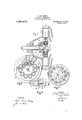
The. inventlon is illustrated in the companying drawings.
In Figures 1 to 5 of the-drawings the disl-v tributing arrangement is shown, b y way of example., combined with a generating pump intended for feeding -a receiving pump,
whichjis not shown in the drawings. The apparatus taken as a whole, yand chosen 1n Specification of Letters Patent. Application iled January 19, 1914. Serial No. 813,128. v
l1. This ligure gives a view of the the inlet and outlet reservoirs.- In this vPatented: Aug. 21,1917.
9 tov 1 4" further modifications Fig.'1'is aivertl'cal sectionthrough the.
axis of the driving shaft of theapparatus iff or pump intended for the? transmission to l another Ysimilar apparatus, or to an apparatus of any suitable system notshow'n, of the energy derived from the driving shaft. The distributing arrangement which regulates the circulation of the liquidhef,
tween the two apparatus is seen in section f in this figure.
Fig. 2 is a View on the 1in@ I -I f rig.
faceare to be seen the openings in the same upon -which the distributing valve is applied.
Fig, 3 is a view on the line II-'II of Fig. 1. In this view the distributor is shown mounted against the supporting face of the reservoirs, the openings of which are shown by dotted lines.
Fig. 4 i's the same view on the line II--II of the Fig. 1, but projected toward the left` of this figure. It shows, in elevation, the openingsof the conduits issuing from the in dotted lines.
. Finally, Fig. 5 is a section, along thev line III-III of Fig. 2,- of the vsupport or bearing ofhpne of the controlling cranks of the distributing valve.
As is to be seen in Figs. 1' to'5, the distributing arrangement has been combined vwith .apump having radiatingcylinders 1 arranged around aL'dri-ving ,shaft 2. In Veach `of these cylinders av piston 3 works,
and -all the pistons 3 arefconnected up to face of cylinders, two of whichhave been indicated .an eccentric disk 4,-' the Vmovements ofk which, in a'plane perpendicular to thelaxis of the driving shaft,- are controlled by a vcam 5, formed'hy a cylinder threaded on the driving shaft, and of which the ,axisv` formsa suitable angle with this shaft." The movements-of the cam .5, e'ected parallel to the axis, of the drivingv shaft,fare pro? the openings 9. Each opening 9 is lined Vp with a sleeve or -bush 10 concentric withV the opening, in which it isadjusted, and in which it is able to move longitudinally. They sleeve is vcombined on the other side with a llning formed, for example, by a U leather 11, lodged in an annular groove in the wall of the opening. The sleeves 10, lining the face of the openings 9, pressagainst the* distributing valvev 12. -This distributer, in
the particular construction represented, is
circular in shape.' It is pierced by holes 13 Which, in` the construction represented- Ain the figures, are arranged on the same circumferencehav1ng for its lcenter the center of thevalve.v As has already been said,. th e 25 edges of the sleeves lining the openings 9 are applied to one ofthe faces of the valve;
- the otherface is applied to thefaces of theV openings 14 and 15, with which the inletv and outlet reservoirs 16 and 17 are provided.
- VEach ofV these-reservoirs, whichare joined together andconcentric, is formed, for eX- ample, by a body having a mid section of any "suitableform, and they are separated by a cylindrical partition 18. The section ofthe holes'13 of the distributing valve and the shape ofthe openings 14 and 1 5 are such A "that,.o n one side,-.the'holes 13 may alwaysbe opposite the openings9, and that, on the- '-.other side, these holes 13 may beat one time 40j opposite the openings 15 (inlet period), at
` another time oppositethe openings 14 v(out- 1 3.5, etiiordelivery period), and at another time z"' ..betwe en these two openings (end of the inlet 'or 'delivery stroke). The movements of the y 4,5.;valve 1,2, to which these different positions 'of-,the holes 13 lcorrespond at' the proper .'moment, are effected in the following manner z-A crank'or an eccentric 19 is keyed njany suitable manner, upon the driving haft perpendicl'llarlyto its airis,` or in the same manner,to a' sha-ft sharing in the move.
-- yment of the. d riviag Shan- The pin 2o of this cranklits intoaiholefrnade-in the thickness of the `valve `The,-i-fe'cil') rocating move- -"ment whichw-thef crank 19 wi] l thusy impart lf to the valve, when the drivingsha'ft rotates,
iscontrolled bytwo'othercranks and 22, having "each" two pins, onev 'of which can rotate Iin* a hole made inthe 'wall of the "reser voirs '16 and 17, andthe otheriofjwhichican rotate in a hole made in the-valve-12. The
positions of these Atwo cranks are. quite f "arrangement which has just been described arbitrary, but the two. cranksffmust have the same radius as that, ofthe crank19, to which they remain always' parallel. The
' thereby-to apply. or press this "valve-upon the supporting'su'rfac'e of the reservoirs 16 ings'14 and .15. L
beenV traced, and the: openings 14 and 15 have ycircumference but by quite another. method,
value of the radius isgiv'en by the distribution to be effected. p,
It will be seen, after what has been said l in the foregoing, that "the driving shaft 2, in rotating impartsl to the valve '12, by means 70 ofi-the crank 19, a movement -which will be controlled-by the two other cranks 21 and 22.. Thev valve or distribution diagram will permit this movement to be effected at such a speed'that all the holes v/13 pass, Awhile 7x5 tribution, whatever maybe the speed of rotation of the shaft 2. --The movements of the valve 12,'whatever this speed may be are, in fact, of van amplitudesuiiciently slight (they arethe function of thefradius of the smalll cranks 19, 21 and 225) to insure that the work absorbed shallbe very slight, and that the friction on the machined or finished surfaces, between Iwhich the valve moves, may be reduced to the minimum. y It is to -be observed 'also thatithev fluid, entering through the openings v9 applies constantly and-in a very' forcible mannerthe sleeves 10 to the valye 12 and' contributes -100 and 17. It will .-be s'uiicient carefully? to iiiish all the sur-faces in contactfin order toinsure an absolutefluid-tightv joint;
It is obvious, of course, that'infthe dis# tributi'ng arrangement which hasjustfbeen lexplained the holes. 18 of thevalve-Iinstead of being, circular, as theyhave been shown,- might take any other form and that their position voo uld be determined in quiteanother way from that represented. @These details' are fixed y a'diagraminfaccordance with theform an the positionv of open- 1n `the constructionshowninjthe .draw- 11'5 ings, fall the holes- 13 have been arranged upon a circumference having a'v diameter equal to that upon which the openings 9^have all an axis ofsymmletry con-verging upon or coinciding with theaXis ofthe driving shaft.l However, the arangementfcould be something quite different', and particularly. if the openings 9 were arranged not upon a as, for examplefsinuously. vThe industrial results obtainedwith thev are numerous. The low speed imparted to the distributer and the advantageous results which the-.slow speedpossessesphave already been pointed out. It may be remarked also that, with thissystem, the use of V,clack valves and the inconveniences which the use .of these valves entail are entirely obviated.
l Finally, it must be noted that all points of 'l0' p lar combination of the system of distribu the distributer move with the sameV speed, with the result that the wear and tear of the same is strictly uniform throughout.
AIn Fig.- 6, there is Vindicated a particution hereinbefore described withv a hydraul' lic transmission arrangement producing a .change of speed. Y
This figure represents, in vertical section through the axis, a hydraulic change speed apparatus in which a receiving pump havi which are coupled the pistons' of the receiving pump.' Thecoupling of thevpis'tons 3 is effected, asin the case of the pistons 3, by attaching the heads of the pistons' to an eccentric 4 controlled by the intermediate l l shaft 2. The eccentricity of the member 4, is, however,oconstant, and is injthis respect different from what obtains 'in the case of that of the shaft 2;
v mediate shaft 2. A clutchv25 enables the` The secondary shaft 24 traverses the interprimaryv shaft '2 to be engaged either with the secondaryshaft 24 (direct engagement) or with the intermediate shaft 2.
As may easily be seen after examination vof the igur,'the combination ofthe two valves 12, 12 insures the distribution of the liquid between the chambers of the. pumps 3 and 3 whatever may be the difference of speed existing between these two pumps.
ln these methods of carrying gut the invention, the cylinder-cam 5 worksl perfectly for low speeds. of rotation of the driving shaft. Withsomewhat higher speeds, however, it has the inconvenient featurethat when the eccentricity of the eccentric 4 is altered by the longitudinal displacement of the cam 5, the wantfof equilibrium of the eccentric when put Vinto operation gives rise to vibrations which are detrimental to the good working and to the preservation ofthe apparatus. On the other hand, by reason of the inclination given tothe cylinder formin the cam 5, the stress borne bythe eccentric 4, whichrests upon the inclined face of this "cylinder, tends to Vdrive it outsideA the plane of the pistons, vwhich entails the necessity of maintaining the eccentric 1n position by means of rings or thrust bearings arranged laterally, the existence.. of which sets up a friction whichis detrimental to good mechanical eliiciency.
In order to obvlate these two inconveniences there'has been devised the arrange- 'm'ent represented in Fig. 7, in vertical section through the axis and in Fig. 8 in plan.
In this arrangement the cylinder-cam 5 is connected to a cam 5. which is itself formed shaft2 and threaded on this shaft. The cam vby a cylinder inclined to the axis of the 1 5 is symmetrical with the cam 5 in respect 'to the plane of junction of these two cams,
which is perpendicular to the shaft 2. On the cam 5, there is mounted, in the same way as the eccentric 4, a counterweight 4a arranged in such a way that it balances the ec Vcentric 4. vThis counterweight is guided in such fashion that it can slide :diametrically at 26 Von the face of the eccentric 4. y
It is readily seen that the edect of this arrangement isvto balance continuallythe eccentric 4 in all its diil'erent positions of eccentricity.v ln fact, the counterweight 4a recedes from the axis of the driving shaft as much as the axis of the eccentric 4 is removed from the axis of the driving shaft by -the' displacements or movements of the cam 5. The movements ofthe cams 5 and 5.a are simultaneous because these camsare in one piecer and they set up radial movements in opposite directions of the counter-weight 4a and the eccentric- 4, because the gradients acting upon this counterweight and upon this eccentric are of the same inclination, but arranged symmetrically `the one with respect to theother.
On 'the fother hand, in lorder to balance I the oblique reactions developed on the eccentric. as has been pointed out, a pin or key 27 is mounted in the driving shaft 2 and traverses the y shaft completely, passing through its axis. This pin or key traverses also the cylinder-cam 5, but it passes through a slot 28 in this cylinder sufficiently long to permit'of the cylinder making all the longitudinal movements necessary for the purpose of varying' the eccentricity of the eccentric 4. At each of its extremities the pin or key engages in corresponding mortlses madein the eccentric 4, which thus rests,
by means of this pin or key, on the drivingl have recourse1 to side thrust bearings for the purpose of supporting it. ln fact, this pin or key 27 takes up entirely the oblique thrusts which constitute one of the incon- Y f veniences to which attention has just beenA The distributer, which has just been described, is perfectly suitable for thepurpose of insuring the distribution of the liquid between Athe partsI of the hydraulic change speed gear shown in Fig. 6. However, in the shaft, without there being any necessity to arrangement of pumps in question the d elivery of liquid is not absolutely regular 1n this respect that, with each turn of lthe driving shaft for a given'position of the cylinder-cam, the variations'in the quantity of liquid delivered by the whole of the cylinders can be shown graphically a sine curve, the minimum or maximum points of which correspond to the passages of the summit or highest pointl of the cylindercam between two consecutive cylinders of the set of motive pumps. It follows from this,
' therefore, both in regard to the set of motive pumps and tothe set of receiving pumps, that vibrations detrimental to the efliciency of the apparatus must be set up. It is thus desirable, in the case of apparatus whose driving shaft rotates at high speeds, to emwith the minimums of the variations of de,-`
- livery of the other set, which regulates `the delivery ofthe system regarded as a whole and suppresses vibration. 1
. This disposition is distinguished by the y fact that the intermediate reservoir has three concentric chambers, the external chambers serving as an inletorsuction reservoir for one of the sets orfOr a combination of similar sets arranged on the driving shaft, and the internal chamber, which communicates with the external chamber by. means of suitable channels, serving as an inlet or suction reservoir for the other set or for thecombination of similar sets displaced in regard to the first, while the intermediate chamber serves as a common chamber for delivery to the two sets and to the two combinations 4of sets. On the other hand,'the vajlve, or if it is'- 'a question of the arrangement hereinbefore described and -shown in Fig. 6, the two valves, instead of beingbored` hy a single r row of distributing holes,- liave two such ,rows'yeach'of which is applicable to one of .the sets. l
- This disposition insures the regularity `of vthe delivery resultingfrom this possibility, .thanks to the two inlet or suction chambers l existing inthe intermediate reservoir, of the arrangement onthe drivingshaft of two setsofradiating cylinders, two to each set, the two sets being displaced lsuitably the. one. with/,regard to the other. The regularity of f delivery results also from the fact that the twoinlet or suction chambers communicate.
The invention relates also'to a special ari displacenflent of the pistons of the sets of motive pumps. lThis arrangement-cons1sts in connecting, by rendering them integral,
the cylinder-cams which produce by their displacements the variations in the resisting couple developed in each set of motive pumps, and in arrangingthein symmetrically with respect to a plane perpendicular to the driving shaft, and passing through or over their-junction surface. The result of this arrangement is an accuratebalancing of the' masses in movement and a balancing ofy 'the resistances which are always opposed during the rotation of the cylinder-cams.
Finally, the symmetrical arrangement ofy the cylinder-cam which acts upon the piston rods of the pistons of the second-set, 'has the efect that if, at one of the extremities of a diameter of thevalve, one of the opening's'of the rst set is at delivery, the opening of.. the
second set, which is to be found in the neighborhood of the otherextr'emity ofthis diam'- eter,k 1s likewise at delivery. 'Th'evalveis 'rangement of the element controlling the The Figs.y 9 to lll' refer .toa*foim o flcon-l struction of this arrangementJfg-L 1' v larly distributed pressurefwhiclijpresses it.'
against the port face'- on `'the reservoir. j 95 Fig. 9 isa vertical section `Of-he entire-.l-
system made through the axis of theidri'ving shaft. i
Fig. l0 is a front elevationof the support-4 ing port face lof the distributing valveon the inlet or suction and delivery reservoirs. In
this view the openings of these reservoirs are v to be seen.
Fig. 11 is an elevation of theyalve showing the holes with which it ispierced.
Fig. 12 is an enlarged'sectionfof-the entire system of motive' pumps, the section'bein taken along the directionof lthe axis of the motor from the lineof connection 'of Fig. 9. l
Fig. 13 is an' enlarged view in tion of theY distributer, :th-is section being vertical secmade through the axis-of the driving sha'ft f and being contained between the lines 'of connection Ml-M and- N-N of-Fig. 9.
Finally, Fig. 414 is likewise jan enlarged As may be seen in thesej'igurels, thersys-Y tem, inaccordance with this form v of con-` 4view of thejset of receiving pumps, -invertical section along thelaxis' of the'driven'shaft from the line 'Nr-N of Fig. 9.
structionfcomprises essentially three`parts: l
(l) the whole `of the motive' pumps with radiating cylinders 1,'l la; (2): the whole'of the receivingpumps with radiatingv cylinders 1:, '1; and,(3 the distributing velement .carrying theyalves12and 12 moving on vwhich formsthe inlet or suction rreservoir for the set of cylinders 1 and which comvmunicates with A through the Channels 30,
and an intermediate chamber P, which is situated kbetween the two others and which forms a delivery reservoir common to the two sets 1 and 1a.
I. Sets of motive pumps. i
The element which controls the movement of the pistons of the set 1 is a cylinder-cam 5 keyed on the driving shaft with the help of the pin or key 27 which completely traverses the shaft, passing through its center, and insures as a result of this, the participation of the cam in the rotary movement of the driving shaft,` but is arranged in a groove or slot of the cylinder-cam which is suciently large to allow for the displacement of this cam along the driving shaft. To this cam 5 is attached, in any suitable way, a cam 5a mounted in the same manner on the shaft 2 with the help of a pin or key 27m This cam is, however, always symmetrical with the cam 5 in respect to the plane perpendicular to the driving shaft and indicated in Fig. 12 `by the straight line I-I. The keys 27, 27,5 in addition to their rle as means of connection or engagement, also serve the partv of thrust bearings by taking the lateral thrusts acting upon the eccentric rings 4, 4a to the shaft 2 itself. -On each cam is mounted aneccentric ring 4, 4a, which-is engaged -by'it in its rotary movement and of which it changes the eccentric ity when it is displaced longitudinally on` the shaft. Between this eccentric ring and the heads of the pistons a ball bearing may be introduced in the interior of which the eccentric rotates. On each ball-bearing are fixed the heads of the piston rods of the corresponding set.` When, as the result of a longitudinal displacement imparted to the cams 5, 5a, by any means whatever, the center of each of the'eccentric rings ceases to coincide with the 'axis f the shaft 2, the pistons of each setl will receive an alternating movement the lamplitude of which will be so much the greater and will produce a delivery so much the greater as the center of each disk is farther removed from the axis of the shaft 2. The pistons are equal in number. in each set and this number is preferably a pair, which allowsv of the strokes of the piston crossing, as has already its may be regularly distributed." s, inthe" case of the form of construction represented 1n the gures,there are in each of the two 'sets 1,11a six cylinders, the two sets 1, 1a are displaced by thirty degrees. Y d II. Se# 0 7' receiving pumps.
:The element receiving the impulses of the pistons fof the set. 1 is a am iixed -on the 'i hollow shaft 2 forming an intermediate shaft between the driving shaft 2 and the driven shaft 24. On this cam rests an ec-4 i centric ring` 4'-, the eccentricity of which with respect to the axis'ofthe line ofthe shafts2, 2, 24, 1s constant. Another cam,
displaced with respect to theiirst by 180 degrees, receives the impulses of the pistons of the set 1'... This cam is likewise fixed on the shaft 2 and carries an eccentric ring .42., the eccentricity of which, with respect to the axis of the shaft 2", is equal to that of thering 4', and is likewise constant.
A sliding clutch 25, mounted on the driven shaft 24, puts this shaft fin engagement either with the primaryshaft'l prolonging the ,driving shaft (direct Idrive) or with the 1H. meritata@ lemma The purpose of this element is to distrib,- ute the liquid delivered by the pistons .of the setV 1 or la to the pistons of the sets 1, la, by causing the corresponding cylinders to communicate during the period of de-y livery whi'ch takes place in the course of each of the revolutions of thev driving shaft 2. It has likewise to distribute to the pistons of the set 1 or 1athe liquid taken in by these pistons duringeach suction period, by
causing the working spaces' of the correworking spaces of the cylinders of the sets 1 or la, which are, at-the same moment, at the delivery period. In short, itmust insure the A .circulation of the liquid with a delivery,
which varies according to requirements, be-
tween the two systems of pumps. f
For this purpose, 1t has an annular reser voir 29 formed by the re-union ofthe three set of pumps 1Q, each of which openings 9a communicates with the base of a cylindr of the set 1a. The openings a', p of the other face are oppositeto openings 9a in a face of the casing of the set 'of pumps la,
110 sponding cylinders to communicate with the each of which openings 9a'comni`unic'ates with the base of a cylinder of the setla. The. openings p, a are in front of openings 9,l 9vv arranged similarly,- and' each of which communicates respectively with the base ofy a cylinder of the set 1 and of the set 1. A valve is arranged between each face of the'reservoir 29 and i the corresponding face of the casingof the sets of pumps. One of them, the valve 12,
is mounted on the driving shaft 2; the
' scribesthe circumference of a circle at each revolution of the shaft. This planetary or epicylic movement may obviously be carried out with the help of any kind of kinetic In the form of construction .Connectionrepresented in 'the figures, the movement of the valve is obtained, as has been'hereinbefore indicated, bythe application of two -small parallel cranks," each having two opposed shafts or spindles, one' of which is ldis.-
posed in a bearing formed in the face of' the reservoir 29, and the other in a bearing made inthe valve. thesetwofcranks having the same radius, which is'determined by the distribution to be `effected.v On the other..
hand the valve is engaged by an eccentric 19 (or 195) the radius of which' is equal and parallel lto that'of the small lcrank `In `each valve are pierced holesfla, 13
l arranged respectively,' in' ,the form 'of conopeningsf.; (period of deliveryqof one cyl-1'.
struction representedupon two, concentric circumferences having' for their centerthe center vof the valve,-each hole insuring the' distribution for one cylinder.'I The section of these holes, theshape o theopenings a', p, a, and finally theradius of the eccentric v19 (or 19"),arechosen 'insuch away that,'- on' the one `hand,lth e holes, ,153, may always beoppositefthe 0'pen1ng9a` '(9va)`, and that, 0112-' reservoir, and means for; imparting a planet-*- w the -.otherl,g hand,` these: same 'holes maye'at '1 vrone-time be'opposite'the, openings a', eriodf 'of admission or suctionofonecyli'n erofthe vset la), atanother-time opposite thefmder ofv the s et la), and at another-time'btween theseopenings (end ofthe period of* suction Vor of delivery); IAlso these holes- 13 are, on ghe one hand, always 'opp'osite'the`= openings (9'), Aand-onthe other hand,
.these` saine holes 13 are'at lone time -opposite"- the o enlngs 'a A(periodof suction offene cylm er of the set l), at another time loppoperiod of suction or ofv delivery). l
vThe application 'of the tically -f l 'pose set' vforth 011.1-
justv been described and their combination Vmake of the systemregarded in its entirety I. The possibility of causing the primary shaft (shaft 2) to rotate at high speeds which, for example, may exceed 1500 revolutions, while the secondary shaft (shaft 24:) 1
can be put to any speed between zero and the -number of revolutions of the shaft 2.
II. The slow speed of the 4distributing valve on its port face.
. III. The perfect equilibrium of all th moving parts as well as of the stresses.
IV. Complete constancy of the delivery i* for anyv given osition of the cylinderLcams.
V. The app ication of the valve on its` ort face for the whole of its circumference,
y a regularly distributed pressure/ and hence Ya perfectly fluid tightjunctionlwhich i is maintained by the regular wear, 'amounting actually to polishing, of thevalve, all
the points lof whichI recelve an e'qual movement. VI. .The possibility of providingprac'- inders.
.sire to secure by Letters Patent is any desired number of'sets Aof cyl .1. A- distributingarrangement for the lpurpose set forthBcomprising asysteinof motive pumps and a `system ot receiving pumps, an mtermedlate reservoir arranged betweenthe saidsystems'of pumps and into -whlch the Huidto be distributed passes, the 'said reservoir comprisingconbentric cham- I bers, l one of said-chambers fornfiing an inlet or `suction reservoir for the motive pumps,
.while anotherforms avdeliv'ery reservoir,I 'a' valve provided with holes corresponding number 'to thenu'mber of cylinders or workingfspaces ii: the. said "pumps, lsaid va1ve movingv agamst af-face of the 'intermediate f ary movement 1to1' said valve.
2. A di'stributing. arrangement Saidv reservoir comprising three concentric berslfserving as 'an inlet' or suction; reservoir .for sets of ,pumpsarra-nged upon thesame` driving shaft, the 'intermedlate chamber serving as a common vdeliveryfchamber to the said sets of pumps, avalveandi means.
-I'foroperating the;valve. 1
; 3. .A distributin' arrangement 'foilae pur,
an intermediate reservoir arranged between the said two systems of pumps, and means for controlling the displacements of the pistons of the motive pump, said means comprising a disk, a pin or key held at its two extremities in the disk, and traversing `the axis of the shaft, a cylinder cam arranged as described, the pin or key passing through the cam in a slot sufficiently long to admit of the longitudinal displacement of said cylinder cam.
4. A distributing arrangement for the purpose set forth comprising a system of motive pumps and a system of receiving pumps, an intermediate reservoir arranged between the said systems of pumps and into which the fluid to be distributed passes, the said reservoir comprising three concentric chambers, the external and internal chambers serving as an inlet or suction reservoir for sets of pumps arranged upon the same driving shaft, .the intermediate chamber serving as a common delivery chamber to the said sets of pumps, means of communication between the said or suction chambers, a valve, and means for operating the valve.
5. A distributing arrangement for the purpose set forth comprising a system of motive pumps and a system of receiving pumps, the said motive pumps being formed of two or more sets of pumps with radiating cylinders arranged about the driving shaft, said cylinders being preferably' two in number in each set and their axes being from one set to the other displaced upon the driving shaft through such an angle that the piston strokes cross, that is to say, that the maxima of the variations of delivery of one of the sets correspond with the minima of the variations of the delivery of another set, an intermediate reservoir into.which the fluid to be distributed passes, a Valve, and means for operating the said valve.
6. A distributing arrangement for the purpose set forth comprising a'system of motive pumps and a system of receiving pumps, an intermediate reservoir, and means for controlling the displacements of the pistons of two consecutive vsets of motive pumpscom prising two cylinder cams having axes inclined to the axis of the driving shaft, the
said cams being connected by one of their faces in such a way that they may lie syminternal and external inlet f metrically with respect to a plane perpendicularto the driving shaft passing through the junction faces, and means for displacing the cams along the driving shaft.
7'. A distributing arrangement for the purpose set forth comprising a system of motive pumps and a system of receiving pumps, an intermediate reservoir into which the luid to be distributed passes, and means for controlling the displacements of the pistons of the motive pumps comprising cylinder cams, a shaft upon which the said cylinder cams are mounted, and pins or keys by which the cams are mounted upon the shaft to permit of the cams being disp'laeeable longitudinally and of the pins or keys serving as thrust bearings.
8. A distributing arrangement for the purpose set forth comprising a system of motive pumps and a system of receiving pumps, the said system of receiving pumps being formed of sets of pumps with radiating cylinders arranged about an intermediate shaft, the axes of the said cylinders being displaced from one set to the other at such an angle that the piston strokes cross, a reservoir, a valve, and means for operating the valve.
9. A distributing arrangement for the purpose set forth comprising a system of motive pumps and a system of receiving pumps, the said system of receiving pumps being formed of sets of pumps with radiating cylinders arranged about an intermediate shaft, the axes of the said cylinders being displaced from one set to the other at such an angle that the piston Astrokes cross, anx element receiving the stroke of the pistons of the receiving pumps, comprising an eccentric in two parts mounted on the intermediate. shaft, the two parts of the said eccentric being displaced one in relation to the other 180o and each eccentric transmitting to the intermediate shaft the effort of the corresponding set of pumps, a reservoir, a valve, and means for operating the valve.
ln testimonyI whereof we have hereunto- 1 signed our names to this specilication in the presence of two subscribing witnesses. JULES NAEDIQR. MAURICE NAEDER.
Vitnesses: Y HANsoN C. CoXE, MIGUEL FERoLo.
Priority Applications (1)
| Application Number | Priority Date | Filing Date | Title |
|---|---|---|---|
| US81312814A US1237679A (en) | 1914-01-19 | 1914-01-19 | Hydraulic transmission. |
Applications Claiming Priority (1)
| Application Number | Priority Date | Filing Date | Title |
|---|---|---|---|
| US81312814A US1237679A (en) | 1914-01-19 | 1914-01-19 | Hydraulic transmission. |
Publications (1)
| Publication Number | Publication Date |
|---|---|
| US1237679A true US1237679A (en) | 1917-08-21 |
Family
ID=3305497
Family Applications (1)
| Application Number | Title | Priority Date | Filing Date |
|---|---|---|---|
| US81312814A Expired - Lifetime US1237679A (en) | 1914-01-19 | 1914-01-19 | Hydraulic transmission. |
Country Status (1)
| Country | Link |
|---|---|
| US (1) | US1237679A (en) |
Cited By (1)
| Publication number | Priority date | Publication date | Assignee | Title |
|---|---|---|---|---|
| US2539571A (en) * | 1942-10-23 | 1951-01-30 | Bendix Aviat Corp | Hydraulic apparatus |
-
1914
- 1914-01-19 US US81312814A patent/US1237679A/en not_active Expired - Lifetime
Cited By (1)
| Publication number | Priority date | Publication date | Assignee | Title |
|---|---|---|---|---|
| US2539571A (en) * | 1942-10-23 | 1951-01-30 | Bendix Aviat Corp | Hydraulic apparatus |
Similar Documents
| Publication | Publication Date | Title |
|---|---|---|
| US1274391A (en) | Hydraulic transmission mechanism. | |
| US2357563A (en) | Fuel injection pump | |
| US3198022A (en) | Wobble plate anchor control mechanism | |
| US1714148A (en) | Pump | |
| US2329912A (en) | Pump | |
| US1411556A (en) | Internal-combustion engine | |
| US1910876A (en) | Rotary pump | |
| US1781068A (en) | Fluid motor and pump | |
| US2827857A (en) | Rotary pump | |
| US1190139A (en) | Power-transmitter. | |
| US2346014A (en) | Fluid pump | |
| US2845030A (en) | Scavenge pump | |
| US3036558A (en) | Wobble plate fluid motor and single valve means | |
| US3155010A (en) | Rotary hydraulic apparatus | |
| US1921747A (en) | Rotary pump or the like | |
| US4168652A (en) | Power transfer unit | |
| US1506892A (en) | Rotary pump or blower | |
| US1998004A (en) | Differential hydraulic speed gear | |
| US511044A (en) | cooper | |
| US1348738A (en) | Power-transmission apparatus | |
| US1414965A (en) | Compound-valve pump or motor | |
| US1945220A (en) | Rotary pump machine | |
| US1315680A (en) | X p pump and motor | |
| US3180275A (en) | Barrel pump | |
| US2403854A (en) | Pump |