US123741A - Improvement in distilling petroleum - Google Patents
Improvement in distilling petroleum Download PDFInfo
- Publication number
- US123741A US123741A US123741DA US123741A US 123741 A US123741 A US 123741A US 123741D A US123741D A US 123741DA US 123741 A US123741 A US 123741A
- Authority
- US
- United States
- Prior art keywords
- still
- oil
- pump
- tanks
- supply
- Prior art date
- Legal status (The legal status is an assumption and is not a legal conclusion. Google has not performed a legal analysis and makes no representation as to the accuracy of the status listed.)
- Expired - Lifetime
Links
- 239000003208 petroleum Substances 0.000 title description 4
- 239000003921 oil Substances 0.000 description 22
- 239000007788 liquid Substances 0.000 description 12
- 239000000470 constituent Substances 0.000 description 4
- 239000000047 product Substances 0.000 description 4
- 239000000446 fuel Substances 0.000 description 3
- 244000261422 Lysimachia clethroides Species 0.000 description 2
- 238000004061 bleaching Methods 0.000 description 2
- 238000001944 continuous distillation Methods 0.000 description 2
- 238000004821 distillation Methods 0.000 description 2
- 238000000034 method Methods 0.000 description 2
- 239000012466 permeate Substances 0.000 description 2
- 238000010924 continuous production Methods 0.000 description 1
- 239000010779 crude oil Substances 0.000 description 1
- 230000007423 decrease Effects 0.000 description 1
- 230000003292 diminished effect Effects 0.000 description 1
- 230000001105 regulatory effect Effects 0.000 description 1
Images

Classifications
-
- C—CHEMISTRY; METALLURGY
- C10—PETROLEUM, GAS OR COKE INDUSTRIES; TECHNICAL GASES CONTAINING CARBON MONOXIDE; FUELS; LUBRICANTS; PEAT
- C10G—CRACKING HYDROCARBON OILS; PRODUCTION OF LIQUID HYDROCARBON MIXTURES, e.g. BY DESTRUCTIVE HYDROGENATION, OLIGOMERISATION, POLYMERISATION; RECOVERY OF HYDROCARBON OILS FROM OIL-SHALE, OIL-SAND, OR GASES; REFINING MIXTURES MAINLY CONSISTING OF HYDROCARBONS; REFORMING OF NAPHTHA; MINERAL WAXES
- C10G9/00—Thermal non-catalytic cracking, in the absence of hydrogen, of hydrocarbon oils
Definitions
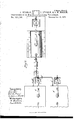
- drawing- Figure l represents a longitudinal vertical section of our apparatus.
- Fig. 2 is a plan or top view of the same.
- the object of this invention is to produce continuous distillation by means of an apparatus composed of two supply-tanks, a pump, and a still, the supply-tanks being alternately connected with the pump, so that the still can be kept in uninterrupted operation, the crude oil in said tank being first freed of its light constituents by the action of a current of steam injected therein, or by heat applied thereto, whereby the temperature of said oil is also raised before the same is injected into the still,-
- the feed-pipe running from the pump to the still extends nearly down to the bottom of said still, spo-that the heated air injected with the oil by the action of the pump permeates the mass of oil in the still and thereby a bleaching action is produced, and at thersame time the vapors are liberated from the liquid, and the distillation is materially facilitated; and, furthermore, said pipe forms a coil in the upper part of the still, so that the temperature of the Oil and air injected by the pump is raised to a point equal, or nearly so, to that of the oil in the still, and thereby the quality of the distilled liquid is materially improved.
- the letters A A designate two tanks, which are intended to be iilled with crude petroleum, and both of which are connected by pipes a a with a double acting pump, B, said pipes being provided with stopcocks b b', so that either of them can be shut off, and that the pump can be made to draw oil, alternately, rst from one and then from the other of the supply-tanks.
- Said tanks are closed at their tops, and through these tops extend steam-pipes c c', which connect with a boiler, and which run down nearly to the bottoms ofthe tanks.
- the oil in the supply-tanks may also be heated to the temperature, as above stated, by the direct application of heat to said supply-tanks.
- the connection between said tank and the pump is opened, and, by the action of the pump, the oil is injected into the still D.
- the contents of the second tank are heated and freed from their light constituents.
- the still D is placed over a furnace, E, and it is kept supplied with oil to a uniform level, to be Obtained by a gauge, e.
- the pump connects With the still by a pipe, f, Which forms a coil, f, in the interior of said still, and eX- tends down nearly to its bottom, as shown in Fig. l. From the top of the still emanates a goose-neck, g, which connects With a condenser, F.
- a check-valve, h in the pipe f, prevents the liquid in the still from returning to the pump.
- the pump When the pump is in operation, it injects into the still a stream of liquid mixed with air, and as this stream passes through the coil f', situated in the interior of the still, its temperature is raised to that of the liquid in the still, or nearly so, and thereby the distilling operation is still further facilitated.
- the air mixed With the liquid Which is injected by the pump is also heated, and as this heated air permeates the liquid in the still, it produces a bleaching action and assists in eX- pelling the vapors from said liquid.
Landscapes
- Chemical & Material Sciences (AREA)
- Oil, Petroleum & Natural Gas (AREA)
- Physics & Mathematics (AREA)
- Thermal Sciences (AREA)
- Engineering & Computer Science (AREA)
- Chemical Kinetics & Catalysis (AREA)
- General Chemical & Material Sciences (AREA)
- Organic Chemistry (AREA)
- Production Of Liquid Hydrocarbon Mixture For Refining Petroleum (AREA)
Description
Z 7 h .nw S 3 s Il .M
D .m me S UF 2 ed le v ...L 0n le tbl ea DI I eet2. J. STUBER, -J.STUBER,&J.W.,MA ER.
nl. e4 m7 e 'l V3 O2 r1! DI.. m0
UNITED STATES PATENT OEEIOE;
` JOHN sTUEEE, JACOB sTUBEE, AND JOHN w. MAGEE, OE ASTORIA, N. Y.
IMPROVEMENT IN DISTILLING PETROLEUM.
Specification forming part of Letters Patent No. 123,741, dated February 13, 1872.
To all whom it may concern:
Be it known that we, JOHN STUEEE, J AOOB STUBER, and JOHN W. MAGER, all of Astoria,
in the county of Queens and State of Newj ing drawing forming part of this specification,
in which drawing- Figure l represents a longitudinal vertical section of our apparatus. Fig. 2 is a plan or top view of the same.
Similar letters in dieate corresponding parts.
The object of this invention is to produce continuous distillation by means of an apparatus composed of two supply-tanks, a pump, and a still, the supply-tanks being alternately connected with the pump, so that the still can be kept in uninterrupted operation, the crude oil in said tank being first freed of its light constituents by the action of a current of steam injected therein, or by heat applied thereto, whereby the temperature of said oil is also raised before the same is injected into the still,-
and the motion of the pump being so regulated that the oil in the still is kept at an uniform level, or nearly so. The feed-pipe running from the pump to the still extends nearly down to the bottom of said still, spo-that the heated air injected with the oil by the action of the pump permeates the mass of oil in the still and thereby a bleaching action is produced, and at thersame time the vapors are liberated from the liquid, and the distillation is materially facilitated; and, furthermore, said pipe forms a coil in the upper part of the still, so that the temperature of the Oil and air injected by the pump is raised to a point equal, or nearly so, to that of the oil in the still, and thereby the quality of the distilled liquid is materially improved.
In the drawing, the letters A A designate two tanks, which are intended to be iilled with crude petroleum, and both of which are connected by pipes a a with a double acting pump, B, said pipes being provided with stopcocks b b', so that either of them can be shut off, and that the pump can be made to draw oil, alternately, rst from one and then from the other of the supply-tanks. Said tanks are closed at their tops, and through these tops extend steam-pipes c c', which connect with a boiler, and which run down nearly to the bottoms ofthe tanks. By admitting steam through these pipes into the oil in the tanks, the light constituents of said oil are disengaged and caused to escape through goose-necks d d', extending from the tops of the tanks and connecting with condensers C C. At the same time, by the action of the-steam thus injected into the supply-tanks, the temperature of the oil contained therein is raised to about 2500, so that the liquid, on being injected into the still, does not cool down materially-the contents of said still, whereby several advantages are gained, to wit: if the oil is pumped into the still at the ordinary temperature of the atmosphere--say from 600 to 7 OO-the contents of the still are cooled, and it requires an additional amount of fuel to keep up the requisite amount of heat in the still; but, besides this, we have found that if the oil is injected into the still at such a low temperature, the color of the liquid iiowing from the still is liable to turn green, and the value of the product is materially diminished. By raising the temperature ofthe oil in the supply-tanks to 2500, therefore, not only a large amount of fuel is economized, but particularly the quality of the product is much improved.
It must be remarked that the oil in the supply-tanks may also be heated to the temperature, as above stated, by the direct application of heat to said supply-tanks. After the oil in one of the supply-tanks has been freed from its light constituents, and while its temperature is from 2300 to 2500, the connection between said tank and the pump is opened, and, by the action of the pump, the oil is injected into the still D. During the time the rst tank is being emptied, the contents of the second tank are heated and freed from their light constituents. While the oil is pumped from the supply-tank to the still, its temperature gradually decreases, unless provision is made to keep up the heat either by the continuous admission of a jet of steam, or by the direct application of fire to said tanks. The still D is placed over a furnace, E, and it is kept supplied with oil to a uniform level, to be Obtained by a gauge, e. The pump connects With the still by a pipe, f, Which forms a coil, f, in the interior of said still, and eX- tends down nearly to its bottom, as shown in Fig. l. From the top of the still emanates a goose-neck, g, which connects With a condenser, F. A check-valve, h, in the pipe f, prevents the liquid in the still from returning to the pump.
When the pump is in operation, it injects into the still a stream of liquid mixed with air, and as this stream passes through the coil f', situated in the interior of the still, its temperature is raised to that of the liquid in the still, or nearly so, and thereby the distilling operation is still further facilitated. At the same time the air mixed With the liquid Which is injected by the pump is also heated, and as this heated air permeates the liquid in the still, it produces a bleaching action and assists in eX- pelling the vapors from said liquid.
The chief advantage of our process, however, is based on the discovery that, When the oil is pumped cold into the still the product running from the still is liable to turn green, whereby it is rendered unfit for the market; but by keeping up a constant supply of heated oil in the still, We are enabled to carry on the distillation with out interruption, While the product flowing from the still is of superior quality, and furthermore, a considerable economy in fuel is effected.
vWe do not claim, broadly, distilling oils by a continuous process in which the oil is poured from one retort or still to another, as such is described in the patent of D. S. Stombs and Julius Brace, dated April l0, 1860, No. 27 ,843; but- What We do claim as new, and desire to secure by Letters Patent, is-
l. The process, substantially as herein described, for producing continuous distillation of petroleum by means of supply-tanks A A', the contents of which are heated before they are injected into the still, and which connect with a double-acting pump, by which a continuous supply of the heated liquid from the supply-tanks is driven into the still, While the still is placed over a furnace for the purpose of keeping up the temperature of the liquid contained therein and injected into the same by the action of the pump.
2. The heating-coilf in the pipe extending from the pump B into the still D, substantially as and for the purpose herein shown and described.
This speciication signed by us this seventh day of October', 1871.
JOHN STUBER.
J AOOB ST'UBER.
Witnesses: JOHN W. MAGER.
W. HAUFF, E. F. KAsTENHUBER.
Publications (1)
| Publication Number | Publication Date |
|---|---|
| US123741A true US123741A (en) | 1872-02-13 |
Family
ID=2193175
Family Applications (1)
| Application Number | Title | Priority Date | Filing Date |
|---|---|---|---|
| US123741D Expired - Lifetime US123741A (en) | Improvement in distilling petroleum |
Country Status (1)
| Country | Link |
|---|---|
| US (1) | US123741A (en) |
-
0
- US US123741D patent/US123741A/en not_active Expired - Lifetime
Similar Documents
| Publication | Publication Date | Title |
|---|---|---|
| US2289953A (en) | Method and apparatus for mixing fluids | |
| US123741A (en) | Improvement in distilling petroleum | |
| US1962580A (en) | Chilling | |
| US798724A (en) | Combined beer heater, condenser, and continuous doubler. | |
| US1765167A (en) | Conversion of heavy hydrocarbon oils into light hydrocarbon oils or spirits | |
| US510734A (en) | Albert f | |
| US477153A (en) | pielstickeb | |
| US764711A (en) | Combined beer-heater, condenser, and continuous doubler. | |
| US672454A (en) | Pasteurizing-machine. | |
| US2029504A (en) | Method for producing oxidized asphalts | |
| US681586A (en) | Apparatus for producing bisulfite liquor. | |
| US2105191A (en) | Method for cracking petroleum oils | |
| US564481A (en) | Apparatus for treating juice and vapor | |
| US1149711A (en) | Apparatus for heating stills. | |
| US209420A (en) | Improvement in milk-coolers | |
| US179783A (en) | Improvement in milk-coolers | |
| US789079A (en) | Cooling-tank for internal-combustion engines. | |
| US846680A (en) | Gas-machine. | |
| US307396A (en) | Edmund jungenfeld | |
| US93739A (en) | Improved process for purifying- pahaffine | |
| US1163570A (en) | Process of and apparatus for distilling petroleum. | |
| US253178A (en) | Milk-cooler | |
| US302684A (en) | Condenser | |
| US1408242A (en) | Process op and apparatus | |
| US218901A (en) | Improvement in oil-stills |