US12349590B2 - Organic electric element, display panel comprising the same and display device comprising the same - Google Patents

Organic electric element, display panel comprising the same and display device comprising the same Download PDF

Info

Publication number
US12349590B2
US12349590B2 US17/137,825 US202017137825A US12349590B2 US 12349590 B2 US12349590 B2 US 12349590B2 US 202017137825 A US202017137825 A US 202017137825A US 12349590 B2 US12349590 B2 US 12349590B2
Authority
US
United States
Prior art keywords
group
compound
electric element
organic electric
layer
Prior art date
Legal status (The legal status is an assumption and is not a legal conclusion. Google has not performed a legal analysis and makes no representation as to the accuracy of the status listed.)
Active, expires
Application number
US17/137,825
Other versions
US20210202847A1 (en
Inventor
Jicheol Shin
Seonkeun YOO
Jeongdae Seo
Shinhan KIM
JooYong YOON
Jun Yun
Dongheon Kim
Yonghan Lee
Sungjae Lee
Current Assignee (The listed assignees may be inaccurate. Google has not performed a legal analysis and makes no representation or warranty as to the accuracy of the list.)
LG Chem Ltd
LG Display Co Ltd
Original Assignee
LG Chem Ltd
LG Display Co Ltd
Priority date (The priority date is an assumption and is not a legal conclusion. Google has not performed a legal analysis and makes no representation as to the accuracy of the date listed.)
Filing date
Publication date
Application filed by LG Chem Ltd, LG Display Co Ltd filed Critical LG Chem Ltd
Assigned to LG DISPLAY CO., LTD., LG CHEM, LTD. reassignment LG DISPLAY CO., LTD. ASSIGNMENT OF ASSIGNORS INTEREST (SEE DOCUMENT FOR DETAILS). Assignors: KIM, SHINHAN, KIM, DONGHEON, LEE, SUNGJAE, LEE, YONGHAN, SEO, JEONGDAE, SHIN, JICHEOL, YOO, SEONKEUN, YOON, JOOYONG, YUN, Jun
Publication of US20210202847A1 publication Critical patent/US20210202847A1/en
Application granted granted Critical
Publication of US12349590B2 publication Critical patent/US12349590B2/en
Active legal-status Critical Current
Adjusted expiration legal-status Critical

Links

Images

Classifications

    • HELECTRICITY
    • H10SEMICONDUCTOR DEVICES; ELECTRIC SOLID-STATE DEVICES NOT OTHERWISE PROVIDED FOR
    • H10KORGANIC ELECTRIC SOLID-STATE DEVICES
    • H10K50/00Organic light-emitting devices
    • H10K50/10OLEDs or polymer light-emitting diodes [PLED]
    • H10K50/11OLEDs or polymer light-emitting diodes [PLED] characterised by the electroluminescent [EL] layers
    • H10K50/12OLEDs or polymer light-emitting diodes [PLED] characterised by the electroluminescent [EL] layers comprising dopants
    • HELECTRICITY
    • H10SEMICONDUCTOR DEVICES; ELECTRIC SOLID-STATE DEVICES NOT OTHERWISE PROVIDED FOR
    • H10KORGANIC ELECTRIC SOLID-STATE DEVICES
    • H10K50/00Organic light-emitting devices
    • H10K50/10OLEDs or polymer light-emitting diodes [PLED]
    • H10K50/11OLEDs or polymer light-emitting diodes [PLED] characterised by the electroluminescent [EL] layers
    • H10K50/125OLEDs or polymer light-emitting diodes [PLED] characterised by the electroluminescent [EL] layers specially adapted for multicolour light emission, e.g. for emitting white light
    • H10K50/13OLEDs or polymer light-emitting diodes [PLED] characterised by the electroluminescent [EL] layers specially adapted for multicolour light emission, e.g. for emitting white light comprising stacked EL layers within one EL unit
    • HELECTRICITY
    • H10SEMICONDUCTOR DEVICES; ELECTRIC SOLID-STATE DEVICES NOT OTHERWISE PROVIDED FOR
    • H10KORGANIC ELECTRIC SOLID-STATE DEVICES
    • H10K85/00Organic materials used in the body or electrodes of devices covered by this subclass
    • H10K85/60Organic compounds having low molecular weight
    • H10K85/615Polycyclic condensed aromatic hydrocarbons, e.g. anthracene
    • HELECTRICITY
    • H10SEMICONDUCTOR DEVICES; ELECTRIC SOLID-STATE DEVICES NOT OTHERWISE PROVIDED FOR
    • H10KORGANIC ELECTRIC SOLID-STATE DEVICES
    • H10K85/00Organic materials used in the body or electrodes of devices covered by this subclass
    • H10K85/60Organic compounds having low molecular weight
    • H10K85/615Polycyclic condensed aromatic hydrocarbons, e.g. anthracene
    • H10K85/622Polycyclic condensed aromatic hydrocarbons, e.g. anthracene containing four rings, e.g. pyrene
    • HELECTRICITY
    • H10SEMICONDUCTOR DEVICES; ELECTRIC SOLID-STATE DEVICES NOT OTHERWISE PROVIDED FOR
    • H10KORGANIC ELECTRIC SOLID-STATE DEVICES
    • H10K85/00Organic materials used in the body or electrodes of devices covered by this subclass
    • H10K85/60Organic compounds having low molecular weight
    • H10K85/615Polycyclic condensed aromatic hydrocarbons, e.g. anthracene
    • H10K85/624Polycyclic condensed aromatic hydrocarbons, e.g. anthracene containing six or more rings
    • HELECTRICITY
    • H10SEMICONDUCTOR DEVICES; ELECTRIC SOLID-STATE DEVICES NOT OTHERWISE PROVIDED FOR
    • H10KORGANIC ELECTRIC SOLID-STATE DEVICES
    • H10K85/00Organic materials used in the body or electrodes of devices covered by this subclass
    • H10K85/60Organic compounds having low molecular weight
    • H10K85/631Amine compounds having at least two aryl rest on at least one amine-nitrogen atom, e.g. triphenylamine
    • HELECTRICITY
    • H10SEMICONDUCTOR DEVICES; ELECTRIC SOLID-STATE DEVICES NOT OTHERWISE PROVIDED FOR
    • H10KORGANIC ELECTRIC SOLID-STATE DEVICES
    • H10K85/00Organic materials used in the body or electrodes of devices covered by this subclass
    • H10K85/60Organic compounds having low molecular weight
    • H10K85/631Amine compounds having at least two aryl rest on at least one amine-nitrogen atom, e.g. triphenylamine
    • H10K85/633Amine compounds having at least two aryl rest on at least one amine-nitrogen atom, e.g. triphenylamine comprising polycyclic condensed aromatic hydrocarbons as substituents on the nitrogen atom
    • HELECTRICITY
    • H10SEMICONDUCTOR DEVICES; ELECTRIC SOLID-STATE DEVICES NOT OTHERWISE PROVIDED FOR
    • H10KORGANIC ELECTRIC SOLID-STATE DEVICES
    • H10K85/00Organic materials used in the body or electrodes of devices covered by this subclass
    • H10K85/60Organic compounds having low molecular weight
    • H10K85/649Aromatic compounds comprising a hetero atom
    • H10K85/654Aromatic compounds comprising a hetero atom comprising only nitrogen as heteroatom
    • HELECTRICITY
    • H10SEMICONDUCTOR DEVICES; ELECTRIC SOLID-STATE DEVICES NOT OTHERWISE PROVIDED FOR
    • H10KORGANIC ELECTRIC SOLID-STATE DEVICES
    • H10K50/00Organic light-emitting devices
    • H10K50/10OLEDs or polymer light-emitting diodes [PLED]
    • H10K50/17Carrier injection layers

Definitions

  • Embodiments relate to an organic electric element, a display panel, and a display device including the organic electric element.
  • an organic light emitting phenomenon refers to the phenomenon of converting electrical energy into light energy by means of an organic material.
  • An organic electric element refers to an electric element using the organic light emitting phenomenon.
  • An organic electric element using the organic light emitting phenomenon may be applied to a display device. Since the portable display device is driven by a battery, which is a limited power source, an organic electric element used in the portable display device requires excellent light emission efficiency. In addition, since the image should be displayed normally during use of the electronic device, a long life of the organic electric element may be also required.
  • embodiments of the present disclosure are directed to an organic electric element, a display panel, and a display device that substantially obviate one or more of the problems due to limitations and disadvantages of the related art.
  • Embodiments may provide an organic electric element having high efficiency or long life.
  • Embodiments may provide a display panel having high efficiency or long life by including the above-described organic electric element.
  • embodiments may provide a display device having high efficiency or long life by including the above-described display panel.
  • an organic electric element comprises a first electrode, a second electrode and an organic layer.
  • the organic layer is positioned between the first electrode and the second electrode.
  • the organic layer comprises a light emitting layer and a first layer.
  • the first layer comprises a first compound and a second compound.
  • the first compound is represented by one or more of the following chemical formula 1 and chemical formula 2.
  • the second compound is represented by the following chemical formula 3.
  • embodiments may provide a display panel comprising a subpixel comprising the organic electric element.
  • the organic electric device having high luminous efficiency and long life.
  • FIG. 1 is a system configuration diagram of a display device according to embodiments
  • first element is connected or coupled to”, “contacts or overlaps” etc. a second element
  • first element is connected or coupled to” or “directly contact or overlap” the second element
  • a third element can also be “interposed” between the first and second elements, or the first and second elements can “be connected or coupled to”, “contact or overlap”, etc. each other via a fourth element.
  • the second element may be included in at least one of two or more elements that “are connected or coupled to”, “contact or overlap”, etc. each other.
  • time relative terms such as “after,” “subsequent to,” “next,” “before,” and the like, are used to describe processes or operations of elements or configurations, or flows or steps in operating, processing, manufacturing methods, these terms may be used to describe non-consecutive or non-sequential processes or operations unless the term “directly” or “immediately” is used together.
  • halo or “halogen” as used herein refers to fluorine (F), bromine (Br), chlorine (Cl), or iodine (I) unless otherwise indicated.
  • alkyl or “alkyl group” refers to a saturated aliphatic functional radical of 1 to 60 carbon atoms with a single bond therein, including a straight chain alkyl group, a branched chain alkyl group, a cycloalkyl (alicyclic) group, an alkyl-substituted cycloalkyl group, and a cycloalkyl-substituted alkyl group, unless otherwise indicated.
  • haloalkyl group or “halogenalkyl group”, as used herein, means a halogen-substituted alkyl group unless otherwise specified.
  • heteroalkyl group means that at least one of the carbon atoms constituting the alkyl group has been replaced with a heteroatom.
  • cycloalkyl refers to an alkyl forming a ring having 3 to 60 carbon atoms, without being limited thereto.
  • alkenoxyl group means an alkenyl group of 2 to 60 carbon atoms having an oxygen radical attached thereto, unless otherwise stated, but is not limited thereto.
  • aryloxyl group or “aryloxy group” means an aryl group of 6 to 60 carbon atoms having an oxygen radical attached thereto unless otherwise specified, but is not limited thereto.
  • aryl group each refer to having 6 to 60 carbon atoms unless otherwise stated, but are not limited thereto.
  • an aryl group or an arylene group means a single or multiple aromatic ring, including an aromatic ring which is formed as neighboring substituents participate in a bond or a reaction.
  • the aryl group may be a phenyl group, a biphenyl group, a terphenyl group, a naphthyl group, an anthracenyl group, a fluorene group, a spirofluorene group, or a spirobifluorene group.
  • aryl or “ar” means a radical substituted with an aryl group.
  • an arylalkyl group is an alkyl group substituted with an aryl group and an arylalkenyl group is an alkenyl group substituted with an aryl group.
  • the radical substituted with an aryl group has the number of carbon atoms described herein.
  • an arylalkoxy group means an alkoxy group substituted with an aryl group
  • an alkoxylcarbonyl group means a carbonyl group substituted with an alkoxyl group
  • an arylcarbonylalkenyl group means an alkenyl group substituted with an arylcarbonyl group wherein the arylcarbonyl group is a carbonyl group substituted with an aryl group.
  • heteroalkyl means an alkyl bearing one or more heteroatoms unless otherwise indicated.
  • heteroaryl group and “heteroarylene group” refer respectively to an aryl group and an arylene group of 2 to 60 carbon atoms bearing one or more heteroatoms therein, unless otherwise specified, without being limited thereto. It may include at least one of a single ring and multiple rings, and may be formed by combining adjacent functional groups.
  • heterocyclic group refers to at least one of heteroaliphatic rings and heteroaromatic rings of 2 to 60 carbon atoms bearing one or more heteroatoms as a ring member thereof, which may be mono- or multi-cyclic and may be formed as neighboring functional groups combine with each other.
  • heteroatom refers to N, O, S, P, or Si unless otherwise stated.
  • Heterocyclic groups may also include rings comprising SO2, in place of carbon atoms, as a ring member.
  • a “heterocyclic group” includes the following compounds.
  • aliphatic as used herein means an aliphatic hydrocarbon of 1 to 60 carbon atoms
  • aliphatic ring means an aliphatic hydrocarbon ring of 3 to 60 carbon atoms.
  • ring refers to an aliphatic ring of 3 to 60 carbon atoms, an aromatic ring of 6 to 60 carbon atoms, a hetero ring of 2 to 60 carbon atoms, or a fused ring consisting of a combination thereof whether or not it is saturated or unsaturated.
  • hetero-compounds or hetero-radicals other than the aforementioned hetero-compounds include, but are not limited to, one or more heteroatoms.
  • carbonyl as used herein is represented by —COR′, wherein R′ is hydrogen, an alkyl group of 1 to 20 carbon atoms, an aryl group of 6 to 30 carbon atoms, a cycloalkyl group of 3 to 30 carbon atoms, an alkenyl group of 2 to 20 carbon atoms, an alkynyl group of 2 to 20 carbon atoms, or a combination thereof.
  • ether as used herein is represented by —R—O—R′, wherein R and R′ are each independently hydrogen, an alkyl group of 1 to 20 carbon atoms, an aryl group of 6 to 30 carbon atoms, a cycloalkyl group of 3 to 30 carbon atoms, an alkenyl group of 2 to 20 carbon atoms, an alkynyl group of 2 to 20 carbon atoms, or a combination thereof.
  • substituted in the expression “substituted or unsubstituted” means having at least one substituent selected from the group consisting of, but not limited to, deuterium, halogen, an amino group, a nitrile group, a nitro group, a C 1 -C 20 alkyl group, a C 1 -C 20 alkoxyl group, a C 1 -C 20 alkylamine group, a C 1 -C 20 alkylthiophene group, a C 6 -C 20 arylthiophene group, a C 2 -C 20 alkenyl group, a C 2 -C 20 alkynyl, a C 3 -C 20 cycloalkyl group, a C 6 -C 20 aryl group, a deuterium-substituted C 6 -C 20 aryl group, a C 8 -C 20 aryl alkenyl group, a silane
  • the formation of a ring by combining substituents with each other means that adjacent groups combine with each other to form a monocycle or single ring, a ring aggregated or a conjugated multi-cycle, and the monocycle, the ring aggregated and the formed conjugated multicycle may include the heterocycle including at least one heteroatom, and may include aromatic and non-aromatic rings.
  • the organic electric element may mean one of an organic electric device, the organic light emitting diode and the panel including the same, and an electronic device including the panel and a circuit.
  • the electronic device includes a display device, a lighting device, a solar cell, a portable or mobile terminal (eg, a smart phone, a tablet, a PDA, an electronic dictionary, a PMP, etc.), a navigation terminal, a game machine, various TVs, and various computers monitor and the like, but is not limited thereto, and may be any type of device as long as the component(s) are included.
  • FIG. 1 is a system configuration diagram of a display device according to embodiments.
  • the display device 100 in accordance with embodiments of the present disclosure includes a display panel 110 in which a plurality of data lines DL and a plurality of gate lines GL are arranged and a plurality of sub-pixels 111 defined by the plurality of data lines DL and the plurality of gate lines GL is arranged, a data driving circuit DDC (or a data driver) for driving the plurality of data lines DL, a gate driving circuit GDC (or a gate driver) for driving the plurality of gate lines GL, a controller D-CTR controlling the data driving circuit DDC and the gate driving circuit GDC, and the like.
  • a data driving circuit DDC or a data driver
  • GDC gate driving circuit
  • controller D-CTR controlling the data driving circuit DDC and the gate driving circuit GDC
  • the controller D-CTR controls operations of the data driving circuit DDC and the gate driving circuit GDC by supplying respective control signals (DCS, GCS) to the data driving circuit DDC and the gate driving circuit GDC.
  • the controller D-CTR starts the scan of pixels according to timings processed in each frame, converts image data inputted from other devices or other image providing sources to be adapted to a data signal form used in the data driving circuit DDC and then outputs image data DATA resulted from the converting, and causes the data to be loaded into the pixels at a pre-configured time according to the scan.
  • the controller D-CTR may be implemented as a separate component from the data driving circuit DDC or may be integrated with data driving circuit DDC so the controller D-CTR can be implemented as an integrated circuit.
  • the data driving circuit DDC drives the plurality of data lines DL by providing data voltages corresponding to image data DATA received from the controller D-CTR to the data lines DL.
  • the data driving circuit DDC is sometimes referred to as a source driving circuit or a source driver.
  • the data driving circuit DDC may include at least one source driver integrated circuit SDIC to be implemented.
  • Each source driver integrated circuit SDIC may include a shift register, a latch circuit, a digital to analog converter DAC, an output buffer, and/or the like.
  • each source driver integrated circuit SDIC may further include one or more analog to digital converters ADC.
  • the third node N 3 of the driving transistor DRT may be the drain node or the source node as a node to which a driving voltage EVDD is applied, and may be electrically connected to a driving voltage line DVL used to supply a driving voltage EVDD.
  • the first transistor T 1 may be electrically connected between a data line DL and the first node N 1 of the driving transistor DRT and may be controlled by a scan signal SCAN that is provided through a gate line and applied to the gate node of the first transistor T 1 .
  • the storage capacitor C 1 may be electrically connected between the first node N 1 and the second node N 2 of the driving transistor DRT.
  • the storage capacitor C 1 is an external capacitor intentionally designed to be located outside of the driving transistor DRT, not an internal storage, such as a parasitic capacitor (e.g., a Cgs, a Cgd) that presents between the first node N 1 and the second node N 2 of the driving transistor DRT.
  • a parasitic capacitor e.g., a Cgs, a Cgd
  • FIG. 3 is a cross-sectional view of a display device according to the embodiments.
  • the organic layer 322 may include a plurality of layers which is located between the first electrode 321 and the second electrode 323 and includes an organic material.
  • the light emitting layer 322 a is a layer in which holes and electrons transmitted from the first electrode 321 and the second electrode 323 are recombined to emit light, and may include, for example, a host material and a dopant.
  • the light emitting layer 322 a may include a third compound.
  • the third compound may be, for example, a host material or a dopant included in the light emitting layer 322 a.
  • the first layer 322 b may be positioned between the light emitting layer 322 a and the first electrode 321 .
  • the first layer 322 b may be positioned between the first electrode 321 as an anode electrode and the light emitting layer 322 a.
  • the first layer 322 b includes a first compound.
  • the hole transport layer may also include the first compound.
  • the first compound included in each layer may be the same as each other or may be different from each other as long as the requirements for the first compound to be described later are met.
  • FIG. 4 is a view schematically showing an organic electric device according to embodiments.
  • the organic electric element 420 includes a first electrode 421 , a second electrode 423 , and an organic layer 422 positioned between the first electrode 421 and the second electrode 423 .
  • the first electrode 421 may be, for example, an anode electrode, and the second electrode 423 may be a cathode electrode.
  • the first electrode 421 may be a transparent electrode, and the second electrode 423 may be a reflective electrode.
  • the first electrode 421 may be a reflective electrode, and the second electrode 423 may be a transparent electrode.
  • the organic layer 422 is a layer including an organic material while being positioned between the first electrode 421 and the second electrode 423 , and may be composed of a plurality of layers.
  • the organic layer 422 includes a first stack 424 , a second stack 425 , and a charge generating layer 426 positioned between the first stack 424 and the second stack 425 .
  • the organic electric element 420 may be a tandem organic electric element including a plurality of stacks each including a light emitting layer.
  • the plurality of light emitting layers may be made of the same material as each other, or may be made of different materials from each other.
  • the first stack 424 includes a first emitting layer 424 a .
  • the first emitting layer 424 a may include, for example, a host material and a dopant.
  • the first stack 424 may further include a first hole transport layer 424 b and a first electron transport layer 424 b.
  • the first hole transport layer 424 b may be positioned between the first light emitting layer 424 a and one of the first electrode 421 and the second electrode 423 as an anode electrode.
  • the first electron transport layer 424 c may be positioned between the first light emitting layer 424 a and one of the first electrode 421 and the second electrode 423 as a cathode electrode.
  • the first hole transport layer 424 b may be positioned on the first electrode 421
  • the first light emitting layer 424 a may be positioned on the first hole transport layer 424 b
  • the first electron transport layer 424 c may be positioned on the first light emitting layer 424 a.
  • the second stack 425 includes a second emitting layer 425 a .
  • the second emitting layer 425 a may include, for example, a host material and a dopant.
  • the second stack 425 may further include a second hole transport layer 425 b and a second electron transport layer 424 b.
  • the second hole transport layer 425 b may be positioned between the second light emitting layer 425 a and one of the first electrode 421 and the second electrode 423 as an anode electrode.
  • the second electron transport layer 425 c may be positioned between the second light emitting layer 424 a and one of the first electrode 421 and the second electrode 423 as a cathode electrode.
  • the second hole transport layer 425 b may be positioned on the second electrode 421
  • the second light emitting layer 425 a may be positioned on the second hole transport layer 425 b
  • the second electron transport layer 424 c may be positioned on the second light emitting layer 425 a.
  • first stack 424 and the second stack 425 are configured as described above, holes and electrons transmitted from the first electrode 421 and the second electrode 423 are recombined with each other in the first and second light emitting layers 424 a and 232 so that tight may be emitted from by recombination the first and second light emitting layers 424 a and 432 .
  • the charge generating layer 426 is formed between a plurality of light emitting layers to smoothly distribute charges so that it may increase the current efficiency of the light emitting layer. Accordingly, the charge generating layer 426 is positioned between the first stack 424 including the first light emitting layer 424 a and the second stack 425 including the second light emitting layer 425 a.
  • the charge generating layer 426 may include a p-type charge generating layer and an n-type charge generating layer in order to smoothly distribute charges.
  • the first layer 426 a may be a p-type charge generating layer and the second layer 426 b may be an n-type charge generating layer.
  • the p-type charge generating layer may be located on the cathode electrode side and the n-type charge generating layer may be located on the anode side.
  • the first layer 426 a may be positioned between the second layer 426 b and the second electrode 423 which is a cathode electrode.
  • FIG. 4 shows the tandem organic electric element including two stacks
  • the embodiment is not limited to the tandem organic electric element including two stacks, and includes tandem organic electric element including two or more stacks.
  • a charge generating layer may be additionally positioned between the additionally included stack and one of the adjacent first stack 424 and the second stack 425 .
  • the organic electric element 420 may include a hole injection layer 427 .
  • the hole injection layer 427 may be positioned between the first electrode 421 as an anode electrode and the first light emitting layer 424 a .
  • the hole injection layer 427 may be positioned between the first electrode 421 as an anode electrode and the first hole transport layer 424 b.
  • the organic electric element 420 may further include an electron injection layer.
  • the electron injection layer may be positioned between the second electrode 423 as a cathode electrode, and the second electron transport layer 425 c.
  • each of the first stack 424 and the second stack 425 may further include one or more of a hole injection layer and an electron injection layer.
  • the hole injection layer may be located between the light emitting layer and the anode electrode
  • an electron injection layer may be located between the light emitting layer and the cathode electrode.
  • the first layer 426 a includes the first compound.
  • the first hole transport layer 424 b may include the first compound, and the second hole transport layer 425 b may also include the first compound. Further, the hole injection layer may also include the first compound.
  • the first compound included in each layer may be the same as each other or may be different from each other as long as the requirements for the first compound described later are met.
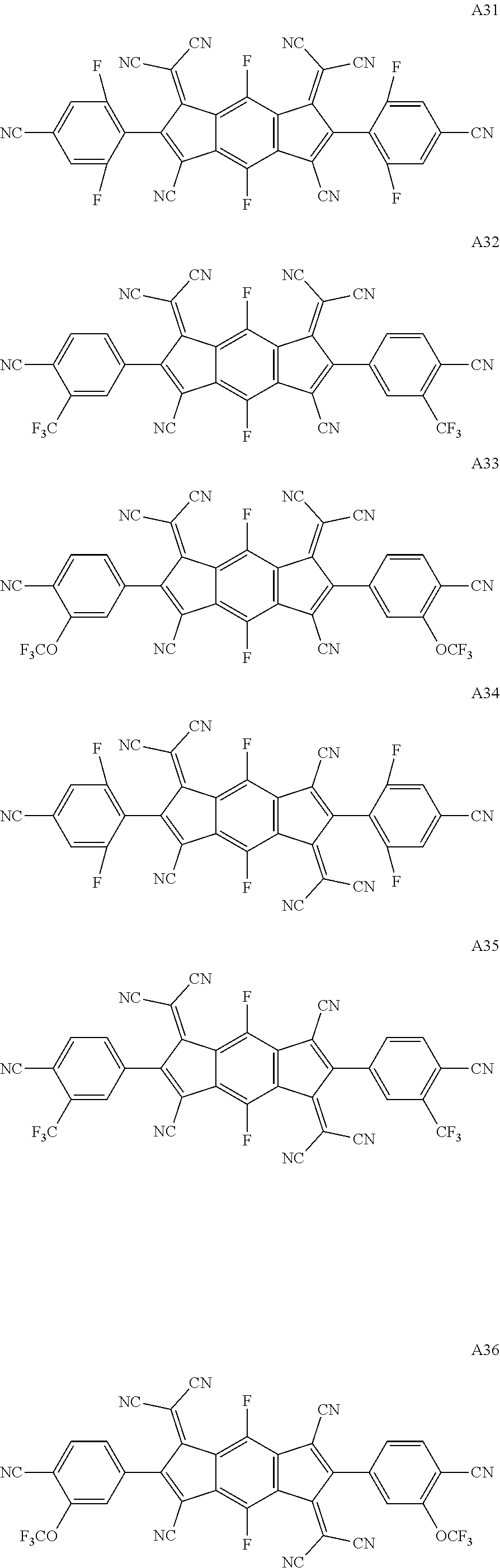
  • the first compound is represented by one or more of the following chemical formula 1 and chemical formula 2.
  • R 1 to R 6 which are same or different, are each independently one selected from the group consisting of a hydrogen; a deuterium; a tritium; a halogen; a cyano group; a nitro group; a C 6 -C 60 aryl group; a fluorenyl group; a C 2 -C 60 hetero ring group containing at least one hetero atom from O, N, S, Si and P; a fused ring group of a C 3 -C 60 aliphatic ring and a C 6 -C 60 aromatic ring; a C 1 -C 50 alkyl group; a C 2 -C 20 alkenyl group; a C 2 -C 20 alkynyl group; a C 1 -C 30 alkoxy group; a C 6 -C 30 aryloxy group; a C 3 -C 60 alkylsilyl group; a C 18 -C 60 arylsilyl group; and a C 8 -
  • R 1 to R 6 are the aryl groups, they may be each independently a C 6 -C 60 aryl group, a C 6 -C 30 aryl group or a C 6 -C 12 aryl group.
  • a 1 to A 4 which may be the same or different, are each independently one selected from the group consisting of a hydrogen; a deuterium; a tritium; a halogen; a cyano group; a nitro group; a C 6 -C 60 aryl group; a fluorenyl group; a C 2 -C 60 hetero ring group containing at least one hetero atom from O, N, S, Si and P; a fused ring group of a C 3 -C 60 aliphatic ring and a C 6 -C 60 aromatic ring; a C 1 -C 50 alkyl group; a C 2 -C 20 alkenyl group; a C 2 -C 20 alkynyl group; a C 1 -C 30 alkoxy group; a C 6 -C 30 aryloxy group; a C 3 -C 60 alkylsilyl group; a C 18 -C 60 arylsilyl group; and a C 8
  • the first layer includes one compound (A) represented by chemical formula 1 and one compound (B) represented by chemical formula 2, it means that all the two compounds (A, B) are included in the first compound.
  • the first layer includes one compound (E) represented by chemical formula 7 and one compound (F) represented by chemical formula 8, it means that all the two compounds (E, F) are included in the first compound.
  • the organic electric element 420 may have high efficiency or long life.
  • the second compound is represented by the following chemical formula 8.
  • A-B-A [chemical formula 8]
  • A is represented by the following chemical formula 8-A.
  • B is any one of chemical structures represented by the followings.
  • R 1 and R 2 which may be the same or different, are each independently one selected from the group consisting of a C 6 -C 60 aryl group; a fluorenyl group; a C 2 -C 60 hetero ring group containing at least one hetero atom from O, N, S, Si and P; a fused ring group of a C 3 -C 60 aliphatic ring and a C 1 -C 20 alkyl group.
  • R 1 and R 2 are the aryl groups, they may be each independently a C 6 -C 60 aryl group, a C 6 -C 30 aryl group or a C 6 -C 12 aryl group.
  • R 1 and R 2 are the alkyl group, they may be each independently a C 1 -C 30 alkyl group, a C 6 -C 20 alkyl group or a C 6 -C 12 alkyl group.
  • the aryl group, the fluorenyl group, the hetero ring group, the fused ring group, and the alkyl group may each be further substituted with at least one substituent selected from the group consisting of a deuterium; a nitro group; a cyano group; a halogen; an amino group; a C 1 -C 20 alkoxyl group; a C 1 -C 20 alkyl group; a C 2 -C 20 alkenyl group; a C 2 -C 20 alkynyl group; a C 6 -C 20 aryl group; a C 6 -C 20 aryl group substituted with the deuterium; a fluorenyl group; a C 2 -C 20 hetero ring group; a C 3 -C 60 alkylsilyl group; a Cis-C 60 arylsilyl group; and a C 8 -C 60 alkylarylsilyl group.
  • the organic electric element 420 includes the first layer 426 a including the second compound represented by the chemical formula 8, it can have high efficiency or long life.
  • the second chemical compound may be one or more of the following chemical compounds.
  • the organic electric element 420 may have high efficiency or long life.
  • the organic electric element 420 may have high efficiency or long life.
  • the organic electric element 420 satisfies the following general formula 1. 0.32 eV ⁇ L 1 ⁇ H 2 ⁇ 0.8 eV [general formula 1]
  • L 1 is the LUMO energy level of the first compound.
  • H 2 is the HOMO(Highest Occupied Molecular Orbital) energy level of the second compound.
  • the lower limit of L 1 ⁇ H 2 defined in the general formula 1 may be 0.34 eV or more, or 0.38 eV or more.
  • the upper limit of L 1 ⁇ H 2 defined in the general formula 1 may be 0.7 eV eV or less, or 0.6 eV eV or less.
  • the organic electric element 420 satisfies the following general formula 2. 0.80 eV ⁇ L 1 ⁇ H 3 ⁇ 1.4 eV [general formula 2]
  • the lower limit of L 1 ⁇ H 3 defined in the general formula 2 may be 0.90 eV or more, or 1.00 eV or more.
  • the upper limit of L 1 ⁇ H 3 defined in the general formula 2 may be 1.3 eV or less, or 1.2 eV or less.
  • the organic electric element 420 satisfies the following general formula 3. 0.40 eV ⁇ H 2 ⁇ H 3 ⁇ 0.9 eV [general formula 3]
  • H 2 is the HOMO(Highest Occupied Molecular Orbital) energy level of the second compound.
  • H 3 is the HOMO(Highest Occupied Molecular Orbital) energy level of the third compound.
  • the lower limit of H 2 ⁇ H 3 defined in the general formula 3 may be 0.45 eV or more, or 0.50 eV or more.
  • the upper limit of H 2 ⁇ H 3 defined in the general formula 3 may be 0.70 eV or less, or 0.60 eV or less.
  • the organic electric device 420 includes the first layer including the second compound satisfying the general formula 3 so that it may have a high efficiency or long life.
  • the first compound included in the first layer 426 a may be a dopant, and the second compound may be a host compound. Since the first layer 426 a includes the above-described first compound as the dopant and the above-described second compound as the host, the first layer 426 a has excellent hole transport properties so that the organic electric element may have excellent efficiency and lifespan.
  • the first compound may be doped at the ratio of 10% to 50% by weight into the first layer 426 a .
  • the first layer has excellent hole transport properties so that the organic electric element may have excellent efficiency and lifespan.
  • the thickness of the first layer 426 a is not particularly limited, but may be, for example, 50 ⁇ to 500 ⁇ .
  • the thickness of the second layer 426 b is not particularly limited, but may be, for example, 50 ⁇ to 500 ⁇ .
  • FIG. 1 may depict a display panel 110 .
  • the display panel 110 includes a sub-pixel 111 including the above-described organic electric element 220 .
  • the organic electrical element 220 is the same as the organic electrical element 220 according to the above-described embodiments, a description thereof will be omitted.
  • FIG. 1 may depict a display device 100 .
  • the display device 100 includes the above-described display panel 110 and a driving circuit for driving the above-described display panel 110 .
  • the display panel 110 is the same as the display panel 110 according to the above-described embodiments, so a description thereof will be omitted.
  • NPD N, N′-Di(1-naphthyl)-N,N′-diphenyl-(1,1′-biphenyl)-4,4′-diamine
  • F4-TCNQ 2,3,5,6-tetrafluoro-tetracyanoquinodimethane
  • a second hole transport layer was formed by thermal vacuum deposition of a hole transport material (TCTA, Tris(4-carbazoyl-9-ylphenyl) amine) to a thickness of 100 nm.
  • TCTA hole transport material
  • ADN(9,10-di(naphtha-2-yl)anthracene) and 1,6-Bis (diphenylamine)pyrene were used as host and dopant materials, respectively, doped with 3%, and thermally vacuum-deposited to a thickness of 20 nm to form a first light emitting layer.
  • a electron transport layer was formed by thermal vacuum deposition of an electron transport material (TmPyPB, 1,3,5-Tri (m-pyridin-3-ylphenyl) benzene) to a thickness of 10 nm, and Bphen(Bathophenanthroline) as an electron injection material was used, and Li was doped with 2% to form a electron injection layer by thermal vacuum deposition to a thickness of 20 nm.
  • a cathode was formed by depositing Al to a thickness of 50 nm, thereby fabricating an organic electric element.
  • the organic electric element was manufactured in the same manner as in the Comparative Example 1, except that the first compound, the second compound and the third compound were used in the types and ratios shown in Table 1 below.
  • Table 2 shows the performances of the manufactured organic electric elements.
  • A04, A15 and A38 are A04, A15 and A38 chemical compounds described as being selectable as the first chemical compound, and 25, 34 and co are the second 25, 34 and 60 chemical compounds described as being selectable as chemical compounds.
  • F4-TCNQ is as follows.
  • the organic electric element according to the embodiments includes the first layer including the first compound and the second compound according to the embodiments so that it may have excellent efficiency or lifespan compared to the organic electric element of the Comparative Example.
  • Embodiments 1, 5 and 9 including the first layer including the first compound represented by at least one of the chemical formula 1 and the chemical formula 2 its efficiency of lifespan is improved compared to the organic electric element of the Comparative Embodiment.
  • the organic electric element of the Embodiments including the first layer further comprising the second compound represented by the chemical formula 3 has better efficiency and longer life than the organic electric elements of Embodiments 1, 5 and 9.
  • a feature comprising the first compound represented by one or more of the chemical formulas 1 and 2 and the second compound represented by the chemical formula 3 provide synergistic effects with each other to provide a more excellent organic electric element.

Landscapes

  • Physics & Mathematics (AREA)
  • Spectroscopy & Molecular Physics (AREA)
  • Chemical & Material Sciences (AREA)
  • Engineering & Computer Science (AREA)
  • Materials Engineering (AREA)
  • Optics & Photonics (AREA)
  • Electroluminescent Light Sources (AREA)

Abstract

Provided are an organic electric element, a display panel and a display device including the organic electric element which include a charge generating layer including a first layer comprising a first compound and a second compound and a second layer comprising a third compound so that they may have excellent efficiency or lifespan.

Description

CROSS REFERENCE TO RELATED APPLICATION
This application claims priority from Korean Patent Application No. 10-2019-0179837, filed on Dec. 31, 2019, which is hereby incorporated by reference for all purposes as if fully set forth herein.
BACKGROUND Technical Field
Embodiments relate to an organic electric element, a display panel, and a display device including the organic electric element.
Discussion of the Related Art
In general, an organic light emitting phenomenon refers to the phenomenon of converting electrical energy into light energy by means of an organic material. An organic electric element refers to an electric element using the organic light emitting phenomenon.
An organic electric element using the organic light emitting phenomenon may be applied to a display device. Since the portable display device is driven by a battery, which is a limited power source, an organic electric element used in the portable display device requires excellent light emission efficiency. In addition, since the image should be displayed normally during use of the electronic device, a long life of the organic electric element may be also required.
In order to improve efficiency, lifespan and driving voltage in the organic electric element, research has been conducted on the organic material included in the organic electric element.
SUMMARY
Accordingly, embodiments of the present disclosure are directed to an organic electric element, a display panel, and a display device that substantially obviate one or more of the problems due to limitations and disadvantages of the related art.
Embodiments may provide an organic electric element having high efficiency or long life.
Embodiments may provide a display panel having high efficiency or long life by including the above-described organic electric element.
Further, embodiments may provide a display device having high efficiency or long life by including the above-described display panel.
Additional features and aspects will be set forth in the description that follows, and in part will be apparent from the description, or may be learned by practice of the inventive concepts provided herein. Other features and aspects of the inventive concepts may be realized and attained by the structure particularly pointed out in the written description, or derivable therefrom, and the claims hereof as well as the appended drawings.
To achieve these and other aspects of the inventive concepts, as embodied and broadly described, an organic electric element comprises a first electrode, a second electrode and an organic layer.
The organic layer is positioned between the first electrode and the second electrode.
The organic layer comprises a light emitting layer and a first layer.
The first layer comprises a first compound and a second compound.
The first compound is represented by one or more of the following chemical formula 1 and chemical formula 2.
Figure US12349590-20250701-C00001
The second compound is represented by the following chemical formula 3.
Figure US12349590-20250701-C00002
According to another aspect, embodiments may provide a display panel comprising a subpixel comprising the organic electric element.
According to another aspect, embodiments may provide a display device comprising the display panel and a driving circuit for driving the display panel.
According to embodiments, it is possible to provide the organic electric device having high luminous efficiency and long life.
According to embodiments, it is possible to provide a display panel including the organic electric device having a high luminous efficiency and long life and a display device comprising the same.
It is to be understood that both the foregoing general description and the following detailed description are exemplary and explanatory and are intended to provide further explanation of the inventive concepts as claimed.
BRIEF DESCRIPTION OF THE DRAWINGS
The accompanying drawings, which are included to provide a further understanding of the disclosure and are incorporated in and constitute a part of this application, illustrate embodiments of the disclosure and together with the description serve to explain various principles. In the drawings:
FIG. 1 is a system configuration diagram of a display device according to embodiments;
FIG. 2 is a view illustrating a subpixel circuit of a display panel according to embodiments; and
FIG. 3 and FIG. 4 are schematic cross-sectional views of an organic electric device according to embodiments.
DETAILED DESCRIPTION
In the following description of examples or embodiments of the present invention, reference will be made to the accompanying drawings in which it is shown by way of illustration specific examples or embodiments that can be implemented, and in which the same reference numerals and signs can be used to designate the same or like components even when they are shown in different accompanying drawings from one another. Further, in the following description of examples or embodiments of the present invention, detailed descriptions of well-known functions and components incorporated herein will be omitted when it is determined that the description may make the subject matter in some embodiments of the present invention rather unclear. The terms such as “including”, “having”, “containing”, “constituting” “make up of”, and “formed of” used herein are generally intended to allow other components to be added unless the terms are used with the term “only”. As used herein, singular forms are intended to include plural forms unless the context clearly indicates otherwise.
Terms, such as “first”, “second”, “A”, “B”, “(A)”, or “(B)” may be used herein to describe elements of the present invention. Each of these terms is not used to define essence, order, sequence, or number of elements etc., but is used merely to distinguish the corresponding element from other elements.
When it is mentioned that a first element “is connected or coupled to”, “contacts or overlaps” etc. a second element, it should be interpreted that, not only can the first element “be directly connected or coupled to” or “directly contact or overlap” the second element, but a third element can also be “interposed” between the first and second elements, or the first and second elements can “be connected or coupled to”, “contact or overlap”, etc. each other via a fourth element. Here, the second element may be included in at least one of two or more elements that “are connected or coupled to”, “contact or overlap”, etc. each other.
When time relative terms, such as “after,” “subsequent to,” “next,” “before,” and the like, are used to describe processes or operations of elements or configurations, or flows or steps in operating, processing, manufacturing methods, these terms may be used to describe non-consecutive or non-sequential processes or operations unless the term “directly” or “immediately” is used together.
In addition, when any dimensions, relative sizes etc. are mentioned, it should be considered that numerical values for an elements or features, or corresponding information (e.g., level, range, etc.) include a tolerance or error range that may be caused by various factors (e.g., process factors, internal or external impact, noise, etc.) even when a relevant description is not specified. Further, the term “may” fully encompasses all the meanings of the term “can”.
The term “halo” or “halogen” as used herein refers to fluorine (F), bromine (Br), chlorine (Cl), or iodine (I) unless otherwise indicated.
As used herein, the term “alkyl” or “alkyl group” refers to a saturated aliphatic functional radical of 1 to 60 carbon atoms with a single bond therein, including a straight chain alkyl group, a branched chain alkyl group, a cycloalkyl (alicyclic) group, an alkyl-substituted cycloalkyl group, and a cycloalkyl-substituted alkyl group, unless otherwise indicated.
The term “haloalkyl group” or “halogenalkyl group”, as used herein, means a halogen-substituted alkyl group unless otherwise specified.
The term “heteroalkyl group”, as used herein, means that at least one of the carbon atoms constituting the alkyl group has been replaced with a heteroatom.
As used herein, the terms “alkenyl group” and “alkynyl group”, refer to a straight or branched chain of 2 to 60 carbon atoms with a double and a triple bond therein, respectively, unless stated otherwise, but are not limited thereto.
Unless otherwise stated, the term “cycloalkyl” as used herein refers to an alkyl forming a ring having 3 to 60 carbon atoms, without being limited thereto.
Unless otherwise stated, the term “alkoxyl group”, “alkoxy group”, or “alkyloxy group” as used herein means an alkyl group of 1 to 60 carbon atoms having an oxygen radical attached thereto, but is not limited thereto.
As used herein, the term “alkenoxyl group”, “alkenoxy group”, “alkenyloxyl group”, or “alkenyloxy group” means an alkenyl group of 2 to 60 carbon atoms having an oxygen radical attached thereto, unless otherwise stated, but is not limited thereto.
As used herein, the term “aryloxyl group” or “aryloxy group” means an aryl group of 6 to 60 carbon atoms having an oxygen radical attached thereto unless otherwise specified, but is not limited thereto.
As used herein, the terms “aryl group” and “arylene group” each refer to having 6 to 60 carbon atoms unless otherwise stated, but are not limited thereto. In the present disclosure, an aryl group or an arylene group means a single or multiple aromatic ring, including an aromatic ring which is formed as neighboring substituents participate in a bond or a reaction. For example, the aryl group may be a phenyl group, a biphenyl group, a terphenyl group, a naphthyl group, an anthracenyl group, a fluorene group, a spirofluorene group, or a spirobifluorene group.
The prefix “aryl” or “ar” means a radical substituted with an aryl group. For example, an arylalkyl group is an alkyl group substituted with an aryl group and an arylalkenyl group is an alkenyl group substituted with an aryl group. In this regard, the radical substituted with an aryl group has the number of carbon atoms described herein.
Also, when prefixes are named consecutively, it means that the substituents are listed in the order described first. By way of example, an arylalkoxy group means an alkoxy group substituted with an aryl group, an alkoxylcarbonyl group means a carbonyl group substituted with an alkoxyl group, and an arylcarbonylalkenyl group means an alkenyl group substituted with an arylcarbonyl group wherein the arylcarbonyl group is a carbonyl group substituted with an aryl group.
As used herein, the term “heteroalkyl” means an alkyl bearing one or more heteroatoms unless otherwise indicated. As used herein, the terms “heteroaryl group” and “heteroarylene group” refer respectively to an aryl group and an arylene group of 2 to 60 carbon atoms bearing one or more heteroatoms therein, unless otherwise specified, without being limited thereto. It may include at least one of a single ring and multiple rings, and may be formed by combining adjacent functional groups.
Unless otherwise indicated, the term “heterocyclic group” as used herein, refers to at least one of heteroaliphatic rings and heteroaromatic rings of 2 to 60 carbon atoms bearing one or more heteroatoms as a ring member thereof, which may be mono- or multi-cyclic and may be formed as neighboring functional groups combine with each other.
The term “heteroatom” as used herein refers to N, O, S, P, or Si unless otherwise stated.
“Heterocyclic groups” may also include rings comprising SO2, in place of carbon atoms, as a ring member. For example, a “heterocyclic group” includes the following compounds.
Figure US12349590-20250701-C00003
Unless otherwise stated, the term “aliphatic” as used herein means an aliphatic hydrocarbon of 1 to 60 carbon atoms, and the “aliphatic ring” means an aliphatic hydrocarbon ring of 3 to 60 carbon atoms.
Unless otherwise stated, the term “ring” as used herein refers to an aliphatic ring of 3 to 60 carbon atoms, an aromatic ring of 6 to 60 carbon atoms, a hetero ring of 2 to 60 carbon atoms, or a fused ring consisting of a combination thereof whether or not it is saturated or unsaturated.
Other hetero-compounds or hetero-radicals other than the aforementioned hetero-compounds include, but are not limited to, one or more heteroatoms.
Unless otherwise stated, the term “carbonyl” as used herein is represented by —COR′, wherein R′ is hydrogen, an alkyl group of 1 to 20 carbon atoms, an aryl group of 6 to 30 carbon atoms, a cycloalkyl group of 3 to 30 carbon atoms, an alkenyl group of 2 to 20 carbon atoms, an alkynyl group of 2 to 20 carbon atoms, or a combination thereof.
Unless otherwise specified, the term “ether” as used herein is represented by —R—O—R′, wherein R and R′ are each independently hydrogen, an alkyl group of 1 to 20 carbon atoms, an aryl group of 6 to 30 carbon atoms, a cycloalkyl group of 3 to 30 carbon atoms, an alkenyl group of 2 to 20 carbon atoms, an alkynyl group of 2 to 20 carbon atoms, or a combination thereof.
Also, unless explicitly stated otherwise, the term “substituted” in the expression “substituted or unsubstituted” means having at least one substituent selected from the group consisting of, but not limited to, deuterium, halogen, an amino group, a nitrile group, a nitro group, a C1-C20 alkyl group, a C1-C20 alkoxyl group, a C1-C20 alkylamine group, a C1-C20 alkylthiophene group, a C6-C20 arylthiophene group, a C2-C20 alkenyl group, a C2-C20 alkynyl, a C3-C20 cycloalkyl group, a C6-C20 aryl group, a deuterium-substituted C6-C20 aryl group, a C8-C20 aryl alkenyl group, a silane group, a boron group, a germanium group, and a C2-C20 hetero-ring.
Also, unless otherwise stated, the chemical formulas used in the present invention are as defined for the exponent parts of the substituent in the following chemical formula:
Figure US12349590-20250701-C00004
    • wherein,
    • when a is an integer of 0, the substituent R1 being null,
    • when a is an integer of 1, one substituent R1 is bonded to any one of the constituent carbon atoms of the benzene ring,
    • when a is an integer of 2 or 3, the substituents R1's, which may be the same or different, are each bonded as represented below, and
    • when a is an integer of 4 to 6, the substituents R1's are bonded to the constituents carbon atoms of the benzene ring in the same manner
    • while the hydrogens bonded to the constituent carbon atoms of the benzene ring are not indicated:
Figure US12349590-20250701-C00005
In the present specification, the formation of a ring by combining substituents with each other means that adjacent groups combine with each other to form a monocycle or single ring, a ring aggregated or a conjugated multi-cycle, and the monocycle, the ring aggregated and the formed conjugated multicycle may include the heterocycle including at least one heteroatom, and may include aromatic and non-aromatic rings.
In the present specification, the organic electric element may mean a component(s) between an anode and a cathode, or an organic light emitting diode including the anode, the cathode and the component(s) positioned therebetween.
In the present specification, the organic electric element may mean one of an organic electric device, the organic light emitting diode and the panel including the same, and an electronic device including the panel and a circuit. For example, the electronic device includes a display device, a lighting device, a solar cell, a portable or mobile terminal (eg, a smart phone, a tablet, a PDA, an electronic dictionary, a PMP, etc.), a navigation terminal, a game machine, various TVs, and various computers monitor and the like, but is not limited thereto, and may be any type of device as long as the component(s) are included.
Hereinafter, exemplary embodiments of the present disclosure will be described in detail with reference to the accompanying drawings.
FIG. 1 is a system configuration diagram of a display device according to embodiments.
Referring to FIG. 1 , the display device 100 in accordance with embodiments of the present disclosure includes a display panel 110 in which a plurality of data lines DL and a plurality of gate lines GL are arranged and a plurality of sub-pixels 111 defined by the plurality of data lines DL and the plurality of gate lines GL is arranged, a data driving circuit DDC (or a data driver) for driving the plurality of data lines DL, a gate driving circuit GDC (or a gate driver) for driving the plurality of gate lines GL, a controller D-CTR controlling the data driving circuit DDC and the gate driving circuit GDC, and the like.
The controller D-CTR controls operations of the data driving circuit DDC and the gate driving circuit GDC by supplying respective control signals (DCS, GCS) to the data driving circuit DDC and the gate driving circuit GDC.
The controller D-CTR starts the scan of pixels according to timings processed in each frame, converts image data inputted from other devices or other image providing sources to be adapted to a data signal form used in the data driving circuit DDC and then outputs image data DATA resulted from the converting, and causes the data to be loaded into the pixels at a pre-configured time according to the scan.
The controller D-CTR may be implemented as a separate component from the data driving circuit DDC or may be integrated with data driving circuit DDC so the controller D-CTR can be implemented as an integrated circuit.
The data driving circuit DDC drives the plurality of data lines DL by providing data voltages corresponding to image data DATA received from the controller D-CTR to the data lines DL. Here, the data driving circuit DDC is sometimes referred to as a source driving circuit or a source driver.
The data driving circuit DDC may include at least one source driver integrated circuit SDIC to be implemented.
Each source driver integrated circuit SDIC may include a shift register, a latch circuit, a digital to analog converter DAC, an output buffer, and/or the like.
In some instances, each source driver integrated circuit SDIC may further include one or more analog to digital converters ADC.
The gate driving circuit GDC sequentially drives a plurality of gate lines GL by sequentially providing scan signals to the plurality of gate lines GL. Here, the gate driving circuit GDC is sometimes referred to as a scan driving circuit or a scan driver.
The gate driving circuit GDC may include at least one gate driver integrated circuit GDIC to be implemented.
Each gate driver integrated circuit GDIC may include a shift register, a level shifter, and/or the like.
Each gate driver integrated circuit GDIC may be connected to a bonding pad of the display panel 110 in a tape automated bonding (TAB) type or a chip on glass (COG) type, or be directly disposed on the display panel 110 as being implemented in a gate in panel (GIP) type. In some instances, the gate driver integrated circuit GDIC may be disposed to be integrated with the display panel 110. Further, each gate driver integrated circuit GDIC may be implemented in a chip on film (COF) type in which the gate driver integrated circuit GDIC is mounted on a film connected with the display panel 110.
According to the controlling of the controller D-CTR, the gate driving circuit GDC sequentially provides scan signals of an on-voltage or an off-voltage to the plurality of gate lines GL.
When a specific gate line is asserted by a scan signal from the gate driving circuit GDC, the data driving circuit DDC converts image data DATA received from the controller D-CTR into analog data voltages and provides the obtained analog data voltages to the plurality of data lines DL.
The data driving circuit DDC may be located on, but not limited to, only one side (e.g., an upper side or a lower side) of the display panel 110, or in some instances, be located on, but not limited to, two sides (e.g., the upper side and the lower side) of the display panel 110 according to driving schemes, panel design schemes, or the like.
The gate driving circuit GDC may be located on, but not limited to, only one side (e.g., a left side or a right side) of the panel 110, or in some instances, be located on, but not limited to, two sides (e.g., the left side and the right side) of the display panel 110 according to driving schemes, panel design schemes, or the like.
The display device 100 according to embodiments of the present disclosure may be one of various types of display devices, such as, a liquid crystal display device, an organic light emitting display device, a plasma display device, or the like.
In case the display device 100 according to embodiments of the present disclosure is an organic light emitting display device, each sub-pixel 111 arranged in the display panel 110 may include circuit components, such as an organic light emitting diode (OLED), which is a self-emissive element, a driving transistor for driving the organic light emitting diode OLED, and the like.
Types of circuit elements and the number of the circuit elements included in each subpixel 111 may be different depending on types of the panel (e.g., an LCD panel, an OLED panel, etc.), provided functions, design schemes/features, or the like.
FIG. 2 is a view illustrating a subpixel circuit of a display panel according to embodiments.
Referring to FIG. 2 , each subpixel 111 may include an organic light emitting diode OLED and a driving transistor DRT for driving the organic light emitting diode OLED as basic circuit components.
Referring to FIG. 2 , each sub-pixel 111 may further include a first transistor T1 allowing a data voltage VDATA to be applied to a first node N1 corresponding to a gate node of the driving transistor DRT, and a storage capacitor C1 for remaining a data voltage VDATA corresponding to an image signal voltage or a voltage corresponding to this during one frame time.
The organic light emitting diode OLED may include a first electrode 221 (an anode electrode or a cathode electrode), a light emitting layer 222, a second electrode 223 (the cathode electrode or the anode electrode), and the like.
In one embodiment, a low-level voltage EVSS may be applied to the second electrode 223 of the organic light emitting diode OLED.
The driving transistor DRT causes the organic light emitting diode OLED to be driven by providing a driving current to the organic light emitting diode OLED.
The driving transistor DRT includes a first node N1, a second node N2 and a third node N3.
The first node N1 of the driving transistor DRT may be a node corresponding to the gate node thereof, and may be electrically connected to a source node or a drain node of the first transistor T1.
The second node N2 of the driving transistor DRT may be electrically connected to the first electrode 221 of the organic light emitting diode OLED and may be a source node or a drain node.
The third node N3 of the driving transistor DRT may be the drain node or the source node as a node to which a driving voltage EVDD is applied, and may be electrically connected to a driving voltage line DVL used to supply a driving voltage EVDD.
The first transistor T1 may be electrically connected between a data line DL and the first node N1 of the driving transistor DRT and may be controlled by a scan signal SCAN that is provided through a gate line and applied to the gate node of the first transistor T1.
The storage capacitor C1 may be electrically connected between the first node N1 and the second node N2 of the driving transistor DRT.
The storage capacitor C1 is an external capacitor intentionally designed to be located outside of the driving transistor DRT, not an internal storage, such as a parasitic capacitor (e.g., a Cgs, a Cgd) that presents between the first node N1 and the second node N2 of the driving transistor DRT.
FIG. 3 is a cross-sectional view of a display device according to the embodiments.
Referring to FIG. 3 , an organic electric element 320 according to the embodiments includes a first electrode 321 and a second electrode 323, an organic layer 322 positioned therebetween.
The first electrode 321 may be an anode and the second electrode 323 may be a cathode. In the case of an inverted type, the first electrode 321 may be a cathode and the second electrode 323 may be an anode.
For example, the first electrode 321 may be a transparent electrode, and the second electrode 323 may be a reflective electrode. In another example, the first electrode 321 may be a reflective electrode, and the second electrode 323 may be a transparent electrode.
The organic layer 322 may include a plurality of layers which is located between the first electrode 321 and the second electrode 323 and includes an organic material.
The organic layer 322 includes a light emitting layer 322 a and a first layer 322 b.
The light emitting layer 322 a is a layer in which holes and electrons transmitted from the first electrode 321 and the second electrode 323 are recombined to emit light, and may include, for example, a host material and a dopant.
The light emitting layer 322 a may include a third compound. The third compound may be, for example, a host material or a dopant included in the light emitting layer 322 a.
The first layer 322 b may be positioned between the light emitting layer 322 a and the first electrode 321. For example, the first layer 322 b may be positioned between the first electrode 321 as an anode electrode and the light emitting layer 322 a.
Although not illustrated in FIG. 3 , the organic electric device 320 may further include one or more of a hole transport layer, an electron transport layer, and an electron injection layer. For example, the hole transport layer may be positioned between the hole injection layer 322 b and the light emitting layer 322 a and at the same time between the light emitting layer 322 a and the first electrode 321 as an anode electrode. For example, the electron injection layer may be positioned between the second electrode 323 as a cathode electrode and the light emitting layer 322 a. For example, the electron transport layer may be positioned between the light emitting layer 322 a and the electron injection layer and at the same time between the second electrode 323 as the cathode electrode and the light emitting layer 322 a. In examples including the hole injection layer, the first layer 322 b may be the hole injection layer.
The first layer 322 b includes a first compound. The hole transport layer may also include the first compound. The first compound included in each layer may be the same as each other or may be different from each other as long as the requirements for the first compound to be described later are met.
FIG. 4 is a view schematically showing an organic electric device according to embodiments.
Referring to FIG. 4 , the organic electric element 420 according to embodiments includes a first electrode 421, a second electrode 423, and an organic layer 422 positioned between the first electrode 421 and the second electrode 423.
The first electrode 421 may be, for example, an anode electrode, and the second electrode 423 may be a cathode electrode.
For example, the first electrode 421 may be a transparent electrode, and the second electrode 423 may be a reflective electrode. In another example, the first electrode 421 may be a reflective electrode, and the second electrode 423 may be a transparent electrode.
The organic layer 422 is a layer including an organic material while being positioned between the first electrode 421 and the second electrode 423, and may be composed of a plurality of layers.
The organic layer 422 includes a first stack 424, a second stack 425, and a charge generating layer 426 positioned between the first stack 424 and the second stack 425.
The organic electric element 420 may be a tandem organic electric element including a plurality of stacks each including a light emitting layer. The plurality of light emitting layers may be made of the same material as each other, or may be made of different materials from each other.
The first stack 424 includes a first emitting layer 424 a. The first emitting layer 424 a may include, for example, a host material and a dopant.
The first stack 424 may further include a first hole transport layer 424 b and a first electron transport layer 424 b.
The first hole transport layer 424 b may be positioned between the first light emitting layer 424 a and one of the first electrode 421 and the second electrode 423 as an anode electrode. The first electron transport layer 424 c may be positioned between the first light emitting layer 424 a and one of the first electrode 421 and the second electrode 423 as a cathode electrode. For example, when the first electrode 421 is the anode electrode and the second electrode 423 is the cathode electrode, the first hole transport layer 424 b may be positioned on the first electrode 421, the first light emitting layer 424 a may be positioned on the first hole transport layer 424 b, and the first electron transport layer 424 c may be positioned on the first light emitting layer 424 a.
The second stack 425 includes a second emitting layer 425 a. The second emitting layer 425 a may include, for example, a host material and a dopant.
The second stack 425 may further include a second hole transport layer 425 b and a second electron transport layer 424 b.
The second hole transport layer 425 b may be positioned between the second light emitting layer 425 a and one of the first electrode 421 and the second electrode 423 as an anode electrode. The second electron transport layer 425 c may be positioned between the second light emitting layer 424 a and one of the first electrode 421 and the second electrode 423 as a cathode electrode. For example, when the first electrode 421 is the anode electrode and the second electrode 423 is the cathode electrode, the second hole transport layer 425 b may be positioned on the second electrode 421, the second light emitting layer 425 a may be positioned on the second hole transport layer 425 b, and the second electron transport layer 424 c may be positioned on the second light emitting layer 425 a.
Since the first stack 424 and the second stack 425 are configured as described above, holes and electrons transmitted from the first electrode 421 and the second electrode 423 are recombined with each other in the first and second light emitting layers 424 a and 232 so that tight may be emitted from by recombination the first and second light emitting layers 424 a and 432.
The charge generating layer 426 is formed between a plurality of light emitting layers to smoothly distribute charges so that it may increase the current efficiency of the light emitting layer. Accordingly, the charge generating layer 426 is positioned between the first stack 424 including the first light emitting layer 424 a and the second stack 425 including the second light emitting layer 425 a.
The charge generating layer 426 may include a p-type charge generating layer and an n-type charge generating layer in order to smoothly distribute charges. For example, the first layer 426 a may be a p-type charge generating layer and the second layer 426 b may be an n-type charge generating layer. When the first electrode 421 is the anode electrode and the second electrode 423 is the cathode electrode, the p-type charge generating layer may be located on the cathode electrode side and the n-type charge generating layer may be located on the anode side. For example, the first layer 426 a may be positioned between the second layer 426 b and the second electrode 423 which is a cathode electrode.
Although FIG. 4 shows the tandem organic electric element including two stacks, the embodiment is not limited to the tandem organic electric element including two stacks, and includes tandem organic electric element including two or more stacks. When the organic electrical element 420 further includes a stack, a charge generating layer may be additionally positioned between the additionally included stack and one of the adjacent first stack 424 and the second stack 425.
The organic electric element 420 may include a hole injection layer 427. The hole injection layer 427 may be positioned between the first electrode 421 as an anode electrode and the first light emitting layer 424 a. For example, the hole injection layer 427 may be positioned between the first electrode 421 as an anode electrode and the first hole transport layer 424 b.
Although not illustrated in FIG. 4 , the organic electric element 420 may further include an electron injection layer. For example, the electron injection layer may be positioned between the second electrode 423 as a cathode electrode, and the second electron transport layer 425 c.
In another example, each of the first stack 424 and the second stack 425 may further include one or more of a hole injection layer and an electron injection layer. Within each stack, the hole injection layer may be located between the light emitting layer and the anode electrode, and an electron injection layer may be located between the light emitting layer and the cathode electrode.
The first layer 426 a includes the first compound. The first hole transport layer 424 b may include the first compound, and the second hole transport layer 425 b may also include the first compound. Further, the hole injection layer may also include the first compound. The first compound included in each layer may be the same as each other or may be different from each other as long as the requirements for the first compound described later are met.
The first compound is represented by one or more of the following chemical formula 1 and chemical formula 2.
Figure US12349590-20250701-C00006
Hereinafter, chemical formula 1 and chemical formula 2 will be described.
R1 to R6, which are same or different, are each independently one selected from the group consisting of a hydrogen; a deuterium; a tritium; a halogen; a cyano group; a nitro group; a C6-C60 aryl group; a fluorenyl group; a C2-C60 hetero ring group containing at least one hetero atom from O, N, S, Si and P; a fused ring group of a C3-C60 aliphatic ring and a C6-C60 aromatic ring; a C1-C50 alkyl group; a C2-C20 alkenyl group; a C2-C20 alkynyl group; a C1-C30 alkoxy group; a C6-C30 aryloxy group; a C3-C60 alkylsilyl group; a C18-C60 arylsilyl group; and a C8-C60 alkylarylsilyl group, and one or more of R1 to R6 is the cyano group.
When R1 to R6 are the aryl groups, they may be each independently a C6-C60 aryl group, a C6-C30 aryl group or a C6-C12 aryl group.
A1 to A4, which may be the same or different, are each independently one selected from the group consisting of a hydrogen; a deuterium; a tritium; a halogen; a cyano group; a nitro group; a C6-C60 aryl group; a fluorenyl group; a C2-C60 hetero ring group containing at least one hetero atom from O, N, S, Si and P; a fused ring group of a C3-C60 aliphatic ring and a C6-C60 aromatic ring; a C1-C50 alkyl group; a C2-C20 alkenyl group; a C2-C20 alkynyl group; a C1-C30 alkoxy group; a C6-C30 aryloxy group; a C3-C60 alkylsilyl group; a C18-C60 arylsilyl group; and a C8-C60 alkylarylsilyl group.
In R1 to R6 and A1 to A4 of the chemical formula 1 and the chemical formula 2, the aryl group, the fluorenyl group, the hetero ring group, the fused ring group, the alkyl group, the alkenyl group, the alkynyl group, the alkoxy group, the aryloxy group, the alkylsilyl group, the arylsilyl group and the alkylarylsilyl group may each be further substituted with at least one substituent selected from the group consisting of a deuterium; a nitro group; a cyano group; a halogen; an amino group; a C1-C20 alkoxyl group; a C1-C20 alkyl group; a C2-C20 alkenyl group; a C2-C20 alkynyl group; a C6-C20 aryl group; a C6-C20 aryl group substituted with the deuterium; a fluorenyl group; a C2-C20 hetero ring group; a C3-C60 alkylsilyl group; a C18-C60 arylsilyl group; and a C8-C60 alkylarylsilyl group.
When the first compound is represented by one or more of the chemical formula 1 and the chemical formula 2, for example, the first layer includes one compound (A) represented by chemical formula 1 and one compound (B) represented by chemical formula 2, it means that all the two compounds (A, B) are included in the first compound.
The first layer 426 a includes a second compound. The second compound is represented by the following chemical formula 3.
Figure US12349590-20250701-C00007
Hereinafter, chemical formula 3 will be described.
R1 and R2, which may be the same or different, are each independently one selected from the group consisting of a C6-C60 aryl group; a fluorenyl group; a C2-C60 hetero ring group containing at least one hetero atom from O, N, S, Si and P; a fused ring group of a C3-C60 aliphatic ring and a C1-C20 alkyl group.
When R1 and R2 are the aryl groups, they may be each independently a C6-C60 aryl group, a C6-C30 aryl group or a C6-C12 aryl group.
When R1 and R2 are the alkyl group, they may be each independently a C1-C30 alkyl group, a C6-C20 alkyl group or a C6-C12 alkyl group.
L is one selected from the group consisting of a C6-C60 arylene group; a fluorylene group; a C2-C60 divalent hetero ring group containing at least one heteroatom from O, N, S, Si and P; a divalent fused ring group of a C3-C60 aliphatic ring and a C6-C60 aromatic ring.
In R1, R2 and L of the chemical formula 3, the aryl group, the fluorenyl group, the hetero ring group, the fused ring group, the alkyl group, the arylene group, the fluorylene group, the divalent fused ring group, and the divalent fused ring group may each be further substituted with at least one substituent selected from the group consisting of a deuterium; a nitro group; a cyano group; a halogen; an amino group; a C1-C20 alkoxyl group; a C1-C20 alkyl group; a C2-C20 alkenyl group; a C2-C20 alkynyl group; a C6-C20 aryl group; a C6-C20 aryl group substituted with the deuterium; a fluorenyl group; a C2-C20 hetero ring group; a C3-C60 alkylsilyl group; a C18-C60 arylsilyl group; and a C8-C60 alkylarylsilyl group.
Since the organic electric element 420 includes the first layer 426 a including the first compound and the second compound, it can have high efficiency or long life.
The first chemical compound is represented by one or more of the following chemical formula 4 and chemical formula 5.
Figure US12349590-20250701-C00008
Hereafter, the chemical formula 4 and the chemical formula 5 will be described.
    • n and m are each independently an integer from 0 to 5.
    • R7 to R8, which may be the same or different, are each independently one selected from the group consisting of a deuterium; a tritium; a halogen; a cyano group; a C1-C50 alkyl group; and a C1-C30 alkoxy group.
When R7 and R8 are alkoxy groups, they may be, for example, a C1-C30 alkoxy group, a C1-C20 alkoxy group or a C1-C10 alkoxy group.
In R7 and R8 of the chemical formula 4 and the chemical formula 5, the alkyl group and the alkoxy group may each be further substituted with at least one substituent selected from the group consisting of a deuterium and a halogen.
When the first compound is represented by one or more of the chemical formula 4 and the chemical formula 5, for example, the first layer includes one compound (C) represented by chemical formula 4 and one compound (D) represented by chemical formula 5, it means that all the two compounds (C, D) are included in the first compound.
When the first layer 426 a includes the first compound represented by one or more of the above chemical formulas 4 and 5, the organic electric element 420 may have high efficiency or long life.
The first chemical compound is represented by one or more of the following chemical formula 6 and formula 7.
Figure US12349590-20250701-C00009
The chemical formula 6 and the chemical formula 7 will be described.
R1 to R6, which are same or different, are each independently one selected from the group consisting of a hydrogen; a deuterium; a tritium; a halogen; a cyano group; a nitro group; a C6-C60 aryl group; a fluorenyl group; a C2-C60 hetero ring group containing at least one hetero atom from O, N, S, Si and P; a fused ring group of a C3-C60 aliphatic ring and a C6-C60 aromatic ring; a C1-C50 alkyl group; a C2-C20 alkenyl group; a C2-C20 alkynyl group; a C1-C30 alkoxy group; a C6-C30 aryloxy group; a C3-C60 alkylsilyl group; a C18-C60 arylsilyl group; and a C8-C60 alkylarylsilyl group, and one or more of R1 to R6 is the cyano group.
When R1 to R6 are the aryl groups, they may be each independently a C6-C60 aryl group, a C6-C30 aryl group or a C6-C12 aryl group.
In R1 to R6 of the chemical formula 6 and the chemical formula 7, the aryl group, the fluorenyl group, the hetero ring group, the fused ring group, the alkyl group, the alkenyl group, the alkynyl group, the alkoxy group, the aryloxy group, the alkylsilyl group, the arylsilyl group and the alkylarylsilyl group may each be further substituted with at least one substituent selected from the group consisting of a deuterium; a nitro group; a cyano group; a halogen; an amino group; a C1-C20 alkoxyl group; a C1-C20 alkyl group; a C2-C20 alkenyl group; a C2-C20 alkynyl group; a C6-C20 aryl group; a C6-C20 aryl group substituted with the deuterium; a fluorenyl group; a C2-C20 hetero ring group; a C3-C60 alkylsilyl group; a C18-C60 arylsilyl group; and a C8-C60 alkylarylsilyl group.
When the first compound is represented by one or more of the chemical formula 7 and the chemical formula 8, for example, the first layer includes one compound (E) represented by chemical formula 7 and one compound (F) represented by chemical formula 8, it means that all the two compounds (E, F) are included in the first compound.
When the first layer 426 a includes the first compound represented by one or more of the above chemical formulas 6 and 7, the organic electric element 420 may have high efficiency or long life.
The first chemical compound may be one or more of the following chemical compounds.
Figure US12349590-20250701-C00010
Figure US12349590-20250701-C00011
Figure US12349590-20250701-C00012
Figure US12349590-20250701-C00013
Figure US12349590-20250701-C00014
Figure US12349590-20250701-C00015
Figure US12349590-20250701-C00016
Figure US12349590-20250701-C00017
When the first layer 426 a includes the first compound represented by one or more of the above chemical compound, the organic electric element 420 may have high efficiency or long life.
The second compound is represented by the following chemical formula 8.
A-B-A  [chemical formula 8]
Hereinafter, chemical formula 8 will be described.
A is represented by the following chemical formula 8-A.
Figure US12349590-20250701-C00018
B is any one of chemical structures represented by the followings.
Figure US12349590-20250701-C00019
    • * in the B is the position to which the A is bonded.
In the chemical formula 8-A, R1 and R2, which may be the same or different, are each independently one selected from the group consisting of a C6-C60 aryl group; a fluorenyl group; a C2-C60 hetero ring group containing at least one hetero atom from O, N, S, Si and P; a fused ring group of a C3-C60 aliphatic ring and a C1-C20 alkyl group.
When R1 and R2 are the aryl groups, they may be each independently a C6-C60 aryl group, a C6-C30 aryl group or a C6-C12 aryl group.
When R1 and R2 are the alkyl group, they may be each independently a C1-C30 alkyl group, a C6-C20 alkyl group or a C6-C12 alkyl group.
In R1 and R2 of the chemical formula 8, the aryl group, the fluorenyl group, the hetero ring group, the fused ring group, and the alkyl group may each be further substituted with at least one substituent selected from the group consisting of a deuterium; a nitro group; a cyano group; a halogen; an amino group; a C1-C20 alkoxyl group; a C1-C20 alkyl group; a C2-C20 alkenyl group; a C2-C20 alkynyl group; a C6-C20 aryl group; a C6-C20 aryl group substituted with the deuterium; a fluorenyl group; a C2-C20 hetero ring group; a C3-C60 alkylsilyl group; a Cis-C60 arylsilyl group; and a C8-C60 alkylarylsilyl group.
Since the organic electric element 420 includes the first layer 426 a including the second compound represented by the chemical formula 8, it can have high efficiency or long life.
The second chemical compound may be one or more of the following chemical compounds.
Figure US12349590-20250701-C00020
Figure US12349590-20250701-C00021
Figure US12349590-20250701-C00022
Figure US12349590-20250701-C00023
Figure US12349590-20250701-C00024
Figure US12349590-20250701-C00025
Figure US12349590-20250701-C00026
Figure US12349590-20250701-C00027
Figure US12349590-20250701-C00028
Figure US12349590-20250701-C00029
When the first layer 426 a includes the second compound represented by one or more of the above chemical compound, the organic electric element 420 may have high efficiency or long life.
When the first layer 426 a includes the third compound represented by one or more of the above chemical compound, the organic electric element 420 may have high efficiency or long life.
The organic electric element 420 satisfies the following general formula 1.
0.32 eV≤L 1 −H 2≤0.8 eV  [general formula 1]
In the general formula 1, L1 is the LUMO energy level of the first compound. H2 is the HOMO(Highest Occupied Molecular Orbital) energy level of the second compound.
The lower limit of L1−H2 defined in the general formula 1 may be 0.34 eV or more, or 0.38 eV or more.
The upper limit of L1−H2 defined in the general formula 1 may be 0.7 eV eV or less, or 0.6 eV eV or less.
The organic electric device 420 includes the first layer including a first compound and a second compound satisfying the general formula 1 so that it may have a high efficiency or long life.
The organic electric element 420 satisfies the following general formula 2.
0.80 eV≤L 1 −H 3≤1.4 eV  [general formula 2]
In the general formula 2, L1 is the LUMO (Lowest Unoccupied Molecular Orbital) energy level of the first compound.
H3 is the HOMO(Highest Occupied Molecular Orbital) energy level of the third compound.
The lower limit of L1−H3 defined in the general formula 2 may be 0.90 eV or more, or 1.00 eV or more.
The upper limit of L1−H3 defined in the general formula 2 may be 1.3 eV or less, or 1.2 eV or less.
The organic electric device 420 includes the first layer including the first compound satisfying the general formula 2 and the light emitting layer including the third compound so that it may have a high efficiency or long life.
The organic electric element 420 satisfies the following general formula 3.
0.40 eV≤H 2 −H 3≤0.9 eV  [general formula 3]
In the general formula 3, H2 is the HOMO(Highest Occupied Molecular Orbital) energy level of the second compound.
H3 is the HOMO(Highest Occupied Molecular Orbital) energy level of the third compound.
The lower limit of H2−H3 defined in the general formula 3 may be 0.45 eV or more, or 0.50 eV or more.
The upper limit of H2−H3 defined in the general formula 3 may be 0.70 eV or less, or 0.60 eV or less.
The organic electric device 420 includes the first layer including the second compound satisfying the general formula 3 so that it may have a high efficiency or long life.
The first compound included in the first layer 426 a may be a dopant, and the second compound may be a host compound. Since the first layer 426 a includes the above-described first compound as the dopant and the above-described second compound as the host, the first layer 426 a has excellent hole transport properties so that the organic electric element may have excellent efficiency and lifespan.
The first compound may be doped at the ratio of 10% to 50% by weight into the first layer 426 a. When the first compound satisfies the above ratio, the first layer has excellent hole transport properties so that the organic electric element may have excellent efficiency and lifespan.
The thickness of the first layer 426 a is not particularly limited, but may be, for example, 50 Å to 500 Å.
The thickness of the second layer 426 b is not particularly limited, but may be, for example, 50 Å to 500 Å.
Other embodiments of the present invention may provide a display panel 110.
The display panel 110 includes a sub-pixel 111 including the above-described organic electric element 220.
In the display panel 110 according to the present embodiment, since the organic electrical element 220 is the same as the organic electrical element 220 according to the above-described embodiments, a description thereof will be omitted.
In addition, since the display panel 110 and the sub-pixel 111 according to the embodiments have been described above, a description thereof will be omitted.
Other embodiments of the present invention may provide a display device 100.
The display device 100 includes the above-described display panel 110 and a driving circuit for driving the above-described display panel 110.
In the display device 100 according to the present embodiments, the display panel 110 is the same as the display panel 110 according to the above-described embodiments, so a description thereof will be omitted.
In addition, since the driving circuit for driving the display panel according to embodiments has been described above, a description thereof will be omitted.
Hereinafter, examples of manufacturing an organic electric element according to the embodiments will be specifically described with reference to the embodiment, but the embodiments are not limited to the following examples.
Manufacturing Evaluation of Organic Electric Element
Comparative Example 1
After washing a glass substrate coated with ITO (indium tin oxide) to a thickness of 1,000 Å, the substrate is washed with a solvent such as isopropyl alcohol, acetone or methanol and dried. On this prepared ITO transparent electrode, NPD (N, N′-Di(1-naphthyl)-N,N′-diphenyl-(1,1′-biphenyl)-4,4′-diamine) is used as the second compound, F4-TCNQ (2,3,5,6-tetrafluoro-tetracyanoquinodimethane) was doped with 10% as the first compound and thermally vacuum-deposited to form a hole injection layer of 10 nm. A first hole transport layer (HTL1) was formed by thermal vacuum deposition of a hole transport material (NPD) of 100 nm.
Subsequently, a second hole transport layer (HTL2) was formed by thermal vacuum deposition of a hole transport material (TCTA, Tris(4-carbazoyl-9-ylphenyl) amine) to a thickness of 100 nm. After that, ADN(9,10-di(naphtha-2-yl)anthracene) and 1,6-Bis (diphenylamine)pyrene were used as host and dopant materials, respectively, doped with 3%, and thermally vacuum-deposited to a thickness of 20 nm to form a first light emitting layer.
Subsequently, a electron transport layer was formed by thermal vacuum deposition of an electron transport material (TmPyPB, 1,3,5-Tri (m-pyridin-3-ylphenyl) benzene) to a thickness of 10 nm, and Bphen(Bathophenanthroline) as an electron injection material was used, and Li was doped with 2% to form a electron injection layer by thermal vacuum deposition to a thickness of 20 nm. Subsequently, a cathode was formed by depositing Al to a thickness of 50 nm, thereby fabricating an organic electric element.
Embodiments 1 to 12 and Comparative Examples 2 to 4
The organic electric element was manufactured in the same manner as in the Comparative Example 1, except that the first compound, the second compound and the third compound were used in the types and ratios shown in Table 1 below. Table 2 shows the performances of the manufactured organic electric elements.
TABLE 1
first second third
chemical chemical chemical L1-H2 L1-H3 H2-H3
compound compound compound (eV) (eV) (eV)
Comparative Example 1 F4-TCNQ (10%) NPD ADN 0.30 0.60 0.30
Comparative Example 2 F4-TCNQ (10%) 25 ADN 0.03 0.60 0.57
Comparative Example 3 F4-TCNQ (10%) 34 ADN −0.01 0.60 0.61
Comparative Example 4 F4-TCNQ (10%) 60 ADN 0 0.60 0.60
Embodiment 1 A04 (10%) NPD ADN 0.75 1.05 0.30
Embodiment 2 A04 (10%) 25 ADN 0.48 1.05 0.57
Embodiment 3 A04 (10%) 34 ADN 0.44 1.05 0.61
Embodiment 4 A04 (10%) 60 ADN 0.45 1.05 0.60
Embodiment 5 A15 (10%) NPD ADN 0.76 1.06 0.30
Embodiment 6 A15 (10%) 25 ADN 0.49 1.06 0.57
Embodiment 7 A15 (10%) 34 ADN 0.45 1.06 0.61
Embodiment 8 A15 (10%) 60 ADN 0.46 1.06 0.60
Embodiment 9 A38 (10%) NPD ADN 0.70 1.00 0.30
Embodiment 10 A38 (10%) 25 ADN 0.43 1.00 0.57
Embodiment 11 A38 (10%) 34 ADN 0.39 1.00 0.61
Embodiment 12 A38 (10%) 60 ADN 0.40 1.00 0.60
In Table 1, A04, A15 and A38 are A04, A15 and A38 chemical compounds described as being selectable as the first chemical compound, and 25, 34 and co are the second 25, 34 and 60 chemical compounds described as being selectable as chemical compounds. F4-TCNQ is as follows.
Figure US12349590-20250701-C00030
TABLE 2
driving
voltage efficiency color coordinate lifespan
(V) (cd/A) (CIE x, y) (T95, hr)
Comparative 4.71 5.37 0.140 0.097 107
Example 1
Comparative 4.80 5.33 0.139 0.098 80
Example 2
Comparative 4.63 5.42 0.140 0.099 110
Example 3
Comparative 4.62 5.49 0.139 0.100 118
Example 4
Embodiment 1 4.58 5.64 0.141 0.099 138
Embodiment 2 4.52 5.70 0.140 0.098 161
Embodiment 3 4.46 5.69 0.139 0.098 180
Embodiment 4 4.45 5.72 0.139 0.098 180
Embodiment 5 4.50 5.65 0.140 0.099 126
Embodiment 6 4.39 5.69 0.140 0.100 164
Embodiment 7 4.40 5.76 0.139 0.099 168
Embodiment 8 4.35 5.81 0.140 0.098 172
Embodiment 9 4.38 5.58 0.139 0.099 147
Embodiment 10 4.34 5.61 0.140 0.099 148
Embodiment 11 4.27 5.79 0.139 0.099 174
Embodiment 12 4.25 5.82 0.141 0.100 191
As can be seen from the result of Table 2, the organic electric element according to the embodiments includes the first layer including the first compound and the second compound according to the embodiments so that it may have excellent efficiency or lifespan compared to the organic electric element of the Comparative Example.
In the case of Embodiments 1, 5 and 9 including the first layer including the first compound represented by at least one of the chemical formula 1 and the chemical formula 2, its efficiency of lifespan is improved compared to the organic electric element of the Comparative Embodiment.
In addition, compared to the Embodiments 1, 5 and 9, it can be seen that the organic electric element of the Embodiments including the first layer further comprising the second compound represented by the chemical formula 3 has better efficiency and longer life than the organic electric elements of Embodiments 1, 5 and 9.
Accordingly, it can be seen that a feature comprising the first compound represented by one or more of the chemical formulas 1 and 2 and the second compound represented by the chemical formula 3 provide synergistic effects with each other to provide a more excellent organic electric element.
It will be apparent to those skilled in the art that various modifications and variations can be made in the present disclosure without departing from the technical idea or scope of the disclosure. Thus, it is intended that the present disclosure cover the modifications and variations of this disclosure provided they come within the scope of the appended claims and their equivalents.

Claims (19)

What is claimed is:
1. An organic electric element comprising:
a first electrode;
a second electrode; and
an organic layer positioned between the first electrode and the second electrode,
wherein the organic layer comprises a first layer, and
the first layer comprises:
a dopant including a first compound represented by one or more of the following chemical formula 1 and chemical formula 2, and
a host including a second compound:
Figure US12349590-20250701-C00031
in the chemical formula 1 and the chemical formula 2,
R1 to R6, which are same or different, are each independently one selected from the group consisting of a hydrogen; a deuterium; a tritium; a halogen; a cyano group; a nitro group; a C6-C60 aryl group; a fluorenyl group; a C2-C60 hetero ring group containing at least one hetero atom from O, N, S, Si and P; a fused ring group of a C3-C60 aliphatic ring and a C6-C60 aromatic ring; a C1-C50 alkyl group; a C2-C20 alkenyl group; a C2-C20 alkynyl group; a C1-C30 alkoxy group; a C6-C30 aryloxy group; a C3-C60 alkylsilyl group; a C18-C60 arylsilyl group; and a C8-C60 alkylarylsilyl group, and one or more of R1 to R6 is the cyano group,
A1 to A4, which are the same or different, are each independently one selected from the group consisting of a hydrogen; a deuterium; a tritium; a halogen; a cyano group; a nitro group; a C6-C60 aryl group; a fluorenyl group; a C2-C60 hetero ring group containing at least one hetero atom from O, N, S, Si and P; a fused ring group of a C3-C60 aliphatic ring and a C6-C60 aromatic ring; a C1-C50 alkyl group; a C2-C20 alkenyl group; a C2-C20 alkynyl group; a C1-C30 alkoxy group; a C6-C30 aryloxy group; a C3-C60 alkylsilyl group; a C18-C60 arylsilyl group; and a C8-C60 alkylarylsilyl group,
in R1 to R6 and A1 to A4 of the chemical formula 1 and the chemical formula 2, each of the aryl group, the fluorenyl group, the hetero ring group, the fused ring group, the alkyl group, the alkenyl group, the alkynyl group, the alkoxy group, the aryloxy group, the alkylsilyl group, the arylsilyl group, and the alkylarylsilyl group is optionally substituted with at least one substituent selected from the group consisting of a deuterium; a nitro group; a cyano group; a halogen; an amino group; a C1-C20 alkoxyl group; a C1-C20 alkyl group; a C2-C20 alkenyl group; a C2-C20 alkynyl group; a C6-C20 aryl group; a C6-C20 aryl group substituted with the deuterium; a fluorenyl group; a C2-C20 hetero ring group; a C3-C60 alkylsilyl group; a C18-C60 arylsilyl group; and a C8-C60 alkylarylsilyl group,
Figure US12349590-20250701-C00032
and
wherein the second compound is the following chemical compound:
Figure US12349590-20250701-C00033
2. The organic electric element according to claim 1, wherein the first compound is represented by one or more of the following chemical formula 4 and chemical formula 5:
Figure US12349590-20250701-C00034
in the chemical formula 4 and the chemical formula 5,
n and m are each independently an integer from 0 to 5,
R7 to R8, which are the same or different, are each independently one selected from the group consisting of a deuterium; a tritium; a halogen; a cyano group; a C1-C50 alkyl group; and a C1-C30 alkoxy group, and
each of the alkyl group and the alkoxy group is optionally substituted with at least one substituent selected from the group consisting of a deuterium and a halogen.
3. The organic electric element according to claim 1, wherein the first compound is represented by one or more of the following chemical formula 6 and formula 7:
Figure US12349590-20250701-C00035
in the chemical formula 6 and the chemical formula 7,
R1 to R6 are the same as R1 to R6 defined in the chemical formulas 1 and 2.
4. The organic electric element according to claim 1, wherein the first compound is one or more of the following chemical compounds:
Figure US12349590-20250701-C00036
Figure US12349590-20250701-C00037
Figure US12349590-20250701-C00038
Figure US12349590-20250701-C00039
Figure US12349590-20250701-C00040
Figure US12349590-20250701-C00041
Figure US12349590-20250701-C00042
Figure US12349590-20250701-C00043
5. The organic electric element according to claim 1, wherein the first electrode is an anode electrode, the second electrode is a cathode electrode, the organic layer further comprises a light emitting layer, and the first layer is positioned between the first electrode and the light emitting layer.
6. The organic electric element according to claim 1, wherein the following general formula 1 is satisfied:

0.32 eV≤K L 1 −H 2≤0.8 eV  [general formula 1]
in the general formula 1, L1 is the LUMO energy level of the first compound, and H2 is the HOMO(Highest Occupied Molecular Orbital) energy level of the second compound.
7. The organic electric element according to claim 1, wherein the organic layer further comprises a light emitting layer comprising a third compound, and the following general formula 2 is satisfied:

0.80 eV≤L 1 −H 3≤1.4 eV  [general formula 2]
in the general formula 2, L1 is the LUMO(LowestUnoccupied Molecular Orbital) energy level of the first compound, and H3 is the HOMO(Highest Occupied Molecular Orbital) energy level of the third compound.
8. The organic electric element according to claim 1, wherein the organic layer further comprises a light emitting layer comprising a third compound, and the following general formula 3 is satisfied:

0.40 eV≤H 2 −H 3≤0.9 eV  [general formula 3]
in the general formula 3, H2 is the HOMO(Highest Occupied Molecular Orbital) energy level of the second compound, and H3 is the HOMO(Highest Occupied Molecular Orbital) energy level of the third compound.
9. A display panel comprising a subpixel comprising the organic electric element of claim 1.
10. A display device comprising;
the display panel of claim 9; and
a driving circuit for driving the display panel.
11. The organic electric element according to claim 1, wherein the first compound is represented by one or more of the following chemical formula 4 and chemical formula 5:
Figure US12349590-20250701-C00044
in the chemical formula 4 and the chemical formula 5,
A1 to A4 are each a cyano group,
R1 and R4 are each independently one selected from the group consisting of a hydrogen; a deuterium; a tritium; and fluorine,
R2, R3, and R5 are the same as R2, R3, and R5 defined in the chemical formulas 1 and 2,
n and m are each independently an integer from 0 to 5,
R7 to R8, which are the same or different, are each independently one selected from the group consisting of a deuterium; a tritium; a cyano group; a C1-C50 alkyl group; and a C1-C30 alkoxy group, and
each of the alkyl group and the alkoxy group is optionally substituted with at least one fluorine.
12. The organic electric element according to claim 11, wherein R7 to R8, which are the same or different, are each independently one selected from the group consisting of a cyano group; a fluorine-substituted C1 alkyl group; and a fluorine-substituted C1 alkoxy group.
13. The organic electric element according to claim 1, wherein the first compound is:
Figure US12349590-20250701-C00045
14. The organic electric element according to claim 1, wherein the first compound is:
Figure US12349590-20250701-C00046
15. The organic electric element according to claim 1, wherein the first compound is:
Figure US12349590-20250701-C00047
16. The organic electric element according to claim 1, wherein the first layer is a hole injection layer.
17. The organic electric element according to claim 1, wherein the first layer includes 10% by weight of the first compound.
18. The organic electric element according to claim 1, wherein the first compound is a dopant, and the second compound is a host.
19. The organic electric element according to claim 14, wherein the first layer is a hole injection layer, and
wherein the first compound is a dopant, and the second compound is a host.
US17/137,825 2019-12-31 2020-12-30 Organic electric element, display panel comprising the same and display device comprising the same Active 2041-07-25 US12349590B2 (en)

Applications Claiming Priority (2)

Application Number Priority Date Filing Date Title
KR10-2019-0179837 2019-12-31
KR1020190179837A KR102808940B1 (en) 2019-12-31 2019-12-31 Organic electronic element, display panel comprising the same and display device comprising the same

Publications (2)

Publication Number Publication Date
US20210202847A1 US20210202847A1 (en) 2021-07-01
US12349590B2 true US12349590B2 (en) 2025-07-01

Family

ID=73855203

Family Applications (1)

Application Number Title Priority Date Filing Date
US17/137,825 Active 2041-07-25 US12349590B2 (en) 2019-12-31 2020-12-30 Organic electric element, display panel comprising the same and display device comprising the same

Country Status (4)

Country Link
US (1) US12349590B2 (en)
EP (1) EP3846238A1 (en)
KR (1) KR102808940B1 (en)
CN (1) CN113130831B (en)

Families Citing this family (2)

* Cited by examiner, † Cited by third party
Publication number Priority date Publication date Assignee Title
KR20220089235A (en) * 2020-12-21 2022-06-28 엘지디스플레이 주식회사 Organic compound, and Organic light emitting diode and Organic light emitting device including the same
KR102867301B1 (en) * 2021-12-31 2025-10-01 엘지디스플레이 주식회사 Light Emitting Device and Light Emitting Display Device

Citations (8)

* Cited by examiner, † Cited by third party
Publication number Priority date Publication date Assignee Title
US20050236970A1 (en) * 2004-04-07 2005-10-27 Noriharu Matsudate Self-emitting display
US20160268508A1 (en) * 2015-03-11 2016-09-15 Samsung Display Co., Ltd. Organic light emitting device
EP3176844A1 (en) 2015-12-03 2017-06-07 LG Display Co., Ltd. Organic light emitting display device
KR20170066194A (en) 2015-12-03 2017-06-14 엘지디스플레이 주식회사 Organic Light Emitting Diode Device
KR20170092483A (en) * 2016-02-03 2017-08-11 주식회사 엘지화학 Amine based compound and organic electronic device using the same
KR20180033000A (en) * 2016-09-23 2018-04-02 주식회사 엘지화학 Amine-based compound and organic light emitting device comprising the same
US20180277762A1 (en) * 2015-10-06 2018-09-27 Lg Chem, Ltd. Amine compound and organic light-emitting device comprising same
WO2018221871A1 (en) * 2017-05-31 2018-12-06 주식회사 엘지화학 Organic light emitting element

Patent Citations (12)

* Cited by examiner, † Cited by third party
Publication number Priority date Publication date Assignee Title
US20050236970A1 (en) * 2004-04-07 2005-10-27 Noriharu Matsudate Self-emitting display
US20160268508A1 (en) * 2015-03-11 2016-09-15 Samsung Display Co., Ltd. Organic light emitting device
US20180277762A1 (en) * 2015-10-06 2018-09-27 Lg Chem, Ltd. Amine compound and organic light-emitting device comprising same
EP3176844A1 (en) 2015-12-03 2017-06-07 LG Display Co., Ltd. Organic light emitting display device
US20170162792A1 (en) * 2015-12-03 2017-06-08 Lg Display Co., Ltd. Organic light emitting display device
KR20170066194A (en) 2015-12-03 2017-06-14 엘지디스플레이 주식회사 Organic Light Emitting Diode Device
KR20170092483A (en) * 2016-02-03 2017-08-11 주식회사 엘지화학 Amine based compound and organic electronic device using the same
KR20180033000A (en) * 2016-09-23 2018-04-02 주식회사 엘지화학 Amine-based compound and organic light emitting device comprising the same
WO2018221871A1 (en) * 2017-05-31 2018-12-06 주식회사 엘지화학 Organic light emitting element
KR20180131100A (en) 2017-05-31 2018-12-10 주식회사 엘지화학 Organic light emitting device
US20200144552A1 (en) * 2017-05-31 2020-05-07 Lg Chem, Ltd. Organic light emitting element
US11877464B2 (en) 2017-05-31 2024-01-16 Lg Chem, Ltd. Organic light emitting element

Non-Patent Citations (3)

* Cited by examiner, † Cited by third party
Title
Extended European Search Report dated May 19, 2021, issued in European patent application No. 20214785.6.
Notice of allowance issued on Jan. 24, 2024 for counterpart Chinese Patent Application No. 202011548874.2 Note: US2018277762A1 and US2017162792A1 cited therein are already of record.
Office Action issued on Jul. 22, 2024 for Korean Patent Application No. 10-2019-0179837.

Also Published As

Publication number Publication date
CN113130831A (en) 2021-07-16
CN113130831B (en) 2024-03-29
KR102808940B1 (en) 2025-05-16
KR20210086121A (en) 2021-07-08
EP3846238A1 (en) 2021-07-07
US20210202847A1 (en) 2021-07-01

Similar Documents

Publication Publication Date Title
US11997919B2 (en) Organic electric element, display panel comprising the same and display device comprising the same
US12167680B2 (en) Organic electric element, display panel comprising the same and display device comprising the same
US20210202858A1 (en) Organic electric element, display panel comprising the same and display device comprising the same
US20240040812A1 (en) Organic electric element, display panel comprising the same and display device comprising the same
US12349590B2 (en) Organic electric element, display panel comprising the same and display device comprising the same
US20210202860A1 (en) Organic electric element, display panel comprising the same and display device comprising the same
US12364158B2 (en) Organic electric element, display panel comprising the same and display device comprising the same
US11430964B2 (en) Organic electric element, display panel comprising the same and display device comprising the same

Legal Events

Date Code Title Description
AS Assignment

Owner name: LG DISPLAY CO., LTD., KOREA, REPUBLIC OF

Free format text: ASSIGNMENT OF ASSIGNORS INTEREST;ASSIGNORS:SHIN, JICHEOL;YOO, SEONKEUN;SEO, JEONGDAE;AND OTHERS;SIGNING DATES FROM 20201207 TO 20201211;REEL/FRAME:054780/0359

Owner name: LG CHEM, LTD., KOREA, REPUBLIC OF

Free format text: ASSIGNMENT OF ASSIGNORS INTEREST;ASSIGNORS:SHIN, JICHEOL;YOO, SEONKEUN;SEO, JEONGDAE;AND OTHERS;SIGNING DATES FROM 20201207 TO 20201211;REEL/FRAME:054780/0359

FEPP Fee payment procedure

Free format text: ENTITY STATUS SET TO UNDISCOUNTED (ORIGINAL EVENT CODE: BIG.); ENTITY STATUS OF PATENT OWNER: LARGE ENTITY

STPP Information on status: patent application and granting procedure in general

Free format text: APPLICATION DISPATCHED FROM PREEXAM, NOT YET DOCKETED

STPP Information on status: patent application and granting procedure in general

Free format text: DOCKETED NEW CASE - READY FOR EXAMINATION

STPP Information on status: patent application and granting procedure in general

Free format text: RESPONSE TO NON-FINAL OFFICE ACTION ENTERED AND FORWARDED TO EXAMINER

STPP Information on status: patent application and granting procedure in general

Free format text: FINAL REJECTION MAILED

STPP Information on status: patent application and granting procedure in general

Free format text: DOCKETED NEW CASE - READY FOR EXAMINATION

STPP Information on status: patent application and granting procedure in general

Free format text: NON FINAL ACTION MAILED

STPP Information on status: patent application and granting procedure in general

Free format text: RESPONSE TO NON-FINAL OFFICE ACTION ENTERED AND FORWARDED TO EXAMINER

STPP Information on status: patent application and granting procedure in general

Free format text: FINAL REJECTION MAILED

STPP Information on status: patent application and granting procedure in general

Free format text: DOCKETED NEW CASE - READY FOR EXAMINATION

STCF Information on status: patent grant

Free format text: PATENTED CASE