US12346309B2 - System and method for using policy to achieve data segmentation - Google Patents
System and method for using policy to achieve data segmentation Download PDFInfo
- Publication number
- US12346309B2 US12346309B2 US16/243,011 US201916243011A US12346309B2 US 12346309 B2 US12346309 B2 US 12346309B2 US 201916243011 A US201916243011 A US 201916243011A US 12346309 B2 US12346309 B2 US 12346309B2
- Authority
- US
- United States
- Prior art keywords
- node
- data
- policy
- nodes
- context
- Prior art date
- Legal status (The legal status is an assumption and is not a legal conclusion. Google has not performed a legal analysis and makes no representation as to the accuracy of the status listed.)
- Active, expires
Links
Images



Classifications
-
- G—PHYSICS
- G06—COMPUTING OR CALCULATING; COUNTING
- G06F—ELECTRIC DIGITAL DATA PROCESSING
- G06F16/00—Information retrieval; Database structures therefor; File system structures therefor
- G06F16/20—Information retrieval; Database structures therefor; File system structures therefor of structured data, e.g. relational data
- G06F16/23—Updating
- G06F16/2365—Ensuring data consistency and integrity
-
- G—PHYSICS
- G06—COMPUTING OR CALCULATING; COUNTING
- G06F—ELECTRIC DIGITAL DATA PROCESSING
- G06F16/00—Information retrieval; Database structures therefor; File system structures therefor
- G06F16/20—Information retrieval; Database structures therefor; File system structures therefor of structured data, e.g. relational data
- G06F16/23—Updating
- G06F16/2379—Updates performed during online database operations; commit processing
-
- G—PHYSICS
- G06—COMPUTING OR CALCULATING; COUNTING
- G06F—ELECTRIC DIGITAL DATA PROCESSING
- G06F16/00—Information retrieval; Database structures therefor; File system structures therefor
- G06F16/20—Information retrieval; Database structures therefor; File system structures therefor of structured data, e.g. relational data
- G06F16/27—Replication, distribution or synchronisation of data between databases or within a distributed database system; Distributed database system architectures therefor
-
- G—PHYSICS
- G06—COMPUTING OR CALCULATING; COUNTING
- G06F—ELECTRIC DIGITAL DATA PROCESSING
- G06F16/00—Information retrieval; Database structures therefor; File system structures therefor
- G06F16/90—Details of database functions independent of the retrieved data types
- G06F16/901—Indexing; Data structures therefor; Storage structures
- G06F16/9024—Graphs; Linked lists
-
- H—ELECTRICITY
- H04—ELECTRIC COMMUNICATION TECHNIQUE
- H04L—TRANSMISSION OF DIGITAL INFORMATION, e.g. TELEGRAPHIC COMMUNICATION
- H04L9/00—Cryptographic mechanisms or cryptographic arrangements for secret or secure communications; Network security protocols
- H04L9/30—Public key, i.e. encryption algorithm being computationally infeasible to invert or user's encryption keys not requiring secrecy
- H04L9/3066—Public key, i.e. encryption algorithm being computationally infeasible to invert or user's encryption keys not requiring secrecy involving algebraic varieties, e.g. elliptic or hyper-elliptic curves
- H04L9/3073—Public key, i.e. encryption algorithm being computationally infeasible to invert or user's encryption keys not requiring secrecy involving algebraic varieties, e.g. elliptic or hyper-elliptic curves involving pairings, e.g. identity based encryption [IBE], bilinear mappings or bilinear pairings, e.g. Weil or Tate pairing
-
- H—ELECTRICITY
- H04—ELECTRIC COMMUNICATION TECHNIQUE
- H04L—TRANSMISSION OF DIGITAL INFORMATION, e.g. TELEGRAPHIC COMMUNICATION
- H04L9/00—Cryptographic mechanisms or cryptographic arrangements for secret or secure communications; Network security protocols
- H04L9/32—Cryptographic mechanisms or cryptographic arrangements for secret or secure communications; Network security protocols including means for verifying the identity or authority of a user of the system or for message authentication, e.g. authorization, entity authentication, data integrity or data verification, non-repudiation, key authentication or verification of credentials
- H04L9/3236—Cryptographic mechanisms or cryptographic arrangements for secret or secure communications; Network security protocols including means for verifying the identity or authority of a user of the system or for message authentication, e.g. authorization, entity authentication, data integrity or data verification, non-repudiation, key authentication or verification of credentials using cryptographic hash functions
- H04L9/3239—Cryptographic mechanisms or cryptographic arrangements for secret or secure communications; Network security protocols including means for verifying the identity or authority of a user of the system or for message authentication, e.g. authorization, entity authentication, data integrity or data verification, non-repudiation, key authentication or verification of credentials using cryptographic hash functions involving non-keyed hash functions, e.g. modification detection codes [MDCs], MD5, SHA or RIPEMD
-
- H—ELECTRICITY
- H04—ELECTRIC COMMUNICATION TECHNIQUE
- H04L—TRANSMISSION OF DIGITAL INFORMATION, e.g. TELEGRAPHIC COMMUNICATION
- H04L9/00—Cryptographic mechanisms or cryptographic arrangements for secret or secure communications; Network security protocols
- H04L9/50—Cryptographic mechanisms or cryptographic arrangements for secret or secure communications; Network security protocols using hash chains, e.g. blockchains or hash trees
Definitions
- the present invention relates to a system and method for controlling user access to data across a shared distributed storage system.
- the present invention relates to a system and method for a distributed data management service that captures context for accessed data and utilizes the captured context and data lineage with operational policy to govern user access to the data.
- relational database management systems centralize user access, and enforce access rules, resulting in a “system of record”.
- the system of record represents the authoritative copy of data and trust in the data through careful management.
- database administrators typically provide trust in the data through clearly defined structure and permissions granted with least-privilege in mind.
- this level of trust has eroded as more applications and ad hoc users interact with the same data, as data is transformed and replicated, and as new types of data management services are introduced that lack sufficient core security capabilities. That erosion is exacerbated by the rapid pace of data provisioning for development and testing and the equally rapid progression of business rules and data governance requirements that must be translated to running code. These factors are increasingly leading to governance failures, resulting in costly and complex audit processes, privacy breaches, sovereign deployment roadblocks, uncertainty in autonomous systems, etc. Examples of such failures can frequently be found in multi-tenant deployments.
- the present invention provides a distributed data management system and method governing and controlling data access and data flow for data stored in nodes subject to credential approval used for mapping, propagating and provisioning with respect to data collections and nodes according to a combined collaborative data access policy enforcement implemented and adapted by continually capturing context and data lineage of nodes functioning as points of durability for specific data sets.
- the present invention provides a distributed data management system and method that capture context for each data transaction (e.g., read/write) and use the context with clear policy to govern data from the inside out.
- the present invention provides data governance through the utilization of policy that encodes compliance against which the data is managed, captures context and lineage of data as it is accessed, and implements a least-privilege model applied to actors within the data management system to control the flow of data through policy based decisions.
- the present invention provides a system and method for addressing data governance within a data management system in a manner that enables applications to become simpler and more secure than when using conventional data management systems.
- a method for utilizing a combination of policy and context to manage the segmentation of data in a distributed logical service includes initiating, using one or more networked computing devices, the distributed logical service.
- the distributed logical service includes one or more nodes comprising physically independent processes, the one or more nodes independently associated with a node policy dictating attributes and capabilities of an associated node and managing a record within the distributed logical service.
- the method can further include provisioning the one or more nodes using one or more networked computing devices.
- the provisioning can include receiving an instruction to provision, and provisioning an initial node with an initial policy, receiving, from an operator using one or more networked computing devices, an instruction to create and creating a node identity associated with the initial node, and the initial node automatically creating a ledger showing a membership with the node identity of the initial node for storage with the initial node.
- the provisioning can also include receiving an instruction to provision, and provisioning, at least one additional node with a second unique policy and a second node identity, the at least one additional node transmitting the second unique policy and the second node identity of the at least one additional node to all nodes in the membership, the approval of the at least one additional node, and that node's unique policy by the membership by execution of a distributed consensus algorithm, the at least one additional node receiving approval and entry credentials from the membership, and the at least one additional node creating a copy of the ledger for storage with the at least one additional node.
- the node policy of the transaction node executing the transaction and the context corresponding to the one or more records can define whether each of one or more target records are permitted to flow to the transaction node, wherein each other node in the membership in a location where the one or more target records are stored sends the one or more target records stored to the transaction node executing the transaction only if the one or more target records are permitted to flow to that transaction node.
- a system for utilizing a combination of policy and context to manage the segmentation of data in a distributed logical service comprises one or more networked computing devices each comprising memory, one or more processors and input/output components. Each of the one or more networked computing devices is configured to initiate the distributed logical service.
- One or more nodes comprise physically independent processes, the one or more nodes independently associated with a node policy dictating attributes and capabilities of an associated node.
- a database engine is configured to access and exchange instructions with one or more external data stores or one or more internal data stores, for managing a record within the distributed logical service.
- Management uses a policy engine configured to create the record and capturing context for the record at creation, store the record in a collection at a node and storing the context as a graph node within a logically separate context graph structure, which may be stored physically separately from the record stored at the node, then receive a request, through the node and transmitted from a user device using a network connection, for executing a data transaction involving the record, and validate, by the node policy of the node, the requested data transaction, by determining whether the requested data transaction complies with the node policy and database policies, which dictates what operations the node can execute and what actions each database can perform.
- the database engine is further configured to perform the data transaction for the record at the node.
- the policy engine is configured to automatically capture context for the data transaction and store new context information resulting from the data transaction or a different transaction in the context graph structure.
- the node policies of the one or more nodes and a captured context of a data transaction limit which target data the one or more nodes can access and which tasks the one or more nodes can perform on the target data.
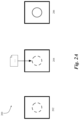
- FIG. 2 B is an illustrative example of provisioning additional nodes in accordance with the present invention.
- FIG. 3 is an illustrative example of provisioning a database in accordance with the present invention.
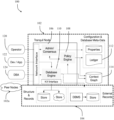
- the operators 120 are also enabled to provision the one or more stores 104 accessed by the one or more nodes 102 , such that the operators 120 manage the mapping of the physical infrastructure within the system.
- the operators 120 are isolated from the content of any given database, which is managed by the DBAs 124 , and accessed by the developer applications 122 .
- This configuration serves as a separation of duty where actors who defined and manage policy on the system 100 cannot also affect the content stored therein.
- each of the one or more stores 104 is a logical, independent collection of data that is serviced and managed by one of the one or more nodes 102 .
- the one or more stores 104 can include any combination of storage devices configured to store and organize a collection of data.
- the one or more stores 104 can be a collection of storage devices on a single computing device, a collection of storage devices at a remote database facility, or a cloud computing storage environment.
- FIG. 2 A depicts an initial setup process 200 of the first node within the system 100 .
- settings for the one or more nodes 102 must be configured.
- a host machine physical or virtual
- the operating software for the system 100 installed thereon.
- the properties for the one or more nodes 102 are setup in a node configuration file.
- the node configuration can be an editable file that is stored directly on a local filesystem (e.g., specifying data directories, cache sizes or logging configuration) utilizing the system.
- a first node can be provisioned/created.
- an operator or autonomous agent acting as an operator first creates an identity for the node (e.g., a public/private key-pair) and associates a policy with the node.
- an identity for the node e.g., a public/private key-pair
- the request for first node is simply allowed into the system 100 because there are no other nodes to query for approval.
- the process 210 depicted in FIG. 2 B is initialized.
- the initial node is provisioned with a node policy, as performed in the process 200 depicted in FIG. 2 A .
- the result of the initial node being provisioned is a system 100 with a single node member operating thereon.
- the first node records its own identity and policy within its ledger 112 , which will be shared with any subsequent nodes that join the system 100 .
- the resulting ledger 112 provides a logical data-set that will capture all allowable behavior for each of the nodes in the system.
- the ledger 112 also supports reasoning about the policy associated with the logical service. Other than bootstrapping the initiation process, there is nothing “special” about that first node, it behaves like all other nodes that will be provisioned within the system 100 , and can be de-provisioned at any point without affecting the functionality of the overall system 100 .
- policy of requested new node against all existing node identities and policies (e.g., in the ledger 112 ) to determine whether there is no conflict.
- each of the nodes will compare the node identity and policy against all node identities and policies stored in the distributed ledger 112 . If the consensus of the existing nodes is that no conflict is found and the proposed policy is acceptable, then the requesting node identity and policy are stored in the distributed ledger, thus memorializing the node and associated policy for the other nodes. Thereafter, at step 216 , the new node establishes connections to the existing nodes and its role in the system 100 will be enforced based on its policy, so that (among other aspects) the other nodes will know what parts of a given database should or may not be shared with the new node. Thereafter, the two nodes in FIG.
- this logical policy (achieved through a formal hierarchy) defines a clean mapping between both the application-specific notions of data models (e.g., schemas) and physical aspects of a distributed system, which enables a segmentation model (discussed in greater detail herein) and integrity of the data model as a whole.
- the node policies stored across the one or more nodes 102 will create a global view of node and database policies.
- developers are no longer burdened with encoding policy inside application logic (a typical source of security flaws and project delays) to meet compliance requirements.
- the framework is in-place to be proactive in ensuring compliance, instead of being reactive and retroactive in action.
- the benefits provided by the proactive policies of the system 100 of the present invention are not achievable through conventional systems and methods because typical “policies” are often simple access control lists, rigid rules defining authorized actions, or configurations dictating how to install and monitor a system's components. They are often decomposed such that the total logic can only be seen by looking at application code, filesystem permissions, user groups and roles, LDAP entries, PKIs, etc. From this perspective, it is difficult to get a holistic view of what a given user is allowed to do, understand the effects of a local change in a global context, introduce new content and functionality, etc. It is common for application policies to be able to speak to users and data access within an application but typically not to resource management, cross-application access, or physical data residence.
- data when the system 100 is configured with multiple nodes, data can be sliced across multiple collections.
- data may or may not have been sliced, but because there was only the one node all interaction with the database engine 110 would be the same.
- any given node may have a node policy that grants access to only a subset of the data slices. This means that the local data store(s) would only have access to that subset and the local context graph and could only correlate to that subset content.
- a multiple node system also provides additional avenues for physical data segmentation. For example, when records are mapped to slices and when any given node is responsible for only a subset of slices, then this has the effect of segmenting groups of data and defining where information is both stored and allowed to flow.
- computing device 600 can include a “workstation,” a “server,” a “laptop,” a “desktop,” a “hand-held device,” a “mobile device,” a “tablet computer,” or other computing devices, as would be understood by those of skill in the art.
- the computing device 600 is depicted for illustrative purposes, embodiments of the present invention may utilize any number of computing devices 600 in any number of different ways to implement a single embodiment of the present invention. Accordingly, embodiments of the present invention are not limited to a single computing device 600 , as would be appreciated by one with skill in the art, nor are they limited to a single type of implementation or configuration of the example computing device 600 .
- the computing device 600 can include a bus 610 that can be coupled to one or more of the following illustrative components, directly or indirectly: a memory 612 , one or more processors 614 , one or more presentation components 616 , input/output ports 618 , input/output components 620 , and a power supply 624 .
- the bus 610 can include one or more busses, such as an address bus, a data bus, or any combination thereof.
- busses such as an address bus, a data bus, or any combination thereof.
- FIG. 4 is merely illustrative of an exemplary computing device that can be used to implement one or more embodiments of the present invention, and in no way limits the invention.
- the memory 612 can include computer-storage media in the form of volatile and/or nonvolatile memory.
- the memory 612 may be removable, non-removable, or any combination thereof.
- Exemplary hardware devices are devices such as hard drives, solid-state memory, optical-disc drives, and the like.
- the computing device 600 can include one or more processors that read data from components such as the memory 612 , the various I/O components 616 , etc.
- Presentation component(s) 616 present data indications to a user or other device.
- Exemplary presentation components include a display device, speaker, printing component, vibrating component, etc.
- the I/O ports 618 can enable the computing device 600 to be logically coupled to other devices, such as I/O components 620 .
- I/O components 620 can be built into the computing device 600 . Examples of such I/O components 620 include a microphone, joystick, recording device, game pad, satellite dish, scanner, printer, wireless device, networking device, and the like.
- the terms “comprises” and “comprising” are intended to be construed as being inclusive, not exclusive.
- the terms “exemplary”, “example”, and “illustrative”, are intended to mean “serving as an example, instance, or illustration” and should not be construed as indicating, or not indicating, a preferred or advantageous configuration relative to other configurations.
- the terms “about”, “generally”, and “approximately” are intended to cover variations that may existing in the upper and lower limits of the ranges of subjective or objective values, such as variations in properties, parameters, sizes, and dimensions.
Landscapes
- Engineering & Computer Science (AREA)
- Theoretical Computer Science (AREA)
- Databases & Information Systems (AREA)
- Physics & Mathematics (AREA)
- General Physics & Mathematics (AREA)
- Data Mining & Analysis (AREA)
- General Engineering & Computer Science (AREA)
- Computer Security & Cryptography (AREA)
- Computer Networks & Wireless Communication (AREA)
- Signal Processing (AREA)
- Computing Systems (AREA)
- Software Systems (AREA)
- Algebra (AREA)
- Mathematical Analysis (AREA)
- Mathematical Optimization (AREA)
- Mathematical Physics (AREA)
- Pure & Applied Mathematics (AREA)
- Information Retrieval, Db Structures And Fs Structures Therefor (AREA)
Abstract
Description
Claims (26)
Priority Applications (1)
| Application Number | Priority Date | Filing Date | Title |
|---|---|---|---|
| US16/243,011 US12346309B2 (en) | 2018-01-26 | 2019-01-08 | System and method for using policy to achieve data segmentation |
Applications Claiming Priority (2)
| Application Number | Priority Date | Filing Date | Title |
|---|---|---|---|
| US201862622683P | 2018-01-26 | 2018-01-26 | |
| US16/243,011 US12346309B2 (en) | 2018-01-26 | 2019-01-08 | System and method for using policy to achieve data segmentation |
Publications (2)
| Publication Number | Publication Date |
|---|---|
| US20190236062A1 US20190236062A1 (en) | 2019-08-01 |
| US12346309B2 true US12346309B2 (en) | 2025-07-01 |
Family
ID=67392129
Family Applications (1)
| Application Number | Title | Priority Date | Filing Date |
|---|---|---|---|
| US16/243,011 Active 2039-09-07 US12346309B2 (en) | 2018-01-26 | 2019-01-08 | System and method for using policy to achieve data segmentation |
Country Status (2)
| Country | Link |
|---|---|
| US (1) | US12346309B2 (en) |
| WO (1) | WO2019147412A1 (en) |
Families Citing this family (11)
| Publication number | Priority date | Publication date | Assignee | Title |
|---|---|---|---|---|
| US11290491B2 (en) * | 2019-03-14 | 2022-03-29 | Oracle International Corporation | Methods, systems, and computer readable media for utilizing a security service engine to assess security vulnerabilities on a security gateway element |
| US11469886B2 (en) * | 2019-05-22 | 2022-10-11 | Salesforce.Com, Inc. | System or method to implement record level access on metadata driven blockchain using shared secrets and consensus on read |
| CN110992443B (en) * | 2019-12-18 | 2023-09-26 | 政采云有限公司 | A business flow chart construction method, device and computer-readable storage medium |
| CN112579682B (en) * | 2020-12-24 | 2023-10-10 | 中国农业银行股份有限公司 | Method and device for notifying change of data model, electronic equipment and storage medium |
| US11436230B1 (en) * | 2021-04-29 | 2022-09-06 | Microsoft Technology Licensing, Llc | Cross-tenant people search in a multi-tenant computing system |
| US11902282B2 (en) | 2021-05-28 | 2024-02-13 | Capital One Services, Llc | Validating compliance of roles with access permissions |
| US11562082B2 (en) | 2021-05-28 | 2023-01-24 | Capital One Services, Llc | Crafting effective policies for identity and access management roles |
| US12155666B2 (en) | 2021-05-28 | 2024-11-26 | Capital One Services, Llc | Evaluation of effective access permissions in identity and access management (IAM) systems |
| US12477030B1 (en) * | 2021-09-30 | 2025-11-18 | Amazon Technologies, Inc. | Client-configurable in-transit segmentation of streaming input at managed data transfer services |
| CN117332121B (en) * | 2023-09-26 | 2024-07-26 | 华能澜沧江水电股份有限公司 | Hydropower plant non-electric quantity protection logic map generation system and method |
| CN120915777B (en) * | 2025-10-10 | 2026-01-30 | 浪潮通信信息系统有限公司 | Data transmission method, device and system |
Citations (15)
| Publication number | Priority date | Publication date | Assignee | Title |
|---|---|---|---|---|
| US20020016845A1 (en) | 1997-11-17 | 2002-02-07 | John Davis Palmer | Method and apparatus for accessing shared resources with asymmetric safety in a multiprocessing system |
| US20100088335A1 (en) * | 2008-10-07 | 2010-04-08 | Yasuyuki Mimatsu | Method and apparatus for improving file access performance of distributed storage system |
| US20130036089A1 (en) | 2011-08-01 | 2013-02-07 | Tagged, Inc. | Systems and methods for asynchronous distributed database management |
| US20140095449A1 (en) * | 2012-09-28 | 2014-04-03 | Oracle International Corporation | Policy Driven Data Placement And Information Lifecycle Management |
| US20150249703A1 (en) * | 2014-02-28 | 2015-09-03 | Red Hat, Inc. | Systems and methods for communicating information of participants registered with a sub-coordinator during distributed transaction processing |
| US9244983B2 (en) * | 2012-04-05 | 2016-01-26 | Microsoft Technology Licensing, Llc | Platform for continuous graph update and computation |
| US20160224949A1 (en) | 2015-02-04 | 2016-08-04 | Ripple Labs Inc. | Temporary consensus subnetwork in a distributed network for payment processing |
| US20160330209A1 (en) * | 2013-12-31 | 2016-11-10 | Thales Nederland B.V. | A data securing system and method |
| US20170034217A1 (en) * | 2014-06-30 | 2017-02-02 | CloudMode, LLC | Authorization of access to a data resource in addition to specific actions to be performed on the data resource based on an authorized context enforced by a use policy |
| US20170060574A1 (en) | 2015-08-27 | 2017-03-02 | FogHorn Systems, Inc. | Edge Intelligence Platform, and Internet of Things Sensor Streams System |
| US20170236120A1 (en) * | 2016-02-11 | 2017-08-17 | Oracle International Corporation | Accountability and Trust in Distributed Ledger Systems |
| US20170262551A1 (en) * | 2016-03-11 | 2017-09-14 | Linkedin Corporation | Fan-out control in scalable distributed data stores |
| US10346626B1 (en) * | 2013-04-01 | 2019-07-09 | Amazon Technologies, Inc. | Versioned access controls |
| US10459664B1 (en) * | 2017-04-10 | 2019-10-29 | Pure Storage, Inc. | Virtualized copy-by-reference |
| US20190384748A1 (en) * | 2017-02-17 | 2019-12-19 | Nokia Technologies Oy | Voting-consensus distributed ledger |
-
2019
- 2019-01-08 US US16/243,011 patent/US12346309B2/en active Active
- 2019-01-08 WO PCT/US2019/012780 patent/WO2019147412A1/en not_active Ceased
Patent Citations (15)
| Publication number | Priority date | Publication date | Assignee | Title |
|---|---|---|---|---|
| US20020016845A1 (en) | 1997-11-17 | 2002-02-07 | John Davis Palmer | Method and apparatus for accessing shared resources with asymmetric safety in a multiprocessing system |
| US20100088335A1 (en) * | 2008-10-07 | 2010-04-08 | Yasuyuki Mimatsu | Method and apparatus for improving file access performance of distributed storage system |
| US20130036089A1 (en) | 2011-08-01 | 2013-02-07 | Tagged, Inc. | Systems and methods for asynchronous distributed database management |
| US9244983B2 (en) * | 2012-04-05 | 2016-01-26 | Microsoft Technology Licensing, Llc | Platform for continuous graph update and computation |
| US20140095449A1 (en) * | 2012-09-28 | 2014-04-03 | Oracle International Corporation | Policy Driven Data Placement And Information Lifecycle Management |
| US10346626B1 (en) * | 2013-04-01 | 2019-07-09 | Amazon Technologies, Inc. | Versioned access controls |
| US20160330209A1 (en) * | 2013-12-31 | 2016-11-10 | Thales Nederland B.V. | A data securing system and method |
| US20150249703A1 (en) * | 2014-02-28 | 2015-09-03 | Red Hat, Inc. | Systems and methods for communicating information of participants registered with a sub-coordinator during distributed transaction processing |
| US20170034217A1 (en) * | 2014-06-30 | 2017-02-02 | CloudMode, LLC | Authorization of access to a data resource in addition to specific actions to be performed on the data resource based on an authorized context enforced by a use policy |
| US20160224949A1 (en) | 2015-02-04 | 2016-08-04 | Ripple Labs Inc. | Temporary consensus subnetwork in a distributed network for payment processing |
| US20170060574A1 (en) | 2015-08-27 | 2017-03-02 | FogHorn Systems, Inc. | Edge Intelligence Platform, and Internet of Things Sensor Streams System |
| US20170236120A1 (en) * | 2016-02-11 | 2017-08-17 | Oracle International Corporation | Accountability and Trust in Distributed Ledger Systems |
| US20170262551A1 (en) * | 2016-03-11 | 2017-09-14 | Linkedin Corporation | Fan-out control in scalable distributed data stores |
| US20190384748A1 (en) * | 2017-02-17 | 2019-12-19 | Nokia Technologies Oy | Voting-consensus distributed ledger |
| US10459664B1 (en) * | 2017-04-10 | 2019-10-29 | Pure Storage, Inc. | Virtualized copy-by-reference |
Non-Patent Citations (1)
| Title |
|---|
| International Search Report from PCT/US2019/012780, dated Mar. 26, 2019. |
Also Published As
| Publication number | Publication date |
|---|---|
| US20190236062A1 (en) | 2019-08-01 |
| WO2019147412A1 (en) | 2019-08-01 |
Similar Documents
| Publication | Publication Date | Title |
|---|---|---|
| US20190236062A1 (en) | System and method for using policy to achieve data segmentation | |
| US11341118B2 (en) | Atomic application of multiple updates to a hierarchical data structure | |
| US20190327271A1 (en) | Automated access control management for computing systems | |
| EP3398091B1 (en) | System and method for unified access control on federated database | |
| US8838556B1 (en) | Managing data sets by reasoning over captured metadata | |
| Khan | Federated ETL Architectures for Multi-Domain Data Integration: Balancing Decentralization, Privacy, and Analytical Performance in Distributed Data Ecosystems | |
| US11501202B1 (en) | Querying databases with machine learning model references | |
| CN114365133A (en) | System or method for implementing forgotten rights on metadata driven blockchains with secret sharing and consensus on reads | |
| US11500837B1 (en) | Automating optimizations for items in a hierarchical data store | |
| Demichev et al. | Business process engineering for data storing and processing in a collaborative distributed environment based on provenance metadata, smart contracts and blockchain technology | |
| Edward et al. | Practical MongoDB: Architecting, Developing, and Administering MongoDB | |
| Kumar et al. | Modern Big Data processing with Hadoop: Expert techniques for architecting end-to-end Big Data solutions to get valuable insights | |
| Zheng | Database as a service-current issues and its future | |
| Zarei et al. | Past, present and future of hadoop: a survey | |
| US20250307248A1 (en) | Data Certification Process for Updates to Data in Cloud Database Platform | |
| US11669527B1 (en) | Optimized policy data structure for distributed authorization systems | |
| US12556559B1 (en) | Providing generative artificial intelligence (AI)-enabled notebook interfaces for a security framework | |
| WO2018057881A1 (en) | Different hierarchies of resource data objects for managing system resources | |
| US12625860B2 (en) | Data management system for UI transactions | |
| Cottrell | MongoDB Topology Design | |
| Mohamed | A New Auditing Mechanism for Open Source NoSQL Database: A Case Study on Open Source MongoDB Database | |
| Ait El Hadj et al. | A log-based method to detect and resolve efficiently conflicts in access control policies | |
| US20260143003A1 (en) | Adaptive Generation of Context-Specific Prompt Manipulation Attacks for LLM-Based Applications | |
| Arrais et al. | AWS Certified Database Study Guide: Specialty (DBS-C01) Exam | |
| Tikotikar et al. | Innovative Study On Database Management Systems In Modern Applications |
Legal Events
| Date | Code | Title | Description |
|---|---|---|---|
| FEPP | Fee payment procedure |
Free format text: ENTITY STATUS SET TO UNDISCOUNTED (ORIGINAL EVENT CODE: BIG.); ENTITY STATUS OF PATENT OWNER: SMALL ENTITY |
|
| FEPP | Fee payment procedure |
Free format text: ENTITY STATUS SET TO SMALL (ORIGINAL EVENT CODE: SMAL); ENTITY STATUS OF PATENT OWNER: SMALL ENTITY |
|
| AS | Assignment |
Owner name: TRANQUIL DATA, INC., MASSACHUSETTS Free format text: ASSIGNMENT OF ASSIGNORS INTEREST;ASSIGNORS:PROCTOR, SETH;SHAH, PETER D.;REEL/FRAME:048326/0823 Effective date: 20190207 |
|
| STPP | Information on status: patent application and granting procedure in general |
Free format text: NON FINAL ACTION MAILED |
|
| STPP | Information on status: patent application and granting procedure in general |
Free format text: FINAL REJECTION MAILED |
|
| STPP | Information on status: patent application and granting procedure in general |
Free format text: RESPONSE AFTER FINAL ACTION FORWARDED TO EXAMINER |
|
| STPP | Information on status: patent application and granting procedure in general |
Free format text: ADVISORY ACTION MAILED |
|
| STPP | Information on status: patent application and granting procedure in general |
Free format text: DOCKETED NEW CASE - READY FOR EXAMINATION |
|
| STPP | Information on status: patent application and granting procedure in general |
Free format text: NON FINAL ACTION MAILED |
|
| STPP | Information on status: patent application and granting procedure in general |
Free format text: RESPONSE TO NON-FINAL OFFICE ACTION ENTERED AND FORWARDED TO EXAMINER |
|
| STPP | Information on status: patent application and granting procedure in general |
Free format text: NON FINAL ACTION MAILED |
|
| STPP | Information on status: patent application and granting procedure in general |
Free format text: RESPONSE TO NON-FINAL OFFICE ACTION ENTERED AND FORWARDED TO EXAMINER |
|
| STPP | Information on status: patent application and granting procedure in general |
Free format text: FINAL REJECTION MAILED |
|
| STPP | Information on status: patent application and granting procedure in general |
Free format text: DOCKETED NEW CASE - READY FOR EXAMINATION |
|
| STPP | Information on status: patent application and granting procedure in general |
Free format text: NON FINAL ACTION MAILED |
|
| STPP | Information on status: patent application and granting procedure in general |
Free format text: RESPONSE TO NON-FINAL OFFICE ACTION ENTERED AND FORWARDED TO EXAMINER |
|
| STPP | Information on status: patent application and granting procedure in general |
Free format text: NON FINAL ACTION MAILED |
|
| STPP | Information on status: patent application and granting procedure in general |
Free format text: RESPONSE TO NON-FINAL OFFICE ACTION ENTERED AND FORWARDED TO EXAMINER |
|
| STPP | Information on status: patent application and granting procedure in general |
Free format text: NON FINAL ACTION MAILED |
|
| STPP | Information on status: patent application and granting procedure in general |
Free format text: RESPONSE TO NON-FINAL OFFICE ACTION ENTERED AND FORWARDED TO EXAMINER |
|
| STPP | Information on status: patent application and granting procedure in general |
Free format text: NOTICE OF ALLOWANCE MAILED -- APPLICATION RECEIVED IN OFFICE OF PUBLICATIONS |
|
| STCF | Information on status: patent grant |
Free format text: PATENTED CASE |