US12344890B2 - Process for cognate nucleotide detection in a nucleic acid sequencing workflow - Google Patents
Process for cognate nucleotide detection in a nucleic acid sequencing workflow Download PDFInfo
- Publication number
- US12344890B2 US12344890B2 US17/190,894 US202117190894A US12344890B2 US 12344890 B2 US12344890 B2 US 12344890B2 US 202117190894 A US202117190894 A US 202117190894A US 12344890 B2 US12344890 B2 US 12344890B2
- Authority
- US
- United States
- Prior art keywords
- nucleotide
- nucleic acid
- nucleotides
- labeled
- template nucleic
- Prior art date
- Legal status (The legal status is an assumption and is not a legal conclusion. Google has not performed a legal analysis and makes no representation as to the accuracy of the status listed.)
- Active, expires
Links
Images


Classifications
-
- C—CHEMISTRY; METALLURGY
- C12—BIOCHEMISTRY; BEER; SPIRITS; WINE; VINEGAR; MICROBIOLOGY; ENZYMOLOGY; MUTATION OR GENETIC ENGINEERING
- C12Q—MEASURING OR TESTING PROCESSES INVOLVING ENZYMES, NUCLEIC ACIDS OR MICROORGANISMS; COMPOSITIONS OR TEST PAPERS THEREFOR; PROCESSES OF PREPARING SUCH COMPOSITIONS; CONDITION-RESPONSIVE CONTROL IN MICROBIOLOGICAL OR ENZYMOLOGICAL PROCESSES
- C12Q1/00—Measuring or testing processes involving enzymes, nucleic acids or microorganisms; Compositions therefor; Processes of preparing such compositions
- C12Q1/68—Measuring or testing processes involving enzymes, nucleic acids or microorganisms; Compositions therefor; Processes of preparing such compositions involving nucleic acids
- C12Q1/6869—Methods for sequencing
-
- C—CHEMISTRY; METALLURGY
- C07—ORGANIC CHEMISTRY
- C07H—SUGARS; DERIVATIVES THEREOF; NUCLEOSIDES; NUCLEOTIDES; NUCLEIC ACIDS
- C07H21/00—Compounds containing two or more mononucleotide units having separate phosphate or polyphosphate groups linked by saccharide radicals of nucleoside groups, e.g. nucleic acids
- C07H21/02—Compounds containing two or more mononucleotide units having separate phosphate or polyphosphate groups linked by saccharide radicals of nucleoside groups, e.g. nucleic acids with ribosyl as saccharide radical
-
- C—CHEMISTRY; METALLURGY
- C07—ORGANIC CHEMISTRY
- C07H—SUGARS; DERIVATIVES THEREOF; NUCLEOSIDES; NUCLEOTIDES; NUCLEIC ACIDS
- C07H21/00—Compounds containing two or more mononucleotide units having separate phosphate or polyphosphate groups linked by saccharide radicals of nucleoside groups, e.g. nucleic acids
- C07H21/04—Compounds containing two or more mononucleotide units having separate phosphate or polyphosphate groups linked by saccharide radicals of nucleoside groups, e.g. nucleic acids with deoxyribosyl as saccharide radical
-
- C—CHEMISTRY; METALLURGY
- C07—ORGANIC CHEMISTRY
- C07H—SUGARS; DERIVATIVES THEREOF; NUCLEOSIDES; NUCLEOTIDES; NUCLEIC ACIDS
- C07H99/00—Subject matter not provided for in other groups of this subclass
-
- C—CHEMISTRY; METALLURGY
- C12—BIOCHEMISTRY; BEER; SPIRITS; WINE; VINEGAR; MICROBIOLOGY; ENZYMOLOGY; MUTATION OR GENETIC ENGINEERING
- C12Q—MEASURING OR TESTING PROCESSES INVOLVING ENZYMES, NUCLEIC ACIDS OR MICROORGANISMS; COMPOSITIONS OR TEST PAPERS THEREFOR; PROCESSES OF PREPARING SUCH COMPOSITIONS; CONDITION-RESPONSIVE CONTROL IN MICROBIOLOGICAL OR ENZYMOLOGICAL PROCESSES
- C12Q1/00—Measuring or testing processes involving enzymes, nucleic acids or microorganisms; Compositions therefor; Processes of preparing such compositions
- C12Q1/68—Measuring or testing processes involving enzymes, nucleic acids or microorganisms; Compositions therefor; Processes of preparing such compositions involving nucleic acids
- C12Q1/6806—Preparing nucleic acids for analysis, e.g. for polymerase chain reaction [PCR] assay
-
- C—CHEMISTRY; METALLURGY
- C12—BIOCHEMISTRY; BEER; SPIRITS; WINE; VINEGAR; MICROBIOLOGY; ENZYMOLOGY; MUTATION OR GENETIC ENGINEERING
- C12Q—MEASURING OR TESTING PROCESSES INVOLVING ENZYMES, NUCLEIC ACIDS OR MICROORGANISMS; COMPOSITIONS OR TEST PAPERS THEREFOR; PROCESSES OF PREPARING SUCH COMPOSITIONS; CONDITION-RESPONSIVE CONTROL IN MICROBIOLOGICAL OR ENZYMOLOGICAL PROCESSES
- C12Q1/00—Measuring or testing processes involving enzymes, nucleic acids or microorganisms; Compositions therefor; Processes of preparing such compositions
- C12Q1/68—Measuring or testing processes involving enzymes, nucleic acids or microorganisms; Compositions therefor; Processes of preparing such compositions involving nucleic acids
- C12Q1/6869—Methods for sequencing
- C12Q1/6874—Methods for sequencing involving nucleic acid arrays, e.g. sequencing by hybridisation
-
- C—CHEMISTRY; METALLURGY
- C12—BIOCHEMISTRY; BEER; SPIRITS; WINE; VINEGAR; MICROBIOLOGY; ENZYMOLOGY; MUTATION OR GENETIC ENGINEERING
- C12Q—MEASURING OR TESTING PROCESSES INVOLVING ENZYMES, NUCLEIC ACIDS OR MICROORGANISMS; COMPOSITIONS OR TEST PAPERS THEREFOR; PROCESSES OF PREPARING SUCH COMPOSITIONS; CONDITION-RESPONSIVE CONTROL IN MICROBIOLOGICAL OR ENZYMOLOGICAL PROCESSES
- C12Q2525/00—Reactions involving modified oligonucleotides, nucleic acids, or nucleotides
- C12Q2525/10—Modifications characterised by
- C12Q2525/186—Modifications characterised by incorporating a non-extendable or blocking moiety
-
- C—CHEMISTRY; METALLURGY
- C12—BIOCHEMISTRY; BEER; SPIRITS; WINE; VINEGAR; MICROBIOLOGY; ENZYMOLOGY; MUTATION OR GENETIC ENGINEERING
- C12Q—MEASURING OR TESTING PROCESSES INVOLVING ENZYMES, NUCLEIC ACIDS OR MICROORGANISMS; COMPOSITIONS OR TEST PAPERS THEREFOR; PROCESSES OF PREPARING SUCH COMPOSITIONS; CONDITION-RESPONSIVE CONTROL IN MICROBIOLOGICAL OR ENZYMOLOGICAL PROCESSES
- C12Q2563/00—Nucleic acid detection characterized by the use of physical, structural and functional properties
- C12Q2563/107—Nucleic acid detection characterized by the use of physical, structural and functional properties fluorescence
-
- C—CHEMISTRY; METALLURGY
- C12—BIOCHEMISTRY; BEER; SPIRITS; WINE; VINEGAR; MICROBIOLOGY; ENZYMOLOGY; MUTATION OR GENETIC ENGINEERING
- C12Q—MEASURING OR TESTING PROCESSES INVOLVING ENZYMES, NUCLEIC ACIDS OR MICROORGANISMS; COMPOSITIONS OR TEST PAPERS THEREFOR; PROCESSES OF PREPARING SUCH COMPOSITIONS; CONDITION-RESPONSIVE CONTROL IN MICROBIOLOGICAL OR ENZYMOLOGICAL PROCESSES
- C12Q2563/00—Nucleic acid detection characterized by the use of physical, structural and functional properties
- C12Q2563/137—Metal/ion, e.g. metal label
-
- C—CHEMISTRY; METALLURGY
- C12—BIOCHEMISTRY; BEER; SPIRITS; WINE; VINEGAR; MICROBIOLOGY; ENZYMOLOGY; MUTATION OR GENETIC ENGINEERING
- C12N—MICROORGANISMS OR ENZYMES; COMPOSITIONS THEREOF; PROPAGATING, PRESERVING, OR MAINTAINING MICROORGANISMS; MUTATION OR GENETIC ENGINEERING; CULTURE MEDIA
- C12N9/00—Enzymes; Proenzymes; Compositions thereof; Processes for preparing, activating, inhibiting, separating or purifying enzymes
- C12N9/10—Transferases (2.)
- C12N9/12—Transferases (2.) transferring phosphorus containing groups, e.g. kinases (2.7)
- C12N9/1241—Nucleotidyltransferases (2.7.7)
Definitions
- the present disclosure generally relates to the field of biotechnology. More specifically, the disclosure concerns a nucleic acid sequencing method and system.
- next-generation sequencing platforms result from the ability to generate extensive sequence information rapidly by parallel processing of different target nucleic acids on a massive scale. Not only are large numbers of targets sequenced simultaneously, but the cycle time can be kept short to facilitate this processing. Thus, reduction of the cycle time needed to determine one base supports the rapid processing.
- Certain NGS approaches rely on the use of stepwise identification of cognate nucleotides by incorporating only one nucleotide at a time.
- labeled reversible terminator nucleotides can be incorporated, the incorporated label identified, and cognate nucleotide identification made by associating the label identity with a nucleotide identity. Removal of the covalently attached reversible terminator moiety and the detectable label from the primed template renders the substrate available for the next round of nucleotide identification.
- the disclosure relates to a method of identifying a next correct nucleotide within the sequence of a primed template nucleic acid molecule.
- the method includes the step of (a) providing a blocked primed template nucleic acid molecule immobilized to a solid support. There also is the step of (b) contacting the blocked primed template nucleic acid molecule with (i) a polymerase, and (ii) a nucleotide analog, whereby a ternary complex forms, without nucleotide incorporation, if the nucleotide analog includes the next correct nucleotide.
- step (a) can involve incorporating a reversible terminator nucleotide into an immobilized primed template nucleic acid molecule with a polymerase to produce the blocked primed template nucleic acid molecule.
- the polymerase of step (b) is the same type of polymerase that is used for incorporating the reversible terminator nucleotide in step (a).
- the blocked primed template nucleic acid molecule includes a reversible terminator moiety at its 3′ terminus, and the method further includes the step of cleaving the reversible terminator moiety from the blocked primed template nucleic acid molecule to produce a 3′ terminus available for polymerization.
- the solid support in step (a) is contained within a flow cell
- step (b) involves flowing into the flow cell a reagent that includes the polymerase and the nucleotide analog
- step (c) involves flowing a stabilizing fluid through the flow cell to replace the reagent
- step (d) involves detecting in the presence of the stabilizing fluid.
- the detectable label of the nucleotide analog includes a fluorescent detectable label
- step (d) involves detecting by fluorometry.
- the fluorescent detectable label does not include an intercalating dye that changes fluorescence after contacting DNA.
- the fluorescent label can be covalently attached to the nucleotide analog by a linker at a position on the nitrogenous base.
- the stabilizing fluid can be a non-aqueous stabilizing fluid, or the stabilizing fluid can be a water-immiscible stabilizing fluid. In accordance with yet another alternative, the stabilizing fluid can be a water-immiscible stabilizing fluid.
- the solid support in step (a) is contained within a flow cell, and step (b) involves flowing into the flow cell a reagent that includes the polymerase and the nucleotide analog, and step (c) involves flowing a stabilizing fluid through the flow cell to replace the reagent, and step (d) involves detecting in the presence of the stabilizing fluid, there are various preferred alternatives.
- the reagent that includes the polymerase and the nucleotide analog can further include a divalent catalytic metal ion.
- the reagent does not include a noncatalytic metal ion that stabilizes ternary complexes and inhibits incorporation.
- step (d) is performed between 10 seconds and 10 minutes after step (c).
- the ternary complex is detectable after 5 minutes in the stabilizing fluid.
- the method further includes, after step (d), the steps of: stripping the polymerase and the nucleotide analog of the ternary complex from the blocked primed template nucleic acid molecule; cleaving a reversible terminator moiety from the blocked primed template nucleic acid molecule to create a deblocked primed template nucleic acid molecule including a 3′ terminus available for polymerization; incorporating a reversible terminator into the deblocked primed template nucleic acid molecule; and then repeating steps (a)-(e).
- the nucleotide analog in step (b) includes no more than two different nucleotide analogs, and the detectable label is the same for each different nucleotide analog.
- the nucleotide analog in step (b) includes at least two different nucleotide analogs, and the detectable labels are different for each different nucleotide analog.
- the solid support in step (a) is contained within a flow cell, step (c) includes flowing a stabilizing fluid through the flow cell to replace any liquid volume contained therein, and the stabilizing fluid is substantially free of the nucleotide analog that includes the detectable label.
- step (e) is performed after a plurality of cycles of performing steps (b)-(d), and each of the plurality of cycles uses a different nucleotide analog.
- the disclosure relates to a method of identifying cognate nucleotides for different primed template nucleic acid molecules immobilized among a plurality of nucleic acid features.
- the method includes the step of (a) contacting the plurality of nucleic acid features with a first reagent that includes a plurality of reversible terminator nucleotides, a plurality of distinguishably labeled non-incorporable nucleotide analogs, at least one polymerase, and a catalytic metal ion, whereby a first reaction mixture is created, and whereby one of the reversible terminator nucleotides of the first reaction mixture incorporates into each of the different primed template nucleic acid molecules to produce a blocked primed template nucleic acid molecule at each of the plurality of nucleic acid features.
- step (b) detecting, in the first reaction mixture, complexes including one of the polymerases, one of the blocked primed template nucleic acid molecules and one of the distinguishably labeled non-incorporable nucleotide analogs at each of the plurality of nucleic acid features.
- step (c) identifying cognate nucleotides for different primed template nucleic acid molecules immobilized among the plurality of nucleic acid features by identifying the distinguishably labeled non-incorporable nucleotide analogs of the complexes detected in step (b).
- the plurality of reversible terminator nucleotides includes four different reversible terminator nucleotides
- the plurality of distinguishably labeled non-incorporable nucleotides includes four different distinguishably labeled non-incorporable nucleotide analogs.
- at least one of the four different distinguishably labeled non-incorporable nucleotide analogs includes a fluorescent label
- none of the four different distinguishably labeled non-incorporable nucleotide analogs includes an intercalating dye that changes fluorescence after contacting DNA.
- each of the four different distinguishably labeled non-incorporable nucleotide analogs includes a different detectable label.
- step (b) involves detecting the different detectable labels of the four different distinguishably labeled non-incorporable nucleotide analogs.
- each of the different detectable labels can include a different fluorescent label.
- the plurality of reversible terminator nucleotides includes four different reversible terminator nucleotides
- the plurality of distinguishably labeled non-incorporable nucleotides includes four different distinguishably labeled non-incorporable nucleotide analogs
- each of the four different reversible terminator nucleotides can include a reversible terminator moiety, and each of the four different distinguishably labeled non-incorporable nucleotide analogs can include a different fluorescent label.
- each of the four different reversible terminator nucleotides can include a reversible terminator moiety, each of the four different distinguishably labeled non-incorporable nucleotide analogs can include a different detectable label, and none of the different detectable labels is an intercalating dye that changes fluorescence after contacting DNA.
- each of the different fluorescent labels can be covalently attached to one of the four different distinguishably labeled non-incorporable nucleotide analogs at a position on its base moiety.
- each of the four different distinguishably labeled non-incorporable nucleotide analogs can include a triphosphate group with a modified linkage between alpha and beta phosphorus atoms.
- each of the different fluorescent labels can be covalently attached to one of the four different distinguishably labeled non-incorporable nucleotide analogs at a position on its base moiety.
- each of the four different distinguishably labeled non-incorporable nucleotide analogs can include a different fluorescent label, and the four different reversible terminator nucleotides do not include distinguishable fluorescent labels.
- each of the four different reversible terminator nucleotides can include a 3′-OH modification.
- the 3′-OH modification can include a 3′-ONH 2 moiety.
- the method further includes the steps of: (d) replacing the first reagent with a second reagent that destabilizes ternary complexes; and (e) replacing the second reagent with a third reagent that removes a reversible terminator moiety from each of the blocked primed template nucleic acid molecules. More preferably, step (d) takes place before step (c), and step (c) is performed using results from step (b) that have been stored electronically.
- the catalytic metal ion of the first reagent is either Mg 2+ ion or Mn 2+ ion.
- steps (a)-(e) can be repeated to identify successive cognate nucleotides for each of the different primed template nucleic acid molecules.
- at least one of the four different distinguishably labeled non-incorporable nucleotide analogs includes a fluorescent label
- none of the four different distinguishably labeled non-incorporable nucleotide analogs includes an intercalating dye that changes fluorescence after contacting DNA
- one of the polymerases in step (b) does not include an exogenous label in energy transfer relationship with the fluorescent label of any of the distinguishably labeled non-incorporable nucleotide analogs
- the catalytic metal ion of the first reagent is either Mg 2+ ion or Mn 2+ ion.
- At least one of the distinguishably labeled non-incorporable nucleotide analogs includes a fluorescent label, and none of the distinguishably labeled non-incorporable nucleotide analogs includes an intercalating dye that changes fluorescence after contacting DNA. More preferably, the one of the polymerases in step (b) does not include an exogenous label in energy transfer relationship with the fluorescent label of any of the distinguishably labeled non-incorporable nucleotide analogs, and the catalytic metal ion of the first reagent is either Mg 2+ ion or Mn 2+ ion.
- each of the plurality of distinguishably labeled non-incorporable nucleotide analogs includes a different detectable label. More preferably, step (b) can involve detecting the different detectable labels of the plurality of distinguishably labeled non-incorporable nucleotide analogs. Alternatively, each of the different detectable labels can include a different fluorescent label. According to another generally preferred embodiment, each of the plurality of reversible terminator nucleotides can include a reversible terminator moiety, and each of the plurality of distinguishably labeled non-incorporable nucleotide analogs can include a different fluorescent label.
- each of the different fluorescent labels can be covalently attached to one of the plurality of distinguishably labeled non-incorporable nucleotide analogs at a position on its base moiety.
- each of the plurality of distinguishably labeled non-incorporable nucleotide analogs includes a triphosphate group with a modified linkage between alpha and beta phosphorus atoms.
- each of the different fluorescent labels is covalently attached to one of the plurality of distinguishably labeled non-incorporable nucleotide analogs at a position on its base moiety.
- each of the plurality of reversible terminator nucleotides can include a reversible terminator moiety
- each of the plurality of distinguishably labeled non-incorporable nucleotide analogs can include a different detectable label, and none of the different detectable labels is an intercalating dye that changes fluorescence after contacting DNA.
- each of the plurality of distinguishably labeled non-incorporable nucleotide analogs includes a different fluorescent label, and the plurality of reversible terminator nucleotides does not include distinguishable fluorescent labels.
- each of the plurality of reversible terminator nucleotides includes a 3′-OH modification.
- the 3′-OH modification includes a 3′-ONH 2 moiety.
- the method further includes the steps of: (d) replacing the first reagent with a second reagent that destabilizes ternary complexes; and (e) replacing the second reagent with a third reagent that removes a reversible terminator moiety from each of the blocked primed template nucleic acid molecules.
- step (d) takes place before step (c), and step (c) is performed using results from step (b) that have been stored electronically.
- steps (a)-(d) can be repeated to identify successive cognate nucleotides for each of the different primed template nucleic acid molecules.
- the catalytic metal ion of the first reagent is either Mg 2+ ion or Mn 2+ ion.
- the disclosure relates to a method of identifying a cognate nucleotide within the sequence of a primed template nucleic acid molecule.
- the method includes the step of (a) contacting the primed template nucleic acid molecule with a first reagent to create a first reaction mixture, where the first reagent includes at least one polymerase, a catalytic metal ion, one or more nucleotide analogs including a reversible terminator moiety, and one or more labeled nucleotide analogs, each labeled nucleotide analog including a nucleotide base-specific label.
- each nucleotide base-specific label includes a fluorescent moiety indicating nucleotide base identity.
- each nucleotide base-specific label includes a base-specific fluorescent moiety that does not substantially change fluorescence after binding to DNA.
- each nucleotide base-specific label includes a base-specific fluorescent moiety, and neither the nucleotide analog including the reversible terminator moiety nor the at least one polymerase includes an energy transfer partner required for detecting formation of the stabilized ternary complex in step (b).
- the nucleotide analog harboring the reversible terminator moiety is an unlabeled nucleotide analog that does not include a fluorescent moiety.
- each labeled nucleotide analog is a non-incorporable nucleotide analog.
- the method further includes the steps of: (d) contacting the reversibly blocked primed template nucleic acid molecule with a second reagent that destabilizes ternary complexes; and (e) contacting the reversibly blocked primed template nucleic acid molecule with a third reagent that removes the reversible terminator moiety from the reversibly blocked primed template nucleic acid molecule.
- each labeled nucleotide analog is a non-incorporable nucleotide analog.
- the method further includes the steps of: (d) contacting the reversibly blocked primed template nucleic acid molecule with a second reagent that destabilizes ternary complexes; and (e) contacting the reversibly blocked primed template nucleic acid molecule with a third reagent that removes the reversible terminator moiety from the reversibly blocked primed template nucleic acid molecule.
- the method further includes the step of (f) repeating steps (a)-(e) to determine the next cognate nucleotide within the sequence of the primed template nucleic acid molecule.
- the nucleotide analogs are distinguishably labeled reversible terminator nucleotides.
- the disclosure relates to a method of identifying a cognate nucleotide within the sequence of a primed template nucleic acid molecule.
- the method includes the step of (a) contacting the primed template nucleic acid molecule with a first reagent to create a first reaction mixture, where the first reagent includes at least one polymerase, a catalytic metal ion, and four reversible terminator nucleotide analogs, each of the reversible terminator nucleotide analogs including a different base and a distinguishable base-specific label.
- one of the reversible terminator nucleotide analogs incorporates into the primed template nucleic acid molecule at the N+1 position thereof to produce a reversibly blocked primed template nucleic acid molecule.
- step (b) detecting, in the first reaction mixture, formation of a stabilized ternary complex including the reversibly blocked primed template nucleic acid molecule, one of the polymerases, and one of the reversible terminator nucleotide analogs.
- each of the distinguishable base-specific labels can be covalently linked to a moiety that is removed from the reversible terminator nucleotide analog upon incorporation into the primed template nucleic acid molecule.
- each of the distinguishable base-specific labels can be covalently linked to a phosphate moiety.
- each of the reversible terminator nucleotide analogs is linked to a reversible terminator moiety at the 3′ position of the sugar moiety.
- the method further includes the steps of: (d) contacting the reversibly blocked primed template nucleic acid molecule with a second reagent that destabilizes ternary complexes; and (e) contacting the reversibly blocked primed template nucleic acid molecule with a third reagent that removes the reversible terminator moiety from the reversibly blocked primed template nucleic acid molecule. More preferably, the method further includes the step of (f) repeating steps (a)-(e) to determine the next cognate nucleotide within the sequence of the primed template nucleic acid molecule.
- each nucleotide base-specific label includes a fluorescent moiety indicating nucleotide base identity.
- each nucleotide base-specific label includes a base-specific fluorescent label that does not substantially change fluorescence after binding to DNA.
- each nucleotide base-specific label includes a base-specific fluorescent label, and neither the nucleotide analog that includes the reversible terminator moiety nor the at least one polymerase includes an energy transfer partner required for detecting formation of the stabilized ternary complex in step (b).
- the nucleotide analog that includes the reversible terminator moiety is an unlabeled nucleotide analog that does not include a fluorescent label.
- the disclosure relates to a reaction mixture.
- the reaction mixture includes: (a) a primed template nucleic acid molecule including a 3′-end available for polymerization; (b) one or more polymerases; (c) one or more incorporable reversible terminator nucleotides; (d) one or more distinguishably labeled nucleotide analogs; and (e) a catalytic metal ion.
- the one or more incorporable reversible terminator nucleotides can include four incorporable reversible terminator nucleotides.
- the one or more distinguishably labeled nucleotide analogs can include four distinguishably labeled nucleotide analogs.
- the reversible terminator nucleotide is an unlabeled reversible terminator nucleotide.
- the at least one labeled non-incorporable nucleotide analog includes four distinguishably labeled non-incorporable nucleotide analogs.
- the distinguishable label of the labeled non-incorporable nucleotide analog present in the stabilized ternary complex includes a fluorescent label, and the fluorescent label is not an intercalating dye that changes fluorescence after contacting DNA. More preferably, neither the reversible terminator nucleotide nor the at least one polymerase includes an energy transfer partner required for detecting the fluorescent label in step (c).
- the first reagent further includes a divalent catalytic metal ion.
- the distinguishable label of each of the four labeled non-incorporable nucleotide analogs includes a distinguishable fluorescent moiety.
- each distinguishable fluorescent moiety is covalently attached by a linker at position 5 of the nitrogenous base for pyrimidine nucleotide analogs, or at position 7 of the nitrogenous base for purine nucleotide analogs.
- each of the four labeled non-incorporable nucleotide analogs is present at a concentration in the range of from 10 nM to 200 nM.
- each distinguishable label includes a base-specific fluorescent moiety, and neither the reversible terminator nucleotide nor the at least one polymerase includes an energy transfer partner required for detecting the base-specific fluorescent moiety of the distinguishable label in step (c).
- the base-specific fluorescent moiety does not include an intercalating dye that changes fluorescence after contacting DNA.
- the distinguishable label of the labeled nucleotide analog present in the stabilized ternary complex includes a fluorescent label, and the fluorescent label is not an intercalating dye that changes fluorescence after contacting DNA.
- the fluorescent label is covalently attached to labeled nucleotide analog by a linker at a position on the nitrogenous base. More preferably, the linker is attached at position 5 of the nitrogenous base for pyrimidines, and wherein the linker is attached at position 7 of the nitrogenous base for purines.
- the at least one labeled nucleotide analog includes four labeled nucleotide analogs.
- the first reagent further includes a divalent catalytic metal ion.
- the first reagent does not include a non-catalytic metal ion that inhibits polymerization.
- the at least one labeled nucleotide analog includes four labeled nucleotide analogs.
- the distinguishable label of each of the four labeled nucleotide analogs includes a distinguishable fluorescent moiety covalently attached at a position on the nitrogenous base by a linker.
- the linker is attached at position 5 of the nitrogenous base for pyrimidines, and wherein the linker is attached at position 7 of the nitrogenous base for purines.
- each of the four labeled nucleotide analogs is present at a concentration in the range of from 10 nM to 200 nM.
- each of the four labeled nucleotide analogs is present at a concentration in the range of from 10 nM to 200 nM.
- the first reagent does not include a non-catalytic metal ion that inhibits polymerization.
- each of the at least one labeled nucleotide analogs of the first reagent is present at a concentration in the range of from 10 nM to 200 nM.
- neither the reversible terminator nucleotide nor the polymerase includes an energy transfer partner required for detecting the distinguishable label in step (c).
- the disclosure relates to a method of identifying cognate nucleotides for each of a plurality of nucleic acid features, with each feature including a primed template nucleic acid molecule.
- the method includes the step of (a) preparing first stabilized ternary complexes at each of the plurality of nucleic acid features, each stabilized ternary complex including the primed template nucleic acid molecule at its respective nucleic acid feature, a reversible terminator nucleotide, and a polymerase.
- step (b) contacting the first stabilized ternary complexes from step (a) with a reagent including a catalytic metal ion, at least one distinguishably labeled incorporable nucleotide, and a polymerase, to produce a reaction mixture.
- a reagent including a catalytic metal ion, at least one distinguishably labeled incorporable nucleotide, and a polymerase.
- the reversible terminator nucleotide incorporates into the primed template nucleic acid molecule to produce a blocked primed template nucleic acid molecule at each of the plurality of nucleic acid features, and there forms at each of the plurality of nucleic acid features a second stabilized ternary complex including the blocked primed template nucleic acid molecule and one of the distinguishably labeled incorporable nucleotides.
- step (c) identifying cognate nucleotides for the primed template nucleic acid molecules at each of the plurality of nucleic acid features by detecting, in the reaction mixture, a label joined to the distinguishably labeled incorporable nucleotide of the second stabilized ternary complex.
- step (a) involves preparing, in a first reaction mixture, the first stabilized ternary complexes
- step (b) involves contacting in a second reaction mixture, that is different from the first reaction mixture, the first stabilized ternary complexes.
- the reversible terminator nucleotide is unlabeled, and includes a reversible terminator moiety.
- the polymerases in the first and second reaction mixtures are identical.
- each of the plurality of nucleic acid features is contained in a flow cell.
- the catalytic metal ion in the second reaction mixture is selected from the group consisting of Mg 2+ ion, and Mn 2+ ion.
- none of the at least one distinguishably labeled incorporable nucleotide includes a reversible terminator moiety.
- each of the at least one distinguishably labeled incorporable nucleotide includes a distinguishable fluorescent label, and the label detected in the second reaction mixture is one of the distinguishable fluorescent labels.
- the at least one distinguishably labeled incorporable nucleotide of the second reaction mixture includes four distinguishably labeled incorporable nucleotides.
- the method further includes the step of (d) preparing a third reaction mixture by contacting the second stabilized ternary complex with one or more wash reagents that destabilize ternary complexes and remove a reversible terminator moiety of each of the reversible terminator nucleotide, whereby 3′-ends of each of the primed template nucleic acid molecules are made available for polymerization.
- the method further involves repeating steps (a)-(d).
- a first reaction mixture is created, and one of the reversible terminator nucleotides of the first reaction mixture incorporates into each of the different primed template nucleic acid molecules to produce a blocked primed template nucleic acid molecule at each of the plurality of nucleic acid features.
- step (b) detecting, in the first reaction mixture, complexes including one of the polymerases, one of the blocked primed template nucleic acid molecules and one of the distinguishably labeled non-incorporable nucleotide analogs at each of the plurality of nucleic acid features.
- step (c) identifying cognate nucleotides for different primed template nucleic acid molecules immobilized among the plurality of nucleic acid features by identifying the distinguishably labeled non-incorporable nucleotide analogs of the complexes detected in step (b), where the distinguishably labeled non-incorporable nucleotide analogs are selected from the group consisting of:
- L is a label moiety
- n is any integer from 1 to 10
- m is any integer from 1 to 5
- o is any integer from 1 to 10.
- the distinguishably labeled non-incorporable nucleotide analogs are selected from the group consisting of:
- the disclosure relates to a method of identifying a cognate nucleotide within the sequence of a primed template nucleic acid molecule.
- the method includes the step of (a) contacting the primed template nucleic acid molecule with a first reagent to create a first reaction mixture, wherein the first reagent includes at least one polymerase, a catalytic metal ion, one or more nucleotide analogs including a reversible terminator moiety, and one or more labeled nucleotide analogs, each labeled nucleotide analog including a nucleotide base-specific label.
- a single nucleotide analog harboring the reversible terminator moiety incorporates into the primed template nucleic acid molecule at the N+1 position thereof to produce a reversibly blocked primed template nucleic acid molecule.
- step (c) identifying the cognate nucleotide for the N+2 position of the primed template nucleic acid molecule by identifying the nucleotide base-specific label present in the stabilized ternary complex, where the one or more labeled nucleotide analogs are selected from the group consisting of:
- L is a label moiety
- n is any integer from 1 to 10
- m is any integer from 1 to 5
- o is any integer from 1 to 10. More preferably, the distinguishably labeled non-incorporable nucleotide analogs are selected from the group consisting of:
- a stabilized ternary complex including each of the blocked primed template nucleic acid molecules, the polymerase, and the labeled nucleotide analog that is the next correct nucleotide.
- the at least one labeled nucleotide analog is selected from the group consisting of:
- the disclosure relates to a method of identifying cognate nucleotides for each of a plurality of nucleic acid features, where each feature includes a primed template nucleic acid molecule.
- the method includes the step of (a) preparing first stabilized ternary complexes at each of the plurality of nucleic acid features, where each stabilized ternary complex includes the primed template nucleic acid molecule at its respective nucleic acid feature, a reversible terminator nucleotide, and a polymerase.
- step (b) contacting the first stabilized ternary complexes from step (a) with a reagent including a catalytic metal ion, at least one distinguishably labeled incorporable nucleotide, and a polymerase, to produce a reaction mixture.
- a reagent including a catalytic metal ion, at least one distinguishably labeled incorporable nucleotide, and a polymerase.
- the reversible terminator nucleotide incorporates into the primed template nucleic acid molecule to produce a blocked primed template nucleic acid molecule at each of the plurality of nucleic acid features, and there forms at each of the plurality of nucleic acid features a second stabilized ternary complex including the blocked primed template nucleic acid molecule and one of the distinguishably labeled incorporable nucleotides.
- the disclosure relates to a stabilized ternary complex including a primed nucleic acid, polymerase and a labeled nucleotide analog selected from the group consisting of:
- L is a label moiety
- n is any integer from 1 to 10
- m is any integer from 1 to 5
- o is any integer from 1 to 10.
- the labeled nucleotide analog is selected from the group consisting of:
- FIG. 1 is a graph showing background-subtracted fluorescent signal intensity (vertical axis) as a function of reaction cycles (horizontal axis). Identities of Cy-5 labeled nucleotides used in the procedure are indicated along the horizontal axis (“T” represents the Cy-5 labeled dTTP analog; “C” represents the Cy-5 labeled dCTP analog; “A” represents the Cy-5 labeled dATP analog; and “G” represents the Cy-5 labeled dGTP analog). “Regenerate” indicates timing of the regeneration solution wash that immediately preceded a contacting step using one of the fluorescent analogs in combination with an unlabeled reversible terminator analog of dATP. The incorporated reversible terminator nucleotide, once incorporated, remained in place through subsequent examination reactions.
- FIG. 4 is a scatter plot showing time (in seconds) on the horizontal axis and normalized fluorescent signal intensities on the vertical axis for two wash conditions following formation of ternary complexes. Trials were conducted in replicates of three for each wash condition.
- FIGS. 5 A- 5 B show results from a labeled nucleotide sequencing procedure employing decane as a stabilizing fluid during an imaging wash step.
- FIG. 5 A shows a collection of fluorescent imaging results for a single bead. Columns represent images captured during imaging wash steps, where ternary complexes included dATP, dGTP, dCTP, and dTTP (each of these nucleotides being labeled with a fluorescent Cy5 moiety), respectively. Rows represent incremental steps that each lengthened blocked primed template nucleic acid molecules by a single nucleotide.
- FIG. 5 B presents quantitative data obtained from the digital images of FIG. 5 A . The highest magnitude signal among results from each set of four nucleotides indicates identity of the cognate nucleotide. Fluorescence intensities were measured in relative fluorescence units.
- FIGS. 7 A- 7 B show results from three replicates of background-subtracted fluorescence readings measured for nucleic acid features contacted with either cognate or non-cognate labeled nucleotide, where fluorescence data was gathered after an air flow displaced examination buffer that included nucleotide and labeled polymerase.
- Nucleic acid features in the procedure were either beads harboring synthetic oligonucleotides hybridized to primers ( FIG. 7 A ), or RCA amplification products synthesized in situ and then hybridized to sequencing primers ( FIG. 7 B ).
- the upper sets of three replicates correspond to results obtained using cognate nucleotides (+), while the lower sets of three replicates correspond to results obtained using non-cognate nucleotides (°). Fluorescence intensities were measured in relative fluorescence units.
- Sequence By Binding refers to a sequencing technique wherein specific binding of a polymerase to a primed template nucleic acid is used for identifying the next correct nucleotide to be incorporated into the primer strand of the primed template nucleic acid. The specific binding interaction precedes chemical incorporation of the nucleotide into the primer strand, and so identification of the next correct nucleotide can take place either without or before incorporation of the next correct nucleotide.
- the position of the 3′ terminal nucleotide of a primer represents position “N.”
- N+1 refers to the position of the first cognate nucleotide to be incorporated into the primer
- N+2 refers to the position of the second cognate nucleotide to be incorporated into the primer.
- stabilize and its grammatical variants mean to hold steady or limit fluctuations.
- “Stabilizing” a complex refers to promoting or prolonging the existence of the complex or inhibiting disruption of the complex.
- the term can be applied to any of a variety of complexes including, but not limited to a binary complex or ternary complex.
- the complex that is stabilized can be a ternary complex between a polymerase, primed template nucleic acid molecule (or blocked primed template nucleic acid) and cognate nucleotide.
- stabilization of the ternary complex prevents incorporation of the nucleotide component of the ternary complex into the primed nucleic acid component of the ternary complex.
- stabilizing a ternary complex can refer to promoting or prolonging non-covalent interactions that bind components of the ternary complex, or inhibiting disruption of non-covalent interactions that bind components of the ternary complex.
- “destabilize” and its grammatical variants mean to cause something to be unable to continue existing or working in its usual way.
- “Destabilizing” a complex refers to the process of promoting dissolution or breakdown of the complex (e.g., separation of the components of the complex).
- “Destabilizing” a complex also includes the process of inhibiting or preventing formation of the complex. The term can be applied to any of a variety of complexes including, but not limited to a binary complex or ternary complex.
- a ternary complex can be destabilized in a way that does not necessarily result in formation of a covalent bond between a primed template nucleic acid and next correct nucleotide. For example, destabilization can result in dissociation of one or more components from a ternary complex.
- a “salt providing monovalent cation” is an ionic compound that dissociates in aqueous solution to produce cations having a single positive charge.
- the cations can be metal cations where the oxidation state +1.
- a glutamate salt is an ionic compound that dissociates in aqueous solution to produce glutamate anions.
- nucleic acid or “oligonucleotide” or “polynucleotide” means at least two nucleotides covalently linked together.
- the terms include, but are not limited to, DNA, RNA, analogs (e.g., derivatives) thereof or any combination thereof, that can be acted upon by a polymerizing enzyme during nucleic acid synthesis.
- the term includes single-, double-, or multiple-stranded DNA, RNA and analogs (e.g., derivatives) thereof.
- Double-stranded nucleic acids advantageously can minimize secondary structures that may hinder nucleic acid synthesis.
- a double stranded nucleic acid may possess a nick or a single-stranded gap.
- a nucleic acid may represent a single, plural, or clonally amplified population of nucleic acid molecules.
- the “next template nucleotide” refers to the nucleotide in a template nucleic acid that is located immediately 5′ of the base in the template that is hybridized to the 3′-end of a hybridized primer.
- a “template nucleic acid” is a nucleic acid to be detected, sequenced, evaluated or otherwise analyzed using a method or apparatus disclosed herein.
- a “primed template nucleic acid” is a template nucleic acid primed with (i.e., hybridized to) a primer, wherein the primer is an oligonucleotide having a 3′-end with a sequence complementary to a portion of the template nucleic acid.
- the primer can optionally have a free 5′-end (e.g., the primer being noncovalently associated with the template) or the primer can be continuous with the template (e.g., via a hairpin structure).
- the primed template nucleic acid includes the complementary primer and the template nucleic acid to which it is bound.
- a primed template nucleic acid can have either a 3′ end that is extendible by a polymerase, or a 3′ end that is blocked from extension.
- An “extendable primed template nucleic acid molecule” is extendable in a polymerization reaction.
- a “blocked primed template nucleic acid” is a primed template nucleic acid modified to preclude or prevent phosphodiester bond formation at the 3′-end of the primer. Blocking may be accomplished, for example, by chemical modification with a blocking group at either the 3′ or 2′ position of the five-carbon sugar at the 3′ terminus of the primer. Alternatively, or in addition, chemical modifications that preclude or prevent phosphodiester bond formation may also be made to the nitrogenous base of a nucleotide. Reversible terminator nucleotide analogs including each of these types of blocking groups will be familiar to those having an ordinary level of skill in the art.
- polymerase refers to a protein or other molecule that forms a ternary complex with a cognate nucleotide and primed template nucleic acid (or blocked primed template nucleic acid) including but not limited to, DNA polymerase, RNA polymerase, reverse transcriptase, primase and transferase.
- the polymerase includes one or more active sites at which nucleotide binding may occur.
- a polymerase includes one or more active sites at which catalysis of nucleotide polymerization may occur.
- a polymerase lacks catalytic nucleotide polymerization function, for example, due to a modification such as a mutation or chemical modification.
- extension refers to the process after an oligonucleotide primer and a template nucleic acid have annealed to one another, wherein a polymerase enzyme catalyzes addition of one or more nucleotides at the 3′-end of the primer.
- a “nucleotide” is a molecule that includes a nitrogenous base, a five-carbon sugar (e.g., ribose or deoxyribose), and at least one phosphate group or functional analogs of such a molecule.
- the functional analogs may have a function of forming a ternary complex with a polymerase and primed template nucleic acid (or blocked primed template nucleic acid) and/or a function of being incorporated into a primed template nucleic acid.
- the term embraces ribonucleotides, deoxyribonucleotides, nucleotides modified to include exogenous labels or reversible terminators, and nucleotide analogs.
- test nucleotide is a nucleotide being investigated for its ability to participate in formation of a ternary complex that further includes a primed template nucleic acid (or blocked primed template nucleic acid) and a polymerase.
- nucleotide refers to a naturally occurring nucleotide that does not include an exogenous label (e.g., a fluorescent dye, or other label) or chemical modification such as may characterize a nucleotide analog.
- exogenous label e.g., a fluorescent dye, or other label
- chemical modification such as may characterize a nucleotide analog.
- Examples of native nucleotides useful for carrying out the Sequencing By BindingTM procedures described herein include: dATP (2′-deoxyadenosine-5′-triphosphate); dGTP (2′-deoxyguanosine-5′-triphosphate); dCTP (2′-deoxycytidine-5′-triphosphate); dTTP (2′-deoxythymidine-5′-triphosphate); and dUTP (2′-deoxyuridine-5′-triphosphate).
- nucleotide analog has one or more modifications, such as chemical moieties, which replace, remove and/or modify any of the components (e.g., nitrogenous base, five-carbon sugar, or phosphate group(s)) of a native nucleotide.
- Nucleotide analogs may be either incorporable or non-incorporable by a polymerase in a nucleic acid polymerization reaction.
- the 3′-OH group of a nucleotide analog is removed, replaced with a different moiety or modified with a moiety.
- the moiety may be a 3′ reversible or irreversible terminator of polymerase extension.
- the base of a nucleotide may be any of adenine, cytosine, guanine, thymine, or uracil, or analogs thereof.
- a nucleotide has an inosine, xanthine, hypoxanthine, isocytosine, isoguanine, nitropyrrole (including 3-nitropyrrole) or nitroindole (including 5-nitroindole) base.
- Nucleotides may include, but are not limited to, ATP, UTP, CTP, GTP, ADP, UDP, CDP, GDP, AMP, UMP, CMP, GMP, dATP, dTTP, dUTP, dCTP, dGTP, dADP, dTDP, dCDP, dGDP, dAMP, dTMP, dCMP, and dGMP.
- Nucleotides may also contain terminating inhibitors of DNA polymerase, dideoxynucleotides or 2′,3′ dideoxynucleotides, which are abbreviated as ddNTPs (ddGTP, ddATP, ddTTP, ddUTP and ddCTP).
- ddNTPs dideoxynucleotides or 2′,3′ dideoxynucleotides
- Such a blocking moiety is referred to herein as a “reversible terminator moiety.”
- reversible terminator moieties are set forth in U.S. Pat. Nos. 7,427,673; 7,414,116; and 7,057,026 and PCT publications WO 91/06678 and WO 07/123744, each of which is incorporated by reference.
- a dATP (2′-deoxyadenosine-5′-triphosphate) molecule modified to include a chemical linker and fluorescent moiety attached to the gamma phosphate would be said to include an exogenous label because the attached chemical components are not ordinarily a part of the nucleotide.
- chemical modifications to add detectable labels to nucleotide bases also would be considered exogenous labels.
- a DNA polymerase modified to include a fluorescent dye e.g., by attachment to a cys residue that is part of the primary sequence of the enzyme
- unlabeled refers to a molecular species free of added or exogenous label(s) or tag(s).
- unlabeled nucleotides will not include either of an exogenous fluorescent label, or an exogenous Raman scattering tag.
- a native nucleotide is another example of an unlabeled molecular species.
- An unlabeled molecular species can exclude one or more of the labels set forth herein or otherwise known in the art relevant to nucleic acid sequencing or analytical biochemistry.
- a “flow cell” is a reaction chamber that includes one or more channels that direct fluid in a predetermined manner to conduct a desired reaction.
- the flow cell can be coupled to a detector such that a reaction occurring in the reaction chamber can be observed.
- a flow cell can contain primed template nucleic acid molecules (or blocked primed template nucleic acid molecules), for example, tethered to a solid support, to which nucleotides and ancillary reagents are iteratively applied and washed away.
- the flow cell can include a transparent material that permits the sample to be imaged after a desired reaction occurs.
- reaction vessel is a container that isolates one reaction (e.g., a binding reaction; an incorporation reaction; etc.) from another, or that provides a space in which a reaction can take place.
- reaction vessels useful in connection with the disclosed technique include: flow cells, wells of a multiwell plate; microscope slides; tubes (e.g., capillary tubes); etc.
- Features to be monitored during binding and/or incorporation reactions can be contained within the reaction vessel.
- library refers to a collection of analytes having different chemical compositions. Typically, the analytes in a library will be different species having a common feature or characteristic.
- a library can include nucleic acid species that differ in nucleotide sequence, but that are similar with respect to having a sugar-phosphate backbone.
- a “feature” is a point, area or volume of a material (e.g., a patterned or random array) that can be distinguished from other points or areas according to relative location.
- An individual feature can include one or more molecules of a particular type.
- a feature can include a single target nucleic acid molecule having a particular sequence, or a feature can include an ensemble of several nucleic acid molecules having the same sequence and/or complementary sequence thereof. Different molecules that are at different features of a pattern can be distinguished from each other according to the locations of the features in the pattern.
- Exemplary features include without limitation, wells in a substrate, beads (or other particles) in or on a substrate, projections (e.g., in situ generated nucleic acid amplification products) from a substrate, pads of gel material on a substrate, or channels in a substrate.
- projections e.g., in situ generated nucleic acid amplification products
- a population of nucleic acid features comprising primed template nucleic acid molecules (or blocked primed template nucleic acid molecules) means to establish identity of the next correct nucleotide for the features that make up the population.
- populations of target nucleic acids may be represented by a collection of beads or in situ generated nucleic acid amplification products.
- a “complex” is a molecular entity formed by non-covalent association involving two or more component molecular entities (e.g., a polymerase and either a primed template nucleic acid molecule or blocked primed template nucleic acid molecule).
- imaging refers to a process for obtaining a representation of a sample or a portion thereof.
- the process may involve acquisition of optical data, such as the relative location of a feature undergoing analysis, and intensity of an optical signal produced at the position of the feature.
- “equilibrium” and “dynamic equilibrium” generally refer to a state of balance due to the equal action of opposing forces (e.g., equal, opposite rates).
- a ternary complex formed between an immobilized primed template nucleic acid, a polymerase, and a cognate nucleotide is in “dynamic equilibrium” with unbound polymerase and cognate nucleotide when the rate of formation of the ternary complex is balanced by the rate of its dissolution. Under this condition, the reversible binding reaction ceases to change its ratio of products/reactants. If the rate of a forward reaction (e.g., ternary complex formation) is balanced by the rate of a reverse reaction (e.g., ternary complex dissociation), then there is no net change.
- an “intercalating dye” is a chemical compound with high affinity for DNA, where the compound binds or inserts between the planar base pairs of a nucleic acid double helix and changes its spectral properties as a consequence.
- the term further embraces minor groove binding dyes, and major groove binding dyes that change fluorescent properties, for example by increasing fluorescence emission, because of the binding.
- energy transfer relationship refers to a relationship between two labels (e.g., a “donor” and an “acceptor”) held sufficiently close that energy emitted by one label can be received or absorbed by the other label.
- the “donor” is the moiety that initially absorbs the energy
- the “acceptor” is the moiety to which the energy is subsequently transferred.
- An “energy transfer partner” refers to one member of the pair of interactive labels (i.e., the donor and acceptor), without specifying whether the member functions as the donor or acceptor.
- FRET fluorescence resonance energy transfer
- reagent exchange can be carried out using robotic liquid handling to remove one liquid reagent contained in a well of a multiwell plate, and to replace it with a volume of a different liquid reagent.
- the composition of a reaction mixture will be different before and after the reagent exchange such that the first mixture, existing in a vessel prior to reagent exchange, will be understood to be different from the second mixture that results in the vessel after the reagent exchange.
- ternary complex-stabilizing agent is any agent that promotes or maintains stability of a ternary complex that includes: either a primed template nucleic acid molecule or a blocked primed template nucleic acid molecule; a polymerase; and a cognate nucleotide (i.e., the next correct nucleotide).
- a “fluid” is a substance, as a liquid or a gas, that is capable of flowing and that changes its shape to fill a vessel. In many conditions, a fluid will change shape at a steady rate when acted upon by a force tending to change its shape.
- a “stabilizing fluid” is a fluid that can contact a ternary complex without substantially promoting decomposition, dissolution, or loss of polymerase or nucleotide from the complex.
- Preferred stabilizing fluids are free of nucleotide and/or polymerase component(s) (e.g., labeled nucleotide and/or labeled polymerase) that participate in the formation of ternary complexes.
- nucleotides nor polymerases are substantially soluble in the stabilizing fluids so that components (e.g., nucleotide and polymerase) of an immobilized ternary complex do not partition into the bulk phase of the stabilizing fluid.
- an immobilized ternary complex formed in the presence of a reagent solution that includes a polymerase and cognate nucleotide may not partition into the bulk phase of a stabilizing fluid that replaces the reagent solution (e.g., by fluid flow through a flow cell), or substitutes in its place.
- stabilizing fluids include, without limitation: air, gas, silicone oils, mineral oils, alcohols (e.g., ethanol and isopropanol), and alcohol-containing solutions that do not substantially solubilize polymerases or nucleotides.
- Gases that are inert to reagents and other components used in a reaction of the present disclosure can be particularly useful including, for example, nitrogen, argon, helium or neon.
- stable for detection refers to a condition wherein a ternary complex can be detected because it has not dissociated. Typically, a population of similar or identical ternary complexes will be considered stable for detection when a sufficient number or fraction remain as intact, and a signal indicating the presence of the complexes can be detected. A ternary complex that dissociates into its constituent parts is not stable for detection.
- non-aqueous fluid is a fluid that is free of water.
- non-aqueous fluids would be air and oils (e.g., silicone oil or mineral oil).
- miscible is a term describing two fluids that form a homogeneous mixture or solution when added together.
- “immiscible” is a term describing two fluids or liquids (including, for example, one fluid that is a liquid and a second that is not) that do not form a homogenous substance when mixed together under particular conditions.
- One fluid may be soluble in another fluid at low concentrations such that the fluid is immiscible with the other fluid over a solubility limit.
- air is immiscible with water or other aqueous liquids above a solubility limit defined by Henry's Law.
- silicone oil e.g., having a polymer backbone of alternating silicon and oxygen atoms
- aqueous liquids e.g., liquids containing nucleotides and polymerases
- One useful category of fluids useful for performing washes or flush steps includes “water-immiscible fluids.”
- a “variant” of a polypeptide reference sequence is a form or version of the polypeptide sequence that differs in some respect. Variants can differ in amino acid sequence and can include, for example, amino acid substitutions, additions (e.g., insertions, and extensions of termini), and deletions. A variant of a polypeptide reference sequence can include amino acid substitutions and/or internal additions and/or deletions and/or additional amino acids at one or both termini of the reference sequence.
- solid support refers to a rigid substrate that is insoluble in aqueous liquid.
- the substrate can be non-porous or porous.
- the substrate can optionally be capable of taking up a liquid (e.g., due to porosity) but will typically be sufficiently rigid that the substrate does not swell substantially when taking up the liquid and does not contract substantially when the liquid is removed by drying.
- a nonporous solid support is generally impermeable to liquids or gases.
- Exemplary solid supports include, but are not limited to, glass and modified or functionalized glass, plastics (including acrylics, polystyrene and copolymers of styrene and other materials, polypropylene, polyethylene, polybutylene, polyurethanes, TeflonTM, cyclic olefins, polyimides etc.), nylon, ceramics, resins, Zeonor, silica or silica-based materials including silicon and modified silicon, carbon, metals, inorganic glasses, optical fiber bundles, and polymers.
- plastics including acrylics, polystyrene and copolymers of styrene and other materials, polypropylene, polyethylene, polybutylene, polyurethanes, TeflonTM, cyclic olefins, polyimides etc.
- nylon ceramics
- resins Zeonor
- silica or silica-based materials including silicon and modified silicon, carbon, metals, inorganic glasses, optical fiber bundles, and poly
- reversible association when used in reference to a multicomponent complex (e.g., a binary complex or a ternary complex) means that the complex is in a state of formation and dissociation.
- the rate of formation and the rate of dissociation are balanced and the complex is in equilibrium with the chemical components of its surroundings.
- ternary complexes are continuously associating and dissociating with the blocked primed template nucleic acid molecule.
- dynamic equilibrium is used herein to reflect this dynamic process.
- the optional step of washing ternary complexes using a stabilizing fluid prior to detection changes the chemical environment containing the ternary complexes. This means that the ternary complexes formed under one condition can be detected under a different condition.
- the stabilizing fluid can slow the dissociation of ternary complexes that otherwise occurs in the absence of one or more binding components (e.g., nucleotide and/or polymerase), thereby allowing detection of the ternary complexes over an extended timeframe.
- compositions and methods used in several embodiments set forth herein exploit the binding specificity of a ternary complex that includes a polymerase, a primed template nucleic acid molecule blocked from extension of the primer strand, and a cognate nucleotide in the presence of a catalytic metal ion.
- This specificity can be used to identify the next correct nucleotide for the primed template nucleic acid by identifying the nucleotide present in the ternary complex.
- nucleotide-containing reagent delivered to a population or ensemble of primed template nucleic acids includes: (a) a polymerase; (b) four types of reversible terminator nucleotides; (c) four types of distinguishably labeled nucleotides; and (d) a catalytic metal ion.
- the components can be delivered as a single reagent or, alternatively, one or more components can be added sequentially to form the reagent in the presence of the primed template nucleic acid.
- the primed template nucleic acids undergoing sequence analysis can be features immobilized within a flow cell. Exemplary features include nucleic acid amplification products (which may be generated in situ or ex situ), or beads harboring nucleic acids.
- the reversible terminator nucleotides can be unlabeled.
- the reversible terminator nucleotides include a detectable label, such as a fluorescent label or a Raman label.
- the distinguishably labeled nucleotides used in the procedure optionally are nucleotide analogs that cannot be acted upon by a polymerase to covalently link to the primed template nucleic acid molecule via a phosphodiester bond (i.e., so-called “non-incorporable” nucleotides).
- the nucleotides examined in the procedure are detectably labeled incorporable nucleotides that are present along with reversible terminator nucleotides in the reaction mixture, but the reversible terminator nucleotides incorporate preferentially.
- the procedure is performed using reversible terminator nucleotides that incorporate, and that also can be detected in a ternary complex without incorporation.
- a single reaction mixture that includes reversible terminator nucleotides (e.g., unlabeled reversible terminator nucleotides); detectably labeled nucleotides that are not incorporated (e.g., labeled non-incorporable nucleotides); one or more polymerases; and a catalytic metal ion can be used to incorporate the reversible terminators and permit dynamic formation of ternary complexes that include the labeled nucleotide.
- reversible terminator nucleotides e.g., unlabeled reversible terminator nucleotides
- detectably labeled nucleotides that are not incorporated e.g., labeled non-incorporable nucleotides
- one or more polymerases e.g., one or more polymerases
- a catalytic metal ion can be used to incorporate the reversible terminators and permit dynamic formation of ternary complex
- detecting ternary complexes containing the labeled cognate nucleotide in the same reaction mixture that incorporated reversible terminator nucleotides streamlines workflow not only by eliminating separate enzymatic steps, but also by eliminating the requirement for an intervening wash step.
- specificity of ternary complex formation permits multiple different complexes to be in fluid communication with each other in a reaction vessel, such as a microarray or flow cell, while being analyzed in a detection method such as a fluorescence detection method (e.g., fluorometry).
- nucleotides present in a reaction mixture i.e., reversible terminator nucleotides, and non-incorporable nucleotides
- This extension reaction increments the primer forward by a single nucleotide, at which point incorporation ceases. Nucleotides remaining in the reaction mixture are free to bind to the reversibly terminated primer in dynamic equilibrium.
- non-incorporable, distinguishably labeled nucleotides harbor labels that can be detected (e.g., labeled nucleotides present in ternary complexes). Success of the technique can be achieved via detection of binding of non-incorporable, distinguishably labeled nucleotides when there is competition for binding by reversible terminator nucleotides that were not incorporated. Surprisingly, this is the case.
- reversible binding of labeled nucleotide was easily detected in the presence of the reversible terminator nucleotide, even though both types of nucleotide may have the same cognate nucleotide specificity. Delivery of reversible terminator nucleotides and non-incorporable nucleotides as a single reagent can simplify procedural workflows.
- the disclosed techniques do not share restrictions on detectable labels that characterize certain other techniques used in the DNA sequencing field.
- a label e.g., a FRET partner
- the polymerase is unlabeled, or does not generate any signal used for identifying cognate or non-cognate nucleotide.
- the polymerase preferably does not transfer energy to the labeled nucleotide to render it detectable by the detection apparatus used for carrying out the technique.
- the label or dye of the detectable nucleotides employed in the procedure preferably is not an intercalating dye (e.g., not an intercalating dye disclosed in U.S. Pat.
- the label or dye present on the labeled nucleotide need not be a conformationally sensitive dye that changes spectral properties when it is the cognate nucleotide present in a ternary complex.
- the disclosed technique achieves rapid processing, in part, because extension of the primer and detection of dynamic nucleotide binding that indicates cognate nucleotide identity occur in the same reaction mixture, without intervening washes or reagent exchanges between those steps.
- the ability to incorporate four types of reversible terminator nucleotides, and to process four distinguishable nucleotides during the examination step (i.e., without incorporation) makes it possible to employ single-scan imaging techniques.
- detectable label associates with the primed template nucleic acid molecule in a ternary complex noncovalently.
- the non-incorporated nucleotide of the ternary complex that includes the blocked primer can be removed by a simple wash step that also cleaves the reversible terminator moiety from the blocked primed template nucleic acid molecule.
- this disclosure provides methods for interrogating a single nucleotide site in a primed template nucleic acid. Interrogation of a single nucleotide site can be useful for detecting a variant at a single site (e.g., a single nucleotide polymorphism or SNP), for example, in a genotyping method.
- a genotyping method is carried out using a template nucleic acid with a known genetic locus, but for which an allelic variation at the locus is to be determined.
- identification of a single nucleotide site can be useful for evaluating characteristics of a target polymerase, such as specificity of the polymerase for binding to a correct nucleotide.
- Methods that interrogate only a single nucleotide site can be carried out using a single cycle of a Sequencing By BindingTM method set forth herein.
- a single nucleotide site can be interrogated using methods or reagents (e.g., nucleotides shown in FIG. 2 or conforming to Formulas below) of the present disclosure in combination with methods or reagents set forth in commonly owned U.S. patent application Ser. No. 15/701,373 and U.S. provisional application having Ser. No. 62/448,630, each of which is incorporated herein by reference.
- Described herein is a Sequencing By BindingTM technique that, in a single processing step (i.e., a so-called “blocking-and-examination” step), advances a primed template nucleic acid molecule forward by adding a single reversible terminator nucleotide to the 3′-end of a primer, and detects label attached to the cognate nucleotide downstream of that extended and blocked primer.
- incorporable reversible terminator nucleotide e.g., unlabeled reversible terminator nucleotides
- detectably labeled nucleotide e.g., labeled non-incorporable nucleotides
- the reversible terminator nucleotides are either incorporated into the primed template nucleic acid molecule in preference to the labeled nucleotides (e.g., when reversible terminator nucleotides are pre-loaded into ternary complexes in the absence of labeled nucleotides), or incorporated exclusively because the labeled nucleotides are structured to prevent incorporation (i.e., they are non-incorporable). Detection of label associated with different nucleic acid features, under dynamic equilibrium conditions, is used for identifying cognate nucleotides.
- wash reagent to dissociate ternary complexes and remove reversible terminator moieties from blocked primed template nucleic acids is possible when the wash reagent conditions are incompatible with conditions needed for polymerase from the examination step to promote incorporation of labeled nucleotides that are not labeled non-incorporable nucleotides. This may be due to a wash buffer having a low pH (e.g., of about pH 5.0-6.0, or about pH 5.5), divalent catalytic metal ion chelators (e.g., EDTA), etc.
- a wash buffer having a low pH (e.g., of about pH 5.0-6.0, or about pH 5.5), divalent catalytic metal ion chelators (e.g., EDTA), etc.
- a catalytic metal ion e.g., Mg 2+ or Mn 2+
- catalytic metal ion catalyzing chemical incorporation of the next correct nucleotide
- the next correct nucleotide e.g., a cognate incorporable reversible terminator nucleotide
- nucleophilic displacement of a pyrophosphate (PPi) by the 3′-hydroxyl of the primer results in phosphodiester bond formation. This is generally referred to as nucleotide “incorporation.”
- the polymerase returns to an open state upon the release of PPi following nucleotide incorporation, and translocation initiates the next round of reaction.
- a ternary complex including a primed template nucleic acid molecule can form in the absence of a divalent catalytic metal ion (e.g., Mg 2+ or Mn 2+ ), chemical addition of nucleotide can proceed in the presence of the divalent metal ions if the primed template nucleic acid molecule is free of any reversible terminator moiety.
- a divalent catalytic metal ion e.g., Mg 2+ or Mn 2+
- chemical addition of nucleotide can proceed in the presence of the divalent metal ions if the primed template nucleic acid molecule is free of any reversible terminator moiety.
- Low or deficient levels of catalytic metal ions, such as Mg 2+ tend to lead to non-covalent (physical) sequestration of the next correct nucleotide in a tight ternary complex.
- non-catalytic metal ions that inhibit incorporation also can be used for stabilizing ternary complexes.
- Certain procedures detailed below that employ a step for forming ternary complexes containing reversible terminator nucleotides in the absence of labeled nucleotides can use non-catalytic metal ions to stabilize ternary complexes preliminary to carrying out the blocking-and-examination step. Again, incorporation of the reversible terminator and detection of labeled nucleotide interaction with the blocked primer in a ternary complex can take place in the same reaction mixture during this combined blocking-and-examination step.
- Reaction conditions can be changed to disengage the polymerase and labeled cognate nucleotide from a blocked primed template nucleic acid molecule, and changed again to remove from the local environment any reversible terminator moiety attached to the nucleotide at the 3′-end of the primer strand of the primed template nucleic acid molecule.
- both the polymerase and cognate nucleotide of the ternary complex, and the reversible terminator moiety are removed in a single step using a reagent that dissociates ternary complexes and cleaves the reversible terminator moiety from its position at the 3′-end of the blocked primed template nucleic acid molecule.
- the disclosed Sequencing By BindingTM procedure includes an “examination” step or sub-step that detects signals useful for identifying the next template base.
- the detected signals reflect the dynamic equilibrium interaction of detectable label with primed template nucleic acid molecules of a nucleic acid feature.
- the detected label is covalently linked to the cognate nucleotide.
- the linkage joins the label to the base moiety of the nucleotide. Exemplary linkers are shown in FIG. 2 and in the Formulas below.
- the label attached to the base is the only label attached to the nucleotide, meaning that neither the pentose sugar nor any phosphate moiety of the nucleotide is attached to a detectable label (e.g., an exogenous fluorescent label).
- a detectable label e.g., an exogenous fluorescent label.
- the absence of a catalytic metal ion in the active site of the polymerase prevents the chemical incorporation of the nucleotide into the primer of the primed template nucleic acid.
- the chelation of a catalytic metal ion in the reaction mixtures of the contacting step prevents the chemical incorporation of the nucleotide into the primer of the primed template nucleic acid.
- Some embodiments of the disclosed technique involve contacting a reversibly blocked primed template nucleic acid molecule with particular types of detectably labeled nucleotides that include a label or tag attached to the nucleotide base. This can be done in the absence of unreacted or “free” (i.e., non-complexed) reversible terminator nucleotides.
- a label can be attached to a nucleotide via a linker shown in FIG. 2 or in a Formula below.
- ternary complex formation using labeled nucleotides is assessed in the presence of a catalytic metal ion that was included in a reagent provided in the contacting step.
- ternary complex formation is detected or assessed during an imaging wash step.
- signal indicating the presence of the ternary complex can be detected (i.e., remains detectable) in a stabilizing fluid over the course of at least 10 seconds, at least 30 seconds, five minutes, or even 10 minutes.
- the composition of the reaction mixture used to form ternary complexes in a contacting step is different from the composition of the reaction mixture in which ternary complexes are detected.
- the detectably labeled nucleotides have affinity for polymerase that permits use of relatively reduced concentrations of labeled nucleotides in the non-incorporating binding reactions.
- dynamic equilibrium binding of the high affinity nucleotides at low nucleotide concentration permits detection or monitoring of the nucleotide binding without removing non-bound nucleotides from the binding reaction mixture, for example by a wash step.
- a reversible terminator nucleotide may have been added in a reaction mixture different from the reaction mixture used to measure, monitor or assess dynamic equilibrium binding of the labeled nucleotide(s).
- the disclosed technique employ a “pre-load” of incorporable reversible terminator nucleotides in the absence of labeled nucleotides.
- the reaction mixture of the contacting step used in the pre-load step, wherein reversible terminator nucleotides are sequestered in ternary complexes without incorporation includes a stabilizing agent.
- the stabilizing agent is a non-catalytic metal ion (e.g., a divalent or trivalent non-catalytic metal ion).
- Non-catalytic metal ions useful in this context include, but are not limited to ions of: calcium, strontium, scandium, titanium, vanadium, chromium, iron, cobalt, nickel, copper, zinc, gallium, germanium, arsenic, selenium, rhodium, europium, and terbium.
- the non-catalytic metal ions can be in a divalent state.
- pre-loading of a non-catalytic ternary complex is achieved during exposure of nucleic acid features to a first solution, while incorporation and detection are performed during exposure to a second solution.
- Some embodiments of the disclosed technique involve contacting a primed template nucleic acid having an extendable 3′-end with a reaction mixture that includes: one or more polymerases, one or more incorporable reversible terminator nucleotides (e.g., unlabeled reversible terminator nucleotides), one or more labeled non-incorporable nucleotides, and a catalytic metal ion.
- a reaction mixture that includes: one or more polymerases, one or more incorporable reversible terminator nucleotides (e.g., unlabeled reversible terminator nucleotides), one or more labeled non-incorporable nucleotides, and a catalytic metal ion.
- a reaction mixture that includes: one or more polymerases, one or more incorporable reversible terminator nucleotides (e.g., unlabeled reversible terminator nucleotides), one or more labele
- the contacting step is facilitated by the use of a flow cell or chamber, multiwell plate, etc.
- Flowing liquid reagents through the flow cell which contains an interior solid support surface (e.g., a planar surface), conveniently permits reagent exchange or replacement.
- Immobilized to the interior surface of the flow cell is one or more primed template nucleic acids to be sequenced or interrogated using the procedures described herein.
- Typical flow cells will include microfluidic valving that permits delivery of liquid reagents (e.g., components of the “reaction mixtures” discussed herein) to an entry port.
- Liquid reagents can be removed from the flow cell by exiting through an exit port.
- liquid reagents can be moved back and forth within the flow cell, for example to effect mixing.
- Detecting e.g., via monitoring or measuring the reversible interaction of a blocked primed template nucleic acid molecule with a polymerase and detectably labeled cognate nucleotide (e.g., a non-incorporable nucleotide) in the presence of catalytic metal ion may be accomplished in different ways.
- monitoring can include measuring association kinetics for the interaction.
- Monitoring the interaction can include measuring equilibrium binding signals or equilibrium binding constants.
- the monitoring may include measuring equilibrium binding signals, or the equilibrium binding constant in the presence of one or more of the labeled nucleotides.
- Monitoring the interaction can include, for example, measuring dissociation kinetics of the nucleotide from the blocked primed template nucleic acid in the presence of any one of the four nucleotides.
- monitoring the interaction of the polymerase with the primed template nucleic acid molecule in the presence of a nucleotide molecule includes measuring the kinetics of the dissociation of the closed-complex (i.e., dissociation of the primed template nucleic acid, the polymerase, and any one of the four nucleotide molecules).
- Association, equilibrium and dissociation kinetics are known and can be readily determined by one in the art.
- a detection technique can accumulate signal over a relatively brief duration as is typically understood to be a single timepoint acquisition.
- signal can be continuously monitored over time as is typical of a time-based acquisition. It is also possible to acquire a series of timepoints in a periodic fashion to obtain a time-based acquisition.
- the examination steps or sub-steps in accordance with the disclosed technique involve formation of a ternary complex that includes a polymerase, a blocked primed template nucleic acid, and a labeled nucleotide without incorporation of that nucleotide.
- the ternary complex is formed and detected in the presence of a catalytic metal ion.
- the ternary complex is formed and detected in the presence of a catalytic metal ion and in the absence of a non-catalytic metal ion that inhibits incorporation. Characteristics of the formation and/or release of the ternary complex can be detected to identify the enclosed nucleotide and therefore the next base in the template nucleic acid.
- Ternary complex characteristics can be dependent on the sequencing reaction components (e.g., polymerase, primer, template nucleic acid, nucleotide) and/or reaction mixture components and/or conditions. Detection of the label of the labeled nucleotide is used to identify the nucleotide present in the ternary complex.
- sequencing reaction components e.g., polymerase, primer, template nucleic acid, nucleotide
- the examination step or sub-step involves detecting the interaction of a polymerase with a blocked primed template nucleic acid in the presence of a labeled nucleotide and a catalytic metal ion.
- the examination step or sub-step involves detecting a labeled nucleotide in a ternary complex after non-bound nucleotides (i.e., nucleotides remaining free in the solution phase) have been removed from contact with the ternary complex.
- the formation of a ternary complex may be detected or monitored by detecting or monitoring the label attached to the nucleotide.
- the absence of formation of ternary complex is detected or monitored.
- the dissociation of a ternary complex is monitored.
- the incorporation step involves detecting or monitoring incorporation of a nucleotide, such as a reversible terminator nucleotide.
- At least one nucleotide employed in the procedure can have a detectable label or tag (e.g., a fluorescent label or a Raman scattering tag).
- the detectable label or tag on the nucleotide is removable.
- a single nucleotide label can be used when multiple scans (e.g., four independent scans) are performed.
- ternary complexes and any reversible terminator moiety attached to the primer strand of the primed template nucleic acid molecule can be dissociated or removed.
- the blocking-and-examination step or alternatively a simple blocking step preliminary to an examination step, can then be repeated to extend the primer strand by a single nucleotide.
- Label associated with the next correct nucleotide can then be detected. This procedure can ensure that only one nucleotide is incorporated per sequencing cycle.
- the reversible terminator nucleotides are not labeled with fluorescent or other detectable labels.
- labeled nucleotide e.g., labeled non-incorporable nucleotide
- the step for detecting ternary complexes takes place during a wash step carried out using a stabilizing fluid.
- the stabilizing fluid is held static (i.e., not moving or flowing) during the detection step.
- detection of ternary complexes during an imaging wash step can reduce background signal associated with non-bound nucleotides or polymerases that may harbor detectable labels.
- ternary complex detection can take place in a reaction mixture different from the reaction mixture that provided the labeled nucleotide(s) to the primed template nucleic acid molecule, which optionally can be blocked at its 3′-end with a reversible terminator moiety.
- a ternary complex that includes a blocked primed template nucleic acid molecule is formed in the presence of one or more polymerases and a plurality of detectably labeled nucleotides.
- a catalytic metal ion is also included to permit incorporation of a reversible terminator nucleotide if the primed template nucleic acid is not already blocked from extension.
- the detectably labeled nucleotide is a detectably labeled non-incorporable nucleotide (e.g., a label can be attached via a linker shown in FIG. 2 or in a Formula below).
- the label attached to the detectably labeled nucleotide does not substantially change its signal generating properties upon interaction with DNA (e.g., the label is not an intercalating dye), or upon inclusion in a ternary complex (e.g., the label is not a conformationally sensitive dye).
- Nucleic acid sequencing reaction mixtures can include one or more reagents that are commonly present in polymerase-based nucleic acid synthesis reactions.
- Reaction mixture reagents include, but are not limited to, enzymes (e.g., polymerase(s)), dNTPs (or analogs thereof), reversible terminator nucleotides, template nucleic acids, primer nucleic acids (e.g., including 3′ blocked primers), salts, buffers, small molecules, agents that remove reversible terminator moieties from reversible terminator nucleotides, co-factors, metals, and ions.
- enzymes e.g., polymerase(s)
- dNTPs or analogs thereof
- reversible terminator nucleotides e.g., template nucleic acids
- primer nucleic acids e.g., including 3′ blocked primers
- salts e.g., buffers, small molecules, agents that remove reversible terminat
- the ions may be catalytic ions, divalent catalytic ions, non-catalytic ions that inhibit polymerization, or a combination thereof.
- the reaction mixture can include salts, such as NaCl, KCl, potassium acetate, ammonium acetate, potassium glutamate, NH 4 Cl, or (NH 4 HSO 4 ), that ionize in aqueous solution to yield monovalent cations.
- the reaction mixture can include a source of ions, such as Mg 2+ or Mn 2+ , Co 2+ , Cd 2+ or Ba 2+ ions.
- the reaction mixture can include tin, Ca 2+ , Zn 2+ , Cu 2+ , Co 2+ , Fe 2+ (e.g., Fe(II)SO 4 ), or Ni 2+ , or other divalent or trivalent non-catalytic metal cations that stabilize ternary complexes by inhibiting formation of phosphodiester bonds between the primed template nucleic acid molecule and the cognate nucleotide.
- the buffer can include Tris, Tricine, HEPES, MOPS, ACES, IVIES, phosphate-based buffers, and/or acetate-based buffers.
- the reaction mixture can include chelating agents such as EDTA, EGTA, DTPA, NTA, and the like.
- reaction mixtures that can be used during the blocking-and-examination step, as well as reaction mixtures used during removal of ternary complexes and reversible terminator moieties from blocked primers can include one or more of the aforementioned agents.
- a wash buffer for removing polymerase bound to blocked primed template nucleic acid molecules can include EDTA.
- a reversible terminator moiety present on 3′-ONH 2 blocked primed template nucleic acid molecules can be removed using a cleavage or deblocking solution including sodium acetate buffer and NaNO 2 .
- a single reagent solution is used for both of these purposes.
- the reaction mixture of a blocking-and-examination step includes a high concentration of salt (e.g., >200 mM); a high pH (e.g., >pH 8.0); 1, 2, 3, 4, or more types of nucleotides; potassium glutamate; a chelating agent; a polymerase inhibitor; a catalytic metal ion; a non-catalytic metal ion; or any combination thereof.
- the first reaction mixture can include 10 mM to 1.6 M of potassium glutamate (including any amount between 10 mM and 1.6 M).
- the incorporation reaction mixture includes a catalytic metal ion; 1, 2, 3, 4, or more types of nucleotides; potassium chloride; or any combination thereof.
- potassium salts there also can be other salts that provide sources of monovalent cations. Likewise, other glutamate salts also may be useful.
- a ternary complex that includes a polymerase, a blocked primed template nucleic acid, and a labeled nucleotide (e.g., a labeled non-incorporable nucleotide).
- a labeled nucleotide e.g., a labeled non-incorporable nucleotide
- the ternary complex that includes detectably labeled nucleotide e.g., the labeled non-incorporable nucleotide
- useful labeled nucleotides include, but are not limited to those shown in FIG. 2 or conforming to a Formula set forth below.
- the examination reaction condition comprises a plurality of blocked primed template nucleic acids, polymerases, labeled nucleotides, or any combination thereof.
- the plurality of labeled nucleotides comprises at least 1, 2, 3, 4, or more types of different non-incorporable nucleotides (e.g., labeled non-incorporable analogs of dATP, dGTP, dCTP, and dTTP or dUTP).
- the plurality of nucleotides comprises at most 1, 2, 3, 4, or more types of different non-incorporable nucleotides (e.g., labeled non-incorporable analogs of dATP, dGTP, dCTP, and dTTP or dUTP).
- the plurality of nucleotides includes one or more types of nucleotides that, individually or collectively, complement at least 1, 2, 3 or 4 types of nucleotides in a template (e.g., having the binding specificity of dATP, dGTP, dCTP, and dTTP or dUTP).
- the plurality of template nucleic acids is a clonal population of template nucleic acids.
- the examination reaction mixture includes one or more reagents or biomolecules generally present in a nucleic acid polymerization reaction.
- Reaction components used in addition to those set forth herein may include, but are not limited to, salts, buffers, small molecules, detergents, crowding agents, metals, and ions.
- properties of the reaction mixture may be manipulated, for example, electrically, magnetically, and/or with vibration.
- reaction mixtures that can be used with the disclosed technique include each of: a primed template nucleic acid molecule having a 3′-end available for polymerization; one or more polymerases; one or more incorporable reversible terminator nucleotides; one or more distinguishably labeled nucleotide analogs; and a catalytic metal ion.
- the one or more incorporable reversible terminator nucleotides include four incorporable reversible terminator nucleotides.
- the one or more distinguishably labeled nucleotide analogs include four distinguishably labeled nucleotide analogs.
- the one or more incorporable reversible terminator nucleotides include four incorporable reversible terminator nucleotides, and the one or more distinguishably labeled nucleotide analogs include four distinguishably labeled nucleotide analogs.
- the one or more incorporable reversible terminator nucleotides are not distinguishably labeled.
- each of the distinguishably labeled nucleotide analogs is a distinguishably labeled non-incorporable nucleotide analog that includes a chemical moiety or linkage that precludes phosphodiester bond formation.
- the one or more incorporable reversible terminator nucleotides include four incorporable reversible terminator nucleotides
- the one or more distinguishably labeled nucleotide analogs include four distinguishably labeled nucleotide analogs
- each of the distinguishably labeled nucleotide analogs is a distinguishably labeled non-incorporable nucleotide analog.
- the reversible terminator nucleotide can include a 3′-hydroxyl group, which can be, for example, a free 3′-hydroxyl group.
- the reversible terminator nucleotide includes a 3′-ONH 2 moiety attached at the 3′ position of the sugar moiety.
- the reversible terminator of the at least one nucleotide molecule is replaced or removed after any examination step (e.g., a blocking-and-examination step) to detect any ternary complex formation.
- Nucleotide analogs include, but are not limited to, alpha-phosphate modified nucleotides, alpha-beta modified nucleotide analogs, beta-phosphate modified nucleotides, beta-gamma modified nucleotide analogs, gamma-phosphate modified nucleotides, caged nucleotides, etc. Examples of nucleotide analogs are described in U.S. Pat. No. 8,071,755, which is incorporated by reference herein in its entirety.
- Nucleotide analogs can include terminators that reversibly prevent nucleotide incorporation at the 3′-end of the primer.
- One type of reversible terminator is a 3′-O-blocked reversible terminator.
- the terminator moiety is linked to the oxygen atom of the 3′-OH end of the 5-carbon sugar of a nucleotide.
- U.S. Pat. Nos. 7,544,794 and 8,034,923 (the disclosures of these patents are incorporated by reference) describe reversible terminator dNTPs having the 3′-OH group replaced by a 3′-ONH 2 group.
- reversible terminator moiety conveniently can be removed (e.g., in a “deblocking” step) using an acetate-buffered solution containing NaNO 2 .
- Another type of reversible terminator nucleotide is the 2′-modified reversible terminator described in EP 1 974 057.
- Yet another type of reversible terminator is a 3′-unblocked reversible terminator, wherein the terminator moiety is linked to the nitrogenous base of a nucleotide.
- one or more native nucleotides employed during the examination step is replaced by a second type of nucleotide that is incorporated during the incorporation step.
- nucleotides present in the reaction mixture used during an examination step may be replaced by nucleotide analogs that include reversible terminator moieties (e.g., positioned on the base or sugar of the nucleotide molecule).
- nucleotide analogs have terminator moieties that irreversibly prevent nucleotide incorporation at the 3′-end of the primer.
- Irreversible nucleotide analogs include 2′,3′-dideoxynucleotides, ddNTPs (ddGTP, ddATP, ddTTP, ddCTP). Dideoxynucleotides lack the 3′-OH group of dNTPs that is essential for polymerase-mediated synthesis.
- non-incorporable nucleotides comprise a blocking moiety that inhibits or prevents the nucleotide from forming a covalent linkage to a second nucleotide (3′-OH of a primer) during the incorporation step of a nucleic acid polymerization reaction.
- the blocking moiety can be removed from the nucleotide, allowing for nucleotide incorporation.
- a nucleotide analog has a different binding affinity for a polymerase than a native nucleotide.
- a nucleotide analog has a different interaction with a next base than a native nucleotide.
- Nucleotide analogs and/or non-incorporable nucleotides may base-pair with a complementary base of a template nucleic acid.
- FIG. 2 presents structural diagrams for fluorescently labeled analogs of each of dATP, dCTP, dGTP, and dUTP, where the label was attached through nitrogenous base position 5 for pyrimidines or position 7 for purines.
- Each nucleotide included a fluorescent moiety constructed on a Cy-5 scaffold.
- each of these base-labeled analogs compared favorably with the corresponding native nucleotide in an incorporation assay using the TherminatorTM DNA polymerase.
- the comparison was against dTTP.
- the following tabulated results compare Km values determined in the incorporation assay.
- a nucleotide analog can have a structure similar to those shown in FIG. 2 , but with the Cy-5 moiety replaced with any of a variety of other label moieties. Accordingly, a particularly useful nucleotide analog can have a structure according to Formula (1a), (1b), (1c) or (1d):
- L is a label moiety.
- the label moiety can be, for example, a fluorescent label, a Raman scattering tag, a chemiluminescent tag, a plasmonic nanoparticle tag, another moiety set forth herein (e.g., in the context of labeling a nucleotide or polymerase) or another moiety known in the art for labeling molecules.
- a further example of a linker having a propargylamide linkage to the nitrogenous base, amide moieties, and 18 atoms between the nitrogenous base and label is present in each of Formulas (2a), (2b), (2c) and (2d):
- n is any integer from 1 to 10
- m is any integer from 1 to 5
- o is any integer from 1 to 10.
- the integer n can differ between two or more CH 2 —CO—NH units of Formula (3a), (3b), (3c) or (3d).
- n is at least 2, 3, 4, 5, 6, 8 or 10.
- m can be at least 2, 3, 4 or 5.
- o can be at least 2, 3, 4, 5, 6, 8 or 10.
- a blocking moiety can be present at the 2′ or 3′ position of the ribose.
- the nucleotide can be incorporated into a nucleic acid (i.e., attached to a nucleic acid via the 5′ position and/or 3′ position of the nucleotide).
- the ribose moiety can be replaced with other sugar analogs.
- a nucleotide can have a base moiety (B) attached to a linker as follows:
- cognate nucleotides are identified using different reaction mixtures to incorporate a reversible terminator nucleotide, and to assess dynamic equilibrium binding of a distinguishably labeled nucleotide analog.
- formation of ternary complexes including a labeled cognate nucleotide can be measured or assessed in the substantial absence of free (non-incorporated) reversible terminator nucleotides.
- Incorporation of a reversible terminator nucleotide to create a blocked primed template nucleic acid incapable of participating in a polymerization reaction is a standard procedure that will be familiar to those having an ordinary level of skill in the art.
- the blocked primed template nucleic acid can be contacted with a polymerase and at least one distinguishably labeled nucleotide (e.g., a labeled non-incorporable nucleotide), optionally in the presence of a catalytic metal ion (e.g., Mg 2+ or Mn 2+ ). If a cognate nucleotide is included in the reaction mixture, there is formed a stabilized ternary complex that includes the blocked primed template nucleic acid, the polymerase, and the cognate nucleotide.
- a distinguishably labeled nucleotide e.g., a labeled non-incorporable nucleotide
- a catalytic metal ion e.g., Mg 2+ or Mn 2+
- the nucleotide in the complex may be desirable to remove the ternary complex and reversible terminator moiety from the blocked primed template nucleic acid, so the next round of reversible terminator incorporation and labeled nucleotide examination can take place.
- This can be accomplished in a single step using a deblocking wash buffer if the labeled nucleotides are labeled non-incorporable nucleotides (i.e., that do not become incorporable following removal of reversible terminator moieties from the blocked primed template nucleic acid).
- the disclosed approach permits cognate nucleotide identification using a single reaction mixture that includes the combination of a polymerase, a plurality of incorporable reversible terminator nucleotides (i.e., nucleotides that are incorporated), and a plurality of detectably labeled nucleotides that are not incorporated (e.g., nucleotides that are non-incorporable). While a single type of polymerase may be used for the reaction mixture, combinations of two different polymerases alternatively can be used in the reaction mixture composition.
- reaction mixtures include four incorporable reversible terminator nucleotides and four distinguishably labeled nucleotides that are non-incorporable.
- labeled nucleotides e.g., non-incorporable nucleotides
- labeled nucleotides can harbor detectable labels on any of the nucleotide base, sugar, or phosphate group(s).
- Exemplary fluorescent moieties that may be used include: rhodols; resorufins; coumarins; xanthenes; acridines; fluoresceins; rhodamines; erythrins; cyanins; phthalaldehydes; naphthylamines; fluorescamines; benzoxadiazoles; stilbenes; pyrenes; indoles; borapolyazaindacenes; quinazolinones; eosin; erythrosin; Malachite green; CY dyes (GE Biosciences), including Cy3 (and its derivatives) and Cy5 (and its derivatives); DYOMICS and DYLIGHT dyes (Dyomics) including DY-547, DY-630, DY-631, DY-632, DY-633, DY-634, DY-635, DY-647, DY-649, DY-652, DY-678,
- the detectable label is attached to the non-incorporable nucleotide via a linker shown in FIG. 2 or in accordance with a Formula set forth herein.
- composition comprising four distinguishably labeled nucleotides (e.g., non-incorporable nucleotides) does not necessarily require use of four different labels.
- two labels (“A” and “B”) can be used in combination with three different nucleotides to yield three different detectably labeled combinations (“A” and “B” and “AB”).
- An unlabeled nucleotide can be used in combination with these three distinguishable nucleotides to yield a fourth combination (i.e., a “dark” combination).
- use of an unlabeled nucleotide and the fourth “dark” combination can be avoided altogether, deducing by the absence of a signal indicating the cognate nucleotide is any of the first three nucleotides that the cognate must be, by default, the fourth nucleotide.
- all four different cognate nucleotides can be identified using fewer than four different labels.
- one, two or three non-incorporable nucleotides among the plurality of non-incorporable nucleotides in the reaction mixture can harbor distinguishable labels.
- four different non-incorporable nucleotides that are used in combination with each other are labeled with four different detectable moieties (e.g., fluorescent moieties or Raman labels).
- reaction mixtures that can be used with the disclosed technique can include a plurality of distinguishable nucleotides. For example, when four distinguishable nucleotides (e.g., non-incorporable nucleotides) are being tested to identify a next correct nucleotide, there can be four non-incorporable nucleotides, each harboring a different detectable label. Alternatively, there can be three labeled nucleotides, each harboring a different detectable label, where the three nucleotides are combined with a single unlabeled nucleotide.
- distinguishable nucleotides e.g., non-incorporable nucleotides
- there can be three labeled nucleotides each harboring a different detectable label, where the three nucleotides are combined with a single unlabeled nucleotide.
- the three distinguishably labeled nucleotides can be used for identifying three different cognate nucleotides, with a fourth cognate nucleotide being identified as the one that did not participate in formation of a ternary complex that included one of the other labeled polymerases.
- a fourth cognate nucleotide being identified as the one that did not participate in formation of a ternary complex that included one of the other labeled polymerases.
- it is even possible to use only two different labels to prepare the three labeled nucleotides e.g., non-incorporable nucleotides
- a fourth unlabeled nucleotide e.g., a non-incorporable nucleotide
- the nucleotide (e.g., a non-incorporable nucleotide) is labeled with a fluorescent detectable label, where the detectable label shows substantially no change in its fluorescent properties (excitation and emission) as the result of interaction with any polymerase, or with any double stranded nucleic acid.
- the detectable label of a distinguishably labeled nucleotide is a fluorescent label, but the fluorescent label is not an intercalating dye that changes properties upon binding a primed template nucleic acid molecule.
- the fluorescent label is not a dye that binds either the minor groove or major groove of double stranded DNA.
- the fluorescent label is not a conformationally sensitive dye.
- the fluorescent label is not an energy transfer partner in energy transfer relationship with a chemical moiety attached to the polymerase or to the blocked primed template nucleic acid.
- Non-incorporable nucleotides harboring detectable label moieties can be synthesized using any number of different chemical scaffolds that will be familiar to those having an ordinary level of skill in the art.
- U.S. Pat. No. 8,399,196 the disclosure of which is incorporated by reference herein, teaches non-incorporable nucleotide, nucleoside, and base analogs, including: H2-HPUra, H2-HPIso or by 4-Hydroxy-17-methylincisterol, aphidicolin, 2′,2′-difluorodeoxycytidine (gemcitabine), triphosphates of acyclovir (ACV), 1-(2′-deoxy-2′-fluoro-beta-D-arabinofuranosyl)-5-iodocytosine (FIAC) and E-5-(2-bromovinyl)-2′-deoxyuridine (BVdU), 2′-Fluoro-2′-deoxycyt
- distinguishably labeled non-incorporable nucleotides include a chemical modification that can be any of: a modified 5′-triphosphate with a methylene (CH 2 ) group between the alpha and beta phosphorus atoms, a modified 5′-triphosphate with a difluoromethylene (CF 2 ) group between the alpha and beta phosphorus atoms, a modified 5′-triphosphate with a fluoromethylene (CHF) group between the alpha and beta phosphorus atoms, a modified 5′-triphosphate with an imido (NH) group between the alpha and beta phosphorus atoms, or a modified 5′-triphosphate with an azidomethylene (CHN 3 ) group between the alpha and beta phosphorus atoms.
- a chemical modification that can be any of: a modified 5′-triphosphate with a methylene (CH 2 ) group between the alpha and beta phosphorus atoms, a modified 5′-triphosphate with
- detectably labeled components can sometimes be used to drive formation of transient or reversible ternary complexes that are to be detected.
- non-complexed reagents harboring detectable labels and remaining in the presence of the specific complexes can generate signals that confound or mask the desired detection. This is especially problematic when the signal generated by the detectable label is substantially similar irrespective of whether the labeled component (e.g., polymerase or nucleotide) is free in solution or included in a complex (e.g., a ternary complex).
- nucleotide concentrations typically far exceed polymerase concentrations in binding reaction mixtures of Sequencing By BindingTM assays means that procedures employing labeled nucleotide can be particularly susceptible to high backgrounds that obscure ternary complex detection.
- dynamic nature of the ternary complex e.g., where ternary complexes are in a state of flux, forming and dissociating, and exchanging with components in their chemical environments
- the reversible complex that is to be detected can be unstable, and so dissociates over time (e.g., over the course of the monitoring or detection period). When the rate of loss is significant, the complex can dissociate before it can be detected.
- a flow cell can include a surface area greater than a single field of view for an optical imaging system.
- an optical system may have to gather images of different parts of the flow cell by moving an optical package (e.g., lenses, cameras, illuminating apparatus, etc.) from one part to another, pausing to stabilize the system, gather an image, and repeat the process. This extends processing time. If transient complexes to be monitored are unstable, then it is possible that only low-quality data—if any—will be acquired for the later images acquired in an optical scanning step. As set forth herein, this problem can be overcome by stabilizing complexes under a condition that permits acquisition of data with high signal-to-background ratios.
- simultaneously stabilizing ternary complexes while removing non-complexed components (e.g., excess labeled polymerase, or labeled nucleotide remaining in solution) from the binding reaction mixture can be used to overcome this problem.
- This can involve, for example, immobilizing the ternary complex to a solid support, and then flushing or washing the system using a fluid in which the labeled reagent(s) are substantially insoluble.
- components of preformed multicomponent complexes cannot substantially partition into the stabilizing fluid used in the imaging wash, or flush step, and so association of the different components or constituents of the complex is maintained.
- ternary complex While not wishing to be limited by any particular theory of operation, it is possible that some multicomponent complexes can be precipitated or encapsulated in place to maintain integrity of the complex. Whether or not structural interaction between components of the ternary complex remain in native or precipitated form following contact with the stabilizing fluid, both the polymerase and the nucleotide remain localized with the immobilized primed template nucleic acid. For simplicity, this aggregation of the immobilized primed template nucleic acid molecule, the polymerase and the cognate nucleotide can be referred to using the term, “ternary complex.”
- signals associated with immobilized complexes can be highly stable when using the disclosed technique.
- complexes in contact with a stabilizing fluid can remain detectable over the course of from between 1-10 minutes, or between 1-5 minutes, or between 2-5 minutes, or between 3-5 minutes, or even more than 10 minutes.
- detecting a ternary complex is performed between 10 seconds and 10 minutes following contact with the stabilizing fluid.
- the ternary complex is detectable after 5 minutes in the stabilizing fluid.
- stability ranges can easily exceed the time needed to make a measurement that would identify the labeled component of the complex. For example, this extent of stabilization is sufficient to permit imaging of multiple different parts or sections of a flow cell using a “tiling” approach, where an aggregated collection of imaged sections represents the flow cell surface.
- washing immobilized ternary complexes with nucleotide-free and polymerase-free aqueous examination buffer to deplete non-complexed labeled reagents from the surrounding solution desirably can reduce background signal to permit detection of specific complexes, but undesirably may impose limits or requirements on the timing of the detection, or may require undesirably complicated data processing to identify a cognate ligand.
- Stabilizing fluids useful for simultaneously removing soluble components of a complex from the vicinity of an immobilized complex, and for stabilizing the complex against dissociation can be defined by certain chemical features or characteristics.
- Certain preferred stabilizing fluids exhibit either substantially no capacity, or only a sparing capacity to solubilize the detectably labeled constituent (e.g., labeled nucleotide or labeled polymerase) of the complex that is to be detected.
- the labeled nucleotide can be insoluble, or only sparingly soluble (i.e., “substantially insoluble”) in the stabilizing fluid.
- the stabilizing fluid can at least partially displace or replace solution-phase nucleotide and polymerase in contact with an immobilized ternary complex without promoting dissociation of that complex.
- this displacement or replacement occurs within a flow cell, and is effected by flowing the stabilizing fluid into and through a flow cell containing the immobilized ternary complex to be detected.
- any volume of the stabilizing fluid will be unavailable for partitioning of the labeled constituent(s) of the immobilized ternary complex. This effectively stabilizes the complex by inhibiting or preventing its dissociation.
- non-complexed polymerase and nucleotide remaining free in solution can be removed from contact with the complex by displacement with the stabilizing fluid.
- stabilizing fluids in which nucleotides (e.g., labeled nucleotides) and polymerases (e.g., labeled polymerases) are substantially insoluble include, without limitation: mineral oils or paraffin oils (e.g., mixtures of higher alkanes having 9 or more carbons); purified higher alkanes (e.g., decane); silicone oil (e.g., 100% silicone oil); perfluorocarbons (e.g., FluorinertTM available from the 3M Company, MN); ethanol (e.g., 100% or about 70% ethanol); isopropanol (e.g., 100%, or 80% isopropanol in a buffered aqueous solution); 2-butanol (soluble in 12 parts water); and even a gas or air.
- mineral oils or paraffin oils e.g., mixtures of higher alkanes having 9 or more carbons
- purified higher alkanes e.g., decane
- Stabilizing fluids can be either water-miscible (e.g., ethanol, isopropanol, etc.) or water-immiscible (e.g., mineral oil, silicone oil, air, etc.) fluids, as long as the detectably labeled constituent of the ternary complex does not substantially partition or distribute from the immobilized complex into the stabilizing fluid used in the imaging wash step.
- a stabilizing fluid may have low solubility in an aqueous fluid but the amount of stabilizing fluid used is oversaturating such that a substantial volume of the stabilizing fluid does not dissolve in the aqueous fluid.
- references herein to use of a stabilizing fluid that is immiscible in water or an aqueous fluid will be understood to include, for example, the use of an amount of stabilizing fluid that yields a volume of stabilizing fluid that is immiscible in water or in the aqueous fluid.
- a stabilizing fluid and an aqueous fluid can form separate fluid phases within a vessel such as a flow cell.
- the labeled constituent e.g., labeled nucleotides or labeled polymerases
- the complex to be detected preferably is either insoluble or only sparingly soluble (i.e., substantially insoluble) in the stabilizing fluid. This is the case for water-miscible and water-immiscible stabilizing fluids.
- the polymerase and cognate nucleotide that form a ternary complex at a feature that includes an immobilized primed template nucleic acid molecule are preferably soluble in the stabilizing fluid at a level that is less than 0.01, more preferably less than 0.001, and yet still more preferably less than 0.0001 of the solubility in an examination buffer used for providing the polymerase and nucleotide to the immobilized primed template nucleic acid molecule to assemble the ternary complex.
- the stabilizing fluid can be substantially free of polymerase and/or nucleotide. This can avoid exchange of the labeled components of ternary complexes that are to be detected. This follows from the dynamic nature of ternary complexes that are detected using the Sequencing By BindingTM platform.
- aqueous wash steps can sometimes undesirably promote dissociation of ternary complexes that are desired to be detected. While this phenomenon can be exploited for identifying cognate nucleotides by monitoring ternary complex destabilization, there also can be problems with signal loss due to the dynamic nature of the complex being detected. It was discovered that transient binding assays employing labeled nucleotides or labeled polymerases could experience compromised signal-to-background readings as the result of high non-specific signals (e.g., fluorescent signals); and that removing non-complexed labeled reagents using a standard wash step could promote signal loss due to the dynamic nature of the ternary complex.
- high non-specific signals e.g., fluorescent signals
- a “flush” or “wash” step to remove non-complexed labeled reagents from the feature or site monitored for ternary complex formation (e.g., within a flow cell or other reaction chamber or vessel), where the step employed a stabilizing fluid reagent.
- the stabilizing fluid was immiscible with the fluid reagent containing the nucleotide, polymerase, and immobilized primed template nucleic acid molecule that combined to form the ternary complex.
- an imaging wash in the flush step can advantageously reduce the magnitude of optical signals arising from labeled components (e.g., fluorescent nucleotides or fluorescent polymerases) remaining free in the solution phase (i.e., non-complexed labeled nucleotide).
- labeled components e.g., fluorescent nucleotides or fluorescent polymerases
- excess cognate nucleotide harboring a fluorescent label and remaining in the bulk solution phase within a flow cell can generate an optical signal that obscures the fluorescent signal arising from cognate nucleotide present in ternary complexes immobilized to a surface.
- ternary complexes that form without chemical incorporation in the Sequencing By BindingTM workflow are in a dynamic equilibrium (i.e., where rates of formation and dissociation are balanced)
- flushing or washing the flow cell with an aqueous solution devoid of polymerase and/or cognate nucleotide to remove non-complexed nucleotide can sometimes promote rapid signal decay of ternary complexes containing labeled nucleotide. This led to a search for methods that could reduce signal arising from non-complexed fluorescent nucleotides while substantially maintaining the integrity of ternary complexes.
- a stabilizing fluid can be immiscible with the aqueous examination solution that includes polymerase and labeled nucleotide.
- the immiscible fluid can be an organic reagent (e.g., an oil, such as a paraffin oil), inorganic reagent (e.g., silicone oil), or a gas (e.g., argon, nitrogen, or even air).
- an organic reagent e.g., an oil, such as a paraffin oil
- inorganic reagent e.g., silicone oil
- a gas e.g., argon, nitrogen, or even air
- ternary complexes that included the polymerase and labeled cognate nucleotide complexed with immobilized primed template nucleic acid remained highly stable in the presence of the stabilizing fluid (e.g., a non-aqueous stabilizing fluid).
- the stabilizing fluid e.g., a non-aqueous stabilizing fluid.
- aqueous fluids that maintain ternary complexes in the absence of non-bound labeled nucleotides, or non-bound labeled polymerase also can be used during the imaging wash step.
- ternary complexes can be maintained under these conditions by slowing the rate of complex dissociation.
- the cognate nucleotide identification workflow can be optimized by incorporating a reversible terminator nucleotide into a primed template nucleic acid, and then examining ternary complex formation with the product of the incorporation reaction in the same reaction mixture (i.e., in a single step, and without intervening removal of reversible terminator nucleotides).
- the procedure becomes even more rapid when four distinguishably labeled nucleotides are processed in the reaction, and ternary complexes detected using single-scan imaging (i.e., where complexes including any of the labeled nucleotides can be detected and distinguished from each other).
- a reversible terminator nucleotide is incorporated in a first reaction mixture, and dynamic equilibrium binding of labeled nucleotide in a ternary complex is detected in a second reaction mixture.
- the labeled nucleotides are non-incorporable nucleotides, a single step can be used for dissociating and removing ternary complexes, and for simultaneously cleaving and removing reversible terminator moieties to relieve the block to primer extension.
- the cognate nucleotide identification method can be applied either to an individual nucleic acid feature or to a population of features that may differ in sequence relative to one another.
- the method may be applied to identification of cognate nucleotides for a population of different spaced-apart nucleic acid features immobilized to a surface or solid support (e.g., within a flow cell, or sell of a multiwell plate).
- exemplary nucleic acid features include in situ- or ex situ-generated nucleic acid amplification products, possibly disposed on beads.
- the workflow procedure concerns a method of identifying cognate nucleotides.
- the process can begin with the step of (a) contacting nucleic acid features with a first reagent solution that includes various components to result in a reaction mixture competent for blocking-and-examining the primed template nucleic acid undergoing analysis.
- the reagent typically includes a plurality of reversible terminator nucleotides, a plurality of distinguishably labeled non-incorporable nucleotide analogs, at least one polymerase, and a catalytic metal ion. This can be accomplished by flowing the first reagent solution through a flow cell.
- one of the reversible terminator nucleotides incorporates into the primed template nucleic acid to result in a blocked primed template nucleic acid that is precluded from participating in subsequent polymerization reactions.
- the presence of a reversible terminator moiety on the 3′ nucleotide of the primer strand renders the primer strand incapable of participating in enzymatic formation of a phosphodiester bond. This limits the incorporation reaction to adding only a single reversible terminator nucleotide for each contacting cycle.
- distinguishably labeled nucleotide in the same reaction permits assembly or formation of a stabilized ternary complex, which can be detected simply by detecting localization of labeled nucleotide to the position of the nucleic acid feature. It should be clear that detection of the cognate nucleotide results from detection of the distinguishable label associated with that localizing nucleotide. More particularly, the distinguishable label identifies the nucleotide base participating in the ternary complex (i.e., the distinguishable label can be said to be “base-specific”).
- the detecting procedure can involve the step of: (b) detecting in the reaction mixture from step (a), ternary complexes that include the blocked primed template nucleic acid, one of the polymerases, and one of the distinguishably labeled non-incorporable nucleotide analogs, again by detecting the label attached to the nucleotide analog. For example, if the distinguishably labeled non-incorporable nucleotide analog includes a fluorescent moiety, then the detecting step will involve detecting that fluorescent moiety.
- the base-specificity of the different distinguishable labels e.g., dATP being associated with a label distinguishable from the labels associated with dGTP, dCTP, and dTTP
- detecting the distinguishable label is sufficient to identify the cognate nucleotide.
- the plurality of reversible terminator nucleotides includes four reversible terminator nucleotides, and the plurality of distinguishably labeled non-incorporable nucleotides includes four distinguishably labeled non-incorporable nucleotide analogs.
- At least one of the four distinguishably labeled non-incorporable nucleotide analogs includes a fluorescent label, and none of the four distinguishably labeled non-incorporable nucleotide analogs includes an intercalating dye that changes fluorescence after contacting DNA.
- each of the four distinguishably labeled non-incorporable nucleotide analogs can include a different detectable label.
- step (b) involves detecting the different detectable labels of the four distinguishably labeled non-incorporable nucleotide analogs.
- each of the different detectable labels can includes a different fluorescent label.
- each of the four reversible terminator nucleotides can include a reversible terminator moiety, and each of the four distinguishably labeled non-incorporable nucleotide analogs can include a different fluorescent label.
- each of the four reversible terminator nucleotides can include a reversible terminator moiety
- each of the four distinguishably labeled non-incorporable nucleotide analogs can include a different detectable label.
- none of the different detectable labels is an intercalating dye that changes fluorescence after contacting DNA.
- the plurality of reversible terminator nucleotides includes four reversible terminator nucleotides
- when the plurality of distinguishably labeled non-incorporable nucleotides includes four distinguishably labeled non-incorporable nucleotide analogs when each of the four reversible terminator nucleotides can include a reversible terminator moiety, and when each of the four distinguishably labeled non-incorporable nucleotide analogs includes a different fluorescent label, each of the different fluorescent labels is covalently attached to one of the four distinguishably labeled non-incorporable nucleotide analogs at a position on its base moiety.
- each of the four distinguishably labeled non-incorporable nucleotides includes a triphosphate group with a modified linkage between alpha and beta phosphorus atoms.
- each of the different fluorescent labels is covalently attached to one of the four distinguishably labeled non-incorporable nucleotide analogs at a position on its base moiety.
- one or more labeled non-incorporable nucleotide analogs have a linkage to the label as shown in Formula (1a), (1b), (1c), (1d), (2a), (2b), (2c), (2d), (3a), (3b), (3c) or (3d).
- one or more labeled non-incorporable nucleotide analogs have a linkage to the label as shown in FIG. 2 .
- each of the four distinguishably labeled non-incorporable nucleotide analogs includes a different fluorescent label, and the four reversible terminator nucleotides do not include distinguishable fluorescent labels.
- each of the four reversible terminator nucleotides includes a 3′-OH modification.
- the 3′-OH modification may involve a 3′-ONH 2 moiety.
- the plurality of reversible terminator nucleotides includes four reversible terminator nucleotides
- the plurality of distinguishably labeled non-incorporable nucleotides includes four distinguishably labeled non-incorporable nucleotide analogs
- step (d) takes place before step (c), and step (c) is performed using results from step (b) that have been stored electronically.
- the catalytic metal ion of the first reagent can be Mg 2+ ion, or Mn 2+ ion.
- steps (a)-(e) can be repeated to identify successive cognate nucleotides for each of the different primed template nucleic acid molecules undergoing processing.
- the one of the polymerases in step (b) does not include an exogenous label that is in energy transfer relationship with the fluorescent label of any of the distinguishably labeled non-incorporable nucleotide analogs, and the catalytic metal ion of the first reagent is either Mg 2+ ion, or Mn 2+ ion.
- At least one of the distinguishably labeled non-incorporable nucleotide analogs includes a fluorescent label, and none of the distinguishably labeled non-incorporable nucleotide analogs includes an intercalating dye that changes fluorescence after contacting DNA.
- each of the plurality of distinguishably labeled non-incorporable nucleotide analogs includes a different detectable label.
- step (b) involves detecting the different detectable labels of the plurality of distinguishably labeled non-incorporable nucleotide analogs.
- each of the different detectable labels can include a different fluorescent label.
- each of the plurality of reversible terminator nucleotides includes a reversible terminator moiety, and each of the plurality of distinguishably labeled non-incorporable nucleotide analogs includes a different fluorescent label.
- each of the plurality of reversible terminator nucleotides includes a reversible terminator moiety
- each of the plurality of distinguishably labeled non-incorporable nucleotide analogs includes a different detectable label
- none of the different detectable labels is an intercalating dye that changes fluorescence after contacting DNA.
- each of the different fluorescent labels can be covalently attached to one of the plurality of distinguishably labeled non-incorporable nucleotide analogs at a position on its base moiety.
- each of the different fluorescent labels is covalently attached to one of the plurality of distinguishably labeled non-incorporable nucleotide analogs at a position on its base moiety.
- each of the plurality of distinguishably labeled non-incorporable nucleotide analogs includes a different fluorescent label, and the plurality of reversible terminator nucleotides do not include distinguishable fluorescent labels.
- each of the plurality of reversible terminator nucleotides includes a 3′-OH modification.
- the 3′-OH modification involves a 3′-ONH 2 moiety.
- step (d) takes place before step (c), and step (c) is performed using results from step (b) that have been stored electronically.
- the catalytic metal ion of the first reagent is either Mg 2+ ion, or Mn 2+ ion.
- steps (d)-(d) when there are the further steps of: (d) replacing the first reagent with a second reagent that destabilizes ternary complexes; and (e) replacing the second reagent with a third reagent that removes a reversible terminator moiety from each of the blocked primed template nucleic acid molecules; steps (a)-(d) can be repeated to identify successive cognate nucleotides for each of the different primed template nucleic acid molecules.
- At least one of the distinguishably labeled non-incorporable nucleotide analogs includes a fluorescent label, and none of the distinguishably labeled non-incorporable nucleotide analogs includes an intercalating dye that changes fluorescence after contacting DNA; and the one of the polymerases in step (b) does not include an exogenous label in energy transfer relationship with the fluorescent label of any of the distinguishably labeled non-incorporable nucleotide analogs, and the catalytic metal ion of the first reagent is either Mg 2+ ion, or Mn 2+ ion.
- the workflow procedure concerns a method of identifying a cognate nucleotide within the sequence of a primed template nucleic acid molecule.
- the process can begin with the step of: (a) contacting the primed template nucleic acid molecule with a first reagent to create a first reaction mixture.
- the first reagent used in the procedure includes at least one polymerase, a catalytic metal ion, one or more nucleotide analogs that include a reversible terminator moiety, and one or more labeled nucleotide analogs.
- Each labeled nucleotide analog includes a nucleotide base-specific label.
- a single nucleotide analog that includes the reversible terminator moiety incorporates into the primed template nucleic acid molecule at the N+1 position thereof to produce a reversibly blocked primed template nucleic acid molecule.
- each nucleotide base-specific label includes a fluorescent moiety indicating nucleotide base identity.
- each nucleotide base-specific label includes a base-specific fluorescent moiety that does not substantially change fluorescence after binding to DNA.
- the base-specific fluorescent moiety is not an intercalating dye.
- one or more labeled nucleotide analogs are attached to a label via a linker shown in Formula (1a), (1b), (1c), (1d), (2a), (2b), (2c), (2d), (3a), (3b), (3c) or (3d).
- one or more labeled nucleotide analogs are attached to a label via a linker shown in FIG. 2 .
- each nucleotide base-specific label includes a base-specific fluorescent moiety, and neither the nucleotide analog that includes the reversible terminator moiety nor the at least one polymerase harbors or includes an energy transfer partner that is required for detecting formation of the stabilized ternary complex in step (b). Thus, detection does not require any FRET relationship.
- the nucleotide analog that includes the reversible terminator moiety is an unlabeled nucleotide analog that does not also include a fluorescent moiety.
- each labeled nucleotide analog is a non-incorporable nucleotide analog.
- step (f) repeating steps (a)-(e) to determine the next cognate nucleotide within the sequence of the primed template nucleic acid molecule.
- each nucleotide base-specific label when each nucleotide base-specific label includes a base-specific fluorescent moiety that does not substantially change fluorescence after binding to DNA, neither the nucleotide analog that includes the reversible terminator moiety nor the at least one polymerase harbors or includes an energy transfer partner required for detecting formation of the stabilized ternary complex in step (b). Thus, detection does not require any FRET relationship.
- the nucleotide analog that includes the reversible terminator moiety is an unlabeled nucleotide analog that does not also include a fluorescent moiety.
- each labeled nucleotide analog is a non-incorporable nucleotide analog.
- the method further involves the step of: (f) repeating steps (a)-(e) to determine the next cognate nucleotide within the sequence of the primed template nucleic acid molecule.
- nucleotide analogs are distinguishably labeled reversible terminator nucleotides.
- the workflow procedure concerns a method of identifying a cognate nucleotide within the sequence of a primed template nucleic acid molecule.
- the process can begin with the step of: (a) contacting the primed template nucleic acid molecule with a first reagent to create a first reaction mixture.
- the first reagent includes at least one polymerase, a catalytic metal ion, and four reversible terminator nucleotide analogs. Each of the reversible terminator nucleotide analogs includes a different base and a distinguishable base-specific label.
- one of the reversible terminator nucleotide analogs incorporates into the primed template nucleic acid molecule at the N+1 position thereof to produce a reversibly blocked primed template nucleic acid molecule.
- each of the distinguishable base-specific labels is covalently linked to a moiety that is removed from the reversible terminator nucleotide analog upon incorporation into the primed template nucleic acid molecule.
- each of the distinguishable base-specific labels is covalently linked to a phosphate moiety.
- each of the reversible terminator nucleotide analogs is linked to a reversible terminator moiety at the 3′ position of the sugar moiety.
- step (f) repeating steps (a)-(e) to determine the next cognate nucleotide within the sequence of the primed template nucleic acid molecule.
- the primed template nucleic acid molecule is contained within a flow cell, and step (a) involves flowing the first reagent through the flow cell.
- each nucleotide base-specific label includes a fluorescent moiety indicating nucleotide base identity.
- each nucleotide base-specific label includes a base-specific fluorescent label that does not substantially change fluorescence after binding to DNA.
- the at least one distinguishably labeled incorporable nucleotide of the second reaction mixture includes four distinguishably labeled incorporable nucleotides.
- one or more distinguishably labeled incorporable nucleotides are attached to a label via a linker shown in Formula (1a), (1b), (1c), (1d), (2a), (2b), (2c), (2d), (3a), (3b), (3c) or (3d).
- one or more distinguishably labeled incorporable nucleotides are attached to a label via a linker shown in FIG. 2 .
- the method further involves repeating steps (a)-(d).
- Each of the plurality of first stabilized complexes includes one of the primed template nucleic acid molecules, the first polymerase, and one of the reversible terminator nucleotides.
- the second reagent includes a second polymerase, four distinguishably labeled nucleotides, and a catalytic metal ion.
- the workflow procedure concerns a method of identifying a next correct nucleotide within the sequence of a primed template nucleic acid molecule.
- the process can begin with the step of: (a) incorporating a reversible terminator nucleotide into the primed template nucleic acid molecule to produce a blocked primed template nucleic acid molecule.
- a first reagent that includes: (i) a polymerase, and (ii) at least one labeled nucleotide analog.
- Each labeled nucleotide analog includes a distinguishable label specific for the base of that nucleotide analog.
- a stabilized ternary complex that includes each of: the blocked primed template nucleic acid molecule, the polymerase, and the labeled nucleotide analog that is the next correct nucleotide.
- the reversible terminator nucleotide is an unlabeled reversible terminator nucleotide.
- each of the at least one labeled nucleotide analog in step (b) is at least one labeled non-incorporable nucleotide analog
- step (c) involves detecting the distinguishable label of the labeled non-incorporable nucleotide analog of the stabilized ternary complex, thereby identifying the next correct nucleotide within the primed template nucleic acid molecule.
- the distinguishable label of the labeled non-incorporable nucleotide analog present in the stabilized ternary complex includes a fluorescent label, and the fluorescent label is not an intercalating dye that changes fluorescence after contacting DNA.
- neither the reversible terminator nucleotide nor the at least one polymerase includes an energy transfer partner required for detecting the fluorescent label in step (c).
- step (b) when each of the at least one labeled nucleotide analog in step (b) is at least one labeled non-incorporable nucleotide analog; when step (c) involves detecting the distinguishable label of the labeled non-incorporable nucleotide analog of the stabilized ternary complex, thereby identifying the next correct nucleotide within the primed template nucleic acid molecule; the first reagent further can include a divalent catalytic metal ion.
- step (d) contacting the blocked primed template nucleic acid molecule, after step (c), with a second reagent that destabilizes ternary complexes and removes the reversible terminator moiety, whereby the blocked primed template nucleic acid molecule is deblocked and made available for polymerization.
- step (e) repeating steps (a)-(c) using the deblocked product of step (d) as the primed template nucleic acid molecule to determine a next correct nucleotide within the sequence of the primed template nucleic acid molecule.
- each of the at least one labeled nucleotide analog in step (b) is at least one labeled non-incorporable nucleotide analog;
- step (c) involves detecting the distinguishable label of the labeled non-incorporable nucleotide analog of the stabilized ternary complex, thereby identifying the next correct nucleotide within the primed template nucleic acid molecule;
- the first reagent further includes a divalent catalytic metal ion;
- the distinguishable label of each of the at least one labeled non-incorporable nucleotide analogs includes a distinguishable fluorescent label that is not an intercalating dye that changes fluorescence after contacting DNA.
- neither the reversible terminator nucleotide nor the at least one polymerase includes an energy transfer partner required for detecting the distinguishable fluorescent label in step (c).
- the at least one labeled non-incorporable nucleotide analog includes four labeled non-incorporable nucleotide analogs.
- each of the at least one labeled nucleotide analog in step (b) is at least one labeled non-incorporable nucleotide analog;
- step (c) involves detecting the distinguishable label of the labeled non-incorporable nucleotide analog of the stabilized ternary complex, thereby identifying the next correct nucleotide within the primed template nucleic acid molecule;
- the first reagent further includes a divalent catalytic metal ion; and the at least one labeled non-incorporable nucleotide analog includes four labeled non-incorporable nucleotide analogs.
- the distinguishable label of each of the four labeled non-incorporable nucleotide analogs includes a distinguishable fluorescent moiety.
- each of the four labeled non-incorporable nucleotide analogs is present at a concentration in the range of from 10 nM to 200 nM.
- each distinguishable label includes a base-specific fluorescent moiety
- neither the reversible terminator nucleotide nor the at least one polymerase includes an energy transfer partner required for detecting the base-specific fluorescent moiety of the distinguishable label in step (c).
- the first reagent does not include a non-catalytic metal ion that inhibits polymerization.
- the distinguishable label of each of the four labeled nucleotide analogs includes a distinguishable fluorescent moiety covalently attached at a position on the nitrogenous base by a linker.
- each of the at least one labeled nucleotide analogs of the first reagent is present at a concentration in the range of from 10 nM to 200 nM.
- incorporacity of reversible terminator nucleotide at the N+1 primer position
- examination for labeled nucleotide binding at the N+2 primer position
- the “regeneration solution” was a pH-buffered mixture that included 50 mM KCl, 10 mM (NH 4 ) 2 SO 4 , and 0.1% Triton X-100.
- the “examination/incorporation solution” was a pH-buffered mixture that included 50 mM KCl, 10 mM (NH 4 ) 2 SO 4 , 0.1% Triton X-100, 2 mM MgCl 2 , 200 nM of an unlabeled reversibly terminated nucleotide analog of dATP, 100 nM of Cy-5-labeled nucleotide (i.e., a nucleotide analog of either dATP, dGTP, dCTP, or dTTP), and 10 U/ml Therminator polymerase.
- the reversible terminator nucleotide used in this illustrative procedure included a 3′-ONH 2 reversible terminator moiety that was removable by contact with an acetate-buffered solution containing NaNO 2 .
- a description of this reversible terminator nucleotide can be found in U.S. Pat. No. 7,544,794, the disclosure of which is incorporated by reference.
- the “stripping solution” was a pH-buffered mixture that included 1 M NaCl, 0.1% Tween-20, 0.02% SDS, 2 mM EDTA, and 2 mM NTA.
- Example 5 further illustrates how a stabilizing fluid simultaneously reduced non-specific background signal and stabilized ternary complexes in a flow cell system.
- the procedure employed fluorescently labeled polymerase and native nucleotides to form ternary complexes with primed template nucleic acid molecules. Good results also have been achieved using fluorescently labeled nucleotides and unlabeled polymerase to form the ternary complexes.
- Primed template nucleic acids included either nucleic acid amplification products immobilized to a surface within a flow cell, or synthetic oligonucleotides that were immobilized to beads contained within flow cells.
- Air served as the stabilizing fluid in this Example.
- the excellent discrimination results presented below indicated that correct base calls could be made using only the fluorescent imaging results acquired during the imaging wash step (e.g., after air displaced examination buffer from within a flow cell).
- Beads harboring synthetic primed template nucleic acid molecules were used for conducting Sequencing By BindingTM reactions with a fluorescently labeled polymerase, where the examination step included either an “air wash” or an aqueous buffer wash to remove non-complexed polymerase and nucleotide prior to fluorescent image capture.
- Streptavidin-coated beads covalently bound to an inner surface of a flow cell harbored biotinylated template DNA hybridized to a complementary oligonucleotide primer.
- Enzymatic incorporation into the primer strand of a single nucleotide having a 3′-ONH 2 reversible terminator moiety resulted in a reversibly terminated (i.e., “blocked”) primed template nucleic acid molecule for use in a subsequent examination step.
- An examination buffer that included a fluorescently labeled polymerase, a single native test nucleotide, and a non-catalytic metal ion (i.e., SrCl 2 ) was introduced into the flow cell to permit formation of ternary complexes when the nucleotide was the next correct nucleotide.
- a blocked primer or a non-catalytic metal ion that inhibits incorporation is sufficient to stabilize ternary complex formation and preclude or prevent polymerase-mediated nucleotide incorporation (i.e., it is unnecessary to include both).
- an engineered polymerase incapable of catalyzing magnesium-dependent phosphodiester bond formation can instead be used to stabilize ternary complexes and prevent nucleotide incorporation.
- An exemplary crippled DNA polymerase useful in this regard is described in commonly assigned U.S. patent application Ser. No. 15/581,822, the disclosure of which is incorporated by reference in its entirety.
- Polymerase and nucleotide complexed with the blocked primed template nucleic acid molecule were removed by washing the flow cell with an EDTA-containing, high-salt (e.g., 1M NaCl) buffer. Thereafter, the binding interaction of the blocked primed template nucleic acid molecule with polymerase and the next test nucleotide was investigated by repeating the procedure and imaging fluorescent signals during the wash steps. After investigating ternary complex formation using each of four different nucleotides, the blocking group on the primer was removed by chemical cleavage, and the next cognate nucleotide containing a reversible terminator blocking group was incorporated. This advanced or lengthened the primer by a single nucleotide.
- an EDTA-containing, high-salt e.g., 1M NaCl
- Reversible terminator nucleotides used in this procedure did not include exogenous fluorescent labels that were detected (i.e., reversible terminator nucleotides were unlabeled). Interrogation of blocked primed template nucleic acid molecules, including cycles of nucleotide examination, fluorescent imaging during wash steps, de-blocking to remove reversible terminator moieties, and incorporation of unlabeled reversible terminator nucleotides, was repeated for 40 cycles.
- Fluorescent signal specifically associated with different features were determined by subtracting measured fluorescent background signal from raw fluorescent signals associated with the different features. Background signal was determined as the fluorescent signal that was not associated with immobilized beads (sometimes referred to as “off signal”).
- FIGS. 6 A (air wash) and 6 B (aqueous buffer wash) show the fiftieth percentile of the fluorescent background signal for each of the four examined nucleotides per cycle.
- FIG. 7 B presents results obtained using RCA products as the features, and also shows that extracted intensity for cognate nucleotide was higher at all time points compared to signals measured using the non-cognate nucleotide.
- the ternary complex-specific signal remained very steady in air after displacing the polymerase- and nucleotide-containing examination buffer (i.e., during the air wash).
Landscapes
- Chemical & Material Sciences (AREA)
- Life Sciences & Earth Sciences (AREA)
- Organic Chemistry (AREA)
- Health & Medical Sciences (AREA)
- Engineering & Computer Science (AREA)
- Proteomics, Peptides & Aminoacids (AREA)
- Molecular Biology (AREA)
- Biochemistry (AREA)
- General Health & Medical Sciences (AREA)
- Biotechnology (AREA)
- Wood Science & Technology (AREA)
- Zoology (AREA)
- Genetics & Genomics (AREA)
- Analytical Chemistry (AREA)
- Immunology (AREA)
- Microbiology (AREA)
- Bioinformatics & Cheminformatics (AREA)
- General Engineering & Computer Science (AREA)
- Biophysics (AREA)
- Physics & Mathematics (AREA)
- Chemical Kinetics & Catalysis (AREA)
- Measuring Or Testing Involving Enzymes Or Micro-Organisms (AREA)
Abstract
Description


| Tested Nucleotide | Km (μM) | ||
| dATP | 0.05 | ||
| Cy-5_dATP analog | 0.23 | ||
| dGPT | 0.23 | ||
| Cy-5_dGTP analog | 0.34 | ||
| dCTP | 0.82 | ||
| Cy-5_dCTP analog | 0.95 | ||
| dTTP | 0.92 | ||
| Cy-5_dUTP analog | 0.16 | ||
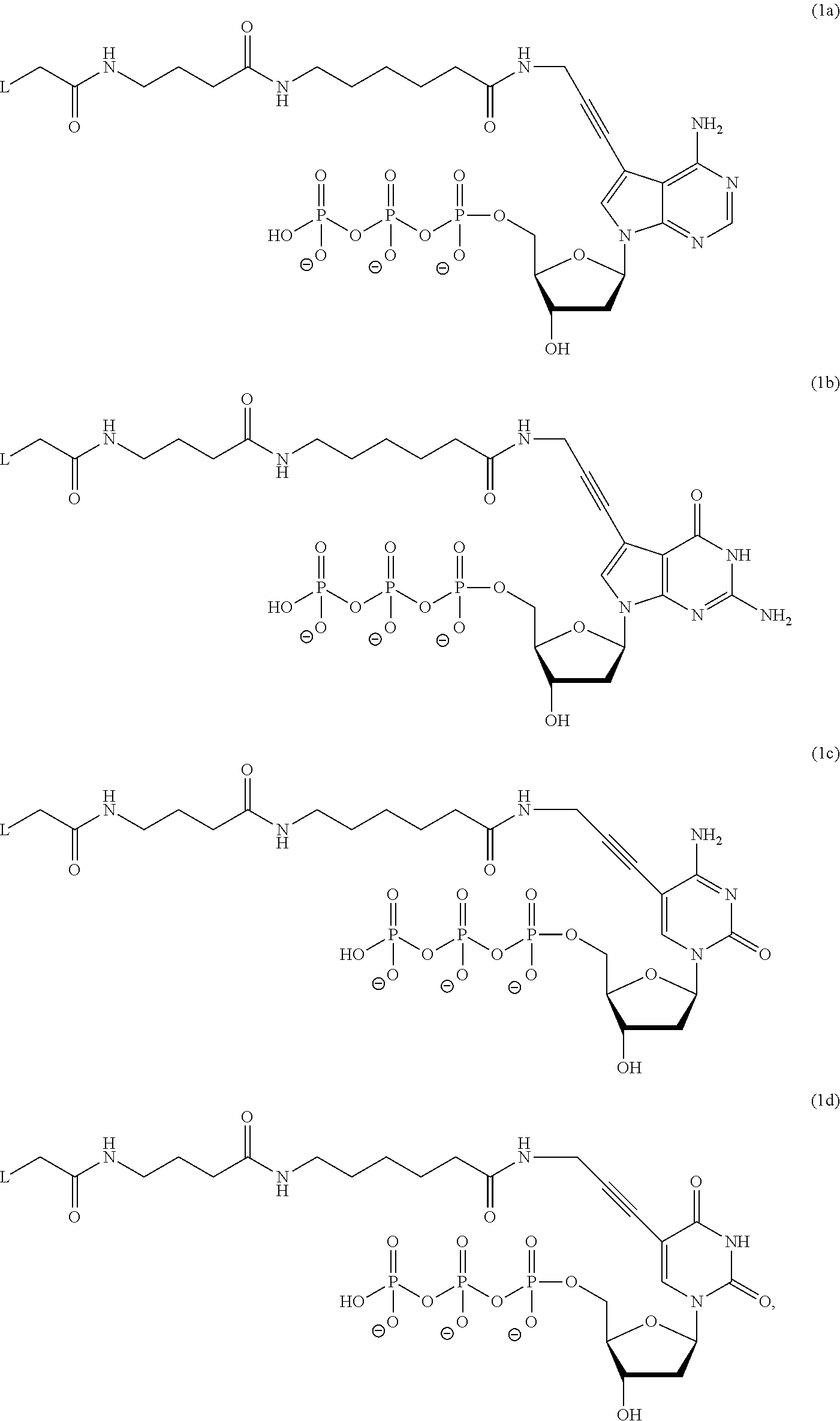
wherein L is a label moiety. The label moiety can be, for example, a fluorescent label, a Raman scattering tag, a chemiluminescent tag, a plasmonic nanoparticle tag, another moiety set forth herein (e.g., in the context of labeling a nucleotide or polymerase) or another moiety known in the art for labeling molecules.

wherein L is a label moiety. Accordingly, the relative positions of amide moieties in a linker can be variable. Furthermore, the number of amide units and the number of carbons between amide units can vary, for example, as shown in Formulas (3a), (3b), (3c) and (3d):

wherein L is a label moiety, n is any integer from 1 to 10, m is any integer from 1 to 5, and o is any integer from 1 to 10. As exemplified above, the integer n can differ between two or more CH2—CO—NH units of Formula (3a), (3b), (3c) or (3d). In particular embodiments, n is at least 2, 3, 4, 5, 6, 8 or 10. Alternatively or additionally, m can be at least 2, 3, 4 or 5. As a further option, o can be at least 2, 3, 4, 5, 6, 8 or 10.

wherein L is a label moiety, n is any integer from 1 to 10, m is any integer from 1 to 5, and o is any integer from 1 to 10. The base B can be a pyrimidine or purine. In particular embodiments, B is attached to the linker via an available carbon, for example, at
Claims (15)
Priority Applications (2)
| Application Number | Priority Date | Filing Date | Title |
|---|---|---|---|
| US17/190,894 US12344890B2 (en) | 2017-01-20 | 2021-03-03 | Process for cognate nucleotide detection in a nucleic acid sequencing workflow |
| US19/020,837 US20250223639A1 (en) | 2017-01-20 | 2025-01-14 | Process for cognate nucleotide detection in a nucleic acid sequencing workflow |
Applications Claiming Priority (6)
| Application Number | Priority Date | Filing Date | Title |
|---|---|---|---|
| US201762448839P | 2017-01-20 | 2017-01-20 | |
| US201762450397P | 2017-01-25 | 2017-01-25 | |
| US201762506759P | 2017-05-16 | 2017-05-16 | |
| US201762574308P | 2017-10-19 | 2017-10-19 | |
| US15/873,343 US10975427B2 (en) | 2017-01-20 | 2018-01-17 | Process for cognate nucleotide detection in a nucleic acid sequencing workflow |
| US17/190,894 US12344890B2 (en) | 2017-01-20 | 2021-03-03 | Process for cognate nucleotide detection in a nucleic acid sequencing workflow |
Related Parent Applications (1)
| Application Number | Title | Priority Date | Filing Date |
|---|---|---|---|
| US15/873,343 Continuation US10975427B2 (en) | 2017-01-20 | 2018-01-17 | Process for cognate nucleotide detection in a nucleic acid sequencing workflow |
Related Child Applications (1)
| Application Number | Title | Priority Date | Filing Date |
|---|---|---|---|
| US19/020,837 Continuation US20250223639A1 (en) | 2017-01-20 | 2025-01-14 | Process for cognate nucleotide detection in a nucleic acid sequencing workflow |
Publications (2)
| Publication Number | Publication Date |
|---|---|
| US20210340612A1 US20210340612A1 (en) | 2021-11-04 |
| US12344890B2 true US12344890B2 (en) | 2025-07-01 |
Family
ID=61569387
Family Applications (3)
| Application Number | Title | Priority Date | Filing Date |
|---|---|---|---|
| US15/873,343 Active 2038-10-20 US10975427B2 (en) | 2017-01-20 | 2018-01-17 | Process for cognate nucleotide detection in a nucleic acid sequencing workflow |
| US17/190,894 Active 2040-09-10 US12344890B2 (en) | 2017-01-20 | 2021-03-03 | Process for cognate nucleotide detection in a nucleic acid sequencing workflow |
| US19/020,837 Pending US20250223639A1 (en) | 2017-01-20 | 2025-01-14 | Process for cognate nucleotide detection in a nucleic acid sequencing workflow |
Family Applications Before (1)
| Application Number | Title | Priority Date | Filing Date |
|---|---|---|---|
| US15/873,343 Active 2038-10-20 US10975427B2 (en) | 2017-01-20 | 2018-01-17 | Process for cognate nucleotide detection in a nucleic acid sequencing workflow |
Family Applications After (1)
| Application Number | Title | Priority Date | Filing Date |
|---|---|---|---|
| US19/020,837 Pending US20250223639A1 (en) | 2017-01-20 | 2025-01-14 | Process for cognate nucleotide detection in a nucleic acid sequencing workflow |
Country Status (5)
| Country | Link |
|---|---|
| US (3) | US10975427B2 (en) |
| EP (1) | EP3571319A1 (en) |
| AU (1) | AU2018210944B2 (en) |
| CA (1) | CA3050695C (en) |
| WO (1) | WO2018136487A1 (en) |
Families Citing this family (36)
| Publication number | Priority date | Publication date | Assignee | Title |
|---|---|---|---|---|
| US10975427B2 (en) | 2017-01-20 | 2021-04-13 | Omniome, Inc. | Process for cognate nucleotide detection in a nucleic acid sequencing workflow |
| SG11202000964UA (en) | 2017-08-15 | 2020-02-27 | Omniome Inc | Scanning apparatus and methods useful for detection of chemical and biological analytes |
| CA3079411C (en) * | 2017-10-19 | 2023-12-05 | Omniome, Inc. | Simultaneous background reduction and complex stabilization in binding assay workflows |
| KR20200139671A (en) | 2018-02-06 | 2020-12-14 | 옴니옴 인코포레이티드 | Composition and technology for nucleic acid primer extension |
| WO2019161253A1 (en) | 2018-02-16 | 2019-08-22 | Ultima Genomics, Inc. | Methods for sequencing with single frequency detection |
| CA3097583A1 (en) | 2018-04-19 | 2019-10-24 | Omniome, Inc. | Improving accuracy of base calls in nucleic acid sequencing methods |
| WO2019209426A1 (en) | 2018-04-26 | 2019-10-31 | Omniome, Inc. | Methods and compositions for stabilizing nucleic acid-nucleotide-polymerase complexes |
| AU2019276719B2 (en) | 2018-05-31 | 2025-11-13 | Pacific Biosciences Of California, Inc. | Increased signal to noise in nucleic acid sequencing |
| US11180794B2 (en) | 2018-05-31 | 2021-11-23 | Omniome, Inc. | Methods and compositions for capping nucleic acids |
| WO2020023362A1 (en) | 2018-07-24 | 2020-01-30 | Omniome, Inc. | Serial formation of ternary complex species |
| CN120795059A (en) | 2018-08-27 | 2025-10-17 | 瑞泽恩制药公司 | Use of raman spectroscopy in downstream purification |
| WO2020060811A1 (en) | 2018-09-17 | 2020-03-26 | Omniome, Inc. | Engineered polymerases for improved sequencing |
| US10768173B1 (en) | 2019-09-06 | 2020-09-08 | Element Biosciences, Inc. | Multivalent binding composition for nucleic acid analysis |
| WO2020101795A1 (en) | 2018-11-15 | 2020-05-22 | Omniome, Inc. | Electronic detection of nucleic acid structure |
| CN211311438U (en) | 2018-12-04 | 2020-08-21 | 欧姆尼欧美公司 | Flow cell |
| WO2020132350A2 (en) | 2018-12-20 | 2020-06-25 | Omniome, Inc. | Temperature control for analysis of nucleic acids and other analytes |
| WO2020167574A1 (en) | 2019-02-14 | 2020-08-20 | Omniome, Inc. | Mitigating adverse impacts of detection systems on nucleic acids and other biological analytes |
| CN113613787B (en) | 2019-02-20 | 2023-06-13 | 加利福尼亚太平洋生物科学股份有限公司 | Scanning device and method for detecting chemical and biological analytes |
| US12391929B2 (en) | 2019-05-24 | 2025-08-19 | Element Biosciences, Inc. | Polymerase-nucleotide conjugates for sequencing by trapping |
| WO2020252186A1 (en) | 2019-06-11 | 2020-12-17 | Omniome, Inc. | Calibrated focus sensing |
| US10656368B1 (en) | 2019-07-24 | 2020-05-19 | Omniome, Inc. | Method and system for biological imaging using a wide field objective lens |
| TW202124406A (en) | 2019-09-10 | 2021-07-01 | 美商歐姆尼歐美公司 | Reversible modification of nucleotides |
| US11287422B2 (en) | 2019-09-23 | 2022-03-29 | Element Biosciences, Inc. | Multivalent binding composition for nucleic acid analysis |
| WO2021076152A1 (en) | 2019-10-18 | 2021-04-22 | Omniome, Inc. | Methods and compositions for capping nucleic acids |
| EP4055155A1 (en) | 2019-11-08 | 2022-09-14 | Pacific Biosciences of California, Inc. | Engineered polymerases for improved sequencing by binding |
| DE202019106694U1 (en) | 2019-12-02 | 2020-03-19 | Omniome, Inc. | System for sequencing nucleic acids in fluid foam |
| WO2021158511A1 (en) | 2020-02-04 | 2021-08-12 | Omniome, Inc. | Flow cells and methods for their manufacture and use |
| CN115836135A (en) | 2020-05-05 | 2023-03-21 | 加利福尼亚太平洋生物科学股份有限公司 | Compositions and methods for modifying polymerase-nucleic acid complexes |
| WO2023081485A1 (en) * | 2021-11-08 | 2023-05-11 | Pacific Biosciences Of California, Inc. | Stepwise sequencing of a polynucleotide with a homogenous reaction mixture |
| CN114958995B (en) * | 2022-04-27 | 2023-07-18 | 深圳赛陆医疗科技有限公司 | A gene sequencing method |
| CA3261351A1 (en) * | 2022-07-12 | 2024-01-18 | Abrus Bio, Inc. | Determination of protein information by recoding amino acid polymers into dna polymers |
| WO2024015962A1 (en) | 2022-07-15 | 2024-01-18 | Pacific Biosciences Of California, Inc. | Blocked asymmetric hairpin adaptors |
| CN115232867B (en) * | 2022-07-21 | 2024-01-30 | 深圳赛陆医疗科技有限公司 | Rapid second-generation gene sequencing method |
| AU2023325064A1 (en) | 2022-08-15 | 2025-03-06 | Element Biosciences, Inc. | Spatially resolved surface capture of nucleic acids |
| CN119061122A (en) * | 2023-05-30 | 2024-12-03 | 深圳市真迈生物科技有限公司 | Single-molecule sequencing methods |
| EP4731786A1 (en) | 2023-06-26 | 2026-04-29 | Pacific Biosciences of California, Inc. | Compositions and methods for nucleic acid extension |
Citations (54)
| Publication number | Priority date | Publication date | Assignee | Title |
|---|---|---|---|---|
| WO1990013666A1 (en) | 1989-05-11 | 1990-11-15 | Amersham International Plc | Sequencing method |
| US5302509A (en) | 1989-08-14 | 1994-04-12 | Beckman Instruments, Inc. | Method for sequencing polynucleotides |
| US5614365A (en) | 1994-10-17 | 1997-03-25 | President & Fellow Of Harvard College | DNA polymerase having modified nucleotide binding site for DNA sequencing |
| WO2001016375A2 (en) | 1999-08-30 | 2001-03-08 | The Government Of The United States Of America, As Represented By The Secretary, Department Of Health And Human Services | High speed parallel molecular nucleic acid sequencing |
| EP1115848A1 (en) | 1998-09-21 | 2001-07-18 | Shanghai Institute of Biochemistry Chinese Academy of Sciences | Dna polymerase having ability to reduce innate selective discrimination against fluorescent dye-labeled dideoxynucleotides |
| WO2002004680A2 (en) | 2000-07-07 | 2002-01-17 | Visigen Biotechnologies, Inc. | Real-time sequence determination |
| US6720177B2 (en) | 1997-09-05 | 2004-04-13 | The Regents Of The University Of California | Porous semiconductor-based optical interferometric sensor |
| US20040096853A1 (en) | 2000-12-08 | 2004-05-20 | Pascal Mayer | Isothermal amplification of nucleic acids on a solid support |
| US6828159B1 (en) | 1999-04-27 | 2004-12-07 | Karl-Heinz Drexhage | Carbopyronine fluorescent dyes |
| US6828094B2 (en) | 1996-12-20 | 2004-12-07 | Roche Diagnostics Gmbh | Method for the uncoupled, direct, exponential amplification and sequencing of DNA molecules with the addition of a second thermostable DNA polymerase and its application |
| US6908736B1 (en) | 1999-10-06 | 2005-06-21 | Medical Biosystems, Ltd. | DNA sequencing method |
| WO2005121363A2 (en) | 2004-06-11 | 2005-12-22 | Medical Biosystems Limited | Method for determining biophysical properties |
| US7008798B2 (en) | 1986-04-18 | 2006-03-07 | Carnegie Mellon University | Cyanine dyes as labeling reagents for detection of biological and other materials by luminescence methods |
| US7008766B1 (en) | 1997-07-28 | 2006-03-07 | Medical Biosystems, Ltd. | Nucleic acid sequence analysis |
| US20060292583A1 (en) | 1999-08-30 | 2006-12-28 | The Government of the U.S.A as represented by the Secretary of Dept. of Health and Human Services | High speed parallel molecular nucleic acid sequencing |
| US20070009925A1 (en) | 2005-05-05 | 2007-01-11 | Applera Corporation | Genomic dna sequencing methods and kits |
| US7223540B2 (en) | 2000-10-20 | 2007-05-29 | The Board Of Trustees Of The Leland Stanford Junior University | Transient electrical signal based methods and devices for characterizing molecular interaction and/or motion in a sample |
| US20070148645A1 (en) | 2003-02-21 | 2007-06-28 | Hoser Mark J | Nucleic acid sequencing methods, kits and reagents |
| US7264934B2 (en) | 2004-06-10 | 2007-09-04 | Ge Healthcare Bio-Sciences Corp. | Rapid parallel nucleic acid analysis |
| US7449297B2 (en) | 2005-04-14 | 2008-11-11 | Euclid Diagnostics Llc | Methods of copying the methylation pattern of DNA during isothermal amplification and microarrays |
| US7482120B2 (en) | 2005-01-28 | 2009-01-27 | Helicos Biosciences Corporation | Methods and compositions for improving fidelity in a nucleic acid synthesis reaction |
| US7604963B2 (en) | 2003-07-24 | 2009-10-20 | Medical Biosystems Ltd | Method for sequencing nucleic acid molecules |
| WO2009145828A2 (en) | 2008-03-31 | 2009-12-03 | Pacific Biosciences Of California, Inc. | Two slow-step polymerase enzyme systems and methods |
| WO2009145820A2 (en) | 2008-03-31 | 2009-12-03 | Pacific Biosciences Of California, Inc. | Generation of modified polymerases for improved accuracy in single molecule sequencing |
| US7635578B2 (en) | 2000-10-06 | 2009-12-22 | The Trustees Of Columbia University In The City Of New York | Massive parallel method for decoding DNA and RNA |
| WO2010068884A2 (en) | 2008-12-11 | 2010-06-17 | The Regents Of The University Of California | Methods and systems for direct sequencing of single dna molecules |
| WO2010111690A2 (en) | 2009-03-27 | 2010-09-30 | Life Technologies Corporation | Polymerase compositions and methods |
| US7871771B2 (en) | 2004-06-10 | 2011-01-18 | Ge Healthcare Bio-Sciences Corp. | Method for nucleic acid analysis |
| US7939264B1 (en) | 1999-10-06 | 2011-05-10 | Gen-Probe Incorporated | DNA sequencing method |
| US20110237464A1 (en) | 2000-10-30 | 2011-09-29 | Sru Biosystems, Inc. | Guided Mode Resonant Filter Biosensor Using a Linear Grating Surface Structure |
| US8071755B2 (en) | 2004-05-25 | 2011-12-06 | Helicos Biosciences Corporation | Nucleotide analogs |
| WO2011159942A1 (en) | 2010-06-18 | 2011-12-22 | Illumina, Inc. | Conformational probes and methods for sequencing nucleic acids |
| US8236532B2 (en) | 2008-12-23 | 2012-08-07 | Illumina, Inc. | Multibase delivery for long reads in sequencing by synthesis protocols |
| US8298792B2 (en) | 2006-12-01 | 2012-10-30 | The Trustees Of Columbia University In The City Of New York | Four-color DNA sequencing by synthesis using cleavable fluorescent nucleotide reversible terminators |
| WO2012166742A2 (en) | 2011-05-27 | 2012-12-06 | Genapsys, Inc. | Systems and methods for genetic and biological analysis |
| US20130165328A1 (en) | 2011-12-21 | 2013-06-27 | Illumina, Inc. | Apparatus and methods for kinetic analysis and determination of nucleic acid sequences |
| US8481266B2 (en) | 2007-11-16 | 2013-07-09 | Hyk Gene Technology Co., Ltd. | DNA sequencing method and system |
| US8603741B2 (en) | 2010-02-18 | 2013-12-10 | Pacific Biosciences Of California, Inc. | Single molecule sequencing with two distinct chemistry steps |
| US8632975B2 (en) | 2009-06-05 | 2014-01-21 | Life Technologies Corporation | Nucleotide transient binding for sequencing methods |
| WO2014114665A1 (en) | 2013-01-23 | 2014-07-31 | Dynamic Biosensors Gmbh | Method for sequencing a template nucleic acid immobilized on a substrate |
| US8911972B2 (en) | 2009-12-16 | 2014-12-16 | Pacific Biosciences Of California, Inc. | Sequencing methods using enzyme conformation |
| US8986930B2 (en) | 2010-07-12 | 2015-03-24 | Pacific Biosciences Of California, Inc. | Sequencing reactions with alkali metal cations for pulse width control |
| US20150337366A1 (en) | 2012-02-16 | 2015-11-26 | Genia Technologies, Inc. | Methods for creating bilayers for use with nanopore sensors |
| WO2016001963A1 (en) | 2014-06-30 | 2016-01-07 | 株式会社日立製作所 | Array device for nucleic acid analysis, nucleic acid analysis device, and nucleic acid analysis method |
| US20170022553A1 (en) | 2015-07-21 | 2017-01-26 | Omniome, Inc. | Nucleic acid sequencing methods and systems |
| WO2017014762A1 (en) | 2015-07-21 | 2017-01-26 | Omniome, Inc. | Nucleic acid sequencing methods and systems |
| US9651490B2 (en) | 2010-10-19 | 2017-05-16 | Atto-Tec Gmbh | Amine-substituted tricyclic fluorescent dyes |
| US20170191125A1 (en) | 2015-12-30 | 2017-07-06 | Omniome, Inc. | Sequencing device |
| WO2017190012A1 (en) | 2016-04-29 | 2017-11-02 | Omniome, Inc. | Method of nucleic acid sequence determination |
| US20170314064A1 (en) | 2016-04-29 | 2017-11-02 | Omniome, Inc. | Sequencing method employing ternary complex destabilization to identify cognate nucleotides |
| US20180044727A1 (en) | 2016-08-15 | 2018-02-15 | Omniome, Inc. | Method and system for sequencing nucleic acids |
| WO2018034780A1 (en) | 2016-08-15 | 2018-02-22 | Omniome, Inc. | Sequencing method for rapid identification and processing of cognate nucleotide pairs |
| US20180187245A1 (en) | 2016-12-30 | 2018-07-05 | Omniome, Inc. | Method and system employing distinguishable polymerases for detecting ternary complexes and identifying cognate nucleotides |
| WO2018136487A1 (en) | 2017-01-20 | 2018-07-26 | Omniome, Inc. | Process for cognate nucleotide detection in a nucleic acid sequencing workflow |
Family Cites Families (17)
| Publication number | Priority date | Publication date | Assignee | Title |
|---|---|---|---|---|
| EP0450060A1 (en) | 1989-10-26 | 1991-10-09 | Sri International | Dna sequencing |
| US7211414B2 (en) | 2000-12-01 | 2007-05-01 | Visigen Biotechnologies, Inc. | Enzymatic nucleic acid synthesis: compositions and methods for altering monomer incorporation fidelity |
| US7057026B2 (en) | 2001-12-04 | 2006-06-06 | Solexa Limited | Labelled nucleotides |
| US7414116B2 (en) | 2002-08-23 | 2008-08-19 | Illumina Cambridge Limited | Labelled nucleotides |
| EP2607369B1 (en) | 2002-08-23 | 2015-09-23 | Illumina Cambridge Limited | Modified nucleotides for polynucleotide sequencing |
| US20110059865A1 (en) | 2004-01-07 | 2011-03-10 | Mark Edward Brennan Smith | Modified Molecular Arrays |
| US20060062531A1 (en) | 2004-09-17 | 2006-03-23 | Stephen Turner | Fabrication of optical confinements |
| US7544794B1 (en) | 2005-03-11 | 2009-06-09 | Steven Albert Benner | Method for sequencing DNA and RNA by synthesis |
| US7405281B2 (en) | 2005-09-29 | 2008-07-29 | Pacific Biosciences Of California, Inc. | Fluorescent nucleotide analogs and uses therefor |
| EP1974057B1 (en) | 2005-12-21 | 2012-06-13 | Roche Diagnostics GmbH | Sequencing and genotyping using reversibly 2'-modified nucleotides |
| WO2007123744A2 (en) | 2006-03-31 | 2007-11-01 | Solexa, Inc. | Systems and devices for sequence by synthesis analysis |
| US8343746B2 (en) | 2006-10-23 | 2013-01-01 | Pacific Biosciences Of California, Inc. | Polymerase enzymes and reagents for enhanced nucleic acid sequencing |
| US7678894B2 (en) | 2007-05-18 | 2010-03-16 | Helicos Biosciences Corporation | Nucleotide analogs |
| US8034923B1 (en) | 2009-03-27 | 2011-10-11 | Steven Albert Benner | Reagents for reversibly terminating primer extension |
| US8951781B2 (en) | 2011-01-10 | 2015-02-10 | Illumina, Inc. | Systems, methods, and apparatuses to image a sample for biological or chemical analysis |
| CN104024269B (en) | 2011-09-13 | 2017-05-24 | 激光基因公司 | 5-methoxy, 3'-OH unblocked, fast photocleavable terminating nucleotides and methods for nucleic acid sequencing |
| US8808989B1 (en) | 2013-04-02 | 2014-08-19 | Molecular Assemblies, Inc. | Methods and apparatus for synthesizing nucleic acids |
-
2018
- 2018-01-17 US US15/873,343 patent/US10975427B2/en active Active
- 2018-01-17 EP EP18709165.7A patent/EP3571319A1/en active Pending
- 2018-01-17 AU AU2018210944A patent/AU2018210944B2/en active Active
- 2018-01-17 WO PCT/US2018/014005 patent/WO2018136487A1/en not_active Ceased
- 2018-01-17 CA CA3050695A patent/CA3050695C/en active Active
-
2021
- 2021-03-03 US US17/190,894 patent/US12344890B2/en active Active
-
2025
- 2025-01-14 US US19/020,837 patent/US20250223639A1/en active Pending
Patent Citations (85)
| Publication number | Priority date | Publication date | Assignee | Title |
|---|---|---|---|---|
| US7008798B2 (en) | 1986-04-18 | 2006-03-07 | Carnegie Mellon University | Cyanine dyes as labeling reagents for detection of biological and other materials by luminescence methods |
| WO1990013666A1 (en) | 1989-05-11 | 1990-11-15 | Amersham International Plc | Sequencing method |
| US5302509A (en) | 1989-08-14 | 1994-04-12 | Beckman Instruments, Inc. | Method for sequencing polynucleotides |
| US5614365A (en) | 1994-10-17 | 1997-03-25 | President & Fellow Of Harvard College | DNA polymerase having modified nucleotide binding site for DNA sequencing |
| US6485909B1 (en) | 1995-10-18 | 2002-11-26 | Shanghai Mendel Dna Center Co., Ltd. | DNA polymerase having ability to reduce innate selective discrimination against fluorescent dye-labeled dideoxynucleotides |
| US6828094B2 (en) | 1996-12-20 | 2004-12-07 | Roche Diagnostics Gmbh | Method for the uncoupled, direct, exponential amplification and sequencing of DNA molecules with the addition of a second thermostable DNA polymerase and its application |
| US20100316999A1 (en) | 1997-07-28 | 2010-12-16 | Daniel Henry Densham | Nucleic Acid Sequence Analysis |
| US7008766B1 (en) | 1997-07-28 | 2006-03-07 | Medical Biosystems, Ltd. | Nucleic acid sequence analysis |
| US6720177B2 (en) | 1997-09-05 | 2004-04-13 | The Regents Of The University Of California | Porous semiconductor-based optical interferometric sensor |
| EP1115848A1 (en) | 1998-09-21 | 2001-07-18 | Shanghai Institute of Biochemistry Chinese Academy of Sciences | Dna polymerase having ability to reduce innate selective discrimination against fluorescent dye-labeled dideoxynucleotides |
| US6828159B1 (en) | 1999-04-27 | 2004-12-07 | Karl-Heinz Drexhage | Carbopyronine fluorescent dyes |
| US20110008794A1 (en) | 1999-08-30 | 2011-01-13 | The Government of USA represented by the Secretary of the Dept. of Health and Human Services | High speed parallel molecular nucleic acid sequencing |
| US20090061447A1 (en) | 1999-08-30 | 2009-03-05 | The Government of the United States of America as represented by the Secretary of the | High speed parallel molecular nucleic acid sequencing |
| US20060292583A1 (en) | 1999-08-30 | 2006-12-28 | The Government of the U.S.A as represented by the Secretary of Dept. of Health and Human Services | High speed parallel molecular nucleic acid sequencing |
| WO2001016375A2 (en) | 1999-08-30 | 2001-03-08 | The Government Of The United States Of America, As Represented By The Secretary, Department Of Health And Human Services | High speed parallel molecular nucleic acid sequencing |
| US8535881B2 (en) | 1999-08-30 | 2013-09-17 | The United States Of America As Represented By The Secretary Of The Department Of Health And Human Services | High speed parallel molecular nucleic acid sequencing |
| US6908736B1 (en) | 1999-10-06 | 2005-06-21 | Medical Biosystems, Ltd. | DNA sequencing method |
| US7939264B1 (en) | 1999-10-06 | 2011-05-10 | Gen-Probe Incorporated | DNA sequencing method |
| US7329492B2 (en) | 2000-07-07 | 2008-02-12 | Visigen Biotechnologies, Inc. | Methods for real-time single molecule sequence determination |
| WO2002004680A2 (en) | 2000-07-07 | 2002-01-17 | Visigen Biotechnologies, Inc. | Real-time sequence determination |
| US7790869B2 (en) | 2000-10-06 | 2010-09-07 | The Trustees Of Columbia University In The City Of New York | Massive parallel method for decoding DNA and RNA |
| US8088575B2 (en) | 2000-10-06 | 2012-01-03 | The Trustees Of Columbia University In The City Of New York | Massive parallel method for decoding DNA and RNA |
| US20100317012A1 (en) | 2000-10-06 | 2010-12-16 | The Trustees Of Columbia University | Massive parallel method for decoding DNA and RNA |
| US7635578B2 (en) | 2000-10-06 | 2009-12-22 | The Trustees Of Columbia University In The City Of New York | Massive parallel method for decoding DNA and RNA |
| US7713698B2 (en) | 2000-10-06 | 2010-05-11 | The Trustees Of Columbia University In The City Of New York | Massive parallel method for decoding DNA and RNA |
| US7223540B2 (en) | 2000-10-20 | 2007-05-29 | The Board Of Trustees Of The Leland Stanford Junior University | Transient electrical signal based methods and devices for characterizing molecular interaction and/or motion in a sample |
| US20110237464A1 (en) | 2000-10-30 | 2011-09-29 | Sru Biosystems, Inc. | Guided Mode Resonant Filter Biosensor Using a Linear Grating Surface Structure |
| US20040096853A1 (en) | 2000-12-08 | 2004-05-20 | Pascal Mayer | Isothermal amplification of nucleic acids on a solid support |
| US20070148645A1 (en) | 2003-02-21 | 2007-06-28 | Hoser Mark J | Nucleic acid sequencing methods, kits and reagents |
| US8399196B2 (en) | 2003-02-21 | 2013-03-19 | Geneform Technologies Limited | Nucleic acid sequencing methods, kits and reagents |
| US7604963B2 (en) | 2003-07-24 | 2009-10-20 | Medical Biosystems Ltd | Method for sequencing nucleic acid molecules |
| US8071755B2 (en) | 2004-05-25 | 2011-12-06 | Helicos Biosciences Corporation | Nucleotide analogs |
| US7871771B2 (en) | 2004-06-10 | 2011-01-18 | Ge Healthcare Bio-Sciences Corp. | Method for nucleic acid analysis |
| US7264934B2 (en) | 2004-06-10 | 2007-09-04 | Ge Healthcare Bio-Sciences Corp. | Rapid parallel nucleic acid analysis |
| WO2005121363A2 (en) | 2004-06-11 | 2005-12-22 | Medical Biosystems Limited | Method for determining biophysical properties |
| US7482120B2 (en) | 2005-01-28 | 2009-01-27 | Helicos Biosciences Corporation | Methods and compositions for improving fidelity in a nucleic acid synthesis reaction |
| US7449297B2 (en) | 2005-04-14 | 2008-11-11 | Euclid Diagnostics Llc | Methods of copying the methylation pattern of DNA during isothermal amplification and microarrays |
| US20070009925A1 (en) | 2005-05-05 | 2007-01-11 | Applera Corporation | Genomic dna sequencing methods and kits |
| US8298792B2 (en) | 2006-12-01 | 2012-10-30 | The Trustees Of Columbia University In The City Of New York | Four-color DNA sequencing by synthesis using cleavable fluorescent nucleotide reversible terminators |
| US8481266B2 (en) | 2007-11-16 | 2013-07-09 | Hyk Gene Technology Co., Ltd. | DNA sequencing method and system |
| US8133672B2 (en) | 2008-03-31 | 2012-03-13 | Pacific Biosciences Of California, Inc. | Two slow-step polymerase enzyme systems and methods |
| WO2009145820A2 (en) | 2008-03-31 | 2009-12-03 | Pacific Biosciences Of California, Inc. | Generation of modified polymerases for improved accuracy in single molecule sequencing |
| US20160177384A1 (en) | 2008-03-31 | 2016-06-23 | Pacific Biosciences Of California, Inc. | Sequencing systems with two slow-step polymerase enzymes |
| US9279155B2 (en) | 2008-03-31 | 2016-03-08 | Pacific Biosciences Of California, Inc. | Step-wise nucleic acid sequencing with catalytic and non-catalytic metals |
| US8658365B2 (en) | 2008-03-31 | 2014-02-25 | Pacific Biosciences Of California, Inc. | Nucleic acid synthesis compositions and methods and systems for using same |
| WO2009145828A2 (en) | 2008-03-31 | 2009-12-03 | Pacific Biosciences Of California, Inc. | Two slow-step polymerase enzyme systems and methods |
| WO2010068884A2 (en) | 2008-12-11 | 2010-06-17 | The Regents Of The University Of California | Methods and systems for direct sequencing of single dna molecules |
| US8236532B2 (en) | 2008-12-23 | 2012-08-07 | Illumina, Inc. | Multibase delivery for long reads in sequencing by synthesis protocols |
| WO2010111690A2 (en) | 2009-03-27 | 2010-09-30 | Life Technologies Corporation | Polymerase compositions and methods |
| US9255258B2 (en) | 2009-06-05 | 2016-02-09 | Life Technologies Corporation | Nucleotide transient binding for sequencing methods |
| US8632975B2 (en) | 2009-06-05 | 2014-01-21 | Life Technologies Corporation | Nucleotide transient binding for sequencing methods |
| US8703461B2 (en) | 2009-06-05 | 2014-04-22 | Life Technologies Corporation | Mutant RB69 DNA polymerase |
| US20160208318A1 (en) * | 2009-06-05 | 2016-07-21 | Life Technologies Corporation | Nucleotide transient binding for sequencing methods |
| US20140234940A1 (en) | 2009-06-05 | 2014-08-21 | Life Technologies Corporation | Mutant rb69 dna polymerase |
| US8911972B2 (en) | 2009-12-16 | 2014-12-16 | Pacific Biosciences Of California, Inc. | Sequencing methods using enzyme conformation |
| US8603741B2 (en) | 2010-02-18 | 2013-12-10 | Pacific Biosciences Of California, Inc. | Single molecule sequencing with two distinct chemistry steps |
| US20160010150A1 (en) | 2010-02-18 | 2016-01-14 | Pacific Biosciences Of California, Inc. | Single molecule sequencing with two distinct chemistry steps |
| US20140127680A1 (en) | 2010-02-18 | 2014-05-08 | Pacific Biosciences Of California, Inc. | Single molecule sequencing with two distinct chemistry steps |
| WO2011159942A1 (en) | 2010-06-18 | 2011-12-22 | Illumina, Inc. | Conformational probes and methods for sequencing nucleic acids |
| US8986930B2 (en) | 2010-07-12 | 2015-03-24 | Pacific Biosciences Of California, Inc. | Sequencing reactions with alkali metal cations for pulse width control |
| US9651490B2 (en) | 2010-10-19 | 2017-05-16 | Atto-Tec Gmbh | Amine-substituted tricyclic fluorescent dyes |
| WO2012166742A2 (en) | 2011-05-27 | 2012-12-06 | Genapsys, Inc. | Systems and methods for genetic and biological analysis |
| WO2012166742A3 (en) | 2011-05-27 | 2013-04-25 | Genapsys, Inc. | Systems and methods for genetic and biological analysis |
| US20160168633A1 (en) | 2011-12-21 | 2016-06-16 | Illumina, Inc. | Apparatus and methods for kinetic analysis and determination of nucleic acid sequences |
| US9279154B2 (en) | 2011-12-21 | 2016-03-08 | Illumina, Inc. | Apparatus and methods for kinetic analysis and determination of nucleic acid sequences |
| WO2013096692A1 (en) | 2011-12-21 | 2013-06-27 | Illumina, Inc. | Apparatus and methods for kinetic analysis and determination of nucleic acid sequences |
| US20130165328A1 (en) | 2011-12-21 | 2013-06-27 | Illumina, Inc. | Apparatus and methods for kinetic analysis and determination of nucleic acid sequences |
| US20150337366A1 (en) | 2012-02-16 | 2015-11-26 | Genia Technologies, Inc. | Methods for creating bilayers for use with nanopore sensors |
| WO2014114665A1 (en) | 2013-01-23 | 2014-07-31 | Dynamic Biosensors Gmbh | Method for sequencing a template nucleic acid immobilized on a substrate |
| WO2016001963A1 (en) | 2014-06-30 | 2016-01-07 | 株式会社日立製作所 | Array device for nucleic acid analysis, nucleic acid analysis device, and nucleic acid analysis method |
| US20170022553A1 (en) | 2015-07-21 | 2017-01-26 | Omniome, Inc. | Nucleic acid sequencing methods and systems |
| WO2017014762A1 (en) | 2015-07-21 | 2017-01-26 | Omniome, Inc. | Nucleic acid sequencing methods and systems |
| US20170191125A1 (en) | 2015-12-30 | 2017-07-06 | Omniome, Inc. | Sequencing device |
| US20170314064A1 (en) | 2016-04-29 | 2017-11-02 | Omniome, Inc. | Sequencing method employing ternary complex destabilization to identify cognate nucleotides |
| WO2017190012A1 (en) | 2016-04-29 | 2017-11-02 | Omniome, Inc. | Method of nucleic acid sequence determination |
| US20170314072A1 (en) | 2016-04-29 | 2017-11-02 | Omniome, Inc. | Method of nucleic acid sequence determination |
| US10294514B2 (en) * | 2016-04-29 | 2019-05-21 | Omniome, Inc. | Sequencing method employing ternary complex destabilization to identify cognate nucleotides |
| US20180044727A1 (en) | 2016-08-15 | 2018-02-15 | Omniome, Inc. | Method and system for sequencing nucleic acids |
| WO2018034780A1 (en) | 2016-08-15 | 2018-02-22 | Omniome, Inc. | Sequencing method for rapid identification and processing of cognate nucleotide pairs |
| WO2018035134A1 (en) | 2016-08-15 | 2018-02-22 | Omniome, Inc. | Method and system for sequencing nucleic acids |
| US10443098B2 (en) * | 2016-08-15 | 2019-10-15 | Omniome, Inc. | Method and system for sequencing nucleic acids |
| US20180187245A1 (en) | 2016-12-30 | 2018-07-05 | Omniome, Inc. | Method and system employing distinguishable polymerases for detecting ternary complexes and identifying cognate nucleotides |
| WO2018136487A1 (en) | 2017-01-20 | 2018-07-26 | Omniome, Inc. | Process for cognate nucleotide detection in a nucleic acid sequencing workflow |
| US20180208983A1 (en) | 2017-01-20 | 2018-07-26 | Omniome, Inc. | Process for cognate nucleotide detection in a nucleic acid sequencing workflow |
| US10975427B2 (en) * | 2017-01-20 | 2021-04-13 | Omniome, Inc. | Process for cognate nucleotide detection in a nucleic acid sequencing workflow |
Non-Patent Citations (100)
Also Published As
| Publication number | Publication date |
|---|---|
| WO2018136487A1 (en) | 2018-07-26 |
| US20180208983A1 (en) | 2018-07-26 |
| AU2018210944A1 (en) | 2019-07-25 |
| US20250223639A1 (en) | 2025-07-10 |
| US20210340612A1 (en) | 2021-11-04 |
| US10975427B2 (en) | 2021-04-13 |
| CA3050695A1 (en) | 2018-07-26 |
| CA3050695C (en) | 2024-02-20 |
| EP3571319A1 (en) | 2019-11-27 |
| AU2018210944B2 (en) | 2021-07-22 |
Similar Documents
| Publication | Publication Date | Title |
|---|---|---|
| US20250223639A1 (en) | Process for cognate nucleotide detection in a nucleic acid sequencing workflow | |
| EP3562962B1 (en) | Method and system employing distinguishable polymerases for detecting ternary complexes and identifying cognate nucleotides | |
| US11168364B2 (en) | Method and system for sequencing nucleic acids | |
| CA3079411C (en) | Simultaneous background reduction and complex stabilization in binding assay workflows | |
| JP6724287B2 (en) | Nucleic acid sequencing method and system | |
| US10077470B2 (en) | Nucleic acid sequencing methods and systems | |
| EP3445870A1 (en) | Nucleic acid sequencing method and system employing enhanced detection of nucleotide-specific ternary complex formation | |
| CA3033741C (en) | Method and system for sequencing nucleic acids | |
| CA2992980C (en) | Nucleic acid sequencing methods and systems | |
| HK1250051B (en) | Nucleic acid sequencing method |
Legal Events
| Date | Code | Title | Description |
|---|---|---|---|
| FEPP | Fee payment procedure |
Free format text: ENTITY STATUS SET TO UNDISCOUNTED (ORIGINAL EVENT CODE: BIG.); ENTITY STATUS OF PATENT OWNER: LARGE ENTITY |
|
| FEPP | Fee payment procedure |
Free format text: ENTITY STATUS SET TO SMALL (ORIGINAL EVENT CODE: SMAL); ENTITY STATUS OF PATENT OWNER: LARGE ENTITY |
|
| AS | Assignment |
Owner name: OMNIOME, INC., CALIFORNIA Free format text: ASSIGNMENT OF ASSIGNORS INTEREST;ASSIGNORS:DAMBACHER, COREY M.;ROKICKI, JOSEPH;AHN, KEUNHO;AND OTHERS;SIGNING DATES FROM 20180123 TO 20180222;REEL/FRAME:056674/0755 |
|
| STPP | Information on status: patent application and granting procedure in general |
Free format text: DOCKETED NEW CASE - READY FOR EXAMINATION |
|
| FEPP | Fee payment procedure |
Free format text: ENTITY STATUS SET TO UNDISCOUNTED (ORIGINAL EVENT CODE: BIG.); ENTITY STATUS OF PATENT OWNER: LARGE ENTITY |
|
| AS | Assignment |
Owner name: OMNIOME, LLC, CALIFORNIA Free format text: MERGER;ASSIGNOR:OMNIOME, INC.;REEL/FRAME:058952/0352 Effective date: 20210920 |
|
| AS | Assignment |
Owner name: PACIFIC BIOSCIENCES OF CALIFORNIA, INC., CALIFORNIA Free format text: ASSIGNMENT OF ASSIGNORS INTEREST;ASSIGNOR:OMNIOME, LLC;REEL/FRAME:059278/0153 Effective date: 20220203 |
|
| STPP | Information on status: patent application and granting procedure in general |
Free format text: NON FINAL ACTION MAILED |
|
| STPP | Information on status: patent application and granting procedure in general |
Free format text: RESPONSE TO NON-FINAL OFFICE ACTION ENTERED AND FORWARDED TO EXAMINER |
|
| STPP | Information on status: patent application and granting procedure in general |
Free format text: NON FINAL ACTION MAILED |
|
| STPP | Information on status: patent application and granting procedure in general |
Free format text: RESPONSE TO NON-FINAL OFFICE ACTION ENTERED AND FORWARDED TO EXAMINER |
|
| STPP | Information on status: patent application and granting procedure in general |
Free format text: NOTICE OF ALLOWANCE MAILED -- APPLICATION RECEIVED IN OFFICE OF PUBLICATIONS |
|
| STCF | Information on status: patent grant |
Free format text: PATENTED CASE |