US12332038B2 - Efficient cut blasting method for medium-length holes in deep high-stress rock roadway based on crustal stress induction effect - Google Patents
Efficient cut blasting method for medium-length holes in deep high-stress rock roadway based on crustal stress induction effect Download PDFInfo
- Publication number
- US12332038B2 US12332038B2 US18/342,369 US202318342369A US12332038B2 US 12332038 B2 US12332038 B2 US 12332038B2 US 202318342369 A US202318342369 A US 202318342369A US 12332038 B2 US12332038 B2 US 12332038B2
- Authority
- US
- United States
- Prior art keywords
- hole
- cutting
- cutting hole
- cracks
- blast
- Prior art date
- Legal status (The legal status is an assumption and is not a legal conclusion. Google has not performed a legal analysis and makes no representation as to the accuracy of the status listed.)
- Active, expires
Links
Images




Classifications
-
- F—MECHANICAL ENGINEERING; LIGHTING; HEATING; WEAPONS; BLASTING
- F42—AMMUNITION; BLASTING
- F42D—BLASTING
- F42D1/00—Blasting methods or apparatus, e.g. loading or tamping
-
- F—MECHANICAL ENGINEERING; LIGHTING; HEATING; WEAPONS; BLASTING
- F42—AMMUNITION; BLASTING
- F42D—BLASTING
- F42D1/00—Blasting methods or apparatus, e.g. loading or tamping
- F42D1/08—Tamping methods; Methods for loading boreholes with explosives; Apparatus therefor
-
- F—MECHANICAL ENGINEERING; LIGHTING; HEATING; WEAPONS; BLASTING
- F42—AMMUNITION; BLASTING
- F42D—BLASTING
- F42D3/00—Particular applications of blasting techniques
- F42D3/04—Particular applications of blasting techniques for rock blasting
Definitions
- the present application relates to the field of drilling and blasting excavation in deep rock mass, in particular to an efficient cut blasting method for medium-length holes in deep high-stress rock roadway based on crustal stress induction effect.
- Deep mining will become the norm and is one of the main ways to ensure the supply of energy and mineral resources in China.
- resource mining marches into the depths of the earth, the resource mining environment becomes more complex, and the difficulty of mining increases sharply.
- the deep mining of mineral resources is faced with ‘three highs and one disturbance’.
- rock roadway (rock tunnel) excavation is the foundation.
- the drilling and blasting method realizes rock crushing by mechanical drilling and charge blasting, and is an important construction method for rock roadway excavation.
- the key to speed is cutting, and the key to quality is the periphery.
- the pros and cons of the effect of cut blasting play a decisive role in the excavation footage.
- the inventor of the present application found in the process of realizing the present application that: at present, the cut blasting technologies such as staged and segmented cut blasting, large-diameter empty hole cut blasting, wedge-straight composite cutting, etc. have also achieved certain results in the application of medium-length hole blasting. However, due to the lack of comprehensive consideration of the influence of deep crustal stress characteristics on blasting cracks, the blasting effect is not good.
- the embodiments of the present application provide an efficient cut blasting method for medium-length holes in deep high-stress rock roadway based on crustal stress induction effect, and based on the induction effect of the crustal stress on the blasting crack propagation and the impact effect of the crustal stress on rock crushing and throwing found in engineering practice, for the cut blasting of medium-length holes in the deep high-stress rock roadway, the impact effect of the crustal stress on rock crushing and throwing is fully and comprehensively considered in the arrangement of the cut blasting hole net, which can improve the cut blasting effect of the medium-length holes in the high-stress rock roadway.
- an efficient cut blasting method for medium-length holes in deep high-stress rock roadway comprising the steps of:
- the step of carrying out a crustal stress blasting test on a free face of an in-situ rock roadway to be excavated, and obtaining a distribution state of cracks under the synergistic action of crustal stress, explosion stress waves and clamping force of surrounding rock of a rock mass in a stratum where the in-situ rock roadway to be excavated is located includes: drilling at least one test blast hole with the same depth as that of the cutting hole on the free face of the rock roadway to be excavated, and
- the first cutting hole and the fourth cutting hole are symmetrically arranged with respect to a center line connecting the second cutting hole and the third cutting hole.
- the center distance between the first cutting hole and the fourth cutting hole l 1 ⁇ square root over (3) ⁇ a
- the center distance between the second cutting hole and the third cutting hole l 2 ⁇ b.
- the center distance between the first cutting hole and the second cutting hole, the center distance between the first cutting hole and the third cutting hole, the center distance between the second cutting hole and the fourth cutting hole, the center distance between the third cutting hole and the fourth cutting hole all must satisfy
- a is the major axis length of the peripheral envelope of the cracks on the surface of the free face
- b is the minor axis length of the peripheral envelope of the cracks on the surface of the free face
- arranging the cutting hole net on the free face of the rock roadway to be excavated according to the distribution state of cracks further includes: determining the horizontal offset distance of the center of the peripheral envelope of the cracks on the surface of the free face relative to the center of the peripheral envelope of the cracks at the hole bottom according to the three-dimensional distribution state of the single-hole blasting cracks; based on the horizontal offset distance, determining the positions of the orifice and the hole bottom of the second and third cutting holes; based on the determined positions of the orifice and the hole bottom, drilling the second cutting hole and the third cutting hole obliquely from the orifice, so that the center distance from the center of the hole bottom of the second cutting hole and the third cutting hole to the center of the orifice is greater than or equal to the horizontal offset distance.
- the second cutting hole and the third cutting hole are obliquely drilled at an angle
- b is the center distance between the orifice of the second cutting hole and the orifice of the third cutting hole
- b 0 is the center distance between the hole bottom of the second cutting hole and the hole bottom of the third cutting hole
- l is the hole depth of the second cutting hole and the third cutting hole.
- arranging the cutting hole net on the free face of the rock roadway to be excavated according to the distribution state of the cracks further includes: according to the three-dimensional distribution state of the single-hole blasting cracks, determining the horizontal offset distance of the center of the peripheral envelope of cracks on the surface of the free face relative to the center of the peripheral envelope of cracks at the hole bottom; based on the horizontal offset distance, determining the positions of the orifice and the hole bottom of the first cutting hole and the fourth cutting hole; based on the determined positions of the orifice and the hole bottom, drilling the first cutting hole and the fourth cutting hole obliquely from the orifice towards the center of the first cutting area respectively, so that the center distance from the center of the hole bottom of the first cutting hole and the fourth cutting hole to the center of the orifice is greater than or equal to the horizontal offset distance.
- the first cutting hole and the fourth cutting hole are obliquely drilled at an angle
- a is the major axis length of the periphery envelope of the elliptical cracks at the orifice
- a 0 is the major axis length of the periphery envelope of the elliptical cracks at the hole bottom
- l is the hole depth of the first cutting hole and the fourth cutting hole.
- the method further includes: according to the length of the major axis and the minor axis of the periphery envelope of the cracks at the hole bottom, the length of the major axis and the minor axis of the periphery envelope of the elliptic cracks at the orifice, and the single-hole charge, determining the unit consumption of explosives for medium-length hole cut blasting in the rock roadway to be excavated.
- the efficient cut blasting method for medium-length holes in deep high-stress rock roadway based on crustal stress induction effect provided by the embodiment of the present application, when excavating a deep high-stress rock roadway based on the drilling and blasting method, by carrying out a crustal stress blasting test on the free face of the in-situ rock roadway to be excavated, obtaining in advance the distribution state of the crack under the synergistic action of crustal stress, explosion stress waves and clamping force of surrounding rock of a rock mass in the stratum where the in-situ rock roadway to be excavated is located; arranging a cutting hole net on the free face of the rock roadway to be excavated according to the distribution state of the cracks; performing cut blasting based on the cutting hole net.
- FIG. 1 is a model diagram of the three-dimensional crustal stress state of the deep unexcavated rock mass of the present application
- FIG. 2 is a model diagram of the actual crustal stress state of the rock roadway excavated along the horizontal direction in the deep rock mass of the present application;
- FIG. 3 is a diagram of the distribution state of cracks without the action of crustal stress
- FIG. 4 is a diagram of the distribution state of blast cracks under the action of different unidirectional crustal stresses
- FIG. 5 is a diagram of the distribution state of blast cracks under the action of bidirectional isobaric crustal stress
- FIG. 6 is a diagram of the distribution state of blast cracks under the action of bidirectional anisobaric crustal stress
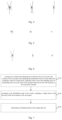
- FIG. 7 is a schematic flowchart of an efficient cut blasting method for medium-length holes in deep high-stress rock roadways based on crustal stress induction effect according to an embodiment of the present application;
- FIG. 8 is a schematic diagram of the relative position of the test blast hole on the free face of the rock roadway to be excavated
- FIG. 9 is a schematic diagram of the distribution of cracks on the free face or perpendicular to the axial section of the blast hole.
- FIG. 10 is a schematic diagram of the crack distribution along the axial section of the blast hole
- FIG. 12 is a schematic diagram of the three-dimensional crack distribution along the axial direction of the blast hole under the condition of single-hole blasting
- FIG. 13 is a simplified diagram of the three-dimensional crack distribution range (peripheral envelope) under the condition of single-hole blasting;
- FIG. 14 is a schematic diagram of the peripheral envelope of the blasting cracks corresponding to the rectangular hole arrangement method of medium-length hole cut blasting in deep high-stress rock roadway;
- FIG. 15 is a schematic diagram of the peripheral envelope of the blasting crack corresponding to the diamond-shaped hole arrangement method of medium-length hole cut blasting in deep high-stress rock roadway;
- FIG. 16 is a schematic diagram of the peripheral envelope of the blasting cracks corresponding to the modular diamond-shaped hole arrangement method of medium-length hole cut blasting in deep high-stress rock roadway;
- FIG. 17 shows the position of the peripheral envelope at the hole bottom corresponding to the straight hole arrangement method of the No. 2 cutting hole and the No. 3 cutting hole;
- FIG. 18 shows the position of the peripheral envelope at the hole bottom corresponding to the oblique hole arrangement method of the No. 2 cutting hole and the No. 3 cutting hole;
- FIG. 19 is a schematic diagram of the borehole inclination angle of the No. 2 cutting hole and the No. 3 cutting hole;
- FIG. 20 shows the change in the position of the envelope at the hole bottom when the No. 1 cutting hole and the No. 4 cutting hole are changed from straight holes to oblique holes;
- FIG. 21 is a schematic diagram of the borehole inclination angle of the No. 1 cutting hole and the No. 4 cutting hole.
- the efficient cut blasting method for medium-length holes in deep high-stress rock roadway based on crustal stress induction effect is suitable for blasting excavation engineering in deep high-stress rock roadways.
- the mining depth of coal has reached 1500 meters
- the mining depth of geothermal and non-ferrous metals has exceeded 3000 meters and 4350 meters respectively
- the mining depth of oil and gas resources has reached 7500 meters.
- ‘deep’ or ‘deep rock mass’ has no clear and specific definition in the industry, which is relative to ‘shallow’ or ‘shallow rock mass’.
- One of the main features of deep rock mass is high crustal stress.
- the medium-length hole refers to a blast hole with a depth of more than 2.5 m.
- the blasting effect of medium-length hole cut blasting in deep high-stress rock mass is mainly affected by two factors. One is the guiding effect of crustal stress on the expansion of blast cracks, and the other is the impact effect of deep hole clamping effect on rock crushing and throwing. At present, the industry has not comprehensively considered the high stress characteristics of deep rock mass when implementing deep rock mass cut blasting, resulting in unsatisfactory blasting effect.
- the induction effect of crustal stress on the expansion of blasting cracks and the effect of deep hole clamping effect on rock crushing and throwing are comprehensively considered in the arrangement of the cutting hole net, which is conducive to making full use of the induction effect of crustal stress on the expansion of blasting cracks and weakening the clamping effect of the deep hole surrounding rock, thereby improving the blasting effect.
- the inventor of the present application has done a lot of related research based on the practice of deep rock roadway engineering. It mainly includes: the impact effect of crustal stress on the propagation of blast cracks. This research result is helpful for in-depth understanding of the technical solutions provided by the embodiments of the present application and their technical effects. For this reason, the following is a description of this study: the impact effect of crustal stress on the propagation of blast cracks.
- the deep unexcavated rock mass is generally in a three-dimensional stress state, with horizontal crustal stresses ⁇ h1 and ⁇ h2 and vertical crustal stress ⁇ v , as shown in FIG. 1 .
- the free face also called free surface, is the surface where the blasted rock or medium is in contact with the air, the blasted rock slides along this surface, emphasizing the sliding surface of the rock mass during blasting
- the horizontal crustal stress perpendicular to the free face has been released when the free face is formed, that is, the horizontal crustal stress perpendicular to the free face is 0.
- the actual crustal stress state of the deep rock roadway can be simplified as a two-dimensional plane strain state, that is, it is subjected to the action of the horizontal crustal stress ⁇ h and the vertical crustal stress ⁇ v parallel to the free face, as shown in FIG. 2 .
- Crustal stress has a significant effect on the propagation of blast cracks.
- the continuous-discontinuous element method can be used to carry out a numerical simulation study of two-dimensional plane strain on the propagation behavior of blasting cracks under different crustal stress conditions. The following is a detailed analysis of the impact effect of crustal stress on the propagation of blast cracks based on numerical simulation results.
- the Protodyakonov coefficient of the rock in the numerical simulation is 3, that is, the compressive strength is 30 MPa.
- FIG. 3 is a diagram of the distribution state of cracks without the action of crustal stress.
- the vertical crustal stress ⁇ v 0
- FIG. 4 shows the diagram of the distribution state of blast cracks under the action of different unidirectional crustal stresses.
- the vertical crustal stress ⁇ v >0, and the horizontal crustal stress ⁇ h 0.
- the crustal stress ⁇ v in the vertical direction increases sequentially from left to right in the diagram of the distribution state of blast cracks in FIG. 4 .
- FIG. 4 it can be seen from FIG. 4 that with the increase of the crustal stress ⁇ v in the vertical direction, the crack propagation length in the horizontal direction gradually decreases.
- FIG. 5 shows the diagram of the distribution state of blast cracks under the action of bidirectional isobaric crustal stress.
- the vertical crustal stress ⁇ v is equal to the horizontal crustal stress ⁇ h . It can be seen from the figure that with the increase of bidirectional isobaric crustal stress, the crack propagation length in both vertical and horizontal directions gradually decreases, and the crack distribution range gradually decreases.
- FIG. 6 shows a diagram of the distribution state of blast cracks under the action of bidirectional anisobaric crustal stress.
- ⁇ v ⁇ h 5 MPa
- the efficient cut blasting method for medium-length holes in deep high-stress rock roadways based on crustal stress induction effect includes the steps:
- crustal stress state of deep rock mass is complex and is often affected by tectonic stress.
- Conventional measurement methods of crustal stress have complex procedures and poor real-time performance, and it is difficult to directly establish the correlation of crustal stress on blasting crack propagation and blasting effect, and cannot directly guide blasting parameter optimization and drilling and blasting construction.
- the in-situ single-hole blasting method for crustal stress testing can be used.
- step S 110 includes: drilling at least one test blast hole with the same depth as that of the cutting hole on the free face of the rock roadway to be excavated, and the diameter of the test blast hole is the same as that of the cutting hole; loading the same amount of explosives with the same charging method as that of the cutting hole in the test blast hole, inserting a detonator and blocking the blast hole.
- At least one test blast hole with the same depth as that of the cutting hole is drilled on the free face of the rock roadway to be excavated, which is used to characterize and reflect the real state of crack distribution under the synergistic action of crustal stress, explosion stress waves and clamping force of surrounding rock after detonation of the stratum where the rock roadway to be excavated is located, and is used in reverse as the basis for the arrangement of the cutting hole net to adapt to the characteristics of high-stress rock roadway, which is conducive to improving cut blasting effect of medium-length hole in high-stress rock roadway.
- a cutting hole with the same depth as that of the test blast hole is drilled in the middle of the free face of the high-stress rock roadway.
- the relative positions of the test blast holes are shown in FIG. 8 .
- the relevant personnel are transferred to a safe place and set up a cordon, and the detonator is detonated with an igniter, and the explosive is detonated by the detonator.
- the rock mass around the blast hole will be broken and cracked under the synergistic action of the explosion stress wave, the deep crustal stress and the clamping force of the surrounding rock around the test blast hole.
- the rock crushing in the cutting area is made under the combined effect of crustal stress, explosion stress and clamping force of hole bottom. After blasting, cracks will appear on the rock mass section perpendicular to the axial direction of the blast hole, and cracks will also appear on the surface of the free face of the rock roadway (the surface where the orifice is located).
- the distribution state of the cracks on the rock mass section perpendicular to the axial direction of the blast hole is determined.
- the shape of the peripheral envelope of the cracks is mainly affected by the crustal stress state. Therefore, due to the stress state environment in the same stratum located, the shape of the crack distribution on the rock section perpendicular to the axial direction of the blast hole is basically consistent. In this way, according to the distribution of visible cracks on the surface of the free face, the distribution state of the cracks on the rock mass section perpendicular to the axial direction of the blast hole can be determined.
- the crack distribution state contains: the shape of peripheral envelope (contour) of the cracks.
- the rock mass section perpendicular to the axial direction of the blast hole contains a surface of the free face; determining the distribution state of the cracks on the rock mass section perpendicular to the axial direction of the blast hole according to the visible cracks on the surface of the free face includes:
- the crack distribution profile (i.e., the peripheral envelope, as shown in FIG. 8 ) on the surface of the free face can be initially outlined with spray paint, a marker pen, an electronic scanner, or the like.
- the crack length and the shape and size of the peripheral envelope of the cracks are affected by the crustal stress state.
- the magnitudes of the crustal stress ⁇ h in the horizontal direction and the crustal stress ⁇ v in the vertical direction are different.
- FIG. 9 shows a schematic diagram of the distribution of cracks on the free face or perpendicular to the axial section of the blast hole.
- the crustal stress ⁇ v in the vertical direction is greater than the crustal stress ⁇ h in the horizontal direction
- the peripheral envelope of the cracks is elliptical.
- the direction of the major axis a of the elliptical envelope is vertical, and the direction of the minor axis b is horizontal.
- the shape of the peripheral envelope of the cracks is mainly affected by the state of crustal stress, but the size and range of the crack peripheral envelope are not only affected by the state of crustal stress, but also by the clamping effect of the rock mass. Since the clamping force of rock mass received by the blast hole gradually increases from the orifice to the hole bottom, the size and range of the peripheral envelope of the cracks will be different.
- the clamping effect of the surrounding rock gradually increases.
- the rock clamping effect at the orifice is small, while the rock clamping effect at the hole bottom is large.
- the shape of the peripheral envelope of the cracks at the hole bottom is the same as that at the orifice, and its major and minor axis are in the same direction, but its size and range are smaller than those at the orifice. Therefore, the distribution range of cracks at the orifice cannot represent the distribution range of cracks at different sections along the axial direction of the blast hole. It is necessary to further obtain the distribution range of cracks at different sections along the axial direction of the blast hole. After the shape and size of the peripheral envelope of the cracks on the rock mass section perpendicular to the axial direction of the blast hole is determined, the three-dimensional distribution state of the single-hole blasting cracks can be drawn, as shown in FIG. 10 .
- the crack distribution range at different sections along the axial direction of the blast hole can be obtained by using the method of borehole acoustic wave testing. Since the shape of the peripheral envelope of the cracks at other sections is the same as that at the free face, it is only necessary to determine the characteristic size of the envelope at other sections to determine the range and size of the envelope. For the elliptical envelope, it is only necessary to determine the length of the semi-major axis a/2 and the length of the semi-minor axis b/2. As shown in FIG. 11 , drill two probing holes with the same depth as that of the blast hole on the free face. The No. 1 probing hole is located in the major axis direction of the ellipse envelope, and the No.
- 2 probing hole is located in the minor axis direction of the ellipse envelope.
- Water is injected into the blast hole and two probing holes, the blast hole is used as an acoustic wave emission hole, and the two probing holes are used as acoustic wave receiving holes.
- the acoustic signals at different hole depths before and after blasting are tested and analyzed, and the damage degrees at different hole depths and the equivalent length of blast cracks are obtained. That is, the lengths of the semi-major and semi-minor axes of the ellipse envelope at different sections are obtained.
- the measurement technical solution provided in this embodiment can determine crack distribution envelope at different sections along the axial direction of the blast hole with as few probing holes as possible.
- the three-dimensional crack distribution along the axial direction of the blast hole under the condition of single-hole blasting can be obtained, as shown in FIG. 12 .
- the range and size of the peripheral envelope of the single-hole burst crack under the combined action of crustal stress, explosion stress and clamping effect can be obtained, and then the corresponding three-dimensional distribution state of the single-hole burst crack can be determined.
- the method further includes: according to the length of the major axis and the minor axis of the peripheral envelope of the cracks at the hole bottom, and the length of the peripheral envelope of the cracks at the surface of the free face, the length of the major axis and the minor axis of the elliptical envelope at the orifice and the single-hole charge, the unit consumption of explosives for medium-length cut blasting in the rock roadway to be excavated is determined.
- the major axis length of the peripheral envelope of the elliptical crack at the orifice is a, and the minor axis length is b;
- the major axis length of the peripheral envelope of the elliptical crack at the hole bottom is a 0 , and the minor axis length is b 0 ;
- the depth of the blast hole is l. Then the volume of the broken rock mass under the condition of single-hole blasting is
- the influence of the crustal stress state on the unit consumption of the explosive can also be determined, specifically: drilling a stress-free test blast hole for comparison in the stress-free stratum; loading with the same amount of explosives with the same charging method in the stress-free test blast hole as that of the test blast hole described in the embodiment, blocking the stress-free test blast hole; detonating the stress-free test blast hole, calculating the corresponding unit consumption of explosive according to the volume of the broken rock mass and the charge amount after the detonation; comparing the unit consumption of explosive with the unit consumption of explosive for medium-length hole cut blasting in the high-stress rock roadway, and determining the degree of influence of crustal stress on the unit consumption of explosive.
- a cutting hole net is arranged on the free face of the rock roadway to be excavated.
- the blasting effect can be simplified as the superposition of multiple single-hole blasting effects and crushing ranges.
- the number of cutting holes commonly used for straight-hole or oblique-hole cutting is 4 or 6.
- the first cutting hole is the No. 1 cutting hole
- the second cutting hole is the No. 2 cutting hole
- the third cutting hole is the No. 3 cutting hole
- the fourth cutting hole is the No. 4 cutting hole.
- 4 cutting holes are distributed in a rectangular shape.
- the rectangular arrangement of the cutting holes is unreasonable. It can be found from the figure that under the action of high crustal stress, the peripheral envelopes of the cracks distributed at any vertical section of the blast hole formed by a single blast hole are all elliptical. Therefore, when the cutting holes are in the form of conventional rectangular arrangement of holes, the central part of the cutting area formed by the four cutting holes cannot be covered by the crushing range of each blast hole, that is, the rock mass in this area cannot be effectively broken, resulting in poor cutting effect.
- the step of arranging cutting hole net on the free face of the rock roadway to be excavated according to the distribution state of the cracks includes: arranging the cutting hole net on the free face of the rock roadway to be excavated according to the shape and size of the peripheral envelope of the cracks.
- the size of the peripheral envelope of the cracks is represented by its major axis and its minor axis; in some embodiment, the arrangement of the cutting hole net on the free face of the rock roadway to be excavated according to the shape and size of the peripheral envelope of the cracks includes:
- At least the first group of cutting holes is arranged, and at least 4 cutting holes should be arranged in the first group, which are respectively the first cutting hole, the second cutting hole, the third cutting hole and the fourth cutting hole.
- the hole diameter, hole depth, charging method and charging amount of the first cutting hole, the second cutting hole, the third cutting hole and the fourth cutting hole are the same as that of the test blast hole;
- the peripheral envelope of the cracks after the fourth cutting hole is detonated
- the peripheral envelope of the cracks after the second cutting hole and the third cutting hole are detonated respectively have at least a tangent or intersecting part respectively
- the first cutting hole, the second cutting hole, the third cutting hole and the fourth cutting hole are arranged to form the first cutting area.
- first cutting hole and the fourth cutting hole are symmetrically arranged with respect to the center line connecting the second cutting hole and the third cutting hole.
- the parameters of the hole net are optimized according to the scheme provided in this embodiment.
- One of the schemes provided in this embodiment exemplarily, the diamond-shaped hole arrangement method shown in FIG. 15 . It can be intuitively concluded from the figure that the arrangement of the hole net in this way can reduce the area that cannot be covered by the peripheral envelope of the cracks in the cutting area, thereby increasing the crushing range of rock mass and improving the cut blasting effect of medium-length hole in high-stress rock roadway.
- the center distance between the first cutting hole and the fourth cutting hole l 1 ⁇ square root over (3) ⁇ a, the center distance between the second cutting hole and the third cutting hole l 2 ⁇ b, the center distance between the first cutting hole and the second cutting hole, the center distance between the first cutting hole and the third cutting hole, the center distance between the second cutting hole and the fourth cutting hole, the center distance between the third cutting hole and the fourth cutting hole all must satisfy
- a is the major axis length of the peripheral envelope of the cracks on the surface of the free face
- b is the minor axis of the peripheral envelope of the cracks on the surface of the free face
- the blast hole spacing must satisfy: the center distance between the No. 1 cutting hole and the No. 4 cutting hole l 1 ⁇ square root over (3) ⁇ a, the center distance between the No. 2 cutting hole and the No. 3 cutting hole l 2 ⁇ b, Furthermore, according to the geometric relationship, it can be further deduced that the center distance between the No. 1 cutting hole and the No. 2 cutting hole, the center distance between the No. 1 cutting hole and the No. 3 cutting hole, the center distance between the No. 2 cutting hole and the No. 4 cutting hole, the center distance between the No. 3 cutting hole and the No. 4 cutting hole all must satisfy
- the number of cutting holes often needs to be determined according to the actual situation of the project, and the above example is described by taking 4 cutting holes as an example.
- a modular blast hole arrangement method can still be carried out based on the diamond-shaped hole arrangement with four cutting holes, as shown in FIG. 16 .
- the center distance of the relevant blast holes is still set with reference to the case where there are 4 cutting holes. In this way, while making full use of the effective crushing range of the blast hole through the modular hole arrangement method, there is no need to repeat the design, and the design of the hole net parameters is greatly simplified.
- the clamping effect is large, resulting in the effective crushing range at the hole bottom being smaller than that of the orifice. Considering that the clamping force of rock mass also has an influence on the blasting effect of the blast hole.
- arranging the cutting hole net on the free face of the rock roadway to be excavated according to the crack distribution state further includes: according to the three-dimensional distribution state of the single-hole blasting cracks, determining the horizontal offset distance of the center of the peripheral envelope of cracks on the surface of the free face relative to the center of the peripheral envelope at the hole bottom; based on the horizontal offset distance, determining the positions of the orifice and the hole bottom of the second and third cutting holes; based on the determined positions of the orifice and the hole bottom, drilling the second cutting hole and the third cutting hole obliquely from the orifice, so that the center distance from the center of the hole bottom of the second cutting hole and the third cutting hole to the center of the orifice is greater than or equal to the horizontal offset distance.
- the influence of the clamping force of rock mass on the peripheral envelopes of the cracks of all sections in the axial direction of the blast hole can be determined, and then based on the influence the arrangement of the cutting hole net can be reversely guided according to the above arrangement method.
- the further optimization of the cutting hole net can further improve the blasting effect of medium-length hole in the high stress rock roadway.
- the second cutting hole and the third cutting hole are respectively drilled obliquely to the center of the first cutting area.
- the center distance from the hole bottom of the second cutting hole to the hole bottom of the third cutting hole is less than or equal to the minor axis length of the peripheral envelope of crack at the hole bottom;
- the hole arrangement method may adopt the diamond hole arrangement or the modular diamond hole arrangement method in the above-mentioned example, but cannot adopt the form of straight-hole cutting.
- the effective crushing range of the hole bottom of a single blast hole is obviously smaller than that of the orifice, and the straight-hole cutting form causes the hole bottom distance of the blast hole to be too large, and the rock at the bottom of the cutting is difficult to be effectively broken and thrown.
- FIG. 17 is in the form of a straight hole. It can be seen that the bottom envelopes of the No. 2 and No.
- the second cutting hole and the third cutting hole are drilled obliquely at an angle
- FIG. 19 shows a schematic diagram of the borehole inclination angle of the No. 2 cutting hole and the No. 3 cutting hole. Due to the inclination angle ⁇ horizontal of the blast hole drilling is relatively small, the change in the blast hole depth is small, and the blast hole depth is still regarded as l. According to the calculation of the geometric relationship, it is obtained that
- the envelopes of the peripheral cracks at the bottom of the two holes are tangent after detonation, and there is still an uncovered range.
- the center distance of the hole bottom of the No. 2 cutting hole and the No. 3 cutting hole should be less than b 0 .
- the inclination angle of No. 2 cutting hole and No. 3 cutting hole is less than b 0 .
- the No. 1 and No. 4 cutting holes also need to be in the form of oblique holes, that is, the No. 1 and No. 4 cutting holes are inclined to the center of the cutting area in the vertical arrangement direction.
- FIG. 20 shows the change in the position of the envelope of the hole bottom when the No. 1 and No. 4 cutting holes are changed from straight to oblique holes.
- the critical case is the hole bottom envelope of the No. 2 and No. 4 cutting holes are tangent to the hole bottom envelope of the No. 2 and No. 3 cutting holes.
- arranging the cutting hole net on the free face of the rock roadway to be excavated according to the crack distribution state further includes: according to the three-dimensional distribution state of the single-hole blasting cracks, determining the vertical offset distance of the center of the crack peripheral envelope on the surface of the free face relative to the center of the peripheral envelope at the hole bottom; based on the vertical offset distance, determining the positions of orifice and hole bottom of the first and fourth cutting holes; based on the determined positions of orifice and hole bottom, drilling the first cutting hole and the fourth cutting hole obliquely from the orifice to the center of the first cutting area, so that the center distance from the center of the hole bottom of the first cutting hole and the fourth cutting hole to the center of the orifice is greater than or equal to the vertical offset distance.
- the center distance between the hole bottom of the first cutting hole and the hole bottom of the fourth cutting hole is less than or equal to ⁇ square root over (3) ⁇ times the length of the major axis of the peripheral envelope of the cracks at the hole bottom.
- a is the length of the major axis of the elliptical periphery envelope of the cracks at the orifice
- a 0 is the length of the major axis of the elliptical periphery envelope of the cracks at the hole bottom
- l is the hole depth of the first cutting hole and the fourth cutting hole.
- FIG. 21 shows a schematic diagram of the inclination angle of the No. 1 cutting hole and the No. 4 cutting hole. Since the inclination angle ⁇ vertical of the blast hole is relatively small, the change of the blast hole depth is small, and the blast hole depth is still regarded as l. According to the calculation of the geometric relationship, it is obtained that under critical conditions,
- the hole bottom distance of the No. 1 cutting hole and the No. 4 cutting hole should be smaller than ⁇ square root over (3) ⁇ a 0 . Therefore, when the inclination angle of the No. 1 cutting hole and the No. 4 cutting hole
- the efficient cut blasting method for medium-length holes in deep high-stress rock roadway based on crustal stress induction effect when excavating deep high-stress rock roadways based on the drilling and blasting method, the crustal stress blasting test is carried out on the free face of the in-situ rock roadway to be excavated to obtain the crack distribution state under the synergistic action of the crustal stress, the explosion stress waves and the clamping force of surrounding rock of the rock mass in the stratum where the in-situ rock roadway to be excavated is located; according to the distribution state of cracks, a cutting hole net is arranged on the free face of the rock roadway to be excavated; the cut blasting is carried out based on the cutting hole net.
- each embodiment may refer to each other; further, in the embodiment of the present application, when states that the technical feature element is fixed on another technical feature element, it may be in direct contact with the surface of another technical feature element, or it can also be another technical feature element that exists in the center.
- relational terms such as first and second are only used to distinguish one entity or operation from another, and do not necessarily require or imply any such actual relationship or order between these entities or operations.
- the term ‘including’, ‘comprises’ or any other variation thereof is intended to cover non-exclusive inclusions, so that a process, method, article or platform comprising a series of elements includes not only those elements, but also other elements not expressly listed, or also includes elements inherent in such process, method, article or platform. Without further restrictions, the elements qualified by the statement ‘including a . . . ’ do not exclude the existence of other identical elements in the process, method, article or table comprising the elements.
Landscapes
- Engineering & Computer Science (AREA)
- General Engineering & Computer Science (AREA)
- Life Sciences & Earth Sciences (AREA)
- General Life Sciences & Earth Sciences (AREA)
- Drilling And Exploitation, And Mining Machines And Methods (AREA)
Abstract
Description
the step of carrying out a crustal stress blasting test on the free face of the in-situ rock roadway to be excavated, and obtaining the distribution state of cracks under the synergistic action of crustal stress, explosion stress waves and the clamping force of the surrounding rock of the rock mass in the stratum where the in-situ rock roadway to be excavated is located includes: drilling at least one test blast hole with the same depth as that of the cutting hole on the free face of the rock roadway to be excavated, and the diameter of the test blast hole is the same as that of the cutting hole; loading the same amount of explosives with the same charging method as that of the cutting hole in the test blast hole, and inserting a detonator and blocking the blast hole; detonating the detonator with an igniter and detonating the explosive through the detonator; after the explosion of explosives, the rock mass around the test blast hole is broken and cracks are formed, based on the synergistic action of the explosion stress waves, the deep crustal stress and the clamping force of the surrounding rock around the test blast hole; according to the visible cracks on the surface of the free face, determining the distribution state of the cracks on the rock mass section perpendicular to the axial direction of the blast hole; the rock mass section perpendicular to the axial direction of the blast hole contains a surface of the free face; determining the distribution state of the cracks on the rock mass section perpendicular to the axial direction of the blast hole according to the visible cracks on the surface of the free face includes: taking the test blast hole as the center, determining the length of the crack extending around; using spray paint, marker pen or electronic scanner to connect the end points of the crack length to outline or draw the crack distribution profile on the surface of the free face to form the corresponding peripheral envelope of the cracks; arranging a cutting hole net on the free face of the rock roadway to be excavated according to the distribution state of the cracks includes: according to the shape and size of the peripheral envelope of the cracks, arranging the cutting hole net on the free face of the rock roadway to be excavated; the shape of the peripheral envelope of the cracks is an ellipse, and the size of the peripheral envelope of the cracks is represented by its major axis and its minor axis; arranging the cutting hole net on the free face of the rock roadway to be excavated according to the shape and size of the peripheral envelope of the cracks includes: at least arranging a first group of cutting holes, and at least 4 cutting holes should be arranged in the first group, which are respectively the first cutting hole, the second cutting hole, the third cutting hole and the fourth cutting hole; the hole diameter, hole depth, charging method and charging amount of the first cutting hole, the second cutting hole, the third cutting hole and the fourth cutting hole are the same as that of the test blast hole; according as the peripheral envelope of the cracks after the first cutting hole is detonated, and the peripheral envelope of the cracks after the second cutting hole and the third cutting hole are detonated respectively, have at least a tangent or intersecting part respectively, the peripheral envelope of the cracks after the second cutting hole is detonated and the peripheral envelope of the cracks after the third cutting hole is detonated have at least a tangent or intersecting part, and the peripheral envelope of the cracks after the fourth cutting hole is detonated and the peripheral envelope of the cracks after the second cutting hole and the third cutting hole are detonated respectively, have at least a tangent or intersecting part respectively, the first cutting hole, the second cutting hole, the third cutting hole and the fourth cutting hole are arranged to form a first cutting area; the shape of the peripheral envelope of the cracks on the rock mass section upward along the axial direction of the blast hole and perpendicular to the axial direction of the blast hole is consistent; determining the distribution state of the cracks on the rock mass section perpendicular to the axial direction of the blast hole according to the visible cracks on the surface of the free face further includes: determining the size of the peripheral envelope of the cracks on the rock mass section upward along the axial direction of the blast hole and perpendicular to the axial direction of the blast hole; determining the three-dimensional distribution state of single-hole blasting cracks under the combined effect of crustal stress, explosion stress waves and clamping force of surrounding rock, according to the obtained shape and size of the peripheral envelope of the cracks on the rock mass section upward along the axial direction of the blast hole and perpendicular to the axial direction of the blast hole; the second cutting hole and the third cutting hole are respectively drilled obliquely to the center of the first cutting area; the center distance from the hole bottom of the second cutting hole to the hole bottom of the third cutting hole is less than or equal to the minor axis length of the peripheral envelope of the cracks at the hole bottom; the center distance from the hole bottom of the first cutting hole to the hole bottom of the fourth cutting hole is less than or equal to √{square root over (3)} times of the major axis length of the peripheral envelope of the cracks at the hole bottom.
wherein a is the major axis length of the peripheral envelope of the cracks on the surface of the free face, and b is the minor axis length of the peripheral envelope of the cracks on the surface of the free face.
wherein b is the center distance between the orifice of the second cutting hole and the orifice of the third cutting hole, b0 is the center distance between the hole bottom of the second cutting hole and the hole bottom of the third cutting hole, l is the hole depth of the second cutting hole and the third cutting hole.
wherein a is the major axis length of the periphery envelope of the elliptical cracks at the orifice, a0 is the major axis length of the periphery envelope of the elliptical cracks at the hole bottom, l is the hole depth of the first cutting hole and the fourth cutting hole.
Assuming that the single-hole charge is Q, according to the results of single-hole charge blasting, the unit consumption of explosives
for medium-length cut blasting in the high-stress rock roadway can be calculated.
wherein a is the major axis length of the peripheral envelope of the cracks on the surface of the free face, and b is the minor axis of the peripheral envelope of the cracks on the surface of the free face.
that is, the side length of the rhombus in the example shown in the figure satisfied
In this way, after each cutting hole is blasted, the crushing crack can completely cover the first cutting area, which improves the blasting effect.
under critical conditions, the envelopes of the peripheral cracks at the bottom of the two holes are tangent after detonation, and there is still an uncovered range. In order to ensure the effective crushing and throwing of the hole bottom, the center distance of the hole bottom of the No. 2 cutting hole and the No. 3 cutting hole should be less than b0. Correspondingly, the inclination angle of No. 2 cutting hole and No. 3 cutting hole
thus can further improve the cut blasting effect of medium-length hole in high stress rock roadway.
wherein a is the length of the major axis of the elliptical periphery envelope of the cracks at the orifice, a0 is the length of the major axis of the elliptical periphery envelope of the cracks at the hole bottom, l is the hole depth of the first cutting hole and the fourth cutting hole.
In order to ensure the effective crushing and throwing of the hole bottom, the hole bottom distance of the No. 1 cutting hole and the No. 4 cutting hole should be smaller than √{square root over (3)}a
the blasting effect is better.
Claims (7)
Applications Claiming Priority (2)
| Application Number | Priority Date | Filing Date | Title |
|---|---|---|---|
| CN202210743419.0 | 2022-06-28 | ||
| CN202210743419.0A CN114993125B (en) | 2022-06-28 | 2022-06-28 | High-efficiency cutting blasting method for deep holes in deep high-stress rock roadways based on in-situ stress induction effect |
Publications (2)
| Publication Number | Publication Date |
|---|---|
| US20230417526A1 US20230417526A1 (en) | 2023-12-28 |
| US12332038B2 true US12332038B2 (en) | 2025-06-17 |
Family
ID=83036494
Family Applications (1)
| Application Number | Title | Priority Date | Filing Date |
|---|---|---|---|
| US18/342,369 Active 2043-08-22 US12332038B2 (en) | 2022-06-28 | 2023-06-27 | Efficient cut blasting method for medium-length holes in deep high-stress rock roadway based on crustal stress induction effect |
Country Status (2)
| Country | Link |
|---|---|
| US (1) | US12332038B2 (en) |
| CN (1) | CN114993125B (en) |
Families Citing this family (9)
| Publication number | Priority date | Publication date | Assignee | Title |
|---|---|---|---|---|
| CN115355782B (en) * | 2022-09-21 | 2023-05-12 | 中国矿业大学 | Determination method for crack propagation track of ultra-deep Kong Bao |
| CN115615271A (en) * | 2022-11-14 | 2023-01-17 | 长安大学 | A Method for Determining the Principal Stress Direction Based on the Outer Profile of Explosive Cracks |
| CN116447938B (en) * | 2023-03-27 | 2025-07-25 | 沈阳工业大学 | Large-section high-ground-stress tunnel damaged rock mass partition induced blasting construction method |
| CN118031743A (en) * | 2024-02-23 | 2024-05-14 | 河南理工大学 | A microwave-assisted pre-splitting deep metal mine tunnel cutting blasting method |
| CN117967300A (en) * | 2024-03-13 | 2024-05-03 | 易合元科技重庆有限公司 | A method for cutting, expanding and breaking rock |
| CN118774824B (en) * | 2024-07-16 | 2026-01-23 | 山东黄金矿业科技有限公司深井开采实验室分公司 | Low-damage stope stoping method for downward approach type stope of deep metal ore |
| CN120800114A (en) * | 2025-06-06 | 2025-10-17 | 三峡大学 | Method for determining distance between deep-buried cavity slitting blastholes under action of high ground stress |
| CN120970412B (en) * | 2025-08-20 | 2026-07-24 | 中建材新材料有限公司 | A method for optimizing borehole parameters based on open-pit deep-hole blasting |
| CN121074525B (en) * | 2025-11-05 | 2026-03-31 | 杭州拓纬视图信息技术有限公司 | Efficient and intelligent annotation method for road defect data in large-scale collaborative modeling |
Citations (7)
| Publication number | Priority date | Publication date | Assignee | Title |
|---|---|---|---|---|
| US3902422A (en) | 1973-07-26 | 1975-09-02 | Du Pont | Explosive fracturing of deep rock |
| CN102997768A (en) | 2012-11-06 | 2013-03-27 | 董少南 | Rock blasting method |
| CN104457465A (en) | 2014-11-26 | 2015-03-25 | 武汉大学 | Deep-buried tunnel blasting excavation effect control method |
| RU2627349C1 (en) | 2016-04-27 | 2017-08-07 | Федеральное государственное бюджетное образовательное учреждение высшего профессионального образования "Забайкальский государственный университет" (ФГБОУ ВПО "ЗабГУ") | Method of obtaining determined degree of cracking of a cracky stressed rock massif in explosion of power charges in two parallel contiguous wells |
| CN107631669A (en) | 2017-10-24 | 2018-01-26 | 中国矿业大学 | A kind of Cut Blasting Optimization Design under large ground pressure |
| CN111102892A (en) | 2020-01-07 | 2020-05-05 | 南昌大学 | Wedge-shaped cut blast hole arrangement method suitable for blasting excavation of deep-buried tunnel |
| CN111692931A (en) | 2019-12-05 | 2020-09-22 | 南京铁道职业技术学院 | Intelligent hole distribution method for tunnel blasting |
-
2022
- 2022-06-28 CN CN202210743419.0A patent/CN114993125B/en active Active
-
2023
- 2023-06-27 US US18/342,369 patent/US12332038B2/en active Active
Patent Citations (7)
| Publication number | Priority date | Publication date | Assignee | Title |
|---|---|---|---|---|
| US3902422A (en) | 1973-07-26 | 1975-09-02 | Du Pont | Explosive fracturing of deep rock |
| CN102997768A (en) | 2012-11-06 | 2013-03-27 | 董少南 | Rock blasting method |
| CN104457465A (en) | 2014-11-26 | 2015-03-25 | 武汉大学 | Deep-buried tunnel blasting excavation effect control method |
| RU2627349C1 (en) | 2016-04-27 | 2017-08-07 | Федеральное государственное бюджетное образовательное учреждение высшего профессионального образования "Забайкальский государственный университет" (ФГБОУ ВПО "ЗабГУ") | Method of obtaining determined degree of cracking of a cracky stressed rock massif in explosion of power charges in two parallel contiguous wells |
| CN107631669A (en) | 2017-10-24 | 2018-01-26 | 中国矿业大学 | A kind of Cut Blasting Optimization Design under large ground pressure |
| CN111692931A (en) | 2019-12-05 | 2020-09-22 | 南京铁道职业技术学院 | Intelligent hole distribution method for tunnel blasting |
| CN111102892A (en) | 2020-01-07 | 2020-05-05 | 南昌大学 | Wedge-shaped cut blast hole arrangement method suitable for blasting excavation of deep-buried tunnel |
Non-Patent Citations (4)
| Title |
|---|
| Meng Chengpu, A Study of Influence Factors of Rock Mass under Blasting Load, J. of Anhui University of Technology(Natural Science), vol. 33 No. Apr. 2, 2016 , p. 160-166, Anhui, China. |
| Notification of grant dated Jun. 1, 2023, Appln No. 202210743419.0. |
| The First Chinese Office Action dated Feb. 8, 2023; Appin #202210743419.0 (No English Abstract). |
| The First Chinese Office Action dated Feb. 8, 2023; Appln #202210743419.0. |
Also Published As
| Publication number | Publication date |
|---|---|
| CN114993125A (en) | 2022-09-02 |
| CN114993125B (en) | 2023-07-14 |
| US20230417526A1 (en) | 2023-12-28 |
Similar Documents
| Publication | Publication Date | Title |
|---|---|---|
| US20230417526A1 (en) | Efficient cut blasting method for medium-length holes in deep high-stress rock roadway based on crustal stress induction effect | |
| Li et al. | Study on three-dimensional dynamic stability of open-pit high slope under blasting vibration | |
| Salum et al. | Optimising blast pulls and controlling blast-induced excavation damage zone in tunnelling through varied rock classes | |
| CN106679522B (en) | Efficient step blasting method for interbedded rock mass | |
| Lu et al. | Dynamic response of rock mass induced by the transient release of in-situ stress | |
| Chen et al. | Blasting excavation induced damage of surrounding rock masses in deep-buried tunnels | |
| Pomasoncco-Najarro et al. | Pre-split blasting design to reduce costs and improve safety in underground mining | |
| Chen et al. | Design and application of blasting parameters for presplitting hard roof with the aid of empty‐hole effect | |
| Zhang et al. | Numerical investigation on optimal blasting parameters of tunnel face in granite rock | |
| CN108151596A (en) | Diversion Tunnel Blasting Excavation out break controls construction method | |
| Song et al. | Numerical simulation and application research of straight-hole cut blasting with empty holes in railway tunnels | |
| CN119918251B (en) | Blasting parameter screening method and system in blind raise primary well-forming blasting | |
| Kai et al. | Cutting parameter optimization for one-step shaft excavation technique based on parallel cutting method | |
| CN119393135B (en) | A method for weakening and preventing impact on the top plate of the working face | |
| CN114352355B (en) | Deep mine rock burst control method | |
| Ding et al. | Effects of the initiation position on the damage and fracture characteristics of linear-charge blasting in rock | |
| Alipour et al. | Support vector machines for the estimation of specific charge in tunnel blasting | |
| Wang et al. | Study on blasting technology for open-pit layering of complex mine adjacent to high and steep slope | |
| Gao et al. | Study on optimization of delay method of wedge cut blasting in tunnel | |
| CN116952084B (en) | Method for preventing and controlling mine earthquake in goaf with thick and hard top plate through ground ultra-deep hole presplitting blasting | |
| Zhou et al. | Improving blast-induced tunnel profile under different in-situ stresses | |
| Afrasiabian et al. | Evaluation of effects of parameters of blast damage factor, sub-drilling, decoupling, and inter-hole delay time on peak particle velocity using numerical modeling | |
| Du et al. | Numerical simulation of damage characteristics of jointed rock under blasting load | |
| Jin et al. | Propagation mechanism of fracture zones in single-hole rock mass under high in-situ stress | |
| CN118999296B (en) | A method for excavating marine underground engineering based on time-controlled blasting |
Legal Events
| Date | Code | Title | Description |
|---|---|---|---|
| AS | Assignment |
Owner name: UNIVERSITY OF SCIENCE AND TECHNOLOGY BEIJING, CHINA Free format text: ASSIGNMENT OF ASSIGNORS INTEREST;ASSIGNORS:YANG, RENSHU;DING, CHENXI;GONG, MIN;AND OTHERS;REEL/FRAME:064085/0855 Effective date: 20230608 |
|
| FEPP | Fee payment procedure |
Free format text: ENTITY STATUS SET TO UNDISCOUNTED (ORIGINAL EVENT CODE: BIG.); ENTITY STATUS OF PATENT OWNER: SMALL ENTITY |
|
| FEPP | Fee payment procedure |
Free format text: ENTITY STATUS SET TO SMALL (ORIGINAL EVENT CODE: SMAL); ENTITY STATUS OF PATENT OWNER: SMALL ENTITY |
|
| STPP | Information on status: patent application and granting procedure in general |
Free format text: DOCKETED NEW CASE - READY FOR EXAMINATION |
|
| STPP | Information on status: patent application and granting procedure in general |
Free format text: NON FINAL ACTION MAILED |
|
| STPP | Information on status: patent application and granting procedure in general |
Free format text: RESPONSE TO NON-FINAL OFFICE ACTION ENTERED AND FORWARDED TO EXAMINER |
|
| STPP | Information on status: patent application and granting procedure in general |
Free format text: FINAL REJECTION MAILED |
|
| STCF | Information on status: patent grant |
Free format text: PATENTED CASE |