US12320952B2 - Antireflection coating material, optical member with antireflection coating, optical device, and image capturing apparatus - Google Patents

Antireflection coating material, optical member with antireflection coating, optical device, and image capturing apparatus Download PDF

Info

Publication number
US12320952B2
US12320952B2 US17/132,949 US202017132949A US12320952B2 US 12320952 B2 US12320952 B2 US 12320952B2 US 202017132949 A US202017132949 A US 202017132949A US 12320952 B2 US12320952 B2 US 12320952B2
Authority
US
United States
Prior art keywords
modified cross
section fiber
protrusions
coating material
antireflection coating
Prior art date
Legal status (The legal status is an assumption and is not a legal conclusion. Google has not performed a legal analysis and makes no representation as to the accuracy of the status listed.)
Active, expires
Application number
US17/132,949
Other versions
US20210116606A1 (en
Inventor
Hiroyuki Tanaka
Masaaki Nakabayashi
Current Assignee (The listed assignees may be inaccurate. Google has not performed a legal analysis and makes no representation or warranty as to the accuracy of the list.)
Canon Inc
Original Assignee
Canon Inc
Priority date (The priority date is an assumption and is not a legal conclusion. Google has not performed a legal analysis and makes no representation as to the accuracy of the date listed.)
Filing date
Publication date
Application filed by Canon Inc filed Critical Canon Inc
Assigned to CANON KABUSHIKI KAISHA reassignment CANON KABUSHIKI KAISHA ASSIGNMENT OF ASSIGNORS INTEREST (SEE DOCUMENT FOR DETAILS). Assignors: NAKABAYASHI, MASAAKI, TANAKA, HIROYUKI
Publication of US20210116606A1 publication Critical patent/US20210116606A1/en
Priority to US19/196,656 priority Critical patent/US20250258320A1/en
Application granted granted Critical
Publication of US12320952B2 publication Critical patent/US12320952B2/en
Active legal-status Critical Current
Adjusted expiration legal-status Critical

Links

Images

Classifications

    • BPERFORMING OPERATIONS; TRANSPORTING
    • B32LAYERED PRODUCTS
    • B32BLAYERED PRODUCTS, i.e. PRODUCTS BUILT-UP OF STRATA OF FLAT OR NON-FLAT, e.g. CELLULAR OR HONEYCOMB, FORM
    • B32B27/00Layered products comprising a layer of synthetic resin
    • B32B27/18Layered products comprising a layer of synthetic resin characterised by the use of special additives
    • BPERFORMING OPERATIONS; TRANSPORTING
    • B32LAYERED PRODUCTS
    • B32BLAYERED PRODUCTS, i.e. PRODUCTS BUILT-UP OF STRATA OF FLAT OR NON-FLAT, e.g. CELLULAR OR HONEYCOMB, FORM
    • B32B7/00Layered products characterised by the relation between layers; Layered products characterised by the relative orientation of features between layers, or by the relative values of a measurable parameter between layers, i.e. products comprising layers having different physical, chemical or physicochemical properties; Layered products characterised by the interconnection of layers
    • B32B7/02Physical, chemical or physicochemical properties
    • B32B7/023Optical properties
    • CCHEMISTRY; METALLURGY
    • C08ORGANIC MACROMOLECULAR COMPOUNDS; THEIR PREPARATION OR CHEMICAL WORKING-UP; COMPOSITIONS BASED THEREON
    • C08KUse of inorganic or non-macromolecular organic substances as compounding ingredients
    • C08K7/00Use of ingredients characterised by shape
    • C08K7/02Fibres or whiskers
    • CCHEMISTRY; METALLURGY
    • C09DYES; PAINTS; POLISHES; NATURAL RESINS; ADHESIVES; COMPOSITIONS NOT OTHERWISE PROVIDED FOR; APPLICATIONS OF MATERIALS NOT OTHERWISE PROVIDED FOR
    • C09DCOATING COMPOSITIONS, e.g. PAINTS, VARNISHES OR LACQUERS; FILLING PASTES; CHEMICAL PAINT OR INK REMOVERS; INKS; CORRECTING FLUIDS; WOODSTAINS; PASTES OR SOLIDS FOR COLOURING OR PRINTING; USE OF MATERIALS THEREFOR
    • C09D133/00Coating compositions based on homopolymers or copolymers of compounds having one or more unsaturated aliphatic radicals, each having only one carbon-to-carbon double bond, and at least one being terminated by only one carboxyl radical, or of salts, anhydrides, esters, amides, imides, or nitriles thereof; Coating compositions based on derivatives of such polymers
    • C09D133/04Homopolymers or copolymers of esters
    • C09D133/06Homopolymers or copolymers of esters of esters containing only carbon, hydrogen and oxygen, the oxygen atom being present only as part of the carboxyl radical
    • C09D133/08Homopolymers or copolymers of acrylic acid esters
    • CCHEMISTRY; METALLURGY
    • C09DYES; PAINTS; POLISHES; NATURAL RESINS; ADHESIVES; COMPOSITIONS NOT OTHERWISE PROVIDED FOR; APPLICATIONS OF MATERIALS NOT OTHERWISE PROVIDED FOR
    • C09DCOATING COMPOSITIONS, e.g. PAINTS, VARNISHES OR LACQUERS; FILLING PASTES; CHEMICAL PAINT OR INK REMOVERS; INKS; CORRECTING FLUIDS; WOODSTAINS; PASTES OR SOLIDS FOR COLOURING OR PRINTING; USE OF MATERIALS THEREFOR
    • C09D133/00Coating compositions based on homopolymers or copolymers of compounds having one or more unsaturated aliphatic radicals, each having only one carbon-to-carbon double bond, and at least one being terminated by only one carboxyl radical, or of salts, anhydrides, esters, amides, imides, or nitriles thereof; Coating compositions based on derivatives of such polymers
    • C09D133/04Homopolymers or copolymers of esters
    • C09D133/14Homopolymers or copolymers of esters of esters containing halogen, nitrogen, sulfur or oxygen atoms in addition to the carboxy oxygen
    • CCHEMISTRY; METALLURGY
    • C09DYES; PAINTS; POLISHES; NATURAL RESINS; ADHESIVES; COMPOSITIONS NOT OTHERWISE PROVIDED FOR; APPLICATIONS OF MATERIALS NOT OTHERWISE PROVIDED FOR
    • C09DCOATING COMPOSITIONS, e.g. PAINTS, VARNISHES OR LACQUERS; FILLING PASTES; CHEMICAL PAINT OR INK REMOVERS; INKS; CORRECTING FLUIDS; WOODSTAINS; PASTES OR SOLIDS FOR COLOURING OR PRINTING; USE OF MATERIALS THEREFOR
    • C09D167/00Coating compositions based on polyesters obtained by reactions forming a carboxylic ester link in the main chain; Coating compositions based on derivatives of such polymers
    • CCHEMISTRY; METALLURGY
    • C09DYES; PAINTS; POLISHES; NATURAL RESINS; ADHESIVES; COMPOSITIONS NOT OTHERWISE PROVIDED FOR; APPLICATIONS OF MATERIALS NOT OTHERWISE PROVIDED FOR
    • C09DCOATING COMPOSITIONS, e.g. PAINTS, VARNISHES OR LACQUERS; FILLING PASTES; CHEMICAL PAINT OR INK REMOVERS; INKS; CORRECTING FLUIDS; WOODSTAINS; PASTES OR SOLIDS FOR COLOURING OR PRINTING; USE OF MATERIALS THEREFOR
    • C09D201/00Coating compositions based on unspecified macromolecular compounds
    • CCHEMISTRY; METALLURGY
    • C09DYES; PAINTS; POLISHES; NATURAL RESINS; ADHESIVES; COMPOSITIONS NOT OTHERWISE PROVIDED FOR; APPLICATIONS OF MATERIALS NOT OTHERWISE PROVIDED FOR
    • C09DCOATING COMPOSITIONS, e.g. PAINTS, VARNISHES OR LACQUERS; FILLING PASTES; CHEMICAL PAINT OR INK REMOVERS; INKS; CORRECTING FLUIDS; WOODSTAINS; PASTES OR SOLIDS FOR COLOURING OR PRINTING; USE OF MATERIALS THEREFOR
    • C09D5/00Coating compositions, e.g. paints, varnishes or lacquers, characterised by their physical nature or the effects produced; Filling pastes
    • CCHEMISTRY; METALLURGY
    • C09DYES; PAINTS; POLISHES; NATURAL RESINS; ADHESIVES; COMPOSITIONS NOT OTHERWISE PROVIDED FOR; APPLICATIONS OF MATERIALS NOT OTHERWISE PROVIDED FOR
    • C09DCOATING COMPOSITIONS, e.g. PAINTS, VARNISHES OR LACQUERS; FILLING PASTES; CHEMICAL PAINT OR INK REMOVERS; INKS; CORRECTING FLUIDS; WOODSTAINS; PASTES OR SOLIDS FOR COLOURING OR PRINTING; USE OF MATERIALS THEREFOR
    • C09D5/00Coating compositions, e.g. paints, varnishes or lacquers, characterised by their physical nature or the effects produced; Filling pastes
    • C09D5/006Anti-reflective coatings
    • CCHEMISTRY; METALLURGY
    • C09DYES; PAINTS; POLISHES; NATURAL RESINS; ADHESIVES; COMPOSITIONS NOT OTHERWISE PROVIDED FOR; APPLICATIONS OF MATERIALS NOT OTHERWISE PROVIDED FOR
    • C09DCOATING COMPOSITIONS, e.g. PAINTS, VARNISHES OR LACQUERS; FILLING PASTES; CHEMICAL PAINT OR INK REMOVERS; INKS; CORRECTING FLUIDS; WOODSTAINS; PASTES OR SOLIDS FOR COLOURING OR PRINTING; USE OF MATERIALS THEREFOR
    • C09D7/00Features of coating compositions, not provided for in group C09D5/00; Processes for incorporating ingredients in coating compositions
    • C09D7/40Additives
    • C09D7/65Additives macromolecular
    • CCHEMISTRY; METALLURGY
    • C09DYES; PAINTS; POLISHES; NATURAL RESINS; ADHESIVES; COMPOSITIONS NOT OTHERWISE PROVIDED FOR; APPLICATIONS OF MATERIALS NOT OTHERWISE PROVIDED FOR
    • C09DCOATING COMPOSITIONS, e.g. PAINTS, VARNISHES OR LACQUERS; FILLING PASTES; CHEMICAL PAINT OR INK REMOVERS; INKS; CORRECTING FLUIDS; WOODSTAINS; PASTES OR SOLIDS FOR COLOURING OR PRINTING; USE OF MATERIALS THEREFOR
    • C09D7/00Features of coating compositions, not provided for in group C09D5/00; Processes for incorporating ingredients in coating compositions
    • C09D7/40Additives
    • C09D7/70Additives characterised by shape, e.g. fibres, flakes or microspheres
    • GPHYSICS
    • G02OPTICS
    • G02BOPTICAL ELEMENTS, SYSTEMS OR APPARATUS
    • G02B1/00Optical elements characterised by the material of which they are made; Optical coatings for optical elements
    • G02B1/10Optical coatings produced by application to, or surface treatment of, optical elements
    • G02B1/11Anti-reflection coatings
    • GPHYSICS
    • G02OPTICS
    • G02BOPTICAL ELEMENTS, SYSTEMS OR APPARATUS
    • G02B1/00Optical elements characterised by the material of which they are made; Optical coatings for optical elements
    • G02B1/10Optical coatings produced by application to, or surface treatment of, optical elements
    • G02B1/11Anti-reflection coatings
    • G02B1/111Anti-reflection coatings using layers comprising organic materials
    • GPHYSICS
    • G02OPTICS
    • G02BOPTICAL ELEMENTS, SYSTEMS OR APPARATUS
    • G02B5/00Optical elements other than lenses
    • G02B5/02Diffusing elements; Afocal elements
    • GPHYSICS
    • G02OPTICS
    • G02BOPTICAL ELEMENTS, SYSTEMS OR APPARATUS
    • G02B5/00Optical elements other than lenses
    • G02B5/02Diffusing elements; Afocal elements
    • G02B5/0205Diffusing elements; Afocal elements characterised by the diffusing properties
    • G02B5/0236Diffusing elements; Afocal elements characterised by the diffusing properties the diffusion taking place within the volume of the element
    • G02B5/0242Diffusing elements; Afocal elements characterised by the diffusing properties the diffusion taking place within the volume of the element by means of dispersed particles
    • GPHYSICS
    • G02OPTICS
    • G02BOPTICAL ELEMENTS, SYSTEMS OR APPARATUS
    • G02B7/00Mountings, adjusting means, or light-tight connections, for optical elements
    • G02B7/02Mountings, adjusting means, or light-tight connections, for optical elements for lenses
    • CCHEMISTRY; METALLURGY
    • C08ORGANIC MACROMOLECULAR COMPOUNDS; THEIR PREPARATION OR CHEMICAL WORKING-UP; COMPOSITIONS BASED THEREON
    • C08LCOMPOSITIONS OF MACROMOLECULAR COMPOUNDS
    • C08L67/00Compositions of polyesters obtained by reactions forming a carboxylic ester link in the main chain; Compositions of derivatives of such polymers

Definitions

  • the present invention relates to an antireflection coating material, an optical member with an antireflection coating made of the coating material, an optical device, and an image capturing apparatus.
  • An optical device such as a lens barrel, includes a housing and an optical system including a plurality of lenses arranged in the housing. Rays of light entering the optical device impinge mainly on the lenses. The rays of light are imaged to form an object image. There are some rays of light that are not imaged and do not contribute to object image formation. The rays of light that do not contribute to object image formation enter the optical device from disordered directions and impinge on parts other than optical members, such as the lenses, causing unnecessary reflected light or scattered light in the housing. These rays of light are called stray light. Stray light reaches an image capturing element, causing flare or ghost.
  • PTL1 discloses that an inner wall surface of an optical component is covered with a coating of black resin containing fine particles having polygonal and elliptical shapes in cross-section and the fine particles protrude from the surface of the black coating.
  • PTL2 discloses that an inner wall surface of an optical component is covered with a coating of black resin containing spherical fine particles and the fine particles protrude from the surface of the black coating.
  • a material for the fine particles is selected such that the protruding fine particles have substantially the same refractive index as that of the resin. This is intended to absorb rays of light, thereby reducing a reflectance.
  • the inner wall surface of the optical component disclosed in PTL1 has a glossiness of 0.3 at an incident angle of 60°. As the incident angle increases, the reflectance reducing effect of this optical component becomes insufficient.
  • the inner wall surface of the optical component disclosed in PTL2 has a glossiness of 0.1 at an incident angle of 85°, resulting in a reduction in reflectance.
  • the area of contact between the resin and the fine particles, which have a spherical shape, is small, leading to the likelihood that the fine particles may easily come off inside the optical component (lens barrel).
  • reflectance reduction is incompatible with reducing or eliminating flaking of fine particles in an optical member with an antireflection coating.
  • An optical member to solve the above-described problem is an optical member including an antireflection coating on a substrate, the antireflection coating includes a resin layer and a modified cross-section fiber bound to the resin layer, the modified cross-section fiber includes a core and a plurality of protrusions extending from the core, and the protrusions have extremities protruding from a surface of the resin layer.
  • FIG. 1 A is a schematic diagram illustrating an embodiment of a modified cross-section fiber to be contained in an antireflection coating material according to the present invention.
  • FIG. 1 B is a schematic diagram illustrating the embodiment of the modified cross-section fiber to be contained in the antireflection coating material according to the present invention.
  • FIG. 1 C is a schematic diagram illustrating an embodiment of the modified cross-section fiber to be contained in the antireflection coating material according to the present invention.
  • FIG. 2 A is a schematic diagram illustrating an embodiment of the modified cross-section fiber to be contained in the antireflection coating material according to the present invention.
  • FIG. 2 B is a schematic diagram illustrating an embodiment of the modified cross-section fiber to be contained in the antireflection coating material according to the present invention.
  • FIG. 2 C is a schematic diagram illustrating an embodiment of the modified cross-section fiber to be contained in the antireflection coating material according to the present invention.
  • FIG. 2 D is a schematic diagram illustrating an embodiment of the modified cross-section fiber to be contained in the antireflection coating material according to the present invention.
  • FIG. 2 E is a schematic diagram illustrating an embodiment of the modified cross-section fiber to be contained in the antireflection coating material according to the present invention.
  • FIG. 3 is a schematic diagram illustrating an embodiment of an optical member according to the present invention.
  • FIG. 4 is a schematic diagram illustrating an embodiment of an image capturing apparatus according to the present invention.
  • An antireflection coating material used to form an antireflection coating on an optical member according to the present invention contains a modified cross-section fiber including a core and a plurality of protrusions extending from the core, a resin, and an organic solvent.
  • FIGS. 1 and 2 are diagrams illustrating embodiments of the modified cross-section fiber to be contained in the antireflection coating material in the present invention.
  • FIG. 1 A is a side view of a fiber in its longitudinal direction.
  • FIGS. 1 B and 1 C are cross-sectional views of the fiber in a direction perpendicular to the longitudinal direction.
  • modified cross-section fiber refers to a fiber whose cross-section taken in the direction perpendicular to the longitudinal directional has a shape other than a circle, an ellipse, and a convex polygon in which all interior angles are less than 180°.
  • a modified cross-section fiber 1 includes a core 2 and a plurality of protrusions 3 extending from the core.
  • the modified cross-section fiber 1 can have a length L of from 0.2 to 1.0 mm.
  • the modified cross-section fiber can be cut to an intended length with a cutter.
  • a length L of less than 0.2 mm of the modified cross-section fiber indicates that the percentage of cut faces having no antireflection capability to the surface area of the modified cross-section fiber may increase, leading to insufficient antireflection effect.
  • a length L of greater than 1.0 mm of the modified cross-section fiber may make it difficult for the protrusions of the modified cross-section fiber to protrude from the surface of the resin when the antireflection coating is formed, and may cause the tip of a spray nozzle to tend to be clogged with the coating material when the coating material is applied with a spray gun.
  • the modified cross-section fiber 1 can have a thickness T of from 10 to 50 ⁇ m.
  • the “thickness T of the modified cross-section fiber” as used herein refers to the length of a cross-section in the direction perpendicular to the longitudinal direction of the modified cross-section fiber, or the length of the cross-section orthogonal to the axis of the fiber. Additionally, the thickness T is a maximum value of the sum of the length of the core 2 and the lengths of the protrusions 3 in the direction across the cross-section. In FIG. 1 B , therefore, a length indicated by arrows corresponds to the thickness T of the modified cross-section fiber 1 .
  • the modified cross-section fiber 1 can have an aspect ratio, which is the ratio (L/T) of the length L to the thickness T, of from 4 to 100.
  • the aspect ratio in this range allows the extremities of the protrusions 3 of the modified cross-section fiber to readily protrude from the surface of the resin layer when the antireflection coating is formed.
  • An aspect ratio of less than 4, which indicates a shape close to isotropic, may increase the likelihood that the cut faces of the modified cross-section fiber will protrude from the surface of the resin layer, leading to insufficient antireflection effect.
  • An aspect ratio of greater than 100 may make it difficult to control the orientation of the modified cross-section fiber 1 and thus make it difficult for the extremities of the protrusions 3 to protrude from the surface of the resin layer.
  • the core 2 is a portion depicted by a dashed line in FIG. 1 B and has a circular shape.
  • the core 2 does not necessarily have to be circular and may be polygonal.
  • the length of the core corresponds to the diameter of the core if the core is a circle, the diameter of a circle inscribed in the core if the core is a polygon, and the diameter of the core along a major axis if the core is an ellipse.
  • the core 2 may have a hole 21 as illustrated in FIG. 1 C .
  • the protrusions 3 extend from the core 2 and are made of the same material as that of the core 2 .
  • FIG. 1 B illustrates eight protrusions 3 , it is only required that the number of protrusions is two or more because two or more protrusions can scatter light incident between two protrusions to prevent the light from returning to an optical path and reaching an image capturing element.
  • the number of protrusions of the modified cross-section fiber can be from three to eight. Therefore, a Y-shaped cross-section providing three protrusions, as illustrated in FIG. 2 A , also achieves advantages of the present invention. Examples of commercially available modified cross-section fibers including eight protrusions include Octa (registered trademark) available from Teijin Frontier Co., Ltd. Modified cross-section fibers including nine or more protrusions are difficult to produce.
  • the protrusions 3 can have a length C L of from 5 to 20 more preferably from 5 to 12.5 ⁇ m.
  • a length C L of less than 5 ⁇ m of the protrusions 3 results in a reduction in the extent to which the protrusions 3 protrude from the surface of the resin layer, so that light may fail to be sufficiently reflected between the protrusions, leading to insufficient reflectance-reducing effect.
  • a length C L of greater than 20 ⁇ m of the protrusions 3 indicates that the protrusions may incline or fall, so that light may fail to sufficiently enter between the protrusions, leading to insufficient reflectance-reducing effect.
  • the protrusions 3 can have a thickness C T of from 2 to 6 ⁇ m.
  • a thickness C T of less than 2 ⁇ m of the protrusions 3 indicates that the protrusions may incline or fall, so that light may fail to sufficiently enter between the protrusions, leading to insufficient reflectance-reducing effect.
  • a thickness C T of greater than 6 ⁇ m of the protrusions 3 results in a reduction in spacing between the protrusions, so that light may fail to be sufficiently reflected between the protrusions, leading to insufficient reflectance-reducing effect.
  • the extremities of the protrusions do not have to be rounded as illustrated in FIG. 1 B .
  • Each protrusion may have a pointed extremity as illustrated in FIG. 2 B .
  • the protrusions 3 do not have to be arranged at substantially regular intervals radially about the core 2 as illustrated in FIG. 1 B .
  • the protrusions 3 may be arranged at irregular intervals as illustrated in FIG. 2 C .
  • the protrusions 3 do not have to have a constant size as illustrated in FIG. 1 B .
  • the protrusions 3 may have different sizes as illustrated in FIG. 2 D .
  • the modified cross-section fiber having a cross-sectional shape illustrated in FIG. 2 D may have another cross-sectional shape as illustrated in FIG. 2 E .
  • fibers having such a shape include crimped fibers, which are individually curled.
  • Examples of commercially available crimped fibers include Calculo (registered trademark) available from Teijin Frontier Co., Ltd.
  • the modified cross-section fiber may be made of any material.
  • the material can be selected from, for example, polyester, nylon, acrylic, polypropylene, rayon, polyethylene, polyurethane, cotton, flax, wool, and combinations thereof.
  • the modified cross-section fiber may be subjected to, for example, processing, light-proof treatment, softening treatment, and anti-fading treatment.
  • the modified cross-section fiber can be contained in an amount of from 50 to 200 parts by mass relative to 100 parts by mass of coating material solids before addition of the modified cross-section fiber.
  • coating material solids refers to all solid components contained in the antireflective coating material that include not only a resin forming a resin layer, which will be described later, but also additives, for example. Less than 50 parts by mass modified cross-section fiber may fail to provide sufficient antireflection effect. More than 200 parts by mass modified cross-section fiber may cause the tip of a spray nozzle to tend to be clogged with the coating material when the coating material is applied with a spray gun. If the antireflection coating were formed, the resin layer would fail to firmly bind the modified cross-section fiber because of a small amount of coating material solids, such as a resin, so that the modified cross-section fiber might be likely to come off.
  • the modified cross-section fiber can be contained in an amount of from 33 to 67 parts by mass relative to 100 parts by mass of the coating material solids.
  • a resin contained in the antireflection coating material according to the present invention forms a resin layer after the antireflection coating material is dried.
  • the resin may be of any kind, and can be selected from, for example, acrylic resin, urethane resin, epoxy resin, and combinations thereof.
  • the resin may be either a solvent soluble resin or a reactive curable resin.
  • the resin in the antireflection coating material according to the present invention can be contained in an amount of from 5 to 50 parts by mass relative to 100 parts by mass of the antireflection coating material. Less than 5 parts by mass resin may deteriorate adhesion with the substrate, whereas more than 50 parts by mass resin may make it difficult to form a thin antireflection coating.
  • An organic solvent contained in the antireflection coating material according to the present invention may be of any kind.
  • the organic solvent include water, thinner, ethanol, isopropyl alcohol, n-butyl alcohol, ethyl acetate, propyl acetate, isobutyl acetate, butyl acetate, methyl ethyl ketone, methyl isobutyl ketone, propylene glycol monomethyl ether, toluene, xylene, acetone, cellosolves, glycol ethers, and ethers.
  • one solvent may be used or multiple solvents may be mixed and used.
  • the organic solvent in the antireflection coating material according to the present invention can be contained in an amount of from 5 to 80 parts by mass relative to 100 parts by mass of the antireflection coating material. Less than 5 parts by mass organic solvent may make it difficult to form a thin antireflection coating. Such an amount may also cause a discharge opening of a spray gun to be clogged with the coating material when the coating material is applied with the spray gun. More than 80 parts by mass organic solvent may deteriorate adhesion with the substrate. Such an amount may also cause sagging when the coating material is applied with a spray gun.
  • the antireflection coating material can have a viscosity of from 10 to 200 mPa ⁇ s.
  • a viscosity of less than 10 mPa ⁇ s of the antireflection coating material may deteriorate adhesion between the substrate and the antireflection coating, whereas a viscosity of greater than 200 mPa ⁇ s may make it difficult to form a thin antireflection coating.
  • the antireflection coating material according to the present invention may further contain an additive.
  • the additive include dispersing agents, curing agents, curing catalysts, plasticizers, thixotropic agents, levelling agents, infrared-transparent organic coloring agents, infrared-transparent inorganic coloring agents, antiseptics, ultraviolet ray absorbers, antioxidants, and coupling agents.
  • the antireflection coating material may contain a filler for coloring or providing a matte appearance.
  • the surface of the modified cross-section fiber can be subjected to coating treatment.
  • Surface-active agents, inorganic salts, and various resins can be used for coating treatment.
  • the surface of the modified cross-section fiber cut to an intended length is treated with, for example, a tannin compound or tartar emetic, thereby forming, for example, a tannin compound on the surface of the fiber.
  • a tannin compound or tartar emetic
  • the water retention properties of, for example, a tannin compound are used to maintain good conductivity of the surface of flock.
  • inorganic salts, an inorganic silicon compound, a surface-active agent, and a mixture thereof are caused to adhere to the surface of the modified cross-section fiber.
  • tannin compounds include natural tannins and synthetic tannins.
  • inorganic salts include sodium chloride (NaCl), barium chloride (BaCl 2 ), magnesium chloride (MgCl 2 ), magnesium sulfate (MgSO 4 ), sodium silicate (Na 2 SiO 3 ), sodium carbonate (Na 2 CO 3 ), and sodium sulfate (Na 2 SO 4 ).
  • inorganic silicon compounds include colloidal silica.
  • surface-active agents include anionic surface-active agents, nonionic surface-active agents, ampholytic surface-active agents, and cationic surface-active agents.
  • the antireflection coating material according to the present invention may be produced by any method as long as the modified cross-section fiber can be dispersed in the antireflection coating material.
  • Examples of a device to be used in the producing method include a bead mill, a ball mill, a jet mill, a three-roll mill, a planetary rotator, a mixer, and an ultrasonic homogenizer.
  • FIG. 3 is a diagram illustrating an exemplary embodiment of an optical member according to the present invention.
  • An optical member 10 includes an antireflection coating 12 on a substrate 11 .
  • the antireflection coating 12 is formed of the antireflection coating material according to the present invention.
  • the antireflection coating 12 includes a resin layer 4 and a modified cross-section fiber 1 bound to the resin layer 4 .
  • the modified cross-section fiber 1 which has been described with reference to FIGS. 1 and 2 , includes a core and a plurality of protrusions extending from the core.
  • the antireflection coating 12 can scatter light incident between two adjacent protrusions because the extremities of the protrusions of the modified cross-section fiber 1 protrude from the surface of the resin layer 4 .
  • the modified cross-section fiber 1 is bound to the resin layer 4 with the protrusions. Therefore, the area of contact between the modified cross-section fiber 1 and the resin layer 4 is greater than that between a spherical particle and the resin layer. The modified cross-section fiber 1 is less likely to come off from the resin layer 4 .
  • the substrate 11 may be made of any material.
  • metal materials include aluminum, titanium, stainless steel, and magnesium alloy.
  • plastic materials include polycarbonate resin, acrylic resin, ABS resin, and fluorocarbon resin.
  • the modified cross-section fiber in the antireflection coating 12 can be contained in an amount of from 33 to 67 parts by mass relative to 100 parts by mass of the antireflection coating. Less than 33 parts by mass modified cross-section fiber may fail to provide sufficient antireflection effect. More than 67 parts by mass modified cross-section fiber, which indicates a small amount of solids, such as a resin, may cause the resin layer to fail to firmly bind the modified cross-section fiber, causing the modified cross-section fiber to be likely to come off.
  • the antireflection coating 12 can have any thickness, preferably a thickness of from 10 to 500 ⁇ m, more preferably from 20 to 200 ⁇ m. A thickness of less than 10 ⁇ m of the antireflection coating may fail to provide sufficient hiding power. A thickness of greater than 500 ⁇ m of the antireflection coating may increase unevenness in thickness of the antireflection coating, causing flaking. To increase the thickness, the coating material can be applied multiple times rather than once.
  • a primer layer can be disposed between the substrate 11 and the antireflection coating 12 .
  • the primer layer can be made of any material. Examples of the material include epoxy resin, urethane resin, acrylic resin, silicone resin, and fluorocarbon resin.
  • the primer layer can have a thickness of from 2 to 30 ⁇ m, more preferably from 5 to 20 ⁇ m. A thickness of less than 2 ⁇ m may provide insufficient adhesion, whereas a thickness of greater than 30 ⁇ m may adversely affect the accuracy of thickness of the antireflection coating 12 .
  • the antireflection coating can be produced by any method, for example, brush coating, spray coating, dip coating, or transfer.
  • spray coating is suitable in terms of excellent conformity with the shape of a substrate.
  • the antireflection coating can be hardened by any method.
  • the antireflection coating can be dried at room temperature. Hardening the antireflection coating can be accelerated with heat. Ultraviolet rays can be applied to the antireflection coating.
  • FIG. 4 illustrates an exemplary configuration of a single-lens reflex digital camera as a suitable embodiment of an image capturing apparatus according to the present invention.
  • a camera body 602 is coupled to a lens barrel 601 , serving as an optical device.
  • the lens barrel 601 is an interchangeable lens, which is attachable to and detachable from the camera body 602 .
  • Light from an object passes through an optical system including lenses 603 and 605 arranged on the optical axis of an image capturing optical system in a housing 620 of the lens barrel 601 and is received by an image capturing element 610 .
  • the lens 605 is supported by an inner cylinder 604 such that the lens 605 is movable relative to an outer cylinder of the lens barrel 601 for focusing or zooming.
  • object light is reflected by a main mirror 607 in a housing 621 of the camera body, passes through a prism 611 , and then passes through a finder lens 612 , so that a user can view an image to be captured.
  • the main mirror 607 is, for example, a half mirror.
  • Light passing through the main mirror is reflected by a sub-mirror 608 to an auto-focusing (AF) unit 613 .
  • AF auto-focusing
  • This reflected light is used for ranging, for example.
  • the main mirror 607 is attached to a main mirror holder 640 by, for example, adhesion, and supported by the holder.
  • a diaphragm 606 is configured such that the area of an aperture is changed to change brightness for image capture or the depth of focus.
  • An optical member according to the present invention includes a substrate, serving as the housing 620 and the inner cylinder 604 , and an antireflection coating 630 disposed on the substrate, and can be used in an image capturing apparatus and an optical device.
  • the housing 620 can be made of any material.
  • metal materials include aluminum, titanium, stainless steel, and magnesium alloy.
  • plastic materials include polycarbonate resin, acrylic resin, ABS resin, and fluorocarbon resin.
  • An optical device includes an antireflection coating having low reflectance even at a large incident angle in a housing. Such a configuration can sufficiently reduce the probability of occurrence of flare or ghost in an image captured with an image capturing apparatus including the optical device according to the present invention and an image capturing element.
  • Reflectance measurement was performed using optical members each including an antireflection coating on a 150-by-70-millimeter surface of ABS resin.
  • a reflectance at an incident angle of 85° was measured every nanometer in wavelength of from 500 to 600 nm with a ultraviolet-visible-near-infrared spectrophotometer (product name: V-770 available from JASCO Corporation). The measured values were averaged, and the mean value was determined as a reflectance. The measurement was performed after background correction.
  • a modified cross-section fiber A-1 (product name: Octa available from Teijin Frontier Co., Ltd.) having a cross-sectional shape like that in FIG. 1 C was prepared.
  • the modified cross-section fiber A-1 is made of polyester and has a thickness T of 25 ⁇ m.
  • This fiber includes a core having a diameter of 12.5 ⁇ m and eight protrusions.
  • the protrusions have a length C L of 6.25 ⁇ m and a thickness C T of 3 ⁇ m.
  • the modified cross-section fiber A-1 was cut to a length of 1 mm by using a cutter.
  • the aspect ratio which is the ratio of the length to the thickness, of the modified cross-section fiber A-1 is 40.
  • the modified cross-section fiber A-1 was dyed with black dye.
  • the cut modified cross-section fiber A-1, acrylic resin, and thinner, which is an organic solvent, were mixed in a beaker such that the modified cross-section fiber A-1 was contained in an amount of 50 parts by mass relative to 100 parts by mass of coating material solids.
  • a flatting agent or a coloring agent, such as carbon black may be optionally added.
  • a stirrer was used for mixing. The mixture was stirred for 60 minutes at room temperature (23° C.) at a speed of 200 rpm to prepare an antireflection coating material in Example 1.
  • Example 1 the antireflection coating material in Example 1 was applied to a 150-by-70-millimeter surface of ABS resin with a spray gun (product name: W-200 available from ANEST IWATA Corporation).
  • the ABS resin coated with the antireflection coating material was placed in a constant-temperature drying oven at a temperature of 100° C. and was dried for 120 minutes to form an antireflection coating having a thickness of 70 ⁇ m, thus preparing an optical member in Example 1 like that in FIG. 3 .
  • Observation of the prepared optical member with a scanning electron microscope revealed that the extremities of the protrusions of the modified cross-section fiber protruded from the surface of the resin layer of the antireflection coating.
  • a determined reflectance of the optical member in Example 1 was 0.12%.
  • the strength of the optical member in Example 1 was evaluated as A because there was no difference in reflectance before and after the tape test.
  • Example 2 to 44 the type of modified cross-section fiber, the length thereof, the aspect ratio thereof, the content thereof relative to resin were changed as illustrated in Tables 1 and 2, and antireflection coatings and optical members were prepared in the same manner as that in Example 1. Observation of the prepared optical members with the scanning electron microscope revealed that the extremities of protrusions of the modified cross-section fiber protruded from the surface of the resin layer of the antireflection coating in each of the optical members. Evaluation results of these examples are summarized in Table 3.
  • the types of the modified cross-section fibers are as follows.
  • Example 1 Modified Cross-Section Fiber Whole Core Protrusion Length Thickness Aspect Length Length Thickness Mass Type Material (mm) ( ⁇ m) Ratio ( ⁇ m) ( ⁇ m) ( ⁇ m) % Resin
  • Example 1 A-1 polyester 1 25 40 12.5 6.25 3 50 acrylic resin
  • Example 2 A-1 polyester 0.5 25 20 12.5 6.25 3 50 acrylic resin
  • Example 3 A-1 polyester 0.3 25 12 12.5 6.25 3 50 acrylic resin
  • Example 4 A-1 polyester 0.2 25 8 12.5 6.25 3 50 acrylic resin
  • Example 5 A-2 polyester 1 50 20 25 12.5 6 50 acrylic resin
  • Example 6 A-2 polyester 0.5 50 10 25 12.5 6 50 acrylic resin
  • Example 7 A-2 polyester 0.3 50 6 25 12.5 6 50 acrylic resin
  • Example 8 A-2 polyester 0.2 50 4 25 12.5 6 50 acrylic resin
  • Example 9 A-1 polyester 1 25 40 12.5 6.25 3 50 two- component curable acrylic urethane resin
  • Example 10 A-1 polyester 0.5 25 20 12.5 6.25 3 50 two- component
  • Example 3 Reflectance (%) Strength Example 1 0.12 A Example 2 0.11 A Example 3 0.11 A Example 4 0.10 A Example 5 0.12 A Example 6 0.11 A Example 7 0.11 A Example 8 0.10 A Example 9 0.12 A Example 10 0.11 A Example 11 0.11 A Example 12 0.10 A Example 13 0.12 A Example 14 0.11 A Example 15 0.11 A Example 16 0.10 A Example 17 0.18 A Example 18 0.17 A Example 19 0.16 A Example 20 0.15 A Example 21 0.15 A Example 22 0.14 A Example 23 0.14 A Example 24 0.13 A Example 25 0.15 A Example 26 0.14 A Example 27 0.14 A Example 28 0.13 A Example 29 0.15 A Example 30 0.14 A Example 31 0.14 A Example 32 0.13 A Example 33 0.12 A Example 34 0.11 A Example 35 0.11 A Example 36 0.10 A Example 37 0.16 A Example 38 0.15 A Example 39 0.15 A Example 40 0.14 A Example 41 0.16 A Example 42 0.15 A Example 43 0.15 A Example 44 0.14 A
  • a circular cross-section fiber A-5 having a perfectly circular cross-sectional shape was prepared.
  • the circular cross-section fiber A-5 is made of nylon and has a thickness T of 10 ⁇ m. In other words, the diameter of the cross-section is 10 ⁇ m.
  • the circular cross-section fiber A-5 was dyed with black dye. After that, the fiber was cut to a length of 1 mm by using a cutter. In other words, the aspect ratio, which is the ratio of the length to the thickness, of the circular cross-section fiber A-5 is 100.
  • the cut circular cross-section fiber A-5, acrylic resin, and thinner, which is an organic solvent, were mixed in a beaker such that the circular cross-section fiber A-5 was contained in an amount of 50 parts by mass relative to 100 parts by mass of coating material solids.
  • a flatting agent or a coloring agent, such as carbon black may be optionally added.
  • a stirrer was used for mixing. The mixture was stirred for 60 minutes at room temperature (23° C.) at a speed of 200 rpm to prepare an antireflection coating material in Comparative Example 1.
  • Comparative Example 1 the antireflection coating material in Comparative Example 1 was applied to a 150-by-70-millimeter surface of ABS resin with a spray gun (product name: W-200 available from ANEST IWATA Corporation).
  • the ABS resin coated with the antireflection coating material was placed in a constant-temperature drying oven at a temperature of 100° C. and was dried for 120 minutes to form an antireflection coating having a thickness of 70 ⁇ m, thus preparing an optical member in Comparative Example 1 like that in FIG. 3 .
  • a determined reflectance of the optical member in Comparative Example 1 was 0.35%.
  • the strength of the optical member in Comparative Example 1 was evaluated as A because there was no difference in reflectance before and after the tape test.
  • Comparative Examples 2 to 12 the type of modified cross-section fiber, the length thereof, the aspect ratio thereof, and the content thereof relative to resin were changed as illustrated in Table 4, and antireflection coatings and optical members were prepared in the same manner as that in Comparative Example 1. Evaluation results of these comparative examples are summarized in Table 5.
  • the reflectances in Examples 1 to 44 using the modified cross-section fibers are less than 0.20%, which are good, whereas the reflectances in Comparative Examples 1 to 12 using the circular cross-section fiber are greater than 0.2%.
  • the reflectance in Comparative Example 12 is lower than the reflectances in Comparative Examples 1 to 11.
  • flaking of the spherical particles was visible by eyes after the tape test.
  • the difference in reflectance before and after the tape test was 0.04%, which is a large change. This seemingly resulted from the fact that the content of the spherical particles was 69 parts by mass, which is a large amount.
  • the optical member according to the present invention can cause light incident between the protrusions to be scattered between the protrusions and thus prevent the light from reaching an image capturing element. Furthermore, the binding force between the modified cross-section fiber and resin is sufficient. Therefore, the optical member that exhibits a low reflectance of less than 0.2% at an incident angle of 85° and in which the modified cross-section fiber is unlikely to come off can be provided.

Landscapes

  • Chemical & Material Sciences (AREA)
  • Organic Chemistry (AREA)
  • Physics & Mathematics (AREA)
  • Life Sciences & Earth Sciences (AREA)
  • Engineering & Computer Science (AREA)
  • Materials Engineering (AREA)
  • Wood Science & Technology (AREA)
  • Optics & Photonics (AREA)
  • General Physics & Mathematics (AREA)
  • Chemical Kinetics & Catalysis (AREA)
  • Health & Medical Sciences (AREA)
  • Polymers & Plastics (AREA)
  • Medicinal Chemistry (AREA)
  • Dispersion Chemistry (AREA)
  • Surface Treatment Of Optical Elements (AREA)
  • Lens Barrels (AREA)
  • Optical Elements Other Than Lenses (AREA)
  • Blocking Light For Cameras (AREA)
  • Structure And Mechanism Of Cameras (AREA)
  • Laminated Bodies (AREA)

Abstract

An optical member 10 includes an antireflection coating 12 on a substrate 11. The antireflection coating 12 includes a resin layer 4 and a modified cross-section fiber 1 bound to the resin layer 4. The modified cross-section fiber includes a core and a plurality of protrusions 3 extending from the core. The protrusions 3 of the modified cross-section fiber 1 have extremities protruding from a surface of the resin layer 4.

Description

CROSS-REFERENCE TO RELATED APPLICATIONS
This application is a Continuation of International Patent Application No. PCT/JP2019/023727, filed Jun. 14, 2019, which claims the benefit of Japanese Patent Application No. 2018-123697, filed Jun. 28, 2018 and No. 2019-101749, filed May 30, 2019, which are hereby incorporated by reference herein in their entirety.
BACKGROUND OF THE INVENTION Field of the Invention
The present invention relates to an antireflection coating material, an optical member with an antireflection coating made of the coating material, an optical device, and an image capturing apparatus.
Description of the Related Art
An optical device, such as a lens barrel, includes a housing and an optical system including a plurality of lenses arranged in the housing. Rays of light entering the optical device impinge mainly on the lenses. The rays of light are imaged to form an object image. There are some rays of light that are not imaged and do not contribute to object image formation. The rays of light that do not contribute to object image formation enter the optical device from disordered directions and impinge on parts other than optical members, such as the lenses, causing unnecessary reflected light or scattered light in the housing. These rays of light are called stray light. Stray light reaches an image capturing element, causing flare or ghost.
Various techniques have been developed to reduce stray light that is generated inside an optical device (component) in order to prevent occurrence of flare or ghost. For example, PTL1 discloses that an inner wall surface of an optical component is covered with a coating of black resin containing fine particles having polygonal and elliptical shapes in cross-section and the fine particles protrude from the surface of the black coating. PTL2 discloses that an inner wall surface of an optical component is covered with a coating of black resin containing spherical fine particles and the fine particles protrude from the surface of the black coating. For these optical components, a material for the fine particles is selected such that the protruding fine particles have substantially the same refractive index as that of the resin. This is intended to absorb rays of light, thereby reducing a reflectance.
CITATION LIST Patent Literature
  • PTL1: Japanese Patent Laid-Open No. 2011-64737
  • PTL2: Japanese Patent Laid-Open No. 2012-2895
The inner wall surface of the optical component disclosed in PTL1 has a glossiness of 0.3 at an incident angle of 60°. As the incident angle increases, the reflectance reducing effect of this optical component becomes insufficient.
The inner wall surface of the optical component disclosed in PTL2 has a glossiness of 0.1 at an incident angle of 85°, resulting in a reduction in reflectance. However, the area of contact between the resin and the fine particles, which have a spherical shape, is small, leading to the likelihood that the fine particles may easily come off inside the optical component (lens barrel).
Therefore, reflectance reduction is incompatible with reducing or eliminating flaking of fine particles in an optical member with an antireflection coating.
SUMMARY OF THE INVENTION
An optical member to solve the above-described problem is an optical member including an antireflection coating on a substrate, the antireflection coating includes a resin layer and a modified cross-section fiber bound to the resin layer, the modified cross-section fiber includes a core and a plurality of protrusions extending from the core, and the protrusions have extremities protruding from a surface of the resin layer.
Further features of the present invention will become apparent from the following description of exemplary embodiments with reference to the attached drawings.
BRIEF DESCRIPTION OF THE DRAWINGS
FIG. 1A is a schematic diagram illustrating an embodiment of a modified cross-section fiber to be contained in an antireflection coating material according to the present invention.
FIG. 1B is a schematic diagram illustrating the embodiment of the modified cross-section fiber to be contained in the antireflection coating material according to the present invention.
FIG. 1C is a schematic diagram illustrating an embodiment of the modified cross-section fiber to be contained in the antireflection coating material according to the present invention.
FIG. 2A is a schematic diagram illustrating an embodiment of the modified cross-section fiber to be contained in the antireflection coating material according to the present invention.
FIG. 2B is a schematic diagram illustrating an embodiment of the modified cross-section fiber to be contained in the antireflection coating material according to the present invention.
FIG. 2C is a schematic diagram illustrating an embodiment of the modified cross-section fiber to be contained in the antireflection coating material according to the present invention.
FIG. 2D is a schematic diagram illustrating an embodiment of the modified cross-section fiber to be contained in the antireflection coating material according to the present invention.
FIG. 2E is a schematic diagram illustrating an embodiment of the modified cross-section fiber to be contained in the antireflection coating material according to the present invention.
FIG. 3 is a schematic diagram illustrating an embodiment of an optical member according to the present invention.
FIG. 4 is a schematic diagram illustrating an embodiment of an image capturing apparatus according to the present invention.
DESCRIPTION OF THE EMBODIMENTS
Suitable embodiments of the present invention will be described below.
<Antireflection Coating Material>
An antireflection coating material used to form an antireflection coating on an optical member according to the present invention contains a modified cross-section fiber including a core and a plurality of protrusions extending from the core, a resin, and an organic solvent.
(Modified Cross-Section Fiber)
FIGS. 1 and 2 are diagrams illustrating embodiments of the modified cross-section fiber to be contained in the antireflection coating material in the present invention. FIG. 1A is a side view of a fiber in its longitudinal direction. FIGS. 1B and 1C are cross-sectional views of the fiber in a direction perpendicular to the longitudinal direction. The term “modified cross-section fiber” as used herein refers to a fiber whose cross-section taken in the direction perpendicular to the longitudinal directional has a shape other than a circle, an ellipse, and a convex polygon in which all interior angles are less than 180°. A modified cross-section fiber 1 includes a core 2 and a plurality of protrusions 3 extending from the core.
The modified cross-section fiber 1 can have a length L of from 0.2 to 1.0 mm. The modified cross-section fiber can be cut to an intended length with a cutter. A length L of less than 0.2 mm of the modified cross-section fiber indicates that the percentage of cut faces having no antireflection capability to the surface area of the modified cross-section fiber may increase, leading to insufficient antireflection effect. A length L of greater than 1.0 mm of the modified cross-section fiber may make it difficult for the protrusions of the modified cross-section fiber to protrude from the surface of the resin when the antireflection coating is formed, and may cause the tip of a spray nozzle to tend to be clogged with the coating material when the coating material is applied with a spray gun.
The modified cross-section fiber 1 can have a thickness T of from 10 to 50 μm. The “thickness T of the modified cross-section fiber” as used herein refers to the length of a cross-section in the direction perpendicular to the longitudinal direction of the modified cross-section fiber, or the length of the cross-section orthogonal to the axis of the fiber. Additionally, the thickness T is a maximum value of the sum of the length of the core 2 and the lengths of the protrusions 3 in the direction across the cross-section. In FIG. 1B, therefore, a length indicated by arrows corresponds to the thickness T of the modified cross-section fiber 1.
The modified cross-section fiber 1 can have an aspect ratio, which is the ratio (L/T) of the length L to the thickness T, of from 4 to 100. The aspect ratio in this range allows the extremities of the protrusions 3 of the modified cross-section fiber to readily protrude from the surface of the resin layer when the antireflection coating is formed. An aspect ratio of less than 4, which indicates a shape close to isotropic, may increase the likelihood that the cut faces of the modified cross-section fiber will protrude from the surface of the resin layer, leading to insufficient antireflection effect. An aspect ratio of greater than 100 may make it difficult to control the orientation of the modified cross-section fiber 1 and thus make it difficult for the extremities of the protrusions 3 to protrude from the surface of the resin layer.
The core 2 is a portion depicted by a dashed line in FIG. 1B and has a circular shape. The core 2 does not necessarily have to be circular and may be polygonal. For the length of the core (the length of a cross-section in the direction perpendicular to the longitudinal direction of the modified cross-section fiber), the length corresponds to the diameter of the core if the core is a circle, the diameter of a circle inscribed in the core if the core is a polygon, and the diameter of the core along a major axis if the core is an ellipse. The core 2 may have a hole 21 as illustrated in FIG. 1C.
The protrusions 3 extend from the core 2 and are made of the same material as that of the core 2. Although FIG. 1B illustrates eight protrusions 3, it is only required that the number of protrusions is two or more because two or more protrusions can scatter light incident between two protrusions to prevent the light from returning to an optical path and reaching an image capturing element. To scatter light more efficiently, the number of protrusions of the modified cross-section fiber can be from three to eight. Therefore, a Y-shaped cross-section providing three protrusions, as illustrated in FIG. 2A, also achieves advantages of the present invention. Examples of commercially available modified cross-section fibers including eight protrusions include Octa (registered trademark) available from Teijin Frontier Co., Ltd. Modified cross-section fibers including nine or more protrusions are difficult to produce.
The protrusions 3 can have a length CL of from 5 to 20 more preferably from 5 to 12.5 μm. A length CL of less than 5 μm of the protrusions 3 results in a reduction in the extent to which the protrusions 3 protrude from the surface of the resin layer, so that light may fail to be sufficiently reflected between the protrusions, leading to insufficient reflectance-reducing effect. A length CL of greater than 20 μm of the protrusions 3 indicates that the protrusions may incline or fall, so that light may fail to sufficiently enter between the protrusions, leading to insufficient reflectance-reducing effect.
The protrusions 3 can have a thickness CT of from 2 to 6 μm. A thickness CT of less than 2 μm of the protrusions 3 indicates that the protrusions may incline or fall, so that light may fail to sufficiently enter between the protrusions, leading to insufficient reflectance-reducing effect. A thickness CT of greater than 6 μm of the protrusions 3 results in a reduction in spacing between the protrusions, so that light may fail to be sufficiently reflected between the protrusions, leading to insufficient reflectance-reducing effect.
For the shape of the protrusions 3, the extremities of the protrusions do not have to be rounded as illustrated in FIG. 1B. Each protrusion may have a pointed extremity as illustrated in FIG. 2B.
Furthermore, the protrusions 3 do not have to be arranged at substantially regular intervals radially about the core 2 as illustrated in FIG. 1B. The protrusions 3 may be arranged at irregular intervals as illustrated in FIG. 2C.
Additionally, the protrusions 3 do not have to have a constant size as illustrated in FIG. 1B. The protrusions 3 may have different sizes as illustrated in FIG. 2D.
Furthermore, the overall cross-section in the direction perpendicular to the longitudinal direction of the modified cross-section fiber 1 does not have to have the same shape. The modified cross-section fiber having a cross-sectional shape illustrated in FIG. 2D may have another cross-sectional shape as illustrated in FIG. 2E. Examples of fibers having such a shape include crimped fibers, which are individually curled. Examples of commercially available crimped fibers include Calculo (registered trademark) available from Teijin Frontier Co., Ltd.
The modified cross-section fiber may be made of any material. The material can be selected from, for example, polyester, nylon, acrylic, polypropylene, rayon, polyethylene, polyurethane, cotton, flax, wool, and combinations thereof. To improve the performance of the antireflection coating, the modified cross-section fiber may be subjected to, for example, processing, light-proof treatment, softening treatment, and anti-fading treatment.
For the content of a modified cross-section fiber in the antireflection coating material according to the present invention, the modified cross-section fiber can be contained in an amount of from 50 to 200 parts by mass relative to 100 parts by mass of coating material solids before addition of the modified cross-section fiber. The term “coating material solids” as used herein refers to all solid components contained in the antireflective coating material that include not only a resin forming a resin layer, which will be described later, but also additives, for example. Less than 50 parts by mass modified cross-section fiber may fail to provide sufficient antireflection effect. More than 200 parts by mass modified cross-section fiber may cause the tip of a spray nozzle to tend to be clogged with the coating material when the coating material is applied with a spray gun. If the antireflection coating were formed, the resin layer would fail to firmly bind the modified cross-section fiber because of a small amount of coating material solids, such as a resin, so that the modified cross-section fiber might be likely to come off.
If the modified cross-section fiber is regarded as part of solids, the modified cross-section fiber can be contained in an amount of from 33 to 67 parts by mass relative to 100 parts by mass of the coating material solids.
(Resin)
A resin contained in the antireflection coating material according to the present invention forms a resin layer after the antireflection coating material is dried. The resin may be of any kind, and can be selected from, for example, acrylic resin, urethane resin, epoxy resin, and combinations thereof. The resin may be either a solvent soluble resin or a reactive curable resin.
The resin in the antireflection coating material according to the present invention can be contained in an amount of from 5 to 50 parts by mass relative to 100 parts by mass of the antireflection coating material. Less than 5 parts by mass resin may deteriorate adhesion with the substrate, whereas more than 50 parts by mass resin may make it difficult to form a thin antireflection coating.
(Organic Solvent)
An organic solvent contained in the antireflection coating material according to the present invention may be of any kind. Examples of the organic solvent include water, thinner, ethanol, isopropyl alcohol, n-butyl alcohol, ethyl acetate, propyl acetate, isobutyl acetate, butyl acetate, methyl ethyl ketone, methyl isobutyl ketone, propylene glycol monomethyl ether, toluene, xylene, acetone, cellosolves, glycol ethers, and ethers. For these solvents, one solvent may be used or multiple solvents may be mixed and used.
The organic solvent in the antireflection coating material according to the present invention can be contained in an amount of from 5 to 80 parts by mass relative to 100 parts by mass of the antireflection coating material. Less than 5 parts by mass organic solvent may make it difficult to form a thin antireflection coating. Such an amount may also cause a discharge opening of a spray gun to be clogged with the coating material when the coating material is applied with the spray gun. More than 80 parts by mass organic solvent may deteriorate adhesion with the substrate. Such an amount may also cause sagging when the coating material is applied with a spray gun.
The antireflection coating material can have a viscosity of from 10 to 200 mPa·s. A viscosity of less than 10 mPa·s of the antireflection coating material may deteriorate adhesion between the substrate and the antireflection coating, whereas a viscosity of greater than 200 mPa·s may make it difficult to form a thin antireflection coating.
(Additive)
The antireflection coating material according to the present invention may further contain an additive. Examples of the additive include dispersing agents, curing agents, curing catalysts, plasticizers, thixotropic agents, levelling agents, infrared-transparent organic coloring agents, infrared-transparent inorganic coloring agents, antiseptics, ultraviolet ray absorbers, antioxidants, and coupling agents. Furthermore, the antireflection coating material may contain a filler for coloring or providing a matte appearance.
(Surface Treatment for Modified Cross-Section Fiber)
To improve dispersibility of the modified cross-section fiber in the antireflection coating material according to the present invention, the surface of the modified cross-section fiber can be subjected to coating treatment. Surface-active agents, inorganic salts, and various resins can be used for coating treatment.
An example will now be described. The surface of the modified cross-section fiber cut to an intended length is treated with, for example, a tannin compound or tartar emetic, thereby forming, for example, a tannin compound on the surface of the fiber. Thus, the water retention properties of, for example, a tannin compound are used to maintain good conductivity of the surface of flock. Alternatively, inorganic salts, an inorganic silicon compound, a surface-active agent, and a mixture thereof are caused to adhere to the surface of the modified cross-section fiber.
Examples of tannin compounds include natural tannins and synthetic tannins. Examples of inorganic salts include sodium chloride (NaCl), barium chloride (BaCl2), magnesium chloride (MgCl2), magnesium sulfate (MgSO4), sodium silicate (Na2SiO3), sodium carbonate (Na2CO3), and sodium sulfate (Na2SO4). Examples of inorganic silicon compounds include colloidal silica. Examples of surface-active agents include anionic surface-active agents, nonionic surface-active agents, ampholytic surface-active agents, and cationic surface-active agents.
(Method of Producing Antireflection Coating)
The antireflection coating material according to the present invention may be produced by any method as long as the modified cross-section fiber can be dispersed in the antireflection coating material. Examples of a device to be used in the producing method include a bead mill, a ball mill, a jet mill, a three-roll mill, a planetary rotator, a mixer, and an ultrasonic homogenizer.
<Optical Member>
FIG. 3 is a diagram illustrating an exemplary embodiment of an optical member according to the present invention.
An optical member 10 includes an antireflection coating 12 on a substrate 11. The antireflection coating 12 is formed of the antireflection coating material according to the present invention. The antireflection coating 12 includes a resin layer 4 and a modified cross-section fiber 1 bound to the resin layer 4. The modified cross-section fiber 1, which has been described with reference to FIGS. 1 and 2 , includes a core and a plurality of protrusions extending from the core.
The antireflection coating 12 can scatter light incident between two adjacent protrusions because the extremities of the protrusions of the modified cross-section fiber 1 protrude from the surface of the resin layer 4. As illustrated in FIG. 3 , the modified cross-section fiber 1 is bound to the resin layer 4 with the protrusions. Therefore, the area of contact between the modified cross-section fiber 1 and the resin layer 4 is greater than that between a spherical particle and the resin layer. The modified cross-section fiber 1 is less likely to come off from the resin layer 4.
The substrate 11 may be made of any material. Examples of metal materials include aluminum, titanium, stainless steel, and magnesium alloy. Examples of plastic materials include polycarbonate resin, acrylic resin, ABS resin, and fluorocarbon resin.
The modified cross-section fiber in the antireflection coating 12 can be contained in an amount of from 33 to 67 parts by mass relative to 100 parts by mass of the antireflection coating. Less than 33 parts by mass modified cross-section fiber may fail to provide sufficient antireflection effect. More than 67 parts by mass modified cross-section fiber, which indicates a small amount of solids, such as a resin, may cause the resin layer to fail to firmly bind the modified cross-section fiber, causing the modified cross-section fiber to be likely to come off.
The antireflection coating 12 can have any thickness, preferably a thickness of from 10 to 500 μm, more preferably from 20 to 200 μm. A thickness of less than 10 μm of the antireflection coating may fail to provide sufficient hiding power. A thickness of greater than 500 μm of the antireflection coating may increase unevenness in thickness of the antireflection coating, causing flaking. To increase the thickness, the coating material can be applied multiple times rather than once.
To improve adhesion between the substrate 11 and the antireflection coating 12, a primer layer can be disposed between the substrate 11 and the antireflection coating 12. The primer layer can be made of any material. Examples of the material include epoxy resin, urethane resin, acrylic resin, silicone resin, and fluorocarbon resin.
The primer layer can have a thickness of from 2 to 30 μm, more preferably from 5 to 20 μm. A thickness of less than 2 μm may provide insufficient adhesion, whereas a thickness of greater than 30 μm may adversely affect the accuracy of thickness of the antireflection coating 12.
(Method of Producing Antireflection Coating)
The antireflection coating can be produced by any method, for example, brush coating, spray coating, dip coating, or transfer. In particular, spray coating is suitable in terms of excellent conformity with the shape of a substrate.
The antireflection coating can be hardened by any method. The antireflection coating can be dried at room temperature. Hardening the antireflection coating can be accelerated with heat. Ultraviolet rays can be applied to the antireflection coating.
<Optical Device>
FIG. 4 illustrates an exemplary configuration of a single-lens reflex digital camera as a suitable embodiment of an image capturing apparatus according to the present invention. Referring to FIG. 4 , a camera body 602 is coupled to a lens barrel 601, serving as an optical device. The lens barrel 601 is an interchangeable lens, which is attachable to and detachable from the camera body 602.
Light from an object passes through an optical system including lenses 603 and 605 arranged on the optical axis of an image capturing optical system in a housing 620 of the lens barrel 601 and is received by an image capturing element 610. The lens 605 is supported by an inner cylinder 604 such that the lens 605 is movable relative to an outer cylinder of the lens barrel 601 for focusing or zooming.
For an observation period of time before image capture, object light is reflected by a main mirror 607 in a housing 621 of the camera body, passes through a prism 611, and then passes through a finder lens 612, so that a user can view an image to be captured. The main mirror 607 is, for example, a half mirror. Light passing through the main mirror is reflected by a sub-mirror 608 to an auto-focusing (AF) unit 613. This reflected light is used for ranging, for example. The main mirror 607 is attached to a main mirror holder 640 by, for example, adhesion, and supported by the holder. To capture an image, the main mirror 607 and the sub-mirror 608 are moved away from the optical path by a driving mechanism (not illustrated), a shutter 609 is opened, and light entering the lens barrel 601 is formed as an image on the image capturing element 610. A diaphragm 606 is configured such that the area of an aperture is changed to change brightness for image capture or the depth of focus.
An optical member according to the present invention includes a substrate, serving as the housing 620 and the inner cylinder 604, and an antireflection coating 630 disposed on the substrate, and can be used in an image capturing apparatus and an optical device.
The housing 620 can be made of any material. Examples of metal materials include aluminum, titanium, stainless steel, and magnesium alloy. Examples of plastic materials include polycarbonate resin, acrylic resin, ABS resin, and fluorocarbon resin.
An optical device according to the present invention includes an antireflection coating having low reflectance even at a large incident angle in a housing. Such a configuration can sufficiently reduce the probability of occurrence of flare or ghost in an image captured with an image capturing apparatus including the optical device according to the present invention and an image capturing element.
<Method of Evaluation>
(Reflectance Measurement)
Reflectance measurement was performed using optical members each including an antireflection coating on a 150-by-70-millimeter surface of ABS resin.
In each of the above-described optical members, a reflectance at an incident angle of 85° was measured every nanometer in wavelength of from 500 to 600 nm with a ultraviolet-visible-near-infrared spectrophotometer (product name: V-770 available from JASCO Corporation). The measured values were averaged, and the mean value was determined as a reflectance. The measurement was performed after background correction.
(Strength of Antireflection Coating)
For the strength of each antireflection coating, a tape test was performed in conformity with JIS Z 1522. A reflectance of the antireflection coating was measured before and after the tape test. A difference in reflectance before and after the test at or below 0.03% was evaluated as A and a difference in reflectance before and after the test above 0.03% was evaluated as B.
EXAMPLES Example 1
<Preparation of Antireflection Coating Material>
A modified cross-section fiber A-1 (product name: Octa available from Teijin Frontier Co., Ltd.) having a cross-sectional shape like that in FIG. 1C was prepared. The modified cross-section fiber A-1 is made of polyester and has a thickness T of 25 μm. This fiber includes a core having a diameter of 12.5 μm and eight protrusions. The protrusions have a length CL of 6.25 μm and a thickness CT of 3 μm.
Then, the modified cross-section fiber A-1 was cut to a length of 1 mm by using a cutter. In other words, the aspect ratio, which is the ratio of the length to the thickness, of the modified cross-section fiber A-1 is 40. After cutting, the modified cross-section fiber A-1 was dyed with black dye.
The cut modified cross-section fiber A-1, acrylic resin, and thinner, which is an organic solvent, were mixed in a beaker such that the modified cross-section fiber A-1 was contained in an amount of 50 parts by mass relative to 100 parts by mass of coating material solids. To adjust a tint, a flatting agent or a coloring agent, such as carbon black, may be optionally added. A stirrer was used for mixing. The mixture was stirred for 60 minutes at room temperature (23° C.) at a speed of 200 rpm to prepare an antireflection coating material in Example 1.
<Preparation of Optical Member>
Then, the antireflection coating material in Example 1 was applied to a 150-by-70-millimeter surface of ABS resin with a spray gun (product name: W-200 available from ANEST IWATA Corporation).
After that, the ABS resin coated with the antireflection coating material was placed in a constant-temperature drying oven at a temperature of 100° C. and was dried for 120 minutes to form an antireflection coating having a thickness of 70 μm, thus preparing an optical member in Example 1 like that in FIG. 3 . Observation of the prepared optical member with a scanning electron microscope revealed that the extremities of the protrusions of the modified cross-section fiber protruded from the surface of the resin layer of the antireflection coating.
(Evaluation of Optical Member>
A determined reflectance of the optical member in Example 1 was 0.12%.
The strength of the optical member in Example 1 was evaluated as A because there was no difference in reflectance before and after the tape test.
Examples 2 to 44
In Examples 2 to 44, the type of modified cross-section fiber, the length thereof, the aspect ratio thereof, the content thereof relative to resin were changed as illustrated in Tables 1 and 2, and antireflection coatings and optical members were prepared in the same manner as that in Example 1. Observation of the prepared optical members with the scanning electron microscope revealed that the extremities of protrusions of the modified cross-section fiber protruded from the surface of the resin layer of the antireflection coating in each of the optical members. Evaluation results of these examples are summarized in Table 3.
The types of the modified cross-section fibers are as follows.
(A-1) Hollow Octa-Lobal Fiber
    • cross-sectional shape: FIG. 1C, material: polyester, thickness T: 25 μm, core diameter: 12.5 μm, the number of protrusions: eight, protrusion length CL: 6.25 μm, protrusion thickness CT: 3 μm
      (A-2) Hollow Octa-Lobal Fiber
    • cross-sectional shape: FIG. 1C, material: polyester, thickness T: 50 μm, core diameter: 25 μm, the number of protrusions: eight, protrusion length CL: 12.5 μm, protrusion thickness CT: 6 μm
      (A-3) Y-Shaped Cross-Section Nylon Fiber
    • cross-sectional shape: FIG. 2A, material: rayon, thickness T: 20 μm, core diameter: 3 μm, the number of protrusions: three, protrusion length CL: 9.9 μm, protrusion thickness CT: 2.5 μm
      (A-4) Crimped Fiber
    • cross-sectional shape: FIGS. 2D and 2E, material: polyester, thickness T: 10 μm, core diameter: 5 μm, the number of protrusions: four, protrusion length CL: 2.5 μm, protrusion thickness CT: 2 μm
      (A-5) Circular Cross-Section Nylon Fiber
    • cross-sectional shape: perfect circle, material: nylon, thickness T: 10 μm, the number of protrusions: none
TABLE 1
Modified Cross-Section Fiber
Whole Core Protrusion
Length Thickness Aspect Length Length Thickness Mass
Type Material (mm) (μm) Ratio (μm) (μm) (μm) % Resin
Example 1 A-1 polyester 1 25 40 12.5 6.25 3 50 acrylic
resin
Example 2 A-1 polyester 0.5 25 20 12.5 6.25 3 50 acrylic
resin
Example 3 A-1 polyester 0.3 25 12 12.5 6.25 3 50 acrylic
resin
Example 4 A-1 polyester 0.2 25 8 12.5 6.25 3 50 acrylic
resin
Example 5 A-2 polyester 1 50 20 25 12.5 6 50 acrylic
resin
Example 6 A-2 polyester 0.5 50 10 25 12.5 6 50 acrylic
resin
Example 7 A-2 polyester 0.3 50 6 25 12.5 6 50 acrylic
resin
Example 8 A-2 polyester 0.2 50 4 25 12.5 6 50 acrylic
resin
Example 9 A-1 polyester 1 25 40 12.5 6.25 3 50 two-
component
curable
acrylic
urethane
resin
Example 10 A-1 polyester 0.5 25 20 12.5 6.25 3 50 two-
component
curable
acrylic
urethane
resin
Example 11 A-1 polyester 0.3 25 12 12.5 6.25 3 50 two-
component
curable
acrylic
urethane
resin
Example 12 A-1 polyester 0.2 25 8 12.5 6.25 3 50 two-
component
curable
acrylic
urethane
resin
Example 13 A-2 polyester 1 50 20 25 12.5 6 50 two-
component
curable
acrylic
urethane
resin
Example 14 A-2 polyester 0.5 50 10 25 12.5 6 50 two-
component
curable
acrylic
urethane
resin
Example 15 A-2 polyester 0.3 50 6 25 12.5 6 50 two-
component
curable
acrylic
urethane
resin
Example 16 A-2 polyester 0.2 50 4 25 12.5 6 50 two-
component
curable
acrylic
urethane
resin
Example 17 A-1 polyester 1 25 40 12.5 6.25 3 43 two-
component
curable
acrylic
urethane
resin
Example 18 A-1 polyester 0.5 25 20 12.5 6.25 3 43 two-
component
curable
acrylic
urethane
resin
Example 19 A-1 polyester 0.3 25 12 12.5 6.25 3 43 two-
component
curable
acrylic
urethane
resin
Example 20 A-1 polyester 0.2 25 8 12.5 6.25 3 43 two-
component
curable
acrylic
urethane
resin
Example 21 A-1 polyester 1 25 40 12.5 6.25 3 56 two-
component
curable
acrylic
urethane
resin
Example 22 A-1 polyester 0.5 25 20 12.5 6.25 3 56 two-
component
curable
acrylic
urethane
resin
TABLE 2
Modified Cross-Section Fiber
Whole Core Protrusion
Length Thickness Aspect Length Length Thickness Mass
Type Material (mm) (μm) Ratio (μm) (μm) (μm) % Resin
Example 23 A-1 polyester 0.3 25 12 12.5 6.25 3 56 two-
component
curable
acrylic
urethane
resin
Example 24 A-1 polyester 0.2 25 8 12.5 6.25 3 56 two-
component
curable
acrylic
urethane
resin
Example 25 A-1 polyester 1 25 40 12.5 6.25 3 60 two-
component
curable
acrylic
urethane
resin
Example 26 A-1 polyester 0.5 25 20 12.5 6.25 3 60 two-
component
curable
acrylic
urethane
resin
Example 27 A-1 polyester 0.3 25 12 12.5 6.25 3 60 two-
component
curable
acrylic
urethane
resin
Example 28 A-1 polyester 0.2 25 8 12.5 6.25 3 60 two-
component
curable
acrylic
urethane
resin
Example 29 A-3 rayon 1 20 50 3 9.9 2.5 50 acrylic
resin
Example 30 A-3 rayon 0.5 20 25 3 9.9 2.5 50 acrylic
resin
Example 31 A-3 rayon 0.3 20 15 3 9.9 2.5 50 acrylic
resin
Example 32 A-3 rayon 0.2 20 10 3 9.9 2.5 50 acrylic
resin
Example 33 A-3 rayon 1 20 50 3 9.9 2.5 50 two-
component
curable
acrylic
urethane
resin
Example 34 A-3 rayon 0.5 20 25 3 9.9 2.5 50 two-
component
curable
acrylic
urethane
resin
Example 35 A-3 rayon 0.3 20 15 3 9.9 2.5 50 two-
component
curable
acrylic
urethane
resin
Example 36 A-3 rayon 0.2 20 10 3 9.9 2.5 50 two-
component
curable
acrylic
urethane
resin
Example 37 A-4 polyester 1 10 100 5 2.5 2 50 acrylic
resin
Example 38 A-4 polyester 0.5 10 50 5 2.5 2 50 acrylic
resin
Example 39 A-4 polyester 0.3 10 30 5 2.5 2 50 acrylic
resin
Example 40 A-4 polyester 0.2 10 20 5 2.5 2 50 acrylic
resin
Example 41 A-4 polyester 1 10 100 5 2.5 2 50 two-
component
curable
acrylic
urethane
resin
Example 42 A-4 polyester 0.5 10 50 5 2.5 2 50 two-
component
curable
acrylic
urethane
resin
Example 43 A-4 polyester 0.3 10 30 5 2.5 2 50 two-
component
curable
acrylic
urethane
resin
Example 44 A-4 polyester 0.2 10 20 5 2.5 2 50 two-
component
curable
acrylic
urethane
resin
TABLE 3
Reflectance (%) Strength
Example 1 0.12 A
Example 2 0.11 A
Example 3 0.11 A
Example 4 0.10 A
Example 5 0.12 A
Example 6 0.11 A
Example 7 0.11 A
Example 8 0.10 A
Example 9 0.12 A
Example 10 0.11 A
Example 11 0.11 A
Example 12 0.10 A
Example 13 0.12 A
Example 14 0.11 A
Example 15 0.11 A
Example 16 0.10 A
Example 17 0.18 A
Example 18 0.17 A
Example 19 0.16 A
Example 20 0.15 A
Example 21 0.15 A
Example 22 0.14 A
Example 23 0.14 A
Example 24 0.13 A
Example 25 0.15 A
Example 26 0.14 A
Example 27 0.14 A
Example 28 0.13 A
Example 29 0.15 A
Example 30 0.14 A
Example 31 0.14 A
Example 32 0.13 A
Example 33 0.12 A
Example 34 0.11 A
Example 35 0.11 A
Example 36 0.10 A
Example 37 0.16 A
Example 38 0.15 A
Example 39 0.15 A
Example 40 0.14 A
Example 41 0.16 A
Example 42 0.15 A
Example 43 0.15 A
Example 44 0.14 A
Comparative Example 1
<Preparation of Antireflection Coating Material>
A circular cross-section fiber A-5 having a perfectly circular cross-sectional shape was prepared. The circular cross-section fiber A-5 is made of nylon and has a thickness T of 10 μm. In other words, the diameter of the cross-section is 10 μm.
Then, the circular cross-section fiber A-5 was dyed with black dye. After that, the fiber was cut to a length of 1 mm by using a cutter. In other words, the aspect ratio, which is the ratio of the length to the thickness, of the circular cross-section fiber A-5 is 100.
The cut circular cross-section fiber A-5, acrylic resin, and thinner, which is an organic solvent, were mixed in a beaker such that the circular cross-section fiber A-5 was contained in an amount of 50 parts by mass relative to 100 parts by mass of coating material solids. To adjust a tint, a flatting agent or a coloring agent, such as carbon black, may be optionally added. A stirrer was used for mixing. The mixture was stirred for 60 minutes at room temperature (23° C.) at a speed of 200 rpm to prepare an antireflection coating material in Comparative Example 1.
<Preparation of Optical Member>
Then, the antireflection coating material in Comparative Example 1 was applied to a 150-by-70-millimeter surface of ABS resin with a spray gun (product name: W-200 available from ANEST IWATA Corporation).
After that, the ABS resin coated with the antireflection coating material was placed in a constant-temperature drying oven at a temperature of 100° C. and was dried for 120 minutes to form an antireflection coating having a thickness of 70 μm, thus preparing an optical member in Comparative Example 1 like that in FIG. 3 .
(Evaluation of Optical Member>
A determined reflectance of the optical member in Comparative Example 1 was 0.35%.
The strength of the optical member in Comparative Example 1 was evaluated as A because there was no difference in reflectance before and after the tape test.
Comparative Examples 2 to 12
In Comparative Examples 2 to 12, the type of modified cross-section fiber, the length thereof, the aspect ratio thereof, and the content thereof relative to resin were changed as illustrated in Table 4, and antireflection coatings and optical members were prepared in the same manner as that in Comparative Example 1. Evaluation results of these comparative examples are summarized in Table 5.
TABLE 4
Modified Cross-Section Fiber
Whole
Length Thickness Aspect
Type Material (mm) (μm) Ratio Mass % Resin
Comparative A-5 nylon 1 10 100 50 acrylic resin
Example 1
Comparative A-5 nylon 0.5 10 50 50 acrylic resin
Example 2
Comparative A-5 nylon 0.3 10 30 50 acrylic resin
Example 3
Comparative A-5 nylon 0.2 10 20 50 acrylic resin
Example 4
Comparative A-5 nylon 1 10 100 50 two-component
Example 5 curable acrylic
urethane resin
Comparative A-5 nylon 0.5 10 50 50 two-component
Example 6 curable acrylic
urethane resin
Comparative A-5 nylon 0.3 10 30 50 two-component
Example 7 curable acrylic
urethane resin
Comparative A-5 nylon 0.2 10 20 50 two-component
Example 8 curable acrylic
urethane resin
Comparative A-5 nylon 1 10 100 56 two-component
Example 9 curable acrylic
urethane resin
Comparative A-5 nylon 0.5 10 50 56 two-component
Example 10 curable acrylic
urethane resin
Comparative A-5 nylon 0.3 10 30 56 two-component
Example 11 curable acrylic
urethane resin
Comparative A-5 nylon 0.2 10 20 69 two-component
Example 12 curable acrylic
urethane resin
TABLE 5
Reflectance (%) Strength
Comparative Example 1 0.35 A
Comparative Example 2 0.33 A
Comparative Example 3 0.32 A
Comparative Example 4 0.30 A
Comparative Example 5 0.35 A
Comparative Example 6 0.33 A
Comparative Example 7 0.32 A
Comparative Example 8 0.30 A
Comparative Example 9 0.35 A
Comparative Example 10 0.33 A
Comparative Example 11 0.32 A
Comparative Example 12 0.22 B
According to the results of Examples and Comparative Examples, the reflectances in Examples 1 to 44 using the modified cross-section fibers are less than 0.20%, which are good, whereas the reflectances in Comparative Examples 1 to 12 using the circular cross-section fiber are greater than 0.2%.
The reflectance in Comparative Example 12 is lower than the reflectances in Comparative Examples 1 to 11. However, flaking of the spherical particles was visible by eyes after the tape test. The difference in reflectance before and after the tape test was 0.04%, which is a large change. This seemingly resulted from the fact that the content of the spherical particles was 69 parts by mass, which is a large amount.
Since the antireflection coating includes the modified cross-section fiber including the core and the protrusions extending from the core and the extremities of the protrusions protrude from the surface of the resin layer, the optical member according to the present invention can cause light incident between the protrusions to be scattered between the protrusions and thus prevent the light from reaching an image capturing element. Furthermore, the binding force between the modified cross-section fiber and resin is sufficient. Therefore, the optical member that exhibits a low reflectance of less than 0.2% at an incident angle of 85° and in which the modified cross-section fiber is unlikely to come off can be provided.
While the present invention has been described with reference to exemplary embodiments, it is to be understood that the invention is not limited to the disclosed exemplary embodiments. The scope of the following claims is to be accorded the broadest interpretation so as to encompass all such modifications and equivalent structures and functions.
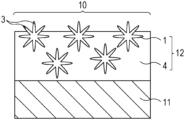
Claims (20)

The invention claimed is:
1. A member comprising a film on a substrate,
wherein the film comprises a resin layer and a modified cross-section fiber, the modified cross-section fiber including a core and a plurality of protrusions extending from the core, and
wherein the modified cross-section fiber is contained in an amount of from 33 to 67 parts by mass relative to 100 parts by mass of the film.
2. The member according to claim 1, wherein the modified cross-section fiber has a length of from 0.2 to 1.0 mm.
3. The member according to claim 1, wherein at least one protrusion of the plurality of protrusions has a length of from 2.5 to 20 μm.
4. The member according to claim 1, wherein a length of a cross-section in a direction perpendicular to a longitudinal direction of the modified cross-section fiber has a thickness of from 10 to 50 μm.
5. The member according to claim 4, wherein the modified cross-section fiber has an aspect ratio of from 4 to 100, the aspect ratio being a ratio of the length to the thickness.
6. The member according to claim 1, wherein a number of protrusions of the plurality of protrusions is from three to eight.
7. The member according to claim 1, wherein at least one protrusion of the plurality of protrusions have extremities protruding from a surface of the resin layer.
8. The member according to claim 1, wherein the resin layer has a thickness of from 10 to 500 μm.
9. The member according to claim 1, wherein the modified cross-section fiber is bound on the resin layer.
10. The member according to claim 1, wherein at least one protrusion of the plurality of protrusions has a thickness of from 2 to 6 μm.
11. The member according to claim 1, wherein the film is an antireflection film.
12. An optical device comprising a housing, an optical system including a plurality of lenses, and the member according to claim 11, in the housing,
wherein the substrate is a support supporting at least one of the lenses and/or an inner wall surface of the housing.
13. A coating material comprising: a modified cross-section fiber including a core and a plurality of protrusions extending from the core; a resin; and an organic solvent,
wherein the modified cross-section fiber is contained in an amount of from 33 to 67 parts by mass relative to 100 parts by mass of coating material solids.
14. The coating material according to claim 13, wherein at least one protrusion of the plurality of protrusions has a thickness of from 2 to 6 μm.
15. The coating material according to claim 13, wherein the modified cross-section fiber has a length of from 0.2 to 1.0 mm.
16. The coating material according to claim 13, wherein at least one protrusion of the plurality of protrusions has a length of from 2.5 to 20 μm.
17. The coating material according to claim 13, wherein a length of a cross-section in a direction perpendicular to a longitudinal direction of the modified cross-section fiber has a thickness of from 10 to 50 μm.
18. The coating material according to claim 13, wherein the modified cross-section fiber has an aspect ratio of from 4 to 100, the aspect ratio being a ratio of the length to the thickness.
19. The coating material according to claim 13, wherein a number of protrusions of the plurality of protrusions is from three to eight.
20. The coating material according to claim 13, wherein the coating material is an antireflection coating material.
US17/132,949 2018-06-28 2020-12-23 Antireflection coating material, optical member with antireflection coating, optical device, and image capturing apparatus Active 2042-05-21 US12320952B2 (en)

Priority Applications (1)

Application Number Priority Date Filing Date Title
US19/196,656 US20250258320A1 (en) 2018-06-28 2025-05-01 Antireflection coating material, optical member with antireflection coating, optical device, and image capturing apparatus

Applications Claiming Priority (5)

Application Number Priority Date Filing Date Title
JP2018123697 2018-06-28
JP2018-123697 2018-06-28
JP2019101749A JP2020008843A (en) 2018-06-28 2019-05-30 Anti-reflective coating material, optical member with anti-reflective film, optical device, and image capturing device
JP2019-101749 2019-05-30
PCT/JP2019/023727 WO2020004082A1 (en) 2018-06-28 2019-06-14 Anti-reflection coating material, optical member having anti-reflection film provided thereto, optical equipment, and imaging device

Related Parent Applications (1)

Application Number Title Priority Date Filing Date
PCT/JP2019/023727 Continuation WO2020004082A1 (en) 2018-06-28 2019-06-14 Anti-reflection coating material, optical member having anti-reflection film provided thereto, optical equipment, and imaging device

Related Child Applications (1)

Application Number Title Priority Date Filing Date
US19/196,656 Continuation US20250258320A1 (en) 2018-06-28 2025-05-01 Antireflection coating material, optical member with antireflection coating, optical device, and image capturing apparatus

Publications (2)

Publication Number Publication Date
US20210116606A1 US20210116606A1 (en) 2021-04-22
US12320952B2 true US12320952B2 (en) 2025-06-03

Family

ID=69151685

Family Applications (2)

Application Number Title Priority Date Filing Date
US17/132,949 Active 2042-05-21 US12320952B2 (en) 2018-06-28 2020-12-23 Antireflection coating material, optical member with antireflection coating, optical device, and image capturing apparatus
US19/196,656 Pending US20250258320A1 (en) 2018-06-28 2025-05-01 Antireflection coating material, optical member with antireflection coating, optical device, and image capturing apparatus

Family Applications After (1)

Application Number Title Priority Date Filing Date
US19/196,656 Pending US20250258320A1 (en) 2018-06-28 2025-05-01 Antireflection coating material, optical member with antireflection coating, optical device, and image capturing apparatus

Country Status (3)

Country Link
US (2) US12320952B2 (en)
JP (3) JP2020008843A (en)
WO (1) WO2020004082A1 (en)

Families Citing this family (2)

* Cited by examiner, † Cited by third party
Publication number Priority date Publication date Assignee Title
DE102023200588A1 (en) 2022-01-28 2023-08-03 Canon Kabushiki Kaisha OPTICAL ELEMENT, OPTICAL DEVICE, IMAGING DEVICE, AND DISPLAY DEVICE
WO2025004985A1 (en) * 2023-06-29 2025-01-02 キヤノン化成株式会社 Inner surface antireflection coating material, inner surface antireflection coating film, and optical element

Citations (23)

* Cited by examiner, † Cited by third party
Publication number Priority date Publication date Assignee Title
JP2003128997A (en) 2001-10-26 2003-05-08 Toyobo Co Ltd Coloring short fiber mixture, paint composition and painted article
JP2005025133A (en) 2003-07-03 2005-01-27 Seiren Co Ltd Diffusion reflection type screen and method of manufacturing it
JP2006039503A (en) 2004-01-14 2006-02-09 Sumitomo Bakelite Co Ltd Light diffusion sheet and backlight for liquid crystal display
JP2007062592A (en) 2005-08-31 2007-03-15 Denso Corp In-vehicle operation unit
JP2007133173A (en) 2005-11-10 2007-05-31 Nippon Shokubai Co Ltd Light diffusing sheet, complex light diffusing plate, and back light unit using those
JP2007298604A (en) 2006-04-28 2007-11-15 Toray Ind Inc Optical sheet support, back light for liquid crystal display using the same, liquid crystal display and rear-projection type display
JP2009217156A (en) 2008-03-12 2009-09-24 Nitto Denko Corp Light diffusion film and manufacturing method for it
JP2010260371A (en) 2009-04-30 2010-11-18 Murakami Corp Mounting structure of camera
JP2011064737A (en) 2009-09-15 2011-03-31 Nikon Corp Optical system component
JP2012002895A (en) 2010-06-15 2012-01-05 Nikon Corp Optical component and coating
WO2013002386A1 (en) 2011-06-30 2013-01-03 積水化成品工業株式会社 Irregularly shaped resin particles, method for producing same, and use thereof
US20130141792A1 (en) * 2011-02-28 2013-06-06 Tanazawa Hakkosha Co., Ltd. Molding die and method for manufacturing same, and method for providing consistent glossiness
US20130300980A1 (en) * 2010-09-17 2013-11-14 Nitto Denko Corporation Light-diffusing element, polarizer having light-diffusing element, and liquid crystal display device having same
WO2014119693A1 (en) 2013-01-31 2014-08-07 大日本印刷株式会社 Electron beam curable resin composition, reflector resin frame, reflector, semiconductor light-emitting device, and molded article production method
US20150226931A1 (en) * 2014-02-11 2015-08-13 Largan Precision Co., Ltd. Optical lens assembly having an optical refractive index matching layer
US20160334697A1 (en) 2014-01-15 2016-11-17 Lg Electronics Inc. Reflective screen, display having the same and method for manufacturing reflective screen
US20170219740A1 (en) * 2016-02-01 2017-08-03 Canon Kabushiki Kaisha Antireflection film, optical member, and method for manufacturing optical member
JP2018031945A (en) 2016-08-26 2018-03-01 三菱製紙株式会社 Optical sheet member and method for manufacturing optical sheet member
JP2018036310A (en) 2016-08-29 2018-03-08 三菱製紙株式会社 Member for optical sheet and method of manufacturing optical sheet
JP2018178271A (en) 2017-04-04 2018-11-15 旭化成株式会社 Artificial leather with local shine
US20190094420A1 (en) * 2017-09-25 2019-03-28 Samsung Display Co., Ltd. Cover window for display device and display device including the same
US20200298273A1 (en) * 2016-05-13 2020-09-24 Kabushiki Kaisha Reniasu Resin glass sheet and method for manufacturing same
US20210011198A1 (en) * 2017-10-25 2021-01-14 Maxell, Ltd. Lens unit

Family Cites Families (3)

* Cited by examiner, † Cited by third party
Publication number Priority date Publication date Assignee Title
JPS6099362A (en) * 1983-11-04 1985-06-03 Giichi Baba Manufacture of diffused reflection preventive material
JPH0737532A (en) * 1993-07-23 1995-02-07 Pioneer Electron Corp Unnecessary reflection preventing structure
JP4911767B2 (en) * 2006-07-31 2012-04-04 東洋鋼鈑株式会社 Hood cover for traffic light

Patent Citations (23)

* Cited by examiner, † Cited by third party
Publication number Priority date Publication date Assignee Title
JP2003128997A (en) 2001-10-26 2003-05-08 Toyobo Co Ltd Coloring short fiber mixture, paint composition and painted article
JP2005025133A (en) 2003-07-03 2005-01-27 Seiren Co Ltd Diffusion reflection type screen and method of manufacturing it
JP2006039503A (en) 2004-01-14 2006-02-09 Sumitomo Bakelite Co Ltd Light diffusion sheet and backlight for liquid crystal display
JP2007062592A (en) 2005-08-31 2007-03-15 Denso Corp In-vehicle operation unit
JP2007133173A (en) 2005-11-10 2007-05-31 Nippon Shokubai Co Ltd Light diffusing sheet, complex light diffusing plate, and back light unit using those
JP2007298604A (en) 2006-04-28 2007-11-15 Toray Ind Inc Optical sheet support, back light for liquid crystal display using the same, liquid crystal display and rear-projection type display
JP2009217156A (en) 2008-03-12 2009-09-24 Nitto Denko Corp Light diffusion film and manufacturing method for it
JP2010260371A (en) 2009-04-30 2010-11-18 Murakami Corp Mounting structure of camera
JP2011064737A (en) 2009-09-15 2011-03-31 Nikon Corp Optical system component
JP2012002895A (en) 2010-06-15 2012-01-05 Nikon Corp Optical component and coating
US20130300980A1 (en) * 2010-09-17 2013-11-14 Nitto Denko Corporation Light-diffusing element, polarizer having light-diffusing element, and liquid crystal display device having same
US20130141792A1 (en) * 2011-02-28 2013-06-06 Tanazawa Hakkosha Co., Ltd. Molding die and method for manufacturing same, and method for providing consistent glossiness
WO2013002386A1 (en) 2011-06-30 2013-01-03 積水化成品工業株式会社 Irregularly shaped resin particles, method for producing same, and use thereof
WO2014119693A1 (en) 2013-01-31 2014-08-07 大日本印刷株式会社 Electron beam curable resin composition, reflector resin frame, reflector, semiconductor light-emitting device, and molded article production method
US20160334697A1 (en) 2014-01-15 2016-11-17 Lg Electronics Inc. Reflective screen, display having the same and method for manufacturing reflective screen
US20150226931A1 (en) * 2014-02-11 2015-08-13 Largan Precision Co., Ltd. Optical lens assembly having an optical refractive index matching layer
US20170219740A1 (en) * 2016-02-01 2017-08-03 Canon Kabushiki Kaisha Antireflection film, optical member, and method for manufacturing optical member
US20200298273A1 (en) * 2016-05-13 2020-09-24 Kabushiki Kaisha Reniasu Resin glass sheet and method for manufacturing same
JP2018031945A (en) 2016-08-26 2018-03-01 三菱製紙株式会社 Optical sheet member and method for manufacturing optical sheet member
JP2018036310A (en) 2016-08-29 2018-03-08 三菱製紙株式会社 Member for optical sheet and method of manufacturing optical sheet
JP2018178271A (en) 2017-04-04 2018-11-15 旭化成株式会社 Artificial leather with local shine
US20190094420A1 (en) * 2017-09-25 2019-03-28 Samsung Display Co., Ltd. Cover window for display device and display device including the same
US20210011198A1 (en) * 2017-10-25 2021-01-14 Maxell, Ltd. Lens unit

Also Published As

Publication number Publication date
US20210116606A1 (en) 2021-04-22
JP2020008843A (en) 2020-01-16
US20250258320A1 (en) 2025-08-14
WO2020004082A1 (en) 2020-01-02
JP7673313B2 (en) 2025-05-08
JP2025100800A (en) 2025-07-03
JP2025003649A (en) 2025-01-09

Similar Documents

Publication Publication Date Title
US20250258320A1 (en) Antireflection coating material, optical member with antireflection coating, optical device, and image capturing apparatus
JP5655387B2 (en) Optical components
US7850319B2 (en) Light-absorbing member
JP6317954B2 (en) Lens unit, imaging module, and electronic device
US20170248739A1 (en) Optical filter and imaging apparatus
JP2018116285A (en) Optical filter
JP7680343B2 (en) Lens unit and camera module
US20240045103A1 (en) Article including film, optical apparatus, coating material, and method for producing article
JP6436681B2 (en) Light shielding paint, light shielding paint set, light shielding film, optical element, method for producing light shielding film, method for producing optical element, and optical apparatus
JP2011064737A (en) Optical system component
JP2023160441A (en) Article including porous layer containing inorganic particles, and coating liquid for forming porous layer containing inorganic particles
JP2024125316A (en) Article having film, coating material, and method for manufacturing article
JP3934199B2 (en) Camera with anti-reflection effect
JP2023110857A (en) Optical member, optical equipment, imaging device and display device
US20250102794A1 (en) Optical unit, optical apparatus, image pickup apparatus, light-shielding film, and light-shielding coating material
JP2023110859A (en) Optical member, optical equipment, imaging device and display device
US20230244078A1 (en) Optical member, optical device, imaging apparatus, and display apparatus
JP7746443B2 (en) Article with film, optical device, coating material, and method for manufacturing article
US20240288613A1 (en) Optical element, optical apparatus, and method for manufacturing optical element
US20250076540A1 (en) Laminated body, optical device, imaging apparatus, and display apparatus
JP3929547B2 (en) Camera with anti-reflection capability
US20240141176A1 (en) Light-shielding film and light-shielding paint
JP7576312B2 (en) Imaging lens
CN116520572A (en) Optical member, optical apparatus, imaging device, and display device
JP2019109502A (en) Optical element, manufacturing method of the same, imaging apparatus, and optical instrument

Legal Events

Date Code Title Description
FEPP Fee payment procedure

Free format text: ENTITY STATUS SET TO UNDISCOUNTED (ORIGINAL EVENT CODE: BIG.); ENTITY STATUS OF PATENT OWNER: LARGE ENTITY

STPP Information on status: patent application and granting procedure in general

Free format text: APPLICATION DISPATCHED FROM PREEXAM, NOT YET DOCKETED

AS Assignment

Owner name: CANON KABUSHIKI KAISHA, JAPAN

Free format text: ASSIGNMENT OF ASSIGNORS INTEREST;ASSIGNORS:TANAKA, HIROYUKI;NAKABAYASHI, MASAAKI;SIGNING DATES FROM 20201211 TO 20201216;REEL/FRAME:055239/0614

STPP Information on status: patent application and granting procedure in general

Free format text: DOCKETED NEW CASE - READY FOR EXAMINATION

STPP Information on status: patent application and granting procedure in general

Free format text: NON FINAL ACTION MAILED

STPP Information on status: patent application and granting procedure in general

Free format text: RESPONSE TO NON-FINAL OFFICE ACTION ENTERED AND FORWARDED TO EXAMINER

STPP Information on status: patent application and granting procedure in general

Free format text: FINAL REJECTION MAILED

STPP Information on status: patent application and granting procedure in general

Free format text: RESPONSE AFTER FINAL ACTION FORWARDED TO EXAMINER

STPP Information on status: patent application and granting procedure in general

Free format text: ADVISORY ACTION MAILED

STPP Information on status: patent application and granting procedure in general

Free format text: RESPONSE AFTER FINAL ACTION FORWARDED TO EXAMINER

STPP Information on status: patent application and granting procedure in general

Free format text: NON FINAL ACTION MAILED

STPP Information on status: patent application and granting procedure in general

Free format text: RESPONSE TO NON-FINAL OFFICE ACTION ENTERED AND FORWARDED TO EXAMINER

STPP Information on status: patent application and granting procedure in general

Free format text: NOTICE OF ALLOWANCE MAILED -- APPLICATION RECEIVED IN OFFICE OF PUBLICATIONS

STCF Information on status: patent grant

Free format text: PATENTED CASE