US12319640B2 - Cyclic diones as herbicidal compounds - Google Patents
Cyclic diones as herbicidal compounds Download PDFInfo
- Publication number
- US12319640B2 US12319640B2 US17/631,052 US202017631052A US12319640B2 US 12319640 B2 US12319640 B2 US 12319640B2 US 202017631052 A US202017631052 A US 202017631052A US 12319640 B2 US12319640 B2 US 12319640B2
- Authority
- US
- United States
- Prior art keywords
- alkyl
- group
- hydrogen
- phenyl
- haloalkyl
- Prior art date
- Legal status (The legal status is an assumption and is not a legal conclusion. Google has not performed a legal analysis and makes no representation as to the accuracy of the status listed.)
- Active, expires
Links
Classifications
-
- C—CHEMISTRY; METALLURGY
- C07—ORGANIC CHEMISTRY
- C07D—HETEROCYCLIC COMPOUNDS
- C07D305/00—Heterocyclic compounds containing four-membered rings having one oxygen atom as the only ring hetero atoms
- C07D305/02—Heterocyclic compounds containing four-membered rings having one oxygen atom as the only ring hetero atoms not condensed with other rings
- C07D305/04—Heterocyclic compounds containing four-membered rings having one oxygen atom as the only ring hetero atoms not condensed with other rings having no double bonds between ring members or between ring members and non-ring members
- C07D305/06—Heterocyclic compounds containing four-membered rings having one oxygen atom as the only ring hetero atoms not condensed with other rings having no double bonds between ring members or between ring members and non-ring members with only hydrogen atoms, hydrocarbon or substituted hydrocarbon radicals, directly attached to the ring atoms
-
- A—HUMAN NECESSITIES
- A01—AGRICULTURE; FORESTRY; ANIMAL HUSBANDRY; HUNTING; TRAPPING; FISHING
- A01N—PRESERVATION OF BODIES OF HUMANS OR ANIMALS OR PLANTS OR PARTS THEREOF; BIOCIDES, e.g. AS DISINFECTANTS, AS PESTICIDES OR AS HERBICIDES; PEST REPELLANTS OR ATTRACTANTS; PLANT GROWTH REGULATORS
- A01N37/00—Biocides, pest repellants or attractants, or plant growth regulators containing organic compounds containing a carbon atom having three bonds to hetero atoms with at the most two bonds to halogen, e.g. carboxylic acids
- A01N37/18—Biocides, pest repellants or attractants, or plant growth regulators containing organic compounds containing a carbon atom having three bonds to hetero atoms with at the most two bonds to halogen, e.g. carboxylic acids containing the group —CO—N<, e.g. carboxylic acid amides or imides; Thio analogues thereof
-
- A—HUMAN NECESSITIES
- A01—AGRICULTURE; FORESTRY; ANIMAL HUSBANDRY; HUNTING; TRAPPING; FISHING
- A01N—PRESERVATION OF BODIES OF HUMANS OR ANIMALS OR PLANTS OR PARTS THEREOF; BIOCIDES, e.g. AS DISINFECTANTS, AS PESTICIDES OR AS HERBICIDES; PEST REPELLANTS OR ATTRACTANTS; PLANT GROWTH REGULATORS
- A01N37/00—Biocides, pest repellants or attractants, or plant growth regulators containing organic compounds containing a carbon atom having three bonds to hetero atoms with at the most two bonds to halogen, e.g. carboxylic acids
- A01N37/36—Biocides, pest repellants or attractants, or plant growth regulators containing organic compounds containing a carbon atom having three bonds to hetero atoms with at the most two bonds to halogen, e.g. carboxylic acids containing at least one carboxylic group or a thio analogue, or a derivative thereof, and a singly bound oxygen or sulfur atom attached to the same carbon skeleton, this oxygen or sulfur atom not being a member of a carboxylic group or of a thio analogue, or of a derivative thereof, e.g. hydroxy-carboxylic acids
-
- A—HUMAN NECESSITIES
- A01—AGRICULTURE; FORESTRY; ANIMAL HUSBANDRY; HUNTING; TRAPPING; FISHING
- A01N—PRESERVATION OF BODIES OF HUMANS OR ANIMALS OR PLANTS OR PARTS THEREOF; BIOCIDES, e.g. AS DISINFECTANTS, AS PESTICIDES OR AS HERBICIDES; PEST REPELLANTS OR ATTRACTANTS; PLANT GROWTH REGULATORS
- A01N37/00—Biocides, pest repellants or attractants, or plant growth regulators containing organic compounds containing a carbon atom having three bonds to hetero atoms with at the most two bonds to halogen, e.g. carboxylic acids
- A01N37/42—Biocides, pest repellants or attractants, or plant growth regulators containing organic compounds containing a carbon atom having three bonds to hetero atoms with at the most two bonds to halogen, e.g. carboxylic acids containing within the same carbon skeleton a carboxylic group or a thio analogue, or a derivative thereof, and a carbon atom having only two bonds to hetero atoms with at the most one bond to halogen, e.g. keto-carboxylic acids
-
- A—HUMAN NECESSITIES
- A01—AGRICULTURE; FORESTRY; ANIMAL HUSBANDRY; HUNTING; TRAPPING; FISHING
- A01N—PRESERVATION OF BODIES OF HUMANS OR ANIMALS OR PLANTS OR PARTS THEREOF; BIOCIDES, e.g. AS DISINFECTANTS, AS PESTICIDES OR AS HERBICIDES; PEST REPELLANTS OR ATTRACTANTS; PLANT GROWTH REGULATORS
- A01N37/00—Biocides, pest repellants or attractants, or plant growth regulators containing organic compounds containing a carbon atom having three bonds to hetero atoms with at the most two bonds to halogen, e.g. carboxylic acids
- A01N37/44—Biocides, pest repellants or attractants, or plant growth regulators containing organic compounds containing a carbon atom having three bonds to hetero atoms with at the most two bonds to halogen, e.g. carboxylic acids containing at least one carboxylic group or a thio analogue, or a derivative thereof, and a nitrogen atom attached to the same carbon skeleton by a single or double bond, this nitrogen atom not being a member of a derivative or of a thio analogue of a carboxylic group, e.g. amino-carboxylic acids
-
- A—HUMAN NECESSITIES
- A01—AGRICULTURE; FORESTRY; ANIMAL HUSBANDRY; HUNTING; TRAPPING; FISHING
- A01N—PRESERVATION OF BODIES OF HUMANS OR ANIMALS OR PLANTS OR PARTS THEREOF; BIOCIDES, e.g. AS DISINFECTANTS, AS PESTICIDES OR AS HERBICIDES; PEST REPELLANTS OR ATTRACTANTS; PLANT GROWTH REGULATORS
- A01N41/00—Biocides, pest repellants or attractants, or plant growth regulators containing organic compounds containing a sulfur atom bound to a hetero atom
- A01N41/02—Biocides, pest repellants or attractants, or plant growth regulators containing organic compounds containing a sulfur atom bound to a hetero atom containing a sulfur-to-oxygen double bond
- A01N41/04—Sulfonic acids; Derivatives thereof
- A01N41/06—Sulfonic acid amides
-
- A—HUMAN NECESSITIES
- A01—AGRICULTURE; FORESTRY; ANIMAL HUSBANDRY; HUNTING; TRAPPING; FISHING
- A01N—PRESERVATION OF BODIES OF HUMANS OR ANIMALS OR PLANTS OR PARTS THEREOF; BIOCIDES, e.g. AS DISINFECTANTS, AS PESTICIDES OR AS HERBICIDES; PEST REPELLANTS OR ATTRACTANTS; PLANT GROWTH REGULATORS
- A01N43/00—Biocides, pest repellants or attractants, or plant growth regulators containing heterocyclic compounds
- A01N43/02—Biocides, pest repellants or attractants, or plant growth regulators containing heterocyclic compounds having rings with one or more oxygen or sulfur atoms as the only ring hetero atoms
- A01N43/04—Biocides, pest repellants or attractants, or plant growth regulators containing heterocyclic compounds having rings with one or more oxygen or sulfur atoms as the only ring hetero atoms with one hetero atom
- A01N43/20—Biocides, pest repellants or attractants, or plant growth regulators containing heterocyclic compounds having rings with one or more oxygen or sulfur atoms as the only ring hetero atoms with one hetero atom three- or four-membered rings
-
- A—HUMAN NECESSITIES
- A01—AGRICULTURE; FORESTRY; ANIMAL HUSBANDRY; HUNTING; TRAPPING; FISHING
- A01N—PRESERVATION OF BODIES OF HUMANS OR ANIMALS OR PLANTS OR PARTS THEREOF; BIOCIDES, e.g. AS DISINFECTANTS, AS PESTICIDES OR AS HERBICIDES; PEST REPELLANTS OR ATTRACTANTS; PLANT GROWTH REGULATORS
- A01N43/00—Biocides, pest repellants or attractants, or plant growth regulators containing heterocyclic compounds
- A01N43/34—Biocides, pest repellants or attractants, or plant growth regulators containing heterocyclic compounds having rings with one nitrogen atom as the only ring hetero atom
- A01N43/40—Biocides, pest repellants or attractants, or plant growth regulators containing heterocyclic compounds having rings with one nitrogen atom as the only ring hetero atom six-membered rings
-
- A—HUMAN NECESSITIES
- A01—AGRICULTURE; FORESTRY; ANIMAL HUSBANDRY; HUNTING; TRAPPING; FISHING
- A01N—PRESERVATION OF BODIES OF HUMANS OR ANIMALS OR PLANTS OR PARTS THEREOF; BIOCIDES, e.g. AS DISINFECTANTS, AS PESTICIDES OR AS HERBICIDES; PEST REPELLANTS OR ATTRACTANTS; PLANT GROWTH REGULATORS
- A01N43/00—Biocides, pest repellants or attractants, or plant growth regulators containing heterocyclic compounds
- A01N43/48—Biocides, pest repellants or attractants, or plant growth regulators containing heterocyclic compounds having rings with two nitrogen atoms as the only ring hetero atoms
- A01N43/54—1,3-Diazines; Hydrogenated 1,3-diazines
-
- A—HUMAN NECESSITIES
- A01—AGRICULTURE; FORESTRY; ANIMAL HUSBANDRY; HUNTING; TRAPPING; FISHING
- A01N—PRESERVATION OF BODIES OF HUMANS OR ANIMALS OR PLANTS OR PARTS THEREOF; BIOCIDES, e.g. AS DISINFECTANTS, AS PESTICIDES OR AS HERBICIDES; PEST REPELLANTS OR ATTRACTANTS; PLANT GROWTH REGULATORS
- A01N43/00—Biocides, pest repellants or attractants, or plant growth regulators containing heterocyclic compounds
- A01N43/48—Biocides, pest repellants or attractants, or plant growth regulators containing heterocyclic compounds having rings with two nitrogen atoms as the only ring hetero atoms
- A01N43/58—1,2-Diazines; Hydrogenated 1,2-diazines
-
- A—HUMAN NECESSITIES
- A01—AGRICULTURE; FORESTRY; ANIMAL HUSBANDRY; HUNTING; TRAPPING; FISHING
- A01N—PRESERVATION OF BODIES OF HUMANS OR ANIMALS OR PLANTS OR PARTS THEREOF; BIOCIDES, e.g. AS DISINFECTANTS, AS PESTICIDES OR AS HERBICIDES; PEST REPELLANTS OR ATTRACTANTS; PLANT GROWTH REGULATORS
- A01N43/00—Biocides, pest repellants or attractants, or plant growth regulators containing heterocyclic compounds
- A01N43/48—Biocides, pest repellants or attractants, or plant growth regulators containing heterocyclic compounds having rings with two nitrogen atoms as the only ring hetero atoms
- A01N43/60—1,4-Diazines; Hydrogenated 1,4-diazines
-
- A—HUMAN NECESSITIES
- A01—AGRICULTURE; FORESTRY; ANIMAL HUSBANDRY; HUNTING; TRAPPING; FISHING
- A01N—PRESERVATION OF BODIES OF HUMANS OR ANIMALS OR PLANTS OR PARTS THEREOF; BIOCIDES, e.g. AS DISINFECTANTS, AS PESTICIDES OR AS HERBICIDES; PEST REPELLANTS OR ATTRACTANTS; PLANT GROWTH REGULATORS
- A01N43/00—Biocides, pest repellants or attractants, or plant growth regulators containing heterocyclic compounds
- A01N43/72—Biocides, pest repellants or attractants, or plant growth regulators containing heterocyclic compounds having rings with nitrogen atoms and oxygen or sulfur atoms as ring hetero atoms
- A01N43/74—Biocides, pest repellants or attractants, or plant growth regulators containing heterocyclic compounds having rings with nitrogen atoms and oxygen or sulfur atoms as ring hetero atoms five-membered rings with one nitrogen atom and either one oxygen atom or one sulfur atom in positions 1,3
- A01N43/76—1,3-Oxazoles; Hydrogenated 1,3-oxazoles
-
- A—HUMAN NECESSITIES
- A01—AGRICULTURE; FORESTRY; ANIMAL HUSBANDRY; HUNTING; TRAPPING; FISHING
- A01N—PRESERVATION OF BODIES OF HUMANS OR ANIMALS OR PLANTS OR PARTS THEREOF; BIOCIDES, e.g. AS DISINFECTANTS, AS PESTICIDES OR AS HERBICIDES; PEST REPELLANTS OR ATTRACTANTS; PLANT GROWTH REGULATORS
- A01N43/00—Biocides, pest repellants or attractants, or plant growth regulators containing heterocyclic compounds
- A01N43/72—Biocides, pest repellants or attractants, or plant growth regulators containing heterocyclic compounds having rings with nitrogen atoms and oxygen or sulfur atoms as ring hetero atoms
- A01N43/84—Biocides, pest repellants or attractants, or plant growth regulators containing heterocyclic compounds having rings with nitrogen atoms and oxygen or sulfur atoms as ring hetero atoms six-membered rings with one nitrogen atom and either one oxygen atom or one sulfur atom in positions 1,4
-
- A—HUMAN NECESSITIES
- A01—AGRICULTURE; FORESTRY; ANIMAL HUSBANDRY; HUNTING; TRAPPING; FISHING
- A01N—PRESERVATION OF BODIES OF HUMANS OR ANIMALS OR PLANTS OR PARTS THEREOF; BIOCIDES, e.g. AS DISINFECTANTS, AS PESTICIDES OR AS HERBICIDES; PEST REPELLANTS OR ATTRACTANTS; PLANT GROWTH REGULATORS
- A01N47/00—Biocides, pest repellants or attractants, or plant growth regulators containing organic compounds containing a carbon atom not being member of a ring and having no bond to a carbon or hydrogen atom, e.g. derivatives of carbonic acid
- A01N47/02—Biocides, pest repellants or attractants, or plant growth regulators containing organic compounds containing a carbon atom not being member of a ring and having no bond to a carbon or hydrogen atom, e.g. derivatives of carbonic acid the carbon atom having no bond to a nitrogen atom
- A01N47/06—Biocides, pest repellants or attractants, or plant growth regulators containing organic compounds containing a carbon atom not being member of a ring and having no bond to a carbon or hydrogen atom, e.g. derivatives of carbonic acid the carbon atom having no bond to a nitrogen atom containing —O—CO—O— groups; Thio analogues thereof
-
- C—CHEMISTRY; METALLURGY
- C07—ORGANIC CHEMISTRY
- C07C—ACYCLIC OR CARBOCYCLIC COMPOUNDS
- C07C233/00—Carboxylic acid amides
- C07C233/01—Carboxylic acid amides having carbon atoms of carboxamide groups bound to hydrogen atoms or to acyclic carbon atoms
- C07C233/30—Carboxylic acid amides having carbon atoms of carboxamide groups bound to hydrogen atoms or to acyclic carbon atoms having the nitrogen atom of at least one of the carboxamide groups bound to a carbon atom of a hydrocarbon radical substituted by doubly-bound oxygen atoms
- C07C233/32—Carboxylic acid amides having carbon atoms of carboxamide groups bound to hydrogen atoms or to acyclic carbon atoms having the nitrogen atom of at least one of the carboxamide groups bound to a carbon atom of a hydrocarbon radical substituted by doubly-bound oxygen atoms with the substituted hydrocarbon radical bound to the nitrogen atom of the carboxamide group by a carbon atom of a ring other than a six-membered aromatic ring
-
- C—CHEMISTRY; METALLURGY
- C07—ORGANIC CHEMISTRY
- C07C—ACYCLIC OR CARBOCYCLIC COMPOUNDS
- C07C233/00—Carboxylic acid amides
- C07C233/01—Carboxylic acid amides having carbon atoms of carboxamide groups bound to hydrogen atoms or to acyclic carbon atoms
- C07C233/56—Carboxylic acid amides having carbon atoms of carboxamide groups bound to hydrogen atoms or to acyclic carbon atoms having carbon atoms of carboxamide groups bound to carbon atoms of carboxyl groups, e.g. oxamides
-
- C—CHEMISTRY; METALLURGY
- C07—ORGANIC CHEMISTRY
- C07C—ACYCLIC OR CARBOCYCLIC COMPOUNDS
- C07C233/00—Carboxylic acid amides
- C07C233/57—Carboxylic acid amides having carbon atoms of carboxamide groups bound to carbon atoms of rings other than six-membered aromatic rings
- C07C233/61—Carboxylic acid amides having carbon atoms of carboxamide groups bound to carbon atoms of rings other than six-membered aromatic rings having the nitrogen atom of at least one of the carboxamide groups bound to a carbon atom of a hydrocarbon radical substituted by doubly-bound oxygen atoms
-
- C—CHEMISTRY; METALLURGY
- C07—ORGANIC CHEMISTRY
- C07C—ACYCLIC OR CARBOCYCLIC COMPOUNDS
- C07C233/00—Carboxylic acid amides
- C07C233/64—Carboxylic acid amides having carbon atoms of carboxamide groups bound to carbon atoms of six-membered aromatic rings
- C07C233/76—Carboxylic acid amides having carbon atoms of carboxamide groups bound to carbon atoms of six-membered aromatic rings having the nitrogen atom of at least one of the carboxamide groups bound to a carbon atom of a hydrocarbon radical substituted by doubly-bound oxygen atoms
-
- C—CHEMISTRY; METALLURGY
- C07—ORGANIC CHEMISTRY
- C07C—ACYCLIC OR CARBOCYCLIC COMPOUNDS
- C07C235/00—Carboxylic acid amides, the carbon skeleton of the acid part being further substituted by oxygen atoms
- C07C235/02—Carboxylic acid amides, the carbon skeleton of the acid part being further substituted by oxygen atoms having carbon atoms of carboxamide groups bound to acyclic carbon atoms and singly-bound oxygen atoms bound to the same carbon skeleton
- C07C235/04—Carboxylic acid amides, the carbon skeleton of the acid part being further substituted by oxygen atoms having carbon atoms of carboxamide groups bound to acyclic carbon atoms and singly-bound oxygen atoms bound to the same carbon skeleton the carbon skeleton being acyclic and saturated
- C07C235/14—Carboxylic acid amides, the carbon skeleton of the acid part being further substituted by oxygen atoms having carbon atoms of carboxamide groups bound to acyclic carbon atoms and singly-bound oxygen atoms bound to the same carbon skeleton the carbon skeleton being acyclic and saturated having the nitrogen atom of at least one of the carboxamide groups bound to a carbon atom of a ring other than a six-membered aromatic ring
-
- C—CHEMISTRY; METALLURGY
- C07—ORGANIC CHEMISTRY
- C07C—ACYCLIC OR CARBOCYCLIC COMPOUNDS
- C07C237/00—Carboxylic acid amides, the carbon skeleton of the acid part being further substituted by amino groups
- C07C237/24—Carboxylic acid amides, the carbon skeleton of the acid part being further substituted by amino groups having the carbon atom of at least one of the carboxamide groups bound to a carbon atom of a ring other than a six-membered aromatic ring of the carbon skeleton
-
- C—CHEMISTRY; METALLURGY
- C07—ORGANIC CHEMISTRY
- C07C—ACYCLIC OR CARBOCYCLIC COMPOUNDS
- C07C255/00—Carboxylic acid nitriles
- C07C255/01—Carboxylic acid nitriles having cyano groups bound to acyclic carbon atoms
- C07C255/19—Carboxylic acid nitriles having cyano groups bound to acyclic carbon atoms containing cyano groups and carboxyl groups, other than cyano groups, bound to the same saturated acyclic carbon skeleton
-
- C—CHEMISTRY; METALLURGY
- C07—ORGANIC CHEMISTRY
- C07C—ACYCLIC OR CARBOCYCLIC COMPOUNDS
- C07C255/00—Carboxylic acid nitriles
- C07C255/01—Carboxylic acid nitriles having cyano groups bound to acyclic carbon atoms
- C07C255/24—Carboxylic acid nitriles having cyano groups bound to acyclic carbon atoms containing cyano groups and singly-bound nitrogen atoms, not being further bound to other hetero atoms, bound to the same saturated acyclic carbon skeleton
- C07C255/29—Carboxylic acid nitriles having cyano groups bound to acyclic carbon atoms containing cyano groups and singly-bound nitrogen atoms, not being further bound to other hetero atoms, bound to the same saturated acyclic carbon skeleton containing cyano groups and acylated amino groups bound to the carbon skeleton
-
- C—CHEMISTRY; METALLURGY
- C07—ORGANIC CHEMISTRY
- C07C—ACYCLIC OR CARBOCYCLIC COMPOUNDS
- C07C259/00—Compounds containing carboxyl groups, an oxygen atom of a carboxyl group being replaced by a nitrogen atom, this nitrogen atom being further bound to an oxygen atom and not being part of nitro or nitroso groups
- C07C259/04—Compounds containing carboxyl groups, an oxygen atom of a carboxyl group being replaced by a nitrogen atom, this nitrogen atom being further bound to an oxygen atom and not being part of nitro or nitroso groups without replacement of the other oxygen atom of the carboxyl group, e.g. hydroxamic acids
- C07C259/08—Compounds containing carboxyl groups, an oxygen atom of a carboxyl group being replaced by a nitrogen atom, this nitrogen atom being further bound to an oxygen atom and not being part of nitro or nitroso groups without replacement of the other oxygen atom of the carboxyl group, e.g. hydroxamic acids having carbon atoms of hydroxamic groups bound to carbon atoms of rings other than six-membered aromatic rings
-
- C—CHEMISTRY; METALLURGY
- C07—ORGANIC CHEMISTRY
- C07C—ACYCLIC OR CARBOCYCLIC COMPOUNDS
- C07C275/00—Derivatives of urea, i.e. compounds containing any of the groups, the nitrogen atoms not being part of nitro or nitroso groups
- C07C275/26—Derivatives of urea, i.e. compounds containing any of the groups, the nitrogen atoms not being part of nitro or nitroso groups having nitrogen atoms of urea groups bound to carbon atoms of rings other than six-membered aromatic rings
-
- C—CHEMISTRY; METALLURGY
- C07—ORGANIC CHEMISTRY
- C07C—ACYCLIC OR CARBOCYCLIC COMPOUNDS
- C07C275/00—Derivatives of urea, i.e. compounds containing any of the groups, the nitrogen atoms not being part of nitro or nitroso groups
- C07C275/46—Derivatives of urea, i.e. compounds containing any of the groups, the nitrogen atoms not being part of nitro or nitroso groups containing any of the groups, X being a hetero atom, Y being any atom, e.g. acylureas
- C07C275/48—Y being a hydrogen or a carbon atom
- C07C275/50—Y being a hydrogen or an acyclic carbon atom
-
- C—CHEMISTRY; METALLURGY
- C07—ORGANIC CHEMISTRY
- C07C—ACYCLIC OR CARBOCYCLIC COMPOUNDS
- C07C311/00—Amides of sulfonic acids, i.e. compounds having singly-bound oxygen atoms of sulfo groups replaced by nitrogen atoms, not being part of nitro or nitroso groups
- C07C311/01—Sulfonamides having sulfur atoms of sulfonamide groups bound to acyclic carbon atoms
- C07C311/02—Sulfonamides having sulfur atoms of sulfonamide groups bound to acyclic carbon atoms of an acyclic saturated carbon skeleton
- C07C311/07—Sulfonamides having sulfur atoms of sulfonamide groups bound to acyclic carbon atoms of an acyclic saturated carbon skeleton having the nitrogen atom of at least one of the sulfonamide groups bound to a carbon atom of a ring other than a six-membered aromatic ring
-
- C—CHEMISTRY; METALLURGY
- C07—ORGANIC CHEMISTRY
- C07C—ACYCLIC OR CARBOCYCLIC COMPOUNDS
- C07C311/00—Amides of sulfonic acids, i.e. compounds having singly-bound oxygen atoms of sulfo groups replaced by nitrogen atoms, not being part of nitro or nitroso groups
- C07C311/14—Sulfonamides having sulfur atoms of sulfonamide groups bound to carbon atoms of rings other than six-membered aromatic rings
-
- C—CHEMISTRY; METALLURGY
- C07—ORGANIC CHEMISTRY
- C07D—HETEROCYCLIC COMPOUNDS
- C07D213/00—Heterocyclic compounds containing six-membered rings, not condensed with other rings, with one nitrogen atom as the only ring hetero atom and three or more double bonds between ring members or between ring members and non-ring members
- C07D213/02—Heterocyclic compounds containing six-membered rings, not condensed with other rings, with one nitrogen atom as the only ring hetero atom and three or more double bonds between ring members or between ring members and non-ring members having three double bonds between ring members or between ring members and non-ring members
- C07D213/04—Heterocyclic compounds containing six-membered rings, not condensed with other rings, with one nitrogen atom as the only ring hetero atom and three or more double bonds between ring members or between ring members and non-ring members having three double bonds between ring members or between ring members and non-ring members having no bond between the ring nitrogen atom and a non-ring member or having only hydrogen or carbon atoms directly attached to the ring nitrogen atom
- C07D213/60—Heterocyclic compounds containing six-membered rings, not condensed with other rings, with one nitrogen atom as the only ring hetero atom and three or more double bonds between ring members or between ring members and non-ring members having three double bonds between ring members or between ring members and non-ring members having no bond between the ring nitrogen atom and a non-ring member or having only hydrogen or carbon atoms directly attached to the ring nitrogen atom with hetero atoms or with carbon atoms having three bonds to hetero atoms with at the most one bond to halogen, e.g. ester or nitrile radicals, directly attached to ring carbon atoms
- C07D213/61—Halogen atoms or nitro radicals
-
- C—CHEMISTRY; METALLURGY
- C07—ORGANIC CHEMISTRY
- C07D—HETEROCYCLIC COMPOUNDS
- C07D213/00—Heterocyclic compounds containing six-membered rings, not condensed with other rings, with one nitrogen atom as the only ring hetero atom and three or more double bonds between ring members or between ring members and non-ring members
- C07D213/02—Heterocyclic compounds containing six-membered rings, not condensed with other rings, with one nitrogen atom as the only ring hetero atom and three or more double bonds between ring members or between ring members and non-ring members having three double bonds between ring members or between ring members and non-ring members
- C07D213/04—Heterocyclic compounds containing six-membered rings, not condensed with other rings, with one nitrogen atom as the only ring hetero atom and three or more double bonds between ring members or between ring members and non-ring members having three double bonds between ring members or between ring members and non-ring members having no bond between the ring nitrogen atom and a non-ring member or having only hydrogen or carbon atoms directly attached to the ring nitrogen atom
- C07D213/60—Heterocyclic compounds containing six-membered rings, not condensed with other rings, with one nitrogen atom as the only ring hetero atom and three or more double bonds between ring members or between ring members and non-ring members having three double bonds between ring members or between ring members and non-ring members having no bond between the ring nitrogen atom and a non-ring member or having only hydrogen or carbon atoms directly attached to the ring nitrogen atom with hetero atoms or with carbon atoms having three bonds to hetero atoms with at the most one bond to halogen, e.g. ester or nitrile radicals, directly attached to ring carbon atoms
- C07D213/72—Nitrogen atoms
- C07D213/75—Amino or imino radicals, acylated by carboxylic or carbonic acids, or by sulfur or nitrogen analogues thereof, e.g. carbamates
-
- C—CHEMISTRY; METALLURGY
- C07—ORGANIC CHEMISTRY
- C07D—HETEROCYCLIC COMPOUNDS
- C07D213/00—Heterocyclic compounds containing six-membered rings, not condensed with other rings, with one nitrogen atom as the only ring hetero atom and three or more double bonds between ring members or between ring members and non-ring members
- C07D213/02—Heterocyclic compounds containing six-membered rings, not condensed with other rings, with one nitrogen atom as the only ring hetero atom and three or more double bonds between ring members or between ring members and non-ring members having three double bonds between ring members or between ring members and non-ring members
- C07D213/04—Heterocyclic compounds containing six-membered rings, not condensed with other rings, with one nitrogen atom as the only ring hetero atom and three or more double bonds between ring members or between ring members and non-ring members having three double bonds between ring members or between ring members and non-ring members having no bond between the ring nitrogen atom and a non-ring member or having only hydrogen or carbon atoms directly attached to the ring nitrogen atom
- C07D213/60—Heterocyclic compounds containing six-membered rings, not condensed with other rings, with one nitrogen atom as the only ring hetero atom and three or more double bonds between ring members or between ring members and non-ring members having three double bonds between ring members or between ring members and non-ring members having no bond between the ring nitrogen atom and a non-ring member or having only hydrogen or carbon atoms directly attached to the ring nitrogen atom with hetero atoms or with carbon atoms having three bonds to hetero atoms with at the most one bond to halogen, e.g. ester or nitrile radicals, directly attached to ring carbon atoms
- C07D213/78—Carbon atoms having three bonds to hetero atoms, with at the most one bond to halogen, e.g. ester or nitrile radicals
- C07D213/81—Amides; Imides
-
- C—CHEMISTRY; METALLURGY
- C07—ORGANIC CHEMISTRY
- C07D—HETEROCYCLIC COMPOUNDS
- C07D213/00—Heterocyclic compounds containing six-membered rings, not condensed with other rings, with one nitrogen atom as the only ring hetero atom and three or more double bonds between ring members or between ring members and non-ring members
- C07D213/02—Heterocyclic compounds containing six-membered rings, not condensed with other rings, with one nitrogen atom as the only ring hetero atom and three or more double bonds between ring members or between ring members and non-ring members having three double bonds between ring members or between ring members and non-ring members
- C07D213/04—Heterocyclic compounds containing six-membered rings, not condensed with other rings, with one nitrogen atom as the only ring hetero atom and three or more double bonds between ring members or between ring members and non-ring members having three double bonds between ring members or between ring members and non-ring members having no bond between the ring nitrogen atom and a non-ring member or having only hydrogen or carbon atoms directly attached to the ring nitrogen atom
- C07D213/60—Heterocyclic compounds containing six-membered rings, not condensed with other rings, with one nitrogen atom as the only ring hetero atom and three or more double bonds between ring members or between ring members and non-ring members having three double bonds between ring members or between ring members and non-ring members having no bond between the ring nitrogen atom and a non-ring member or having only hydrogen or carbon atoms directly attached to the ring nitrogen atom with hetero atoms or with carbon atoms having three bonds to hetero atoms with at the most one bond to halogen, e.g. ester or nitrile radicals, directly attached to ring carbon atoms
- C07D213/78—Carbon atoms having three bonds to hetero atoms, with at the most one bond to halogen, e.g. ester or nitrile radicals
- C07D213/84—Nitriles
- C07D213/85—Nitriles in position 3
-
- C—CHEMISTRY; METALLURGY
- C07—ORGANIC CHEMISTRY
- C07D—HETEROCYCLIC COMPOUNDS
- C07D237/00—Heterocyclic compounds containing 1,2-diazine or hydrogenated 1,2-diazine rings
- C07D237/02—Heterocyclic compounds containing 1,2-diazine or hydrogenated 1,2-diazine rings not condensed with other rings
- C07D237/06—Heterocyclic compounds containing 1,2-diazine or hydrogenated 1,2-diazine rings not condensed with other rings having three double bonds between ring members or between ring members and non-ring members
- C07D237/10—Heterocyclic compounds containing 1,2-diazine or hydrogenated 1,2-diazine rings not condensed with other rings having three double bonds between ring members or between ring members and non-ring members with hetero atoms or with carbon atoms having three bonds to hetero atoms with at the most one bond to halogen, e.g. ester or nitrile radicals, directly attached to ring carbon atoms
- C07D237/24—Carbon atoms having three bonds to hetero atoms with at the most one bond to halogen
-
- C—CHEMISTRY; METALLURGY
- C07—ORGANIC CHEMISTRY
- C07D—HETEROCYCLIC COMPOUNDS
- C07D239/00—Heterocyclic compounds containing 1,3-diazine or hydrogenated 1,3-diazine rings
- C07D239/02—Heterocyclic compounds containing 1,3-diazine or hydrogenated 1,3-diazine rings not condensed with other rings
- C07D239/24—Heterocyclic compounds containing 1,3-diazine or hydrogenated 1,3-diazine rings not condensed with other rings having three or more double bonds between ring members or between ring members and non-ring members
- C07D239/28—Heterocyclic compounds containing 1,3-diazine or hydrogenated 1,3-diazine rings not condensed with other rings having three or more double bonds between ring members or between ring members and non-ring members with hetero atoms or with carbon atoms having three bonds to hetero atoms with at the most one bond to halogen, directly attached to ring carbon atoms
- C07D239/30—Halogen atoms or nitro radicals
-
- C—CHEMISTRY; METALLURGY
- C07—ORGANIC CHEMISTRY
- C07D—HETEROCYCLIC COMPOUNDS
- C07D241/00—Heterocyclic compounds containing 1,4-diazine or hydrogenated 1,4-diazine rings
- C07D241/02—Heterocyclic compounds containing 1,4-diazine or hydrogenated 1,4-diazine rings not condensed with other rings
- C07D241/10—Heterocyclic compounds containing 1,4-diazine or hydrogenated 1,4-diazine rings not condensed with other rings having three double bonds between ring members or between ring members and non-ring members
- C07D241/14—Heterocyclic compounds containing 1,4-diazine or hydrogenated 1,4-diazine rings not condensed with other rings having three double bonds between ring members or between ring members and non-ring members with hetero atoms or with carbon atoms having three bonds to hetero atoms with at the most one bond to halogen, e.g. ester or nitrile radicals, directly attached to ring carbon atoms
- C07D241/24—Carbon atoms having three bonds to hetero atoms with at the most one bond to halogen, e.g. ester or nitrile radicals
-
- C—CHEMISTRY; METALLURGY
- C07—ORGANIC CHEMISTRY
- C07D—HETEROCYCLIC COMPOUNDS
- C07D263/00—Heterocyclic compounds containing 1,3-oxazole or hydrogenated 1,3-oxazole rings
- C07D263/02—Heterocyclic compounds containing 1,3-oxazole or hydrogenated 1,3-oxazole rings not condensed with other rings
- C07D263/30—Heterocyclic compounds containing 1,3-oxazole or hydrogenated 1,3-oxazole rings not condensed with other rings having two or three double bonds between ring members or between ring members and non-ring members
- C07D263/34—Heterocyclic compounds containing 1,3-oxazole or hydrogenated 1,3-oxazole rings not condensed with other rings having two or three double bonds between ring members or between ring members and non-ring members with hetero atoms or with carbon atoms having three bonds to hetero atoms with at the most one bond to halogen, e.g. ester or nitrile radicals, directly attached to ring carbon atoms
-
- C—CHEMISTRY; METALLURGY
- C07—ORGANIC CHEMISTRY
- C07D—HETEROCYCLIC COMPOUNDS
- C07D265/00—Heterocyclic compounds containing six-membered rings having one nitrogen atom and one oxygen atom as the only ring hetero atoms
- C07D265/28—1,4-Oxazines; Hydrogenated 1,4-oxazines
- C07D265/30—1,4-Oxazines; Hydrogenated 1,4-oxazines not condensed with other rings
-
- C—CHEMISTRY; METALLURGY
- C07—ORGANIC CHEMISTRY
- C07D—HETEROCYCLIC COMPOUNDS
- C07D279/00—Heterocyclic compounds containing six-membered rings having one nitrogen atom and one sulfur atom as the only ring hetero atoms
- C07D279/10—1,4-Thiazines; Hydrogenated 1,4-thiazines
- C07D279/12—1,4-Thiazines; Hydrogenated 1,4-thiazines not condensed with other rings
-
- C—CHEMISTRY; METALLURGY
- C07—ORGANIC CHEMISTRY
- C07D—HETEROCYCLIC COMPOUNDS
- C07D295/00—Heterocyclic compounds containing polymethylene-imine rings with at least five ring members, 3-azabicyclo [3.2.2] nonane, piperazine, morpholine or thiomorpholine rings, having only hydrogen atoms directly attached to the ring carbon atoms
- C07D295/16—Heterocyclic compounds containing polymethylene-imine rings with at least five ring members, 3-azabicyclo [3.2.2] nonane, piperazine, morpholine or thiomorpholine rings, having only hydrogen atoms directly attached to the ring carbon atoms acylated on ring nitrogen atoms
- C07D295/18—Heterocyclic compounds containing polymethylene-imine rings with at least five ring members, 3-azabicyclo [3.2.2] nonane, piperazine, morpholine or thiomorpholine rings, having only hydrogen atoms directly attached to the ring carbon atoms acylated on ring nitrogen atoms by radicals derived from carboxylic acids, or sulfur or nitrogen analogues thereof
- C07D295/182—Radicals derived from carboxylic acids
- C07D295/185—Radicals derived from carboxylic acids from aliphatic carboxylic acids
-
- C—CHEMISTRY; METALLURGY
- C07—ORGANIC CHEMISTRY
- C07D—HETEROCYCLIC COMPOUNDS
- C07D305/00—Heterocyclic compounds containing four-membered rings having one oxygen atom as the only ring hetero atoms
- C07D305/02—Heterocyclic compounds containing four-membered rings having one oxygen atom as the only ring hetero atoms not condensed with other rings
- C07D305/04—Heterocyclic compounds containing four-membered rings having one oxygen atom as the only ring hetero atoms not condensed with other rings having no double bonds between ring members or between ring members and non-ring members
- C07D305/08—Heterocyclic compounds containing four-membered rings having one oxygen atom as the only ring hetero atoms not condensed with other rings having no double bonds between ring members or between ring members and non-ring members with hetero atoms or with carbon atoms having three bonds to hetero atoms with at the most one bond to halogen, e.g. ester or nitrile radicals, directly attached to ring atoms
-
- C—CHEMISTRY; METALLURGY
- C07—ORGANIC CHEMISTRY
- C07D—HETEROCYCLIC COMPOUNDS
- C07D319/00—Heterocyclic compounds containing six-membered rings having two oxygen atoms as the only ring hetero atoms
- C07D319/10—1,4-Dioxanes; Hydrogenated 1,4-dioxanes
- C07D319/12—1,4-Dioxanes; Hydrogenated 1,4-dioxanes not condensed with other rings
-
- C—CHEMISTRY; METALLURGY
- C07—ORGANIC CHEMISTRY
- C07C—ACYCLIC OR CARBOCYCLIC COMPOUNDS
- C07C2601/00—Systems containing only non-condensed rings
- C07C2601/02—Systems containing only non-condensed rings with a three-membered ring
-
- C—CHEMISTRY; METALLURGY
- C07—ORGANIC CHEMISTRY
- C07C—ACYCLIC OR CARBOCYCLIC COMPOUNDS
- C07C2602/00—Systems containing two condensed rings
- C07C2602/50—Spiro compounds
Definitions
- the present invention relates to novel herbicidal cyclohexanedione compounds, to processes for their preparation, to herbicidal compositions which comprise the novel compounds, and to their use for controlling weeds.
- Herbicidal cyclic dione compounds substituted by a phenyl which has various substituents are disclosed in, for example, WO2008/110308, WO2014/191534 and WO2015/197468.
- the present invention relates to novel herbicidal cyclohexanedione derivatives with improved properties.
- Alkyl groups include, for example, methyl (Me, CH 3 ), ethyl (Et, C 2 H 5 ), n-propyl (n-Pr), isopropyl (i-Pr), n-butyl (n-Bu), isobutyl (i-Bu), sec-butyl (s-Bu) and tert-butyl (t-Bu).
- Alkenyl and alkynyl moieties can be in the form of straight or branched chains, and the alkenyl moieties, where appropriate, can be of either the (E)- or (Z)-configuration. Examples are vinyl, allyl and propargyl. Alkenyl and alkynyl moieties can contain one or more double and/or triple bonds in any combination.
- Halogen encompasses fluorine, chlorine, bromine or iodine. The same correspondingly applies to halogen in the context of other definitions, such as haloalkyl.
- Haloalkyl groups are, for example, fluoromethyl, difluoromethyl, trifluoromethyl, chloromethyl, dichloromethyl, trichloromethyl, 2,2,2-trifluoroethyl, 2-fluoroethyl, 2-chloroethyl, pentafluoroethyl, 1,1-difluoro-2,2,2-trichloroethyl, 2,2,3,3-tetrafluoroethyl and 2,2,2-trichloroethyl, heptafluoro-n-propyl and perfluoro-n-hexyl.
- Alkoxy groups are, for example, methoxy, ethoxy, propoxy, isopropoxy, n-butoxy, isobutoxy, sec-butoxy or tert-butoxy, preferably methoxy and ethoxy.
- Alkoxyalkyl groups (e.g. C 1 -C 5 alkoxy-C 1 -C 3 alkyl-) includes, for example, methoxymethyl, methoxyethyl, ethoxymethyl, ethoxyethyl, n-propoxymethyl, n-propoxyethyl, isopropoxymethyl or isopropoxyethyl.
- Cycloalkyl groups include, for example cyclopropyl (c-propyl, c-Pr), cyclobutyl (c-butyl, c-Bu), cyclopentyl (c-pentyl) and cyclohexyl (c-hexyl) and may be substituted or unsubstituted as indicated.
- C 1 -C 6 alkyl-S— (alkylthio) is, for example, methylthio, ethylthio, propylthio, isopropylthio, n-butylthio, isobutylthio, sec-butylthio or tert-butylthio, preferably methylthio or ethylthio.
- alkylsulfinyl is, for example, methylsulfinyl, ethylsulfinyl, propylsulfinyl, isopropylsulfinyl, n-butylsulfinyl, isobutylsulfinyl, sec-butylsulfinyl or tert-butylsulfinyl, preferably methylsulfinyl or ethylsulfinyl.
- alkylsulfonyl is, for example, methylsulfonyl, ethylsulfonyl, propylsulfonyl, isopropylsulfonyl, n-butylsulfonyl, isobutylsulfonyl, sec-butylsulfonyl or tert-butylsulfonyl, preferably methylsulfonyl or ethylsulfonyl.
- Heterocyclyl is a 5- or 6-membered heterocyclyl which may be aromatic, saturated or partially saturated and can contain from 1 to 4 heteroatoms each independently selected from the group consisting of oxygen, nitrogen and sulphur.
- the invention also relates agriculturally acceptable salts of the compounds of Formula (I).
- Such salts include those which are able to form with amines, alkali metal and alkaline earth metal bases or quaternary ammonium bases.
- alkali metal and alkaline earth metal hydroxides as salt formers special mention should be made of the hydroxides of lithium, sodium, potassium, magnesium and calcium, but especially the hydroxides of sodium and potassium.
- the compounds of Formula (I) according to the invention also include hydrates which may be formed during the salt formation.
- amines suitable for ammonium salt formation include ammonia as well as primary, secondary and tertiary C 1 -C 18 alkylamines, C 1 -C 4 hydroxyalkylamines and C 2 -C 4 alkoxyalkylamines, for example methylamine, ethylamine, n-propylamine, isopropylamine, the four butylamine isomers, n-amylamine, isoamylamine, hexylamine, heptylamine, octylamine, nonylamine, decylamine, pentadecylamine, hexadecylamine, heptadecylamine, octadecylamine, methylethylamine, methylisopropylamine, methylhexylamine, methylnonylamine, methylpentadecylamine, methyloctadecylamine, ethyl
- m is 1 and r is 0. In another embodiment of the present invention m is 0 and r is 0. In a preferred embodiment of the present invention m is 1 and r is 1.
- R 4y is R 4a .
- R 4aa is preferably hydrogen or methyl and R 4ab is preferably selected from the group consisting of C 1 -C 6 alkyl (e.g. methyl, t-butyl), pyridyl, —C(O)CH 2 X 1 CH 2 CH 2 — (wherein X 1 is O), —CH 2 CH 2 X 1 CH 2 CH 2 — (wherein X 1 is O, N—R 28 wherein R 28 is —C(O)C 1 -C 3 alkyl (preferably methyl), or S(O) n wherein n is 2), hydroxyC 1 -C 6 alkyl- (e.g.
- C 1 -C 6 alkoxy e.g. MeO
- —C 1 -C 4 alkoxyC 1 -C 6 alkyl e.g. CH 3 OCH 2 CH 2 —
- cyanoC 1 -C 6 alkyl- e.g. —C(CH 3 )(C 2 H 5 )(CN).
- R 4y is R 4b .
- R 4ba is preferably hydrogen or methyl and R 4bb is selected from the group consisting of —C(O)C 1 -C 4 alkyl (e.g. —C(O)CH 3 , —C(O)t-butyl), —C(O)—(CH 2 ) n —C 3 -C 6 cycloalkyl (e.g. —C(O)-cyclopropyl), —C(O)-heterocyclyl (e.g.
- pyridyl —C(O)—(CH 2 ) n -phenyl, —C(O)(CH 2 ) n NR 5 R 6 , —C(O)C 1 -C 3 alkoxyC 1 -C 6 haloalkyl (e.g. CHF 2 —O—CH 2 —), —C(O)(CR 9 R 10 )CN (e.g. —C(O)CH 2 CN), —C(O)(CR 9 R 10 )(CR 9 R 10 )CN (e.g. —C(O)CH 2 CH 2 CN), —C(O)C 1 -C 4 haloalkyl (e.g.
- —C(O)CHF 2 hydroxyC 1 -C 6 alkyl-C(O)— (e.g. HOCH(CH 3 )C(O)—), —C(O)CH 2 OC(O)—C 1 -C 6 alkyl (e.g. CH 3 OCH 2 C(O)—) and —C(O)—(CH 2 ) n —NR 7 C(O)R 8 .
- each aforementioned heterocyclyl is an aromatic heterocyclyl (i.e. heteroaryl), more preferably selected from the group consisting of furanyl, pyrrolyl, thiophenyl, imidazolyl, pyrazolyl, oxazolyl, isoxazolyl, thiazolyl, pyranyl, pyridyl, pyrazinyl, pyrimidinyl, pyridazinyl, and triazolyl more preferably selected from the group consisting of pyridyl, pyridazinyl, pyrimidinyl and pyrazinyl each of which is optionally substituted as defined previously.
- aromatic heterocyclyl i.e. heteroaryl
- each aforementioned heterocyclyl is a partially saturated heterocyclyl, more preferably selected from the group consisting of imidazolinyl, isoxazolinyl and thiazolinyl each of which is optionally substituted as defined previously.
- each aforementioned heterocyclyl is a saturated heterocyclyl more preferably selected from the group consisting of morpholinyl, tetrahydrofuryl and tetrahydropyranyl each of which is optionally substituted as defined previously.
- R 5 is hydrogen or methyl, preferably hydrogen.
- R 6 is C 1 -C 6 alkyl (e.g. methyl) or pyridyl.
- R 7 is hydrogen or methyl, preferably hydrogen.
- R 8 is C 1 -C 6 alkyl (e.g. t-butyl) or pyridyl.
- R 9 is hydrogen
- R 19 is hydrogen
- G is selected from the group consisting of hydrogen, C 1 -C 8 alkyl (e.g. methyl, ethyl, n-propyl, i-propyl, n-butyl, t-butyl, —C 2 -C 8 alkenyl (e.g. vinyl), C 2 -C 8 alkynyl (e.g. propargyl), —C(O)C 1 -C 8 alkyl (more preferably —C(O)C 1 -C 6 alkyl e.g.
- C 1 -C 8 alkyl e.g. methyl, ethyl, n-propyl, i-propyl, n-butyl, t-butyl, —C 2 -C 8 alkenyl (e.g. vinyl), C 2 -C 8 alkynyl (e.g. propargyl), —C(O)C 1 -C 8 alkyl (more preferably
- G is hydrogen.
- compounds of Formula (I) may exist in different isomeric forms.
- G is hydrogen, for example, compounds of Formula (I) may exist in different tautomeric forms.
- This invention covers all such isomers and tautomers and mixtures thereof in all proportions. Also, when substituents contain double bonds, cis- and trans-isomers can exist. These isomers, too, are within the scope of the claimed compounds of the Formula (I).
- Compounds of Formula (I) may contain asymmetric centres and may be present as a single enantiomer, pairs of enantiomers in any proportion or, where more than one asymmetric centre are present, contain diastereoisomers in all possible ratios. Typically one of the enantiomers has enhanced biological activity compared to the other possibilities.
- the compounds of Formula (I) according to the invention can be used as herbicides by themselves, but they are generally formulated into herbicidal compositions using formulation adjuvants, such as carriers, solvents and surface-active agents (SFAs).
- formulation adjuvants such as carriers, solvents and surface-active agents (SFAs).
- the present invention further provides a herbicidal composition comprising a herbicidal compound according to any one of the previous claims and an agriculturally acceptable formulation adjuvant.
- the composition can be in the form of concentrates which are diluted prior to use, although ready-to-use compositions can also be made. The final dilution is usually made with water, but can be made instead of, or in addition to, water, with, for example, liquid fertilisers, micronutrients, biological organisms, oil or solvents.
- the herbicidal compositions generally comprise from 0.1 to 99% by weight, especially from 0.1 to 95% by weight, compounds of Formula (I) and from 1 to 99.9% by weight of a formulation adjuvant which preferably includes from 0 to 25% by weight of a surface-active substance.
- compositions can be chosen from a number of formulation types, many of which are known from the Manual on Development and Use of FAO Specifications for Plant Protection Products, 5th Edition, 1999. These include dustable powders (DP), soluble powders (SP), water soluble granules (SG), water dispersible granules (WG), wettable powders (WP), granules (GR) (slow or fast release), soluble concentrates (SL), oil miscible liquids (OL), ultra low volume liquids (UL), emulsifiable concentrates (EC), dispersible concentrates (DC), emulsions (both oil in water (EW) and water in oil (EO)), micro-emulsions (ME), suspension concentrates (SC), aerosols, capsule suspensions (CS) and seed treatment formulations.
- the formulation type chosen in any instance will depend upon the particular purpose envisaged and the physical, chemical and biological properties of the compound of Formula (I).
- Dustable powders may be prepared by mixing a compound of Formula (I) with one or more solid diluents (for example natural clays, kaolin, pyrophyllite, bentonite, alumina, montmorillonite, kieselguhr, chalk, diatomaceous earths, calcium phosphates, calcium and magnesium carbonates, sulphur, lime, flours, talc and other organic and inorganic solid carriers) and mechanically grinding the mixture to a fine powder.
- solid diluents for example natural clays, kaolin, pyrophyllite, bentonite, alumina, montmorillonite, kieselguhr, chalk, diatomaceous earths, calcium phosphates, calcium and magnesium carbonates, sulphur, lime, flours, talc and other organic and inorganic solid carriers
- Soluble powders may be prepared by mixing a compound of Formula (I) with one or more water-soluble inorganic salts (such as sodium bicarbonate, sodium carbonate or magnesium sulphate) or one or more water-soluble organic solids (such as a polysaccharide) and, optionally, one or more wetting agents, one or more dispersing agents or a mixture of said agents to improve water dispersibility/solubility. The mixture is then ground to a fine powder. Similar compositions may also be granulated to form water soluble granules (SG).
- water-soluble inorganic salts such as sodium bicarbonate, sodium carbonate or magnesium sulphate
- water-soluble organic solids such as a polysaccharide
- WP Wettable powders
- WG Water dispersible granules
- Granules may be formed either by granulating a mixture of a compound of Formula (I) and one or more powdered solid diluents or carriers, or from pre-formed blank granules by absorbing a compound of Formula (I) (or a solution thereof, in a suitable agent) in a porous granular material (such as pumice, attapulgite clays, fuller's earth, kieselguhr, diatomaceous earths or ground corn cobs) or by adsorbing a compound of Formula (I) (or a solution thereof, in a suitable agent) on to a hard core material (such as sands, silicates, mineral carbonates, sulphates or phosphates) and drying if necessary.
- a hard core material such as sands, silicates, mineral carbonates, sulphates or phosphates
- Agents which are commonly used to aid absorption or adsorption include solvents (such as aliphatic and aromatic petroleum solvents, alcohols, ethers, ketones and esters) and sticking agents (such as polyvinyl acetates, polyvinyl alcohols, dextrins, sugars and vegetable oils).
- solvents such as aliphatic and aromatic petroleum solvents, alcohols, ethers, ketones and esters
- sticking agents such as polyvinyl acetates, polyvinyl alcohols, dextrins, sugars and vegetable oils.
- One or more other additives may also be included in granules (for example an emulsifying agent, wetting agent or dispersing agent).
- DC Dispersible Concentrates
- a compound of Formula (I) may be prepared by dissolving a compound of Formula (I) in water or an organic solvent, such as a ketone, alcohol or glycol ether.
- organic solvent such as a ketone, alcohol or glycol ether.
- surface-active agent for example to improve water dilution or prevent crystallisation in a spray tank.
- Emulsifiable concentrates or oil-in-water emulsions (EW) may be prepared by dissolving a compound of Formula (I) in an organic solvent (optionally containing one or more wetting agents, one or more emulsifying agents or a mixture of said agents).
- Suitable organic solvents for use in ECs include aromatic hydrocarbons (such as alkylbenzenes or alkylnaphthalenes, exemplified by SOLVESSO 100, SOLVESSO 150 and SOLVESSO 200; SOLVESSO is a Registered Trade Mark), ketones (such as cyclohexanone or methylcyclohexanone) and alcohols (such as benzyl alcohol, furfuryl alcohol or butanol), N-alkylpyrrolidones (such as N-methylpyrrolidone or N-octylpyrrolidone), dimethyl amides of fatty acids (such as C 8 -C 10 fatty acid dimethylamide) and chlorinated hydrocarbons.
- An EC product may spontaneously emulsify on addition to water, to produce an emulsion with sufficient stability to allow spray application through appropriate equipment.
- Preparation of an EW involves obtaining a compound of Formula (I) either as a liquid (if it is not a liquid at room temperature, it may be melted at a reasonable temperature, typically below 70° C.) or in solution (by dissolving it in an appropriate solvent) and then emulsifying the resultant liquid or solution into water containing one or more SFAs, under high shear, to produce an emulsion.
- Suitable solvents for use in EWs include vegetable oils, chlorinated hydrocarbons (such as chlorobenzenes), aromatic solvents (such as alkylbenzenes or alkylnaphthalenes) and other appropriate organic solvents which have a low solubility in water.
- Microemulsions may be prepared by mixing water with a blend of one or more solvents with one or more SFAs, to produce spontaneously a thermodynamically stable isotropic liquid formulation.
- a compound of Formula (I) is present initially in either the water or the solvent/SFA blend.
- Suitable solvents for use in MEs include those hereinbefore described for use in in ECs or in EWs.
- An ME may be either an oil-in-water or a water-in-oil system (which system is present may be determined by conductivity measurements) and may be suitable for mixing water-soluble and oil-soluble pesticides in the same formulation.
- An ME is suitable for dilution into water, either remaining as a microemulsion or forming a conventional oil-in-water emulsion.
- SC Suspension concentrates
- SCs may comprise aqueous or non-aqueous suspensions of finely divided insoluble solid particles of a compound of Formula (I).
- SCs may be prepared by ball or bead milling the solid compound of Formula (I) in a suitable medium, optionally with one or more dispersing agents, to produce a fine particle suspension of the compound.
- One or more wetting agents may be included in the composition and a suspending agent may be included to reduce the rate at which the particles settle.
- a compound of Formula (I) may be dry milled and added to water, containing agents hereinbefore described, to produce the desired end product.
- Aerosol formulations comprise a compound of Formula (I) and a suitable propellant (for example n-butane).
- a compound of Formula (I) may also be dissolved or dispersed in a suitable medium (for example water or a water miscible liquid, such as n-propanol) to provide compositions for use in non-pressurised, hand-actuated spray pumps.
- Capsule suspensions may be prepared in a manner similar to the preparation of EW formulations but with an additional polymerisation stage such that an aqueous dispersion of oil droplets is obtained, in which each oil droplet is encapsulated by a polymeric shell and contains a compound of Formula (I) and, optionally, a carrier or diluent therefor.
- the polymeric shell may be produced by either an interfacial polycondensation reaction or by a coacervation procedure.
- the compositions may provide for controlled release of the compound of Formula (I) and they may be used for seed treatment.
- a compound of Formula (I) may also be formulated in a biodegradable polymeric matrix to provide a slow, controlled release of the compound.
- the composition may include one or more additives to improve the biological performance of the composition, for example by improving wetting, retention or distribution on surfaces; resistance to rain on treated surfaces; or uptake or mobility of a compound of Formula (I).
- additives include surface active agents (SFAs), spray additives based on oils, for example certain mineral oils or natural plant oils (such as soy bean and rape seed oil), and blends of these with other bio-enhancing adjuvants (ingredients which may aid or modify the action of a compound of Formula (I).
- Wetting agents, dispersing agents and emulsifying agents may be SFAs of the cationic, anionic, amphoteric or non-ionic type.
- Suitable SFAs of the cationic type include quaternary ammonium compounds (for example cetyltrimethyl ammonium bromide), imidazolines and amine salts.
- Suitable anionic SFAs include alkali metals salts of fatty acids, salts of aliphatic monoesters of sulphuric acid (for example sodium lauryl sulphate), salts of sulphonated aromatic compounds (for example sodium dodecylbenzenesulphonate, calcium dodecylbenzenesulphonate, butylnaphthalene sulphonate and mixtures of sodium di-isopropyl- and tri-isopropyl-naphthalene sulphonates), ether sulphates, alcohol ether sulphates (for example sodium laureth-3-sulphate), ether carboxylates (for example sodium laureth-3-carboxylate), phosphate esters (products from the reaction between one or more fatty alcohols and phosphoric acid (predominately mono-esters) or phosphorus pentoxide (predominately di-esters), for example the reaction between lauryl alcohol and tetraphosphoric acid; additionally
- Suitable SFAs of the amphoteric type include betaines, propionates and glycinates.
- Suitable SFAs of the non-ionic type include condensation products of alkylene oxides, such as ethylene oxide, propylene oxide, butylene oxide or mixtures thereof, with fatty alcohols (such as oleyl alcohol or cetyl alcohol) or with alkylphenols (such as octylphenol, nonylphenol or octylcresol); partial esters derived from long chain fatty acids or hexitol anhydrides; condensation products of said partial esters with ethylene oxide; block polymers (comprising ethylene oxide and propylene oxide); alkanolamides; simple esters (for example fatty acid polyethylene glycol esters); amine oxides (for example lauryl dimethyl amine oxide); and lecithins.
- alkylene oxides such as ethylene oxide, propylene oxide, butylene oxide or mixtures thereof
- fatty alcohols such as oleyl alcohol or cetyl alcohol
- alkylphenols such as octylphenol, nonyl
- Suitable suspending agents include hydrophilic colloids (such as polysaccharides, polyvinylpyrrolidone or sodium carboxymethylcellulose) and swelling clays (such as bentonite or attapulgite).
- hydrophilic colloids such as polysaccharides, polyvinylpyrrolidone or sodium carboxymethylcellulose
- swelling clays such as bentonite or attapulgite
- the herbicidal compounds of the present invention can also be used in mixture with one or more additional herbicides and/or plant growth regulators.
- additional herbicides or plant growth regulators include acetochlor, acifluorfen (including acifluorfen-sodium), aclonifen, ametryn, amicarbazone, aminopyralid, aminotriazole, atrazine, beflubutamid-M, bensulfuron (including bensulfuron-methyl), bentazone, bicyclopyrone, bilanafos, bispyribac-sodium, bixlozone, bromacil, bromoxynil, butachlor, butafenacil, carfentrazone (including carfentrazone-ethyl), cloransulam (including cloransulam-methyl), chlorimuron (including chlorimuron-ethyl), chlorotoluron, chlorsulfuron, cinmethylin, clacyfos
- the mixing partners of the compound of Formula (I) may also be in the form of esters or salts, as mentioned e.g. in The Pesticide Manual, Sixteenth Edition, British Crop Protection Council, 2012.
- the compound of Formula (I) can also be used in mixtures with other agrochemicals such as fungicides, nematicides or insecticides, examples of which are given in The Pesticide Manual.
- the mixing ratio of the compound of Formula (I) to the mixing partner is preferably from 1:100 to 1000:1.
- mixtures can advantageously be used in the above-mentioned formulations (in which case “active ingredient” relates to the respective mixture of compound of Formula (I) with the mixing partner).
- the compounds or mixtures of the present invention can also be used in combination with one or more herbicide safeners.
- herbicide safeners include benoxacor, cloquintocet (including cloquintocet-mexyl), cyprosulfamide, dichlormid, fenchlorazole (including fenchlorazole-ethyl), fenclorim, fluxofenim, furilazole, isoxadifen (including isoxadifen-ethyl), mefenpyr (including mefenpyr-diethyl), metcamifen and oxabetrinil.
- mixtures of a compound of Formula (I) with cyprosulfamide, isoxadifen-ethyl, cloquintocet-mexyl and/or metcamifen are particularly preferred.
- the safeners of the compound of Formula (I) may also be in the form of esters or salts, as mentioned e.g. in The Pesticide Manual, 16 th Edition (BCPC), 2012.
- the reference to cloquintocet-mexyl also applies to a lithium, sodium, potassium, calcium, magnesium, aluminium, iron, ammonium, quaternary ammonium, sulfonium or phosphonium salt thereof as disclosed in WO 02/34048.
- the mixing ratio of compound of Formula (I) to safener is from 100:1 to 1:10, especially from 20:1 to 1:1.
- mixtures can advantageously be used in the above-mentioned formulations (in which case “active ingredient” relates to the respective mixture of compound of Formula (I) with the safener).
- the present invention still further provides a method of controlling weeds at a locus comprising crop plants and weeds, wherein the method comprises application to the locus of a weed controlling amount of a composition according to the present invention.
- Controlling means killing, reducing or retarding growth or preventing or reducing germination. Generally the plants to be controlled are unwanted plants (weeds).
- Locus means the area in which the plants are growing or will grow.
- the rates of application of compounds of Formula (I) may vary within wide limits and depend on the nature of the soil, the method of application (pre- or post-emergence; seed dressing; application to the seed furrow; no tillage application etc.), the crop plant, the weed(s) to be controlled, the prevailing climatic conditions, and other factors governed by the method of application, the time of application and the target crop.
- the compounds of Formula (I) according to the invention are generally applied at a rate of from 10 to 2000 g/ha, especially from 50 to 1000 g/ha.
- the application is generally made by spraying the composition, typically by tractor mounted sprayer for large areas, but other methods such as dusting (for powders), drip or drench can also be used.
- composition according to the invention can be used include crops such as cereals, for example barley and wheat, cotton, oilseed rape, sunflower, maize, rice, soybeans, sugar beet, sugar cane and turf.
- crops such as cereals, for example barley and wheat, cotton, oilseed rape, sunflower, maize, rice, soybeans, sugar beet, sugar cane and turf.
- Crop plants can also include trees, such as fruit trees, palm trees, coconut trees or other nuts. Also included are vines such as grapes, fruit bushes, fruit plants and vegetables.
- Crops are to be understood as also including those crops which have been rendered tolerant to herbicides or classes of herbicides (e.g. ALS-, GS-, EPSPS-, PPO—, ACCase- and HPPD-inhibitors) by conventional methods of breeding or by genetic engineering.
- herbicides or classes of herbicides e.g. ALS-, GS-, EPSPS-, PPO—, ACCase- and HPPD-inhibitors
- An example of a crop that has been rendered tolerant to imidazolinones, e.g. imazamox, by conventional methods of breeding is Clearfield® summer rape (canola).
- crops that have been rendered tolerant to herbicides by genetic engineering methods include e.g. glyphosate- and glufosinate-resistant maize varieties commercially available under the trade names RoundupReady® and LibertyLink®.
- Crops are also to be understood as being those which have been rendered resistant to harmful insects by genetic engineering methods, for example Bt maize (resistant to European corn borer), Bt cotton (resistant to cotton boll weevil) and also Bt potatoes (resistant to Colorado beetle).
- Bt maize are the Bt 176 maize hybrids of NK® (Syngenta Seeds).
- the Bt toxin is a protein that is formed naturally by Bacillus thuringiensis soil bacteria.
- Examples of toxins, or transgenic plants able to synthesise such toxins are described in EP-A-451 878, EP-A-374 753, WO 93/07278, WO 95/34656, WO 03/052073 and EP-A-427 529.
- transgenic plants comprising one or more genes that code for an insecticidal resistance and express one or more toxins are KnockOut® (maize), Yield Gard® (maize), NuCOTIN33B® (cotton), Bollgard® (cotton), NewLeaf® (potatoes), NatureGard® and Protexcta®.
- Plant crops or seed material thereof can be both resistant to herbicides and, at the same time, resistant to insect feeding (“stacked” transgenic events).
- seed can have the ability to express an insecticidal Cry3 protein while at the same time being tolerant to glyphosate.
- Crops are also to be understood to include those which are obtained by conventional methods of breeding or genetic engineering and contain so-called output traits (e.g. improved storage stability, higher nutritional value and improved flavour).
- output traits e.g. improved storage stability, higher nutritional value and improved flavour.
- turf grass for example in golf-courses, lawns, parks and roadsides, or grown commercially for sod
- ornamental plants such as flowers or bushes.
- the compositions can be used to control unwanted plants (collectively, ‘weeds’).
- the weeds to be controlled may be both monocotyledonous species, for example Agrostis, Alopecurus, Avena, Brachiaria, Bromus, Cenchrus, Cyperus, Digitaria, Echinochloa, Eleusine, Lolium, Monochoria, Rottboellia, Sagittaria, Scirpus, Setaria and Sorghum , and dicotyledonous species, for example Abutilon, Amaranthus, Ambrosia, Chenopodium, Chrysanthemum, Conyza, Galium, Ipomoea, Nasturtium, Sida, Sinapis, Solanum, Stellaria, Veronica , Viola and Xanthium .
- Agrostis Alopecurus
- Avena Brachiaria
- Bromus Cenchrus
- Cyperus Digitaria
- Echinochloa Eleusine
- Lolium Monochoria
- the compounds of the present invention have been shown to exhibit particularly good activity against certain grass weed species, especially Lolium Perenne .
- Weeds can also include plants which may be considered crop plants but which are growing outside a crop area (escapes), or which grow from seed left over from a previous planting of a different crop (volunteers). Such volunteers or escapes may be tolerant to certain other herbicides.
- the compounds of the present invention can be prepared according to the following schemes.
- Compounds of formula (I) wherein G is other than hydrogen may be prepared by treating a compound of formula (I) wherein G is hydrogen, with a reagent G-Z, wherein G-Z is an alkylating agent such as an alkyl halide, acylating agent such as an acid chloride or anhydride, sulfonylating agent such as a sulfonyl chloride, carbamylating agent such as a carbamoyl chloride, or carbonating agent such as a chloroformate, using known methods.
- G-Z is an alkylating agent such as an alkyl halide, acylating agent such as an acid chloride or anhydride, sulfonylating agent such as a sulfonyl chloride, carbamylating agent such as a carbamoyl chloride, or carbonating agent such as a chloroformate, using known methods.
- R 4 is of type R4 a
- R 4 a may be prepared by reacting an iodonium ylide of formula (A), wherein Ar is an optionally substituted phenyl group, and an aryl boronic acid of formula (B), in the presence of a suitable palladium catalyst, a base and in a suitable solvent.
- the palladium catalyst is palladium acetate
- the base is lithium hydroxide
- the solvent is aqueous 1,2-dimethoxyethane.
- R 1 can be added later in the synthetic sequence by a range of metal catalysed cross-coupling reactions from intermediates of type (D) or (E) using standard literature procedures.
- a compound of formula (A) may be prepared from a 1,3 dione compound of formula (F) by treatment with a hypervalent iodine reagent such as a (diacetoxy)iodobenzene or an iodosylbenzene and a base such as aqueous sodium carbonate, lithium hydroxide or sodium hydroxide in a solvent such as water or an aqueous alcohol such as aqueous ethanol using known procedures.
- a hypervalent iodine reagent such as a (diacetoxy)iodobenzene or an iodosylbenzene
- a base such as aqueous sodium carbonate, lithium hydroxide or sodium hydroxide in a solvent such as water or an aqueous alcohol such as aqueous ethanol using known procedures.
- Boronic acids can be prepared by methods such as below in Scheme 5.
- a compound of formula (B) or (C) may be prepared from an aryl halide of formula (G) or (I) by known methods.
- an aryl halide of formula (G or I) may be treated with an alkyl lithium or alkyl magnesium halide in a suitable solvent, preferably diethyl ether or tetrahydrofuran, at a temperature of between ⁇ 80° C.
- aryl magnesium or aryl lithium reagent obtained may then be reacted with a trialkyl borate (preferably trimethylborate) to give an aryl dialkylboronate which may be hydrolysed to provide a boronic acid of formula (B) or (C) under acidic conditions.
- a trialkyl borate preferably trimethylborate
- Compounds of formula (D) can also be prepared via Pb coupling as shown in the scheme below by reacting a compound of formula (C), to form an organolead reagent of formula (J) and subsequent reaction with 1,3 dione (F) under conditions described, for example, by J. Pinhey, Pure and Appl. Chem., (1996), 68 (4), 819 and by M. Moloney et al., Tetrahedron Lett., (2002), 43, 3407.
- a suitable triarylbismuth compound under conditions described, for example, by A. Yu. Fedorov et al., Russ. Chem. Bull. Int. Ed., (2005), 54 (11), 2602, and by P. Koech and M. Kharide, J. Am. Chem. Soc., (2004), 126 (17), 5350 and references therein may be used as a related procedure.
- a suitable 1,3 dione may also be directly coupled to a Halo-compound (for example of formula (K)) with palladium catalysis).
- Intermediate (L) gives compounds of type (I) by suitable conversion of the halide to R 1 as described in Scheme 3.
- Compounds of type (I) can also be made by late stage functionalisation from a common intermediate acid (0).
- Compound (M) can be converted to intermediate (N) by the methods described above and then the ester group hydrolysed, for example under basic conditions.
- Intermediate acid (0) can then be directly converted to compounds of type (I) by standard methods of amide coupling such as by the use of HATU.
- 1,3 Diones of type (F) and (M) may be prepared using methods such as that shown below. So commercially available ketones (for example of type (P)) can be converted into intermediate (Q) and then converted to intermediate (R) and finally cyclisation to intermediate (S) and decarboxylation gives intermediate (F) (these methods are described in WO2008/110308).
- R 4 is of type R4 b
- R 4 b may be prepared in a similar manner as for type R4 a .
- Suitably protected amines such as the BOC group shown in ketone (T)
- T ketone
- 1,3 Diones of type (U) can then be converted to compounds of type (V) by the methods described above. Removal of the protecting group (under acidic conditions in this example) gives amines of type (W).
- suitably mono protected diketones such as the acetal group shown in ketone (X)
- ketone (X) can be converted to intermediates of type (Z) by the methods described above. Removal of the ketone protecting group (under acidic conditions in this example), followed by reductive amination with a suitable amine gives amines of type (AB).
- Amides, ureas, acyl ureas and oxamides can be made from intermediates (W) and (AB) by standard literature methods as known to someone skilled in the art, such as in scheme 13.
- EXAMPLE 1 SYNTHESIS OF 3-(2,6-DIMETHYL-4-PROP-1-YNYL-PHENYL)-N-METHYL-2,4-DIOXO-SPIRO[5.5]UNDECANE-9-CARBOXAMIDE (COMPOUND 1.002)
- reaction mixture was concentrated, acidified with citric acid solution and extracted with ethyl acetate.
- the combined organics were dried over Na 2 SO 4 , concentrated and purified by flash column chromatography (MeOH-DCM) to give N-methyl-2,4-dioxo-spiro[5.5]undecane-9-carboxamide as an off white foam (2.3 g, 9.69 mmol, 79% yield).
- Step 4 Synthesis of [diacetoxy-(4-bromo-2,6-dimethyl-phenyl)plumbyl] acetate
- Step 5 Synthesis of 3-(4-bromo-2,6-dimethyl-phenyl)-N-methyl-2,4-dioxo-spiro[5.5]undecane-9-carboxamide
- Step 6 Synthesis of 3-(2,6-dimethyl-4-prop-1-ynyl-phenyl)-N-methyl-2,4-dioxo-spiro[5.5]undecane-9-carboxamide (Compound 1.002)
- EXAMPLE 2 SYNTHESIS OF N-[3-[4-(5-CHLORO-2-PYRIDYL)-2,6-DIMETHYL-PHENYL]-2,4-DIOXO-SPIRO[5.5]UNDECAN-9-YL]ACETAMIDE (COMPOUND 2.026)
- Step 1 Synthesis of tert-butyl N-(4-acetonylidenecyclohexyl)carbamate
- Step 2 Synthesis of tert-butyl N-(2,4-dioxospiro[5.5]undecan-9-yl)carbamate
- Step 3 Synthesis of tert-butyl N-[2,4-dioxo-3-(phenyl-$I ⁇ circumflex over ( ) ⁇ 3 ⁇ -iodanylidene)spiro[5.5]undecan-9-yl]carbamate
- Step 4 Synthesis of tert-butyl N-[3-(4-bromo-2,6-dimethyl-phenyl)-2,4-dioxo-spiro[5.5]undecan-9-yl]carbamate
- the reaction mixture was stirred at room temperature for 5 min and a solution of lithium hydroxide (3 equiv., 12.3 mmol) in water (2 mL/mmol, 442 mmol) was finally added.
- the mixture was stirred at 50° C. for 20 hours, cooled, diluted with aqueous citric acid and extracted with ethyl acetate.
- Step 5 Synthesis of tert-butyl N-[3-[2,6-dimethyl-4-(4,4,5,5-tetramethyl-1,3,2-dioxaborolan-2-yl)phenyl]-2,4-dioxo-spiro[5.5]undecan-9-yl]carbamate
- Step 6 Synthesis of tert-butyl N-[3-[4-(5-chloro-2-pyridyl)-2,6-dimethyl-phenyl]-2,4-dioxo-spiro[5.5]undecan-9-yl]carbamate
- reaction mixture was stirred at 100° C. for 18 hours. On cooling, the mixture was diluted with 10% aqueous citric acid and extracted with ethyl acetate. The combined organics were dried over Na 2 SO 4 , passed through a phase-separator cartridge, concentrated and purified by flash column chromatography (0-100% ethyl acetate DCM) to give tert-butyl N-[3-[4-(5-chloro-2-pyridyl)-2,6-dimethyl-phenyl]-2,4-dioxo-spiro[5.5]undecan-9-yl]carbamate as a brown solid (100 mg, 0.180 mmol, 36% yield).
- Step 7 Synthesis of N-[3-[4-(5-chloro-2-pyridyl)-2,6-dimethyl-phenyl]-2,4-dioxo-spiro[5.5]undecan-9-yl]acetamide (Compound 2.026)
- Step 1 Synthesis of tert-butyl N-[3-(2,6-dimethyl-4-prop-1-ynyl-phenyl)-2,4-dioxo-spiro[5.5]undecan-9-yl]carbamate
- the reaction mixture was de-gassed and bis(triphenylphosphine)palladium(II) dichloride (0.05 equiv., 0.02477 mmol) was added, followed by DBU (3 equiv., 1.486 mmol).
- Step 2 Synthesis of 9-amino-3-(2,6-dimethyl-4-prop-1-ynyl-phenyl)spiro[5.5]undecane-2,4-dione hydrochloride
- Step 3 Synthesis of N-[3-(2,6-dimethyl-4-prop-1-ynyl-phenyl)-2,4-dioxo-spiro[5.5]undecan-9-yl]acetamide (Compound 2.001)
- [3-(2,6-dimethyl-4-prop-1-ynyl-phenyl)-2,4-dioxo-spiro[5.5]undecan-9-yl]ammonium hydrochloride (100 mg, 0.208 mmol) was dissolved in DCM (1.040 mL, 0.2 M), cooled to 0° C. and treated with triethylamine (0.117 mL, 4 equiv.) and acetyl chloride (0.0379 mL, 2.5 equiv.). The mixture was allowed to stir at room temperature for 3 hours, acidified with dilute hydrochloric acid and extracted with DCM.
- Seeds of a variety of test species are sown in standard soil in pots ( Lolium perenne (LOLPE), Setaria faberi (SETFA), Alopecurus myosuroides (ALOMY), Echinochloa crus - galli (ECHCG), Avena fatua (AVEFA)).
- LPE Lolium perenne
- SETFA Setaria faberi
- EHCG Echinochloa crus - galli
- AVEFA Avena fatua
- the plants After cultivation for one day (pre-emergence) or after 8 days cultivation (post-emergence) under controlled conditions in a glasshouse (at 24/16° C., day/night; 14 hours light; 65% humidity), the plants are sprayed with an aqueous spray solution derived from the formulation of the technical active ingredient in acetone/water (50:50) solution containing 0.5% Tween 20 (polyoxyethelyene sorbitan monolaurate, CAS RN 9005-64-5). Compounds are applied at 250 g/h. The test plants are then grown in a glasshouse under controlled conditions in a glasshouse (at 24/16° C., day/night; 14 hours light; 65% humidity) and watered twice daily.
Landscapes
- Chemical & Material Sciences (AREA)
- Organic Chemistry (AREA)
- Life Sciences & Earth Sciences (AREA)
- Dentistry (AREA)
- Wood Science & Technology (AREA)
- Plant Pathology (AREA)
- Health & Medical Sciences (AREA)
- Engineering & Computer Science (AREA)
- Agronomy & Crop Science (AREA)
- General Health & Medical Sciences (AREA)
- Pest Control & Pesticides (AREA)
- Zoology (AREA)
- Environmental Sciences (AREA)
- Plural Heterocyclic Compounds (AREA)
- Agricultural Chemicals And Associated Chemicals (AREA)
- Pyridine Compounds (AREA)
- Nitrogen And Oxygen Or Sulfur-Condensed Heterocyclic Ring Systems (AREA)
- Nitrogen Condensed Heterocyclic Rings (AREA)
- Organic Low-Molecular-Weight Compounds And Preparation Thereof (AREA)
Abstract

Description

-
- wherein
- R1 is selected from the group consisting of 1-propynyl, phenyl and a 5 or 6 membered heteroaryl which comprises one or two nitrogen heteroatoms, said phenyl and heteroaryl optionally substituted by one or two R15 substituents;
- R2 is methyl, ethyl, methoxy or chloro;
- R3 is selected from the group consisting of methyl, ethyl, methoxy and chloro;
- m is 0 or 1;
- r is 0 or 1;
- R4x is selected from the group consisting of hydrogen, C1-C6 alkyl, hydroxyl, methoxy and halogen;
- R4y is selected from the group consisting of R4a, R4b and R4c:

-
- R4aa is selected from the group consisting of hydrogen, C1-C6 alkyl and C1-C6alkoxy-;
- R4ab is selected from the group consisting of hydrogen, C1-C6alkyl, C2-C6alkenyl, C2-C6alkynyl, C1-C6haloalkyl, hydroxy-, hydroxyC1-C6alkyl-, C1-C6alkoxy, C3-C6cycloalkyl, —C1-C4alkoxyC1-C6alkyl, —C1-C3alkoxyC1-C6haloalkyl, cyanoC1-C6alkyl-, C(O)R27, S(O)nR27, phenyl, -pyridyl, wherein the phenyl and pyridyl are optionally substituted by one, two or three substituents independently selected from the group consisting of C1-C3 alkyl, C1-C3 haloalkyl, C1-C3 alkoxy, C2-C3 alkenyl, C2-C3 alkynyl, halogen, cyano and nitro; or
- R4aa and R4ab together form —(CH2)q—, —CH2CH2X1CH2CH2— or —C(O)CH2X1CH2CH2— wherein X1 is selected from the group consisting of O, S(O)n and N—R28; and
- R4ba is selected from the group consisting of hydrogen, C1-C4 alkyl and C1-C4alkoxy-;
- R4bb is selected from the group consisting of C1-C4alkyl, C1-C4alkoxy-, C1-C4haloalkyl, —C(O)C1-C4alkyl, —C(O)C1-C4haloalkyl, hydroxyC1-C6alkyl-C(O)—, —S(O)nC1-C6alkyl, —S(O)nC1-C6haloalkyl, —S(O)n—(CH2)n—C3-C6cycloalkyl, —S(O)nC(R11)R12R13, —C(O)H, —C(O)—(CH2)n—C3-C6cycloalkyl, —C(O)C(R11)R12R13, —C(O)C2-C4alkenyl, —C(O)(CR9R10)CN, —C(O)(CR9R10)(CR9R10)CN, —C(O)CH2C(O)—C1-C6alkyl, —C(O)CH2OC(O)—C1-C6alkyl, —C(O)OC1-C6alkyl, —C(O)OC1-C6haloalkyl, —C(O)(CH2)nS(O)nC1-C6alkyl, —C(O)C1-C3alkoxyC1-C6alkyl, —C(O)C1-C3alkoxyC2-C6alkenyl, —C(O)C1-C3alkoxyC2-C6alkynyl, —C(O)C1-C3alkoxyC1-C6haloalkyl, —C(O)C1-C3alkoxyC3-C6cycloalkyl, —C(O)OC1-C3alkoxyC1-C6alkyl, —C(O)C1-C3alkoxyC1-C3alkoxyC1-C6alkyl, —C(O)(CH2)nNR5R6, —C(O)—(CH2)n—NR7C(O)R8, —C(O)—(CH2)n—O—N═CR5R5, —CN, —S(O)2NR16R17, —S(O)(═NR18)R19, —C(O)C(O)R20, —C(O)C(R23)═N—O—R24 or —C(O)C(R23)═N—NR25R26, —(CH2)n-phenyl, —C(O)—(CH2)n-phenyl, —S(O)n—(CH2)n-phenyl, -heterocyclyl, —C(O)—(CH2)n-heterocyclyl, —C(O)(CH2)nO—(CH2)n-heterocyclyl, —S(O)n—(CH2)n-heterocyclyl, wherein each heterocyclyl is a 5- or 6-membered heterocyclyl which may be aromatic, saturated or partially saturated and can contain from 1 to 4 heteroatoms each independently selected from the group consisting of oxygen, nitrogen and sulphur, and wherein said heterocyclyl or phenyl groups are optionally substituted by one, two or three substituents independently selected from the group consisting of C1-C3haloalkyl, C1-C3alkoxy, C2-C3alkenyl, C2-C3alkynyl, halogen, cyano and nitro;
- R5 is independently selected from the group consisting of hydrogen and C1-C6 alkyl;
- R6 is selected from the group consisting of hydrogen, C1-C6alkyl, C2-C6alkenyl, C2-C6alkynyl, C1-C6haloalkyl, hydroxyl-, C1-C6alkoxy, C3-C6 cycloalkyl, —C1-C4alkoxyC1-C6alkyl, —C1-C3alkoxyC1-C6haloalkyl, —(CR9R10)C1-C6haloalkyl, —(CR9R10)C(O)NR5R5, phenyl, -pyridyl, wherein the phenyl and pyridyl are optionally substituted by one, two or three substituents independently selected from the group consisting of C1-C3 alkyl, C1-C3 haloalkyl, C1-C3 alkoxy, C2-C3 alkenyl, C2-C3 alkynyl, halogen, cyano and nitro; or
- R5 and R6 together form —CH2CH2OCH2CH2—; and
- R7 is selected from the group consisting of hydrogen and C1-C6 alkyl;
- R8 is selected from the group consisting of hydrogen, C1-C6 alkyl, C1-C6 alkoxy, C3-C6 cycloalkyl, phenyl, -pyridyl, wherein the phenyl and pyridyl are optionally substituted by one, two or three substituents independently selected from the group consisting of C1-C3 alkyl, C1-C3 haloalkyl, C1-C3 alkoxy, C2-C3 alkenyl, C2-C3 alkynyl, halogen, cyano and nitro;
- R9 is hydrogen or methyl;
- R10 is hydrogen or methyl; or
- R9 and R19 together form —CH2CH2—; and
- R11 is hydrogen or methyl;
- R12 is selected from the group consisting of hydrogen, C1-C6 alkyl, hydroxyl and C1-C6 alkoxy-;
- R13 is selected from the group consisting of hydrogen, C1-C6 alkyl, hydroxyl and C1-C6 alkoxy; or
- R12 and R13 together form —CH2—X2—CH2— wherein X2 is selected from the group consisting of O, S and N—R14; and
- R14 is selected from the group consisting of hydrogen, C1-C3 alkyl and C1-C3 alkoxy-;
- R15 is independently selected from the group consisting of C1-C4 alkyl, C1-C4 haloalkyl, cyano and halogen;
- R16 is hydrogen or C1-C6alkyl; and
- R17 is selected from the group consisting of hydrogen, C1-C6alkyl, C3-C6cycloalkyl, C1-C6 alkoxy-C1-C3alkyl-, —C(O)C1-C6alkyl, —C(O)OC1-C6alkyl and CH2CN; or
- R16 and R17 together form —CH2CH2OCH2CH2—, —CH2CH2S(O)2CH2CH2—; and
- R18 is hydrogen or C1-C6alkyl;
- R19 is selected from the group consisting of hydrogen, C1-C6 alkyl, C1-C6 alkoxy, C3-C6cycloalkyl, phenyl, -pyridyl, wherein the phenyl and pyridyl are optionally substituted by one, two or three substituents independently selected from the group consisting of C1-C3 alkyl, C1-C3 haloalkyl, C1-C3 alkoxy, C2-C3 alkenyl, C2-C3 alkynyl, halogen, cyano and nitro;
- R20 is selected from the group consisting of C1-C6alkyl, C1-C6haloalkyl, C1-C6alkoxy-, C1-C6haloalkoxy, —NR21R22, phenyl and -pyridyl, wherein the phenyl and pyridyl are optionally substituted by one, two or three substituents independently selected from the group consisting of C1-C3 alkyl, C1-C3 haloalkyl, C1-C3 alkoxy, C2-C3 alkenyl, C2-C3 alkynyl, halogen, cyano and nitro;
- R21 is selected from the group consisting of hydrogen, C1-C6 alkyl, C1-C6 alkoxy, C1-C6alkoxyC1-C3alkyl-, C3-C6 cycloalkyl, C1-C6haloalkyl- and C1-C6haloalkoxy-, —C(O)C1-C6alkyl, phenyl, -pyridyl, wherein the phenyl and pyridyl are optionally substituted by one, two or three substituents independently selected from the group consisting of C1-C3 alkyl, C1-C3 haloalkyl, C1-C3 alkoxy, C2-C3 alkenyl, C2-C3 alkynyl, halogen, cyano and nitro;
- R22 is hydrogen or C1-C6alkyl; or
- R21 and R22 together form —CH2CH2OCH2CH2—; and
- R23 is selected from the group consisting of hydrogen, C1-C6alkyl, C1-C6haloalkyl, C1-C6alkoxy- and C1-C6haloalkoxy-;
- R24 is selected from the group consisting of hydrogen, C1-C6alkyl, C1-C6alkoxyC1-C3alkyl-, C3-C6cycloalkyl, —CH2CN, tetrahydropyranyl-, phenyl and -pyridyl, wherein the phenyl and pyridyl are optionally substituted by one, two or three substituents independently selected from the group consisting of C1-C3alkyl, C1-C3haloalkyl, C1-C3alkoxy, C2-C3alkenyl, C2-C3alkynyl, halogen, cyano and nitro;
- R25 is hydrogen or C1-C6 alkyl;
- R26 is hydrogen or C1-C6 alkyl; and
- R4ca is selected from hydrogen, C1-C6alkyl, C2-C6alkenyl, C2-C6alkynyl, C1-C6haloalkyl, hydroxyl-, C1-C6alkoxy, C3-C6cycloalkyl, —C1-C4alkoxyC1-C6alkyl, —C1-C3alkoxyC1-C6haloalkyl, cyanoC1-C6alkyl-. C(O)R27, S(O)nR27, phenyl, -pyridyl, wherein the phenyl and pyridyl are optionally substituted by one, two or three substituents independently selected from the group consisting of C1-C3 alkyl, C1-C3 haloalkyl, C1-C3 alkoxy, C2-C3 alkenyl, C2-C3 alkynyl, halogen, cyano and nitro;
- R4cb is selected from the group consisting of hydrogen, C1-C6 alkyl and C1-C6alkoxy-; or
- R4ca and R4cb together form —(CH2)q—, —CH2CH2X1CH2CH2— or —C(O)CH2X1CH2CH2— wherein X1 is selected from the group consisting of O, S(O)n and N—R28;
- R27 is selected from the group consisting of hydrogen, C1-C6 alkyl, C1-C6 haloalkyl, C2-C6alkenyl, C2-C6alkynyl, C1-C6 alkoxy, C3-C6 cycloalkyl, phenyl, -pyridyl, wherein the phenyl and pyridyl are optionally substituted by one, two or three substituents independently selected from the group consisting of C3 alkyl, C1-C3 haloalkyl, C1-C3 alkoxy, C2-C3 alkenyl, C2-C3 alkynyl, halogen, cyano and nitro;
- R28 is selected from the group consisting of hydrogen, C1-C3 alkyl, —C(O)C1-C3alkyl and C1-C3 alkoxy-;
- q is 3, 4 or 5; and
- G is selected from the group consisting of hydrogen, —(CH2)n—Ra, —C(O)—Ra, —C(O)—(CRcRd)n—O—Rb, —C(O)—(CR′Rd)n—S—Rb, —C(O)NRaRa, —S(O)2—Ra and C1-C8alkoxy-C1-C3alkyl-;
- Ra is independently selected from the group consisting of hydrogen, C1-C8alkyl, C1-C3haloalkyl, C2-C8alkenyl, C2-C8alkynyl, C3-C6cycloalkyl, heterocyclyl and phenyl wherein said heterocyclyl and phenyl groups are optionally substituted by one, two or three substituents independently selected from the group consisting of C1-C3alkyl, C1-C3haloalkyl, C1-C3alkoxy, C2-C3alkenyl, C2-C3alkynyl, halogen, cyano and nitro;
- Rb is selected from the group consisting of C1-C8alkyl, C1-C3haloalkyl, C2-C8alkenyl, C2-C8alkynyl, C3-C6 cycloalkyl, heterocyclyl and phenyl wherein said heterocyclyl and phenyl groups are optionally substituted by one, two or three substituents independently selected from the group consisting of C1-C3alkyl, C1-C3haloalkyl, C1-C3alkoxy, C2-C3alkenyl, C2-C3alkynyl, halogen, cyano and nitro;
- Rc is hydrogen or C1-C3 alkyl;
- Rd is hydrogen or C1-C3 alkyl; and
- n is independently 0, 1 or 2;
- or an agriculturally acceptable salt thereof.
-
- In one embodiment of the present invention R1 is 1-propynyl.
- In another embodiment of the present invention R1 is phenyl optionally substituted by one or two R15 substituents, e.g. selected from the group consisting of cyano, chloro and fluoro.
- In another embodiment of the present invention R1 is a 5 or 6 membered heteroaryl which comprises one or two nitrogen heteroatoms, said heteroaryl optionally substituted by one or two R15 substituents, e.g. selected from the group consisting of cyano, chloro and fluoro. In a preferred embodiment, said heteroaryl is selected from the group consisting of pyridyl, pyrimidinyl, and pyrazolyl.
- In one embodiment of the present invention R2 is preferably methyl.
- In one embodiment of the present invention R3 is methyl.
- In another embodiment of the present invention R3 is methoxy.

Compounds of formula (I) wherein G is other than hydrogen may be prepared by treating a compound of formula (I) wherein G is hydrogen, with a reagent G-Z, wherein G-Z is an alkylating agent such as an alkyl halide, acylating agent such as an acid chloride or anhydride, sulfonylating agent such as a sulfonyl chloride, carbamylating agent such as a carbamoyl chloride, or carbonating agent such as a chloroformate, using known methods.

Compounds of formula (I) where R4 is of type R4a may be prepared by reacting an iodonium ylide of formula (A), wherein Ar is an optionally substituted phenyl group, and an aryl boronic acid of formula (B), in the presence of a suitable palladium catalyst, a base and in a suitable solvent.

Preferably the palladium catalyst is palladium acetate, the base is lithium hydroxide and the solvent is aqueous 1,2-dimethoxyethane.
Alternatively R1 can be added later in the synthetic sequence by a range of metal catalysed cross-coupling reactions from intermediates of type (D) or (E) using standard literature procedures.

A compound of formula (A) may be prepared from a 1,3 dione compound of formula (F) by treatment with a hypervalent iodine reagent such as a (diacetoxy)iodobenzene or an iodosylbenzene and a base such as aqueous sodium carbonate, lithium hydroxide or sodium hydroxide in a solvent such as water or an aqueous alcohol such as aqueous ethanol using known procedures.

Boronic acids can be prepared by methods such as below in Scheme 5. For example, a compound of formula (B) or (C) may be prepared from an aryl halide of formula (G) or (I) by known methods. For example, an aryl halide of formula (G or I) may be treated with an alkyl lithium or alkyl magnesium halide in a suitable solvent, preferably diethyl ether or tetrahydrofuran, at a temperature of between −80° C. and 30° C., and the aryl magnesium or aryl lithium reagent obtained may then be reacted with a trialkyl borate (preferably trimethylborate) to give an aryl dialkylboronate which may be hydrolysed to provide a boronic acid of formula (B) or (C) under acidic conditions.

Compounds of formula (D) can also be prepared via Pb coupling as shown in the scheme below by reacting a compound of formula (C), to form an organolead reagent of formula (J) and subsequent reaction with 1,3 dione (F) under conditions described, for example, by J. Pinhey, Pure and Appl. Chem., (1996), 68 (4), 819 and by M. Moloney et al., Tetrahedron Lett., (2002), 43, 3407. A suitable triarylbismuth compound under conditions described, for example, by A. Yu. Fedorov et al., Russ. Chem. Bull. Int. Ed., (2005), 54 (11), 2602, and by P. Koech and M. Krische, J. Am. Chem. Soc., (2004), 126 (17), 5350 and references therein may be used as a related procedure.

With suitable conditions, a suitable 1,3 dione may also be directly coupled to a Halo-compound (for example of formula (K)) with palladium catalysis). Intermediate (L) gives compounds of type (I) by suitable conversion of the halide to R1 as described in Scheme 3.

Compounds of type (I) can also be made by late stage functionalisation from a common intermediate acid (0). Compound (M) can be converted to intermediate (N) by the methods described above and then the ester group hydrolysed, for example under basic conditions. Intermediate acid (0) can then be directly converted to compounds of type (I) by standard methods of amide coupling such as by the use of HATU.

1,3 Diones of type (F) and (M) may be prepared using methods such as that shown below. So commercially available ketones (for example of type (P)) can be converted into intermediate (Q) and then converted to intermediate (R) and finally cyclisation to intermediate (S) and decarboxylation gives intermediate (F) (these methods are described in WO2008/110308).

Compounds of formula (I) where R4 is of type R4b may be prepared in a similar manner as for type R4a.
Suitably protected amines (such as the BOC group shown in ketone (T)) can be converted to intermediates of type (U) by the methods described in scheme 10. 1,3 Diones of type (U) can then be converted to compounds of type (V) by the methods described above. Removal of the protecting group (under acidic conditions in this example) gives amines of type (W).

Alternatively suitably mono protected diketones (such as the acetal group shown in ketone (X)) can be converted to intermediates of type (Z) by the methods described above. Removal of the ketone protecting group (under acidic conditions in this example), followed by reductive amination with a suitable amine gives amines of type (AB).

Amides, ureas, acyl ureas and oxamides can be made from intermediates (W) and (AB) by standard literature methods as known to someone skilled in the art, such as in scheme 13.

-
- (a) 2-methoxyacetic acid, HATU, DIPEA, DMF, RT; (b) 2-(methylamino)-2-oxo-acetic acid,
- HATU, NEt3, DCM, RT; (c) 2-isocyanato-2-methyl-propane, NEt3, DCM; (d) 2,2 dimethylpropanoyl isocyanate, NEt3, DCM;
The following non-limiting examples provide specific synthesis methods for representative compounds of the present invention, as referred to in the Tables below.


| TABLE 1 | ||
| CMP | Structure | NMR |
| 1.001 |
 |
1H NMR (MeOD, 400 MHz): δ = 7.00 (s, 2H), 3.10 (s, 3H), 2.92 (s, 3H), 2.72-2.66 (m, 1H), 2.64 (s, 2H), 2.37 (s, 2H), 2.00-1.96 (m, 11H), 1.72-1.62 (m, 4H), 1.45- 1.37 (m, 2H) |
| 1.002 |
 |
1HNMR (MeOD, 400 MHz): δ = 7.81 (br s, 1H), 7.02 (s, 2H), 2.71-2.67 (m, 5H), 2.39 (br s, 2H), 2.20-2.14 (m, 1H), 2.03- 1.98 (m, 10H), 1.94 (m, 1H), 1.69-1.67 (m, 4H), 1.40-1.33 (m, 2H) |
| 1.003 |
 |
1H NMR (MeOD, 400 MHz): δ = 8.69-8.68 (m, 1H), 8.22-8.20 (m, 1H), 8.05-8.00 (m, 1H), 7.66- 7.63 (m, 1H), 7.01 (s, 2H), 3.06 (m, 1H), 2.66-2.64 (s, 2H), 2.44 (s, 2H), 2.00-1.90 (m, 13H), 1.81-1.74 (m, 2H), 1.51- 1.45 (m, 2H) |
| 1.004 |
 |
1H NMR (MeOD, 400 MHz): δ = 8.27 (d, 1H), 8.07 (d, 1H), 7.77- 7.72 (m, 1H), 7.10-7.07 (m, 1H), 7.02 (s, 2H), 2.69 (2H), 2.49 (m, 1H), 2.42 (s, 2H), 2.01-1.98 (m, 11H), 1.83- 1.77 (m, 4H), 1.48-1.41 (m, 2H) |
| 1.005 |
 |
1H NMR (MeOD, 400 MHz): δ = 7.01 (s, 2H), 4.24 (s, 2H), 3.91- 3.89 (m, 2H), 3.71-3.69 (m, 2H), 3.51-3.47 (m, 1H), 2.63 (s, 2H), 2.40 (s, 2H), 2.00-1.94 (m, 11H), 1.86-1.83 (m, 2H), 1.72- 1.66 (m, 2H), 1.44-1.36 (m, 2H) |
| 1.006 |
 |
1H NMR (MeOD, 400 MHz): δ = 7.01 (s, 2H), 3.64-3.54 (m, 8H), 2.72 (m, 1H), 2.67 (s, 2H), 2.40 (s, 2H), 2.12 (s, 3H), 2.00-1.96 (m, 11H), 1.74-1.67 (m, 4H), 1.47-1.41 (m, 2H) |
| 1.007 |
 |
1H NMR (MeOD, 400 MHz): δ = 7.01 (s, 2H), 4.04-3.97 (m, 4H), 3.17 (m, 2H), 3.10 (m, 2H), 2.77- 2.74 (m, 1H), 2.66 (s, 2H), 2.41 (s, 2H), 2.02-1.95 (m, 11H), 1.74-1.69 m, (4H), 1.49-1.42 (m, 2H) |
| 1.008 |
 |
1H NMR (MeOD, 400 MHz): δ = 7.01 (s, 2H), 3.64-3.63 (m, 4H), 3.58 (m, 4H), 2.67 (m, 3H), 2.40 2H), 1.99-1.95 (m, 11H), 1.74-1.62 (m, 4H), 1.46-1.40 (m, 2H) |
| 1.009 |
 |
1H NMR (MeOD, 400 MHz): δ = 7.01 (s, 2H), 3.69-3.64 (m, 2H), 3.53-3.64 (m, 2H), 3.16-2.94 (2 × s, 3H), 2.85-2.67 (m, 3H), 2.39- 2.38 (m, 2H), 1.99-1.94 (m, 11H), 1.75-1.67 (m, 4H), 1.43- 1.41 (m, 2H) |
| 1.010 |
 |
1H NMR (MeOD, 400 MHz): δ = 7.02 (s, 2H), 3.66 (s, 3H), 2.67 (s, 2H), 2.40 (s, 2H), 1.99-1.98 (m, 12H), 1.79-1.65 (m, 4H), 1.40- 1.33 (m, 2H) |
| 1.011 |
 |
1H NMR (MeOD, 400 MHz): δ = 7.01(s, 2H), 3.45-3.42 (m, 2H), 3.33-3.30 (m, 5H), 2.65 (s, 2H), 2.38 (s, 2H), 2.22-2.20 (m, 1H), 2.00-1.94 (m, 11H), 1.70- 1.68 (m, 4H), 1.40-1.33 (m, 2H) |
| 1.012 |
 |
1H NMR (MeOD, 400 MHz): δ = 7.89 (m, 1H), 7.01 (s, 2H), 3.59- 3.56 (m, 2H), 3.29-3.23 (m, 2H), 2.65 (s, 2H), 2.38 (s, 2H), 2.24- 2.20 (m, 1H), 1.99-1.94 (m, 11H), 1.71 (m, 4H), 1.41-1.33 (m, 2H) |
| 1.013 |
 |
1H NMR (MeOD, 400 MHz): δ = 7.39 (m, 1H), 7.01 (s, 2H), 2.66 (s, 2H), 2.37 (s, 2H), 2.16- 2.13 (m, 1H), 1.99-1.93 (m, 11H), 1.69-1.63 (m, 4H), 1.38- 1.28 (m, 11H) |
| 1.014 |
 |
1H NMR (MeOD, 400 MHz): δ = 7.01 (s, 2H), 2.67-2.64 (s, 2H), 2.39 (s, 2H), 2.25 (m, 1H), 2.02- 1.90 (m, 13H), 1.70 (m, 4H), 1.58 (s, 3H), 1.40- 1.36 (m, 2H), 1.06-1.03 (t, 3H) |
| 1.015 |
 |
1H NMR (MeOD, 400 MHz): δ = 6.82 (s, 1H), 6.74 (s, 1H), 3.65 (s, 3H), 3.10 (s, 3H), 2.92 (s, 3H), 2.72-2.58 (m, 3H), 2.35 (m, 2H), 2.09-2.05 (m, 1H), 2.00-1.99 (m, 6H), 1.93-1.90 (m, 1H), 1.71- 1.64 (m, 4H), 1.45-1.32 (m, 2H) |
| 1.016 |
 |
1H NMR (MeOD, 400 MHz): δ = 7.80 (m, 1H), 6.82 (s, 1H), 6.75 (s, 1H), 3.65 (s, 3H), 2.71-2.61 (m, 5H), 2.39-2.31 (m, 2H), 2.21-2.13 (m, 1H), 2.08- 2.04 (m, 1H), 1.99 (m, 6H), 1.93- 1.90 (m, 1H), 1.68-1.66 (m, 4H), 1.39-1.28 (m, 2H) |
| 1.017 |
 |
1H NMR (MeOD, 400 MHz): δ = 7.78 (br s, 1H), 7.01 (s, 2H), 3.10-3.06 (m, 1H), 2.72- 2.67 (m, 7H), 2.21-2.11 (m, 4H), 1.98-1.96 (m, 9H) |
| 1.018 |
 |
1H NMR (MeOD, 400 MHz): δ = 6.97 (s, 2H), 2.83-2.79 (m, 1H), 2.69 (s, 3H), 2.53-2.43 (m, 2H), 2.39 (s, 2H), 2.01 (s, 6H), 1.97 (s, 3H), 1.95-1.68 (m, 6H) |
| 1.019 |
 |
1H NMR (400 MHz, MeOD) δ = 8.74 (s, 2H), 8.05 (s, 2H), 2.72 (s, 5H), 2.44 (s, 2H), 2.21 (s, 1H), 2.14 (s, 6H), 2.00 (br d, 2H), 1.77-1.67 (m, 4H), 1.47- 1.35 (m, 2H) |
| 1.020 |
 |
1H NMR (400 MHz, MeOD) δ = 8.92 (d, 1H), 8.17 (dd, 8.4 Hz, 1H), 8.07-8.02 (m, 1H), 7.77 (s, 2H), 2.72 (s, 5H), 2.44 (s, 2H), 2.26-2.18 (m, 1H), 2.15 (s, 6H), 2.00 (br d, 2H), 1.76-1.68 (m, 4H), 1.47-1.34 (m, 2H) |
| 1.021 |
 |
1H NMR (400 MHz, MeOD) δ = 8.94-8.91 (m, 1H), 8.17 (dd, 1H), 8.04 (d, 1H), 7.77 (s, 2H), 3.12 (s, 3H), 2.94 (s, 3H), 2.79- 2.68 (s, 2H), 2.45 (s, 2H), 2.16 (s, 6H), 2.04-1.97 (m, 2H), 1.76- 1.64 (m, 4H), 1.52-1.42 (m, 2H) |
| 1.022 |
 |
1H NMR (400 MHz, MeOD) δ = 8.61 (d, 1H), 7.96 (dd, 1H), 7.89 (d, 1H), 7.63 (s, 2H), 2.72 (s, 5H), 2.44 (s, 2H), 2.25-2.18 (m, 1H), 2.15 (s, 6H), 2.00 (br d, 2H), 1.78-1.67 (m, 4H), 1.47- 1.35 (m, 2H) |
| 1.023 |
 |
1H NMR (400 MHz, MeOD) δ = 8.44 (d, 1H), 7.65 (ddd, 1H), 7.53 (s, 2H), 2.74-2.67 (m, 5H), 2.46-2.39 (m, 2H), 2.26-2.16 (m, 1H), 2.13 (s, 6H), 2.02-1.96 (m, 2H), 1.77-1.65 (m, 4H), 1.45-1.34 (m, 2H) |
| 1.024 |
 |
1H NMR (400 MHz, MeOD) δ = 8.54 (d, 1H), 7.95 (dd, 1H), 7.78 1H), 7.59 (s, 2H), 2.72-(s, 5H), 2.44 (s, 2H), 2.27-2.18 (m, 1H), 2.15 (s, 6H), 2.05-1.96 (m, 2H), 1.77-1.68 (m, 4H), 1.47- 1.35 (m, 2H) |
| 1.025 |
 |
1H NMR (400 MHz, MeOD) δ = 7.63-7.57 (m, 2H), 7.25 (s, 2H), 7.16-7.09 (m, 2H), 2.73-2.69 (m, 5H), 2.43 (s, 2H), 2.28-2.15 (m, 1H), 2.11 (s, 6H), 2.04-1.95 (m, 2H), 1.77-1.67 (m, 4H), 1.46-1.34 (m, 2H) |
| P1.001 |
 |
1H NMR (MeOD, 400 MHz): δ = 7.00 (s, 2H), 3.67-3.64 (m, 3H), 2.90 (s, 1H), 2.72-2.68 (m, 5H), 2.47 (s, 1H), 2.20-2.19 (m, 1H), 1.99-1.95 (m, 11H), 1.75-1.70 (m, 4H), 1.49-1.45 (m, 1H), 1.37- 1.33 (m, 1H) |
| TABLE 2 | ||
| CMP | Structure | NMR |
| 2.001 |
 |
1H NMR (MeOD, 400 MHz): δ = 7.02 (s, 2H), 3.64-3.72 (m, 1H), 2.60 (s, 2H), 2.44 (s, 2H), 1.99-2.02 (m, 6H), 1.98-1.99 (m, 3H), 1.92-1.93 (m, 3H), 1.88-1.92 (m, 2H), 1.73-1.82 (m, 2H), 1.41-1.53 (m, 4H) |
| 2.002 |
 |
1H NMR (MeOD, 400 MHz δ = 7.03 (s, 2H), 4.36 and 3.73 (2 × m, 1H), 2.95 and 2.84 (2 × s, 3H), 2.69-2.65 (m, 2H), 2.44 (s, 2H), 2.14 and 2.09 (2 × s, 3H), 2.05-1.95 (m, 11H), 1.91-1.41 (m, 6H) |
| 2.003 |
 |
1H NMR (MeOD, 400 MHz): δ = 8.00-7.99 (m, 1H), 6.83 (s, 1H), 6.75 (s, 1H), 3.65 (m, 4H), 2.59-2.41 (m, 4H), 1.99- 1.77 (m, 13H), 1.49-1.41 (m, 4H) |
| 2.004 |
 |
1H NMR (MeOD, 400 MHz): δ = 7.03 (s, 2H), 3.69 (br s, 1H), 2.63 (s, 2H), 2.46 (s, 2H), 2.00 (s, 6H), 1.99 (s, 3H), 1.88- 1.95 (m, 2H), 1.75-1.83 (m, 2H), 1.52-1.58 (m, 1H), 1.42- 1.52 (m, 4H), 0.79-0.86 (m, 2H), 0.69-0.76 (m, 2H) |
| 2.005 |
 |
1H NMR (MeOD, 400 MHz): δ = 7.03 (s, 2H), 3.63-3.76 (m, 1H), 2.64 (s, 2H), 2.44 (s, 2H), 2.00 (s, 6H), 1.99 (s, 3H), 1.93 (br d, 2H), 1.72 (br dd, 2H), 1.43-1.57 (m, 4H), 1.17 (s, 9H) |
| 2.006 |
 |
1H NMR (MeOD, 400 MHz): δ = 8.59-8.65 (m, 1H), 8.09 (dt, 1H), 7.95 (td, 1H), 7.54 (ddd, 1H), 7.03 (s, 2H), 3.88-3.99 (m, 1H), 2.69 (s, 2H), 2.49 (s, 2H), 2.02 (s, 6H), 1.99 (s, 3H), 1.96 (br s, 2H), 1.85-1.93 (m, 2H), 1.62-1.76 (m, 2H), 1.47-1.60 (m, 2H) |
| 2.007 |
 |
1H NMR (MeOD, 400 MHz): δ = 7.03 (s, 2H), 3.66-3.77 (m, 1H), 2.81-2.82 (m, 3H), 2.66 (s, 2H), 2.46 (s, 2H), 2.00 (s, 6H), 1.99 (s, 3H), 1.94 (br d, 2H), 1.73-1.84 (m, 2H), 1.57-1.69 (m, 2H), 1.40- 1.54 (m, 2H) |
| 2.008 |
 |
1H NMR (MeOD, 400 MHz): δ = 7.03 (s, 2H), 6.32-6.70 (m, 1H), 4.31 (s, 2H), 3.73-3.83 (m, 1H), 2.64 (s, 2H), 2.46 (s, 2H), 2.00 (s, 6H), 1.99 (s, 3H), 1.94 (br d, 2H), 1.78 (br dd, 2H), 1.42-1.63 (m, 4H) |
| 2.009 |
 |
1H NMR (MeOD, 400 MHz): δ = 7.03 (s, 2H), 4.06 (dd, 1H), 3.98 (dd, 1H), 3.84-3.92 (m, 1H), 3.67-3.79 (m, 3H), 3.53-3.64 (m, 1H), 3.42 (dd, 1H), 2.64 (s, 2H), 2.45 (s, 2H), 2.00 (s, 6H), 1.99 (s, 3H), 1.93 (br d, 2H), 1.68-1.78 (m, 2H), 1.41-1.65 (m, 4H) |
| 2.010 |
 |
1H NMR (MeOD, 400 MHz): δ = 7.03 (s, 2H), 3.65-3.76 (m, 1H), 3.51 (s, 2H), 2.61 (s, 2H), 2.47 (s, 2H), 2.00 (s, 6H), 1.99 (s, 3H), 1.88-1.95 (m, 2H), 1.78-1.87 (m, 2H), 1.43-1.56 (m, 4H) |
| 2.011 |
 |
1H NMR (MeOD, 400 MHz): δ = 7.03 (s, 2H), 5.79-6.21 (m, 1H), 3.69-3.85 (m, 1H), 2.64 (s, 2H), 2.47 (s, 2H), 2.00 (s, 6H), 1.99 (s, 3H), 1.95 (br d, 2H), 1.80 (br dd, 2H), 1.34-1.68 (m, 4H) |
| 2.012 |
 |
1H NMR (MeOD, 400 MHz): δ = 8.22 (d, 1H), 7.90-8.01 (m, 1H), 7.13 (s, 2H), 7.04 (s, 2H), 3.71- 3.79 (m, 1H), 2.65 (s, 2H), 2.51 (s, 2H), 2.01 (s, 6H), 1.99 (s, 3H), 1.92 (br d, 4H), 1.51-1.62 (m, 4H) |
| 2.013 |
 |
1H NMR (MeOD, 400 MHz): δ = 8.11 (d, 1H), 7.02 (s, 2H), 3.71 (m, 1H), 2.68 (t, 2H), 2.62 (s, 2H), 2.51 (t, 2H), 2.46 (s, 2H), 1.99-1.91 (m, 11H), 1.80 (m, 2H), 1.52-1.48 (m, 4H) |
| 2.014 |
 |
1H NMR (MeOD, 400 MHz): δ = 8.12 (d, 1H), 7.27 (d, 1H), 7.03 (s, 2H), 4.16 (s, 3H), 3.95-3.92 (m, 1H), 2.69 (s, 2H), 2.48 (s, 2H), 2.01-1.89 (m, 13H), 1.76- 1.68 (m, 2H), 1.57-1.51 (m, 2H) |
| 2.015 |
 |
1H NMR (MeOD, 400 MHz): δ = 8.58 (d, 1H), 8.48 (d, 1H), 7.03 (s, 2H), 3.92 (m, 1H), 2.79 (s, 3H), 2.66 (s, 2H), 2.49 (s, 2H), 2.01-1.89 (m, 13H), 1.67-1.61 (m, 2H), 1.57-1.52 (m, 2H) |
| 2.016 |
 |
1H NMR (MeOD, 400 MHz): δ = 8.31 (s, 1H), 7.71 (s, 1H), 7.02 (s, 2H), 3.92-3.86 (m, 1H), 2.65 (s, 2H), 2.46 (s, 2H), 2.0-1.96 (m, 11H), 1.85-1.83 (m, 2H), 1.68- 1.59 (m, 2H), 1.53-1.47 (m, 2H) |
| 2.017 |
 |
1H NMR (MeOD, 400 MHz): δ = 7.01 (s, 2H), 4.09-4.07 (m, 1H), 3.70-3.69 (m, 1H), 2.64-2.62 (s, 2H), 2.44 (s, 2H), 2.00-1.98 (m, 9H), 1.93-1.90 (m, 2H), 1.75 (m, 2H), 1.56-1.44 (m, 4H), 1.33- 1.28 (d, 3H) |
| 2.018 |
 |
1H NMR (MeOD, 400 MHz): δ = 8.32 (d, 1H), 7.65 (d, 1H), 7.42 (s, 1H), 7.03 (s, 2H), 3.94-3.88 (m, 1H), 2.67 (s, 2H), 2.48 (s, 2H), 2.01-1.99 (m, 11H), 1.89- 1.87 (m, 2H), 1.68-1.59 (m, 2H), 1.55-1.49 (m, 2H) |
| 2.019 |
 |
1H NMR (MeOD, 400 MHz): δ = 7.81-7.79 (m, 2H), 7.53-7.49 (m, 1H), 7.46-7.42 (m, 2H), 7.03 (s, 2H), 3.91-3.90 (m, 1H), 2.67 (s, 2H), 2.48 (s, 2H), 2.01-1.98 (m, 9H), 1.89-1.86 (m, 2H), 1.66- 1.59 (m, 2H), 1.55-1.49 (m, 2H), 1.30-1.23 (m, 2H) |
| 2.020 |
 |
1H NMR (MeOD, 400 MHz): δ = 7.02 (s, 2H), 3.85 (s, 2H), 3.76 (m, 1H), 3.40 s, (3H), 2.63 (s, 2H), 2.45 (s, 2H), 1.99-1.98 (m, 9H), 1.94-1.90 (m, 2H), 1.77- 1.74 (m, 2H), 1.58-1.46 (m, 4H) |
| 2.021 |
 |
1H NMR (MeOD, 400 MHz): δ = 7.02 (s, 2H), 3.48 (m, 1H), 2.58 (s, 2H), 2.46 (s, 2H), 1.99-1.98 (m, 9H), 1.86-1.77 (m, 4H), 1.50- 1.44 (m, 2H), 1.40-1.34 (m, 2H), 1.28 (s, 9H) |
| 2.022 |
 |
1H NMR (MeOD, 400 MHz): δ = 7.02 (s, 2H), 3.70 (br s, 1H), 2.62 (s, 2H), 2.47 (s, 2H), 2.00-1.98 (m, 9H), 1.88-1.86 (m, 4H), 1.53- 1.51 (m, 4H), 1.21 (s, 9H) |
| 2.023 |
 |
1H NMR (MeOD, 400 MHz): δ = 8.69-8.68 (m, 1H), 8.22-8.21 (m, 1H), 8.05-8.01 (m, 1H), 7.66- 7.63 (m, 1H), 7.02 (s, 2H), 3.79 (m, 1H), 2.65 (s, 2H), 2.49 (s, 2H), 2.01-1.90 (m, 13H), 1.66- 1.53 (m, 4H) |
| 2.024 |
 |
1H NMR (MeOD, 400 MHz): δ = 6.99 (s, 2H), 4.26-4.19 (m, 1H), 2.51-2.46 (m, 4H), 2.11-2.04 (m, 2H), 2.01-1.97 (m, 9H), 1.90 (s, 3H), 1.85-1.44 (m, 4H) |
| 2.025 |
 |
1H NMR (MeOD, 400 MHz): δ = 7.01 (s, 2H), 4.33-4.31 (m, 1H), 2.73 (s, 2H), 2.62 (s, 2H), 2.41- 2.36 (m, 2H), 1.97 (m, 9H), 1.92- 1.87 (m, 5H) |
| 2.026 |
 |
δ = ppm = 8.59-8.53 (m, 1H), 7.90-7.80 (m, 2H), 7.67-7.60 (m, 2H), 3.73-3.64 (m, 1H), 2.65 (s, 2H), 2.49 (s, 2H), 2.14 (s, 6H), 1.98 (s, 2H), 1.93 (s, 3H), 1.85-1.75 (m, 2H), 1.55-1.42 (m, 4H) |
| 2.027 |
 |
1H NMR (400 MHz, CD3OD) δ = ppm 7.57-7.67 (m, 2 H) 7.28 (s, 2 H) 7.15 (t, J = 8.80 Hz, 2 H) 3.71 (br s, 1 H) 2.67 (s, 2 H) 2.51 (s, 2 H) 2.11− 2.16 (m, 6 H) 1.98 (br s, 2 H) 1.95 (s, 3 H) 1.76-1.88 (m, 2 H) 1.45-1.59 (m, 4 H) |
| 2.028 |
 |
1H NMR (400 MHz, MeOD) δ = 8.74 (s, 2H), 8.05 (s, 2H), 3.78- 3.62 (m, 1H), 2.66 (s, 2H), 2.50 (s, 2H), 2.14 (s, 6H), 2.00-1.90 (m, 5H), 1.84-1.75 (m, 2H), 1.56- 1.44 (m, 4H) |
| 2.029 |
 |
1H NMR (400 MHz, MeOD) δ = 8.92 (d, 1H), 8.17 (dd, 1H), 8.04 (d, 1H), 7.78 (s, 2H), 3.75-3.66 (m, 1H), 2.67 (s, 2H), 2.51 (s, 2H), 2.16 (s, 6H), 1.95 (br d, 2H), 1.86-1.76 (m, 2H), 1.59-1.46 (m, 5H), 0.87-0.81 (m, 2H), 0.77 0.69 (m, 2H) |
| 2.030 |
 |
1H NMR (400 MHz, MeOD) δ = 8.92 (dd, 1H), 8.17 (dd, 1H), 8.04 (dd, 1H), 7.77 (s, 2H), 3.75- 3.64 (m, 1H), 2.66 (s, 2H), 2.50 (s, 2H), 2.15 (s, 6H), 1.99-1.91 (m, 5H), 1.84-1.76 (m, 2H), 1.56-1.41 (m, 4H) |
| 2.031 |
 |
1H NMR (400 MHz, MeOD) δ = 8.44 (d, 1H), 7.66 (ddd, 1H), 7.53 (s, 2H), 3.75-3.63 (m, 1H), 2.66 (s, 2H), 2.50 (s, 2H), 2.13 (s, 6H), 1.99-1.90 (m, 5H), 1.85- 1.75 (m, 2H), 1.55-1.44 (m, 4H) |
| 2.032 |
 |
1H NMR (400 MHz, MeOD) δ = 8.55 (d, 1H), 7.96 (dd, 1H), 7.80 (dt, 1H), 7.59 (s, 2H), 3.74- 3.63 (m, 1H), 2.66 (s, 2H), 2.50 (s, 2H), 2.15 (s, 6H), 2.01- 1.91 (m, 5H), 1.86-1.74 (m, 2H), 1.57- 1.42 (m, 4H) |
| 2.033 |
 |
1H NMR (400 MHz, MeOD) δ = 7.02 (s, 2H), 3.15-3.10 (m, 1H), 2.95 (s, 3H), 2.60 (s, 2H), 2.45 (s, 2H), 2.00 (s, 6H), 1.99 (s, 3H), 1.95-1.86 (m, 4H), 1.60-1.43 (m, 4H) |
| 2.034 |
 |
|
| TABLE 3 | ||
| CMP | Structure | NMR |
| 3.001 |
 |
1HNMR (MeOD, 400 MHz): δ = 7.01 (s, 2H), 3.09-3.03 (m, 1H), 2.71 (s, 3H), 2.64 (s, 2H), 2.41 (s, 2H), 2.06-1.94 (m, 13H), 1.82- 1.71 (m, 2H), 1.47-1.40 (m, 2H) |
| 3.002 |
 |
1HNMR (MeOD, 400 MHz): δ = 7.01 (s, 2H), 3.22-3.19 (m, 1H), 2.90 (s, 6H), 2.64 (s, 2H), 2.41 (s, 2H), 2.04-1.98 (m, 13H), 1.81- 1.75 (m, 2H), 1.46-1.40 (m, 2H) |
| TABLE B1 | |||||
| LOLPE | SETFA | ALOMY | ECHCG | AVEFA | |
| Compound | PRE | POST | PRE | POST | PRE | POST | PRE | POST | PRE | POST |
| 1.001 | 5 | 5 | 5 | 5 | 5 | 5 | 5 | 5 | 5 | 5 |
| 1.002 | 5 | 5 | 5 | 5 | 5 | 5 | 5 | 5 | 5 | 5 |
| 1.003 | 4 | 5 | 5 | 5 | 4 | 5 | 5 | 5 | 4 | 5 |
| 1.004 | 4 | 4 | 5 | 4 | 3 | 4 | 5 | 4 | 4 | 5 |
| 1.005 | 5 | 5 | 5 | 5 | 3 | 4 | 5 | 5 | 4 | 5 |
| 1.007 | 5 | 5 | 4 | 5 | 3 | 5 | 5 | 5 | 3 | 5 |
| 1.008 | 5 | 5 | 5 | 4 | 4 | 5 | 5 | 5 | 3 | 5 |
| 1.009 | 5 | 5 | 3 | 5 | 4 | 5 | 4 | 5 | 3 | 5 |
| 1.010 | 5 | 5 | 5 | 5 | 3 | 4 | 5 | 5 | 3 | 5 |
| 1.011 | 5 | 5 | 5 | 5 | 5 | 5 | 5 | 5 | 5 | 5 |
| 1.012 | 4 | 4 | 4 | 5 | 4 | 4 | 4 | 5 | 4 | 4 |
| 1.013 | 5 | 5 | 5 | 5 | 3 | 5 | 5 | 5 | 1 | 4 |
| 1.014 | 5 | 5 | 5 | 5 | 3 | 5 | 5 | 5 | 2 | 5 |
| 1.016 | 5 | 5 | 5 | 5 | 5 | 5 | 5 | 5 | 5 | 5 |
| 1.017 | 5 | 5 | 5 | 5 | 5 | 5 | 5 | 5 | 5 | 5 |
| 1.018 | 5 | 5 | 5 | 5 | 5 | 5 | 5 | 5 | 5 | 5 |
| 1.020 | 5 | 5 | 5 | 5 | 5 | 5 | 5 | 5 | 5 | 5 |
| 1.021 | 4 | 5 | 4 | 5 | 4 | 5 | 5 | 5 | 2 | 5 |
| 1.022 | 5 | 5 | 5 | 5 | 5 | 5 | 5 | 5 | 5 | 5 |
| 1.023 | 5 | 5 | 5 | 5 | 5 | 5 | 5 | 5 | 5 | 5 |
| 1.024 | 5 | 5 | 5 | 5 | 5 | 5 | 5 | 5 | 5 | 5 |
| 1.025 | 5 | 5 | 5 | 5 | 5 | 5 | 5 | 5 | 5 | 5 |
| 2.001 | 5 | 5 | 5 | 5 | 5 | 5 | 5 | 5 | 5 | 5 |
| 2.003 | 5 | 5 | 5 | 5 | 5 | 5 | 5 | 5 | 5 | 5 |
| 2.004 | 5 | 5 | 5 | 5 | 5 | 5 | 5 | 5 | 5 | 5 |
| 2.005 | 5 | 5 | 5 | 5 | 5 | 5 | 5 | 5 | 5 | 5 |
| 2.006 | 5 | 5 | 5 | 5 | 5 | 5 | 5 | 5 | 4 | 5 |
| 2.007 | 5 | 5 | 5 | 5 | 5 | 5 | 5 | 5 | 5 | 5 |
| 2.008 | 5 | 5 | 5 | 5 | 5 | 5 | 5 | 5 | 5 | 5 |
| 2.009 | 5 | 5 | 5 | 5 | 4 | 4 | 5 | 5 | 4 | 5 |
| 2.010 | 5 | 5 | 5 | 5 | 5 | 5 | 5 | 5 | 5 | 5 |
| 2.011 | 5 | 5 | 5 | 5 | 5 | 5 | 5 | 5 | 5 | 5 |
| 2.012 | 5 | 5 | 4 | 4 | 4 | 4 | 4 | 4 | 3 | 5 |
| 2.013 | 5 | 5 | 5 | 5 | 3 | 5 | 5 | 5 | 5 | 5 |
| 2.014 | 5 | 5 | 5 | 5 | 5 | 5 | 5 | 5 | 5 | 5 |
| 2.015 | 5 | 5 | 5 | 5 | 4 | 5 | 5 | 5 | 5 | 5 |
| 2.016 | 5 | 5 | 5 | 5 | 3 | 4 | 5 | 5 | 4 | 5 |
| 2.017 | 4 | 5 | 5 | 5 | 4 | 5 | 5 | 5 | 4 | 5 |
| 2.018 | 5 | 5 | 5 | 5 | 4 | 5 | 5 | 5 | 5 | 5 |
| 2.019 | 5 | 5 | 5 | 5 | 5 | 5 | 5 | 5 | 5 | 5 |
| 2.020 | 5 | 5 | 5 | 5 | 5 | 5 | 5 | 5 | 5 | 5 |
| 2.021 | 5 | 5 | 5 | 5 | 5 | 5 | 5 | 5 | 4 | 5 |
| 2.022 | 5 | 5 | 5 | 5 | 5 | 5 | 5 | 5 | 3 | 5 |
| 2.023 | 5 | 5 | 5 | 5 | 5 | 5 | 5 | 5 | 4 | 5 |
| 2.024 | 5 | 5 | 5 | 5 | 5 | 5 | 5 | 5 | 5 | 5 |
| 2.025 | 5 | 5 | 5 | 5 | 5 | 5 | 5 | 5 | 5 | 5 |
| 2.027 | 4 | 5 | 5 | 5 | 3 | 5 | 2 | 5 | 4 | 5 |
| 2.028 | 5 | 5 | 5 | 5 | 5 | 5 | 5 | 5 | 4 | 5 |
| 2.029 | 5 | 5 | 5 | 5 | 2 | 5 | 5 | 5 | 4 | 5 |
| 2.030 | 5 | 5 | 5 | 5 | 4 | 5 | 5 | 5 | 5 | 5 |
| 2.031 | 5 | 5 | 5 | 5 | 5 | 5 | 5 | 5 | 5 | 5 |
| 2.032 | 5 | 5 | 5 | 5 | 5 | 5 | 5 | 5 | 4 | 5 |
| 2.033 | 5 | 5 | 5 | 5 | 5 | 5 | 5 | 5 | 5 | 5 |
| P1.001 | 5 | 5 | 5 | 5 | 5 | 5 | 5 | 5 | 5 | 5 |
Claims (20)


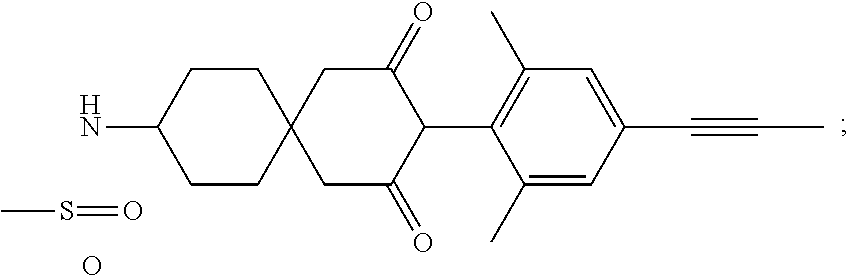


Applications Claiming Priority (4)
| Application Number | Priority Date | Filing Date | Title |
|---|---|---|---|
| GB1910926.3 | 2019-07-31 | ||
| GBGB1910926.3A GB201910926D0 (en) | 2019-07-31 | 2019-07-31 | Improvements in or relating to organic compounds |
| GB1910926 | 2019-07-31 | ||
| PCT/EP2020/071131 WO2021018834A1 (en) | 2019-07-31 | 2020-07-27 | Cyclic diones as herbicidal compounds |
Publications (2)
| Publication Number | Publication Date |
|---|---|
| US20220281804A1 US20220281804A1 (en) | 2022-09-08 |
| US12319640B2 true US12319640B2 (en) | 2025-06-03 |
Family
ID=67990358
Family Applications (1)
| Application Number | Title | Priority Date | Filing Date |
|---|---|---|---|
| US17/631,052 Active 2042-06-21 US12319640B2 (en) | 2019-07-31 | 2020-07-27 | Cyclic diones as herbicidal compounds |
Country Status (13)
| Country | Link |
|---|---|
| US (1) | US12319640B2 (en) |
| EP (1) | EP4003956B1 (en) |
| CN (1) | CN114222733B (en) |
| AR (1) | AR119509A1 (en) |
| AU (1) | AU2020320003B2 (en) |
| BR (1) | BR112022001425A2 (en) |
| CA (1) | CA3146891A1 (en) |
| ES (1) | ES2987403T3 (en) |
| GB (1) | GB201910926D0 (en) |
| PY (1) | PY2039272A (en) |
| UA (1) | UA129774C2 (en) |
| UY (1) | UY38812A (en) |
| WO (1) | WO2021018834A1 (en) |
Families Citing this family (1)
| Publication number | Priority date | Publication date | Assignee | Title |
|---|---|---|---|---|
| AU2024327939A1 (en) * | 2023-08-21 | 2026-03-12 | Bayer Aktiengesellschaft | Herbicide/safener combinations based on safeners from the class of substituted [(1,5-diphenyl-1h-1,2,4-triazol-3-yl)oxy] acetic acids and herbicides from the class of substituted cyclic diones and the salts thereof |
Citations (5)
| Publication number | Priority date | Publication date | Assignee | Title |
|---|---|---|---|---|
| GB1567300A (en) | 1977-03-28 | 1980-05-14 | Union Carbide Corp | Synthesis of biocidal 2-aryl-1,3-cycloalkane-diones and their enol esters |
| WO2008110308A2 (en) | 2007-03-09 | 2008-09-18 | Syngenta Participations Ag | Novel herbicides |
| WO2010089211A1 (en) | 2009-02-04 | 2010-08-12 | Syngenta Limited | Novel herbicides |
| WO2014191534A1 (en) | 2013-05-30 | 2014-12-04 | Syngenta Limited | Herbicidally active (alkynyl-phenyl)-substituted cyclic dione compounds and derivatives thereof |
| WO2015197468A1 (en) | 2014-06-26 | 2015-12-30 | Syngenta Participations Ag | Herbicidal propynyl-phenyl compounds |
Family Cites Families (7)
| Publication number | Priority date | Publication date | Assignee | Title |
|---|---|---|---|---|
| BR8600161A (en) | 1985-01-18 | 1986-09-23 | Plant Genetic Systems Nv | CHEMICAL GENE, HYBRID, INTERMEDIATE PLASMIDIO VECTORS, PROCESS TO CONTROL INSECTS IN AGRICULTURE OR HORTICULTURE, INSECTICIDE COMPOSITION, PROCESS TO TRANSFORM PLANT CELLS TO EXPRESS A PLANTINIDE TOXIN, PRODUCED BY CULTURES, UNITED BY BACILLA |
| CA2005658A1 (en) | 1988-12-19 | 1990-06-19 | Eliahu Zlotkin | Insecticidal toxins, genes encoding these toxins, antibodies binding to them and transgenic plant cells and plants expressing these toxins |
| ATE121267T1 (en) | 1989-11-07 | 1995-05-15 | Pioneer Hi Bred Int | LARVAE-KILLING LECTINS AND BASED PLANT RESISTANCE AGAINST INSECTS. |
| UA48104C2 (en) | 1991-10-04 | 2002-08-15 | Новартіс Аг | Dna fragment including sequence that codes an insecticide protein with optimization for corn, dna fragment providing directed preferable for the stem core expression of the structural gene of the plant related to it, dna fragment providing specific for the pollen expression of related to it structural gene in the plant, recombinant dna molecule, method for obtaining a coding sequence of the insecticide protein optimized for corn, method of corn plants protection at least against one pest insect |
| US5530195A (en) | 1994-06-10 | 1996-06-25 | Ciba-Geigy Corporation | Bacillus thuringiensis gene encoding a toxin active against insects |
| AR031027A1 (en) | 2000-10-23 | 2003-09-03 | Syngenta Participations Ag | AGROCHEMICAL COMPOSITIONS |
| AU2002361696A1 (en) | 2001-12-17 | 2003-06-30 | Syngenta Participations Ag | Novel corn event |
-
2019
- 2019-07-31 GB GBGB1910926.3A patent/GB201910926D0/en not_active Ceased
-
2020
- 2020-07-24 PY PY202002039272A patent/PY2039272A/en unknown
- 2020-07-27 ES ES20746954T patent/ES2987403T3/en active Active
- 2020-07-27 CA CA3146891A patent/CA3146891A1/en active Pending
- 2020-07-27 UA UAA202200815A patent/UA129774C2/en unknown
- 2020-07-27 AU AU2020320003A patent/AU2020320003B2/en active Active
- 2020-07-27 EP EP20746954.5A patent/EP4003956B1/en active Active
- 2020-07-27 WO PCT/EP2020/071131 patent/WO2021018834A1/en not_active Ceased
- 2020-07-27 CN CN202080055298.XA patent/CN114222733B/en active Active
- 2020-07-27 US US17/631,052 patent/US12319640B2/en active Active
- 2020-07-27 BR BR112022001425A patent/BR112022001425A2/en unknown
- 2020-07-28 AR ARP200102117A patent/AR119509A1/en unknown
- 2020-07-29 UY UY0001038812A patent/UY38812A/en not_active Application Discontinuation
Patent Citations (8)
| Publication number | Priority date | Publication date | Assignee | Title |
|---|---|---|---|---|
| GB1567300A (en) | 1977-03-28 | 1980-05-14 | Union Carbide Corp | Synthesis of biocidal 2-aryl-1,3-cycloalkane-diones and their enol esters |
| WO2008110308A2 (en) | 2007-03-09 | 2008-09-18 | Syngenta Participations Ag | Novel herbicides |
| US8084649B2 (en) * | 2007-03-09 | 2011-12-27 | Syngenta Crop Protection, Inc. | Herbicides |
| WO2010089211A1 (en) | 2009-02-04 | 2010-08-12 | Syngenta Limited | Novel herbicides |
| WO2014191534A1 (en) | 2013-05-30 | 2014-12-04 | Syngenta Limited | Herbicidally active (alkynyl-phenyl)-substituted cyclic dione compounds and derivatives thereof |
| US10696686B2 (en) * | 2013-05-30 | 2020-06-30 | Syngenta Limited | Herbicidally active (alkynyl-phenyl)-substituted cyclic dione compounds and derivatives thereof |
| WO2015197468A1 (en) | 2014-06-26 | 2015-12-30 | Syngenta Participations Ag | Herbicidal propynyl-phenyl compounds |
| US10662138B2 (en) * | 2014-06-26 | 2020-05-26 | Syngenta Participations Ag | Herbicidal propynyl-phenyl compounds |
Non-Patent Citations (2)
| Title |
|---|
| GB search report for GB1910926.3 dated Jan. 21, 2020. |
| International Search Report and Written Opinion PCT/EP2020/071131 dated Feb. 4, 2021. |
Also Published As
| Publication number | Publication date |
|---|---|
| US20220281804A1 (en) | 2022-09-08 |
| CA3146891A1 (en) | 2021-02-04 |
| BR112022001425A2 (en) | 2022-03-22 |
| AR119509A1 (en) | 2021-12-22 |
| UA129774C2 (en) | 2025-07-30 |
| CN114222733A (en) | 2022-03-22 |
| EP4003956B1 (en) | 2024-05-15 |
| AU2020320003B2 (en) | 2026-02-05 |
| UY38812A (en) | 2021-02-26 |
| PY2039272A (en) | 2021-07-13 |
| ES2987403T3 (en) | 2024-11-14 |
| GB201910926D0 (en) | 2019-09-11 |
| EP4003956A1 (en) | 2022-06-01 |
| CN114222733B (en) | 2025-03-21 |
| WO2021018834A1 (en) | 2021-02-04 |
| AU2020320003A1 (en) | 2022-01-27 |
Similar Documents
| Publication | Publication Date | Title |
|---|---|---|
| US12281081B2 (en) | Herbicidal compounds | |
| US12398101B2 (en) | Herbicidal 2-azaspiro[3-5]nonane compounds | |
| US12250947B2 (en) | Substituted azaspiro-cycles as herbicides | |
| US12161115B2 (en) | Herbicidal compounds | |
| US12479804B2 (en) | Herbicidal compounds | |
| US12590067B2 (en) | Herbicidal cyclohexanedione derivatives | |
| WO2021018833A1 (en) | Cyclohexanediones as herbicidal compounds | |
| EP4003956B1 (en) | Cyclic diones as herbicidal compounds | |
| WO2021018826A1 (en) | Cyclic diones as herbicides | |
| RU2822391C2 (en) | Cyclic diones as herbicidal compounds |
Legal Events
| Date | Code | Title | Description |
|---|---|---|---|
| FEPP | Fee payment procedure |
Free format text: ENTITY STATUS SET TO UNDISCOUNTED (ORIGINAL EVENT CODE: BIG.); ENTITY STATUS OF PATENT OWNER: LARGE ENTITY |
|
| AS | Assignment |
Owner name: SYNGENTA CROP PROTECTION AG, SWITZERLAND Free format text: ASSIGNMENT OF ASSIGNORS INTEREST;ASSIGNORS:HENNESSY, ALAN JOSEPH;JONES, ELIZABETH PEARL;DALE, SUZANNA JANE;AND OTHERS;SIGNING DATES FROM 20200805 TO 20200922;REEL/FRAME:059157/0865 |
|
| STPP | Information on status: patent application and granting procedure in general |
Free format text: DOCKETED NEW CASE - READY FOR EXAMINATION |
|
| STPP | Information on status: patent application and granting procedure in general |
Free format text: NON FINAL ACTION MAILED |
|
| STPP | Information on status: patent application and granting procedure in general |
Free format text: RESPONSE TO NON-FINAL OFFICE ACTION ENTERED AND FORWARDED TO EXAMINER |
|
| STPP | Information on status: patent application and granting procedure in general |
Free format text: NOTICE OF ALLOWANCE MAILED -- APPLICATION RECEIVED IN OFFICE OF PUBLICATIONS |
|
| STCF | Information on status: patent grant |
Free format text: PATENTED CASE |