US12312377B2 - Biconjugatable labels and methods of use - Google Patents
Biconjugatable labels and methods of use Download PDFInfo
- Publication number
- US12312377B2 US12312377B2 US16/510,794 US201916510794A US12312377B2 US 12312377 B2 US12312377 B2 US 12312377B2 US 201916510794 A US201916510794 A US 201916510794A US 12312377 B2 US12312377 B2 US 12312377B2
- Authority
- US
- United States
- Prior art keywords
- certain embodiments
- optionally substituted
- labeled
- alkyl
- formula
- Prior art date
- Legal status (The legal status is an assumption and is not a legal conclusion. Google has not performed a legal analysis and makes no representation as to the accuracy of the status listed.)
- Active, expires
Links
Images


Classifications
-
- C—CHEMISTRY; METALLURGY
- C07—ORGANIC CHEMISTRY
- C07H—SUGARS; DERIVATIVES THEREOF; NUCLEOSIDES; NUCLEOTIDES; NUCLEIC ACIDS
- C07H21/00—Compounds containing two or more mononucleotide units having separate phosphate or polyphosphate groups linked by saccharide radicals of nucleoside groups, e.g. nucleic acids
- C07H21/04—Compounds containing two or more mononucleotide units having separate phosphate or polyphosphate groups linked by saccharide radicals of nucleoside groups, e.g. nucleic acids with deoxyribosyl as saccharide radical
-
- C—CHEMISTRY; METALLURGY
- C07—ORGANIC CHEMISTRY
- C07H—SUGARS; DERIVATIVES THEREOF; NUCLEOSIDES; NUCLEOTIDES; NUCLEIC ACIDS
- C07H21/00—Compounds containing two or more mononucleotide units having separate phosphate or polyphosphate groups linked by saccharide radicals of nucleoside groups, e.g. nucleic acids
-
- A—HUMAN NECESSITIES
- A61—MEDICAL OR VETERINARY SCIENCE; HYGIENE
- A61K—PREPARATIONS FOR MEDICAL, DENTAL OR TOILETRY PURPOSES
- A61K49/00—Preparations for testing in vivo
- A61K49/001—Preparation for luminescence or biological staining
- A61K49/0013—Luminescence
- A61K49/0017—Fluorescence in vivo
- A61K49/0019—Fluorescence in vivo characterised by the fluorescent group, e.g. oligomeric, polymeric or dendritic molecules
- A61K49/0021—Fluorescence in vivo characterised by the fluorescent group, e.g. oligomeric, polymeric or dendritic molecules the fluorescent group being a small organic molecule
- A61K49/0032—Methine dyes, e.g. cyanine dyes
-
- C—CHEMISTRY; METALLURGY
- C07—ORGANIC CHEMISTRY
- C07D—HETEROCYCLIC COMPOUNDS
- C07D405/00—Heterocyclic compounds containing both one or more hetero rings having oxygen atoms as the only ring hetero atoms, and one or more rings having nitrogen as the only ring hetero atom
- C07D405/14—Heterocyclic compounds containing both one or more hetero rings having oxygen atoms as the only ring hetero atoms, and one or more rings having nitrogen as the only ring hetero atom containing three or more hetero rings
-
- C—CHEMISTRY; METALLURGY
- C07—ORGANIC CHEMISTRY
- C07D—HETEROCYCLIC COMPOUNDS
- C07D491/00—Heterocyclic compounds containing in the condensed ring system both one or more rings having oxygen atoms as the only ring hetero atoms and one or more rings having nitrogen atoms as the only ring hetero atoms, not provided for by groups C07D451/00 - C07D459/00, C07D463/00, C07D477/00 or C07D489/00
- C07D491/22—Heterocyclic compounds containing in the condensed ring system both one or more rings having oxygen atoms as the only ring hetero atoms and one or more rings having nitrogen atoms as the only ring hetero atoms, not provided for by groups C07D451/00 - C07D459/00, C07D463/00, C07D477/00 or C07D489/00 in which the condensed system contains four or more hetero rings
-
- C—CHEMISTRY; METALLURGY
- C07—ORGANIC CHEMISTRY
- C07D—HETEROCYCLIC COMPOUNDS
- C07D493/00—Heterocyclic compounds containing oxygen atoms as the only ring hetero atoms in the condensed system
- C07D493/02—Heterocyclic compounds containing oxygen atoms as the only ring hetero atoms in the condensed system in which the condensed system contains two hetero rings
- C07D493/10—Spiro-condensed systems
-
- C—CHEMISTRY; METALLURGY
- C07—ORGANIC CHEMISTRY
- C07F—ACYCLIC, CARBOCYCLIC OR HETEROCYCLIC COMPOUNDS CONTAINING ELEMENTS OTHER THAN CARBON, HYDROGEN, HALOGEN, OXYGEN, NITROGEN, SULFUR, SELENIUM OR TELLURIUM
- C07F5/00—Compounds containing elements of Groups 3 or 13 of the Periodic Table
- C07F5/02—Boron compounds
- C07F5/022—Boron compounds without C-boron linkages
-
- C—CHEMISTRY; METALLURGY
- C07—ORGANIC CHEMISTRY
- C07H—SUGARS; DERIVATIVES THEREOF; NUCLEOSIDES; NUCLEOTIDES; NUCLEIC ACIDS
- C07H1/00—Processes for the preparation of sugar derivatives
-
- C—CHEMISTRY; METALLURGY
- C09—DYES; PAINTS; POLISHES; NATURAL RESINS; ADHESIVES; COMPOSITIONS NOT OTHERWISE PROVIDED FOR; APPLICATIONS OF MATERIALS NOT OTHERWISE PROVIDED FOR
- C09B—ORGANIC DYES OR CLOSELY-RELATED COMPOUNDS FOR PRODUCING DYES, e.g. PIGMENTS; MORDANTS; LAKES
- C09B11/00—Diaryl- or thriarylmethane dyes
- C09B11/04—Diaryl- or thriarylmethane dyes derived from triarylmethanes, i.e. central C-atom is substituted by amino, cyano, alkyl
- C09B11/10—Amino derivatives of triarylmethanes
- C09B11/24—Phthaleins containing amino groups ; Phthalanes; Fluoranes; Phthalides; Rhodamine dyes; Phthaleins having heterocyclic aryl rings; Lactone or lactame forms of triarylmethane dyes
-
- C—CHEMISTRY; METALLURGY
- C09—DYES; PAINTS; POLISHES; NATURAL RESINS; ADHESIVES; COMPOSITIONS NOT OTHERWISE PROVIDED FOR; APPLICATIONS OF MATERIALS NOT OTHERWISE PROVIDED FOR
- C09B—ORGANIC DYES OR CLOSELY-RELATED COMPOUNDS FOR PRODUCING DYES, e.g. PIGMENTS; MORDANTS; LAKES
- C09B23/00—Methine or polymethine dyes, e.g. cyanine dyes
- C09B23/0075—Methine or polymethine dyes, e.g. cyanine dyes the polymethine chain being part of an heterocyclic ring
-
- C—CHEMISTRY; METALLURGY
- C09—DYES; PAINTS; POLISHES; NATURAL RESINS; ADHESIVES; COMPOSITIONS NOT OTHERWISE PROVIDED FOR; APPLICATIONS OF MATERIALS NOT OTHERWISE PROVIDED FOR
- C09B—ORGANIC DYES OR CLOSELY-RELATED COMPOUNDS FOR PRODUCING DYES, e.g. PIGMENTS; MORDANTS; LAKES
- C09B57/00—Other synthetic dyes of known constitution
-
- C—CHEMISTRY; METALLURGY
- C12—BIOCHEMISTRY; BEER; SPIRITS; WINE; VINEGAR; MICROBIOLOGY; ENZYMOLOGY; MUTATION OR GENETIC ENGINEERING
- C12Q—MEASURING OR TESTING PROCESSES INVOLVING ENZYMES, NUCLEIC ACIDS OR MICROORGANISMS; COMPOSITIONS OR TEST PAPERS THEREFOR; PROCESSES OF PREPARING SUCH COMPOSITIONS; CONDITION-RESPONSIVE CONTROL IN MICROBIOLOGICAL OR ENZYMOLOGICAL PROCESSES
- C12Q1/00—Measuring or testing processes involving enzymes, nucleic acids or microorganisms; Compositions therefor; Processes of preparing such compositions
- C12Q1/68—Measuring or testing processes involving enzymes, nucleic acids or microorganisms; Compositions therefor; Processes of preparing such compositions involving nucleic acids
- C12Q1/6869—Methods for sequencing
-
- G—PHYSICS
- G01—MEASURING; TESTING
- G01N—INVESTIGATING OR ANALYSING MATERIALS BY DETERMINING THEIR CHEMICAL OR PHYSICAL PROPERTIES
- G01N33/00—Investigating or analysing materials by specific methods not covered by groups G01N1/00 - G01N31/00
- G01N33/48—Biological material, e.g. blood, urine; Haemocytometers
- G01N33/50—Chemical analysis of biological material, e.g. blood, urine; Testing involving biospecific ligand binding methods; Immunological testing
- G01N33/53—Immunoassay; Biospecific binding assay; Materials therefor
- G01N33/531—Production of immunochemical test materials
- G01N33/532—Production of labelled immunochemicals
-
- G—PHYSICS
- G01—MEASURING; TESTING
- G01N—INVESTIGATING OR ANALYSING MATERIALS BY DETERMINING THEIR CHEMICAL OR PHYSICAL PROPERTIES
- G01N33/00—Investigating or analysing materials by specific methods not covered by groups G01N1/00 - G01N31/00
- G01N33/48—Biological material, e.g. blood, urine; Haemocytometers
- G01N33/50—Chemical analysis of biological material, e.g. blood, urine; Testing involving biospecific ligand binding methods; Immunological testing
- G01N33/53—Immunoassay; Biospecific binding assay; Materials therefor
- G01N33/531—Production of immunochemical test materials
- G01N33/532—Production of labelled immunochemicals
- G01N33/533—Production of labelled immunochemicals with fluorescent label
-
- C—CHEMISTRY; METALLURGY
- C12—BIOCHEMISTRY; BEER; SPIRITS; WINE; VINEGAR; MICROBIOLOGY; ENZYMOLOGY; MUTATION OR GENETIC ENGINEERING
- C12Q—MEASURING OR TESTING PROCESSES INVOLVING ENZYMES, NUCLEIC ACIDS OR MICROORGANISMS; COMPOSITIONS OR TEST PAPERS THEREFOR; PROCESSES OF PREPARING SUCH COMPOSITIONS; CONDITION-RESPONSIVE CONTROL IN MICROBIOLOGICAL OR ENZYMOLOGICAL PROCESSES
- C12Q2563/00—Nucleic acid detection characterized by the use of physical, structural and functional properties
- C12Q2563/103—Nucleic acid detection characterized by the use of physical, structural and functional properties luminescence
Definitions
- Labeled probes are widely used in methods for detecting biological analytes and analyzing biological processes. Some of these techniques involve monitoring a biological reaction in real-time using luminescently labeled reaction components. The labels are illuminated with a light source to cause luminescence, and the luminescent light is detected with a photodetector. These events can be recorded and analyzed to identify individual reaction components based on corresponding luminescent properties. In identifying a specific type of labeled molecule among a plurality of types, it is critical that each type exhibits unique and readily differentiable luminescent properties. However, the inherent sensitivity of complex biological processes requires careful consideration when designing labeled probes for use in these systems.
- aspects of the disclosure relate to labeled biomolecules comprising internally-conjugated luminescent labels.
- the disclosure provides labeled biomolecules comprising a substrate configured for use in a reaction.
- the disclosure provides labeled biomolecules comprising a nucleotide configured for use in a polymerization reaction.
- the disclosure provides methods of sequencing using labeled nucleotides described herein.
- the disclosure provides biconjugatable luminescent labels and methods of making the same.
- the application provides labeled biomolecules of Formula (I):
- Q 1 and Q 2 are independently monomeric or oligomeric biomolecules: A is a polycyclic fluorophore; and L 1 and L 2 are independently linkers selected from the group consisting of optionally substituted alkylene, optionally substituted alkenylene, optionally substituted alkynylene, optionally substituted heteroalkylene, optionally substituted heteroalkenylene, optionally substituted heteroalkynylene, optionally substituted carbocyclylene, optionally substituted heterocyclylene, optionally substituted arylene, optionally substituted heteroarylene, and combinations thereof.
- a labeled nucleotide comprising one or more nucleotides associated with a labeled biomolecule according to the present application.
- the one or more nucleotides comprise one type of nucleotide selected from guanine, cytosine, adenine, and thymine or uracil.
- the one or more nucleotides are cleaved from the labeled biomolecule by a polymerase when subjected to polymerization reaction conditions.
- the one or more nucleotides comprise nucleoside polyphosphates.
- the one or more nucleotides comprise nucleoside triphosphates.
- the one or more nucleotides comprise nucleoside hexaphosphates. In some embodiments, the one or more nucleotides (e.g., nucleoside polyphosphates) are attached through a terminal phosphate to the labeled biomolecule. In some aspects, provided herein are compositions comprising a labeled nucleotide according to the present application.
- nucleic acid sequencing reaction composition comprising two or more different types of labeled nucleotides in a reaction mixture.
- at least one type of labeled nucleotide of the nucleic acid sequencing reaction composition is a labeled nucleotide according to the present application.
- the nucleic acid sequencing reaction composition comprises four different types of labeled nucleotides.
- the nucleic acid sequencing reaction composition comprises a first labeled nucleotide comprising guanine, a second labeled nucleotide comprising cytosine, a third labeled nucleotide comprising adenine, and a fourth labeled nucleotide comprising thymine or uracil.
- the methods comprise exposing a complex in a target volume, the complex comprising the template nucleic acid, a primer, and a polymerizing enzyme, to a nucleic acid sequencing reaction composition according to the present application.
- the methods further comprise directing a series of pulses of one or more excitation energies towards a vicinity of the target volume.
- the methods further comprise detecting a plurality of emitted photons from luminescently labeled nucleotides during sequential incorporation into a nucleic acid comprising the primer.
- the methods further comprise identifying the sequence of incorporated nucleotides by determining timing and optionally luminescence intensity of the emitted photons.
- kits for sequencing a template nucleic acid comprises two or more different types of labeled nucleotides. In some embodiments, at least one of the two or more different types of labeled nucleotides comprises a labeled nucleotide according to the present application.
- the application provides compounds Formula (II):
- compositions comprising a compound of Formula (II).
- the method comprises (i) contacting a monomeric or oligomeric biomolecule of formula Q 2 -OH, or a salt thereof, with a compound of Formula (II), or a salt thereof, under conditions sufficient to promote conjugation to yield a conjugate of the formula
- the method further comprises (ii) deprotecting the conjugate formed in step (i) under conditions sufficient to cleave the P 1 protecting group and yield a conjugate of the formula:
- the method further comprises (iii) contacting the conjugate formed in step (ii) with a monomeric or oligomeric biomolecule of formula Q 1 -O—R 1 , or a salt thereof, under conditions sufficient to promote conjugation to yield a labeled biomolecule of Formula (I).
- FIGS. 1 A- 1 G show various examples of labeled biomolecules in accordance with the application.
- FIG. 1 A shows a labeled biomolecule having one internal label.
- FIG. 1 B shows a labeled biomolecule having two internal labels.
- FIG. 1 C shows a circularized labeled biomolecule.
- FIG. 1 D shows a labeled oligonucleotide that comprises an internally-labeled strand hybridized to an unlabeled strand.
- FIG. 1 E shows a labeled oligonucleotide that comprises one internally-labeled strand hybridized to another internally-labeled strand.
- FIG. 1 A shows a labeled biomolecule having one internal label.
- FIG. 1 B shows a labeled biomolecule having two internal labels.
- FIG. 1 C shows a circularized labeled biomolecule.
- FIG. 1 D shows a labeled oligonucleotide that comprises an internally-labeled strand hybridized to an unlab
- FIG. 1 F shows a labeled oligonucleotide that comprises an unlabeled strand hybridized to a labeled strand having two internal labels.
- FIG. 1 G shows a labeled oligonucleotide strand that is self-hybridized to form a stem-loop motif.
- FIGS. 2 A- 2 C depict examples of uses of labeled biomolecules in accordance with the application.
- FIG. 2 A depicts an internally-labeled oligonucleotide hybridized to a target nucleic acid sequence.
- FIG. 2 B depicts an internally-labeled biomolecule bound by a target protein.
- FIG. 2 C depicts an internally-labeled antibody bound to a target protein.
- FIGS. 3 A- 3 B illustrate examples of labeled biomolecules modified with functional moieties in accordance with the application.
- FIG. 3 A depicts an internally-labeled oligonucleotide modified with a quenching moiety that prevents detection of an internal label unless cleaved from the biomolecule.
- FIG. 3 B depicts an internally-labeled biomolecule modified with a ligand that is bound by a target protein, where binding of the ligand to the target protein permits detection of an internal label.
- FIGS. 4 A- 4 C depict examples of labeled nucleotides bound by a polymerizing enzyme in accordance with the application.
- FIG. 4 A depicts a polymerizing enzyme bound to a nucleotide that comprises an external label.
- FIG. 4 B depicts a polymerizing enzyme bound to a nucleotide that comprises an internally-labeled biomolecule.
- FIG. 4 C depicts a polymerizing enzyme bound to a nucleotide that comprises an internally-labeled oligonucleotide.
- FIGS. 5 A- 5 B show a comparative sequencing analysis of externally-labeled biomolecules and an internally-labeled biomolecule in accordance with the application.
- FIG. 5 A generically depicts a set of externally-labeled and internally-labeled nucleotides that were prepared and subjected to further analysis.
- FIG. 5 B shows the results of a single-molecule sequencing reaction that was performed using externally-labeled and internally-labeled nucleotides.
- FIG. 6 shows an alignment of excitation and emission spectra for an externally-labeled and an internally-labeled nucleotide.
- the disclosure provides labeled biomolecules comprising internally-conjugated luminescent labels (e.g., internal labels).
- an internal label is configured with enhanced conformational restraint to restrict rotation and block deactivation pathways that shorten luminescence lifetime.
- a labeled biomolecule is configured to provide a rigid molecular scaffold for the internal label that avoids label-label interactions and other quenching effects which could reduce luminescence intensity or other emission characteristics.
- labeled biomolecules provided herein offer a number of distinct advantages, such as improved quantum yields and extended luminescence lifetimes, increased luminescence intensity and/or brightness, and decreased exposure to bulk solvent molecules to limit formation of reactive species. Accordingly, in some embodiments, provided herein are labeled biomolecules and methods of use. In some embodiments, the disclosure provides compositions and methods related to the preparation of labeled biomolecules. In some embodiments, the disclosure provides compositions and methods related to the preparation of biconjugatable labels.
- labeled biomolecules e.g., oligonucleotides, nucleic acids, polypeptides, proteins, polysaccharides
- the labeled biomolecules comprise internally-conjugated luminescent compounds (“luminescent labels” or “labels”, e.g., polycyclic fluorophores).
- luminescent labels e.g., polycyclic fluorophores
- Internally-labeled or “internally-conjugated” are used interchangeably herein and refer to when one portion of the biomolecule is conjugated to a first site on the luminescent compound, and another portion of the biomolecule is conjugated to a second site on the luminescent compound.
- Internal conjugation of luminescent compounds can have several advantages. For example, internal conjugation of a label into a biomolecule can alter the lifetime and other photophysical properties of the label (e.g., via restricted rotation of the label). As another example, internal conjugation of a label can immobilize the label, separating it from other labels so as to mitigate self-quenching. Further, internal conjugation of a label can limit the label's access to bulk solvents in solution so as to mitigate radical formation which may be damaging to other components in the solution. Internal incorporation of labels have other advantages as described herein. A non-limiting set of examples of labeled biomolecules is shown in FIGS. 1 A- 1 G .
- FIGS. 1 A- 1 G generically depict various configurations of labeled biomolecules in accordance with the present application. Each example is shown as having an internal label and a biomolecule (shown as stippled shapes).
- FIG. 1 A is a labeled biomolecule comprising one internal label that conjugates one portion of a biomolecule to another portion of the biomolecule.
- a labeled biomolecule comprises two or more internal labels.
- FIG. 1 B is a labeled biomolecule comprising two internal labels. As shown, one label conjugates a first portion of a biomolecule to a second portion of the biomolecule, and another label conjugates the second portion of the biomolecule to a third portion of the biomolecule.
- labeled biomolecules having two or more copies of the same internal label exhibit increased luminescence intensity and/or brightness relative to a labeled biomolecule having one copy of the internal label.
- labeled biomolecules having two or more different types of internal labels provide two or more unique detectable signals. Examples of various configurations and uses of multiply-labeled biomolecules are described elsewhere herein.
- a biomolecular scaffold upon which an internal label is conjugated can be engineered to further promote rigidity and further enhance the one or more luminescent properties in these systems.
- FIG. 1 C is a labeled biomolecule comprising an internal label conjugated to a circularized biomolecule.
- an internal label conjugates one end of a biomolecule to another end of the biomolecule such that the labeled biomolecule is circularized.
- circularization promotes structural rigidity throughout the backbone of a biomolecule, which enhances the favorable luminescent properties of internal labels provided herein.
- examples of circular biomolecules include, without limitation, cyclic peptides, cyclic proteins, and circular nucleic acids (e.g., circular RNA, DNA plasmids).
- oligonucleotides e.g., polynucleotides, nucleic acids
- FIGS. 1 D- 1 G Various examples of internally-labeled oligonucleotides are shown in FIGS. 1 D- 1 G . These example constructs and additional embodiments related to internally-labeled oligonucleotides are described in detail elsewhere herein.
- internal label 100 corresponds to A of Formula (I), as depicted herein.
- a biomolecule (shown as stippled shapes) of the example structures corresponds to Q 1 and/or Q 2 of Formula (I), as depicted herein.
- internal label 100 corresponds to A and a biomolecule (shown as stippled shapes) of the example structures corresponds to Q 1 and Q 2 of Formula (I), as depicted herein.
- Q 1 and Q 2 are independently monomeric or oligomeric biomolecules
- A is a polycyclic fluorophore
- L 1 and L 2 are independently linkers selected from the group consisting of optionally substituted alkylene, optionally substituted alkenylene, optionally substituted alkynylene, optionally substituted heteroalkylene, optionally substituted heteroalkenylene, optionally substituted heteroalkynylene, optionally substituted carbocyclylene, optionally substituted heterocyclylene, optionally substituted arylene, optionally substituted heteroarylene, and combinations thereof.
- A is a luminescent compound or dye.
- A is conjugated to one portion of a biomolecule (group Q 1 ) through a linker represented by L 1 , and is conjugated to another portion of the biomolecule (group Q 1 ) through linker L 1 .
- Q 1 and Q 2 together form a biomolecule, which is interrupted by a structure: —O-L 1 -A-L 2 -O—, and is thereby internally labeled.
- A is a polycyclic fluorophore.
- incorporating a polycyclic fluorophore is advantageous insofar as the polycyclic structure can impart greater rigidity to the system as compared with linear or non-polycyclic fluorophores.
- L 1 and L 2 are directly linked (e.g., through a covalent bonds) to one or more rings (e.g., benzenoid or heteroaromatic rings) of the polycyclic structure. This direct linkage can also impart greater rigidity to the system (e.g., via immobilization/restricted rotation of the label). In certain embodiments, L 1 and L 2 are directly linked to different rings on A, a design feature which can also impart greater rigidity to the system and/or help immobilize the dye.
- rings e.g., benzenoid or heteroaromatic rings
- A is a polycyclic cyanine, fluorone, acridine, phenoxazine, coumarin, or boron-dipyrromethene (BODIPY) fluorophore.
- A is a porphyrin, phthalocyanine, or naphthalimide. These are non-limiting examples.
- A is a polycyclic cyanine fluorophore.
- A is a polycyclic fluorone fluorophore.
- A is a polycyclic acridine fluorophore.
- A is a polycyclic phenoxazine fluorophore.
- A is a polycyclic coumarin fluorophore. In certain embodiments, A is a polycyclic BODIPY fluorophore. In certain embodiments, A is a porphyrin. In certain embodiments, A is a phthalocyanine. In certain embodiments, A is a naphthalimide. Other embodiments of Ring A are described below and herein.
- A is a polycyclic cyanine fluorophore. In certain embodiments, A is an optionally substituted Cy3B dye. In certain embodiments, A is Cy3B. In certain embodiments, A is of the following formula:
- X ⁇ is a counterion or is absent; and wherein the structure is optionally substituted at any position. In certain embodiments, the structure is unsubstituted.
- A is of the following formula:
- X ⁇ is a counterion or is absent; and wherein the structure is optionally substituted at any position. In certain embodiments, the structure is unsubstituted.
- the labeled biomolecule is of the formula
- X ⁇ is a counterion or is absent.
- the labeled biomolecule is of the formula:
- n is independently an integer from 1-20, inclusive.
- the labeled biomolecule is of the formula:
- the labeled biomolecule is of the formula:
- Ring A is a polycyclic fluorone fluorophore (e.g., fluorescein or rhodamine).
- A is a fluorone dye.
- A is a rhodamine dye.
- A is of the following formula:
- each R is independently hydrogen, halogen, —N 3 , —CN, —NO 2 , optionally substituted alkyl, optionally substituted alkenyl, optionally substituted alkynyl, optionally substituted carbocyclyl, optionally substituted aryl, optionally substituted heterocyclyl, optionally substituted heteroaryl, —OR O , —SR S , or —N(R N ) 2 .
- the structure is optionally substituted at any position. In certain embodiments, the structure is unsubstituted.
- each R is independently hydrogen, halogen, —N 3 , —CN, —NO 2 , optionally substituted alkyl, optionally substituted alkenyl, optionally substituted alkynyl, optionally substituted carbocyclyl, optionally substituted aryl, optionally substituted heterocyclyl, optionally substituted heteroaryl, —OR O , —SR S , or —N(R N ) 2 .
- R is hydrogen.
- R is halogen.
- R is —N 3 .
- R is —CN.
- R is —NO 2 .
- R is optionally substituted alkyl.
- R is optionally substituted alkenyl. In certain embodiments, R is optionally substituted alkynyl. In certain embodiments, R is optionally substituted carbocyclyl. In certain embodiments, R is optionally substituted aryl. In certain embodiments, R is optionally substituted heterocyclyl. In certain embodiments, R is optionally substituted heteroaryl. In certain embodiments, R is —OR O . In certain embodiments, R is —SR S . In certain embodiments, R is —N(R N ) 2 . In certain embodiments, R is optionally substituted C 1-6 alkyl. In certain embodiments, R is unsubstituted C 1-6 alkyl.
- R is optionally substituted C 1-3 alkyl. In certain embodiments, R is unsubstituted C 1-3 alkyl. In certain embodiments, R is selected from the group consisting of methyl, ethyl, n-propyl, iso-propyl, n-butyl, iso-butyl, sec-butyl, and tert-butyl. In certain embodiments, R is methyl. In certain embodiments, each R is methyl.
- A is of the formula:
- the structure is optionally substituted at any position.
- the structure is unsubstituted.
- A is of the formula:
- the structure is optionally substituted at any position.
- the structure is unsubstituted.
- A is of the formula:
- the structure is optionally substituted at any position.
- the structure is unsubstituted.
- the labeled biomolecule is of the formula:
- the labeled biomolecule is of the formula:
- n is independently an integer from 1-20, inclusive;
- each instance of R N is independently hydrogen, optionally substituted alkyl, optionally substituted alkenyl, optionally substituted alkynyl, optionally substituted carbocyclyl optionally substituted heterocyclyl, optionally substituted aryl, optionally substituted heteroaryl, optionally substituted acyl, or a nitrogen protecting group.
- the labeled biomolecule is of the formula:
- the labeled biomolecule is of the formula:
- the labeled biomolecule is of the formula:
- A is a boron-dipyrromethene (BODIPY) fluorophore.
- BODIPY boron-dipyrromethene
- A is of the formula:
- Ar is optionally substituted aryl or optionally substituted heteroaryl; and wherein the structure is optionally substituted at any position.
- Ar is optionally substituted aryl or optionally substituted heteroaryl. In certain embodiments, Ar is optionally substituted aryl. In certain embodiments, Ar is optionally substituted heteroaryl. In certain embodiments, Ar is optionally substituted phenyl. In certain embodiments, A is polyfluorophenyl. In certain embodiments, Ar is of the formula:
- Ar is of the formula
- Ar is of the formula
- Ar is of the formula:
- R Ar is hydrogen, halogen, —N 3 , —CN, —NO 2 , optionally substituted alkyl, optionally substituted alkenyl, optionally substituted alkynyl, optionally substituted carbocyclyl, optionally substituted aryl, optionally substituted heterocyclyl, optionally substituted heteroaryl, —OR O , —SR S , or —N(R N ) 2 .
- R Ar is hydrogen.
- R Ar is halogen (—Cl, —I, —Br, —F).
- R Ar is —N 3 .
- R Ar is —CN.
- R Ar is —NO 2 . In certain embodiments. R Ar is optionally substituted alkyl. In certain embodiments, R Ar is optionally substituted alkenyl. In certain embodiments, R Ar is optionally substituted alkynyl. In certain embodiments, R Ar is optionally substituted carbocyclyl. In certain embodiments, R Ar is optionally substituted aryl. In certain embodiments, R Ar is optionally substituted heterocyclyl. In certain embodiments, R Ar is optionally substituted heteroaryl. In certain embodiments, R Ar is —OR O . In certain embodiments, R Ar is —SR S . In certain embodiments, R 1 is or —N(R N ) 2 . In certain embodiments, R Ar is —F. In certain embodiments, R Ar is —S(CH 2 CH 2 O) m OCH 3 , wherein m is as defined herein.
- m is an integer from 1-6, inclusive.
- A is of the formula:
- R Ar is hydrogen, halogen, —N 3 , —CN, —NO 2 , optionally substituted alkyl, optionally substituted alkenyl, optionally substituted alkynyl, optionally substituted carbocyclyl, optionally substituted aryl, optionally substituted heterocyclyl, optionally substituted heteroaryl, —OR O , —SR S , or —N(R N ) 2 .
- the structure is substituted at any position. In certain embodiments, the structure is unsubstituted.
- the labeled biomolecule is of the formula:
- R Ar is hydrogen, halogen, —N 3 , —CN, —NO 2 , optionally substituted alkyl, optionally substituted alkenyl, optionally substituted alkynyl, optionally substituted carbocyclyl, optionally substituted aryl, optionally substituted heterocyclyl, optionally substituted heteroaryl, —OR O , —SR S , or N(R N ) 2 .
- the labeled biomolecule is of the formula:
- the labeled biomolecule is of one of the following formulae:
- the labeled biomolecule is of the formula:
- the labeled biomolecule is of one of the following formulae:
- A is an acridine fluorophore.
- A is an acridine fluorophore of the following formula
- A is a phenoxazine fluorophore.
- A is a phenoxazine fluorophore of the following formula:
- A is a coumarin fluorophore.
- A is a coumarin fluorophore of the following formula:
- A is a coumarin fluorophore of the following formula
- L 1 and L 2 are independently linkers selected from the group consisting of optionally substituted alkylene, optionally substituted alkenylene, optionally substituted alkynylene, optionally substituted heteroalkylene, optionally substituted heteroalkenylene, optionally substituted heteroalkynylene, optionally substituted carbocyclylene, optionally substituted heterocyclylene, optionally substituted arylene, optionally substituted heteroarylene, and combinations thereof.
- L 1 comprises optionally substituted alkylene.
- L 1 comprises optionally substituted alkenylene.
- L 1 comprises optionally substituted alkynylene.
- L 1 comprises optionally substituted heteroalkylene.
- L 1 comprises optionally substituted heteroalkenylene. In certain embodiments, L 1 comprises optionally substituted heteroalkynylene. In certain embodiments, L 1 comprises optionally substituted carbocyclylene. In certain embodiments, L 1 comprises optionally substituted heterocyclylene. In certain embodiments, L 1 comprises optionally substituted arylene. In certain embodiments. L 1 comprises optionally substituted heteroarylene. In certain embodiments, L 1 is optionally substituted C 1-20 alkylene. In certain embodiments, L 1 is optionally substituted C 1-10 alkylene. In certain embodiments, L 1 is optionally substituted C 1-6 alkylene. In certain embodiments, L 1 is of the formula:
- L 1 is of the formula:
- L 1 is of the formula:
- L 1 is of the formula:
- L 1 is of the formula:
- L 1 is of the formula:
- L 1 is of the formula:
- L 1 is of the formula:
- L 1 is of the formula:
- L 1 is of the formula:
- L 1 is of the formula:
- L 1 is of the formula:
- L 1 is of the formula:
- L 2 comprises optionally substituted alkylene. In certain embodiments, L 2 comprises optionally substituted alkenylene. In certain embodiments. L 2 comprises optionally substituted alkynylene. In certain embodiments, L 2 comprises optionally substituted heteroalkylene. In certain embodiments, L 2 comprises optionally substituted heteroalkenylene. In certain embodiments, L 2 comprises optionally substituted heteroalkynylene. In certain embodiments, L 2 comprises optionally substituted carbocyclylene. In certain embodiments, L 2 comprises optionally substituted heterocyclylene. In certain embodiments, L 2 comprises optionally substituted arylene. In certain embodiments, L 2 comprises optionally substituted heteroarylene. In certain embodiments, L 2 is optionally substituted C 1-20 alkylene. In certain embodiments, L 2 is optionally substituted C 1-10 alkylene. In certain embodiments L 2 is optionally substituted C 1-6 alkylene. In certain embodiments, L 2 is of the formula:
- L 2 is of the formula:
- L 2 is of the formula:
- L 2 is of the formula:
- L 2 is of the formula:
- L 2 is of the formula:
- L 2 is of the formula:
- L 2 is of the formula:
- L 2 is of the formula:
- L 2 is of the formula:
- L 2 is of the formula:
- L 2 is of the formula:
- L 2 is of the formula:
- n is independently an integer from 1-20, inclusive. In certain embodiments, n is 1. In certain embodiments, n is 2. In certain embodiments, n is 3. In certain embodiments, n is 4. In certain embodiments, n is 5. In certain embodiments, n is 6. In certain embodiments, n is 7. In certain embodiments, n is 8. In certain embodiments, n is 9. In certain embodiments, n is 10. In certain embodiments, n is 11. In certain embodiments, n is 12. In certain embodiments, n is 13. In certain embodiments, n is 14. In certain embodiments, n is 15. In certain embodiments, n is 16. In certain embodiments, n is 17. In certain embodiments, n is 18. In certain embodiments, n is 19. In certain embodiments, n is 20.
- Q 1 and Q 2 are independently monomeric or oligomeric biomolecules. As described herein, Q 1 and Q 2 together form an oligomeric or polymeric biomolecule, which is interrupted by —O-L 1 -A-L 2 -O— and is thereby internally labeled (e.g., forming a labeled biomolecule).
- the labeled biomolecule is an oligomeric or polymeric biomolecule comprising at least 5 monomeric biomolecules (e.g., at least 5 nucleotides, at least 5 amino acids, at least 5 monosaccharides). In some embodiments, an oligomeric or polymeric biomolecule comprises at least 10 monomeric biomolecules. In some embodiments, an oligomeric or polymeric biomolecule comprises at least 10 and fewer than 200 monomeric biomolecules.
- an oligomeric or polymeric biomolecule comprises at least 10 and fewer than 150 monomeric biomolecules, at least 10 and fewer than 100 monomeric biomolecules, at least 10 and fewer than 50 monomeric biomolecules, at least 10 and fewer than 40 monomeric biomolecules, at least 10 and fewer than 30 monomeric biomolecules, or at least 10 and fewer than 20 monomeric biomolecules.
- the labeled biomolecule is an oligonucleotide or nucleic acid.
- Q 1 and Q 2 are independently nucleosides, nucleotides, oligonucleotides, nucleic acids, or derivatives or fragments thereof. In certain embodiments, Q 1 and Q 2 are independently nucleosides or derivatives or fragments thereof. In certain embodiments, Q 1 and Q 2 are independently nucleotides derivatives or fragments thereof. In certain embodiments, Q 1 and Q 2 are independently oligonucleotides or derivatives or fragments thereof. In certain embodiments, Q 1 and Q 2 are independently nucleic acids or derivatives or fragments thereof.
- Q 1 and Q 2 are independently deoxyribonucleic acids, ribonucleic acids, peptide nucleic acids, locked nucleic acids, or derivatives or fragments thereof. In certain embodiments, Q 1 and Q 2 are independently deoxyribonucleic acids or derivatives or fragments thereof. In certain embodiments, Q 1 and Q 2 are independently ribonucleic acids or derivatives or fragments thereof. In certain embodiments, Q 1 and Q 2 are independently peptide nucleic acids or derivatives or fragments thereof. In certain embodiments. Q 1 and Q 2 are locked nucleic acids, or derivatives or fragments thereof.
- Q 1 and Q 2 together form an oligomeric or polymeric biomolecule, which is interrupted by —O-L 1 -A-L 2 -O— and is thereby internally labeled (e.g., forming a labeled biomolecule).
- the labeled biomolecule is a single-stranded nucleic acid.
- the single-stranded nucleic acid comprises a first oligonucleotide strand (Q 1 and/or Q 2 ).
- the labeled biomolecule comprises a second oligonucleotide strand hybridized to the first oligonucleotide strand.
- the second oligonucleotide strand is hybridized to Q 1 and/or Q 2 .
- a visual representation of this internally-labeled system is represented below (wherein - - - - - represents hybridization interactions (e.g., one or more Watson-Crick base interactions)):
- FIG. 1 D A visual representation of this system can also be found in FIG. 1 D .
- FIGS. 1 E- 1 G Additional examples of internally-labeled oligonucleotides are shown in FIGS. 1 E- 1 G .
- oligonucleotide strand hybridization can be used as a general design strategy in preparing labeled oligonucleotides of the application.
- oligonucleotide strand hybridization involves self-strand hybridization (e.g., self-hybridizing within a single strand).
- oligonucleotide strand hybridization involves hybridization of different oligonucleotide strands.
- FIG. 1 D is a labeled oligonucleotide comprising an internally-labeled oligonucleotide strand hybridized to an unlabeled oligonucleotide strand.
- an unlabeled oligonucleotide strand is used to increase rigidity in specific regions of a labeled oligonucleotide strand (e.g., in a region comprising an internal label).
- an unlabeled oligonucleotide strand is hybridized to an internally-labeled oligonucleotide strand that comprises two or more internal labels provided herein.
- FIG. 1 E is a labeled oligonucleotide comprising one internally-labeled oligonucleotide strand hybridized to another internally-labeled oligonucleotide strand.
- an internal label of one oligonucleotide strand comprises the same fluorophore as an internal label of the other oligonucleotide strand.
- an internal label of one oligonucleotide strand comprises a different fluorophore from an internal label of the other oligonucleotide strand.
- one of the internally-labeled oligonucleotide strands comprises two or more internal labels of the present application.
- both of the internally-labeled oligonucleotide strands comprise two or more internal labels of the present application.
- oligonucleotide strand hybridization promotes formation of one or more structural motifs, such as stem-loops, junctions, pseudoknots, and double helices.
- Structural motifs in accordance with the present application, are useful for enhancing rigidity of a labeled oligonucleotide and/or limiting the extent to which an internal label is exposed to bulk solvent.
- FIGS. 1 F- 1 G depict examples of labeled oligonucleotides having higher order structural motifs formed through strand hybridization.
- FIG. 1 F is a labeled oligonucleotide comprising an unlabeled oligonucleotide strand hybridized to an oligonucleotide strand that comprises two internal labels.
- formation of a double helix can promote separation of two internal labels of the same oligonucleotide strand.
- hybridized oligonucleotide strands form a double helix having approximately 10 to 12 base pairs per turn.
- the internal labels are minimally separated by 5 to 6 nucleotides along the strand such that the labels are on approximately opposite sides of a double helix.
- internal labels are separated by between 4 to 8 (e.g., 4, 5, 6, 7, or 8) nucleotides along the oligonucleotide strand.
- such design strategies may be utilized to limit the extent of label-label interaction (e.g., quenching effects) due to the intervening helical structure absorbing any radiative and/or non-radiative decay.
- Internal labels of the disclosure are integrated into the oligonucleotide backbone to minimize the extent of label-label interaction. Accordingly, in some embodiments, internal labels are separated by between 1 to 3 (e.g., 1, 2, or 3) or 9 to 13 (e.g., 9, 10, 11, 12, or 13) nucleotides along the same oligonucleotide strand. As illustrated by this example, labeled oligonucleotides may be designed by consideration of a predicted or known helical structure such that the relative location of one internal label to another through space can be manipulated to the desired application. Additional examples of structural motifs useful in the design of labeled oligonucleotides are known in the art and described herein.
- FIG. 1 G is an internally-labeled oligonucleotide strand that is self-hybridized to form a stem-loop motif.
- a stem-loop, or hairpin loop is an unpaired loop of nucleotides on an oligonucleotide strand that is formed when the oligonucleotide strand folds and forms base pairs with another section of the same strand.
- the unpaired loop of a stem-loop comprises three to ten nucleotides.
- a stem-loop can be formed by two regions of an oligonucleotide strand having reverse complementary sequences that hybridize to form a stem, where the two regions are separated by the three to ten nucleotides that form the unpaired loop.
- the stem can be designed to have one or more G/C nucleotides, which can provide added stability with the additional hydrogen bonding interactions that form compared to A-T/U nucleotides.
- the stem comprises G/C nucleotides immediately adjacent to an unpaired loop sequence.
- the stem comprises G/C nucleotides within the first 2, 3, 4, or 5 nucleotides adjacent to an unpaired loop sequence.
- an internal label conjugates one portion of an oligonucleotide strand to another portion of the oligonucleotide strand.
- both portions of an oligonucleotide strand conjugated by an internal label are hybridized to the same oligonucleotide strand.
- an internal label can be adjacent to one or more (e.g., 1, 2, 3, 4, 5, or more) unpaired bases of a hybridized oligonucleotide strand.
- an internal label can interact with guanine nucleobases via radiative and/or non-radiative decay to effect diminished luminescence lifetime.
- the one or more unpaired bases adjacent to an internal label are designed to exclude or minimize guanine.
- regions surrounding an internally conjugated label are designed to exclude or minimize G/C content.
- an internally-conjugated label is at least 2 nucleotides separated from a G or C nucleotide on the oligonucleotide strand (e.g., 2, 3, 4, 5, 6, 7, 8, 9, or more than 10 nucleotides separated from a G or C nucleotide).
- each internal label is flanked on either side by at least 2 consecutive nucleotides selected from A or T/U.
- the labeled biomolecule is a polypeptide or protein.
- Q 1 and Q 2 are independently amino acids, oligopeptides, polypeptides, proteins, or fragments thereof.
- Q 1 and Q 2 are independently amino acids.
- Q 1 and Q 2 are independently oligopeptides or fragments thereof.
- Q 1 and Q 2 are independently polypeptides or proteins, or fragments thereof.
- Q 1 and Q 2 are joined together to form a cyclic peptide or cyclic protein.
- Non-limiting examples of oligopeptides and polypeptides peptides suitable for use in labeled biomolecules of the application include, without limitation, oligopeptides, cyclic peptides, and small proteins (e.g., avian pancreatic peptide-based miniature proteins, such as described in Hodges, A. M. and Schepartz, A. (2007) J. Am. Chem. Soc. 129:11024-11025).
- Methods of engineering structural constraints into polypeptides are well known in the art and are envisioned to be particularly useful, e.g., to impart rigidity and enhance one or more luminescent properties discussed herein.
- proline content of a peptide amino acid sequence can be modified to control peptide shape and impart rigidity (see, e.g., Kritzer, J. A., et al. (2006) Chem Bio Chem 7:29-31).
- Additional non-limiting examples of useful peptide engineering techniques include peptide cyclization (see, e.g., Maltsev, O. V., et al. (2016) Angewandte Chemie 55(4): 1535-1539), ⁇ -helical peptide constraint via stapling and/or H-bond surrogates (see, e.g., Douse, C. H., et al. (2014) ACS Chem. Biol.
- the labeled biomolecule is an oligosaccharide or a polysaccharide.
- Q 1 and Q 2 are independently monosaccharides, oligosaccharides, polysaccharides, or fragments thereof.
- Q 1 and Q 2 are independently monosaccharides.
- Q 1 and Q 2 are independently oligosaccharides or fragments thereof.
- Q 1 and Q 2 are independently polysaccharides or fragments thereof.
- oligosaccharides and polysaccharides suitable for use in labeled biomolecules of the application are known in the art (e.g., as described in Solid Support Oligosaccharide Synthesis and Combinatorial Carbohydrate Libraries, Wiley 2001).
- labeled biomolecules comprise a biomolecule that functions as a rigid scaffold upon which an internal label of the application is incorporated.
- the biomolecule comprises one or more features which confer additional functions useful in various methods of detection, quantitative analysis, and imaging.
- FIGS. 2 A- 2 C illustrate non-limiting examples of internally-labeled biomolecules comprising a biomolecule that interacts with a desired target molecule.
- a labeled biomolecule comprising an oligonucleotide can function as a hybridization probe.
- a hybridization probe is a labeled fragment of DNA or RNA (e.g., an oligonucleotide) that can be added to a sample of known or unknown content to detect the presence of a desired target nucleic acid that is complementary to the hybridization probe.
- FIG. 2 A depicts an internally-labeled hybridization probe 200 hybridized with a target nucleic acid 210 .
- internally-labeled hybridization probe 200 forms base pairing interactions with target nucleic acid 210 which results in a detectable increase in luminescence from the internal label. In some embodiments, however, hybridization of internally-labeled hybridization probe 200 with target nucleic acid 210 results in a detectable decrease in luminescence.
- an internally-labeled hybridization probe of the application comprises a sequence that is substantially complementary to a target nucleic acid sequence such that the probe and target form base pairing interactions under hybridization conditions.
- an internal label conjugates one portion of a biomolecule to another portion of a biomolecule. Accordingly, one or both portions of the biomolecule (e.g., the oligonucleotide) conjugated by an internal label can be designed to hybridize with a target nucleic acid sequence.
- a target nucleic acid comprises RNA (e.g., mRNA).
- a target nucleic acid comprises DNA (e.g., cDNA, genomic DNA or fragments thereof).
- Internally-labeled hybridization probes of the application can be utilized in any methodology known in the art which utilizes hybridization probes. Examples of such techniques include, without limitation, fluorescent in situ hybridization (FISH), Northern blotting, Southern blotting, and general techniques involving SNP detection, real-time nucleic acid detection, real-time PCR quantification, allelic discrimination and identification, multiplex PCR assays, and diagnostic clinical assays.
- FISH fluorescent in situ hybridization
- Northern blotting Northern blotting
- Southern blotting Southern blotting
- general techniques involving SNP detection real-time nucleic acid detection
- real-time PCR quantification real-time PCR quantification
- allelic discrimination and identification allelic discrimination and identification
- multiplex PCR assays multiplex PCR assays
- diagnostic clinical assays diagnostic clinical assays.
- Labeled biomolecules of the application comprise a biomolecule that functions as a protein ligand.
- FIG. 2 B depicts a labeled biomolecule 201 bound by a target protein 211 .
- target protein 211 associates with (e.g., binds) at least a portion of the biomolecule (shown as dashed lines) of labeled biomolecule 201 which results in a detectable increase in luminescence from the internal label. In some embodiments, however, binding of target protein 211 to labeled biomolecule 201 results in a detectable decrease in luminescence.
- labeled biomolecule 201 and target protein 211 comprise a known binding pair.
- labeled biomolecule 201 can be added to a sample of known or unknown content to detect presence of target protein 211 .
- target protein 211 is a receptor and labeled biomolecule 201 comprises a receptor ligand.
- target protein 211 is an antibody specific for at least a portion of labeled biomolecule 201 .
- target protein 211 is an antibody and labeled biomolecule 201 comprises an antigen.
- target protein 211 is a nucleic acid-binding protein (e.g., a DNA-binding protein) and labeled biomolecule 201 comprises a nucleic acid.
- labeled biomolecules are contemplated to be useful in methodologies that employ labeled protein ligands to detect presence of a target protein or to evaluate a protein-ligand binding interaction (e.g., fluorescence polarization and other techniques known in the art or described herein).
- a labeled biomolecule comprising a polypeptide can function as an antibody.
- FIG. 2 C depicts an internally-labeled antibody 202 bound to a target protein 212 .
- internally-labeled antibody 202 comprises a Fab region configured to specifically bind target protein 212 which results in a detectable increase in luminescence from the internal label. In some embodiments, however, binding of internally-labeled antibody 202 with target protein 212 results in a detectable decrease in luminescence.
- Internally-labeled antibodies of the application can be utilized in methods known in the art which utilizes luminescently labeled antibodies. Examples of such techniques include, without limitation, fluorescent in situ hybridization (FISH). Western blotting, general methodologies involving immunolabeling, such as immunocytochemistry and immunohistochemistry techniques, and other techniques known in the art or described herein.
- FISH fluorescent in situ hybridization
- an internal label of the application can be conjugated to a biomolecule that interacts with a desired target molecule.
- an internal label is conjugated to a protein that associates with (e.g., binds to) a target ligand.
- the protein is an antibody or an antigen-binding portion of an antibody.
- the protein is an enzyme, such as a peptidase (e.g., an exopeptidase or an endopeptidase), a ribozyme, an aptazyme, a ligase, a transferase, or a tRNA synthetase.
- an internal label is conjugated to a nucleic acid that associates with (e.g., binds to) a target ligand.
- the nucleic acid is a nucleic acid aptamer (e.g., a DNA aptamer, an RNA aptamer, or a derivative or analog thereof).
- a labeled biomolecule comprises a biomolecule that is modified with one or more functional moieties.
- FIGS. 3 A- 3 B illustrate non-limiting examples of labeled biomolecules comprising moieties that interact with a target molecule and/or an internal label.
- biomolecular scaffolds provide rigid labeling scaffolds which can be of particular benefit with techniques in which a strongly defined position of an internal label is desired.
- FRET Förster resonance energy transfer
- FCS fluorescence correlation spectroscopy
- a labeled biomolecule comprises one or more quenching moieties (e.g., fluorescent and/or non-fluorescent quenching moieties) that interact with an internal label of the labeled biomolecule.
- quenching moieties e.g., fluorescent and/or non-fluorescent quenching moieties
- such moieties can be useful in real-time PCR where an internal label's position is well defined in relation to a quencher that is cleaved by exonuclease activity. An example of this process is illustrated in FIG. 3 A .
- an internally-labeled hybridization probe comprising a quenching moiety 300 is hybridized with a target nucleic acid.
- quenching moiety 300 is a non-fluorescent quencher that absorbs emission from an internal label.
- quenching moiety 300 is a fluorescent quencher that absorbs emission of one wavelength from an internal label and emits at another wavelength.
- quenching moiety 300 has been cleaved from the internally-labeled hybridization probe (e.g., by an exonuclease). This separation of quenching moiety 300 from the internal label eliminates the distance-dependent quenching effects to permit detection of a luminescence from the internal label. It should be appreciated that in some embodiments, an internally-labeled hybridization probe comprises an internal label that functions as a quencher of another label of the hybridization probe.
- Quenching moiety-modified hybridization probes are known in the art and are contemplated to be useful with internal labels of the application.
- Examples of such hybridization probes include, without limitation, molecular beacons, TaqMan probes, Exciton-controlled hybridization-sensitive fluorescent oligonucleotide (ECHO) probes, and cycling probe technology (CPT) probes.
- multiple internal labels can be incorporated into a biomolecule according to the desired luminescent properties of a labeled biomolecule provided herein.
- a labeled biomolecule having two or more internal labels exhibits increased luminescence intensity and/or brightness relative to the biomolecule having one internal label.
- the two or more internal labels are configured to provide independent reporter signals.
- the two or more internal labels are configured to provide dependent reporter signals (e.g., a donor label and an acceptor label of a FRET pair).
- the application provides internal labels configured for use in conventional solid-phase synthesis techniques, e.g., phosphoramidite analogs useful in oligonucleotide synthesis.
- labels provided herein can be readily incorporated into a biomolecule to generate a labeled biomolecule having a number of internal labels that may be limited only by the desired size of the biomolecule.
- a labeled biomolecule comprises two or more (e.g., 2, 3, 4, 5, 6, 7, 8, 9, 10, or more) internal labels.
- a labeled biomolecule comprises between 2 and 5, between 2 and 10, between 5 and 10, between 5 and 15, between 10 and 15, between 15 and 20, or more internal labels.
- a labeled biomolecule provided herein further comprises one or more luminescent labels other than the polycyclic fluorophore of Formula (I).
- a labeled biomolecule comprises at least one internal label according to Formula (I), and one or more internal labels comprising a linear or non-polycyclic fluorophore.
- a labeled biomolecule comprises at least one internal label according to Formula (I), and one or more external labels.
- an external label refers to a label (e.g., a fluorophore) conjugated to a single site of a labeled biomolecule provided herein.
- an external label is conjugated to a labeled biomolecule at a terminal end.
- an external label is conjugated to a 5′ or 3′ end of a labeled oligonucleotide.
- an external label is conjugated to an N- or C-terminus of a labeled polypeptide.
- an external label is conjugated to a labeled biomolecule at a terminal monomer of the biomolecule (e.g., conjugated to a base of a terminal nucleotide in an oligonucleotide strand, conjugated to a side chain of a terminal amino acid in a polypeptide strand).
- an external label is conjugated to a labeled biomolecule at a non-terminal site of the biomolecule. In some embodiments, an external label is conjugated to a labeled biomolecule at a site that is between monomers of the biomolecule. In some embodiments, an external label is conjugated to an abasic site of a labeled oligonucleotide. In some embodiments, an external label is conjugated to a labeled biomolecule at a non-terminal monomer of the biomolecule (e.g., conjugated to a base of a non-terminal nucleotide in an oligonucleotide strand, conjugated to a side chain of a non-terminal amino acid in a polypeptide strand).
- Labeled biomolecules of the application comprise a biomolecule modified with one or more moieties that function as protein ligands.
- FIG. 3 B illustrates a process whereby a labeled biomolecule comprising a ligand moiety is detectably bound by a target protein.
- a target protein is exposed to a labeled biomolecule comprising a ligand moiety 301 configured to bind the target protein.
- the internal label of the labeled biomolecule does not emit a detectable signal.
- the target protein associates with (e.g., binds) ligand moiety 301 which results in a detectable increase in luminescence from the internal label. In some embodiments, however, binding of the target protein to ligand moiety 301 results in a detectable decrease in luminescence.
- the change in detectable luminescence upon binding occurs as a result of confinement of the internal label biomolecule to an observation region (e.g., immobilization to a surface for a period of time sufficient to permit detection). In some embodiments, the change in luminescence upon binding occurs as a result of FRET interactions (e.g., with the target protein or a surface-conjugated acceptor/donor).
- labeled biomolecules comprising one or more ligand moieties can be used, e.g., for purposes of immobilizing a labeled biomolecule to a surface or a material, for detection of target protein in a known or unknown sample, for detection (e.g., quantitation) of a binding interaction between the target protein and a ligand moiety that is known or not known to bind the target protein.
- the labeled biomolecule is associated with a reactant configured for use as a substrate in a reaction.
- Q 1 and Q 2 of Formula (I) are independently optionally associated with a reactant configured for use as a substrate in a reaction.
- the first and second oligonucleotide strands are independently optionally associated with a reactant configured for use as a substrate in a reaction.
- the reactant is configured for use as a substrate in a polymerization reaction.
- the reactant is cleaved from the labeled biomolecule by a polymerase when subjected to polymerization reaction conditions.
- the reactant is a nucleotide (e.g., for use in a method of sequencing a nucleic acid).
- labeled nucleotides comprising one or more nucleotides associated with a labeled biomolecule described herein.
- the one or more nucleotides comprise one type of nucleotide selected from guanine, cytosine, adenine, and thymine or uracil.
- the one or more nucleotides are cleaved from the labeled biomolecule by a polymerase when subjected to polymerization reaction conditions.
- labeled nucleotides provided herein offer a number of distinct advantages over those currently used in sequencing reactions, such as increased readlength and increased accuracy, in addition to the advantages described elsewhere herein.
- FIGS. 4 A- 4 C highlight several features of labeled nucleotides of the disclosure.
- FIGS. 4 A- 4 C depicts a nucleotide 400 bound by a polymerase 410 .
- Nucleotide 400 of FIG. 4 A is externally-conjugated to a luminescent label
- nucleotides of FIGS. 4 B and 4 C are associated with different labeled biomolecules described herein.
- the externally-conjugated label is relatively proximal to the polymerase and has a relatively high degree of access to bulk solvent molecules. In some embodiments, such characteristics are adverse to a polymerization reaction.
- a shorter distance between a label and a polymerase can result in label-induced damage to the polymerase via radiative and/or non-radiative decay (shown as path (i)).
- path (i) a higher degree of a label's access to bulk solvent molecules can result in a higher incidence of reactive oxygen species (ROS) formation. Once formed, ROS can damage the polymerase to adversely affect enzymatic activity (shown as path (ii)).
- ROS reactive oxygen species
- FIG. 4 B depicts a nucleotide associated with a labeled biomolecule, such as a labeled oligonucleotide strand.
- a labeled biomolecule such as a labeled oligonucleotide strand.
- the biomolecule increases separation between the label and the polymerase.
- the portion of the biomolecule between the nucleotide and the internal label provides a protective barrier between the label and polymerase. Accordingly, the occurrence of label-induced damage to the polymerase can be decreased, due to the label-polymerase separation and/or due to the biomolecule absorbing any decay emitted from the label (shown as path (iii)).
- FIG. 4 C depicts a nucleotide associate with a labeled oligonucleotide. As shown, the labeled oligonucleotide is hybridized with an unlabeled oligonucleotide strand. In accordance with the application, such constructs impart a high degree of rigidity that enhance each of the above advantages described for the labeled nucleotide of FIG. 4 B .
- the hybridized strand provides increased rigidity, meaning less overall flexibility which further promotes label-polymerase separation.
- the hybridized strand also provides another barrier between the label and the polymerase that can absorb any label-induced decay (shown as path (v)).
- path (v) label-induced decay
- ROS-induced damage is further decreased due to the hybridized strand further restricting access of the label to bulk solvent, and/or due to the hybridized strand absorbing any ROS-induced damage, and/or due to free radical decay over the increased label-polymerase separation distance.
- the advantages provided by the labeled biomolecules of the application provide increased readlength in sequencing reactions by limiting the extent of photo-induced damage to the polymerase. Additionally, labeled nucleotides of the application provide increased accuracy, e.g., as a result of the enhancement of one or more emission characteristics.
- nucleotide or “nucleoside polyphosphate” attached thereto refers to the one or more nucleotides (e.g., nucleoside polyphosphates) that are configured to be incorporated into a growing nucleic acid strand (e.g., during a sequencing reaction).
- the one or more nucleotides comprise one or more nucleoside monophosphates or nucleoside polyphosphates.
- nucleoside polyphosphates include, in some embodiments, nucleoside di- or triphosphates, or nucleosides with more than three 5′ phosphates, such as nucleoside hexaphosphates.
- a phosphate portion e.g., a polyphosphate portion
- a nucleotide includes one or more phosphates (e.g., 1, 2, 3, 4, 5, 6, 7, 8, 9, 10, or more phosphate groups) or variants thereof.
- a phosphate portion (e.g., a polyphosphate portion) of a nucleotide can include a phosphate ester, a thioester, a phosphoramidate, an alkyl phosphonate linkage, other suitable linkage, or more than one such modifications, or a combination of two or more thereof.
- a labeled nucleotide can be a terminal phosphate labeled nucleotide, such that a labeled biomolecule of the application is attached to a terminal phosphate of the nucleotide.
- one or more nucleotides may be attached through a terminal phosphate to a biomolecule (e.g., Q 1 and/or Q 1 of Formula (I)) that forms part of a labeled biomolecule as described in this application.
- a “labeled nucleotide” of the application refers to a nucleotide attached to a labeled biomolecule of Formula (I).
- the one or more nucleotides may be attached through a terminal phosphate to an oligonucleotide (e.g., an unlabeled oligonucleotide strand) that forms part of a labeled biomolecule as described in this application.
- an oligonucleotide e.g., an unlabeled oligonucleotide strand
- a labeled biomolecule can be attached to a terminal phosphate of a nucleotide through a linker.
- the linker can include, for example, at least one or a plurality of hydroxyl groups, sulfhydryl groups, amino groups or haloalkyl groups, which may be suitable for forming, for example, a phosphate ester, a thioester, a phosphoramidate or an alkyl phosphonate linkage at the terminal phosphate of a natural or modified nucleotide.
- a linker can be cleavable so as to separate a label from the terminal phosphate, such as with the aid of a polymerization enzyme. Examples of nucleotides and linkers are provided in U.S. Pat.
- the linker comprises optionally substituted alkylene, optionally substituted alkenylene, optionally substituted alkynylene, optionally substituted heteroalkylene, optionally substituted heteroalkenylene, optionally substituted heteroalkynylene, optionally substituted carbocyclylene, optionally substituted heterocyclylene, optionally substituted arylene, optionally substituted heteroarylene, and combinations thereof. Additional examples of linkers useful for attaching a label to a nucleotide can be found in co-pending U.S. patent application Ser. No. 15/600,979, the relevant portions of which are incorporated herein by reference in entirety.
- a nucleotide e.g., a nucleoside polyphosphate
- a nucleotide can comprise any of an adenine (A), cytosine (C), guanine (G), thymine (T), and uracil (U), or variants thereof.
- a nucleotide e.g., a nucleoside polyphosphate
- a methylated nucleotide can be a nucleotide that comprises one or more methyl groups attached to the nucleobase (e.g., attached directly to a ring of the nucleobase, attached to a substituent of a ring of the nucleobase).
- Exemplary methylated nucleobases include 1-methylthymine, I-methyluracil, 3-methyluracil, 3-methylcytosine, 5-methylcytosine, 1-methyladenine, 2-methyladenine, 7-methyladenine, N6-methyladenine, N6,N6-dimethyladenine, 1-methylguanine, 7-methylguanine, N2-methylguanine, and N2,N2-dimethylguanine.
- nucleic acid generally refers to a molecule comprising one or more nucleic acid subunits.
- a nucleic acid may include one or more subunits selected from adenine (A), cytosine (C), guanine (G), thymine (T), and uracil (U), or variants thereof.
- a nucleic acid is deoxyribonucleic acid (DNA) or ribonucleic acid (RNA), or derivatives thereof.
- the nucleic acid is a modified nucleic acid, including, without limitation, a locked nucleic acid (LNA), a peptide nucleic acid (PNA), a triazole-linked nucleic acid, a 2′-F-modified nucleic acid, and derivatives and analogs thereof.
- LNA locked nucleic acid
- PNA peptide nucleic acid
- a nucleic acid may be single-stranded or double stranded.
- a nucleic acid generally refers to any polymer of nucleotides.
- internal conjugation of a label into a biomolecule can alter the photophysical properties of the label (e.g., via restricted rotation or immobilization of the label within the biomolecule). Therefore, in certain embodiments, one or more emission characteristics of the labeled biomolecule are altered (e.g., increased) relative to an unconjugated molecule comprising the label.
- the “unconjugated molecule” comprising the label, as described herein, does not comprise one or both of Q 1 and Q 2 .
- the one or more emission characteristics that are altered by internal conjugation can include, but are not limited to, luminescence lifetime, luminescence intensity, brightness, emission maximum, luminescence quantum yield, and photostability.
- luminescence lifetime of a labeled biomolecule is increased relative to the unconjugated molecule. In certain embodiments, the luminescence lifetime of the labeled biomolecule is increased by at least 10% relative to the unconjugated molecule. In certain embodiments, the luminescence lifetime of the labeled biomolecule is increased by between approximately 10% and 50% (e.g., between about 10% and 25%, between about 10%6 and 15%, between about 25% and 50%, between about 40% and 50%) relative to the unconjugated molecule. An example of increased luminescence lifetime is shown in FIGS. 5 A- 5 B .
- a set of labeled biomolecules comprising nucleotides were prepared in accordance with the constructs generically depicted in FIG. 5 A .
- Labeled nucleotides (1) and (2) represent conjugates wherein a Cy3B dye was externally conjugated to a DNA linker at the terminus or a branch point, respectively, of the oligonucleotide.
- labeled nucleotide (3) exchanges a base within the oligonucleotide strand for the Cy3B dye itself to become internally incorporated into the DNA backbone.
- These labeled nucleotides were used in sequencing experiments, and lifetime measurements for each conjugate were obtained.
- the externally conjugated Cy3B constructs (1) and (2) produced lifetimes of approximately 2.2 nanoseconds, whereas the measured lifetime for the internally conjugated Cy3B construct (3) was 2.6 nanoseconds—an increase in lifetime of approximately 15-20% for the internally conjugated dye.
- luminescence intensity of a labeled biomolecule is increased relative to the unconjugated molecule. In certain embodiments, luminescence intensity of the labeled biomolecule is increased by between approximately 5% and 25% (e.g., between about 5% and 20%, between about 5% and 15%, between about 5% and 10%, between about 10% and 25%, between about 15% and 25%, between about 20% and 25%) relative to the unconjugated molecule. In some embodiments, luminescence intensity of the labeled biomolecule is increased by approximately 5%, approximately 10%, approximately 15%, approximately 20%, approximately 25%, or more relative to the unconjugated molecule.
- brightness of a labeled biomolecule is increased relative to the unconjugated molecule. In certain embodiments, brightness of the labeled biomolecule is increased by between approximately 5% and 10% relative to the unconjugated molecule. In certain embodiments, brightness of the labeled biomolecule is increased by between approximately 5% and 25% (e.g., between about 5% and 20%, between about 5% and 15%, between about 5% and 10%, between about 10% and 25%, between about 15% and 25%, between about 20% and 25%) relative to the unconjugated molecule. In some embodiments, brightness of the labeled biomolecule is increased by approximately 5%, approximately 10%, approximately 15%, approximately 20%, approximately 25%, or more relative to the unconjugated molecule.
- emission maximum of a labeled biomolecule is increased by at least 1% relative to the unconjugated molecule. In certain embodiments, emission maximum of the labeled biomolecule is increased by between approximately 1% and 10% (e.g., between about 1% and 5%, between about 5% and 10%) relative to the unconjugated molecule. An example of increased emission maximum is shown in FIG. 6 . In some embodiments, emission maximum of the labeled biomolecule is increased by approximately 1%, approximately 2%, approximately 5%, approximately 10%, or more relative to the unconjugated molecule.
- FIG. 6 Bulk fluorescence data obtained for an internally-conjugated Cy3B and an externally-conjugated Cy3B are depicted in FIG. 6 .
- the excitation spectrum of the internal dye is red-shifted by 8 nm relative to the external dye, which places the vibronic shoulder (the hump on the left of the trace) closer to 532 nm.
- the emission spectrum of the internal dye is red-shifted, which was found to advantageously increase detectable signals as more light was permitted past the filter.
- luminescence quantum yield of a labeled biomolecule is increased relative to the unconjugated molecule. In certain embodiments, luminescence quantum yield of the labeled biomolecule is increased by between approximately 5% and 25% (e.g., between about 5% and 20%, between about 5% and 15%, between about 5% and 10%, between about 10% and 25%, between about 15% and 25%, between about 20% and 25%) relative to the unconjugated molecule. In some embodiments, luminescence quantum yield of the labeled biomolecule is increased by approximately 5%, approximately 10%, approximately 15%, approximately 20%, approximately 25%, or more relative to the unconjugated molecule.
- photostability of a labeled biomolecule is increased relative to the unconjugated molecule.
- photostability refers to the ability of a luminescent molecule to continue to fluoresce over time.
- photostability can be evaluated by measuring the rate of photobleaching.
- the rate of photobleaching can be measured for a labeled biomolecule (e.g., a biomolecule having an internally-conjugated label) and compared to the rate of photobleaching measured for the unconjugated molecule. A measured decrease in the rate of photobleaching would be indicative of increased photostability.
- a labeled biomolecule has decreased photobleaching relative to the unconjugated molecule, as measured by fluorescence recovery after photobleaching (FRAP), e.g., as described in Meyvis, T., et al. (1999) Pharmaceutical Research, 16(8): 1153-1162.
- FRAP fluorescence recovery after photobleaching
- a labeled biomolecule has decreased photobleaching relative to the unconjugated molecule, as measured by fluorescence loss in photobleaching (FLIP), e.g., as described in Wüstner, D., et al. (2012) BMC Bioinformatics, 13:296.
- FLIP fluorescence loss in photobleaching
- the disclosure provides new compositions for identifying single molecules based on one or more luminescent properties of those molecules.
- a molecule e.g., a luminescently labeled nucleotide
- Identifying may mean assigning the exact molecular identity of a molecule, or may mean distinguishing or differentiating the particular molecule from a set of possible molecules.
- a plurality of single molecules can be distinguished from each other based on different brightnesses, luminescence lifetimes, absorption spectra, emission spectra, luminescence quantum yields, luminescence intensities, or combinations of two or more thereof.
- a single molecule is identified (e.g., distinguished from other molecules) by exposing the molecule to a series of separate light pulses and evaluating the timing or other properties of each photon that is emitted from the molecule.
- information for a plurality of photons emitted sequentially from a single molecule is aggregated and evaluated to identify the molecule.
- a luminescence lifetime of a molecule is determined from a plurality of photons that are emitted sequentially from the molecule, and the luminescence lifetime can be used to identify the molecule.
- a luminescence intensity of a molecule is determined from a plurality of photons that are emitted sequentially from the molecule, and the luminescence intensity can be used to identify the molecule.
- a luminescence lifetime and luminescence intensity of a molecule is determined from a plurality of photons that are emitted sequentially from the molecule, and the luminescence lifetime and luminescence intensity can be used to identify the molecule.
- a reaction sample is exposed to a plurality of separate light pulses and a series of emitted photons are detected and analyzed.
- the series of emitted photons provides information about a single molecule that is present and that does not change in the reaction sample over the time of the experiment.
- the series of emitted photons provides information about a series of different molecules that are present at different times in the reaction sample (e.g., as a reaction or process progresses).
- Determination of a luminescence lifetime of a molecule can be performed using any suitable method (e.g., by measuring the lifetime using a suitable technique or by determining time-dependent characteristics of emission). In some embodiments, determining the luminescence lifetime of a molecule comprises determining the lifetime relative to one or more molecules (e.g., different luminescently labeled nucleotides in a sequencing reaction). In some embodiments, determining the luminescence lifetime of a molecule comprises determining the lifetime relative to a reference. In some embodiments, determining the luminescence lifetime of a molecule comprises measuring the lifetime (e.g., fluorescence lifetime).
- determining the luminescence lifetime of a molecule comprises determining one or more temporal characteristics that are indicative of lifetime.
- the luminescence lifetime of a molecule can be determined based on a distribution of a plurality of emission events (e.g., 1, 2, 3, 4, 5, 6, 7, 8, 9, 10, 11, 12, 13, 14, 15, 16, 17, 18, 19, 20, 30, 40, 50, 60, 70, 80, 90, 100, or more emission events) occurring across one or more time-gated windows relative to an excitation pulse.
- a luminescence lifetime of a single molecule can be distinguished from a plurality of molecules having different luminescence lifetimes based on the distribution of photon arrival times measured with respect to an excitation pulse.
- a luminescence lifetime of a single molecule is indicative of the timing of photons emitted after the single molecule reaches an excited state and the single molecule can be distinguished by information indicative of the timing of the photons.
- Some embodiments may include distinguishing a molecule from a plurality of molecules based on the molecule's luminescence lifetime by measuring times associated with photons emitted by the molecule. The distribution of times may provide an indication of the luminescence lifetime which may be determined from the distribution.
- the single molecule is distinguishable from the plurality of molecules based on the distribution of times, such as by comparing the distribution of times to a reference distribution corresponding to a known molecule.
- a value for the luminescence lifetime is determined from the distribution of times.
- luminescence intensity refers to the number of emitted photons per unit time that are emitted by a molecule which is being excited by delivery of a pulsed excitation energy. In some embodiments, the luminescence intensity refers to the detected number of emitted photons per unit time that are emitted by a molecule which is being excited by delivery of a pulsed excitation energy, and are detected by a particular sensor or set of sensors.
- the disclosure provides methods and compositions related to labeled biomolecules having enhanced emission brightness.
- “brightness” refers to a parameter that reports on the average emission intensity per labeled reactant molecule.
- emission intensity may be used to generally refer to brightness of a composition comprising brightly labeled reactants.
- brightness of a labeled reactant is equal to the product of its quantum yield and extinction coefficient.
- the labeled biomolecules of the disclosure are engineered to maximize quantum yield to promote increased brightness.
- Luminescence quantum yield refers to the fraction of excitation events at a given wavelength or within a given spectral range that lead to an emission event, and is typically less than 1.
- the luminescence quantum yield of a molecule described herein is between 0 and about 0.001, between about 0.001 and about 0.01, between about 0.01 and about 0.1, between about 0.1 and about 0.5, between about 0.5 and 0.9, or between about 0.9 and 1.
- a molecule is identified by determining or estimating the luminescence quantum yield.
- internal labels described herein allow for the addition of successive luminescent labels to a labeled biomolecule for increasing brightness and/or luminescence intensity.
- internally-labeled biomolecules comprising two or more luminescent labels exhibit brightness and/or luminescent intensity according to the formula L n (x), where L n is equal to the total number of luminescent labels on a labeled reactant and x is equal to the measured brightness or fluorescent intensity of the corresponding singly-labeled reactant.
- a two-dye labeled reaction component possesses brightness and/or luminescent intensity that is doubled compared to the one-dye labeled analog.
- a three- or four-dye labeled reaction component possesses brightness and/or luminescent intensity that is tripled or quadrupled, respectively, compared to the one-dye labeled analog.
- the brightly labeled reactants described herein exhibit brightness and/or luminescent intensity that is at least 70%, at least 80%, at least 90%, at least 95%, at least 98%, or at least 99% 0 of the value predicted by L n (x).
- nucleic acid sequencing reaction compositions comprising two or more different types of labeled nucleotides in a reaction mixture, wherein at least one type of labeled nucleotide is a labeled nucleotide comprising a labeled biomolecule described herein.
- a nucleic acid sequencing reaction composition comprises two or more (e.g., two, three, four, five, or more) different types of labeled nucleotides. In some embodiments, a nucleic acid sequencing reaction composition comprises four different types of labeled nucleotides. In some embodiments, the four different types of labeled nucleotides comprising a first labeled nucleotide comprising guanine, a second labeled nucleotide comprising cytosine, a third labeled nucleotide comprising adenine, and a fourth labeled nucleotide comprising thymine or uracil.
- each type of labeled nucleotide in a nucleic acid sequencing reaction composition is present at a concentration of between about 100 and 1000 nM (e.g., between about 100 and 800 nM, between about 150 and 700 nM, between about 200 and 600 nM, or between about 250 and 500 nM).
- a nucleic acid sequencing reaction composition comprises a sequencing template comprising a polymerase in a complex with a target nucleic acid.
- the complex further comprises a primer oligonucleotide having a sequence complementary to a portion of the target nucleic acid.
- the complex is present at a concentration of between about 10 pM and 10 nM (e.g., between about 25 pM and 5 nM, between about 50 pM and 2 nM, between about 50 pM and 1 nM, between about 50 pM and 500 pM, between about 50 pM and 100 pM, between about 250 pM and 5 nM, between about 250 pM and 2 nM, between about 250 pM and 1 nM, or between about 250 pM and 500 pM.
- 10 pM and 10 nM e.g., between about 25 pM and 5 nM, between about 50 pM and 2 nM, between about 50 pM and 1 nM, between about 50 pM and 500 pM, between about 50 pM and 100 pM, between about 250 pM and 5 nM, between about 250 pM and 2 nM, between about 250 pM and 1 nM, or between about 250 p
- a nucleic acid sequencing reaction composition comprises one or more buffering agents (e.g., MES, MOPS, MOPSO, HEPES, Tris, TAPS, and other such suitable buffering agents known in the art).
- the one or more buffering agents comprises MOPS.
- a buffering agent is present at a concentration of between about 25 and 100 mM (e.g., between about 25 and 75 mM, between about 50 and 75 mM, or approximately 65 mM).
- a nucleic acid sequencing reaction composition comprises a divalent cation (e.g., magnesium ion, calcium ion).
- the divalent cation comprises a magnesium or calcium salt (e.g., a salt comprising magnesium or calcium and acetate, chloride, phosphate, sulfate).
- the salt is magnesium acetate.
- a divalent cation is present at a concentration of between about 5 and 50 mM (e.g., between about 10 and 40 mM, between about 15 and 35 mM, between about 20 and 30 mM, or approximately 25 mM).
- a nucleic acid sequencing reaction composition comprises one or more monovalent salts (e.g., a sodium or potassium salt, such as sodium chloride, sodium acetate, potassium chloride, or potassium acetate).
- the monovalent salt is present at a concentration of between about 10 and 200 mM (e.g., between about 25 and 150 mM, between about 25 and 40 mM, between about 50 and 150 mM, between about 100 and 150 mM).
- a nucleic acid sequencing reaction composition comprises approximately 40 mM monovalent salt, such as 40 mM sodium chloride.
- a nucleic acid sequencing reaction composition comprises approximately 120 mM monovalent salt, such as 120 mM potassium acetate.
- a nucleic acid sequencing reaction composition comprises one or more photostabilizers (e.g., one or more photoprotective additives, such as antioxidants, oxygen scavengers, triplet state quenchers, and similar energy-absorbing additives known in the art).
- a photostabilizer comprises protocatechuic acid (PCA).
- a photostabilizer comprises 4-nitrobenzyl alcohol (NBA).
- NBA 4-nitrobenzyl alcohol
- a photostabilizer comprises trolox, or a derivative thereof.
- a photostabilizer is present in a concentration of between about 0.1 mM and about 20 mM. In some embodiments, the concentration of trolox is about 5 mM.
- the concentration of PCA is about 3 mM. In some embodiments, the concentration of PCA is about 8 mM. In some embodiments, the concentration of NBA is about 3 mM.
- a mixture with a photostabilizer may also comprise an enzyme to regenerate the photostabilizer (e.g., protocatechuic acid dioxygenase (PCD)). In some embodiments, the concentration of PCD is about 0.3 mM. In some embodiments, the concentration of PCD is about 0.5 mg/mL.
- a nucleic acid sequencing reaction composition comprises one or more reducing agents.
- a nucleic acid sequencing reaction composition comprises between about 10 and 100 mM DTT (e.g., approximately 40 mM DTT).
- compositions and techniques described in the application can be used to identify a series of nucleotide or amino acid monomers that are incorporated into a nucleic acid or protein (e.g., by detecting a time-course of incorporation of a series of labeled nucleotide or amino acid monomers).
- compositions and techniques described in the application can be used to identify a series of nucleotides that are incorporated into a template-dependent nucleic acid sequencing reaction product synthesized by a polymerase enzyme.
- methods of sequencing comprise steps of: (i) exposing a complex in a target volume, the complex comprising the template nucleic acid, a primer, and a polymerizing enzyme, to a nucleic acid sequencing reaction composition according to the disclosure (e.g., at least one labeled nucleotide comprising a labeled biomolecule described herein); (ii) directing a series of pulses of one or more excitation energies towards a vicinity of the target volume; (iii) detecting a plurality of emitted photons from luminescently labeled nucleotides during sequential incorporation into a nucleic acid comprising the primer; and (iv) identifying the sequence of incorporated nucleotides by determining timing and optionally luminescence intensity of the emitted photons.
- an excitation energy is a pulse of light from a light source. In some embodiments, an excitation energy is in the visible spectrum. In some embodiments, an excitation energy is in the ultraviolet spectrum. In some embodiments, an excitation energy is in the infrared spectrum. In some embodiments, an excitation energy is at or near the absorption maximum of a luminescently labeled molecule from which a plurality of emitted photons are to be detected.
- the excitation energy is between about 500 nm and about 700 nm (e.g., between about 500 nm and about 600 nm, between about 600 nm and about 700 nm, between about 500 nm and about 550 nm, between about 550 nm and about 600 nm, between about 600 nm and about 650 nm, or between about 650 nm and about 700 nm).
- an excitation energy may be monochromatic or confined to a spectral range.
- a spectral range has a range of between about 0.1 nm and about 1 nm, between about 1 nm and about 2 nm, or between about 2 nm and about 5 nm. In some embodiments a spectral range has a range of between about 5 nm and about 10 nm, between about 10 nm and about 50 nm, or between about 50 nm and about 100 nm.
- the polymerase Upon base pairing between a nucleobase of a target nucleic acid and the complementary nucleoside polyphosphate (e.g., dNTP), the polymerase incorporates the dNTP into the newly synthesized nucleic acid strand by forming a phosphodiester bond between the 3′ hydroxyl end of the newly synthesized strand and the alpha phosphate of the dNTP.
- a luminescent molecule e.g., a labeled biomolecule as described herein
- conjugated to the dNTP comprises a fluorophore
- its presence is signaled by excitation and a pulse of emission is detected during and/or after the step of incorporation.
- luminescent molecules e.g., labeled biomolecules
- the terminal (gamma) phosphate of the dNTP conjugated to the terminal (gamma) phosphate of the dNTP
- incorporation of the dNTP into the newly synthesized strand results in release of the beta and gamma phosphates and the luminescent molecule, which is free to diffuse in the sample well, resulting in a decrease in emission detected from the fluorophore.
- the template-dependent nucleic acid sequencing product is carried out by naturally occurring nucleic acid polymerases.
- the polymerase is a mutant or modified variant of a naturally occurring polymerase.
- the template-dependent nucleic acid sequence product will comprise one or more nucleotide segments complementary to the template nucleic acid strand.
- the application provides a method of determining the sequence of a template (or target) nucleic acid strand by determining the sequence of its complementary nucleic acid strand.
- polymerase generally refers to any enzyme (or polymerizing enzyme) capable of catalyzing a polymerization reaction.
- examples of polymerases include, without limitation, a nucleic acid polymerase, a transcriptase or a ligase.
- a polymerase can be a polymerization enzyme.
- Embodiments directed towards single molecule nucleic acid extension may use any polymerase that is capable of synthesizing a nucleic acid complementary to a target nucleic acid molecule.
- a polymerase may be a DNA polymerase, an RNA polymerase, a reverse transcriptase, and/or a mutant or altered form of one or more thereof.
- polymerases include, but are not limited to, a DNA polymerase, an RNA polymerase, a thermostable polymerase, a wild-type polymerase, a modified polymerase, E. coli DNA polymerase I, T7 DNA polymerase, bacteriophage T4 DNA polymerase ⁇ 29 (psi29) DNA polymerase, Taq polymerase, Tth polymerase, Tli polymerase, Pfu polymerase, Pwo polymerase, VENT polymerase, DEEPVENT polymerase, EX-Taq polymerase, LA-Taq polymerase, Sso polymerase, Poc polymerase, Pab polymerase, Mth polymerase, ES4 polymerase.
- Tru polymerase Tac polymerase, Tne polymerase. Tma polymerase, Tca polymerase, Tih polymerase, Tfi polymerase, Platinum Taq polymerases, Tbr polymerase, Tfl polymerase, Tth polymerase, Pfutubo polymerase, Pyrobest polymerase, Pwo polymerase, KOD polymerase, Bst polymerase, Sac polymerase, Klenow fragment, polymerase with 3′ to 5′ exonuclease activity, and variants, modified products and derivatives thereof.
- the polymerase is a single subunit polymerase.
- Non-limiting examples of DNA polymerases and their properties are described in detail in, among other places, DNA Replication 2nd edition, Komberg and Baker, W. H. Freeman, New York, N.Y. (1991).
- the application provides methods of sequencing target nucleic acids by sequencing a plurality of nucleic acid fragments, wherein the target nucleic acid comprises the fragments.
- the method comprises combining a plurality of fragment sequences to provide a sequence or partial sequence for the parent target nucleic acid.
- the step of combining is performed by computer hardware and software. The methods described herein may allow for a set of related target nucleic acids, such as an entire chromosome or genome to be sequenced.
- a polymerizing enzyme may couple (e.g., attach) to a priming location of a target nucleic acid molecule.
- the priming location can be a primer that is complementary to a portion of the target nucleic acid molecule.
- the priming location is a gap or nick that is provided within a double stranded segment of the target nucleic acid molecule.
- a gap or nick can be from 0 to at least 1, 2, 3, 4, 5, 6, 7, 8, 9, 10, 20, 30, or 40 nucleotides in length.
- a nick can provide a break in one strand of a double stranded sequence, which can provide a priming location for a polymerizing enzyme, such as, for example, a strand displacing polymerase enzyme.
- a sequencing primer can be annealed to a target nucleic acid molecule that may or may not be immobilized to a solid support.
- a solid support can comprise, for example, a sample well (e.g., a nanoaperture, a reaction chamber) on a chip used for nucleic acid sequencing.
- a sequencing primer may be immobilized to a solid support and hybridization of the target nucleic acid molecule also immobilizes the target nucleic acid molecule to the solid support.
- a polymerase is immobilized to a solid support and soluble primer and target nucleic acid are contacted to the polymerase.
- a complex comprising a polymerase, a target nucleic acid and a primer is formed in solution and the complex is immobilized to a solid support (e.g., via immobilization of the polymerase, primer, and/or target nucleic acid).
- a sample well e.g., a nanoaperture, a reaction chamber
- a complex comprising a polymerase, a target nucleic acid, and a primer is formed in solution and the complex is not immobilized to a solid support.
- a polymerase enzyme that is contacted to an annealed primer/target nucleic acid can add or incorporate one or more nucleotides onto the primer, and nucleotides can be added to the primer in a 5′ to 3′, template-dependent fashion.
- Such incorporation of nucleotides onto a primer e.g., via the action of a polymerase
- sequencing by synthesis methods can include the presence of a population of target nucleic acid molecules (e.g., copies of a target nucleic acid) and/or a step of amplification of the target nucleic acid to achieve a population of target nucleic acids.
- sequencing by synthesis is used to determine the sequence of a single molecule in each reaction that is being evaluated (and nucleic acid amplification is not required to prepare the target template for sequencing).
- a plurality of single molecule sequencing reactions are performed in parallel (e.g., on a single chip) according to aspects of the present application.
- a plurality of single molecule sequencing reactions are each performed in separate reaction chambers (e.g., nanoapertures, sample wells) on a single chip.
- Embodiments are capable of sequencing single nucleic acid molecules with high accuracy and long read lengths, such as an accuracy of at least about 50%, 60%, 70%, 75%, 80%, 85%, 90%, 95%, 96%, 97%, 98%, 99%, 99.9%, 99.99%, 99.999%, or 99.9999%, and/or read lengths greater than or equal to about 10 base pairs (bp), 50 bp, 100 bp, 200 bp, 300 bp, 400 bp, 500 bp, 1000 bp, 10,000 bp, 20,000 bp, 30,000 bp, 40,000 bp, 50,000 bp, or 100,000 bp.
- the target nucleic acid molecule used in single molecule sequencing is a single stranded target nucleic acid (e.g., deoxyribonucleic acid (DNA), DNA derivatives, ribonucleic acid (RNA).
- RNA derivatives template that is added or immobilized to a sample well (e.g., nanoaperture) containing at least one additional component of a sequencing reaction (e.g., a polymerase such as, a DNA polymerase, a sequencing primer) immobilized or attached to a solid support such as the bottom or side walls of the sample well.
- the target nucleic acid molecule or the polymerase can be attached to a sample wall, such as at the bottom or side walls of the sample well directly or through a linker.
- the sample well e.g., nanoaperture
- the sample well also can contain any other reagents needed for nucleic acid synthesis via a primer extension reaction, such as, for example suitable buffers, co-factors, enzymes (e.g., a polymerase) and deoxyribonucleoside polyphosphates, such as, e.g., deoxyribonucleoside triphosphates, including deoxyadenosine triphosphate (dATP), deoxycytidine triphosphate (dCTP), deoxyguanosine triphosphate (dGTP), deoxyuridine triphosphate (dUTP) and deoxythymidine triphosphate (dTTP) dNTPs, that include luminescent labels, such as luminescent labels of a labeled biomolecule provided herein.
- each class of dNTPs e.g., adenine-containing dNTPs (e.g., dATP), cytosine-containing dNTPs (e.g., dCTP), guanine-containing dNTPs (e.g., dGTP), uracil-containing dNTPs (e.g., dUTPs) and thymine-containing dNTPs (e.g., dTTP)) is conjugated to a luminescent molecule that comprises distinct luminescent properties such that detection of light emitted from the luminescent molecule indicates the identity of the dNTP that was incorporated into the newly synthesized nucleic acid.
- adenine-containing dNTPs e.g., dATP
- cytosine-containing dNTPs e.g., dCTP
- guanine-containing dNTPs e.g., dGTP
- Emitted light from the luminescent molecule can be detected and attributed to its appropriate luminescent molecule (and, thus, associated dNTP) via any suitable device and/or method.
- the luminescent molecule may be conjugated to the dNTP at any position such that the presence of the luminescent molecule (e.g., a labeled biomolecule of the application) does not inhibit the incorporation of the dNTP into the newly synthesized nucleic acid strand or the activity of the polymerase.
- the luminescent molecule is conjugated to the terminal phosphate (e.g., the gamma phosphate) of the dNTP.
- the single-stranded target nucleic acid template can be contacted with a sequencing primer, dNTPs, polymerase and other reagents necessary for nucleic acid synthesis.
- all appropriate dNTPs can be contacted with the single-stranded target nucleic acid template simultaneously (e.g., all dNTPs are simultaneously present) such that incorporation of dNTPs can occur continuously.
- the dNTPs can be contacted with the single-stranded target nucleic acid template sequentially, where the single-stranded target nucleic acid template is contacted with each appropriate dNTP separately, with washing steps in between contact of the single-stranded target nucleic acid template with differing dNTPs.
- Such a cycle of contacting the single-stranded target nucleic acid template with each dNTP separately followed by washing can be repeated for each successive base position of the single-stranded target nucleic acid template to be identified.
- the sequencing primer anneals to the single-stranded target nucleic acid template and the polymerase consecutively incorporates the dNTPs (or other nucleoside polyphosphate) to the primer based on the single-stranded target nucleic acid template.
- the unique luminescent molecule such as a labeled biomolecule described herein, associated with each incorporated dNTP can be excited with the appropriate excitation light during or after incorporation of the dNTP to the primer and its emission can be subsequently detected, using, any suitable device(s) and/or method(s).
- Detection of a particular emission of light can be attributed to a particular dNTP incorporated.
- the sequence obtained from the collection of detected luminescent molecules can then be used to determine the sequence of the single-stranded target nucleic acid template via sequence complementarity.
- the present disclosure provides methods and compositions that may be advantageously utilized in the technologies described in co-pending U.S. patent application Ser. Nos. 14/543,865, 14/543,867, 14/543,888, 14/821,656, 14/821,686, 14/821,688, 15/161,067, 15/161,088, 15/161,125, 15/255,245, 15/255,303, 15/255.624, 15/261,697, 15/261,724, 15/600,979, 15/846,967, 15/847,001, 62/289,019, 62/296,546, 62/310,398, 62/339,790, 62/343,997, 62/344,123, 62/426,144, and 62/505,525 the contents of each of which are incorporated herein by reference.
- kits for sequencing a template nucleic acid comprising two or more different types of labeled nucleotides, wherein at least one type of labeled nucleotide is a labeled nucleotide comprising a labeled biomolecule as described herein.
- a kit comprises two or more (e.g., two, three, four, five, or more) different types of labeled nucleotides.
- a kit comprises four different types of labeled nucleotides.
- a kit comprises a polymerizing enzyme.
- a kit comprises a primer complementary to the template nucleic acid.
- a kit comprises a plurality of types of labeled nucleotides comprising a labeled biomolecule as described herein.
- at least one type e.g., two, three, four, five, or more types
- the plurality of nucleotides is selected from the labeled nucleotides depicted in FIGS. 1 A- 1 G, 4 A- 4 C, 5 A, and 5 C .
- the kit further comprises a polymerizing enzyme (e.g., a DNA polymerase, as described elsewhere herein).
- the kit further comprises a primer complementary to the template nucleic acid being sequenced.
- the present invention provides compounds.
- the compounds provided herein can be used as labels—that is, used in conjugation reactions to form the labeled biomolecules described herein.
- A is a polycyclic fluorophore
- L 1 and L 2 are independently linkers selected from the group consisting of optionally substituted alkylene, optionally substituted alkenylene, optionally substituted alkynylene, optionally substituted heteroalkylene, optionally substituted heteroalkenylene, optionally substituted heteroalkynylene, optionally substituted carbocyclylene, optionally substituted heterocyclylene, optionally substituted arylene, optionally substituted heteroarylene, and combinations thereof;
- P 1 is an oxygen protecting group
- R 1 is a reactive moiety
- R 1 is a reactive moiety that can be used as a reactive handle in a conjugation reaction.
- P 1 is an oxygen protecting group that can be cleaved or removed after the conjugation reaction involving R 1 , thereby revealing a free —OH group, which can then be used as a reactive moiety in a subsequent conjugation reaction.
- R 1 is a reactive moiety reactive in nucleoside coupling reactions (e.g., a phosphoramidite).
- Various oxygen protecting groups can be used at the position corresponding to P 1 , and examples are provided herein.
- L 1 and L 2 are defined herein, and exemplary embodiments are provided. Furthermore, exemplary embodiments of A are provided herein. All definitions and embodiments provided herein, including but not limited to those provided in the section I NTERNALLY -L ABELED B IOMOLECULES , are applicable to the compounds provided herein.
- P 1 is an oxygen protecting group. Several examples of oxygen protecting groups are provided herein.
- P 1 is an optionally substituted triphenyl protecting group (e.g., trityl).
- P 1 is trityl, of the formula:
- P 1 is 4-monomethoxytrityl (MMT), of the formula:
- P 1 is 4,4-dimethoxytrityl (DMT), of the formula:
- R 1 is a reactive moiety.
- R 1 is a reactive handle useful in polynucleotide synthesis, polypeptide synthesis, polysaccharide synthesis, etc.
- a reactive moiety can be any group capable of reacting with the second reactive moiety (e.g., an —OH or —NH 2 group) to form a covalent bond.
- R 1 is a moiety useful in polynucleotide synthesis (e.g., a phosphoramidite).
- R 1 is a phosphoramidite.
- R 1 is a phosphoramidite of the formula:
- R N1 and R 2 are as defined herein.
- R 1 is a phosphoramidite of the formula:
- R 1 is a phosphoramidite of the formula:
- R 2 is hydrogen, optionally substituted alkyl, optionally substituted alkenyl, optionally substituted alkynyl, optionally substituted carbocyclyl, optionally substituted heterocyclyl, optionally substituted aryl, optionally substituted heteroaryl, optionally substituted acyl, or an oxygen protecting group.
- R 2 is optionally substituted alkyl.
- R 2 is optionally substituted C 1-6 alkyl.
- R 2 is optionally substituted C 1-3 alkyl.
- R 2 is of the formula:
- each instance of R N1 is independently hydrogen, optionally substituted alkyl, optionally substituted alkenyl, optionally substituted alkynyl, optionally substituted carbocyclyl, optionally substituted heterocyclyl, optionally substituted aryl, optionally substituted heteroaryl, optionally substituted acyl, or a nitrogen protecting group; optionally wherein two R N1 bonded to the same nitrogen are joined together with the intervening atoms to form optionally substituted heterocyclyl or optionally substituted heteroaryl.
- R N1 is optionally substituted alkyl.
- R N1 is optionally substituted C 1-6 alkyl.
- R N1 is unsubstituted C 1-6 alkyl. In certain embodiments, R N1 is optionally substituted C 1-3 alkyl. In certain embodiments, R N1 is unsubstituted C 1-3 alkyl. In certain embodiments, R N1 is selected from the group consisting of methyl, ethyl, n-propyl, iso-propyl, n-butyl, iso-butyl, sec-butyl, and tert-butyl. In certain embodiments, R N1 is iso-propyl. In certain embodiments, both instances of R N1 are iso-propyl.
- R 1 is a moiety reactive in nucleoside coupling reactions, such as a phosphoramidite.
- the compound of Formula (II) is of the formula:
- R 2 is hydrogen, optionally substituted alkyl, optionally substituted alkenyl, optionally substituted alkynyl, optionally substituted carbocyclyl, optionally substituted heterocyclyl, optionally substituted aryl, optionally substituted heteroaryl, optionally substituted acyl, or an oxygen protecting group;
- the compound of Formula (II) is of the formula:
- the compound of Formula (II) is of the formula:
- the compound of Formula (II) is of the formula:
- n is an integer from 1-20, inclusive.
- the compound of Formula (II) is of the formula:
- n is an integer from 1-20, inclusive.
- the compound of Formula (II) is of the formula:
- the compound of Formula (II) is of the formula:
- Ring A can be a polycyclic cyanine, such as Cy3B.
- the compound of Formula (II) is of the formula:
- the compound of Formula (II) is of the formula:
- the compound of Formula (II) is of the formula:
- the compound of Formula (II) is of the formula:
- the compound of Formula (II) is of the formula:
- the compound of Formula (II) is of the formula:
- the compound of Formula (II) is of the formula:
- the compound of Formula (II) is of the formula:
- the compound of Formula (II) is of the formula:
- the compound of Formula (II) is of the formula:
- A can be a fluorone fluorophore, such as fluorescein or rhodamine, for example.
- the compound of Formula (II) is of the formula:
- each R is independently hydrogen, halogen, —N 3 , —CN, —NO 2 , optionally substituted alkyl, optionally substituted alkenyl, optionally substituted alkynyl, optionally substituted carbocyclyl, optionally substituted aryl, optionally substituted heterocyclyl, optionally substituted heteroaryl, —OR O , —SR S , or N(R N ) 2 .
- the compound of Formula (II) is of the formula:
- n is independently an integer from 1-20, inclusive.
- the compound of Formula (II) is of the formula:
- n is independently an integer from 1-20, inclusive;
- each instance of R N is independently hydrogen, optionally substituted alkyl, optionally substituted alkenyl, optionally substituted alkynyl, optionally substituted carbocyclyl, optionally substituted heterocyclyl, optionally substituted aryl, optionally substituted heteroaryl, optionally substituted acyl, or a nitrogen protecting group.
- the compound of Formula (II) is of the formula:
- the compound of Formula (II) is of the formula:
- the compound of Formula (II) is of the formula:
- the compound of Formula (II) is of the formula:
- the compound of Formula (II) is of the formula:
- A is a BODIPY fluorophore. Therefore, in certain embodiments, the compound of Formula (II) is of the following formula:
- each R is independently hydrogen, halogen, —N 3 , —CN, —NO 2 , optionally substituted alkyl, optionally substituted alkenyl, optionally substituted alkynyl, optionally substituted carbocyclyl, optionally substituted aryl, optionally substituted heterocyclyl, optionally substituted heteroaryl, —OR O , —SR S , or N(R N ) 2 ; and Ar is optionally substituted aryl or optionally substituted heteroaryl.
- the compound of Formula (II) is of the formula:
- the compound of Formula (II) is of the formula:
- R Ar is hydrogen, halogen, —N 3 , —CN, —NO 2 , optionally substituted alkyl, optionally substituted alkenyl, optionally substituted alkynyl, optionally substituted carbocyclyl, optionally substituted aryl, optionally substituted heterocyclyl, optionally substituted heteroaryl, —OR O , —SR S , or N(R N ) 2 .
- R O is hydrogen, optionally substituted alkyl, optionally substituted alkenyl, optionally substituted alkynyl, optionally substituted carbocyclyl, optionally substituted heterocyclyl, optionally substituted aryl, optionally substituted heteroaryl, optionally substituted acyl, or an oxygen protecting group.
- R O is hydrogen.
- R O is optionally substituted alkyl.
- R O is optionally substituted C 1-6 alkyl.
- R O is unsubstituted C 1-6 alkyl.
- R O is selected from methyl, ethyl, n-propyl, iso-propyl, n-butyl, iso-butyl, sec-butyl, and tert-butyl.
- R O is optionally substituted alkenyl.
- R O is optionally substituted alkynyl.
- R O is optionally substituted carbocyclyl.
- R O is optionally substituted heterocyclyl.
- R O is optionally substituted aryl.
- R O is optionally substituted heteroaryl.
- R O is optionally substituted acyl.
- R O is an oxygen protecting group.
- R O is —C( ⁇ O)Ph.
- each instance of R N is independently hydrogen, optionally substituted alkyl, optionally substituted alkenyl, optionally substituted alkynyl, optionally substituted carbocyclyl, optionally substituted heterocyclyl, optionally substituted aryl, optionally substituted heteroaryl, optionally substituted acyl, or a nitrogen protecting group; or optionally two R N are joined together with the intervening atoms to form optionally substituted heterocyclyl or optionally substituted heteroaryl.
- R N is hydrogen.
- R N is optionally substituted alkyl.
- R N is optionally substituted C 1-6 alkyl.
- R N is unsubstituted C 1-6 alkyl. In certain embodiments, R N is selected from methyl, ethyl, n-propyl, iso-propyl, n-butyl, iso-butyl, sec-butyl, and tert-butyl. In certain embodiments, R N is optionally substituted alkenyl. In certain embodiments, R N is optionally substituted alkynyl. In certain embodiments, R N is optionally substituted carbocyclyl. In certain embodiments, R N is optionally substituted heterocyclyl. In certain embodiments, R N is optionally substituted aryl. In certain embodiments, R N is optionally substituted heteroaryl.
- R N is optionally substituted acyl. In certain embodiments, R N is a nitrogen protecting group. In certain embodiments, two R N are joined together with the intervening atoms to form optionally substituted heterocyclyl or optionally substituted heteroaryl
- R S is hydrogen, optionally substituted alkyl, optionally substituted alkenyl, optionally substituted alkynyl, optionally substituted carbocyclyl, optionally substituted heterocyclyl, optionally substituted aryl, optionally substituted heteroaryl, optionally substituted acyl, or a sulfur protecting group.
- R S is hydrogen.
- R S is optionally substituted alkyl.
- R S is optionally substituted C 1-6 alkyl.
- R S is unsubstituted C 1-6 alkyl.
- R S is selected from methyl, ethyl, n-propyl, iso-propyl, n-butyl, iso-butyl, sec-butyl, and tert-butyl.
- R S is optionally substituted alkenyl.
- R S is optionally substituted alkynyl.
- R S is optionally substituted carbocyclyl.
- R S is optionally substituted heterocyclyl.
- R S is optionally substituted aryl.
- R S is optionally substituted heteroaryl.
- R S is optionally substituted acyl.
- R S is a sulfur protecting group.
- R S is PEG (polyethylene glycol).
- R S is —(CH 2 CH 2 O) m OCH 3 .
- —SR S is —S(CH 2 CH 2 O) m OCH 3 .
- the compound of Formula (II) is of the formula:
- the compound of Formula (II) is of the formula:
- the compound of Formula (II) is of the formula:
- the compound of Formula (II) is of the formula:
- n is independently an integer from 1-20, inclusive.
- the compound of Formula (II) is of the formula:
- the compound of Formula (II) is of the formula:
- the compound of Formula (II) is of the formula:
- the compound of Formula (II) is of the formula:
- the compound of Formula (II) is of the formula:
- the methods comprise two subsequent conjugation steps involving the bifunctional compounds (e.g., compounds of Formula (II)) provided herein.
- step (ii) deprotecting the conjugate formed in step (i) under conditions sufficient to cleave the P 1 protecting group and yield a conjugate of the formula:
- step (iii) contacting the conjugate formed in step (ii) with a monomeric or oligomeric biomolecule of formula Q 1 -O—R 1 , or a salt thereof, under conditions sufficient to promote conjugation to yield a labeled biomolecule of Formula (I):
- the compound of Formula (II) when an internally-labeled oligonucleotide is prepared, can be coupled to coupled with Q 2 -OH using standard phosphoramidite chemistry.
- unprotected conjugate bearing a hydroxyl moiety formed in step (ii) is coupled to alkyl-(2-cyanoethyl)-N,N-diisopropyl)-phosphoramidites, such as are used in standard oligonucleotide synthesis.
- reaction can be carried out in the presence of an activator such as 1H-tetrazole, ethylthiotetrazole, benzylthiotetrazole, dicyanoimidazole, or other suitable weak acid.
- an activator such as 1H-tetrazole, ethylthiotetrazole, benzylthiotetrazole, dicyanoimidazole, or other suitable weak acid.
- Step (iii) can, in certain embodiments, then be carried out using standard phosphoramidite chemistry.
- the present invention provides synthetic methods for preparing the biconjugatable labels described herein (e.g., compounds of Formula (II)).
- a reagent may be present in a catalytic amount.
- a catalytic amount is from 0-1 mol %, 0-5 mol %, 0-10 mol %, 1-5 mol %, 1-10 mol %, 5-10 mol %, 10-20 mol %, 20-30 mol %, 30-40 mol %, 40-50 mol %, 50-60 mol %, 60-70 mol %, 70-80 mol %, 80-90 mol %, or 90-99 mol %.
- a reagent may be present in a stoichiometric amount (e.g., about 1 equivalent). In certain embodiments, a reagent may be present in excess amount (e.g., greater than 1 equivalent). In certain embodiments, the excess amount is about 1.1, 1.2, 1.3, 1.4, 1.5, 2.0, 2.5, 3.0, 3.5, 4.0, 4.5, 5.0, 5.5, 6.0, 6.5, 7.0, 7.5, 8.0, 8.5, 9.0, 9.5, 10, 15, or 20 equivalents. In certain embodiments, the excess amount is from about 1.1-2, 2-3, 3-4, 4-5, 1.1-5, 5-10, 10-15, 15-20, or 10-20 equivalents. In certain embodiments, the excess amount is greater than 20 equivalents.
- a reaction described herein may be carried out at any temperature.
- a reaction is carried out at or around room temperature (rt) (21° C. or 70° F.). In certain embodiments, a reaction is carried out at below room temperature (e.g., from ⁇ 100° C. to 21° C.). In certain embodiments, a reaction is carried out at or around ⁇ 78° C. In certain embodiments, a reaction is carried out at or around ⁇ 10° C. In certain embodiments, a reaction is carried out at around 0° C. In certain embodiments, a reaction is carried out at above room temperature. In certain embodiment, a reaction is carried out at 30, 40, 50, 60, 70, 80, 110, 120, 130, 140, or 150° C. In certain embodiments, a reaction is carried out at above 150° C.
- a reaction described herein may be carried out in a solvent, or a mixture of solvents (e.g., cosolvents).
- Solvents can be polar or non-polar, protic or aprotic. Any solvent may be used in the reactions described herein, and the reactions are not limited to particular solvents or combinations of solvents.
- Common organic solvents useful in the methods described herein include, but are not limited to, acetone, acetonitrile, benzene, benzonitrile, 1-butanol, 2-butanone, butyl acetate, tert-butyl methyl ether, carbon disulfide carbon tetrachloride, chlorobenzene, 1-chlorobutane, chloroform, cyclohexane, cyclopentane, 1,2-dichlorobenzene, 1,2-dichloroethane, dichloromethane (DCM), N,N-dimethylacetamide N,N-dimethylformamide (DMF), 1,3-dimethyl-3,4,5,6-tetrahydro-2-pyrimidinone (DMPU), 1,4-dioxane, 1,3-dioxane, diethylether, 2-ethoxyethyl ether, ethyl acetate, ethyl alcohol, ethylene glycol
- a reaction described herein may be carried out over any amount of time. In certain embodiments, a reaction is allowed to run for seconds, minutes, hours, or days.
- a compound is produced in from 1-10%, 10-20% 20-30%, 30-40%, 40-50%, 50-60%, 60-70%, 70-80%, 80-90%, or 90-100% yield.
- the yield is the percent yield after one synthetic step. In certain embodiments, the yield is the percent yield after more than one synthetic step (e.g., 2, 3, 4, or 5 synthetic steps).
- Methods described herein may further comprise one or more purification steps.
- a compound produced by a method described herein may be purified by chromatography, extraction, filtration, precipitation, crystallization, or any other method known in the art.
- a compound or mixture is carried forward to the next synthetic step without purification (e.g., crude).
- X 1 is halogen or a leaving group
- B(R B ) 2 is a borane, boronic acid, or boronic ester
- L 1 is a linker selected from the group consisting of optionally substituted alkylene, optionally substituted alkenylene, optionally substituted alkynylene, optionally substituted heteroalkylene, optionally substituted heteroalkenylene, optionally substituted heteroalknylene, optionally substituted carbocyclylene, optionally substituted heterocyclylene, optionally substituted arylene, optionally substituted heteroarylene, and combinations thereof, and
- R O is an oxygen protecting group
- the reaction to yield a compound of Formula (III) is carried out in the presence of a metal other than palladium.
- the reaction can be palladium-catalyzed, or catalyzed by a different metal.
- the metal is a transition metal.
- the group —B(R B ) 2 is a borane, a boronic acid, or a boronic ester.
- —B(R B ) 2 is a borane.
- —B(R B ) 2 is a boronic acid.
- —B(R B ) 2 is a boronic ester.
- —B(R B ) 2 is a borane of the formula:
- each instance of R B is independently optionally substituted alkyl, optionally substituted carbocyclyl, optionally substituted heterocyclyl, optionally substituted aryl, optionally substituted heteroaryl, —OH, or —OR O .
- two R B are joined together with the intervening atoms to form optionally substituted carbocyclyl or optionally substituted heterocyclyl.
- —B(R B ) 2 is any suitable borane, boronic acid, or boronic ester useful in a metal-promoted or metal-catalyzed cross-coupling reaction.
- the linker L 1 is as defined herein.
- X 1 is a halogen or a leaving group. In certain embodiments, X 1 is a halogen. In certain embodiments, X 1 is a leaving group. In certain embodiments, X 1 is —Cl, —Br, or —I. In certain embodiments, X 1 is —I
- the compound of Formula (III) is of the formula:
- the compound of Formula (III) is of the formula:
- n is an integer from 1-20, inclusive; and therefore the starting materials are of the formulae:
- the coupling reaction is carried out in the presence of palladium.
- the palladium is a palladium complex.
- the palladium complex is a palladium(II) complex.
- the palladium complex is PdCl 2 (dppf).
- the palladium is present in a catalytic amount. In other embodiments, the palladium is present in a stoichiometric or excess amount.
- the coupling reaction is carried out in the presence of a base.
- the base is a carbonate base.
- the base is Cs 2 CO 3 .
- the coupling reaction is carried out in a solvent.
- the solvent is THF, DMF, or a mixture thereof.
- the coupling reaction can be carried out at any temperature. In certain embodiments, the reaction is carried out at room temperature. In certain embodiments, the reaction is carried out at above room temperature (i.e., elevated temperature). In certain embodiments, the reaction is carried out at between room temperature and 100° C. In certain embodiments, the reaction is carried out at between 50° and 100° C. In certain embodiments, the reaction is carried out at around 70° C.
- the method further comprises a step of alkylating a compound of Formula (III) with a compound of the formula:
- X 2 is halogen or a leaving group
- each R 3 is independently optionally substituted alkyl, optionally substituted acyl, or an oxygen protecting group; or optionally two R 3 are joined together with the intervening atoms to form optionally substituted heterocyclyl.
- the product is a compound of the formula:
- the step of alkylating is carried out in the presence of a base.
- the base is a halide salt.
- the base is an iodide salt.
- the base is KI.
- the step of alkylating is carried out in a solvent.
- the solvent is acetonitrile (MeCN).
- the reaction is carried out at room temperature. In certain embodiments, the reaction is carried out at elevated temperature. In certain embodiments, the reaction is carried out at around 100° C.
- X 2 is halogen or a leaving group. In certain embodiments, X 2 is a halogen. In certain embodiments, X 2 is —Cl, —Br, or —I. In certain embodiments, X 2 is —Br. In certain embodiments, X 2 is a leaving group.
- each R 3 is independently optionally substituted alkyl, optionally substituted acyl, or an oxygen protecting group; or optionally two R 3 are joined together with the intervening atoms to form optionally substituted heterocyclyl.
- R 3 is optionally substituted alkyl.
- R 3 is optionally substituted acyl.
- R 3 is an oxygen protecting group.
- two R 3 are joined together with the intervening atoms to form optionally substituted heterocyclyl.
- two R 3 are joined together with the intervening atoms to form:
- two R 3 are joined together with the intervening atoms to form:
- the method further comprises reacting the compound of formula:
- the reaction entails (i) reacting the compound of Formula (IV), or a salt thereof, in the presence of a formamidine to form an intermediate; and (ii) reacting the intermediate formed in step (i) with another compound of Formula (IV), or a salt thereof, to yield the product shown above.
- the formamidine in step (i) is diphenylformamidine.
- the reaction in step (i) is carried out in the presence of a base.
- the base is a pyridine base.
- the base is DMAP.
- the reaction is step (i) is carried out in the presence of an anhydride.
- the anhydride is acetic anhydride (Ac 2 O).
- the reaction in step (i) is carried out at elevated temperature (e.g., around 125° C.).
- the reaction is carried out in a solvent.
- the reaction in step (ii) is carried out in the presence of a base.
- the base is an amine base (e.g., a trialkylamine base).
- the base is Et 3 N, wherein the reaction is carried out in the presence of a base.
- the reaction is carried out in a solvent.
- the solvent is EtOH.
- the reaction is carried out at elevated temperature (e.g., around 80° C.).
- the product is of the formula:
- the method further comprises cyclizing a compound of formula:
- the acid is a sulfonic acid. In certain embodiments, the acid is sulfuric acid. In certain embodiments, the reaction is carried out in a solvent. In certain embodiments, the solvent is CH 2 Cl 2 . In certain embodiments, the reaction is carried out at elevated temperature (e.g., around 60° C.).
- the product is of the formula:
- the method further comprises a step of deprotecting a compound of the formula:
- the compound if of the formula:
- the method further comprises the steps of:
- step (ii) reacting the compound produced in step (i) under conditions sufficient form a compound of the formula:
- Compounds described herein can comprise one or more asymmetric centers, and thus can exist in various stereoisomeric forms, e.g., enantiomers and/or diastereomers.
- the compounds described herein can be in the form of an individual enantiomer, diastereomer or geometric isomer, or can be in the form of a mixture of stereoisomers, including racemic mixtures and mixtures enriched in one or more stereoisomer.
- Isomers can be isolated from mixtures by methods known to those skilled in the art, including chiral high pressure liquid chromatography (HPLC) and the formation and crystallization of chiral salts; or preferred isomers can be prepared by asymmetric syntheses.
- HPLC high pressure liquid chromatography
- structures depicted herein are also meant to include compounds that differ only in the presence of one or more isotopically enriched atoms.
- compounds having the present structures except for the replacement of hydrogen by deuterium or tritium, replacement of 19 F with 18 F, or the replacement of 12 C with 13 C or 14 C are within the scope of the disclosure.
- Such compounds are useful, for example, as analytical tools or probes in biological assays.
- C 1-6 alkyl is intended to encompass, C 1 , C 2 , C 3 , C 4 , C 5 , C 6 , C 1-6 , C 1-5 , C 1-4 , C 1-3 , C 1-2 , C 2-6 , C 2-5 , C 1-4 , C 2-3 , C 3-6 , C 3-5 , C 3-4 , C 4-6 , C 4-5 , and C 5-6 alkyl.
- aliphatic refers to alkyl, alkenyl, alkynyl, and carbocyclic groups.
- heteroaliphatic refers to heteroalkyl, heteroalkenyl, heteroalkynyl, and heterocyclic groups.
- alkyl refers to a radical of a straight-chain or branched saturated hydrocarbon group having from 1 to 10 carbon atoms (“C 1-10 alkyl”). In some embodiments, an alkyl group has 1 to 9 carbon atoms (“C 1-9 alkyl”). In some embodiments, an alkyl group has 1 to 8 carbon atoms (“C 1-8 alkyl”). In some embodiments, an alkyl group has 1 to 7 carbon atoms (“C 1-7 alkyl”). In some embodiments, an alkyl group has 1 to 6 carbon atoms (“C 1-6 alkyl”). In some embodiments, an alkyl group has 1 to 5 carbon atoms (“C 1-5 alkyl”).
- an alkyl group has 1 to 4 carbon atoms (“C 1-4 alkyl”). In some embodiments, an alkyl group has 1 to 3 carbon atoms (“C 1-3 alkyl”). In some embodiments, an alkyl group has 1 to 2 carbon atoms (“C 1-2 alkyl”). In some embodiments, an alkyl group has 1 carbon atom (“C 1 alkyl”). In some embodiments, an alkyl group has 2 to 6 carbon atoms (“C 2-6 alkyl”).
- C 1-6 alkyl groups include methyl (C 1 ), ethyl (C 2 ), propyl (C 3 ) (e.g., n-propyl, isopropyl), butyl (C 4 ) (e.g., n-butyl, tert-butyl, sec-butyl, iso-butyl), pentyl (C 5 ) (e.g., n-pentyl, 3-pentanyl, amyl, neopentyl, 3-methyl-2-butanyl, tertiary amyl), and hexyl (C 6 ) (e.g., n-hexyl).
- alkyl groups include n-heptyl (C 7 ), n-octyl (C 8 ), and the like. Unless otherwise specified, each instance of an alkyl group is independently unsubstituted (an “unsubstituted alkyl”) or substituted (a “substituted alkyl”) with one or more substituents (e.g., halogen, such as F).
- substituents e.g., halogen, such as F
- the alkyl group is an unsubstituted C 1-10 alkyl (such as unsubstituted C 1-6 alkyl, e.g., —CH 3 (Me), unsubstituted ethyl (Et), unsubstituted propyl (Pr, e.g., unsubstituted n-propyl (n-Pr), unsubstituted isopropyl (i-Pr)), unsubstituted butyl (Bu, e.g., unsubstituted n-butyl (n-Bu), unsubstituted tert-butyl (tert-Bu or t-Bu), unsubstituted sec-butyl (sec-Bu), unsubstituted isobutyl (i-Bu)).
- the alkyl group is a substituted C 1-10 alkyl (such as substituted C 1-6 alkyl, e.g.,
- haloalkyl is a substituted alkyl group, wherein one or more of the hydrogen atoms are independently replaced by a halogen, e.g., fluoro, bromo, chloro, or iodo.
- the haloalkyl moiety has 1 to 8 carbon atoms (“C 1-8 haloalkyl”).
- the haloalkyl moiety has 1 to 6 carbon atoms (“C 1-6 haloalkyl”).
- the haloalkyl moiety has 1 to 4 carbon atoms (“C 1-4 haloalkyl”).
- the haloalkyl moiety has 1 to 3 carbon atoms (“C 1-3 haloalkyl”). In some embodiments, the haloalkyl moiety has 1 to 2 carbon atoms (“C 1-2 haloalkyl”). Examples of haloalkyl groups include —CHF 2 , —CH 2 F, —CF 3 , —CH 2 CF 3 , —CF 2 CF 3 , —CF 2 CF 2 CF 3 , —CCl 3 , —CFCl 2 , —CF 2 Cl, and the like.
- heteroalkyl refers to an alkyl group, which further includes at least one heteroatom (e.g., 1, 2, 3, or 4 heteroatoms) selected from oxygen, nitrogen, or sulfur within (e.g., inserted between adjacent carbon atoms of) and/or placed at one or more terminal position(s) of the parent chain.
- a heteroalkyl group refers to a saturated group having from 1 to 10 carbon atoms and 1 or more heteroatoms within the parent chain (“heteroC 1-10 alkyl”).
- a heteroalkyl group is a saturated group having 1 to 9 carbon atoms and 1 or more heteroatoms within the parent chain (“heteroC 1-9 alkyl”).
- a heteroalkyl group is a saturated group having 1 to 8 carbon atoms and 1 or more heteroatoms within the parent chain (“heteroC 1-8 alkyl”). In some embodiments, a heteroalkyl group is a saturated group having 1 to 7 carbon atoms and 1 or more heteroatoms within the parent chain (“heteroC 1-7 alkyl”). In some embodiments, a heteroalkyl group is a saturated group having 1 to 6 carbon atoms and 1 or more heteroatoms within the parent chain (“heteroC 1-6 alkyl”). In some embodiments, a heteroalkyl group is a saturated group having 1 to 5 carbon atoms and 1 or 2 heteroatoms within the parent chain (“heteroC 1-5 alkyl”).
- a heteroalkyl group is a saturated group having 1 to 4 carbon atoms and 1 or 2 heteroatoms within the parent chain (“heteroC 1-4 alkyl”). In some embodiments, a heteroalkyl group is a saturated group having 1 to 3 carbon atoms and 1 heteroatom within the parent chain (“heteroC 1-3 alkyl”). In some embodiments, a heteroalkyl group is a saturated group having 1 to 2 carbon atoms and 1 heteroatom within the parent chain (“heteroC 1-2 alkyl”). In some embodiments, a heteroalkyl group is a saturated group having 1 carbon atom and 1 heteroatom (“heteroC 1 alkyl”).
- a heteroalkyl group is a saturated group having 2 to 6 carbon atoms and 1 or 2 heteroatoms within the parent chain (“heteroC 2-6 alkyl”). Unless otherwise specified, each instance of a heteroalkyl group is independently unsubstituted (an “unsubstituted heteroalkyl”) or substituted (a “substituted heteroalkyl”) with one or more substituents. In certain embodiments, the heteroalkyl group is an unsubstituted heteroC 1-10 alkyl. In certain embodiments, the heteroalkyl group is a substituted heteroC 1-10 alkyl.
- alkenyl refers to a radical of a straight-chain or branched hydrocarbon group having from 2 to 10 carbon atoms and one or more carbon-carbon double bonds (e.g., 1, 2, 3, or 4 double bonds).
- an alkenyl group has 2 to 9 carbon atoms (“C 2-9 alkenyl”).
- an alkenyl group has 2 to 8 carbon atoms (“C 2-8 alkenyl”).
- an alkenyl group has 2 to 7 carbon atoms (“C 2-7 alkenyl”).
- an alkenyl group has 2 to 6 carbon atoms (“C 2-6 alkenyl”).
- an alkenyl group has 2 to 5 carbon atoms (“C 2-5 alkenyl”). In some embodiments, an alkenyl group has 2 to 4 carbon atoms (“C 2-4 alkenyl”). In some embodiments, an alkenyl group has 2 to 3 carbon atoms (“C 2-3 alkenyl”). In some embodiments, an alkenyl group has 2 carbon atoms (“C 2 alkenyl”).
- the one or more carbon-carbon double bonds can be internal (such as in 2-butenyl) or terminal (such as in 1-butenyl).
- Examples of C 2-4 alkenyl groups include ethenyl (C 2 ), 1-propenyl (C 3 ), 2-propenyl (C 3 ), 1-butenyl (C 4 ), 2-butenyl (C 4 ), butadienyl (C 4 ), and the like.
- Examples of C 2-6 alkenyl groups include the aforementioned C 2-4 alkenyl groups as well as pentenyl (C 5 ), pentadienyl (C 5 ), hexenyl (C 6 ), and the like. Additional examples of alkenyl include heptenyl (C 7 ), octenyl (C 8 ), octatrienyl (C 8 ), and the like.
- each instance of an alkenyl group is independently unsubstituted (an “unsubstituted alkenyl”) or substituted (a “substituted alkenyl”) with one or more substituents.
- the alkenyl group is an unsubstituted C 2-10 alkenyl.
- the alkenyl group is a substituted C 2-10 alkenyl.
- a C ⁇ C double bond for which the stereochemistry is not specified e.g., —CH ⁇ CHCH 3 or
- heteroalkenyl refers to an alkenyl group, which further includes at least one heteroatom (e.g., 1, 2, 3, or 4 heteroatoms) selected from oxygen, nitrogen, or sulfur within (e.g., inserted between adjacent carbon atoms of) and/or placed at one or more terminal position(s) of the parent chain.
- a heteroalkenyl group refers to a group having from 2 to 10 carbon atoms, at least one double bond, and 1 or more heteroatoms within the parent chain (“heteroC 2-10 alkenyl”).
- a heteroalkenyl group has 2 to 9 carbon atoms at least one double bond, and 1 or more heteroatoms within the parent chain (“heteroC 2-9 alkenyl”). In some embodiments, a heteroalkenyl group has 2 to 8 carbon atoms, at least one double bond, and 1 or more heteroatoms within the parent chain (“heteroC 2-8 alkenyl”). In some embodiments, a heteroalkenyl group has 2 to 7 carbon atoms, at least one double bond, and 1 or more heteroatoms within the parent chain (“heteroC 2-7 alkenyl”).
- a heteroalkenyl group has 2 to 6 carbon atoms, at least one double bond, and 1 or more heteroatoms within the parent chain (“heteroC 2-6 alkenyl”). In some embodiments, a heteroalkenyl group has 2 to 5 carbon atoms, at least one double bond, and 1 or 2 heteroatoms within the parent chain (“heteroC 2-5 alkenyl”). In some embodiments, a heteroalkenyl group has 2 to 4 carbon atoms, at least one double bond, and 1 or 2 heteroatoms within the parent chain (“heteroC 2-4 alkenyl”).
- a heteroalkenyl group has 2 to 3 carbon atoms, at least one double bond, and 1 heteroatom within the parent chain (“heteroC 2-3 alkenyl”). In some embodiments, a heteroalkenyl group has 2 to 6 carbon atoms, at least one double bond, and 1 or 2 heteroatoms within the parent chain (“heteroC 2-6 alkenyl”). Unless otherwise specified, each instance of a heteroalkenyl group is independently unsubstituted (an “unsubstituted heteroalkenyl”) or substituted (a “substituted heteroalkenyl”) with one or more substituents. In certain embodiments, the heteroalkenyl group is an unsubstituted heteroC 2-10 alkenyl. In certain embodiments, the heteroalkenyl group is a substituted heteroC 2-10 alkenyl.
- alkynyl refers to a radical of a straight-chain or branched hydrocarbon group having from 2 to 10 carbon atoms and one or more carbon-carbon triple bonds (e.g., 1, 2, 3, or 4 triple bonds) (“C 2-10 alkynyl”).
- an alkynyl group has 2 to 9 carbon atoms (“C 2-9 alkynyl”).
- an alkynyl group has 2 to 8 carbon atoms (“C 2-8 alkynyl”).
- an alkynyl group has 2 to 7 carbon atoms (“C 2-7 alkynyl”).
- an alkynyl group has 2 to 6 carbon atoms (“C 2-6 alkynyl”).
- an alkynyl group has 2 to 5 carbon atoms (“C 2-5 alkynyl”). In some embodiments, an alkynyl group has 2 to 4 carbon atoms (“C 2-4 alkynyl”). In some embodiments, an alkynyl group has 2 to 3 carbon atoms (“C 2-3 alkynyl”). In some embodiments, an alkynyl group has 2 carbon atoms (“C 2 alkynyl”).
- the one or more carbon-carbon triple bonds can be internal (such as in 2-butynyl) or terminal (such as in 1-butynyl).
- Examples of C 2-4 alkynyl groups include, without limitation, ethynyl (C 2 ), 1-propynyl (C 3 ), 2-propynyl (C 3 ), 1-butynyl (C 4 ), 2-butynyl (C 4 ), and the like.
- Examples of C 2-6 alkenyl groups include the aforementioned C 2-4 alkynyl groups as well as pentynyl (C 5 ), hexynyl (C 6 ), and the like. Additional examples of alkynyl include heptynyl (C 7 ), octynyl (C 8 ), and the like.
- each instance of an alkynyl group is independently unsubstituted (an “unsubstituted alkynyl”) or substituted (a “substituted alkynyl”) with one or more substituents.
- the alkynyl group is an unsubstituted C 2-10 alkynyl.
- the alkynyl group is a substituted C 2-10 alkynyl.
- heteroalkynyl refers to an alkynyl group, which further includes at least one heteroatom (e.g., 1, 2, 3, or 4 heteroatoms) selected from oxygen, nitrogen, or sulfur within (e.g., inserted between adjacent carbon atoms of) and/or placed at one or more terminal position(s) of the parent chain.
- a heteroalkynyl group refers to a group having from 2 to 10 carbon atoms, at least one triple bond, and 1 or more heteroatoms within the parent chain (“heteroC 2-10 alkynyl”).
- a heteroalkynyl group has 2 to 9 carbon atoms, at least one triple bond, and 1 or more heteroatoms within the parent chain (“heteroC 2-9 alkynyl”). In some embodiments, a heteroalkynyl group has 2 to 8 carbon atoms, at least one triple bond, and 1 or more heteroatoms within the parent chain (“heteroC 2-8 alkynyl”). In some embodiments, a heteroalkynyl group has 2 to 7 carbon atoms, at least one triple bond, and 1 or more heteroatoms within the parent chain (“heteroC 2-7 alkynyl”).
- a heteroalkynyl group has 2 to 6 carbon atoms, at least one triple bond, and 1 or more heteroatoms within the parent chain (“heteroC 2-6 alkynyl”). In some embodiments, a heteroalkynyl group has 2 to 5 carbon atoms, at least one triple bond, and 1 or 2 heteroatoms within the parent chain (“heteroC 2-5 alkynyl”). In some embodiments, a heteroalkynyl group has 2 to 4 carbon atoms, at least one triple bond, and 1 or 2 heteroatoms within the parent chain (“heteroC 2-4 alkynyl”).
- a heteroalkynyl group has 2 to 3 carbon atoms, at least one triple bond, and 1 heteroatom within the parent chain (“heteroC 2-3 alkynyl”). In some embodiments, a heteroalkynyl group has 2 to 6 carbon atoms, at least one triple bond, and 1 or 2 heteroatoms within the parent chain (“heteroC 2-6 alkynyl”). Unless otherwise specified, each instance of a heteroalkynyl group is independently unsubstituted (an “unsubstituted heteroalkynyl”) or substituted (a “substituted heteroalkynyl”) with one or more substituents. In certain embodiments, the heteroalkynyl group is an unsubstituted heteroC 2-10 alkynyl. In certain embodiments, the heteroalkynyl group is a substituted heteroC 2-10 alkynyl.
- carbocyclyl refers to a radical of a non-aromatic cyclic hydrocarbon group having from 3 to 14 ring carbon atoms (“C 3-14 carbocyclyl”) and zero heteroatoms in the non-aromatic ring system.
- a carbocyclyl group has 3 to 10 ring carbon atoms (“C 3-10 carbocyclyl”).
- a carbocyclyl group has 3 to 8 ring carbon atoms (“C 3-8 carbocyclyl”).
- a carbocyclyl group has 3 to 7 ring carbon atoms (“C 3-7 carbocyclyl”).
- a carbocyclyl group has 3 to 6 ring carbon atoms (“C 3-6 carbocyclyl”). In some embodiments, a carbocyclyl group has 4 to 6 ring carbon atoms (“C 4-6 carbocyclyl”). In some embodiments, a carbocyclyl group has 5 to 6 ring carbon atoms (“C 5-6 carbocyclyl”). In some embodiments, a carbocyclyl group has 5 to 10 ring carbon atoms (“C 5-10 carbocyclyl”).
- Exemplary C 3-6 carbocyclyl groups include, without limitation, cyclopropyl (C 3 ), cyclopropenyl (C 3 ), cyclobutyl (C 4 ), cyclobutenyl (C 4 ), cyclopentyl (C 5 ), cyclopentenyl (C 5 ), cyclohexyl (C 6 ), cyclohexenyl (C 6 ), cyclohexadienyl (C 6 ), and the like.
- Exemplary C 3-8 carbocyclyl groups include, without limitation, the aforementioned C 3-6 carbocyclyl groups as well as cycloheptyl (C 7 ), cycloheptenyl (C 7 ), cycloheptadienyl (C 7 ), cycloheptatrienyl (C 7 ), cyclooctyl (C 8 ), cyclooctenyl (C 8 ), bicyclo[2.2.1]heptanyl (C 7 ), bicyclo[2.2.2]octanyl (C 8 ), and the like.
- Exemplary C 3-10 carbocyclyl groups include, without limitation, the aforementioned C 3-8 carbocyclyl groups as well as cyclononyl (C 9 ), cyclononenyl (C 9 ), cyclodecyl (C 10 ), cyclodecenyl (C 10 ), octahydro-1H-indenyl (C 9 ), decahydronaphthalenyl (C 10 ), spiro[4.5]decanyl (C 10 ), and the like.
- the carbocyclyl group is either monocyclic (“monocyclic carbocyclyl”) or polycyclic (e.g., containing a fused, bridged or spiro ring system such as a bicyclic system (“bicyclic carbocyclyl”) or tricyclic system (“tricyclic carbocyclyl”)) and can be saturated or can contain one or more carbon-carbon double or triple bonds.
- Carbocyclyl also includes ring systems wherein the carbocyclyl ring, as defined above, is fused with one or more aryl or heteroaryl groups wherein the point of attachment is on the carbocyclyl ring, and in such instances, the number of carbons continue to designate the number of carbons in the carbocyclic ring system.
- each instance of a carbocyclyl group is independently unsubstituted (an “unsubstituted carbocyclyl”) or substituted (a “substituted carbocyclyl”) with one or more substituents.
- the carbocyclyl group is an unsubstituted C 3-14 carbocyclyl.
- the carbocyclyl group is a substituted C 3-14 carbocyclyl.
- “carbocyclyl” is a monocyclic, saturated carbocyclyl group having from 3 to 14 ring carbon atoms (“C 3-14 cycloalkyl”). In some embodiments, a cycloalkyl group has 3 to 10 ring carbon atoms (“C 3-10 cycloalkyl”). In some embodiments, a cycloalkyl group has 3 to 8 ring carbon atoms (“C 3-8 cycloalkyl”). In some embodiments, a cycloalkyl group has 3 to 6 ring carbon atoms (“C 3-6 cycloalkyl”). In some embodiments, a cycloalkyl group has 4 to 6 ring carbon atoms (“C 4-6 cycloalkyl”).
- a cycloalkyl group has 5 to 6 ring carbon atoms (“C 5-6 cycloalkyl”). In some embodiments, a cycloalkyl group has 5 to 10 ring carbon atoms (“C 5-10 cycloalkyl”). Examples of C 5-6 cycloalkyl groups include cyclopentyl (C 5 ) and cyclohexyl (C 5 ). Examples of C 3-6 cycloalkyl groups include the aforementioned C 5-6 cycloalkyl groups as well as cyclopropyl (C 3 ) and cyclobutyl (C 4 ).
- C 3-8 cycloalkyl groups include the aforementioned C 3-6 cycloalkyl groups as well as cycloheptyl (C 7 ) and cyclooctyl (C 8 ).
- each instance of a cycloalkyl group is independently unsubstituted (an “unsubstituted cycloalkyl”) or substituted (a “substituted cycloalkyl”) with one or more substituents.
- the cycloalkyl group is an unsubstituted C 3-14 cycloalkyl.
- the cycloalkyl group is a substituted C 3-14 cycloalkyl.
- heterocyclyl refers to a radical of a 3- to 14-membered non-aromatic ring system having ring carbon atoms and 1 to 4 ring heteroatoms, wherein each heteroatom is independently selected from nitrogen, oxygen, and sulfur (“3-14 membered heterocyclyl”).
- heterocyclyl groups that contain one or more nitrogen atoms, the point of attachment can be a carbon or nitrogen atom, as valency permits.
- a heterocyclyl group can either be monocyclic (“monocyclic heterocyclyl”) or polycyclic (e.g., a fused, bridged or spiro ring system such as a bicyclic system (“bicyclic heterocyclyl”) or tricyclic system (“tricyclic heterocyclyl”)), and can be saturated or can contain one or more carbon-carbon double or triple bonds.
- Heterocyclyl polycyclic ring systems can include one or more heteroatoms in one or both rings.
- Heterocyclyl also includes ring systems wherein the heterocyclyl ring, as defined above, is fused with one or more carbocyclyl groups wherein the point of attachment is either on the carbocyclyl or heterocyclyl ring, or ring systems wherein the heterocyclyl ring, as defined above, is fused with one or more aryl or heteroaryl groups, wherein the point of attachment is on the heterocyclyl ring, and in such instances, the number of ring members continue to designate the number of ring members in the heterocyclyl ring system.
- each instance of heterocyclyl is independently unsubstituted (an “unsubstituted heterocyclyl”) or substituted (a “substituted heterocyclyl”) with one or more substituents.
- the heterocyclyl group is an unsubstituted 3-14 membered heterocyclyl. In certain embodiments, the heterocyclyl group is a substituted 3-14 membered heterocyclyl.
- a heterocyclyl group is a 5-10 membered non-aromatic ring system having ring carbon atoms and 1-4 ring heteroatoms, wherein each heteroatom is independently selected from nitrogen, oxygen, and sulfur (“5-10 membered heterocyclyl”).
- a heterocyclyl group is a 5-8 membered non-aromatic ring system having ring carbon atoms and 1-4 ring heteroatoms, wherein each heteroatom is independently selected from nitrogen, oxygen, and sulfur (“5-8 membered heterocyclyl”).
- a heterocyclyl group is a 5-6 membered non-aromatic ring system having ring carbon atoms and 1-4 ring heteroatoms, wherein each heteroatom is independently selected from nitrogen, oxygen, and sulfur (“5-6 membered heterocyclyl”).
- the 5-6 membered heterocyclyl has 1-3 ring heteroatoms selected from nitrogen, oxygen, and sulfur.
- the 5-6 membered heterocyclyl has 1-2 ring heteroatoms selected from nitrogen, oxygen, and sulfur.
- the 5-6 membered heterocyclyl has 1 ring heteroatom selected from nitrogen, oxygen, and sulfur.
- Exemplary 3-membered heterocyclyl groups containing 1 heteroatom include, without limitation, aziridinyl, oxiranyl, and thiiranyl.
- Exemplary 4-membered heterocyclyl groups containing 1 heteroatom include, without limitation, azetidinyl, oxetanyl, and thietanyl.
- Exemplary 5-membered heterocyclyl groups containing 1 heteroatom include, without limitation, tetrahydrofuranyl, dihydrofuranyl, tetrahydrothiophenyl, dihydrothiophenyl, pyrrolidinyl, dihydropyrrolyl, and pyrrolyl-2,5-dione.
- Exemplary 5-membered heterocyclyl groups containing 2 heteroatoms include, without limitation, dioxolanyl, oxathiolanyl and dithiolanyl.
- Exemplary 5-membered heterocyclyl groups containing 3 heteroatoms include, without limitation, triazolinyl, oxadiazolinyl, and thiadiazolinyl.
- Exemplary 6-membered heterocyclyl groups containing 1 heteroatom include, without limitation, piperidinyl, tetrahydropyranyl, dihydropyridinyl, and thianyl.
- Exemplary 6-membered heterocyclyl groups containing 2 heteroatoms include, without limitation, piperazinyl, morpholinyl, dithianyl, and dioxanyl.
- Exemplary 6-membered heterocyclyl groups containing 3 heteroatoms include, without limitation, triazinyl.
- Exemplary 7-membered heterocyclyl groups containing 1 heteroatom include, without limitation, azepanyl, oxepanyl and thiepanyl.
- Exemplary 8-membered heterocyclyl groups containing 1 heteroatom include, without limitation, azocanyl, oxecanyl and thiocanyl.
- bicyclic heterocyclyl groups include, without limitation, indolinyl, isoindolinyl, dihydrobenzofuranyl, dihydrobenzothienyl, tetrahydrobenzothienyl, tetrahydrobenzofuranyl, tetrahydroindolyl, tetrahydroquinolinyl, tetrahydroisoquinolinyl, decahydroquinolinyl, decahydroisoquinolinyl, octahydrochromenyl, octahydroisochromenyl, decahydronaphthyridinyl, decahydro-1,8-naphthyridinyl, octahydropyrrolo[3,2-b]pyrrole, indolinyl, phthalimidyl, naphthalimidyl, chromanyl, chromenyl, 1H-benzo[e][1.4]
- aryl refers to a radical of a monocyclic or polycyclic (e.g., bicyclic or tricyclic) 4n+2 aromatic ring system (e.g., having 6, 10, or 14 ⁇ electrons shared in a cyclic array) having 6-14 ring carbon atoms and zero heteroatoms provided in the aromatic ring system (“C 6-14 aryl”).
- an aryl group has 6 ring carbon atoms (“C 6 aryl”; e.g., phenyl).
- an aryl group has 10 ring carbon atoms (“C 10 aryl”; e.g., naphthyl such as 1-naphthyl and 2-naphthyl).
- an aryl group has 14 ring carbon atoms (“C 14 aryl”; e.g., anthracyl).
- Aryl also includes ring systems wherein the aryl ring, as defined above, is fused with one or more carbocyclyl or heterocyclyl groups wherein the radical or point of attachment is on the aryl ring, and in such instances, the number of carbon atoms continue to designate the number of carbon atoms in the aryl ring system.
- each instance of an aryl group is independently unsubstituted (an “unsubstituted aryl”) or substituted (a “substituted aryl”) with one or more substituents.
- the aryl group is an unsubstituted C 6-14 aryl.
- the aryl group is a substituted C 6-14 aryl.
- heteroaryl refers to a radical of a 5-14 membered monocyclic or polycyclic (e.g., bicyclic, tricyclic) 4n+2 aromatic ring system (e.g., having 6, 10, or 14 ix electrons shared in a cyclic array) having ring carbon atoms and 1-4 ring heteroatoms provided in the aromatic ring system, wherein each heteroatom is independently selected from nitrogen, oxygen, and sulfur (“5-14 membered heteroaryl”).
- the point of attachment can be a carbon or nitrogen atom, as valency permits.
- Heteroaryl polycyclic ring systems can include one or more heteroatoms in one or both rings.
- Heteroaryl includes ring systems wherein the heteroaryl ring, as defined above, is fused with one or more carbocyclyl or heterocyclyl groups wherein the point of attachment is on the heteroaryl ring, and in such instances, the number of ring members continue to designate the number of ring members in the heteroaryl ring system. “Heteroaryl” also includes ring systems wherein the heteroaryl ring, as defined above, is fused with one or more aryl groups wherein the point of attachment is either on the aryl or heteroaryl ring, and in such instances, the number of ring members designates the number of ring members in the fused polycyclic (aryl/heteroaryl) ring system.
- Polycyclic heteroaryl groups wherein one ring does not contain a heteroatom e.g., indolyl, quinolinyl, carbazolyl, and the like
- the point of attachment can be on either ring, e.g., either the ring bearing a heteroatom (e.g., 2-indolyl) or the ring that does not contain a heteroatom (e.g., 5-indolyl).
- a heteroaryl group is a 5-10 membered aromatic ring system having ring carbon atoms and 1-4 ring heteroatoms provided in the aromatic ring system, wherein each heteroatom is independently selected from nitrogen, oxygen, and sulfur (“5-10 membered heteroaryl”).
- a heteroaryl group is a 5-8 membered aromatic ring system having ring carbon atoms and 1-4 ring heteroatoms provided in the aromatic ring system, wherein each heteroatom is independently selected from nitrogen, oxygen, and sulfur (“5-8 membered heteroaryl”).
- a heteroaryl group is a 5-6 membered aromatic ring system having ring carbon atoms and 1-4 ring heteroatoms provided in the aromatic ring system, wherein each heteroatom is independently selected from nitrogen, oxygen, and sulfur (“5-6 membered heteroaryl”).
- the 5-6 membered heteroaryl has 1-3 ring heteroatoms selected from nitrogen, oxygen, and sulfur.
- the 5-6 membered heteroaryl has 1-2 ring heteroatoms selected from nitrogen, oxygen, and sulfur.
- the 5-6 membered heteroaryl has 1 ring heteroatom selected from nitrogen, oxygen, and sulfur.
- each instance of a heteroaryl group is independently unsubstituted (an “unsubstituted heteroaryl”) or substituted (a “substituted heteroaryl”) with one or more substituents.
- the heteroaryl group is an unsubstituted 5-14 membered heteroaryl.
- the heteroaryl group is a substituted 5-14 membered heteroaryl.
- Exemplary 5-membered heteroaryl groups containing 1 heteroatom include, without limitation, pyrrolyl, furanyl, and thiophenyl.
- Exemplary 5-membered heteroaryl groups containing 2 heteroatoms include, without limitation, imidazolyl, pyrazolyl, oxazolyl, isoxazolyl, thiazolyl, and isothiazolyl.
- Exemplary 5-membered heteroaryl groups containing 3 heteroatoms include, without limitation, triazolyl, oxadiazolyl, and thiadiazolyl.
- Exemplary 5-membered heteroaryl groups containing 4 heteroatoms include, without limitation, tetrazolyl.
- Exemplary 6-membered heteroaryl groups containing 1 heteroatom include, without limitation, pyridinyl.
- Exemplary 6-membered heteroaryl groups containing 2 heteroatoms include, without limitation, pyridazinyl, pyrimidinyl, and pyrazinyl.
- Exemplary 6-membered heteroaryl groups containing 3 or 4 heteroatoms include, without limitation, triazinyl and tetrazinyl, respectively.
- Exemplary 7-membered heteroaryl groups containing 1 heteroatom include, without limitation, azepinyl, oxepinyl, and thiepinyl.
- Exemplary 5,6-bicyclic heteroaryl groups include, without limitation, indolyl, isoindolyl, indazolyl, benzotriazolyl, benzothiophenyl, isobenzothiophenyl, benzofuranyl, benzoisofuranyl, benzimidazolyl, benzoxazolyl, benzisoxazolyl, benzoxadiazolyl, benzthiazolyl, benzisothiazolyl, benzthiadiazolyl, indolizinyl, and purinyl.
- Exemplary 6,6-bicyclic heteroaryl groups include, without limitation, naphthyridinyl, pteridinyl, quinolinyl, isoquinolinyl, cinnolinyl, quinoxalinyl, phthalazinyl, and quinazolinyl.
- Exemplary tricyclic heteroaryl groups include, without limitation, phenanthridinyl, dibenzofuranyl, carbazolyl, acridinyl, phenothiazinyl, phenoxazinyl, and phenazinyl.
- unsaturated or “partially unsaturated” refers to a moiety that includes at least one double or triple bond.
- saturated refers to a moiety that does not contain a double or triple bond, i.e., the moiety only contains single bonds.
- alkylene is the divalent moiety of alkyl
- alkenylene is the divalent moiety of alkenyl
- alkynylene is the divalent moiety of alkynyl
- heteroalkylene is the divalent moiety of heteroalkyl
- heteroalkenylene is the divalent moiety of heteroalkenyl
- heteroalkynylene is the divalent moiety of heteroalkynyl
- carbocyclylene is the divalent moiety of carbocyclyl
- heterocyclylene is the divalent moiety of heterocyclyl
- arylene is the divalent moiety of aryl
- heteroarylene is the divalent moiety of heteroaryl.
- a group is optionally substituted unless expressly provided otherwise.
- the term “optionally substituted” refers to being substituted or unsubstituted.
- alkyl, alkenyl, alkynyl, heteroalkyl, heteroalkenyl, heteroalkynyl, carbocyclyl, heterocyclyl, aryl, and heteroaryl groups are optionally substituted.
- Optionally substituted refers to a group which may be substituted or unsubstituted (e.g., “substituted” or “unsubstituted” alkyl, “substituted” or “unsubstituted” alkenyl, “substituted” or “unsubstituted” alkynyl, “substituted” or “unsubstituted” heteroalkyl, “substituted” or “unsubstituted” heteroalkenyl, “substituted” or “unsubstituted” heteroalkynyl, “substituted” or “unsubstituted” carbocyclyl, “substituted” or “unsubstituted” heterocyclyl.
- substituted or “unsubstituted” aryl or “substituted” or “unsubstituted” heteroaryl group).
- substituted means that at least one hydrogen present on a group is replaced with a permissible substituent, e.g., a substituent which upon substitution results in a stable compound, e.g., a compound which does not spontaneously undergo transformation such as by rearrangement, cyclization, elimination, or other reaction.
- a “substituted” group has a substituent at one or more substitutable positions of the group, and when more than one position in any given structure is substituted, the substituent is either the same or different at each position.
- substituted is contemplated to include substitution with all permissible substituents of organic compounds, and includes any of the substituents described herein that results in the formation of a stable compound.
- the present invention contemplates any and all such combinations in order to arrive at a stable compound.
- heteroatoms such as nitrogen may have hydrogen substituents and/or any suitable substituent as described herein which satisfy the valencies of the heteroatoms and results in the formation of a stable moiety.
- the invention is not intended to be limited in any manner by the exemplary substituents described herein.
- Exemplary carbon atom substituents include, but are not limited to, halogen, —CN, —NO 2 , —N 3 , —SO 2 H, —SO 3 H, —OH, —OR aa , —ON(R bb ) 2 , —N(R bb ) 2 , N(R bb ) 3 + X ⁇ , —N(OR cc )R bb , —SH, —SR aa , —SSR cc , —C( ⁇ O)R aa , —CO 2 H, —CHO, —C(OR cc ) 3 , —CO 2 R aa , —OC( ⁇ O)R aa , —OCO 2 R aa , —C( ⁇ O)N(R bb ) 2 , —OC( ⁇ O)N(R bb ) 2 , —NR bb C( ⁇
- each alkyl, alkenyl, alkynyl, heteroalkyl, heteroalkenyl, heteroalkynyl, carbocyclyl, heterocyclyl, aryl, and heteroaryl is independently substituted with 0, 1, 2, 3, 4, or 5 R dd groups; wherein X ⁇ is a counterion:
- each instance of R aa is, independently, selected from C 1-10 alkyl, C 1-10 perhaloalkyl, C 2-10 alkenyl.
- C 2-10 alkynyl, heteroC 1-10 alkyl, heteroC 2-10 alkenyl, heteroC 2-10 alkynyl, C 3-10 carbocyclyl, 3-14 membered heterocyclyl, C 6-14 aryl, and 5-14 membered heteroaryl, or two R aa groups are joined to form a 3-14 membered heterocyclyl or 5-14 membered heteroaryl ring, wherein each alkyl, alkenyl, alkynyl, heteroalkyl, heteroalkenyl, heteroalkynyl, carbocyclyl, heterocyclyl, aryl, and heteroaryl is independently substituted with 0, 1, 2, 3, 4, or 5 R dd groups;
- each instance of R bb is, independently, selected from hydrogen, —OH, —OR aa , —N(R cc ) 2 , —CN, —C( ⁇ O)R aa , —C( ⁇ O)N(R cc ) 2 , —CO 2 R aa , —SO 2 R aa , —C( ⁇ NR cc )OR aa , —C( ⁇ NR cc )N(R cc ) 2 , —SO 2 N(R cc ) 2 , —SO 2 R cc , —SO 2 OR cc , —SOR aa , —C( ⁇ S)N(R cc ) 2 , —C( ⁇ O)SR cc , —C( ⁇ S)SR cc , —P( ⁇ O)(R aa ) 2 , —P( ⁇ O)(OR cc ) 2
- each instance of R cc is, independently, selected from hydrogen, C 1-10 alkyl, C 1-10 perhaloalkyl, C 2-10 alkenyl, C 2-10 alkynyl, heteroC 1-10 alkyl, heteroC 2-10 alkenyl, heteroC 2-10 alkynyl, C 3-10 carbocyclyl, 3-14 membered heterocyclyl, C 6-14 aryl, and 5-14 membered heteroaryl, or two R cc groups are joined to form a 3-14 membered heterocyclyl or 5-14 membered heteroaryl ring, wherein each alkyl, alkenyl, alkynyl, heteroalkyl, heteroalkenyl, heteroalkynyl, carbocyclyl, heterocyclyl, aryl, and heteroaryl is independently substituted with 0, 1, 2, 3, 4, or 5 R dd groups:
- each instance of R dd is, independently, selected from halogen, —CN, —NO 2 , —N 3 , —SO 2 H, —SO 3 H, —OH, —OR ee , —ON(R ff ) 2 , —N(R ff ) 2 , —N(R ff ) 3 + X ⁇ , —N(OR ee )R ff , —SH, —SR ee , —SSR ee , —C( ⁇ O)R ee , —CO 2 H, —CO 2 R ee , —OC( ⁇ O)R ee , —OCO 2 R ee , —C( ⁇ O)N(R ff ) 2 , —OC( ⁇ O)N(R ff ) 2 , —NR ff C( ⁇ O)R ee , —NR ff CO 2 R
- each instance of R ee is, independently, selected from C 1-6 alkyl, C 1-6 perhaloalkyl, C 2-6 alkenyl, C 2-6 alkynyl, heteroC 1-6 alkyl, heteroC 2-6 alkenyl, heteroC 2-6 alkynyl, C 3-10 carbocyclyl, C 6-10 aryl, 3-10 membered heterocyclyl, and 3-10 membered heteroaryl, wherein each alkyl, alkenyl, alkynyl, heteroalkyl, heteroalkenyl, heteroalkynyl, carbocyclyl, heterocyclyl, aryl, and heteroaryl is independently substituted with 0, 1, 2, 3, 4, or 5 R 98 groups;
- each instance of R ff is, independently, selected from hydrogen.
- C 2-6 alkynyl, heteroC 1-6 alkyl, heteroC 2-6 alkenyl, heteroC 2-6 alkynyl, C 3-10 carbocyclyl, 3-10 membered heterocyclyl, C 6-10 aryl and 5-10 membered heteroaryl, or two R ff groups are joined to form a 3-10 membered heterocyclyl or 5-10 membered heteroaryl ring, wherein each alkyl, alkenyl, alkynyl, heteroalkyl, heteroalkenyl, heteroalkynyl, carbocyclyl, heterocyclyl, aryl, and heteroaryl is independently substituted with 0, 1, 2, 3, 4, or 5 R gg groups; and
- each instance of R gg is, independently, halogen, —CN, —NO 2 , —N 3 , —SO 2 H, —SO 3 H, —OH, —OC 1-6 alkyl, —ON(C 1-6 alkyl) 2 , —N(C 1-6 alkyl) 2 , —N(C 1-6 alkyl) 3 + X ⁇ , —NH(C 1-6 alkyl) 2 + X ⁇ , —NH 2 (C 1-6 alkyl) + X ⁇ , —NH 3 + X ⁇ , —N(OC 1-6 alkyl)(C 1-6 alkyl), —N(OH)(C 1-6 alkyl), —NH(OH), —SH, —SC 1-6 alkyl, —SS(C 1-6 alkyl), —C( ⁇ O)(C 1-6 alkyl), —CO 2 H, —CO 2 (C 1-6 alkyl), —OC( ⁇ O)
- carbon atom substituents include: halogen, —CN, —NO 2 , —N 3 , —SO 2 H, —SO 3 H, —OH, —OC 1-6 alkyl, —ON(C 1-6 alkyl) 2 , —N(C 1-6 alkyl) 2 , —N(C 1-6 alkyl) 3 + X ⁇ , —NH(C 1-6 alkyl) 2 + X ⁇ , —NH 2 (C 1-6 alkyl) + X ⁇ , —NH 3 + X ⁇ , —N(OC 1-6 alkyl)(C 1-6 alkyl), —N(OH)C 1-6 alkyl), —NH(OH), —SH, —SC 1-6 alkyl, —SS(C 1-6 alkyl), —C( ⁇ O)(C 1-6 alkyl), —CO 2 H, —CO 2 (C 1-6 alkyl), —OC( ⁇ O)(C
- halo or halogen refers to fluorine (fluoro, —F), chlorine (chloro, —Cl), bromine (bromo, —Br), or iodine (iodo, —I).
- hydroxyl refers to the group —OH.
- substituted hydroxyl or “substituted hydroxyl,” by extension, refers to a hydroxyl group wherein the oxygen atom directly attached to the parent molecule is substituted with a group other than hydrogen, and includes groups selected from —OR aa , —ON(R bb ) 2 , —OC( ⁇ O)SR, —OC( ⁇ O)R aa , —OCO 2 R aa , —OC( ⁇ O)N(R bb ) 2 , —OC( ⁇ NR bb )R aa , —OC( ⁇ NR bb )OR aa , —OC( ⁇ NR bb )N(R bb ) 2 , —OS( ⁇ O)R aa , —OSO 2 R aa , —OSi(R aa ) 3 , —OP(R aa , —ON(R b
- amino refers to the group —NH 2 .
- substituted amino by extension, refers to a monosubstituted amino, a disubstituted amino, or a trisubstituted amino. In certain embodiments, the “substituted amino” is a monosubstituted amino or a disubstituted amino group.
- the term “monosubstituted amino” refers to an amino group wherein the nitrogen atom directly attached to the parent molecule is substituted with one hydrogen and one group other than hydrogen, and includes groups selected from —NH(R bb ), —NHC( ⁇ O)R aa , —NHCO 2 R aa , —NHC( ⁇ O)N(R bb ) 2 , —NHC( ⁇ NR bb )N(R bb ) 2 , —NHSO 2 R aa , —NHP( ⁇ O)OR cc ) 2 , and —NHP( ⁇ O)(N(R bb ) 2 ) 2 , wherein R aa , R bb and R cc are as defined herein, and wherein R bb of the group —NH(R bb ) is not hydrogen.
- disubstituted amino refers to an amino group wherein the nitrogen atom directly attached to the parent molecule is substituted with two groups other than hydrogen, and includes groups selected from —N(R bb ) 2 , —NR bb C( ⁇ O)R aa , —NR bb CO 2 R aa , —NR bb C( ⁇ O)N(R bb ) 2 , —NR bb C( ⁇ NR bb )N(R bb ) 2 , —NR bb SO 2 R aa , —NR bb P( ⁇ O)(OR cc ) 2 , and —NR bb P( ⁇ O)(N(R bb ) 2 ) 2 , wherein R aa , R bb , and R cc are as defined herein, with the proviso that the nitrogen atom directly attached to the parent molecule is not substituted with hydrogen.
- trisubstituted amino refers to an amino group wherein the nitrogen atom directly attached to the parent molecule is substituted with three groups, and includes groups selected from —N(R bb ) 3 and —N(R bb ) 3 + X ⁇ , wherein R bb and X ⁇ are as defined herein.
- sulfonyl refers to a group selected from —SO 2 N(R bb ) 2 , —SO 2 R aa , and —SO 2 OR aa , wherein R aa and R bb are as defined herein.
- sulfinyl refers to the group —S( ⁇ O)R aa , wherein R aa is as defined herein.
- acyl refers to a group having the general formula —C( ⁇ O)R X1 —C( ⁇ O)OR X1 , —C( ⁇ O)—O—C( ⁇ O)R X1 , —C( ⁇ O)SR X1 , —C( ⁇ O)N(R X1 ) 2 , —C( ⁇ S)R X1 , —C( ⁇ S)N(R X1 ) 2 , —C( ⁇ S)O(R X1 ), —C( ⁇ S)S(R X1 ), —C( ⁇ NR X1 )R X1 , —C( ⁇ NR X1 )OR X1 , —C( ⁇ NR X1 )SR X1 , and —C( ⁇ NR X1 )N(R X1 ) 2 , wherein R X1 is hydrogen; halogen; substituted or unsubstituted hydroxyl; substituted
- acyl groups include aldehydes (—CHO), carboxylic acids (—CO 2 H), ketones, acyl halides, esters, amides, imines, carbonates, carbamates, and ureas.
- Acyl substituents include, but are not limited to, any of the substituents described herein, that result in the formation of a stable moiety (e.g., aliphatic, alkyl, alkenyl, alkynyl, heteroaliphatic, heterocyclic, aryl, heteroaryl, acyl, oxo, imino, thiooxo, cyano, isocyano, amino, azido, nitro, hydroxyl, thiol, halo, aliphaticamino, heteroaliphaticamino, alkylamino, heteroalkylamino, arylamino, heteroarylamino, alkylaryl, arylalkyl, aliphaticoxy, heteroaliphaticoxy, alkyl
- carbonyl refers a group wherein the carbon directly attached to the parent molecule is sp 2 hybridized, and is substituted with an oxygen, nitrogen or sulfur atom, e.g., a group selected from ketones (e.g., —C( ⁇ O)R aa ), carboxylic acids (e.g., —CO 2 H), aldehydes (—CHO), esters (e.g., —CO 2 R aa , —C( ⁇ O)SR aa , —C( ⁇ S)SR aa ), amides (e.g., —C( ⁇ O)N(R bb ) 2 , —C( ⁇ O)NR bb SO 2 R aa , —C( ⁇ S)N(R bb ) 2 ), and imines (e.g., —C( ⁇ NR bb )R aa , —C( ⁇ NR bb )OR aa ), —C( ⁇
- sil refers to the group —Si(R aa ) 3 , wherein R aa is as defined herein.
- oxo refers to the group ⁇ O
- thiooxo refers to the group ⁇ S.
- Nitrogen atoms can be substituted or unsubstituted as valency permits, and include primary, secondary, tertiary, and quaternary nitrogen atoms.
- Exemplary nitrogen atom substituents include, but are not limited to, hydrogen, —OH, —OR aa , —N(R cc ) 2 , —CN, —C( ⁇ O)R aa , —C( ⁇ O)N(R cc ) 2 , —CO 2 R aa , —SO 2 R aa , —C( ⁇ NR bb )R aa , —C( ⁇ NR cc )OR aa , —C( ⁇ NR cc )N(R cc ) 2 , —SO 2 N(R cc ) 2 , —SO 2 R cc , —SO 2 OR cc , —SOR aa , —C( ⁇ S)N(R
- the substituent present on the nitrogen atom is an nitrogen protecting group (also referred to herein as an “amino protecting group”).
- Nitrogen protecting groups include, but are not limited to, —OH, —OR aa , —N(R cc ) 2 , —C( ⁇ O)R aa , —C( ⁇ O)N(R cc ) 2 , —CO 2 R aa , —SO 2 R aa , —C( ⁇ NR cc )R aa , —C( ⁇ NR)OR aa , —C( ⁇ NR cc )N(R cc ) 2 , —SO 2 N(R cc ) 2 , —SO 2 R cc , —SO 2 OR cc , —SOR aa , —C( ⁇ S)N(R cc ) 2 , —C( ⁇ O)SR cc , —C( ⁇ ( ⁇
- Nitrogen protecting groups are well known in the art and include those described in detail in Protecting Groups in Organic Synthesis , T. W. Greene and P. G. M. Wuts, 3 rd edition, John Wiley & Sons, 1999, incorporated herein by reference.
- nitrogen protecting groups such as amide groups (e.g., —C( ⁇ O)R aa ) include, but are not limited to, formamide, acetamide, chloroacetamide, trichloroacetamide, trifluoroacetamide, phenylacetamide, 3-phenylpropanamide, picolinamide, 3-pyridylcarboxamide, N-benzoylphenylalanyl derivative, benzamide, p-phenylbenzamide, o-nitrophenylacetamide, o-nitrophenoxyacetamide, acetoacetamide, (N′-dithiobenzyloxyacylamino)acetamide, 3-(p-hydroxyphenyl)propanamide, 3-(o-nitrophenyl)propanamide, 2-methyl-2-(o-nitrophenoxy)propanamide, 2-methyl-2-(o-phenylazophenoxy)propanamide, 4-chlorobutanamide, 3-methyl-3-nitrobutanamide, o-nitrocin
- Nitrogen protecting groups such as carbamate groups include, but are not limited to, methyl carbamate, ethyl carbamate, 9-fluorenylmethyl carbamate (Fmoc), 9-(2-sulfo)fluorenylmethyl carbamate, 9-(2,7-dibromo)fluoroenylmethyl carbamate, 2,7-di-t-butyl-[9-(10,10-dioxo-10,10,10,10-tetrahydrothioxanthyl)]methyl carbamate (DBD-Tmoc), 4-methoxyphenacyl carbamate (Phenoc), 2,2,2-trichloroethyl carbamate (Troc), 2-trimethylsilylethyl carbamate (Teoc), 2-phenylethyl carbamate (hZ), 1-(1-adamantyl)-1-methylethyl carbamate
- Nitrogen protecting groups such as sulfonamide groups include, but are not limited to, p-toluenesulfonamide (Ts), benzenesulfonamide, 2,3,6-trimethyl-4-methoxybenzenesulfonamide (Mtr), 2,4,6-trimethoxybenzenesulfonamide (Mtb), 2,6-dimethyl-4-methoxybenzenesulfonamide (Pme), 2,3,5,6-tetramethyl-4-methoxybenzenesulfonamide (Mte), 4-methoxybenzenesulfonamide (Mbs), 2,4,6-trimethylbenzenesulfonamide (Mts), 2,6-dimethoxy-4-methylbenzenesulfonamide (iMds), 2,2,5,7,8-pentamethylchroman-6-sulfonamide (Pmc), methanesulfonamide
- Ts p-toluenesulfonamide
- nitrogen protecting groups include, but are not limited to, phenothiazinyl-(10)-acyl derivative, N′-p-toluenesulfonylaminoacyl derivative, N′-phenylaminothioacyl derivative, N-benzoylphenylalanyl derivative, N-acetylmethionine derivative, 4,5-diphenyl-3-oxazolin-2-one, N-phthalimide, N-dithiasuccinimide (Dts), N-2,3-diphenylmaleimide, N-2,5-dimethylpyrrole, N-1,1,4,4-tetramethyldisilylazacyclopentane adduct (STABASE), 5-substituted 1,3-dimethyl-1,3,5-triazacyclohexan-2-one, 5-substituted 1,3-dibenzyl-1,3,5-triazacyclohexan-2-one, 1-substituted 3,5-dinitro-4
- a nitrogen protecting group is benzyl (Bn), tert-butyloxycarbonyl (BOC), carbobenzyloxy (Cbz), 9-flurenylmethyloxycarbonyl (Fmoc), trifluoroacetyl, triphenylmethyl, acetyl (Ac), benzoyl (Bz), p-methoxybenzyl (PMB), 3,4-dimethoxybenzyl (DMPM), p-methoxyphenyl (PMP), 2,2,2-trichloroethyloxycarbonyl (Troc), triphenylmethyl (Tr), tosyl (Ts), brosyl (Bs), nosyl (Ns), mesyl (Ms), triflyl (Tf), or dansyl (Ds).
- Bn benzyl
- BOC tert-butyloxycarbonyl
- Cbz carbobenzyloxy
- Fmoc 9-flurenylmethyloxycarbony
- the substituent present on an oxygen atom is an oxygen protecting group (also referred to herein as an “hydroxyl protecting group”).
- Oxygen protecting groups include, but are not limited to, —R aa , —N(R bb ) 2 , —C( ⁇ O)SR aa , —C( ⁇ O)R aa , —CO 2 R aa , —C( ⁇ O)N(R bb ) 2 , —C( ⁇ NR bb )R aa , —C( ⁇ NR bb )OR aa , —C( ⁇ NR bb )N(R bb ) 2 , —S( ⁇ O)R aa , —SO 2 R aa , —Si(R aa ) 3 , —P(R cc ) 2 , —P(R cc ) 3 + X ⁇ , —P(OR cc
- Oxygen protecting groups are well known in the art and include those described in detail in Protecting Groups in Organic Synthesis , T. W. Greene and P. G. M. Wuts, 3 rd edition. John Wiley & Sons, 1999, incorporated herein by reference.
- oxygen protecting groups include, but are not limited to, methyl, methoxylmethyl (MOM), methylthiomethyl (MTM), t-butylthiomethyl, (phenyldimethylsilyl)methoxymethyl (SMOM), benzyloxymethyl (BOM), p-methoxybenzyloxymethyl (PMBM), (4-methoxyphenoxy)methyl (p-AOM), guaiacolmethyl (GUM), t-butoxymethyl, 4-pentenyloxymethyl (POM), siloxymethyl, 2-methoxyethoxymethyl (MEM), 2,2,2-trichloroethoxymethyl, bis(2-chloroethoxy)methyl, 2-(trimethylsilyl)ethoxymethyl (SEMOR), tetrahydropyranyl (THP), 3-bromotetrahydropyranyl, tetrahydrothiopyranyl, 1-methoxycyclohexyl, 4-methoxytetrahydropyranyl (MTHP), 4-meth
- an oxygen protecting group is silyl.
- an oxygen protecting group is t-butyldiphenylsilyl (TBDPS), t-butyldimethylsilyl (TBDMS), triisoproylsilyl (TIPS), triphenylsilyl (TPS), triethylsilyl (TES), trimethylsilyl (TMS), triisopropylsiloxymethyl (TOM), acetyl (Ac), benzoyl (Bz), allyl carbonate, 2,2,2-trichloroethyl carbonate (Troc), 2-trimethylsilylethyl carbonate, methoxymethyl (MOM), 1-ethoxyethyl (EE), 2-methyoxy-2-propyl (MOP), 2,2,2-trichloroethoxyethyl, 2-methoxyethoxymethyl (MEM), 2-trimethylsilylethoxymethyl (SEM), methylthiomethyl (MTM), tetra
- the substituent present on a sulfur atom is a sulfur protecting group (also referred to as a “thiol protecting group”).
- Sulfur protecting groups include, but are not limited to, —R aa , —N(R bb ) 2 , —C( ⁇ O)SR aa , —C( ⁇ O)R aa , —CO 2 R aa , —C( ⁇ O)N(R bb ) 2 , —C( ⁇ NR bb )R aa , —C( ⁇ NR bb )OR aa , —C( ⁇ NR bb )N(R bb ) 2 , —S( ⁇ O)R aa , —SO 2 R aa , —Si(R aa ) 3 , —P(R cc ) 2 , —P(R cc ) 3 + X ⁇ , —P(OR c
- a sulfur protecting group is acetamidomethyl, t-butyl, 3-nitro-2-pyridine sulfenyl, 2-pyridine-sulfenyl, or triphenylmethyl.
- a “counterion” or “anionic counterion” is a negatively charged group associated with a positively charged group in order to maintain electronic neutrality.
- An anionic counterion may be monovalent (i.e., including one formal negative charge).
- An anionic counterion may also be multivalent (i.e., including more than one formal negative charge), such as divalent or trivalent.
- Exemplary counterions include halide ions (e.g., F ⁇ , Cl ⁇ , Br ⁇ , I ⁇ ), NO 3 ⁇ , ClO 4 ⁇ , OH ⁇ , H 2 PO 4 ⁇ , HCO 3 ⁇ , HSO 4 ⁇ , sulfonate ions (e.g., methansulfonate, trifluoromethanesulfonate, p-toluenesulfonate, benzenesulfonate, 10-camphor sulfonate, naphthalene-2-sulfonate, naphthalene-1-sulfonic acid-5-sulfonate, ethan-1-sulfonic acid-2-sulfonate, and the like), carboxylate ions (e.g., acetate, propanoate, benzoate, glycerate, lactate, tartrate, glycolate, gluconate, and the like), BF 4
- Exemplary counterions which may be multivalent include CO 3 2 ⁇ , HPO 4 2 ⁇ , PO 4 3 ⁇ , B 4 O 7 2 ⁇ , SO 4 2 ⁇ , S 2 O 3 2 ⁇ , carboxylate anions (e.g., tartrate, citrate, fumarate, maleate, malate, malonate, gluconate, succinate, glutarate, adipate, pimelate, suberate, azelate, sebacate, salicylate, phthalates, aspartate, glutamate, and the like), and carboranes.
- carboxylate anions e.g., tartrate, citrate, fumarate, maleate, malate, malonate, gluconate, succinate, glutarate, adipate, pimelate, suberate, azelate, sebacate, salicylate, phthalates, aspartate, glutamate, and the like
- carboranes e.g., tartrate, citrate, fumarate, maleate, mal
- leaving group is given its ordinary meaning in the art of synthetic organic chemistry and refers to an atom or a group capable of being displaced by a nucleophile. See, for example, Smith, March Advanced Organic Chemistry 6th ed. (501-502).
- Suitable leaving groups include, but are not limited to, halogen (such as F, Cl, Br, or I (iodine)), alkoxycarbonyloxy, aryloxycarbonyloxy, alkanesulfonyloxy, arenesulfonyloxy, alkyl-carbonyloxy (e.g., acetoxy), arylcarbonyloxy, aryloxy, methoxy, N,O-dimethylhydroxylamino, pixyl, and haloformates.
- halogen such as F, Cl, Br, or I (iodine
- the leaving group is a sulfonic acid ester, such as toluenesulfonate (tosylate, —OTs), methanesulfonate (mesylate, —OMs), p-bromobenzenesulfonyloxy (brosylate, —OBs), —OS( ⁇ O) 2 (CF 2 ) 3 CF 3 (nonaflate, —ONf), or trifluoromethanesulfonate (triflate, —OTf).
- the leaving group is a brosylate, such as p-bromobenzenesulfonyloxy.
- the leaving group is a nosylate, such as 2-nitrobenzenesulfonyloxy.
- the leaving group may also be a phosphineoxide (e.g., formed during a Mitsunobu reaction) or an internal leaving group such as an epoxide or cyclic sulfate.
- phosphineoxide e.g., formed during a Mitsunobu reaction
- an internal leaving group such as an epoxide or cyclic sulfate.
- Other non-limiting examples of leaving groups are water, ammonia, alcohols, ether moieties, thioether moieties, zinc halides, magnesium moieties, diazonium salts, and copper moieties.
- Further exemplary leaving groups include, but are not limited to, halo (e.g., chloro, bromo, iodo) and activated substituted hydroxyl groups (e.g., —OC( ⁇ O)SR aa , —OC( ⁇ O)R aa , —OCO 2 R aa , —OC( ⁇ O)N(R bb ) 2 , —OC( ⁇ NR bb )R aa , —OC( ⁇ NR bb )OR aa , OC( ⁇ NR bb )N(R bb ), —OS( ⁇ O)R aa , —OSO 2 R aa , —OP(R cc ) 2 , —OP(R cc ) 3 , —OP( ⁇ O) 2 R aa , —OP( ⁇ O)(R aa ) 2 , —OP( ⁇ O)(OR cc ) 2
- At least one instance refers to 1, 2, 3, 4, or more instances, but also encompasses a range, e.g., for example, from 1 to 4, from 1 to 3, from 1 to 2, from 2 to 4, from 2 to 3, or from 3 to 4 instances, inclusive.
- non-hydrogen group refers to any group that is defined for a particular variable that is not hydrogen.
- salt refers to any and all salts, and encompasses pharmaceutically acceptable salts.
- pharmaceutically acceptable salt refers to those salts which are, within the scope of sound medical judgment, suitable for use in contact with the tissues of humans and lower animals without undue toxicity, irritation, allergic response, and the like, and are commensurate with a reasonable benefit/risk ratio.
- Pharmaceutically acceptable salts are well known in the art. For example, Berge et al. describe pharmaceutically acceptable salts in detail in J. Pharmaceutical Sciences, 1977, 66, 1-19, incorporated herein by reference.
- Pharmaceutically acceptable salts of the compounds of this invention include those derived from suitable inorganic and organic acids and bases.
- Examples of pharmaceutically acceptable, nontoxic acid addition salts are salts of an amino group formed with inorganic acids, such as hydrochloric acid, hydrobromic acid, phosphoric acid, sulfuric acid, and perchloric acid or with organic acids, such as acetic acid, oxalic acid, maleic acid, tartaric acid, citric acid, succinic acid, or malonic acid or by using other methods known in the art such as ion exchange.
- inorganic acids such as hydrochloric acid, hydrobromic acid, phosphoric acid, sulfuric acid, and perchloric acid
- organic acids such as acetic acid, oxalic acid, maleic acid, tartaric acid, citric acid, succinic acid, or malonic acid or by using other methods known in the art such as ion exchange.
- salts include adipate, alginate, ascorbate, aspartate, benzenesulfonate, benzoate, bisulfate, borate, butyrate, camphorate, camphorsulfonate, citrate, cyclopentanepropionate, digluconate, dodecylsulfate, ethanesulfonate, formate, fumarate, glucoheptonate, glycerophosphate, gluconate, hemisulfate, heptanoate, hexanoate, hydroiodide, 2-hydroxy-ethanesulfonate, lactobionate, lactate, laurate, lauryl sulfate, malate, maleate, malonate, methanesulfonate, 2-naphthalenesulfonate, nicotinate, nitrate, oleate, oxalate, palmitate, pamoate, pectinate,
- Salts derived from appropriate bases include alkali metal, alkaline earth metal, ammonium, and N + (C 1-4 alkyl) 4 salts.
- Representative alkali or alkaline earth metal salts include sodium, lithium, potassium, calcium, magnesium, and the like.
- Further pharmaceutically acceptable salts include, when appropriate, nontoxic ammonium, quaternary ammonium, and amine cations formed using counterions such as halide, hydroxide, carboxylate, sulfate, phosphate, nitrate, lower alkyl sulfonate, and aryl sulfonate.
- stereoisomers that are not mirror images of one another are termed “diastereomers” and those that are non-superimposable mirror images of each other are termed “enantiomers”.
- enantiomers When a compound has an asymmetric center, for example, it is bonded to four different groups, a pair of enantiomers is possible.
- An enantiomer can be characterized by the absolute configuration of its asymmetric center and is described by the R- and S-sequencing rules of Cahn and Prelog, or by the manner in which the molecule rotates the plane of polarized light and designated as dextrorotatory or levorotatory (i.e., as (+) or ( ⁇ )-isomers respectively).
- a chiral compound can exist as either individual enantiomer or as a mixture thereof. A mixture containing equal proportions of the enantiomers is called a “racemic mixture”.
- catalysis refers to the increase in rate of a chemical reaction due to the participation of a substance called a “catalyst.”
- the amount and nature of a catalyst remains essentially unchanged during a reaction.
- a catalyst is regenerated, or the nature of a catalyst is essentially restored after a reaction.
- a catalyst may participate in multiple chemical transformations. The effect of a catalyst may vary due to the presence of other substances known as inhibitors or poisons (which reduce the catalytic activity) or promoters (which increase the activity).
- Catalyzed reactions have lower activation energy (rate-limiting free energy of activation) than the corresponding uncatalyzed reaction, resulting in a higher reaction rate at the same temperature.
- Catalysts may affect the reaction environment favorably, bind to the reagents to polarize bonds, form specific intermediates that are not typically produced by a uncatalyzed reaction, or cause dissociation of reagents to reactive forms.
- solvent refers to a substance that dissolves one or more solutes, resulting in a solution.
- a solvent may serve as a medium for any reaction or transformation described herein.
- the solvent may dissolve one or more reactants or reagents in a reaction mixture.
- the solvent may facilitate the mixing of one or more reagents or reactants in a reaction mixture.
- the solvent may also serve to increase or decrease the rate of a reaction relative to the reaction in a different solvent.
- Solvents can be polar or non-polar, protic or aprotic. Common organic solvents useful in the methods are described herein.
- a schlenk flask was charged with potassium iodide (2.0 g, 12.0 mmol) and flushed with argon.
- Indolenine (2, 2.0 g, 6.0 mmol) was added as a solution in acetonitrile (8.0 mL), 2-(2-bromoethyl)-1,3-dioxolane (1.4 mL, 12.0 mmol) was added and the sealed vessel was heated to 100° C. for 14 hours.
- the reaction was diluted with dichloromethane (20 mL) and the suspension was filtered through a fritted glass funnel.
- the invention encompasses all variations, combinations, and permutations in which one or more limitations, elements, clauses, and descriptive terms from one or more of the listed claims is introduced into another claim.
- any claim that is dependent on another claim can be modified to include one or more limitations found in any other claim that is dependent on the same base claim.
- elements are presented as lists, e.g., in Markush group format, each subgroup of the elements is also disclosed, and any element(s) can be removed from the group.
- the invention, or aspects of the invention is/are referred to as comprising particular elements and/or features, certain embodiments of the invention or aspects of the invention consist, or consist essentially of, such elements and/or features. For purposes of simplicity, those embodiments have not been specifically set forth in haec verba herein.
- a reference to “A and/or B”, when used in conjunction with open-ended language such as “comprising” can refer, in one embodiment, to A only (optionally including elements other than B); in another embodiment, to B only (optionally including elements other than A); in yet another embodiment, to both A and B (optionally including other elements); etc.
- the phrase “at least one,” in reference to a list of one or more elements, should be understood to mean at least one element selected from any one or more of the elements in the list of elements, but not necessarily including at least one of each and every element specifically listed within the list of elements and not excluding any combinations of elements in the list of elements.
- This definition also allows that elements may optionally be present other than the elements specifically identified within the list of elements to which the phrase “at least one” refers, whether related or unrelated to those elements specifically identified.
- “at least one of A and B” can refer, in one embodiment, to at least one, optionally including more than one, A, with no B present (and optionally including elements other than B); in another embodiment, to at least one, optionally including more than one, B, with no A present (and optionally including elements other than A); in yet another embodiment, to at least one, optionally including more than one, A, and at least one, optionally including more than one, B (and optionally including other elements); etc.
Landscapes
- Chemical & Material Sciences (AREA)
- Health & Medical Sciences (AREA)
- Organic Chemistry (AREA)
- Life Sciences & Earth Sciences (AREA)
- Immunology (AREA)
- Engineering & Computer Science (AREA)
- Molecular Biology (AREA)
- Biochemistry (AREA)
- General Health & Medical Sciences (AREA)
- Biotechnology (AREA)
- Biomedical Technology (AREA)
- Hematology (AREA)
- Urology & Nephrology (AREA)
- Genetics & Genomics (AREA)
- Physics & Mathematics (AREA)
- Analytical Chemistry (AREA)
- Microbiology (AREA)
- Pathology (AREA)
- Food Science & Technology (AREA)
- Medicinal Chemistry (AREA)
- Cell Biology (AREA)
- General Physics & Mathematics (AREA)
- Proteomics, Peptides & Aminoacids (AREA)
- Wood Science & Technology (AREA)
- Zoology (AREA)
- Public Health (AREA)
- Veterinary Medicine (AREA)
- Animal Behavior & Ethology (AREA)
- Epidemiology (AREA)
- General Engineering & Computer Science (AREA)
- Bioinformatics & Cheminformatics (AREA)
- Biophysics (AREA)
- Measuring Or Testing Involving Enzymes Or Micro-Organisms (AREA)
- Low-Molecular Organic Synthesis Reactions Using Catalysts (AREA)
- Peptides Or Proteins (AREA)
- Investigating Or Analysing Biological Materials (AREA)
Abstract
Description

wherein: Q1 and Q2 are independently monomeric or oligomeric biomolecules: A is a polycyclic fluorophore; and L1 and L2 are independently linkers selected from the group consisting of optionally substituted alkylene, optionally substituted alkenylene, optionally substituted alkynylene, optionally substituted heteroalkylene, optionally substituted heteroalkenylene, optionally substituted heteroalkynylene, optionally substituted carbocyclylene, optionally substituted heterocyclylene, optionally substituted arylene, optionally substituted heteroarylene, and combinations thereof.

or a salt thereof, wherein: A is a polycyclic fluorophore; L1 and L2 are independently linkers selected from the group consisting of optionally substituted alkylene, optionally substituted alkenylene, optionally substituted alkynylene, optionally substituted heteroalkylene, optionally substituted heteroalkenylene, optionally substituted heteroalkynylene, optionally substituted carbocyclylene, optionally substituted heterocyclylene, optionally substituted arylene, optionally substituted heteroarylene, and combinations thereof; P1 is an oxygen protecting group; and R1 is a reactive moiety. In some aspects, provided herein are compositions comprising a compound of Formula (II).


wherein:

(also depicted herein as “A”) is a luminescent compound or dye. As represented by Formula (I), A is conjugated to one portion of a biomolecule (group Q1) through a linker represented by L1, and is conjugated to another portion of the biomolecule (group Q1) through linker L1. Q1 and Q2 together form a biomolecule, which is interrupted by a structure: —O-L1-A-L2-O—, and is thereby internally labeled.

wherein X− is a counterion or is absent; and wherein the structure is optionally substituted at any position. In certain embodiments, the structure is unsubstituted.

wherein X− is a counterion or is absent; and wherein the structure is optionally substituted at any position. In certain embodiments, the structure is unsubstituted.

wherein X− is a counterion or is absent.

wherein n is independently an integer from 1-20, inclusive.


wherein each R is independently hydrogen, halogen, —N3, —CN, —NO2, optionally substituted alkyl, optionally substituted alkenyl, optionally substituted alkynyl, optionally substituted carbocyclyl, optionally substituted aryl, optionally substituted heterocyclyl, optionally substituted heteroaryl, —ORO, —SRS, or —N(RN)2. In certain embodiments, the structure is optionally substituted at any position. In certain embodiments, the structure is unsubstituted.

wherein the structure is optionally substituted at any position. In certain embodiments, the structure is unsubstituted.

wherein the structure is optionally substituted at any position. In certain embodiments, the structure is unsubstituted.

wherein the structure is optionally substituted at any position. In certain embodiments, the structure is unsubstituted.


wherein:


wherein the structure is optionally substituted at any position.

wherein Ar is optionally substituted aryl or optionally substituted heteroaryl; and wherein the structure is optionally substituted at any position.

In certain embodiments, Ar is of the formula

In certain embodiments, Ar is of the formula

In certain embodiments, Ar is of the formula:

wherein m is as defined herein.

wherein RAr is hydrogen, halogen, —N3, —CN, —NO2, optionally substituted alkyl, optionally substituted alkenyl, optionally substituted alkynyl, optionally substituted carbocyclyl, optionally substituted aryl, optionally substituted heterocyclyl, optionally substituted heteroaryl, —ORO, —SRS, or —N(RN)2. In certain embodiments, the structure is substituted at any position. In certain embodiments, the structure is unsubstituted.

wherein RAr is hydrogen, halogen, —N3, —CN, —NO2, optionally substituted alkyl, optionally substituted alkenyl, optionally substituted alkynyl, optionally substituted carbocyclyl, optionally substituted aryl, optionally substituted heterocyclyl, optionally substituted heteroaryl, —ORO, —SRS, or N(RN)2.


wherein the structure is optionally substituted.

wherein the structure is optionally substituted.

wherein the structure is optionally substituted. In certain embodiments, A is a coumarin fluorophore of the following formula

wherein the structure is optionally substituted.

wherein n is as defined herein. In certain embodiments, L1 is of the formula:

In certain embodiments, L1 is of the formula:

In certain embodiments, L1 is of the formula:

In certain embodiments, L1 is of the formula:

In certain embodiments, L1 is of the formula:

In certain embodiments, L1 is of the formula:

In certain embodiments, L1 is of the formula:

In certain embodiments, L1 is of the formula:

In certain embodiments. L1 is of the formula:

In certain embodiments, L1 is of the formula:

In certain embodiments, L1 is of the formula:

In certain embodiments, L1 is of the formula:


wherein n is as defined herein. In certain embodiments, L2 is of the formula:

In certain embodiments, L2 is of the formula:

In certain embodiments, L2 is of the formula:

In certain embodiments, L2 is of the formula:

In certain embodiments, L2 is of the formula:

In certain embodiments. L2 is of the formula:

In certain embodiments. L2 is of the formula:

In certain embodiments, L2 is of the formula:

In certain embodiments, L2 is of the formula:

In certain embodiments, L2 is of the formula:

In certain embodiments, L2 is of the formula:

In certain embodiments, L2 is of the formula:


A visual representation of this system can also be found in

and salts thereof, wherein:

In certain embodiments. P1 is 4-monomethoxytrityl (MMT), of the formula:

In certain embodiments, P1 is 4,4-dimethoxytrityl (DMT), of the formula:


wherein RN1 and R2 are as defined herein. In certain embodiments, R1 is a phosphoramidite of the formula:

In certain embodiments, R1 is a phosphoramidite of the formula:


or a salt thereof, wherein:
-
- each instance of RN1 is independently hydrogen, optionally substituted alkyl, optionally substituted alkenyl, optionally substituted alknyl, optionally substituted carbocyclyl, optionally substituted heterocyclyl, optionally substituted aryl, optionally substituted heteroaryl, optionally substituted acyl, or a nitrogen protecting group; optionally wherein two RN1 bonded to the same nitrogen are joined together with the intervening atoms to form optionally substituted heterocyclyl or optionally substituted heteroaryl.
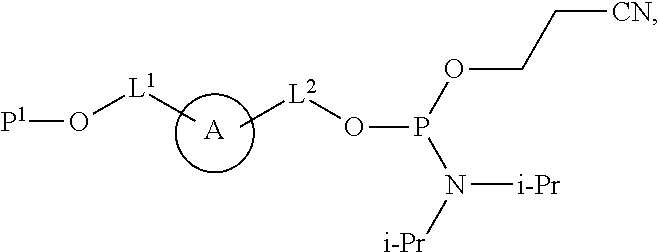
or a salt thereof.

or a salt thereof.

or a salt thereof, wherein:

or a salt thereof, wherein:

or a salt thereof.

or a salt thereof.

or a salt thereof, wherein X− is a counterion or is absent.

or a salt thereof.

or a salt thereof.

or a salt thereof.

or a salt thereof.

or a salt thereof.

or a salt thereof.

or a salt thereof.

or a salt thereof.

or a salt thereof.

or a salt thereof, wherein:

or a salt thereof, wherein:

or a salt thereof, wherein:

or a salt thereof.

or a salt thereof.

or a salt thereof.

or a salt thereof.

or a salt thereof.

or a salt thereof, wherein:

or a salt thereof.

or a salt thereof, wherein:

or a salt thereof.

or a salt thereof.

or a salt thereof.

or a salt thereof, wherein n is independently an integer from 1-20, inclusive.

or a salt thereof.

or a salt thereof.

or a salt thereof.

or a salt thereof.

or a salt thereof.
Methods for Preparing Internally-Labeled Biomolecules

or a salt thereof;

or a salt thereof:


or a salt thereof, the method comprising coupling a compound of the formula:

or a salt thereof, with a compound of the formula

or a salt thereof, in the presence of palladium to yield a compound of Formula (III), or a salt thereof, wherein:

As defined herein, each instance of RB is independently optionally substituted alkyl, optionally substituted carbocyclyl, optionally substituted heterocyclyl, optionally substituted aryl, optionally substituted heteroaryl, —OH, or —ORO. Optionally, two RB are joined together with the intervening atoms to form optionally substituted carbocyclyl or optionally substituted heterocyclyl. In general, —B(RB)2 is any suitable borane, boronic acid, or boronic ester useful in a metal-promoted or metal-catalyzed cross-coupling reaction.

or a salt thereof; and the starting material is therefore of the formula:

or a salt thereof.

or a salt thereof; wherein n is an integer from 1-20, inclusive; and therefore the starting materials are of the formulae:

or salts thereof.

or a salt thereof, to yield a compound of the formula:

or its tautomer:

or a salt thereof, wherein:

or its tautomer:

or a salt thereof.

In certain embodiments, two R3 are joined together with the intervening atoms to form:


or a salt thereof, in the presence of a formamidine, to yield a compound of formula:

or a salt thereof. In certain embodiments, the reaction entails (i) reacting the compound of Formula (IV), or a salt thereof, in the presence of a formamidine to form an intermediate; and (ii) reacting the intermediate formed in step (i) with another compound of Formula (IV), or a salt thereof, to yield the product shown above.

or a salt thereof.

or a salt thereof, in the presence of an acid, to yield a compound of the formula:

or a salt thereof. In certain embodiments, the acid is a sulfonic acid. In certain embodiments, the acid is sulfuric acid. In certain embodiments, the reaction is carried out in a solvent. In certain embodiments, the solvent is CH2Cl2. In certain embodiments, the reaction is carried out at elevated temperature (e.g., around 60° C.).

or a salt thereof.

or a salt thereof, to yield a compound of the formula:

or a salt thereof.

or a salt thereof.

or a salt thereof, to yield a compound of the formula:

or a salt thereof; and

or a salt thereof.

may be an (E)- or (Z)-double bond.


Claims (15)


Priority Applications (1)
| Application Number | Priority Date | Filing Date | Title |
|---|---|---|---|
| US16/510,794 US12312377B2 (en) | 2018-07-13 | 2019-07-12 | Biconjugatable labels and methods of use |
Applications Claiming Priority (2)
| Application Number | Priority Date | Filing Date | Title |
|---|---|---|---|
| US201862698006P | 2018-07-13 | 2018-07-13 | |
| US16/510,794 US12312377B2 (en) | 2018-07-13 | 2019-07-12 | Biconjugatable labels and methods of use |
Publications (2)
| Publication Number | Publication Date |
|---|---|
| US20200031861A1 US20200031861A1 (en) | 2020-01-30 |
| US12312377B2 true US12312377B2 (en) | 2025-05-27 |
Family
ID=67480391
Family Applications (1)
| Application Number | Title | Priority Date | Filing Date |
|---|---|---|---|
| US16/510,794 Active 2041-11-14 US12312377B2 (en) | 2018-07-13 | 2019-07-12 | Biconjugatable labels and methods of use |
Country Status (10)
| Country | Link |
|---|---|
| US (1) | US12312377B2 (en) |
| EP (1) | EP3820943A1 (en) |
| JP (1) | JP7676302B2 (en) |
| KR (1) | KR20210031935A (en) |
| CN (1) | CN112739781B (en) |
| AU (2) | AU2019300169A1 (en) |
| BR (1) | BR112021000344A2 (en) |
| CA (1) | CA3105715A1 (en) |
| MX (1) | MX2021000470A (en) |
| WO (1) | WO2020014681A1 (en) |
Families Citing this family (4)
| Publication number | Priority date | Publication date | Assignee | Title |
|---|---|---|---|---|
| WO2019023257A1 (en) | 2017-07-24 | 2019-01-31 | Quantum-Si Incorporated | High intensity labeled reactant compositions and methods for sequencing |
| CN113614097A (en) | 2019-01-23 | 2021-11-05 | 宽腾矽公司 | High-strength labeled reactant compositions and sequencing methods |
| KR20230097103A (en) * | 2020-10-27 | 2023-06-30 | 퀀텀-에스아이 인코포레이티드 | Single molecule detection system using photobleaching information |
| CN119320418A (en) * | 2022-01-05 | 2025-01-17 | 大睿生物医药科技(上海)有限公司 | Double stranded RNA with nucleotide analogs |
Citations (107)
| Publication number | Priority date | Publication date | Assignee | Title |
|---|---|---|---|---|
| US5210015A (en) | 1990-08-06 | 1993-05-11 | Hoffman-La Roche Inc. | Homogeneous assay system using the nuclease activity of a nucleic acid polymerase |
| WO1993009128A1 (en) | 1991-11-07 | 1993-05-13 | Nanotronics, Inc. | Hybridization of polynucleotides conjugated with chromophores and fluorophores to generate donor-to-donor energy transfer system |
| US5594117A (en) | 1994-08-25 | 1997-01-14 | Chiron Corporation | Polynucleotide reagents containing modified deoxyribose moieties and associated methods of synthesis and use |
| US5707804A (en) | 1994-02-01 | 1998-01-13 | The Regents Of The University Of California | Primers labeled with energy transfer coupled dyes for DNA sequencing |
| US5851840A (en) | 1994-01-19 | 1998-12-22 | Boehringer Mannheim Gmbh | Biotinsilane compounds and a binding matrix containing these compounds |
| US6133445A (en) | 1997-12-17 | 2000-10-17 | Carnegie Mellon University | Rigidized trimethine cyanine dyes |
| WO2000070073A1 (en) | 1999-05-19 | 2000-11-23 | Cornell Research Foundation, Inc. | Method for sequencing nucleic acid molecules |
| US6153442A (en) | 1998-05-20 | 2000-11-28 | Dade Behring Inc. | Reagents and methods for specific binding assays |
| WO2001009389A2 (en) | 1999-08-02 | 2001-02-08 | Molecular Dynamics, Inc. | Methods and apparatus for template capture and normalization for submicroliter reaction |
| US6248518B1 (en) | 1996-10-29 | 2001-06-19 | Board Of Regents Of University Of Nebraska | Method for detecting point mutations in DNA utilizing fluorescence energy transfer |
| US6255083B1 (en) | 1998-12-14 | 2001-07-03 | Li Cor Inc | System and methods for nucleic acid sequencing of single molecules by polymerase synthesis |
| JP2002508428A (en) | 1997-12-17 | 2002-03-19 | カーネギー メロン ユニヴァーシティ | Cured trimethine cyanine dye |
| US6399335B1 (en) | 1999-11-16 | 2002-06-04 | Advanced Research And Technology Institute, Inc. | γ-phosphoester nucleoside triphosphates |
| US6444682B1 (en) | 1997-07-31 | 2002-09-03 | Nycomed Amersham Plc | Base analogues |
| US20020182625A1 (en) | 2001-03-12 | 2002-12-05 | Mcgall Glenn | Nucleic acid labeling compounds |
| CA2457513A1 (en) | 2001-08-29 | 2003-03-13 | Amersham Biosciences Corp | Labeled nucleoside polyphosphates |
| US20030138809A1 (en) | 1998-05-01 | 2003-07-24 | Peter Williams | Method of determining the nucleotide sequence of oligonucleotides and DNA molecules |
| US20030143591A1 (en) | 2001-10-19 | 2003-07-31 | Proligo, Llc | Nucleic acid probes and methods to detect and/or quantify nucleic acid analytes |
| WO2003089670A2 (en) | 2002-04-22 | 2003-10-30 | Lawler Joseph F Jr | Reagents for monitoring nuclei acid amplification and methods of using same |
| WO2003102239A2 (en) | 2002-05-31 | 2003-12-11 | Secretary, Department Of Atomic Energy | Met/fret based method of target nucleic acid detection whereby the donor/acceptor moieties are on complementary strands |
| GB2398383A (en) | 2003-02-12 | 2004-08-18 | Global Genomics Ab | Nucleic acid sequencing-by-synthesis |
| US6787308B2 (en) | 1998-07-30 | 2004-09-07 | Solexa Ltd. | Arrayed biomolecules and their use in sequencing |
| WO2004096997A2 (en) | 2003-04-29 | 2004-11-11 | Ribomed Biotechnologies, Inc. | Molecular detection systems utilizing reiterative oligonucleotide synthesis |
| US20050014154A1 (en) | 2001-11-05 | 2005-01-20 | Michael Weizenegger | Method in the form of a dry rapid test for detecting nucleic acids |
| US6846638B2 (en) | 2000-08-10 | 2005-01-25 | Nanobiodynamics, Inc. | Method and system for rapid biomolecular recognition of amino acids and protein sequencing |
| US20050042633A1 (en) | 2003-04-08 | 2005-02-24 | Li-Cor, Inc. | Composition and method for nucleic acid sequencing |
| US6869764B2 (en) | 2000-06-07 | 2005-03-22 | L--Cor, Inc. | Nucleic acid sequencing using charge-switch nucleotides |
| WO2005044836A2 (en) | 2003-11-05 | 2005-05-19 | Genovoxx Gmbh | Macromolecular nucleotide compounds and methods for using the same |
| US6936702B2 (en) | 2000-06-07 | 2005-08-30 | Li-Cor, Inc. | Charge-switch nucleotides |
| US20050266456A1 (en) | 2004-04-30 | 2005-12-01 | Li-Cor, Inc. | Field-switch sequencing |
| US7057026B2 (en) | 2001-12-04 | 2006-06-06 | Solexa Limited | Labelled nucleotides |
| EP1681356A1 (en) | 1999-05-19 | 2006-07-19 | Cornell Research Foundation, Inc. | Method for sequencing nucleic acid molecules |
| WO2007015168A2 (en) | 2005-07-01 | 2007-02-08 | Dako Denmark A/S | Monomeric and polymeric linkers useful for conjugating biological molecules and other substances |
| CN1938328A (en) | 2004-03-09 | 2007-03-28 | 日本碍子株式会社 | Nucleotide Derivatives and DNA Microarrays |
| US20070072196A1 (en) | 2005-09-29 | 2007-03-29 | Pacific Biosciences Of California, Inc. | Fluorescent nucleotide analogs and uses therefor |
| WO2007064905A2 (en) | 2005-12-02 | 2007-06-07 | Pacific Biosciences Of California, Inc. | Mitigation of photodamage in analytical reactions |
| WO2007070572A2 (en) | 2005-12-12 | 2007-06-21 | The Government Of The United States Of America, As Represented By The Secretary Of The Department Of Health And Human Services | Probe for nucleic acid sequencing and methods of use |
| US20070219367A1 (en) | 2003-10-20 | 2007-09-20 | Shchepinov Mikhail S | Parallel Polymer Sequencing Methods |
| CN101076537A (en) | 2003-11-19 | 2007-11-21 | 阿莱洛吉克生物科学公司 | Oligonucleotides labeled with a plurality of fluorophores |
| CN101268200A (en) | 2005-07-20 | 2008-09-17 | Lgc有限公司 | Oligonucleotides |
| CN101346472A (en) | 2005-12-21 | 2009-01-14 | 霍夫曼—拉罗奇有限公司 | Sequencing and genotyping with reversibly 2'-modified nucleotides |
| US20090068645A1 (en) | 2004-10-11 | 2009-03-12 | Interaseq Genetics Limited | Labeling and Sequencing of Nucleic Acids |
| US20090104614A1 (en) | 2006-03-15 | 2009-04-23 | The Trustees Of The University Of Pennsylvania | Quantitative molecular probes |
| US20090117540A1 (en) | 1999-10-29 | 2009-05-07 | Stratagene California | Methods for detection of a target nucleic acid by forming a cleavage structure using an RNA polymerase |
| CN101434988A (en) | 2007-11-16 | 2009-05-20 | 深圳华因康基因科技有限公司 | High throughput oligonucleotide sequencing method |
| US20090214436A1 (en) | 2008-02-18 | 2009-08-27 | Washington University | Dichromic fluorescent compounds |
| US20090233302A1 (en) | 2008-03-13 | 2009-09-17 | Pacific Biosciences Of California, Inc. | Labeled reactants and their uses |
| US20090263802A1 (en) | 2008-01-28 | 2009-10-22 | Complete Genomics, Inc. | Methods and compositions for efficient base calling in sequencing reactions |
| US20090263327A1 (en) * | 2000-10-16 | 2009-10-22 | Mallinckrodt Inc. | Minimally invasive physiological function monitoring agents |
| US20100009872A1 (en) | 2008-03-31 | 2010-01-14 | Pacific Biosciences Of California, Inc. | Single molecule loading methods and compositions |
| CN101636406A (en) | 2006-12-05 | 2010-01-27 | 激光基因公司 | Photocleavable labeled nucleotides and nucleosides and methods of use thereof in DNA sequencing |
| US20100035254A1 (en) | 2003-04-08 | 2010-02-11 | Pacific Biosciences Of California, Inc. | Composition and method for nucleic acid sequencing |
| US20100034750A1 (en) | 2006-12-21 | 2010-02-11 | Emma Perfect | Composition and method for detection of demineralisation |
| US20100093553A1 (en) | 2001-09-05 | 2010-04-15 | Joon Won Park | Solid Substrate Comprising Array of Dendrons and Methods for Using the Same |
| US20100129822A1 (en) | 2008-11-25 | 2010-05-27 | Gen-Probe Incorporated | Compositions and methods for detecting small rnas, and uses thereof |
| WO2010065322A1 (en) | 2008-12-01 | 2010-06-10 | Research Triangle Institute | Concurrent identification of multitudes of polypeptides |
| US20100152424A1 (en) | 2008-11-19 | 2010-06-17 | Pacific Biosciences Of California, Inc. | Modular Nucleotide Compositions and Uses Therefor |
| EP2226330A1 (en) | 2000-06-07 | 2010-09-08 | Pacific Biosciences of California, Inc. | Charge-switch nucleotides |
| WO2010115016A2 (en) | 2009-04-03 | 2010-10-07 | Sequenom, Inc. | Nucleic acid preparation compositions and methods |
| WO2010117420A2 (en) | 2009-03-30 | 2010-10-14 | Pacific Biosciences Of California, Inc. | Fret-labeled compounds and uses therefor |
| US20100317005A1 (en) | 2000-07-07 | 2010-12-16 | Life Technologies Corporation | Modified Nucleotides and Methods for Making and Use Same |
| US20110003343A1 (en) | 2009-03-27 | 2011-01-06 | Life Technologies Corporation | Conjugates of biomolecules to nanoparticles |
| US7973146B2 (en) | 2008-03-26 | 2011-07-05 | Pacific Biosciences Of California, Inc. | Engineered fluorescent dye labeled nucleotide analogs for DNA sequencing |
| US20110165652A1 (en) | 2008-01-14 | 2011-07-07 | Life Technologies Corporation | Compositions, methods and systems for single molecule sequencing |
| CN102124128A (en) | 2008-06-16 | 2011-07-13 | Plc诊断股份有限公司 | Systems and methods for nucleic acid sequencing by phased synthesis |
| US20110212437A1 (en) | 2010-02-18 | 2011-09-01 | Pacific Biosciences Of California, Inc. | Single molecule sequencing with two distinct chemistry steps |
| US8034623B2 (en) | 2009-01-12 | 2011-10-11 | University-Industry Cooperation Foundation, Sogang University | Method for free radical initiated peptide sequencing |
| US20110256549A1 (en) | 2010-01-19 | 2011-10-20 | Sirigen, Inc. | Novel reagents for directed biomarker signal amplification |
| US20110281776A1 (en) | 2010-05-06 | 2011-11-17 | Ibis Biosciences, Inc. | Integrated sample preparation systems and stabilized enzyme mixtures |
| WO2011150852A1 (en) | 2010-06-02 | 2011-12-08 | Industrial Technology Research Institute | Compositions and methods for sequencing nucleic acids |
| US8084734B2 (en) | 2006-05-26 | 2011-12-27 | The George Washington University | Laser desorption ionization and peptide sequencing on laser induced silicon microcolumn arrays |
| US20120016128A1 (en) * | 2010-07-16 | 2012-01-19 | Zhenjun Diwu | Rhodamine lactone phosphoramidites and polymers |
| CN102329884A (en) | 2011-10-20 | 2012-01-25 | 东南大学 | Synchronous synthesis and DNA sequencing method for two nucleotides and application thereof |
| WO2012027625A2 (en) | 2010-08-25 | 2012-03-01 | Pacific Biosciences Of California, Inc. | Scaffold-based polymerase enzyme substrates |
| US8153375B2 (en) | 2008-03-28 | 2012-04-10 | Pacific Biosciences Of California, Inc. | Compositions and methods for nucleic acid sequencing |
| US8257954B2 (en) | 2008-03-31 | 2012-09-04 | Pacific Biosciences Of California, Inc. | Generation of modified polymerases for improved accuracy in single molecule sequencing |
| US20120322692A1 (en) | 2011-03-23 | 2012-12-20 | Pacific Biosciences Of California, Inc. | Loading molecules onto substrates |
| US8420366B2 (en) | 2008-03-31 | 2013-04-16 | Pacific Biosciences Of California, Inc. | Generation of modified polymerases for improved accuracy in single molecule sequencing |
| US20130240359A1 (en) | 2010-04-09 | 2013-09-19 | Pacific Biosciences Of California, Inc. | Nanopore sequencing using charge blockade labels |
| US8581179B2 (en) | 2009-03-18 | 2013-11-12 | Bruker Daltonik Gmbh | Protein sequencing with MALDI mass spectrometry |
| US20130316912A1 (en) | 2012-02-15 | 2013-11-28 | Pacific Biosciences Of California, Inc. | Polymerase enzyme substrates with protein shield |
| US20140094375A1 (en) | 2012-10-01 | 2014-04-03 | Pacific Biosciences Of California, Inc. | Recombinant Polymerases for Incorporation of Protein Shield Nucleotide Analogs |
| CN103866010A (en) | 2014-02-28 | 2014-06-18 | 郭诚 | Gene sequencing method |
| US20150050659A1 (en) | 2013-08-05 | 2015-02-19 | Pacific Biosciences Of California, Inc. | Protected fluorescent reagent compounds |
| JP2015073523A (en) | 2013-10-11 | 2015-04-20 | 国立大学法人 東京大学 | Nucleic acid detection method, detection probe, microarray, nucleic acid detection kit, nucleic acid-detection probe-capture probe complex, nucleic acid-immobilized carrier, and fluidic device |
| US20150293022A1 (en) | 2014-04-15 | 2015-10-15 | The Government Of The United States Of America, As Represented By The Secretary Of The Navy | Use of Modular Nucleic Acid Scaffolds to Create Nanoscale Energy Harvesting and Focusing Arrays |
| CN105001292A (en) | 2015-07-14 | 2015-10-28 | 深圳市瀚海基因生物科技有限公司 | Light-fractured fluorescence-labeling reversible terminal compound and use thereof in DNA (Deoxyribonucleic Acid) or RNA (Ribonucleic Acid) sequencing |
| JP2016011429A (en) | 2006-01-20 | 2016-01-21 | スターファーマ・プロプライエタリー・リミテッドStarpharma Pty Ltd | Modified polymer |
| US9435810B2 (en) | 2013-03-15 | 2016-09-06 | Washington University | Molecules and methods for iterative polypeptide analysis and processing |
| WO2016187580A1 (en) | 2015-05-20 | 2016-11-24 | Quantum-Si Incorporated | Method of determining the sequence of a nuclear acid using time resolved luminescence |
| US9566335B1 (en) | 2009-09-25 | 2017-02-14 | The Governing Council Of The University Of Toronto | Protein sequencing method and reagents |
| US20170136433A1 (en) | 2015-11-18 | 2017-05-18 | Pacific Biosciences Of California, Inc. | Loading nucleic acids onto substrates |
| US9678080B2 (en) | 2013-06-14 | 2017-06-13 | Pacific Biosciences Of California, Inc. | Bis-biotinylation tags |
| US9719073B2 (en) | 2008-03-31 | 2017-08-01 | Pacific Biosciences Of California, Inc. | Recombinant polymerases for improved single molecule sequencing |
| WO2017201514A1 (en) | 2016-05-20 | 2017-11-23 | Quantum-Si Incorporated | Labeled nucleotide compositions and methods for nucleic acid sequencing |
| US20180002736A1 (en) * | 2015-01-28 | 2018-01-04 | The Regents Of The University Of California | Methods and compositions for labeling a single-stranded target nucleic acid |
| US20180299460A1 (en) | 2015-10-16 | 2018-10-18 | The Governing Council Of The University Of Toronto | Protein sequencing methods and reagents |
| US10150872B2 (en) | 2015-02-04 | 2018-12-11 | Pacific Biosciences Of California, Inc. | Multimeric protected fluorescent reagents |
| US10174363B2 (en) | 2015-05-20 | 2019-01-08 | Quantum-Si Incorporated | Methods for nucleic acid sequencing |
| US20190024168A1 (en) | 2017-07-24 | 2019-01-24 | Quantum-Si Incorporated | High intensity labeled reactant compositions and methods for sequencing |
| WO2019040825A1 (en) | 2017-08-24 | 2019-02-28 | The United States Of America, As Represented By The Secretary, Department Of Health And Human Services | Conformational restriction of cyanine fluorophores in far-red and near-ir range |
| US10545153B2 (en) | 2014-09-15 | 2020-01-28 | Board Of Regents, The University Of Texas System | Single molecule peptide sequencing |
| US10544449B2 (en) | 2013-06-14 | 2020-01-28 | Pacific Biosciences Of California, Inc. | Bis-biotinylation tags |
| US20200148727A1 (en) | 2018-11-08 | 2020-05-14 | Government Of The United States Of America, As Represented By The Secretary Of Commerce | Amino acid-specific binder and selectively identifying an amino acid |
| US10676788B2 (en) | 2015-11-20 | 2020-06-09 | Pacific Biosciences Of California, Inc. | Modified nucleotide reagents |
| US20200232017A1 (en) | 2019-01-23 | 2020-07-23 | Quantum-Si Incorporated | High intensity labeled reactant compositions and methods for sequencing |
| US20230221330A1 (en) | 2022-01-12 | 2023-07-13 | Quantum-Si Incorporated | Labeled binding reagents and methods of use thereof |
-
2019
- 2019-07-12 MX MX2021000470A patent/MX2021000470A/en unknown
- 2019-07-12 WO PCT/US2019/041717 patent/WO2020014681A1/en not_active Ceased
- 2019-07-12 CA CA3105715A patent/CA3105715A1/en active Pending
- 2019-07-12 BR BR112021000344-4A patent/BR112021000344A2/en not_active IP Right Cessation
- 2019-07-12 JP JP2021500923A patent/JP7676302B2/en active Active
- 2019-07-12 CN CN201980061143.4A patent/CN112739781B/en not_active Expired - Fee Related
- 2019-07-12 AU AU2019300169A patent/AU2019300169A1/en not_active Abandoned
- 2019-07-12 US US16/510,794 patent/US12312377B2/en active Active
- 2019-07-12 EP EP19746323.5A patent/EP3820943A1/en not_active Withdrawn
- 2019-07-12 KR KR1020217003873A patent/KR20210031935A/en not_active Ceased
-
2024
- 2024-11-11 AU AU2024259870A patent/AU2024259870A1/en not_active Abandoned
Patent Citations (180)
| Publication number | Priority date | Publication date | Assignee | Title |
|---|---|---|---|---|
| US5487972A (en) | 1990-08-06 | 1996-01-30 | Hoffmann-La Roche Inc. | Nucleic acid detection by the 5'-3'exonuclease activity of polymerases acting on adjacently hybridized oligonucleotides |
| US5210015A (en) | 1990-08-06 | 1993-05-11 | Hoffman-La Roche Inc. | Homogeneous assay system using the nuclease activity of a nucleic acid polymerase |
| WO1993009128A1 (en) | 1991-11-07 | 1993-05-13 | Nanotronics, Inc. | Hybridization of polynucleotides conjugated with chromophores and fluorophores to generate donor-to-donor energy transfer system |
| JPH07502992A (en) | 1991-11-07 | 1995-03-30 | ナノトロニクス,インコーポレイテッド | Hybridization of polynucleotides conjugated with chromophores and fluorophores to create donor-donor energy transfer systems |
| US5851840A (en) | 1994-01-19 | 1998-12-22 | Boehringer Mannheim Gmbh | Biotinsilane compounds and a binding matrix containing these compounds |
| US5707804A (en) | 1994-02-01 | 1998-01-13 | The Regents Of The University Of California | Primers labeled with energy transfer coupled dyes for DNA sequencing |
| US5594117A (en) | 1994-08-25 | 1997-01-14 | Chiron Corporation | Polynucleotide reagents containing modified deoxyribose moieties and associated methods of synthesis and use |
| US6248518B1 (en) | 1996-10-29 | 2001-06-19 | Board Of Regents Of University Of Nebraska | Method for detecting point mutations in DNA utilizing fluorescence energy transfer |
| US6444682B1 (en) | 1997-07-31 | 2002-09-03 | Nycomed Amersham Plc | Base analogues |
| US6133445A (en) | 1997-12-17 | 2000-10-17 | Carnegie Mellon University | Rigidized trimethine cyanine dyes |
| JP2002508428A (en) | 1997-12-17 | 2002-03-19 | カーネギー メロン ユニヴァーシティ | Cured trimethine cyanine dye |
| US20030138809A1 (en) | 1998-05-01 | 2003-07-24 | Peter Williams | Method of determining the nucleotide sequence of oligonucleotides and DNA molecules |
| US6153442A (en) | 1998-05-20 | 2000-11-28 | Dade Behring Inc. | Reagents and methods for specific binding assays |
| US6787308B2 (en) | 1998-07-30 | 2004-09-07 | Solexa Ltd. | Arrayed biomolecules and their use in sequencing |
| US8530154B2 (en) | 1998-12-14 | 2013-09-10 | Pacific Biosciences Of California, Inc. | System and method for nucleic acid sequencing by polymerase synthesis |
| US7229799B2 (en) | 1998-12-14 | 2007-06-12 | Li-Cor, Inc. | System and method for nucleic acid sequencing by polymerase synthesis |
| US9845501B2 (en) | 1998-12-14 | 2017-12-19 | Pacific of Biosciences of California, Inc. | System and methods for nucleic acid sequencing of single molecules by polymerase synthesis |
| US8192961B2 (en) | 1998-12-14 | 2012-06-05 | Pacific Biosciences Of California, Inc. | System and methods for nucleic acid sequencing of single molecules by polymerase synthesis |
| US6762048B2 (en) | 1998-12-14 | 2004-07-13 | Li-Cor, Inc. | System and apparatus for nucleic acid sequencing of single molecules by polymerase synthesis |
| US8980584B2 (en) | 1998-12-14 | 2015-03-17 | Pacific Biosciences Of California, Inc. | System and methods for nucleic acid sequencing of single molecules by polymerase synthesis |
| US6255083B1 (en) | 1998-12-14 | 2001-07-03 | Li Cor Inc | System and methods for nucleic acid sequencing of single molecules by polymerase synthesis |
| CA2373385C (en) | 1999-05-19 | 2012-07-03 | Cornell Research Foundation, Inc. | Method for sequencing nucleic acid molecules |
| US7052847B2 (en) | 1999-05-19 | 2006-05-30 | Cornell Research Foundation, Inc. | Method for sequencing nucleic acid molecules |
| WO2000070073A1 (en) | 1999-05-19 | 2000-11-23 | Cornell Research Foundation, Inc. | Method for sequencing nucleic acid molecules |
| EP1179085B1 (en) | 1999-05-19 | 2010-05-05 | Cornell Research Foundation, Inc. | Method for sequencing nucleic acid molecules |
| JP2002543847A (en) | 1999-05-19 | 2002-12-24 | コーネル リサーチ ファンデーション インク. | Methods for sequencing nucleic acid molecules |
| US7361466B2 (en) | 1999-05-19 | 2008-04-22 | Cornell Research Foundation, Inc. | Nucleic acid analysis using terminal-phosphate-labeled nucleotides |
| EP1681356A1 (en) | 1999-05-19 | 2006-07-19 | Cornell Research Foundation, Inc. | Method for sequencing nucleic acid molecules |
| US7056661B2 (en) | 1999-05-19 | 2006-06-06 | Cornell Research Foundation, Inc. | Method for sequencing nucleic acid molecules |
| CN1373813A (en) | 1999-08-02 | 2002-10-09 | 分子动力学公司 | Method and apparatus for template capture and normalization of submicroliter reactions |
| WO2001009389A2 (en) | 1999-08-02 | 2001-02-08 | Molecular Dynamics, Inc. | Methods and apparatus for template capture and normalization for submicroliter reaction |
| US20090117540A1 (en) | 1999-10-29 | 2009-05-07 | Stratagene California | Methods for detection of a target nucleic acid by forming a cleavage structure using an RNA polymerase |
| US6399335B1 (en) | 1999-11-16 | 2002-06-04 | Advanced Research And Technology Institute, Inc. | γ-phosphoester nucleoside triphosphates |
| EP2226330A1 (en) | 2000-06-07 | 2010-09-08 | Pacific Biosciences of California, Inc. | Charge-switch nucleotides |
| US7625701B2 (en) | 2000-06-07 | 2009-12-01 | Pacific Biosciences Of California, Inc. | Charge switch nucleotides |
| US6936702B2 (en) | 2000-06-07 | 2005-08-30 | Li-Cor, Inc. | Charge-switch nucleotides |
| US6869764B2 (en) | 2000-06-07 | 2005-03-22 | L--Cor, Inc. | Nucleic acid sequencing using charge-switch nucleotides |
| US8148516B2 (en) | 2000-06-07 | 2012-04-03 | Pacific Biosciences Of California, Inc. | Flowcell systems for single molecule detection |
| US20100317005A1 (en) | 2000-07-07 | 2010-12-16 | Life Technologies Corporation | Modified Nucleotides and Methods for Making and Use Same |
| US6846638B2 (en) | 2000-08-10 | 2005-01-25 | Nanobiodynamics, Inc. | Method and system for rapid biomolecular recognition of amino acids and protein sequencing |
| US20090263327A1 (en) * | 2000-10-16 | 2009-10-22 | Mallinckrodt Inc. | Minimally invasive physiological function monitoring agents |
| US20020182625A1 (en) | 2001-03-12 | 2002-12-05 | Mcgall Glenn | Nucleic acid labeling compounds |
| US20030124576A1 (en) | 2001-08-29 | 2003-07-03 | Shiv Kumar | Labeled nucleoside polyphosphates |
| EP1421213B1 (en) | 2001-08-29 | 2010-02-17 | Amersham Biosciences Corp. | Labeled nucleoside polyphosphates |
| US7041812B2 (en) | 2001-08-29 | 2006-05-09 | Amersham Biosciences Corp | Labeled nucleoside polyphosphates |
| CA2457513A1 (en) | 2001-08-29 | 2003-03-13 | Amersham Biosciences Corp | Labeled nucleoside polyphosphates |
| US20100093553A1 (en) | 2001-09-05 | 2010-04-15 | Joon Won Park | Solid Substrate Comprising Array of Dendrons and Methods for Using the Same |
| US20030143591A1 (en) | 2001-10-19 | 2003-07-31 | Proligo, Llc | Nucleic acid probes and methods to detect and/or quantify nucleic acid analytes |
| JP2005507674A (en) | 2001-11-05 | 2005-03-24 | へイン ライフサイエンス ゲーエムベーハー | Methods for detecting nucleic acids in the form of rapid drying assays |
| US20050014154A1 (en) | 2001-11-05 | 2005-01-20 | Michael Weizenegger | Method in the form of a dry rapid test for detecting nucleic acids |
| US7057026B2 (en) | 2001-12-04 | 2006-06-06 | Solexa Limited | Labelled nucleotides |
| WO2003089670A2 (en) | 2002-04-22 | 2003-10-30 | Lawler Joseph F Jr | Reagents for monitoring nuclei acid amplification and methods of using same |
| WO2003102239A2 (en) | 2002-05-31 | 2003-12-11 | Secretary, Department Of Atomic Energy | Met/fret based method of target nucleic acid detection whereby the donor/acceptor moieties are on complementary strands |
| CN1771336A (en) | 2003-02-12 | 2006-05-10 | 金尼松斯文斯卡股份公司 | Methods and means for nucleic acid sequencing |
| GB2398383A (en) | 2003-02-12 | 2004-08-18 | Global Genomics Ab | Nucleic acid sequencing-by-synthesis |
| US20050042633A1 (en) | 2003-04-08 | 2005-02-24 | Li-Cor, Inc. | Composition and method for nucleic acid sequencing |
| US20100035254A1 (en) | 2003-04-08 | 2010-02-11 | Pacific Biosciences Of California, Inc. | Composition and method for nucleic acid sequencing |
| WO2004096997A2 (en) | 2003-04-29 | 2004-11-11 | Ribomed Biotechnologies, Inc. | Molecular detection systems utilizing reiterative oligonucleotide synthesis |
| US20070219367A1 (en) | 2003-10-20 | 2007-09-20 | Shchepinov Mikhail S | Parallel Polymer Sequencing Methods |
| US20100029494A1 (en) | 2003-11-05 | 2010-02-04 | Dmitry Cherkasov | Macromolecular Nucleotide Compounds And Methods For Using The Same |
| WO2005044836A2 (en) | 2003-11-05 | 2005-05-19 | Genovoxx Gmbh | Macromolecular nucleotide compounds and methods for using the same |
| CN101076537A (en) | 2003-11-19 | 2007-11-21 | 阿莱洛吉克生物科学公司 | Oligonucleotides labeled with a plurality of fluorophores |
| CN1938328A (en) | 2004-03-09 | 2007-03-28 | 日本碍子株式会社 | Nucleotide Derivatives and DNA Microarrays |
| US20050266456A1 (en) | 2004-04-30 | 2005-12-01 | Li-Cor, Inc. | Field-switch sequencing |
| US20090068645A1 (en) | 2004-10-11 | 2009-03-12 | Interaseq Genetics Limited | Labeling and Sequencing of Nucleic Acids |
| WO2007015168A2 (en) | 2005-07-01 | 2007-02-08 | Dako Denmark A/S | Monomeric and polymeric linkers useful for conjugating biological molecules and other substances |
| US8383791B1 (en) | 2005-07-20 | 2013-02-26 | Lgc Limited | Oligonucleotides |
| CN101268200A (en) | 2005-07-20 | 2008-09-17 | Lgc有限公司 | Oligonucleotides |
| US7405281B2 (en) | 2005-09-29 | 2008-07-29 | Pacific Biosciences Of California, Inc. | Fluorescent nucleotide analogs and uses therefor |
| US20070072196A1 (en) | 2005-09-29 | 2007-03-29 | Pacific Biosciences Of California, Inc. | Fluorescent nucleotide analogs and uses therefor |
| WO2007041342A2 (en) | 2005-09-29 | 2007-04-12 | Pacific Biosciences Of California, Inc. | Labeled nucleotide analogs and uses therefor |
| JP2009518009A (en) | 2005-12-02 | 2009-05-07 | パシフィック バイオサイエンシーズ オブ カリフォルニア, インコーポレイテッド | Mitigation of photodamage in analytical reactions. |
| WO2007064905A2 (en) | 2005-12-02 | 2007-06-07 | Pacific Biosciences Of California, Inc. | Mitigation of photodamage in analytical reactions |
| WO2007070572A2 (en) | 2005-12-12 | 2007-06-21 | The Government Of The United States Of America, As Represented By The Secretary Of The Department Of Health And Human Services | Probe for nucleic acid sequencing and methods of use |
| CN101346472A (en) | 2005-12-21 | 2009-01-14 | 霍夫曼—拉罗奇有限公司 | Sequencing and genotyping with reversibly 2'-modified nucleotides |
| JP2016011429A (en) | 2006-01-20 | 2016-01-21 | スターファーマ・プロプライエタリー・リミテッドStarpharma Pty Ltd | Modified polymer |
| US20090104614A1 (en) | 2006-03-15 | 2009-04-23 | The Trustees Of The University Of Pennsylvania | Quantitative molecular probes |
| US8084734B2 (en) | 2006-05-26 | 2011-12-27 | The George Washington University | Laser desorption ionization and peptide sequencing on laser induced silicon microcolumn arrays |
| CN101636406A (en) | 2006-12-05 | 2010-01-27 | 激光基因公司 | Photocleavable labeled nucleotides and nucleosides and methods of use thereof in DNA sequencing |
| US20100034750A1 (en) | 2006-12-21 | 2010-02-11 | Emma Perfect | Composition and method for detection of demineralisation |
| CN101434988A (en) | 2007-11-16 | 2009-05-20 | 深圳华因康基因科技有限公司 | High throughput oligonucleotide sequencing method |
| US20110165652A1 (en) | 2008-01-14 | 2011-07-07 | Life Technologies Corporation | Compositions, methods and systems for single molecule sequencing |
| US20090263802A1 (en) | 2008-01-28 | 2009-10-22 | Complete Genomics, Inc. | Methods and compositions for efficient base calling in sequencing reactions |
| US20090214436A1 (en) | 2008-02-18 | 2009-08-27 | Washington University | Dichromic fluorescent compounds |
| EP2263087A1 (en) | 2008-03-13 | 2010-12-22 | Pacific Biosciences of California, Inc. | Labeled reactants and their uses |
| US7968702B2 (en) | 2008-03-13 | 2011-06-28 | Pacific Biosciences Of California, Inc. | Labeled reactants and their uses |
| US8906614B2 (en) | 2008-03-13 | 2014-12-09 | Pacific Biosciences Of California, Inc. | Labeled reactants and their uses |
| US9464107B2 (en) | 2008-03-13 | 2016-10-11 | Pacific Biosciences Of California, Inc. | Labeled nucleotide analogs |
| US20090233302A1 (en) | 2008-03-13 | 2009-09-17 | Pacific Biosciences Of California, Inc. | Labeled reactants and their uses |
| WO2009114182A1 (en) | 2008-03-13 | 2009-09-17 | Pacific Biosciences Of California, Inc. | Labeled reactants and their uses |
| US8354252B2 (en) | 2008-03-13 | 2013-01-15 | Pacific Biosciences Of California, Inc. | Labeled reactants and their uses |
| US8133702B2 (en) | 2008-03-26 | 2012-03-13 | Pacific Biosciences Of California, Inc. | Engineered fluorescent dye labeled nucleotide analogs for DNA sequencing |
| US7973146B2 (en) | 2008-03-26 | 2011-07-05 | Pacific Biosciences Of California, Inc. | Engineered fluorescent dye labeled nucleotide analogs for DNA sequencing |
| US20180211003A1 (en) | 2008-03-28 | 2018-07-26 | Pacific Biosciences Of California, Inc. | Sequencing using concatemers of copies of sense and antisense strands |
| US8309330B2 (en) | 2008-03-28 | 2012-11-13 | Pacific Biosciences Of California, Inc. | Diagnostic sequencing with small nucleic acid circles |
| US9542527B2 (en) | 2008-03-28 | 2017-01-10 | Pacific Biosciences Of California, Inc. | Compositions and methods for nucleic acid sequencing |
| US9600626B2 (en) | 2008-03-28 | 2017-03-21 | Pacific Biosciences Of California, Inc. | Methods and systems for obtaining a single molecule consensus sequence |
| US9404146B2 (en) | 2008-03-28 | 2016-08-02 | Pacific Biosciences Of California, Inc. | Compositions and methods for nucleic acid sequencing |
| US8455193B2 (en) | 2008-03-28 | 2013-06-04 | Pacific Biosciences Of California, Inc. | Compositions and methods for nucleic acid sequencing |
| US8153375B2 (en) | 2008-03-28 | 2012-04-10 | Pacific Biosciences Of California, Inc. | Compositions and methods for nucleic acid sequencing |
| US9910956B2 (en) | 2008-03-28 | 2018-03-06 | Pacific Biosciences Of California, Inc. | Sequencing using concatemers of copies of sense and antisense strands |
| US9582640B2 (en) | 2008-03-28 | 2017-02-28 | Pacific Biosciences Of California, Inc. | Methods for obtaining a single molecule consensus sequence |
| US20190249153A1 (en) | 2008-03-31 | 2019-08-15 | Pacific Biosciences Of California, Inc. | Recombinant polymerases for improved single molecule sequencing |
| US8257954B2 (en) | 2008-03-31 | 2012-09-04 | Pacific Biosciences Of California, Inc. | Generation of modified polymerases for improved accuracy in single molecule sequencing |
| US20100009872A1 (en) | 2008-03-31 | 2010-01-14 | Pacific Biosciences Of California, Inc. | Single molecule loading methods and compositions |
| US8420366B2 (en) | 2008-03-31 | 2013-04-16 | Pacific Biosciences Of California, Inc. | Generation of modified polymerases for improved accuracy in single molecule sequencing |
| US9719073B2 (en) | 2008-03-31 | 2017-08-01 | Pacific Biosciences Of California, Inc. | Recombinant polymerases for improved single molecule sequencing |
| CN102124128A (en) | 2008-06-16 | 2011-07-13 | Plc诊断股份有限公司 | Systems and methods for nucleic acid sequencing by phased synthesis |
| US10161002B2 (en) | 2008-11-19 | 2018-12-25 | Pacific Biosciences Of California, Inc. | Modular nucleotide compositions and uses therefor |
| US9551031B2 (en) | 2008-11-19 | 2017-01-24 | Pacific Biosciences Of California, Inc. | Modular nucleotide compositions and uses therefor |
| US9879319B2 (en) | 2008-11-19 | 2018-01-30 | Pacific Biosciences Of California, Inc. | Modular nucleotide compositions and uses therefor |
| US20100152424A1 (en) | 2008-11-19 | 2010-06-17 | Pacific Biosciences Of California, Inc. | Modular Nucleotide Compositions and Uses Therefor |
| US8252910B2 (en) | 2008-11-19 | 2012-08-28 | Pacific Biosciences Of California, Inc. | Modular nucleotide compositions and uses therefor |
| US8846881B2 (en) | 2008-11-19 | 2014-09-30 | Pacific Biosciences Of California, Inc. | Modular nucleotide compositions and uses therefor |
| US10745750B2 (en) | 2008-11-19 | 2020-08-18 | Pacific Biosciences Of California, Inc. | Modular nucleotide compositions and uses therefor |
| US20100129822A1 (en) | 2008-11-25 | 2010-05-27 | Gen-Probe Incorporated | Compositions and methods for detecting small rnas, and uses thereof |
| WO2010065322A1 (en) | 2008-12-01 | 2010-06-10 | Research Triangle Institute | Concurrent identification of multitudes of polypeptides |
| US8034623B2 (en) | 2009-01-12 | 2011-10-11 | University-Industry Cooperation Foundation, Sogang University | Method for free radical initiated peptide sequencing |
| US8581179B2 (en) | 2009-03-18 | 2013-11-12 | Bruker Daltonik Gmbh | Protein sequencing with MALDI mass spectrometry |
| US20110003343A1 (en) | 2009-03-27 | 2011-01-06 | Life Technologies Corporation | Conjugates of biomolecules to nanoparticles |
| US9551660B2 (en) | 2009-03-30 | 2017-01-24 | Pacific Biosciences Of California, Inc. | Method for detecting reactants using fluorescent signal intensity |
| US10066258B2 (en) | 2009-03-30 | 2018-09-04 | Pacific Biosciences Of California, Inc. | FRET-labeled compounds and uses therefor |
| US8927212B2 (en) | 2009-03-30 | 2015-01-06 | Pacific Biosciences Of California, Inc. | FRET-labeled compounds and uses therefor |
| WO2010117420A2 (en) | 2009-03-30 | 2010-10-14 | Pacific Biosciences Of California, Inc. | Fret-labeled compounds and uses therefor |
| US10570445B2 (en) | 2009-03-30 | 2020-02-25 | Pacific Biosciences Of California, Inc. | Fret-labeled compounds and uses therefor |
| WO2010115016A2 (en) | 2009-04-03 | 2010-10-07 | Sequenom, Inc. | Nucleic acid preparation compositions and methods |
| US20200141944A1 (en) | 2009-09-25 | 2020-05-07 | The Governing Council Of The University Of Toronto | Protein sequencing method and reagents |
| US10481162B2 (en) | 2009-09-25 | 2019-11-19 | The Governing Council Of The University Of Toronto | Protein sequencing method and reagents |
| US9566335B1 (en) | 2009-09-25 | 2017-02-14 | The Governing Council Of The University Of Toronto | Protein sequencing method and reagents |
| US20110256549A1 (en) | 2010-01-19 | 2011-10-20 | Sirigen, Inc. | Novel reagents for directed biomarker signal amplification |
| US20110212437A1 (en) | 2010-02-18 | 2011-09-01 | Pacific Biosciences Of California, Inc. | Single molecule sequencing with two distinct chemistry steps |
| US20130240359A1 (en) | 2010-04-09 | 2013-09-19 | Pacific Biosciences Of California, Inc. | Nanopore sequencing using charge blockade labels |
| US20110281776A1 (en) | 2010-05-06 | 2011-11-17 | Ibis Biosciences, Inc. | Integrated sample preparation systems and stabilized enzyme mixtures |
| WO2011150852A1 (en) | 2010-06-02 | 2011-12-08 | Industrial Technology Research Institute | Compositions and methods for sequencing nucleic acids |
| CN102782159A (en) | 2010-06-02 | 2012-11-14 | 财团法人工业技术研究院 | Compositions and methods for sequencing nucleic acids |
| US20120016128A1 (en) * | 2010-07-16 | 2012-01-19 | Zhenjun Diwu | Rhodamine lactone phosphoramidites and polymers |
| WO2012027625A2 (en) | 2010-08-25 | 2012-03-01 | Pacific Biosciences Of California, Inc. | Scaffold-based polymerase enzyme substrates |
| US20120322692A1 (en) | 2011-03-23 | 2012-12-20 | Pacific Biosciences Of California, Inc. | Loading molecules onto substrates |
| CN102329884A (en) | 2011-10-20 | 2012-01-25 | 东南大学 | Synchronous synthesis and DNA sequencing method for two nucleotides and application thereof |
| US10023605B2 (en) | 2012-02-15 | 2018-07-17 | Pacific Biosciences Of California, Inc. | Labeled nucleotide analogs having protein shields |
| US20150330987A1 (en) | 2012-02-15 | 2015-11-19 | Pacific Biosciences Of California, Inc. | Labeled nucleotide analogs having protein shields |
| US20190010183A1 (en) | 2012-02-15 | 2019-01-10 | Pacific Biosciences Of California, Inc. | Fluorescent polymerase enzyme substrates having protein shields |
| US9062091B2 (en) | 2012-02-15 | 2015-06-23 | Pacific Biosciences Of California, Inc. | Polymerase enzyme substrates with protein shield |
| US20130316912A1 (en) | 2012-02-15 | 2013-11-28 | Pacific Biosciences Of California, Inc. | Polymerase enzyme substrates with protein shield |
| EP2814953A1 (en) | 2012-02-15 | 2014-12-24 | Pacific Biosciences Of California, Inc. | Polymerase enzyme substrates with protein shield |
| US20140094375A1 (en) | 2012-10-01 | 2014-04-03 | Pacific Biosciences Of California, Inc. | Recombinant Polymerases for Incorporation of Protein Shield Nucleotide Analogs |
| US9435810B2 (en) | 2013-03-15 | 2016-09-06 | Washington University | Molecules and methods for iterative polypeptide analysis and processing |
| US10544449B2 (en) | 2013-06-14 | 2020-01-28 | Pacific Biosciences Of California, Inc. | Bis-biotinylation tags |
| US9678080B2 (en) | 2013-06-14 | 2017-06-13 | Pacific Biosciences Of California, Inc. | Bis-biotinylation tags |
| US9957291B2 (en) | 2013-08-05 | 2018-05-01 | Pacific Biosciences Of California, Inc. | Protected fluorescent reagent compounds |
| US20150050659A1 (en) | 2013-08-05 | 2015-02-19 | Pacific Biosciences Of California, Inc. | Protected fluorescent reagent compounds |
| US20180346507A1 (en) | 2013-08-05 | 2018-12-06 | Pacific Biosciences Of California, Inc. | Protected fluorescent reagent compounds |
| JP2015073523A (en) | 2013-10-11 | 2015-04-20 | 国立大学法人 東京大学 | Nucleic acid detection method, detection probe, microarray, nucleic acid detection kit, nucleic acid-detection probe-capture probe complex, nucleic acid-immobilized carrier, and fluidic device |
| CN103866010A (en) | 2014-02-28 | 2014-06-18 | 郭诚 | Gene sequencing method |
| US20150293022A1 (en) | 2014-04-15 | 2015-10-15 | The Government Of The United States Of America, As Represented By The Secretary Of The Navy | Use of Modular Nucleic Acid Scaffolds to Create Nanoscale Energy Harvesting and Focusing Arrays |
| US10545153B2 (en) | 2014-09-15 | 2020-01-28 | Board Of Regents, The University Of Texas System | Single molecule peptide sequencing |
| US20180002736A1 (en) * | 2015-01-28 | 2018-01-04 | The Regents Of The University Of California | Methods and compositions for labeling a single-stranded target nucleic acid |
| US10787573B2 (en) | 2015-02-04 | 2020-09-29 | Pacific Biosciences Of California, Inc. | Multimeric protected fluorescent reagents |
| US10150872B2 (en) | 2015-02-04 | 2018-12-11 | Pacific Biosciences Of California, Inc. | Multimeric protected fluorescent reagents |
| US11001875B2 (en) | 2015-05-20 | 2021-05-11 | Quantum-Si Incorporated | Methods for nucleic acid sequencing |
| WO2016187580A1 (en) | 2015-05-20 | 2016-11-24 | Quantum-Si Incorporated | Method of determining the sequence of a nuclear acid using time resolved luminescence |
| US20190330688A1 (en) | 2015-05-20 | 2019-10-31 | Quantum-Si Incorporated | Methods for nucleic acid sequencing |
| US10174363B2 (en) | 2015-05-20 | 2019-01-08 | Quantum-Si Incorporated | Methods for nucleic acid sequencing |
| CN105001292A (en) | 2015-07-14 | 2015-10-28 | 深圳市瀚海基因生物科技有限公司 | Light-fractured fluorescence-labeling reversible terminal compound and use thereof in DNA (Deoxyribonucleic Acid) or RNA (Ribonucleic Acid) sequencing |
| US20180299460A1 (en) | 2015-10-16 | 2018-10-18 | The Governing Council Of The University Of Toronto | Protein sequencing methods and reagents |
| US20170136433A1 (en) | 2015-11-18 | 2017-05-18 | Pacific Biosciences Of California, Inc. | Loading nucleic acids onto substrates |
| US10676788B2 (en) | 2015-11-20 | 2020-06-09 | Pacific Biosciences Of California, Inc. | Modified nucleotide reagents |
| US20240035081A1 (en) | 2016-05-20 | 2024-02-01 | Quantum-Si Incorporated | Labeled nucleotide compositions and methods for nucleic acid sequencing |
| US20170362651A1 (en) | 2016-05-20 | 2017-12-21 | Quantum-Si Incorporated | Labeled nucleotide compositions and methods for nucleic acid sequencing |
| WO2017201514A1 (en) | 2016-05-20 | 2017-11-23 | Quantum-Si Incorporated | Labeled nucleotide compositions and methods for nucleic acid sequencing |
| US11655504B2 (en) | 2017-07-24 | 2023-05-23 | Quantum-Si Incorporated | High intensity labeled reactant compositions and methods for sequencing |
| US20240068027A1 (en) | 2017-07-24 | 2024-02-29 | Quantum-Si Incorporated | High intensity labeled reactant compositions and methods for sequencing |
| WO2019023257A1 (en) | 2017-07-24 | 2019-01-31 | Quantum-Si Incorporated | High intensity labeled reactant compositions and methods for sequencing |
| US20190024168A1 (en) | 2017-07-24 | 2019-01-24 | Quantum-Si Incorporated | High intensity labeled reactant compositions and methods for sequencing |
| WO2019040825A1 (en) | 2017-08-24 | 2019-02-28 | The United States Of America, As Represented By The Secretary, Department Of Health And Human Services | Conformational restriction of cyanine fluorophores in far-red and near-ir range |
| US20200148727A1 (en) | 2018-11-08 | 2020-05-14 | Government Of The United States Of America, As Represented By The Secretary Of Commerce | Amino acid-specific binder and selectively identifying an amino acid |
| US11613772B2 (en) | 2019-01-23 | 2023-03-28 | Quantum-Si Incorporated | High intensity labeled reactant compositions and methods for sequencing |
| US20200232017A1 (en) | 2019-01-23 | 2020-07-23 | Quantum-Si Incorporated | High intensity labeled reactant compositions and methods for sequencing |
| US20240124918A1 (en) | 2019-01-23 | 2024-04-18 | Quantum-Si Incorporated | High intensity labeled reactant compositions and methods for sequencing |
| US20230221330A1 (en) | 2022-01-12 | 2023-07-13 | Quantum-Si Incorporated | Labeled binding reagents and methods of use thereof |
Non-Patent Citations (49)
| Title |
|---|
| Algar et al. (Analyt. Chim. Acta 2007, 581, 193-201). * |
| Antonio et al., Boronic acids as building blocks for the construction of therapeutically useful bioconjugates. Chem Soc Rev. Jul. 1, 2019;48(13):3513-3536. doi: 10.1039/c9cs00184k. |
| Brown et al., Synthesis of a modified thymidine monomer for site-specific incorporation of reporter groups into oligonucleotides. Tetrahedron Letters. 2001;42:2587-2591. |
| Bunt et al., FRET from single to multiplexed signaling events. Biophys Rev. 2017;9:119-29. Epub Mar. 23, 2017. |
| Cheng-Yao, DNA polymerases drive DNA sequencing-by-synthesis technologies: both past and present. Frontiers in Microbiology. 2014. 10 pages. |
| Demeter et al. (Bioconj. Chem. 2017, 28, 1552-1559). * |
| Demeter et al. (Chem. Eur. J. 2016, 22, 6382-6388). * |
| Extended European Search Report mailed May 6, 2021 for Application No. EP 18837972.1. |
| Gerowska, M. (2012). Synthesis and Properties of New Fluorescent Dyes and Dye-Labelled Oligonucleotides, Thesis for the degree of Doctor of Philosophy, University of Southampton). * |
| Gutsche et al. (Chem. Eur. J. 2016, 22, 13953-19364). * |
| Hall et al., A highly fluorescent DNA toolkit: synthesis and properties of oligonucleotides containing new Cy3, Cy5 and Cy3B monomers. Nucleic acids research. Aug. 1, 2012;40(14):e108-. 10 pages. |
| Inoyama et al. (J. Biomol. Screen. 2012, 17, 435-447). * |
| International Preliminary Report on Patentability for Application No. PCT/US2018/043526 mailed Feb. 6, 2020. |
| International Preliminary Report on Patentability for Application No. PCT/US2019/041717 mailed Jan. 28, 2021. |
| International Preliminary Report on Patentability for International Application No. PCT/US2017/033706 dated Nov. 29, 2018. |
| International Preliminary Report on Patentability for International Application No. PCT/US2020/014856 mailed Aug. 5, 2021. |
| International Search Report and Written Opinion for Application No. PCT/US2019/041717 mailed Nov. 13, 2019. |
| International Search Report and Written Opinion for International Application No. PCT/US2017/033706 dated Sep. 12, 2017. |
| International Search Report and Written Opinion for International Application No. PCT/US2018/043526 dated Oct. 3, 2018. |
| International Search Report and Written Opinion for International Application No. PCT/US2020/014856 mailed Jun. 30, 2020. |
| Invitation to Pay Additional Fees for Application No. PCT/US2019/041717 mailed Sep. 20, 2019. |
| Invitation to Pay Additional Fees for International Application No. PCT/US2020/014856 mailed May 8, 2020. |
| Koushik et al., Cerulean, Venus, and VenusY67C FRET reference standards. Biophys J. Dec. 15, 2006;91(12):L99-L101. doi: 10.1529/biophysj.106.096206. Epub Oct. 13, 2006. PMID: 17040988; PMCID: PMC1779932. |
| Kowada et al. (Chem. Soc. Rev. 2015, 44, 4953-4972). * |
| Kretschy et al., Comparison of the sequence-dependent fluorescence of the cyanine dyes Cy3, Cy5, DyLight DY547 and DyLight DY647 on single-stranded DNA. PLoS One. Jan. 15, 2014;9(1):e85605. doi: 10.1371/journal.pone.0085605. eCollection 2014. |
| Kumar et al., Terminal phosphate labeled nucleotides: synthesis, applications, and linker effect on incorporation by DNA polymerases. Nucleosides Nucleotides Nucleic Acids. Nov. 2005; 24(5-7):401-8. |
| Lakshmi et al. (Reports Org. Chem. 2016, 6, 1-24 ). * |
| Lee et al., Bodipy-diacrylate imaging probes for targeted proteins inside live cells. Chem Commun (Camb). Apr. 21, 2011;47(15):4508-10. doi: 10.1039/c1cc10362h. Epub Mar. 8, 2011. |
| Li et al., A photocleavable fluorescent nucleotide for DNA sequencing and analysis. Proceedings of the National Academy of Sciences. Jan. 21, 2003;100(2):414-9. |
| Linck et al. (Photochem. Photobiol. 2012, 88, 867-875). * |
| PCT/US2017/033706, Nov. 29, 2018, International Preliminary Report on Patentability. |
| PCT/US2017/033706, Sep. 12, 2017, International Search Report and Written Opinion. |
| PCT/US2018/043526, Oct. 3, 2018, International Search Report and Written Opinion. |
| PCT/US2019/041717, Sep. 20, 2019, Invitation to Pay Additional Fee. |
| Ryabinin et al. (Russian J. Bioorg. Chem. 2016, 42, 111-114). * |
| Saito et al., Dual-labeled oligonucleotide probe for sensing adenosine via FRET: a novel alternative to SNPs genotyping. Chem Commun (Camb). Jun. 7, 2007;(21):2133-5. doi: 10.1039/b618465k. Epub Feb. 28, 2007. PMID: 17520113. |
| Sato et al., Polyproline-rod approach to isolating protein targets of bioactive small molecules: isolation of a new target of indomethacin. J Am Chem Soc. Jan. 31, 2007;129(4):873-80. doi: 10.1021/ja0655643. PMID: 17243824. |
| Scheck et al., Surveying protein structure and function using bis-arsenical small molecules. Acc Chem Res. Sep. 20, 2011;44(9):654-65. doi: 10.1021/ar2001028. Epub Jul. 18, 2011. |
| Stryer et al., Energy transfer: a spectroscopic ruler. Proc Natl Acad Sci U S A. Aug. 1967;58(2):719-26. doi: 10.1073/pnas.58.2.719. PMID: 5233469; PMCID: PMC335693. |
| Sun et al., Boronic acids for fluorescence imaging of carbohydrates. Chem Commun (Camb). Feb. 28, 2016;52(17):3456-69. doi: 10.1039/c5cc08633g. Epub Jan. 5, 2016. |
| Takkellapati et al., Synthesis of aminomethyl- and bis-aminomethyl-fluorescein energy transfer terminators. Nucleosides Nucleotides Nucleic Acids. Dec. 2007; 26(10-12):1467-70. |
| U.S. Appl. No. 15/161,125, filed May 20, 2016, Rothberg et al. |
| U.S. Appl. No. 15/600,979, filed May 22, 2017, Rothberg et al. |
| U.S. Appl. No. 16/043,547, filed Jul. 24, 2018, Rothberg et al. |
| U.S. Appl. No. 18/153,093, filed Jan. 11, 2023, Reed et al. |
| U.S. Appl. No. 61/069,247, filed Mar. 13, 2008, Korlach et al. |
| U.S. Appl. No. 61/979,724, filed Apr. 14, 2014. |
| Vives et al., Facile functionalization of a fully fluorescent perfluorophenyl BODIPY: photostable thiol and amine conjugates. Chem Commun (Camb). Oct. 7, 2011;47(37):10425-7. doi: 10.1039/c1cc13778f. Epub Aug. 19, 2011. |
| Williams et al., An artificial processivity clamp made with streptavidin facilitates oriented attachment of polymerase—DNA complexes to surfaces. Nucleic Acids Res. Oct. 2008;36(18):e121. doi: 10.1093/nar/gkn531. Epub Aug. 22, 2008. |
Also Published As
| Publication number | Publication date |
|---|---|
| JP2021530993A (en) | 2021-11-18 |
| US20200031861A1 (en) | 2020-01-30 |
| KR20210031935A (en) | 2021-03-23 |
| CN112739781A (en) | 2021-04-30 |
| MX2021000470A (en) | 2021-06-23 |
| BR112021000344A2 (en) | 2021-04-06 |
| JP7676302B2 (en) | 2025-05-14 |
| CN112739781B (en) | 2024-12-13 |
| WO2020014681A1 (en) | 2020-01-16 |
| CA3105715A1 (en) | 2020-01-16 |
| AU2024259870A1 (en) | 2024-11-28 |
| EP3820943A1 (en) | 2021-05-19 |
| AU2019300169A1 (en) | 2021-01-28 |
Similar Documents
| Publication | Publication Date | Title |
|---|---|---|
| US20220145295A1 (en) | Enzymatic rna synthesis | |
| AU2024259870A1 (en) | Biconjugatable labels and methods of use | |
| US10106833B2 (en) | Methods and compounds for identifying glycosyltransferase inhibitors | |
| US20210188787A1 (en) | Dota compounds and uses thereof | |
| US20240228671A1 (en) | Polypeptidyl linkers | |
| JP7724632B2 (en) | Light-controlled amplification reagent, light-controlled amplification method, and detection method for target nucleic acid | |
| EP4519275A1 (en) | Fluorescent dye for protein or nucleic acid labeling | |
| US20260023081A1 (en) | Solid phase library preparation for polypeptide sequencing | |
| US20230028318A1 (en) | Fluorogenic amino acids | |
| US20240360076A1 (en) | Nonionic surfactants | |
| US20240262851A1 (en) | Cyclopropene phosphoramidites and conjugates thereof | |
| US20250346908A1 (en) | Fluorogenic nucleosides | |
| WO2025147654A1 (en) | Novel dyes | |
| US20250019375A1 (en) | Benzothiazole dyes | |
| WO2025174876A1 (en) | Cysteine conjugation | |
| Pinheiro | Light Controlled Synthesis of Nucleic Acids | |
| KR20100134362A (en) | GP or DVD selective fluorescent probe, manufacturing method thereof and method for detecting GP or DVD using the same |
Legal Events
| Date | Code | Title | Description |
|---|---|---|---|
| FEPP | Fee payment procedure |
Free format text: ENTITY STATUS SET TO UNDISCOUNTED (ORIGINAL EVENT CODE: BIG.); ENTITY STATUS OF PATENT OWNER: LARGE ENTITY |
|
| FEPP | Fee payment procedure |
Free format text: ENTITY STATUS SET TO SMALL (ORIGINAL EVENT CODE: SMAL); ENTITY STATUS OF PATENT OWNER: LARGE ENTITY |
|
| AS | Assignment |
Owner name: QUANTUM-SI INCORPORATED, CONNECTICUT Free format text: ASSIGNMENT OF ASSIGNORS INTEREST;ASSIGNORS:ROTHBERG, JONATHAN M.;LACKEY, JEREMY;NANI, ROGER;AND OTHERS;SIGNING DATES FROM 20180913 TO 20180917;REEL/FRAME:050128/0089 |
|
| STPP | Information on status: patent application and granting procedure in general |
Free format text: APPLICATION DISPATCHED FROM PREEXAM, NOT YET DOCKETED |
|
| FEPP | Fee payment procedure |
Free format text: ENTITY STATUS SET TO UNDISCOUNTED (ORIGINAL EVENT CODE: BIG.); ENTITY STATUS OF PATENT OWNER: LARGE ENTITY |
|
| STPP | Information on status: patent application and granting procedure in general |
Free format text: DOCKETED NEW CASE - READY FOR EXAMINATION |
|
| STPP | Information on status: patent application and granting procedure in general |
Free format text: NON FINAL ACTION MAILED |
|
| STPP | Information on status: patent application and granting procedure in general |
Free format text: RESPONSE TO NON-FINAL OFFICE ACTION ENTERED AND FORWARDED TO EXAMINER |
|
| STPP | Information on status: patent application and granting procedure in general |
Free format text: NON FINAL ACTION MAILED |
|
| STPP | Information on status: patent application and granting procedure in general |
Free format text: FINAL REJECTION MAILED |
|
| STPP | Information on status: patent application and granting procedure in general |
Free format text: DOCKETED NEW CASE - READY FOR EXAMINATION |
|
| STPP | Information on status: patent application and granting procedure in general |
Free format text: NON FINAL ACTION MAILED |
|
| STPP | Information on status: patent application and granting procedure in general |
Free format text: RESPONSE TO NON-FINAL OFFICE ACTION ENTERED AND FORWARDED TO EXAMINER |
|
| STPP | Information on status: patent application and granting procedure in general |
Free format text: NON FINAL ACTION MAILED |
|
| STPP | Information on status: patent application and granting procedure in general |
Free format text: RESPONSE TO NON-FINAL OFFICE ACTION ENTERED AND FORWARDED TO EXAMINER |
|
| STPP | Information on status: patent application and granting procedure in general |
Free format text: NOTICE OF ALLOWANCE MAILED -- APPLICATION RECEIVED IN OFFICE OF PUBLICATIONS |
|
| STCF | Information on status: patent grant |
Free format text: PATENTED CASE |