US12295208B2 - Display panel and display device - Google Patents

Display panel and display device Download PDF

Info

Publication number
US12295208B2
US12295208B2 US17/667,056 US202217667056A US12295208B2 US 12295208 B2 US12295208 B2 US 12295208B2 US 202217667056 A US202217667056 A US 202217667056A US 12295208 B2 US12295208 B2 US 12295208B2
Authority
US
United States
Prior art keywords
display region
gate
region
light
display panel
Prior art date
Legal status (The legal status is an assumption and is not a legal conclusion. Google has not performed a legal analysis and makes no representation as to the accuracy of the status listed.)
Active, expires
Application number
US17/667,056
Other versions
US20220165827A1 (en
Inventor
Chuanzhi Xu
Ji Xu
Lu Zhang
Zhengfang Xie
Current Assignee (The listed assignees may be inaccurate. Google has not performed a legal analysis and makes no representation or warranty as to the accuracy of the list.)
Kunshan Govisionox Optoelectronics Co Ltd
Original Assignee
Kunshan Govisionox Optoelectronics Co Ltd
Priority date (The priority date is an assumption and is not a legal conclusion. Google has not performed a legal analysis and makes no representation as to the accuracy of the date listed.)
Filing date
Publication date
Application filed by Kunshan Govisionox Optoelectronics Co Ltd filed Critical Kunshan Govisionox Optoelectronics Co Ltd
Assigned to KUNSHAN GO-VISIONOX OPTO-ELECTRONICS CO., LTD reassignment KUNSHAN GO-VISIONOX OPTO-ELECTRONICS CO., LTD ASSIGNMENT OF ASSIGNORS INTEREST (SEE DOCUMENT FOR DETAILS). Assignors: XIE, ZHENGFANG, XU, CHUANZHI, XU, JI, ZHANG, LU
Publication of US20220165827A1 publication Critical patent/US20220165827A1/en
Application granted granted Critical
Publication of US12295208B2 publication Critical patent/US12295208B2/en
Active legal-status Critical Current
Adjusted expiration legal-status Critical

Links

Images

Classifications

    • HELECTRICITY
    • H10SEMICONDUCTOR DEVICES; ELECTRIC SOLID-STATE DEVICES NOT OTHERWISE PROVIDED FOR
    • H10KORGANIC ELECTRIC SOLID-STATE DEVICES
    • H10K59/00Integrated devices, or assemblies of multiple devices, comprising at least one organic light-emitting element covered by group H10K50/00
    • H10K59/10OLED displays
    • H10K59/12Active-matrix OLED [AMOLED] displays
    • H10K59/121Active-matrix OLED [AMOLED] displays characterised by the geometry or disposition of pixel elements
    • GPHYSICS
    • G09EDUCATION; CRYPTOGRAPHY; DISPLAY; ADVERTISING; SEALS
    • G09FDISPLAYING; ADVERTISING; SIGNS; LABELS OR NAME-PLATES; SEALS
    • G09F9/00Indicating arrangements for variable information in which the information is built-up on a support by selection or combination of individual elements
    • GPHYSICS
    • G09EDUCATION; CRYPTOGRAPHY; DISPLAY; ADVERTISING; SEALS
    • G09GARRANGEMENTS OR CIRCUITS FOR CONTROL OF INDICATING DEVICES USING STATIC MEANS TO PRESENT VARIABLE INFORMATION
    • G09G3/00Control arrangements or circuits, of interest only in connection with visual indicators other than cathode-ray tubes
    • G09G3/20Control arrangements or circuits, of interest only in connection with visual indicators other than cathode-ray tubes for presentation of an assembly of a number of characters, e.g. a page, by composing the assembly by combination of individual elements arranged in a matrix no fixed position being assigned to or needed to be assigned to the individual characters or partial characters
    • HELECTRICITY
    • H10SEMICONDUCTOR DEVICES; ELECTRIC SOLID-STATE DEVICES NOT OTHERWISE PROVIDED FOR
    • H10KORGANIC ELECTRIC SOLID-STATE DEVICES
    • H10K50/00Organic light-emitting devices
    • H10K50/80Constructional details
    • H10K50/86Arrangements for improving contrast, e.g. preventing reflection of ambient light
    • H10K50/865Arrangements for improving contrast, e.g. preventing reflection of ambient light comprising light absorbing layers, e.g. light-blocking layers
    • HELECTRICITY
    • H10SEMICONDUCTOR DEVICES; ELECTRIC SOLID-STATE DEVICES NOT OTHERWISE PROVIDED FOR
    • H10KORGANIC ELECTRIC SOLID-STATE DEVICES
    • H10K59/00Integrated devices, or assemblies of multiple devices, comprising at least one organic light-emitting element covered by group H10K50/00
    • H10K59/10OLED displays
    • H10K59/12Active-matrix OLED [AMOLED] displays
    • H10K59/1201Manufacture or treatment
    • HELECTRICITY
    • H10SEMICONDUCTOR DEVICES; ELECTRIC SOLID-STATE DEVICES NOT OTHERWISE PROVIDED FOR
    • H10KORGANIC ELECTRIC SOLID-STATE DEVICES
    • H10K59/00Integrated devices, or assemblies of multiple devices, comprising at least one organic light-emitting element covered by group H10K50/00
    • H10K59/10OLED displays
    • H10K59/12Active-matrix OLED [AMOLED] displays
    • H10K59/121Active-matrix OLED [AMOLED] displays characterised by the geometry or disposition of pixel elements
    • H10K59/1213Active-matrix OLED [AMOLED] displays characterised by the geometry or disposition of pixel elements the pixel elements being TFTs
    • HELECTRICITY
    • H10SEMICONDUCTOR DEVICES; ELECTRIC SOLID-STATE DEVICES NOT OTHERWISE PROVIDED FOR
    • H10KORGANIC ELECTRIC SOLID-STATE DEVICES
    • H10K59/00Integrated devices, or assemblies of multiple devices, comprising at least one organic light-emitting element covered by group H10K50/00
    • H10K59/10OLED displays
    • H10K59/12Active-matrix OLED [AMOLED] displays
    • H10K59/124Insulating layers formed between TFT elements and OLED elements
    • HELECTRICITY
    • H10SEMICONDUCTOR DEVICES; ELECTRIC SOLID-STATE DEVICES NOT OTHERWISE PROVIDED FOR
    • H10KORGANIC ELECTRIC SOLID-STATE DEVICES
    • H10K59/00Integrated devices, or assemblies of multiple devices, comprising at least one organic light-emitting element covered by group H10K50/00
    • H10K59/10OLED displays
    • H10K59/12Active-matrix OLED [AMOLED] displays
    • H10K59/126Shielding, e.g. light-blocking means over the TFTs
    • GPHYSICS
    • G09EDUCATION; CRYPTOGRAPHY; DISPLAY; ADVERTISING; SEALS
    • G09GARRANGEMENTS OR CIRCUITS FOR CONTROL OF INDICATING DEVICES USING STATIC MEANS TO PRESENT VARIABLE INFORMATION
    • G09G2300/00Aspects of the constitution of display devices
    • G09G2300/08Active matrix structure, i.e. with use of active elements, inclusive of non-linear two terminal elements, in the pixels together with light emitting or modulating elements
    • G09G2300/0809Several active elements per pixel in active matrix panels
    • G09G2300/0819Several active elements per pixel in active matrix panels used for counteracting undesired variations, e.g. feedback or autozeroing
    • GPHYSICS
    • G09EDUCATION; CRYPTOGRAPHY; DISPLAY; ADVERTISING; SEALS
    • G09GARRANGEMENTS OR CIRCUITS FOR CONTROL OF INDICATING DEVICES USING STATIC MEANS TO PRESENT VARIABLE INFORMATION
    • G09G2300/00Aspects of the constitution of display devices
    • G09G2300/08Active matrix structure, i.e. with use of active elements, inclusive of non-linear two terminal elements, in the pixels together with light emitting or modulating elements
    • G09G2300/0809Several active elements per pixel in active matrix panels
    • G09G2300/0842Several active elements per pixel in active matrix panels forming a memory circuit, e.g. a dynamic memory with one capacitor
    • GPHYSICS
    • G09EDUCATION; CRYPTOGRAPHY; DISPLAY; ADVERTISING; SEALS
    • G09GARRANGEMENTS OR CIRCUITS FOR CONTROL OF INDICATING DEVICES USING STATIC MEANS TO PRESENT VARIABLE INFORMATION
    • G09G2300/00Aspects of the constitution of display devices
    • G09G2300/08Active matrix structure, i.e. with use of active elements, inclusive of non-linear two terminal elements, in the pixels together with light emitting or modulating elements
    • G09G2300/0809Several active elements per pixel in active matrix panels
    • G09G2300/0842Several active elements per pixel in active matrix panels forming a memory circuit, e.g. a dynamic memory with one capacitor
    • G09G2300/0861Several active elements per pixel in active matrix panels forming a memory circuit, e.g. a dynamic memory with one capacitor with additional control of the display period without amending the charge stored in a pixel memory, e.g. by means of additional select electrodes
    • GPHYSICS
    • G09EDUCATION; CRYPTOGRAPHY; DISPLAY; ADVERTISING; SEALS
    • G09GARRANGEMENTS OR CIRCUITS FOR CONTROL OF INDICATING DEVICES USING STATIC MEANS TO PRESENT VARIABLE INFORMATION
    • G09G2320/00Control of display operating conditions
    • G09G2320/02Improving the quality of display appearance
    • G09G2320/0238Improving the black level
    • GPHYSICS
    • G09EDUCATION; CRYPTOGRAPHY; DISPLAY; ADVERTISING; SEALS
    • G09GARRANGEMENTS OR CIRCUITS FOR CONTROL OF INDICATING DEVICES USING STATIC MEANS TO PRESENT VARIABLE INFORMATION
    • G09G3/00Control arrangements or circuits, of interest only in connection with visual indicators other than cathode-ray tubes
    • G09G3/20Control arrangements or circuits, of interest only in connection with visual indicators other than cathode-ray tubes for presentation of an assembly of a number of characters, e.g. a page, by composing the assembly by combination of individual elements arranged in a matrix no fixed position being assigned to or needed to be assigned to the individual characters or partial characters
    • G09G3/22Control arrangements or circuits, of interest only in connection with visual indicators other than cathode-ray tubes for presentation of an assembly of a number of characters, e.g. a page, by composing the assembly by combination of individual elements arranged in a matrix no fixed position being assigned to or needed to be assigned to the individual characters or partial characters using controlled light sources
    • G09G3/30Control arrangements or circuits, of interest only in connection with visual indicators other than cathode-ray tubes for presentation of an assembly of a number of characters, e.g. a page, by composing the assembly by combination of individual elements arranged in a matrix no fixed position being assigned to or needed to be assigned to the individual characters or partial characters using controlled light sources using electroluminescent panels
    • G09G3/32Control arrangements or circuits, of interest only in connection with visual indicators other than cathode-ray tubes for presentation of an assembly of a number of characters, e.g. a page, by composing the assembly by combination of individual elements arranged in a matrix no fixed position being assigned to or needed to be assigned to the individual characters or partial characters using controlled light sources using electroluminescent panels semiconductive, e.g. using light-emitting diodes [LED]
    • G09G3/3208Control arrangements or circuits, of interest only in connection with visual indicators other than cathode-ray tubes for presentation of an assembly of a number of characters, e.g. a page, by composing the assembly by combination of individual elements arranged in a matrix no fixed position being assigned to or needed to be assigned to the individual characters or partial characters using controlled light sources using electroluminescent panels semiconductive, e.g. using light-emitting diodes [LED] organic, e.g. using organic light-emitting diodes [OLED]
    • G09G3/3225Control arrangements or circuits, of interest only in connection with visual indicators other than cathode-ray tubes for presentation of an assembly of a number of characters, e.g. a page, by composing the assembly by combination of individual elements arranged in a matrix no fixed position being assigned to or needed to be assigned to the individual characters or partial characters using controlled light sources using electroluminescent panels semiconductive, e.g. using light-emitting diodes [LED] organic, e.g. using organic light-emitting diodes [OLED] using an active matrix
    • G09G3/3233Control arrangements or circuits, of interest only in connection with visual indicators other than cathode-ray tubes for presentation of an assembly of a number of characters, e.g. a page, by composing the assembly by combination of individual elements arranged in a matrix no fixed position being assigned to or needed to be assigned to the individual characters or partial characters using controlled light sources using electroluminescent panels semiconductive, e.g. using light-emitting diodes [LED] organic, e.g. using organic light-emitting diodes [OLED] using an active matrix with pixel circuitry controlling the current through the light-emitting element
    • HELECTRICITY
    • H10SEMICONDUCTOR DEVICES; ELECTRIC SOLID-STATE DEVICES NOT OTHERWISE PROVIDED FOR
    • H10KORGANIC ELECTRIC SOLID-STATE DEVICES
    • H10K2102/00Constructional details relating to the organic devices covered by this subclass
    • H10K2102/10Transparent electrodes, e.g. using graphene
    • H10K2102/101Transparent electrodes, e.g. using graphene comprising transparent conductive oxides [TCO]
    • H10K2102/102Transparent electrodes, e.g. using graphene comprising transparent conductive oxides [TCO] comprising tin oxides, e.g. fluorine-doped SnO2
    • HELECTRICITY
    • H10SEMICONDUCTOR DEVICES; ELECTRIC SOLID-STATE DEVICES NOT OTHERWISE PROVIDED FOR
    • H10KORGANIC ELECTRIC SOLID-STATE DEVICES
    • H10K2102/00Constructional details relating to the organic devices covered by this subclass
    • H10K2102/10Transparent electrodes, e.g. using graphene
    • H10K2102/101Transparent electrodes, e.g. using graphene comprising transparent conductive oxides [TCO]
    • H10K2102/103Transparent electrodes, e.g. using graphene comprising transparent conductive oxides [TCO] comprising indium oxides, e.g. ITO
    • HELECTRICITY
    • H10SEMICONDUCTOR DEVICES; ELECTRIC SOLID-STATE DEVICES NOT OTHERWISE PROVIDED FOR
    • H10KORGANIC ELECTRIC SOLID-STATE DEVICES
    • H10K59/00Integrated devices, or assemblies of multiple devices, comprising at least one organic light-emitting element covered by group H10K50/00
    • H10K59/10OLED displays
    • H10K59/12Active-matrix OLED [AMOLED] displays
    • H10K59/123Connection of the pixel electrodes to the thin film transistors [TFT]
    • HELECTRICITY
    • H10SEMICONDUCTOR DEVICES; ELECTRIC SOLID-STATE DEVICES NOT OTHERWISE PROVIDED FOR
    • H10KORGANIC ELECTRIC SOLID-STATE DEVICES
    • H10K59/00Integrated devices, or assemblies of multiple devices, comprising at least one organic light-emitting element covered by group H10K50/00
    • H10K59/10OLED displays
    • H10K59/12Active-matrix OLED [AMOLED] displays
    • H10K59/131Interconnections, e.g. wiring lines or terminals
    • HELECTRICITY
    • H10SEMICONDUCTOR DEVICES; ELECTRIC SOLID-STATE DEVICES NOT OTHERWISE PROVIDED FOR
    • H10KORGANIC ELECTRIC SOLID-STATE DEVICES
    • H10K59/00Integrated devices, or assemblies of multiple devices, comprising at least one organic light-emitting element covered by group H10K50/00
    • H10K59/60OLEDs integrated with inorganic light-sensitive elements, e.g. with inorganic solar cells or inorganic photodiodes
    • H10K59/65OLEDs integrated with inorganic image sensors

Definitions

  • Embodiments of the present disclosure relate to the technical field of display panels, for example, to a display panel and a display device.
  • the under-screen camera technology has emerged, that is, the technology through which the region provided with a photosensitive device in a display screen can still be used for display.
  • the display uniformity of the region correspondingly provided with a photosensitive device in the display screen is poor.
  • Embodiments of the present application provide a display panel and a display device.
  • the display uniformity of a transition display region of a second display region of the display pane is improved.
  • an embodiment of the present application provides a display panel.
  • the display panel includes a first display region, a second display region, a substrate, a driver circuit layer and a plurality of light-emitting units.
  • the first display region is disposed around at least part of the second display region, and the second display region includes a transparent display region and a transition display region.
  • the driver circuit layer is located on the substrate.
  • the plurality of light-emitting units are located on a side of the driver circuit layer away from the substrate and are disposed in the first display region, the transparent display region and the transition display region.
  • the driver circuit layer includes a plurality of pixel circuits being in one-to-one correspondence with the plurality of light-emitting units, the plurality of pixel circuits include a plurality of drive transistors; pixel circuits corresponding to light-emitting units of the transparent display region and the transition display region are located in the transition display region, the drive transistors include a first drive transistor, the first drive transistor of the pixel circuits is located in the transition display region.
  • a gate of the first drive transistor is configured to transmit a first gate signal
  • the driver circuit layer includes a plurality of gate transmission structures configured to transmit the first gate signal, along a direction perpendicular to the substrate, an overlapping region is located between the gate transmission structures and a lower electrode disposed on a side, close to the substrate, of a light-emitting unit of the transition display region located above the respective gate transmission structure, and a shielding layer is disposed between the lower electrode and the driver circuit layer, the shielding layer is configured to connect to a fixed potential and is disposed in at least part of the overlapping region to shield from parasitic capacitance between the lower electrode and the gate transmission structure.
  • an embodiment of the present application provides a display device.
  • the display device includes a housing body and the display panel of the first aspect.
  • the housing body includes a device region.
  • the display panel covers the housing body.
  • the device region is located below the transparent display region of the display panel to enable light passing through the transparent display region to be shone to a photosensitive device disposed in the corresponding device region.
  • Each pixel circuit of pixel circuits disposed in a transition display region includes a first drive transistor.
  • a gate of the first drive transistor is configured to transmit a first gate signal
  • a driver circuit layer includes a plurality of gate transmission structures configured to transmit the first gate signal, along a direction perpendicular to a substrate, an overlapping region is located between the gate transmission structures and a lower electrode disposed on a side, close to the substrate, of a light-emitting unit located above the respective gate transmission structure
  • a shielding layer configured to connect to a fixed potential is disposed between the lower electrode and the driver circuit layer, and the shielding layer is disposed in at least part of the overlapping region to shield from parasitic capacitance between the lower electrode and the gate transmission structure.
  • the change of the potential at a lower electrode of a light-emitting unit in the transition display region of the second display region is prevented from affecting the gate transmission structure, and the change of the potential at the lower electrode is prevented from affecting the gate potential of the first drive transistor in the transition display region of the second display region. Therefore, the uniformity of drive currents generated by first drive transistors in the transition display region of the second display region can be improved, and the display uniformity of the transition display region of the second display region of the display panel can be improved.
  • FIG. 1 is a top structural view of a display panel according to an embodiment of the present application.
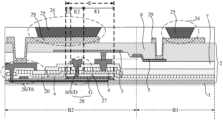
  • FIG. 2 is a sectional structural view of FIG. 1 taken along an AA′ direction;
  • FIG. 3 is a schematic view of a layout of a pixel circuit of a transition display region according to an embodiment of the present application
  • FIG. 4 is a structural diagram of a pixel circuit according to an embodiment of the present application.
  • FIG. 5 is a structural view of a layout of a display panel according to an embodiment of the present application.
  • FIG. 6 is a structural diagram of a display device according to an embodiment of the present application.
  • the display panel in the related art adopts the under-screen camera technology, which has the problem of poor display uniformity in the region correspondingly provided with a photosensitive device in the display screen.
  • the region correspondingly provided with a photosensitive device in the display screen is also provided with pixel circuits for driving light-emitting units in the region to emit light.
  • a gate of a thin-film transistor in a pixel circuit in the region is relatively sensitive to capacitive coupling, and when the coupling strength is not uniform, the uniformity of drive currents generated by different drive transistors is prone to be relatively poor, so that the display uniformity of the region correspondingly provided with a photosensitive device in the display screen is affected.
  • FIG. 1 is a top structural view of a display panel according to an embodiment of the present application.
  • FIG. 2 is a sectional structural view of FIG. 1 taken along an AA′ direction.
  • FIG. 3 is a schematic view of a layout of a pixel circuit of a transition display region according to an embodiment of the present application.
  • the display panel 100 provided by the embodiments of the present application includes a first display region AA 1 and a second display region AA 2 .
  • the first display region AA 1 is disposed around at least part of the second display region AA 2 .
  • the first display region AA 1 surrounds the entire second display region AA 2 .
  • the second display region AA 2 includes a transparent display region B 1 and a transition display region B 2 .
  • the transition display region B 2 surrounds the entire transparent display region B 1 .
  • the transparent display region B 1 is correspondingly provided with a photosensitive device, and the photosensitive device collects light through the transparent display region B 1 .
  • the photosensitive device may be, for example, a photosensitive device such as a camera photosensitive device or a fingerprint recognition sensor.
  • the second display region AA 2 is the region of the display panel 100 disposed corresponding to the photosensitive device. This region not only can achieve the display function, but also has enough light transmittance to ensure the accuracy of photosensitive recognition performed by the photosensitive device.
  • the first display region AA 1 is a normal display region in the display panel 100 , and is configured to achieve the normal display of the region provided with no photosensitive device of the display panel 100 .
  • FIG. 1 only exemplarily shows the position of the second display region AA 2 in the display panel 100 , and the embodiments of the present application do not limit the position of the second display region AA 2 in the display panel 100 .
  • the display panel 100 further includes a substrate 1 , a driver circuit layer 2 located on the substrate 1 and multiple light-emitting units 24 located on a side of the driver circuit layer 2 away from the substrate 1 and disposed in the first display region AA 1 , the transparent display region B 1 and the transition display region B 2 .
  • the driver circuit layer 2 includes multiple pixel circuits being in one-to-one correspondence with the multiple light-emitting units 24 .
  • Each pixel circuit among the multiple pixel circuits includes a drive transistor.
  • Pixel circuits among the multiple pixel circuits disposed corresponding to light-emitting units 24 in the first display region AA 1 among the multiple light-emitting units 24 are located in the first display region AA 1 , and pixel circuits among the multiple pixel circuits disposed corresponding to light-emitting units 24 of the transparent display region B 1 among the multiple light-emitting units 24 and pixel circuits among the multiple pixel circuits disposed corresponding to light-emitting units 24 of the transition display region B 2 among the multiple light-emitting units 24 are all located in the transition display region B 2 .
  • a drive transistor included by each pixel circuit of pixel circuits located in the transition display region B 2 among the multiple pixel circuits is a first drive transistor 27 .
  • a gate G of the first drive transistor 27 is configured to transmit a first gate signal.
  • the driver circuit layer 2 includes a gate transmission structure 28 configured to transmit the first gate signal.
  • Each light-emitting unit 24 among the multiple light-emitting units 24 includes a lower electrode 29 , a light-emitting functional layer 25 located on a side of the lower electrode 29 away from the substrate 1 and an upper electrode (not shown in FIG. 2 ) located on a side of the light-emitting functional layer 25 away from the substrate 1 , and the light-emitting functional layer 25 emits light when a voltage is applied to an upper electrode and the lower electrode 29 of the each light-emitting unit 24 .
  • an overlapping region E is located between the gate transmission structure 28 and a lower electrode 29 disposed on a side, close to the substrate 1 , of a light-emitting unit 24 located above the gate transmission structure 28 among the multiple light-emitting units 24 , a shielding layer 3 configured to connect to a fixed potential is disposed between the lower electrode 29 and the driver circuit layer 2 , and the shielding layer 3 is disposed in at least part of the overlapping region E to shield from parasitic capacitance between the lower electrode 29 and the gate transmission structure 28 .
  • the display panel 100 includes a substrate 1 and multiple light-emitting units 24 located on the substrate 1 and disposed in a first display region AA 1 and a second display region AA 2 .
  • the light-emitting units 24 may be, for example, organic light-emitting units 24 .
  • Each pixel circuit includes a drive transistor, and the light-emitting units 24 are disposed in one-to-one corresponding with pixel circuits.
  • Each pixel circuit provides a drive current to a corresponding light-emitting unit 24 , the light-emitting unit 24 emits light in response to the drive current, and the display panel 100 achieves the display function.
  • the transparency of the first display region AA 1 of the display panel 100 is different from the transparency of the second display region AA 2 of the display panel 100 , and the transparency of the first display region AA 1 may be less than the transparency of the second display region AA 2 . If the second display region AA 2 intends to achieve the same display effect as the first display region AA 1 , the luminance of the second display region AA 2 needs to be greater than the luminance of the first display area AA 1 , and the drive current of lower electrodes 29 of light-emitting units 24 in the second display region AA 2 needs to be relatively large than the drive current of lower electrodes 29 of light-emitting units 24 in the first display region AA 1 .
  • Pixel circuits disposed corresponding to light-emitting units 24 of the transparent display region B 1 and pixel circuits disposed corresponding to light-emitting units 24 of the transition display region B 2 are all located in the transition display region B 2 , and the pixel circuits disposed in the transition display region B 2 are configured to drive the light-emitting units 24 of the transparent display region B 1 and the light-emitting units 24 of the transition display region B 2 , so that the transparency of the transparent display region B 1 is ensured to satisfy the transparency requirements of the photosensitive device.
  • Each of the pixel circuits disposed in the transition display region B 2 includes a first drive transistor 27 .
  • a gate G of the first driver transistor 27 is configured to transmit a first gate signal.
  • a driver circuit layer 2 includes a gate transmission structure 28 configured to transmit the first gate signal.
  • an overlapping region E is located between the gate transmission structure 28 and a lower electrode 29 disposed on a side, close to the substrate 1 , of a light-emitting unit 24 of the transition display region B 2 located above the gate transmission structure 28 . Coupling between the lower electrode 29 of the transition display region B 2 and the gate transmission structure 28 of the transition display region B 2 generates parasitic capacitance.
  • a shielding layer configured to connect to a fixed potential is disposed between the lower electrode of the light-emitting unit and the driver circuit layer, and the shielding layer is disposed in at least part of the overlapping region to shield from parasitic capacitance between the lower electrode and the gate transmission structure.
  • the existence of this parasitic capacitance leads to that the change of the potential at the lower electrode causes the change of the potential of the gate transmission structure that transmits the first gate signal and has the overlapping region with the lower electrode, thereby affecting the working state of the pixel circuit in the driver circuit layer, and affecting the display effect of the display panel.
  • the change of the potential at a lower electrode of a light-emitting unit in the transition display region of the second display region is prevented from affecting the gate transmission structure, and the change of the potential at the lower electrode is prevented from affecting the gate potential of the first drive transistor in the transition display region of the second display region. Therefore, the uniformity of drive currents generated by first drive transistors in the transition display region of the second display region can be improved, and the display uniformity of the transition display region of the second display region of the display panel can be improved.
  • the driver circuit layer 2 further includes a metal layer 4 located in the transition display region B 2 , and the metal layer 4 is located between the gate G of the first drive transistor 27 and the shielding layer 3 .
  • the driver circuit layer 2 further includes a first power signal line, and the first power signal line is configured to provide a first power signal to the pixel circuits.
  • the metal layer 4 since a directly-facing area exists between the metal layer 4 and the gate G of the first drive transistor 27 , the metal layer 4 is electrically connected to the first power signal line, and a storage capacitor C 11 is formed between the metal layer 4 and the gate G of the first drive transistor 27 .
  • the directly-facing area may be understood as the area of the overlapping region existed between the metal layer 4 and the gate G of the first drive transistor 27 along the direction perpendicular to the substrate 1 .
  • FIG. 4 is a structural diagram of a pixel circuit according to an embodiment of the present application.
  • a seventh transistor T 7 in the pixel circuit is the first drive transistor 27 .
  • the pixel circuit is electrically connected to the first power signal line through a first power signal input terminal VDD, and a first electrode a of the storage capacitor C 11 is electrically connected to the gate G of the first drive transistor 27 .
  • the gate G of the first drive transistor 27 may serve as a lower electrode plate of the storage capacitor C 11 , that is, the first electrode a, and the metal layer 4 may serve as a upper electrode plate of the storage capacitor C 11 , that is, a second electrode b.
  • the upper electrode plate of the storage capacitor C 11 that is, the second electrode b, needs to be electrically connected to the first power signal line, so that the metal layer 4 may be electrically connected to the first power signal line.
  • the metal layer 4 covers a first region E 1 of the gate G of the first drive transistor 27 and exposes a second region E 2 of the gate G of the first drive transistor 27 , and the shielding layer 3 at least covers the second region E 2 of the gate G of the first drive transistor 27 .
  • the first region E 1 is provided with the metal layer 4
  • the metal layer 4 is the upper electrode plate of the capacitor C 11 in the pixel circuit, that is, the second electrode b of the capacitor C 11 .
  • the metal layer 4 is connected to a stable first power signal, and no parasitic capacitance is formed between the gate G of the first drive transistor 27 disposed in the first region E 1 and the lower electrode 29 of the light-emitting unit 24 , and the gate G of the first drive transistor 27 disposed in the second region E 2 is directly opposite to the lower electrode 29 of the light-emitting unit 24 , forming parasitic capacitance.
  • the shielding layer 3 is provided to at least cover the second region E 2 of the gate G of the first drive transistor 27 , and the shielding layer 3 connected to a fixed potential signal shields from the parasitic capacitance formed between the lower electrode 29 of the light-emitting unit 24 disposed in the second region E 2 and the gate G of the first drive transistor 27 , so that the change of the potential at the lower electrode 29 of the light-emitting unit 24 will not leads to the change of the potential at the gate G of the first drive transistor 27 disposed in the second region E 2 . Therefore, the problem is effectively avoided that the increase of the potential at the gate G of the first drive transistor 27 reduces the drive current generated by the first drive transistor 27 , reduces the display luminance of the display panel, and affects the life of the display panel.
  • the embodiments of the present application do not limit the number of thin-film transistors and the number of capacitor structures in the pixel circuits, and the number of thin-film transistors and the number of capacitor structures in the pixel circuits may be limited according to specific requirements.
  • the pixel circuit is configured to drive a light-emitting device 5 to emit light.
  • the pixel circuit includes a first transistor T 1 , a second transistor T 2 , a third transistor T 3 , a fourth transistor T 4 , a fifth transistor T 5 , a sixth transistor T 6 , a seventh transistor T 7 , a storage capacitor C 11 , a reference signal input terminal Vinit, a first power signal input terminal VDD, a second power signal input terminal VSS, a first scan signal input terminal Sn, a second scan signal input terminal Sn- 1 , a data signal input terminal Vd and a light emission control terminal En.
  • a gate G of the first transistor T 1 is electrically connected to the second scan signal input terminal Sn- 1 , a first electrode b 2 of the first transistor T 1 is electrically connected to the reference signal input terminal Vinit, a second electrode b 3 of the first transistor T 1 is electrically connected to a gate G of the seventh transistor T 7 and the first electrode a of the storage capacitor C 11 , and the second electrode b of the storage capacitor C 11 is electrically connected to the first power signal input terminal VDD.
  • a gate G of the second transistor T 2 is electrically connected to the second scan signal input terminal Sn- 1 , a first electrode b 2 of the second transistor T 2 is electrically connected to the reference signal input terminal Vinit, a second electrode b 3 of the second transistor T 2 is electrically connected to a first terminal 51 of the light-emitting device 5 , and the second power signal input terminal VSS is electrically connected to a second terminal 52 of the light-emitting device 5 .
  • a gate G of the third transistor T 3 is electrically connected to the first scan signal input terminal Sn, a first electrode b 2 of the third transistor T 3 is electrically connected to the data signal input terminal Vd, and a second electrode b 3 of the third transistor T 3 is electrically connected to a first electrode b 2 of the seventh transistor T 7 .
  • a gate G of the fourth transistor T 4 is electrically connected to the first scan signal input terminal Sn, a first electrode b 2 of the fourth transistor T 4 is electrically connected to a second electrode b 3 of the seventh transistor T 7 , and a second electrode b 3 of the fourth transistor T 4 is electrically connected to the gate G of the seventh transistor T 7 .
  • a gate G of the fifth transistor T 5 is electrically connected to the light emission control terminal En, a first electrode b 2 of the fifth transistor T 5 is electrically connected to the first power signal input terminal VDD, and a second electrode b 3 of the fifth transistor T 5 is electrically connected to the first electrode b 2 of the seventh transistor T 7 .
  • a gate G of the sixth transistor T 6 is electrically connected to the light emission control terminal En, a first electrode b 2 of the sixth transistor T 6 is electrically connected to the second electrode b 3 of the seventh transistor T 7 , and a second electrode b 3 of the sixth transistor T 6 is electrically connected to the first terminal 51 of the light-emitting device 5 .
  • the transistors T 1 to T 7 may all be p-type transistors or n-type transistors.
  • the working principle of the pixel circuit shown in FIG. 4 is illustrated by taking the example that the transistors T 1 to T 7 are all p-type transistors, and a reference voltage Vref provided by the reference signal input terminal Vinit is a low-level signal.
  • the second scan signal input terminal Sn- 1 is at a low level, and the first scan signal input terminal Sn and the light emission control terminal En are at a high level.
  • the first transistor T 1 is turned on, and the second transistor T 2 is also turned on.
  • the reference voltage Vref provided by the reference signal input terminal Vinit is applied to the first electrode a of the storage capacitor C 11 through the first transistor T 1 , that is, the potential at the node N 1 and the potential at the node N 2 are the reference voltage Vref, and the potential at the gate G of the seventh transistor T 7 is also the reference voltage Vref.
  • the reference voltage Vref provided by the reference signal input terminal Vinit is applied to the first terminal 51 of the light-emitting device 5 through the second transistor T 2 to initialize the potential at the first terminal 51 of the light-emitting device 5 , so as to reduce the impact of the voltage of the first terminal 51 of the light-emitting device 5 in a previous frame on the voltage of the first terminal 51 of the light-emitting device 5 in a next frame, and further improve the display uniformity of the light-emitting device 5 .
  • the first scan signal input terminal Sn is at a low level, and the second scan signal input terminal Sn- 1 and the light emission control terminal En are at a high level.
  • the third transistor T 3 and the fourth transistor T 4 are turned on, and since the potential at the gate G of the seventh transistor T 7 is the reference voltage Vref, that is, is also at a low level, the seventh transistor T 7 is also turned on.
  • a data signal voltage V 1 provided by the data signal input terminal Vd sequentially passes through the third transistor T 3 , the seventh transistor T 7 and the fourth transistor T 4 , and is applied to the node N 2 .
  • the potential at the gate G of the seventh transistor T 7 is gradually pulled up by the data signal voltage V 1 .
  • the seventh transistor T 7 When the potential at the gate G of the seventh transistor T 7 is pulled up until a potential difference between the potential at the gate G of the seventh transistor T 7 and the potential at the first electrode b 2 of the seventh transistor T 7 is less than or equal to a threshold voltage V th of the seventh transistor T 7 , the seventh transistor T 7 is in a turned-off state. Since the first electrode b 2 of the seventh transistor T 7 is electrically connected to the data signal input terminal Vd through the third transistor T 3 , the potential at the first electrode b 2 of the seventh transistor T 7 remains unchanged as the data signal voltage V 1 , so that when the seventh transistor T 7 is turned off, the potential at the gate G of the seventh transistor T 7 is V 1 ⁇
  • Va is the potential at the first electrode a of the storage capacitor C 11
  • Vb is the potential at the second electrode b of the storage capacitor C 11
  • V 2 is the first power signal provided by the first power signal input terminal VDD.
  • the storage capacitor C 11 may store the potential at the gate G of the seventh transistor T 7 .
  • the light emission control terminal En is at a low level, and the first scan signal input terminal Sn and the second scan signal input terminal Sn- 1 are at a high level.
  • the fifth transistor T 5 and the sixth transistor T 6 are turned on, the data signal input terminal Vd stops providing the data signal voltage V 1 , and a first power signal V 2 provided by the first power signal input terminal VDD passes through the fifth transistor T 5 and is applied to the first electrode b 2 of the seventh transistor T 7 .
  • V sg V 2 ⁇ (V 1 ⁇
  • the driver circuit layer 2 further includes a reference signal transmission line 6 electrically connected to the gate G of the first drive transistor 27 .
  • the reference signal transmission line 6 is manufactured in the same layer as a source electrode and a drain electrode of the first drive transistor 27 , that is, the reference signal transmission line 6 may be manufactured in the same layer as a source electrode S or a drain electrode D of the first drive transistor 27 .
  • the shielding layer 3 at least covers part of the reference signal transmission line 6 .
  • the reference signal transmission line 6 is manufactured in the same layer as the source electrode and the drain electrode of the first drive transistor 27 , that is, the reference signal transmission line 6 is disposed on a side of a first insulating layer 202 away from the gate G of the first drive transistor 27 .
  • the shielding layer 3 of the transition display region B 2 is disposed between the lower electrode 29 of the light-emitting unit 24 and the source-drain electrode layer, so that the shielding layer 3 of the transition display region B 2 is disposed between the lower electrode 29 of the light-emitting unit 24 and the reference signal transmission line 6 , and the shielding layer 3 at least covers part of the reference signal transmission line 6 . Referring to the diagram of the pixel circuit shown in FIG.
  • one terminal of the reference signal transmission line 6 is electrically connected to the gate G of the first drive transistor 27 , and the other terminal is electrically connected to the reference signal input terminal Vinit through the first transistor T 1 .
  • the reference signal transmission line 6 is configured to transmit a reference signal to the gate G of the first drive transistor 27 , that is, the gate transmission structure 28 includes the reference signal transmission line 6 .
  • the shielding layer 3 at least covers part of the reference signal transmission line 6 , and the shielding layer 3 connected to a fixed potential signal is used to shield from the parasitic capacitance formed between the lower electrode 29 of the light-emitting unit 24 disposed corresponding to the reference signal transmission line 6 and the reference signal transmission line 6 , so that the change of the potential at the lower electrode 29 of the light-emitting unit 24 will not cause the change of the potential of the corresponding reference signal transmission line 6 and the potential at the gate G of the first drive transistor 27 electrically connected to the reference signal transmission line 6 .
  • the problem is effectively avoided that the increase of the potential at the gate G of the first drive transistor 27 reduces the drive current generated by the first drive transistor 27 , reduces the display luminance of the display panel, and affects the life of the display panel; the display uniformity is improved, the light emission effect of the light-emitting unit 24 in the second display region AA 2 is optimized, and the manufacturing process of the display panel 100 is simplified.
  • a lower electrode 29 is electrically connected to a pixel circuit located in the transition display region B 2 through an electrode trace 5 , and the shielding layer 3 is manufactured in the same layer as the electrode trace 5 .
  • the lower electrode 29 is disposed on a side of the light-emitting units 24 of the transparent display region B 1 close to the substrate 1 , and the pixel circuit corresponds to the lower electrode 29 .
  • the number of light-emitting units 24 in the first display region AA 1 and the number of light-emitting units 24 in the second display region AA 2 of the display panel 100 increase, and the number of light-emitting units 24 in the transparent display region B 1 of the second display region AA 2 also increases, that is, lower electrodes 29 are arranged closer and closer in the transparent display region B 1 .
  • the lower electrode 29 of each light-emitting unit 24 in the transparent display region B 1 needs to be electrically connected to a corresponding pixel circuit in the transition display region B 2 , so that it is difficult to leave extra space for the electrode trace 5 in the film where the lower electrode 29 of the transparent display region B 1 is located to enable the electrode trace 5 to extend to the transition display region B 2 to be electrically connected to the corresponding pixel circuit. Therefore, the transparent display region B 1 may be provided with a corresponding electrode trace 5 in other films to connect a lower electrode 29 of the transparent display region B 1 and the pixel circuit corresponding to the lower electrode 29 in the transition display region B 2 .
  • the shielding layer 3 in the transition display region B 2 is manufactured in the same layer as the electrode trace 5 of the light-emitting unit 24 in the transparent display region B 1 .
  • the shielding layer 3 in the transition display region B 2 and the electrode trace 5 of the light-emitting unit 24 in the transparent display region B 1 may be both located in a second insulating layer 7 , and the light-emitting unit 24 located in the transparent display region B 1 is electrically connected to the electrode trace 5 through a via hole penetrating a third insulating layer 8 , so that the shielding layer 3 in the transition display region B 2 covers the lower electrode 29 of the corresponding light-emitting unit 24 and a region in the transition display region B 2 that exposes the gate G of the first drive transistor 27 and is directly opposite to the lower electrode 29 .
  • the light emission effect of the light-emitting unit 24 in the second display region AA 2 is optimized, and the manufacturing process of the display panel is simplified at the same time.
  • the material composing the shielding layer 3 may be a transparent material.
  • a lower electrode 29 disposed on a side of the light-emitting units 24 of the transparent display region B 1 close to the substrate 1 is electrically connected to a corresponding pixel circuit located in the transition display region B 2 through an electrode trace 5 , and the shielding layer 3 is manufactured in the same layer as the electrode trace 5 .
  • the material composing the electrode trace 5 may be a transparent material; and since the shielding layer 3 is manufactured in the same layer as the electrode trace 5 , the material composing the shielding layer 3 may be the transparent material to simplify the manufacturing process of the display panel.
  • the material composing the shielding layer 3 and the electrode trace 5 may be indium tin oxide (ITO), or indium zinc oxide (IZO) or a mixed layer of ITO and IZO.
  • FIG. 5 is a structural view of a layout of another display panel according to an embodiment of the present application.
  • shielding layers 3 disposed corresponding to different first drive transistors 27 form a grid structure.
  • the shielding layers 3 disposed corresponding to different first drive transistors 27 are connected to form the grid structure, the shielding layers 3 may be electrically connected to the first power signal line that provides a first power signal.
  • the first power signal line is the metal layer 4 , and the first power signal line forms a grid structure in the entire display panel.
  • the shielding layers 3 disposed corresponding to different first drive transistors 27 form a grid structure, so that multiple electrical-connection nodes are formed between the shielding layers and the first power signal line, and the stability and uniformity of electrical signals on the shielding layers 3 are improved.
  • the driver circuit layer 2 further includes a second power signal line, the second power signal line is configured to provide a second power signal to the pixel circuits, and the shielding layer 3 is electrically connected to the second power signal line.
  • the potential of the first power signal is higher than the potential of the second power signal.
  • the potential of the power signal on the second power signal line is constant.
  • the shielding layer 3 is electrically connected to the second power signal line, that is, the shielding layer 3 is connected to a constant low-level signal, so that the parasitic capacitance formed between the gate G of the first drive transistor 27 that has the overlapping region with the lower electrode 29 and the lower electrode 29 of the light-emitting unit 24 is effectively shielded from, the change of the potential at the lower electrode 29 of the light-emitting unit 24 will not cause the change of the potential at the gate G of the first drive transistor 27 that has the overlapping region E with the lower electrode 29 , and thus the life of the display panel will not be affected.
  • the second power signal line accessing the second power signal is located in a non-display region surrounding the display region of the display panel.
  • the shielding layer 3 may be electrically connected to the second power signal line at the periphery of the display region.
  • FIG. 6 is a structural diagram of a display device according to an embodiment of the present application.
  • the display device 601 provided by the embodiment of the present application includes a housing body 602 and the display panel 100 proposed in any of the above embodiments, the housing body 602 has a device region C, and the display panel 100 covers the housing body 602 .
  • the device region C is located below the transparent display region B 1 of the display panel 100 , and the device region C is provided with the photosensitive device that collects light through the transparent display region B 1 .
  • the display panel 100 may adopt the display panel of the above embodiments, which is not repeated herein.
  • the housing body 602 in the display device 601 has the device region C, and the device region C is located below the transparent display region B 1 of the second display region AA 2 of the display panel 100 .
  • Light passes through the transparent display region B 1 and is shone to the photosensitive device in the device region C, and the photosensitive device, which may be a photosensitive device such as a camera and a light sensor, operations such as collecting external light through the transparent display region B 1 may be performed.
  • the display device 601 may be a digital device such as a mobile phone, a tablet computer, a palmtop computer or an internet portable audio device (iPod). Arrows along the vertical direction in FIG. 6 indicate the incident direction of external light.
Landscapes

  • Engineering & Computer Science (AREA)
  • Physics & Mathematics (AREA)
  • Microelectronics & Electronic Packaging (AREA)
  • Geometry (AREA)
  • General Physics & Mathematics (AREA)
  • Theoretical Computer Science (AREA)
  • Optics & Photonics (AREA)
  • Computer Hardware Design (AREA)
  • Manufacturing & Machinery (AREA)
  • Electroluminescent Light Sources (AREA)
  • Devices For Indicating Variable Information By Combining Individual Elements (AREA)

Abstract

A display panel includes a first display region and a second display region, and the second display region includes a transparent display region and a transition display region. Pixel circuits corresponding to light-emitting units of the transparent display region and the transition display region are located in the transition display region, and the pixel circuits located in the transition display region includes a first drive transistor. Along a direction perpendicular to the substrate, an overlapping region is located between the gate transmission structures and a lower electrode disposed on a side, close to the substrate, of a light-emitting unit of the transition display region located above the respective gate transmission structure, a shielding layer connected to a fixed potential is disposed in at least part of the overlapping region to shield from parasitic capacitance between the lower electrode and the gate transmission structure.

Description

The present application is a continuation of International Patent Application No. PCT/CN2020/085526, filed on Apr. 20, 2020, which is based on and claims priority to Chinese Patent Application No. 202010033407.X filed with the China National Intellectual Property Administration (CNIPA) on Jan. 13, 2020, the disclosures of which are incorporated herein by reference in their entireties.
TECHNICAL FIELD
Embodiments of the present disclosure relate to the technical field of display panels, for example, to a display panel and a display device.
BACKGROUND
With the rapid development of electronic devices, users have increasingly higher requirements for the screen-to-body ratio, so that full screens of electronic devices attract more and more attention in the industry. Electronic devices such as mobile phones and tablet computers need to integrate front-facing cameras, receivers and infrared sensing components, so that their display screens can be notched, and cameras, receivers and infrared sensing components are disposed in the notched regions. However, the display screens of these electronic devices are not full screens in the true sense and cannot perform display in various regions of the entire screen. For example, images cannot be displayed in a camera region.
In order that true full screens are achieved, the under-screen camera technology has emerged, that is, the technology through which the region provided with a photosensitive device in a display screen can still be used for display. However, the display uniformity of the region correspondingly provided with a photosensitive device in the display screen is poor.
SUMMARY
Embodiments of the present application provide a display panel and a display device. The display uniformity of a transition display region of a second display region of the display pane is improved.
In a first aspect, an embodiment of the present application provides a display panel. The display panel includes a first display region, a second display region, a substrate, a driver circuit layer and a plurality of light-emitting units.
The first display region is disposed around at least part of the second display region, and the second display region includes a transparent display region and a transition display region.
The driver circuit layer is located on the substrate.
The plurality of light-emitting units are located on a side of the driver circuit layer away from the substrate and are disposed in the first display region, the transparent display region and the transition display region.
The driver circuit layer includes a plurality of pixel circuits being in one-to-one correspondence with the plurality of light-emitting units, the plurality of pixel circuits include a plurality of drive transistors; pixel circuits corresponding to light-emitting units of the transparent display region and the transition display region are located in the transition display region, the drive transistors include a first drive transistor, the first drive transistor of the pixel circuits is located in the transition display region.
A gate of the first drive transistor is configured to transmit a first gate signal, the driver circuit layer includes a plurality of gate transmission structures configured to transmit the first gate signal, along a direction perpendicular to the substrate, an overlapping region is located between the gate transmission structures and a lower electrode disposed on a side, close to the substrate, of a light-emitting unit of the transition display region located above the respective gate transmission structure, and a shielding layer is disposed between the lower electrode and the driver circuit layer, the shielding layer is configured to connect to a fixed potential and is disposed in at least part of the overlapping region to shield from parasitic capacitance between the lower electrode and the gate transmission structure.
In a second aspect, an embodiment of the present application provides a display device. The display device includes a housing body and the display panel of the first aspect.
The housing body includes a device region.
The display panel covers the housing body.
The device region is located below the transparent display region of the display panel to enable light passing through the transparent display region to be shone to a photosensitive device disposed in the corresponding device region.
The embodiments of the present application provide a display panel and a display device. Each pixel circuit of pixel circuits disposed in a transition display region includes a first drive transistor. A gate of the first drive transistor is configured to transmit a first gate signal, a driver circuit layer includes a plurality of gate transmission structures configured to transmit the first gate signal, along a direction perpendicular to a substrate, an overlapping region is located between the gate transmission structures and a lower electrode disposed on a side, close to the substrate, of a light-emitting unit located above the respective gate transmission structure, a shielding layer configured to connect to a fixed potential is disposed between the lower electrode and the driver circuit layer, and the shielding layer is disposed in at least part of the overlapping region to shield from parasitic capacitance between the lower electrode and the gate transmission structure. In this way, the change of the potential at a lower electrode of a light-emitting unit in the transition display region of the second display region is prevented from affecting the gate transmission structure, and the change of the potential at the lower electrode is prevented from affecting the gate potential of the first drive transistor in the transition display region of the second display region. Therefore, the uniformity of drive currents generated by first drive transistors in the transition display region of the second display region can be improved, and the display uniformity of the transition display region of the second display region of the display panel can be improved.
BRIEF DESCRIPTION OF DRAWINGS
Drawings used in the description of embodiments of the present application are briefly described below.
FIG. 1 is a top structural view of a display panel according to an embodiment of the present application;
FIG. 2 is a sectional structural view of FIG. 1 taken along an AA′ direction;
FIG. 3 is a schematic view of a layout of a pixel circuit of a transition display region according to an embodiment of the present application;
FIG. 4 is a structural diagram of a pixel circuit according to an embodiment of the present application;
FIG. 5 is a structural view of a layout of a display panel according to an embodiment of the present application; and
FIG. 6 is a structural diagram of a display device according to an embodiment of the present application.
DETAILED DESCRIPTION
The present application is described hereinafter in conjunction with drawings and embodiments. The embodiments described herein are intended to explain and not to limit the present application. Only part, not all, of structures related to the present application are illustrated in the drawings.
As mentioned in the Background, to achieve the true full screen, the display panel in the related art adopts the under-screen camera technology, which has the problem of poor display uniformity in the region correspondingly provided with a photosensitive device in the display screen.
The region correspondingly provided with a photosensitive device in the display screen is also provided with pixel circuits for driving light-emitting units in the region to emit light. However, a gate of a thin-film transistor in a pixel circuit in the region is relatively sensitive to capacitive coupling, and when the coupling strength is not uniform, the uniformity of drive currents generated by different drive transistors is prone to be relatively poor, so that the display uniformity of the region correspondingly provided with a photosensitive device in the display screen is affected.
FIG. 1 is a top structural view of a display panel according to an embodiment of the present application. FIG. 2 is a sectional structural view of FIG. 1 taken along an AA′ direction. FIG. 3 is a schematic view of a layout of a pixel circuit of a transition display region according to an embodiment of the present application. Referring to FIGS. 1 to 3 , the display panel 100 provided by the embodiments of the present application includes a first display region AA1 and a second display region AA2. The first display region AA1 is disposed around at least part of the second display region AA2. In FIG. 1 , exemplarily, the first display region AA1 surrounds the entire second display region AA2. The second display region AA2 includes a transparent display region B1 and a transition display region B2. In FIG. 1 , exemplarily, the transition display region B2 surrounds the entire transparent display region B1. Exemplarily, the transparent display region B1 is correspondingly provided with a photosensitive device, and the photosensitive device collects light through the transparent display region B1.
In an embodiment, the photosensitive device may be, for example, a photosensitive device such as a camera photosensitive device or a fingerprint recognition sensor. The second display region AA2 is the region of the display panel 100 disposed corresponding to the photosensitive device. This region not only can achieve the display function, but also has enough light transmittance to ensure the accuracy of photosensitive recognition performed by the photosensitive device. The first display region AA1 is a normal display region in the display panel 100, and is configured to achieve the normal display of the region provided with no photosensitive device of the display panel 100. FIG. 1 only exemplarily shows the position of the second display region AA2 in the display panel 100, and the embodiments of the present application do not limit the position of the second display region AA2 in the display panel 100.
The display panel 100 further includes a substrate 1, a driver circuit layer 2 located on the substrate 1 and multiple light-emitting units 24 located on a side of the driver circuit layer 2 away from the substrate 1 and disposed in the first display region AA1, the transparent display region B1 and the transition display region B2. The driver circuit layer 2 includes multiple pixel circuits being in one-to-one correspondence with the multiple light-emitting units 24. Each pixel circuit among the multiple pixel circuits includes a drive transistor. Pixel circuits among the multiple pixel circuits disposed corresponding to light-emitting units 24 in the first display region AA1 among the multiple light-emitting units 24 are located in the first display region AA1, and pixel circuits among the multiple pixel circuits disposed corresponding to light-emitting units 24 of the transparent display region B1 among the multiple light-emitting units 24 and pixel circuits among the multiple pixel circuits disposed corresponding to light-emitting units 24 of the transition display region B2 among the multiple light-emitting units 24 are all located in the transition display region B2. A drive transistor included by each pixel circuit of pixel circuits located in the transition display region B2 among the multiple pixel circuits is a first drive transistor 27. A gate G of the first drive transistor 27 is configured to transmit a first gate signal. The driver circuit layer 2 includes a gate transmission structure 28 configured to transmit the first gate signal. Each light-emitting unit 24 among the multiple light-emitting units 24 includes a lower electrode 29, a light-emitting functional layer 25 located on a side of the lower electrode 29 away from the substrate 1 and an upper electrode (not shown in FIG. 2 ) located on a side of the light-emitting functional layer 25 away from the substrate 1, and the light-emitting functional layer 25 emits light when a voltage is applied to an upper electrode and the lower electrode 29 of the each light-emitting unit 24. Along a direction perpendicular to the substrate 1, an overlapping region E is located between the gate transmission structure 28 and a lower electrode 29 disposed on a side, close to the substrate 1, of a light-emitting unit 24 located above the gate transmission structure 28 among the multiple light-emitting units 24, a shielding layer 3 configured to connect to a fixed potential is disposed between the lower electrode 29 and the driver circuit layer 2, and the shielding layer 3 is disposed in at least part of the overlapping region E to shield from parasitic capacitance between the lower electrode 29 and the gate transmission structure 28.
In an embodiment, the display panel 100 includes a substrate 1 and multiple light-emitting units 24 located on the substrate 1 and disposed in a first display region AA1 and a second display region AA2. The light-emitting units 24 may be, for example, organic light-emitting units 24.
Each pixel circuit includes a drive transistor, and the light-emitting units 24 are disposed in one-to-one corresponding with pixel circuits. Each pixel circuit provides a drive current to a corresponding light-emitting unit 24, the light-emitting unit 24 emits light in response to the drive current, and the display panel 100 achieves the display function.
The transparency of the first display region AA1 of the display panel 100 is different from the transparency of the second display region AA2 of the display panel 100, and the transparency of the first display region AA1 may be less than the transparency of the second display region AA2. If the second display region AA2 intends to achieve the same display effect as the first display region AA1, the luminance of the second display region AA2 needs to be greater than the luminance of the first display area AA1, and the drive current of lower electrodes 29 of light-emitting units 24 in the second display region AA2 needs to be relatively large than the drive current of lower electrodes 29 of light-emitting units 24 in the first display region AA1. Pixel circuits disposed corresponding to light-emitting units 24 of the transparent display region B1 and pixel circuits disposed corresponding to light-emitting units 24 of the transition display region B2 are all located in the transition display region B2, and the pixel circuits disposed in the transition display region B2 are configured to drive the light-emitting units 24 of the transparent display region B1 and the light-emitting units 24 of the transition display region B2, so that the transparency of the transparent display region B1 is ensured to satisfy the transparency requirements of the photosensitive device.
Each of the pixel circuits disposed in the transition display region B2 includes a first drive transistor 27. A gate G of the first driver transistor 27 is configured to transmit a first gate signal. A driver circuit layer 2 includes a gate transmission structure 28 configured to transmit the first gate signal. Along the direction perpendicular to the substrate 1, an overlapping region E is located between the gate transmission structure 28 and a lower electrode 29 disposed on a side, close to the substrate 1, of a light-emitting unit 24 of the transition display region B2 located above the gate transmission structure 28. Coupling between the lower electrode 29 of the transition display region B2 and the gate transmission structure 28 of the transition display region B2 generates parasitic capacitance. Since overlapping regions E between lower electrodes 29 of light-emitting units 24 at different positions of the transition display region B2 and the gate transmission structure 28 have different areas, the strength of the coupling is different, and the generated parasitic capacitance is different, so that it is easy to cause non-uniformity of the display of the transition display region B2.
In the embodiment of the present application, a shielding layer configured to connect to a fixed potential is disposed between the lower electrode of the light-emitting unit and the driver circuit layer, and the shielding layer is disposed in at least part of the overlapping region to shield from parasitic capacitance between the lower electrode and the gate transmission structure. The existence of this parasitic capacitance leads to that the change of the potential at the lower electrode causes the change of the potential of the gate transmission structure that transmits the first gate signal and has the overlapping region with the lower electrode, thereby affecting the working state of the pixel circuit in the driver circuit layer, and affecting the display effect of the display panel. Through the above setting, the change of the potential at a lower electrode of a light-emitting unit in the transition display region of the second display region is prevented from affecting the gate transmission structure, and the change of the potential at the lower electrode is prevented from affecting the gate potential of the first drive transistor in the transition display region of the second display region. Therefore, the uniformity of drive currents generated by first drive transistors in the transition display region of the second display region can be improved, and the display uniformity of the transition display region of the second display region of the display panel can be improved.
Referring to FIGS. 1 to 3 , the driver circuit layer 2 further includes a metal layer 4 located in the transition display region B2, and the metal layer 4 is located between the gate G of the first drive transistor 27 and the shielding layer 3. The driver circuit layer 2 further includes a first power signal line, and the first power signal line is configured to provide a first power signal to the pixel circuits. Referring to FIGS. 2 and 3 , since a directly-facing area exists between the metal layer 4 and the gate G of the first drive transistor 27, the metal layer 4 is electrically connected to the first power signal line, and a storage capacitor C11 is formed between the metal layer 4 and the gate G of the first drive transistor 27. The directly-facing area may be understood as the area of the overlapping region existed between the metal layer 4 and the gate G of the first drive transistor 27 along the direction perpendicular to the substrate 1.
FIG. 4 is a structural diagram of a pixel circuit according to an embodiment of the present application. In an embodiment, referring to FIGS. 1 to 4 , a seventh transistor T7 in the pixel circuit is the first drive transistor 27. The pixel circuit is electrically connected to the first power signal line through a first power signal input terminal VDD, and a first electrode a of the storage capacitor C11 is electrically connected to the gate G of the first drive transistor 27. The gate G of the first drive transistor 27 may serve as a lower electrode plate of the storage capacitor C11, that is, the first electrode a, and the metal layer 4 may serve as a upper electrode plate of the storage capacitor C11, that is, a second electrode b. The upper electrode plate of the storage capacitor C11, that is, the second electrode b, needs to be electrically connected to the first power signal line, so that the metal layer 4 may be electrically connected to the first power signal line.
In an embodiment, referring to FIGS. 1 to 4 , along the direction perpendicular to the substrate 1, the metal layer 4 covers a first region E1 of the gate G of the first drive transistor 27 and exposes a second region E2 of the gate G of the first drive transistor 27, and the shielding layer 3 at least covers the second region E2 of the gate G of the first drive transistor 27.
In an embodiment, the first region E1 is provided with the metal layer 4, and the metal layer 4 is the upper electrode plate of the capacitor C11 in the pixel circuit, that is, the second electrode b of the capacitor C11. The metal layer 4 is connected to a stable first power signal, and no parasitic capacitance is formed between the gate G of the first drive transistor 27 disposed in the first region E1 and the lower electrode 29 of the light-emitting unit 24, and the gate G of the first drive transistor 27 disposed in the second region E2 is directly opposite to the lower electrode 29 of the light-emitting unit 24, forming parasitic capacitance. The shielding layer 3 is provided to at least cover the second region E2 of the gate G of the first drive transistor 27, and the shielding layer 3 connected to a fixed potential signal shields from the parasitic capacitance formed between the lower electrode 29 of the light-emitting unit 24 disposed in the second region E2 and the gate G of the first drive transistor 27, so that the change of the potential at the lower electrode 29 of the light-emitting unit 24 will not leads to the change of the potential at the gate G of the first drive transistor 27 disposed in the second region E2. Therefore, the problem is effectively avoided that the increase of the potential at the gate G of the first drive transistor 27 reduces the drive current generated by the first drive transistor 27, reduces the display luminance of the display panel, and affects the life of the display panel.
The embodiments of the present application do not limit the number of thin-film transistors and the number of capacitor structures in the pixel circuits, and the number of thin-film transistors and the number of capacitor structures in the pixel circuits may be limited according to specific requirements.
Referring to FIG. 4 , in an embodiment, the pixel circuit is configured to drive a light-emitting device 5 to emit light. The pixel circuit includes a first transistor T1, a second transistor T2, a third transistor T3, a fourth transistor T4, a fifth transistor T5, a sixth transistor T6, a seventh transistor T7, a storage capacitor C11, a reference signal input terminal Vinit, a first power signal input terminal VDD, a second power signal input terminal VSS, a first scan signal input terminal Sn, a second scan signal input terminal Sn-1, a data signal input terminal Vd and a light emission control terminal En. A gate G of the first transistor T1 is electrically connected to the second scan signal input terminal Sn-1, a first electrode b2 of the first transistor T1 is electrically connected to the reference signal input terminal Vinit, a second electrode b3 of the first transistor T1 is electrically connected to a gate G of the seventh transistor T7 and the first electrode a of the storage capacitor C11, and the second electrode b of the storage capacitor C11 is electrically connected to the first power signal input terminal VDD. A gate G of the second transistor T2 is electrically connected to the second scan signal input terminal Sn-1, a first electrode b2 of the second transistor T2 is electrically connected to the reference signal input terminal Vinit, a second electrode b3 of the second transistor T2 is electrically connected to a first terminal 51 of the light-emitting device 5, and the second power signal input terminal VSS is electrically connected to a second terminal 52 of the light-emitting device 5. A gate G of the third transistor T3 is electrically connected to the first scan signal input terminal Sn, a first electrode b2 of the third transistor T3 is electrically connected to the data signal input terminal Vd, and a second electrode b3 of the third transistor T3 is electrically connected to a first electrode b2 of the seventh transistor T7. A gate G of the fourth transistor T4 is electrically connected to the first scan signal input terminal Sn, a first electrode b2 of the fourth transistor T4 is electrically connected to a second electrode b3 of the seventh transistor T7, and a second electrode b3 of the fourth transistor T4 is electrically connected to the gate G of the seventh transistor T7. A gate G of the fifth transistor T5 is electrically connected to the light emission control terminal En, a first electrode b2 of the fifth transistor T5 is electrically connected to the first power signal input terminal VDD, and a second electrode b3 of the fifth transistor T5 is electrically connected to the first electrode b2 of the seventh transistor T7. A gate G of the sixth transistor T6 is electrically connected to the light emission control terminal En, a first electrode b2 of the sixth transistor T6 is electrically connected to the second electrode b3 of the seventh transistor T7, and a second electrode b3 of the sixth transistor T6 is electrically connected to the first terminal 51 of the light-emitting device 5.
In the embodiment, the transistors T1 to T7 may all be p-type transistors or n-type transistors. The working principle of the pixel circuit shown in FIG. 4 is illustrated by taking the example that the transistors T1 to T7 are all p-type transistors, and a reference voltage Vref provided by the reference signal input terminal Vinit is a low-level signal.
In a first time period (an initialization stage), the second scan signal input terminal Sn-1 is at a low level, and the first scan signal input terminal Sn and the light emission control terminal En are at a high level. The first transistor T1 is turned on, and the second transistor T2 is also turned on. The reference voltage Vref provided by the reference signal input terminal Vinit is applied to the first electrode a of the storage capacitor C11 through the first transistor T1, that is, the potential at the node N1 and the potential at the node N2 are the reference voltage Vref, and the potential at the gate G of the seventh transistor T7 is also the reference voltage Vref. At the same time, the reference voltage Vref provided by the reference signal input terminal Vinit is applied to the first terminal 51 of the light-emitting device 5 through the second transistor T2 to initialize the potential at the first terminal 51 of the light-emitting device 5, so as to reduce the impact of the voltage of the first terminal 51 of the light-emitting device 5 in a previous frame on the voltage of the first terminal 51 of the light-emitting device 5 in a next frame, and further improve the display uniformity of the light-emitting device 5.
In a second time period (a data signal voltage write stage), the first scan signal input terminal Sn is at a low level, and the second scan signal input terminal Sn-1 and the light emission control terminal En are at a high level. At this time, the third transistor T3 and the fourth transistor T4 are turned on, and since the potential at the gate G of the seventh transistor T7 is the reference voltage Vref, that is, is also at a low level, the seventh transistor T7 is also turned on. A data signal voltage V1 provided by the data signal input terminal Vd sequentially passes through the third transistor T3, the seventh transistor T7 and the fourth transistor T4, and is applied to the node N2. The potential at the gate G of the seventh transistor T7 is gradually pulled up by the data signal voltage V1. When the potential at the gate G of the seventh transistor T7 is pulled up until a potential difference between the potential at the gate G of the seventh transistor T7 and the potential at the first electrode b2 of the seventh transistor T7 is less than or equal to a threshold voltage Vth of the seventh transistor T7, the seventh transistor T7 is in a turned-off state. Since the first electrode b2 of the seventh transistor T7 is electrically connected to the data signal input terminal Vd through the third transistor T3, the potential at the first electrode b2 of the seventh transistor T7 remains unchanged as the data signal voltage V1, so that when the seventh transistor T7 is turned off, the potential at the gate G of the seventh transistor T7 is V1−|Vth|. At this time, a voltage difference Vc between the second electrode b of the storage capacitor C11 and the first electrode a of the storage capacitor C11 satisfies:
Vc=Vb−Va=V2−(V1−|V th|).
Va is the potential at the first electrode a of the storage capacitor C11, Vb is the potential at the second electrode b of the storage capacitor C11, and V2 is the first power signal provided by the first power signal input terminal VDD.
In the data signal voltage write stage, the storage capacitor C11 may store the potential at the gate G of the seventh transistor T7.
In a third time period (a light emission stage), the light emission control terminal En is at a low level, and the first scan signal input terminal Sn and the second scan signal input terminal Sn-1 are at a high level. At this time, the fifth transistor T5 and the sixth transistor T6 are turned on, the data signal input terminal Vd stops providing the data signal voltage V1, and a first power signal V2 provided by the first power signal input terminal VDD passes through the fifth transistor T5 and is applied to the first electrode b2 of the seventh transistor T7. At this time, a potential difference Vsg between the first electrode b2 of the seventh transistor T7 and the gate G of the seventh transistor T7 satisfies: Vsg=V2−(V1−|Vth|), and the seventh transistor T7 is turned on again and forms a leakage current to drive the light-emitting device 5 to emit light.
In an embodiment, with continued reference to FIGS. 2 and 3 , the driver circuit layer 2 further includes a reference signal transmission line 6 electrically connected to the gate G of the first drive transistor 27. The reference signal transmission line 6 is manufactured in the same layer as a source electrode and a drain electrode of the first drive transistor 27, that is, the reference signal transmission line 6 may be manufactured in the same layer as a source electrode S or a drain electrode D of the first drive transistor 27. Along the direction perpendicular to the substrate 1, the shielding layer 3 at least covers part of the reference signal transmission line 6.
In an embodiment, the reference signal transmission line 6 is manufactured in the same layer as the source electrode and the drain electrode of the first drive transistor 27, that is, the reference signal transmission line 6 is disposed on a side of a first insulating layer 202 away from the gate G of the first drive transistor 27. The shielding layer 3 of the transition display region B2 is disposed between the lower electrode 29 of the light-emitting unit 24 and the source-drain electrode layer, so that the shielding layer 3 of the transition display region B2 is disposed between the lower electrode 29 of the light-emitting unit 24 and the reference signal transmission line 6, and the shielding layer 3 at least covers part of the reference signal transmission line 6. Referring to the diagram of the pixel circuit shown in FIG. 4 , one terminal of the reference signal transmission line 6 is electrically connected to the gate G of the first drive transistor 27, and the other terminal is electrically connected to the reference signal input terminal Vinit through the first transistor T1. The reference signal transmission line 6 is configured to transmit a reference signal to the gate G of the first drive transistor 27, that is, the gate transmission structure 28 includes the reference signal transmission line 6.
The shielding layer 3 at least covers part of the reference signal transmission line 6, and the shielding layer 3 connected to a fixed potential signal is used to shield from the parasitic capacitance formed between the lower electrode 29 of the light-emitting unit 24 disposed corresponding to the reference signal transmission line 6 and the reference signal transmission line 6, so that the change of the potential at the lower electrode 29 of the light-emitting unit 24 will not cause the change of the potential of the corresponding reference signal transmission line 6 and the potential at the gate G of the first drive transistor 27 electrically connected to the reference signal transmission line 6. In this way, the problem is effectively avoided that the increase of the potential at the gate G of the first drive transistor 27 reduces the drive current generated by the first drive transistor 27, reduces the display luminance of the display panel, and affects the life of the display panel; the display uniformity is improved, the light emission effect of the light-emitting unit 24 in the second display region AA2 is optimized, and the manufacturing process of the display panel 100 is simplified.
In an embodiment, with continued reference to FIG. 2 , a lower electrode 29 is electrically connected to a pixel circuit located in the transition display region B2 through an electrode trace 5, and the shielding layer 3 is manufactured in the same layer as the electrode trace 5. The lower electrode 29 is disposed on a side of the light-emitting units 24 of the transparent display region B1 close to the substrate 1, and the pixel circuit corresponds to the lower electrode 29.
In an embodiment, as the resolution of the display panel increases, the number of light-emitting units 24 in the first display region AA1 and the number of light-emitting units 24 in the second display region AA2 of the display panel 100 increase, and the number of light-emitting units 24 in the transparent display region B1 of the second display region AA2 also increases, that is, lower electrodes 29 are arranged closer and closer in the transparent display region B1. However, the lower electrode 29 of each light-emitting unit 24 in the transparent display region B1 needs to be electrically connected to a corresponding pixel circuit in the transition display region B2, so that it is difficult to leave extra space for the electrode trace 5 in the film where the lower electrode 29 of the transparent display region B1 is located to enable the electrode trace 5 to extend to the transition display region B2 to be electrically connected to the corresponding pixel circuit. Therefore, the transparent display region B1 may be provided with a corresponding electrode trace 5 in other films to connect a lower electrode 29 of the transparent display region B1 and the pixel circuit corresponding to the lower electrode 29 in the transition display region B2.
In the second display region AA2, the shielding layer 3 in the transition display region B2 is manufactured in the same layer as the electrode trace 5 of the light-emitting unit 24 in the transparent display region B1. For example, the shielding layer 3 in the transition display region B2 and the electrode trace 5 of the light-emitting unit 24 in the transparent display region B1 may be both located in a second insulating layer 7, and the light-emitting unit 24 located in the transparent display region B1 is electrically connected to the electrode trace 5 through a via hole penetrating a third insulating layer 8, so that the shielding layer 3 in the transition display region B2 covers the lower electrode 29 of the corresponding light-emitting unit 24 and a region in the transition display region B2 that exposes the gate G of the first drive transistor 27 and is directly opposite to the lower electrode 29. In this way, the light emission effect of the light-emitting unit 24 in the second display region AA2 is optimized, and the manufacturing process of the display panel is simplified at the same time.
In an embodiment, the material composing the shielding layer 3 may be a transparent material. A lower electrode 29 disposed on a side of the light-emitting units 24 of the transparent display region B1 close to the substrate 1 is electrically connected to a corresponding pixel circuit located in the transition display region B2 through an electrode trace 5, and the shielding layer 3 is manufactured in the same layer as the electrode trace 5. Since the transparent display region B1 is correspondingly provided with a photosensitive device, to achieve the photosensitive function of the photosensitive device disposed corresponding to the transparent display region B1, for example, to achieve the camera function, the fingerprint recognition function or the like, it is necessary to ensure that the transparent display region B1 has sufficient light transmittance, the material composing the electrode trace 5 may be a transparent material; and since the shielding layer 3 is manufactured in the same layer as the electrode trace 5, the material composing the shielding layer 3 may be the transparent material to simplify the manufacturing process of the display panel. Exemplarily, the material composing the shielding layer 3 and the electrode trace 5 may be indium tin oxide (ITO), or indium zinc oxide (IZO) or a mixed layer of ITO and IZO. In this way, the transparent display region B1 is ensured to have sufficient light transmittance, and the manufacturing process of the display panel is simplified at the same time. FIG. 5 is a structural view of a layout of another display panel according to an embodiment of the present application. Referring to FIGS. 1 to 5 , shielding layers 3 disposed corresponding to different first drive transistors 27 form a grid structure. For example, the shielding layers 3 disposed corresponding to different first drive transistors 27 are connected to form the grid structure, the shielding layers 3 may be electrically connected to the first power signal line that provides a first power signal. The first power signal line is the metal layer 4, and the first power signal line forms a grid structure in the entire display panel. The shielding layers 3 disposed corresponding to different first drive transistors 27 form a grid structure, so that multiple electrical-connection nodes are formed between the shielding layers and the first power signal line, and the stability and uniformity of electrical signals on the shielding layers 3 are improved.
In an embodiment, referring to FIGS. 1 to 5 , the driver circuit layer 2 further includes a second power signal line, the second power signal line is configured to provide a second power signal to the pixel circuits, and the shielding layer 3 is electrically connected to the second power signal line.
In the embodiment, the potential of the first power signal is higher than the potential of the second power signal.
In an embodiment, the potential of the power signal on the second power signal line is constant. The shielding layer 3 is electrically connected to the second power signal line, that is, the shielding layer 3 is connected to a constant low-level signal, so that the parasitic capacitance formed between the gate G of the first drive transistor 27 that has the overlapping region with the lower electrode 29 and the lower electrode 29 of the light-emitting unit 24 is effectively shielded from, the change of the potential at the lower electrode 29 of the light-emitting unit 24 will not cause the change of the potential at the gate G of the first drive transistor 27 that has the overlapping region E with the lower electrode 29, and thus the life of the display panel will not be affected. Exemplarily, the second power signal line accessing the second power signal is located in a non-display region surrounding the display region of the display panel. The shielding layer 3 may be electrically connected to the second power signal line at the periphery of the display region.
FIG. 6 is a structural diagram of a display device according to an embodiment of the present application. Referring to FIGS. 1 to 6 , the display device 601 provided by the embodiment of the present application includes a housing body 602 and the display panel 100 proposed in any of the above embodiments, the housing body 602 has a device region C, and the display panel 100 covers the housing body 602. In the embodiment, the device region C is located below the transparent display region B1 of the display panel 100, and the device region C is provided with the photosensitive device that collects light through the transparent display region B1.
In an embodiment, the display panel 100 may adopt the display panel of the above embodiments, which is not repeated herein. Referring to FIGS. 1 and 6 , the housing body 602 in the display device 601 has the device region C, and the device region C is located below the transparent display region B1 of the second display region AA2 of the display panel 100. Light passes through the transparent display region B1 and is shone to the photosensitive device in the device region C, and the photosensitive device, which may be a photosensitive device such as a camera and a light sensor, operations such as collecting external light through the transparent display region B1 may be performed. Exemplarily, the display device 601 may be a digital device such as a mobile phone, a tablet computer, a palmtop computer or an internet portable audio device (iPod). Arrows along the vertical direction in FIG. 6 indicate the incident direction of external light.

Claims (20)

What is claimed is:
1. A display panel, comprising:
a first display region and a second display region, wherein the first display region is disposed around at least part of the second display region, and the second display region comprises a transparent display region and a transition display region;
a substrate;
a driver circuit layer, which is located on the substrate; and
a plurality of light-emitting units, which is located on a side of the driver circuit layer away from the substrate and is disposed in the first display region, the transparent display region and the transition display region;
an electrode trace, wherein a lower electrode is electrically connected to a pixel circuit among the plurality of pixel circuits located in the transition display region through the electrode trace, the lower electrode is disposed on a side of the light-emitting units of the transparent display region close to the substrate, and the pixel circuit corresponds to the lower electrode, the driver circuit layer comprises:
a plurality of pixel circuits being in a one-to-one correspondence with the plurality of light-emitting units, the plurality of pixel circuits comprises:
a plurality of drive transistors, wherein pixel circuits corresponding to light-emitting units of the transparent display region and the transition display region are located in the transition display region, the drive transistors comprise:
a first drive transistor located in the transition display region, a gate of the first drive transistor is configured to transmit a first gate signal, the driver circuit layer comprises:
a plurality of gate transmission structures configured to transmit the first gate signal, along a direction perpendicular to the substrate, an overlapping region is located between the gate transmission structures and a lower electrode disposed on a side, close to the substrate, of a light-emitting unit of the transition display region located above the respective gate transmission structure, a shielding layer is disposed between the lower electrode and the driver circuit layer, configured to connect to a fixed potential disposed in at least part of the overlapping region to shield from parasitic capacitance between the lower electrode and the gate transmission structure, and located in a same layer as the electrode trace.
2. The display panel according to claim 1, wherein the driver circuit layer further comprises:
a metal layer located in the transition display region between the gate of the first drive transistor and the shielding layer; and
a first power signal line configured to provide a first power signal to the plurality of pixel circuits, the metal layer is electrically connected to the first power signal line, and a storage capacitor is formed between the metal layer and the gate of the first drive transistor.
3. The display panel according to claim 2, wherein along the direction perpendicular to the substrate, the metal layer covers a first region of the gate of the first drive transistor and exposes a second region of the gate of the first drive transistor, and the shielding layer at least covers the second region of the gate of the first drive transistor.
4. The display panel according to claim 2, wherein shielding layers disposed corresponding to different first drive transistors form a grid structure and the shielding layers are electrically connected to the first power signal line.
5. The display panel according to claim 3, wherein the driver circuit layer further comprises:
a reference signal transmission line electrically connected to the gate of the first drive transistor, the reference signal transmission line is located in a same layer as a source electrode or a drain electrode of the first drive transistor, and, along the direction perpendicular to the substrate, the shielding layer at least covers part of the reference signal transmission line.
6. The display panel according to claim 1, wherein a material composing the shielding layer is a transparent material.
7. The display panel according to claim 6, wherein the material composing the shielding layer is at least one of indium tin oxide or indium zinc oxide.
8. The display panel according to claim 1, wherein shielding layers disposed corresponding to different first drive transistors form a grid structure.
9. The display panel according to claim 1, wherein the driver circuit layer further comprises:
a second power signal line configured to provide a second power signal to the plurality of pixel circuits, and the shielding layer is electrically connected to the second power signal line.
10. The display panel according to claim 1, wherein the transition display region surrounds the entire transparent display region.
11. The display panel according to claim 1, wherein a material composing the electrode trace is a transparent material.
12. The display panel according to claim 11, wherein the material composing the electrode trace is at least one of indium tin oxide or indium zinc oxide.
13. The display panel according to claim 1, wherein a transmittance of the first display region is different from a transmittance of the second display region; and the transmittance of the first display region is less than the transmittance of the second display region.
14. The display panel according to claim 1, wherein the plurality of light-emitting units is a plurality of organic light-emitting units.
15. The display panel according to claim 9, further comprising:
a non-display region, wherein the non-display region surrounds the first display region and the second display region and the second power signal line is located in the non-display region.
16. A display device, comprising:
a housing body comprising a device region; and
the display panel of claim 1, wherein the display panel covers the housing body, the device region is located below the transparent display region of the display panel to enable light passing through the transparent display region to a photosensitive device disposed in the corresponding device region, and the photosensitive device comprises a camera and a light sensor.
17. The display device according to claim 16, wherein the light sensor comprises a fingerprint recognition sensor.
18. A display panel, comprising:
a first display region and a second display region, wherein the first display region is disposed around at least part of the second display region and the second display region comprises a transparent display region and a transition display region;
a substrate;
a driver circuit layer, which is located on the substrate; and
a plurality of light-emitting units, which is located on a side of the driver circuit layer away from the substrate and is disposed in the first display region, the transparent display region and the transition display region;
an electrode trace, wherein a lower electrode of the light-emitting units of the transparent display region is electrically connected to a pixel circuit among the plurality of pixel circuits through the electrode trace, the lower electrode of the light-emitting units of the transparent display region is disposed on a side of the light-emitting units of the transparent display region close to the substrate, and the pixel circuit corresponds to the lower electrode, wherein the driver circuit layer comprises:
a plurality of pixel circuits corresponding with the plurality of light-emitting units, and the plurality of pixel circuits comprises:
a plurality of drive transistors that comprises:
a first drive transistor located in the transition display region, a gate of the first drive transistor is configured to transmit a first gate signal, and the driver circuit layer comprises:
a plurality of gate transmission structures configured to transmit the first gate signal; wherein, along a direction perpendicular to the substrate, an overlapping region is located between the gate transmission structures and a lower electrode disposed on a side, close to the substrate, of a light-emitting unit of the transition display region located above the respective gate transmission structure, a shielding layer is disposed between the lower electrode of the light-emitting unit of the transition display region and the driver circuit layer, configured to connect to a fixed potential and is disposed in at least part of the overlapping region to shield from parasitic capacitance between the lower electrode of the light-emitting unit of the transition display region and the gate transmission structure, and located in a same layer as the electrode trace.
19. The display panel according to claim 18, wherein the driver circuit layer further comprises:
a metal layer located in the transition display region between the gate of the first drive transistor and the shielding layer; and
a first power signal line configured to provide a first power signal to the plurality of pixel circuits, the metal layer is electrically connected to the first power signal line, a storage capacitor is formed between the metal layer and the gate of the first drive transistor, shielding layers disposed corresponding to different first drive transistors form a grid structure, and the shielding layers are electrically connected to the first power signal line.
20. The display panel according to claim 19, wherein, along the direction perpendicular to the substrate, the metal layer covers a first region of the gate of the first drive transistor and exposes a second region of the gate of the first drive transistor, the shielding layer at least covers the second region of the gate of the first drive transistor, and the driver circuit layer further comprises:
a reference signal transmission line electrically connected to the gate of the first drive transistor and manufactured in a same layer as a source electrode or a drain electrode of the first drive transistor, and, along the direction perpendicular to the substrate, the shielding layer at least covers part of the reference signal transmission line.
US17/667,056 2020-01-13 2022-02-08 Display panel and display device Active 2042-03-01 US12295208B2 (en)

Applications Claiming Priority (3)

Application Number Priority Date Filing Date Title
CN202010033407.XA CN111833720B (en) 2020-01-13 2020-01-13 A display panel and display device
CN202010033407.X 2020-01-13
PCT/CN2020/085526 WO2021142964A1 (en) 2020-01-13 2020-04-20 Display panel and display device

Related Parent Applications (1)

Application Number Title Priority Date Filing Date
PCT/CN2020/085526 Continuation WO2021142964A1 (en) 2020-01-13 2020-04-20 Display panel and display device

Publications (2)

Publication Number Publication Date
US20220165827A1 US20220165827A1 (en) 2022-05-26
US12295208B2 true US12295208B2 (en) 2025-05-06

Family

ID=72913347

Family Applications (1)

Application Number Title Priority Date Filing Date
US17/667,056 Active 2042-03-01 US12295208B2 (en) 2020-01-13 2022-02-08 Display panel and display device

Country Status (3)

Country Link
US (1) US12295208B2 (en)
CN (1) CN111833720B (en)
WO (1) WO2021142964A1 (en)

Families Citing this family (20)

* Cited by examiner, † Cited by third party
Publication number Priority date Publication date Assignee Title
CN210120136U (en) * 2019-07-31 2020-02-28 昆山国显光电有限公司 Display panel
CN111275001A (en) * 2020-02-18 2020-06-12 京东方科技集团股份有限公司 Fingerprint identification unit and its manufacturing method, display substrate and display device
CN111430427A (en) * 2020-04-08 2020-07-17 武汉华星光电半导体显示技术有限公司 Display panel and manufacturing method thereof
CN111863903B (en) * 2020-07-23 2023-04-18 武汉天马微电子有限公司 Display panel, manufacturing method thereof and display device
CN112116872B (en) * 2020-09-23 2022-12-06 京东方科技集团股份有限公司 Display panel, preparation method thereof and display device
CN112271205B (en) * 2020-11-06 2024-08-20 武汉华星光电半导体显示技术有限公司 Display device and electronic apparatus
CN112271206B (en) 2020-11-09 2025-05-09 武汉华星光电半导体显示技术有限公司 Display panel and display device
CN112750965A (en) * 2021-01-05 2021-05-04 武汉华星光电半导体显示技术有限公司 Display panel, manufacturing method of display panel and display device
CN112885876B (en) 2021-01-18 2022-10-04 武汉华星光电半导体显示技术有限公司 display device
EP4123717A4 (en) * 2021-02-20 2023-07-05 BOE Technology Group Co., Ltd. DISPLAY PANEL AND DISPLAY DEVICE
CN115666168A (en) * 2021-07-07 2023-01-31 昆山国显光电有限公司 Display panel and display device
CN113707698B (en) * 2021-08-30 2024-10-18 京东方科技集团股份有限公司 Transparent display panel and display device
TWI850610B (en) * 2021-12-15 2024-08-01 友達光電股份有限公司 Driving device
CN114446254A (en) * 2021-12-30 2022-05-06 锐捷网络股份有限公司 Liquid crystal handwriting board and system
CN114551540B (en) 2022-02-09 2025-01-03 深圳市华星光电半导体显示技术有限公司 OLED display panel and manufacturing method thereof, OLED display module
CN114725176B (en) * 2022-04-11 2025-08-19 京东方科技集团股份有限公司 Display panel, manufacturing method thereof and display device
CN119053191B (en) * 2022-08-11 2025-11-18 武汉华星光电半导体显示技术有限公司 Display panel and display device
CN119072169A (en) * 2023-05-30 2024-12-03 京东方科技集团股份有限公司 Display panel and display device
CN117082924A (en) * 2023-09-20 2023-11-17 合肥维信诺科技有限公司 Array substrate and display panel
CN120282668B (en) * 2025-06-11 2025-11-25 合肥维信诺科技有限公司 Display panel and display device

Citations (24)

* Cited by examiner, † Cited by third party
Publication number Priority date Publication date Assignee Title
KR20080105897A (en) 2007-06-01 2008-12-04 엘지디스플레이 주식회사 LCD Display
US20160181291A1 (en) 2013-08-07 2016-06-23 Sharp Kabushiki Kaisha Semiconductor device, display device, and method for manufacturing semiconductor device
CN106469748A (en) 2015-08-20 2017-03-01 乐金显示有限公司 Transparent display panel and the transparent display including this transparent display panel
CN106774685A (en) 2017-01-18 2017-05-31 张帆 One kind full screen display terminal
CN106997731A (en) 2015-09-30 2017-08-01 乐金显示有限公司 Transparent display device, transparent display panel and repair method thereof
US20170345876A1 (en) 2015-06-12 2017-11-30 Everdisplay Optronics (Shanghai) Limited Edge-to-edge mobile terminal
CN107481669A (en) 2017-09-08 2017-12-15 武汉天马微电子有限公司 Display panel and display device
CN107579101A (en) 2017-08-30 2018-01-12 京东方科技集团股份有限公司 A kind of display base plate and preparation method thereof, display device
CN107644895A (en) 2017-09-22 2018-01-30 上海天马微电子有限公司 Organic light-emitting display panel, preparation method thereof, driving method thereof and display device
CN107863373A (en) * 2017-10-31 2018-03-30 昆山国显光电有限公司 Display panel and terminal
CN107919090A (en) 2017-11-30 2018-04-17 武汉天马微电子有限公司 Display panel and display device
CN207338380U (en) 2017-07-21 2018-05-08 京东方科技集团股份有限公司 A kind of electroluminescence display panel and display device
CN108156280A (en) 2017-12-21 2018-06-12 广东欧珀移动通信有限公司 Display control method and related product
CN108254954A (en) 2016-12-29 2018-07-06 乐金显示有限公司 Transparent display
CN108376696A (en) 2017-09-30 2018-08-07 云谷(固安)科技有限公司 Terminal and display screen
CN108398822A (en) 2018-03-23 2018-08-14 厦门天马微电子有限公司 touch display substrate, display panel and display device
CN108469697A (en) * 2018-05-14 2018-08-31 昆山国显光电有限公司 Display panel and display device
CN108615019A (en) 2018-04-28 2018-10-02 上海天马有机发光显示技术有限公司 A kind of display panel and display device
CN108803160A (en) 2018-06-29 2018-11-13 厦门天马微电子有限公司 Display panel and display device
CN109285860A (en) 2017-07-21 2019-01-29 京东方科技集团股份有限公司 An electroluminescent display panel, display device and method for acquiring and displaying images
CN109697958A (en) * 2019-01-10 2019-04-30 昆山国显光电有限公司 A kind of organic light emitting display panel and organic light-emitting display device
CN109976021A (en) 2019-04-29 2019-07-05 武汉华星光电技术有限公司 Display panel and display device
CN110189639A (en) 2019-06-28 2019-08-30 昆山国显光电有限公司 Display base plate, display panel and display device
CN110459175A (en) 2019-08-09 2019-11-15 武汉华星光电半导体显示技术有限公司 Display panel and display device

Patent Citations (25)

* Cited by examiner, † Cited by third party
Publication number Priority date Publication date Assignee Title
KR20080105897A (en) 2007-06-01 2008-12-04 엘지디스플레이 주식회사 LCD Display
US20160181291A1 (en) 2013-08-07 2016-06-23 Sharp Kabushiki Kaisha Semiconductor device, display device, and method for manufacturing semiconductor device
US20170345876A1 (en) 2015-06-12 2017-11-30 Everdisplay Optronics (Shanghai) Limited Edge-to-edge mobile terminal
CN106469748A (en) 2015-08-20 2017-03-01 乐金显示有限公司 Transparent display panel and the transparent display including this transparent display panel
CN106997731A (en) 2015-09-30 2017-08-01 乐金显示有限公司 Transparent display device, transparent display panel and repair method thereof
CN108254954A (en) 2016-12-29 2018-07-06 乐金显示有限公司 Transparent display
CN106774685A (en) 2017-01-18 2017-05-31 张帆 One kind full screen display terminal
CN109285860A (en) 2017-07-21 2019-01-29 京东方科技集团股份有限公司 An electroluminescent display panel, display device and method for acquiring and displaying images
CN207338380U (en) 2017-07-21 2018-05-08 京东方科技集团股份有限公司 A kind of electroluminescence display panel and display device
US20190206953A1 (en) * 2017-07-21 2019-07-04 Boe Technology Group Co., Ltd. Display apparatus, electroluminescent display panel and method of acquiring and displaying image by display apparatus
CN107579101A (en) 2017-08-30 2018-01-12 京东方科技集团股份有限公司 A kind of display base plate and preparation method thereof, display device
CN107481669A (en) 2017-09-08 2017-12-15 武汉天马微电子有限公司 Display panel and display device
CN107644895A (en) 2017-09-22 2018-01-30 上海天马微电子有限公司 Organic light-emitting display panel, preparation method thereof, driving method thereof and display device
CN108376696A (en) 2017-09-30 2018-08-07 云谷(固安)科技有限公司 Terminal and display screen
CN107863373A (en) * 2017-10-31 2018-03-30 昆山国显光电有限公司 Display panel and terminal
CN107919090A (en) 2017-11-30 2018-04-17 武汉天马微电子有限公司 Display panel and display device
CN108156280A (en) 2017-12-21 2018-06-12 广东欧珀移动通信有限公司 Display control method and related product
CN108398822A (en) 2018-03-23 2018-08-14 厦门天马微电子有限公司 touch display substrate, display panel and display device
CN108615019A (en) 2018-04-28 2018-10-02 上海天马有机发光显示技术有限公司 A kind of display panel and display device
CN108469697A (en) * 2018-05-14 2018-08-31 昆山国显光电有限公司 Display panel and display device
CN108803160A (en) 2018-06-29 2018-11-13 厦门天马微电子有限公司 Display panel and display device
CN109697958A (en) * 2019-01-10 2019-04-30 昆山国显光电有限公司 A kind of organic light emitting display panel and organic light-emitting display device
CN109976021A (en) 2019-04-29 2019-07-05 武汉华星光电技术有限公司 Display panel and display device
CN110189639A (en) 2019-06-28 2019-08-30 昆山国显光电有限公司 Display base plate, display panel and display device
CN110459175A (en) 2019-08-09 2019-11-15 武汉华星光电半导体显示技术有限公司 Display panel and display device

Non-Patent Citations (3)

* Cited by examiner, † Cited by third party
Title
First Office Action issued on Feb. 20, 2021 in corresponding Chinese Application No. 202010033407.X; 19 pages.
International Search Report issued on Oct. 21, 2020 in corresponding International Application No. PCT/CN2020/085526; 4 pages.
Second Office Action issued on May 18, 2021 in corresponding Chinese Application No. 2202010033407.X; 14 pages.

Also Published As

Publication number Publication date
US20220165827A1 (en) 2022-05-26
CN111833720B (en) 2021-08-31
CN111833720A (en) 2020-10-27
WO2021142964A1 (en) 2021-07-22

Similar Documents

Publication Publication Date Title
US12295208B2 (en) Display panel and display device
CN112117320B (en) Display panel and display device
US20200380917A1 (en) Display screen, display device integrated with display screen, and cover plate
CN103413524B (en) Organic light-emitting diode pixel circuit, method for driving same and display device
CN103413521B (en) Organic light-emitting diode pixel circuit, method for driving same and display device
CN111369946A (en) Display screen, mobile terminal and control method thereof
KR102488120B1 (en) Display device
CN102738198A (en) Display panel, display device and electronic apparatus
CN210955904U (en) Display substrate, display panel and display device
CN109147693B (en) LED display device with infrared identification
US11640212B2 (en) Control component, display screen, and control device
US11741890B2 (en) Power supplier circuit and display device including the same
US10025416B2 (en) Display panel and method for forming the same
US20240188386A1 (en) Display device, display module and manufacturing method thereof
WO2021256185A1 (en) Image display device and electronic apparatus
WO2021256194A1 (en) Image display device and electronic apparatus
WO2021196895A1 (en) Display screen assembly and electronic device
US9099418B2 (en) Display panel, display device, and electronic instrument
CN110767166B (en) Display screen and display terminal
CN203520345U (en) Organic light emitting diode pixel circuit and display device
CN115552622B (en) Display substrate and display device
WO2020087851A1 (en) Display screen and display terminal
US11574967B2 (en) Organic light-emitting display panel
JP2008241511A (en) Optical detector and electro-optical apparatus
US12093492B2 (en) Display device

Legal Events

Date Code Title Description
AS Assignment

Owner name: KUNSHAN GO-VISIONOX OPTO-ELECTRONICS CO., LTD, CHINA

Free format text: ASSIGNMENT OF ASSIGNORS INTEREST;ASSIGNORS:XU, CHUANZHI;XU, JI;ZHANG, LU;AND OTHERS;REEL/FRAME:058929/0041

Effective date: 20220128

FEPP Fee payment procedure

Free format text: ENTITY STATUS SET TO UNDISCOUNTED (ORIGINAL EVENT CODE: BIG.); ENTITY STATUS OF PATENT OWNER: LARGE ENTITY

STPP Information on status: patent application and granting procedure in general

Free format text: DOCKETED NEW CASE - READY FOR EXAMINATION

STPP Information on status: patent application and granting procedure in general

Free format text: NON FINAL ACTION MAILED

STPP Information on status: patent application and granting procedure in general

Free format text: RESPONSE TO NON-FINAL OFFICE ACTION ENTERED AND FORWARDED TO EXAMINER

STCF Information on status: patent grant

Free format text: PATENTED CASE