US12286446B2 - Organometallic compound, organic light- emitting device including the same, and diagnostic composition including the organometallic compound - Google Patents

Organometallic compound, organic light- emitting device including the same, and diagnostic composition including the organometallic compound Download PDF

Info

Publication number
US12286446B2
US12286446B2 US16/559,056 US201916559056A US12286446B2 US 12286446 B2 US12286446 B2 US 12286446B2 US 201916559056 A US201916559056 A US 201916559056A US 12286446 B2 US12286446 B2 US 12286446B2
Authority
US
United States
Prior art keywords
group
substituted
deuterium
alkyl
bicyclo
Prior art date
Legal status (The legal status is an assumption and is not a legal conclusion. Google has not performed a legal analysis and makes no representation as to the accuracy of the status listed.)
Active, expires
Application number
US16/559,056
Other versions
US20200071346A1 (en
Inventor
Jongwon CHOI
Yongsuk CHO
Yoonhyun Kwak
Hyun Koo
Ohyun Kwon
Soyeon Kim
Sukekazu Aratani
Jiyoun Lee
Kyuhyun IM
Dmitry Kravchuk
Current Assignee (The listed assignees may be inaccurate. Google has not performed a legal analysis and makes no representation or warranty as to the accuracy of the list.)
Samsung Electronics Co Ltd
Original Assignee
Samsung Electronics Co Ltd
Priority date (The priority date is an assumption and is not a legal conclusion. Google has not performed a legal analysis and makes no representation as to the accuracy of the date listed.)
Filing date
Publication date
Application filed by Samsung Electronics Co Ltd filed Critical Samsung Electronics Co Ltd
Priority claimed from KR1020190108601A external-priority patent/KR102752039B1/en
Assigned to SAMSUNG ELECTRONICS CO., LTD. reassignment SAMSUNG ELECTRONICS CO., LTD. ASSIGNMENT OF ASSIGNORS INTEREST (SEE DOCUMENT FOR DETAILS). Assignors: ARATANI, SUKEKAZU, CHO, Yongsuk, CHOI, JONGWON, IM, KYUHYUN, KIM, SOYEON, KOO, HYUN, KRAVCHUK, DMITRY, KWAK, YOONHYUN, KWON, OHYUN, LEE, JIYOUN
Publication of US20200071346A1 publication Critical patent/US20200071346A1/en
Application granted granted Critical
Publication of US12286446B2 publication Critical patent/US12286446B2/en
Active legal-status Critical Current
Adjusted expiration legal-status Critical

Links

Images

Classifications

    • CCHEMISTRY; METALLURGY
    • C07ORGANIC CHEMISTRY
    • C07FACYCLIC, CARBOCYCLIC OR HETEROCYCLIC COMPOUNDS CONTAINING ELEMENTS OTHER THAN CARBON, HYDROGEN, HALOGEN, OXYGEN, NITROGEN, SULFUR, SELENIUM OR TELLURIUM
    • C07F15/00Compounds containing elements of Groups 8, 9, 10 or 18 of the Periodic Table
    • C07F15/0006Compounds containing elements of Groups 8, 9, 10 or 18 of the Periodic Table compounds of the platinum group
    • C07F15/0033Iridium compounds
    • CCHEMISTRY; METALLURGY
    • C09DYES; PAINTS; POLISHES; NATURAL RESINS; ADHESIVES; COMPOSITIONS NOT OTHERWISE PROVIDED FOR; APPLICATIONS OF MATERIALS NOT OTHERWISE PROVIDED FOR
    • C09KMATERIALS FOR MISCELLANEOUS APPLICATIONS, NOT PROVIDED FOR ELSEWHERE
    • C09K11/00Luminescent, e.g. electroluminescent, chemiluminescent materials
    • C09K11/06Luminescent, e.g. electroluminescent, chemiluminescent materials containing organic luminescent materials
    • HELECTRICITY
    • H10SEMICONDUCTOR DEVICES; ELECTRIC SOLID-STATE DEVICES NOT OTHERWISE PROVIDED FOR
    • H10KORGANIC ELECTRIC SOLID-STATE DEVICES
    • H10K50/00Organic light-emitting devices
    • H10K50/10OLEDs or polymer light-emitting diodes [PLED]
    • H10K50/11OLEDs or polymer light-emitting diodes [PLED] characterised by the electroluminescent [EL] layers
    • HELECTRICITY
    • H10SEMICONDUCTOR DEVICES; ELECTRIC SOLID-STATE DEVICES NOT OTHERWISE PROVIDED FOR
    • H10KORGANIC ELECTRIC SOLID-STATE DEVICES
    • H10K50/00Organic light-emitting devices
    • H10K50/10OLEDs or polymer light-emitting diodes [PLED]
    • H10K50/14Carrier transporting layers
    • H10K50/15Hole transporting layers
    • HELECTRICITY
    • H10SEMICONDUCTOR DEVICES; ELECTRIC SOLID-STATE DEVICES NOT OTHERWISE PROVIDED FOR
    • H10KORGANIC ELECTRIC SOLID-STATE DEVICES
    • H10K50/00Organic light-emitting devices
    • H10K50/10OLEDs or polymer light-emitting diodes [PLED]
    • H10K50/14Carrier transporting layers
    • H10K50/16Electron transporting layers
    • HELECTRICITY
    • H10SEMICONDUCTOR DEVICES; ELECTRIC SOLID-STATE DEVICES NOT OTHERWISE PROVIDED FOR
    • H10KORGANIC ELECTRIC SOLID-STATE DEVICES
    • H10K50/00Organic light-emitting devices
    • H10K50/10OLEDs or polymer light-emitting diodes [PLED]
    • H10K50/17Carrier injection layers
    • H10K50/171Electron injection layers
    • HELECTRICITY
    • H10SEMICONDUCTOR DEVICES; ELECTRIC SOLID-STATE DEVICES NOT OTHERWISE PROVIDED FOR
    • H10KORGANIC ELECTRIC SOLID-STATE DEVICES
    • H10K50/00Organic light-emitting devices
    • H10K50/80Constructional details
    • H10K50/805Electrodes
    • H10K50/81Anodes
    • HELECTRICITY
    • H10SEMICONDUCTOR DEVICES; ELECTRIC SOLID-STATE DEVICES NOT OTHERWISE PROVIDED FOR
    • H10KORGANIC ELECTRIC SOLID-STATE DEVICES
    • H10K50/00Organic light-emitting devices
    • H10K50/80Constructional details
    • H10K50/805Electrodes
    • H10K50/82Cathodes
    • HELECTRICITY
    • H10SEMICONDUCTOR DEVICES; ELECTRIC SOLID-STATE DEVICES NOT OTHERWISE PROVIDED FOR
    • H10KORGANIC ELECTRIC SOLID-STATE DEVICES
    • H10K85/00Organic materials used in the body or electrodes of devices covered by this subclass
    • H10K85/30Coordination compounds
    • H10K85/341Transition metal complexes, e.g. Ru(II)polypyridine complexes
    • H10K85/342Transition metal complexes, e.g. Ru(II)polypyridine complexes comprising iridium
    • HELECTRICITY
    • H10SEMICONDUCTOR DEVICES; ELECTRIC SOLID-STATE DEVICES NOT OTHERWISE PROVIDED FOR
    • H10KORGANIC ELECTRIC SOLID-STATE DEVICES
    • H10K85/00Organic materials used in the body or electrodes of devices covered by this subclass
    • H10K85/60Organic compounds having low molecular weight
    • H10K85/649Aromatic compounds comprising a hetero atom
    • CCHEMISTRY; METALLURGY
    • C09DYES; PAINTS; POLISHES; NATURAL RESINS; ADHESIVES; COMPOSITIONS NOT OTHERWISE PROVIDED FOR; APPLICATIONS OF MATERIALS NOT OTHERWISE PROVIDED FOR
    • C09KMATERIALS FOR MISCELLANEOUS APPLICATIONS, NOT PROVIDED FOR ELSEWHERE
    • C09K2211/00Chemical nature of organic luminescent or tenebrescent compounds
    • C09K2211/18Metal complexes
    • C09K2211/185Metal complexes of the platinum group, i.e. Os, Ir, Pt, Ru, Rh or Pd
    • HELECTRICITY
    • H10SEMICONDUCTOR DEVICES; ELECTRIC SOLID-STATE DEVICES NOT OTHERWISE PROVIDED FOR
    • H10KORGANIC ELECTRIC SOLID-STATE DEVICES
    • H10K2101/00Properties of the organic materials covered by group H10K85/00
    • H10K2101/10Triplet emission
    • HELECTRICITY
    • H10SEMICONDUCTOR DEVICES; ELECTRIC SOLID-STATE DEVICES NOT OTHERWISE PROVIDED FOR
    • H10KORGANIC ELECTRIC SOLID-STATE DEVICES
    • H10K85/00Organic materials used in the body or electrodes of devices covered by this subclass
    • H10K85/30Coordination compounds
    • H10K85/321Metal complexes comprising a group IIIA element, e.g. Tris (8-hydroxyquinoline) gallium [Gaq3]
    • H10K85/324Metal complexes comprising a group IIIA element, e.g. Tris (8-hydroxyquinoline) gallium [Gaq3] comprising aluminium, e.g. Alq3

Definitions

  • An embodiment relates to an organometallic compound, an organic light-emitting device including the organometallic compound, and a diagnostic composition including the organometallic compound.
  • Organic light-emitting devices are self-emission devices, which have better characteristics in terms of a viewing angle, response time, brightness, driving voltage, and response speed, and produce full-color images.
  • luminescent compounds may be used to monitor, sense, or detect a variety of biological materials including cells and proteins.
  • An example of a luminescent compound is a phosphorescent luminescent compound.
  • An embodiment relates to a novel organometallic compound and an organic light-emitting device and a diagnostic composition including the same.
  • An aspect of the present disclosure provides an organometallic compound represented by Formula 1 below:
  • R 1 to R 12 and R 23 may each independently be hydrogen, deuterium, —F, —Cl, —Br, —I, —SF 5 , a hydroxyl group, a cyano group, a nitro group, an amino group, an amidino group, a hydrazino group, a hydrazono group, a carboxylic acid group or a salt thereof, a sulfonic acid group or a salt thereof, a phosphoric acid group or a salt thereof, a substituted or unsubstituted C 1 -C 60 alkyl group, a substituted or unsubstituted C 2 -C 60 alkenyl group, a substituted or unsubstituted C 2 -C 60 alkynyl group, a substituted or unsubstituted C 1 -C 60 alkoxy group, a substituted or unsubstituted C 3 -C 10 cycloalkyl group, a substituted or
  • R 1 to R 5 may each independently be deuterium, —F, —Cl, —Br, —I, —SF 5 , a hydroxyl group, a cyano group, a nitro group, an amino group, an amidino group, a hydrazino group, a hydrazono group, a carboxylic acid group or a salt thereof, a sulfonic acid group or a salt thereof, a phosphoric acid group or a salt thereof, a substituted or unsubstituted C 1 -C 60 alkyl group, a substituted or unsubstituted C 2 -C 60 alkenyl group, a substituted or unsubstituted C 2 -C 60 alkynyl group, a substituted or unsubstituted C 1 -C 60 alkoxy group, a substituted or unsubstituted C 3 -C 10 cycloalkyl group, a substituted or unsubstituted C
  • R 21 may be a C 2 -C 20 alkyl group, a deuterium-containing C 2 -C 20 alkyl group, a C 3 -C 10 cycloalkyl group, or a deuterium-containing C 3 -C 10 cycloalkyl group,
  • R 22 may be a C 1 -C 20 alkyl group, a deuterium-containing C 1 -C 20 alkyl group, a C 3 -C 10 cycloalkyl group, or a deuterium-containing C 3 -C 10 cycloalkyl group,
  • R 1 to R 9 may optionally be linked to each other to form a C 5 -C 30 carbocyclic group unsubstituted or substituted with at least one R 1a group or a C 2 -C 30 heterocyclic group unsubstituted or substituted with at least one R 1a group,
  • R 10 to R 12 may optionally be linked to each other to form a C 5 -C 30 carbocyclic group unsubstituted or substituted with at least one R 1a group or a C 2 -C 30 heterocyclic group unsubstituted or substituted with at least one R 1a group,
  • R 1a is the same as defined in connection with R 1 ,
  • deuterium deuterium, —F, —Cl, —Br, —I, —CD 3 , —CD 2 H, —CDH 2 , —CF 3 , —CF 2 H, —CFH 2 , a hydroxyl group, a cyano group, a nitro group, an amino group, an amidino group, a hydrazino group, a hydrazono group, a carboxylic acid group or a salt thereof, a sulfonic acid group or a salt thereof, a phosphoric acid group or a salt thereof, a C 1 -C 60 alkyl group, a C 2 -C 60 alkenyl group, a C 2 -C 60 alkynyl group, or a C 1 -C 60 alkoxy group;
  • Q 1 to Q 9 , Q 11 to Q 19 , Q 21 to Q 29 , and Q 31 to Q 39 may each independently be hydrogen; deuterium; —F; —C 1 ; —Br; —I; a hydroxyl group; a cyano group; a nitro group; an amino group; an amidino group; a hydrazine group; a hydrazone group; a carboxylic acid group or a salt thereof; a sulfonic acid group or a salt thereof; a phosphoric acid group or a salt thereof; a C 1 -C 60 alkyl group unsubstituted or substituted with deuterium, a C 1 -C 60 alkyl group, a C 6 -C 60 aryl group, or any combination thereof; a C 2 -C 60 alkenyl group; a C 2 -C 60 alkynyl group; a C 1 -C 60 alkoxy group; a C 3 -C 10 cyclo
  • an organic light-emitting device including: a first electrode, a second electrode, and an organic layer disposed between the first electrode and the second electrode and including an emission layer, wherein the organic layer includes at least one the organometallic compound represented by Formula 1.
  • the organometallic compound represented by Formula 1 included in the emission layer in the organic layer may act as a dopant.
  • FIGURE is a schematic view of an organic light-emitting device according to an embodiment.
  • first,” “second,” “third” etc. may be used herein to describe various elements, components, regions, layers and/or sections, these elements, components, regions, layers and/or sections should not be limited by these terms. These terms are only used to distinguish one element, component, region, layer, or section from another element, component, region, layer, or section. Thus, “a first element,” “component,” “region,” “layer,” or “section” discussed below could be termed a second element, component, region, layer, or section without departing from the teachings herein.
  • relative terms such as “lower” or “bottom” and “upper” or “top,” may be used herein to describe one element's relationship to another element as illustrated in the Figures. It will be understood that relative terms are intended to encompass different orientations of the device in addition to the orientation depicted in the Figures. For example, if the device in one of the figures is turned over, elements described as being on the “lower” side of other elements would then be oriented on “upper” sides of the other elements. The exemplary term “lower,” can therefore, encompasses both an orientation of “lower” and “upper,” depending on the particular orientation of the FIGURE.
  • “About” or “approximately” as used herein is inclusive of the stated value and means within an acceptable range of deviation for the particular value as determined by one of ordinary skill in the art, considering the measurement in question and the error associated with measurement of the particular quantity (i.e., the limitations of the measurement system). For example, “about” can mean within one or more standard deviations, or within +30%, 20%, 10%, or 5% of the stated value.
  • Exemplary embodiments are described herein with reference to cross section illustrations that are schematic illustrations of idealized embodiments. As such, variations from the shapes of the illustrations as a result, for example, of manufacturing techniques and/or tolerances, are to be expected. Thus, embodiments described herein should not be construed as limited to the particular shapes of regions as illustrated herein but are to include deviations in shapes that result, for example, from manufacturing. For example, a region illustrated or described as flat may, typically, have rough and/or nonlinear features. Moreover, sharp angles that are illustrated may be rounded. Thus, the regions illustrated in the figures are schematic in nature and their shapes are not intended to illustrate the precise shape of a region and are not intended to limit the scope of the present claims.
  • R 1 to R 12 and R 23 may each independently be hydrogen, deuterium, —F, —Cl, —Br, —I, —SF 5 , a hydroxyl group, a cyano group, a nitro group, an amino group, an amidino group, a hydrazino group, a hydrazono group, a carboxylic acid group or a salt thereof, a sulfonic acid group or a salt thereof, a phosphoric acid group or a salt thereof, a substituted or unsubstituted C 1 -C 60 alkyl group, a substituted or unsubstituted C 2 -C 60 alkenyl group, a substituted or unsubstituted C 2 -C 60 alkynyl group, a substituted or unsubstituted C 1 -C 60 alkoxy group, a substituted or unsubstituted C 3 -C 10 cycloalkyl group, a substituted or
  • At least one of R 1 to R 5 may not be hydrogen.
  • at least one of R 1 to R 5 in Formula 1 may each independently be deuterium, —F, —Cl, —Br, —I, —SF 5 , a hydroxyl group, a cyano group, a nitro group, an amino group, an amidino group, a hydrazino group, a hydrazono group, a carboxylic acid group or a salt thereof, a sulfonic acid group or a salt thereof, a phosphoric acid group or a salt thereof, a substituted or unsubstituted C 1 -C 60 alkyl group, a substituted or unsubstituted C 2 -C 60 alkenyl group, a substituted or unsubstituted C 2
  • R 1 may not be hydrogen and R 2 , R 3 , R 4 and R 5 may each be independently be hydrogen or deuterium;
  • R 2 may not be hydrogen and R 1 , R 2 , R 4 and R 5 may each be independently hydrogen or deuterium;
  • R 3 may not be hydrogen and R 1 , R 2 , R 4 and R 5 may each be independently hydrogen or deuterium;
  • R 4 may not be hydrogen and R 1 , R 2 , R 3 and R 5 may each independently be hydrogen or deuterium; or
  • R 5 may not be hydrogen and R 1 , R 2 , R 3 and R 4 may each independently be hydrogen or deuterium.
  • R 1 to R 12 and R 23 may each independently be: hydrogen, deuterium, —F, —Cl, —Br, —I, a hydroxyl group, a cyano group, a nitro group, an amino group, an amidino group, a hydrazine group, a hydrazone group, a carboxylic acid group or a salt thereof, a sulfonic acid group or a salt thereof, a phosphoric acid group or a salt thereof, —SF 5 , a C 1 -C 20 alkyl group, or a C 1 -C 20 alkoxy group;
  • a C 1 -C 20 alkyl group or a C 1 -C 20 alkoxy group each substituted with deuterium, —F, —Cl, —Br, —I, —CD 3 , —CD 2 H, —CDH 2 , —CF 3 , —CF 2 H, —CFH 2 , a hydroxyl group, a cyano group, a nitro group, an amino group, an amidino group, a hydrazine group, a hydrazone group, a carboxylic acid group or a salt thereof, a sulfonic acid group or a salt thereof, a phosphoric acid group or a salt thereof, a C 1 -C 10 alkyl group, a C 1 -C 20 alkoxy group, a cyclopentyl group, a cyclohexyl group, a cycloheptyl group, a cyclooctyl group, an adamantyl
  • a cyclopentyl group a cyclohexyl group, a cycloheptyl group, a cyclooctyl group, an adamantyl group, a norbornenyl group, a cyclopentenyl group, a cyclohexenyl group, a cycloheptenyl group, a bicyclo[1.1.1]pentyl group, a bicyclo[2.1.1]hexyl group, a bicyclo[2.2.1]heptyl group, a bicyclo[2.2.2]octyl group, a phenyl group, a (C 1 -C 20 alkyl)phenyl group, a biphenyl group, a terphenyl group, a naphthyl group, a fluorenyl group, a phenanthrenyl group, an anthracenyl group, a fluoranthenyl group, a triphenyleny
  • R 1 to R 5 may not be hydrogen
  • Q 1 to Q 9 may each independently be:
  • an n-propyl group an isopropyl group, an n-butyl group, a sec-butyl group, an isobutyl group, a tert-butyl group, an n-pentyl group, a tert-pentyl group, a neopentyl group, an isopentyl group, a sec-pentyl group, a 3-pentyl group, a sec-isopentyl group, a phenyl group, a biphenyl group, or a naphthyl group, each unsubstituted or substituted with deuterium, a C 1 -C 10 alkyl group, a phenyl group, or any combination thereof.
  • R 1 to R 12 and R 23 may each independently be:
  • a C 1 -C 20 alkyl group substituted with deuterium —F, —CD 3 , —CD 2 H, —CDH 2 , —CF 3 , —CF 2 H, —CFH 2 , a cyano group, a C 1 -C 10 alkyl group, a cyclopentyl group, a cyclohexyl group, a cycloheptyl group, a cyclooctyl group, an adamantyl group, a norbornenyl group, a cyclopentenyl group, a cyclohexenyl group, a cycloheptenyl group, a bicyclo[1.1.1]pentyl group, a bicyclo[2.1.1]hexyl group, a bicyclo[2.2.1]heptyl group, a bicyclo[2.2.2]octyl group, a phenyl group, a (C 1 -C 20
  • a cyclopentyl group a cyclohexyl group, a cycloheptyl group, a cyclooctyl group, an adamantyl group, a norbornenyl group, a cyclopentenyl group, a cyclohexenyl group, a cycloheptenyl group, a bicyclo[1.1.1]pentyl group, a bicyclo[2.1.1]hexyl group, a bicyclo[2.2.1]heptyl group, a bicyclo[2.2.2]octyl group, a phenyl group, a (C 1 -C 20 alkyl)phenyl group, a biphenyl group, or a terphenyl group, each unsubstituted or substituted with deuterium, —F, —CD 3 , —CD 2 H, —CDH 2 , —CF 3 , —CF 2 H, —CFH
  • R 1 to R 5 may each independently be:
  • deuterium —F, a cyano group, or a C 1 -C 20 alkyl group
  • a C 1 -C 20 alkyl group substituted with deuterium —F, —CD 3 , —CD 2 H, —CDH 2 , —CF 3 , —CF 2 H, —CFH 2 , a cyano group, a C 1-10 alkyl group, a cyclopentyl group, a cyclohexyl group, a cycloheptyl group, a cyclooctyl group, an adamantyl group, a norbornenyl group, a cyclopentenyl group, a cyclohexenyl group, a cycloheptenyl group, a bicyclo[1.1.1]pentyl group, a bicyclo[2.1.1]hexyl group, a bicyclo[2.2.1]heptyl group, a bicyclo[2.2.2]octyl group, a phenyl group, a (C 1 -C 20 alkyl
  • a cyclopentyl group a cyclohexyl group, a cycloheptyl group, a cyclooctyl group, an adamantyl group, a norbornenyl group, a cyclopentenyl group, a cyclohexenyl group, a cycloheptenyl group, a bicyclo[1.1.1]pentyl group, a bicyclo[2.1.1]hexyl group, a bicyclo[2.2.1]heptyl group, a bicyclo[2.2.2]octyl group, a phenyl group, a (C 1 -C 20 alkyl)phenyl group, a biphenyl group, or a terphenyl group, each unsubstituted or substituted with deuterium, —F, —CD 3 , —CD 2 H, —CDH 2 , —CF 3 , —CF 2 H, —CFH
  • R 21 may be a C 2 -C 20 alkyl group, a deuterium-containing C 2 -C 20 alkyl group, a C 3 -C 10 cycloalkyl group, or a deuterium-containing C 3 -C 10 cycloalkyl group
  • R 22 may be a C 1 -C 20 alkyl group, a deuterium-containing C 1 -C 20 alkyl group, a C 3 -C 10 cycloalkyl group, or a deuterium-containing C 3 -C 10 cycloalkyl group.
  • R 21 in Formula 1 may be an ethyl group, an n-propyl group, an isopropyl group, an n-butyl group, a sec-butyl group, an isobutyl group, a tert-butyl group, an n-pentyl group, a tert-pentyl group, a neopentyl group, an isopentyl group, a sec-pentyl group, a 3-pentyl group, a sec-isopentyl group, an n-hexyl group, an isohexyl group, a sec-hexyl group, a tert-hexyl group, an n-heptyl group, an isoheptyl group, a sec-heptyl group, a tert-heptyl group, an n-octyl group, an isooctyl group, a sec-oc
  • R 22 in Formula 1 may be a methyl group, an ethyl group, an n-propyl group, an isopropyl group, an n-butyl group, a sec-butyl group, an isobutyl group, a tert-butyl group, an n-pentyl group, a tert-pentyl group, a neopentyl group, an isopentyl group, a sec-pentyl group, a 3-pentyl group, a sec-isopentyl group, an n-hexyl group, an isohexyl group, a sec-hexyl group, a tert-hexyl group, an n-heptyl group, an isoheptyl group, a sec-heptyl group, a tert-heptyl group, an n-octyl group, an isooctyl group,
  • one of R 1 to R 5 in Formula 1 may be a substituted or unsubstituted C 1 -C 60 alkyl group, a substituted or unsubstituted C 3 -C 10 cycloalkyl group, —Si(Q 3 )(Q 4 )(Q 5 ), or —Ge(Q 3 )(Q 4 )(Q 5 ).
  • R 6 and R 8 may each independently be hydrogen or deuterium
  • R 7 and R 9 may each independently be a substituted or unsubstituted C 1 -C 60 alkyl group, a substituted or unsubstituted C 3 -C 10 cycloalkyl group, —Si(Q 3 )(Q 4 )(Q 5 ), or —Ge(Q 3 )(Q 4 )(Q 5 ).
  • R 7 and R 9 may each independently be a substituted or unsubstituted C 1 -C 60 alkyl group, and R 7 and R 9 may be identical to each other.
  • R 7 and R 9 may each independently be a substituted or unsubstituted C 1 -C 60 alkyl group, and R 7 and R 9 may be different from each other.
  • R 7 and R 9 may each independently be a substituted or unsubstituted C 1 -C 60 alkyl group, R 7 and R 9 may be different from each other, and the number of carbon atoms included in R 7 may be greater than that of carbon atoms included in R 9 .
  • R 21 may be a C 3 -C 10 cycloalkyl group or a deuterium-containing C 3 -C 10 cycloalkyl group.
  • R 21 may be a C 3 -C 20 alkyl group, a deuterium-containing C 3 -C 20 alkyl group, a C 3 -C 10 cycloalkyl group, or a deuterium-containing C 3 -C 10 cycloalkyl group.
  • R 21 may be a branched C 3 -C 20 alkyl group, a deuterium-containing branched C 3 -C 20 alkyl group, a C 3 -C 10 cycloalkyl group, or a deuterium-containing C 3 -C 10 cycloalkyl group.
  • R 22 may be a methyl group.
  • R 22 may be a C 2 -C 20 alkyl group, a deuterium-containing C 2 -C 20 alkyl group, a C 3 -C 10 cycloalkyl group, or a deuterium-containing C 3 -C 10 cycloalkyl group.
  • R 21 and R 22 may be identical to each other.
  • R 21 and R 22 may be different from each other.
  • R 23 may be hydrogen or deuterium.
  • the organometallic compound represented by Formula 1 may satisfy Condition 3, Condition 4, or any combination thereof:
  • R 10 in Formula 1 is represented by Formula 3.
  • R 12 in Formula 1 is represented by Formula 4.
  • a 1 to A 6 may each independently be:
  • a C 1 -C 20 alkyl group a C 3 -C 10 cycloalkyl group, a C 6 -C 60 aryl group, or a C 1 -C 60 heteroaryl group, each unsubstituted or substituted with deuterium, a C 1 -C 20 alkyl group, a C 3 -C 10 cycloalkyl group, or any combination thereof;
  • * indicates a binding site to a neighboring atom.
  • Formula 3 may satisfy one of Condition 3-1 to Condition 3-5 and/or Formula 4 may satisfy one of Condition 4-1 to Condition 4-5:
  • a 1 to A 3 are not all hydrogen, simultaneously.
  • a 1 to A 3 are each independently a C 1 -C 20 alkyl group, or a C 3 -C 10 cycloalkyl group, each unsubstituted or substituted with deuterium, a C 1 -C 20 alkyl group, a C 3 -C 10 cycloalkyl group, or any combination thereof.
  • a 1 and A 2 are each independently a C 1 -C 20 alkyl group, or a C 3 -C 10 cycloalkyl group, each unsubstituted or substituted with deuterium, a C 1 -C 20 alkyl group, a C 3 -C 10 cycloalkyl group, or any combination thereof
  • a 3 is a C 2 -C 20 alkyl group, or a C 3 -C 10 cycloalkyl group, each unsubstituted or substituted with deuterium, a C 1 -C 20 alkyl group, a C 3 -C 10 cycloalkyl group, or any combination thereof.
  • a 1 is a C 1 -C 20 alkyl group, or a C 3 -C 10 cycloalkyl group, each unsubstituted or substituted with deuterium, a C 1 -C 20 alkyl group, a C 3 -C 10 cycloalkyl group, or any combination thereof
  • a 2 and A 3 are each independently a C 2 -C 20 alkyl group or a C 3 -C 10 cycloalkyl group, each unsubstituted or substituted with deuterium, a C 1 -C 20 alkyl group, a C 3 -C 10 cycloalkyl group, or any combination thereof.
  • a 1 is hydrogen or deuterium
  • a 2 is a C 1 -C 20 alkyl group, or a C 3 -C 10 cycloalkyl group, each unsubstituted or substituted with deuterium, a C 1 -C 20 alkyl group, a C 3 -C 10 cycloalkyl group, or any combination thereof, and
  • a 3 is a C 2 -C 20 alkyl group, or a C 3 -C 10 cycloalkyl group, each unsubstituted or substituted with deuterium, a C 1 -C 20 alkyl group, a C 3 -C 10 cycloalkyl group, or any combination thereof.
  • a 4 to A 6 are not all hydrogen, simultaneously.
  • a 4 to A 6 are each independently a C 1 -C 20 alkyl group, or a C 3 -C 10 cycloalkyl group, each unsubstituted or substituted with deuterium, a C 1 -C 20 alkyl group, a C 3 -C 10 cycloalkyl group, or any combination thereof.
  • a 4 and A 5 are each independently a C 1 -C 20 alkyl group, or a C 3 -C 10 cycloalkyl group, each unsubstituted or substituted with deuterium, a C 1 -C 20 alkyl group, a C 3 -C 10 cycloalkyl group, or any combination thereof
  • a 6 is a C 2 -C 20 alkyl group, or a C 3 -C 10 cycloalkyl group, each unsubstituted or substituted with deuterium, a C 1 -C 20 alkyl group, a C 3 -C 10 cycloalkyl group, or any combination thereof.
  • a 4 is a C 1 -C 20 alkyl group, or a C 3 -C 10 cycloalkyl group, each unsubstituted or substituted with deuterium, a C 1 -C 20 alkyl group, a C 3 -C 10 cycloalkyl group, or any combination thereof, and
  • a 5 and A 6 are each independently a C 2 -C 20 alkyl group, or a C 3 -C 10 cycloalkyl group, each unsubstituted or substituted with deuterium, a C 1 -C 20 alkyl group, a C 3 -C 10 cycloalkyl group, or any combination thereof.
  • a 4 is hydrogen or deuterium
  • a 5 is a C 1 -C 20 alkyl group, or a C 3 -C 10 cycloalkyl group, each unsubstituted or substituted with deuterium, a C 1 -C 20 alkyl group, a C 3 -C 10 cycloalkyl group, or any combination thereof, and
  • a 6 is a C 2 -C 20 alkyl group, or a C 3 -C 10 cycloalkyl group, each unsubstituted or substituted with deuterium, a C 1 -C 20 alkyl group, a C 3 -C 10 cycloalkyl group, or any combination thereof.
  • R 10 , R 12 , or a combination thereof (for example, both R 10 and R 12 ) in Formula 1 may be a substituted or unsubstituted C 3 -C 10 cycloalkyl group.
  • R 10 , R 12 , or a combination thereof (for example, both R 10 and R 12 ) in Formula 1 may each independently be a cyclopentyl group, a cyclohexyl group, a cycloheptyl group, a cyclooctyl group, an adamantyl group, a norbornenyl group, a cyclopentenyl group, a cyclohexenyl group, a cycloheptenyl group, a bicyclo[1.1.1]pentyl group, a bicyclo[2.1.1]hexyl group, a bicyclo[2.2.1]heptyl group, or a bicyclo[2.2.2]octyl group, each unsubstituted or substituted with deuterium, —F, —CD 3 , —CD 2 H, —CDH 2 , —CF 3 , —CF 2 H, —CFH 2 , a cyan
  • R 10 and R 12 in Formula 1 may be identical to each other.
  • R 10 and R 12 in Formula 1 may be different from each other.
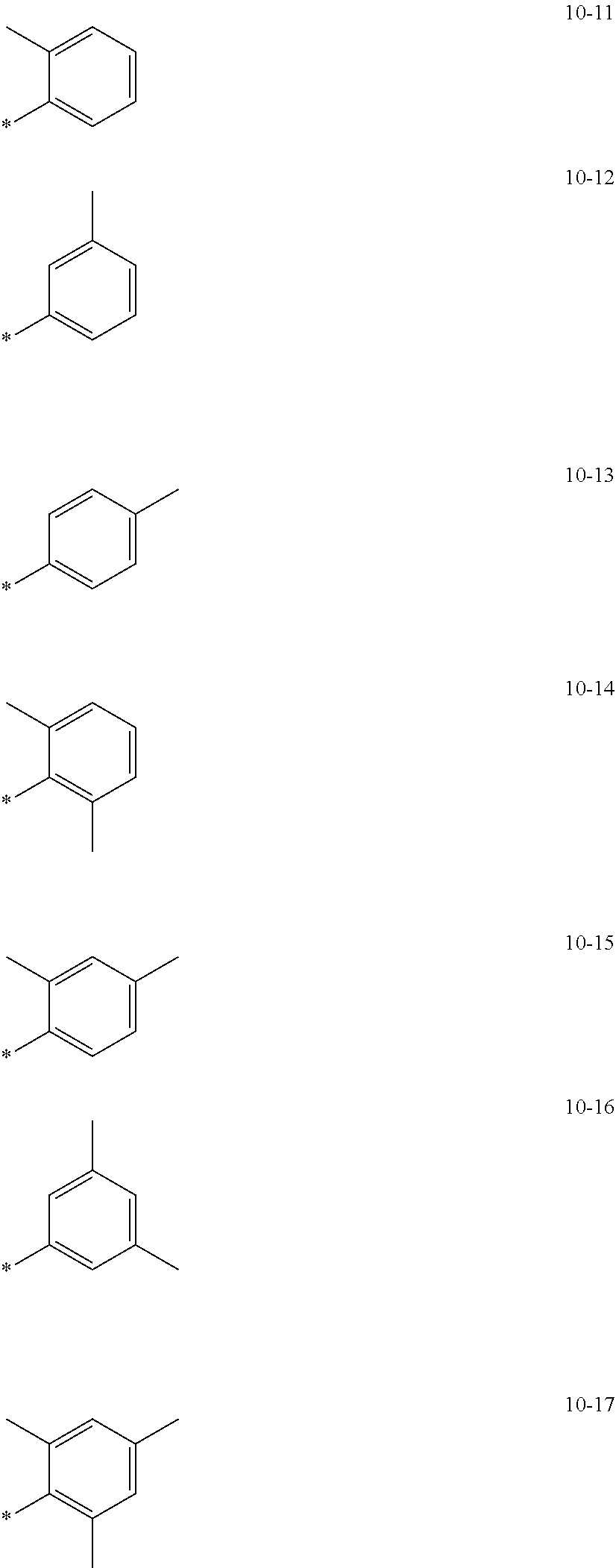
  • R 1 to R 5 may each independently be deuterium, —F, a cyano group, a nitro group, —SF 5 , —CH 3 , —CD 3 , —CD 2 H, —CDH 2 , —CF 3 , —CF 2 H, —CFH 2 , a group represented by one of Formulae 9-1 to 9-66, a group represented by one of Formulae 9-1 to 9-66 in which at least one hydrogen is substituted with deuterium, a group represented by one of Formulae 10-1 to 10-249, a group represented by one of Formulae 10-1 to 10-249 in which at least one hydrogen is substituted with deuterium, —Si(Q 3 )(Q 4 )(Q 5 ), or —Ge(Q 3 )(Q 4 )(Q 5 ) (wherein Q 3 to Q 5 are the same as described herein); and/or
  • R 21 may be a group represented by one of Formulae 9-1 to 9-33, a group represented by one of Formulae 9-1 to 9-33 in which at least one hydrogen is substituted with deuterium, a group represented by one of Formulae 10-1 to 10-10, or a group represented by one of Formulae 10-1 to 10-10 in which at least one hydrogen is substituted with deuterium; and/or
  • R 22 may be —CH 3 , —CD 3 , —CD 2 H, —CDH 2 , a group represented by one of Formulae 9-1 to 9-33, a group represented by one of Formulae 9-1 to 9-33 in which at least one hydrogen is substituted with deuterium, a group represented by one of Formulae 10-1 to 10-10, or a group represented by one of Formulae 10-1 to 10-10 in which at least one hydrogen is substituted with deuterium; and/or
  • a 1 to A 6 may each independently be hydrogen, deuterium, —CH 3 , —CD 3 , —CD 2 H, —CDH 2 , a group represented by one of Formulae 9-1 to 9-63, a group represented by one of Formulae 9-1 to 9-63 in which at least one hydrogen is substituted with deuterium, a group represented by one of Formulae 10-1 to 10-10, or a group represented by one of Formulae 10-1 to 10-10 in which at least one hydrogen is substituted with deuterium:
  • * indicates a binding site to a neighboring atom
  • Ph indicates a phenyl group
  • TMS indicates a trimethylsilyl group.
  • the “group represented by one of Formulae 9-1 to 9-66 in which at least one hydrogen is substituted with deuterium” may be, for example, a group represented by one of Formulae 9-501 to 9-552:
  • Non-limiting examples of the “C 1 -C 60 alkyl group include a methyl group, an ethyl group, an n-propyl group, an isopropyl group, an n-butyl group, a sec-butyl group, an isobutyl group, a tert-butyl group, an n-pentyl group, a tert-pentyl group, a neopentyl group, an isopentyl group, a sec-pentyl group, a 3-pentyl group, a sec-isopentyl group, an n-hexyl group, an isohexyl group, a sec-hexyl group, a tert-hexyl group, an n-heptyl group, an isoheptyl group, a sec-heptyl group, a tert-heptyl
  • an isoquinoline ring, i.e., a lowest unoccupied molecular orbital (LUMO) part, of the organometallic compound represented by Formula 1 may have secured stability, and therefore, an electronic device, for example, an organic light-emitting device, including the organometallic compound may have improved lifespan.
  • an electronic device for example, an organic light-emitting device, including the organometallic compound may have improved lifespan.
  • the horizontal orientation ratio of the organometallic compound may be increased while full width at half maximum (FWHM) of the organometallic compound may be reduced, when at least one of R 1 to R 5 in Formula 1 satisfies the definition as described above.
  • the horizontal orientation ratio of a transition dipole moment may be about 90% to about 100%.
  • the horizontal orientation ratio of the transition dipole moment in the organometallic compound may be, for example, about 90% to about 100%, about 91% to about 100%, about 92% to about 100%, about 93% to about 100%, about 94% to about 100%, about 95% to about 100%, about 96% to about 100%, about 97% to about 100%, about 98% to about 100%, about 99% to about 100%, or 100%, but embodiments of the present disclosure are not limited thereto.
  • the horizontal orientation ratio of the transition dipole moment refers to a ratio of an organometallic compound having dipole moment that is perpendicular to a film relative to the total organometallic compound included in the films.
  • the horizontal orientation ratio of the transition dipole moment may be evaluated using an angle-dependent PL measuring device.
  • an angle-dependent PL measuring device may be described by referring to, for example, the angle-dependent PL measuring device described in KR Application No. 2013-0150834.
  • the specification of KR Application No. 2013-0150834 is incorporated herein by reference.
  • the organometallic compound represented by Formula 1 Since the organometallic compound represented by Formula 1 has a high horizontal orientation ratio of the transition dipole moment as described above, the organometallic compound represented by Formula 1 is also considered to have a large horizontal orientation transition dipole moment (i.e., a large horizontal orientation photo-orientation). Accordingly, substantial electrical fields traveling in a direction perpendicular to the film including the organometallic compound represented by Formula 1 may be emitted.
  • the light emitted according to such a mechanism may result in high external purge efficiency (i.e., efficiency at which the light emitted from the organometallic compound represented by Formula 1 is purged to the outside from a device (for example, an organic light-emitting device) including a film (for example, an emission layer to be described later) including the organometallic compound represented by Formula 1. Therefore, an electronic device, for example, an organic light-emitting device, including the organometallic compound represented by Formula 1 may achieve high luminescence efficiency.
  • Synthesis methods of the organometallic compound represented by Formula 1 may be understood by one of ordinary skill in the art by referring to Synthesis Examples provided below.
  • the organometallic compound represented by Formula 1 may be used between a pair of electrodes of an organic light-emitting device.
  • the organometallic compound represented by Formula 1 may be included in the emission layer.
  • the organometallic compound may act as a dopant, and the emission layer may further include a host (that is, in the emission layer, an amount of the organometallic compound represented by Formula 1 is smaller than an amount of the host).
  • the emission layer may emit red light.
  • (an organic layer) includes at least one organometallic compounds” as used herein may include a case in which “(an organic layer) includes identical organometallic compounds represented by Formula 1” and a case in which “(an organic layer) includes two or more different organometallic compounds represented by Formula 1”.
  • the organic layer may include, as the organometallic compound, only Compound 1.
  • Compound 1 may exist only in the emission layer of the organic light-emitting device.
  • the organic layer may include, as the organometallic compound, Compound 1 and Compound 2.
  • Compound 1 and Compound 2 may exist in an identical layer (for example, Compound 1 and Compound 2 all may exist in an emission layer).
  • the first electrode may be an anode, which is a hole injection electrode, and the second electrode may be a cathode, which is an electron injection electrode; or the first electrode may be a cathode, which is an electron injection electrode, and the second electrode may be an anode, which is a hole injection electrode.
  • the first electrode is an anode
  • the second electrode is a cathode
  • the organic layer further includes a hole transport region between the first electrode and the emission layer and an electron transport region between the emission layer and the second electrode
  • the hole transport region includes a hole injection layer, a hole transport layer, an electron blocking layer, a buffer layer, or any combination thereof
  • the electron transport region includes a hole blocking layer, an electron transport layer, an electron injection layer, or any combination thereof.
  • organic layer refers to a single layer and/or a plurality of layers disposed between the first electrode and the second electrode of an organic light-emitting device.
  • the “organic layer” may include, in addition to an organic compound, an organometallic complex including metal.
  • the charge-generation material may be, for example, a p-dopant.
  • the p-dopant may be a quinone derivative, a metal oxide, a cyano group-containing compound, or any combination thereof, but embodiments of the present disclosure are not limited thereto.
  • Non-limiting examples of the p-dopant are a quinone derivative, such as tetracyanoquinodimethane (TCNQ) or 2,3,5,6-tetrafluoro-tetracyano-1,4-benzoquinodimethane (F4-TCNQ); a metal oxide, such as a tungsten oxide or a molybdenum oxide; and a cyano group-containing compound, such as Compound HT-D1 below, but are not limited thereto:
  • a quinone derivative such as tetracyanoquinodimethane (TCNQ) or 2,3,5,6-tetrafluoro-tetracyano-1,4-benzoquinodimethane (F4-TCNQ)
  • a metal oxide such as a tungsten oxide or a molybdenum oxide
  • a cyano group-containing compound such as Compound HT-D1 below, but are not limited thereto:
  • the hole transport region may include a buffer layer.
  • the buffer layer may compensate for an optical resonance distance according to a wavelength of light emitted from the emission layer, and thus, efficiency of a formed organic light-emitting device may be improved.
  • a material for the electron blocking layer may be a material for the hole transport region described above, a material for a host to be explained later, or any combination thereof.
  • the material for the electron blocking layer is not limited thereto.
  • a material for the electron blocking layer may be mCP, which will be explained later.
  • an emission layer may be formed on the hole transport region by vacuum deposition, spin coating, casting, LB deposition, or the like.
  • the deposition or coating conditions may be similar to those applied in forming the hole injection layer although the deposition or coating conditions may vary according to a compound that is used to form the emission layer.
  • the emission layer may include a host and a dopant, and the dopant may include the organometallic compound represented by Formula 1.
  • the host may include TPBi, TBADN, ADN (also referred to as “DNA”), CBP, CDBP, TCP, mCP, Compound H50, Compound H51, Compound 52, or any combination thereof:
  • the emission layer may be patterned into a red emission layer, a green emission layer, and/or a blue emission layer.
  • the emission layer may emit white light.
  • an amount of the dopant may be in a range of about 0.01 parts by weight to about 15 parts by weight based on 100 parts by weight of the host, but embodiments of the present disclosure are not limited thereto.
  • a thickness of the emission layer may be in a range of about 100 ⁇ to about 1,000 ⁇ , for example, about 200 ⁇ to about 600 ⁇ . When the thickness of the emission layer is within this range, excellent light-emission characteristics may be obtained without a substantial increase in driving voltage.
  • an electron transport region may be disposed on the emission layer.
  • the electron transport region may include a hole blocking layer, an electron transport layer, an electron injection layer, or any combination thereof.
  • the electron transport region may have a hole blocking layer/electron transport layer/electron injection layer structure or an electron transport layer/electron injection layer structure, but the structure of the electron transport region is not limited thereto.
  • the electron transport layer may have a single-layered structure or a multi-layered structure including two or more different materials.
  • Conditions for forming the hole blocking layer, the electron transport layer, and the electron injection layer which constitute the electron transport region may be understood by referring to the conditions for forming the hole injection layer.
  • the hole blocking layer may include, for example, BCP, Bphen, BAIq, or any combination thereof, but embodiments of the present disclosure are not limited thereto:
  • a thickness of the hole blocking layer may be from about 20 ⁇ to about 1,000 ⁇ , for example, about 30 ⁇ to about 300 ⁇ . When the thickness of the hole blocking layer is within these ranges, the hole blocking layer may have excellent hole blocking characteristics without a substantial increase in driving voltage.
  • the electron transport layer may include BCP, Bphen, Alq3, BAIq, TAZ, NTAZ, or any combination thereof:
  • the electron transport layer may include ET1 to ET25, but are not limited thereto:
  • a thickness of the electron transport layer may be from about 100 ⁇ to about 1,000 ⁇ , for example, about 150 ⁇ to about 500 ⁇ . When the thickness of the electron transport layer is within the range described above, the electron transport layer may have satisfactory electron transport characteristics without a substantial increase in driving voltage.
  • the electron injection layer may include LiF, NaCl, CsF, Li 2 O, BaO, or any combination thereof.
  • the second electrode 19 is disposed on the organic layer 15 .
  • the second electrode 19 may be a cathode.
  • a material for forming the second electrode 19 may be a metal, an alloy, an electrically conductive compound, or any combination thereof, which have a relatively low work function.
  • lithium (Li), magnesium (Mg), aluminum (Al), aluminum-lithium (Al—Li), calcium (Ca), magnesium-indium (Mg—In), or magnesium-silver (Mg—Ag) may be formed as the material for forming the second electrode 19 .
  • a transmissive electrode formed using ITO or IZO may be used as the second electrode 19 .
  • Another aspect of the present disclosure provides a diagnostic composition including at least one organometallic compound represented by Formula 1.
  • the organometallic compound represented by Formula 1 provides high luminescent efficiency. Accordingly, a diagnostic composition including the organometallic compound may have high diagnostic efficiency.
  • the diagnostic composition may be used in various applications including a diagnosis kit, a diagnosis reagent, a biosensor, and a biomarker.
  • C 1 -C 60 alkyl group refers to a linear or branched saturated aliphatic hydrocarbon monovalent group having 1 to 60 carbon atoms, and examples thereof include a methyl group, an ethyl group, a propyl group, an isobutyl group, a sec-butyl group, a tert-butyl group, a pentyl group, an isoamyl group, and a hexyl group.
  • C 1 -C 60 alkylene group refers to a divalent group having the same structure as the C 1 -C 60 alkyl group.
  • C 1 -C 60 alkoxy group refers to a monovalent group represented by—OA 101 (wherein A 101 is the C 1 -C 60 alkyl group), and examples thereof include a methoxy group, an ethoxy group, and an isopropyloxy group.
  • C 2 -C 60 alkenyl group refers to a hydrocarbon group having at least one carbon-carbon double bond in the middle or at the terminus of the C 2 -C 60 alkyl group, and examples thereof include an ethenyl group, a propenyl group, and a butenyl group.
  • C 2 -C 60 alkenylene group refers to a divalent group having the same structure as the C 2 -C 60 alkenyl group.
  • C 2 -C 60 alkynyl group refers to a hydrocarbon group having a carbon-carbon triple bond in the middle or at the terminus of the C 2 -C 60 alkyl group, and examples thereof include an ethynyl group, and a propynyl group.
  • C 2 -C 60 alkynylene group refers to a divalent group having the same structure as the C 2 -C 60 alkynyl group.
  • C 3 -C 10 cycloalkyl group refers to a monovalent saturated hydrocarbon monocyclic group having 3 to 10 carbon atoms, and non-limiting examples thereof include a cyclopropyl group, a cyclobutyl group, a cyclopentyl group, a cyclohexyl group, and a cycloheptyl group.
  • C 3 -C 10 cycloalkylene group refers to a divalent group having the same structure as the C 3 -C 10 cycloalkyl group.
  • C 2 -C 10 heterocycloalkyl group refers to a monovalent saturated monocyclic group having N, O, P, Se, Si, S, or any combination thereof as a ring-forming atom and 1 to 10 carbon atoms, and non-limiting examples thereof include a tetrahydrofuranyl group, and a tetrahydrothiophenyl group.
  • C 2 -C 10 heterocycloalkylene group refers to a divalent group having the same structure as the C 2 -C 10 heterocycloalkyl group.
  • C 3 -C 10 cycloalkenyl group refers to a monovalent monocyclic group that has 3 to 10 carbon atoms and at least one carbon-carbon double bond in the ring thereof and no aromaticity, and non-limiting examples thereof include a cyclopentenyl group, a cyclohexenyl group, and a cycloheptenyl group.
  • C 3 -C 10 cycloalkenylene group refers to a divalent group having the same structure as the C 3 -C 10 cycloalkenyl group.
  • C 2 -C 10 heterocycloalkenyl group refers to a monovalent monocyclic group that has N, O, P, Si, Se, S, or any combination thereof as a ring-forming atom, 1 to 10 carbon atoms, and at least one double bond in its ring.
  • Examples of the C 2 -C 10 heterocycloalkenyl group are a 2,3-dihydrofuranyl group, and a 2,3-dihydrothiophenyl group.
  • C 2 -C 10 heterocycloalkenylene group refers to a divalent group having the same structure as the C 2 -C 10 heterocycloalkenyl group.
  • C 6 -C 60 aryl group refers to a monovalent group having a carbocyclic aromatic system having 6 to 60 carbon atoms
  • C 6 -C 60 arylene group refers to a divalent group having a carbocyclic aromatic system having 6 to 60 carbon atoms.
  • Non-limiting examples of the C 6 -C 60 aryl group include a phenyl group, a naphthyl group, an anthracenyl group, a phenanthrenyl group, a pyrenyl group, and a chrysenyl group.
  • the C 6 -C 60 aryl group and the C 6 -C 60 arylene group each include two or more rings, the rings may be fused to each other.
  • C 1 -C 60 heteroaryl group refers to a monovalent group having a cyclic aromatic system that has N, O, P, Si, Se, S, or any combination thereof as a ring-forming atom, in addition to 1 to 60 carbon atoms.
  • C 1 -C 60 heteroarylene group refers to a divalent group having a cyclic aromatic system that has N, O, P, Si, Se, S, or any combination thereof as a ring-forming atom, in addition to 1 to 60 carbon atoms.
  • Non-limiting examples of the C 1 -C 60 heteroaryl group include a pyridinyl group, a pyrimidinyl group, a pyrazinyl group, a pyridazinyl group, a triazinyl group, a quinolinyl group, and an isoquinolinyl group.
  • the C 1 -C 60 heteroaryl group and the C 1 -C 60 heteroarylene group each include two or more rings, the rings may be fused to each other.
  • C 7 -C 60 arylalkyl group refers to an alkylene group substituted with an aryl group.
  • a non-limiting example of a C 7 -C 60 arylalkyl group includes a —CH 2 -phenyl (i.e., benzyl) group and a —CH 2 -naphthyl group.
  • C 2 -C 60 heteroarylalkyl group refers to an alkylene group substituted with a heteroaryl group.
  • a non-limiting example of a C 2 -C 60 heteroarylalkyl group includes a —CH 2 -pyridyl group.
  • the term “monovalent non-aromatic condensed polycyclic group” as used herein refers to a monovalent group (for example, having 8 to 60 carbon atoms) having two or more rings condensed to each other, only carbon atoms as ring-forming atoms, and no aromaticity in its entire molecular structure.
  • Examples of the monovalent non-aromatic condensed polycyclic group include a fluorenyl group.
  • divalent non-aromatic condensed polycyclic group refers to a divalent group having the same structure as the monovalent non-aromatic condensed polycyclic group.
  • the term “monovalent non-aromatic condensed heteropolycyclic group” as used herein refers to a monovalent group (for example, having 2 to 60 carbon atoms) having two or more rings condensed to each other, a heteroatom selected from N, O, P, Si, and S, other than carbon atoms, as a ring-forming atom, and no aromaticity in its entire molecular structure.
  • Non-limiting examples of the monovalent non-aromatic condensed heteropolycyclic group include a carbazolyl group.
  • divalent non-aromatic condensed heteropolycyclic group refers to a divalent group having the same structure as the monovalent non-aromatic condensed heteropolycyclic group.
  • C 5 -C 60 carbocyclic group refers to a saturated or unsaturated cyclic group having, as a ring-forming atom, 5 to 60 carbon atoms (or, 5 to 30 carbon atoms) only.
  • the C 5 -C 60 carbocyclic group (or, C 5 -C 30 carbocyclic group) may be a monocyclic group or a polycyclic group.
  • C 1 -C 60 heterocyclic group refers to a saturated or unsaturated cyclic group having, as a ring-forming atom, N, O, Si, P, Se, S, or any combination thereof other than 1 to 60 carbon atoms (or, 1 to 30 carbon atoms).
  • the C 1 -C 60 heterocyclic group (or, C 1 -C 30 heterocyclic group) may be a monocyclic group or a polycyclic group.
  • deuterium deuterium, —F, —Cl, —Br, —I, —CD 3 , —CD 2 H, —CDH 2 , —CF 3 , —CF 2 H, —CFH 2 , a hydroxyl group, a cyano group, a nitro group, an amino group, an amidino group, a hydrazino group, a hydrazono group, a carboxylic acid group or a salt thereof, a sulfonic acid group or a salt thereof, a phosphoric acid group or a salt thereof, a C 1 -C 60 alkyl group, a C 2 -C 60 alkenyl group, a C 2 -C 60 alkynyl group, or a C 1 -C 60 alkoxy group;
  • Q 1 to Q 9 , Q 11 to Q 19 , Q 21 to Q 29 , and Q 31 to Q 39 may each independently be hydrogen; deuterium; —F; —C 1 ; —Br; —I; a hydroxyl group; a cyano group; a nitro group; an amino group; an amidino group; a hydrazine group; a hydrazone group; a carboxylic acid group or a salt thereof; a sulfonic acid group or a salt thereof; a phosphoric acid group or a salt thereof; a C 1 -C 60 alkyl group unsubstituted or substituted with deuterium, a C 1 -C 60 alkyl group, a C 6 -C 60 aryl group, or any combination thereof; a C 2 -C 60 alkenyl group; a C 2 -C 60 alkynyl group; a C 1 -C 60 alkoxy group; a C 3 -C 10 cyclo
  • Dimer 3 (yield: 70%) was synthesized in the same manner as in the synthesis of Dimer 1 according to Synthesis Example 1, except that Intermediate L3 was used instead of Intermediate L1.
  • Dimer 7 was synthesized in the same manner as in the synthesis of Dimer 1 according to Synthesis Example 1, except that Intermediate L7 was used instead of Intermediate L1 Synthesis of Compound 7
  • Intermediate L8-6 was synthesized in the same manner as in the synthesis of Intermediate L1-6 according to Synthesis Example 1, except that 2-(1-cyclopentylvinyl)-4,4,5,5-tetramethyl-1,3,2-dioxaborolane was used instead of sec-butenylboronic acid.
  • Dimer 8 was synthesized in the same manner as in the synthesis of Dimer 1 according to Synthesis Example 1, except that Intermediate L8 was used instead of Intermediate L1.
  • Dimer 13 was synthesized in the same manner as in the synthesis of Dimer 1 according to Synthesis Example 1, except that Intermediate L13 was used instead of Intermediate L1.
  • Dimer 14 was synthesized in the same manner as in the synthesis of Dimer 3 according to Synthesis Example 2, except that Intermediate L14 was used instead of Intermediate L3.
  • thermogravimetric analysis TGA
  • DSC differential scanning calorimetry
  • mCP and Compound 1 were co-deposited at a weight ratio of 97:3 on a fused silica substrate layer (having a thickness of 1 mm) to form Sample 1 having a thickness of 30 nm (3 wt %). Then, Sample 1 was sealed using glass and glue in a nitrogen atmosphere. The same process was repeated for each of the compounds shown in Table 2 to prepare the remaining samples.
  • Source of excited light He—Cd laser, Melles Griot Company
  • Measuring means of excited light Light fiber, diameter of 1 mm, Thorlabs Company
  • Semi-cylindrical prism Fused silica, diameter of 100 mm, length of 30 mm,
  • Detection means of emitted light Photomultiplier tube, Acton Company
  • Polarizer mounted on detection means of emitted light Linear polarizer
  • Distance between sample to detection means of emitted light (or, radius of movement path of detection means of emitted light): 900 mm
  • each sample was fixed on a semi-cylindrical lens, and then, irradiated with a laser having a wavelength of 325 nm to emit light.
  • the light emitted therefrom passes through a polarizing film, and an intensity of p-polarized light emission was measured for the light having a wavelength of 530 nm by rotating the semi-cylindrical lens fixed with the samples using a charge-coupled device (CCD) at an angle of 1 degree with respect to the axis of the lens.
  • CCD charge-coupled device
  • the intensity of p-polarized light when each compound had a vertical orientation (No. 1: Intensity of p-polarized light emission) and the intensity of p-polarized light when each compound had a horizontal orientation (No. 2: Intensity of p-polarized light emission) were each calculated at an angle from 0 degree to 90 degree. Then, weightings that match the p-polarized light, which is obtained by multiplying the intensities of p-polarized light of No. 1 and No. 2 by each weighting thereof were obtained. Then, the horizontal orientation ratios of the compounds of Table 2 were also measured, and results of the measurements are shown in Table 2.
  • the angle-dependent photoluminescence spectra were analyzed using a classical dipole model which regards the emission from the excitons as the dissipated power from the oscillating dipoles.
  • a glass substrate, on which ITO/Ag/ITO were deposited to thicknesses of 70 ⁇ /1,000 ⁇ /70 ⁇ was cut to a size of 50 mm ⁇ 50 mm ⁇ 0.5 mm, sonicated with isopropyl alcohol and pure water each for 5 minutes, and then cleaned by exposure to ultraviolet rays and ozone for 30 minutes. Then, the glass substrate was provided to a vacuum deposition apparatus.
  • 2-TNATA was vacuum-deposited on the anode to form a hole injection layer having a thickness of 600 ⁇
  • NPB 4,4′-bis[N-(1-naphthyl)-N-phenylamino]biphenyl
  • CBP(host) and Compound 1(dopant) were co-deposited in a weight ratio of 97:3 on the hole transport layer to form an emission layer having a thickness of 400 ⁇ .
  • BCP was vacuum deposited on the emission layer to form a hole blocking layer having a thickness of 50 ⁇
  • Alq 3 was vacuum deposited on the hole blocking layer to form an electron transport layer having a thickness of 350 ⁇ .
  • LiF was then vacuum deposited on the electron transport layer to form an electron injection layer having a thickness of 10 ⁇
  • Mg and Ag were co-deposited on a weight ratio of 90:10 on the electron injection layer to form a cathode having a thickness of 120 ⁇ , thereby completing the manufacture of an organic light-emitting device (front red light-emitting device).
  • Organic light-emitting devices were manufactured in the same manner as in Example 1, except that Compounds shown in Table 3 were each used instead of Compound 1 as a dopant in forming an emission layer.
  • the driving voltage, FWHM of an EL spectrum, lifespan (T 97 ) and conversion luminescence efficiency, of the organic light-emitting devices manufactured according to Examples 1 to 10 and Comparative Examples A to C were evaluated, and results thereof are shown in Table 3.
  • a current-voltage meter (Keithley 2400) and a luminance meter (Minolta Cs-1000A) were used as evaluation devices, and the lifespan (LT 97 ) (at 3,500 nit) indicates an amount of time that lapsed when luminance was 97% of initial luminance (100%).
  • Each of lifespan (LT 97 ) and conversion luminescence efficiency were shown in a relative value (%) compared to lifespan (LT 97 ) and conversion luminescence efficiency of Comparative Example A.
  • an organometallic compound represented by Formula I has excellent electric characteristics and thermal stability, and in this regard, an organic light-emitting device including the organometallic compound may have excellent driving voltage, relatively reduced FWHM, excellent lifespan and excellent luminescent efficiency characteristics.

Landscapes

  • Chemical & Material Sciences (AREA)
  • Physics & Mathematics (AREA)
  • Organic Chemistry (AREA)
  • Optics & Photonics (AREA)
  • Engineering & Computer Science (AREA)
  • Materials Engineering (AREA)
  • Crystallography & Structural Chemistry (AREA)
  • Inorganic Chemistry (AREA)
  • Spectroscopy & Molecular Physics (AREA)
  • Organic Low-Molecular-Weight Compounds And Preparation Thereof (AREA)
  • Electroluminescent Light Sources (AREA)

Abstract

An organometallic compound represented by Formula 1, an organic light-emitting device including the same, and a diagnostic composition including the organometallic compound:
Figure US12286446-20250429-C00001
    • wherein, Formula 1, R1 to R12 and R21 to R23 are each independently the same as described in the detailed description of the specification.

Description

CROSS-REFERENCE TO RELATED APPLICATION
This application claims priority to and the benefit of Korean Patent Applications Nos. 10-2018-0106188, filed on Sep. 5, 2018, and 10-2019-0108601, filed on Sep. 3, 2019, in the Korean Intellectual Property Office, and all the benefits accruing therefrom under 35 U.S.C. § 119, the content of which is incorporated herein in its entirety by reference.
BACKGROUND 1. Field
An embodiment relates to an organometallic compound, an organic light-emitting device including the organometallic compound, and a diagnostic composition including the organometallic compound.
2. Description of the Related Art
Organic light-emitting devices are self-emission devices, which have better characteristics in terms of a viewing angle, response time, brightness, driving voltage, and response speed, and produce full-color images.
In an example, an organic light-emitting device includes an anode, a cathode, and an organic layer between the anode and the cathode, wherein the organic layer includes an emission layer. A hole transport region may be between the anode and the emission layer, and an electron transport region may be between the emission layer and the cathode. Holes provided from the anode may move toward the emission layer through the hole transport region, and electrons provided from the cathode may move toward the emission layer through the electron transport region. The holes and the electrons recombine in the emission layer to produce excitons. These excitons transit from an excited state to a ground state, thereby generating light.
Meanwhile, luminescent compounds may be used to monitor, sense, or detect a variety of biological materials including cells and proteins. An example of a luminescent compound is a phosphorescent luminescent compound.
SUMMARY
An embodiment relates to a novel organometallic compound and an organic light-emitting device and a diagnostic composition including the same.
Additional aspects will be set forth in part in the description which follows and, in part, will be apparent from the description, or may be learned by practice of the presented embodiments.
An aspect of the present disclosure provides an organometallic compound represented by Formula 1 below:
Figure US12286446-20250429-C00002
In Formula 1, R1 to R12 and R23 may each independently be hydrogen, deuterium, —F, —Cl, —Br, —I, —SF5, a hydroxyl group, a cyano group, a nitro group, an amino group, an amidino group, a hydrazino group, a hydrazono group, a carboxylic acid group or a salt thereof, a sulfonic acid group or a salt thereof, a phosphoric acid group or a salt thereof, a substituted or unsubstituted C1-C60 alkyl group, a substituted or unsubstituted C2-C60 alkenyl group, a substituted or unsubstituted C2-C60 alkynyl group, a substituted or unsubstituted C1-C60 alkoxy group, a substituted or unsubstituted C3-C10 cycloalkyl group, a substituted or unsubstituted C2-C10 heterocycloalkyl group, a substituted or unsubstituted C3-C10 cycloalkenyl group, a substituted or unsubstituted C2-C10 heterocycloalkenyl group, a substituted or unsubstituted C6-C60 aryl group, a substituted or unsubstituted C7-C60 arylalkyl group, a substituted or unsubstituted C6-C60 aryloxy group, a substituted or unsubstituted C6-C60 arylthio group, a substituted or unsubstituted C1-C60 heteroaryl group, a substituted or unsubstituted C2-C60 heteroarylalkyl group, a substituted or unsubstituted monovalent non-aromatic condensed polycyclic group, a substituted or unsubstituted monovalent non-aromatic condensed heteropolycyclic group, —N(Q1)(Q2), —Si(Q3)(Q4)(Q5), —Ge(Q3)(Q4)(Q5), —B(Q6)(Q7), —P(═O)(Q8)(Q9), or —P(Q8)(Q9),
at least one of R1 to R5 may each independently be deuterium, —F, —Cl, —Br, —I, —SF5, a hydroxyl group, a cyano group, a nitro group, an amino group, an amidino group, a hydrazino group, a hydrazono group, a carboxylic acid group or a salt thereof, a sulfonic acid group or a salt thereof, a phosphoric acid group or a salt thereof, a substituted or unsubstituted C1-C60 alkyl group, a substituted or unsubstituted C2-C60 alkenyl group, a substituted or unsubstituted C2-C60 alkynyl group, a substituted or unsubstituted C1-C60 alkoxy group, a substituted or unsubstituted C3-C10 cycloalkyl group, a substituted or unsubstituted C2-C10 heterocycloalkyl group, a substituted or unsubstituted C3-C10 cycloalkenyl group, a substituted or unsubstituted C2-C10 heterocycloalkenyl group, a substituted or unsubstituted C6-C60 aryl group, a substituted or unsubstituted C7-C60 arylalkyl group, a substituted or unsubstituted C6-C60 aryloxy group, a substituted or unsubstituted C6-C60 arylthio group, a substituted or unsubstituted C1-C60 heteroaryl group, a substituted or unsubstituted C2-C60 heteroarylalkyl group, a substituted or unsubstituted monovalent non-aromatic condensed polycyclic group, a substituted or unsubstituted monovalent non-aromatic condensed heteropolycyclic group, —N(Q1)(Q2), —Si(Q3)(Q4)(Q5), —Ge(Q3)(Q4)(Q5), —B(Q6)(Q7), —P(═O)(Q8)(Q9), or —P(Q8)(Q9),
R21 may be a C2-C20 alkyl group, a deuterium-containing C2-C20 alkyl group, a C3-C10 cycloalkyl group, or a deuterium-containing C3-C10 cycloalkyl group,
R22 may be a C1-C20 alkyl group, a deuterium-containing C1-C20 alkyl group, a C3-C10 cycloalkyl group, or a deuterium-containing C3-C10 cycloalkyl group,
two or more of R1 to R9 may optionally be linked to each other to form a C5-C30 carbocyclic group unsubstituted or substituted with at least one R1a group or a C2-C30 heterocyclic group unsubstituted or substituted with at least one R1a group,
two or more of R10 to R12 may optionally be linked to each other to form a C5-C30 carbocyclic group unsubstituted or substituted with at least one R1a group or a C2-C30 heterocyclic group unsubstituted or substituted with at least one R1a group,
R1a is the same as defined in connection with R1,
a substituent of the substituted C1-C60 alkyl group, the substituted C2-C60 alkenyl group, the substituted C2-C60 alkynyl group, the substituted C1-C60 alkoxy group, the substituted C3-C10 cycloalkyl group, the substituted C2-C10 heterocycloalkyl group, the substituted C3-C10 cycloalkenyl group, the substituted C2-C10 heterocycloalkenyl group, the substituted C6-C60 aryl group, the substituted C7-C60 arylalkyl group, the substituted C6-C60 aryloxy group, the substituted C6-C60 arylthio group, the substituted C1-C60 heteroaryl group, the substituted C2-C60 heteroarylalkyl group, the substituted monovalent non-aromatic condensed polycyclic group, and the substituted monovalent non-aromatic condensed heteropolycyclic group may be each independently:
deuterium, —F, —Cl, —Br, —I, —CD3, —CD2H, —CDH2, —CF3, —CF2H, —CFH2, a hydroxyl group, a cyano group, a nitro group, an amino group, an amidino group, a hydrazino group, a hydrazono group, a carboxylic acid group or a salt thereof, a sulfonic acid group or a salt thereof, a phosphoric acid group or a salt thereof, a C1-C60 alkyl group, a C2-C60 alkenyl group, a C2-C60 alkynyl group, or a C1-C60 alkoxy group;
a C1-C60 alkyl group, a C2-C60 alkenyl group, a C2-C60 alkynyl group, or a C1-C60 alkoxy group, each substituted with deuterium, —F, —Cl, —Br, —I, —CD3, —CD2H, —CDH2, —CF3, —CF2H, —CFH2, a hydroxyl group, a cyano group, a nitro group, an amino group, an amidino group, a hydrazino group, a hydrazono group, a carboxylic acid group or a salt thereof, a sulfonic acid group or a salt thereof, a phosphoric acid group or a salt thereof, a C3-C10 cycloalkyl group, a C2-C10 heterocycloalkyl group, a C3-C10 cycloalkenyl group, a C2-C10 heterocycloalkenyl group, a C6-C60 aryl group, a C7-C60 arylalkyl group, a C6-C60 aryloxy group, a C6-C60 arylthio group, a C1-C60 heteroaryl group, a C2-C60 heteroarylalkyl group, a monovalent non-aromatic condensed polycyclic group, a monovalent non-aromatic condensed heteropolycyclic group, —N(Q11)(Q12), —Si(Q13)(Q14)(Q15), —Ge(Q13)(Q14)(Q15), —B(Q16)(Q17), —P(═O)(Q18)(Q19), —P(Q18)(Q19), or any combination thereof;
a C3-C10 cycloalkyl group, a C2-C10 heterocycloalkyl group, a C3-C10 cycloalkenyl group, a C2-C10 heterocycloalkenyl group, a C6-C60 aryl group, a C7-C60 arylalkyl group, a C6-C60 aryloxy group, a C6-C60 arylthio group, a C1-C60 heteroaryl group, a monovalent non-aromatic condensed polycyclic group, or a monovalent non-aromatic condensed heteropolycyclic group, each unsubstituted or substituted with deuterium, —F, —Cl, —Br, —I, —CD3, —CD2H, —CDH2, —CF3, —CF2H, —CFH2, a hydroxyl group, a cyano group, a nitro group, an amino group, an amidino group, a hydrazino group, a hydrazono group, a carboxylic acid group or a salt thereof, a sulfonic acid group or a salt thereof, a phosphoric acid group or a salt thereof, a C1-C60 alkyl group, a C2-C60 alkenyl group, a C2-C60 alkynyl group, a C1-C60 alkoxy group, a C3-C10 cycloalkyl group, a C2-C10 heterocycloalkyl group, a C3-C10 cycloalkenyl group, a C2-C10 heterocycloalkenyl group, a C6-C60 aryl group, a C7-C60 arylalkyl group, a C6-C60 aryloxy group, a C6-C60 arylthio group, a C1-C60 heteroaryl group, a monovalent non-aromatic condensed polycyclic group, a monovalent non-aromatic condensed heteropolycyclic group, —N(Q21)(Q22), —Si(Q23)(Q24)(Q25), —Ge(Q23)(Q24)(Q25), —B(Q26)(Q27), P(═O)(Q28)(Q29), —P(Q28)(Q29), or any combination thereof;
—N(Q31)(Q32), —Si(Q33)(Q34)(Q35), —Ge(Q33)(Q34)(Q35), —B(Q36)(Q37), P(═O)(Q38)(Q39) or —P(Q38)(Q39); or
any combination thereof; and
Q1 to Q9, Q11 to Q19, Q21 to Q29, and Q31 to Q39 may each independently be hydrogen; deuterium; —F; —C1; —Br; —I; a hydroxyl group; a cyano group; a nitro group; an amino group; an amidino group; a hydrazine group; a hydrazone group; a carboxylic acid group or a salt thereof; a sulfonic acid group or a salt thereof; a phosphoric acid group or a salt thereof; a C1-C60 alkyl group unsubstituted or substituted with deuterium, a C1-C60 alkyl group, a C6-C60 aryl group, or any combination thereof; a C2-C60 alkenyl group; a C2-C60 alkynyl group; a C1-C60 alkoxy group; a C3-C10 cycloalkyl group; a C2-C10 heterocycloalkyl group; a C3-C10 cycloalkenyl group; a C2-C10 heterocycloalkenyl group; a C6-C60 aryl group unsubstituted or substituted with a C1-C60 alkyl group, a C6-C60 aryl group, or any combination thereof; a C6-C60 aryloxy group; a C6-C60 arylthio group; a C1-C60 heteroaryl group; a monovalent non-aromatic condensed polycyclic group; or a monovalent non-aromatic condensed heteropolycyclic group.
Another aspect of the present disclosure provides an organic light-emitting device including: a first electrode, a second electrode, and an organic layer disposed between the first electrode and the second electrode and including an emission layer, wherein the organic layer includes at least one the organometallic compound represented by Formula 1.
The organometallic compound represented by Formula 1 included in the emission layer in the organic layer may act as a dopant.
BRIEF DESCRIPTION OF THE DRAWING
These and/or other aspects will become apparent and more readily appreciated from the following description of the embodiments, taken in conjunction with FIGURE which is a schematic view of an organic light-emitting device according to an embodiment.
DETAILED DESCRIPTION
Reference will now be made in detail to embodiments, examples of which are illustrated in the accompanying drawings, wherein like reference numerals refer to like elements throughout. In this regard, the present embodiments may have different forms and should not be construed as being limited to the descriptions set forth herein. Accordingly, the embodiments are merely described below, by referring to the figures, to explain aspects of the present description. As used herein, the term “and/or” includes any and all combinations of one or more of the associated listed items. Expressions such as “at least one of,” when preceding a list of elements, modify the entire list of elements and do not modify the individual elements of the list.
It will be understood that when an element is referred to as being “on” another element, it can be directly on the other element or intervening elements may be present therebetween. In contrast, when an element is referred to as being “directly on” another element, there are no intervening elements present.
It will be understood that, although the terms “first,” “second,” “third” etc. may be used herein to describe various elements, components, regions, layers and/or sections, these elements, components, regions, layers and/or sections should not be limited by these terms. These terms are only used to distinguish one element, component, region, layer, or section from another element, component, region, layer, or section. Thus, “a first element,” “component,” “region,” “layer,” or “section” discussed below could be termed a second element, component, region, layer, or section without departing from the teachings herein.
The terminology used herein is for the purpose of describing particular embodiments only and is not intended to be limiting. As used herein, “a,” “an,” “the,” and “at least one” do not denote a limitation of quantity, and are intended to cover both the singular and plural, unless the context clearly indicates otherwise. For example, “an element” has the same meaning as “at least one element,” unless the context clearly indicates otherwise.
“Or” means “and/or.” It will be further understood that the terms “comprises” and/or “comprising,” or “includes” and/or “including” when used in this specification, specify the presence of stated features, regions, integers, steps, operations, elements, and/or components, but do not preclude the presence or addition of one or more other features, regions, integers, steps, operations, elements, components, and/or groups thereof.
Furthermore, relative terms, such as “lower” or “bottom” and “upper” or “top,” may be used herein to describe one element's relationship to another element as illustrated in the Figures. It will be understood that relative terms are intended to encompass different orientations of the device in addition to the orientation depicted in the Figures. For example, if the device in one of the figures is turned over, elements described as being on the “lower” side of other elements would then be oriented on “upper” sides of the other elements. The exemplary term “lower,” can therefore, encompasses both an orientation of “lower” and “upper,” depending on the particular orientation of the FIGURE. Similarly, if the device in one of the figures is turned over, elements described as “below” or “beneath” other elements would then be oriented “above” the other elements. The exemplary terms “below” or “beneath” can, therefore, encompass both an orientation of above and below.
“About” or “approximately” as used herein is inclusive of the stated value and means within an acceptable range of deviation for the particular value as determined by one of ordinary skill in the art, considering the measurement in question and the error associated with measurement of the particular quantity (i.e., the limitations of the measurement system). For example, “about” can mean within one or more standard deviations, or within +30%, 20%, 10%, or 5% of the stated value.
Unless otherwise defined, all terms (including technical and scientific terms) used herein have the same meaning as commonly understood by one of ordinary skill in the art to which this disclosure belongs. It will be further understood that terms, such as those defined in commonly used dictionaries, should be interpreted as having a meaning that is consistent with their meaning in the context of the relevant art and the present disclosure, and will not be interpreted in an idealized or overly formal sense unless expressly so defined herein.
Exemplary embodiments are described herein with reference to cross section illustrations that are schematic illustrations of idealized embodiments. As such, variations from the shapes of the illustrations as a result, for example, of manufacturing techniques and/or tolerances, are to be expected. Thus, embodiments described herein should not be construed as limited to the particular shapes of regions as illustrated herein but are to include deviations in shapes that result, for example, from manufacturing. For example, a region illustrated or described as flat may, typically, have rough and/or nonlinear features. Moreover, sharp angles that are illustrated may be rounded. Thus, the regions illustrated in the figures are schematic in nature and their shapes are not intended to illustrate the precise shape of a region and are not intended to limit the scope of the present claims.
An aspect of the present disclosure provides an organometallic compound represented by Formula 1 below:
Figure US12286446-20250429-C00003
In Formula 1, R1 to R12 and R23 may each independently be hydrogen, deuterium, —F, —Cl, —Br, —I, —SF5, a hydroxyl group, a cyano group, a nitro group, an amino group, an amidino group, a hydrazino group, a hydrazono group, a carboxylic acid group or a salt thereof, a sulfonic acid group or a salt thereof, a phosphoric acid group or a salt thereof, a substituted or unsubstituted C1-C60 alkyl group, a substituted or unsubstituted C2-C60 alkenyl group, a substituted or unsubstituted C2-C60 alkynyl group, a substituted or unsubstituted C1-C60 alkoxy group, a substituted or unsubstituted C3-C10 cycloalkyl group, a substituted or unsubstituted C2-C10 heterocycloalkyl group, a substituted or unsubstituted C3-C10 cycloalkenyl group, a substituted or unsubstituted C2-C10 heterocycloalkenyl group, a substituted or unsubstituted C6-C60 aryl group, a substituted or unsubstituted C7-C60 arylalkyl group, a substituted or unsubstituted C6-C60 aryloxy group, a substituted or unsubstituted C6-C60 arylthio group, a substituted or unsubstituted C1-C60 heteroaryl group, a substituted or unsubstituted C2-C60 heteroarylalkyl group, a substituted or unsubstituted monovalent non-aromatic condensed polycyclic group, a substituted or unsubstituted monovalent non-aromatic condensed heteropolycyclic group, —N(Q1)(Q2), —Si(Q3)(Q4)(Q5), —Ge(Q3)(Q4)(Q5), —B(Q6)(Q7), —P(═O)(Q8)(Q9), or —P(Q8)(Q9), wherein Q1 to Q9 will be each understood by referring to a detailed description thereof provided below.
In Formula 1, at least one of R1 to R5 (for example, one, two, three, four, or five of R1 to R5) may not be hydrogen. For example, at least one of R1 to R5 in Formula 1 (for example, one, two, three, four, or five of R1 to R5) may each independently be deuterium, —F, —Cl, —Br, —I, —SF5, a hydroxyl group, a cyano group, a nitro group, an amino group, an amidino group, a hydrazino group, a hydrazono group, a carboxylic acid group or a salt thereof, a sulfonic acid group or a salt thereof, a phosphoric acid group or a salt thereof, a substituted or unsubstituted C1-C60 alkyl group, a substituted or unsubstituted C2-C60 alkenyl group, a substituted or unsubstituted C2-C60 alkynyl group, a substituted or unsubstituted C1-C60 alkoxy group, a substituted or unsubstituted C3-C10 cycloalkyl group, a substituted or unsubstituted C2-C10 heterocycloalkyl group, a substituted or unsubstituted C3-C10 cycloalkenyl group, a substituted or unsubstituted C2-C10 heterocycloalkenyl group, a substituted or unsubstituted C6-C60 aryl group, a substituted or unsubstituted C7-C60 arylalkyl group, a substituted or unsubstituted C6-C60 aryloxy group, a substituted or unsubstituted C6-C60 arylthio group, a substituted or unsubstituted C1-C60 heteroaryl group, a substituted or unsubstituted C2-C60 heteroarylalkyl group, a substituted or unsubstituted monovalent non-aromatic condensed polycyclic group, a substituted or unsubstituted monovalent non-aromatic condensed heteropolycyclic group, —N(Q1)(Q2), —Si(Q3)(Q4)(Q5), —Ge(Q3)(Q4)(Q5), —B(Q6)(Q7), —P(═O)(Q8)(Q9), or —P(Q8)(Q9).
In an embodiment, in Formula 1, R1 may not be hydrogen and R2, R3, R4 and R5 may each be independently be hydrogen or deuterium;
R2 may not be hydrogen and R1, R2, R4 and R5 may each be independently hydrogen or deuterium;
R3 may not be hydrogen and R1, R2, R4 and R5 may each be independently hydrogen or deuterium;
R4 may not be hydrogen and R1, R2, R3 and R5 may each independently be hydrogen or deuterium; or
R5 may not be hydrogen and R1, R2, R3 and R4 may each independently be hydrogen or deuterium.
For example, in Formula 1, R1 to R12 and R23 may each independently be: hydrogen, deuterium, —F, —Cl, —Br, —I, a hydroxyl group, a cyano group, a nitro group, an amino group, an amidino group, a hydrazine group, a hydrazone group, a carboxylic acid group or a salt thereof, a sulfonic acid group or a salt thereof, a phosphoric acid group or a salt thereof, —SF5, a C1-C20 alkyl group, or a C1-C20 alkoxy group;
a C1-C20 alkyl group or a C1-C20 alkoxy group, each substituted with deuterium, —F, —Cl, —Br, —I, —CD3, —CD2H, —CDH2, —CF3, —CF2H, —CFH2, a hydroxyl group, a cyano group, a nitro group, an amino group, an amidino group, a hydrazine group, a hydrazone group, a carboxylic acid group or a salt thereof, a sulfonic acid group or a salt thereof, a phosphoric acid group or a salt thereof, a C1-C10 alkyl group, a C1-C20 alkoxy group, a cyclopentyl group, a cyclohexyl group, a cycloheptyl group, a cyclooctyl group, an adamantyl group, a norbornenyl group, a cyclopentenyl group, a cyclohexenyl group, a cycloheptenyl group, a bicyclo[1.1.1]pentyl group, a bicyclo[2.1.1]hexyl group, a bicyclo[2.2.1]heptyl group, a bicyclo[2.2.2]octyl group, a phenyl group, a (C1-C20 alkyl)phenyl group, a biphenyl group, a terphenyl group, a naphthyl group, a pyridinyl group, a pyrimidinyl group, or any combination thereof;
a cyclopentyl group, a cyclohexyl group, a cycloheptyl group, a cyclooctyl group, an adamantyl group, a norbornenyl group, a cyclopentenyl group, a cyclohexenyl group, a cycloheptenyl group, a bicyclo[1.1.1]pentyl group, a bicyclo[2.1.1]hexyl group, a bicyclo[2.2.1]heptyl group, a bicyclo[2.2.2]octyl group, a phenyl group, a (C1-C20 alkyl)phenyl group, a biphenyl group, a terphenyl group, a naphthyl group, a fluorenyl group, a phenanthrenyl group, an anthracenyl group, a fluoranthenyl group, a triphenylenyl group, a pyrenyl group, a chrysenyl group, a pyrrolyl group, a thiophenyl group, a furanyl group, an imidazolyl group, a pyrazolyl group, a thiazolyl group, an isothiazolyl group, an oxazolyl group, an isoxazolyl group, a pyridinyl group, a pyrazinyl group, a pyrimidinyl group, a pyridazinyl group, an isoindolyl group, an indolyl group, an indazolyl group, a purinyl group, a quinolinyl group, an isoquinolinyl group, a benzoquinolinyl group, a quinoxalinyl group, a quinazolinyl group, a cinnolinyl group, a carbazolyl group, a phenanthrolinyl group, a benzimidazolyl group, a benzofuranyl group, a benzothiophenyl group, an isobenzothiazolyl group, a benzoxazolyl group, an isobenzoxazolyl group, a triazolyl group, a tetrazolyl group, an oxadiazolyl group, a triazinyl group, a dibenzofuranyl group, a dibenzothiophenyl group, a benzocarbazolyl group, a dibenzocarbazolyl group, an imidazopyridinyl group. or an imidazopyrimidinyl group, each unsubstituted or substituted with deuterium, —F, —Cl, —Br, —I, —CD3, —CD2H, —CDH2, —CF3, —CF2H, —CFH2, a hydroxyl group, a cyano group, a nitro group, an amino group, an amidino group, a hydrazine group, a hydrazone group, a carboxylic acid group or a salt thereof, a sulfonic acid group or a salt thereof, a phosphoric acid group or a salt thereof, a C1-C10 alkyl group, a C1-C20 alkoxy group, a cyclopentyl group, a cyclohexyl group, a cycloheptyl group, a cyclooctyl group, an adamantyl group, a norbornenyl group, a cyclopentenyl group, a cyclohexenyl group, a cycloheptenyl group, a bicyclo[1.1.1]pentyl group, a bicyclo[2.1.1]hexyl group, a bicyclo[2.2.1]heptyl group, a bicyclo[2.2.2]octyl group, a phenyl group, a (C1-C20 alkyl)phenyl group, a biphenyl group, a terphenyl group, a naphthyl group, a fluorenyl group, a phenanthrenyl group, an anthracenyl group, a fluoranthenyl group, a triphenylenyl group, a pyrenyl group, a chrysenyl group, a pyrrolyl group, a thiophenyl group, a furanyl group, an imidazolyl group, a pyrazolyl group, a thiazolyl group, an isothiazolyl group, an oxazolyl group, an isoxazolyl group, a pyridinyl group, a pyrazinyl group, a pyrimidinyl group, a pyridazinyl group, an isoindolyl group, an indolyl group, an indazolyl group, a purinyl group, a quinolinyl group, an isoquinolinyl group, a benzoquinolinyl group, a quinoxalinyl group, a quinazolinyl group, a cinnolinyl group, a carbazolyl group, a phenanthrolinyl group, a benzimidazolyl group, a benzofuranyl group, a benzothiophenyl group, an isobenzothiazolyl group, a benzoxazolyl group, an isobenzoxazolyl group, a triazolyl group, a tetrazolyl group, an oxadiazolyl group, a triazinyl group, a dibenzofuranyl group, a dibenzothiophenyl group, a benzocarbazolyl group, a dibenzocarbazolyl group, an imidazopyridinyl group, an imidazopyrimidinyl group, or any combination thereof; or
—N(Q1)(Q2), —Si(Q3)(Q4)(Q5), —Ge(Q3)(Q4)(Q5), —B(Q6)(Q7), or —P(═O)(Q8)(Q9);
at least one of R1 to R5 may not be hydrogen, and
Q1 to Q9 may each independently be:
—CH3, —CD3, —CD2H, —CDH2, —CH2CH3, —CH2CD3, —CH2CD2H, —CH2CDH2, —CHDCH3, —CHDCD2H, —CHDCDH2, —CHDCD3, —CD2CD3, —CD2CD2H, or —CD2CDH2; or
an n-propyl group, an isopropyl group, an n-butyl group, a sec-butyl group, an isobutyl group, a tert-butyl group, an n-pentyl group, a tert-pentyl group, a neopentyl group, an isopentyl group, a sec-pentyl group, a 3-pentyl group, a sec-isopentyl group, a phenyl group, a biphenyl group, or a naphthyl group, each unsubstituted or substituted with deuterium, a C1-C10 alkyl group, a phenyl group, or any combination thereof.
In an embodiment, in Formula 1, R1 to R12 and R23 may each independently be:
hydrogen, deuterium, —F, a cyano group, or a C1-C20 alkyl group;
a C1-C20 alkyl group substituted with deuterium, —F, —CD3, —CD2H, —CDH2, —CF3, —CF2H, —CFH2, a cyano group, a C1-C10 alkyl group, a cyclopentyl group, a cyclohexyl group, a cycloheptyl group, a cyclooctyl group, an adamantyl group, a norbornenyl group, a cyclopentenyl group, a cyclohexenyl group, a cycloheptenyl group, a bicyclo[1.1.1]pentyl group, a bicyclo[2.1.1]hexyl group, a bicyclo[2.2.1]heptyl group, a bicyclo[2.2.2]octyl group, a phenyl group, a (C1-C20 alkyl)phenyl group, a biphenyl group, a terphenyl group, or any combination thereof;
a cyclopentyl group, a cyclohexyl group, a cycloheptyl group, a cyclooctyl group, an adamantyl group, a norbornenyl group, a cyclopentenyl group, a cyclohexenyl group, a cycloheptenyl group, a bicyclo[1.1.1]pentyl group, a bicyclo[2.1.1]hexyl group, a bicyclo[2.2.1]heptyl group, a bicyclo[2.2.2]octyl group, a phenyl group, a (C1-C20 alkyl)phenyl group, a biphenyl group, or a terphenyl group, each unsubstituted or substituted with deuterium, —F, —CD3, —CD2H, —CDH2, —CF3, —CF2H, —CFH2, a cyano group, a C1-C10 alkyl group, a cyclopentyl group, a cyclohexyl group, a cycloheptyl group, a cyclooctyl group, an adamantyl group, a norbornenyl group, a cyclopentenyl group, a cyclohexenyl group, a cycloheptenyl group, a bicyclo[1.1.1]pentyl group, a bicyclo[2.1.1]hexyl group, a bicyclo[2.2.1]heptyl group, a bicyclo[2.2.2]octyl group, a phenyl group, a (C1-C20 alkyl)phenyl group, a biphenyl group, a terphenyl group, or any combination thereof; or
—Si(Q3)(Q4)(Q5), or —Ge(Q3)(Q4)(Q5); and/or
at least one of R1 to R5 may each independently be:
deuterium, —F, a cyano group, or a C1-C20 alkyl group;
a C1-C20 alkyl group substituted with deuterium, —F, —CD3, —CD2H, —CDH2, —CF3, —CF2H, —CFH2, a cyano group, a C1-10 alkyl group, a cyclopentyl group, a cyclohexyl group, a cycloheptyl group, a cyclooctyl group, an adamantyl group, a norbornenyl group, a cyclopentenyl group, a cyclohexenyl group, a cycloheptenyl group, a bicyclo[1.1.1]pentyl group, a bicyclo[2.1.1]hexyl group, a bicyclo[2.2.1]heptyl group, a bicyclo[2.2.2]octyl group, a phenyl group, a (C1-C20 alkyl)phenyl group, a biphenyl group, a terphenyl group, or any combination thereof;
a cyclopentyl group, a cyclohexyl group, a cycloheptyl group, a cyclooctyl group, an adamantyl group, a norbornenyl group, a cyclopentenyl group, a cyclohexenyl group, a cycloheptenyl group, a bicyclo[1.1.1]pentyl group, a bicyclo[2.1.1]hexyl group, a bicyclo[2.2.1]heptyl group, a bicyclo[2.2.2]octyl group, a phenyl group, a (C1-C20 alkyl)phenyl group, a biphenyl group, or a terphenyl group, each unsubstituted or substituted with deuterium, —F, —CD3, —CD2H, —CDH2, —CF3, —CF2H, —CFH2, a cyano group, a C1-C10 alkyl group, a cyclopentyl group, a cyclohexyl group, a cycloheptyl group, a cyclooctyl group, an adamantyl group, a norbornenyl group, a cyclopentenyl group, a cyclohexenyl group, a cycloheptenyl group, a bicyclo[1.1.1]pentyl group, a bicyclo[2.1.1]hexyl group, a bicyclo[2.2.1]heptyl group, a bicyclo[2.2.2]octyl group, a phenyl group, a (C1-C20 alkyl)phenyl group, a biphenyl group, a terphenyl group, or any combination thereof; or
—Si(Q3)(Q4)(Q5), or —Ge(Q3)(Q4)(Q5), wherein Q3 to Q5 may be each understood by referring to the detailed description.
In Formula 1, R21 may be a C2-C20 alkyl group, a deuterium-containing C2-C20 alkyl group, a C3-C10 cycloalkyl group, or a deuterium-containing C3-C10 cycloalkyl group, and R22 may be a C1-C20 alkyl group, a deuterium-containing C1-C20 alkyl group, a C3-C10 cycloalkyl group, or a deuterium-containing C3-C10 cycloalkyl group.
In an exemplary embodiment, R21 in Formula 1 may be an ethyl group, an n-propyl group, an isopropyl group, an n-butyl group, a sec-butyl group, an isobutyl group, a tert-butyl group, an n-pentyl group, a tert-pentyl group, a neopentyl group, an isopentyl group, a sec-pentyl group, a 3-pentyl group, a sec-isopentyl group, an n-hexyl group, an isohexyl group, a sec-hexyl group, a tert-hexyl group, an n-heptyl group, an isoheptyl group, a sec-heptyl group, a tert-heptyl group, an n-octyl group, an isooctyl group, a sec-octyl group, a tert-octyl group, an n-nonyl group, an isononyl group, a sec-nonyl group, a tert-nonyl group, an n-decyl group, an isodecyl group, a sec-decyl group, a tert-decyl group, a cyclopentyl group, a cyclohexyl group, a cycloheptyl group, a cyclooctyl group, a bicyclo[1.1.1]pentyl group, a bicyclo[2.1.1]hexyl group, a bicyclo[2.2.1]heptyl group, or a bicyclo[2.2.2]octyl group, each unsubstituted or substituted with at least one deuterium.
In an exemplary embodiment, R22 in Formula 1 may be a methyl group, an ethyl group, an n-propyl group, an isopropyl group, an n-butyl group, a sec-butyl group, an isobutyl group, a tert-butyl group, an n-pentyl group, a tert-pentyl group, a neopentyl group, an isopentyl group, a sec-pentyl group, a 3-pentyl group, a sec-isopentyl group, an n-hexyl group, an isohexyl group, a sec-hexyl group, a tert-hexyl group, an n-heptyl group, an isoheptyl group, a sec-heptyl group, a tert-heptyl group, an n-octyl group, an isooctyl group, a sec-octyl group, a tert-octyl group, an n-nonyl group, an isononyl group, a sec-nonyl group, a tert-nonyl group, an n-decyl group, an isodecyl group, a sec-decyl group, a tert-decyl group, a cyclopentyl group, a cyclohexyl group, a cycloheptyl group, a cyclooctyl group, a bicyclo[1.1.1]pentyl group, a bicyclo[2.1.1]hexyl group, a bicyclo[2.2.1]heptyl group, or a bicyclo[2.2.2]octyl group, each unsubstituted or substituted with at least one deuterium.
In an embodiment, one of R1 to R5 in Formula 1 may be a substituted or unsubstituted C1-C60 alkyl group, a substituted or unsubstituted C3-C10 cycloalkyl group, —Si(Q3)(Q4)(Q5), or —Ge(Q3)(Q4)(Q5).
In an embodiment, in Formula 1, R6 and R8 may each independently be hydrogen or deuterium, R7 and R9 may each independently be a substituted or unsubstituted C1-C60 alkyl group, a substituted or unsubstituted C3-C10 cycloalkyl group, —Si(Q3)(Q4)(Q5), or —Ge(Q3)(Q4)(Q5).
In an embodiment, in Formula 1, R7 and R9 may each independently be a substituted or unsubstituted C1-C60 alkyl group, and R7 and R9 may be identical to each other.
In an embodiment, in Formula 1, R7 and R9 may each independently be a substituted or unsubstituted C1-C60 alkyl group, and R7 and R9 may be different from each other.
In an embodiment, in Formula 1, R7 and R9 may each independently be a substituted or unsubstituted C1-C60 alkyl group, R7 and R9 may be different from each other, and the number of carbon atoms included in R7 may be greater than that of carbon atoms included in R9.
In an embodiment, in Formula 1, R21 may be a C3-C10 cycloalkyl group or a deuterium-containing C3-C10 cycloalkyl group.
In an embodiment, in Formula 1, R21 may be a C3-C20 alkyl group, a deuterium-containing C3-C20 alkyl group, a C3-C10 cycloalkyl group, or a deuterium-containing C3-C10 cycloalkyl group.
In an embodiment, in Formula 1, R21 may be a branched C3-C20 alkyl group, a deuterium-containing branched C3-C20 alkyl group, a C3-C10 cycloalkyl group, or a deuterium-containing C3-C10 cycloalkyl group.
In an embodiment, in Formula 1, R22 may be a methyl group.
In an embodiment, in Formula 1, R22 may be a C2-C20 alkyl group, a deuterium-containing C2-C20 alkyl group, a C3-C10 cycloalkyl group, or a deuterium-containing C3-C10 cycloalkyl group.
In an embodiment, in Formula 1, R21 and R22 may be identical to each other.
In an embodiment, in Formula 1, R21 and R22 may be different from each other.
In an embodiment, in Formula 1, R23 may be hydrogen or deuterium.
In an embodiment, the organometallic compound represented by Formula 1 may satisfy Condition 3, Condition 4, or any combination thereof:
Condition 3
R10 in Formula 1 is represented by Formula 3.
Condition 4
R12 in Formula 1 is represented by Formula 4.
Figure US12286446-20250429-C00004
In Formulae 3 and 4,
A1 to A6 may each independently be:
hydrogen or deuterium; or
a C1-C20 alkyl group, a C3-C10 cycloalkyl group, a C6-C60 aryl group, or a C1-C60 heteroaryl group, each unsubstituted or substituted with deuterium, a C1-C20 alkyl group, a C3-C10 cycloalkyl group, or any combination thereof; and
* indicates a binding site to a neighboring atom.
In an exemplary embodiment, Formula 3 may satisfy one of Condition 3-1 to Condition 3-5 and/or Formula 4 may satisfy one of Condition 4-1 to Condition 4-5:
Condition 3-1
A1 to A3 are not all hydrogen, simultaneously.
Condition 3-2
A1 to A3 are each independently a C1-C20 alkyl group, or a C3-C10 cycloalkyl group, each unsubstituted or substituted with deuterium, a C1-C20 alkyl group, a C3-C10 cycloalkyl group, or any combination thereof.
Condition 3-3
A1 and A2 are each independently a C1-C20 alkyl group, or a C3-C10 cycloalkyl group, each unsubstituted or substituted with deuterium, a C1-C20 alkyl group, a C3-C10 cycloalkyl group, or any combination thereof, and A3 is a C2-C20 alkyl group, or a C3-C10 cycloalkyl group, each unsubstituted or substituted with deuterium, a C1-C20 alkyl group, a C3-C10 cycloalkyl group, or any combination thereof.
Condition 3-4
A1 is a C1-C20 alkyl group, or a C3-C10 cycloalkyl group, each unsubstituted or substituted with deuterium, a C1-C20 alkyl group, a C3-C10 cycloalkyl group, or any combination thereof, and A2 and A3 are each independently a C2-C20 alkyl group or a C3-C10 cycloalkyl group, each unsubstituted or substituted with deuterium, a C1-C20 alkyl group, a C3-C10 cycloalkyl group, or any combination thereof.
Condition 3-5
A1 is hydrogen or deuterium,
A2 is a C1-C20 alkyl group, or a C3-C10 cycloalkyl group, each unsubstituted or substituted with deuterium, a C1-C20 alkyl group, a C3-C10 cycloalkyl group, or any combination thereof, and
A3 is a C2-C20 alkyl group, or a C3-C10 cycloalkyl group, each unsubstituted or substituted with deuterium, a C1-C20 alkyl group, a C3-C10 cycloalkyl group, or any combination thereof.
Condition 4-1
A4 to A6 are not all hydrogen, simultaneously.
Condition 4-2
A4 to A6 are each independently a C1-C20 alkyl group, or a C3-C10 cycloalkyl group, each unsubstituted or substituted with deuterium, a C1-C20 alkyl group, a C3-C10 cycloalkyl group, or any combination thereof.
Condition 4-3
A4 and A5 are each independently a C1-C20 alkyl group, or a C3-C10 cycloalkyl group, each unsubstituted or substituted with deuterium, a C1-C20 alkyl group, a C3-C10 cycloalkyl group, or any combination thereof, and A6 is a C2-C20 alkyl group, or a C3-C10 cycloalkyl group, each unsubstituted or substituted with deuterium, a C1-C20 alkyl group, a C3-C10 cycloalkyl group, or any combination thereof.
Condition 4-4
A4 is a C1-C20 alkyl group, or a C3-C10 cycloalkyl group, each unsubstituted or substituted with deuterium, a C1-C20 alkyl group, a C3-C10 cycloalkyl group, or any combination thereof, and
A5 and A6 are each independently a C2-C20 alkyl group, or a C3-C10 cycloalkyl group, each unsubstituted or substituted with deuterium, a C1-C20 alkyl group, a C3-C10 cycloalkyl group, or any combination thereof.
Condition 4-5
A4 is hydrogen or deuterium,
A5 is a C1-C20 alkyl group, or a C3-C10 cycloalkyl group, each unsubstituted or substituted with deuterium, a C1-C20 alkyl group, a C3-C10 cycloalkyl group, or any combination thereof, and
A6 is a C2-C20 alkyl group, or a C3-C10 cycloalkyl group, each unsubstituted or substituted with deuterium, a C1-C20 alkyl group, a C3-C10 cycloalkyl group, or any combination thereof.
In an embodiment, R10, R12, or a combination thereof (for example, both R10 and R12) in Formula 1 may be a substituted or unsubstituted C3-C10 cycloalkyl group.
In an embodiment, R10, R12, or a combination thereof (for example, both R10 and R12) in Formula 1 may each independently be a cyclopentyl group, a cyclohexyl group, a cycloheptyl group, a cyclooctyl group, an adamantyl group, a norbornenyl group, a cyclopentenyl group, a cyclohexenyl group, a cycloheptenyl group, a bicyclo[1.1.1]pentyl group, a bicyclo[2.1.1]hexyl group, a bicyclo[2.2.1]heptyl group, or a bicyclo[2.2.2]octyl group, each unsubstituted or substituted with deuterium, —F, —CD3, —CD2H, —CDH2, —CF3, —CF2H, —CFH2, a cyano group, a C1-C10 alkyl group, or any combination thereof.
In an embodiment, R10 and R12 in Formula 1 may be identical to each other.
In an embodiment, R10 and R12 in Formula 1 may be different from each other.
In an embodiment, R11 in Formula 1 may be hydrogen, deuterium, or a methyl group.
In an embodiment, a case in which R10 and R12 in Formula 1 are each a methyl group and R11 in Formula 1 is hydrogen is excluded from the scope of this disclosure.
In an embodiment, in Formulae 1, 3 and 4, R1 to R12 and R23 may each independently be hydrogen, deuterium, —F, a cyano group, a nitro group, —SF5, —CH3, —CD3, —CD2H, —CDH2, —CF3, —CF2H, —CFH2, a group represented by one of Formulae 9-1 to 9-66, a group represented by one of Formulae 9-1 to 9-66 in which at least one hydrogen is substituted with deuterium, a group represented by one of Formulae 10-1 to 10-249, a group represented by one of Formulae 10-1 to 10-249 in which at least one hydrogen is substituted with deuterium, —Si(Q3)(Q4)(Q5), or —Ge(Q3)(Q4)(Q5) (wherein Q3 to Q5 are the same as described herein); and/or
at least one of R1 to R5 may each independently be deuterium, —F, a cyano group, a nitro group, —SF5, —CH3, —CD3, —CD2H, —CDH2, —CF3, —CF2H, —CFH2, a group represented by one of Formulae 9-1 to 9-66, a group represented by one of Formulae 9-1 to 9-66 in which at least one hydrogen is substituted with deuterium, a group represented by one of Formulae 10-1 to 10-249, a group represented by one of Formulae 10-1 to 10-249 in which at least one hydrogen is substituted with deuterium, —Si(Q3)(Q4)(Q5), or —Ge(Q3)(Q4)(Q5) (wherein Q3 to Q5 are the same as described herein); and/or
R21 may be a group represented by one of Formulae 9-1 to 9-33, a group represented by one of Formulae 9-1 to 9-33 in which at least one hydrogen is substituted with deuterium, a group represented by one of Formulae 10-1 to 10-10, or a group represented by one of Formulae 10-1 to 10-10 in which at least one hydrogen is substituted with deuterium; and/or
R22 may be —CH3, —CD3, —CD2H, —CDH2, a group represented by one of Formulae 9-1 to 9-33, a group represented by one of Formulae 9-1 to 9-33 in which at least one hydrogen is substituted with deuterium, a group represented by one of Formulae 10-1 to 10-10, or a group represented by one of Formulae 10-1 to 10-10 in which at least one hydrogen is substituted with deuterium; and/or
A1 to A6 may each independently be hydrogen, deuterium, —CH3, —CD3, —CD2H, —CDH2, a group represented by one of Formulae 9-1 to 9-63, a group represented by one of Formulae 9-1 to 9-63 in which at least one hydrogen is substituted with deuterium, a group represented by one of Formulae 10-1 to 10-10, or a group represented by one of Formulae 10-1 to 10-10 in which at least one hydrogen is substituted with deuterium:
Figure US12286446-20250429-C00005
Figure US12286446-20250429-C00006
Figure US12286446-20250429-C00007
Figure US12286446-20250429-C00008
Figure US12286446-20250429-C00009
Figure US12286446-20250429-C00010
Figure US12286446-20250429-C00011
Figure US12286446-20250429-C00012
Figure US12286446-20250429-C00013
Figure US12286446-20250429-C00014
Figure US12286446-20250429-C00015
Figure US12286446-20250429-C00016
Figure US12286446-20250429-C00017
Figure US12286446-20250429-C00018
Figure US12286446-20250429-C00019
Figure US12286446-20250429-C00020
Figure US12286446-20250429-C00021
Figure US12286446-20250429-C00022
Figure US12286446-20250429-C00023
Figure US12286446-20250429-C00024
Figure US12286446-20250429-C00025
Figure US12286446-20250429-C00026
Figure US12286446-20250429-C00027
Figure US12286446-20250429-C00028
Figure US12286446-20250429-C00029
Figure US12286446-20250429-C00030
Figure US12286446-20250429-C00031
Figure US12286446-20250429-C00032
Figure US12286446-20250429-C00033
Figure US12286446-20250429-C00034
Figure US12286446-20250429-C00035
Figure US12286446-20250429-C00036
Figure US12286446-20250429-C00037
Figure US12286446-20250429-C00038
Figure US12286446-20250429-C00039
Figure US12286446-20250429-C00040
Figure US12286446-20250429-C00041
Figure US12286446-20250429-C00042
Figure US12286446-20250429-C00043
Figure US12286446-20250429-C00044
Figure US12286446-20250429-C00045
Figure US12286446-20250429-C00046
Figure US12286446-20250429-C00047
Figure US12286446-20250429-C00048
Figure US12286446-20250429-C00049
In Formulae 9-1 to 9-66 and 10-1 to 10-249, * indicates a binding site to a neighboring atom, Ph indicates a phenyl group, and TMS indicates a trimethylsilyl group.
The “group represented by one of Formulae 9-1 to 9-66 in which at least one hydrogen is substituted with deuterium” may be, for example, a group represented by one of Formulae 9-501 to 9-552:
Figure US12286446-20250429-C00050
Figure US12286446-20250429-C00051
Figure US12286446-20250429-C00052
Figure US12286446-20250429-C00053
Figure US12286446-20250429-C00054
Figure US12286446-20250429-C00055
The “group represented by one of Formulae 10-1 to 10-249 in which at least one hydrogen is substituted with deuterium” may be, for example, a group represented by one of Formulae 10-501 to 10-510:
Figure US12286446-20250429-C00056
Figure US12286446-20250429-C00057
The terms “a deuterium-containing C1-C60 alkyl group (for example, a deuterium-containing C1-C20 alkyl group)” and “a deuterium-containing C3-C10 cycloalkyl group” as used herein each refer to a C1-C60 alkyl group substituted with at least one deuterium (for example, a C1-C20 alkyl group substituted with at least one deuterium) and a C3-C10 cycloalkyl group substituted with at least one deuterium, respectively. For example, a deuterium-containing methyl group may be—CDH2, —CD2H, or —CD3.
Non-limiting examples of the “C1-C60 alkyl group (for example, a C1-C20 alkyl group)” include a methyl group, an ethyl group, an n-propyl group, an isopropyl group, an n-butyl group, a sec-butyl group, an isobutyl group, a tert-butyl group, an n-pentyl group, a tert-pentyl group, a neopentyl group, an isopentyl group, a sec-pentyl group, a 3-pentyl group, a sec-isopentyl group, an n-hexyl group, an isohexyl group, a sec-hexyl group, a tert-hexyl group, an n-heptyl group, an isoheptyl group, a sec-heptyl group, a tert-heptyl group, an n-octyl group, an isooctyl group, a sec-octyl group, a tert-octyl group, an n-nonyl group, an isononyl group, a sec-nonyl group, a tert-nonyl group, an n-decyl group, an isodecyl group, a sec-decyl group, a tert-decyl group, and the like, but embodiments of the present disclosure are not limited thereto.
Non-limiting examples of the “C2-C60 alkyl group (for example, C2-C20 alkyl group)” include groups in which “a methyl group” is excluded from above examples for the “C1-C60 alkyl group (for example, C1-C20 alkyl group)”.
Non-limiting of the “C3-C10 cycloalkyl group” include a cyclopentyl group, a cyclohexyl group, a cycloheptyl group, a cyclooctyl group, an adamantyl group, a bicyclo[1.1.1]pentyl group, a bicyclo[2.1.1]hexyl group, a bicyclo[2.2.1]heptyl group, a bicyclo[2.2.2]octyl group, and the like, but embodiments of the present disclosure are not limited thereto.
In Formula 1, two or more of R1 to R9 may optionally be linked to each other to form a C5-C30 carbocyclic group unsubstituted or substituted with at least one R1a group or a C2-C30 heterocyclic group unsubstituted or substituted with at least one R1a group, and two or more of R10 to R12 may optionally be linked to each other to form a C5-C30 carbocyclic group unsubstituted or substituted with at least one R1a group or a C2-C30 heterocyclic group unsubstituted or substituted with at least one R1a group.
For example, the C5-C30 carbocyclic group unsubstituted or substituted with at least one R1a group and the C2-C30 heterocyclic group unsubstituted or substituted with at least one R1a group may be a cyclopentane group, a cyclohexane group, a cycloheptane group, a cyclooctane group, an adamantane group, a norbornene group, a cyclopentene group, a cyclohexene group, a cycloheptene group, a bicyclo[1.1.1]pentane group, a bicyclo[2.1.1]hexane group, a bicyclo[2.2.1]heptane group, a bicyclo[2.2.2]octane group, a benzene group, a naphthalene group, a fluorene group, a phenanthrene group, an anthracene group, a fluoranthene group, a triphenylene group, a pyrene group, a chrysene group, a pyrrole group, a thiophene group, a furan group, an imidazole group, a pyrazole group, a thiazole group, an isothiazole group, an oxazole group, an isoxazole group, a pyridine group, a pyrazine group, a pyrimidine group, a pyridazine group, an isoindole group, an indole group, an indazole group, a purine group, a quinoline group, an isoquinoline group, a benzoquinoline group, a quinoxaline group, a quinazoline group, a cinnoline group, a carbazole group, a phenanthroline group, a benzimidazole group, a benzofuran group, a benzothiophene group, an isobenzothiophene group, a benzoxazole group, an isobenzoxazole group, a triazole group, a tetrazole group, an oxadiazole group, a triazine group, a tetrazine group, a dibenzofuran group, a dibenzothiophene group, a benzocarbazole group, a dibenzocarbazole group, an imidazopyridine group, or an imidazopyrimidine group, each unsubstituted or substituted with at least one R1a group.
R1a may be the same as defined in connection with R1.
For example, the organometallic compound may be one of Compounds 1 to 22, but embodiments of the present disclosure are not limited thereto:
Figure US12286446-20250429-C00058
Figure US12286446-20250429-C00059
Figure US12286446-20250429-C00060
Figure US12286446-20250429-C00061
Figure US12286446-20250429-C00062
In Formula 1, R21 may be a C2-C20 alkyl group, a deuterium-containing C2-C20 alkyl group, a C3-C10 cycloalkyl group, or a deuterium-containing C3-C10 cycloalkyl group. In this regard, the organometallic compound represented by Formula 1 may have increased anisotropy so that the horizontal orientation ratio may be increased. Therefore, an electronic device, for example, an organic light-emitting device, including the organometallic compound represented by Formula 1 may have improved luminescence efficiency.
In addition, R22 in Formula 1 may be a C1-C20 alkyl group, a deuterium-containing C1-C20 alkyl group, a C3-C10 cycloalkyl group, or a deuterium-containing C3-C10 cycloalkyl group. In this regard, the organometallic compound represented by Formula 1 may have improved structural rigidity. Therefore, the organometallic compound represented by Formula 1 may have reduced non-radiative transition. In addition, molecules of the organometallic compound may be structurally elongated along the molecular axis direction of the organometallic compound so that the horizontal orientation ratio may be increased. Therefore, an electronic device, for example, an organic light-emitting device, including the organometallic compound represented by Formula 1 may have improved luminescence efficiency.
Furthermore, at least one of R1 to R5 in Formula 1 may not be hydrogen. For example, at least one of R1 to R5 in Formula 1 may each independently be deuterium, —F, —Cl, —Br, —I, —SF5, a hydroxyl group, a cyano group, a nitro group, an amino group, an amidino group, a hydrazino group, a hydrazono group, a carboxylic acid group or a salt thereof, a sulfonic acid group or a salt thereof, a phosphoric acid group or a salt thereof, a substituted or unsubstituted C1-C60 alkyl group, a substituted or unsubstituted C2-C60 alkenyl group, a substituted or unsubstituted C2-C60 alkynyl group, a substituted or unsubstituted C1-C60 alkoxy group, a substituted or unsubstituted C3-C10 cycloalkyl group, a substituted or unsubstituted C2-C10 heterocycloalkyl group, a substituted or unsubstituted C3-C10 cycloalkenyl group, a substituted or unsubstituted C2-C10 heterocycloalkenyl group, a substituted or unsubstituted C6-C60 aryl group, a substituted or unsubstituted C7-C60 arylalkyl group, a substituted or unsubstituted C6-C60 aryloxy group, a substituted or unsubstituted C6-C60 arylthio group, a substituted or unsubstituted C1-C60 heteroaryl group, a substituted or unsubstituted C2-C60 heteroarylalkyl group, a substituted or unsubstituted monovalent non-aromatic condensed polycyclic group, a substituted or unsubstituted monovalent non-aromatic condensed heteropolycyclic group, —N(Q1)(Q2), —Si(Q3)(Q4)(Q5), —Ge(Q3)(Q4)(Q5), —B(Q6)(Q7), —P(═O)(Q8)(Q9), or —P(Q8)(Q9). Accordingly, an isoquinoline ring, i.e., a lowest unoccupied molecular orbital (LUMO) part, of the organometallic compound represented by Formula 1 may have secured stability, and therefore, an electronic device, for example, an organic light-emitting device, including the organometallic compound may have improved lifespan. In addition, although not limited to a particular theory, the horizontal orientation ratio of the organometallic compound may be increased while full width at half maximum (FWHM) of the organometallic compound may be reduced, when at least one of R1 to R5 in Formula 1 satisfies the definition as described above.
In the organometallic compound represented by Formula 1, the horizontal orientation ratio of a transition dipole moment may be about 90% to about 100%.
For example, the horizontal orientation ratio of the transition dipole moment in the organometallic compound may be, for example, about 90% to about 100%, about 91% to about 100%, about 92% to about 100%, about 93% to about 100%, about 94% to about 100%, about 95% to about 100%, about 96% to about 100%, about 97% to about 100%, about 98% to about 100%, about 99% to about 100%, or 100%, but embodiments of the present disclosure are not limited thereto.
Here, the horizontal orientation ratio of the transition dipole moment refers to a ratio of an organometallic compound having dipole moment that is perpendicular to a film relative to the total organometallic compound included in the films.
The horizontal orientation ratio of the transition dipole moment may be evaluated using an angle-dependent PL measuring device. Such an angle-dependent PL measuring device may be described by referring to, for example, the angle-dependent PL measuring device described in KR Application No. 2013-0150834. The specification of KR Application No. 2013-0150834 is incorporated herein by reference.
Since the organometallic compound represented by Formula 1 has a high horizontal orientation ratio of the transition dipole moment as described above, the organometallic compound represented by Formula 1 is also considered to have a large horizontal orientation transition dipole moment (i.e., a large horizontal orientation photo-orientation). Accordingly, substantial electrical fields traveling in a direction perpendicular to the film including the organometallic compound represented by Formula 1 may be emitted. The light emitted according to such a mechanism may result in high external purge efficiency (i.e., efficiency at which the light emitted from the organometallic compound represented by Formula 1 is purged to the outside from a device (for example, an organic light-emitting device) including a film (for example, an emission layer to be described later) including the organometallic compound represented by Formula 1. Therefore, an electronic device, for example, an organic light-emitting device, including the organometallic compound represented by Formula 1 may achieve high luminescence efficiency.
Synthesis methods of the organometallic compound represented by Formula 1 may be understood by one of ordinary skill in the art by referring to Synthesis Examples provided below.
The organometallic compound represented by Formula 1 is suitable for use in an organic layer of an organic light-emitting device, for example, for use as a dopant in an emission layer of the organic layer. Thus, another aspect of the present disclosure provides an organic light-emitting device including: a first electrode; a second electrode; and an organic layer disposed between the first electrode and the second electrode and including an emission layer, wherein the organic layer includes at least one organometallic compound represented by Formula 1.
The organic light-emitting device may have, due to the inclusion of an organic layer including the organometallic compound represented by Formula 1, a low driving voltage, relatively reduced FWHM, a long lifespan and/or high luminescent efficiency.
The organometallic compound represented by Formula 1 may be used between a pair of electrodes of an organic light-emitting device. For example, the organometallic compound represented by Formula 1 may be included in the emission layer. In this regard, the organometallic compound may act as a dopant, and the emission layer may further include a host (that is, in the emission layer, an amount of the organometallic compound represented by Formula 1 is smaller than an amount of the host).
In an embodiment, the emission layer may emit red light.
The expression “(an organic layer) includes at least one organometallic compounds” as used herein may include a case in which “(an organic layer) includes identical organometallic compounds represented by Formula 1” and a case in which “(an organic layer) includes two or more different organometallic compounds represented by Formula 1”.
In an exemplary embodiment, the organic layer may include, as the organometallic compound, only Compound 1. In this regard, Compound 1 may exist only in the emission layer of the organic light-emitting device. In an embodiment, the organic layer may include, as the organometallic compound, Compound 1 and Compound 2. In this regard, Compound 1 and Compound 2 may exist in an identical layer (for example, Compound 1 and Compound 2 all may exist in an emission layer).
The first electrode may be an anode, which is a hole injection electrode, and the second electrode may be a cathode, which is an electron injection electrode; or the first electrode may be a cathode, which is an electron injection electrode, and the second electrode may be an anode, which is a hole injection electrode.
In an embodiment, in the organic light-emitting device, the first electrode is an anode, and the second electrode is a cathode, and the organic layer further includes a hole transport region between the first electrode and the emission layer and an electron transport region between the emission layer and the second electrode, and the hole transport region includes a hole injection layer, a hole transport layer, an electron blocking layer, a buffer layer, or any combination thereof, and the electron transport region includes a hole blocking layer, an electron transport layer, an electron injection layer, or any combination thereof.
The term “organic layer” as used herein refers to a single layer and/or a plurality of layers disposed between the first electrode and the second electrode of an organic light-emitting device. The “organic layer” may include, in addition to an organic compound, an organometallic complex including metal.
FIGURE is a schematic cross-sectional view of an organic light-emitting device 10 according to an embodiment. Hereinafter, the structure of an organic light-emitting device according to an embodiment and a method of manufacturing an organic light-emitting device according to an embodiment will be described in connection with the FIGURE. The organic light-emitting device 10 includes a first electrode 11, an organic layer 15, and a second electrode 19, which are sequentially stacked.
A substrate may be additionally disposed under the first electrode 11 or above the second electrode 19. For use as the substrate, any substrate that is used in general organic light-emitting devices may be used, and the substrate may be a glass substrate or a transparent plastic substrate, each having excellent mechanical strength, thermal stability, transparency, surface smoothness, ease of handling, and water resistance.
The first electrode 11 may be formed by depositing or sputtering a material for forming the first electrode 11 on the substrate. The first electrode 11 may be an anode. The material for forming the first electrode 11 may include a material with a high work function to facilitate hole injection. The first electrode 11 may be a reflective electrode, a semi-transmissive electrode, or a transmissive electrode. The material for forming the first electrode 11 may be, for example, indium tin oxide (ITO), indium zinc oxide (IZO), tin oxide (SnO2), zinc oxide (ZnO), or any combination thereof. In an embodiment, the material for forming the first electrode 11 may be metal, such as magnesium (Mg), aluminum (Al), aluminum-lithium (Al—Li), calcium (Ca), magnesium-indium (Mg—In), or magnesium-silver (Mg—Ag).
The first electrode 11 may have a single-layered structure or a multi-layered structure including two or more layers. For example, the first electrode 11 may have a three-layered structure of ITO/Ag/ITO, but the structure of the first electrode 11 is not limited thereto.
The organic layer 15 is disposed on the first electrode 11.
The organic layer 15 may include a hole transport region, an emission layer, and an electron transport region.
The hole transport region may be disposed between the first electrode 11 and the emission layer.
The hole transport region may include a hole injection layer, a hole transport layer, an electron blocking layer, a buffer layer, or any combination thereof.
The hole transport region may include only either a hole injection layer or a hole transport layer. In an embodiment, the hole transport region may have a hole injection layer/hole transport layer structure or a hole injection layer/hole transport layer/electron blocking layer structure, which are sequentially stacked in this stated order from the first electrode 11.
When the hole transport region includes a hole injection layer, the hole injection layer may be formed on the first electrode 11 by using one or more suitable methods, for example, vacuum deposition, spin coating, casting, and/or Langmuir-Blodgett (LB) deposition.
When a hole injection layer is formed by vacuum deposition, the deposition conditions may vary according to a material that is used to form the hole injection layer, and the structure and thermal characteristics of the hole injection layer. For example, the deposition conditions may include a deposition temperature of about 100° C. to about 500° C., a vacuum pressure of about 10−8 to about 10−3 torr, and a deposition rate of about 0.01 Å/sec to about 100 Å/sec. However, the deposition conditions are not limited thereto.
When the hole injection layer is formed using spin coating, coating conditions may vary according to the material used to form the hole injection layer, and the structure and thermal properties of the hole injection layer. For example, a coating speed may be from about 2,000 rpm to about 5,000 rpm, and a temperature at which a heat treatment is performed to remove a solvent after coating may be from about 80° C. to about 200° C. However, the coating conditions are not limited thereto.
Conditions for forming a hole transport layer and an electron blocking layer may be understood by referring to conditions for forming the hole injection layer.
The hole transport region may include m-MTDATA, TDATA, 2-TNATA, NPB, β-NPB, TPD, Spiro-TPD, Spiro-NPB, methylated-NPB, TAPC, HMTPD, 4,4′,4″-tris(N-carbazolyl)triphenylamine (TCTA), polyaniline/dodecylbenzenesulfonic acid (PAN I/D BSA), poly(3,4-ethylenedioxythiophene)/poly(4-styrenesulfonate) (PEDOT/PSS), polyaniline/camphor sulfonic acid (PANI/CSA), polyaniline/poly(4-styrenesulfonate) (PANI/PSS), a compound represented by Formula 201 below, a compound represented by Formula 202 below, or any combination thereof:
Figure US12286446-20250429-C00063
Figure US12286446-20250429-C00064
Figure US12286446-20250429-C00065
Figure US12286446-20250429-C00066
In Formula 201, Ar101 and Ar102 may each independently be a phenylene group, a pentalenylene group, an indenylene group, a naphthylene group, an azulenylene group, a heptalenylene group, an acenaphthylene group, a fluorenylene group, a phenalenylene group, a phenanthrenylene group, an anthracenylene group, a fluoranthenylene group, a triphenylenylene group, a pyrenylene group, a chrysenylenylene group, a naphthacenylene group, a picenylene group, a perylenylene group, or a pentacenylene group, each unsubstituted or substituted with deuterium, —F, —Cl, —Br, —I, a hydroxyl group, a cyano group, a nitro group, an amino group, an amidino group, a hydrazino group, a hydrazono group, a carboxylic acid group or a salt thereof, a sulfonic acid group or a salt thereof, a phosphoric acid group or a salt thereof, a C1-C60 alkyl group, a C2-C60 alkenyl group, a C2-C60 alkynyl group, a C1-C60 alkoxy group, a C3-C10 cycloalkyl group, a C3-C10 cycloalkenyl group, a C2-C10 heterocycloalkyl group, a C2-C10 heterocycloalkenyl group, a C6-C60 aryl group, a C7-C60 arylalkyl group, a C6-C60aryloxy group, a C6-C60 arylthio group, a C1-C60 heteroaryl group, a monovalent non-aromatic condensed polycyclic group, a monovalent non-aromatic condensed heteropolycyclic group, or any combination thereof.
In Formula 201, xa and xb may each independently be an integer from 0 to 5, or may be 0, 1, or 2. For example, xa may be 1 and xb may be 0, but xa and xb are not limited thereto.
In Formulae 201 and 202, R101 to R108, R111 to R119, and R121 to R124 may each independently be:
hydrogen, deuterium, —F, —Cl, —Br, —I, a hydroxyl group, a cyano group, a nitro group, an amino group, an amidino group, a hydrazino group, a hydrazono group, a carboxylic acid group or a salt thereof, a sulfonic acid group or a salt thereof, a phosphoric acid group or a salt thereof, a C1-C10 alkyl group (for example, a methyl group, an ethyl group, a propyl group, a butyl group, pentyl group, a hexyl group, or the like), or a C1-C10 alkoxy group (for example, a methoxy group, an ethoxy group, a propoxy group, a butoxy group, a pentoxy group, or the like);
a C1-C10 alkyl group or a C1-C10 alkoxy group, each substituted with deuterium, —F, —Cl, —Br, —I, a hydroxyl group, a cyano group, a nitro group, an amino group, an amidino group, a hydrazino group, a hydrazono group, a carboxylic acid group or a salt thereof, a sulfonic acid group or a salt thereof, a phosphoric acid group or a salt thereof, or any combination thereof; or
a phenyl group, a naphthyl group, an anthracenyl group, a fluorenyl group, or a pyrenyl group, each unsubstituted or substituted with deuterium, —F, —Cl, —Br, —I, a hydroxyl group, a cyano group, a nitro group, an amino group, an amidino group, a hydrazino group, a hydrazono group, a carboxylic acid group or a salt thereof, a sulfonic acid group or a salt thereof, a phosphoric acid group or a salt thereof, a C1-C10 alkyl group, a C1-C10 alkoxy group, or any combination thereof; but embodiments of the present disclosure are not limited thereto.
In Formula 201, R109 may be a phenyl group, a naphthyl group, an anthracenyl group, or a pyridinyl group, each unsubstituted or substituted with deuterium, —F, —Cl, —Br, —I, a hydroxyl group, a cyano group, a nitro group, an amino group, an amidino group, a hydrazino group, a hydrazono group, a carboxylic acid group or a salt thereof, a sulfonic acid group or a salt thereof, a phosphoric acid group or a salt thereof, a C1-C20 alkyl group, a C1-C20 alkoxy group, a phenyl group, a naphthyl group, an anthracenyl group, a pyridinyl group, or any combination thereof.
In an embodiment, the compound represented by Formula 201 may be represented by Formula 201A below, but embodiments of the present disclosure are not limited thereto:
Figure US12286446-20250429-C00067
Detailed descriptions about R101, R111, R112, and R109 in Formula 201A are already described above.
In an exemplary embodiment, the compound represented by Formula 201 and the compound represented by Formula 202 may each include Compounds HT1 to HT20 illustrated below, but are not limited thereto:
Figure US12286446-20250429-C00068
Figure US12286446-20250429-C00069
Figure US12286446-20250429-C00070
Figure US12286446-20250429-C00071
Figure US12286446-20250429-C00072
Figure US12286446-20250429-C00073
Figure US12286446-20250429-C00074
A thickness of the hole transport region may be from about 100 Å to about 10,000 Å, for example, about 100 Å to about 1,000 Å. When the hole transport region includes a hole injection layer, a hole transport layer, or any combination thereof, a thickness of the hole injection layer may be in a range of about 100 Å to about 10,000 Å, for example, about 100 Å to about 1,000 Å, and a thickness of the hole transport layer may be in a range of about 50 Å to about 2,000 Å, for example about 100 Å to about 1,500 Å. When the thicknesses of the hole transport region, the hole injection layer, and the hole transport layer are within these ranges, satisfactory hole transporting characteristics may be obtained without a substantial increase in driving voltage.
The hole transport region may further include, in addition to these materials, a charge-generation material for the improvement of conductive properties. The charge-generation material may be homogeneously or non-homogeneously dispersed in the hole transport region.
The charge-generation material may be, for example, a p-dopant. The p-dopant may be a quinone derivative, a metal oxide, a cyano group-containing compound, or any combination thereof, but embodiments of the present disclosure are not limited thereto. Non-limiting examples of the p-dopant are a quinone derivative, such as tetracyanoquinodimethane (TCNQ) or 2,3,5,6-tetrafluoro-tetracyano-1,4-benzoquinodimethane (F4-TCNQ); a metal oxide, such as a tungsten oxide or a molybdenum oxide; and a cyano group-containing compound, such as Compound HT-D1 below, but are not limited thereto:
Figure US12286446-20250429-C00075
The hole transport region may include a buffer layer.
Also, the buffer layer may compensate for an optical resonance distance according to a wavelength of light emitted from the emission layer, and thus, efficiency of a formed organic light-emitting device may be improved.
Meanwhile, when the hole transport region includes an electron blocking layer, a material for the electron blocking layer may be a material for the hole transport region described above, a material for a host to be explained later, or any combination thereof. However, the material for the electron blocking layer is not limited thereto. For example, when the hole transport region includes an electron blocking layer, a material for the electron blocking layer may be mCP, which will be explained later.
Then, an emission layer may be formed on the hole transport region by vacuum deposition, spin coating, casting, LB deposition, or the like. When the emission layer is formed by vacuum deposition or spin coating, the deposition or coating conditions may be similar to those applied in forming the hole injection layer although the deposition or coating conditions may vary according to a compound that is used to form the emission layer.
The emission layer may include a host and a dopant, and the dopant may include the organometallic compound represented by Formula 1.
The host may include TPBi, TBADN, ADN (also referred to as “DNA”), CBP, CDBP, TCP, mCP, Compound H50, Compound H51, Compound 52, or any combination thereof:
Figure US12286446-20250429-C00076
Figure US12286446-20250429-C00077
When the organic light-emitting device is a full-color organic light-emitting device, the emission layer may be patterned into a red emission layer, a green emission layer, and/or a blue emission layer. In an embodiment, due to a stacked structure including a red emission layer, a green emission layer, and/or a blue emission layer, the emission layer may emit white light.
When the emission layer includes a host and a dopant, an amount of the dopant may be in a range of about 0.01 parts by weight to about 15 parts by weight based on 100 parts by weight of the host, but embodiments of the present disclosure are not limited thereto.
A thickness of the emission layer may be in a range of about 100 Å to about 1,000 Å, for example, about 200 Å to about 600 Å. When the thickness of the emission layer is within this range, excellent light-emission characteristics may be obtained without a substantial increase in driving voltage.
Then, an electron transport region may be disposed on the emission layer.
The electron transport region may include a hole blocking layer, an electron transport layer, an electron injection layer, or any combination thereof.
For example, the electron transport region may have a hole blocking layer/electron transport layer/electron injection layer structure or an electron transport layer/electron injection layer structure, but the structure of the electron transport region is not limited thereto. The electron transport layer may have a single-layered structure or a multi-layered structure including two or more different materials.
Conditions for forming the hole blocking layer, the electron transport layer, and the electron injection layer which constitute the electron transport region may be understood by referring to the conditions for forming the hole injection layer.
When the electron transport region includes a hole blocking layer, the hole blocking layer may include, for example, BCP, Bphen, BAIq, or any combination thereof, but embodiments of the present disclosure are not limited thereto:
Figure US12286446-20250429-C00078
A thickness of the hole blocking layer may be from about 20 Å to about 1,000 Å, for example, about 30 Å to about 300 Å. When the thickness of the hole blocking layer is within these ranges, the hole blocking layer may have excellent hole blocking characteristics without a substantial increase in driving voltage.
The electron transport layer may include BCP, Bphen, Alq3, BAIq, TAZ, NTAZ, or any combination thereof:
Figure US12286446-20250429-C00079
In an embodiment, the electron transport layer may include ET1 to ET25, but are not limited thereto:
Figure US12286446-20250429-C00080
Figure US12286446-20250429-C00081
Figure US12286446-20250429-C00082
Figure US12286446-20250429-C00083
Figure US12286446-20250429-C00084
Figure US12286446-20250429-C00085
Figure US12286446-20250429-C00086
Figure US12286446-20250429-C00087
A thickness of the electron transport layer may be from about 100 Å to about 1,000 Å, for example, about 150 Å to about 500 Å. When the thickness of the electron transport layer is within the range described above, the electron transport layer may have satisfactory electron transport characteristics without a substantial increase in driving voltage.
Also, the electron transport layer may further include, in addition to the materials described above, a metal-containing material.
The metal-containing material may include a Li complex. The Li complex may include, for example, Compound ET-D1 (LiQ) or ET-D2:
Figure US12286446-20250429-C00088
The electron transport region may include an electron injection layer that promotes flow of electrons from the second electrode 19 thereinto.
The electron injection layer may include LiF, NaCl, CsF, Li2O, BaO, or any combination thereof.
A thickness of the electron transport layer may be from about 1 Å to about 100 Å, for example, about 3 Å to about 90 Å. When a thickness of the electron injection layer is within these ranges, satisfactory electron injection characteristics may be obtained without substantial increase in driving voltage.
The second electrode 19 is disposed on the organic layer 15. The second electrode 19 may be a cathode. A material for forming the second electrode 19 may be a metal, an alloy, an electrically conductive compound, or any combination thereof, which have a relatively low work function. For example, lithium (Li), magnesium (Mg), aluminum (Al), aluminum-lithium (Al—Li), calcium (Ca), magnesium-indium (Mg—In), or magnesium-silver (Mg—Ag) may be formed as the material for forming the second electrode 19. To manufacture a top-emission type light-emitting device, a transmissive electrode formed using ITO or IZO may be used as the second electrode 19.
Hereinbefore, the organic light-emitting device according to an embodiment has been described in connection with the FIGURE.
Another aspect of the present disclosure provides a diagnostic composition including at least one organometallic compound represented by Formula 1.
The organometallic compound represented by Formula 1 provides high luminescent efficiency. Accordingly, a diagnostic composition including the organometallic compound may have high diagnostic efficiency.
The diagnostic composition may be used in various applications including a diagnosis kit, a diagnosis reagent, a biosensor, and a biomarker.
The term “C1-C60 alkyl group” as used herein refers to a linear or branched saturated aliphatic hydrocarbon monovalent group having 1 to 60 carbon atoms, and examples thereof include a methyl group, an ethyl group, a propyl group, an isobutyl group, a sec-butyl group, a tert-butyl group, a pentyl group, an isoamyl group, and a hexyl group. The term “C1-C60 alkylene group” as used herein refers to a divalent group having the same structure as the C1-C60 alkyl group.
The term “C1-C60 alkoxy group” as used herein refers to a monovalent group represented by—OA101 (wherein A101 is the C1-C60 alkyl group), and examples thereof include a methoxy group, an ethoxy group, and an isopropyloxy group.
The term “C2-C60 alkenyl group” as used herein refers to a hydrocarbon group having at least one carbon-carbon double bond in the middle or at the terminus of the C2-C60 alkyl group, and examples thereof include an ethenyl group, a propenyl group, and a butenyl group. The term “C2-C60 alkenylene group” as used herein refers to a divalent group having the same structure as the C2-C60 alkenyl group.
The term “C2-C60 alkynyl group” as used herein refers to a hydrocarbon group having a carbon-carbon triple bond in the middle or at the terminus of the C2-C60 alkyl group, and examples thereof include an ethynyl group, and a propynyl group. The term “C2-C60 alkynylene group” as used herein refers to a divalent group having the same structure as the C2-C60 alkynyl group.
The term “C3-C10 cycloalkyl group” as used herein refers to a monovalent saturated hydrocarbon monocyclic group having 3 to 10 carbon atoms, and non-limiting examples thereof include a cyclopropyl group, a cyclobutyl group, a cyclopentyl group, a cyclohexyl group, and a cycloheptyl group. The term “C3-C10 cycloalkylene group” as used herein refers to a divalent group having the same structure as the C3-C10 cycloalkyl group.
The term “C2-C10 heterocycloalkyl group” as used herein refers to a monovalent saturated monocyclic group having N, O, P, Se, Si, S, or any combination thereof as a ring-forming atom and 1 to 10 carbon atoms, and non-limiting examples thereof include a tetrahydrofuranyl group, and a tetrahydrothiophenyl group. The term “C2-C10 heterocycloalkylene group” as used herein refers to a divalent group having the same structure as the C2-C10 heterocycloalkyl group.
The term “C3-C10 cycloalkenyl group” as used herein refers to a monovalent monocyclic group that has 3 to 10 carbon atoms and at least one carbon-carbon double bond in the ring thereof and no aromaticity, and non-limiting examples thereof include a cyclopentenyl group, a cyclohexenyl group, and a cycloheptenyl group. The term “C3-C10 cycloalkenylene group” as used herein refers to a divalent group having the same structure as the C3-C10 cycloalkenyl group.
The term “C2-C10 heterocycloalkenyl group” as used herein refers to a monovalent monocyclic group that has N, O, P, Si, Se, S, or any combination thereof as a ring-forming atom, 1 to 10 carbon atoms, and at least one double bond in its ring. Examples of the C2-C10 heterocycloalkenyl group are a 2,3-dihydrofuranyl group, and a 2,3-dihydrothiophenyl group. The term “C2-C10 heterocycloalkenylene group” as used herein refers to a divalent group having the same structure as the C2-C10 heterocycloalkenyl group.
The term “C6-C60 aryl group” as used herein refers to a monovalent group having a carbocyclic aromatic system having 6 to 60 carbon atoms, and the term “C6-C60 arylene group” as used herein refers to a divalent group having a carbocyclic aromatic system having 6 to 60 carbon atoms. Non-limiting examples of the C6-C60 aryl group include a phenyl group, a naphthyl group, an anthracenyl group, a phenanthrenyl group, a pyrenyl group, and a chrysenyl group. When the C6-C60 aryl group and the C6-C60 arylene group each include two or more rings, the rings may be fused to each other.
The term “C1-C60 heteroaryl group” as used herein refers to a monovalent group having a cyclic aromatic system that has N, O, P, Si, Se, S, or any combination thereof as a ring-forming atom, in addition to 1 to 60 carbon atoms. The term “C1-C60 heteroarylene group” as used herein refers to a divalent group having a cyclic aromatic system that has N, O, P, Si, Se, S, or any combination thereof as a ring-forming atom, in addition to 1 to 60 carbon atoms. Non-limiting examples of the C1-C60 heteroaryl group include a pyridinyl group, a pyrimidinyl group, a pyrazinyl group, a pyridazinyl group, a triazinyl group, a quinolinyl group, and an isoquinolinyl group. When the C1-C60 heteroaryl group and the C1-C60 heteroarylene group each include two or more rings, the rings may be fused to each other.
The term “C6-C60 aryloxy group” used herein indicates-OA102 (wherein A102 is the C6-C60 aryl group), and a C6-C60 arylthio group used herein indicates-SA103 (wherein A103 is the C6-C60 aryl group).
The term “C7-C60 arylalkyl group” as used herein refers to an alkylene group substituted with an aryl group. A non-limiting example of a C7-C60 arylalkyl group includes a —CH2-phenyl (i.e., benzyl) group and a —CH2-naphthyl group.
The term “C2-C60 heteroarylalkyl group” as used herein refers to an alkylene group substituted with a heteroaryl group. A non-limiting example of a C2-C60 heteroarylalkyl group includes a —CH2-pyridyl group.
The term “monovalent non-aromatic condensed polycyclic group” as used herein refers to a monovalent group (for example, having 8 to 60 carbon atoms) having two or more rings condensed to each other, only carbon atoms as ring-forming atoms, and no aromaticity in its entire molecular structure. Examples of the monovalent non-aromatic condensed polycyclic group include a fluorenyl group. The term “divalent non-aromatic condensed polycyclic group” as used herein refers to a divalent group having the same structure as the monovalent non-aromatic condensed polycyclic group.
The term “monovalent non-aromatic condensed heteropolycyclic group” as used herein refers to a monovalent group (for example, having 2 to 60 carbon atoms) having two or more rings condensed to each other, a heteroatom selected from N, O, P, Si, and S, other than carbon atoms, as a ring-forming atom, and no aromaticity in its entire molecular structure. Non-limiting examples of the monovalent non-aromatic condensed heteropolycyclic group include a carbazolyl group. The term “divalent non-aromatic condensed heteropolycyclic group” as used herein refers to a divalent group having the same structure as the monovalent non-aromatic condensed heteropolycyclic group.
The term “C5-C60 carbocyclic group (or, C5-C30 carbocyclic group)” as used herein refers to a saturated or unsaturated cyclic group having, as a ring-forming atom, 5 to 60 carbon atoms (or, 5 to 30 carbon atoms) only. The C5-C60 carbocyclic group (or, C5-C30 carbocyclic group) may be a monocyclic group or a polycyclic group.
The term “C1-C60 heterocyclic group (or, C1-C30 heterocyclic group)” as used herein refers to a saturated or unsaturated cyclic group having, as a ring-forming atom, N, O, Si, P, Se, S, or any combination thereof other than 1 to 60 carbon atoms (or, 1 to 30 carbon atoms). The C1-C60 heterocyclic group (or, C1-C30 heterocyclic group) may be a monocyclic group or a polycyclic group.
A substituent of the substituted C1-C60 alkyl group, the substituted C2-C60 alkenyl group, the substituted C2-C60 alkynyl group, the substituted C1-C60 alkoxy group, the substituted C3-C10 cycloalkyl group, the substituted C2-C10 heterocycloalkyl group, the substituted C3-C10 cycloalkenyl group, the substituted C2-C10 heterocycloalkenyl group, the substituted C6-C60 aryl group, the substituted C7-C60 arylalkyl group, the substituted C6-C60 aryloxy group, the substituted C6-C60 arylthio group, the substituted C1-C60 heteroaryl group, the substituted C2-C60 heteroarylalkyl group, the substituted monovalent non-aromatic condensed polycyclic group and substituted monovalent non-aromatic condensed heteropolycyclic group may each independently be:
deuterium, —F, —Cl, —Br, —I, —CD3, —CD2H, —CDH2, —CF3, —CF2H, —CFH2, a hydroxyl group, a cyano group, a nitro group, an amino group, an amidino group, a hydrazino group, a hydrazono group, a carboxylic acid group or a salt thereof, a sulfonic acid group or a salt thereof, a phosphoric acid group or a salt thereof, a C1-C60 alkyl group, a C2-C60 alkenyl group, a C2-C60 alkynyl group, or a C1-C60 alkoxy group;
a C1-C60 alkyl group, a C2-C60 alkenyl group, a C2-C60 alkynyl group, or a C1-C60 alkoxy group, each substituted with deuterium, —F, —Cl, —Br, —I, —CD3, —CD2H, —CDH2, —CF3, —CF2H, —CFH2, a hydroxyl group, a cyano group, a nitro group, an amino group, an amidino group, a hydrazino group, a hydrazono group, a carboxylic acid group or a salt thereof, a sulfonic acid group or a salt thereof, a phosphoric acid group or a salt thereof, a C3-C10 cycloalkyl group, a C2-C10 heterocycloalkyl group, a C3-C10 cycloalkenyl group, a C2-C10 heterocycloalkenyl group, a C6-C60 aryl group, a C7-C60 arylalkyl group, a C6-C60 aryloxy group, a C6-C60 arylthio group, a C1-C60 heteroaryl group, a C2-C60 heteroarylalkyl group, a monovalent non-aromatic condensed polycyclic group, a monovalent non-aromatic condensed heteropolycyclic group, —N(Q11)(Q12), —Si(Q13)(Q14)(Q15), —Ge(Q13)(Q14)(Q15), —B(Q16)(Q17), —P(═O)(Q18)(Q19), —P(Q18)(Q19), or any combination thereof;
a C3-C10 cycloalkyl group, a C2-C10 heterocycloalkyl group, a C3-C10 cycloalkenyl group, a C2-C10 heterocycloalkenyl group, a C6-C60 aryl group, a C7-C60 arylalkyl group, a C6-C60 aryloxy group, a C6-C60 arylthio group, a C1-C60 heteroaryl group, a C2-C60 heteroarylalkyl group, a monovalent non-aromatic condensed polycyclic group, or a monovalent non-aromatic condensed heteropolycyclic group, each unsubstituted or substituted with deuterium, —F, —Cl, —Br, —I, —CD3, —CD2H, —CDH2, —CF3, —CF2H, —CFH2, a hydroxyl group, a cyano group, a nitro group, an amino group, an amidino group, a hydrazino group, a hydrazono group, a carboxylic acid group or a salt thereof, a sulfonic acid group or a salt thereof, a phosphoric acid group or a salt thereof, a C1-C60 alkyl group, a C2-C60 alkenyl group, a C2-C60 alkynyl group, a C1-C60 alkoxy group, a C3-C10 cycloalkyl group, a C2-C10 heterocycloalkyl group, a C3-C10 cycloalkenyl group, a C2-C10 heterocycloalkenyl group, a C6-C60 aryl group, a C7-C60 arylalkyl group, a C6-C60 aryloxy group, a C6-C60 arylthio group, a C1-C60 heteroaryl group, a C2-C60 heteroarylalkyl group, a monovalent non-aromatic condensed polycyclic group, a monovalent non-aromatic condensed heteropolycyclic group, —N(Q21)(Q22), —Si(Q23)(Q24)(Q25), —Ge(Q23)(Q24)(Q25), —B(Q26)(Q27), —P(═O)(Q28)(Q29), —P(Q28)(Q29), or any combination thereof;
—N(Q31)(Q32), —Si(Q33)(Q34)(Q35), —Ge(Q33)(Q34)(Q35), —B(Q36)(Q37), P(═O)(Q38)(Q39) or —P(Q38)(Q39); or
any combination thereof.
Q1 to Q9, Q11 to Q19, Q21 to Q29, and Q31 to Q39 may each independently be hydrogen; deuterium; —F; —C1; —Br; —I; a hydroxyl group; a cyano group; a nitro group; an amino group; an amidino group; a hydrazine group; a hydrazone group; a carboxylic acid group or a salt thereof; a sulfonic acid group or a salt thereof; a phosphoric acid group or a salt thereof; a C1-C60 alkyl group unsubstituted or substituted with deuterium, a C1-C60 alkyl group, a C6-C60 aryl group, or any combination thereof; a C2-C60 alkenyl group; a C2-C60 alkynyl group; a C1-C60 alkoxy group; a C3-C10 cycloalkyl group; a C2-C10 heterocycloalkyl group; a C3-C10 cycloalkenyl group; a C2-C10 heterocycloalkenyl group; a C6-C60 aryl group unsubstituted or substituted with a C1-C60 alkyl group, a C6-C60 aryl group, or any combination thereof; a C6-C60 aryloxy group; a C6-C60 arylthio group; a C1-C60 heteroaryl group; a monovalent non-aromatic condensed polycyclic group; or a monovalent non-aromatic condensed heteropolycyclic group.
Hereinafter, a compound and an organic light-emitting device according to embodiments are described in detail with reference to Synthesis Example and Examples. However, the organic light-emitting device is not limited thereto. The wording “B was used instead of A” used in describing Synthesis Examples means that an amount of B used was identical to an amount of A used, in terms of a molar equivalent.
EXAMPLES
Synthesis of Compound 1
Figure US12286446-20250429-C00089

Synthesis of Intermediate L1-6
44 g (181.4 mmol) of 6-bromoisoquinoline was mixed with 400 ml of tetrahydrofuran (THF) and 100 ml of water, 33.0 g (181.4 mmol) of sec-butenylboronic acid, 14.7 g (12.7 mmol) of a Pd(PPh3)4, and 63.0 g (453.0 mmol) of K2CO3 were added thereto, and the mixture was heated under reflux at a temperature of 80° C. for 18 hours. After the completion of the reaction, the reaction mixture was concentrated under reduced pressure, and an extraction process was performed thereon using 200 ml of ethyl acetate. An organic layer obtained therefrom was then dried with magnesium sulfate, and then, subjected to distillation under reduced pressure. The resulting product was purified by liquid chromatography, thereby obtaining 18.0 g (yield: 46%) of Intermediate L1-6.
Synthesis of Intermediate L1-5
1.0 g (55.3 mmol) of Intermediate L1-6 was mixed with 200 ml of methanol, and 1.0 g (10 wt %) of a Pd(PPh3)4 was added thereto. By injecting hydrogen thereto, the mixed solution was stirred for 18 hours. After the completion of the reaction, the reaction mixture was passed through a celite pad, and then, concentrated under reduced pressure. The resulting product was purified by liquid chromatography, thereby obtaining 9.7 g (yield: 95%) of Intermediate L1-5.
Synthesis of Intermediate L1-4
9.2 g (50.0 mmol) of Intermediate L1-5 was mixed with 60 ml of CH2Cl2, and 100.0 mmol of 3-chlorobenzoic acid (mCPBA) was slowly added thereto dropwise at a temperature of 0° C. The resulting product was stirred for one day. After the completion of the reaction, an extraction process was performed on the reaction mixture by using 6N KOH, and an organic layer obtained therefrom was dried with magnesium sulfate. The resulting product was purified by liquid chromatography, thereby obtaining 9.9 g (yield: 99%) of Intermediate L1-4.
Synthesis of Intermediate L1-3
9.5 g (47.2 mmol) of Intermediate L1-4 was mixed with acetic anhydride, and the mixed solution was heated under reflux. After the completion of the reaction, an extraction process was performed on the reaction mixture by using saturated sodium bicarbonate. An organic layer obtained therefrom was dried with magnesium sulfate, and then, was subjected to distillation under reduced pressure. The resulting product was purified by liquid chromatography, thereby obtaining 7.1 g (yield: 75%) of Intermediate L1-3.
Synthesis of Intermediate L1-2
7.0 g (34.8 mmol) of Intermediate L1-3 was mixed with 350 ml of CH2Cl2, and 24 g (87.4 mmol) of POBr3 was slowly added thereto dropwise at a temperature of 0° C. Then, 5.0 ml of DMF was added thereto, and the resulting solution was stirred for 24 h at room temperature. After the completion of the reaction, an extraction process was performed on the reaction mixture by using saturated sodium bicarbonate. An organic layer obtained therefrom was dried with magnesium sulfate, and then, was subjected to distillation under reduced pressure. The resulting product was purified by liquid chromatography, thereby obtaining 7.7 g (yield: 65%) of Intermediate L1-2.
Synthesis of Intermediate L1-1
1.7 g (4.9 mmol) of Intermediate L1-2 was mixed with 40 ml of toluene and 8 ml of ethanol. 0.8 g (5.23 mmol) of 3,5-dimethylphenylboronic acid, 0.4 g (0.4 mmol) of a Pd(PPh3)4, 2N Na2CO3 in H2O were added thereto, and the mixture was heated under reflux at a temperature of 80° C. for 18 hours. After the completion of the reaction, the reaction mixture was concentrated under reduced pressure, and an extraction process was performed thereon using 100 ml of ethyl acetate. An organic layer obtained therefrom was then dried with magnesium sulfate, and then, subjected to distillation under reduced pressure. The resulting product was purified by liquid chromatography, thereby obtaining 1.5 g (yield: 70%) of Intermediate L1-1.
Synthesis of Intermediate L1
1.5 g (4.1 mmol) of Intermediate L1-1 was mixed with 80 ml of THF. 2.1 g (8.2 mmol) of DABAL-Me3 (triethylenediaminine bis(trimethylaluminum)), 0.4 g (0.4 mmol) of a Pd(PPh3)4, and 0.4 g (0.4 mmol) of Xphos (2-dicyclohexylphosphino-2′,4′,6′-triisopropylbiphenyl) were added thereto, the mixture was heated under reflux at a temperature of 80° C. for 18 hours. After the completion of the reaction, the reaction mixture was neutralized with HCl, and then, an extraction process was performed thereon using 100 ml of ethyl acetate. An organic layer obtained therefrom was then dried with magnesium sulfate, and then, subjected to distillation under reduced pressure. The resulting product was purified by liquid chromatography, thereby obtaining 0.9 g (yield: 70%) of Intermediate L1.
Synthesis of Dimer 1
0.9 g (2.96 mmol) of Intermediate L1 and 0.5 g (1.41 mmol) of iridium chloride were mixed with 45 mL of 2-ethoxyethanol and 15 mL of distilled water, and the resulting solution was stirred under reflux for 24 hours. When the reaction was complete, the temperature was lowered to room temperature. A solid produced therefrom was separated by filtration, and then, sufficiently washed using water/methanol/hexane in the stated order. The resulting solid was dried in a vacuum oven, thereby obtaining 0.95 g (yield: 77%) of Dimer 1.
Synthesis Example 1 (Compound 1)
0.95 g (0.57 mmol) of Dimer 1, 0.34 g (1.43 mmol) of 3,7-diethyl-3,7-dimethylnonane-4,6-dione, and 0.18 g (1.71 mmol) of Na2CO3 were mixed with 15 mL of 2-ethoxyethanol, and the mixed solution was stirred for 24 hours. When the reaction was complete, a solid obtained by filtering the reaction mixture was washed sufficiently with ethanol and hexane, and then, was subjected to column chromatography under conditions of dichloromethane: n-hexane=1:1(v/v), thereby obtaining 0.5 g (yield: 45%) of Compound 1.
LC-MS m/z=1037 (M+H)
Synthesis Example 2 (Compound 3)
Figure US12286446-20250429-C00090

Synthesis of Intermediate L3-8
72 ml (461.3 mmol) of sec-butylbenzene was mixed with 450 ml of acetonitrile, and 88.0 g (346.0 mmol) of iodine and 122.6 g (346.0 mmol) of Selectfluor (1-chloromethyl-4-fluoro-1,4-diazoniabicyclo[2.2.2]octane bis(tetrafluoroborate)) were added thereto. The mixture was then stirred at a temperature of 60° C. for 4 hours. After the completion of the reaction, the reaction mixture was mixed with dichloromethane, and an extraction process was performed thereon using saturated sodium thiosulfate. An organic layer obtained therefrom was then dried with magnesium sulfate, and subjected to distillation under reduced pressure. The resulting product was purified by liquid chromatography, thereby obtaining 75.0 g (yield: 63%) of Intermediate L3-8.
LC-MS m/z=261 (M+H)
Synthesis of Intermediate L3-7
148 g (512.9 mmol) of Intermediate L3-8 was mixed with 500 ml of tetrahydrofuran, and 205 ml (205 mmol) of 1.0 M isopropylmagnesium chloride solution was slowly added thereto. The mixture was then stirred at a temperature of 0° C. After 10 minutes, 256 ml (410 mmol) of a 1.6 M n-butyl lithium (BuLi) solution was slowly added thereto, and then, the mixed solution was stirred for 1 hour. Afterwards, 51 ml (666.7 mmol) of DMF was slowly added thereto dropwise at a temperature of −10° C., and the resulting solution was stirred at room temperature for 1 hour. After the completion of the reaction, an extraction process was performed on the reaction mixture by using ethyl acetate and an aqueous hydrochloric acid solution. An organic layer obtained therefrom was dried with magnesium sulfate, and subjected to distillation under reduced pressure. The resulting product was purified by liquid chromatography, thereby obtaining 83.2 g (yield: 100%) of Intermediate L3-7.
LC-MS m/z=163 (M+H)+
Synthesis of Intermediate L3-6
44 g (326.6 mmol) of AlCl3 was added to 100 ml of dichloromethane, and the mixture was heated at a temperature of 40° C. 30 g (186.6 mmol) of Intermediate L3-7 mixed with 6 ml of dichloromethane was slowly added thereto, and the resulting mixture was then stirred for 30 minutes. 10 ml (205.3 mmol) of bromine was added thereto for 1 hour. After the completion of the reaction, the reaction mixture was slowly added to iced water, and an organic layer obtained therefrom was then dried with magnesium sulfate, and subjected to distillation under reduced pressure. The resulting product was purified by liquid chromatography, thereby obtaining 27 g (yield: 60%) of Intermediate L3-6.
LC-MS m/z=241 (M+H)
Synthesis of Intermediate L3-5
27 g (112.7 mmol) of Intermediate L3-6 was mixed with 100 ml of chloroform, and 18 ml (169 mmol) of aminoacetaldehyde dimethyl acetal was slowly added thereto at room temperature. After 1 hour, the mixture was heated at a temperature of 100° C. to remove a solvent therefrom. The resulting reaction mixture was then cooled to room temperature, and without a separate purification process, Intermediate L3-5 was obtained.
Synthesis of Intermediate L3-4
37 g (113.6 mmol) of Intermediate L3-5 was mixed with 100 ml of chloroform, and 11 ml (113.6 mmol) of ethyl chloroformate and 16 ml (136.3 mmol) of trimethyl phosphite were slowly added dropwise thereto at a temperature of 0° C. sequentially in the stated order. The reaction mixture obtained therefrom was then stirred at room temperature for 48 hours, and 454 ml (454 mmol) of 1.0 M TiCl4 was slowly added dropwise thereto at a temperature of 0° C. The resulting mixture was then heated under reflux for about 48 hours. After the completion of the reaction, the reaction mixture was cooled to room temperature, and then, added to iced water. A water layer obtained therefrom was washed using dichloromethane, and added to 256 g (908.5 mmol) of tartrate solution. The mixed solution was neutralized with saturated NaHCO3 solution, and an extraction process was performed thereon using dichloromethane. An organic layer obtained therefrom was purified by liquid chromatography, thereby obtaining 11 g (yield: 38%) of Intermediate L3-4.
LC-MS m/z=264 (M+H)+
Synthesis of Intermediate L3-3
11 g (43.2 mmol) of Intermediate L3-4 was mixed with 90 ml of dichloromethane, and 15 g (86.4 mmol) of mCPBA was slowly added dropwise thereto at a temperature of 0° C. The reaction mixture was stirred for about 18 hours at room temperature, and then, an extraction process was performed thereon using 6 N KOH solution. An organic layer obtained therefrom was dried with magnesium sulfate, and without a separate purification process, 12 g (yield: 100%) of Intermediate L3-3 was obtained.
Synthesis of Intermediate L3-2
12 g (43.2 mmol) of Intermediate L3-3 was mixed with 90 ml of dichloromethane, and 15 g (52 mmol) of POBr3 was slowly added dropwise thereto at a temperature of 0° C. Then, 1.7 ml (22 mmol) of DMF was slowly added thereto, and the mixture was stirred for about 18 hours at room temperature. After the completion of the reaction, the reaction solution was neutralized with a saturated NaHCO3 solution, and an extraction process was performed thereon using dichloromethane. An organic layer obtained therefrom was dried with magnesium sulfate, and purified by liquid chromatography, thereby obtaining 3.8 g (yield: 26%) of Intermediate L3-2.
LC-MS m/z=342 (M+H)+
Synthesis of Intermediate L3-1
3.8 g (10.9 mmol) of Intermediate L3-2 was mixed with 40 ml of toluene and 8 ml of EtOH, and 1.5 g (9.8 mmol) of 3,5-dimethylphenyl boronic acid, 0.6 g (0.5 mmol) of a Pd(PPh3)4, and 8 ml of 2.0 N Na2CO3 solution were added thereto. The mixture was then heated under reflux at a temperature of 85° C. for 18 hours. After the completion of the reaction, an extraction process was performed thereon using 50 ml of ethyl acetate. An organic layer obtained therefrom was dried with magnesium sulfate, and purified by liquid chromatography, thereby obtaining 3.6 g (yield: 90%) of Intermediate L3-1.
LC-MS m/z=368 (M+H)
Synthesis of Intermediate L3
0.9 g (yield: 90%) of Intermediate L3 was synthesized in the same manner as in the synthesis of Intermediate L1 according to Synthesis Example 1, except that Intermediate L3-1 was used instead of Intermediate L1-1. The synthesized compound was identified by LCMS.
LC-MS m/z=304 (M+H)+
Synthesis of Dimer 3
Dimer 3 (yield: 70%) was synthesized in the same manner as in the synthesis of Dimer 1 according to Synthesis Example 1, except that Intermediate L3 was used instead of Intermediate L1.
Synthesis of Compound 3
Compound 3 (yield: 45%) was synthesized in the same manner as in the synthesis of Compound 1 according to Synthesis Example 1, except that Dimer 3 was used instead of Dimer 1 and 3,3,7,7-tetramethylnonane-4,6-dione was used instead of 3,7-diethyl-3,7-dimethylnonane-4,6-dione. The synthesized compound was identified by LCMS.
LC-MS m/z=1009 (M+H)+
Synthesis Example 3 (Compound 7)
Figure US12286446-20250429-C00091

Synthesis of Intermediate L7-5
20 g (96.1 mmol) of 6-bromoisoquinoline was mixed with 120 ml of tetrahydrofuran, and 11 g (9.6 mmol) of Pd(PPh3)4, 18 g (144.2 mmol) of (4-methylpent-1-en-2-yl)boronic acid, 33.2 g (240.5 mmol) of K2CO3, and 30 ml of water were added thereto. The mixture was then heated under reflux at a temperature of 80° C. for about 18 hours. After the completion of the reaction, an extraction process was performed thereon using ethyl acetate. An organic layer obtained therefrom was dried with magnesium sulfate, and purified by liquid chromatography, thereby obtaining 16 g (yield: 80%) of Intermediate L7-5.
LC-MS m/z=212 (M+H)+
Synthesis of Intermediate L7-4
Intermediate L7-4 (yield: 95%) was synthesized in the same manner as in the synthesis of Intermediate L1-5 according to Synthesis Example 1, except that Intermediate L7-5 was used instead of Intermediate L1-6.
LC-MS m/z=214 (M+H)+
Synthesis of Intermediate L7-3
5.8 g (43.2 mmol) of AlCl3 was mixed with 120 ml of chloroform, and the mixture was stirred at a temperature of 55° C. for 30 minutes. Then, 4.6 g (21.6 mmol) of Intermediate L7-4 mixed with a small amount of chloroform was slowing added dropwise thereto, and the resulting mixture was stirred at a temperature of 55° C. for 1 hour. Subsequently, 1.2 ml (32.4 mmol) of bromine mixed with 30 ml of chloroform was slowly added dropwise thereto, and the resulting mixture was stirred for 3 hours. After the completion of the reaction, an extraction process was performed thereon using iced water and saturated sodium thiosulfate. An organic layer obtained therefrom was dried with magnesium sulfate, and purified by liquid chromatography, thereby obtaining 2.3 g (yield: 40%) of Intermediate L7-3.
LC-MS m/z=292 (M+H)+
Synthesis of Intermediate L7-2
1.7 g (yield: 70%) of Intermediate L7-2 was synthesized in the same manner as in the synthesis of Intermediate L3-2 according to Synthesis Example 2, except that Intermediate L7-3 was used instead of Intermediate L3-3.
LC-MS m/z=370 (M+H)+
Synthesis of Intermediate L7-1
Intermediate L7-1 was synthesized in the same manner as in the synthesis of Intermediate L3-1 according to Synthesis Example 2, except that Intermediate L7-2 was used instead of Intermediate L3-2.
LC-MS m/z=396 (M+H)+
Synthesis of Intermediate L7
0.8 g (yield: 85%) of Intermediate L7 was synthesized in the same manner as in the synthesis of Intermediate L1 according to Synthesis Example 1, except that Intermediate L7-1 was used instead of Intermediate L1-1. The synthesized compound was identified by LCMS.
LC-MS m/z=332 (M+H)
Synthesis of Dimer 7
Dimer 7 was synthesized in the same manner as in the synthesis of Dimer 1 according to Synthesis Example 1, except that Intermediate L7 was used instead of Intermediate L1 Synthesis of Compound 7
0.5 g (yield: 46%) of Compound 7 was synthesized in the same manner as in the synthesis of Compound 1 according to Synthesis Example 1, except that Dimer 7 and 3,3,7,7-tetramethylnonane-4,6-dione were used instead of Dimer 1 and 3,7-diethyl-3,7-dimethylnonane-4,6-dione, respectively. The synthesized compound was identified by LCMS.
LC-MS m/z=1065 (M+H)
Synthesis Example 4 (Compound 8)
Figure US12286446-20250429-C00092

Synthesis of Intermediate L8-6
Intermediate L8-6 was synthesized in the same manner as in the synthesis of Intermediate L1-6 according to Synthesis Example 1, except that 2-(1-cyclopentylvinyl)-4,4,5,5-tetramethyl-1,3,2-dioxaborolane was used instead of sec-butenylboronic acid.
Synthesis of Intermediate L8-5
Intermediate L8-5 was synthesized in the same manner as in the synthesis of Intermediate L1-5 according to Synthesis Example 1, except that Intermediate L8-6 was used instead of Intermediate L1-6.
Synthesis of Intermediate L8-4
Intermediate L8-4 was synthesized in the same manner as in the synthesis of Intermediate L1-4 according to Synthesis Example 1, except that Intermediate L8-5 was used instead of Intermediate L1-5.
Synthesis of Intermediate L8-3
Intermediate L8-3 was synthesized in the same manner as in the synthesis of Intermediate L1-3 according to Synthesis Example 1, except that Intermediate L8-4 was used instead of Intermediate L1-4.
Synthesis of Intermediate L8-2
Intermediate L8-2 was synthesized in the same manner as in the synthesis of Intermediate L1-2 according to Synthesis Example 1, except that Intermediate L8-3 was used instead of Intermediate L1-3.
Synthesis of Intermediate L8-1
Intermediate L8-1 was synthesized in the same manner as in the synthesis of Intermediate L1-1 according to Synthesis Example 1, except that Intermediate L8-2 was used instead of Intermediate L1-2.
Synthesis of Intermediate L8
Intermediate L8 was synthesized in the same manner as in the synthesis of Intermediate L1 according to Synthesis Example 1, except that Intermediate L8-1 was used instead of Intermediate L1-1.
LC-MS m/z=344 (M+H)+
Synthesis of Dimer 8
Dimer 8 was synthesized in the same manner as in the synthesis of Dimer 1 according to Synthesis Example 1, except that Intermediate L8 was used instead of Intermediate L1.
Synthesis of Compound 8
1.5 g (0.82 mmol) of Dimer 8, 0.38 g (2.05 mmol) of 2,2,6,6-tetramethylheptane-3,5-dione, and 0.34 g (2.46 mmol) of K2CO3 were mixed with 30 ml of 2-ethoxyethanol, and the mixture was stirred for 48 hours. When the reaction proceeded, a solid obtained by filtering the reaction mixture was sufficiently washed with methanol and hexane, and then, was subjected to column chromatography under conditions of dichloromethane: n-hexane=1:2(v/v), thereby obtaining 0.8 g (yield: 46%) of Compound 8. The synthesized compound was identified by LCMS.
LC-MS m/z=1061 (M+H)
Synthesis Example 5 (Compound 13)
Figure US12286446-20250429-C00093

Synthesis of Intermediate L13-1
1.52 g (4.12 mmol) of Intermediate L3-1 was mixed with 400 ml of THF and 60 ml of water, and 1.0 g (6.2 mmol) of 4,4,5,5-tetramethyl-2-(prop-1-en-2-yl)-1,3,2-dioxaborolane, 0.3 g (0.3 mmol) of Pd(PPh3)4, and 1.4 g (10.3 mmol) of K2CO3 were added thereto. The mixture was then heated under reflux at a temperature of 80° C. for 18 hours. After the completion of the reaction, the reaction mixture was concentrated under reduced pressure, and an extraction process was performed thereon using 30 ml of ethyl acetate. An organic layer obtained therefrom was then dried with magnesium sulfate, and then, subjected to distillation under reduced pressure. The resulting product was purified by liquid chromatography, thereby obtaining 1.1 g (yield: 81%) of Intermediate L13-1.
LC-MS m/z=330 (M+H)+
Synthesis of Intermediate L13
1.0 g (3.0 mmol) of Intermediate L3-1 was mixed with 50 ml of MeOH, and 19.0 g (30.0 mmol) of ammonium formate and 0.15 g of Pd/C were added thereto. The mixture was then heated under reflux at a temperature of 70° C. for 6 hours. After the completion of the reaction, the reaction mixture was filtered through a celite pad, and then, concentrated under reduced pressure. The resulting product was purified by liquid chromatography, thereby obtaining 0.9 g (yield: 95%) of Intermediate L13.
LC-MS m/z=332 (M+H)
Synthesis of Dimer 13
Dimer 13 was synthesized in the same manner as in the synthesis of Dimer 1 according to Synthesis Example 1, except that Intermediate L13 was used instead of Intermediate L1.
Synthesis of Compound 13
0.6 g (yield: 47%) of Compound 13 was synthesized in the same manner as in the synthesis of Compound 1 according to Synthesis Example 1, except that Dimer 13 was used instead of Dimer 1.
LC-MS m/z=1093 (M+H)+
Synthesis Example 6(Compound 14)
Figure US12286446-20250429-C00094

Synthesis of Intermediate L14-4
Intermediate L14-4 was synthesized in the same manner as in the synthesis of Intermediate L7-3 according to Synthesis Example 3, except that Intermediate L1-5 was used instead of Intermediate L7-4.
Synthesis of Intermediate L14-3 Intermediate L14-3 was synthesized in the same manner as in the synthesis of Intermediate L7-2 according to Synthesis Example 3, except that Intermediate L14-4 was used instead of Intermediate L7-3.
Synthesis of Intermediate L14-2
Intermediate L14-2 was synthesized in the same manner as in the synthesis of Intermediate L7-1 according to Synthesis Example 3, except that Intermediate L14-3 was used instead of Intermediate L7-2.
LC-MS m/z=369 (M+H)
Synthesis of Intermediate L14-1
Intermediate L14-1 was synthesized in the same manner as in the synthesis of Intermediate L13-1 according to Synthesis Example 5, except that Intermediate L14-2 was used instead of Intermediate L3-1.
LC-MS m/z=330 (M+H)
Synthesis of Intermediate L14
Intermediate L14 was synthesized in the same manner as in the synthesis of Intermediate L13 according to Synthesis Example 5, except that Intermediate L14-1 was used instead of Intermediate L13-1.
LC-MS m/z=332 (M+H) Synthesis of Dimer 14
Dimer 14 was synthesized in the same manner as in the synthesis of Dimer 3 according to Synthesis Example 2, except that Intermediate L14 was used instead of Intermediate L3.
Synthesis of Compound 14
0.9 g (yield: 46%) of Compound 14 was synthesized in the same manner as in the synthesis of Compound 3 according to Synthesis Example 2, except that Dimer 14 was used instead of Dimer 3.
LC-MS m/z=1065 (M+H)
Synthesis Example 7 (Compound 15)
Figure US12286446-20250429-C00095
0.7 g (yield: 45%) of Compound 15 was synthesized in the same manner as in the synthesis of Compound 14 according to Synthesis Example 6, except that pentane-2,4-dione was used instead of 3,3,7,7-tetramethylnonane-4,6-dione.
LC-MS m/z=953 (M+H)+
Compounds 17, 18 and 21 can be synthesized by those skilled in the art by referring to the Synthesis Examples 1 to 7 mentioned above and MS spectrum of Compounds 17, 18 and 21 are as follow:
Compound 17: LC-MS m/z=981.49 (M+H)+
Compound 18: LC-MS m/z=981.49 (M+H)+
Compound 21: LC-MS m/z=1173.67 (M+H)+
Evaluation Example 1: Evaluation of Thermal Characteristics
Regarding Compounds 1, 3, 7, 8, 13, 14 and A to C, the thermogravimetric analysis (TGA) and the differential scanning calorimetry (DSC) were performed for thermal analysis (N2 atmosphere, temperature section: room temperature to 800° C. (10° C./min)-TGA, room temperature to 400° C.-DSC, Pan Type: Pt Pan in disposable Al Pan (TGA), disposable Al pan (DSC)), and results thereof are summarized in Table 1.
TABLE 1
Ts_10%
Compound No. (° C.)
1 192
3 203
7 200
8 213
13 205
14 202
A 238
B 235
C 253
Figure US12286446-20250429-C00096
Figure US12286446-20250429-C00097
Figure US12286446-20250429-C00098
Figure US12286446-20250429-C00099
Figure US12286446-20250429-C00100
Figure US12286446-20250429-C00101
Figure US12286446-20250429-C00102
Figure US12286446-20250429-C00103
Figure US12286446-20250429-C00104
Referring to Table 1, Compounds 1, 3, 7, 8, 13 and 14 were found to have relatively low sublimation temperatures compared to Compounds A to C, and in this regard, a thin film having excellent performance may be prepared by using Compound 1, 3, 7, 8, 13 and 14.
Evaluation Example 2: Evaluation of Horizontal Orientation Ratio
In a vacuum deposition apparatus having a vacuum pressure of 1×10⁻⁷ torr, mCP and Compound 1 were co-deposited at a weight ratio of 97:3 on a fused silica substrate layer (having a thickness of 1 mm) to form Sample 1 having a thickness of 30 nm (3 wt %). Then, Sample 1 was sealed using glass and glue in a nitrogen atmosphere. The same process was repeated for each of the compounds shown in Table 2 to prepare the remaining samples.
Meanwhile, an angle-dependent PL measuring device having the structure shown in FIG. 3 in KR Application No. 2013-0150834 was prepared. Specifications are as follows:
Wavelength of excited light: 325 nm
Source of excited light: He—Cd laser, Melles Griot Company
Measuring means of excited light: Light fiber, diameter of 1 mm, Thorlabs Company
Semi-cylindrical prism: Fused silica, diameter of 100 mm, length of 30 mm,
Detection means of emitted light: Photomultiplier tube, Acton Company
Polarizer mounted on detection means of emitted light: Linear polarizer,
Thorlabs Company
Recording device: SpectraSense, Acton Company
Incident angle of excited light: OP=45°, eH=0°
Distance between sample to detection means of emitted light (or, radius of movement path of detection means of emitted light): 900 mm
Next, each sample was fixed on a semi-cylindrical lens, and then, irradiated with a laser having a wavelength of 325 nm to emit light. The light emitted therefrom passes through a polarizing film, and an intensity of p-polarized light emission was measured for the light having a wavelength of 530 nm by rotating the semi-cylindrical lens fixed with the samples using a charge-coupled device (CCD) at an angle of 1 degree with respect to the axis of the lens.
The intensity of p-polarized light when each compound had a vertical orientation (No. 1: Intensity of p-polarized light emission) and the intensity of p-polarized light when each compound had a horizontal orientation (No. 2: Intensity of p-polarized light emission) were each calculated at an angle from 0 degree to 90 degree. Then, weightings that match the p-polarized light, which is obtained by multiplying the intensities of p-polarized light of No. 1 and No. 2 by each weighting thereof were obtained. Then, the horizontal orientation ratios of the compounds of Table 2 were also measured, and results of the measurements are shown in Table 2. Here, the angle-dependent photoluminescence spectra were analyzed using a classical dipole model which regards the emission from the excitons as the dissipated power from the oscillating dipoles.
TABLE 2
Horizontal orientation
Sample No. Materials for co-deposition ratio (%)
1 mCP: Compound 1 (3 wt %) 90%
3 mCP: Compound 3 (3 wt %) 92%
7 mCP: Compound 7 (3 wt %) 93%
8 mCP: Compound 8 (3 wt %) 94%
13 mCP: Compound 13 (3 wt %) 93%
14 mCP: Compound 14 (3 wt %) 92%
15 mCP: Compound 15 (3 wt %) 92%
A mCP: Compound A (3 wt %) 89%
B mCP: Compound B (3 wt %) 88%
C mCP: Compound C (3 wt %) 89%
Figure US12286446-20250429-C00105
Figure US12286446-20250429-C00106
Figure US12286446-20250429-C00107
Figure US12286446-20250429-C00108
Figure US12286446-20250429-C00109
Figure US12286446-20250429-C00110
Figure US12286446-20250429-C00111
Figure US12286446-20250429-C00112
Figure US12286446-20250429-C00113
Figure US12286446-20250429-C00114
Referring to Table 2, it was confirmed that Compound 1, 3, 7, 8, 13, 14 and 15 had superior horizontal orientation ratios, i.e., excellent directional photoalignment in a horizontal direction, compared to Compounds A to C.
Example 1
As an anode, a glass substrate, on which ITO/Ag/ITO were deposited to thicknesses of 70 Å/1,000 Å/70 Å, was cut to a size of 50 mm×50 mm×0.5 mm, sonicated with isopropyl alcohol and pure water each for 5 minutes, and then cleaned by exposure to ultraviolet rays and ozone for 30 minutes. Then, the glass substrate was provided to a vacuum deposition apparatus.
2-TNATA was vacuum-deposited on the anode to form a hole injection layer having a thickness of 600 Å, and 4,4′-bis[N-(1-naphthyl)-N-phenylamino]biphenyl (NPB) was vacuum-deposited on the hole injection layer to form a hole transport layer having a thickness of 1,350 Å.
Then, CBP(host) and Compound 1(dopant) were co-deposited in a weight ratio of 97:3 on the hole transport layer to form an emission layer having a thickness of 400 Å.
Then, BCP was vacuum deposited on the emission layer to form a hole blocking layer having a thickness of 50 Å, and Alq3 was vacuum deposited on the hole blocking layer to form an electron transport layer having a thickness of 350 Å. LiF was then vacuum deposited on the electron transport layer to form an electron injection layer having a thickness of 10 Å, and Mg and Ag were co-deposited on a weight ratio of 90:10 on the electron injection layer to form a cathode having a thickness of 120 Å, thereby completing the manufacture of an organic light-emitting device (front red light-emitting device).
Figure US12286446-20250429-C00115
Figure US12286446-20250429-C00116
Examples 2 to 10 and Comparative Examples A to C
Organic light-emitting devices were manufactured in the same manner as in Example 1, except that Compounds shown in Table 3 were each used instead of Compound 1 as a dopant in forming an emission layer.
Evaluation Example 3: Evaluation of Characteristics of Organic Light-Emitting Device
The driving voltage, FWHM of an EL spectrum, lifespan (T97) and conversion luminescence efficiency, of the organic light-emitting devices manufactured according to Examples 1 to 10 and Comparative Examples A to C were evaluated, and results thereof are shown in Table 3. A current-voltage meter (Keithley 2400) and a luminance meter (Minolta Cs-1000A) were used as evaluation devices, and the lifespan (LT97) (at 3,500 nit) indicates an amount of time that lapsed when luminance was 97% of initial luminance (100%). Each of lifespan (LT97) and conversion luminescence efficiency were shown in a relative value (%) compared to lifespan (LT97) and conversion luminescence efficiency of Comparative Example A.
TABLE 3
Conversion
efficiency
LT97 at CIEx
(relative 0.680
value (relative value
Dopant compared to compared to
in Driving Comparative Comparative
emission voltage FWHM Example A) Example A)
layer (V) (nm) (%) (%)
Example 1  1 4.1 50 197 130
Example 2  3 4.2 52 220 140
Example 3  7 4.2 45 231 148
Example 4  8 4.3 58 200 135
Example 5 13 4.2 57 220 130
Example 6 14 4.2 50 200 130
Example 7 15 4.1 60 150 125
Example 8 17 4.4 60 180 130
Example 9 18 4.2 58 190 150
Example 10 21 4.3 58 170 125
Comparative A 4.3 70 100 100
Example A
Comparative B 4.4 68 105 103
Example B
Comparative C 4.4 70 115 106
Example C
Figure US12286446-20250429-C00117
Figure US12286446-20250429-C00118
Figure US12286446-20250429-C00119
Figure US12286446-20250429-C00120
Figure US12286446-20250429-C00121
Figure US12286446-20250429-C00122
Figure US12286446-20250429-C00123
Figure US12286446-20250429-C00124
Figure US12286446-20250429-C00125
Figure US12286446-20250429-C00126
Figure US12286446-20250429-C00127
Figure US12286446-20250429-C00128
Figure US12286446-20250429-C00129
Referring to Table 3, it was confirmed that the FWHM of the light emitted from the organic light-emitting devices of Examples 1 to 10 was smaller than that of the light emitted from the organic light-emitting devices of Comparative Examples A to C, and that the organic light-emitting devices of Examples 1 to 10 had improved driving voltage, improved lifespan, and improved luminescence efficiency, as compared with the organic light-emitting devices of Comparative Examples A to C.
According to an embodiment, an organometallic compound represented by Formula I has excellent electric characteristics and thermal stability, and in this regard, an organic light-emitting device including the organometallic compound may have excellent driving voltage, relatively reduced FWHM, excellent lifespan and excellent luminescent efficiency characteristics.
It should be understood that embodiments described herein should be considered in a descriptive sense only and not for purposes of limitation. Descriptions of features or aspects within each embodiment should typically be considered as available for other similar features or aspects in other embodiments.
While an embodiment have been described with reference to the figures, it will be understood by those of ordinary skill in the art that various changes in form and details may be made therein without departing from the spirit and scope as defined by the following claims.

Claims (17)

What is claimed is:
1. An organometallic compound represented by Formula 1:
Figure US12286446-20250429-C00130
wherein, in Formula 1,
R1 to R9, R11 and R23 are each independently:
hydrogen, deuterium, —F, a cyano group, or a C1-C20 alkyl group;
a C1-C20 alkyl group substituted with deuterium, —F, —CD3, —CD2H, —CDH2, —CF3, —CF2H, —CFH2, a cyano group, a C1-C10 alkyl group, a cyclopentyl group, a cyclohexyl group, a cycloheptyl group, a cyclooctyl group, an adamantyl group, a norbornenyl group, a cyclopentenyl group, a cyclohexenyl group, a cycloheptenyl group, a bicyclo[1.1.1] pentyl group, a bicyclo[2.1.1] hexyl group, a bicyclo[2.2.1] heptyl group, a bicyclo[2.2.2] octyl group, a phenyl group, a (C1-C20 alkyl) phenyl group, a biphenyl group, a terphenyl group, or any combination thereof;
a cyclopentyl group, a cyclohexyl group, a cycloheptyl group, a cyclooctyl group, an adamantyl group, a norbornenyl group, a cyclopentenyl group, a cyclohexenyl group, a cycloheptenyl group, a bicyclo[1.1.1] pentyl group, a bicyclo[2.1.1] hexyl group, a bicyclo[2.2.1] heptyl group, a bicyclo[2.2.2] octyl group, a phenyl group, a (C1-C20 alkyl) phenyl group, a biphenyl group, or a terphenyl group, each unsubstituted or substituted with deuterium, —F, —CD3, —CD2H, —CDH2, —CF3, —CF2H, —CFH2, a cyano group, a C1-C10 alkyl group, a cyclopentyl group, a cyclohexyl group, a cycloheptyl group, a cyclooctyl group, an adamantyl group, a norbornenyl group, a cyclopentenyl group, a cyclohexenyl group, a cycloheptenyl group, a bicyclo[1.1.1] pentyl group, a bicyclo[2.1.1] hexyl group, a bicyclo[2.2.1] heptyl group, a bicyclo[2.2.2] octyl group, a phenyl group, a (C1-C20 alkyl) phenyl group, a biphenyl group, a terphenyl group, or any combination thereof; or
—Si (Q3) (Q4) (Q5), or —Ge (Q3) (Q4) (Q5); and
at least one of R1 to R5 is each independently:
deuterium, —F, a cyano group, or a C1-C20 alkyl group;
a C1-C20 alkyl group substituted with deuterium, —F, —CD3, —CD2H, —CDH2, —CF3, —CF2H, —CFH2, a cyano group, a C1-C10 alkyl group, a cyclopentyl group, a cyclohexyl group, a cycloheptyl group, a cyclooctyl group, an adamantyl group, a norbornenyl group, a cyclopentenyl group, a cyclohexenyl group, a cycloheptenyl group, a bicyclo[1.1.1] pentyl group, a bicyclo[2.1.1] hexyl group, a bicyclo[2.2.1] heptyl group, a bicyclo[2.2.2] octyl group, a phenyl group, a (C1-C20 alkyl) phenyl group, a biphenyl group, a terphenyl group, or any combination thereof;
a cyclopentyl group, a cyclohexyl group, a cycloheptyl group, a cyclooctyl group, an adamantyl group, a norbornenyl group, a cyclopentenyl group, a cyclohexenyl group, a cycloheptenyl group, a bicyclo[1.1.1] pentyl group, a bicyclo[2.1.1] hexyl group, a bicyclo[2.2.1] heptyl group, a bicyclo[2.2.2] octyl group, a (C1-C20 alkyl) phenyl group, a biphenyl group, or a terphenyl group, each unsubstituted or substituted with deuterium, —F, —CD3, —CD2H, —CDH2, —CF3, —CF2H, —CFH2, a cyano group, a C1-C10 alkyl group, a cyclopentyl group, a cyclohexyl group, a cycloheptyl group, a cyclooctyl group, an adamantyl group, a norbornenyl group, a cyclopentenyl group, a cyclohexenyl group, a cycloheptenyl group, a bicyclo[1.1.1] pentyl group, a bicyclo[2.1.1] hexyl group, a bicyclo[2.2.1] heptyl group, a bicyclo[2.2.2] octyl group, a phenyl group, a (C1-C20 alkyl) phenyl group, a biphenyl group, a terphenyl group, or any combination thereof;
a phenyl group, unsubstituted or substituted with deuterium, —CD3, —CD2H, —CDH2, —CF3, —CF2H, —CFH2, a cyano group, a C1-C10 alkyl group, a cyclopentyl group, a cyclohexyl group, a cycloheptyl group, a cyclooctyl group, an adamantyl group, a norbornenyl group, a cyclopentenyl group, a cyclohexenyl group, a cycloheptenyl group, a bicyclo[1.1.1] pentyl group, a bicyclo[2.1.1] hexyl group, a bicyclo[2.2.1] heptyl group, a bicyclo[2.2.2] octyl group, a phenyl group, a (C1-C20 alkyl) phenyl group, a biphenyl group, a terphenyl group, or any combination thereof; or
—Si (Q3) (Q4) (Q5), or —Ge (Q3) (Q4) (Q5);
wherein, Q3 to Q5 are each independently:
—CH3, —CD3, —CD2H, —CDH2, —CH2CH3, —CH2CD3, —CH2CD2H, —CH2CDH2, —CHDCH3, —CHDCD2H, —CHDCDH2, —CHDCD3, —CD2CD3, —CD2CD2H, or—CD2CDH2; or
an n-propyl group, an isopropyl group, an n-butyl group, a sec-butyl group, an isobutyl group, a tert-butyl group, an n-pentyl group, a tert-pentyl group, a neopentyl group, an isopentyl group, a sec-pentyl group, a 3-pentyl group, a sec-isopentyl group, a phenyl group, a biphenyl group, or a naphthyl group, each unsubstituted or substituted with deuterium, a C1-C10 alkyl group, a phenyl group, or any combination thereof,
R10 in Formula 1 is represented by Formula 3, and R12 in Formula 1 is represented by Formula 4,
Figure US12286446-20250429-C00131
wherein, in Formulae 3 and 4,
A1 to A6 are each independently:
deuterium; or
a C1-C20 alkyl group, a C3-C10 cycloalkyl group, a C6-C60 aryl group, or a C1-C60 heteroaryl group, each unsubstituted or substituted with deuterium, a C1-C20 alkyl group, a C3-C10 cycloalkyl group, or any combination thereof; and
* indicates a binding site to a neighboring atom,
wherein any two of A1 to A3 and any two of A4 to A6 are not optionally cyclized to form a C5-C30 carbocyclic group unsubstituted or substituted with at least one R1a group or a C2-C30 heterocyclic group unsubstituted or substituted with at least one R1a group, and
wherein at least one of A1 to A6 is:
a C3-C10 cycloalkyl group, unsubstituted or substituted with deuterium, a C1-C20 alkyl group, a C3-C10 cycloalkyl group, or any combination thereof, or
a C2-C20 alkyl group, unsubstituted or substituted with deuterium, a C1-C20 alkyl group, a C3-C10 cycloalkyl group, or any combination thereof,
R21 is a C2-C20 alkyl group, a deuterium-containing C2-C20 alkyl group, a C3-C10 cycloalkyl group, or a deuterium-containing C3-C10 cycloalkyl group,
R22 is a C1-C20 alkyl group, a deuterium-containing C1-C20 alkyl group, a C3-C10 cycloalkyl group, or a deuterium-containing C3-C10 cycloalkyl group,
two or more of R1 to R9 are not optionally linked to each other to form a C5-C30 carbocyclic group unsubstituted or substituted with at least one R1a group or a C2-C30 heterocyclic group unsubstituted or substituted with at least one R1a group,
R4 is not optionally linked with R21, R22, or R23 to form a C5-C30 carbocyclic group unsubstituted or substituted with at least one R1a group or a C2-C30 heterocyclic group unsubstituted or substituted with at least one R1a group, and
R1a is the same as defined in connection with R1.
2. The organometallic compound of claim 1, wherein
R21 is an ethyl group, an n-propyl group, an isopropyl group, an n-butyl group, a sec-butyl group, an isobutyl group, a tert-butyl group, an n-pentyl group, a tert-pentyl group, a neopentyl group, an isopentyl group, a sec-pentyl group, a 3-pentyl group, a sec-isopentyl group, an n-hexyl group, an isohexyl group, a sec-hexyl group, a tert-hexyl group, an n-heptyl group, an isoheptyl group, a sec-heptyl group, a tert-heptyl group, an n-octyl group, an isooctyl group, a sec-octyl group, a tert-octyl group, an n-nonyl group, an isononyl group, a sec-nonyl group, a tert-nonyl group, an n-decyl group, an isodecyl group, a sec-decyl group, a tert-decyl group, a cyclopentyl group, a cyclohexyl group, a cycloheptyl group, a cyclooctyl group, a bicyclo[1.1.1] pentyl group, a bicyclo[2.1.1] hexyl group, a bicyclo[2.2.1] heptyl group, or a bicyclo[2.2.2] octyl group, each unsubstituted or substituted with at least one deuterium, and
R22 is a methyl group, an ethyl group, an n-propyl group, an isopropyl group, an n-butyl group, a sec-butyl group, an isobutyl group, a tert-butyl group, an n-pentyl group, a tert-pentyl group, a neopentyl group, an isopentyl group, a sec-pentyl group, a 3-pentyl group, a sec-isopentyl group, an n-hexyl group, an isohexyl group, a sec-hexyl group, a tert-hexyl group, an n-heptyl group, an isoheptyl group, a sec-heptyl group, a tert-heptyl group, an n-octyl group, an isooctyl group, a sec-octyl group, a tert-octyl group, an n-nonyl group, an isononyl group, a sec-nonyl group, a tert-nonyl group, an n-decyl group, an isodecyl group, a sec-decyl group, a tert-decyl group, a cyclopentyl group, a cyclohexyl group, a cycloheptyl group, a cyclooctyl group, a bicyclo[1.1.1] pentyl group, a bicyclo[2.1.1] hexyl group, a bicyclo[2.2.1] heptyl group, or a bicyclo[2.2.2] octyl group, each unsubstituted or substituted with at least one deuterium.
3. The organometallic compound of claim 1, wherein
R6 and R5 are each independently hydrogen or deuterium, and
R7 and R9 are each independently:
a C1-C20 alkyl group;
a C1-C20 alkyl group substituted with deuterium, —F, —CD3, —CD2H, —CDH2, —CF3, —CF2H, —CFH2, or any combination thereof; or
—Si (Q3) (Q4) (Q5), or-Ge (Q3) (Q4) (Q5).
4. The organometallic compound of claim 1, wherein
R7 and R9 are each independently:
a C1-C20 alkyl group; or
a C1-C20 alkyl group substituted with deuterium, —F, —CD3, —CD2H, —CDH2, —CF3, —CF2H, —CFH2, or any combination thereof; and
R7 and R9 are different from each other.
5. The organometallic compound of claim 4, wherein the number of carbon atoms in R7 is greater than the number of carbon atoms in R9.
6. The organometallic compound of claim 1, wherein
R21 is a C3-C10 cycloalkyl group, or a deuterium-containing C3-C10 cycloalkyl group.
7. The organometallic compound of claim 1, wherein
R22 is a methyl group.
8. The organometallic compound of claim 1, wherein
R22 is a C2-C20 alkyl group, a deuterium-containing C2-C20 alkyl group, a C3-C10 cycloalkyl group, or a deuterium-containing C3-C10 cycloalkyl group.
9. The organometallic compound of claim 1, wherein
R23 is hydrogen or deuterium.
10. The organometallic compound of claim 1, wherein
Formula 3 satisfies one of Condition 3-3 to Condition 3-5 and
Formula 4 satisfies one of Condition 4-3 to Condition 4-5:
Condition 3-3
A1 and A2 are each independently a C1-C20 alkyl group, or a C3-C10 cycloalkyl group, each unsubstituted or substituted with deuterium, a C1-C20 alkyl group, a C3-C10 cycloalkyl group, or any combination thereof, and
A3 is a C2-C20 alkyl group, or a C3-C10 cycloalkyl group, each unsubstituted or substituted
with deuterium, a C1-C20 alkyl group, a C3-C10 cycloalkyl group, or any combination thereof;
Condition 3-4
A1 is a C1-C20 alkyl group or a C3-C10 cycloalkyl group, each unsubstituted or substituted with deuterium, a C1-C20 alkyl group, a C3-C10 cycloalkyl group, or any combination thereof, and
A2 and A3 are each independently a C2-C20 alkyl group, or a C3-C10 cycloalkyl group, each unsubstituted or substituted with deuterium, a C1-C20 alkyl group, a C3-C10 cycloalkyl group, or
any combination thereof ;
Condition 3-5
A1 is deuterium,
A2 is a C1-C20 alkyl group, or a C3-C10 cycloalkyl group, each unsubstituted or substituted with deuterium, a C1-C20 alkyl group, a C3-C10 cycloalkyl group, or any combination thereof, and
A3 is a C2-C20 alkyl group, or a C3-C10 cycloalkyl group, each unsubstituted or substituted
with deuterium, a C1-C20 alkyl group, a C3-C10 cycloalkyl group, or any combination thereof;
Condition 4-3
A4 and As are each independently a C1-C20 alkyl group, or a C3-C10 cycloalkyl group, each unsubstituted or substituted with deuterium, a C1-C20 alkyl group, a C3-C10 cycloalkyl group, or any combination thereof, and
A6 is a C2-C20 alkyl group or a C3-C10 cycloalkyl group, each unsubstituted or substituted
with deuterium, a C1-C20 alkyl group, a C3-C10 cycloalkyl group, or any combination thereof ;
Condition 4-4
A4 is a C1-C20 alkyl group, or a C3-C10 cycloalkyl group, each unsubstituted or substituted with deuterium, a C1-C20 alkyl group, a C3-C10 cycloalkyl group, or any combination thereof, and
A5 and A6 are each independently a C2-C20 alkyl group, or a C3-C10 cycloalkyl group, each unsubstituted or substituted with deuterium, a C1-C20 alkyl group, a C3-C10 cycloalkyl group, or
any combination thereof;
Condition 4-5
A4 is deuterium,
A5 is a C1-C20 alkyl group, or a C3-C10 cycloalkyl group, each unsubstituted or substituted with deuterium, a C1-C20 alkyl group, a C3-C10 cycloalkyl group, or any combination thereof, and
A6 is a C2-C20 alkyl group, or a C3-C10 cycloalkyl group, each unsubstituted or substituted with deuterium, a C1-C20 alkyl group, a C3-C10 cycloalkyl group, or any combination thereof.
11. The organometallic compound of claim 1, wherein the organometallic compound is one of Compounds 1, 2, 3, 6, 7, 9 to 14 or 22:
Figure US12286446-20250429-C00132
Figure US12286446-20250429-C00133
12. An organic light-emitting device comprising:
a first electrode;
a second electrode; and
an organic layer disposed between the first electrode and the second electrode and comprising an emission layer,
wherein the organic layer comprises at least one organometallic compound of claim 1.
13. The organic light-emitting device of claim 12, wherein
the first electrode is an anode,
the second electrode is a cathode,
the organic layer further comprises a hole transport region disposed between the first electrode and the emission layer and an electron transport region disposed between the emission layer and the second electrode,
the hole transport region comprises a hole injection layer, a hole transport layer, an electron blocking layer, a buffer layer, or any combination thereof, and
the electron transport region comprises a hole blocking layer, an electron transport layer, an electron injection layer, or any combination thereof.
14. The organic light-emitting device of claim 12, wherein
the emission layer comprises the organometallic compound.
15. The organic light-emitting device of claim 14, wherein
the emission layer emits red light.
16. The organic light-emitting device of claim 14, wherein
the emission layer further comprises a host, and an amount of the host in the emission layer is larger than an amount of the organometallic compound in the emission layer.
17. A diagnostic composition comprising at least one organometallic compound of claim 1.
US16/559,056 2018-09-05 2019-09-03 Organometallic compound, organic light- emitting device including the same, and diagnostic composition including the organometallic compound Active 2041-12-30 US12286446B2 (en)

Applications Claiming Priority (4)

Application Number Priority Date Filing Date Title
KR20180106188 2018-09-05
KR10-2018-0106188 2018-09-05
KR1020190108601A KR102752039B1 (en) 2018-09-05 2019-09-03 Organometallic compound, organic light emitting device including the same and a composition for diagnosing including the same
KR10-2019-0108601 2019-09-03

Publications (2)

Publication Number Publication Date
US20200071346A1 US20200071346A1 (en) 2020-03-05
US12286446B2 true US12286446B2 (en) 2025-04-29

Family

ID=69642065

Family Applications (1)

Application Number Title Priority Date Filing Date
US16/559,056 Active 2041-12-30 US12286446B2 (en) 2018-09-05 2019-09-03 Organometallic compound, organic light- emitting device including the same, and diagnostic composition including the organometallic compound

Country Status (2)

Country Link
US (1) US12286446B2 (en)
CN (1) CN110878105B (en)

Families Citing this family (6)

* Cited by examiner, † Cited by third party
Publication number Priority date Publication date Assignee Title
US9512355B2 (en) * 2011-12-09 2016-12-06 Universal Display Corporation Organic light emitting materials
CN117362353A (en) * 2018-09-20 2024-01-09 北京夏禾科技有限公司 Organic light-emitting materials containing new auxiliary ligands
US11800788B2 (en) 2018-12-28 2023-10-24 Samsung Electronics Co., Ltd. Organometallic compound and organic light-emitting device including i he same
KR102787165B1 (en) * 2019-04-17 2025-03-26 삼성전자주식회사 Organometallic compound, organic light emitting device including the same and a composition for diagnosing including the same
US12063850B2 (en) 2019-12-24 2024-08-13 Samsung Electronics Co., Ltd. Organometallic compound, organic light-emitting device including the same and electronic apparatus including the organic light-emitting device
CN113410402A (en) * 2020-03-16 2021-09-17 咸阳彩虹光电科技有限公司 OLED device structure, display panel and display device

Citations (34)

* Cited by examiner, † Cited by third party
Publication number Priority date Publication date Assignee Title
JP2000003782A (en) 1998-06-12 2000-01-07 Casio Comput Co Ltd EL device
US20010019782A1 (en) 1999-12-27 2001-09-06 Tatsuya Igarashi Light-emitting material comprising orthometalated iridium complex, light-emitting device, high efficiency red light-emitting device, and novel iridium complex
US6465115B2 (en) 1998-12-09 2002-10-15 Eastman Kodak Company Electroluminescent device with anthracene derivatives hole transport layer
US6596415B2 (en) 1998-12-09 2003-07-22 Eastman Kodak Company Electroluminescent device with polyphenyl hydrocarbon hole transport layer
US20060008671A1 (en) * 2004-07-07 2006-01-12 Raymond Kwong Electroluminescent efficiency
KR20060097320A (en) 2005-03-05 2006-09-14 주식회사 두산 Novel Iridium Complexes and Organic Electroluminescent Devices Using the Same
US20070034863A1 (en) * 2003-09-29 2007-02-15 Rocco Fortte Metal complexes
KR20070030778A (en) 2004-03-26 2007-03-16 더 유니버시티 오브 써던 캘리포니아 Heavy metal complex for organic photosensitive device
US20080261076A1 (en) * 2007-03-08 2008-10-23 Universal Display Corporation Phosphorescent materials
US20090115323A1 (en) 2007-11-01 2009-05-07 Canon Kabushiki Kaisha Oligofluorene compound and organic el element using same
US20100090591A1 (en) 2008-09-16 2010-04-15 Universal Display Corporation Phosphorescent materials
KR20110077350A (en) 2009-12-30 2011-07-07 엘지디스플레이 주식회사 Red phosphorescent compound, organic electroluminescent device using same and manufacturing method thereof
US20110175072A1 (en) 2010-01-20 2011-07-21 Canon Kabushiki Kaisha Organic light-emitting device
US20130146848A1 (en) * 2011-12-09 2013-06-13 Universal Display Corporation Novel Organic Light Emitting Materials
US8603645B2 (en) 2005-05-19 2013-12-10 Universal Display Corporation Stable and efficient electroluminescent materials
KR101468065B1 (en) 2013-12-05 2014-12-02 서울대학교산학협력단 Apparatus for angular dependent measurement of photoluminescence emission spectrum
US20150001472A1 (en) 2013-07-01 2015-01-01 Universal Display Corporation Ancillary ligands for organometallic complexes
US20150115250A1 (en) * 2013-10-29 2015-04-30 Universal Display Corporation Organic electroluminescent materials and devices
US20150171348A1 (en) * 2012-08-07 2015-06-18 Merck Patent Gmbh Metal Complexes
US9130177B2 (en) 2011-01-13 2015-09-08 Universal Display Corporation 5-substituted 2 phenylquinoline complexes materials for light emitting diode
US20170047532A1 (en) 2015-08-13 2017-02-16 Samsung Electronics Co., Ltd. Organometallic compound, organic light-emitting device including the organometallic compound, and diagnosis composition including the organometallic compound
US20170054095A1 (en) 2015-08-18 2017-02-23 Samsung Electronics Co., Ltd. Organometallic compound and organic light-emitting device including the same
US20170229663A1 (en) 2016-02-09 2017-08-10 Universal Display Corporation Organic electroluminescent materials and devices
WO2018105986A1 (en) 2016-12-07 2018-06-14 Rohm And Haas Electronic Materials Korea Ltd. Organic electroluminescent material and organic electroluminescent device comprising the same
WO2018124697A1 (en) 2016-12-27 2018-07-05 Rohm And Haas Electronic Materials Korea Ltd. Organic electroluminescent compound and organic electroluminescent device comprising the same
KR20180076332A (en) 2016-12-27 2018-07-05 롬엔드하스전자재료코리아유한회사 Organic electroluminescent compound and organic electroluminescent device comprising the same
US20180198079A1 (en) 2017-01-09 2018-07-12 Universal Display Corporation Organic electroluminescent materials and devices
KR20180082339A (en) 2017-01-09 2018-07-18 유니버셜 디스플레이 코포레이션 Organic electroluminescent materials and devices
US20190300557A1 (en) 2018-04-02 2019-10-03 Samsung Electronics Co., Ltd. Organometallic compound, ortganic light-emitting device including the same, and diagnostic composition including the organometallic compound
JP2019182850A (en) 2018-04-02 2019-10-24 三星電子株式会社Samsung Electronics Co.,Ltd. Organic metal compound, and organic light emitting element and diagnostic composition containing the same
US20200259107A1 (en) 2011-01-13 2020-08-13 Universal Display Corporation Organic electroluminescent materials and devices
US20200325393A1 (en) * 2017-12-14 2020-10-15 Guangzhou Chinaray Optoelectronic Materials Ltd. Transition metal complex, polymer, mixture, formulation and use thereof
US20220165969A1 (en) 2016-12-27 2022-05-26 Rohm And Haas Electronic Materials Korea Ltd. Organic electroluminescent compound and organic electroluminescent device comprising the same
US12101994B2 (en) * 2019-04-17 2024-09-24 Samsung Electronics Co., Ltd. Organometallic compound, organic light-emitting device including the organometallic compound, and diagnostic composition including the organometallic compound

Patent Citations (55)

* Cited by examiner, † Cited by third party
Publication number Priority date Publication date Assignee Title
JP2000003782A (en) 1998-06-12 2000-01-07 Casio Comput Co Ltd EL device
US6465115B2 (en) 1998-12-09 2002-10-15 Eastman Kodak Company Electroluminescent device with anthracene derivatives hole transport layer
US6596415B2 (en) 1998-12-09 2003-07-22 Eastman Kodak Company Electroluminescent device with polyphenyl hydrocarbon hole transport layer
US20010019782A1 (en) 1999-12-27 2001-09-06 Tatsuya Igarashi Light-emitting material comprising orthometalated iridium complex, light-emitting device, high efficiency red light-emitting device, and novel iridium complex
US20070034863A1 (en) * 2003-09-29 2007-02-15 Rocco Fortte Metal complexes
KR20070030778A (en) 2004-03-26 2007-03-16 더 유니버시티 오브 써던 캘리포니아 Heavy metal complex for organic photosensitive device
US20060008671A1 (en) * 2004-07-07 2006-01-12 Raymond Kwong Electroluminescent efficiency
CN101076902A (en) 2004-07-07 2007-11-21 通用显示公司 Stable and effective electroluminescent material
KR20060097320A (en) 2005-03-05 2006-09-14 주식회사 두산 Novel Iridium Complexes and Organic Electroluminescent Devices Using the Same
US20080194853A1 (en) 2005-03-05 2008-08-14 Doosan Corporation Novel Iridium Complex and Organic Electroluminescence Device Using the Same
US8603645B2 (en) 2005-05-19 2013-12-10 Universal Display Corporation Stable and efficient electroluminescent materials
JP2010520882A (en) 2007-03-08 2010-06-17 ユニバーサル ディスプレイ コーポレイション Phosphorescent material
US20190157576A1 (en) 2007-03-08 2019-05-23 Universal Display Corporation Organic electroluminescent materials and devices
EP2465912A1 (en) 2007-03-08 2012-06-20 Universal Display Corporation Phosphorescent Materials
US20080261076A1 (en) * 2007-03-08 2008-10-23 Universal Display Corporation Phosphorescent materials
US8431243B2 (en) 2007-03-08 2013-04-30 Universal Display Corporation Phosphorescent materials containing iridium complexes
US8481175B2 (en) 2007-11-01 2013-07-09 Canon Kabushiki Kaisha Oligofluorene compound and organic EL element using same
US20090115323A1 (en) 2007-11-01 2009-05-07 Canon Kabushiki Kaisha Oligofluorene compound and organic el element using same
US9034483B2 (en) 2008-09-16 2015-05-19 Universal Display Corporation Phosphorescent materials
US20100090591A1 (en) 2008-09-16 2010-04-15 Universal Display Corporation Phosphorescent materials
KR20110077350A (en) 2009-12-30 2011-07-07 엘지디스플레이 주식회사 Red phosphorescent compound, organic electroluminescent device using same and manufacturing method thereof
US8330153B2 (en) 2010-01-20 2012-12-11 Canon Kabushiki Kaisha Organic light-emitting device
US20110175072A1 (en) 2010-01-20 2011-07-21 Canon Kabushiki Kaisha Organic light-emitting device
US9130177B2 (en) 2011-01-13 2015-09-08 Universal Display Corporation 5-substituted 2 phenylquinoline complexes materials for light emitting diode
US20200259107A1 (en) 2011-01-13 2020-08-13 Universal Display Corporation Organic electroluminescent materials and devices
KR20130065595A (en) 2011-12-09 2013-06-19 유니버셜 디스플레이 코포레이션 Novel organic light emitting materials
JP2013121957A (en) 2011-12-09 2013-06-20 Universal Display Corp Novel organic light-emitting material
CN103159798A (en) 2011-12-09 2013-06-19 通用显示公司 New Organic Luminescent Materials
US20130146848A1 (en) * 2011-12-09 2013-06-13 Universal Display Corporation Novel Organic Light Emitting Materials
US9512355B2 (en) 2011-12-09 2016-12-06 Universal Display Corporation Organic light emitting materials
US20200006675A1 (en) 2011-12-09 2020-01-02 Universal Display Corporation Organic electroluminescent materials and devices
US20150171348A1 (en) * 2012-08-07 2015-06-18 Merck Patent Gmbh Metal Complexes
US20150001472A1 (en) 2013-07-01 2015-01-01 Universal Display Corporation Ancillary ligands for organometallic complexes
US20150115250A1 (en) * 2013-10-29 2015-04-30 Universal Display Corporation Organic electroluminescent materials and devices
KR101468065B1 (en) 2013-12-05 2014-12-02 서울대학교산학협력단 Apparatus for angular dependent measurement of photoluminescence emission spectrum
JP2017039713A (en) 2015-08-13 2017-02-23 三星電子株式会社Samsung Electronics Co.,Ltd. Organometallic compound, and organic light-emitting device and diagnosis composition including the same
US20170047532A1 (en) 2015-08-13 2017-02-16 Samsung Electronics Co., Ltd. Organometallic compound, organic light-emitting device including the organometallic compound, and diagnosis composition including the organometallic compound
US20170054095A1 (en) 2015-08-18 2017-02-23 Samsung Electronics Co., Ltd. Organometallic compound and organic light-emitting device including the same
US20170229663A1 (en) 2016-02-09 2017-08-10 Universal Display Corporation Organic electroluminescent materials and devices
WO2018105986A1 (en) 2016-12-07 2018-06-14 Rohm And Haas Electronic Materials Korea Ltd. Organic electroluminescent material and organic electroluminescent device comprising the same
KR20180065353A (en) 2016-12-07 2018-06-18 롬엔드하스전자재료코리아유한회사 Organic electroluminescent material and organic electroluminescent device comprising the same
US20190326525A1 (en) * 2016-12-07 2019-10-24 Rohm And Haas Electronic Materials Korea Ltd. Organic electroluminescent material and organic electroluminescent device comprising the same
US20190312218A1 (en) * 2016-12-27 2019-10-10 Rohm And Haas Electronic Materials Korea Ltd. Organic electroluminescent compound and organic electroluminescent device comprising the same
KR20180076332A (en) 2016-12-27 2018-07-05 롬엔드하스전자재료코리아유한회사 Organic electroluminescent compound and organic electroluminescent device comprising the same
WO2018124697A1 (en) 2016-12-27 2018-07-05 Rohm And Haas Electronic Materials Korea Ltd. Organic electroluminescent compound and organic electroluminescent device comprising the same
US20220165969A1 (en) 2016-12-27 2022-05-26 Rohm And Haas Electronic Materials Korea Ltd. Organic electroluminescent compound and organic electroluminescent device comprising the same
KR20180082339A (en) 2017-01-09 2018-07-18 유니버셜 디스플레이 코포레이션 Organic electroluminescent materials and devices
US20180198079A1 (en) 2017-01-09 2018-07-12 Universal Display Corporation Organic electroluminescent materials and devices
US20200325393A1 (en) * 2017-12-14 2020-10-15 Guangzhou Chinaray Optoelectronic Materials Ltd. Transition metal complex, polymer, mixture, formulation and use thereof
US20190300557A1 (en) 2018-04-02 2019-10-03 Samsung Electronics Co., Ltd. Organometallic compound, ortganic light-emitting device including the same, and diagnostic composition including the organometallic compound
JP2019182850A (en) 2018-04-02 2019-10-24 三星電子株式会社Samsung Electronics Co.,Ltd. Organic metal compound, and organic light emitting element and diagnostic composition containing the same
US20220029112A1 (en) 2018-04-02 2022-01-27 Samsung Electronics Co., Ltd. Organometallic compound, ortganic light-emitting device including the same, and diagnostic composition including the organometallic compound
US11459348B2 (en) * 2018-04-02 2022-10-04 Samsung Electronics Co., Ltd. Organometallic compound, organic light-emitting device including the same, and diagnostic composition including the organometallic compound
US11827648B2 (en) * 2018-04-02 2023-11-28 Samsung Electronics Co., Ltd. Organometallic compound, organic light-emitting device including the same, and diagnostic composition including the organometallic compound
US12101994B2 (en) * 2019-04-17 2024-09-24 Samsung Electronics Co., Ltd. Organometallic compound, organic light-emitting device including the organometallic compound, and diagnostic composition including the organometallic compound

Non-Patent Citations (19)

* Cited by examiner, † Cited by third party
Title
Cheuk-Lam Ho et al. "Red to near-infrared organometallic phosphorescent dyes for OLED applications" J. Organometallic Chem. 2014, vol. 751, p. 261-285 (Year: 2014). *
English AbstractorKR 1020070031778, Mar. 16, 2007.
English Translation of Office Action dated Mar. 22, 2023, issued in corresponding CN Patent Application No. 201910835923.1, 8 pp.
English Translation of Office Action issued in corresponding JP Patent Application No. 2019-160713, dated Mar. 8, 2022, 6 pp.
English translation of Office Action issued on May 15, 2023 in corresponding Korean Patent Application No. KR 10-2019-0108601, 8 pgs.
Extended European search report issued by the European Patent Office on Jan. 23, 2020 in the examination of the European Patent Application No. 19195090.6.
Julianne M. Thomsen, et al., Iridium-based complexes for water oxidation, Dalton Trans., 2015, 44, 12452-12472.
Jun Ohata, et al., Luminogenic iridium azide complexes, Chem. Commun., 2015, 51, 15192, 5 pp.
M. A. Baldo, et al., Highly efficient phosphorescent emission fromorganic electroluminescent devices, Nature, 1998, 395, 151-154.
M. A. BaldoS, et al., Very high-efficiency green organic light-emitting devices based on electrophosphorescenceAppl. Phys. Lett. 1999, 75(3), 4 pp.
Office Action dated Mar. 22, 2023, issued in corresponding CN Patent Application No. 201910835923.1, 6 pp.
Office Action issued in corresponding JP Patent Application No. 2019-160713, dated Mar. 8, 2022, 3 pp.
Office action issued on May 15, 2023 in corresponding Korean Patent Application No. KR 10-2019-0108601, 7 pgs.
Qin Wang, et al., Effects of charged self-assembled quantum dots on two-dimensional quantum transport, Appl. Phys. Lett., 2000, 78, 1704-1706.
Raymond C. Kwong, et al., High operational stability of electrophosphorescent devices, Appl. Phys. Lett.,2000, 81, 162-164.
Sergey Lamansky, et al., Highly Phosphorescent Bis-Cyclometalated Iridium Complexes:Synthesis, Photophysical Characterization, and Use in Organic LightEmitting Diodes, J. Am. Chem. Soc. 2001, 123, 4304-4312.
Sergey Lamansky, et al., Synthesis and Characterization of Phosphorescent Cyclometalated Iridium Complexes, Inorganic Chemistry, 2001, 40, 1704-1711.
Toshitada Yoshihara, et al., Mitochondria-targeted oxygen probes based on cationic iridiumcomplexes with a 5-amino-1, 10-phenanthroline ligand, J. Photochem. Photobiol., 2015, 299, 172-182.
Yang Li et al. "Ultra-high general and special color rendering index white organic light-emitting device based on a deep red phosphorescent dye", Org. Electronics 2013, vol. 14, p. 3201-3205 (Year: 2013). *

Also Published As

Publication number Publication date
US20200071346A1 (en) 2020-03-05
CN110878105B (en) 2024-07-12
CN110878105A (en) 2020-03-13

Similar Documents

Publication Publication Date Title
US20230371359A1 (en) Organometallic compound, organic light-emitting device including the same, and electronic apparatus including the organic light-emitting device
US11780867B2 (en) Organometallic compound, organic light-emitting device including the organometallic compound, and diagnostic composition including the organometallic compound
US20230397488A1 (en) Organometallic compound and organic light-emitting device including the same
US12286446B2 (en) Organometallic compound, organic light- emitting device including the same, and diagnostic composition including the organometallic compound
US11780866B2 (en) Organometallic compound, organic light-emitting device including organometallic compound, and diagnostic composition including organometallic compound
US12201010B2 (en) Organometallic compound, organic light-emitting device including the organometallic compound, and diagnostic composition including the organometallic compound
US11459348B2 (en) Organometallic compound, organic light-emitting device including the same, and diagnostic composition including the organometallic compound
US11773123B2 (en) Organometallic compound, organic light-emitting device including organometallic compound, and diagnostic composition including organometallic compound
US12291540B2 (en) Organometallic compound, organic light-emitting device including the same, and electronic apparatus including the organic light-emitting device
US20210193938A1 (en) Organometallic compound, organic light-emitting device including the same and electronic apparatus including the organic light-emitting device
US20250066401A1 (en) Organometallic compound, organic light-emitting device including the same, and electronic apparatus including the organic light-emitting device
US20190074454A1 (en) Organometallic compound, organic light-emitting device including organometallic compound, and diagnostic composition including organometallic compound
US20220310940A1 (en) Organometallic compound, organic light-emitting device including the same, and electronic apparatus including the organic light-emitting device
EP3620460B1 (en) Organometallic compound, organic light-emitting device including the same, and diagnostic composition including the organometallic compound
US11512105B2 (en) Organometallic compound, organic light-emitting device including the organometallic compound, and diagnostic composition including the organometallic compound
US11856838B2 (en) Organometallic compound, organic light-emitting device including the organometallic compound, diagnostic composition including the organometallic compound
US20210122774A1 (en) Organometallic compound, organic light-emitting device including the same, and diagnostic composition including the organometallic compound
US12534486B2 (en) Organometallic compound, organic light-emitting device including the same, and electronic apparatus including the organic light-emitting device
US20190326526A1 (en) Organometallic compound, organic light-emitting device including the organometallic compound, and diagnostic composition including the organometallic compound
US12137604B2 (en) Organometallic compound and organic light-emitting device including the same
US11937496B2 (en) Organometallic compound, organic light-emitting device including the same, and electronic apparatus including the organic light-emitting device
US20220059781A1 (en) Organometallic compound, organic light-emitting device including the same, and electronic apparatus including the organic light-emitting device
US12312364B2 (en) Organometallic compound, organic light-emitting device including the same, and diagnostic composition including the organometallic compound
US20230157152A1 (en) Organometallic compound, light-emitting device including the same, and electronic apparatus including the light-emitting device
US12101994B2 (en) Organometallic compound, organic light-emitting device including the organometallic compound, and diagnostic composition including the organometallic compound

Legal Events

Date Code Title Description
AS Assignment

Owner name: SAMSUNG ELECTRONICS CO., LTD., KOREA, REPUBLIC OF

Free format text: ASSIGNMENT OF ASSIGNORS INTEREST;ASSIGNORS:CHOI, JONGWON;CHO, YONGSUK;KWAK, YOONHYUN;AND OTHERS;REEL/FRAME:050251/0485

Effective date: 20190903

FEPP Fee payment procedure

Free format text: ENTITY STATUS SET TO UNDISCOUNTED (ORIGINAL EVENT CODE: BIG.); ENTITY STATUS OF PATENT OWNER: LARGE ENTITY

STPP Information on status: patent application and granting procedure in general

Free format text: NON FINAL ACTION MAILED

STPP Information on status: patent application and granting procedure in general

Free format text: RESPONSE TO NON-FINAL OFFICE ACTION ENTERED AND FORWARDED TO EXAMINER

STPP Information on status: patent application and granting procedure in general

Free format text: NON FINAL ACTION MAILED

STPP Information on status: patent application and granting procedure in general

Free format text: RESPONSE TO NON-FINAL OFFICE ACTION ENTERED AND FORWARDED TO EXAMINER

STPP Information on status: patent application and granting procedure in general

Free format text: FINAL REJECTION MAILED

STPP Information on status: patent application and granting procedure in general

Free format text: NON FINAL ACTION MAILED

STPP Information on status: patent application and granting procedure in general

Free format text: RESPONSE TO NON-FINAL OFFICE ACTION ENTERED AND FORWARDED TO EXAMINER

STPP Information on status: patent application and granting procedure in general

Free format text: FINAL REJECTION MAILED

STPP Information on status: patent application and granting procedure in general

Free format text: RESPONSE AFTER FINAL ACTION FORWARDED TO EXAMINER

STPP Information on status: patent application and granting procedure in general

Free format text: ADVISORY ACTION MAILED

STPP Information on status: patent application and granting procedure in general

Free format text: DOCKETED NEW CASE - READY FOR EXAMINATION

STPP Information on status: patent application and granting procedure in general

Free format text: NON FINAL ACTION MAILED

STPP Information on status: patent application and granting procedure in general

Free format text: RESPONSE TO NON-FINAL OFFICE ACTION ENTERED AND FORWARDED TO EXAMINER

STPP Information on status: patent application and granting procedure in general

Free format text: FINAL REJECTION MAILED

STPP Information on status: patent application and granting procedure in general

Free format text: RESPONSE AFTER FINAL ACTION FORWARDED TO EXAMINER

STPP Information on status: patent application and granting procedure in general

Free format text: NOTICE OF ALLOWANCE MAILED -- APPLICATION RECEIVED IN OFFICE OF PUBLICATIONS

STCF Information on status: patent grant

Free format text: PATENTED CASE