US12281180B2 - Peptoid-peptide macrocycles, pharmaceutical compositions and methods of using the same - Google Patents
Peptoid-peptide macrocycles, pharmaceutical compositions and methods of using the same Download PDFInfo
- Publication number
- US12281180B2 US12281180B2 US17/259,914 US201917259914A US12281180B2 US 12281180 B2 US12281180 B2 US 12281180B2 US 201917259914 A US201917259914 A US 201917259914A US 12281180 B2 US12281180 B2 US 12281180B2
- Authority
- US
- United States
- Prior art keywords
- peptoid
- substituted
- cancer
- peptide
- unsubstituted
- Prior art date
- Legal status (The legal status is an assumption and is not a legal conclusion. Google has not performed a legal analysis and makes no representation as to the accuracy of the status listed.)
- Active
Links
Images




Classifications
-
- C—CHEMISTRY; METALLURGY
- C07—ORGANIC CHEMISTRY
- C07K—PEPTIDES
- C07K7/00—Peptides having 5 to 20 amino acids in a fully defined sequence; Derivatives thereof
- C07K7/50—Cyclic peptides containing at least one abnormal peptide link
- C07K7/54—Cyclic peptides containing at least one abnormal peptide link with at least one abnormal peptide link in the ring
- C07K7/56—Cyclic peptides containing at least one abnormal peptide link with at least one abnormal peptide link in the ring the cyclisation not occurring through 2,4-diamino-butanoic acid
-
- A—HUMAN NECESSITIES
- A61—MEDICAL OR VETERINARY SCIENCE; HYGIENE
- A61K—PREPARATIONS FOR MEDICAL, DENTAL OR TOILETRY PURPOSES
- A61K31/00—Medicinal preparations containing organic active ingredients
- A61K31/185—Acids; Anhydrides, halides or salts thereof, e.g. sulfur acids, imidic, hydrazonic or hydroximic acids
- A61K31/19—Carboxylic acids, e.g. valproic acid
- A61K31/195—Carboxylic acids, e.g. valproic acid having an amino group
- A61K31/197—Carboxylic acids, e.g. valproic acid having an amino group the amino and the carboxyl groups being attached to the same acyclic carbon chain, e.g. gamma-aminobutyric acid [GABA], beta-alanine, epsilon-aminocaproic acid or pantothenic acid
- A61K31/198—Alpha-amino acids, e.g. alanine or edetic acid [EDTA]
-
- A—HUMAN NECESSITIES
- A61—MEDICAL OR VETERINARY SCIENCE; HYGIENE
- A61P—SPECIFIC THERAPEUTIC ACTIVITY OF CHEMICAL COMPOUNDS OR MEDICINAL PREPARATIONS
- A61P35/00—Antineoplastic agents
-
- C—CHEMISTRY; METALLURGY
- C07—ORGANIC CHEMISTRY
- C07K—PEPTIDES
- C07K5/00—Peptides containing up to four amino acids in a fully defined sequence; Derivatives thereof
- C07K5/04—Peptides containing up to four amino acids in a fully defined sequence; Derivatives thereof containing only normal peptide links
- C07K5/08—Tripeptides
- C07K5/0802—Tripeptides with the first amino acid being neutral
- C07K5/0804—Tripeptides with the first amino acid being neutral and aliphatic
- C07K5/0806—Tripeptides with the first amino acid being neutral and aliphatic the side chain containing 0 or 1 carbon atoms, i.e. Gly, Ala
-
- A—HUMAN NECESSITIES
- A61—MEDICAL OR VETERINARY SCIENCE; HYGIENE
- A61K—PREPARATIONS FOR MEDICAL, DENTAL OR TOILETRY PURPOSES
- A61K38/00—Medicinal preparations containing peptides
Definitions
- PPIs protein-protein interactions
- Protein-protein interactions provide the structural and functional basis for many critical biological processes. Extensive efforts have been made to identify small molecules or peptides capable of inhibiting particular PPIs that play a role in the pathogenesis of disease. Despite these important advances, additional design strategies are urgently needed. Small molecules may lack sufficient surface area to abrogate protein-protein binding effectively, as these interfaces are typically broad and flat. In addition, peptides often lack desirable pharmacological characteristics and are readily susceptible to degradation in vivo. These shortcomings can potentially be addressed by development of peptidomimetic oligomers that exhibit steric and chemical complementarity with protein surfaces. Such molecules may populate an attractive “middle ground” between small molecules and biomacromolecular therapeutics. Crafting peptidomimetics suitable for targeting PPIs is a daunting and interesting challenge, however, as potent and specific binding likely necessitates identifying conformationally ordered oligomers capable of presenting diverse functional groups in a predictable orientation.
- ‘Foldamers’ are sequence-specific oligomers that can mimic a range of secondary structure motifs that are ubiquitous in proteins and oligonucleotides.
- One particularly promising class of foldamers are termed “peptoids”, which are composed of sequences of N-substituted glycine monomer units.
- peptoids are oligo-amides, like native peptides, the side chains project from the backbone amide nitrogens instead of the ⁇ -carbon. This backbone modification confers peptoids with a broad resistance to proteolytic cleavage.
- Peptoid synthesis efficiently employs the use of myriad primary amines as “submonomer” reagents, leading to rapid solid-phase generation of oligomers that exhibit extraordinary chemical diversity and tunable physicochemical properties.
- These synthetic and structural features endow peptoids with the capability to satisfy the physicochemical requirements for a variety of biomedical applications.
- Peptoid sequences comprised of bulky chiral side chains have the capacity to adopt a stable helical secondary structure, although some conformational heterogeneity is evident in solution.
- the crystal structure of one linear peptoid homopentamer composed of bulky chiral side chains exhibited a helical conformation resembling that of a polyproline type I helix.
- Oligopeptoid sequences incorporating repeating units of two bulky chiral side chains and a cationic side chain can form facially amphiphilic helical structures. Recent studies describe antimicrobial activities generated from facially amphiphilic helical peptoids. These peptoid oligomers are reported to be good functional mimics of maganin-2 amide, a peptide antimicrobial agent from Xenopus skin.
- Macrocyclic oligomers can address many of these challenges, and constitute a promising class of molecules for drug discovery.
- the presence of the macrocyclic constraint can enforce conformational ordering and enhance binding energies.
- the folding properties may be sufficiently well understood to allow for the predictable design of particular monomer sequences that will be pre-organized to establish favorable building interactions with a specified protein target.
- Oligomers of N-substituted glycine known as “peptoids,” are a family of peptidomimetic oligomers with the capacity to self-assemble into ordered secondary structures. A variety of bioactivities have been described for peptoids, and they constitute one of the most promising classes of “foldamer” molecules.
- peptoids have been extensively evaluated and they are highly amenable to structure prediction and computational design.
- a number of high-resolution structures have been obtained for various peptoid sequences, varying from dimers to 16mer molecules.
- many of the solved structures have been of macrocyclic peptoids, indicative of the importance of the covalent constraint to establish conformational ordering.
- peptoids and peptide-peptoid hybrids have been observed to display improved cell permeability properties in comparison to the corresponding peptide oligomer analogs.
- Prostate cancer is the most common form of male cancer and the third most common cause of male cancer-related death. While patients with localized disease have a positive prognosis, those with metastatic disease have a five year survival of 30%.
- the main therapeutic target in prostate cancer is the androgen receptor (AR).
- AR androgen receptor
- mCRPC metastatic castration resistant prostate cancer
- auxiliary pathways can be oncogenic and/or upregulate AR signaling.
- the AR gene is under transcriptional control of the Wnt signaling pathway.
- the central Wnt regulator, ⁇ -catenin can also interact with AR and act as a co-activator.
- the Wnt/wingless (wg) proteins are a family of conserved signaling molecules that have been shown to regulate a plethora of fundamental developmental and cell biological processes, including cell proliferation, differentiation and cell polarity. Mutations in the Wnt genes or in those genes encoding regulators of the Wnt/wg signaling pathway can cause devastating birth defects, including debilitating abnormalities of the central nervous system, axial skeleton, limbs, and occasionally other organs. Aberrant Wnt signaling has also been linked to human diseases, such as, for example, hepatic, colorectal, breast and skin cancers.
- ⁇ -catenin contains three domains, an unstructured N-terminal regulatory domain, an unstructured C-terminal transactivation domain, and an alpha-helical armadillo domain that encompasses the majority of the protein.
- ⁇ -catenin interacts with most of its binding partners including TCF, APC, Axin, E-cadherin, and the AR through the armadillo domain. While the protein contacts partially overlap, there are distinct differences that can potentially enable specific inhibition of one PPI without affecting the others.
- a co-crystal structure of ⁇ -catenin and TCF shows there is a unique ⁇ -hairpin loop motif in TCF that binds to a cleft in the ⁇ -catenin armadillo domain.
- the Wnt signaling pathway is dysregulated in several cancer subtypes, including, for example: colorectal cancer and melanoma.
- ⁇ -catenin:TCF protein-protein interactions are distal components of the Wnt signaling pathway.
- ⁇ -catenin:TCF complexes turn on transcription of several anti-apoptotic and anti-cell-cycle arrest proteins, thereby driving cancer formation.
- Components of the Wnt signaling pathway specifically the interaction of ⁇ -catenin and the Androgen Receptor (AR), are also dysregulated in prostate cancer. Targeting these interactions is of great interest to the scientific community, but the lack of a well-defined TCF binding mode/pocket on the surface of ⁇ -catenin has prevented much success in this endeavor.
- peptoid-containing macrocycles e.g., peptoid-peptide macrocycles
- peptoid-peptide macrocycles that, in various examples, address outstanding challenges in molecular pharmacology, including targets that are currently considered “undruggable.”
- the peptoid-peptide macrocycles may be referred to as “compounds” or “macrocycles.”
- the macrocycles of the present disclosure comprise substituted hybrid peptoid-peptide macrocycles.
- the macrocycles may have inhibitory activity towards the Wnt signaling pathway. Accordingly, the peptoid-peptide macrocycles of the disclosure may have anticancer activity.
- the present disclosure relates to macrocycles where at least one of the peptoid monomers is replaced with an amino acid.
- the amino acid is a D-isomer of the amino acid.
- the resulting macrocycles are referred to as peptoid-peptide macrocycles.
- peptoid-peptide macrocycles according to formula A:
- Peptide is a single amino acid residue
- “Peptoid” is N-substituted amino acid residue
- m is an integer from 2-20; or a pharmaceutically acceptable salt, solvate or prodrug thereof; and stereoisomers, isotopic variants and tautomers thereof.
- the disclosure provides a pharmaceutical composition
- a pharmaceutical composition comprising a pharmaceutically acceptable carrier and a pharmaceutically effective amount of the peptoid-peptide macrocycles of the disclosure.
- this disclosure provides a method of treating a mammal susceptible to or afflicted with a condition that gives rise to increased cellular proliferation or a transformed phenotype, or that relates to dysregulation of Wnt/wg signaling.
- the present macrocycles may be used as anti-proliferative agents that reduce proliferative levels (potentially to normal levels for a particular cell type), and/or anti-transformed phenotype agents that restore, at least in part, normal phenotypic properties of a particular cell type. Accordingly, the present macrocycles have use for the treatment of cancers and hyperproliferative disorders relating to aberrant Wnt/wg signaling.
- FIG. 1 shows monitoring structure before and after head-to-tail macrocyclization.
- A Cyclization scheme starting with a linear peptoid-peptide hybrid sequence (left panel) and proceeding through macrocylization utilizing PyBOP and DIEA.
- B Far-UV CD spectrum of linear compounds (100 mM, 1 mm path length, ACN).
- C Far-UV CD spectrum of cyclic compounds (100 mM, 1 mm path length, ACN).
- FIG. 2 shows non-limiting examples from the library of peptoid-peptide macrocycles synthesized that have been designed to antagonize the interaction between the proteins ⁇ -catenin and TCF.
- the particular side chain types at each of the 6 monomer positions is depicted for compounds 1 to 12. Note that most monomers are N-substituted glycine (peptoid) units, but the R 6 position corresponds to a canonical ⁇ -amino acid.
- FIG. 3 shows results from a cell based assay designed to identify antagonists of the Wnt signaling pathway.
- Oligomer compounds of this disclosure (1-12) were administered at 10 micromolar concentration and Wnt signaling activity was monitored after 24 hours. The results are compared to the vehicle alone (DMSO), a cytotoxic agent (Puromyocin, Puro), a previously reported small molecule antagonist of the Wnt signaling pathway (iCRT3), water (H 2 O), non-treated cells (NT), and a control condition that does not establish activation of the pathway (siCtrl).
- FIG. 4 shows (left panel) co-immunopreciptation (co-IP) of ⁇ -catenin and the Androgen Receptor (AR) as visualized by western blot (WB).
- WB western blot
- Cells were incubated with 5 ⁇ M of peptoid macrocycles prior to co-IP.
- Dose response curves for cell viability of one of the best peptoid macrocycles shows destruction of several cell types including prostate and colon cells, as well as HEK293cells assess general toxicity (right panel).
- FIG. 5 shows proposed mechanism by which designed macrocycles inhibit the interaction of the N-terminal region of TCF and ⁇ -catenin resulting in a downregulation of AR (Androgen Receptor), Myc, and CycD1 (Cyclin-D1).
- FIG. 6 shows (A) peptoid-peptide hybrid macrocycle backbone scaffold. Middle table details compound number list and chemical compositions. Bottom section details the chemical compositions of peptoid side chains.
- N-meo N-(methoxy-ethyl)-glycine
- N-mpe N-(4-methoxy-phenyl-ethyl)-glycine
- N-dmp N-(3,5-dimethoxy-phenyl)-glycine
- N-Smpe N—((S)-4-methoxy-phenyl-ethyl)-glycine
- N-Sfpe N—((S)-4-fluoro-phenyl-ethyl)-glycine
- N-mpp N-(2-phenoxy-phenyl-ethyl)-glycine
- N-ipp N-(isopropoxy-propyl)-glycine
- N-mop N-(methoxy-propyl)-glycine.
- FIG. 7 shows the peptoid macrocycle inhibits the ⁇ -catenin:TCF4 interaction.
- A Schematic for ELISA-based detection of recombinant His 6 - ⁇ -catenin binding to a GST-TCF4 N-terminal Catenin Binding Domain fusion protein
- B Dose response curves for the cyclic oligomer (black solid line) and linear oligomer (grey dashed line) in the ELISA assay
- C Western blot depicting a co-immunoprecipitation (IP) for myc-TCF4 and ⁇ -catenin treated with compound.
- ATCF4 A myc-TCF4 construct that lacks the ⁇ -catenin binding domain.
- FIG. 8 shows the peptoid affects prostate cancer cell lines.
- A RT-qPCR of mRNA collected from LNCaP-abl or LNCaP-95 cells treated with 10 ⁇ M cyclic (black) or 10 ⁇ M linear (grey) oligomer for 24 hours.
- B Cell viability measurements using CellTiter-Fluor reagent with 5 day oligomer treatment.
- FIG. 9 shows the peptoid macrocycle slows prostate cancer spheroid cell growth.
- A Representative images of tumor spheroids imaged from above on day 20 and treated with vehicle or 2 ⁇ M oligomer.
- B End point viability measurements taken on day 22 using PrestoBlue.
- C-F Time course of spheroid areas calculated from images taken throughout the experiment.
- FIG. 10 shows Zebrafish phenotypic assay of Wnt signaling.
- A Schematic for experimental design.
- B-D Images of 24 hour post-fertilization of zebrafish embryos treated with vehicle alone (B), vehicle plus the small molecule “BIO” to activate Wnt signaling (C), or oligomeric macrocycle inhibitor in combination with BIO (D). Arrows point to developing eye structures. The presence of BIO activates Wnt signaling and disrupts typical development of eye structures. The addition of the oligomeric macrocycle abrogates Wnt signaling and restores eye development.
- FIG. 11 shows (A) sequence alignment of the catenin binding domains for human TCF/LEF family members with xenopus TCF3.
- the following amino acid sequences are described in (A) MPQLNSGGGDELGANDELIRFKDEG (SEQ ID NO:1), EQEEKSPGEGSAEG (SEQ ID NO:2), DLADVKSSLVNESEN (SEQ ID NO:3), MPQLNGGGGDDLGANDELISFKDEG (SEQ ID NO:4), EQEEKSSENSSAER (SEQ ID NO:5), DLADVKSSLVNESET (SEQ ID NO:6), MPQLGGGGGGGGGGGGSGGGGGGGSSAGAAGGGDDLGANDELIPFQDEGGEEQEPSSDS ASA (SEQ ID NO:7), DLDEVKSSLVNESEN (SEQ ID NO:8), MPQLDSGGGG (SEQ ID NO:9), AGGGDDLGAPDELLAFQDEGEEQDDKSRDSAAGPER (SEQ ID NO:10), DL
- FIG. 12 shows covalent B-catenin binder design.
- FIG. 13 shows covalent B-catenin binder design.
- FIG. 14 shows covalent B-catenin binder design.
- FIG. 15 shows a two-hybrid like assay to examine ⁇ -catenin:TCF family member interactions.
- FIG. 16 shows cyclic 13 inhibits TCF family interaction but not E-cadherin with ⁇ -catenin.
- FIG. 17 shows the effect of cyclic 13 compared to the covalent ⁇ -catenin binder on Wnt/luciferase reporter gene activity.
- Ranges of values are disclosed herein.
- the ranges set out a lower limit value and an upper limit value. Unless otherwise stated, the ranges include all values to the magnitude of the smallest value (either lower limit value or upper limit value) and ranges between the values of the stated range. As an illustrative example, any range provided herein includes all values that fall within the ranges to the tenth decimal place, unless indicated otherwise.
- peptoid-containing macrocycles e.g., peptoid-peptide macrocycles
- peptoid-peptide macrocycles that, in various examples, address outstanding challenges in molecular pharmacology, including targets that are currently considered “undruggable.”
- the peptoid-peptide macrocycles may be referred to as “compounds” or “macrocycles.”
- TCF PPI T-Cell Factor
- analogue means one analogue or more than one analogue.
- group refers to a chemical entity that has one terminus that can be covalently bonded to other chemical species. Examples of groups include, but are not limited to:
- moieties refers to a chemical entity that has two or more termini that can be covalently bonded to other chemical species. Examples of moieties include, but are not limited to:
- “Acyl” or “Alkanoyl” refers to a radical-C(O)R 20 , where R 20 is hydrogen, C 1 -C 8 alkyl (C 1 , C 2 , C 3 , C 4 , C 5 , C 6 , C 7 , or C 8 ), C 3 -C 10 cycloalkyl (C 3 , C 4 , C 5 , C 6 , C 7 , C 8 , C 9 , or C 10 ), C 3 -C 10 cycloalkylmethyl (C 3 , C 4 , C 5 , C 6 , C 7 , C 8 , C 9 , or C 10 ), 4-10 membered heterocycloalkyl (4, 5, 6, 7, 8, 9, or 10), aryl, arylalkyl, 5-10 membered heteroaryl or heteroarylalkyl (5, 6, 7, 8, 9, or 10) as defined herein.
- acyl groups/moieties include, but are not limited to, —C(O)H, —C(O)—C 1 -C 8 alkyl, —C(O)—(CH 2 ) t (C 6 -C 10 aryl), —C(O)—(CH 2 ) t (5-10 membered heteroaryl), —C(O)—(CH 2 ) t (C 3 -C 10 cycloalkyl), and —C(O)—(CH 2 ) t (4-10 membered heterocycloalkyl), wherein t is an integer from 0 to 4 (0, 1, 2, 3, or 4).
- “Substituted Acyl” or “Substituted Alkanoyl” refers to a radical-C(O)R 21 , wherein R 21 is independently C 1 -C 8 alkyl (C 1 , C 2 , C 3 , C 4 , C 5 , C 6 , C 7 , or C 8 ), substituted with halo or hydroxy; or C 3 -C 10 cycloalkyl (C 3 , C 4 , C 5 , C 6 , C 7 , C 8 , C 9 , or C 10 ), 4-10 membered heterocycloalkyl (4, 5, 6, 7, 8, 9, or 10), C 6 -C 10 aryl (C 6 , C 7 , C 8 , C 9 , or C 10 ), arylalkyl, 5-10 membered heteroaryl or heteroarylalkyl (5, 6, 7, 8, 9, or 10), each of which is substituted with unsubstituted C 1 -C 4 alkyl (C 1 ,
- Alkoxy refers to the group-OR 29 where R 29 is C 1 -C 8 alkyl.
- Non-limiting examples of alkoxy groups are methoxy, ethoxy, n-propoxy, isopropoxy, n-butoxy, tert-butoxy, sec-butoxy, n-pentoxy, n-hexoxy, 1,2-dimethylbutoxy, and the like.
- alkoxy groups are lower alkoxy, i.e., with 1 and 6 carbon atoms (1, 2, 3, 4, 5, or 6).
- alkoxy groups have 1 to 4 carbon atoms (1, 2, 3, or 4).
- Substituted alkoxy refers to an alkoxy group substituted with one or more of those groups recited in the definition of “substituted” herein, and particularly refers to an alkoxy group having 1 or more substituents, for instance from 1 to 5 substituents (1, 2, 3, 4, or 5), and particularly from 1 to 3 substituents (1, 2, or 3), in particular 1 substituent, chosen from amino, substituted amino, C 6 -C 10 aryl (C 6 , C 7 , C 8 , C 9 , or C 10 ), aryloxy, carboxyl, cyano, C 3 -C 10 cycloalkyl (C 3 , C 4 , C 5 , C 6 , C 7 , C 8 , C 9 , or C 10 ), 4-10 membered heterocycloalkyl (4, 5, 6, 7, 8, 9, or 10), halogen, 5-10 membered heteroaryl (5, 6, 7, 8, 9, or 10), hydroxyl, nitro, thioalkoxy,
- “substituted alkoxy” groups are-O—(CH 2 ) t (C 6 -C 10 aryl), —O—(CH 2 ) t (5-10 membered heteroaryl), —O—(CH 2 ) t (C 3 -C 10 cycloalkyl), and —O—(CH 2 ) t (4-10 membered heterocycloalkyl), wherein t is an integer from 0 to 4 (0, 1, 2, 3, or 4) and any aryl, heteroaryl, cycloalkyl or heterocycloalkyl groups present, may themselves be substituted by unsubstituted C 1 -C 4 alkyl (C 1 , C 2 , C 3 , or C 4 ), halo, unsubstituted C 1 -C 4 alkoxy (C 1 , C 2 , C 3 , or C 4 ), unsubstituted C 1 -C 4 haloalky (C 1 , C 2 , C
- substituted alkoxy groups are OCF 3 , OCH 2 CF 3 , OCH 2 Ph, OCH 2 -cyclopropyl, OCH 2 CH 2 OH, and OCH 2 CH 2 NMe 2 .
- Alkyl means straight or branched hydrocarbon having 1 to 20 carbon atoms, (1, 2, 3, 4, 5, 6, 7, 8, 9, 10, 11, 12, 13, 14, 15, 16, 17, 18, 19, or 20). In an example, an alkyl group/moiety has 1 to 12 carbon atoms (1, 2, 3, 4, 5, 6, 7, 8, 9, 10, 11, or 12). In another example, an alkyl group/moiety is a lower alkyl group/moiety that has 1 to 6 carbon atoms (1, 2, 3, 4, 5, or 6). In another example, an alkyl group/moiety has 1 to 4 carbon atoms (1, 2 3, or 4). Examples of straight chained groups include, but are not limited to, methyl, ethyl, n-propyl, and n-butyl.
- Branched means that one or more lower alkyl groups such as methyl, ethyl, propyl or butyl is attached to a linear alkyl group/moiety
- exemplary branched groups include isopropyl, iso-butyl, t-butyl and isoamyl.
- “Substituted alkyl” refers to an alkyl group/moiety as defined above substituted with one or more of those groups recited in the definition of “substituted” herein, and, in non-limiting examples, refers to an alkyl group having 1 or more substituents, for instance from 1 to 5 substituents, and particularly from 1 to 3 substituents (1, 2, or 3), in particular 1 substituent, chosen from acyl, acylamino, acyloxy (—O-acyl or —OC(O)R 20 ), alkoxy, alkoxycarbonyl, alkoxycarbonylamino (—NR′′-alkoxycarbonyl or —NH—C(O)—OR 27 ), amino, substituted amino, aminocarbonyl (carbamoyl or amido or —C(O)—NR′′ 2 ), aminocarbonylamino (—NR′′—C(O)—NR′′ 2 ), aminocarbonyloxy (—O—C(O)—NR′′ 2
- substituted alkyl refers to a C 1 -C 8 (C 1 , C 2 , C 3 , C 4 , C 5 , C 6 , C 7 , or C 8 ) alkyl group substituted with halo, cyano, nitro, trifluoromethyl, trifluoromethoxy, azido, —NR′′′SO 2 R′′, —SO 2 NR′′R′′, —C(O)R′′, —C(O)OR′′, —OC(O)R′′,-NR′′′C(O)R′′, —C(O)NR′′R′′, —NR′′R′′, or —(CR′′R′′′′) m OR′′′; wherein each R′′ is independently chosen from H, C 1 -C 8 alkyl (C 1 , C 2 , C 3 , C 4 , C 5 , C 6 , C 7 , or C 8 ), —(CH 2 ) t (C 6 -C
- Alkyl or arylalkyl refers to an alkyl group/moiety, as defined above, substituted with one or more aryl groups/moieties, as defined above. Particular aralkyl or arylalkyl groups are alkyl groups substituted with one aryl group.
- “Substituted aralkyl” or “substituted arylalkyl” refers to an alkyl group/moiety, as defined above, substituted with one or more aryl groups/moieties; and at least one of the aryl groups/moieties present, may themselves be substituted by unsubstituted C 1 -C 4 alkyl (C 1 , C 2 , C 3 , or C 4 ), halo, cyano, unsubstituted C 1 -C 4 alkoxy (C 1 , C 2 , C 3 , or C 4 ), unsubstituted C 1 -C 4 haloalkyl (C 1 , C 2 , C 3 , or C 4 ), unsubstituted C 1 -C 4 hydroxyalkyl (C 1 , C 2 , C 3 , or C 4 ), or unsubstituted C 1 -C 4 haloalkoxy or hydroxy (C 1 , C 2
- Aryl refers to a monovalent aromatic hydrocarbon group/moiety derived by the removal of one hydrogen atom from a single carbon atom of a parent aromatic ring system.
- aryl refers to an aromatic ring structure, mono-cyclic or poly-cyclic that includes from 5 to 12 ring members (5, 6, 7, 8, 9, 10, 11, or 12), or, more particularly, 5 to 10 members (5, 6, 7, 8, 9, or 10).
- the aryl group/moiety is a monocyclic ring system it preferentially contains 6 carbon atoms.
- Typical aryl groups/moieties include, but are not limited to, groups/moieties derived from aceanthrylene, acenaphthylene, acephenanthrylene, anthracene, azulene, benzene, chrysene, coronene, fluoranthene, fluorene, hexacene, hexaphene, hexalene, as-indacene, s-indacene, indane, indene, naphthalene, octacene, octaphene, octalene, ovalene, penta-2,4-diene, pentacene, pentalene, pentaphene, perylene, phenalene, phenanthrene, picene, pleiadene, pyrene, pyranthrene, rubicene, triphenylene and trinaphthalene.
- Substituted aryl refers to an aryl group/moiety substituted with one or more of those groups recited in the definition of ‘substituted’ herein, and particularly refers to an aryl group/moiety that may optionally be substituted with 1 or more substituents, for instance from 1 to 5 substituents (1, 2, 3, 4, or 5), particularly 1 to 3 substituents (1, 2, or 3), in particular 1 substituent.
- substituted aryl refers to an aryl group substituted with one or more of groups selected from halo, C 1 -C 8 alkyl (C 1 , C 2 , C 3 , C 4 , C 5 , C 6 , C 7 , or C 8 ), C 1 -C 8 haloalkyl (C 1 , C 2 , C 3 , C 4 , C 5 , C 6 , C 7 , or C 8 ), cyano, hydroxy, C 1 -C 8 alkoxy (C 1 , C 2 , C 3 , C 4 , C 5 , C 6 , C 7 , or C 8 ), amino, and the like.
- Representative substituted aryls include the following:
- one of R 56 and R 57 may be hydrogen and at least one of R 56 and R 57 is each independently chosen from C 1 -C 8 alkyl (C 1 , C 2 , C 3 , C 4 , C 5 , C 6 , C 7 , or C 8 ), C 1 -C 8 haloalkyl (C 1 , C 2 , C 3 , C 4 , C 5 , C 6 , C 7 , or C 8 ), 4-10 membered heterocycloalkyl (4, 5, 6, 7, 8, 9, or 10), alkanoyl, C 1 -C 8 alkoxy (C 1 , C 2 , C 3 , C 4 , C 5 , C 6 , C 7 , or C 8 ), heteroaryloxy, alkylamino, arylamino, heteroarylamino, NR 58 COR 59 , NR 58 SOR 59 NR 58 SO 2 R 59 , COOalkyl, COOaryl, CON
- R 60 and R 61 are independently hydrogen, C 1 -C 8 alkyl (C 1 , C 2 , C 3 , C 4 , C 5 , C 6 , C 7 , or C 8 ), C 1 -C 4 haloalkyl (C 1 , C 2 , C 3 , or C 4 ), C 3 -C 10 cycloalkyl (C 3 , C 4 , C 5 , C 6 , C 7 , C 8 , C 9 , or C 10 ), 4-10 membered heterocycloalkyl (4, 5, 6, 7, 8, 9, or 10), C 6 -C 10 aryl (C 6 , C 7 , C 8 , C 9 , or C 10 ), substituted aryl, 5-10 membered heteroaryl (5, 6, 7, 8, 9, or 10).
- Heteroaryl refers to an aromatic monocycle or polycycle that includes one or more heteroatoms and 5 to 12 ring members (5, 6, 7, 8, 9, 10, 11, or 12), or, more particularly, 5 to 10 ring members (5, 6, 7, 8, 9, or 10).
- the heteroaryl group/moiety can be, for example, but not limited to, a five membered or six membered monocyclic ring or a bicyclic structure formed from fused five and six membered rings or two fused six membered rings or two fused five membered rings. Each ring may contain up to four heteroatoms typically selected from nitrogen, sulfur and oxygen.
- the heteroaryl ring will contain up to 4 heteroatoms, more typically up to 3 heteroatoms, more usually up to 2, for example a single heteroatom.
- the heteroaryl ring contains at least one ring nitrogen atom.
- the nitrogen atoms in the heteroaryl rings can be basic, as in the case of an imidazole or pyridine, or essentially non-basic as in the case of an indole or pyrrole nitrogen. In general the number of basic nitrogen atoms present in the heteroaryl group, including any amino group substituents of the ring, will be less than five.
- Examples of five membered monocyclic heteroaryl groups/moieties include, but are not limited to, pyrrole, furan, thiophene, imidazole, furazan, oxazole, oxadiazole, oxatriazole, isoxazole, thiazole, isothiazole, pyrazole, triazole and tetrazole groups.
- Examples of six membered monocyclic heteroaryl groups/moieties include, but are not limited to, pyridine, pyrazine, pyridazine, pyrimidine and triazine.
- bicyclic heteroaryl groups containing a five membered ring fused to another five membered ring include but are not limited to imidazothiazole and imidazoimidazole.
- bicyclic heteroaryl groups/moieties containing a six membered ring fused to a five membered ring include, but are not limited to, benzofuran, benzothiophene, benzimidazole, benzoxazole, isobenzoxazole, benzisoxazole, benzthiazole, benzisothiazole, isobenzofuran, indole, isoindole, isoindolone, indolizine, indoline, isoindoline, purine (e.g., adenine, guanine), indazole, pyrazolopyrimidine, triazolopyrimidine, benzodioxole and pyrazolopyridine groups.
- bicyclic heteroaryl groups/moieties containing two fused six membered rings include, but are not limited to, quinoline, isoquinoline, chroman, thiochroman, chromene, isochromene, chroman, isochroman, benzodioxan, quinolizine, benzoxazine, benzodiazine, pyridopyridine, quinoxaline, quinazoline, cinnoline, phthalazine, naphthyridine and pteridine groups.
- heteroaryl groups/moieties are those derived from thiophene, pyrrole, benzothiophene, benzofuran, indole, pyridine, quinoline, imidazole, oxazole and pyrazine.
- Representative heteroaryls include, but are not limited to, the following:
- each Y is selected from carbonyl, N, NR 65 , O and S; and R 65 is independently hydrogen, C 1 -C 8 alkyl (C 1 , C 2 , C 3 , C 4 , C 5 , C 6 , C 7 , or C 8 ), C 3 -C 10 cycloalkyl (C 3 , C 4 , C 5 , C 6 , C 7 , C 8 , C 9 , or C 10 ), 4-10 membered heterocycloalkyl (4, 5, 6, 7, 8, 9, or 10), C 6 -C 10 aryl (C 6 , C 7 , C 8 , C 9 , or C 10 ), and 5-10 membered heteroaryl (5, 6, 7, 8, 9, or 10).
- aryl having hetero atoms containing substitution examples include, but are not limited to, the following:
- each W is selected from C(R 66 ) 2 , NR 66 , O and S; and each Y is selected from carbonyl, NR 66 , O and S; and R 66 is independently hydrogen, C 1 -C 8 alkyl (C 1 , C 2 , C 3 , C 4 , C 5 , C 6 , C 7 , or C 8 ), C 3 -C 10 cycloalkyl (C 3 , C 4 , C 5 , C 6 , C 7 , C 8 , C 9 , or C 10 ), 4-10 membered heterocycloalkyl (4, 5, 6, 7, 8, 9, or 10), C 6 -C 10 aryl (C 6 , C 7 , C 8 , C 9 , or C 10 ), and 5-10 membered heteroaryl (5, 6, 7, 8, 9, or 10).
- Unnatural amino acids means amino acids and corresponding peptoid oligomers that are synthesized from single amino acid starting materials. Such unnatural amino acids may be prepared and used individually in accordance with the present disclosure, or may incorporated into existing proteins. This method may be used to create analogs with unnatural amino acids. A general method for site-specific incorporation of unnatural amino acids into proteins is described in Christopher J. Noren, Spencer J. Anthony-Cahill, Michael C. Griffith, Peter G. Schultz, Science, 244:182-188 (April 1989). Examples of unnatural amino acids include, but are not limited to:
- “Pharmaceutically acceptable” means approved by a regulatory agency of the Federal or a state government or listed in the U.S. Pharmacopoeia or other generally recognized pharmacopoeia for use in animals, and more particularly in humans.
- Preventing refers to a reduction in risk of acquiring a disease or disorder (i.e., causing at least one of the clinical symptoms of the disease not to develop in a subject not yet exposed to or predisposed to the disease, and not yet experiencing or displaying symptoms of the disease).
- Prodrugs refers to compounds, including derivatives of the compounds provided herein, which have cleavable groups and become by solvolysis or under physiological conditions the compounds provided herein which are pharmaceutically active in vivo. Such examples include, but are not limited to, choline ester derivatives and the like, N-alkylmorpholine esters and the like.
- Solidvate refers to forms of the compound that are associated with a solvent, usually by a solvolysis reaction.
- solvents include water, ethanol, acetic acid and the like.
- the compounds provided herein may be prepared e.g. in crystalline form and may be solvated or hydrated.
- Suitable solvates include pharmaceutically acceptable solvates, such as hydrates, and further include both stoichiometric solvates and non-stoichiometric solvates.
- Subject includes humans.
- the terms “patient” and “subject” are used interchangeably herein. Accordingly, a subject can be a mammal, in a particular embodiment a human, or a bird, a reptile, an amphibian, or a plant.
- Tautomers refer to compounds that are interchangeable forms of a particular compound structure, and that vary in the displacement of hydrogen atoms and electrons. Thus, two structures may be in equilibrium through the movement of ⁇ electrons and an atom (usually H). For example, enols and ketones are tautomers because they are rapidly interconverted by treatment with either acid or base. Another example of tautomerism is the aci- and nitro-forms of phenylnitromethane that are likewise formed by treatment with acid or base. Tautomeric forms may be relevant to the attainment of the optimal chemical reactivity and biological activity of a compound of interest.
- “Therapeutically effective amount” means the amount of a compound that, when administered to a subject for treating a disease, is sufficient to effect such treatment for the disease.
- the “therapeutically effective amount” can vary depending on the compound, the disease and its severity, and the age, weight, etc., of the subject to be treated.
- Treating” or “treatment” of any disease or disorder refers, in one embodiment, to ameliorating the disease or disorder (i.e., arresting or reducing the development of the disease or at least one of the clinical symptoms thereof). In another embodiment “treating” or “treatment” refers to ameliorating at least one physical parameter, which may not be discernible by the subject. In yet another embodiment, “treating” or “treatment” refers to modulating the disease or disorder, either physically, (e.g., stabilization of a discernible symptom), physiologically, (e.g., stabilization of a physical parameter), or both.
- Prodrugs include, but are not limited to, acid derivatives well known to practitioners of the art, such as, for example, esters prepared by reaction of the parent acid with a suitable alcohol, or amides prepared by reaction of the parent acid compound with a substituted or unsubstituted amine, or acid anhydrides, or mixed anhydrides.
- Simple aliphatic or aromatic esters, amides and anhydrides derived from acidic groups pendant on the compounds provided herein are preferred prodrugs.
- double ester type prodrugs such as (acyloxy)alkyl esters or ((alkoxycarbonyl)oxy)alkylesters.
- C 1 -C 8 alkyl C 1 , C 2 , C 3 , C 4 , C 5 , C 6 , C 7 , or C 8
- C 2 -C 8 alkenyl C 2 , C 3 , C 4 , C 5 , C 6 , C 7 , or C 8
- aryl, C 7 -C 12 substituted aryl C 7 , C 8 , C 9 , C 10 , C 11 , or C 12
- C 7 -C 12 arylalkyl esters C 1 , C 8 , C 9 , C 10 , C 11 , or C 12
- isotopic variant refers to a compound that comprises an unnatural proportion of an isotope of one or more of the atoms that constitute such compound.
- an “isotopic variant” of a compound can comprise an unnatural proportion of one or more non-radioactive isotopes, such as for example, deuterium ( 2 H or D), carbon-13 ( 13 C), nitrogen-15 ( 15 N), or the like. It will be understood that, in a compound comprising an unnatural proportion of an isotope, any example of an atom where present, may vary in isotope composition.
- any hydrogen may be 2 H/D, or any carbon may be 13 C, or any nitrogen may be 15 N, and that the presence and placement of such atoms may be determined within the skill of the art.
- methods for preparation of isotopic variants with radioisotopes in the instance for example, where the resulting compounds may be used for drug and/or substrate tissue distribution studies.
- the radioactive isotopes tritium, i.e., 3 H, and carbon-14, i.e., 14 C, are particularly useful for this purpose in view of their ease of incorporation and ready means of detection.
- compounds may be prepared that are substituted with positron emitting isotopes, such as 11 C, 18 F, 15 O and 13 N, and would be useful in Positron Emission Topography (PET) studies for examining substrate receptor occupancy. All isotopic variants of the compounds provided herein, radioactive or not, are intended to be encompassed within the scope provided herein.
- positron emitting isotopes such as 11 C, 18 F, 15 O and 13 N
- stereoisomers that are not mirror images of one another are termed “diastereomers” and those that are non-superimposable mirror images of each other are termed “enantiomers.”
- enantiomers When a compound has an asymmetric center, for example, it is bonded to four different groups, a pair of enantiomers is possible.
- An enantiomer can be characterized by the absolute configuration of its asymmetric center and is described by the R- and S-sequencing rules of Cahn and Prelog, or by the manner in which the molecule rotates the plane of polarized light and designated as dextrorotatory or levorotatory (i.e., as (+) or ( ⁇ )-isomers respectively).
- a chiral compound can exist as either individual enantiomer or as a mixture thereof. A mixture containing equal proportions of the enantiomers is called a “racemic mixture.”
- the macrocycles of the present disclosure comprise substituted hybrid peptoid-peptide macrocycles.
- the macrocycles may have inhibitory activity towards the Wnt signaling pathway. Accordingly, the peptoid-peptide macrocycles of the disclosure may have anticancer activity.
- the present disclosure provides peptoid-based macrocycles that can bind to the surface of the protein ⁇ -catenin to modulate the Wnt signaling pathway within cells and to establish a modality for treatment of cancer and other disease states related to aberrant Wnt signaling.
- peptoid-peptide macrocycles may be prepared that exhibit inhibitory activity of the Wnt signaling pathway.
- peptoid-peptide macrocycles of the present disclosure may exhibit anticancer activity. These findings lead to novel peptoid oligomers that are promising candidates for therapeutic use. It also leads to pharmaceutical compositions comprising the peptoid-peptide macrocycles of the present disclosure as active ingredients and to their use to treat, prevent, or ameliorate a range of conditions associated with Wnt signaling pathway.
- the present disclosure relates to macrocycles where at least one of the peptoid monomers is replaced with an amino acid.
- the amino acid is a D-isomer of the amino acid.
- the resulting macrocycles are referred to as peptoid-peptide macrocycles.
- peptoid-peptide macrocycles according to formula A:
- Peptide is a single amino acid residue
- “Peptoid” is N-substituted amino acid residue
- m is an integer from 2-20; or a pharmaceutically acceptable salt, solvate or prodrug thereof; and stereoisomers, isotopic variants and tautomers thereof, provided that
- the present disclosure provides methods to treat, prevent or ameliorate a range of conditions associated with the Wnt signaling pathway using peptoid-peptide macrocycles described herein.
- peptoid-peptide macrocycle is according to formula I, where “Peptide” refers to glycine, D-alanine, D-valine, D-leucine, D-isoleucine, D-tyrosine, D-proline, D-serine, D-glutamic acid, D-tryptophan, D-phenylalanine, D-methionine, D-arginine, D-histidine, D-glutamine, D-lysine, D-aspartic acid, D-threonine, D-cysteine, or D-asparagine.
- Peptide refers to glycine, D-alanine, D-valine, D-leucine, D-isoleucine, D-tyrosine, D-proline, D-serine, D-glutamic acid, D-tryptophan, D-phenylalanine, D-methionine, D-arginine, D-histidine, D-
- peptoid-peptide macrocycle is according to formula I, where “Peptide” refers to glycine, L-alanine, L-valine, L-leucine, L-isoleucine, L-tyrosine, L-proline, L-serine, L-glutamic acid, L-tryptophan, L-phenylalanine, L-methionine, L-arginine, L-histidine, L-glutamine, L-lysine, L-aspartic acid, L-threonine, L-cysteine, or L-asparagine.
- Peptide refers to glycine, L-alanine, L-valine, L-leucine, L-isoleucine, L-tyrosine, L-proline, L-serine, L-glutamic acid, L-tryptophan, L-phenylalanine, L-methionine, L-arginine, L-histidine, L-
- “Peptide” refers to D-alanine. In another embodiment, “Peptoid” is N-substituted glycine.
- R 2 is selected from substituted or unsubstituted alkyl.
- the stereochemistry at the alpha carbon is R or S.
- a peptide comprises a plurality of amino acid residues.
- the stereochemistry at the alpha carbon is R or S.
- R 2 is H or Me.
- R 2 is the side chain of a canonical, natural amino acid, or unnatural amino acid as disclosed herein.
- “Peptide” comprises canonical amino acid residues, natural amino acid residues, unnatural amino acid residues, beta-amino acid residues, gamma-amino acid residues, oligo-urea residues, aromatic oligoamide residues, or a combination thereof.
- peptoid-peptide macrocycle is according to formula I, “Peptoid” is an N-substituted amino acid residue, and the N-substitution is selected from substituted or unsubstituted alkyl, substituted or unsubstituted cycloalkyl, substituted or unsubstituted heterocycloalkyl, substituted or unsubstituted aryl, and substituted or unsubstituted heteroaryl.
- “Peptoid” is an N-substituted amino acid residue, and the amino acid residue is a glycine residue.
- “Peptoid” is a plurality of peptoid residues (e.g., N-substituted glycine residues), beta-peptoid residues, alpha-beta alternating peptoid residues, azapeptoid residues, aminoxypeptoid residues, ureapeptoid residues, or a combination thereof.
- peptoid residues e.g., N-substituted glycine residues
- beta-peptoid residues e.g., alpha-beta alternating peptoid residues
- azapeptoid residues e.g., aminoxypeptoid residues, ureapeptoid residues, or a combination thereof.
- R 1 is selected from substituted or unsubstituted alkyl, substituted or unsubstituted cycloalkyl, substituted or unsubstituted heterocycloalkyl, substituted or unsubstituted aryl, and substituted or unsubstituted heteroaryl, and the entire moiety is referred to as a peptoid residue.
- “Peptoid” may comprise a plurality of residues that are the same or different.
- peptoid residues include, but are not limited to, “N-meo”: N-(methoxy-ethyl)-glycine, “N-mpe”: N-(4-methoxy-phenyl-ethyl)-glycine, “N-dmp”: N-(3,5-dimethoxy-phenyl)-glycine, “N-Smpe”: N—((S)-4-methoxy-phenyl-ethyl)-glycine, “N-Sfpe”: N—((S)-4-fluoro-phenyl-ethyl)-glycine, “N-mpp”: N-(2-phenoxy-phenyl-ethyl)-glycine, “N-ipp”: N-(isopropoxy-propyl)-glycine, and “N-mop”: N-(methoxy-propyl)-glycine.
- R 1 substitutents include, but are not limited to, methoxy-ethyl; 4-methoxy-phenyl-ethyl; 3,5-dimethoxy-phenyl; (S)-4-methoxy-phenyl-ethyl; (S)-4-fluoro-phenyl-ethyl; 2-phenoxy-phenyl-ethyl; isopropoxy-propyl; and methoxy-propyl.
- peptoid residues include the peptoid residues of the following compounds:
- the amine submonomers are used to generate N-substituted residues (e.g., peptoid residues).
- N-substituted residues e.g., peptoid residues.
- an amine submonomer is incorporated as follows:
- amine submonomers include, but are not limited to, the following:
- “Peptoid” comprises peptoid residues, beta-peptoid residues; alpha-beta alternating peptoid residues, azapeptoid residues, aminoxypeptoid residues, ureapeptoid residues, or combinations thereof.
- the peptoid-peptide macrocycle is according to formula I:
- each R 1 is independently substituted or unsubstituted alkyl, substituted or unsubstituted cycloalkyl, substituted or unsubstituted heterocycloalkyl, substituted or unsubstituted aryl, or substituted or unsubstituted heteroaryl;
- the subscript n is an integer from 0 to 20 (e.g., 0-15), including all integer values and ranges therebetween;
- the subscript n is 1. In another embodiment, the subscript n is 2. In another embodiment, the subscript n is 3. In another embodiment, n is 1, 2, 3, 4, 5, 6, 7, 8, 9, 10, 11, 12, 13, 14, 15, 16, 17, 18, 19, or 20.
- the oligomer is according to formula IIa, IIb, or IIc:
- a peptoid macrocycle of the present disclosure is a 4mer, 5mer, 6mer, 7mer, 8mer, 9mer, 10mer, 11mer, 12mer, 13mer, 14mer, 15mer, 16mer, 17mer, 18mer, 19mer, or 20mer.
- a 20mer is a 60 atom macrocycle.
- the moiety —NH—CH(R 2 )—C(O)— is an amino acid residue; and the amino acid is glycine, D-alanine, D-valine, D-leucine, D-isoleucine, D-tyrosine, D-proline, D-serine, D-glutamic acid, D-tryptophan, D-phenylalanine, D-methionine, D-arginine, D-histidine, D-glutamine, D-lysine, D-aspartic acid, D-threonine, D-cysteine, or D-asparagine.
- the moiety —NH—CH(R 2 )—C(O)— is an amino acid residue; and the amino acid is glycine, L-alanine, L-valine, L-leucine, L-isoleucine, L-tyrosine, L-proline, L-serine, L-glutamic acid, L-tryptophan, L-phenylalanine, L-methionine, L-arginine, or L-histidine.
- the amino acid is glycine. In another particular embodiment, the amino acid is D-alanine.
- the group —NH—CH(R 2 )—C(O)— is an amino acid residue; and R 2 is H or Me.
- each R 1 is independently substituted or unsubstituted alkyl, substituted or unsubstituted phenyl, substituted or unsubstituted naphthyl, substituted or unsubstituted benzyl, substituted or unsubstituted phenethyl, or substituted or unsubstituted heteroaryl.
- each R 1 is independently:
- heteroaryl is furanyl, thienyl, pyrrolyl, imidazolyl, pyridyl, pyrimidinyl, or the like.
- each R 1 is independently methoxyethyl, i-propoxyethyl, dimethoxyphenyl, fluorophenethyl, phenoxyphenethyl, methoxyphenethyl, or the like.
- each R 1 is independently 2-methoxyethyl, 2-i-propoxyethyl, 3,4-dimethoxyphenyl, 1-(4-fluorophen)ethyl, 1-(2-phenoxyphen)ethyl, 1-(4-methoxyphen)ethyl, 2-(2-phenoxyphen)ethyl, or 2-(4-methoxyphen)ethyl.
- the disclosure provides a class of peptide-peptoid macrocycles that have a characteristic structure induced upon cyclization of the peptide-peptoid oligomer.
- the molecules may be, for example, hexamers, synthesized using solid phase protocols to include a specific sequence of diverse side chain functional groups.
- the side chains have been selected using the computational modeling package Rosetta, to provide complementarity to the ⁇ -catenin surface.
- peptoid-peptide macrocycles of the present disclosure can be trimer, tetramer, pentamer, hexamer, heptamer, octamer, nonamer, decamer, undecamer, dodecamer, tridecamer, tetradecamer, pentadecamer, hexadecamer, heptadecamer, octadecamer, nonadecamer, or a dodecamer.
- the peptoid-peptide macrocycle is selected from FIG. 2 .
- the present disclosure provides prodrugs and derivatives of the macrocycles according to the formulae above.
- Prodrugs are derivatives of the macrocycles of the disclosure, which have metabolically cleavable groups and become by solvolysis or under physiological conditions the macrocycles of the disclosure, which are pharmaceutically active, in vivo.
- Such examples include, but are not limited to, choline ester derivatives and the like, N-alkylmorpholine esters and the like.
- Prodrugs include acid derivatives known in the art, such as, for example, esters prepared by reaction of the parent acid with a suitable alcohol, or amides prepared by reaction of the parent acid compound with a substituted or unsubstituted amine, or acid anhydrides, or mixed anhydrides. Simple aliphatic or aromatic esters, amides and anhydrides derived from acidic groups pendant on the compounds of this disclosure are preferred prodrugs.
- double ester type prodrugs such as (acyloxy)alkyl esters or ((alkoxycarbonyl)oxy)alkylesters.
- Preferred are the C 1 -C 8 alkyl, C 2 -C 8 alkenyl, C 6 -C 10 aryl, C 7 -C 12 substituted aryl, and C 7 -C 12 arylalkyl esters of the compounds of the disclosure.
- the disclosure provides a pharmaceutical composition
- a pharmaceutical composition comprising a pharmaceutically acceptable carrier and a pharmaceutically effective amount of the peptoid-peptide macrocycles of the disclosure.
- the disclosure provides a pharmaceutical composition of the peptoid-peptide macrocycles of the disclosure, comprising a pharmaceutically acceptable carrier, and the carrier is a parenteral, oral, or topical carrier.
- the disclosure provides a method for preventing, treating, ameliorating, or managing a disease or condition which comprises administering to a patient in need of such prevention, treatment, amelioration or management, a prophylactically, or therapeutically effective amount of the pharmaceutical composition of the peptoid-peptide macrocycles of the disclosure.
- the peptoid-peptide macrocycles described herein are typically administered in the form of a pharmaceutical composition.
- Such compositions can be prepared in a manner well known in the pharmaceutical art and comprise at least one active complex.
- the macrocycles of the present disclosure are administered in a pharmaceutically effective amount.
- the amount of the complex actually administered may be determined by a physician, in light of the relevant circumstances, including the condition to be treated, the chosen route of administration, the actual complex administered, the age, weight, and response of the individual patient, the severity of the patient's symptoms, and the like.
- compositions of this disclosure may be administered by a variety of routes including by way of non-limiting example, oral, rectal, vaginal, transdermal, subcutaneous, intravenous, intramuscular, intrathecal, intranasal, and intrapulmonary (via, e.g., aerosolized delivery).
- routes including by way of non-limiting example, oral, rectal, vaginal, transdermal, subcutaneous, intravenous, intramuscular, intrathecal, intranasal, and intrapulmonary (via, e.g., aerosolized delivery).
- the compounds of this disclosure are preferably formulated as, for example, injectable or oral compositions or as salves, as lotions or as patches, each of which are for transdermal administration.
- compositions for oral administration may take the form of bulk liquid solutions or suspensions, or bulk powders.
- the compositions are presented in unit dosage forms to facilitate accurate dosing.
- unit dosage forms refers to physically discrete units suitable as unitary dosages for human subjects and other mammals, each unit containing a predetermined quantity of active material calculated to produce the desired therapeutic effect, in association with a suitable pharmaceutical excipient.
- Typical unit dosage forms include prefilled, premeasured ampoules or syringes of the liquid compositions or pills, tablets, capsules or the like in the case of solid compositions.
- the furansulfonic acid compound is usually a minor component (from about 0.1 to about 50% by weight or preferably from about 1 to about 40% by weight) with the remainder being various vehicles or carriers and processing aids helpful for forming the desired dosing form.
- Liquid forms suitable for oral administration may include a suitable aqueous or nonaqueous vehicle with buffers, suspending and dispensing agents, colorants, flavors and the like.
- Solid forms may include, for example, any of the following ingredients, or compounds of a similar nature: a binder such as microcrystalline cellulose, gum tragacanth or gelatin; an excipient such as starch or lactose, a disintegrating agent such as alginic acid, Primogel, or corn starch; a lubricant such as magnesium stearate; a glidant such as colloidal silicon dioxide; a sweetening agent such as sucrose or saccharin; or a flavoring agent such as peppermint, methyl salicylate, or orange flavoring.
- a binder such as microcrystalline cellulose, gum tragacanth or gelatin
- an excipient such as starch or lactose, a disintegrating agent such as alginic acid, Primogel, or corn starch
- Injectable compositions may be based upon injectable sterile saline or phosphate-buffered saline or other injectable carriers known in the art.
- the active compound in such compositions is typically a minor component, often being from about 0.05 to 10% by weight with the remainder being the injectable carrier and the like.
- Transdermal compositions are typically formulated as a topical ointment or cream containing the active ingredient(s), generally in an amount ranging from about 0.01 to about 20% by weight, preferably from about 0.1 to about 20% by weight, preferably from about 0.1 to about 10% by weight, and more preferably from about 0.5 to about 15% by weight.
- the active ingredients When formulated as an ointment, the active ingredients will typically be combined with either a paraffinic or a water-miscible ointment base. Alternatively, the active ingredients may be formulated in a cream with, for example an oil-in-water cream base.
- Such transdermal formulations are well-known in the art and generally include additional ingredients to enhance the dermal penetration of stability of the active ingredients or the formulation. All such known transdermal formulations and ingredients are included within the scope of this disclosure.
- transdermal administration can be accomplished using a patch either of the reservoir or porous membrane type, or of a solid matrix variety.
- the compounds of this disclosure can also be administered in sustained release forms or from sustained release drug delivery systems.
- sustained release materials can be found in Remington's Pharmaceutical Sciences.
- formulation examples illustrate representative pharmaceutical compositions that may be prepared in accordance with this disclosure.
- the present disclosure is not limited to the following pharmaceutical compositions.
- a compound of the disclosure may be admixed as a dry powder with a dry gelatin binder in, for example, an approximate 1:2 weight ratio.
- a minor amount of magnesium stearate is added as a lubricant.
- the mixture is formed into 240-270 mg tablets (80-90 mg of active compound per tablet) in a tablet press.
- a compound of the disclosure may be admixed as a dry powder with a starch diluent in, for example, an approximate 1:1 weight ratio.
- the mixture is filled into 250 mg capsules (125 mg of active compound per capsule).
- a compound of the disclosure may be, for example, admixed with sucrose (1.75 g) and xanthan gum (4 mg) and the resultant mixture may be blended, passed through a No. 10 mesh U.S. sieve, and then mixed with a previously made solution of microcrystalline cellulose and sodium carboxymethyl cellulose (11:89, 50 mg) in water.
- Sodium benzoate (10 mg) flavor, and color are diluted with water and added with stirring. Sufficient water may then be added to produce a total volume of 5 mL.
- a compound of the disclosure may be, for example, admixed as a dry powder with a dry gelatin binder in an approximate 1:2 weight ratio. A minor amount of magnesium stearate is added as a lubricant. The mixture is formed into 450-900 mg tablets (150-300 mg of active compound) in a tablet press.
- a compound of the disclosure may be, for example, dissolved or suspended in a buffered sterile saline injectable aqueous medium to a concentration of approximately 5 mg/mL.
- Stearyl alcohol (250 g) and a white petrolatum (250 g) may be melted at about 75° C. and then a mixture of a compound of the disclosure (50 g) methylparaben (0.25 g), propylparaben (0.15 g), sodium lauryl sulfate (10 g), and propylene glycol (120 g) dissolved in water (about 370 g) may be added and the resulting mixture is stirred until it congeals.
- the present macrocycles may be used as therapeutic agents for the treatment of conditions in mammals that are causally related or attributable to aberrant activity of the Wnt/wg signaling pathway. Accordingly, the compounds and pharmaceutical compositions of this disclosure find use as therapeutics for preventing and/or treating a variety of cancers, hyperproliferative conditions, and fibrotic diseases in mammals, including humans. Thus, and as stated earlier, the present disclosure includes within its scope, and extends to, the recited methods of treatment, as well as to the compounds for use in such methods, and for the preparation of medicaments useful for such methods.
- this disclosure provides a method of treating a mammal susceptible to or afflicted with a condition associated with cancer and/or a hyperproliferative disorder, which method comprises administering an effective amount of one or more of the pharmaceutical compositions just described.
- this disclosure provides a method of treating a mammal susceptible to or afflicted with a condition that gives rise to increased cellular proliferation or a transformed phenotype, or that relates to dysregulation of Wnt/wg signaling.
- the present macrocycles may be used as anti-proliferative agents that reduce proliferative levels (potentially to normal levels for a particular cell type), and/or anti-transformed phenotype agents that restore, at least in part, normal phenotypic properties of a particular cell type. Accordingly, the present macrocycles have use for the treatment of cancers and hyperproliferative disorders relating to aberrant Wnt/wg signaling.
- this disclosure provides methods of treating a mammal susceptible to or afflicted with a cancer causally related or attributable to aberrant activity of the Wnt/wg signaling pathway.
- cancers include, without limitation, those of the prostate cancer, colon cancer, rectal cancer, breast cancer, skin cancer (e.g., melanoma), liver cancer (e.g., hepatocellular cancer and hepatoblastoma), head and neck cancer, lung cancer (e.g., non-small cell lung cancer), gastric cancer, mesothelioma, Barrett's esophagus, synovial sarcoma, cervical cancer, endometrial ovarian cancer, Wilm's tumor, bladder cancer, and leukemia.
- Such methods comprise administering an effective condition-treating or condition-preventing amount of one or more of the pharmaceutical compositions just described.
- macrocycles and compositions thereof and methods described herein are also envisioned as useful for targeting cancerous prostate cells that remain following radical prostatectomy, including, for example, micrometastases and thus, are useful for treating prostate cancer patients following surgical intervention.
- macrocycles and compositions thereof and methods described herein are envisioned as being useful in advance of surgical intervention to delay or prevent the need for surgery.
- direct delivery of the macrocycles or compositions thereof to the prostate tumor or in the vicinity of the tumor is envisioned as a particular delivery mode suitable for such an application.
- combination therapies that comprise administration of one or more of the macrocycles described herein, or a composition thereof, in conjunction with therapeutic regimens (e.g., local and/or systemic therapeutic modalities) implemented for treating patients afflicted with diseases or conditions that are causally related to the aberrant activity of the Wnt pathway in vivo.
- therapeutic regimens e.g., local and/or systemic therapeutic modalities
- Such diseases include, without limitation, pulmonary fibrosis and cancers, including: without limitation, prostate cancer, colon cancer, rectal cancer, breast cancer, skin cancer (e.g., melanoma), liver cancer (e.g., hepatocellular cancer and hepatoblastoma), head and neck cancer, lung cancer (e.g., non-small cell lung cancer), gastric cancer, mesothelioma, Barrett's esophagus, synovial sarcoma, cervical cancer, endometrial ovarian cancer, Wilm's tumor, bladder cancer, and leukemia.
- prostate cancer e.g., melanoma
- liver cancer e.g., hepatocellular cancer and hepatoblastoma
- head and neck cancer e.g., lung cancer (e.g., non-small cell lung cancer)
- gastric cancer mesothelioma, Barrett's esophagus, synovial sarcoma, cervical cancer,
- Combination therapies may boost the therapeutic activity of each of the therapeutic modalities with the potential for synergistic therapeutic benefit.
- Combination therapy furthermore, has the potential to improve therapeutic benefit with no significant increase in morbidity relative to that typically achieved using the individual therapeutic modalities (monotherapies) separately. Under some circumstances, the doses of each of the individual therapeutic modalities can be reduced, which may result in an overall decrease in morbidity when combination therapy is implemented.
- combination therapies may involve administration of one or more of the macrocycles described herein, or a composition thereof, at the same time, before, and/or after a second therapeutic modality of the combination therapy.
- the timing of administration of the, e.g., first and second therapeutic modalities of a combination therapy may be determined based on the experience of the attending physician and the manner in which therapeutic modalities known in the art are typically administered.
- a combination therapy comprises administration of one or more of the macrocycles described herein, or a composition thereof, in conjunction with a systemic therapeutic modality, such as, for example, one or more of a systemic inhibitor of immune system down regulation, such as anti-CTLA-4 (including but not limited to ipilimumab and tremelimumab), PD-1, and PD-L1 antibodies.
- a systemic therapeutic modality such as, for example, one or more of a systemic inhibitor of immune system down regulation, such as anti-CTLA-4 (including but not limited to ipilimumab and tremelimumab), PD-1, and PD-L1 antibodies.
- combination therapy may comprise administration of one or more of the macrocycles described herein, or a composition thereof, in conjunction with one or more of a systemic immune upregulating agent, including: non-specific cytokines, such as interleukin-1, -2, or -6 (IL-1, IL-2, or IL-6) and aldesleukin; interferon-alpha or gamma (IFN- ⁇ and IFN- ⁇ ), interferon alfa-2b and PEGylated interferon (including PEGylated interferon alfa-2a and PEGylated interferon alfa-2b); granulocyte macrophage colony stimulating factor (GM-CSF, molgramostim or sargramostim); dendritic cell vaccines and other allogeneic or autologous therapeutic cancer vaccines, including intralesional vaccines containing an oncolytic herpes virus encoding GM-CSF (ONCOVEX®) or a plasmid encoding human leukocyte anti
- combination therapy may comprise administration of one or more of the macrocycles described herein, or a composition thereof, in conjunction with one or more systemic targeted therapy agent, including: drugs that target protein kinases and the receptors that activate them, including but not limited to afatinib (BIBW 2992), bevacizumab, cetuximab, dasatinib, E7080, erlotinib, gefitinib, imatinib, lapatinib, nilotinib, panitumumab, pazopanib, pegaptanib, ranibizumab, sorafenib, sunitinib, trastuzumab and vandetanib; serine/threonine-selective protein kinase inhibitors, including but not limited to those targeting the B-Raf/MEK ERK pathway, such as vemurafenib (also known as PLX4032, RG7204 or RO5
- a combination therapy comprises administration of one or more of the macrocycles described herein, or a composition thereof, in conjunction with a local therapeutic modality, such as, for example, a local immunomodulative therapy: including, but not limited to, intralesional (IL) chemoablation using an IL chemoablative agent consisting primarily of rose bengal (4,5,6,7-tetrachloro-2′,4′,5′,7′-tetraiodofluorescein) or another halogenated xanthene, including erythrosin B, phloxine B, 4,5,6,7-tetrabromo-2′,4′,5′,7′-tetraiodofluorescein, 2′,4,5,6,7-pentachloro-4′,5′,7′-triiodofluorescein, 4,4′,5,6,7-pentachloro-2′,5′,7′-triiodofluorescein,
- a physiologically acceptable salt of the halogenated xanthene may be used in this composition.
- the aforementioned local immunomodulative therapies are known in the art and are described in, for example, U.S. 2015/0290318 and U.S. application Ser. No. 12/315,781, the entire content of each of which is incorporated herein by reference.
- a combination therapy comprises administration of one or more of the macrocycles described herein, or a composition thereof, in conjunction with intralesional (IL) chemoablation with PV-10 or another halogenated xanthene agent.
- IL intralesional
- PV-10 IL chemoablation using a specific class of agent
- a specific class of agent for example certain formulations of certain halogenated xanthenes, as exemplified by a 10% (w/v) solution of rose bengal disodium in saline, termed “PV-10”
- PV-10 can elicit not only highly specific ablation of the injected lesion but also an antitumor immune response (“bystander effect”) that augments local efficacy in the injected tumor and leads to spontaneous regression of uninjected tumors.
- a specific class of agent for example certain formulations of certain halogenated xanthenes, as exemplified by a 10% (w/v) solution of rose bengal disodium in saline, termed “PV-10”
- bystander effect an antitumor immune response
- IL chemoablation can lead to rapid reduction in tumor burden, thereby reducing the potential for tumor-induced immune suppression and potentially minimizing the extent and severity of the disease.
- Chemoablation of entire tumors or substantially all of the tumors, and especially chemoablation of multiple tumors, enhances exposure of the patient's immune system to distinct clonal subpopulations of tumor cells that may be present, and thus maximizes overall immune response to the tumor.
- combination therapy can be heightened by repeated administration. Since IL chemoablation is well suited to repeat treatment, continued therapeutic intervention by ongoing administration of the macrocycles described herein, or a composition thereof, alongside repeated IL chemoablation is envisioned. The timing of administration may be varied and combination therapy may be performed with concurrent administration of either therapy, or delayed administration of one or another of the therapies.
- Complementary immunomodulative therapies may be used to advantage to promote additive or synergistic immunologic interactions that allow one or multiple therapies to be used at reduced doses relative to those used when administered individually as monotherapies, while retaining high efficacy and potentially reducing undesirable adverse effects.
- Exemplary immunomodulative therapies elicit immune system upregulation or counter tumor-induced immune system down regulation.
- Monotherapy dose schedules may be set by determining the maximum tolerated dose (MTD) in early-stage clinical trials.
- MTD maximum tolerated dose
- the MTD (or a close variation thereof) is then applied to later-stage clinical trials that optimize efficacy and further assess issues pertaining to safety.
- Exemplary dosing schedules for a number of systemic agents that may be combined with administration of one or more of the macrocycles described herein, or a composition thereof, are provided in Table 1.
- the combination therapies and methods for treatment described herein will generally permit administration of a systemic agent at a level at or below the typical dose schedule for the systemic agent when used as a monotherapy (as described in Table 1). This may also apply to dosing parameters for the macrocycles described herein or a composition thereof. Lower doses of the macrocycles described herein, or a composition thereof, may confer benefit when used in combination with either systemic or a local therapeutic modality, such as, for example, a local immunomodulative therapy.
- combination therapies that comprise administration of one or more of the macrocycles described herein, or a composition thereof, in conjunction with therapeutic regimens directed to promoting immune responses are envisioned.
- Such therapeutic regimens may be directed to promoting immune responses systemically and/or in a localized manner.
- effective systemic immunotherapeutic approaches have been developed and implemented for the treatment of a variety of cancers, including melanoma, lung cancer, and prostate cancer. These approaches include blockade of immune-inhibitory receptors on activated T cells. Monoclonal antibodies against CTLA-4, PD-1, and PD-L1, for example, have been used to advantage to promote immune responses. See, for example, Kaufman et al.
- combination therapies comprise administration of one or more of the macrocycles described herein, or a composition thereof, in conjunction with a therapeutic regimen used for the treatment of a cancer, such as those understood in the art and listed, for example, herein below.
- Cancer drugs approved by the Food and Drug Administration (FDA) for treating breast cancer include, without limitation: Abitrexate (Methotrexate), Abraxane (Paclitaxel Albumin-stabilized Nanoparticle Formulation) Ado-Trastuzumab Emtansine, Adrucil (Fluorouracil), Afinitor (Everolimus), Anastrozole, Aredia (Pamidronate Disodium), Arimidex (Anastrozole), Aromasin (Exemestane), Capecitabine, Clafen (Cyclophosphamide), Cyclophosphamide, Cytoxan (Cyclophosphamide), Docetaxel, Doxorubicin Hydrochloride, Efudex (Fluorouracil), Ellence (Epirubicin Hydrochloride), Epirubicin Hydrochloride, Eribulin Mesylate, Everolimus, Exemestane, 5-FU (Fluorouracil), Fareston (Tore
- Drug combinations used for treating breast include, without limitation: AC: Doxorubicin Hydrochloride (Adriamycin) (A); and Cyclophosphamide (C); AC-T: Doxorubicin Hydrochloride (Adriamycin) (A); Cyclophosphamide (C); Paclitaxel (Taxol) (T); CAF: Cyclophosphamide (C); Doxorubicin Hydrochloride (Adriamycin) (A); and Fluorouracil (F); CMF: Cyclophosphamide (C); Methotrexate (M); and Fluorouracil (F); FEC: Fluorouracil (F); Epirubicin Hydrochloride (E); Cyclophosphamide (C); TAC: Docetaxel (Taxotere) (T); Doxorubicin Hydrochloride (Adriamycin) (A); and Cyclophosphamide (C).
- Cancer drugs approved by the FDA for treating prostate cancer include, without limitation: Abiraterone Acetate; Bicalutamide; Cabazitaxel; Casodex (Bicalutamide); Degarelix; Docetaxel; Enzalutamide; Goserelin Acetate; Jevtana (Cabazitaxel); Leuprolide Acetate; Lupron (Leuprolide Acetate); Lupron Depot (Leuprolide Acetate); Lupron Depot-3 Month (Leuprolide Acetate); Lupron Depot-4 Month (Leuprolide Acetate); Lupron Depot-Ped (Leuprolide Acetate); Mitoxantrone Hydrochloride; Prednisone; Provenge (Sipuleucel-T); Radium 223 Dichloride; Sipuleucel-T; Taxotere (Docetaxel); Viadur (Leuprolide Acetate); Xofigo (Radium 223 Dichloride); Xtandi (Enzalutamide); Zoladex
- Cancer drugs approved by the FDA for treating colon cancer include, without limitation: Adrucil (Fluorouracil); Avastin (Bevacizumab); Bevacizumab; Camptosar (Irinotecan Hydrochloride); Capecitabine; Cetuximab; Cyramza (Ramucirumab); Efudex (Fluorouracil); Eloxatin (Oxaliplatin); Erbitux (Cetuximab); 5-FU (Fluorouracil); Fluoroplex (Fluorouracil); Fluorouracil; Irinotecan Hydrochloride; Leucovorin Calcium; Lonsurf (Trifluridine and Tipiracil Hydrochloride); Oxaliplatin; Panitumumab; Ramucirumab; Regorafenib; Stivarga (Regorafenib); Trifluridine and Tipiracil Hydrochloride; Vectibix (Panitumumab); Wellco
- Drug combinations used for treating colon cancer include, without limitation: CAPOX: Capecitabine (CAP); Oxaliplatin (OX); FOLFIRI: Leucovorin Calcium (Folinic Acid) (FOL); Fluorouracil (F); Irinotecan Hydrochloride (IRI); FOLFIRI-BEVACIZUMAB: Leucovorin Calcium (Folinic Acid) (FOL); Fluorouracil (F); Irinotecan Hydrochloride (IRI); Bevacizumab; FOLFIRI-CETUXIMAB: Leucovorin Calcium (Folinic Acid) (FOL); Fluorouracil (F); Irinotecan Hydrochloride (IRI); Cetuximab; FOLFOX: Leucovorin Calcium (Folinic Acid) (FOL); Fluorouracil (F); Oxaliplatin (OX); FU-LV: Fluorouracil (FU); Leucovorin Calcium (LV); and XELIRI: Capecitabine (Xel
- Cancer drugs approved by the FDA for treating rectal cancer include, without limitation: Adrucil (Fluorouracil); Avastin (Bevacizumab); Bevacizumab; Camptosar (Irinotecan Hydrochloride); Capecitabine; Cetuximab; Cyramza (Ramucirumab); Efudex (Fluorouracil); Eloxatin (Oxaliplatin); Erbitux (Cetuximab); 5-FU (Fluorouracil); Fluoroplex (Fluorouracil); Fluorouracil; Irinotecan Hydrochloride; Leucovorin Calcium; Lonsurf (Trifluridine and Tipiracil Hydrochloride); Oxaliplatin; Panitumumab; Ramucirumab; Regorafenib; Stivarga (Regorafenib); Trifluridine and Tipiracil Hydrochloride; Vectibix (Panitumumab); Well
- Drug combinations used for treating rectal cancer include, without limitation: CAPOX: Capecitabine (CAP); Oxaliplatin (OX); FOLFIRI: Leucovorin Calcium (Folinic Acid) (FOL); Fluorouracil (F); Irinotecan Hydrochloride (IRI); FOLFIRI-BEVACIZUMAB: Leucovorin Calcium (Folinic Acid) (FOL); Fluorouracil (F); Irinotecan Hydrochloride (IRI); Bevacizumab; FOLFIRI-CETUXIMAB: Leucovorin Calcium (Folinic Acid) (FOL); Fluorouracil (F); Irinotecan Hydrochloride (IRI); Cetuximab; FOLFOX: Leucovorin Calcium (Folinic Acid) (FOL); Fluorouracil (F); Oxaliplatin (OX); FU-LV: Fluorouracil (FU); Leucovorin Calcium (LV); XELIRI: Capecitabine (Xel
- Cancer drugs approved by the FDA for treating gastroenteropancreatic neuroendocrine tumors include, without limitation: Lanreotide Acetate; and Somatuline Depot (Lanreotide Acetate).
- Cancer drugs approved by the FDA for treating ovarian cancer, fallopian tube cancer, and primary peritoneal cancer include, without limitation: Avastin (Bevacizumab); Bevacizumab; Carboplatin; Clafen; (Cyclophosphamide); Cisplatin; Cyclophosphamide; Cytoxan (Cyclophosphamide); Doxorubicin Hydrochloride; Dox-SL (Doxorubicin Hydrochloride Liposome); DOXIL (Doxorubicin Hydrochloride Liposome); Doxorubicin Hydrochloride Liposome; Evacet (Doxorubicin Hydrochloride Liposome); Gemcitabine Hydrochloride; Gemzar (Gemcitabine Hydrochloride); Hycamtin (Topotecan Hydrochloride); LipoDox (Doxorubicin Hydrochloride Liposome); Lynparza (Olaparib); Neosar (Cyclophosphamide); Ol
- Drug combinations used for treating ovarian cancer, fallopian tube cancer, and primary peritoneal cancer include, without limitation: BEP: Bleomycin (B); Etoposide (E); Cisplatin (Platinol) (P); CARBOPLATIN-TAXOL: Carboplatin (C); Paclitaxel (Taxol); GEMCITABINE-CISPLATIN: Gemcitabine Hydrochloride, Cisplatin; and VeIP: Vinblastine Sulfate (Velban) (Ve); Ifosfamide (I); Cisplatin (Platinol).
- Cancer drugs approved by the FDA for treating liver cancer include, without limitation: Nexavar (Sorafenib Tosylate); and Sorafenib Tosylate.
- Cancer drugs approved by the FDA for treating cancer that arises in the head or neck region include, without limitation: Abitrexate (Methotrexate); Adrucil (Fluorouracil); Blenoxane (Bleomycin); Bleomycin; Cetuximab; Cisplatin; Docetaxel; Efudex (Fluorouracil); Erbitux (Cetuximab); 5-FU (Fluorouracil); Fluoroplex (Fluorouracil); Fluorouracil; Folex (Methotrexate); Folex PFS (Methotrexate); Methotrexate; Methotrexate LPF (Methotrexate); Mexate (Methotrexate); Mexate-AQ (Methotrexate); Platinol (Cisplatin); Platinol-AQ (Cisplatin); and Taxotere (Do
- Drug combinations used for treating head and neck cancer include, without limitation: TPF: Docetaxel (Taxotere) (T); Cisplatin (Platinol) (P); and Fluorouracil (F).
- Cancer drugs approved by the FDA for treating acute lymphoblastic leukemia include, without limitation: Abitrexate (Methotrexate); Arranon (Nelarabine); Asparaginase Erwinia chrysanthemi ; Blinatumomab; Blincyto (Blinatumomab); Cerubidine (Daunorubicin Hydrochloride); Clafen (Cyclophosphamide); Clofarabine; Clofarex (Clofarabine); Clolar (Clofarabine); Cyclophosphamide; Cytarabine; Cytosar-U (Cytarabine); Cytoxan (Cyclophosphamide); Dasatinib; Daunorubicin Hydrochloride; Doxorubicin Hydrochloride; Erwinaze (Asparaginase Erwinia Chrysanthemi ); Folex (Methotrexate); Folex PFS (Methotrexate); Gleeve
- Drug combinations used for treating ALL include, without limitation: Hyper-CVAD: Cyclophosphamide (C); Vincristine Sulfate (V); and Doxorubicin Hydrochloride (Adriamycin).
- Cancer drugs approved by the FDA for treating acute myeloid leukemia include, without limitation: Cerubidine (Daunorubicin Hydrochloride); Clafen (Cyclophosphamide); Cyclophosphamide; Cytarabine; Cytosar-U (Cytarabine); Cytoxan (Cyclophosphamide); Daunorubicin Hydrochloride; Doxorubicin Hydrochloride; Idamycin (Idarubicin Hydrochloride); Idarubicin Hydrochloride; Mitoxantrone Hydrochloride; Neosar (Cyclophosphamide); Rubidomycin (Daunorubicin Hydrochloride); Tabloid (Thioguanine); Tarabine PFS (Cytarabine); Thioguanine; Trisenox (Arsenic Trioxide); Vincasar PFS (Vincristine Sulfate); and Vincristine Sulfate.
- Drug combinations used for treating AML include, without limitation: ADE: Cytarabine (Ara-C); Daunorubicin Hydrochloride (D); and Etoposide (E).
- Cancer drugs approved by the FDA for treating chronic lymphocytic leukemia include, without limitation: Alemtuzumab; Ambochlorin (Chlorambucil); Amboclorin (Chlorambucil); Arzerra (Ofatumumab); Bendamustine Hydrochloride; Campath (Alemtuzumab); Chlorambucil; Clafen (Cyclophosphamide); Cyclophosphamide; Cytoxan (Cyclophosphamide); Fludara (Fludarabine Phosphate); Fludarabine Phosphate; Gazyva (Obinutuzumab); Ibrutinib; Idelalisib; Imbruvica (Ibrutinib); Leukeran (Chlorambucil); Linfolizin (Chlorambucil); Mechlorethamine Hydrochloride; Mustargen (Mechlorethamine Hydrochloride); Neosar (Cyclophopho
- Drug combinations used for treating CLL include, without limitation: chlorambucil-prednisone; and CVP: Cyclophosphamide (C); Vincristine Sulfate (V); and Prednisone (P).
- Cancer drugs approved by the FDA for treating chronic myelogenous leukemia include, without limitation: Bosulif (Bosutinib); Bosutinib; Busulfan; Busulfex (Busulfan); Clafen (Cyclophosphamide); Cyclophosphamide; Cytarabine; Cytosar-U (Cytarabine); Cytoxan (Cyclophosphamide); Dasatinib; Gleevec (Imatinib Mesylate); Iclusig (Ponatinib Hydrochloride); Imatinib Mesylate; Mechlorethamine Hydrochloride; Mustargen (Mechlorethamine Hydrochloride); Myleran (Busulfan); Neosar (Cyclophosphamide); Nilotinib; Omacetaxine Mepesuccinate; Ponatinib Hydrochloride; Sprycel (Dasatinib); Synribo (Omacetaxine Mepes
- Cancer drugs approved by the FDA for treating hairy cell leukemia include, without limitation: Intron A (Recombinant Interferon Alfa-2b); and Recombinant Interferon Alfa-2b.
- Cancer drugs approved by the FDA for treating meningeal leukemia include, without limitation: Cytarabine; Cytosar-U (Cytarabine); and Tarabine PFS (Cytarabine).
- Cancer drugs approved by the FDA for treating non-small cell lung cancer include, without limitation: Abitrexate (Methotrexate); Abraxane (Paclitaxel Albumin-stabilized Nanoparticle Formulation); Afatinib Dimaleate; Alimta (Pemetrexed Disodium); Avastin (Bevacizumab); Bevacizumab; Carboplatin; Ceritinib; Cisplatin; Crizotinib; Cyramza (Ramucirumab); Docetaxel; Erlotinib Hydrochloride; Folex (Methotrexate); Folex PFS (Methotrexate); Gefitinib; Gilotrif (Afatinib Dimaleate); Gemcitabine Hydrochloride; Gemzar (Gemcitabine Hydrochloride); Iressa (Gefitinib); Keytruda (Pembrolizumab); Mechlorethamine Hydrochloride; Methotrexate; Methotrexate L
- Drug combinations used for treating non-small cell lung cancer include, without limitation: Carboplatin-Taxol and Gemcitabine-Cisplatin.
- Cancer drugs approved by the FDA for treating small cell lung cancer include, without limitation: Abitrexate (Methotrexate); Doxorubicin Hydrochloride; Etopophos (Etoposide Phosphate); Etoposide; Etoposide Phosphate; Folex (Methotrexate); Folex PFS (Methotrexate); Hycamtin (Topotecan Hydrochloride); Mechlorethamine Hydrochloride; Methotrexate; Methotrexate LPF (Methotrexate); Mexate (Methotrexate); Mexate-AQ (Methotrexate); Mustargen (Mechlorethamine Hydrochloride); Toposar (Etoposide); Topotecan Hydrochloride; and VePesid (Etoposide).
- Cancer drugs approved by the FDA for treating basal cell carcinoma include, without limitation: Adrucil (Fluorouracil); Aldara (Imiquimod); Efudex (Fluorouracil); Erivedge (Vismodegib); 5-FU (Fluorouracil); Fluoroplex (Fluorouracil); Fluorouracil; Imiquimod; Odomzo (Sonidegib); Sonidegib; and Vismodegib.
- Cancer drugs approved by the FDA for treating melanoma include, without limitation: Aldesleukin; Dabrafenib; dacarbazine; DTIC-Dome (Dacarbazine); IL-2 (Aldesleukin); Imlygic (Talimogene Laherparepvec); Interleukin-2 (Aldesleukin); Intron A (Recombinant Interferon Alfa-2b); Ipilimumab; Keytruda (Pembrolizumab); Mekinist (Trametinib); Nivolumab; Opdivo (Nivolumab); Peginterferon Alfa-2b; Pembrolizumab; Proleukin (Aldesleukin); Recombinant Interferon Alfa-2; Sylatron (Peginterferon Alfa-2b); Tafinlar (Dabrafenib); Talimogene Laherparepvec; Trametinib; Vemurafenib; Yervoy (I
- Cancer drugs approved by the FDA for treating melanoma include, without limitation: Adrucil (Fluorouracil); Cyramza (Ramucirumab); Docetaxel; Doxorubicin Hydrochloride; Efudex (Fluorouracil); 5-FU (Fluorouracil); Fluoroplex (Fluorouracil); Fluorouracil; Herceptin (Trastuzumab); Mitomycin C; Mitozytrex (Mitomycin C); Mutamycin (Mitomycin C); Ramucirumab; Taxotere (Docetaxel); and Trastuzumab.
- Drug combinations used for treating gastric cancer include, without limitation: FU-LV; TPF; and XELIRI.
- Cancer drugs approved by the FDA for treating malignant mesothelioma include, without limitation: Alimta (Pemetrexed Disodium); Cisplatin; Pemetrexed Disodium; Platinol (Cisplatin); and Platinol-AQ (Cisplatin).
- Drug combinations used for treating malignant mesothelioma include, without limitation: gemcitabine-cisplatin.
- Cancer drugs approved by the FDA for treating esophageal cancer include, without limitation: Cyramza (Ramucirumab); Docetaxel; Herceptin (Trastuzumab); Ramucirumab; Taxotere (Docetaxel); and Trastuzumab.
- Drug combinations used for treating malignant esophageal cancer include, without limitation: FU-LV and XELIRI.
- Drug combinations used for treating synovial sarcoma include, without limitation: Doxorubicin and/or Ifosfamide.
- the primary treatment for synovial sarcoma is surgical resection, preferably with clear margins.
- Cancer drugs approved by the FDA for treating cervical cancer include, without limitation: Avastin (Bevacizumab); Bevacizumab; Blenoxane (Bleomycin); Bleomycin; Cisplatin; Hycamtin (Topotecan Hydrochloride); Platinol (Cisplatin); Platinol-AQ (Cisplatin); and Topotecan Hydrochloride.
- Drug combinations used for treating cervical cancer include, without limitation: Gemcitabine-Cisplatin.
- Cancer drugs approved by the FDA for treating bladder cancer include, without limitation: Cisplatin; Doxorubicin Hydrochloride; Platinol (Cisplatin); Platinol-AQ (Cisplatin); and Thiotepa.
- Drugs used for treating Wilms Tumor include, without limitation: actinomycin D, vincristine, doxorubicin, cyclophosphamide, etoposide, carboplatin, mesna (to protect the bladder from the effects of the cyclophosphamide), and irinotecan, and combinations thereof.
- the macrocycles described herein, or a composition thereof may be administered in conjunction with a therapeutic regimen that calls for radiation and/or surgery.
- the order in which combination therapies are administered may vary depending on, for example, the cancer to be treated, the stage of the cancer, and the general health of the patient afflicted with the cancer.
- the macrocycles described herein, or a composition thereof may, for example, be administered alone or in a combination therapy to shrink a tumor in advance of surgical resection and/or may be administered after surgical resection to minimize or ablate residual disease.
- Idiopathic pulmonary fibrosis is a progressive disease with a high mortality rate.
- Dysregulation of the Wnt/ ⁇ -catenin pathway has been implicated in lung fibrosis. See, for example, Lam et al, (2014, Am J Resp Crit Care Med 190:185); Selman et al. (2008, PLOS Med 5:e62); Henderson et al. (2010, Proc Natl Acad Sci USA 107: 14309); Ulsamer et al.
- combination therapies for the treatment of IPF comprise administration of at least one of the present macrocycles in combination with a therapeutic regimen currently applied to the care of patients suffering from pulmonary fibrosis.
- Guidelines for the care of IPF are known in the art and may be provided by the American Thoracic Society, European Respiratory Society, Japanese Respiratory Society, and the Latin American Thoracic Association.
- nintedanib a tyrosine kinase inhibitor that targets multiple tyrosine kinases, including vascular endothelial growth factor, fibroblast growth factor, and PDGF receptors
- pirfenidone a tyrosine kinase inhibitor that targets multiple tyrosine kinases, including vascular endothelial growth factor, fibroblast growth factor, and PDGF receptors
- pirfenidone pirfenidone
- antacid therapy even in patients without symptoms of gastroesophageal reflux (GER), are conditionally recommended.
- Pirfenidone Esbriet
- Oxidanib available from Boehringer Ingelheim GmbH, received FDA approval for treating IPF in 2014.
- the guidelines also provide a conditional recommendation against using N-acetylcysteine monotherapy, sildenafil, macitentan, and bosentan.
- the guidelines further recommend against the use of anticoagulation agents (warfarin); imatinib, a selective tyrosine kinase inhibitor against platelet-derived growth factor (PDGF) receptors; combination prednisone, azathioprine, and N-acetylcysteine; and selective endothelin receptor antagonist (ambrisentan).
- the combination therapy encompassed herein may comprise administration of at least one of the present macrocycles in combination with a corticosteroid alone or in combination with an immunosuppressant such as methotrexate or cyclosporine.
- Combination therapy encompassed herein may also comprise administration of at least one of the present macrocycles in combination with oxygen therapy, pulmonary rehabilitation, and/or surgery. All of the above therapeutic interventions are known in the art to be implemented for treating pulmonary fibrosis and are described in various websites, including that provided by the Mayo Clinic.
- the present compounds are provided for use as a pharmaceutical especially in the treatment or prevention of the aforementioned conditions and diseases. Also provided herein is the use of the present compounds in the manufacture of a medicament for the treatment or prevention of one of the aforementioned conditions and diseases.
- injection dose levels range from about 0.1 mg/kg/hour to at least 10 mg/kg/hour, all for from about 1 to about 120 hours and especially 24 to 96 hours.
- a preloading bolus of from about 0.1 mg/kg to about 10 mg/kg or more may also be administered to achieve adequate steady state levels.
- the maximum total dose is not expected to exceed about 2 g/day for a 40 to 80 kg human patient.
- each dose provides from about 0.01 to about 20 mg/kg of the compound of the disclosure, with preferred doses each providing from about 0.1 to about 10 mg/kg and especially about 1 to about 5 mg/kg.
- Transdermal doses are generally selected to provide similar or lower blood levels than are achieved using injection doses.
- the compounds of this disclosure may be administered to a patient at risk for developing the condition, typically on the advice and under the supervision of a physician, at the dosage levels described above.
- Patients at risk for developing a particular condition generally include those that have a family history of the condition, or those who have been identified by genetic testing or screening to be particularly susceptible to developing the condition.
- the compounds of this disclosure may be administered as the sole active agent or they may be administered in combination with other agents, including other compounds that demonstrate the same or a similar therapeutic activity, and that are determined to safe and efficacious for such combined administration.
- protecting groups may be necessary to prevent certain functional groups from undergoing undesired reactions.
- the choice of a suitable protecting group for a particular functional group as well as suitable conditions for protection and deprotection are well known in the art. For example, numerous protecting groups, and their introduction and removal, are described in T. W. Greene and P. G. M. Wuts, Protecting Groups in Organic Synthesis , Second Edition, Wiley, New York, 1991, and references cited therein.
- peptoid-peptide macrocycles described herein may be prepared from known or commercially available starting materials and reagents by one skilled in the art of organic synthesis.
- reagents 9-fluorenylmethoxycarbonyl (Fmoc); tert-butoxycarbonyl (Boc); benzotriazole-1-yl-oxy-tris-pyrrolidino-phosphonium hexafluorophosphate (PyBOP); Bromo-tris-pyrrolidino phosphoniumhexafluorophosphate (PyBrOP); trifluoroacetic acid (TFA); hexafluoroisopropyl alcohol (HFIP); methylene chloride (DCM); N,N′-dimethylformamide (DMF); N,N′-diisopropylcarbodiimide (DIC); diisopropylethylamine (DIEA); acetonitrile (ACN); N-methylmorpholine (NMM); O-Benzotriazole-N,N,N′,
- a class peptide-peptoid macrocycles that features a characteristic structure induced upon cyclization were prepared. Within this family, several representative macrocycles are hexamers. The macrocycles are synthesized using solid phase protocols to include a specific sequence of diverse side chain functional groups. The side chains have been selected using the computational modeling package Rosetta to provide complementarity to the ⁇ -catenin surface. Although the linear oligomer may be poorly ordered, upon installation of the macrocyclic covalent constraint, the oligomer displays extensive conformational ordering, enabling the molecule to be pre-organized for binding to the target protein surface. The cyclization-induced ordering is readily observed by circular dichroism spectroscopy ( FIG. 1 ).
- a library of cyclic hybrid oligomers was synthesized ( FIG. 2 ). The oligomers were then evaluated for their ability to inhibit the Wnt signaling pathway in cell culture.
- Desirable features of macrocycles of the present disclosure include, but are not limited to:
- Peptide is a single amino acid residue, beta-amino acid residue, gamma-amino acid residue, oligo-urea residue, or aromatic oligoamides; “Peptoid” is an N-substituted amino acid residue, beta-peptoid residue; alpha-beta alternating peptoid residue, azapeptoid residue, aminoxypeptoid residue, ureapeptoid residue, or a combination thereof, and m is an integer from 2-20; or a pharmaceutically acceptable salt, solvate or prodrug thereof; and stereoisomers, isotopic variants and tautomers thereof.
- Statement 1a A peptoid-peptide macrocycle according to Statement 1, where the peptoid-peptide macrocycle does not have the following structure:
- Peptide is glycine, D-alanine, D-valine, D-leucine, D-isoleucine, D-tyrosine, D-proline, D-serine
- Statement 3 A peptoid-peptide macrocycle according to Statement 1, where “Peptide” is glycine, L-alanine, L-valine, L-leucine, L-isoleucine, L-tyrosine, L-proline, L-serine, L-glutamic acid, L-tryptophan, L-phenylalanine, L-methionine, L-arginine, L-histidine, L-glutamine, L-lysine, L-aspartic acid, L-threonine, L-cysteine, or L-asparagine, or an L-unnatural amino acid (e.g., L-amino-isobutryic acid and the like).
- Peptide is glycine, L-alanine, L-valine, L-leucine, L-isoleucine, L-tyrosine, L-proline, L-serine, L-glutamic acid, L-tryptophan, L-
- Statement 5. A peptoid-peptide macrocycle according to any one of the preceding Statements, where “Peptoid” comprises various N-substituted glycine monomers.
- Statement 6. A peptoid-peptide macrocycle according to any one of the preceding Statements, where the N-substitution is selected from substituted or unsubstituted alkyl, substituted or unsubstituted cycloalkyl, substituted or unsubstituted heterocycloalkyl, substituted or unsubstituted aryl, and substituted or unsubstituted heteroaryl.
- Statement 7. A peptoid-peptide macrocycle according to any one of the preceding Statements, where “Peptoid” is
- R 1 is selected from substituted or unsubstituted alkyl, substituted or unsubstituted cycloalkyl, substituted or unsubstituted heterocycloalkyl, substituted or unsubstituted aryl, and substituted or unsubstituted heteroaryl.
- each R 1 is independently substituted or unsubstituted alkyl, substituted or unsubstituted cycloalkyl, substituted or unsubstituted heterocycloalkyl, substituted or unsubstituted aryl, or substituted or unsubstituted heteroaryl; and the subscript n is an integer from 0 to 15 (0, 1, 2, 3, 4, 5, 6, 7, 8, 9, 10, 11, 12, 13, 14, or 15).
- Statement 13 A peptoid-peptide macrocycle according to Statement 11 or Statement 12, where the subscript n is 1.
- Statement 15 A peptoid-peptide macrocycle according to Statement 11 or Statement 12, where the subscript n is 3.
- Statement 16 A peptoid-peptide macrocycle according to Statement 1, where the peptoid-peptide macrocycle is formula IIa, IIb, or IIc:
- the amino acid is glycine, D-alanine, D-valine, D-leucine, D-isoleucine, D-tyrosine, D-proline, D
- the amino acid is glycine, L-alanine, L-valine, L-leucine, L-isoleucine, L-tyrosine, L-proline, L-serine, L
- Statement 19 A peptoid-peptide macrocycle according to any one of Statements 7-18, where each R 1 is independently substituted or unsubstituted alkyl, substituted or unsubstituted substituted or unsubstituted phenyl, substituted or unsubstituted naphthyl, substituted or unsubstituted benzyl, substituted or unsubstituted phenethyl, or substituted or unsubstituted heteroaryl.
- Statement 20 A peptoid-peptide macrocycle according to Statement 19, where unsubstituted alkyl is Me, Et, n-Pr, i-Pr, n-Bu, sec-Bu, or i-Bu.
- Statement 22. A peptoid-peptide macrocycle according to Statement 19, where substituted alkyl is alkyl substituted with one or more groups independently chosen from F, Cl, CN, OMe, OAc, O-i-Pr, 4-methoxyphenyl, and CF 3 .
- substituted phenyl, substituted naphthyl, substituted benzyl, substituted phenethyl is phenyl, naphthyl, benzyl, or phenethyl each substituted with one or more groups independently chosen from halo, hydroxy, amino, alkylamino, dialkylamino, and alkoxy.
- Statement 25. A peptoid-peptide macrocycle according to Statement 19, where substituted heteroaryl is heteroaryl substituted with one or more groups independently chosen from halo, hydroxy, amino, alkylamino, dialkylamino, and alkoxy.
- Statement 27. A peptoid-peptide macrocycle according to Statement 25 or Statement 26, where heteroaryl is furanyl, thienyl, pyrrolyl, imidazolyl, pyridyl, or pyrimidinyl.
- Statement 28. A peptoid-peptide macrocycle according to any one of Statements 7-18, where each R 1 independently is:
- Statement 34 A pharmaceutical composition comprising a pharmaceutically acceptable carrier and a pharmaceutically effective amount of the peptoid-peptide macrocycle of any one of Statements 1-33.
- Statement 35 A pharmaceutical composition according to Statement 34, where the carrier is a parenteral, oral, or topical carrier.
- Statement 36 A method for preventing, treating, ameliorating or managing a disease or condition which comprises administering to a patient in need of such prevention, treatment, amelioration or management, a prophylactically or therapeutically effective amount of a prophylactically or therapeutically acceptable amount of the peptoid-peptide macrocycle of any of Statements 1-33, or the pharmaceutical composition of either of Statements 34 or 35.
- Statement 37 A pharmaceutical composition comprising a pharmaceutically acceptable carrier and a pharmaceutically effective amount of the peptoid-peptide macrocycle of any one of Statements 1-33.
- Statement 38. A method according to Statement 37, where the cancer is hepatic cancer, colon cancer, rectal cancer, breast cancer, prostate cancer, skin cancer, head and neck cancer, lung cancer, gastric cancer, mesothelioma, Barrett's esophagus, synovial sarcoma, cervical cancer, endometrial ovarian cancer, Wilm's tumor, bladder cancer, or leukemia.
- the macrocycles were evaluated for their ability to inhibit the Wnt signaling pathway in cell culture.
- the macrocycles were administered at a concentration of 10 micromolar, and the activity was monitored with a luciferase reporter assay responsive to signaling through the Wnt pathway. All compounds were observed to be highly potent in the cell-based assay at 24 hours after dosing ( FIG. 3 ).
- the macrocycles were also observed to exert minimal cellular toxicity at the 10 micromolar concentration.
- FIG. 4 shows co-immunoprecipitation (co-IP) of ⁇ -catenin and the Androgen Receptor (AR) as revealed by western blot analysis.
- FIG. 4 (right panel) depicts dose response curves for cell viability of one of the best peptoid macrocycles, which shows toxicity towards several cell types including prostate and colon cancer cells, as well as HEK293 cells, which are included to assess non-specific toxicity of the peptoid macrocycle.
- computational protein design protocols were applied to design macrocyclic peptoid-peptide hybrids to target the N-terminal TCF ⁇ -hairpin binding pocket of ⁇ -catenin and demonstrate its potential for use as a therapeutic in prostate cancer models.
- As a demonstration of computational modeling and in silico design of bioactive peptoid-peptide hybrid macrocycles targeting of a PPI in the Wnt signaling pathway was sought.
- Rosetta suite of computational tools a small library of peptoid-peptide macrocycles designed in silico that were predicted to bind ⁇ -catenin were designed.
- Cell culture based luciferase assays were used to test the oligomers and select a lead compound.
- At least one macrocycle was shown to potently inhibit binding between ⁇ -catenin and TCF proteins.
- the macrocycle also inhibited the proliferation of prostate cancer cells with nano-molar IC 50 values in both 2D and 3D cell culture models.
- the macrocycle inhibits Wnt signaling in vivo through a zebrafish model.
- Results Design of oligomer macrocycles to bind ⁇ -catenin—A cleft on the surface of ⁇ -catenin created by armadillo repeats 8, 9, and 10 ( FIG. 5 ), which was suitable for targeting with a cyclic oligomer, was identified.
- This region includes the binding site between ⁇ -catenin and the N-terminal sequence of Xenopus laevis TCF3, which forms a ⁇ -hairpin structure at the site of interaction in the X-ray structure (PDBid: 1G3J).
- This cleft is also adjacent to the G 13 ANDE 17 (SEQ ID NO:14) region of the human hTCF4 ⁇ -catenin binding sequence which had been mimicked in other efforts towards inhibiting the ⁇ -catenin:TCF4 interaction.
- Rational design techniques were applied to target the xTCF3 ⁇ -hairpin binding pocket of ⁇ -catenin.
- high-resolution structures experimentally determined for a set of peptoid and peptoid- ⁇ -amino acid hybrid macrocyclic structures were evaluated.
- One cyclic hexamer peptoid- ⁇ -amino acid hybrid (18-atom macrocycle Compound 1, FIG. 6 B ) was observed to provide a favorable steric compliment to the targeted ⁇ -catenin cleft after modeling with the Rosetta molecular design suite.
- the in silico AGbinding values were evaluated after several iterations of guided (PyMOL, Schrödinger) and automated docking protocols.
- FIG. 6 A Based on the inhibitory data from other compounds containing similar side chain types, it was reasoned that if a macrocycle with the “N-ipp” side chain in position R 3 and the “N-mpp” side chain in position R 1 ( FIG. 6 A ) was generated, it may create a more potent compound. An optimal sequence composed of these monomer types resulted in our ‘hit’ oligomer compound 13. The hit compound was in fact more effective at inhibiting both the Wnt and AR luciferase reporters.
- FIG. 2 B depicts the predicted structure and contacts of the ⁇ -catenin: 13 complex.
- the hit oligomer macrocycle inhibits Wnt and AR signaling—The dose response curves for the hit compound 13 in the Wnt and AR luciferase reporters were characterized.
- the linear version of 13 (linear 13: NH 2 -D-Ala-N-mpp, N-dmp, N-ipp, N-Smpe, N-Smpe-OH) was used as a control compound. It incorporates the identical chemical moieties as its cyclic counterpart, but is likely not arranged in an optimal binding conformation and was therefore anticipated to demonstrate weaker affinity. Indeed, as observed in luciferase assays ( FIG.
- the IC 50 for Wnt luciferase inhibition was 0.105 ⁇ M+/ ⁇ 0.040 for 13 compared to 3.27 ⁇ M+/ ⁇ 0.99 for the linear oligomer.
- Compound 13 also showed better inhibition of the AR luciferase reporter (IC 50 of 1.02 ⁇ M+/ ⁇ 0.20) compared to linear 13 (IC 50 7.63 ⁇ M+/ ⁇ 1.22). While these values may suggest that the compounds inhibit Wnt signaling with increased potency relative to the AR pathway, the experimental conditions used with each reporter, including siRNA knockdown of APC to activate the Wnt reporter and DHT treatment to activate AR signaling, confound direct comparison of the values.
- FIG. 7 A To confirm that 13 does inhibit the ⁇ -catenin:TCF protein interaction, we developed a sandwich ELISA that detected recombinant ⁇ -catenin binding to a peptide containing the TCF4 N-terminal ⁇ -catenin binding domain ( FIG. 7 A ). In this assay, 13 inhibited binding with an IC 50 of 5.44 ⁇ M+/ ⁇ 0.82 ( FIG. 7 B ). Inhibition of ⁇ -catenin:TCF4 protein interaction was also confirmed in cell culture. HEK293 cells were transiently transfected with a plasmid expressing full length, myc-tagged TCF4.
- FIG. 9 A shows representative images of cells treated with DMSO, 2 ⁇ M 13, or 2 ⁇ M linear 13 at 20 days.
- PrestoBlue was used to measure cell viability on day 22 ( FIG. 9 B ).
- Compound 13 reduced spheroid proliferation with an IC 50 of 0.694 ⁇ M+/ ⁇ 0.037when added in the initial seeding (Day 0). It also reduced spheroid proliferation when added on day 5, with somewhat lower potency and efficacy and an IC 50 of 1.34 ⁇ M+/ ⁇ 0.11.
- FIG. 9 C-F depicts spheroid area over time based on size measurements from the images taken throughout the experiment. Higher concentrations of compound 13 (20 ⁇ M, 10 ⁇ M, 5 ⁇ M, 2 ⁇ M and 1 ⁇ M) prevented spheroid formation when added on day 0 with seeding and 0.5 ⁇ M 13 also slowed the growth ( FIG.
- BIO was added to zebrafish embryos at 6 hpf with and without 13 as described in FIG. 10 A . Indeed, 13 inhibited Wnt signaling, as anticipated, as only one of the eight fish treated with GSK3 inhibitor BIO alone developed eyes, while all the fish treated with both BIO and 13 developed eyes ( FIG. 10 B-D ). This result was reproduced in 3 additional independent experiments each showing that 0/8 BIO treated fish developed eyes while 8/8 BIO plus 13 treated fish developed eyes.
- Wnt pathway remains a tantalizing but elusive target for drug discovery.
- Chemical inhibition of Wnt signaling has been achieved through multiple strategies. For example, Wnt secretion and function necessitates the post-translational addition of a palmitoyl group, catalyzed by the acyltransferase porcupine. Enzymatic inhibitors of porcupine have been developed and shown to inhibit the secretion of Wnts. In addition, antibodies against frizzled receptors have also been developed to inhibit Wnt signaling at the cell surface. Both of these strategies have therapeutic potential for tumors bearing mutations in R-spondin or the ubiquitin ligases ZNRF3 and RNF43 which cause amplification of Wnt signals.
- FIG. 5 depicts a proposed mechanism whereby the oligomer macrocycle inhibits canonical Wnt target gene expression via inhibiting the interaction between ⁇ -catenin and TCF. It was also observe that decreased AR pathway target gene expression, which could result either from direct inhibition of the ⁇ -catenin: AR interaction or indirectly through the decrease in AR gene transcript levels upon Wnt signal inhibition. It remains to be shown which pathway when inhibited, Wnt or AR, plays a critical role in the proliferation inhibition phenotype. There may be a synergistic effect of inhibiting both pathways concurrently.
- ⁇ -catenin:TCF protein-protein interaction has been targeted previously. However, there does not appear to be rapid clinical implementation of this pharmacological approach. Future testing with 13 in mouse xenograft models of prostate cancer will be important to determine its therapeutic potential, as demonstrated for other bioactive peptoid oligomers. The ability to introduce a broad range of alternative oligomer side chains should facilitate further improvements of activity along with enhanced pharmacokinetic and pharmacodynamic properties towards the identification of an optimized lead compound. In addition to promising activity versus prostate cancer, macrocycles targeting ⁇ -catenin:TCF could also be of therapeutic benefit in other forms of cancer for which Wnt signaling is similarly pro-tumorigenic, such as colon and breast cancers.
- Compound 13 used the following amines: S-( ⁇ )-4-methoxy- ⁇ -methyl-benzyl-amine (Sigma), 3-isopropoxy-propyl-amine (Sigma), 3,5-dimethoxy-aniline (Sigma, overnight incubation), and 2-phenoxy-phenyl-ethyl-amine (Sigma).
- the resin was cleaved with 8:1:1 DCM:Acetic Acid:HFIP for 1 hour. The DCM was removed via rotary evaporation and the remaining solid was dissolved in 50:50 water:ACN and lyophilized overnight. Reverse phase HPLC was used to purify the linear product.
- Cyclization was carried out using 25 mg of linear compound with 5 ⁇ Pybop and 10 ⁇ DIEA in dry DCM with less than 1 mg/ml compound overnight under argon.
- the DCM was removed via rotary evaporation and the remaining solid was dissolved in 50:50 water: ACN and lyophilized overnight.
- the final product was purified to >95% by reverse phase HPLC and verified by electrospray ionization mass spectrometry (Agilent LCMSD Trap XCT).
- LNCaP-abl and LNCaP-95 cells were cultured in indicator free RPMI 1640 media (Life) supplemented with 10% charcoal stripped FBS, 1% penn/strep, and 1% L-Glutamine.
- HEK-293 Cells were cultured in DMEM media (Life) supplemented with 10% FBS and 1% penn/strep.
- Luciferase assays were conducted using stably transfected TOP-flash and 3 ⁇ ARE LNCaP-abl cell lines. For the Wnt pathway, TOP-Flash LNCaP-abl cells were treated with siAPC for 24 hours followed by 24 hours treatment with compound.
- 3 ⁇ ARE LNCaP-abl cells were treated for 48 hours with compound, with the addition of R1881 for the final 8 hours. Both were measured using the ONE-Glo detection kit (Promega) and reported data is standardized to the cell-titer control values.
- Co-immunoprecipitation was carried out using HEK293 cells transfected with either myc-TCF (addgene #32738) or myc-TCF dominant negative (addgene #32739) followed by 48 hours of treatment with compound. Cells were lysed using trition lysis buffer and 1 mg total protein was incubated overnight at 4 C with 40 ⁇ l anti-cMyc magnetic beads (Thermo).
- the Verso cDNA synthesis kit (Thermo) with 1 ⁇ g total RNA was used, and qPCR data was collected using Fast SYBR Green Master Mix on a QuantiStudio 6 Flex (Life Technologies).
- 2D proliferation assays were conducted using 384 well plates seeded with 2000 cells/well LNCaP-abl or LNCaP-95 cells. After 5 days of treatment the cell viability was measured with the CellTiter-Fluor Cell Viability Assay (Promega) and data is reported standardized to DMSO control.
- Recombinant Proteins and ELISA The ELISA was conducted using recombinant GST-tagged catenin binding domain (CBD) of TCF4 and His 6 - ⁇ -catenin armadillo domain. Both proteins were expressed in BL21 DL3 (NEB) bacteria grown to OD600 0.6 and induced with 0.5 mM IPTG (Sigma) for ⁇ -catenin and 0.1 mM IPTG for TCF. The cells were then shaken for 8 hours at 30 C.
- CBD catenin binding domain
- Proteins were incubated overnight with Ni-NTA or glutathione affixed resin (Thermo), washed with TBS, and eluted using 250 mM imidazole or 20 mM glutathione in 20 mM Tris-HCL pH8.0 and 200 mM NaCl.
- the imidazole or glutathione were removed by dialysis into a buffer containing 20 mM Tris-HCL pH 8.0, 200 mM NaCl, and 10% glycerol.
- the ELISA was initiated with adsorption of 5 ⁇ g/ml GST-TCF CBD into a 96 well Nunc Maxisorp plate (Fisher) overnight at 4 C. BSA was adsorbed to control wells.
- the wells were washed, blocked with 5% milk for 1 hour, washed, incubated with 5 nM His 6 - ⁇ -catenin with varying concentrations of compound in washing buffer for 1 hour, washed, incubated with anti-HIS (Thermo MA1-135) diluted 1:10000 in blocking buffer for 1 hour, washed, incubated with anti-mouse-HRP (Santa Cruz) diluted 1:15000 in blocked buffer for 1 hour, washed, and then developed using 1-Step Ultra TMB-ELISA (Thermo).
- Spheroid 3D Cell Culture LNCaP-abl cells were seeded into 384 well ultra-low attachment plates (Corning), 1000 cells/well. Varying concentrations of compound were added either on the same day as seeding or on day 5. Media was changed every 3-4 days using a Biotek automated media exchanger. Images were taken using an ArraySca VTI (Thermo) on days 5, 9, 13, 16, 20, and 22. A final viability measurement was taken on day 22 using PrestoBlue reagent (Thermo).
- Zebrafish phenotypic assay was conducted using wildtype zebrafish embryos seeded into a 96 well round bottom plate in 50 ⁇ l of blue zebrafish embryo media. At 50% epiboly, roughly 5.5 hours post fertilization, 50 ul of 30 ⁇ M cyclic peptoid compound was added. About 30 minutes later at shield stage, 50 ⁇ l 6 nM (3 ⁇ ) BIO was added. The embryos were then visualized for the presence of eyes and imaged at 30 hours post fertilization.
Landscapes
- Chemical & Material Sciences (AREA)
- Organic Chemistry (AREA)
- Health & Medical Sciences (AREA)
- Life Sciences & Earth Sciences (AREA)
- Medicinal Chemistry (AREA)
- General Health & Medical Sciences (AREA)
- Biophysics (AREA)
- Proteomics, Peptides & Aminoacids (AREA)
- Molecular Biology (AREA)
- Genetics & Genomics (AREA)
- Biochemistry (AREA)
- Public Health (AREA)
- Veterinary Medicine (AREA)
- Animal Behavior & Ethology (AREA)
- Pharmacology & Pharmacy (AREA)
- Chemical Kinetics & Catalysis (AREA)
- General Chemical & Material Sciences (AREA)
- Nuclear Medicine, Radiotherapy & Molecular Imaging (AREA)
- Epidemiology (AREA)
- Medicines That Contain Protein Lipid Enzymes And Other Medicines (AREA)
Abstract
Description

where “Peptide” is a single amino acid residue, “Peptoid” is N-substituted amino acid residue, and m is an integer from 2-20; or a pharmaceutically acceptable salt, solvate or prodrug thereof; and stereoisomers, isotopic variants and tautomers thereof.


In these formulae, one of R56 and R57 may be hydrogen and at least one of R56 and R57 is each independently chosen from C1-C8 alkyl (C1, C2, C3, C4, C5, C6, C7, or C8), C1-C8 haloalkyl (C1, C2, C3, C4, C5, C6, C7, or C8), 4-10 membered heterocycloalkyl (4, 5, 6, 7, 8, 9, or 10), alkanoyl, C1-C8 alkoxy (C1, C2, C3, C4, C5, C6, C7, or C8), heteroaryloxy, alkylamino, arylamino, heteroarylamino, NR58COR59, NR58SOR59NR58SO2R59, COOalkyl, COOaryl, CONR58R59, CONR58OR59, NR58R59, SO2NR58R59, S-alkyl, SOalkyl, SO2alkyl, Saryl, SOaryl, SO2aryl, or R56 and R57 may be joined to form a cyclic ring (saturated or unsaturated) from 5 to 8 atoms (5, 6, 7, or 8), optionally containing one or more heteroatoms selected from the group N, O or S. R60 and R61 are independently hydrogen, C1-C8 alkyl (C1, C2, C3, C4, C5, C6, C7, or C8), C1-C4 haloalkyl (C1, C2, C3, or C4), C3-C10 cycloalkyl (C3, C4, C5, C6, C7, C8, C9, or C10), 4-10 membered heterocycloalkyl (4, 5, 6, 7, 8, 9, or 10), C6-C10 aryl (C6, C7, C8, C9, or C10), substituted aryl, 5-10 membered heteroaryl (5, 6, 7, 8, 9, or 10).

where each Y is selected from carbonyl, N, NR65, O and S; and R65 is independently hydrogen, C1-C8 alkyl (C1, C2, C3, C4, C5, C6, C7, or C8), C3-C10 cycloalkyl (C3, C4, C5, C6, C7, C8, C9, or C10), 4-10 membered heterocycloalkyl (4, 5, 6, 7, 8, 9, or 10), C6-C10 aryl (C6, C7, C8, C9, or C10), and 5-10 membered heteroaryl (5, 6, 7, 8, 9, or 10).

where each W is selected from C(R66)2, NR66, O and S; and each Y is selected from carbonyl, NR66, O and S; and R66 is independently hydrogen, C1-C8 alkyl (C1, C2, C3, C4, C5, C6, C7, or C8), C3-C10 cycloalkyl (C3, C4, C5, C6, C7, C8, C9, or C10), 4-10 membered heterocycloalkyl (4, 5, 6, 7, 8, 9, or 10), C6-C10 aryl (C6, C7, C8, C9, or C10), and 5-10 membered heteroaryl (5, 6, 7, 8, 9, or 10).


where “Peptide” is a single amino acid residue, “Peptoid” is N-substituted amino acid residue, and m is an integer from 2-20; or a pharmaceutically acceptable salt, solvate or prodrug thereof; and stereoisomers, isotopic variants and tautomers thereof, provided that
-
- i) the compound is other than:


where R2 is selected from substituted or unsubstituted alkyl. The stereochemistry at the alpha carbon is R or S.

where the moiety —NH—CH(R2)—C(O)— is an amino acid residue. A peptide comprises a plurality of amino acid residues. The stereochemistry at the alpha carbon is R or S.

where R1 is selected from substituted or unsubstituted alkyl, substituted or unsubstituted cycloalkyl, substituted or unsubstituted heterocycloalkyl, substituted or unsubstituted aryl, and substituted or unsubstituted heteroaryl, and the entire moiety is referred to as a peptoid residue. “Peptoid” may comprise a plurality of residues that are the same or different. Examples of peptoid residues include, but are not limited to, “N-meo”: N-(methoxy-ethyl)-glycine, “N-mpe”: N-(4-methoxy-phenyl-ethyl)-glycine, “N-dmp”: N-(3,5-dimethoxy-phenyl)-glycine, “N-Smpe”: N—((S)-4-methoxy-phenyl-ethyl)-glycine, “N-Sfpe”: N—((S)-4-fluoro-phenyl-ethyl)-glycine, “N-mpp”: N-(2-phenoxy-phenyl-ethyl)-glycine, “N-ipp”: N-(isopropoxy-propyl)-glycine, and “N-mop”: N-(methoxy-propyl)-glycine. Examples of R1 substitutents include, but are not limited to, methoxy-ethyl; 4-methoxy-phenyl-ethyl; 3,5-dimethoxy-phenyl; (S)-4-methoxy-phenyl-ethyl; (S)-4-fluoro-phenyl-ethyl; 2-phenoxy-phenyl-ethyl; isopropoxy-propyl; and methoxy-propyl. Additional non-limiting examples of peptoid residues include the peptoid residues of the following compounds:


which are also peptoid-peptide macrocycles of the present disclosure.

where sub is the remainder of the submonomer. Examples of amine submonomers include, but are not limited to, the following:


or a pharmaceutically acceptable salt, solvate or prodrug thereof; and stereoisomers, isotopic variants and tautomers thereof; wherein the moiety —NH—CH(R2)—C(O)— is an amino acid residue; each R1 is independently substituted or unsubstituted alkyl, substituted or unsubstituted cycloalkyl, substituted or unsubstituted heterocycloalkyl, substituted or unsubstituted aryl, or substituted or unsubstituted heteroaryl; the subscript n is an integer from 0 to 20 (e.g., 0-15), including all integer values and ranges therebetween; and provided that
-
- i) the compound is other than (e.g., the compound (e.g., peptoid-peptide macrocycle) is not one or more or all of these):


where the moiety —NH—CH(R2)—C(O)— is an amino acid residue; and R1 is as described herein.
-
- i) unsubstituted alkyl;
- ii) Me, Et, n-Pr, i-Pr, n-Bu, sec-Bu, or i-Bu;
- iii) alkyl substituted with one or more groups independently chosen from halo, hydroxy, amino, alkylamino, dialkylamino, acyl, acyloxy, substituted or unsubstituted phenyl, and alkoxy;
- iv) alkyl substituted with one or more groups independently chosen from F, Cl, CN, OMe, O-i-Pr, 4-methoxyphenyl, 2-phenoxyphenyl, and CF3;
- v) unsubstituted phenyl;
- vi) unsubstituted naphthyl;
- vii) unsubstituted benzyl;
- viii) unsubstituted phenethyl;
- ix) phenyl substituted with one or more groups independently chosen from halo, alkyl, haloalkyl, CN, hydroxy, amino, alkylamino, dialkylamino, and alkoxy;
- x) naphthyl substituted with one or more groups independently chosen from halo, alkyl, haloalkyl, CN, hydroxy, amino, alkylamino, dialkylamino, and alkoxy;
- xi) benzyl substituted with one or more groups independently chosen from halo, alkyl, haloalkyl, CN, hydroxy, amino, alkylamino, dialkylamino, substituted or unsubstituted phenoxy, and alkoxy;
- xii) phenethyl substituted with one or more groups independently chosen from halo, alkyl, haloalkyl, CN, hydroxy, amino, alkylamino, dialkylamino, and alkoxy;
- xiii) phenyl substituted with one or more groups independently chosen from F, Cl, CN, OMe, and CF3;
- xiv) naphthyl substituted with one or more groups independently chosen from F, Cl, CN, OMe, and CF3;
- xv) benzyl substituted with one or more groups independently chosen from F, Cl, CN, OMe, OPh, and CF3;
- xvi) phenethyl substituted with one or more groups independently chosen from F, Cl, CN, OMe, and CF3;
- xvii) unsubstituted heteroaryl;
- xviii) heteroaryl substituted with one or more groups independently chosen from halo, hydroxy, amino, alkylamino, dialkylamino, and alkoxy;
- xix) heteroaryl substituted with one or more groups independently chosen from F, Cl, CN, OMe, and CF3; or
- any combinations thereof.
| TABLE 1 |
| Example systemic immunomodulatory or targeted anticancer agents |
| Systemic Agent | Typical Dose Schedule |
| Ipilimumab | 3 mg/kg q21d for 4 treatments |
| Tremelimumab | 15 mg/kg q3m |
| Aldesleukin | 600,000 IU/kg q8h (up to 14 doses before 9 day rest and |
| repeat; rest at least 7 wks before repeat of course) | |
| interferon alfa-2b | 20 million IU/m2 5 times per week for 4 weeks |
| (induction phase) followed by 10 million IU/m2 three | |
| times per week (maintenance phase) | |
| pegylated interferon | 6 μg/kg qwk for eight weeks (induction phase) followed |
| by 3 μg/kg qwk (maintenance phase) | |
| Oncovex ® | 4 mL IL at 108 pfu/mL |
| GM-CSF | 125 μg/m2 daily for 14 wks followed by 14 days rest |
| Allovectin-7 ® | 2 mg IL qwk for 6 wks |
| Afatinib | 20-50 mg daily |
| Bevacizumab | 5-15 mg/kg q14d-q21d |
| Cetuximab | 400 mg/m2 followed by weekly maintenance at 250 mg/m2 |
| Dasatinib | 100 mg daily |
| Erlotinib | 100-150 mg daily |
| Gefitinib | 250 mg daily |
| Imatinib | 400-600 mg daily (increased to twice daily if well |
| tolerated or disease progresses) | |
| Lapatinib | 1250 mg daily for 21 day cycle |
| Nilotinib | 400 mg twice daily |
| Panitumumab | 6 mg/kg q14d |
| Pazopanib | 800 mg daily |
| Pegaptanib | 0.3 mg q6wks |
| Ranibizumab | 0.5 mg q4wks |
| Sorafenib | 400 mg twice daily |
| Sunitinib | 50 mg daily for 4 weeks followed by 2 week recovery |
| Trastuzumab | 4 mg/kg followed by weekly maintenance at 2 mg/kg |
| Vandetanib | 200-300 mg daily |
| Vemurafenib (PLX4032) | 960 mg twice daily |
| GSK2118436 a | 150 mg twice daily |
| GSK1120212 a | 2 mg daily |
| aminoglutethimide | 250 mg q6h |
| Anastrozole | 1 mg daily |
| Exemestane | 25 mg daily |
| Fadrozole | 1 mg twice daily |
| Formestane | 250 mg daily |
| Letrozole | 2.5 mg daily |
| Vorozole | 2.5 mg daily |
| Raloxifene | 60 mg daily |
| Tamoxifen | 20-40 mg daily |
| Toremifene | 60 mg daily |
| Celecoxib | 200-400 mg twice daily |
| Rofecoxib | 20-25 mg daily |
| Suramin | 1 g qwk |
| thrombospondin (ABT-510 a) | 20 mg daily to 100 mg twice daily |
| a Proprietary code name for drug under development for which no nonproprietary name is currently available. | |
-
- the distinctive chemical composition of the oligomers, consisting largely of peptoid monomer units that are known to have desirable stability and pharmacological attributes,
- their macrocyclic forms, which establish favorable binding and cell-uptake characteristics, and
- the inclusion of side chain groups that are predicted to establish the desired binding, proper steric complimentarity, functional groups with suitable physico-chemical properties to enhance association with a target surface (e.g., β-catenin), and bioactivities.

where “Peptide” is a single amino acid residue, beta-amino acid residue, gamma-amino acid residue, oligo-urea residue, or aromatic oligoamides; “Peptoid” is an N-substituted amino acid residue, beta-peptoid residue; alpha-beta alternating peptoid residue, azapeptoid residue, aminoxypeptoid residue, ureapeptoid residue, or a combination thereof, and m is an integer from 2-20; or a pharmaceutically acceptable salt, solvate or prodrug thereof; and stereoisomers, isotopic variants and tautomers thereof.
Statement 1a. A peptoid-peptide macrocycle according to Statement 1, where the peptoid-peptide macrocycle does not have the following structure:
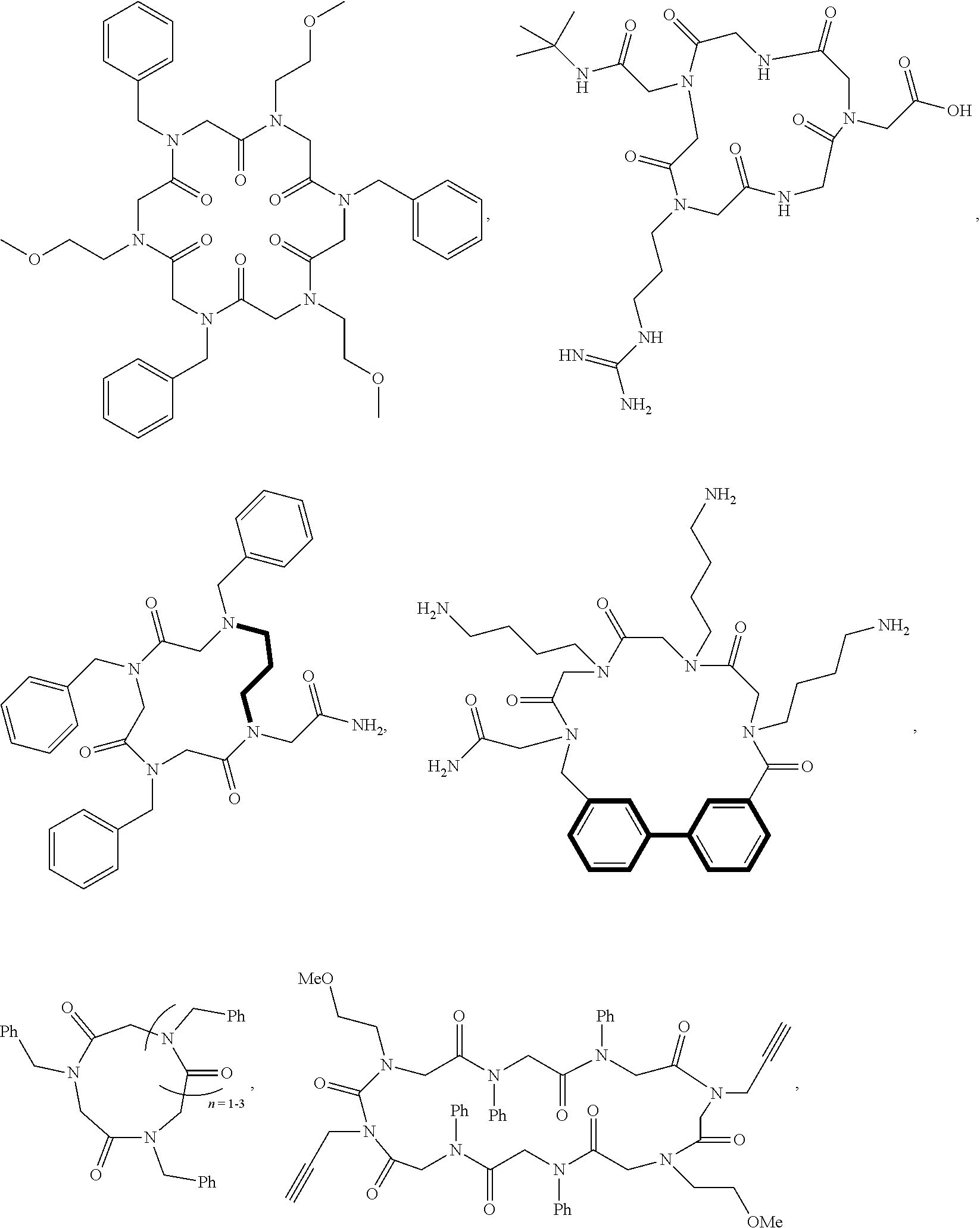


Statement 4. A peptoid-peptide macrocycle according to

where R1 is selected from substituted or unsubstituted alkyl, substituted or unsubstituted cycloalkyl, substituted or unsubstituted heterocycloalkyl, substituted or unsubstituted aryl, and substituted or unsubstituted heteroaryl.

where R2 is selected from substituted or unsubstituted alkyl, a canonical amino acid sidechain, or an unnatural amino acid side chain.

Where the moiety —NH—CH(R2)—C(O)— is an amino acid residue or unnatural amino acid residue.
Statement 11. A peptoid-peptide macrocycle according to Statement 1, where the peptoid-peptide macrocycle is formula I:

or a pharmaceutically acceptable salt, solvate or prodrug thereof, and stereoisomers, isotopic variants and tautomers thereof; where the moiety —NH—CH(R2)—C(O)— is an amino acid residue or unnatural amino acid residue; each R1 is independently substituted or unsubstituted alkyl, substituted or unsubstituted cycloalkyl, substituted or unsubstituted heterocycloalkyl, substituted or unsubstituted aryl, or substituted or unsubstituted heteroaryl; and the subscript n is an integer from 0 to 15 (0, 1, 2, 3, 4, 5, 6, 7, 8, 9, 10, 11, 12, 13, 14, or 15).
Statement 14. A peptoid-peptide macrocycle according to
Statement 16. A peptoid-peptide macrocycle according to Statement 1, where the peptoid-peptide macrocycle is formula IIa, IIb, or IIc:

where the moiety —NH—CH(R2)—C(O)— is an amino acid residue or unnatural amino acid residue, and R1 is as in
Statement 17. A peptoid-peptide macrocycle according to
Statement 18. A peptoid-peptide macrocycle according to
Statement 19. A peptoid-peptide macrocycle according to any one of Statements 7-18, where each R1 is independently substituted or unsubstituted alkyl, substituted or unsubstituted substituted or unsubstituted phenyl, substituted or unsubstituted naphthyl, substituted or unsubstituted benzyl, substituted or unsubstituted phenethyl, or substituted or unsubstituted heteroaryl.
Statement 21. A peptoid-peptide macrocycle according to Statement 19, where substituted alkyl is alkyl substituted with one or more groups independently chosen from halo, hydroxy, amino, alkylamino, dialkylamino, acyloxy, substituted or unsubstituted phenyl, and alkoxy.
Statement 22. A peptoid-peptide macrocycle according to Statement 19, where substituted alkyl is alkyl substituted with one or more groups independently chosen from F, Cl, CN, OMe, OAc, O-i-Pr, 4-methoxyphenyl, and CF3.
Statement 23. A peptoid-peptide macrocycle according to Statement 19, where substituted phenyl, substituted naphthyl, substituted benzyl, substituted phenethyl is phenyl, naphthyl, benzyl, or phenethyl each substituted with one or more groups independently chosen from halo, hydroxy, amino, alkylamino, dialkylamino, and alkoxy.
Statement 26. A peptoid-peptide macrocycle according to Statement 19, where substituted heteroaryl is heteroaryl substituted with one or more groups independently chosen from F, Cl, CN, OMe, and CF3.
Statement 27. A peptoid-peptide macrocycle according to
Statement 28. A peptoid-peptide macrocycle according to any one of Statements 7-18, where each R1 independently is:
-
- i) unsubstituted alkyl;
- ii) Me, Et, n-Pr, i-Pr, n-Bu, sec-Bu, or i-Bu;
- iii) alkyl substituted with one or more groups independently chosen from halo, hydroxy, amino, alkylamino, dialkylamino, acyl, acyloxy, substituted or unsubstituted phenyl, and alkoxy;
- iv) alkyl substituted with one or more groups independently chosen from F, Cl, CN, OMe, O-i-Pr, 4-methoxyphenyl, 2-phenoxyphenyl, and CF3;
- v) unsubstituted phenyl;
- vi) unsubstituted naphthyl;
- vii) unsubstituted benzyl;
- viii) unsubstituted phenethyl;
- ix) phenyl substituted with one or more groups independently chosen from halo, alkyl, haloalkyl, CN, hydroxy, amino, alkylamino, dialkylamino, and alkoxy;
- x) naphthyl substituted with one or more groups independently chosen from halo, alkyl, haloalkyl, CN, hydroxy, amino, alkylamino, dialkylamino, and alkoxy;
- xi) benzyl substituted with one or more groups independently chosen from halo, alkyl, haloalkyl, CN, hydroxy, amino, alkylamino, dialkylamino, substituted or unsubstituted phenoxy, and alkoxy;
- xii) phenethyl substituted with one or more groups independently chosen from halo, alkyl, haloalkyl, CN, hydroxy, amino, alkylamino, dialkylamino, and alkoxy;
- xiii) phenyl substituted with one or more groups independently chosen from F, Cl, CN, OMe, and CF3;
- xiv) naphthyl substituted with one or more groups independently chosen from F, Cl, CN, OMe, and CF3;
- xv) benzyl substituted with one or more groups independently chosen from F, Cl, CN, OMe, OPh, and CF3;
- xvi) phenethyl substituted with one or more groups independently chosen from F, C, CN, OMe, and CF3;
- xvii) unsubstituted heteroaryl;
- xviii) heteroaryl substituted with one or more groups independently chosen from halo, hydroxy, amino, alkylamino, dialkylamino, and alkoxy;
- xix) heteroaryl substituted with one or more groups independently chosen from F, Cl, CN, OMe, and CF3; or any combinations thereof.
Statement 29. A peptoid-peptide macrocycle according to Statement 28, where heteroaryl is furanyl, thienyl, pyrrolyl, imidazolyl, pyridyl, or pyrimidinyl.
Statement 30. A peptoid-peptide macrocycle according to any one of Statements 7-29, where each R1 independently is methoxyethyl, i-propoxyethyl, dimethoxyphenyl, fluorophenethyl, or methoxyphenethyl.
Statement 31. A peptoid-peptide macrocycle according to any one of Statements 7-29, where each R1 independently is 2-methoxyethyl, 2-i-propoxyethyl, 3,4-dimethoxyphenyl, 1-(4-fluorophen)ethyl, 1-(2-phenoxyphen)ethyl, 1-(4-methoxyphen)ethyl, 2-(2-phenoxyphen)ethyl, or 2-(4-methoxyphen)ethyl.
Statement 32. A peptoid-peptide macrocycle according to any one of Statements 1-31, where “Peptide” or the moiety —NH—CH(R2)—C(O)— is D-alanine.
Statement 33. A peptoid-peptide macrocycle according to Statement 1, where the macrocycle is any one of the macrocycles listed inFIG. 2 , which are:

wherein

R2 is

R3 is

R4 is

R5 is

and R6 is


R2 is

R3 is

R4 is

R5 is

and R6 is


R2 is

R3 is

R4 is

R5 is

and R6 is


R2 is

R3 is

R4 is

R5 is

and R6 is


R2 is

R3 is

R4 is

R5 is

and R6 is


R2 is

R3 is

R4 is

R5 is

and R6 is


R2 is

R3 is

R4 is

R5 is

and R6 is


R2 is

R3 is

R4 is

R5 is

and R6 is


R2 is

R3 is

R4 is

R5 is

and R6 is


R2 is

R3 is

R4 is

R5 is

and R6 is


R2 is

R3 is

R4 is

R5 is

and R6 is

and

R2 is

R3 is

R4 is

R5 is

and R6 is

Statement 34. A pharmaceutical composition comprising a pharmaceutically acceptable carrier and a pharmaceutically effective amount of the peptoid-peptide macrocycle of any one of Statements 1-33.
Statement 36. A method for preventing, treating, ameliorating or managing a disease or condition which comprises administering to a patient in need of such prevention, treatment, amelioration or management, a prophylactically or therapeutically effective amount of a prophylactically or therapeutically acceptable amount of the peptoid-peptide macrocycle of any of Statements 1-33, or the pharmaceutical composition of either of
Statement 37. A method according to Statement 36, where the disease or condition is cancer, pulmonary fibrosis, psoriasis, or a combination thereof.
Statement 38. A method according to Statement 37, where the cancer is hepatic cancer, colon cancer, rectal cancer, breast cancer, prostate cancer, skin cancer, head and neck cancer, lung cancer, gastric cancer, mesothelioma, Barrett's esophagus, synovial sarcoma, cervical cancer, endometrial ovarian cancer, Wilm's tumor, bladder cancer, or leukemia.
Statement 39. Use of the peptoid-peptide macrocycle set forth in any one of Statements 1-33 for the preparation of a medicament for the treatment of a disease or condition that is causally related to the aberrant activity of the Wnt signaling pathway in vivo.
Statement 41. Use according to Statement 39, where the cancer is hepatic cancer, colon cancer, rectal cancer, breast cancer, prostate cancer, skin cancer, head and neck cancer, lung cancer, gastric cancer, mesothelioma, Barrett's esophagus, synovial sarcoma, cervical cancer, endometrial ovarian cancer, Wilm's tumor, bladder cancer, or leukemia.
Statement 42. Use according to Statement 41, where the skin cancer is melanoma, the liver cancer is hepatocellular cancer or hepatoblastoma, and/or the lung cancer is non-small cell lung cancer.
Statement 44. A compound according to any one of Statements 1-33 for use in the treatment of a disease or condition that is causally related to the aberrant activity of the Wnt signaling pathway in vivo.
Statement 45. A peptoid-peptide macrocycle according to any one of Statements 1-11, where the peptoid-peptide macrocycle is chosen from:


Claims (9)


Priority Applications (1)
| Application Number | Priority Date | Filing Date | Title |
|---|---|---|---|
| US17/259,914 US12281180B2 (en) | 2018-07-13 | 2019-07-12 | Peptoid-peptide macrocycles, pharmaceutical compositions and methods of using the same |
Applications Claiming Priority (4)
| Application Number | Priority Date | Filing Date | Title |
|---|---|---|---|
| US201862697893P | 2018-07-13 | 2018-07-13 | |
| US201962796460P | 2019-01-24 | 2019-01-24 | |
| US17/259,914 US12281180B2 (en) | 2018-07-13 | 2019-07-12 | Peptoid-peptide macrocycles, pharmaceutical compositions and methods of using the same |
| PCT/US2019/041674 WO2020014652A1 (en) | 2018-07-13 | 2019-07-12 | Peptoid-peptide macrocycles, pharmaceutical compositions and methods of using the same |
Publications (2)
| Publication Number | Publication Date |
|---|---|
| US20210269482A1 US20210269482A1 (en) | 2021-09-02 |
| US12281180B2 true US12281180B2 (en) | 2025-04-22 |
Family
ID=69141742
Family Applications (1)
| Application Number | Title | Priority Date | Filing Date |
|---|---|---|---|
| US17/259,914 Active US12281180B2 (en) | 2018-07-13 | 2019-07-12 | Peptoid-peptide macrocycles, pharmaceutical compositions and methods of using the same |
Country Status (2)
| Country | Link |
|---|---|
| US (1) | US12281180B2 (en) |
| WO (1) | WO2020014652A1 (en) |
Families Citing this family (2)
| Publication number | Priority date | Publication date | Assignee | Title |
|---|---|---|---|---|
| AU2021338857A1 (en) * | 2020-09-13 | 2023-05-25 | The Research Foundation For The State University Of New York | Linear and cyclic aromatic oligoamides, methods of making same and uses thereof |
| JP2025536942A (en) * | 2022-10-20 | 2025-11-12 | ジェネンテック, インコーポレイテッド | Biomolecular fitness inference using machine learning for drug discovery by directed evolution |
Citations (5)
| Publication number | Priority date | Publication date | Assignee | Title |
|---|---|---|---|---|
| US5525590A (en) * | 1987-06-17 | 1996-06-11 | Sandoz Ltd. | Cyclosporins and their use as pharmaceuticals |
| US20070099917A1 (en) * | 2005-10-20 | 2007-05-03 | The Walter And Eliza Hall Institute Of Medical Research | Novel inhibitors and methods for their preparation |
| US20130310375A1 (en) | 2009-03-02 | 2013-11-21 | Irm Llc | N-(hetero)aryl, 2-(hetero)aryl-substituted acetamides for use as wnt signaling modulators |
| WO2014145389A1 (en) | 2013-03-15 | 2014-09-18 | Board Of Regents, The University Of Texas System | Inhibition of pulmonary fibrosis with nutlin-3a and peptides |
| WO2015153560A1 (en) | 2014-03-31 | 2015-10-08 | H. Lee Moffitt Cancer Center And Research Institute, Inc. | Stabilized peptoid-peptide hybrids and uses thereof |
-
2019
- 2019-07-12 WO PCT/US2019/041674 patent/WO2020014652A1/en not_active Ceased
- 2019-07-12 US US17/259,914 patent/US12281180B2/en active Active
Patent Citations (5)
| Publication number | Priority date | Publication date | Assignee | Title |
|---|---|---|---|---|
| US5525590A (en) * | 1987-06-17 | 1996-06-11 | Sandoz Ltd. | Cyclosporins and their use as pharmaceuticals |
| US20070099917A1 (en) * | 2005-10-20 | 2007-05-03 | The Walter And Eliza Hall Institute Of Medical Research | Novel inhibitors and methods for their preparation |
| US20130310375A1 (en) | 2009-03-02 | 2013-11-21 | Irm Llc | N-(hetero)aryl, 2-(hetero)aryl-substituted acetamides for use as wnt signaling modulators |
| WO2014145389A1 (en) | 2013-03-15 | 2014-09-18 | Board Of Regents, The University Of Texas System | Inhibition of pulmonary fibrosis with nutlin-3a and peptides |
| WO2015153560A1 (en) | 2014-03-31 | 2015-10-08 | H. Lee Moffitt Cancer Center And Research Institute, Inc. | Stabilized peptoid-peptide hybrids and uses thereof |
Non-Patent Citations (14)
| Title |
|---|
| Culf, A.S., et al., Solid-Phase Synthesis of N-Substituted Glycine Oligomers (alpha-peptoids) and Derivatives, Molecules, Aug. 4, 2010, vol. 15, pp. 5282-5335. |
| D'Amato, A., et al., Conformational isomerism in cyclic peptoids and its specification, Organic Biomolecular Chemistry, Nov. 16, 2017, vol. 15, pp. 9932-9942. |
| D'Amato, A., et al., Cyclic Peptoids as Topological Templates: Synthesis via Central to Conformational Chirality Induction, Organic Letters, Jan. 17, 2018, vol. 20, No. 3, pp. 640-643. |
| Rady, I., et al., Melittin, a major peptide component of bee venom, and its conjugates in cancer therapy, Cancer Letters, May 20, 2017, vol. 402, pp. 1-31. |
| Registry No. 241148-10-7, entered STN Sep. 24, 1999, 1 page (Year: 1999). * |
| Registry No. 944251-03-0, entered STN Aug. 8, 2007, 2 pages (Year: 2007). * |
| Shin, S.B.Y., et al., Cyclic Peptoids, J. Am. Chem. Soc., Feb. 27, 2007, vol. 129, No. 11, pp. 3218-3225. |
| STN entry for Titlestad with RN 30270-82-7, 1972, 1 page (Year: 1972). * |
| Thakkar, A., et al., High-Throughput Sequencing of Peptoids and Peptide-Peptoid Hybrids by Partial Edman Degradation and Mass Spectrometry, Journal of Combinatorial Chemistry, 2009, vol. 11, No. 2, pp. 1-18. |
| Titlestad K (‘Cleavage of linear tetrapeptides into two cyclic dipeptides’ Chemical Communications 1971 v23 pp. 1527-1529) ( Year: 1971). * |
| Vippagunta et al. (‘Crystalline solids’ Advanced Drug Delivery Reviews v48 2001 pp. 3-26) (Year: 2001). * |
| Vollrath et al. (‘Twice tied tight: enforcing conformational order in bicyclic peptoid oligomers’ Chem Sci v3 2012 pp. 2726-2731) ( Year: 2012). * |
| Webster, A.M., et al., Recent Advances in the Synthesis of Peptoid Macrocycles, Chemistry: A European Journal, Jan. 22, 2018, vol. 24, No. 30, pp. 7560-7573. |
| Yelamanchi et al. (‘A pathway map of glutamate metabolism’ J Cell Commun Signal v10 2016 pp. 69-75) (Year: 2016). * |
Also Published As
| Publication number | Publication date |
|---|---|
| US20210269482A1 (en) | 2021-09-02 |
| WO2020014652A1 (en) | 2020-01-16 |
Similar Documents
| Publication | Publication Date | Title |
|---|---|---|
| US12459974B2 (en) | Bicyclic peptide ligands specific for Nectin-4 | |
| TWI822827B (en) | IL-2Rγc ligands, compounds containing IL-2Rγc ligands and uses thereof | |
| JP6971970B2 (en) | Peptidomimetic macrocyclic molecules and their use | |
| KR20120102716A (en) | Melanocortin-1 receptor-specific linear peptides | |
| US11046739B2 (en) | BH4 stabilized peptides and uses thereof | |
| JP2020536096A (en) | Materials and Methods for Inhibiting Tumor Growth | |
| US10882863B2 (en) | Compounds for reducing c-Myc in c-Myc overexpressing cancers background | |
| US11766480B2 (en) | Multivalent peptoid oligomers, pharmaceutical compositions and methods of using same | |
| US20210269482A1 (en) | Peptoid-peptide macrocycles, pharmaceutical compositions and methods of using the same | |
| EP3621633A2 (en) | Peptidomimetic macrocycles and uses thereof | |
| US9695153B2 (en) | Oligooxopiperazines for p53 reactivation | |
| JP2022525416A (en) | Peptidomimetic macrocyclic molecules and their use | |
| JP2023544223A (en) | Radiolabeled ligands and methods of their use for targeted PET/SPECT imaging | |
| CN116234541A (en) | Treatment of diseases by EpoR antagonists | |
| US20170240592A1 (en) | Gadd45beta/mkk7 inhibitor for the treatment of a resistant haematological malignancy | |
| US12569536B2 (en) | Macrocyclic peptides for targeted inhibition of autophagy | |
| WO2023096947A1 (en) | C-terminal extended p53 activator crosslinked peptidomimetic macrocycles against mdm2/mdmx | |
| JP2024546110A (en) | P53 peptidomimetic macrocycles | |
| EP2578227B1 (en) | Cancer therapy method | |
| WO2021032955A1 (en) | Treatment | |
| WO2023196891A2 (en) | Methods of treating cancer by inhibiting bacterial dnak to restore activities of anticancer drugs | |
| EA045862B1 (en) | BICYCLIC PEPTIDE LIGANDS SPECIFIC TO NECTIN-4 |
Legal Events
| Date | Code | Title | Description |
|---|---|---|---|
| FEPP | Fee payment procedure |
Free format text: ENTITY STATUS SET TO UNDISCOUNTED (ORIGINAL EVENT CODE: BIG.); ENTITY STATUS OF PATENT OWNER: SMALL ENTITY |
|
| FEPP | Fee payment procedure |
Free format text: ENTITY STATUS SET TO SMALL (ORIGINAL EVENT CODE: SMAL); ENTITY STATUS OF PATENT OWNER: SMALL ENTITY |
|
| AS | Assignment |
Owner name: NEW YORK UNIVERSITY, NEW YORK Free format text: ASSIGNMENT OF ASSIGNORS INTEREST;ASSIGNORS:KIRSHENBAUM, KENT;LOGAN, SUSAN;CRAVEN, TIMOTHY;AND OTHERS;SIGNING DATES FROM 20201012 TO 20201107;REEL/FRAME:056638/0977 |
|
| STPP | Information on status: patent application and granting procedure in general |
Free format text: DOCKETED NEW CASE - READY FOR EXAMINATION |
|
| STPP | Information on status: patent application and granting procedure in general |
Free format text: NON FINAL ACTION MAILED |
|
| STPP | Information on status: patent application and granting procedure in general |
Free format text: RESPONSE TO NON-FINAL OFFICE ACTION ENTERED AND FORWARDED TO EXAMINER |
|
| STPP | Information on status: patent application and granting procedure in general |
Free format text: NON FINAL ACTION MAILED |
|
| STPP | Information on status: patent application and granting procedure in general |
Free format text: RESPONSE TO NON-FINAL OFFICE ACTION ENTERED AND FORWARDED TO EXAMINER |
|
| STPP | Information on status: patent application and granting procedure in general |
Free format text: FINAL REJECTION MAILED |
|
| STPP | Information on status: patent application and granting procedure in general |
Free format text: NON FINAL ACTION MAILED |
|
| STPP | Information on status: patent application and granting procedure in general |
Free format text: RESPONSE TO NON-FINAL OFFICE ACTION ENTERED AND FORWARDED TO EXAMINER |
|
| STPP | Information on status: patent application and granting procedure in general |
Free format text: FINAL REJECTION MAILED |
|
| STPP | Information on status: patent application and granting procedure in general |
Free format text: RESPONSE AFTER FINAL ACTION FORWARDED TO EXAMINER |
|
| STPP | Information on status: patent application and granting procedure in general |
Free format text: ADVISORY ACTION MAILED |
|
| STPP | Information on status: patent application and granting procedure in general |
Free format text: DOCKETED NEW CASE - READY FOR EXAMINATION |
|
| STPP | Information on status: patent application and granting procedure in general |
Free format text: NOTICE OF ALLOWANCE MAILED -- APPLICATION RECEIVED IN OFFICE OF PUBLICATIONS |
|
| STPP | Information on status: patent application and granting procedure in general |
Free format text: PUBLICATIONS -- ISSUE FEE PAYMENT RECEIVED |
|
| STPP | Information on status: patent application and granting procedure in general |
Free format text: PUBLICATIONS -- ISSUE FEE PAYMENT VERIFIED |
|
| STPP | Information on status: patent application and granting procedure in general |
Free format text: PUBLICATIONS -- ISSUE FEE PAYMENT VERIFIED |
|
| STCF | Information on status: patent grant |
Free format text: PATENTED CASE |