US12264792B2 - Systems, methods, and devices for spectrochrome laser output - Google Patents
Systems, methods, and devices for spectrochrome laser output Download PDFInfo
- Publication number
- US12264792B2 US12264792B2 US17/807,331 US202217807331A US12264792B2 US 12264792 B2 US12264792 B2 US 12264792B2 US 202217807331 A US202217807331 A US 202217807331A US 12264792 B2 US12264792 B2 US 12264792B2
- Authority
- US
- United States
- Prior art keywords
- handheld device
- light source
- enclosed chamber
- housing
- laser
- Prior art date
- Legal status (The legal status is an assumption and is not a legal conclusion. Google has not performed a legal analysis and makes no representation as to the accuracy of the status listed.)
- Active, expires
Links
Images




Classifications
-
- A—HUMAN NECESSITIES
- A61—MEDICAL OR VETERINARY SCIENCE; HYGIENE
- A61N—ELECTROTHERAPY; MAGNETOTHERAPY; RADIATION THERAPY; ULTRASOUND THERAPY
- A61N5/00—Radiation therapy
- A61N5/06—Radiation therapy using light
- A61N5/067—Radiation therapy using light using laser light
-
- F—MECHANICAL ENGINEERING; LIGHTING; HEATING; WEAPONS; BLASTING
- F21—LIGHTING
- F21L—LIGHTING DEVICES OR SYSTEMS THEREOF, BEING PORTABLE OR SPECIALLY ADAPTED FOR TRANSPORTATION
- F21L4/00—Electric lighting devices with self-contained electric batteries or cells
- F21L4/005—Electric lighting devices with self-contained electric batteries or cells the device being a pocket lamp
-
- A—HUMAN NECESSITIES
- A61—MEDICAL OR VETERINARY SCIENCE; HYGIENE
- A61N—ELECTROTHERAPY; MAGNETOTHERAPY; RADIATION THERAPY; ULTRASOUND THERAPY
- A61N2/00—Magnetotherapy
- A61N2/002—Magnetotherapy in combination with another treatment
-
- F—MECHANICAL ENGINEERING; LIGHTING; HEATING; WEAPONS; BLASTING
- F21—LIGHTING
- F21V—FUNCTIONAL FEATURES OR DETAILS OF LIGHTING DEVICES OR SYSTEMS THEREOF; STRUCTURAL COMBINATIONS OF LIGHTING DEVICES WITH OTHER ARTICLES, NOT OTHERWISE PROVIDED FOR
- F21V23/00—Arrangement of electric circuit elements in or on lighting devices
- F21V23/04—Arrangement of electric circuit elements in or on lighting devices the elements being switches
- F21V23/0414—Arrangement of electric circuit elements in or on lighting devices the elements being switches specially adapted to be used with portable lighting devices
-
- F—MECHANICAL ENGINEERING; LIGHTING; HEATING; WEAPONS; BLASTING
- F21—LIGHTING
- F21V—FUNCTIONAL FEATURES OR DETAILS OF LIGHTING DEVICES OR SYSTEMS THEREOF; STRUCTURAL COMBINATIONS OF LIGHTING DEVICES WITH OTHER ARTICLES, NOT OTHERWISE PROVIDED FOR
- F21V3/00—Globes; Bowls; Cover glasses
- F21V3/04—Globes; Bowls; Cover glasses characterised by materials, surface treatments or coatings
- F21V3/06—Globes; Bowls; Cover glasses characterised by materials, surface treatments or coatings characterised by the material
-
- A—HUMAN NECESSITIES
- A61—MEDICAL OR VETERINARY SCIENCE; HYGIENE
- A61N—ELECTROTHERAPY; MAGNETOTHERAPY; RADIATION THERAPY; ULTRASOUND THERAPY
- A61N5/00—Radiation therapy
- A61N5/06—Radiation therapy using light
- A61N2005/0635—Radiation therapy using light characterised by the body area to be irradiated
- A61N2005/0643—Applicators, probes irradiating specific body areas in close proximity
- A61N2005/0644—Handheld applicators
-
- A—HUMAN NECESSITIES
- A61—MEDICAL OR VETERINARY SCIENCE; HYGIENE
- A61N—ELECTROTHERAPY; MAGNETOTHERAPY; RADIATION THERAPY; ULTRASOUND THERAPY
- A61N5/00—Radiation therapy
- A61N5/06—Radiation therapy using light
- A61N2005/065—Light sources therefor
- A61N2005/0651—Diodes
-
- A—HUMAN NECESSITIES
- A61—MEDICAL OR VETERINARY SCIENCE; HYGIENE
- A61N—ELECTROTHERAPY; MAGNETOTHERAPY; RADIATION THERAPY; ULTRASOUND THERAPY
- A61N5/00—Radiation therapy
- A61N5/06—Radiation therapy using light
- A61N2005/0658—Radiation therapy using light characterised by the wavelength of light used
- A61N2005/0662—Visible light
- A61N2005/0663—Coloured light
-
- A—HUMAN NECESSITIES
- A61—MEDICAL OR VETERINARY SCIENCE; HYGIENE
- A61N—ELECTROTHERAPY; MAGNETOTHERAPY; RADIATION THERAPY; ULTRASOUND THERAPY
- A61N5/00—Radiation therapy
- A61N5/06—Radiation therapy using light
- A61N2005/0664—Details
- A61N2005/0665—Reflectors
-
- F—MECHANICAL ENGINEERING; LIGHTING; HEATING; WEAPONS; BLASTING
- F21—LIGHTING
- F21Y—INDEXING SCHEME ASSOCIATED WITH SUBCLASSES F21K, F21L, F21S and F21V, RELATING TO THE FORM OR THE KIND OF THE LIGHT SOURCES OR OF THE COLOUR OF THE LIGHT EMITTED
- F21Y2115/00—Light-generating elements of semiconductor light sources
- F21Y2115/30—Semiconductor lasers
-
- H—ELECTRICITY
- H01—ELECTRIC ELEMENTS
- H01S—DEVICES USING THE PROCESS OF LIGHT AMPLIFICATION BY STIMULATED EMISSION OF RADIATION [LASER] TO AMPLIFY OR GENERATE LIGHT; DEVICES USING STIMULATED EMISSION OF ELECTROMAGNETIC RADIATION IN WAVE RANGES OTHER THAN OPTICAL
- H01S3/00—Lasers, i.e. devices using stimulated emission of electromagnetic radiation in the infrared, visible or ultraviolet wave range
- H01S3/0007—Applications not otherwise provided for
-
- H—ELECTRICITY
- H01—ELECTRIC ELEMENTS
- H01S—DEVICES USING THE PROCESS OF LIGHT AMPLIFICATION BY STIMULATED EMISSION OF RADIATION [LASER] TO AMPLIFY OR GENERATE LIGHT; DEVICES USING STIMULATED EMISSION OF ELECTROMAGNETIC RADIATION IN WAVE RANGES OTHER THAN OPTICAL
- H01S3/00—Lasers, i.e. devices using stimulated emission of electromagnetic radiation in the infrared, visible or ultraviolet wave range
- H01S3/02—Constructional details
Landscapes
- Engineering & Computer Science (AREA)
- General Engineering & Computer Science (AREA)
- Health & Medical Sciences (AREA)
- Biomedical Technology (AREA)
- Physics & Mathematics (AREA)
- General Health & Medical Sciences (AREA)
- Life Sciences & Earth Sciences (AREA)
- Animal Behavior & Ethology (AREA)
- Radiology & Medical Imaging (AREA)
- Public Health (AREA)
- Veterinary Medicine (AREA)
- Nuclear Medicine, Radiotherapy & Molecular Imaging (AREA)
- Optics & Photonics (AREA)
- Electromagnetism (AREA)
- Pathology (AREA)
- Magnetic Treatment Devices (AREA)
- Plasma & Fusion (AREA)
- Chemical & Material Sciences (AREA)
- Combustion & Propulsion (AREA)
Abstract
In one aspect, an example handheld device for providing a spectrochrome output includes (a) an enclosed chamber containing one or more substances; (b) a light source; (c) an electromagnetic coil; (d) one or more magnets; and (e) a housing, wherein the housing is configured to: (i) secure the enclosed chamber; (ii) secure the light source such that an output of the light source is substantially aligned to pass through the enclosed chamber in one or more directions; and (iii) secure the electromagnetic coil around the enclosed chamber such that an electromagnetic field is created in a substantially same direction of the output of the light source through the enclosed chamber.
Description
This application claims priority to U.S. Provisional Application No. 63/211,780 filed Jun. 17, 2021, which is incorporated herein by reference in its entirety.
In this disclosure, unless otherwise specified and/or unless the particular context clearly dictates otherwise, the terms “a” or “an” mean at least one, and the term “the” means the at least one.
In one aspect, an example handheld device for providing a spectrochrome output is disclosed. The example handheld device includes (a) an enclosed chamber containing one or more substances; (b) a light source; (c) an electromagnetic coil; (d) one or more magnets; and (e) a housing, wherein the housing is configured to: (i) secure the enclosed chamber; (ii) secure the light source such that an output of the light source is substantially aligned to pass through the enclosed chamber in one or more directions; and (iii) secure the electromagnetic coil and the one or more magnets around the enclosed chamber such that an electromagnetic field is created in a substantially same direction of the output of the light source through the enclosed chamber.
The above, as well as additional, features will be better understood through the following illustrative and non-limiting detailed description of example embodiments, with reference to the appended drawings.
Light and electromagnetic waves can be used in a number of ways to help amplify and interact with a number of substances. These interactions may impart unexpected results in the medium through which the light may pass, including human tissues and digestible liquids (e.g., water). To date, there have not been any consistent, convenient, and/or portable options for practitioners incorporating such light waves (including lasers) and/or electromagnetic waves into their practice for treating human conditions.
Conventionally, utilizing such light waves (including lasers) and/or electromagnetic waves has required large scale systems, which may vary from practitioner to practitioner, and may cause different treatment results from patient to patient.
If, however, practitioners could provide an efficient, effective, and novel solution for consistent, convenient, and/or portable options for practitioners incorporating such light waves (including lasers) and/or electromagnetic waves into their practice for treating human conditions, then the overall variability associated with these treatments would be reduced.
Accordingly, features of the present disclosure can help to address these and other issues to provide an improvement to select technical fields. More specifically, features of the present disclosure help address issues within and provide improvements for select technical fields, which include for example, handheld devices that include passing a light source through an enclosed chamber containing one or more substances and surrounded by an electromagnetic coil, such that an output of the light source is substantially aligned to pass through the enclosed chamber in one or more directions and an electromagnetic field is created in a substantially same direction of the output of the light source through the enclosed chamber. These features will now be described in the claims below.
Embodiments of the present invention provide methods, systems, and devices that allow practitioners to effectively use light waves (including lasers) and/or electromagnetic waves into their practice for a number of reasons, including treating human physical and mental health conditions.
More specifically, example embodiments relate to methods, systems, and devices for improving the consistency, ease, and performance treatments using light waves (including lasers) and/or electromagnetic waves.
A handheld device for providing a spectrochrome output may include an enclosed chamber containing one or more substances. In some example embodiments, these substances may include one or more substances that are in a solid, gaseous, or liquid phase, or some combination thereof. For example, in some embodiments, the enclosed chamber may contain one or more noble gases, including one or more of the following gases: (i) helium; (ii) neon; (iii) argon; (iv) krypton; (v) xenon; and (vi) radon. In other examples, the enclosed chamber may contain one or more of the following non-noble gases: hydrogen, nitrogen, oxygen, fluorine, and chlorine, potentially in combination with other substances (including the noble gases listed above). In a further aspect, the enclosed chamber may also contain one or more solid and/or liquid materials (including solid and/or liquid versions of the substances listed above), among other possibilities.
In a further aspect, the handheld device for providing a spectrochrome output may also include a light source. This light source may include one or more of several different types of light from a variety of sources. For example, in some embodiments, the light source may be a laser. In a further aspect, the laser may operate at one or more wavelengths and create a visible output of one or more colors, including one or more of the following: (i) a laser with a wavelength between approximately 520 to 560 nanometers and a visible output of green light; (ii) a laser with a wavelength of approximately 380 to 450 nanometers and a visible output of violet light; (iii) a laser with a wavelength between approximately 450 to 495 nanometers and a visible output of blue light; (iv) a laser with a wavelength between approximately 495 to 520 nanometers and a visible output of cyan light; (v) a laser with a wavelength between approximately 560 to 590 nanometers and a visible output of yellow light; (vi) a laser with a wavelength between approximately 590 to 620 nanometers and a visible output of orange light; and (vii) a laser with a wavelength between approximately 620 to 740 nanometers and a visible output of red light. Other examples are possible.
In other examples, the light source may include light generated by one or more other light sources, including one or more of the following: (i) a fluorescent light source; (ii) light-emitting diode light source; (iii) halogen light source; (iv) a filament light source; and (v) reflector and/or refractor directing light from external light sources (e.g., the sun).
In a further aspect, the handheld device for providing a spectrochrome output may also include an electromagnetic coil. This electromagnetic coil may be made of and/or include one or more of several different materials and arranged in a variety of ways. For example, in some embodiments, the electromagnetic coil may be made of one or more of the following: (i) copper wire; (ii) silver wire; (iii) gold wire; (iv) aluminum wire; (v) iron wire, and/or combinations thereof.
In a further aspect, the electromagnetic coil may be arranged in a variety of ways, including wrapping the electromagnetic coil around the enclosed chamber or a receiving portion of the handheld device that holds the enclosed chamber, either of which may be configured in a manner that may create a field substantially in the center of the coil and the enclosed chamber. For example, the electromagnetic coil may be a continuous strand of wire wrapped uniformly around the enclosed chamber a receiving portion of the handheld device that holds the enclosed chamber such that the electromagnetic field created by the electromagnetic coil is focused on an area in the enclosed chamber. To do so, the handheld device may also contain one or more magnets. In some examples, these magnets may include one or more of the following: (i) neodymium magnets (including neodymium iron boron (“NdFeB”) magnets); (ii) ceramic magnets; (iii) ferrite magnets; (iv) samarium cobalt (“SmCo”) magnets; and (v) alnico magnets. Other examples are possible.
In a further aspect, in other examples, the electromagnetic coil may be a continuous strand of wire wrapped uniformly around the enclosed chamber such that a magnetic field created by the electromagnetic coil is focused on an area in the enclosed chamber. In some examples, an electrical current may be applied to the electromagnetic coil to create a magnetic field. To create this field, one or more electrical currents may be applied to the electromagnetic coil using one or more sources (e.g., one or more batteries). Other examples are possible.
In a further aspect, the handheld device for providing a spectrochrome output may also include a housing that may be made of one or more materials and be configured to promote one or more functionalities of the handheld device. In some examples, this housing may be made of and/or include one or more of several different materials, including plastics, rubbers, metals, glass, and/or combinations thereof, as well as other materials. Furthermore, this housing may be arranged in a variety of ways. For example, in some embodiments, the housing may be configured to secure the enclosed chamber that holds the enclosed chamber (e.g., via a receiving portion of the housing), perhaps in one or more directions in relation to other components of the handheld device. For example, the housing may be configured to secure the light source such that an output of the light source is substantially aligned to pass through the enclosed chamber in one or more directions. In other examples, the housing may be configured to secure the electromagnetic coil and the one or more magnets around the enclosed chamber such that an magnetic field is created in a substantially same direction of the output of the light source through the enclosed chamber.
In a further aspect, the housing may have one or more recesses to align the electromagnetic coil and the one or more magnets around the enclosed chamber such that the magnetic field is created in a substantially same axial direction of the output of the light source through the enclosed chamber. In other examples, the housing may have one or more recesses to hold one or more other more specific components of the handheld device (e.g., one or more recesses to hold particular types of neodymium magnets).
In a further aspect, the housing may be configured to receive the light source and/or after receiving the light source, activate the light source by turning the light source in a clockwise and/or counterclockwise manner in relation to the housing (e.g., using one or more specifically configured receiving portions of the housing and/or keys).
In a further aspect, the components described herein may work together to create one or more unexpected results. For example, the electromagnetic coil (e.g., the wiring and magnets) interacts with the electromagnetic aspects of the light emitted from the light source. For example, the magnetic aspect interacts with the light as it passes through the electromagnetic coils and the electric aspect interacts with the light as it passes by the magnets. In a further aspect, the magnets may have opposite poles pointing towards each other so they are trying to attract each other. In yet a further aspect, the light emitted by the light source (e.g., the laser) may act as a carrier wave for the one or more materials contained in the enclosed chamber (e.g., the stable noble gas argon contained in the enclosed chamber).
In a further aspect, the type of light emitted from the light source may influence the light that emits from the handheld device after passing through the enclosed chamber. For example, if visibly green light is utilized, the output may be perceived as a neutralizing color and, when used on a patient's body (e.g., tissue, organs, bones, teeth, gums, etc.), if the electromagnetic charge is too high or too low then it can stimulate or depress areas which might be out of balance. Put another way, if the patient feels emotionally charged then it can help neutralize those emotions (e.g., to help address mental and emotional trauma). Other examples are possible.
For example, the light ultimately emitted from the handheld device may be used to charge a glass of drinking water, bath water, and/or any type of water with which a patient may interact. Other examples are possible.
Referring now to the figures, FIG. 1A illustrates a spectrochrome housing 100. As shown in FIG. 1A , in this example embodiment, the spectrochrome housing 100 has a first receiving portion 102; an engaging mechanism 104 (e.g., for a light source); a first recess 106; a second receiving portion 108; and a second recess 110. In some embodiments, the spectrochrome housing 100 may be made of and/or include one or more of several different materials, including plastics, rubbers, metals, glasses, and/or combinations thereof, as well as other materials.
In some embodiments, the first receiving portion 102 may be configured to receive a light source. This light source may include one or more of several different types of light from a variety of sources.
For example, in some embodiments, the light source may be a laser. In a further aspect, the laser may operate at one or more wavelengths and create a visible output of one or more colors, including one or more of the following: (i) a laser with a wavelength between approximately 520 to 570 nanometers and a visible output of green light; (ii) a laser with a wavelength of approximately 380 to 450 nanometers and a visible output of violet light; (iii) a laser with a wavelength between approximately 450 to 500 nanometers and a visible output of blue light; (iv) a laser with a wavelength between approximately 500 to 520 nanometers and a visible output of cyan light; (v) a laser with a wavelength between approximately 570 to 590 nanometers and a visible output of yellow light; (vi) a laser with a wavelength between approximately 590 to 620 nanometers and a visible output of orange light; and (vii) a laser with a wavelength between approximately 625 to 740 nanometers and a visible output of red light. In some embodiments, the light source may include lasers that emit light that includes wavelengths not in the visible part of the light spectrum. Other examples, are possible.
For example, the light source may include light generated by one or more other light sources, including one or more of the following: (i) a fluorescent light source; (ii) light-emitting diode light source; (iii) halogen light source; (iv) a filament light source; and (v) reflector and/or refractor directing light from external light sources (e.g., the sun).
The engaging mechanism 104 may interact with the light source in such a way that a substantial portion of the light from the light source passes through the spectrochrome housing 100 and leaves through the second receiving portion 110. Further, in some embodiments, an interior wall of the engaging mechanism 104 can change in thickness, such that the engaging mechanism 104 can be used to activate the light source through a manual manipulation, for example, a counterclockwise and/or counterclockwise rotation of the housing 100 in relation to the light source that may be inserted into the housing (e.g., via the first receiving portion 102).
In some embodiments, the first recess 106 can be surrounded with an electromagnetic coil. Further, in some embodiments, the second recess 108 can be filled with a magnet. In some embodiments there can be one, two, or multiple second recesses 108 to receive one, two, or multiple magnets of the same or different magnetic strengths.
In some embodiments, the second receiving portion 110 can receive an enclosed chamber containing one or more substances that are in a solid, gaseous, or liquid phase, or some combination thereof. Other examples, are possible.
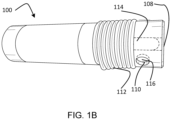
Turning to FIG. 1B , FIG. 1B shows an assembled view of an example embodiment of the spectrochrome housing 100. As shown in FIG. 1B , the assembled view of the spectrochrome housing 100 includes an electromagnetic coil 112, and an enclosed chamber 114 inserted into the second receiving portion 110, and a magnet 116 inserted into the second recess 108.
In some embodiments, the electromagnetic coil 112 is wrapped around the first recess 106. In some embodiments, the electromagnetic coil 112 may be made of and/or include one or more of several different materials and arranged in a variety of ways. For example, in some embodiments, the electromagnetic coil 112 may be made of one or more of the following: (i) copper wire; (ii) silver wire; (iii) gold wire; (iv) aluminum wire; or (v) iron wire. In a further aspect, the electromagnetic coil 112 may be arranged in a variety of ways, including wrapping the electromagnetic coil 112 around the first recess 106 and around the enclosed chamber 114 in a manner that may create a magnetic field substantially in the center of the enclosed chamber 114. For example, the electromagnetic coil 112 may be a continuous strand of wire wrapped uniformly around the enclosed chamber 114 such that the magnetic field created by applying a current to the electromagnetic coil 112 is focused on an area in the enclosed chamber 114. The current can be generated using one or more sources (e.g., one or more batteries). Other examples are possible, including creating a magnetic field in different sections of the enclosed chamber 114. In some example embodiments, the electromagnetic coil 112 may be insulated on an exterior portion (e.g., the exterior portion of the spectrochrome housing 100) and/or between the electromagnetic coil 112 and the first recess 106, among other possibilities. The types of materials used to insulate the electromagnetic coil 112 may include one or more of the following materials: (i) rubbers, (ii) polyvinyl chloride (PVC), (iii) polyethylene, (iv) nylon, (v) silicon, (vi) Teflon, and/or combinations thereof. Other examples are possible.
In some embodiments, the enclosed chamber 114 may be filled with one or more substances that are in a solid, gaseous, or liquid phase, or some combination thereof. For example, in some embodiments, the enclosed chamber 114 may contain gases individually or as a combination, including one or more of the following gases: (i) helium; (ii) neon; (iii) argon; (iv) krypton; (v) xenon; (vi) radon; (vii) hydrogen; (viii) nitrogen; (ix) oxygen; (x) fluorine; and (xi) chlorine. In a further aspect, the enclosed chamber 114 may also contain one or more solid and/or liquid materials (including solid and/or liquid versions of the substances listed above), among other possibilities.
In some embodiments, the one or more magnets 116 may include one or more of the following: (i) neodymium magnets (including neodymium iron boron (“NdFeB”) magnets); (ii) ceramic magnets; (iii) ferrite magnets; (iv) samarium cobalt (“SmCo”) magnets; and (v) alnico magnets. Other examples are possible. In embodiments where there is more than one magnet 116, the magnetic fields created by the magnets can be oriented in the same or different directions to change the strength and direction of the magnetic field within the enclosed chamber 114.
The magnetic fields produced by the electromagnetic coil 112 and the one or more magnets 116 and combine to change the magnetic field within the enclosed chamber 114. In a further aspect, the magnetic field may interact with the light emitted from the light source as it passes through the enclosed chamber 114.
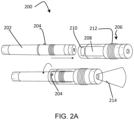
Turning to FIG. 2A , the upper portion of FIG. 2A illustrates a decoupled view of various components of a handled device 200, while the lower portion of FIG. 2A illustrates an assembled view of the handheld device. The handheld device illustrated in FIG. 2A includes a light source 202, containing an activation mechanism 204, and a spectrochrome housing 206 with a first receiving portion 208 that contains an engaging mechanism 210 and an insulated electromagnetic coil 212. In example embodiments, when assembled, the combination of light source 202 and spectrochrome housing 206 can produce an emitted light 214.
For example, as shown in the bottom portion of FIG. 2A , in some embodiments, the engaging mechanism 204 aligns with the engaging mechanism 210 in the spectrochrome housing 206 to secure the light source 202 within the first receiving portion 208 of the spectrochrome housing 206. In a further aspect, the spectrochrome housing 206 may be configured to activate the light source 202 by turning the light source 202 in a clockwise and/or counterclockwise manner in relation to the spectrochrome housing 206 (e.g., using one or more specifically configured keys) can produce an emitted light 214. In example embodiments, Further, in some embodiments, an interior wall of the engaging mechanism 204 can vary in thickness, such that the engaging mechanism 204 can be used to activate the light source 202 through a manual manipulation, for example, a counterclockwise and/or counterclockwise rotation of the housing 206 in relation to the light source to activate the light source's activation mechanism 204 and produce the emitted light 214.
For example, turning to FIG. 2B , FIG. 2B illustrates a top-down view of engaging mechanism 210, which contains an interior wall of a first thickness 216 and a second thickness 218. In FIG. 2B , first thickness 216 is great than second thickness 218, such that when the light source 202 is inserted into the first receiving portion of 208, the activation mechanism 204 aligns with the engaging mechanism 210, and a counterclockwise and/or counterclockwise rotation of the housing 206 in relation to the light source causes a thicker portion of the engaging mechanism 210 (e.g., first thickness 216) to compress the light source's activation mechanism 204 and produce the emitted light 214. Other examples are possible.
Turning to FIG. 3A , the upper portion of FIG. 3A shows a detailed sagittal view of the housing cap 300 comprising a magnet recess 302, a receiving portion 304, a first end 306, and a second end 308. The lower portion of FIG. 3 shows an axial view of the housing cap 300. In some embodiments, as illustrated in FIG. 3A , the first end 306 may be open and may be configured to receive one or more components (e.g., a spectrochrome housing). In some embodiments, as illustrated in FIG. 3A , the second end 308 may be closed, and may be configured to hold one or more substances in the internal portion 304, particularly once one or more components (e.g. a spectrochrome housing) are inserted into the first end 306. Such substances may comprise one or more of the following: (i) water, (ii) gemstones, (iii) essential oils, (iv) salts, (v) homeopathic substances and remedies, (vi) pharmaceuticals, (vii) natural substances, and/or combinations thereof, among other substances. Other examples are possible.
In some embodiments, one or more magnets can be inserted into the recess 302. In some embodiments, there can be one, two, or multiple recesses 302 that can be filled with one two or multiple magnets of the same or different types and magnetic strengths. In embodiments were there are more than one magnet recess 302, the magnets may be oriented in the same or different directions to change the strength and direction of the magnetic field within the internal portion 304. Further, in example embodiments, the overall direction of the magnetic field can be aligned with the direction of the light moving through the housing cap 300.
Turning to FIG. 3B , in example embodiments, spectrochrome housing 310 may include one or more magnets 312, one or more of which may comprise one or more of the following substances: (i) neodymium magnets (including neodymium iron boron (“NdFeB”) magnets), (ii) ceramic magnets, (iii) ferrite magnets, (iv) samarium cobalt (“SmCo”) magnets, (v) alnico magnets, and/or combinations thereof. Other examples are possible. Although not illustrated in FIG. 3B , these magnets can also be attached in a manner causing the generation of a current through an electromagnetic coil, potentially through the interaction of the magnetic fields of the one or more magnets in the recess 302 of the housing cap 300 and the magnetic fields of the one or more magnets 312 in the spectrochrome housing 300. In some examples, this interaction may include manipulating (e.g. rotating) the housing cap 300 (and therefor magnet recess 302), and any substances contained in receiving portion 304, when the housing cap 300 is moved relative to the spectrochrome housing 310.
In some embodiments, as illustrated in FIG. 3B , the end of housing cap 300 may be closed and configured to hold one or more substances in the internal portion 304, as the spectrochrome housing 310 is inserted into the housing cap 300. Such substances may comprise one or more of the following: (i) water, (ii) gemstones, (iii) essential oils, (iv) salts, (v) homeopathic substances and remedies, (vi) pharmaceuticals, (vii) natural substances and/or combinations thereof, among other substances. Other examples are possible. In example embodiments, the housing cap 300 may be configured to secure to the spectrochrome housing 300 such that light is emitted via the end of the housing cap 300, thereby passing through and interacting with the one or more substances in the internal portion 304, and is substantially aligned to pass through the housing cap in one or more directions. Other examples are possible.
Although some of the acts and/or functions described in this disclosure have been described as being performed by a particular entity, the acts and/or functions can be performed by any entity, such as those entities described in this disclosure. Further, although the acts and/or functions have been recited in a particular order, the acts and/or functions need not be performed in the order recited. However, in some instances, it can be desired to perform the acts and/or functions in the order recited. Further, each of the acts and/or functions can be performed responsive to one or more of the other acts and/or functions. Also, not all of the acts and/or functions need to be performed to achieve one or more of the benefits provided by this disclosure, and therefore not all of the acts and/or functions are required.
Although certain variations have been discussed in connection with one or more examples of this disclosure, these variations can also be applied to all of the other examples of this disclosure as well.
Although select examples of this disclosure have been described, alterations and permutations of these examples will be apparent to those of ordinary skill in the art. Other changes, substitutions, and/or alterations are also possible without departing from the invention in its broader aspects as set forth in the following claims.
Claims (21)
1. A handheld device for providing a spectrochrome output, wherein the handheld device comprises:
an enclosed chamber containing one or more substances;
a light source;
an electromagnetic coil;
one or more magnets; and
a housing, wherein the housing is configured to:
(i) secure the enclosed chamber;
(ii) secure the light source such that an output of the light source is substantially aligned to pass through the enclosed chamber in one or more directions; and
(iii) secure the electromagnetic coil and the one or more magnets around the enclosed chamber such that an electromagnetic field is created in a substantially same direction of the output of the light source through the enclosed chamber.
2. The handheld device of claim 1 , wherein the enclosed chamber containing one or more substances comprises an enclosed chamber of one or more noble gases.
3. The handheld device of claim 2 , wherein the one or more noble gases comprise one or more of the following: (i) helium; (ii) neon; (iii) argon; (iv) krypton; (v) xenon; and (vi) radon.
4. The handheld device of claim 1 , wherein the light source comprises a laser.
5. The handheld device of claim 4 , wherein the laser comprises a laser with a wavelength between approximately 520 to 570 nanometers and a visible output of green light.
6. The handheld device of claim 4 , wherein the laser comprises a laser with a wavelength of approximately 380 to 450 nanometers and a visible output of violet light.
7. The handheld device of claim 4 , wherein the laser comprises a laser with a wavelength between approximately 450 to 495 nanometers and a visible output of blue light.
8. The handheld device of claim 4 , wherein the laser comprises a laser with a wavelength between approximately 495 to 520 nanometers and a visible output of cyan light.
9. The handheld device of claim 4 , wherein the laser comprises a laser with a wavelength between approximately 570 to 590 nanometers and a visible output of yellow light.
10. The handheld device of claim 4 , wherein the laser comprises a laser with a wavelength between approximately 590 to 620 nanometers and a visible output of orange light.
11. The handheld device of claim 4 , wherein the laser comprises a laser with a wavelength between approximately 620 to 740 nanometers and a visible output of red light.
12. The handheld device of claim 1 , wherein the electromagnetic coil is secured around the enclosed chamber such that the electromagnetic field is created in a substantially same axial direction of the substantially aligned output of the light source through the enclosed chamber.
13. The handheld device of claim 1 , wherein the housing comprises a recess to align the electromagnetic coil and the one or more magnets around the enclosed chamber such that the electromagnetic field is created in a substantially same axial direction of the substantially aligned output of the light source through the enclosed chamber.
14. The handheld device of claim 1 , wherein the electromagnetic coil comprises a continuous strand of wire wrapped uniformly around a portion of the housing containing the enclosed chamber such that the electromagnetic field created by the electromagnetic coil is focused on an area in the enclosed chamber.
15. The handheld device of claim 14 , wherein the electromagnetic coil comprises a copper wire.
16. The handheld device of claim 14 , wherein the electromagnetic coil comprises a wire comprises one or more of the following materials: (i) silver; (ii) gold; (iii) aluminum; or (iv) iron.
17. The handheld device of claim 14 , wherein the electromagnetic coil is connected to a first magnet of the one or more magnets at a first end of the continuous strand of wire and connected to a second magnet of the one or more magnets at a second end of the continuous strand of wire, and wherein the first and second magnet are securely contained in at least one additional recess of the housing.
18. The handheld device of claim 14 , wherein the electromagnetic coil further comprises a first battery connected to a first end of the continuous strand of wire a and a second battery connected to a second end of the continuous strand of wire, and wherein the first and second battery are securely contained in at least one additional recess of the housing.
19. The handheld device of claim 1 , wherein the one or more magnets comprise a neodymium magnet.
20. The handheld device of claim 1 , wherein the housing is further configured to:
(i) receive the light source; and
(ii) after receiving the light source, activate the light source by turning the light source in a clockwise manner in relation to the housing.
21. The handheld device of claim 1 , wherein the handheld device further comprises a housing cap configured to integrate with the housing and contain at least one or more of the following: (i) one or more additional substances; and (ii) one or more additional magnets.
Priority Applications (2)
| Application Number | Priority Date | Filing Date | Title |
|---|---|---|---|
| US17/807,331 US12264792B2 (en) | 2021-06-17 | 2022-06-16 | Systems, methods, and devices for spectrochrome laser output |
| US19/068,664 US20250383054A1 (en) | 2021-06-17 | 2025-03-03 | Systems, Methods and Devices for Spectrochrome Laser Output |
Applications Claiming Priority (2)
| Application Number | Priority Date | Filing Date | Title |
|---|---|---|---|
| US202163211780P | 2021-06-17 | 2021-06-17 | |
| US17/807,331 US12264792B2 (en) | 2021-06-17 | 2022-06-16 | Systems, methods, and devices for spectrochrome laser output |
Related Child Applications (1)
| Application Number | Title | Priority Date | Filing Date |
|---|---|---|---|
| US19/068,664 Continuation US20250383054A1 (en) | 2021-06-17 | 2025-03-03 | Systems, Methods and Devices for Spectrochrome Laser Output |
Publications (2)
| Publication Number | Publication Date |
|---|---|
| US20230006406A1 US20230006406A1 (en) | 2023-01-05 |
| US12264792B2 true US12264792B2 (en) | 2025-04-01 |
Family
ID=84785667
Family Applications (2)
| Application Number | Title | Priority Date | Filing Date |
|---|---|---|---|
| US17/807,331 Active 2043-12-20 US12264792B2 (en) | 2021-06-17 | 2022-06-16 | Systems, methods, and devices for spectrochrome laser output |
| US19/068,664 Pending US20250383054A1 (en) | 2021-06-17 | 2025-03-03 | Systems, Methods and Devices for Spectrochrome Laser Output |
Family Applications After (1)
| Application Number | Title | Priority Date | Filing Date |
|---|---|---|---|
| US19/068,664 Pending US20250383054A1 (en) | 2021-06-17 | 2025-03-03 | Systems, Methods and Devices for Spectrochrome Laser Output |
Country Status (1)
| Country | Link |
|---|---|
| US (2) | US12264792B2 (en) |
Cited By (1)
| Publication number | Priority date | Publication date | Assignee | Title |
|---|---|---|---|---|
| US12550871B2 (en) * | 2024-11-19 | 2026-02-17 | Wenjin Feng | Pet companion device, handheld device, terminal device and system |
Citations (6)
| Publication number | Priority date | Publication date | Assignee | Title |
|---|---|---|---|---|
| US2307379A (en) * | 1942-02-20 | 1943-01-05 | Henry B Armstrong | Dimmer for flash lamps |
| US5165781A (en) * | 1991-12-05 | 1992-11-24 | Zeki Orak | Flashlight with color producing chambers |
| US20040120143A1 (en) * | 2002-12-24 | 2004-06-24 | Ting-Hsing Chen | Flashlight with a sound system |
| WO2007096814A1 (en) * | 2006-02-20 | 2007-08-30 | Koninklijke Philips Electronics N.V. | Portable illumination device |
| US20100283264A1 (en) * | 2006-06-06 | 2010-11-11 | Omnitek Partners Llc | Impact Powered Devices |
| WO2018097755A1 (en) * | 2016-11-22 | 2018-05-31 | Егор Евгеньевич НИЛОВ | Lighting device |
Family Cites Families (3)
| Publication number | Priority date | Publication date | Assignee | Title |
|---|---|---|---|---|
| US6313570B1 (en) * | 1999-02-18 | 2001-11-06 | Lars Anders Bergkvist | High intensity gas discharge aircraft lighting |
| US12241601B2 (en) * | 2021-03-03 | 2025-03-04 | L&L Candle Company, Llc | Article with randomized motion |
| JP2024514489A (en) * | 2021-04-01 | 2024-04-02 | シグニファイ ホールディング ビー ヴィ | Optical and thermal improvements of double-sided multichannel filaments. |
-
2022
- 2022-06-16 US US17/807,331 patent/US12264792B2/en active Active
-
2025
- 2025-03-03 US US19/068,664 patent/US20250383054A1/en active Pending
Patent Citations (6)
| Publication number | Priority date | Publication date | Assignee | Title |
|---|---|---|---|---|
| US2307379A (en) * | 1942-02-20 | 1943-01-05 | Henry B Armstrong | Dimmer for flash lamps |
| US5165781A (en) * | 1991-12-05 | 1992-11-24 | Zeki Orak | Flashlight with color producing chambers |
| US20040120143A1 (en) * | 2002-12-24 | 2004-06-24 | Ting-Hsing Chen | Flashlight with a sound system |
| WO2007096814A1 (en) * | 2006-02-20 | 2007-08-30 | Koninklijke Philips Electronics N.V. | Portable illumination device |
| US20100283264A1 (en) * | 2006-06-06 | 2010-11-11 | Omnitek Partners Llc | Impact Powered Devices |
| WO2018097755A1 (en) * | 2016-11-22 | 2018-05-31 | Егор Евгеньевич НИЛОВ | Lighting device |
Cited By (1)
| Publication number | Priority date | Publication date | Assignee | Title |
|---|---|---|---|---|
| US12550871B2 (en) * | 2024-11-19 | 2026-02-17 | Wenjin Feng | Pet companion device, handheld device, terminal device and system |
Also Published As
| Publication number | Publication date |
|---|---|
| US20230006406A1 (en) | 2023-01-05 |
| US20250383054A1 (en) | 2025-12-18 |
Similar Documents
| Publication | Publication Date | Title |
|---|---|---|
| US20250383054A1 (en) | Systems, Methods and Devices for Spectrochrome Laser Output | |
| US11589432B2 (en) | Up and down conversion systems for production of emitted light from various energy sources including radio frequency, microwave energy and magnetic induction sources for upconversion | |
| US20220088233A1 (en) | Plasma Directed Electron Beam Wound Care System Apparatus and Method | |
| EP2622948A1 (en) | Active gases and treatment methods | |
| WO2011128636A1 (en) | Treatment methods using gas | |
| Xu et al. | NO2-and NO3-enhance cold atmospheric plasma induced cancer cell death by generation of ONOO | |
| US9757583B2 (en) | Method of use of hybrid infra-red laser and pulsed electromagnetic medical apparatus | |
| KR20180083565A (en) | Dispenser for stimulating skin due to ion generation | |
| Wende et al. | Cold physical plasma: A short introduction | |
| US20160074670A1 (en) | Hybrid infra-red laser and pulsed electromagnetic medical apparatus and methods of use | |
| CN106169412B (en) | Device is used in fluid processing | |
| CN107781712A (en) | A kind of plant growth lamp for rotating light filling | |
| US20150245884A1 (en) | Magnetostrictive scaler with phosphor-lighted insert and led-generated visible light block | |
| CN214910876U (en) | Excimer germicidal lamp | |
| RU2261682C2 (en) | Method and device for carrying out tissue coagulation with plasma | |
| CN211244532U (en) | Circuit structure for beauty instrument, circuit board for beauty instrument, and beauty instrument | |
| RU2187346C2 (en) | Method for forming of field similar in its manifestation to biofield of human being and device for its realization | |
| CN202169024U (en) | Therapeutic instrument | |
| JP2021061177A (en) | Ultraviolet irradiation device | |
| WO2021070781A1 (en) | Ultraviolet irradiation device | |
| RU2001126605A (en) | Relativistic magnetron | |
| GR1003236B (en) | Device operating with electricity for the therapy of cancer, aids, venereal diseases and other diseases | |
| HK1049477A1 (en) | Apparatus for beauty treatment | |
| KR20150094183A (en) | High temperature generating apparatus and the electric discharge lamp having polyphase AC multielectrode discharger and an electromagnet | |
| JP2017023711A (en) | Light source using semiconductor light emitting device, quantum LED light therapy device using the same, and quantum energy transmission method |
Legal Events
| Date | Code | Title | Description |
|---|---|---|---|
| FEPP | Fee payment procedure |
Free format text: ENTITY STATUS SET TO UNDISCOUNTED (ORIGINAL EVENT CODE: BIG.); ENTITY STATUS OF PATENT OWNER: SMALL ENTITY |
|
| FEPP | Fee payment procedure |
Free format text: ENTITY STATUS SET TO SMALL (ORIGINAL EVENT CODE: SMAL); ENTITY STATUS OF PATENT OWNER: SMALL ENTITY |
|
| STPP | Information on status: patent application and granting procedure in general |
Free format text: DOCKETED NEW CASE - READY FOR EXAMINATION |
|
| STPP | Information on status: patent application and granting procedure in general |
Free format text: AWAITING TC RESP, ISSUE FEE PAYMENT VERIFIED |
|
| STPP | Information on status: patent application and granting procedure in general |
Free format text: PUBLICATIONS -- ISSUE FEE PAYMENT VERIFIED |
|
| STCF | Information on status: patent grant |
Free format text: PATENTED CASE |