US12264168B2 - Ruthenium compound, thin-film forming raw material, and method of producing thin film - Google Patents
Ruthenium compound, thin-film forming raw material, and method of producing thin film Download PDFInfo
- Publication number
- US12264168B2 US12264168B2 US17/620,934 US202017620934A US12264168B2 US 12264168 B2 US12264168 B2 US 12264168B2 US 202017620934 A US202017620934 A US 202017620934A US 12264168 B2 US12264168 B2 US 12264168B2
- Authority
- US
- United States
- Prior art keywords
- thin
- film
- compound
- raw material
- group
- Prior art date
- Legal status (The legal status is an assumption and is not a legal conclusion. Google has not performed a legal analysis and makes no representation as to the accuracy of the status listed.)
- Active, expires
Links
Images


Classifications
-
- C—CHEMISTRY; METALLURGY
- C07—ORGANIC CHEMISTRY
- C07F—ACYCLIC, CARBOCYCLIC OR HETEROCYCLIC COMPOUNDS CONTAINING ELEMENTS OTHER THAN CARBON, HYDROGEN, HALOGEN, OXYGEN, NITROGEN, SULFUR, SELENIUM OR TELLURIUM
- C07F15/00—Compounds containing elements of Groups 8, 9, 10 or 18 of the Periodic Table
- C07F15/0006—Compounds containing elements of Groups 8, 9, 10 or 18 of the Periodic Table compounds of the platinum group
- C07F15/0046—Ruthenium compounds
-
- C—CHEMISTRY; METALLURGY
- C07—ORGANIC CHEMISTRY
- C07F—ACYCLIC, CARBOCYCLIC OR HETEROCYCLIC COMPOUNDS CONTAINING ELEMENTS OTHER THAN CARBON, HYDROGEN, HALOGEN, OXYGEN, NITROGEN, SULFUR, SELENIUM OR TELLURIUM
- C07F17/00—Metallocenes
-
- C—CHEMISTRY; METALLURGY
- C23—COATING METALLIC MATERIAL; COATING MATERIAL WITH METALLIC MATERIAL; CHEMICAL SURFACE TREATMENT; DIFFUSION TREATMENT OF METALLIC MATERIAL; COATING BY VACUUM EVAPORATION, BY SPUTTERING, BY ION IMPLANTATION OR BY CHEMICAL VAPOUR DEPOSITION, IN GENERAL; INHIBITING CORROSION OF METALLIC MATERIAL OR INCRUSTATION IN GENERAL
- C23C—COATING METALLIC MATERIAL; COATING MATERIAL WITH METALLIC MATERIAL; SURFACE TREATMENT OF METALLIC MATERIAL BY DIFFUSION INTO THE SURFACE, BY CHEMICAL CONVERSION OR SUBSTITUTION; COATING BY VACUUM EVAPORATION, BY SPUTTERING, BY ION IMPLANTATION OR BY CHEMICAL VAPOUR DEPOSITION, IN GENERAL
- C23C16/00—Chemical coating by decomposition of gaseous compounds, without leaving reaction products of surface material in the coating, i.e. chemical vapour deposition [CVD] processes
- C23C16/06—Chemical coating by decomposition of gaseous compounds, without leaving reaction products of surface material in the coating, i.e. chemical vapour deposition [CVD] processes characterised by the deposition of metallic material
- C23C16/18—Chemical coating by decomposition of gaseous compounds, without leaving reaction products of surface material in the coating, i.e. chemical vapour deposition [CVD] processes characterised by the deposition of metallic material from metallo-organic compounds
-
- C—CHEMISTRY; METALLURGY
- C23—COATING METALLIC MATERIAL; COATING MATERIAL WITH METALLIC MATERIAL; CHEMICAL SURFACE TREATMENT; DIFFUSION TREATMENT OF METALLIC MATERIAL; COATING BY VACUUM EVAPORATION, BY SPUTTERING, BY ION IMPLANTATION OR BY CHEMICAL VAPOUR DEPOSITION, IN GENERAL; INHIBITING CORROSION OF METALLIC MATERIAL OR INCRUSTATION IN GENERAL
- C23C—COATING METALLIC MATERIAL; COATING MATERIAL WITH METALLIC MATERIAL; SURFACE TREATMENT OF METALLIC MATERIAL BY DIFFUSION INTO THE SURFACE, BY CHEMICAL CONVERSION OR SUBSTITUTION; COATING BY VACUUM EVAPORATION, BY SPUTTERING, BY ION IMPLANTATION OR BY CHEMICAL VAPOUR DEPOSITION, IN GENERAL
- C23C16/00—Chemical coating by decomposition of gaseous compounds, without leaving reaction products of surface material in the coating, i.e. chemical vapour deposition [CVD] processes
- C23C16/44—Chemical coating by decomposition of gaseous compounds, without leaving reaction products of surface material in the coating, i.e. chemical vapour deposition [CVD] processes characterised by the method of coating
- C23C16/455—Chemical coating by decomposition of gaseous compounds, without leaving reaction products of surface material in the coating, i.e. chemical vapour deposition [CVD] processes characterised by the method of coating characterised by the method used for introducing gases into reaction chamber or for modifying gas flows in reaction chamber
- C23C16/45523—Pulsed gas flow or change of composition over time
- C23C16/45525—Atomic layer deposition [ALD]
- C23C16/45553—Atomic layer deposition [ALD] characterized by the use of precursors specially adapted for ALD
-
- Y—GENERAL TAGGING OF NEW TECHNOLOGICAL DEVELOPMENTS; GENERAL TAGGING OF CROSS-SECTIONAL TECHNOLOGIES SPANNING OVER SEVERAL SECTIONS OF THE IPC; TECHNICAL SUBJECTS COVERED BY FORMER USPC CROSS-REFERENCE ART COLLECTIONS [XRACs] AND DIGESTS
- Y02—TECHNOLOGIES OR APPLICATIONS FOR MITIGATION OR ADAPTATION AGAINST CLIMATE CHANGE
- Y02E—REDUCTION OF GREENHOUSE GAS [GHG] EMISSIONS, RELATED TO ENERGY GENERATION, TRANSMISSION OR DISTRIBUTION
- Y02E60/00—Enabling technologies; Technologies with a potential or indirect contribution to GHG emissions mitigation
- Y02E60/30—Hydrogen technology
- Y02E60/50—Fuel cells
Definitions
- the present invention relates to a novel ruthenium compound, a thin-film forming raw material containing the compound, and a method of producing a thin-film including using the thin-film forming raw material.
- a thin-film forming raw material, containing a ruthenium element shows specific electrical characteristics, and hence has been applied to a wide variety of technologies.
- the material has been used as, for example, an electrode material for a memory element typified by a DRAM element, a resistance film, a diamagnetic film used for the recording layer of a hard disk, and a catalyst material for a polymer electrolyte fuel cell.
- a method of producing the thin-film there are given, for example, a sputtering method, an ion plating method, MOD methods, such as a coating thermal decomposition method and a sol-gel method, and chemical vapor deposition methods.
- CVD chemical vapor deposition
- ALI atomic layer deposition
- Patent Literature 1 there is disclosed bis(1-ethylpentadienyl)ruthenium as a material that can be suitably used as a thin-film forming raw material.
- Patent Literature 2 there is disclosed bis(2,4-dimethyl-1,3-pentadienyi)ruthenium
- Patent Literature 3 there is disclosed a ruthenium compound in which a cyclohexadienyl group and a pentadienyl group are coordinated.
- Patent Literature 4 there are disclosed bis(fluorocyclopentadienyl) ruthenium and bis(trifluoromethylcyclopentadienyl) ruthenium as ruthenium compounds each containing a fluorine atom.
- the compound (precursor) to be used as a raw material is required to satisfy the following conditions: the compound has a low melting point, and hence can be transported under the state of a liquid; the compound has a large vapor pressure, and hence can be easily vaporized; the compound has high thermal stability; and the compound can produce a high-quality thin-film with high productivity.
- the related-art ruthenium compounds has been sufficiently satisfactory in terms of those conditions.
- an object of the present invention is to provide a novel ruthenium compound, which has a low melting point, a large vapor pressure, and high thermal stability, and which can produce a high-quality thin-film with high productivity as compared to the related-art ruthenium compounds, a thin-film forming raw material containing the compound, and a method of producing a thin-film involving forming a thin-film containing a ruthenium atom through use of the raw material.
- the inventors of the present invention made investigations, and as a result, found that a ruthenium compound including a ligand having a specific structure can solve the above-mentioned problem. Thus, the inventors reached the present invention.
- ruthenium compound represented by the following general formula (1) or (2) and a thin-film forming raw material containing the ruthenium compound:
- R 1 to R 12 each independently represent a hydrogen atom, an alkyl group having 1 to 5 carbon atoms, or a fluorine atom-containing group, and “n” represents an integer from 0 to 2, provided that at least one of R 1 to R 12 represents the fluorine atom-containing group;
- R 13 to R 17 each independently represent a hydrogen atom or an alkyl group having 1 to 5 carbon atoms, and a total number of the carbon atoms of R 13 to R 17 is 3 or more.
- a method of producing a thin-film including the steps of: vaporizing the thin-film forming raw material containing the ruthenium compound represented by the general formula (1) or (2); introducing vapor containing the ruthenium compound obtained in the vaporization step into a film formation chamber in which a substrate is set; and subjecting the ruthenium compound to decomposition and/or a chemical reaction, to thereby form the thin-film containing ruthenium atoms on a surface of the substrate.
- the ruthenium compound having a low melting point, a large vapor pressure, and high thermal stability can be provided.
- the compound is suitable as a thin-film forming raw material to be used in the CVD method.
- the compound has an ALD window, and hence can be suitably used as a thin-film forming raw material to be used in an ALD method.
- FIG. 1 is a schematic diagram for illustrating an example of an apparatus for chemical vapor deposition to be used in a method of producing a thin-film according to the present invention.
- FIG. 2 is a schematic diagram for illustrating another example of the apparatus for chemical vapor deposition to be used in the method of producing a thin-film according to the present invention.
- FIG. 3 is a schematic diagram for illustrating still another example of the apparatus for chemical vapor deposition to be used in the method of producing a thin-film according to the present invention.
- FIG. 4 is a schematic diagram for illustrating yet still another example of the apparatus for chemical vapor deposition to be used in the method of producing a thin-film according to the present invention.
- a ruthenium compound of the present invention is represented by the general formula (1) or (2), is suitable as a thin-film forming raw material to be used in a method of producing a thin-film including a vaporization step, such as a CVD method, and can also form a thin-film through use of an ALD method.
- R 1 to R 12 each independently represent a hydrogen atom, an alkyl group having 1 to 5 carbon atoms, or a fluorine atom-containing group
- n represents an integer from 0 to 2, provided that at least one of R 1 to R 12 represents the fluorine atom-containing group.
- n represents preferably 0 or 2, more preferably 2.
- Examples of the alkyl group having 1 to 5 carbon atoms represented by each of R 1 to R 12 include a methyl group, an ethyl group, a propyl group, an isopropyl group, a butyl group, an isobutyl group, a sec-butyl group, a tert-butyl group, a pentyl group, an isopentyl group, and a neopentyl group.
- fluorine atom-containing group examples include a fluoro group, a monofluoromethyl group, a difluoromethyl group, a trifluoromethyl group, and a trifluoroethyl group.
- the fluorine atom-containing group contains a carbon atom
- the fluorine atom-containing group is preferably a fluoroalkyl group having 1 to 3 carbon atoms, more preferably a fluoroalkyl group having 1 or 2 carbon atoms, still more preferably a fluoroalkyl group having 1 carbon atom.
- R 1 to R 12 are appropriately selected in accordance with a method of producing a thin-film to which the thin-film forming raw material is applied.
- the raw material is used in a method of producing a thin-film including a step of vaporizing the compound, it is preferred to select R 1 to R 12 so that the compound has a large vapor pressure, a low melting point, and high thermal stability.
- R 1 to R 12 be each independently selected from a hydrogen atom, an alkyl group having 1 to 3 carbon atoms, or a fluorine atom-containing group because the compound has a large vapor pressure.
- alkyl group having 1 to 3 carbon atoms a methyl group or an ethyl group is preferred, and a methyl group is more preferred.
- fluorine atom-containing group a fluorine atom, a monofluoromethyl group, a difluoromethyl group, or a trifluoromethyl group is preferred, and a trifluoromethyl group is more preferred.
- R 1 to R 12 contain one to three fluorine atom-containing groups similarly because the compound has a large vapor pressure. Meanwhile, from the viewpoint of thermal stability, it is preferred that R 1 to R 12 contain at least one alkyl group having 1 to 5 carbon atoms, and it is more preferred that. R 1 to R 12 contain one to three alkyl groups each having 1 to 5 carbon atoms.
- R 1 to R 12 may be arbitrarily selected in accordance with, for example, solubility in a solvent to be used and a thin-film formation reaction.
- R 1 to R 5 contain preferably one or two methyl groups or ethyl groups, more preferably one or two methyl groups.
- R 1 to R 5 contain preferably one or two fluorine atom-containing groups, more preferably one or two trifluoromethyl groups.
- R 1 to R 5 contain preferably one methyl group or ethyl group, one trifluoromethyl group, and three hydrogen atoms, more preferably one methyl group, one trifluoromethyl group, and three hydrogen atoms.
- R 1 or R 2 represent a methyl group
- R 4 or R 5 represent a trifluoromethyl group
- R 2 represent a methyl group
- R 4 represent a trifluoromethyl group
- R 1 , R 3 , and R 5 each represent a hydrogen atom.
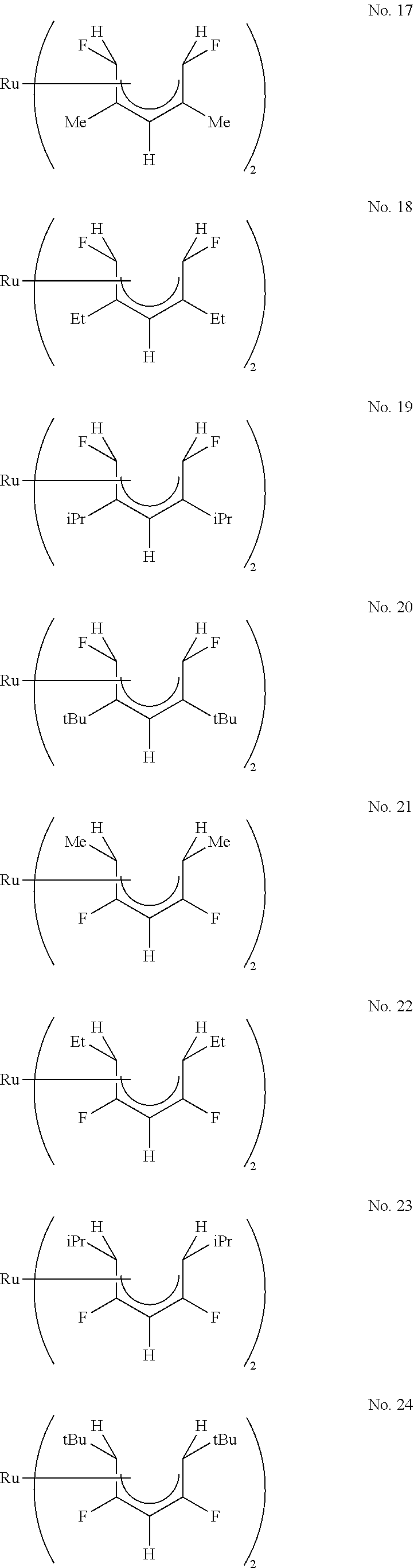
- Preferred specific examples of the ruthenium compound represented by the general formula (1) include Compounds No. 1 to No. 96 below.
- “Me” represents a methyl group
- “Et” represents an ethyl group
- “iPr” represents an isopropyl group
- “tBu” represents a tert-butyl group.
- a method of producing the compound represented by the general formula (1) is not particularly limited, and the compound is produced by applying a well-known reaction.
- the compound may be obtained by, for example, a production method including: causing dichlorodi- ⁇ -chlorobis[(1,2,3,6,7,8- ⁇ -2,7-alkyl-2,6-octadiene)-1,8-diyl]dirutheniun(IV), lithium carbonate, acetonitrile, and a fluorine-based diene compound having a corresponding structure to react with each other under an alcohol solvent; then removing the solvent to obtain an intermediate; adding dichloromethane to the obtained intermediate, followed by filtration; distilling off the solvent from the filtrate; and then purifying the resultant through distillation.
- fluorine-based diene compound examples include 1-fluoropenta-1,3-diene, 2-fluoropenta-1,3-diene, 3-fluoropenta-1,3-diene, 2,4-difluoropenta-1,3-diene, 1,5-difluoropenta-1,3-diene, 1,2-difluoropenta-1,3-diene, 1,2,4,5-tetrafluoropenta-1,3-diene, 1,2,3,4,5-pentafluoropenta-1,3-diene, 1-fluorohexa-2,4-diene, 1-fluorohepta-2,4-diene, 4-fluoro-2-methylpenta-1,3-diene, 2-fluoro-4-methylenehex-2-ene, 1,5-difluoro-2,4-dimethylpenta-1,3-diene, 3,5-difluorohepta-2,4-diene, 6,6,6-trifluorohexa-1,3
- R 13 to R 17 each independently represent a hydrogen atom or an alkyl group having 1 to 5 carbon atoms, and the total number of the carbon atoms of R 13 to R 17 is 3 or more.
- the total number of the carbon atoms of R 13 to R 17 is preferably 10 or less, more preferably 6 or less, still more preferably 4 or less.
- Examples of the alkyl group having 1 to 5 carbon atoms represented by each of R 13 to R 17 include a methyl group, an ethyl group, a propyl group, an isopropyl group, a butyl group, an isobutyl group, a sec-butyl group, a tert-butyl group, a pentyl group, an isopentyl group, and a neopentyl group.
- R 13 to R 17 are appropriately selected in accordance with a method of producing a thin-film to which the thin-film forming raw material is applied.
- the raw material is used in a method of producing a thin-film including a step of vaporizing the compound, it is preferred to select R 13 to R 17 so that the compound has a large vapor pressure, a low melting point, and high thermal stability.
- R 13 to R 17 be each independently selected from a hydrogen atom and an alkyl group having 1 to 3 carbon atoms, it is more preferred that R 13 to R 17 be selected from a hydrogen atom, a methyl group, and an ethyl group, and it is still more preferred that R 13 to R 17 each represent a methyl group, because the compound has a large vapor pressure.
- the total number of the carbon atoms of R 13 to R 17 is preferably from 3 to 10, more preferably from 3 to 6, still more preferably 3 or 4, yet still more preferably 3 because the compound has a large vapor pressure.
- R 1 and R 17 represent groups different from each other, and/or that R 14 and R 16 represent groups different from each other because the compound has a low melting point. Meanwhile, from the viewpoint of the thermal stability of the compound, it is preferred that R 13 to R 17 contain three or more alkyl groups each having 1 to 5 carbon atoms.
- R 13 to R 17 may be arbitrarily selected in accordance with, for example, solubility in a solvent to be used and a thin-film formation reaction.
- R 13 to R 17 when the total number of the carbon atoms of R 13 to R 17 is 3, it is preferred that R 13 to R 17 contain three methyl groups, and it is preferred that R 14 , R 16 , and R 17 each represent a methyl group.
- Preferred specific examples of the ruthenium compound represented by the general formula (2) include Compounds No. 97 to No. 117 below.
- “Me” represents a methyl group
- “Et” represents an ethyl group
- “iPr” represents an isopropyl group
- “tBu” represents a tert-butyl group.
- a method of producing the Compound represented by the general formula (2) is not particularly limited, and the compound is produced by applying a well-known reaction.
- the compound may be obtained by, for example, a production method including: causing dichlorodi- ⁇ -chlorobis[(1, 2, 3, 6,7, 8- ⁇ -2,7-alkyl-2,6-octadiene)-1,8-diyl]dirutheniun(IV), lithium carbonate, acetonitrile, and a diene compound having a corresponding structure to react with each other under an alcohol solvent; then removing the solvent to obtain an intermediate; adding dichloromethane to the obtained intermediate, followed by filtration; distilling off the solvent from the filtrate; and purifying the resultant through distillation.
- diene compound examples include 2-methyl-4-methylenehex-2-ene and 2,4-dimethylhexa-1,3-diene.
- fluorine-based diene compound 5 mol to 10 mol is added to 1 mol of dichlorodi- ⁇ -chlorobis[(1,2, 3,6,7,8- ⁇ -2,7-alkyl-2,6-octadiene)-1,8-diyl]diruthenium(IV).
- the thin-film forming raw material of the present invention includes the ruthenium compound of the present invention described above as a precursor of a thin-film.
- the form of the thin-film forming raw material varies depending on a production process to which the thin-film forming raw material is applied. For example, when a thin-film containing only ruthenium as a metal is produced, the thin-film forming raw material of the present invention is free of a metal compound other than the ruthenium compound of the present invention and a Semimetal compound.
- the thin-film forming raw material of the present invention may include a compound containing a desired metal and/or a compound containing the semimetal (hereinafter sometimes referred to as “other precursor”) in addition to the ruthenium compound of the present invention.
- the thin-film forming raw material of the present invention may further contain an organic solvent and/or a nucleophilic reagent as described later.
- the physical properties of the ruthenium compound of the present invention serving as the precursor are suitable for a CVD method and an ALD method, and hence the thin-film forming raw material of the present invention is useful, in particular, as a chemical vapor deposition raw material (hereinafter sometimes referred to as “CVE) raw material”).
- CVE chemical vapor deposition raw material
- the thin-film forming raw material of the present invention is a chemical vapor deposition raw material
- the form thereof is appropriately selected depending on a procedure, such as a transportation and supply method of the CVD method to be used.
- the gas transportation method involves heating and/or decompressing the CVD raw material in a container in which the raw material is stored (hereinafter sometimes referred to as “raw material container”), to thereby vaporize the raw material to obtain vapor, and introducing the vapor into a film formation chamber (hereinafter sometimes referred to as “deposition reaction portion”) having a substrate set therein together with a carrier gas, such as argon, nitrogen, or helium, to be used as required.
- a carrier gas such as argon, nitrogen, or helium
- the liquid transportation method involves transporting the CVD raw material to a vaporization chamber under the state of a liquid or a solution, heating and/or decompressing the raw material in the vaporization chamber, to thereby vaporize the raw material to obtain vapor, and introducing the vapor into the film formation chamber.
- the ruthenium compound represented by the general formula (1) or (2) itself may be used as the CVD raw material.
- the ruthenium compound represented by the general formula (1) or (2) itself or a solution obtained by dissolving the compound in an organic solvent may be used as the CVD raw material. Any such CVD raw material may further contain the other precursor, a nucleophilic reagent, and the like.
- a method involving vaporizing and supplying the CVD raw material independently for each component hereinafter sometimes referred to as “single source method”
- a method involving vaporizing and supplying a mixed raw material obtained by mixing a multi-component raw material with a desired composition in advance hereinafter sometimes referred to as “cocktail source method”.
- the cocktail source method a mixture of the ruthenium compound of the present invention and the other precursor or a mixed solution obtained by dissolving the mixture in an organic solvent may be used as the CVD raw material.
- the mixture or the mixed solution may further contain a nucleophilic reagent and the like.
- organic solvent there is no particular limitation on the above-mentioned organic solvent, and a well-known general organic solvent may be used.
- organic solvent include: acetic acid esters, such as ethyl acetate, butyl acetate, and methoxyethyl acetate; ethers, such as tetrahydrofuran, tetrahydropyran, ethylene glycol dimethyl ether, diethylene glycol dimethyl ether, triethylene glycol dimethyl ether, dibutyl ether, and dioxane; ketones, such as methyl butyl ketone, methyl isobutyl ketone, ethyl butyl ketone, dipropyl ketone, diisobutyl ketone, methyl amyl ketone, cyclohexanone, and methylcyclohexanone; hydrocarbons, such as hexane, cyclohexane, methylcyclohexane, dimethylcyclo
- organic solvents may be used alone or as a mixed solvent thereof depending on the solubility of a solute, the relationship among the use temperature, the boiling point, and the flash point, and the like.
- the amount of the entire precursors in the CVD raw material (solution state) obtained by dissolving the precursors in the organic solvent is typically from 0.01 mol/liter to 2.0 mol/liter, preferably from 0.05 mol/liter to 1.0 mol/liter.
- the amount of the entire precursors refers to the amount of the ruthenium compound of the present invention.
- the amount of the entire precursors refers to the total amount of the ruthenium compound of the present invention and the other precursor.
- the other precursor to be used together with the ruthenium compound of the present invention there is no particular limitation on the other precursor to be used together with the ruthenium compound of the present invention, and a well-known general precursor used in the CVD raw material may be used.
- Examples of the other precursor include compounds of one kind or more kinds selected from the group consisting of compounds used as organic ligands, such as an alcohol compound, a glycol compound, a ⁇ -diketone compound, a cyclopentadiene compound, and an organic amine compound, and silicon or a metal.
- compounds used as organic ligands such as an alcohol compound, a glycol compound, a ⁇ -diketone compound, a cyclopentadiene compound, and an organic amine compound, and silicon or a metal.
- examples of the kind of the metal in the precursor include lithium, sodium, potassium, magnesium, calcium, strontium, barium, titanium, zirconium, hafnium, vanadium, tantalum, chromium, molybdenum, tungsten, manganese, iron, cobalt, rhodium, iridium, nickel, palladium, platinum, copper, silver, gold, zinc, aluminum, gallium, indium, germanium, tin, lead, antimony, bismuth, yttrium, lanthanum, cerium, praseodymium, neodymium, promethium, samarium, europium, gadolinium, terbium, dysprosium, holmium, erbium, thulium, ytterbium, and lutetium.
- Examples of the alcohol compound to be used as the organic ligand in the above-mentioned other precursor include: alkyl alcohols, such as methanol, ethanol, propanol, isopropyl alcohol, butanol, sec-butyl alcohol, isobutyl alcohol, tert-butyl alcohol, pentyl alcohol, isopentyl alcohol, and tert-pentyl alcohol; ether alcohols, such as 2-methoxyethanol, 2-ethoxyethanol, 2-butoxyethanol, 2-(2-methoxyethoxy)ethanol, 2-methoxy-1-methylethanol, 2-methoxy-1,1-dimethylethanol, 2-ethoxy-1,1-dimethylethanol, 2-isopropoxy-1,1-dimethylethanol, 2-butoxy-1,1-dimethylethanol, 2-(2-methoxyethoxy)-1,1-dimethylethanol, 2-propoxy-1,1-diethylethanol, 2-s-butoxy-1,1-diethylethanol, and 3-methoxy
- glycol compound to be used as the organic ligand in the above-mentioned other precursor examples include 1,2-ethanediol, 1,2-propanediol, 1,3-propanediol, 2,4-hexanediol, 2,2-dimethyl-1,3-propanediol, 2,2-diethyl-1,3-propanediol, 1,3-butanediol, 2,4-butanediol, 2,2-diethyl-1,3-butanediol, 2-ethyl-2-butyl-1,3-propanediol, 2,4-pentanediol, 2-methyl-1,3-propanediol, 2-methyl-2,4-pentanediol, 2,4-hexanediol, and 2,4-dimethyl-2,4-pentanediol.
- examples of the ⁇ -diketone compound include: alkyl-substituted-diketones, such as acetylacetone, hexane-2,4-dione, 5-methylhexane-2,4-dione, heptane-2,4-dione, 2-methyltheptane-3,5-dione, 5-methylheptane-2,4-dione, 6-methylheptane-2,4-dione, 2,2-dimethylheptane-3,5-dione, 2,6-dimethylheptane-3,5-dione, 2,2,6-trimethylheptane-3,5-dione, 2,2,6,6-tetramethylheptane-3,5-dione, octane-2,4-dione, 2,2,6-trimethyloctane-3,5-dione, 2,6-dimethyloctane-3,5-dione, 2,9-dimethylnon
- examples of the cyclopentadiene compound include cyclopentadiene, methylcyclopentadiene, ethylcyclopentadiene, propylcyclopentadiene, isopropylcyclopentadiene, butylcyclopentadiene, sec-butylcyclopentadiene, isobutylcyclopentadiene, tert-butylcyclopentadiene, dimethylcyclopentadiene, and tetramethylcyclopentadiene
- examples of the organic amine compound to be used as the above-mentioned organic ligand include methylamine, ethylamine, propylamine, isopropylamine, butylamine, sec-butylamine, tert-butylamine, isobutylamine, dimethylamine, diethylamine, dipropylamine, diisopropylamine, ethylmethylamine, propylmethylamine, and isopropyl
- the precursor when the alcohol compound is used as the organic ligand, the precursor may be produced through a reaction between an inorganic salt of the metal described above or a hydrate thereof and an alkali metal alkoxide of the alcohol compound.
- examples of the inorganic salt of the metal or the hydrate thereof may include a halide and a nitrate of the metal
- examples of the alkali metal alkoxide may include a sodium alkoxide, a lithium alkoxide, and a potassium alkoxide.
- a compound similar to the ruthenium compound of the present invention in the behavior of thermal decomposition and/or oxidative decomposition is preferably used as the above-mentioned other precursor.
- a compound that not only is similar to the ruthenium compound of the present invention in the behavior of thermal decomposition and/or oxidative decomposition but also does not cause any change impairing desired characteristics as a precursor through a chemical reaction or the like at the time of mixing is preferably used as the above-mentioned other precursor.
- the thin-film forming raw material of the present invention may contain a nucleophilic reagent as required in order to impart stability to the ruthenium compound of the present invention and the other precursor.
- the nucleophilic reagent include: ethylene glycol ethers, such as glyme, diglyme, triglyme, and tetraglyme; crown ethers, such as 18-crown-6, dicyclohexyl-18-crown-6, 24-crown-8, dicyclohexyl-24-crown-8, and dibenzo-24-crown-8; polyamines, such as ethylenediamine, N,N′-tetramethylethylenediamine, diethylenetriamine, triethylenetetramine, tetraethylenepentamine, pentaethylenehexamine, 1,1,4,7,7-pentamethyldiethylenetriamine, 1,1,4,7,10,10-hexamethyltriethylenetetramine, and triethoxytriethyleneamine;
- the content of the impurity halogens is preferably 100 ppm or less, more preferably 10 ppm or less, most preferably 1 ppm or less.
- the total content of the impurity organic substances is preferably 500 ppm or less, more preferably 50 ppm or less, most preferably 10 ppm or less.
- moisture causes generation of particles in the chemical vapor deposition raw material and generation of particles during thin-film formation. Accordingly, moisture in each of the precursor, the organic solvent, and the nucleophilic reagent is preferably removed as much as possible before its use.
- the moisture content of each of the precursor, the organic solvent, and the nucleophilic reagent is preferably 10 ppm or less, more preferably 1 ppm or less.
- the thin-film forming raw material of the present invention be prevented from containing particles to the extent possible in order to reduce or prevent particle contamination of a thin-film to be formed.
- the number of particles larger than 0.3 ⁇ m be 100 or less in 1 mL of the liquid phase
- the number of particles larger than 0.2 ⁇ m be 1,000 or less in 1 mL of the liquid phase
- a method of producing a thin-film of the present invention in which the thin-film is produced by using the thin-film forming raw material of the present invention is a CVD method including: introducing vapor obtained by vaporizing the thin-film forming raw material of the present invention and a reactive gas to be used as required into a film formation chamber (treatment atmosphere) having a substrate set therein; and then subjecting the precursor to decomposition and/or a chemical reaction on the substrate, to thereby grow and deposit the thin-film containing a metal on the surface of the substrate.
- a transportation and supply method for the raw material a deposition method therefor, production conditions, a production apparatus, and the like, and well-known general conditions and methods may be used.
- Examples of the above-mentioned reactive gas to be used as required include: oxidizing gases, such as oxygen, ozone, nitrogen dioxide, nitrogen monoxide, water vapor, hydrogen peroxide, formic acid, acetic acid, and acetic anhydride; reducing gases, such as hydrocarbon compounds including methane and ethane, hydrogen, carbon monoxide, and organic metal compounds; and gases for producing nitrides, such as organic amine compounds including a monoalkylamine, a dialkylamine, a trialkylamine, and an alkylenediamine, hydrazine, and ammonia. Those gases may be used alone or in combination thereof.
- oxidizing gases such as oxygen, ozone, nitrogen dioxide, nitrogen monoxide, water vapor, hydrogen peroxide, formic acid, acetic acid, and acetic anhydride
- reducing gases such as hydrocarbon compounds including methane and ethane, hydrogen, carbon monoxide, and organic metal compounds
- the thin-film forming raw material of the present invention has satisfactory reactivity with a reducing gas out of those gases, and has particularly satisfactory reactivity with hydrogen. Accordingly, when one kind is used as the reactive gas, hydrogen is preferably used, and when a mixed gas of two or more kinds is used as the reactive gas, the mixed gas preferably contains at least hydrogen.
- examples of the above-mentioned transportation and supply method include the gas transportation method, the liquid transportation method, the single source method, and the cocktail source method described above.
- examples of the above-mentioned deposition method include: thermal CVD including causing a raw material gas, or the raw material gas and a reactive gas, to react only with heat, to thereby deposit a thin-film; plasma CVD using heat and plasma; optical CVD using heat and light; optical plasma CVD using heat, light, and plasma; and ALD including dividing a deposition reaction of CVD into elementary steps, and performing deposition at a molecular level in a stepwise manner.
- the substrate As a material for the substrate, there are given, for example: silicon; ceramics, such as silicon nitride, titanium nitride, tantalum nitride, titanium oxide, titanium nitride, ruthenium oxide, zirconium oxide, hafnium oxide, and lanthanum oxide; glass; and metals, such as metal cobalt.
- the shape of the substrate is, for example, a plate shape, a spherical shape, a fibrous shape, or a scaly shape.
- the surface of the substrate may be planar, or may have a three-dimensional structure, such as a trench structure.
- examples of conditions for the above-mentioned production method include a reaction temperature (substrate temperature), a reaction pressure, and a deposition rate.
- the reaction temperature is preferably not less than 100° C. that is the temperature at which the compound of the present invention sufficiently reacts, more preferably from 150° C. to 400° C., particularly preferably from 200° C. to 350° C.
- the reaction pressure is preferably from 10 Pa to an atmospheric pressure in the case of the thermal CVD or the optical CVD, and is preferably from 10 Pa to 2,000 Pa in the case of using plasma.
- the deposition rate may be controlled by the supply conditions (vaporization temperature and vaporization pressure) of the raw material, the reaction temperature, and the reaction pressure.
- the deposition rate is preferably from 0.01 nm/min to 100 nm/min, more preferably from 1 nm/min to 50 nm/min.
- the deposition rate is controlled by the number of cycles so that a desired film thickness may be obtained.
- the step of vaporizing the thin-film forming raw material to obtain vapor may be performed in the raw material container or in the vaporization chamber.
- the thin-film forming raw material of the present invention be evaporated at a temperature of from 0° C. to 150° C.
- the pressure in the raw material container and the pressure in the vaporization chamber are both preferably from 1 Pa to 10,000 Pa.
- the method of producing a thin-film of the present invention may include, in addition to a raw material introduction step of vaporizing the thin-film forming raw material by the above-mentioned transportation and supply method to provide vapor, followed by the introduction of the vapor into the film formation chamber, a precursor thin-film formation step of forming a precursor thin-film from the above-mentioned compound in the vapor on the surface of the above-mentioned substrate, an evacuation step of evacuating an unreacted compound gas, and a metal-containing thin-film formation step of causing the precursor thin-film to chemically react with the reactive gas, to thereby form a thin-film containing a metal on the surface of the substrate.
- the case of forming a metal thin-film is described in detail as an example.
- the above-mentioned raw material introduction step is performed.
- the preferred temperature and pressure when the thin-film forming raw material is turned into vapor are the same as those described in the method of producing a thin-film by the CVD method.
- the vapor introduced intro the film formation chamber and the surface of the substrate are brought into contact with each other, and hence the precursor thin-film is formed on the surface of the substrate (precursor thin-film formation step).
- heat may be applied by heating the substrate or heating the film formation chamber.
- the precursor thin-film formed in this step is a thin-film produced from the compound of the present invention or a thin-film produced by the decomposition and/or reaction of part of the compound of the present invention, and hence has composition different from that of the target metal nitride thin-film.
- the temperature of the substrate when this step is performed is preferably from room temperature to 500° C., more preferably from 150° C. to 350° C.
- the pressure of a system (in the film formation chamber) when this step is performed is preferably from 1 Pa to 10,000 Pa, more preferably from 10 Pa to 1,000 Pa.
- the unreacted compound gas and a gas generated as a by-product are evacuated from the film formation chamber (evacuation step). It is ideal that the unreacted compound gas and the gas generated as a by-product be completely evacuated from the film formation chamber, but it is not always required that the gases be completely evacuated.
- an evacuation method there are given, for example: a method including purging the inside of the system with an inert gas, such as nitrogen, helium, or argon; a method including performing evacuation by decompressing the inside of the system; and a combination of these methods.
- the degree of decompression when the decompression is performed is preferably from 0.01 Pa to 300 Pa, more preferably from 0.01 Pa to 100 Pa.
- a reducing gas is introduced as the reactive gas into the film formation chamber, and the metal thin-film is formed from the precursor thin-film obtained in the previous precursor thin-film formation step through the action of the reducing gas or the action of the reducing gas and heat (metal-containing thin-film formation step).
- the temperature when the heat is applied is preferably from room temperature to 500° C., more preferably from 150° C. to 350° C.
- the pressure of the system (in the film formation chamber) when this step is performed is preferably from 1 Pa to 10,000 Pa, more preferably from 10 Pa to 1,000 Pa.
- the compound of the present invention has satisfactory reactivity with the reducing gas, and hence a high-quality metal thin-film containing less residual carbon can be obtained.
- thin-film deposition performed by a series of operations including the above-mentioned raw material introduction step, precursor thin-film formation step, evacuation step, and metal-containing thin-film formation step is defined as one cycle, and this cycle may be repeated a plurality of times until a thin-film having a required film thickness is obtained.
- a compound gas and a reactive gas that are unreacted, and a gas generated as a by-product be evacuated from the deposition reaction portion in the same manner as in the above-mentioned evacuation step, and then the subsequent one cycle be performed.
- energy such as plasma, light, or a voltage
- a catalyst may be used.
- the energy may be applied or the catalyst may be used, for example, at the time of introducing the compound gas in the raw material introduction step, at the time of heating in the precursor thin-film formation step or the metal-containing thin-film formation step, at the time of evacuating the inside of the system in the evacuation step, or at the time of introducing the reducing gas in the metal-containing thin-film formation step, or between the above-mentioned respective steps.
- annealing treatment may be performed in an inert atmosphere, an oxidizing atmosphere, or a reducing atmosphere in order to obtain more satisfactory electrical characteristics.
- a reflow step may be provided.
- the temperature in this case is from 200° C. to 1,000° C., preferably from 250° C. to 500° C.
- an apparatus for producing a thin-film through use of the thin-film forming raw material of the present invention a well-known apparatus for a chemical vapor deposition method may be used.
- the apparatus there are given an apparatus capable of performing bubbling supply of a precursor as illustrated in FIG. 1 and an apparatus including a vaporization chamber as illustrated in FIG. 2 .
- an apparatus capable of subjecting the reactive gas to plasma treatment as illustrated in FIG. 3 and FIG. 4 .
- the apparatus is not limited to single-substrate type apparatus as illustrated in FIG. 1 to FIG. 4 , and an apparatus capable of simultaneously processing a large number of substrates through use of a batch furnace may also be used.
- a thin-film produced through use of the thin-film forming raw material of the present invention may be formed as desired kinds of thin-films, such as thin-films of a metal, oxide ceramics, nitride ceramics, and glass, by appropriately selecting the other precursor, the reactive gas, and the production conditions. It has been known that the thin-films exhibit electrical characteristics, optical characteristics, and the like, and the thin-films have been applied to various usages. Examples thereof include a metal ruthenium thin-film, a ruthenium oxide thin-film, a ruthenium nitride thin-film, a ruthenium alloy, and a ruthenium-containing composite oxide thin-film.
- ruthenium alloy examples include a Ru—Pd alloy and a Ru—Pt alloy.
- Those thin-films have been widely used in the production of, for example, electrode materials for memory elements typified by DRAM elements, resistance films, diamagnetic films used for the recording layers of hard disks, and catalyst materials for polymer electrolyte fuel cells.
- Compound No. 106 was a liquid at 25° C.
- Compound No. 37 was a solid at 25° C., but had a relatively low melting point of 55° C.
- Comparative Compound 1 had a melting point of 90° C. or more, which was much higher than that of the product of the present invention.
- Compounds No. 37 and No. 106 each had a thermal decomposition start temperature higher than that of Comparative Compound 1 by 15° C. or more, and in particular, Compound No. 37 had a thermal decomposition start temperature higher than that of Comparative Compound 1 by 30° C.
- a ruthenium nitride thin-film was produced on a silicon substrate by the ALD method under the following conditions through use of an ALD apparatus illustrated in FIG. 1 with each of Compounds No. 37 and No. 106, and Comparative Compound 1 being used as a chemical vapor deposition raw material.
- a film thickness was measured by an X-ray reflectivity method, a compound of the thin-film was identified by an X-ray diffraction method, and the content of carbon in the thin-film was measured by X-ray photoelectron spectroscopy. The results are shown in Table 2.
- Reaction temperature 200° C.
- reactive gas ammonia
- the content of carbon in the thin-film obtained by the ALD method is 10 atm % or more in Comparative Example 1, whereas the content of carbon is not more than 0.1 atm % that is the detection limit in Examples 1 and 2. That is, it was shown that a high-quality thin-film can be obtained through use of the ruthenium compound of the present invention in addition, the fil thickness of the obtained thin-film is 2.5 nm in Comparative Example 1, whereas the film thickness is 5.5 nm or more in Examples 1 and 2. Thus, the thin-film was obtained with high productivity through use of the ruthenium compound of the present invention. In particular, the thin-film was able to be obtained with higher productivity when Compound No. 37 was used as a chemical vapor deposition raw material, and hence it was shown that Compound No. 37 was excellent as a chemical vapor deposition raw material.
Landscapes
- Chemical & Material Sciences (AREA)
- Organic Chemistry (AREA)
- General Chemical & Material Sciences (AREA)
- Chemical Kinetics & Catalysis (AREA)
- Engineering & Computer Science (AREA)
- Materials Engineering (AREA)
- Mechanical Engineering (AREA)
- Metallurgy (AREA)
- Chemical Vapour Deposition (AREA)
- Electrodes Of Semiconductors (AREA)
Abstract

where R1 to R12 each independently represent a hydrogen atom, an alkyl group having 1 to 5 carbon atoms, or a fluorine atom-containing group, and “n” represents an integer from 0 to 2, provided that at least one of R1 to R12 represents the fluorine atom-containing group;

where R13 to R17 each independently represent a hydrogen atom or an alkyl group having 1 to 5 carbon atoms, and a total number of the carbon atoms of R13 to R17 is 3 or more.
Description
-
- [PTL 1] JP 2008-069453 A
- [PTL 2] JP 2011-521983 A
- [PTL 3] JP 2016-074929 A
- [PTL 4] JP 2005-060814 A




| TABLE 1 | ||||||
| Thermal | ||||||
| decomposition | ||||||
| State | Melting | start | ||||
| at | point/ | temperature/ | TG50/ | |||
| Compound | 25° C. | ° C. | ° C. | ° C. | ||
| Evaluation | No. 37 | Solid | 55 | 250 | 105 | |
| Example 1 | ||||||
| Evaluation | No. 106 | Liquid | — | 235 | 130 | |
| Example 2 | ||||||
| Comparative | Comparative | Solid | 90 | 220 | 135 | |
| | compound | 1 | ||||
| Example 1 | ||||||
| TABLE 2 | ||||
| Chemical | ||||
| vapor | Film | |||
| deposition | thickness | Compoand | Content of | |
| raw | of thin- | of thin- | carbon in | |
| material | film | film | thin-film | |
| Example 1 | Compound | 7.5 nm | Metal | Undetectable*1 |
| No. 37 | ruthenium | |||
| Example 2 | Compound | 5.5 nm | Metal | Undetectable*1 |
| No. 106 | ruthenium | |||
| Comparative | Comparative | 2.5 nm | Metal | 10 atm % |
| Example 1 | |
ruthenium | ||
| *1The detection limit is 0.1 atm %. | ||||
Claims (3)

Applications Claiming Priority (3)
| Application Number | Priority Date | Filing Date | Title |
|---|---|---|---|
| JP2019115184 | 2019-06-21 | ||
| JP2019-115184 | 2019-06-21 | ||
| PCT/JP2020/022828 WO2020255822A1 (en) | 2019-06-21 | 2020-06-10 | Ruthenium compound, raw material for thin film formation, and method for forming thin film |
Publications (2)
| Publication Number | Publication Date |
|---|---|
| US20220372056A1 US20220372056A1 (en) | 2022-11-24 |
| US12264168B2 true US12264168B2 (en) | 2025-04-01 |
Family
ID=74040058
Family Applications (1)
| Application Number | Title | Priority Date | Filing Date |
|---|---|---|---|
| US17/620,934 Active 2041-11-17 US12264168B2 (en) | 2019-06-21 | 2020-06-10 | Ruthenium compound, thin-film forming raw material, and method of producing thin film |
Country Status (5)
| Country | Link |
|---|---|
| US (1) | US12264168B2 (en) |
| JP (1) | JP7565270B2 (en) |
| KR (1) | KR102859536B1 (en) |
| TW (1) | TWI831983B (en) |
| WO (1) | WO2020255822A1 (en) |
Citations (9)
| Publication number | Priority date | Publication date | Assignee | Title |
|---|---|---|---|---|
| TWI227239B (en) | 2001-09-12 | 2005-02-01 | Tosoh Corp | Ruthenium complex, process for producing the same and process for producing thin film |
| JP2005060814A (en) | 2002-12-03 | 2005-03-10 | Jsr Corp | Method for producing ruthenium compounds and metal ruthenium films |
| JP2008069453A (en) | 2006-08-08 | 2008-03-27 | L'air Liquide-Sa Pour L'etude & L'exploitation Des Procedes Georges Claude | Precursor having open ligand for ruthenium-containing film deposition |
| EP1935897A1 (en) * | 2006-12-22 | 2008-06-25 | L'AIR LIQUIDE, Société Anonyme pour l'Etude et l'Exploitation des Procédés Georges Claude | New organo-Ruthenium compound, the process for its preparation and its use as a ruthenium precursor to manufacture ruthenium based film coated metal electrodes |
| WO2009094259A1 (en) * | 2008-01-24 | 2009-07-30 | Praxair Technology, Inc. | Organometallic compounds processes and methods of use |
| JP2009536267A (en) | 2006-05-05 | 2009-10-08 | アプライド マテリアルズ インコーポレイテッド | Method and apparatus for photoexcitation of chemicals for atomic layer deposition of dielectric films |
| JP2011521983A (en) | 2008-06-02 | 2011-07-28 | ユミコア・アクチエンゲゼルシャフト・ウント・コムパニー・コマンディットゲゼルシャフト | Method for producing dienyl-ruthenium complex |
| US20150225437A1 (en) * | 2012-08-20 | 2015-08-13 | Tanaka Kikinzoku Kogyo K.K. | Chemical deposition raw material formed of ruthenium complex and method for producing the same, and chemical deposition method |
| JP2016074929A (en) | 2014-10-03 | 2016-05-12 | 田中貴金属工業株式会社 | Chemical vapor deposition material comprising organic ruthenium compound and chemical vapor deposition method using the chemical vapor deposition material |
Family Cites Families (2)
| Publication number | Priority date | Publication date | Assignee | Title |
|---|---|---|---|---|
| WO2004050947A1 (en) * | 2002-12-03 | 2004-06-17 | Jsr Corporation | Ruthenium compound and process for producing metallic ruthenium film |
| JP2015153993A (en) | 2014-02-18 | 2015-08-24 | キヤノン株式会社 | organic light-emitting element |
-
2020
- 2020-06-10 KR KR1020227000592A patent/KR102859536B1/en active Active
- 2020-06-10 WO PCT/JP2020/022828 patent/WO2020255822A1/en not_active Ceased
- 2020-06-10 JP JP2021528132A patent/JP7565270B2/en active Active
- 2020-06-10 US US17/620,934 patent/US12264168B2/en active Active
- 2020-06-18 TW TW109120508A patent/TWI831983B/en active
Patent Citations (9)
| Publication number | Priority date | Publication date | Assignee | Title |
|---|---|---|---|---|
| TWI227239B (en) | 2001-09-12 | 2005-02-01 | Tosoh Corp | Ruthenium complex, process for producing the same and process for producing thin film |
| JP2005060814A (en) | 2002-12-03 | 2005-03-10 | Jsr Corp | Method for producing ruthenium compounds and metal ruthenium films |
| JP2009536267A (en) | 2006-05-05 | 2009-10-08 | アプライド マテリアルズ インコーポレイテッド | Method and apparatus for photoexcitation of chemicals for atomic layer deposition of dielectric films |
| JP2008069453A (en) | 2006-08-08 | 2008-03-27 | L'air Liquide-Sa Pour L'etude & L'exploitation Des Procedes Georges Claude | Precursor having open ligand for ruthenium-containing film deposition |
| EP1935897A1 (en) * | 2006-12-22 | 2008-06-25 | L'AIR LIQUIDE, Société Anonyme pour l'Etude et l'Exploitation des Procédés Georges Claude | New organo-Ruthenium compound, the process for its preparation and its use as a ruthenium precursor to manufacture ruthenium based film coated metal electrodes |
| WO2009094259A1 (en) * | 2008-01-24 | 2009-07-30 | Praxair Technology, Inc. | Organometallic compounds processes and methods of use |
| JP2011521983A (en) | 2008-06-02 | 2011-07-28 | ユミコア・アクチエンゲゼルシャフト・ウント・コムパニー・コマンディットゲゼルシャフト | Method for producing dienyl-ruthenium complex |
| US20150225437A1 (en) * | 2012-08-20 | 2015-08-13 | Tanaka Kikinzoku Kogyo K.K. | Chemical deposition raw material formed of ruthenium complex and method for producing the same, and chemical deposition method |
| JP2016074929A (en) | 2014-10-03 | 2016-05-12 | 田中貴金属工業株式会社 | Chemical vapor deposition material comprising organic ruthenium compound and chemical vapor deposition method using the chemical vapor deposition material |
Non-Patent Citations (3)
| Title |
|---|
| Bauer, Andre et al., "Efficient Synthesis of Ruthenium(II) η5-Dienyl Compounds Starting from Di-μ-chlorodichloro-bis[(1-3η:6-8η)-2,7-dimethyloctadienediyl]diruthenium(IV). Versatile Precursors for Enantioselective Hydrogenation Catalysts", Organometallices, 2000, vol. 19, No. 25, pp. 5471-5476. |
| International Search Report issued Aug. 11, 2020 in International (PCT) Application No. PCT/JP2020/022828. |
| Kirss et al., "Synthesis, characterization and electrochemistry of bis(3-ary1-6,6-dimethylcyclohexadieny1)ruthenium complexes", Inorganica Chimica Acta, vol. 359, 2006, pp. 4393-4397. |
Also Published As
| Publication number | Publication date |
|---|---|
| KR20220024443A (en) | 2022-03-03 |
| TWI831983B (en) | 2024-02-11 |
| JP7565270B2 (en) | 2024-10-10 |
| JPWO2020255822A1 (en) | 2020-12-24 |
| TW202110866A (en) | 2021-03-16 |
| US20220372056A1 (en) | 2022-11-24 |
| WO2020255822A1 (en) | 2020-12-24 |
| KR102859536B1 (en) | 2025-09-12 |
Similar Documents
| Publication | Publication Date | Title |
|---|---|---|
| US20210155638A1 (en) | Raw material for forming thin film by atomic layer deposition method and method for producing thin film | |
| US11555044B2 (en) | Thin-film forming raw material for use in atomic layer deposition method, thin-film forming raw material, method for producing thin-film, and compound | |
| EP3712159B1 (en) | Ruthenium compound, raw material for forming thin film, and method for producing thin film | |
| US11623935B2 (en) | Raw material for forming thin film by atomic layer deposition method, method of producing thin film, and alkoxide compound | |
| US12276022B2 (en) | Alkoxide compound, thin-film forming raw material, and method of producing thin-film | |
| US12275748B2 (en) | Amidinate compound, dimer compound thereof, thin-film forming raw material, and method of producing thin film | |
| US20240425975A1 (en) | Thin-film forming raw material, method of producing thin-film, thin-film, and molybdenum compound | |
| EP4067365B1 (en) | Compound, thin film-forming material, and method for producing thin film | |
| US20220213592A1 (en) | Raw material for forming thin film, method for producing thin film, and scandium compound | |
| US20220372056A1 (en) | Ruthenium compound, thin-film forming raw material, and method of producing thin film | |
| US12509764B2 (en) | Thin-film forming raw material used in atomic layer deposition method, and method of producing thin-film | |
| US12486573B2 (en) | Thin-film forming raw material, thin-film and method of producing thin-film | |
| US12371778B2 (en) | Cobalt compound, thin-film forming raw material, thin-film, and method of producing thin-film | |
| US12559839B2 (en) | Indium compound, thin-film forming raw material, thin film, and method of producing same | |
| US12577660B2 (en) | Compound, thin-film forming raw material, thin-film, and method of producing thin-film | |
| US12480207B2 (en) | Tin compound, thin-film forming raw material, thin-film, method for producing thin-film, and halogen compound |
Legal Events
| Date | Code | Title | Description |
|---|---|---|---|
| AS | Assignment |
Owner name: ADEKA CORPORATION, JAPAN Free format text: ASSIGNMENT OF ASSIGNORS INTEREST;ASSIGNORS:ENZU, MASAKI;HATASE, MASAKO;TAKEDA, KEISUKE;REEL/FRAME:058435/0010 Effective date: 20211202 |
|
| FEPP | Fee payment procedure |
Free format text: ENTITY STATUS SET TO UNDISCOUNTED (ORIGINAL EVENT CODE: BIG.); ENTITY STATUS OF PATENT OWNER: LARGE ENTITY |
|
| STPP | Information on status: patent application and granting procedure in general |
Free format text: DOCKETED NEW CASE - READY FOR EXAMINATION |
|
| STPP | Information on status: patent application and granting procedure in general |
Free format text: NON FINAL ACTION MAILED |
|
| STPP | Information on status: patent application and granting procedure in general |
Free format text: RESPONSE TO NON-FINAL OFFICE ACTION ENTERED AND FORWARDED TO EXAMINER |
|
| STPP | Information on status: patent application and granting procedure in general |
Free format text: NON FINAL ACTION MAILED |
|
| STPP | Information on status: patent application and granting procedure in general |
Free format text: RESPONSE TO NON-FINAL OFFICE ACTION ENTERED AND FORWARDED TO EXAMINER |
|
| STPP | Information on status: patent application and granting procedure in general |
Free format text: NOTICE OF ALLOWANCE MAILED -- APPLICATION RECEIVED IN OFFICE OF PUBLICATIONS |
|
| STPP | Information on status: patent application and granting procedure in general |
Free format text: PUBLICATIONS -- ISSUE FEE PAYMENT VERIFIED |
|
| STCF | Information on status: patent grant |
Free format text: PATENTED CASE |