US12264157B2 - Compounds and methods for the enhanced degradation of targeted proteins - Google Patents
Compounds and methods for the enhanced degradation of targeted proteins Download PDFInfo
- Publication number
- US12264157B2 US12264157B2 US17/931,814 US202217931814A US12264157B2 US 12264157 B2 US12264157 B2 US 12264157B2 US 202217931814 A US202217931814 A US 202217931814A US 12264157 B2 US12264157 B2 US 12264157B2
- Authority
- US
- United States
- Prior art keywords
- optionally substituted
- group
- alkyl
- compound
- groups
- Prior art date
- Legal status (The legal status is an assumption and is not a legal conclusion. Google has not performed a legal analysis and makes no representation as to the accuracy of the status listed.)
- Active, expires
Links
Images

Classifications
-
- C—CHEMISTRY; METALLURGY
- C07—ORGANIC CHEMISTRY
- C07D—HETEROCYCLIC COMPOUNDS
- C07D471/00—Heterocyclic compounds containing nitrogen atoms as the only ring hetero atoms in the condensed system, at least one ring being a six-membered ring with one nitrogen atom, not provided for by groups C07D451/00 - C07D463/00
- C07D471/02—Heterocyclic compounds containing nitrogen atoms as the only ring hetero atoms in the condensed system, at least one ring being a six-membered ring with one nitrogen atom, not provided for by groups C07D451/00 - C07D463/00 in which the condensed system contains two hetero rings
- C07D471/04—Ortho-condensed systems
-
- C—CHEMISTRY; METALLURGY
- C07—ORGANIC CHEMISTRY
- C07D—HETEROCYCLIC COMPOUNDS
- C07D495/00—Heterocyclic compounds containing in the condensed system at least one hetero ring having sulfur atoms as the only ring hetero atoms
- C07D495/12—Heterocyclic compounds containing in the condensed system at least one hetero ring having sulfur atoms as the only ring hetero atoms in which the condensed system contains three hetero rings
- C07D495/14—Ortho-condensed systems
-
- A—HUMAN NECESSITIES
- A61—MEDICAL OR VETERINARY SCIENCE; HYGIENE
- A61K—PREPARATIONS FOR MEDICAL, DENTAL OR TOILETRY PURPOSES
- A61K31/00—Medicinal preparations containing organic active ingredients
- A61K31/33—Heterocyclic compounds
- A61K31/395—Heterocyclic compounds having nitrogen as a ring hetero atom, e.g. guanethidine or rifamycins
- A61K31/41—Heterocyclic compounds having nitrogen as a ring hetero atom, e.g. guanethidine or rifamycins having five-membered rings with two or more ring hetero atoms, at least one of which being nitrogen, e.g. tetrazole
- A61K31/425—Thiazoles
- A61K31/427—Thiazoles not condensed and containing further heterocyclic rings
-
- A—HUMAN NECESSITIES
- A61—MEDICAL OR VETERINARY SCIENCE; HYGIENE
- A61K—PREPARATIONS FOR MEDICAL, DENTAL OR TOILETRY PURPOSES
- A61K31/00—Medicinal preparations containing organic active ingredients
- A61K31/33—Heterocyclic compounds
- A61K31/395—Heterocyclic compounds having nitrogen as a ring hetero atom, e.g. guanethidine or rifamycins
- A61K31/55—Heterocyclic compounds having nitrogen as a ring hetero atom, e.g. guanethidine or rifamycins having seven-membered rings, e.g. azelastine, pentylenetetrazole
- A61K31/551—Heterocyclic compounds having nitrogen as a ring hetero atom, e.g. guanethidine or rifamycins having seven-membered rings, e.g. azelastine, pentylenetetrazole having two nitrogen atoms, e.g. dilazep
-
- A—HUMAN NECESSITIES
- A61—MEDICAL OR VETERINARY SCIENCE; HYGIENE
- A61K—PREPARATIONS FOR MEDICAL, DENTAL OR TOILETRY PURPOSES
- A61K45/00—Medicinal preparations containing active ingredients not provided for in groups A61K31/00 - A61K41/00
- A61K45/06—Mixtures of active ingredients without chemical characterisation, e.g. antiphlogistics and cardiaca
-
- A—HUMAN NECESSITIES
- A61—MEDICAL OR VETERINARY SCIENCE; HYGIENE
- A61K—PREPARATIONS FOR MEDICAL, DENTAL OR TOILETRY PURPOSES
- A61K47/00—Medicinal preparations characterised by the non-active ingredients used, e.g. carriers or inert additives; Targeting or modifying agents chemically bound to the active ingredient
- A61K47/50—Medicinal preparations characterised by the non-active ingredients used, e.g. carriers or inert additives; Targeting or modifying agents chemically bound to the active ingredient the non-active ingredient being chemically bound to the active ingredient, e.g. polymer-drug conjugates
- A61K47/51—Medicinal preparations characterised by the non-active ingredients used, e.g. carriers or inert additives; Targeting or modifying agents chemically bound to the active ingredient the non-active ingredient being chemically bound to the active ingredient, e.g. polymer-drug conjugates the non-active ingredient being a modifying agent
- A61K47/54—Medicinal preparations characterised by the non-active ingredients used, e.g. carriers or inert additives; Targeting or modifying agents chemically bound to the active ingredient the non-active ingredient being chemically bound to the active ingredient, e.g. polymer-drug conjugates the non-active ingredient being a modifying agent the modifying agent being an organic compound
- A61K47/55—Medicinal preparations characterised by the non-active ingredients used, e.g. carriers or inert additives; Targeting or modifying agents chemically bound to the active ingredient the non-active ingredient being chemically bound to the active ingredient, e.g. polymer-drug conjugates the non-active ingredient being a modifying agent the modifying agent being an organic compound the modifying agent being also a pharmacologically or therapeutically active agent, i.e. the entire conjugate being a codrug
-
- A—HUMAN NECESSITIES
- A61—MEDICAL OR VETERINARY SCIENCE; HYGIENE
- A61P—SPECIFIC THERAPEUTIC ACTIVITY OF CHEMICAL COMPOUNDS OR MEDICINAL PREPARATIONS
- A61P1/00—Drugs for disorders of the alimentary tract or the digestive system
- A61P1/04—Drugs for disorders of the alimentary tract or the digestive system for ulcers, gastritis or reflux esophagitis, e.g. antacids, inhibitors of acid secretion, mucosal protectants
-
- A—HUMAN NECESSITIES
- A61—MEDICAL OR VETERINARY SCIENCE; HYGIENE
- A61P—SPECIFIC THERAPEUTIC ACTIVITY OF CHEMICAL COMPOUNDS OR MEDICINAL PREPARATIONS
- A61P11/00—Drugs for disorders of the respiratory system
-
- A—HUMAN NECESSITIES
- A61—MEDICAL OR VETERINARY SCIENCE; HYGIENE
- A61P—SPECIFIC THERAPEUTIC ACTIVITY OF CHEMICAL COMPOUNDS OR MEDICINAL PREPARATIONS
- A61P13/00—Drugs for disorders of the urinary system
- A61P13/12—Drugs for disorders of the urinary system of the kidneys
-
- A—HUMAN NECESSITIES
- A61—MEDICAL OR VETERINARY SCIENCE; HYGIENE
- A61P—SPECIFIC THERAPEUTIC ACTIVITY OF CHEMICAL COMPOUNDS OR MEDICINAL PREPARATIONS
- A61P15/00—Drugs for genital or sexual disorders; Contraceptives
-
- A—HUMAN NECESSITIES
- A61—MEDICAL OR VETERINARY SCIENCE; HYGIENE
- A61P—SPECIFIC THERAPEUTIC ACTIVITY OF CHEMICAL COMPOUNDS OR MEDICINAL PREPARATIONS
- A61P17/00—Drugs for dermatological disorders
- A61P17/06—Antipsoriatics
-
- A—HUMAN NECESSITIES
- A61—MEDICAL OR VETERINARY SCIENCE; HYGIENE
- A61P—SPECIFIC THERAPEUTIC ACTIVITY OF CHEMICAL COMPOUNDS OR MEDICINAL PREPARATIONS
- A61P19/00—Drugs for skeletal disorders
- A61P19/02—Drugs for skeletal disorders for joint disorders, e.g. arthritis, arthrosis
-
- A—HUMAN NECESSITIES
- A61—MEDICAL OR VETERINARY SCIENCE; HYGIENE
- A61P—SPECIFIC THERAPEUTIC ACTIVITY OF CHEMICAL COMPOUNDS OR MEDICINAL PREPARATIONS
- A61P19/00—Drugs for skeletal disorders
- A61P19/06—Antigout agents, e.g. antihyperuricemic or uricosuric agents
-
- A—HUMAN NECESSITIES
- A61—MEDICAL OR VETERINARY SCIENCE; HYGIENE
- A61P—SPECIFIC THERAPEUTIC ACTIVITY OF CHEMICAL COMPOUNDS OR MEDICINAL PREPARATIONS
- A61P21/00—Drugs for disorders of the muscular or neuromuscular system
-
- A—HUMAN NECESSITIES
- A61—MEDICAL OR VETERINARY SCIENCE; HYGIENE
- A61P—SPECIFIC THERAPEUTIC ACTIVITY OF CHEMICAL COMPOUNDS OR MEDICINAL PREPARATIONS
- A61P25/00—Drugs for disorders of the nervous system
-
- A—HUMAN NECESSITIES
- A61—MEDICAL OR VETERINARY SCIENCE; HYGIENE
- A61P—SPECIFIC THERAPEUTIC ACTIVITY OF CHEMICAL COMPOUNDS OR MEDICINAL PREPARATIONS
- A61P25/00—Drugs for disorders of the nervous system
- A61P25/08—Antiepileptics; Anticonvulsants
-
- A—HUMAN NECESSITIES
- A61—MEDICAL OR VETERINARY SCIENCE; HYGIENE
- A61P—SPECIFIC THERAPEUTIC ACTIVITY OF CHEMICAL COMPOUNDS OR MEDICINAL PREPARATIONS
- A61P25/00—Drugs for disorders of the nervous system
- A61P25/14—Drugs for disorders of the nervous system for treating abnormal movements, e.g. chorea, dyskinesia
-
- A—HUMAN NECESSITIES
- A61—MEDICAL OR VETERINARY SCIENCE; HYGIENE
- A61P—SPECIFIC THERAPEUTIC ACTIVITY OF CHEMICAL COMPOUNDS OR MEDICINAL PREPARATIONS
- A61P25/00—Drugs for disorders of the nervous system
- A61P25/14—Drugs for disorders of the nervous system for treating abnormal movements, e.g. chorea, dyskinesia
- A61P25/16—Anti-Parkinson drugs
-
- A—HUMAN NECESSITIES
- A61—MEDICAL OR VETERINARY SCIENCE; HYGIENE
- A61P—SPECIFIC THERAPEUTIC ACTIVITY OF CHEMICAL COMPOUNDS OR MEDICINAL PREPARATIONS
- A61P25/00—Drugs for disorders of the nervous system
- A61P25/18—Antipsychotics, i.e. neuroleptics; Drugs for mania or schizophrenia
-
- A—HUMAN NECESSITIES
- A61—MEDICAL OR VETERINARY SCIENCE; HYGIENE
- A61P—SPECIFIC THERAPEUTIC ACTIVITY OF CHEMICAL COMPOUNDS OR MEDICINAL PREPARATIONS
- A61P25/00—Drugs for disorders of the nervous system
- A61P25/22—Anxiolytics
-
- A—HUMAN NECESSITIES
- A61—MEDICAL OR VETERINARY SCIENCE; HYGIENE
- A61P—SPECIFIC THERAPEUTIC ACTIVITY OF CHEMICAL COMPOUNDS OR MEDICINAL PREPARATIONS
- A61P25/00—Drugs for disorders of the nervous system
- A61P25/24—Antidepressants
-
- A—HUMAN NECESSITIES
- A61—MEDICAL OR VETERINARY SCIENCE; HYGIENE
- A61P—SPECIFIC THERAPEUTIC ACTIVITY OF CHEMICAL COMPOUNDS OR MEDICINAL PREPARATIONS
- A61P25/00—Drugs for disorders of the nervous system
- A61P25/28—Drugs for disorders of the nervous system for treating neurodegenerative disorders of the central nervous system, e.g. nootropic agents, cognition enhancers, drugs for treating Alzheimer's disease or other forms of dementia
-
- A—HUMAN NECESSITIES
- A61—MEDICAL OR VETERINARY SCIENCE; HYGIENE
- A61P—SPECIFIC THERAPEUTIC ACTIVITY OF CHEMICAL COMPOUNDS OR MEDICINAL PREPARATIONS
- A61P27/00—Drugs for disorders of the senses
- A61P27/02—Ophthalmic agents
-
- A—HUMAN NECESSITIES
- A61—MEDICAL OR VETERINARY SCIENCE; HYGIENE
- A61P—SPECIFIC THERAPEUTIC ACTIVITY OF CHEMICAL COMPOUNDS OR MEDICINAL PREPARATIONS
- A61P29/00—Non-central analgesic, antipyretic or antiinflammatory agents, e.g. antirheumatic agents; Non-steroidal antiinflammatory drugs [NSAID]
-
- A—HUMAN NECESSITIES
- A61—MEDICAL OR VETERINARY SCIENCE; HYGIENE
- A61P—SPECIFIC THERAPEUTIC ACTIVITY OF CHEMICAL COMPOUNDS OR MEDICINAL PREPARATIONS
- A61P3/00—Drugs for disorders of the metabolism
- A61P3/06—Antihyperlipidemics
-
- A—HUMAN NECESSITIES
- A61—MEDICAL OR VETERINARY SCIENCE; HYGIENE
- A61P—SPECIFIC THERAPEUTIC ACTIVITY OF CHEMICAL COMPOUNDS OR MEDICINAL PREPARATIONS
- A61P3/00—Drugs for disorders of the metabolism
- A61P3/08—Drugs for disorders of the metabolism for glucose homeostasis
- A61P3/10—Drugs for disorders of the metabolism for glucose homeostasis for hyperglycaemia, e.g. antidiabetics
-
- A—HUMAN NECESSITIES
- A61—MEDICAL OR VETERINARY SCIENCE; HYGIENE
- A61P—SPECIFIC THERAPEUTIC ACTIVITY OF CHEMICAL COMPOUNDS OR MEDICINAL PREPARATIONS
- A61P35/00—Antineoplastic agents
-
- A—HUMAN NECESSITIES
- A61—MEDICAL OR VETERINARY SCIENCE; HYGIENE
- A61P—SPECIFIC THERAPEUTIC ACTIVITY OF CHEMICAL COMPOUNDS OR MEDICINAL PREPARATIONS
- A61P35/00—Antineoplastic agents
- A61P35/02—Antineoplastic agents specific for leukemia
-
- A—HUMAN NECESSITIES
- A61—MEDICAL OR VETERINARY SCIENCE; HYGIENE
- A61P—SPECIFIC THERAPEUTIC ACTIVITY OF CHEMICAL COMPOUNDS OR MEDICINAL PREPARATIONS
- A61P43/00—Drugs for specific purposes, not provided for in groups A61P1/00-A61P41/00
-
- A—HUMAN NECESSITIES
- A61—MEDICAL OR VETERINARY SCIENCE; HYGIENE
- A61P—SPECIFIC THERAPEUTIC ACTIVITY OF CHEMICAL COMPOUNDS OR MEDICINAL PREPARATIONS
- A61P5/00—Drugs for disorders of the endocrine system
- A61P5/14—Drugs for disorders of the endocrine system of the thyroid hormones, e.g. T3, T4
-
- A—HUMAN NECESSITIES
- A61—MEDICAL OR VETERINARY SCIENCE; HYGIENE
- A61P—SPECIFIC THERAPEUTIC ACTIVITY OF CHEMICAL COMPOUNDS OR MEDICINAL PREPARATIONS
- A61P7/00—Drugs for disorders of the blood or the extracellular fluid
- A61P7/04—Antihaemorrhagics; Procoagulants; Haemostatic agents; Antifibrinolytic agents
-
- A—HUMAN NECESSITIES
- A61—MEDICAL OR VETERINARY SCIENCE; HYGIENE
- A61P—SPECIFIC THERAPEUTIC ACTIVITY OF CHEMICAL COMPOUNDS OR MEDICINAL PREPARATIONS
- A61P7/00—Drugs for disorders of the blood or the extracellular fluid
- A61P7/06—Antianaemics
-
- A—HUMAN NECESSITIES
- A61—MEDICAL OR VETERINARY SCIENCE; HYGIENE
- A61P—SPECIFIC THERAPEUTIC ACTIVITY OF CHEMICAL COMPOUNDS OR MEDICINAL PREPARATIONS
- A61P9/00—Drugs for disorders of the cardiovascular system
-
- A—HUMAN NECESSITIES
- A61—MEDICAL OR VETERINARY SCIENCE; HYGIENE
- A61P—SPECIFIC THERAPEUTIC ACTIVITY OF CHEMICAL COMPOUNDS OR MEDICINAL PREPARATIONS
- A61P9/00—Drugs for disorders of the cardiovascular system
- A61P9/10—Drugs for disorders of the cardiovascular system for treating ischaemic or atherosclerotic diseases, e.g. antianginal drugs, coronary vasodilators, drugs for myocardial infarction, retinopathy, cerebrovascula insufficiency, renal arteriosclerosis
-
- A—HUMAN NECESSITIES
- A61—MEDICAL OR VETERINARY SCIENCE; HYGIENE
- A61P—SPECIFIC THERAPEUTIC ACTIVITY OF CHEMICAL COMPOUNDS OR MEDICINAL PREPARATIONS
- A61P9/00—Drugs for disorders of the cardiovascular system
- A61P9/12—Antihypertensives
-
- C—CHEMISTRY; METALLURGY
- C07—ORGANIC CHEMISTRY
- C07D—HETEROCYCLIC COMPOUNDS
- C07D401/00—Heterocyclic compounds containing two or more hetero rings, having nitrogen atoms as the only ring hetero atoms, at least one ring being a six-membered ring with only one nitrogen atom
- C07D401/14—Heterocyclic compounds containing two or more hetero rings, having nitrogen atoms as the only ring hetero atoms, at least one ring being a six-membered ring with only one nitrogen atom containing three or more hetero rings
-
- C—CHEMISTRY; METALLURGY
- C07—ORGANIC CHEMISTRY
- C07D—HETEROCYCLIC COMPOUNDS
- C07D403/00—Heterocyclic compounds containing two or more hetero rings, having nitrogen atoms as the only ring hetero atoms, not provided for by group C07D401/00
- C07D403/02—Heterocyclic compounds containing two or more hetero rings, having nitrogen atoms as the only ring hetero atoms, not provided for by group C07D401/00 containing two hetero rings
- C07D403/06—Heterocyclic compounds containing two or more hetero rings, having nitrogen atoms as the only ring hetero atoms, not provided for by group C07D401/00 containing two hetero rings linked by a carbon chain containing only aliphatic carbon atoms
-
- C—CHEMISTRY; METALLURGY
- C07—ORGANIC CHEMISTRY
- C07D—HETEROCYCLIC COMPOUNDS
- C07D403/00—Heterocyclic compounds containing two or more hetero rings, having nitrogen atoms as the only ring hetero atoms, not provided for by group C07D401/00
- C07D403/14—Heterocyclic compounds containing two or more hetero rings, having nitrogen atoms as the only ring hetero atoms, not provided for by group C07D401/00 containing three or more hetero rings
-
- C—CHEMISTRY; METALLURGY
- C07—ORGANIC CHEMISTRY
- C07D—HETEROCYCLIC COMPOUNDS
- C07D405/00—Heterocyclic compounds containing both one or more hetero rings having oxygen atoms as the only ring hetero atoms, and one or more rings having nitrogen as the only ring hetero atom
- C07D405/14—Heterocyclic compounds containing both one or more hetero rings having oxygen atoms as the only ring hetero atoms, and one or more rings having nitrogen as the only ring hetero atom containing three or more hetero rings
-
- C—CHEMISTRY; METALLURGY
- C07—ORGANIC CHEMISTRY
- C07D—HETEROCYCLIC COMPOUNDS
- C07D413/00—Heterocyclic compounds containing two or more hetero rings, at least one ring having nitrogen and oxygen atoms as the only ring hetero atoms
- C07D413/14—Heterocyclic compounds containing two or more hetero rings, at least one ring having nitrogen and oxygen atoms as the only ring hetero atoms containing three or more hetero rings
-
- C—CHEMISTRY; METALLURGY
- C07—ORGANIC CHEMISTRY
- C07D—HETEROCYCLIC COMPOUNDS
- C07D417/00—Heterocyclic compounds containing two or more hetero rings, at least one ring having nitrogen and sulfur atoms as the only ring hetero atoms, not provided for by group C07D415/00
- C07D417/02—Heterocyclic compounds containing two or more hetero rings, at least one ring having nitrogen and sulfur atoms as the only ring hetero atoms, not provided for by group C07D415/00 containing two hetero rings
- C07D417/12—Heterocyclic compounds containing two or more hetero rings, at least one ring having nitrogen and sulfur atoms as the only ring hetero atoms, not provided for by group C07D415/00 containing two hetero rings linked by a chain containing hetero atoms as chain links
-
- C—CHEMISTRY; METALLURGY
- C07—ORGANIC CHEMISTRY
- C07D—HETEROCYCLIC COMPOUNDS
- C07D417/00—Heterocyclic compounds containing two or more hetero rings, at least one ring having nitrogen and sulfur atoms as the only ring hetero atoms, not provided for by group C07D415/00
- C07D417/14—Heterocyclic compounds containing two or more hetero rings, at least one ring having nitrogen and sulfur atoms as the only ring hetero atoms, not provided for by group C07D415/00 containing three or more hetero rings
-
- C—CHEMISTRY; METALLURGY
- C07—ORGANIC CHEMISTRY
- C07D—HETEROCYCLIC COMPOUNDS
- C07D495/00—Heterocyclic compounds containing in the condensed system at least one hetero ring having sulfur atoms as the only ring hetero atoms
- C07D495/02—Heterocyclic compounds containing in the condensed system at least one hetero ring having sulfur atoms as the only ring hetero atoms in which the condensed system contains two hetero rings
- C07D495/04—Ortho-condensed systems
Definitions
- the present invention relates to bifunctional compounds, which find utility as modulators of targeted ubiquitination.
- the present invention is directed to compounds, which contain on one end a VHL ligand, which binds to the VHL E3 ubiquitin ligase and on the other end a moiety, which binds a target protein such that degradation of the target protein/polypeptide is effectuated.
- the present invention exhibits a broad range of pharmacological activities associated with compounds according to the present invention, consistent with the degradation/inhibition of targeted polypeptides.
- E3 ubiquitin ligases (of which over 600 are known in humans) confer substrate specificity for ubiquitination and are more attractive therapeutic targets than general proteasome inhibitors due to their specificity for certain protein substrates.
- ligands of E3 ligase have proven challenging, in part due to the fact that they must disrupt protein-protein interactions recent developments have provided specific ligands which bind to these ligases. Protein-protein interaction interactions are notoriously difficult to target using small molecules due to their large contact surfaces and the shallow grooves or flat interfaces involved. Conversely, most small molecule drugs bind enzymes or receptors in tight and well-defined pockets.
- VHL von Hippel-Lindau
- VCB the substrate recognition subunit of the E3 ligase complex
- the primary substrate of VHL is Hypoxia Inducible Factor 1 ⁇ (HIF-1 ⁇ ), a transcription factor that upregulates genes such as the pro-angiogenic growth factor VEGF and the red blood cell inducing cytokine erythropoietin in response to low oxygen levels.
- HIF-1 ⁇ Hypoxia Inducible Factor 1 ⁇
- HIF-1 ⁇ is constitutively expressed, its intracellular levels are kept very low under normoxic conditions via its hydroxylation by prolyl hydroxylase domain (PHD) proteins and subsequent VHL-mediated ubiquitination ( FIG. 1 ).
- VHL Von Hippel Lindau
- the present disclosure relates to the discovery that an ubiquitin pathway protein ubiquitinates any target protein once the ubiquitin pathway protein and the target protein are placed in proximity by a chimeric construct that binds the ubiquitin pathway protein and the target protein. Accordingly, the present invention provides compositions and associated methods of use that result in the ubiquitination and subsequent degradation of a chosen target protein. The present invention also provides a library of compositions and the use thereof.
- the disclosure provides small molecules (i.e., non-peptide based compounds) which function to recruit endogenous proteins to E3 Ubiquitin Ligase for degradation.
- the disclosure provides proteolysis targeting chimera compounds or PROTACs that modulate protein degradation in a patient or subject and can be used for treating disease states or conditions which are modulated through the degraded protein.
- compositions comprising effective amounts of the compounds as described herein, especially including inhibitors for therapeutic treatment of a patient or subject, preferably including a human patient or subject.
- the disclosure provides methods for identifying endogenous proteins in a biological system, especially including a human system, which bind to protein binding moieties in compounds according to the present invention.
- the disclosure provides methods for identifying the effects of the degradation of proteins of interest in a biological system using compounds according to the present invention.
- the disclosure provides methods for treating a disease or disorder in a subject, for example, a patient such as a human, where the degradation of a targeted protein will produce an intended therapeutic effect.
- the disclosure provides compounds and compositions which may be used in a first medical application.
- any one of the aspects or embodiments described herein are contemplated to be able to combine with any other one or more embodiments, even though the embodiments are described under different aspects of the invention.
- FIG. 1 shows (A) HIF-1 ⁇ accumulation leads to the transcriptional upregulation of genes involved in the hypoxic response, such as erythropoietin and VEGF. (B) Under normoxic conditions HIF-1 a is hydroxylated, recognized by VHL, ubiquitinated and degraded by the proteasome, preventing transcriptional upregulation.
- compositions that bind an E3 ubquitin ligase protein complex.
- compositions are described that bind to Von Hippel-Lindau (VHL), the substrate recognition subunit of the E3 ligase complex VCB.
- VHL Von Hippel-Lindau
- the description provides bifunctional compounds including the same and associates methods of use for effectuating the ubiquitination and/or degradation of a chosen target protein.
- the description also provides a library of compounds as described herein.
- a reference to “A and/or B”, when used in conjunction with open-ended language such as “comprising” can refer, in one embodiment, to A only (optionally including elements other than B); in another embodiment, to B only (optionally including elements other than A); in yet another embodiment, to both A and B (optionally including other elements); etc.
- the phrase “at least one,” in reference to a list of one or more elements, should be understood to mean at least one element selected from anyone or more of the elements in the list of elements, but not necessarily including at least one of each and every element specifically listed within the list of elements and not excluding any combinations of elements in the list of elements.
- This definition also allows that elements may optionally be present other than the elements specifically identified within the list of elements to which the phrase “at least one” refers, whether related or unrelated to those elements specifically identified.
- co-administration and “co-administering” or “combination therapy” refer to both concurrent administration (administration of two or more therapeutic agents at the same time) and time varied administration (administration of one or more therapeutic agents at a time different from that of the administration of an additional therapeutic agent or agents), as long as the therapeutic agents are present in the patient to some extent, preferably at effective amounts, at the same time.
- one or more of the present compounds described herein are coadministered in combination with at least one additional bioactive agent, especially including an anticancer agent.
- the co-administration of compounds results in synergistic activity and/or therapy, including anticancer activity.
- compound refers to any specific chemical compound disclosed herein and includes tautomers, regioisomers, geometric isomers, and where applicable, stereoisomers, including optical isomers (enantiomers) and other stereoisomers (diastereomers) thereof, as well as pharmaceutically acceptable salts and derivatives (including prodrug forms) thereof where applicable, in context.
- compound generally refers to a single compound, but also may include other compounds such as stereoisomers, regioisomers and/or optical isomers (including racemic mixtures) as well as specific enantiomers or enantiomerically enriched mixtures of disclosed compounds.
- the term also refers, in context to prodrug forms of compounds which have been modified to facilitate the administration and delivery of compounds to a site of activity. It is noted that in describing the present compounds, numerous substituents and variables associated with same, among others, are described. It is understood by those of ordinary skill that molecules which are described herein are stable compounds as generally described hereunder. When the bond is shown, both a double bond and single bond are represented within the context of the compound shown.
- patient or “subject” is used throughout the specification to describe an animal, preferably a human or a domesticated animal, to whom treatment, including prophylactic treatment, with the compositions according to the present invention is provided.
- patient refers to that specific animal, including a domesticated animal such as a dog or cat or a farm animal such as a horse, cow, sheep, etc.
- patient refers to a human patient unless otherwise stated or implied from the context of the use of the term.
- VLB E3 Ubiquitin Ligase “Von Hippel-Lindau (or VHL) E3 Ubiquitin Ligase,” “VHL,” or “Ubiquitin Ligase,” which are generually used interchangeably unless the context indicates otherwise, is used to describe a target enzyme(s) binding site of ubiquitin ligase moieties as described herein, e.g., in the bifunctional (chimeric) compounds as described herein.
- VCB E3 is a protein that in combination with an E2 ubiquitin-conjugating enzyme causes the attachment of ubiquitin to a lysine on a target protein; the E3 ubiquitin ligase targets specific protein substrates for degradation by the proteasome.
- E3 ubiquitin ligase alone or in complex with an E2 ubiquitin conjugating enzyme is responsible for the transfer of ubiquitin to targeted proteins.
- the ubiquitin ligase is involved in polyubiquitination such that a second ubiquitin is attached to the first; a third is attached to the second, and so forth. Polyubiquitination marks proteins for degradation by the proteasome.
- ubiquitination events that are limited to mono-ubiquitination, in which only a single ubiquitin is added by the ubiquitin ligase to a substrate molecule.
- Mono-ubiquitinated proteins are not targeted to the proteasome for degradation, but may instead be altered in their cellular location or function, for example, via binding other proteins that have domains capable of binding ubiquitin.
- different lysines on ubiquitin can be targeted by an E3 to make chains. The most common lysine is Lys48 on the ubiquitin chain. This is the lysine used to make polyubiquitin, which is recognized by the proteasome.
- ubiquintin ligase binding moiety As used herein, a moiety that binds the E3 ubquitin ligase or component thereof, e.g., VHL, is referred to as ubiquintin ligase binding moiety or “ULM.”
- protein target moiety or PTM is used to describe a small molecule which binds to a target protein or other protein or polypeptide of interest and places/presents that protein or polypeptide in proximity to an ubiquitin ligase such that degradation of the protein or polypeptide by ubiquitin ligase may occur.
- small molecule target protein binding moieties include Hsp90 inhibitors, kinase inhibitors, MDM2 inhibitors, compounds targeting Human BET Bromodomain-containing proteins, HDAC inhibitors, human lysine methyltransferase inhibitors, angiogenesis inhibitors, immunosuppressive compounds, and compounds targeting the aryl hydrocarbon receptor (AHR), among numerous others.
- compositions described below exemplify some of the members of these and other types of small molecule target proteins.
- ULM protein target binding moiety
- PTM protein target binding moiety
- the description relates to the surprising and unexpected discovery that an E3 ubiquitin ligase protein ubiquitinates a target protein once it and the target protein are placed in proximity by a bifunctional PROTAC compound that binds the E3 ubiquitin ligase protein or component thereof and the target protein. Accordingly, the description provides such compounds that bind to such E3 ubiquitin ligase proteins, as well as binfunctional PROTAC compounds comprising the same.
- the compounds comprise a ubiquitin pathway protein binding moiety (preferably for an E3 ubiquitin ligase, alone or in complex with an E2 ubiquitin conjugating enzyme which is responsible for the transfer of ubiquitin to targeted proteins) as described herein.
- a ubiquitin pathway protein binding moiety preferably for an E3 ubiquitin ligase, alone or in complex with an E2 ubiquitin conjugating enzyme which is responsible for the transfer of ubiquitin to targeted proteins
- the E3 ubquitin ligase binding moiety is a small molecule (i.e., not peptide based).
- the ubiquitin pathway protein binding moiety is chemically linked, via a bond or through a chemical linker, to a protein targeting moiety, wherein the ubiquitin ligase binding moiety recognizes an ubiquitin ligase and the targeting moiety recognizes a target protein, and wherein the ubiquitin ligase protein binding moiety is coupled to the targeting moiety.
- the description provides ubiquitin ligase binding compounds (ULMs) capable of binding an E3 ubiquitin ligase, e.g., VHL, as described further below.
- ULMs ubiquitin ligase binding compounds
- VHL E3 ubiquitin ligase
- the ULM binds VHL.
- the present invention is directed to a compound according to the structure: L-ULM, where L is a linker group and ULM is a ubiquitin ligase binding moiety.
- L is a linker group and ULM is a ubiquitin ligase binding moiety.
- the ULM is coupled directly or via a chemical linker to a PTM.
- the description provides compounds that comprise a PTM group according to the general structure: ULM-L-PTM, where ULM is an E3 ubiquitin ligase, e.g., VHL, binding moiety, PTM is a chemical moiety (protein targeting moiety), which binds to a target protein or polypeptide, which is ubiquitinated by an ubiquitin ligase and is chemically linked directly to the ULM group or through a linker moiety L, which can be a bond or a chemical linker.
- ULM is an E3 ubiquitin ligase, e.g., VHL
- PTM is a chemical moiety (protein targeting moiety), which binds to a target protein or polypeptide, which is ubiquitinated by an ubiquitin ligase and is chemically linked directly to the ULM group or through a linker moiety L, which can be a bond or a chemical linker.
- PTM is alternatively a ULM′ group which is also an E3 ubiquitin ligase binding moiety, which may be the same or different than the ULM group and is linked directly to the ULM group directly or through a linker moiety or a pharmaceutically acceptable salt, enantiomer, stereoisomer, solvate or polymorph thereof.
- at least one of the ULM and ULM′ are coupled to a PTM, PTM′ or combination thereof directly (a bond) or via a chemical linker.
- the compound resembles a dimeric compound where both ends of the compound comprise an ubiquitin ligase binding moiety as otherwise described herein.
- ULM group and PTM group may be covalently linked to the linker group through any group which is appropriate and stable to the chemistry of the linker, in certain embodiments, and as detailed further below, the linker may be independently covalently bonded to the ULM group and the PTM group through an amide, ester, thioester, keto group, carbamate (urethane), carbon or ether, each of which groups may be inserted anywhere on the ULM group and PTM group to provide maximum binding of the ULM group on the ubiquitin ligase and the PTM group on the target protein to be degraded. (It is noted that in certain aspects where the PTM group is a ULM group, the target protein for degradation may be the ubiquitin ligase itself).
- the linker may be linked to an optionally substituted alkyl, alkylene, alkene or alkyne group, an aryl group or a heterocyclic group on the ULM and/or PTM groups.
- the description provides a library of compounds.
- the library comprises more than one compound wherein each composition is a ULM as described herein.
- the description provides a library of compounds of formula of A-B, wherein A is a ubiquitin pathway protein binding moiety or ULM (preferably, an E3 ubiquitin ligase moiety as otherwise disclosed herein), and B is a protein binding member of a molecular library or PTM, wherein A is coupled (preferably, through a linker moiety) to B, and wherein the ubiquitin pathway protein binding moiety recognizes an ubiquitin pathway protein, in particular, an E3 ubiquitin ligase.
- ULM preferably, an E3 ubiquitin ligase moiety as otherwise disclosed herein
- PTM protein binding member of a molecular library or PTM
- the library contains a specific ubiquitination recognition moiety for VHL for an E3 ubiquitin ligase (ubiquitin pathway protein binding moiety as otherwise disclosed herein) with random target protein binding elements (e.g., a chemical compound library).
- the target protein is not determined in advance and the method can be used to determine the activity of a putative protein binding element and its pharmacological value as a target upon degradation by ubiquitin ligase.
- ULM and where present, ULM′ are each independently a group according to the chemical structure:
- R 1′ is an optionally substituted C 1 -C 6 alkyl group, an optionally substituted —(CH 2 ) n OH, an optionally substituted —(CH 2 ) n SH, an optionally substituted (CH 2 ) n —O—(C 1 -C 6 )alkyl group, an optionally substituted (CH 2 ) n -WCOCW-(C 0 -C 6 )alkyl group containing an epoxide moiety WCOCW where each W is independently H or a C 1 -C 3 alkyl group, an optionally substituted —(CH 2 ) n COOH, an optionally substituted —(CH 2 ) n C(O)—(C 1 -C 6 alkyl), an optionally substituted —(CH 2 ) n NHC(O)—R 1 , an optionally substituted —(CH 2 ) n C(O)—NR 1 R 2 , an optionally substituted —(CH 2
- R 1 and R 2 are each independently H or a C 1 -C 6 alkyl group which may be optionally substituted with one or two hydroxyl groups or up to three halogen groups (preferably fluorine);
- X and X′ are each independently C ⁇ O, C ⁇ S, —S(O), S(O) 2 , (preferably X and X′ are both C ⁇ O);
- R 3′ is an optionally substituted alkyl, an optionally substituted —(CH 2 ) n —(O) u (NR 1 ),(SO 2 ) w -alkyl, an optionally substituted —(CH 2 ) n —C(O) u (NR 1 ),(SO 2 ) w —NR 1N R 2N , an optionally substituted —(CH 2 ) n —C(O) u (NR 1 ) v (SO 2 ) w —NR 1 C(O)R 1N , an optionally substituted —(CH 2 ) n —C(O) u (NR 1 ) v (SO 2 ) w —C(O)NR 1 R 2 , an optionally substituted —(CH 2 ) n —C(O) u (NR 1 ) v (SO 2 ) w —C(O)NR 1 R 2 , an optionally substituted —(CH 2 )
- R 1N and R 2N are each independently H, C 1 -C 6 alkyl which is optionally substituted with one or two hydroxyl groups and up to three halogen groups or an optionally substituted —(CH 2 ) n -Aryl, —(CH 2 ) n -Heteroaryl or —(CH 2 ) n -Heterocycle group;
- the ULM and when present, ULM′ are each independently a group according to the chemical structure:
- R 1′ , R 2′ and R 3′ are the same as above and X is C ⁇ O, C ⁇ S, —S(O) group or a S(O) 2 group, more preferably a C ⁇ O group, and
- any one or more of R 1′ , R 2′ and R 3′ are optionally modified to bind a linker group to which is further covalently bonded to the PTM group when PTM is not ULM′, or when PTM is ULM′, any one or more of R 1′ , R 2′ , R 3′ of each of ULM and ULM′ are optionally modified to be covalently bonded to each other directly or through a linker group, or
- the ULM and when present, ULM′, are each independently according to the chemical structure:
- any one or more of R 1′ , R 2′ and R 3′ are optionally modified to bind a linker group to which is further covalently bonded to the PTM group when PTM is not ULM′, or when PTM is ULM′, any one or more of R 1′ , R 2′ , R 3′ of each of ULM and ULM′ are optionally modified to be covalently bonded to each other directly or through a linker group, or
- R 1′ is preferably a hydroxyl group or a group which may be metabolized to a hydroxyl or carboxylic group, such that the compound represents a prodrug form of an active compound.
- exemplary preferred R 1′ groups include, for example, —(CH 2 ) n OH, (CH 2 ) n —O—(C 1 -C 6 )alkyl group, —(CH 2 ) n COOH, —(CH 2 O) n H, an optionally substituted —(CH 2 ) n OC(O)—(C 1 -C 6 alkyl), or an optionally substituted —(CH 2 ) n C(O)—O—(C 1 -C 6 alkyl), wherein n is O or 1.
- R 1′ is or contains a carboxylic acid group, a hydroxyl group or an amine group
- the hydroxyl group, carboxylic acid group or amine may be further chemically modified to provide a covalent link to a linker group to which the PTM group (including a ULM′ group) is bonded;
- X and X′ are preferably a C ⁇ O, C ⁇ S, —S(O) group or a S(O) 2 group, more preferably a C ⁇ O group;
- R 2′ is preferably an optionally substituted —NR 1 -T-Aryl, an optionally substituted —NR 1 —T-Heteroaryl group or an optionally substituted —NR 1 -T-Heterocycle, where R 1 is H or CH 3 , preferably H and T is an optionally substituted —(CH 2 ) n -group, wherein each one of the methylene groups may be optionally substituted with one or two substituents, preferably selected from halogen, an amino acid sidechain as otherwise described herein or a C 1 -C 3 alkyl group, preferably one or two methyl groups, which may be optionally substituted; and n is O to 6, often 0, 1, 2 or 3, preferably 0 or 1.
- T may also be a —(CH 2 O) n — group, a —(OCH 2 ) n —group, a —(CH 2 CH 2 O) n — group, a —(OCH 2 CH 2 ) n — group, all of which groups are optionally substituted.
- Preferred Aryl groups for R 2′ include optionally substituted phenyl or naphthyl groups, preferably phenyl groups, wherein the phenyl group is optionally substituted with a linker group to which is attached a PTM group (including a ULM′ group), a halogen (preferably F or Cl), an amine, monoalkyl- or dialkyl amine (preferably, dimethylamine), F, Cl, OH, COOH, C 1 -C 6 alkyl, preferably CH 3 , CF 3 , OMe, OCF 3 , NO 2 , or CN group (each of which may be substituted in ortho-, meta- and/or para-positions of the phenyl ring, preferably para-), an optionally substituted phenyl group (the phenyl group itself is optionally substituted with a linker group attached to a PTM group, including a ULM′ group), and/or at least one of F, Cl, OH, COOH, CH 3 ,
- S c is CHR SS , NR URE , or O;
- R HET is H, CN, NO 2 , halo (preferably Cl or F), optionally substituted C 1 -C 6 alkyl (preferably substituted with one or two hydroxyl groups or up to three halo groups (e.g. CF 3 ), optionally substituted O(C 1 -C 6 alkyl) (preferably substituted with one or two hydroxyl groups or up to three halo groups) or an optionally substituted acetylenic group —C ⁇ C—Ra where Ra is H or a C 1 -C 6 alkyl group (preferably C 1 -C 3 alkyl);
- R SS is H, CN, NO 2 , halo (preferably F or Cl), optionally substituted C 1 -C 6 alkyl (preferably substituted with one or two hydroxyl groups or up to three halo groups), optionally substituted O—(C 1 -C 6 alkyl) (preferably substituted with one or two hydroxyl groups or up to three halo groups) or an optionally substituted —C(O)(C 1 -C 6 alkyl) (preferably substituted with one or two hydroxyl groups or up to three halo groups);
- R URE is H, a C 1 -C 6 alkyl (preferably H or C 1 -C 3 alkyl) or a —C(O)(C 1 -C 6 alkyl) each of which groups is optionally substituted with one or two hydroxyl groups or up to three halogen, preferably fluorine groups, or an optionally substituted phenyl group, an optionally substituted heteroaryl, or an optionally substituted heterocycle, preferably for example piperidine, morpholine, pyrrolidine, tetrahydrofuran);
- R PRO is H, optionally substituted C 1 -C 6 alkyl or an optionally substituted aryl (phenyl or napthyl), heteroaryl or heterocyclic group selected from the group consisting of oxazole, isoxazole, thiazole, isothiazole, imidazole, diazole, oximidazole, pyrrole, pyrollidine, furan, dihydrofuran, tetrahydrofuran, thiene, dihydrothiene, tetrahydrothiene, pyridine, piperidine, piperazine, morpholine, quinoline, (each preferably substituted with a C 1 -C 3 alkyl group, preferably methyl or a halo group, preferably F or Cl), benzofuran, indole, indolizine, azaindolizine;
- R PRO1 and R PRO2 are each independently H, an optionally substituted C 1 -C 3 alkyl group or together form a keto group;
- each n is independently 0, 1, 2, 3, 4, 5, or 6 (preferably 0 or 1), or
- an optionally substituted heterocycle preferably tetrahydrofuran, tetrahydrothiene, piperidine, piperazine or morpholine (each of which groups when substituted, are preferably substituted with a methyl or halo (F, Br, C 1 ), each of which groups may be optionally substituted with a linker group to which is attached a PTM group (including a ULM′ group).
- Preferred heteroaryl groups for R 2′ include an optionally substituted quinoline (which may be attached to the pharmacophore or substituted on any carbon atom within the quinoline ring), an optionally substituted indole, an optionally substituted indolizine, an optionally substituted azaindolizine, an optionally substituted benzofuran, including an optionally substituted benzofuran, an optionally substituted isoxazole, an optionally substituted thiazole, an optionally substituted isothiazole, an optionally substituted thiophene, an optionally substituted pyridine (2-, 3, or 4-pyridine), an optionally substituted imidazole, an optionally substituted pyrrole, an optionally substituted diazole, an optionally substituted triazole, a tetrazole, an optionally substituted oximidazole, or a group according to the chemical structure:
- S c is CHR SS , NR URE , or O;
- R HET is H, CN, NO 2 , halo (preferably Cl or F), optionally substituted C 1 -C 6 alkyl (preferably substituted with one or two hydroxyl groups or up to three halo groups (e.g. CF 3 ), optionally substituted O(C 1 -C 6 alkyl) (preferably substituted with one or two hydroxyl groups or up to three halo groups) or an optionally substituted acetylenic group —C ⁇ C—R a where R a is H or a C 1 -C 6 alkyl group (preferably C 1 -C 3 alkyl);
- R SS is H, CN, NO 2 , halo (preferably F or Cl), optionally substituted C 1 -C 6 alkyl (preferably substituted with one or two hydroxyl groups or up to three halo groups), optionally substituted O—(C 1 -C 6 alkyl) (preferably substituted with one or two hydroxyl groups or up to three halo groups) or an optionally substituted —C(O)(C 1 -C 6 alkyl) (preferably substituted with one or two hydroxyl groups or up to three halo groups);
- Y C is N or C—R YC , where R YC is H, OH, CN, NO 2 , halo (preferably Cl or F), optionally substituted C 1 -C 6 alkyl (preferably substituted with one or two hydroxyl groups or up to three halo groups (e.g.
- CF 3 optionally substituted O(C 1 -C 6 alkyl) (preferably substituted with one or two hydroxyl groups or up to three halo groups) or an optionally substituted acetylenic group —C ⁇ C—R a where R a is H or a C 1 -C 6 alkyl group (preferably C 1 -C 3 alkyl), each of which groups may be optionally substituted with a linker group to which is attached a PTM group (including a ULM′ group).
- Preferred heterocycle groups for R 2′ include tetrahydrofuran, tetrahydrothiene, tetrahydroquinoline, piperidine, piperazine, pyrrollidine, morpholine, oxane or thiane, each of which groups may be optionally substituted, or a group according to the chemical structure:
- R PRO is H, optionally substituted C 1 -C 6 alkyl or an optionally substituted aryl, heteroaryl or heterocyclic group;
- R PRO1 and R PRO2 are each independently H, an optionally substituted C 1 -C 3 alkyl group or together form a keto group and
- each n is independently 0, 1, 2, 3, 4, 5, or 6 (often 0 or 1), each of which groups may be optionally substituted with a linker group to which is attached a PTM group (including a ULM′ group).
- R 2′ substituents for use in the present invention also include specifically (and without limitation to the specific compound disclosed) the R 2′ substituents which are found in the identified compounds disclosed herein (which includes the specific compounds which are disclosed in the present specification, and the figures which are attached hereto). Each of these R 2′ substituents may be used in conjunction with any number of R 3′ substituents which are also disclosed herein.
- R 3′ is preferably an optionally substituted -T-Aryl, an optionally substituted
- Preferred aryl groups for R 3′ include optionally substituted phenyl or naphthyl groups, preferably phenyl groups, wherein the phenyl or naphthyl group is optionally substituted with a linker group to which is attached a PTM group (including a ULM′ group) and/or a halogen (preferably F or Cl), an amine, monoalkyl- or dialkyl amine (preferably, dimethylamine), an amido group (preferably a —(CH 2 )m-NR 1 C(O)R 2 group where m, R 1 and R 2 are the same as above), a halo (often F or Cl), OH, CH 3 , CF 3 , OMe, OCF 3 , NO 2 , CN or a S(O) 2 R S group (R S is a a C 1 -C 6 alkyl group, an optionally substituted aryl, heteroaryl or heterocycle group or a —(CH 2 ) m NR
- said substituent phenyl group is an optionally substituted phenyl group (i.e., the substituent phenyl group itself is preferably substituted with at least one of F, Cl, OH, SH, COOH, CH 3 , CF 3 , OMe, OCF 3 , NO 2 , CN or a linker group to which is attached a PTM group (including a ULM′ group), wherein the substitution occurs in ortho-, meta- and/or para-positions of the phenyl ring, preferably para-), a naphthyl group, which may be optionally substituted including as described above, an optionally substituted heteroaryl (preferably an optionally substituted isoxazole including a methylsubstituted isoxazole, an optionally substituted oxazole including a methylsubstituted oxazole, an optionally substituted thiazole including a methyl substituted thiazole, an optionally substituted pyrrole including a
- Preferred Heteroaryl groups for R 3′ include an optionally substituted quinoline (which may be attached to the pharmacophore or substituted on any carbon atom within the quinoline ring), an optionally substituted indole (including dihydroindole), an optionally substituted indolizine, an optionally substituted azaindolizine (2, 3 or 4-azaindolizine) an optionally substituted benzimidazole, benzodiazole, benzoxofuran, an optionally substituted imidazole, an optionally substituted isoxazole, an optionally substituted oxazole (preferably methyl substituted), an optionally substituted diazole, an optionally substituted triazole, a tetrazole, an optionally substituted benzofuran, an optionally substituted thiophene, an optionally substituted thiazole (preferably methyl and/or thiol substituted), an optionally substituted isothiazole, an optionally substituted tri
- S c is CHR SS , NR URE or O;
- R HET is H, CN, NO 2 , halo (preferably Cl or F), optionally substituted C 1 -C 6 alkyl (preferably substituted with one or two hydroxyl groups or up to three halo groups (e.g. CF 3 ), optionally substituted O(C 1 -C 6 alkyl) (preferably substituted with one or two hydroxyl groups or up to three halo groups) or an optionally substituted acetylenic group —C ⁇ C—R a where R a is H or a C 1 -C 6 alkyl group (preferably C 1 -C 3 alkyl);
- R SS is H, CN, NO 2 , halo (preferably F or Cl), optionally substituted C 1 -C 6 alkyl (preferably substituted with one or two hydroxyl groups or up to three halo groups), optionally substituted O—(C 1 -C 6 alkyl) (preferably substituted with one or two hydroxyl groups or up to three halo groups) or an optionally substituted —C(O)(C 1 -C 6 alkyl) (preferably substituted with one or two hydroxyl groups or up to three halo groups);
- R URE is H, a C 1 -C 6 alkyl (preferably H or C 1 -C 3 alkyl) or a —C(O)(C 1 -C 6 alkyl), each of which groups is optionally substituted with one or two hydroxyl groups or up to three halogen, preferably fluorine groups, or an optionally substituted heterocycle, for example piperidine, morpholine, pyrrolidine, tetrahydrofuran, tetrahydrothiophene, piperidine, piperazine, each of which is optionally substituted, and
- Y C is N or C—R YC , where R YC is H, OH, CN, NO 2 , halo (preferably Cl or F), optionally substituted C 1 -C 6 alkyl (preferably substituted with one or two hydroxyl groups or up to three halo groups (e.g. CF 3 ), optionally substituted O(C 1 -C 6 alkyl) (preferably substituted with one or two hydroxyl groups or up to three halo groups) or an optionally substituted acetylenic group —C ⁇ C—R a where R a is H or a C 1 -C 6 alkyl group (preferably C 1 -C 3 alkyl).
- Each of said heteroaryl groups may be optionally substituted with a linker group to which is attached a PTM group (including a ULM′ group).
- Preferred heterocycle groups for R 3′ include tetrahydroquinoline, piperidine, piperazine, pyrrollidine, morpholine, tetrahydrofuran, tetrahydrothiophene, oxane and thiane, each of which groups may be optionally substituted or a group according to the chemical structure:
- R PRO is H, optionally substituted C 1 -C 6 alkyl or an optionally substituted aryl (phenyl or napthyl), heteroaryl or heterocyclic group selected from the group consisting of oxazole, isoxazole, thiazole, isothiazole, imidazole, diazole, oximidazole, pyrrole, pyrollidine, furan, dihydrofuran, tetrahydrofuran, thiene, dihydrothiene, tetrahydrothiene, pyridine, piperidine, piperazine, morpholine, quinoline, (each preferably substituted with a C 1 -C 3 alkyl group, preferably methyl or a halo group, preferably F or Cl), benzofuran, indole, indolizine, azaindolizine;
- each n is 0, 1, 2, 3, 4, 5, or 6 (preferably 0 or 1), wherein each of said Heterocycle groups may be optionally substituted with a linker group to which is attached a PTM group (including a ULM′ group).
- R 3′ substituents for use in the present invention also include specifically (and without limitation to the specific compound disclosed) the R 3′ substituents which are found in the identified compounds disclosed herein (which includes the specific compounds which are disclosed in the present specification, and the figures which are attached hereto). Each of these R 3′ substituents may be used in conjunction with any number of R 2′ substituents, which are also disclosed herein.
- R 2′ is an optionally substituted —NR 1 —X R2′ -alkyl group, —NR 1 —X R2′ -Aryl group; an optionally substituted —NR 1 — X R2′ -HET, an optionally substituted —NR 1 —X R2′ -Aryl-HET or an optionally substituted —NR 1 -X R2′ -HET-Aryl;
- R 1 is H or a C 1 -C 3 alkyl group (preferably H);
- X R2′ is an optionally substituted —CH 2 ) n —, —CH 2 ) n —CH(X v ) ⁇ CH(X v )— (cis or trans),
- X is H, a halo or a C 1 -C 3 alkyl group which is optionally substituted with one or two hydroxyl groups or up to three halogen groups;
- Alkyl is an optionally substituted C 1 -C 10 alkyl (preferably a C 1 -C 6 alkyl) group (in certain preferred embodiments, the alkyl group is end-capped with a halo group, often a Cl or Br);
- Aryl is an optionally substituted phenyl or naphthyl group (preferably, a phenyl group);
- S c is CHR SS , NR URE or O;
- R HET is H, CN, NO 2 , halo (preferably Cl or F), optionally substituted C 1 -C 6 alkyl (preferably substituted with one or two hydroxyl groups or up to three halo groups (e.g. CF 3 ), optionally substituted O(C 1 -C 6 alkyl) (preferably substituted with one or two hydroxyl groups or up to three halo groups) or an optionally substituted acetylenic group —C ⁇ C—R a where R a is H or a C 1 -C 6 alkyl group (preferably C 1 -C 3 alkyl);
- R SS is H, CN, NO 2 , halo (preferably F or Cl), optionally substituted C 1 -C 6 alkyl (preferably substituted with one or two hydroxyl groups or up to three halo groups), optionally substituted O—(C 1 -C 6 alkyl) (preferably substituted with one or two hydroxyl groups or up to three halo groups) or an optionally substituted —C(O)(C 1 -C 6 alkyl) (preferably substituted with one or two hydroxyl groups or up to three halo groups);
- R URE is H, a C 1 -C 6 alkyl (preferably H or C 1 -C 3 alkyl) or a —C(O)(C 1 -C 6 alkyl), each of which groups is optionally substituted with one or two hydroxyl groups or up to three halogen, preferably fluorine groups, or an optionally substituted heterocycle, for example piperidine, morpholine, pyrrolidine, tetrahydrofuran, tetrahydrothiophene, piperidine, piperazine, each of which is optionally substituted;
- Y C is N or C—R YC , where R YC is H, OH, CN, NO 2 , halo (preferably Cl or F), optionally substituted C 1 -C 6 alkyl (preferably substituted with one or two hydroxyl groups or up to three halo groups (e.g. CF 3 ), optionally substituted O(C 1 -C 6 alkyl) (preferably substituted with one or two hydroxyl groups or up to three halo groups) or an optionally substituted acetylenic group —C ⁇ C—R a where R a is H or a C 1 -C 6 alkyl group (preferably C 1 -C 3 alkyl);
- R PRO is H, optionally substituted C 1 -C 6 alkyl or an optionally substituted aryl (phenyl or napthyl), heteroaryl or heterocyclic group selected from the group consisting of oxazole, isoxazole, thiazole, isothiazole, imidazole, diazole, oximidazole, pyrrole, pyrollidine, furan, dihydrofuran, tetrahydrofuran, thiene, dihydrothiene, tetrahydrothiene, pyridine, piperidine, piperazine, morpholine, quinoline, (each preferably substituted with a C 1 -C 3 alkyl group, preferably methyl or a halo group, preferably F or Cl), benzofuran, indole, indolizine, azaindolizine;
- R PRO1 and R PRO2 are each independently H, an optionally substituted C 1 -C 3 alkyl group or together form a keto group, and
- each n is independently 0, 1, 2, 3, 4, 5, or 6 (preferably 0 or 1).
- Each of said groups may be optionally substituted with a linker group to which is attached a PTM group (including a ULM′ group).
- R 3′ is an optionally substituted —(CH 2 ) n —(V) n′ —(CH 2 ) n —,—(V) n′ —-R S3′ group, an optionally substituted
- R S3′ is an optionally substituted alkyl group (C 1 -C 10 , preferably C 1 -C 6 alkyl), an optionally substituted Aryl group or a HET group;
- R 1′ is H or a C 1 -C 3 alkyl group (preferably H);
- V is O, S or NR 1′ ;
- X R3′ is —(CH 2 ) n —, —(CH 2 CH 2 O) n —, —CH 2 ) n —CH(X v ) ⁇ CH(X v )— (cis or trans), —CH 2 ) n —CH-CH—, or a C 3 -C 6 cycloalkyl group, all optionally substituted;
- X v is H, a halo or a C 1 -C 3 alkyl group which is optionally substituted with one or two hydroxyl groups or up to three halogen groups;
- Alkyl is an optionally substituted C 1 -C 10 alkyl (preferably a C 1 -C 6 alkyl) group (in certain preferred embodiments, the alkyl group is end-capped with a halo group, often a Cl or Br);
- Aryl is an optionally substituted phenyl or napthyl group (preferably, a phenyl group);
- HET is an optionally substituted oxazole, isoxazole, thiazole, isothiazole, imidazole, diazole, oximidazole, pyrrole, pyrollidine, furan, dihydrofuran, tetrahydrofuran, thiene, dihydrothiene, tetrahydrothiene, pyridine, piperidine, piperazine, morpholine, benzofuran, indole, indolizine, azaindolizine, quinoline (when substituted, each preferably substituted with a C 1 -C 3 alkyl group, preferably methyl or a halo group, preferably F or Cl), or a group according to the chemical structure:
- S c is CHR SS , NR URE or O;
- R HET is H, CN, NO 2 , halo (preferably Cl or F), optionally substituted C 1 -C 6 alkyl (preferably substituted with one or two hydroxyl groups or up to three halo groups (e.g. CF 3 ), optionally substituted O(C 1 -C 6 alkyl) (preferably substituted with one or two hydroxyl groups or up to three halo groups) or an optionally substituted acetylenic group —C ⁇ C—R a where R a is H or a C 1 -C 6 alkyl group (preferably C 1 -C 3 alkyl);
- R SS is H, CN, NO 2 , halo (preferably F or Cl), optionally substituted C 1 -C 6 alkyl (preferably substituted with one or two hydroxyl groups or up to three halo groups), optionally substituted O—(C 1 -C 6 alkyl) (preferably substituted with one or two hydroxyl groups or up to three halo groups) or an optionally substituted —C(O)(C 1 -C 6 alkyl) (preferably substituted with one or two hydroxyl groups or up to three halo groups);
- R URE is H, a C 1 -C 6 alkyl (preferably H or C 1 -C 3 alkyl) or a —C(O)(C 0 -C 6 alkyl), each of which groups is optionally substituted with one or two hydroxyl groups or up to three halogen, preferably fluorine groups, or an optionally substituted heterocycle, for example piperidine, morpholine, pyrrolidine, tetrahydrofuran, tetrahydrothiophene, piperidine, piperazine, each of which is optionally substituted;
- Y C is N or C—R YC , where R YC is H, OH, CN, NO 2 , halo (preferably Cl or F), optionally substituted C 1 -C 6 alkyl (preferably substituted with one or two hydroxyl groups or up to three halo groups (e.g. CF 3 ), optionally substituted O(C 1 -C 6 alkyl) (preferably substituted with one or two hydroxyl groups or up to three halo groups) or an optionally substituted acetylenic group —C ⁇ C—R a where R a is H or a C 1 -C 6 alkyl group (preferably C 1 -C 3 alkyl);
- R PRO1 and R PRO2 are each independently H, an optionally substituted C 1 -C 3 alkyl group or together form a keto group;
- R 3′ is —(CH 2 ) n -Aryl, —(CH 2 CH 2 O) n -Aryl, —(CH 2 ) n —HET or —(CH 2 CH 2 O) n -HET;
- Aryl is phenyl which is optionally substituted with one or two substitutents, wherein said substituent(s) is preferably selected from —(CH 2 ) n OH, C 1 -C 6 alkyl which itself is further optionally substituted with CN, halo (up to three halo groups), OH, —(CH 2 ) n O(C 1 -C 6 )alkyl, amine, mono- or di-(C 1 -C 6 alkyl) amine wherein the alkyl group on the amine is optionally substituted with 1 or 2 hydroxyl groups or up to three halo (preferably F, C 1 ) groups, or
- said Aryl group is substituted with —(CH 2 ) n OH, —(CH 2 ) n —O—(C 1 -C 6 )alkyl, —(CH 2 ) n —O—(CH 2 ) n —(C 1 -C 6 )alkyl, —(CH 2 ) n —C(O)(C 0 -C 6 ) alkyl, —(CH 2 ) n —C(O)O(C 0 -C 6 )alkyl, —(CH 2 ) n —OC(O)(C 0 -C 6 )alkyl, amine, mono- or di-(C 1 -C 6 alkyl) amine wherein the alkyl group on the amine is optionally substituted with 1 or 2 hydroxyl groups or up to three halo (preferably F, C 1 ) groups, CN, NO 2 , an optionally substituted —(CH 2 ) n —
- S c is CHR SS , NR URE or O;
- R HET is H, CN, NO 2 , halo (preferably Cl or F), optionally substituted C 1 -C 6 alkyl (preferably substituted with one or two hydroxyl groups or up to three halo groups (e.g. CF 3 ), optionally substituted O(C 1 -C 6 alkyl) (preferably substituted with one or two hydroxyl groups or up to three halo groups) or an optionally substituted acetylenic group —C ⁇ C—R a where R a is H or a C 1 -C 6 alkyl group (preferably C 1 -C 3 alkyl);
- R SS is H, CN, NO 2 , halo (preferably F or Cl), optionally substituted C 1 -C 6 alkyl (preferably substituted with one or two hydroxyl groups or up to three halo groups), optionally substituted O—(C 1 -C 6 alkyl) (preferably substituted with one or two hydroxyl groups or up to three halo groups) or an optionally substituted —C(O)(C 1 -C 6 alkyl) (preferably substituted with one or two hydroxyl groups or up to three halo groups);
- R URE is H, a C 1 -C 6 alkyl (preferably H or C 1 -C 3 alkyl) or a —C(O)(C 0 -C 6 alkyl), each of which groups is optionally substituted with one or two hydroxyl groups or up to three halogen, preferably fluorine groups, or an optionally substituted heterocycle, for example piperidine, morpholine, pyrrolidine, tetrahydrofuran, tetrahydrothiophene, piperidine, piperazine, each of which is optionally substituted;
- Y C is N or C—R YC , where R YC is H, OH, CN, NO 2 , halo (preferably Cl or F), optionally substituted C 1 -C 6 alkyl (preferably substituted with one or two hydroxyl groups or up to three halo groups (e.g. CF 3 ), optionally substituted O(C 1 -C 6 alkyl) (preferably substituted with one or two hydroxyl groups or up to three halo groups) or an optionally substituted acetylenic group —C ⁇ C—R a where R a is H or a C 1 -C 6 alkyl group (preferably C 1 -C 3 alkyl);
- R PRO is H, optionally substituted C 1 -C 6 alkyl or an optionally substituted aryl (phenyl or napthyl), heteroaryl or heterocyclic group selected from the group consisting of oxazole, isoxazole, thiazole, isothiazole, imidazole, diazole, oximidazole, pyrrole, pyrollidine, furan, dihydrofuran, tetrahydrofuran, thiene, dihydrothiene, tetrahydrothiene, pyridine, piperidine, piperazine, morpholine, quinoline, (each preferably substituted with a C 1 -C 3 alkyl group, preferably methyl or a halo group, preferably F or Cl), benzofuran, indole, indolizine, azaindolizine;
- R PRO1 and R PRO2 are each independently H, an optionally substituted C 1 -C 3 alkyl group or together form a keto group;
- HET is preferably oxazole, isoxazole, thiazole, isothiazole, imidazole, diazole, oximidazole, pyrrole, pyrollidine, furan, dihydrofuran, tetrahydrofuran, thiene, dihydrothiene, tetrahydrothiene, pyridine, piperidine, piperazine, morpholine, quinoline, (each preferably substituted with a C 1 -C 3 alkyl group, preferably methyl or a halo group, preferably F or Cl), benzofuran, indole, indolizine, azaindolizine, or a group according to the chemical structure:
- S c is CHR SS , NR URE or O;
- R HET is H, CN, NO 2 , halo (preferably Cl or F), optionally substituted C 1 -C 6 alkyl (preferably substituted with one or two hydroxyl groups or up to three halo groups (e.g. CF 3 ), optionally substituted O(C 1 -C 6 alkyl) (preferably substituted with one or two hydroxyl groups or up to three halo groups) or an optionally substituted acetylenic group —C ⁇ C—R a where R a is H or a C 1 -C 6 alkyl group (preferably C 1 -C 3 alkyl);
- R SS is H, CN, NO 2 , halo (preferably F or Cl), optionally substituted C 1 -C 6 alkyl (preferably substituted with one or two hydroxyl groups or up to three halo groups), optionally substituted O—(C 1 -C 6 alkyl) (preferably substituted with one or two hydroxyl groups or up to three halo groups) or an optionally substituted —C(O)(C 1 -C 6 alkyl) (preferably substituted with one or two hydroxyl groups or up to three halo groups);
- R URE is H, a C 1 -C 6 alkyl (preferably H or C 1 -C 3 alkyl) or a —C(O)(C 0 -C 6 alkyl), each of which groups is optionally substituted with one or two hydroxyl groups or up to three halogen, preferably fluorine groups, or an optionally substituted heterocycle, for example piperidine, morpholine, pyrrolidine, tetrahydrofuran, tetrahydrothiophene, piperidine, piperazine, each of which is optionally substituted;
- Y C is N or C—R YC , where R YC is H, OH, CN, NO 2 , halo (preferably Cl or F), optionally substituted C 1 -C 6 alkyl (preferably substituted with one or two hydroxyl groups or up to three halo groups (e.g. CF 3 ), optionally substituted O(C 1 -C 6 alkyl) (preferably substituted with one or two hydroxyl groups or up to three halo groups) or an optionally substituted acetylenic group —C ⁇ C—R a where R a is H or a C 1 -C 6 alkyl group (preferably C 1 -C 3 alkyl);
- R PRO is H, optionally substituted C 1 -C 6 alkyl or an optionally substituted aryl, heteroaryl or heterocyclic group;
- R PRO1 and R PRO2 are each independently H, an optionally subsituted C 1 -C 3 alkyl group or together form a keto group;
- preferred compounds include those according to the chemical structure:
- R 1′ is OH or a group which is metabolized in a patient or subject to OH;
- R 2′ is a —NH—CH 2 —Aryl-HET (preferably, a phenyl linked directly to a methyl substituted thiazole);
- R 3′ is a —CHR CR3′ —NH—C(O)—R 3P1 group or a —CHR CR3′ -R 3P2 group;
- R CR3′ is a C 1 -C 4 alkyl group, preferably methyl, isopropyl or tert-butyl;
- the ethyl ether group is preferably meta-substituted on the phenyl moiety
- a morpholino group (linked to the carbonyl at the 2—or 3-position
- R 3P2 is a
- Aryl is phenyl
- HET is an optionally substituted thiazole or isothiazole
- R HET is H or a halo group (preferably H);
- each of said compounds is optionally substituted with a linker group to which is attached a PTM group (including a ULM′ group).
- bifunctional compounds comprising a ubiquitin E3 ligase binding moiety (ULM), wherein ULM is a group according to the chemical structure:
- each R 5 and R 6 is independently OH, SH, or optionally substituted alkyl or R 5 , R 6 , and the carbon atom to which they are attached form a carbonyl;
- R 7 is H or optionally substituted alkyl
- E is a bond, C ⁇ O, or C ⁇ S
- G is a bond, optionally substituted alkyl, —COOH or C ⁇ J;
- J is O or N—R 8 ;
- R 8 is H, CN, optionally substituted alkyl or optionally substituted alkoxy;
- M is optionally substituted aryl, optionally substituted heteroaryl, optionally substituted heterocyclic or
- each R 9 and R 10 is independently H; optionally substituted alkyl, optionally substituted cycloalkyl, optionally substituted hydroxyalkyl, optionally substituted thioalkyl, a disulphide linked ULM, optionally substituted heteroaryl, or haloalkyl; or R 9 , R 10 , and the carbon atom to which they are attached form an optionally substituted cycloalkyl;
- R 11 is optionally substituted heterocyclic, optionally substituted alkoxy, optionally substituted heteroaryl, optionally substituted aryl, or
- R 12 is H or optionally substituted alkyl
- R 13 is H, optionally substituted alkyl, optionally substituted alkylcarbonyl, optionally substituted (cycloalkyl)alkylcarbonyl, optionally substituted aralkylcarbonyl, optionally substituted arylcarbonyl, optionally substituted (heterocyclyl)carbonyl, or optionally substituted aralkyl; optionally substituted (oxoalkyl)carbamate,
- each R 14 is independently H, haloalkyl, optionally substituted cycloalkyl, optionally substituted alkyl or optionally substituted heterocycloalkyl;
- R 15 is H, optionally substituted heteroaryl, haloalkyl, optionally substituted aryl, optionally substituted alkoxy, or optionally substituted heterocyclyl;
- each R 16 is independently halo, optionally substituted alkyl, optionally substituted haloalkyl, CN, or optionally substituted haloalkoxy;
- each R 25 is independently H or optionally substituted alkyl; or both R 25 groups can be taken together to form an oxo or optionally substituted cycloalkyl group;
- R 23 is H or OH
- Z 1 , Z 2 , Z 3 , and Z 4 are independently C or N;
- o 0, 1, 2, 3, or 4, or a pharmaceutically acceptable salt, stereoisomer, solvate or polymorph thereof.
- the ULM is coupled to a protein targeting moiety (PTM) directly via a bond or through a chemical linker (L).
- PTM protein targeting moiety
- L chemical linker
- G is C ⁇ J, J is O, R 7 is H, each R 14 is H, and o is 0.
- G is C ⁇ J, J is O, R 7 is H, each R 14 is H, R 15 is optionally substituted heteroaryl, and o is 0.
- E is C ⁇ O and M is
- E is C ⁇ O, R 11 is optionally substituted heterocyclic or
- E is C ⁇ O
- M is
- each R 18 is independently halo, optionally substituted alkoxy, cyano, optionally substituted alkyl, haloalkyl, or haloalkoxy; and p is 0, 1, 2, 3, or 4.
- ULM and where present, ULM′ are each independently a group according to the chemical structure:
- G is C ⁇ J, J is O, R 7 is H, each R 14 is H, o is 0, R 15 is
- R 17 is H, halo, optionally substituted cycloalkyl, optionally substituted alkyl, optionally substituted alkenyl, and haloalkyl.
- R 17 is alkyl (e.g., methyl) or cycloalkyl (e.g., cyclopropyl).
- the ULM is coupled to a PTM directly via a bond or by a chemical linker.
- ULM and where present, ULM′ are each independently a group according to the chemical structure:
- R 15 is selected from the group consisting of:
- R 30 is H or an optionally substituted alkyl.
- the ULM is coupled to a PTM directly via a bond or by a chemical linker.
- ULM and where present, ULM′ are each independently a group according to the chemical structure:
- R 11 is selected from the group consisting of:
- the ULM is coupled to a PTM directly via a bond or by a chemical linker.
- R 20 is H, optionally substituted alkyl, optionally substituted cycloalkyl, optionally substituted aryl, or
- R 21 is H or optionally substituted alkyl
- R 22 is H, optionally substituted alkyl, optionally substituted alkoxy, or haloalkyl.
- the ULM is coupled to a PTM directly via a bond or by a chemical linker.
- R 11 is selected from the group consisting of:
- Rn is selected from the group consisting of
- ULM (or when present ULM′) is a group according to the chemical structure:
- Y is H, methyl or ethyl
- R 17 is H, methyl, ethyl, hydoxymethyl or cyclopropyl
- M is optionally substituted heteroaryl, optionally substituted aryl, R 9 is H;
- R 10 is H, optionally substituted alkyl, optionally substituted haloalkyl, optionally substituted heteroaryl, optionally substituted aryl, optionally substituted hydroxyalkyl, optionally substituted thioalkyl or cycloalkyl.
- R 11 is optionally substituted heteroaromatic, optionally substituted heterocyclic, optionally substituted aryl or
- R 12 is H or optionally substituted alkyl
- R 13 is H, optionally substituted alkyl, optionally substituted alkylcarbonyl, optionally substituted (cycloalkyl)alkylcarbonyl, optionally substituted aralkylcarbonyl, optionally substituted arylcarbonyl, optionally substituted (heterocyclyl)carbonyl, or optionally substituted aralkyl; optionally substituted (oxoalkyl)carbamate.
- ULM and where present, ULM′ are each independently a group according to the chemical structure:
- Y is H, methyol or ethyl
- R9 is H
- R 10 is isopropyl, tert-butyl, sec-butyl, cyclopentyl, or cyclohexyl;
- R 11 is optionally substituted amide, optionally substituted isoindolinone, optionally substituted isooxazole, optionally substituted heterocycles.
- ULM and where present, ULM′ are each independently a group according to the chemical structure:
- R 17 is methyl, ethyl, or cyclopropyl
- R 9 , R 10 , and R 11 are as defined above. In other instances, R 9 is H; and
- R 10 is H, alkyl, or or cycloalkyl (preferably, isopropyl, tert-butyl, sec-butyl, cyclopentyl, or cyclohexyl).
- the ULM (or when present, ULM′) as described herein may be a pharmaceutically acceptable salt, enantiomer, diastereomer, solvate or polymorph thereof.
- the ULM (or when present, ULM′) as described herein may be coupled to a PTM directly via a bond or by a chemical linker.
- alkyl shall mean within its context a linear, branch-chained or cyclic fully saturated hydrocarbon radical or alkyl group, preferably a C 1 -C 10 , more preferably a C 1 -C 6 , alternatively a C 1 -C 3 alkyl group, which may be optionally substituted.
- alkyl groups are methyl, ethyl, n-butyl, sec-butyl, n-hexyl, n-heptyl, n-octyl, n-nonyl, n-decyl, isopropyl, 2-methylpropyl, cyclopropyl, cyclopropylmethyl, cyclobutyl, cyclopentyl, cyclopen-tylethyl, cyclohexylethyl and cyclohexyl, among others.
- the alkyl group is end-capped with a halogen group (At, Br, Cl, F, or I).
- compounds according to the present invention which may be used to covalently bind to dehalogenase enzymes.
- These compounds generally contain a side chain (often linked through a polyethylene glycol group) which terminates in an alkyl group which has a halogen substituent (often chlorine or bromine) on its distal end which results in covalent binding of the compound containing such a moiety to the protein.
- alkenyl refers to linear, branch-chained or cyclic C 2 -C 10 (preferably C 2 -C 6 ) hydrocarbon radicals containing at least one C ⁇ C bond.
- Alkynyl refers to linear, branch-chained or cyclic C 2 -C 10 (preferably C 2 -C 6 ) hydrocarbon radicals containing at least one C—C bond.
- alkylene when used, refers to a —(CH 2 ) n — group (n is an integer generally from 0-6), which may be optionally substituted.
- the alkylene group preferably is substituted on one or more of the methylene groups with a C 1 -C 6 alkyl group (including a cyclopropyl group or a t-butyl group), but may also be substituted with one or more halo groups, preferably from 1 to 3 halo groups or one or two hydroxyl groups, O—(C 1 -C 6 alkyl) groups or amino acid sidechains as otherwise disclosed herein.
- an alkylene group may be substituted with a urethane or alkoxy group (or other group) which is further substituted with a polyethylene glycol chain (of from 1 to 10, preferably 1 to 6, often 1 to 4 ethylene glycol units) to which is substituted (preferably, but not exclusively on the distal end of the polyethylene glycol chain) an alkyl chain substituted with a single halogen group, preferably a chlorine group.
- a polyethylene glycol chain of from 1 to 10, preferably 1 to 6, often 1 to 4 ethylene glycol units
- the alkylene (often, a methylene) group may be substituted with an amino acid sidechain group such as a sidechain group of a natural or unnatural amino acid, for example, alanine, ⁇ -alanine, arginine, asparagine, aspartic acid, cysteine, cystine, glutamic acid, glutamine, glycine, phenylalanine, histidine, isoleucine, lysine, leucine, methionine, proline, serine, threonine, valine, tryptophan or tyrosine.
- an amino acid sidechain group such as a sidechain group of a natural or unnatural amino acid, for example, alanine, ⁇ -alanine, arginine, asparagine, aspartic acid, cysteine, cystine, glutamic acid, glutamine, glycine, phenylalanine, histidine, isoleucine, lysine, leucine, methion
- unsubstituted shall mean substituted only with hydrogen atoms.
- a range of carbon atoms which includes Co means that carbon is absent and is replaced with H.
- a range of carbon atoms which is C 0 -C 6 includes carbons atoms of 1, 2, 3, 4, 5 and 6 and for Co, H stands in place of carbon.
- substituted or “optionally substituted” shall mean independently (i.e., where more than substituent occurs, each substituent is independent of another substituent) one or more substituents (independently up to five substitutents, preferably up to three substituents, often 1 or 2 substituents on a moiety in a compound according to the present invention and may include substituents which themselves may be further substituted) at a carbon (or nitrogen) position anywhere on a molecule within context, and includes as substituents hydroxyl, thiol, carboxyl, cyano (C ⁇ N), nitro (NO 2 ), halogen (preferably, 1, 2 or 3 halogens, especially on an alkyl, especially a methyl group such as a trifluoromethyl), an alkyl group (preferably, C 1 -C 10 , more preferably, C 1 -C 6 ), aryl (especially phenyl and substituted phenyl for example benzyl or benzoyl), alkoxy group (
- Substituents according to the present invention may include, for example -SiR 1 R 2 R 3 groups where each of R 1 and R 2 is as otherwise described herein and R 3 is H or a C 1 -C 6 alkyl group, preferably R 1 , R 2 , R 3 in this context is a C 1 -C 3 alkyl group (including an isopropyl or t-butyl group).
- Each of the above-described groups may be linked directly to the substituted moiety or alternatively, the substituent may be linked to the substituted moiety (preferably in the case of an aryl or heteraryl moiety) through an optionally substituted —(CH 2 ) m —or alternatively an optionally substituted —(OCH 2 ) m —, —(OCH 2 CH 2 ) m — or —(CH 2 CH 2 O) m — group, which may be substituted with any one or more of the above-described substituents.
- Alkylene groups —(CH 2 ) m — or —(CH 2 ) n — groups or other chains such as ethylene glycol chains, as identified above, may be substituted anywhere on the chain.
- Preferred substitutents on alkylene groups include halogen or C 1 -C 6 (preferably C 1 -C 3 ) alkyl groups, which may be optionally substituted with one or two hydroxyl groups, one or two ether groups (O—C 1 -C 6 groups), up to three halo groups (preferably F), or a sideshain of an amino acid as otherwise described herein and optionally substituted amide (preferably carboxamide substituted as described above) or urethane groups (often with one or two C 0 -C 6 alkyl substitutents, which group(s) may be further substituted).
- the alkylene group (often a single methylene group) is substituted with one or two optionally substituted C 1 -C 6 alkyl groups, preferably C 1 -C 4 alkyl group, most often methyl or O-methyl groups or a sidechain of an amino acid as otherwise described herein.
- a moiety in a molecule may be optionally substituted with up to five substituents, preferably up to three substituents. Most often, in the present invention moieties which are substituted are substituted with one or two substituents.
- substituted (each substituent being independent of any other substituent) shall also mean within its context of use C 1 -C 6 alkyl, C 1 -C 6 alkoxy, halogen, amido, carboxamido, sulfone, including sulfonamide, keto, carboxy, C 1 -C 6 ester (oxyester or carbonylester), C 1 -C 6 keto, urethane -O—C(O)—NR 1 R 2 or —N(R 1 )—C(O)—O—R 1 , nitro, cyano and amine (especially including a C 1 -C 6 alkylene-NR 1 R 2 , a mono- or di-C 1 -C 6 alkyl substituted amines which may be optionally substituted with one or two hydroxyl groups).
- substituents will include for example, —NH—, —NHC(O)—, —O—, ⁇ O, —(CH 2 ) m — (here, m and n are in context, 1, 2, 3, 4, 5 or 6), —S—, —S(O)—, SO 2 —or —NH—C(O)—NH—, —(CH 2 ) n OH, —(CH 2 ) n SH, —(CH 2 ) n COOH, C 1 -C 6 alkyl, —(CH 2 ) n O—(C 1 -C 6 alkyl), —(CH 2 ) n C(O)—(C 1 -C 6 alkyl), —(CH 2 ) n OC(O)—(C 1 -C 6 alkyl), —(CH 2 ) n C(O)O—(C 1 -C 6 alkyl), —(CH 2 ) n C(O)O—(C
- R 1 and R 2 are each, within context, H or a C 1 -C 6 alkyl group (which may be optionally substituted with one or two hydroxyl groups or up to three halogen groups, preferably fluorine).
- substituted shall also mean, within the chemical context of the compound defined and substituent used, an optionally substituted aryl or heteroaryl group or an optionally substituted heterocyclic group as otherwise described herein.
- Alkylene groups may also be substituted as otherwise disclosed herein, preferably with optionally substituted C 1 -C 6 alkyl groups (methyl, ethyl or hydroxymethyl or hydroxyethyl is preferred, thus providing a chiral center), a sidechain of an amino acid group as otherwise described herein, an amido group as described hereinabove, or a urethane group O—C(O)—NR 1 R 2 group where R 1 and R 2 are as otherwise described herein, although numerous other groups may also be used as substituents.
- Various optionally substituted moieties may be substituted with 3 or more substituents, preferably no more than 3 substituents and preferably with 1 or 2 substituents.
- aryl or “aromatic”, in context, refers to a substituted (as otherwise described herein) or unsubstituted monovalent aromatic radical having a single ring (e.g., benzene, phenyl, benzyl) or condensed rings (e.g., naphthyl, anthracenyl, phenanthrenyl, etc.) and can be bound to the compound according to the present invention at any available stable position on the ring(s) or as otherwise indicated in the chemical structure presented.
- aryl groups in context, may include heterocyclic aromatic ring systems, “heteroaryl” groups having one or more nitrogen, oxygen, or sulfur atoms in the ring (moncyclic) such as imidazole, furyl, pyrrole, furanyl, thiene, thiazole, pyridine, pyrimidine, pyrazine, triazole, oxazole or fused ring systems such as indole, quinoline, indolizine, azaindolizine, benzofurazan, etc., among others, which may be optionally substituted as described above.
- heteroaryl groups having one or more nitrogen, oxygen, or sulfur atoms in the ring (moncyclic) such as imidazole, furyl, pyrrole, furanyl, thiene, thiazole, pyridine, pyrimidine, pyrazine, triazole, oxazole or fused ring systems such as indole, quinoline, indolizin
- heteroaryl groups include nitrogen-containing heteroaryl groups such as pyrrole, pyridine, pyridone, pyridazine, pyrimidine, pyrazine, pyrazole, imidazole, triazole, triazine, tetrazole, indole, isoindole, indolizine, azaindolizine, purine, indazole, quinoline, dihydroquinoline, tetrahydroquinoline, isoquinoline, dihydroisoquinoline, tetrahydroisoquinoline, quinolizine, phthalazine, naphthyridine, quinoxaline, quinazoline, cinnoline, pteridine, imidazopyridine, imidazotriazine, pyrazinopyridazine, acridine, phenanthridine, carbazole, carbazoline, pyrimidine, phenanthroline
- substituted aryl refers to an aromatic carbocyclic group comprised of at least one aromatic ring or of multiple condensed rings at least one of which being aromatic, wherein the ring(s) are substituted with one or more substituents.
- an aryl group can comprise a substituent(s) selected from: —(CH 2 ),OH, —(CH 2 ) n —O—(C 1 -C 6 )alkyl, —(CH 2 ) n —O—(CH 2 ) n —(C 1 -C 6 )alkyl, —(CH 2 ) n —C(O)(C 0 -C 6 ) alkyl, —(CH 2 ) n —C(O)O(C 0 -C 6 )alkyl, —(CH 2 ) n —OC(O)(C 0 -C 6 )alkyl, amine, mono- or di-(C 1 -C 6 alkyl) amine wherein the alkyl group on the amine is optionally substituted with 1 or 2 hydroxyl groups or up to three halo (preferably F, C 1 ) groups, OH, COOH, C 1 -C 6 alkyl,
- Carboxyl denotes the group —C(O)OR, where R is hydrogen, alkyl, substituted alkyl, aryl, substituted aryl, heteroaryl or substituted heteroaryl, whereas these generic substituents have meanings which are identical with definitions of the corresponding groups defined herein.
- heteroaryl or “hetaryl” can mean but is in no way limited to an optionally substituted quinoline (which may be attached to the pharmacophore or substituted on any carbon atom within the quinoline ring), an optionally substituted indole (including dihydroindole), an optionally substituted indolizine, an optionally substituted azaindolizine (2, 3 or 4-azaindolizine) an optionally substituted benzimidazole, benzodiazole, benzoxofuran, an optionally substituted imidazole, an optionally substituted isoxazole, an optionally substituted oxazole (preferably methyl substituted), an optionally substituted diazole, an optionally substituted triazole, a tetrazole, an optionally substituted benzofuran, an optionally substituted thiophene, an optionally substituted thiazole (preferably methyl and/or thiol substituted), an optionally substituted is
- aralkyl and heteroarylalkyl refer to groups that comprise both aryl or, respectively, heteroaryl as well as alkyl and/or heteroalkyl and/or carbocyclic and/or heterocycloalkyl ring systems according to the above definitions.
- arylalkyl refers to an aryl group as defined above appended to an alkyl group defined above.
- the arylalkyl group is attached to the parent moiety through an alkyl group wherein the alkyl group is one to six carbon atoms.
- the aryl group in the arylalkyl group may be substituted as defined above.
- Heterocycle refers to a cyclic group which contains at least one heteroatom, e.g., N, O or S, and may be aromatic (heteroaryl) or non-aromatic.
- heteroaryl moieties are subsumed under the definition of heterocycle, depending on the context of its use. Exemplary heteroaryl groups are described above.
- heterocyclics include: azetidinyl, benzimidazolyl, 1,4-benzodioxanyl, 1,3-benzodioxolyl, benzoxazolyl, benzothiazolyl, benzothienyl, dihydroimidazolyl, dihydropyranyl, dihydrofuranyl, dioxanyl, dioxolany], ethyleneurea, 1,3-dioxolane, 1,3-dioxane, 1,4-dioxane, furyl, homopiperidinyl, imidazolyl, imidazolinyl, imidazolidinyl, indolinyl, indolyl, isoquinolinyl, isothiazolidinyl, isothiazolyl, isoxazolidinyl, isoxazolyl, morpholinyl, naphthyridinyl, oxazolidinyl, oxazoly
- Heterocyclic groups can be optionally substituted with a member selected from the group consisting of alkoxy, substituted alkoxy, cycloalkyl, substituted cycloalkyl, cycloalkenyl, substituted cycloalkenyl, acyl, acylamino, acyloxy, amino, substituted amino, aminoacyl, aminoacyloxy, oxyaminoacyl, azido, cyano, halogen, hydroxyl, keto, thioketo, carboxy, carboxyalkyl, thioaryloxy, thioheteroaryloxy, thioheterocyclooxy, thiol, thioalkoxy, substituted thioalkoxy, aryl, aryloxy, heteroaryl, heteroaryloxy, heterocyclic, heterocyclooxy, hydroxyamino, alkoxyamino, nitro, —SO-alkyl, SO-substituted alkyl, —SOaryl,
- heterocyclic groups can have a single ring or multiple condensed rings.
- nitrogen heterocycles and heteroaryls include, but are not limited to, pyrrole, imidazole, pyrazole, pyridine, pyrazine, pyrimidine, pyridazine, indolizine, isoindole, indole, indazole, purine, quinolizine, isoquinoline, quinoline, phthalazine, naphthylpyridine, quinoxaline, quinazoline, cinnoline, pteridine, carbazole, carboline, phenanthridine, acridine, phenanthroline, isothiazole, phenazine, isoxazole, phenoxazine, phenothiazine, imidazolidine, imidazoline, piperidine, piperazine, indoline, morpholino, piperidinyl, tetrahydrofur
- heterocyclic also includes bicyclic groups in which any of the heterocyclic rings is fused to a benzene ring or a cyclohexane ring or another heterocyclic ring (for example, indolyl, quinolyl, isoquinolyl, tetrahydroquinolyl, and the like).
- cycloalkyl can mean but is in no way limited to univalent groups derived from monocyclic or polycyclic alkyl groups or cycloalkanes, as defined herein, e.g., saturated monocyclic hydrocarbon groups having from three to twenty carbon atoms in the ring, including, but not limited to, cyclopropyl, cyclobutyl, cyclopentyl, cyclohexyl, cycloheptyl and the like.
- substituted cycloalkyl can mean but is in no way limited to a monocyclic or polycyclic alkyl group and being substituted by one or more substituents, for example, amino, halogen, alkyl, substituted alkyl, carbyloxy, carbylmercapto, aryl, nitro, mercapto or sulfo, whereas these generic substituent groups have meanings which are identical with definitions of the corresponding groups as defined in this legend.
- hydrocarbyl shall mean a compound which contains carbon and hydrogen and which may be fully saturated, partially unsaturated or aromatic and includes aryl groups, alkyl groups, alkenyl groups and alkynyl groups.
- a 1 is a group which links a moiety selected from the group consisting of ULM, PTM, and a combination thereof, to the linker Aq or directly to a moiety selected from the group consisting of ULM, PTM, and a combination thereof
- the compounds as described herein include one or more PTM chemically linked or coupled to one or more ULMs or ULM's via a chemical linker (L).
- the linker group L is a group comprises one or more covalently connected structural units of A (e.g. -A 1 . . . A q -), wherein A 1 is a group coupled to at least one of a ULM, a PTM or a combination thereof.
- q is an integer greater than or equal to 0.
- q is an integer greater than or equal to 1.
- a q is a group which is connected to a ULM or ULM′ moiety, and A 1 and A q are connected via structural units of A (number of such structural units of A: q-2).
- a q is a group which is connected to A 1 and to a ULM or ULM′ moiety.
- the structure of the linker group L is -A 1 -, and A 1 is a group which is connected to a ULM or ULM′ moiety and a PTM moiety.
- q is an integer from 1 to 100, 1 to 90, 1 to 80, 1 to 70, 1 to 60, 1 to 50, 1 to 40, 1 to 30, 1 to 20, or 1 to 10.
- a 1 to A q are, each independently, a bond, CR L1 R L2 , O, S, SO, SO 2 , NR L3 , SO 2 NR L3 , SONR L3 , CONR L3 , NR L3 CONR L4 , NR L3 SO 2 NR L4 , CO, CR L1 ⁇ CR L2 , C ⁇ C, SiR L1 R L2 , P(O)RY, P(O)OR L1 , NR L3 C( ⁇ NCN)NR L4 , NR L3 C( ⁇ NCN), NR L3 C( ⁇ CNO 2 )NR L4 C 3-11 cycloalkyl optionally substituted with 0-6 R L1 and/or R L2 groups, C 3-11 heteocyclyl optionally substituted with 0-6 R L1 and/or R L2 groups, aryl optionally substituted with 0-6 R L1 and/or R L2 groups, heteroaryl optionally substituted with 0
- A is independently selected from a bond (i.e., absent), —(CH 2 )—O, —(CHR)—O, (CR 2 )—O, —(CH 2 ) i —S, —(CH 2 ) i —N—R, —S, —S(O), —S(O) 2 , —OP(O)OR, —SiR 2 , a bond (i.e., absent), —(CH 2 )—O, —(CHR)—O, (CR 2 )—O, —(CH 2 ) i —S, —(CH 2 ) i —N—R, —S, —S(O), —S(O) 2 , —OP(O)OR, —SiR 2 , a
- X 1 Y 1 forms an amide group, or a urethane group, ester or thioester group, or a
- each R is independently H, or a C 1 -C 3 alkyl, an alkanol group or a heterocycle (including a water soluble heterocycle, preferably, a morpholino, piperidine or piperazine group to promote water solubility of the linker group);
- each i is independently 0 to 100, 1 to 75, 1 to 60, 1 to 55, 1 to 50, 1 to 45, 1 to 40, 2 to 35, 3 to 30, 1 to 15, 1 to 10, 1 to 8, 1 to 6; 1,2, 3, 4 or 5.
- A is a
- j is 1 to 100, 1 to 75, 1 to 60, 1 to 55, 1 to 50, 1 to 45, 1 to 40,2 to 35,3 to 30, 1 to 15, 1 to 10, 1 to 8, 1 to 6, 1, 2, 3, 4 or 5;
- m′ is 1 to 100, 1 to 75, 1 to 60, 1 to 55, 1 to 50, 1 to 45, 1 to 40, 2 to 35, 3 to 30, 1 to 15, 1 to 10, 1 to 8, 1 to 6, 1, 2, 3, 4 or 5;
- n is 1 to 100, 1 to 75, 1 to 60, 1 to 55, 1 to 50, 1 to 45, 1 to 40,2 to 35,3 to 30, 1 to 15, 1 to 10, 1 to 8, 1 to 6, 1, 2, 3, 4 or 5;
- Y is the same as above; and CON is a connector group (which may be a bond) which connects A 1 to A q , when present in the linker group.
- CON is a bond (absent), a heterocycle including a water soluble heterocycle such as a piperazinyl or other group or a group, wherein X 2 is independently O, S, NR 4 , OP(O)OR, SiR 2 , —CC, cycloalkyl, heterocyclyl, S(O), S(O) 2 , —S(O) 2 O, —OS(O) 2 , or OS(O) 2 O;
- X 3 is O, S, CHR 4 , NR 4 ;
- R 4 is H or a C 1 -C 3 alkyl group optionally substituted with one or two hydroxyl groups, or a pharmaceutically acceptable salt, enantiomer or stereoisomer thereof.
- CON is a group or an amide group.
- the linker can be asymmetric or symmetrical.
- CON is a
- the linker group is an optionally substituted (poly)ethyleneglycol having between 1 and about 100 ethylene glycol units, between about 1 and about 50 ethylene glycol units, between 1 and about 25 ethylene glycol units, between about 1 and 10 ethylene glycol units, between 1 and about 8 ethylene glycol units and 1 and 6 ethylene glycol units, between 2 and 4 ethylene glycol units.
- the linker is optionally substituted; i.e., comprises chemical groups interdispersed within or on the PEG linker.
- the PEG linker is substituted with an alkyl, alkylene, aromatic group, or aryl group, e.g., phenyl, benzyl or heterocyclyl group, or amino acid side chain and is optionally interdispersed with optionally substituted, O, N, S, P or Si atoms.
- the linker (L) is selected from the group consisting of:
- the ULM group and PTM group may be covalently linked to the linker group through any group which is appropriate and stable to the chemistry of the linker
- the linker is independently covalently bonded to the ULM group and the PTM group (including a ULM′ group) preferably through an amide, ester, thioester, keto group, carbamate (urethane) or ether, each of which groups may be inserted anywhere on the ULM group and PTM group (including a ULM′ group) to provide maximum binding of the ULMgroup on the ubiquitin ligase and the PTM group on the target protein to be degraded.
- the target protein for degradation may be the ubiquitin ligase itself).
- the linker may be linked to an optionally substituted alkyl, alkylene, alkene or alkyne group, an aryl group or a heterocyclic group on the ULM and/or PTM groups.
- particularly preferred compounds according to the present invention may be identified according to any one or more of the chemical structures as set forth in FIG. 19 hereof:
- any one or more of R 1PC , R 2PC , R 3PC , R 4PC , R 5PC , R 6PC , R 7PC , R 8PC , R 9PC , R 10PC , R 11PC , R 12PC , R 3PC and R 14PC is a group
- L is a linker group
- no more than two of R 1PC , R 2PC , R 3PC , R 4PC , R 5PC , R 6PC , R 7PC , R 8PC , R 9PC , R 10PC , R 11PC , R 12PC , R 13PC and R 14PC is a
- R 7PC and R 10PC are each independently a —[L-PTM] group or H; or
- R 7PC or R 10PC is a —[L-PTM] group and the other R 7PC or R 10PC is H.
- the compound has the chemical structure:
- R 7PC , R 11PC R 12PC , R 13PC and R 14PC are each independently a —[L-PTM]group or H; or
- R 7PC , R 11PC , R 12PC , R 13PC and R 14PC is a —[L-PTM] group and the other groups are H, or
- the compound has the chemical structure:
- R 4PC , R 7PC , R 11PC R 12PC , R 13PC and R 14PC are each independently a —[L-PTM] group or H; or
- R 4PC , R 7PC or one of R 11PC , R 12PC , R 13PC and R 14PC is a —[L-PTM] group and the other groups are H; or
- the ULM compound has the chemical structure:
- R 3PC , R 7PC , R 11PC R 12PC , R 13PC and R 14PC are each independently a —[L-PTM] group or H; or
- R 3PC , R 7PC , R 11PC , R 12PC , R 13PC and R 14PC is a —[L-PTM] group and the other groups are H; or
- the compound has the chemical structure:
- R 7PC and R 9PC are each independently a —[L-PTM] group or H; or a pharmaceutically acceptable salt, stereoisomer, solvate or polymorph thereof.
- one of R 7PC and R 9PC is a —[L-PTM] group and the other group is H; or
- the linker group may be any linker group as described hereinabove, below is preferably a polyethylene glycol group ranging in size from about 1 to about 12 ethylene glycol units, between 1 and about 10 ethylene glycol units, about 2 about 6 ethylene glycol units, between about 2 and 5 ethylene glycol units, between about 2 and 4 ethylene glycole units.
- the PTM group is a group that binds to target proteins.
- Targets of the PTM group are numerous in kind and are selected from proteins that are expressed in a cell such that at least a portion of the sequences is found in the cell and may bind to a PTM group.
- the term “protein” includes oligopeptides and polypeptide sequences of sufficient length that they can bind to a PTM group according to the present invention. Any protein in a eukaryotic system or a microbial system, including a virus, bacteria or fungus, as otherwise described herein, are targets for ubiquitination mediated by the compounds according to the present invention.
- the target protein is a eukaryotic protein.
- the protein binding moiety is a haloalkane (preferably a C 1 -C 10 alkyl group which is substituted with at least one halo group, preferably a halo group at the distil end of the alkyl group (i.e., away from the linker or ULM group), which may covalently bind to a dehalogenase enzyme in a patient or subject or in a diagnostic assay.
- a haloalkane preferably a C 1 -C 10 alkyl group which is substituted with at least one halo group, preferably a halo group at the distil end of the alkyl group (i.e., away from the linker or ULM group)
- PTM groups according to the present invention include, for example, include any moiety which binds to a protein specifically (binds to a target protein) and includes the following non-limiting examples of small molecule target protein moieties: Hsp90 inhibitors, kinase inhibitors, MDM2 inhibitors, compounds targeting Human BET Bromodomain-containing proteins, HDAC inhibitors, human lysine methyltransferase inhibitors, angiogenesis inhibitors, immunosuppressive compounds, and compounds targeting the aryl hydrocarbon receptor (AHR), among numerous others.
- the compositions described below exemplify some of the members of these nine types of small molecule target protein binding moieties.
- Such small molecule target protein binding moieties also include pharmaceutically acceptable salts, enantiomers, solvates and polymorphs of these compositions, as well as other small molecules that may target a protein of interest.
- These binding moieties are linked to the ubiquitin ligase binding moiety preferably through a linker in order to present a target protein (to which the protein target moiety is bound) in proximity to the ubiquitin ligase for ubiquitination and degradation.
- target proteins may include, for example, structural proteins, receptors, enzymes, cell surface proteins, proteins pertinent to the integrated function of a cell, including proteins involved in catalytic activity, aromatase activity, motor activity, helicase activity, metabolic processes (anabolism and catrabolism), antioxidant activity, proteolysis, biosynthesis, proteins with kinase activity, oxidoreductase activity, transferase activity, hydrolase activity, lyase activity, isomerase activity, ligase activity, enzyme regulator activity, signal transducer activity, structural molecule activity, binding activity (protein, lipid carbohydrate), receptor activity, cell motility, membrane fusion, cell communication, regulation of biological processes, development, cell differentiation, response to stimulus, behavioral proteins, cell adhesion proteins, proteins involved in cell death, proteins involved in transport (including protein transporter activity,
- Proteins of interest can include proteins from eurkaryotes and prokaryotes including humans as targets for drug therapy, other animals, including domesticated animals, microbials for the determination of targets for antibiotics and other antimicrobials and plants, and even viruses, among numerous others.
- the PTM group is a haloalkyl group, wherein said alkyl group generally ranges in size from about 1 or 2 carbons to about 12 carbons in length, often about 2 to 10 carbons in length, often about 3 carbons to about 8 carbons in length, more often about 4 carbons to about 6 carbons in length.
- the haloalkyl groups are generally linear alkyl groups (although branched-chain alkyl groups may also be used) and are end-capped with at least one halogen group, preferably a single halogen group, often a single chloride group.
- Haloalkyl PTM groups for use in the present invention are preferably represented by the chemical structure —(CH 2 ) v -Halo where v is any integer from 2 to about 12, often about 3 to about 8, more often about 4 to about 6.
- Halo may be any halogen, but is preferably Cl or Br, more often Cl.
- the PTM group is a
- This group binds selectively to estrogen receptors and is useful for treating diseases which are modulated through estrogen receptors, and in particular cancers, such as breast cancer, endometrial cancer, ovarian cancer and uterine cancer, among others.
- the present invention may be used to treat a number of disease states and/or conditions, including any disease state and/or condition in which proteins are dysregulated and where a patient would benefit from the degradation of proteins.
- the present invention relates to pharmaceutical compositions comprising an effective amount of a compound as set forth hereinabove, in combination with a pharmaceutically acceptable carrier, additive or excipient, and optionally an additional bioactive agent.
- the present invention relates to a method for treating a disease state by degrading a protein or polypeptide through which a disease state or condition is modulated comprising administering to said patient or subject an effective amount of at least one compound as described hereinabove, optionally in combination with an additional bioactive agent.
- the method according to the present invention may be used to treat a large number of disease states or conditions including cancer, by virtue of the administration of effective amounts of at least one compound described herein.
- Protein target moieties according to the present invention include, for example, Haloalkane halogenase inhibitors, Hsp90 inhibitors, kinase inhibitors, MDM2 inhibitors, compounds targeting Human BET Bromodomain-containing proteins, HDAC inhibitors, human lysine methyltransferase inhibitors, angiogenesis inhibitors, immunosuppressive compounds, and compounds targeting the aryl hydrocarbon receptor (AHR).
- the compositions described below exemplify some of the members of these types of small molecule target protein binding moieties.
- Such small molecule target protein binding moieties also include pharmaceutically acceptable salts, enantiomers, solvates and polymorphs of these compositions, as well as other small molecules that may target a protein of interest. References which are cited hereinbelow are incorporated by reference herein in their entirety.
- HSP90 Heat Shock Protein 90
- HSP90 inhibitors as used herein include, but are not limited to:
- HSP90 inhibitors identified in Vallee, et al., “Tricyclic Series of Heat Shock Protein 90 (HSP90) Inhibitors Part I: Discovery of Tricyclic Imidazo[4,5-C]Pyridines as Potent Inhibitors of the HSP90 Molecular Chaperone (2011) J. Med. Chem. 54: 7206, including
- HSP90 inhibitors modified (modified) identified in Wright, et al., Structure-Activity Relationships in Purine-Based Inhibitor Binding to HSP90 Isoforms, Chem Biol. 2004 Jun; 11(6):775-85, including the HSP90 inhibitor PU3 having the structure:
- Kinase inhibitors as used herein include, but are not limited to:
- R is a linker group L or a
- amine aniline
- carboxylic acid or amine alpha to cyclopropyl group, or cyclopropyl group
- the kinase inhibitor Afatinib (derivatized) (N-[4-[(3-Chloro-4-fluorophenyl)amino]-7—[[(3S)-tetrahydro-3-furanyl]oxy]-6-quinazolinyl]-4(dimethylamino)-butenamide)(Derivatized where a linker group L or a
- the kinase inhibitor Fostamatinib (derivatized) ([6-( ⁇ 5-fluoro-2-[(3,4,5-trimethoxyphenyl)amino]pyrimidin-4-yl ⁇ amino)-2,2-dimethyl-3-oxo-2,3-dihydro-4H-pyrido[3,2-b]-1,4-oxazin-4-yl]methyl disodium phosphate hexahydrate) (Derivatized where a linker group L or a
- Vandetanib (N-(4-bromo-2-fluorophenyl)-6-methoxy-7-[(1-methylpiperidin-4-yl)methoxy]quinazolin-4-amine) (derivatized where a linker group L or a
- the kinase inhibitor Pazopanib (derivatized) (VEGFR3 inhibitor):
- the kinase inhibitor Nilotanib (derivatized) Abl inhibitor Nilotanib (derivatized) Abl inhibitor:
- MDM2 inhibitors as used herein include, but are not limited to:
- linker group is attached a linker group L or a
- Compounds targeting Human BET Bromodomain-containing proteins include, but are not limited to the compounds associated with the targets as described below, where “R” designates a site for linker group L or a
- R designates a site for attachment, for example, of a linker group L or a -(L-ULM) group).
- HDAC Inhibitors include, but are not limited to:
- Human Lysine Methyltransferase inhibitors include, but are not limited to:
- Azacitidine (derivatized) (4-amino-1- ⁇ -D-ribofuranosyl-1,3,5-triazin-2(1H)-one) (Derivatized where a linker group L or a
- Angiogenesis inhibitors include, but are not limited to:
- GA-1 derivatized and derivatives and analogs thereof, having the structure(s) and binding to linkers as described in Sakamoto, et al., Development of Protacs to target cancer-promoting proteins for ubiquitination and degradation, Mol Cell Proteomics 2003 Dec;2(12):1350-8;
- Estradiol which may be bound to a linker group L or a
- Estradiol, testosterone (derivatized) and related derivatives including but not limited to DHT and derivatives and analogs thereof, having the structure(s) and binding to a L ULM linker group L or a
- Immunosuppressive compounds include, but are not limited to:
- AP21998 (derivatized), having the structure(s) and binding to a linker group L or a
- Glucocorticoids e.g., hydrocortisone, prednisone, prednisolone, and methylprednisolone
- Ciclosporin (Derivatized where a linker group or a
- Tacrolimus FK-506
- rapamycin Derivatized where a linker group L or a
- AHR aryl hydrocarbon receptor
- R designates a linker group L or a
- R designates a linker group L or a
- R designates a linker group L or a
- R designates a linker group L or a
- L is a linker group as otherwise described herein and said ULM group is as otherwise described herein such that
- target protein is used to describe a protein or polypeptide, which is a target for binding to a compound according to the present invention and degradation by ubiquitin ligase hereunder.
- target protein binding moieties also include pharmaceutically acceptable salts, enantiomers, solvates and polymorphs of these compositions, as well as other small molecules that may target a protein of interest. These binding moieties are linked to ULM groups through linker groups L.
- the description provides therapeutic or pharmaceutical compositions comprising an effective amount of at least one of the compounds as described herein, including, e.g., at least one ULM, at least one PROTAC, and combinations thereof.
- Pharmaceutical compositions comprising an effective amount of at least one bifunctional compound according to the present invention, and optionally one or more of the compounds otherwise described herein, all in effective amounts, in combination with a pharmaceutically effective amount of a carrier, additive or excipient, represents a further aspect of the disclosure.
- the compositions comprise pharmaceutically acceptable salts, in particular, acid or base addition salts of compounds as described herein.
- the acids which are used to prepare the pharmaceutically acceptable acid addition salts of the aforementioned base compounds include those which form non-toxic acid addition salts, i.e., salts containing pharmacologically acceptable anions, such as the hydrochloride, hydrobromide, hydroiodide, nitrate, sulfate, bisulfate, phosphate, acid phosphate, acetate, lactate, citrate, acid citrate, tartrate, bitartrate, succinate, maleate, fumarate, gluconate, saccharate, benzoate, methanesulfonate, ethanesulfonate, benzenesulfonate, p-toluenesulfonate and pamoate [i.e., 1,1′-methylene-bis-(2-hydroxy-3 naphthoate)]salts, among numerous others.
- Pharmaceutically acceptable base addition salts may also be used to produce pharmaceutically acceptable salt forms of the compounds or derivatives.
- the chemical bases that may be used as reagents to prepare pharmaceutically acceptable base salts of the present compounds that are acidic in nature are those that form non-toxic base salts with such compounds.
- Such non-toxic base salts include, but are not limited to those derived from such pharmacologically acceptable cations such as alkali metal cations (eg., potassium and sodium) and alkaline earth metal cations (eg, calcium, zinc and magnesium), ammonium or water-soluble amine addition salts such as N-methylglucamine-(meglumine), and the lower alkanolammonium and other base salts of pharmaceutically acceptable organic amines, among others.
- the compounds as described herein may in certain embodiments be administered in single or divided unit doses by the oral, parenteral or topical routes.
- Administration of the active compound may range from continuous (intravenous drip) to several oral administrations per day (for example, Q.I.D.) and may include oral, topical, parenteral, intramuscular, intravenous, sub-cutaneous, transdermal (which may include a penetration enhancement agent), buccal, sublingual and suppository administration, among other routes of administration.
- Enteric coated oral tablets may also be used to enhance bioavailability of the compounds from an oral route of administration. The most effective dosage form will depend upon the pharmacokinetics of the particular agent chosen as well as the severity of disease in the patient.
- compositions comprising an effective amount of compound according to the present invention, optionally in combination with a pharmaceutically acceptable carrier, additive or excipient.
- Compounds according to the present invention may be administered in immediate release, intermediate release or sustained or controlled release forms. Sustained or controlled release forms are preferably administered orally, but also in suppository and transdermal or other topical forms. Intramuscular injections in liposomal form may also be used to control or sustain the release of compound at an injection site.
- compositions of the present invention may be formulated in a conventional manner using one or more pharmaceutically acceptable carriers and may also be administered in controlled-release formulations.
- Pharmaceutically acceptable carriers that may be used in these pharmaceutical compositions include, but are not limited to, ion exchangers, alumina, aluminum stearate, lecithin, serum proteins, such as human serum albumin, buffer substances such as phosphates, glycine, sorbic acid, potassium sorbate, partial glyceride mixtures of saturated vegetable fatty acids, water, salts or electrolytes, such as prolamine sulfate, disodium hydrogen phosphate, potassium hydrogen phosphate, sodium chloride, zinc salts, colloidal silica, magnesium trisilicate, polyvinyl pyrrolidone, cellulose-based substances, polyethylene glycol, sodium carboxymethylcellulose, polyacrylates, waxes, polyethylene-polyoxypropylene-block polymers, polyethylene glycol and wool fat.
- compositions of as described herein may be administered orally, parenterally, by inhalation spray, topically, rectally, nasally, buccally, vaginally or via an implanted reservoir.
- parenteral as used herein includes subcutaneous, intravenous, intramuscular, intra-articular, intra-synovial, intrasternal, intrathecal, intrahepatic, intralesional and intracranial injection or infusion techniques.
- the compositions are administered orally, intraperitoneally or intravenously.
- Sterile injectable forms of the compositions as described herein may be aqueous or oleaginous suspension. These suspensions may be formulated according to techniques known in the art using suitable dispersing or wetting agents and suspending agents.
- the sterile injectable preparation may also be a sterile injectable solution or suspension in a non-toxic parenterally-acceptable diluent or solvent, for example as a solution in 1, 3-butanediol.
- the acceptable vehicles and solvents that may be employed are water, Ringer's solution and isotonic sodium chloride solution.
- sterile, fixed oils are conventionally employed as a solvent or suspending medium. For this purpose, any bland fixed oil may be employed including synthetic mono- or di-glycerides.
- Fatty acids such as oleic acid and its glyceride derivatives are useful in the preparation of injectables, as are natural pharmaceutically-acceptable oils, such as olive oil or castor oil, especially in their polyoxyethylated versions.
- oils such as olive oil or castor oil, especially in their polyoxyethylated versions.
- These oil solutions or suspensions may also contain a long-chain alcohol diluent or dispersant, such as Ph. Helv or similar alcohol.
- compositions as described herein may be orally administered in any orally acceptable dosage form including, but not limited to, capsules, tablets, aqueous suspensions or solutions.
- carriers which are commonly used include lactose and corn starch.
- Lubricating agents such as magnesium stearate, are also typically added.
- useful diluents include lactose and dried corn starch.
- aqueous suspensions are required for oral use, the active ingredient is combined with emulsifying and suspending agents. If desired, certain sweetening, flavoring or coloring agents may also be added.
- compositions as described herein may be administered in the form of suppositories for rectal administration.
- suppositories for rectal administration.
- a suitable non-irritating excipient which is solid at room temperature but liquid at rectal temperature and therefore will melt in the rectum to release the drug.
- suitable non-irritating excipient include cocoa butter, beeswax and polyethylene glycols.
- compositions as described herein may also be administered topically. Suitable topical formulations are readily prepared for each of these areas or organs. Topical application for the lower intestinal tract can be effected in a rectal suppository formulation (see above) or in a suitable enema formulation. Topically-acceptable transdermal patches may also be used.
- the pharmaceutical compositions may be formulated in a suitable ointment containing the active component suspended or dissolved in one or more carriers.
- Carriers for topical administration of the compounds of this invention include, but are not limited to, mineral oil, liquid petrolatum, white petrolatum, propylene glycol, polyoxyethylene, polyoxypropylene compound, emulsifying wax and water.
- the compounds may be coated onto a stent which is to be surgically implanted into a patient in order to inhibit or reduce the likelihood of occlusion occurring in the stent in the patient.
- the pharmaceutical compositions can be formulated in a suitable lotion or cream containing the active components suspended or dissolved in one or more pharmaceutically acceptable carriers.
- suitable carriers include, but are not limited to, mineral oil, sorbitan monostearate, polysorbate 60, cetyl esters wax, cetearyl alcohol, 2-octyldodecanol, benzyl alcohol and water.
- the pharmaceutical compositions may be formulated as micronized suspensions in isotonic, pH adjusted sterile saline, or, preferably, as solutions in isotonic, pH adjusted sterile saline, either with our without a preservative such as benzylalkonium chloride.
- the pharmaceutical compositions may be formulated in an ointment such as petrolatum.
- compositions of this invention may also be administered by nasal aerosol or inhalation.
- Such compositions are prepared according to techniques well-known in the art of pharmaceutical formulation and may be prepared as solutions in saline, employing benzyl alcohol or other suitable preservatives, absorption promoters to enhance bioavailability, fluorocarbons, and/or other conventional solubilizing or dispersing agents.
- compositions should be formulated to contain between about 0.05 milligram to about 750 milligrams or more, more preferably about 1 milligram to about 600 milligrams, and even more preferably about 10 milligrams to about 500 milligrams of active ingredient, alone or in combination with at least one other compound according to the present invention.
- a specific dosage and treatment regimen for any particular patient will depend upon a variety of factors, including the activity of the specific compound employed, the age, body weight, general health, sex, diet, time of administration, rate of excretion, drug combination, and the judgment of the treating physician and the severity of the particular disease or condition being treated.
- a patient or subject in need of therapy using compounds according to the present invention can be treated by administering to the patient (subject) an effective amount of the compound according to the present invention including pharmaceutically acceptable salts, solvates or polymorphs, thereof optionally in a pharmaceutically acceptable carrier or diluent, either alone, or in combination with other known erythopoiesis stimulating agents as otherwise identified herein.
- These compounds can be administered by any appropriate route, for example, orally, parenterally, intravenously, intradermally, subcutaneously, or topically, including transdermally, in liquid, cream, gel, or solid form, or by aerosol form.
- the active compound is included in the pharmaceutically acceptable carrier or diluent in an amount sufficient to deliver to a patient a therapeutically effective amount for the desired indication, without causing serious toxic effects in the patient treated.
- a preferred dose of the active compound for all of the herein-mentioned conditions is in the range from about 10 ng/kg to 300 mg/kg, preferably 0.1 to 100 mg/kg per day, more generally 0.5 to about 25 mg per kilogram body weight of the recipient/patient per day.
- a typical topical dosage will range from 0.01-5% wt/wt in a suitable carrier.
- the compound is conveniently administered in any suitable unit dosage form, including but not limited to one containing less than 1 mg, 1 mg to 3000 mg, preferably 5 to 500 mg of active ingredient per unit dosage form.
- An oral dosage of about 25-250 mg is often convenient.
- the active ingredient is preferably administered to achieve peak plasma concentrations of the active compound of about 0.00001-30 mM, preferably about 0.1-30 ⁇ M. This may be achieved, for example, by the intravenous injection of a solution or formulation of the active ingredient, optionally in saline, or an aqueous medium or administered as a bolus of the active ingredient. Oral administration is also appropriate to generate effective plasma concentrations of active agent.
- the concentration of active compound in the drug composition will depend on absorption, distribution, inactivation, and excretion rates of the drug as well as other factors known to those of skill in the art. It is to be noted that dosage values will also vary with the severity of the condition to be alleviated. It is to be further understood that for any particular subject, specific dosage regimens should be adjusted over time according to the individual need and the professional judgment of the person administering or supervising the administration of the compositions, and that the concentration ranges set forth herein are exemplary only and are not intended to limit the scope or practice of the claimed composition.
- the active ingredient may be administered at once, or may be divided into a number of smaller doses to be administered at varying intervals of time.
- the tablets, pills, capsules, troches and the like can contain any of the following ingredients, or compounds of a similar nature: a binder such as microcrystalline cellulose, gum tragacanth or gelatin; an excipient such as starch or lactose, a dispersing agent such as alginic acid, Primogel, or corn starch; a lubricant such as magnesium stearate or Sterotes; a glidant such as colloidal silicon dioxide; a sweetening agent such as sucrose or saccharin; or a flavoring agent such as peppermint, methyl salicylate, or orange flavoring.
- a binder such as microcrystalline cellulose, gum tragacanth or gelatin
- an excipient such as starch or lactose, a dispersing agent such as alginic acid, Primogel, or corn starch
- a lubricant such as magnesium stearate or Sterotes
- a glidant such as colloidal silicon dioxide
- the active compound or pharmaceutically acceptable salt thereof can be administered as a component of an elixir, suspension, syrup, wafer, chewing gum or the like.
- a syrup may contain, in addition to the active compounds, sucrose as a sweetening agent and certain preservatives, dyes and colorings and flavors.
- the active compound or pharmaceutically acceptable salts thereof can also be mixed with other active materials that do not impair the desired action, or with materials that supplement the desired action, such as erythropoietin stimulating agents, including EPO and darbapoietin alfa, among others.
- erythropoietin stimulating agents including EPO and darbapoietin alfa
- one or more compounds according to the present invention are coadministered with another bioactive agent, such as an erythropoietin stimulating agent or a would healing agent, including an antibiotic, as otherwise described herein.
- Solutions or suspensions used for parenteral, intradermal, subcutaneous, or topical application can include the following components: a sterile diluent such as water for injection, saline solution, fixed oils, polyethylene glycols, glycerine, propylene glycol or other synthetic solvents; antibacterial agents such as benzyl alcohol or methyl parabens; antioxidants such as ascorbic acid or sodium bisulfite; chelating agents such as ethylenediaminetetraacetic acid; buffers such as acetates, citrates or phosphates and agents for the adjustment of tonicity such as sodium chloride or dextrose.
- the parental preparation can be enclosed in ampoules, disposable syringes or multiple dose vials made of glass or plastic.
- preferred carriers are physiological saline or phosphate buffered saline (PBS).
- the active compounds are prepared with carriers that will protect the compound against rapid elimination from the body, such as a controlled release formulation, including implants and microencapsulated delivery systems.
- a controlled release formulation including implants and microencapsulated delivery systems.
- Biodegradable, biocompatible polymers can be used, such as ethylene vinyl acetate, polyanhydrides, polyglycolic acid, collagen, polyorthoesters, and polylactic acid. Methods for preparation of such formulations will be apparent to those skilled in the art.
- Liposomal suspensions may also be pharmaceutically acceptable carriers. These may be prepared according to methods known to those skilled in the art, for example, as described in U.S. Pat. No. 4,522,811 (which is incorporated herein by reference in its entirety).
- liposome formulations may be prepared by dissolving appropriate lipid(s) (such as stearoyl phosphatidyl ethanolamine, stearoyl phosphatidyl choline, arachadoyl phosphatidyl choline, and cholesterol) in an inorganic solvent that is then evaporated, leaving behind a thin film of dried lipid on the surface of the container. An aqueous solution of the active compound are then introduced into the container. The container is then swirled by hand to free lipid material from the sides of the container and to disperse lipid aggregates, thereby forming the liposomal suspension.
- appropriate lipid(s) such as stearoyl phosphatidyl ethanolamine, stearoyl phosphat
- pharmaceutically acceptable salt is used throughout the specification to describe, where applicable, a salt form of one or more of the compounds described herein which are presented to increase the solubility of the compound in the gastic juices of the patient's gastrointestinal tract in order to promote dissolution and the bioavailability of the compounds.
- Pharmaceutically acceptable salts include those derived from pharmaceutically acceptable inorganic or organic bases and acids, where applicable. Suitable salts include those derived from alkali metals such as potassium and sodium, alkaline earth metals such as calcium, magnesium and ammonium salts, among numerous other acids and bases well known in the pharmaceutical art. Sodium and potassium salts are particularly preferred as neutralization salts of the phosphates according to the present invention.
- pharmaceutically acceptable derivative is used throughout the specification to describe any pharmaceutically acceptable prodrug form (such as an ester, amide other prodrug group), which, upon administration to a patient, provides directly or indirectly the present compound or an active metabolite of the present compound.
- treat refers to any action providing a benefit to a patient for which the present compounds may be administered, including the treatment of any disease state or condition which is modulated through the protein to which the present compounds bind.
- Disease states or conditions, including cancer, which may be treated using compounds according to the present invention, are set forth hereinabove.
- the description provides a method of identifying a target protein associated with a predetermined function of a cell.
- the method comprises incubating a cell with a composition from the library of the present invention; monitoring the predetermined function of the cell; identifying a composition that changes the predetermined function of the cell; identifying a target protein that binds to the identified composition, wherein the target protein is associated with the predetermined function of the cell.
- the description provides a method of identifying a target protein associated with a predetermined function of a cell.
- the method comprises incubating a cell with a pool of entities from the library of the present invention; monitoring the predetermined function of the cell; identifying a pool of entities that change the predetermined function of the cell; incubating the cell with a composition from the identified pool of entities; monitoring the predetermined function of the cell; identifying a composition that changes the predetermined function of the cell; and identifying a target protein that binds to the identified composition, wherein the target protein is associated with the predetermined function of the cell.
- the description provides a method of ubiquitinating/degrading a target protein in a cell.
- the method comprises administering a bifunctional composition comprising an ubiquitin pathway protein binding moiety and a targeting moiety, preferably linked through a linker moiety, as otherwise described herein, wherein the ubiquitin pathway protein binding moiety is coupled to the targeting moiety and wherein the ubiquitin pathway protein binding moiety recognizes a ubiquitin pathway protein (e.g., an ubiquitin ligase, preferably an E3 ubiquitin ligase) and the targeting moiety recognizes the target protein such that degradation of the target protein will occur when the target protein is placed in proximity to the ubiquitin ligase, thus resulting in degradation/inhibition of the effects of the target protein and the control of protein levels.
- the control of protein levels afforded by the present invention provides treatment of a disease state or condition, which is modulated through the target protein by lowering the level of that protein in the cells of a patient.
- the description provides a method of treating or preventing in a patient in need thereof a disease state or condition modulated through a protein where the degradation of that protein will produce a therapeutic effect in that patient, the method comprising administering to a patient in need an effective amount of a compound according to the present invention, optionally in combination with another bioactive agent.
- the disease state or condition may be a disease caused by a microbial agent or other exogenous agent such as a virus, bacteria, fungus, protozoa or other microbe or may be a disease state, which is caused by overexpression of a protein, which leads to a disease state and/or condition.
- Target proteins which may be bound to the protein target moiety and degraded by the ligase to which the ubiquitin ligase binding moiety is bound include structural proteins, receptors, enzymes, cell surface proteins, proteins pertinent to the integrated function of a cell, including proteins involved in catalytic activity, aromatase activity, motor activity, helicase activity, metabolic processes (anabolism and catrabolism), antioxidant activity, proteolysis, biosynthesis, proteins with kinase activity, oxidoreductase activity, transferase activity, hydrolase activity, lyase activity, isomerase activity, ligase activity, enzyme regulator activity, signal transducer activity, structural molecule activity, binding activity (protein, lipid carbohydrate), receptor activity, cell motility, membrane fusion, cell communication, regulation of biological processes, development, cell differentiation, response to stimulus, behavioral proteins, cell adhesion proteins, proteins involved in cell death, proteins involved in transport (including protein transporter activity, nuclear transport, ion transporter activity, channel transporter activity, carrier activity,
- Proteins of interest can include proteins from eurkaryotes and prokaryotes, including microbes, viruses, fungi and parasites, including humans, microbes, viruses, fungi and parasites, among numerous others, as targets for drug therapy, other animals, including domesticated animals, microbials for the determination of targets for antibiotics and other antimicrobials and plants, and even viruses, among numerous others
- a number of drug targets for human therapeutics represent protein targets to which protein target moiety may be bound and incorporated into compounds according to the present invention.
- proteins which may be used to restore function in numerous polygenic diseases including for example B7.1 and B7, TINFR1m, TNFR2, NADPH oxidase, BclIBax and other partners in the apotosis pathway, C5a receptor, HMG-CoA reductase, PDE V phosphodiesterase type, PDE IV phosphodiesterase type 4, PDE I, PDEII, PDEIII, squalene cyclase inhibitor, CXCR1, CXCR2, nitric oxide (NO) synthase, cyclo-oxygenase 1, cyclo-oxygenase 2, 5HT receptors, dopamine receptors, G
- NO nitric oxide
- Proteins i.e., Gq, histamine receptors, 5-lipoxygenase, tryptase serine protease, thymidylate synthase, purine nucleoside phosphorylase, GAPDH trypanosomal, glycogen phosphorylase, Carbonic anhydrase, chemokine receptors, JAW STAT, RXR and similar, HIV 1 protease, HIV 1 integrase, influenza, neuramimidase, hepatitis B reverse transcriptase, sodium channel, multi drug resistance (MDR), protein P-glycoprotein (and MRP), tyrosine kinases, CD23, CD124, tyrosine kinase p56 lck, CD4, CD5, IL-2 receptor, IL-1 receptor, TNF-alphaR, ICAM1, Cat+ channels, VCAM, VLA-4 integrin, selectins, CD40/CD40L, newokinins and receptors, inosine
- Additional protein targets include, for example, ecdysone 20-monooxygenase, ion channel of the GABA gated chloride channel, acetylcholinesterase, voltage-sensitive sodium channel protein, calcium release channel, and chloride channels. Still further target proteins include Acetyl-CoA carboxylase, adenylosuccinate synthetase, protoporphyrinogen oxidase, and enolpyruvylshikimate-phosphate synthase.
- Haloalkane dehalogenase enzymes are another target of specific compounds according to the present invention.
- Compounds according to the present invention which contain chloroalkane peptide binding moieties may be used to inhibit and/or degrade haloalkane dehalogenase enzymes which are used in fusion proteins or related dioagnostic proteins as described in PCT/US 2012/063401 filed Dec. 6, 2011 and published as WO 2012/078559 on Jun. 14, 2012, the contents of which is incorporated by reference herein.
- disease state or condition is used to describe any disease state or condition wherein protein dysregulation (i.e., the amount of protein expressed in a patient is elevated) occurs and where degradation of one or more proteins in a patient may provide beneficial therapy or relief of symptoms to a patient in need thereof. In certain instances, the disease state or condition may be cured.
- Disease states of conditions which may be treated using compounds according to the present invention include, for example, asthma, autoimmune diseases such as multiple sclerosis, various cancers, ciliopathies, cleft palate, diabetes, heart disease, hypertension, inflammatory bowel disease, mental retardation, mood disorder, obesity, refractive error, infertility, Angelman syndrome, Canavan disease, Coeliac disease, Charcot-Marie-Tooth disease, Cystic fibrosis, Duchenne muscular dystrophy, Haemochromatosis, Haemophilia, Klinefelter's syndrome, Neurofibromatosis, Phenylketonuria, Polycystic kidney disease, (PKD1) or 4 (PKD2) Prader-Willi syndrome, Sickle-cell disease, Tay-Sachs disease, Turner syndrome.
- autoimmune diseases such as multiple sclerosis, various cancers, ciliopathies, cleft palate, diabetes, heart disease, hypertension, inflammatory bowel disease, mental retardation, mood disorder, obesity, refractive error
- Further disease states or conditions which may be treated by compounds according to the present invention include Alzheimer's disease, Amyotrophic lateral sclerosis (Lou Gehrig's disease), Anorexia nervosa, Anxiety disorder, Atherosclerosis, Attention deficit hyperactivity disorder, Autism, Bipolar disorder, Chronic fatigue syndrome, Chronic obstructive pulmonary disease, Crohn's disease, Coronary heart disease, Dementia, Depression, Diabetes mellitus type 1, Diabetes mellitus type 2, Epilepsy, Guillain-Barre syndrome, Irritable bowel syndrome, Lupus, Metabolic syndrome, Multiple sclerosis, Myocardial infarction, Obesity, Obsessive-compulsive disorder, Panic disorder, Parkinson's disease, Psoriasis, Rheumatoid arthritis, Sarcoidosis, Schizophrenia, Stroke, Thromboangiitis obliterans, Tourette syndrome, Vasculitis.
- Alzheimer's disease Amyotrophic lateral sclerosis
- Still additional disease states or conditions which can be treated by compounds according to the present invention include aceruloplasminemia, Achondrogenesis type II, achondroplasia, Acrocephaly, Gaucher disease type 2, acute intermittent porphyria , Canavan disease, Adenomatous Polyposis Coli , ALA dehydratase deficiency, adenylosuccinate lyase deficiency, Adrenogenital syndrome, Adrenoleukodystrophy, ALA-D porphyria , ALA dehydratase deficiency, Alkaptonuria, Alexander disease, Alkaptonuric ochronosis, alpha 1-antitrypsin deficiency, alpha-1 proteinase inhibitor, emphysema, amyotrophic lateral sclerosis, Alstrom syndrome, Alexander disease, Amelogenesis imperfecta, ALA dehydratase deficiency, Anderson-Fabry disease, androgen insensitivity syndrome, Anemia, Angiokeratoma
- cancer is used throughout the specification to refer to the pathological process that results in the formation and growth of a cancerous or malignant neoplasm, i.e., abnormal tissue that grows by cellular proliferation, often more rapidly than normal and continues to grow after the stimuli that initiated the new growth cease.
- malignant neoplasms show partial or complete lack of structural organization and functional coordination with the normal tissue and most invade surrounding tissues, metastasize to several sites, and are likely to recur after attempted removal and to cause the death of the patient unless adequately treated.
- Exemplary cancers which may be treated by the present compounds either alone or in combination with at least one additional anti-cancer agent include squamous-cell carcinoma, basal cell carcinoma, adenocarcinoma, hepatocellular carcinomas, and renal cell carcinomas, cancer of the bladder, bowel, breast, cervix, colon, esophagus, head, kidney, liver, lung, neck, ovary, pancreas, prostate, and stomach; leukemias; benign and malignant lymphomas, particularly Burkitt's lymphoma and Non-Hodgkin's lymphoma; benign and malignant melanomas; myeloproliferative diseases; sarcomas, including Ewing's sarcoma, hemangiosarcoma, Kaposi's sarcoma, liposarcoma, myosarcomas, peripheral neuroepithelioma, synovial sarcoma, gliomas, astrocytomas, oligodendro
- Additional cancers which may be treated using compounds according to the present invention include, for example, T-lineage Acute lymphoblastic Leukemia (T-ALL), T-lineage lymphoblastic Lymphoma (T-LL), Peripheral T-cell lymphoma, Adult T-cell Leukemia, Pre-B ALL, Pre-B Lymphomas, Large B-cell Lymphoma, Burkitts Lymphoma, B-cell ALL, Philadelphia chromosome positive ALL and Philadelphia chromosome positive CML,
- T-ALL T-lineage Acute lymphoblastic Leukemia
- T-LL T-lineage lymphoblastic Lymphoma
- Peripheral T-cell lymphoma Peripheral T-cell lymphoma
- Adult T-cell Leukemia Pre-B ALL, Pre-B Lymphomas
- Large B-cell Lymphoma Burkitts Lymphoma
- B-cell ALL Philadelphia chromosome positive ALL and Philadelphia chromosome positive CML
- coadministration shall mean that at least two compounds or compositions are administered to the patient at the same time, such that effective amounts or concentrations of each of the two or more compounds may be found in the patient at a given point in time.
- compounds according to the present invention may be co-administered to a patient at the same time, the term embraces both administration of two or more agents at the same time or at different times, provided that effective concentrations of all coadministered compounds or compositions are found in the subject at a given time.
- bioactive agent is used to describe an agent, other than a compound as described herein, which is used in combination with the present compounds as an agent with biological activity to assist in effecting an intended therapy, inhibition and/or prevention/prophylaxis for which the present compounds are used.
- Preferred bioactive agents for use herein include those agents which have pharmacological activity similar to that for which the present compounds are used or administered and include for example, anti-cancer agents, antiviral agents, especially including anti-HIV agents and anti-HCV agents, antimicrobial agents, antifungal agents, etc.
- the compound as described herein, the additional bioactive agent or both are present in an effective amount or, in certain embodiments, a synergistically effective amount.
- additional anti-cancer agent is used to describe an anti-cancer agent, which may be combined with compounds according to the present invention to treat cancer.
- agents include, for example, everolimus, trabectedin, abraxane, TLK 286, AV-299, DN-101, pazopanib, GSK690693, RTA 744, ON 0910.Na, AZD 6244 (ARRY-142886), AMN-107, TKI-258, GSK461364, AZD 1152, enzastaurin, vandetanib, ARQ-197, MK-0457, MLN8054, PHA-739358, R-763, AT-9263, a FLT-3 inhibitor, a VEGFR inhibitor, an EGFR TK inhibitor, an aurora kinase inhibitor, a PIK-1 modulator, a Bcl-2 inhibitor, an HDAC inhbitor, a c-MET inhibitor, a PARP inhibitor, a Cdk inhibitor,
- anti-HIV agent or “additional anti-HIV agent” includes, for example, nucleoside reverse transcriptase inhibitors (NRTI), other non-nucloeoside reverse transcriptase inhibitors (i.e., those which are not representative of the present invention), protease inhibitors, fusion inhibitors, among others, exemplary compounds of which may include, for example, 3TC (Lamivudine), AZT (Zidovudine), (-)-FTC, ddI (Didanosine), ddC (zalcitabine), abacavir (ABC), tenofovir (PMPA), D-D4FC (Reverset), D4T (Stavudine), Racivir, L-FddC, L-FD4C, NVP (Nevirapine), DLV (Delavirdine), EFV (Efavirenz), SQVM (Saquinavir mesylate), RTV (Ritona
- NNRTI's i.e., other than the NNRTI's according to the present invention
- NNRTI's may be selected from the group consisting of nevirapine (BI-R6-587), delavirdine (U-90152S/T), efavirenz (DMP-266), UC-781 (N-[4-chloro-3-(3-methyl-2-butenyloxy)phenyl]-2methyl3-furancarbothiamide), etravirine (TMC125), Trovirdine (Ly300046.HCl), MKC-442 (emivirine, coactinon), HI-236, HI-240, HI-280, HI-281, rilpivirine (TMC-278), MSC-127, HBY 097, DMP266, Baicalin (TJN-151) ADAM-II (Methyl 3′,3′-dichloro
- the pyrrolidine amine may be protected and the carboxylic acid moiety may be condensed with a nucleophilic group on a right hand fragment to provide an amide on the right hand portion of the pyrrolidine moiety.
- the left and right hand fragments to be condensed onto, respectively, the amine and carboxylic acid group of the pyrrolidine moiety are preferably prepared prior to condensing onto the pyrrolidine group, but other approaches may be taken to introduce groups onto the pyrrolidine group.
- the individual components which are combined to produce a ULM group can be prepared using blocking groups at preferred functional groups on the ULM group which can be removed so as to react with and covalently link a linker group which is prepared to accommodate a PTM moiety to which is already bound a protein binding moiety.or PTM group or may be further reacted to form a covalent bound with a PTM group, which may also may comprise a ULM′ group as otherwise described herein.
- a carboxylic acid containing left hand fragment may be condensed onto the amine group of the pyrroline, thus forming an amide group with an R i left hand fragment as depicted below.
- any number of nucleophilic (preferably, amine containing) right hand fragments may be condensed onto the carboxyl group to provide an amide group with an R 2 right fragment as depicted below.
- Formation of the pre-synthesized groups to condense onto the amine and/or the carboxyl moiety of the pyrrolidine proceeds in a facile manner.
- a solid phase synthetic method can also be used and employs similar methods used in the solution phase synthesis, the major difference being that the hydroxyl group may be bound to a solid support as the other steps of the synthesis occur.
- the general synthetic methods are applicable to virtually all of the compounds of the present invention with facile modifications being made consistent with the state of chemical synthetic art as used directly or adapted from the specific teachings of the examples which follow.
- Solution phase chemistry is favored by many for library construction due to the wider range of organic reactions available for solution-phase synthesis, the technology used traditionally by most synthetic organic chemists, and products in solution can be more easily identified in standard drug target assays and characterized.
- a problem for solution-phase synthesis of one molecule at a time is the final purification that can be both expensive and slow. Chromatography is commonly a first resort since it usually works.
- the problems associated with solution chemistry are compounded when attempting to make tens of thousands of compounds to generate a library or a ‘book’ for a library.
- the present invention provides a mechanism to overcome these problems in drug and small molecule discovery.
- the target protein-binding element of the compounds of the invention has been identified. These optimal binding molecules are then subjected to further chemistry to add the ubiquitin ligase binding moiety (ULM), pursuant to the disclosure of the present application.
- ULM ubiquitin ligase binding moiety
- This invention also relates to a method for the control of protein levels with a cell. This is based on the use of compounds of the invention, which are known to interact with a specific target protein such that degradation of a target protein in vivo will result in the control of the amount of protein in a biological system, preferably to a particular therapeutic benefit.
- Method F subsumes methods C, D and E and is a general method which proceeds through commercially available amines.
- 1 HNMR (300 or 400 MHz) and 13 CNMR (100.6 MHz) spectra were recorded on Bruker spectrometers at rt with TMS or the residual solvent peak as the internal standard.
- the line positions or multiples are given in (6) and the coupling constants (J) are given as absolute values in Hertz (Hz).
- the multiplicities in 1 HNMR spectra are abbreviated as follows: s (singlet), d (doublet), t (triplet), q (quartet), m (multiplet), br or broad (broadened).
- Analytical LC-MS data was collected on a Shimadzu LCMS-2020 with a mobile phase of 0.05% TFA in Acetonitrile (A) and 0.05% TFA in HPLC grade water (B); 0.1% FA in Acetonitrile (A) and 0.1% FA in HPLC grade water (B); Acetonitrile (A) and 5 mM ammonium bicarbonate in HPLC grade water (B).
- LCMS data were also collected on an Agilent infinity 1260 LC; Agilent 6230 TOF mass spectrometer The analyses were conducted on a Poroshell 120 EC C18 column (50 mm ⁇ 3.0 mm internal diameter 2.7 m packing diameter) at 45° C.
- the UV detection is an averaged signal from wavelength of 210 nm to 350 nm and mass spectra were recorded on the mass spectrometer using positive mode electrospray ionization.
- HPLC analysis was conducted on a Sunfire C18 column (150 mm ⁇ 30 mm internal diameter, 5 m packing diameter) at ambient temperature.
- HPLC analysis was conducted on a Sunfire C18 column (150 mm ⁇ 30 mm internal diameter, 5 m packing diameter) at ambient temperature.
- the gradient employed was dependent upon the retention time of the particular compound undergoing purification as recorded in the analytical LCMS, and was as follows:
- Preparative HPLC purifications were also performed on a Waters® UV-Directed Purification System equipped with 2545 Binary Gradient Module, 2767 Sample Manager and 2489 UV/Visible Detector, controlled by MassLynx V4.1 software. All purification work was completed using the following columns: Atlantis Prep T3 OBD Column, SunFire Prep C18 OBD Column and XBridge Prep Phenyl OBD Column. The mobile phases were water (with 0.1% TFA or 0.01% NH 4 HCO 3 ) and acetonitrile; all reagents used were of HPLC grade. The flow rate was 30 ml/min.
- a 1:1000 LC packings flow splitter allowed transfer of a small portion of the eluent into the UV detector.
- the electrospray source was set at 3.0 kV capillary voltage, 30 V conevoltage, 110° C. source temperature, 350° C. desolvation temperature, 600L/h desolvation gas flow, and 60L/h cone gas flow.
- the multiplier was set at 550 for preparative tune method.
Landscapes
- Health & Medical Sciences (AREA)
- Chemical & Material Sciences (AREA)
- Organic Chemistry (AREA)
- Public Health (AREA)
- Pharmacology & Pharmacy (AREA)
- Life Sciences & Earth Sciences (AREA)
- Animal Behavior & Ethology (AREA)
- General Health & Medical Sciences (AREA)
- Veterinary Medicine (AREA)
- Medicinal Chemistry (AREA)
- Engineering & Computer Science (AREA)
- Bioinformatics & Cheminformatics (AREA)
- Chemical Kinetics & Catalysis (AREA)
- General Chemical & Material Sciences (AREA)
- Nuclear Medicine, Radiotherapy & Molecular Imaging (AREA)
- Neurology (AREA)
- Neurosurgery (AREA)
- Biomedical Technology (AREA)
- Diabetes (AREA)
- Epidemiology (AREA)
- Hematology (AREA)
- Pain & Pain Management (AREA)
- Psychiatry (AREA)
- Physical Education & Sports Medicine (AREA)
- Cardiology (AREA)
- Endocrinology (AREA)
- Rheumatology (AREA)
- Heart & Thoracic Surgery (AREA)
- Urology & Nephrology (AREA)
- Obesity (AREA)
- Psychology (AREA)
- Orthopedic Medicine & Surgery (AREA)
- Pulmonology (AREA)
- Hospice & Palliative Care (AREA)
- Reproductive Health (AREA)
- Ophthalmology & Optometry (AREA)
- Emergency Medicine (AREA)
- Immunology (AREA)
- Dermatology (AREA)
- Oncology (AREA)
Abstract
Description


-
- V is O, S or NR1;
- R1 is the same as above;
- R1 and R1, are each independently H or a C1-C3 alkyl group;
- XR2′ and XR3′ are each independently an optionally substituted —CH2)n—, —CH2)n—CH(Xv)═CH(Xv)— (cis or trans), —CH2)n—CH≡CH—, —(CH2CH2O)n—or a C3-C6 cycloalkyl group, where X, is H, a halo or a C1-C3 alkyl group which is optionally substituted;
- each m is independently 0, 1, 2, 3, 4, 5, 6;
- each m′ is independently 0 or 1;
- each n is independently 0, 1, 2, 3, 4, 5, 6;
- each n′ is independently 0 or 1;
- each u is independently 0 or 1;
- each v is independently 0 or 1;
- each w is independently 0 or 1; and
- wherein any one or more of R1′, R2′, R3′, X and X′ of ULM is optionally modified to be covalently bonded to the PTM group through a linker group when PTM is not ULM′, or when PTM is ULM′, any one or more of R1′, R2′, R3′, X and X′ of each of ULM and ULM′ are optionally modified to be covalently bonded to each other directly or through a linker group, or a pharmaceutically acceptable salt, stereoisomer, solvate or polymorph thereof.


is a

group,


preferably, a

group,
-
- T-Heteroaryl, an optionally substituted -T-Heterocycle, an optionally substituted
- —NR1-T-Aryl, an optionally substituted —NR1-T-Heteroaryl or an optionally substituted
- —NR1-T-Heterocycle, where R1 is H or a C1-C3 alkyl group, preferably H or CH3, T is an optionally substituted —(CH2)n— group, wherein each one of the methylene groups may be optionally substituted with one or two substituents, preferably selected from halogen, a C1-C3 alkyl group or the sidechain of an amino acid as otherwise described herein, preferably methyl, which may be optionally substituted; and n is O to 6, often 0, 1, 2, or 3 preferably 0 or 1. Alternatively, T may also be a —(CH2O)n— group, a —(OCH2)n— group, a —(CH2CH2O)n— group, a —(OCH2CH2)n— group, each of which groups is optionally substituted.


group;


-
- each n is independently 0, 1, 2, 3, 4, 5, or 6 (preferably 0 or 1);
- each m′ is O or 1; and
- each n′ is O or 1;
- wherein each of said compounds, preferably on the alkyl, Aryl or Het groups, is optionally substituted with a linker group to which is attached a PTM group (including a ULM′ group).


-
- each m′ is independently 0 or 1; and
- each n is independently 0, 1, 2, 3, 4, 5, or 6 (preferably 0 or 1),
- wherein each of said compounds, preferably on said Aryl or HET groups, is optionally substituted with a linker group to which is attached a PTM group (including a ULM′ group).


group (the ethyl ether group is preferably meta-substituted on the phenyl moiety), a morpholino group (linked to the carbonyl at the 2—or 3-position;

group;


and M is


and R11 is

each R18 is independently halo, optionally substituted alkoxy, cyano, optionally substituted alkyl, haloalkyl, or haloalkoxy; and p is 0, 1, 2, 3, or 4.

wherein G is C═J, J is O, R7 is H, each R14 is H, o is 0, R15 is

and R17 is H, halo, optionally substituted cycloalkyl, optionally substituted alkyl, optionally substituted alkenyl, and haloalkyl. In other instances, R17 is alkyl (e.g., methyl) or cycloalkyl (e.g., cyclopropyl). In certain embodiments, the ULM is coupled to a PTM directly via a bond or by a chemical linker.

wherein G is C═J, J is O, R7 is H, each R14 is H, o is 0, and R15 is selected from the group consisting of:

wherein R30 is H or an optionally substituted alkyl. In certain embodiments, the ULM is coupled to a PTM directly via a bond or by a chemical linker.


and R11 is selected from the group consisting of:

In certain embodiments, the ULM is coupled to a PTM directly via a bond or by a chemical linker.

wherein E is C═O, R11 is

and M is

wherein q is 1 or 2;


group wherein X1Y1 forms an amide group, or a urethane group, ester or thioester group, or a


group


group or an amide group.


where L is a linker group and

is a protein targeting moiety, or A pharmaceutically acceptable salt, stereoisomer, solvate or polymorph thereof.

group and the other of groups R1PC, R2PC, R3PC, R4PC, R5PC, R6PC, R7PC, R8PC, R9PC, R10PC, R11PC, R12PC, R13PC and R14PC are independently H or a CH3 group, often H.


group, where w is O to 3, preferably 1 or 2. This group binds selectively to estrogen receptors and is useful for treating diseases which are modulated through estrogen receptors, and in particular cancers, such as breast cancer, endometrial cancer, ovarian cancer and uterine cancer, among others.


group is attached via the terminal amide group;


group is attached via the terminal acetylene group;


group is attached via the amide group (at the amine or at the alkyl group on the amine;


is attached via the butyl group; and

group is attached via the amide group).
II. Kinase and Phosphatase Inhibitors:


group attached via the ether group;


group attached to the pyrrole moiety);


group attached to the phenyl moiety);


attached to the pyrimidine);


group is attached via the terminal methyl of the sulfonyl methyl group;


group is attached via the amine (aniline), carboxylic acid or amine alpha to cyclopropyl group, or cyclopropyl group;


group is attached preferably via the propyl group;


group is attached preferably via either the propyl group or the butyl group;


group is attached preferably via the terminal methyl group bound to amide moiety;


group is attached preferably via the terminal methyl group bound to the amide moiety;


group is attached preferably via the secondary amine or terminal amino group;


group is attached preferably via either of the terminal hydroxyl groups;


group is attached preferably via the terminal hydroxyl group (XK9) or the hydrazone group (NXP);

group is attached preferably via the aliphatic amine group);

group is attached preferably via a methoxy group);

group is attached preferably via a methoxy or ether group);


group is attached preferably via the cyclopropyl group);

group is attached preferably via the methoxy or hydroxyl group); and

group is attached preferably via the sulfonyl propyl group);


group is attached preferably via the amide group or via the aniline amine group);


group preferably attached to the phenyl moiety or via the aniline amine group);


group attached preferably to the phenyl moiety);


group attached preferably to the phenyl moiety);


group attached preferably to the phenyl moiety or the aniline amine group);


group attached to the phenyl moiety or the diazole group);


group attached to the phenyl moiety or the diazole group);


group attached preferably to the phenyl moiety);


group attached to the phenyl moiety or a hydroxyl or ether group on the quinoline moiety);


group is preferably attached at R, as indicated.


group is attached preferably at R.


group is attached preferably at R.


group on the piperazine moiety).
III. MDM2 Inhibitors:


group is attached preferably at the methoxy group or as a hydroxyl group)


group is attached preferably at the methoxy group or hydroxyl group);


group is attached via the methoxy group or as a hydroxyl group); and


group is attached a linker group L or a

group is attached group is attached via a hydroxy group);
IV. Compounds Targeting Human BET Bromodomain-containing proteins:

group attachment for example.


group); and

group is attached via the hydroxyl group);
VI. Human Lysine Methyltransferase Inhibitors:


group);


group);

group is attached via the hydroxy or amino groups); and

group is attached via either of the hydroxy groups or at the amino group).
VII. Angiouenesis Inhibitors:

group as is generally described in Rodriguez-Gonzalez, et al., Targeting steroid hormone receptors for ubiquitination and degradation in breast and prostate cancer, Oncogene (2008) 27, 7201-7211;

group as generally described in Sakamoto, et al., Development of Protacs to target cancer-promoting proteins for ubiquitination and degradation, Mol Cell Proteomics 2003 Dec; 2(12):1350-8; and

group as is generally described in Sakamoto, et al., Protacs: chimeric molecules that target proteins to the Skp1-Cullin-F box complex for ubiquitination and degradation Proc Natl Acad Sci USA. 2001 Jul. 17; 98(15):8554-9 and U.S. Pat. No. 7,208,157.
VIII. Immunosuppressive Compounds:

group as is generally described in Schneekloth, et al., Chemical Genetic Control of Protein Levels: Selective in Vivo Targeted Degradation, J AM CHEM. SOC. 2004, 126, 3748-3754;

group is to bound, e.g. to any of the hydroxyls) and beclometasone dipropionate (Derivatized where a linker group or a

is bound, e.g. to a proprionate);

group can be bound, e.g. to either of the terminal hydroxyls);

group can be bound, e.g. at any of the butyl groups);

group can be bound, e.g. at one of the methoxy groups); and

group can be bound, e.g. at one of the isopropyl groups).
IX. Compounds tareting the aryl hydrocarbon receptor (AHR):

group as is generally illustrated in Lee, et al., Targeted Degradation of the Aryl Hydrocarbon Receptor by the PROTAC Approach: A Useful Chemical Genetic Tool, ChemBioChem Volume 8, Issue 17, pages 2058-2062, Nov. 23, 2007); and

is bound), as described in Boitano, et al., Aryl Hydrocarbon Receptor Antagonists Promote the Expansion of Human Hematopoietic Stem Cells,
X. Compounds tareting RAF Receptor (Kinase):


group attachment).
XI. Compounds Targeting FKBP


group attachment).
XII. Compounds Targeting Androgen Receptor (AR)


group attachment).


group attachment).


group attachment).
MDV3100-like Ligand (derivatized)


group;
ARN-509-like Ligand (derivatized)


group;
Hexahydrobenzisoxazoles

where R designates a linker group L or a

group;
Tetramethylcyclobutanes

where R designates a linker group L or a

group;
XIII. Compounds Targeting Estrogen Receptor (ER) ICI-182780


group attachment).
Compounds Targeting Thyroid Hormone Receptor (TR)


group attachment and MOMO indicates a methoxymethoxy group).
XV. Compounds targeting HIV Protease


group attachment). See, J. Med. Chem. 2010, 53, 521-538.
Inhibitor of HIV Protease


group attachment). See, J. Med. Chem. 2010, 53, 521-538.
XVI. Compounds targeting HIV Integrase


group attachment). See, J. Med. Chem. 2010, 53, 6466.


group attachment). See, J. Med. Chem. 2010, 53, 6466.
XVII. Compounds targeting HCV Protease


group attachment).


group attachment). See, Angew. Chem. Int. Ed. 2011, 50, 9838-9842, where

binds the ULM group to a PTM group as otherwise described herein.

Solution Phase Methods


- Buckley D L et al. J. Am. Chem. Soc 2012, 134, 4465-4468.
- Van Molle I et al. A Chemistry & Biology 2012, 19, 1300-1312
- Buckley, D Angew. Chem. Int. Ed., 2012, 51, 11463-11467
- Buckley, D. Let al. Angew. Chem. 2012, 124, 11630-11634.


-
- A=0.1% v/v solution of formic acid in water.
- B=0.1% v/v solution of formic acid in acetonitrile.
| Time | Flow Rate | ||||
| (minutes) | (mL/min) | % A | % B | ||
| 0 | 1 | 95 | 5 | ||
| 0.5 | 1 | 95 | 5 | ||
| 3.0 | 1 | 1 | 99 | ||
| 4.0 | 1 | 1 | 99 | ||
| 4.1 | 1 | 95 | 5 | ||
| 4.5 | 1 | 95 | 5 | ||
-
- A=0.1% v/v solution of formic acid in water.
- B=0.1% v/v solution of formic acid in acetonitrile.
Mass-Directed Autopreparative HPLC (Trifluoroacetic Acid Modifier)
-
- A=0.1% v/v solution of trifluoroacetic acid in water.
- B=0.1% v/v solution of trifluoroacetic acid in acetonitrile.
Mass-Directed Autopreparative HPLC (Ammonium Bicarbonate Modifier)
-
- A=10 mM ammonium bicarbonate in water adjusted to
pH 10 with ammonia solution. - B=acetonitrile.
- A=10 mM ammonium bicarbonate in water adjusted to
| Time | Flow Rate | ||||
| (minutes) | (mL/min) | % A | % B | ||
| 0 | 40 | 99 | 1 | ||
| 1 | 40 | 99 | 1 | ||
| 10 | 40 | 70 | 30 | ||
| 11 | 40 | 1 | 99 | ||
| 15 | 40 | 1 | 99 | ||
| Time | Flow Rate | ||||
| (minutes) | (mL/min) | % A | % B | ||
| 0 | 40 | 85 | 15 | ||
| 1 | 40 | 85 | 15 | ||
| 10 | 40 | 45 | 55 | ||
| 11 | 40 | 1 | 99 | ||
| 15 | 40 | 1 | 99 | ||
| Time | Flow Rate | ||||
| (minutes) | (mL/min) | % A | % B | ||
| 0 | 40 | 70 | 30 | ||
| 1 | 40 | 70 | 30 | ||
| 10 | 40 | 15 | 85 | ||
| 11 | 40 | 1 | 99 | ||
| 15 | 40 | 1 | 99 | ||
| Time | Flow Rate | ||||
| (minutes) | (mL/min) | % A | % B | ||
| 0 | 40 | 50 | 50 | ||
| 1 | 40 | 50 | 50 | ||
| 10 | 40 | 1 | 99 | ||
| 11 | 40 | 1 | 99 | ||
| 15 | 40 | 1 | 99 | ||


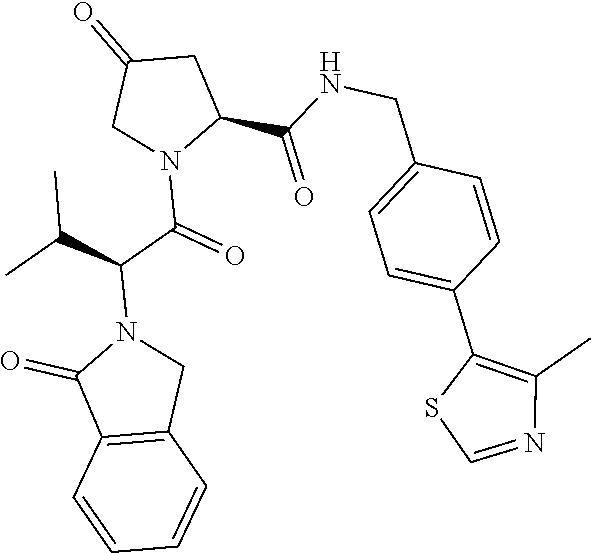


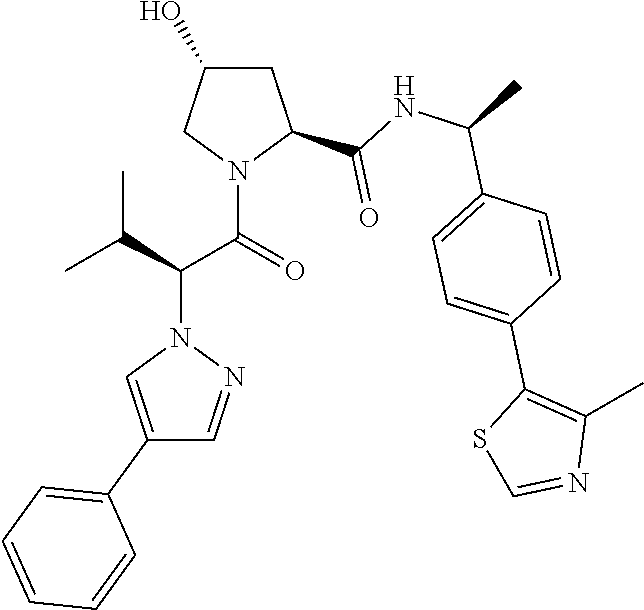


| TABLE 1 |
| VHL inhibition data (i.e., IC50, μM) in |
| fluorescence polarization (FP) assay. |
| VHL FP Assay IC50 (uM) at various | |
| concentrations of test compounds in DMSO |
| Example No. | 0.25% in DMSO | 1% in DMSO | 10% in DMSO |
| 1 | 2.38 | 2.28 | |
| 2 | 2.86 | 0.732 | 0.533 |
| 3 | 2.54 | 0.696 | 1.48 |
| 4 | 3.34 | 1.22 | 1.94 |
| 5 | 7.72 | 0.799 | 1.58 |
| 6 | 6.37 | 0.697 | 1.48 |
| 7 | 7.51 | 8.52 | |
| 8 | 3.04 | 0.619 | 1.33 |
| 9 | 1.28 | 0.309 | 0.498 |
| 10 | ~6.73 | 295 | |
| 11 | 1.56 | 0.542 | 0.0163 |
| 12 | 9.34 | 2.08 | 4.86 |
| 13 | 3.37 | 1.34 | 2.94 |
| 14 | 7.15 | 4.63 | 13.3 |
| 15 | 1.22 | 24.5 | 81.9 |
| 16 | 2.95 | 0.265 | 1.8 |
| 17 | 2.2 | 0.317 | 1.07 |
| 18 | 5.5 | 0.855 | 2.72 |
| 19 | 3.77 | 0.937 | 1.65 |
| 20 | 4.96 | 1.05 | 1.15 |
| 21 | 5.69 | 0.392 | 1.49 |
| 22 | 6.25 | 8.29 | |
| 23 | 1.14 | 2.51 | 6.04 |
| 24 | 1.39 | 8.65 | 28.0 |
| 25 | 2.38 | 1.33 | 1.67 |
| 26 | 2.94 | 0.941 | 0.441 |
| 27 | ~1.569 | 3.04 | 8.31 |
| 28 | 4.47 | 2.21 | 3.6 |
| 29 | 2.42 | 0.905 | 1.85 |
| 30 | 2.27 | 0.572 | 0.859 |
| 31 | 3.22 | 1.28 | 2.11 |
| 32 | 2.22 | 1.15 | 3.36 |
| 33 | 1.94 | 0.539 | 1.08 |
| 34 | 2.12 | 0.66 | 1.18 |
| 35 | 2.05 | 0.509 | 1.3 |
| 36 | 6.54 | 3.55 | 5.48 |
| 37 | 1.9 | 20.6 | 7.41 |
| 38 | 2.19 | 0.758 | 1.09 |
| 39 | 0.958 | 0.699 | 1.63 |
| 40 | 17.5 | 2.36 | 3.92 |
| 41 | 7.28 | 1.19 | 3.05 |
| 42 | 4.95 | 15.7 | |
| 43 | 0.906 | 1.2 | |
| 44 | 0.385 | 0.465 | |
| 45 | ~32 | 472 | |
| 46 | 19410 | 5103 | |
| 47 | 0.178 | 0.339 | |
| 48 | 3.77 | 4.7 | |
| 49 | 244 | ||
| 50 | 235 | ||
| 51 | 56.6 | 1518 | |
| 52 | 2.48 | 3.73 | |
| 53 | 0.474 | 1.03 | |
| 54 | 0.834 | 1.21 | |
| 55 | 115 | 461 | |
| 56 | 0.878 | 1.48 | |
| 57 | 0.717 | 1.41 | |
| 58 | 32.6 | 26.2 | |
| 59 | 1.42 | 3.69 | |
| 60 | 1.45 | 0.293 | |
| 61 | Not Active | Not Active | |
| 62 | Not Active | Not Active | |
| 63 | 58.4 | 53.0 | |
| 64 | 16.8 | 30.5 | |
| 65 | 0.631 | 0.578 | |
| 66 | Not Active | Not Active | |
| 67 | Not Active | Not Active | |
| 68 | 0.972 | 0.668 | |
| 69 | 1.43 | 4.28 | |
| 70 | 2.02 | 1.2 | |
| 71 | 1.62 | 1.38 | |
| 72 | 0.86 | 1.03 | |
| 73 | 1.33 | 1.19 | |
| 74 | 0.45 | 0.264 | |
| 75 | 13.7 | 9.29 | |
| 76 | 0.169 | ||
| 77 | 0.55 | 0.349 | |
| 78 | 1.03 | 0.81 | |
| 79 | >100 | >100 | |
| 80 | 22.4 | 38.9 | |
| 81 | >49 | 371 | |
| 82 | 1.64 | 1.58 | |
| 83 | 0.626 | 0.32 | |
| 84 | 1.24 | 1.46 | |
| 85 | 28.9 | 21.2 | |
| 86 | 151 | 225 | |
| 87 | 384 | 263 | |
| 88 | 20.4 | 39.2 | |
| 89 | 60.6 | 139 | |
| 90 | 45.2 | 47.9 | |
| 91 | >100 | ||
| 92 | 1.65 | ||
| 93 | 1.2 | ||
| 94 | 0.566 | ||
| 95 | 23.4 | ||
| 96 | 35.4 | ||
| 97 | 1.45 | ||
| 98 | 4.15 | ||
| 99 | 0.418 | ||
| 100 | 9.77 | ||
| 101 | 4.39 | ||
| 102 | 7.75 | ||
| 103 | 33.8 | ||
| 104 | >10 | ||
| 105 | 37.7 | ||
| 106 | 14.2 | ||
| 107 | 64.6 | ||
| 108 | 33.5 | ||
| 109 | 6.67 | ||
| 110 | 21.6 | ||
| 111 | 0.859 | ||
| 112 | >100 | ||
| 113 | >10 | ||
| 114 | 47.3 | ||
| 115 | 15.8 | ||
| 116 | 3.9 | ||
| 117 | 15.5 | ||
| 118 | 330 | ||
| 119 | Not Active | ||
| 120 | 15.5 | ||
| 121 | >100 | ||
| 122 | 2.18 | ||
| 123 | 4.23 | ||
| 124 | 1.11 | ||
| 125 | 1.64 | ||
| 126 | 79.5 | 112 | |
| 127 | 406 | ||
| 128 | >100 | ||
| 129 | 19.3 | ||
| 130 | 3.89 | ||
| 131 | Not Active | ||
| 132 | 1.69 | ||
| 133 | 1.64 | ||
| 134 | 12.7 | ||
| 135 | 19.2 | ||
| 136 | 5.59 | ||
| 137 | 13.1 | ||
| 138 | 2.38 | ||
| 139 | 65.4 | ||
| 140 | 157 | ||
| 141 | 0.0709 | ||
| 142 | 134 | ||
| 143 | 0.964 | ||
| 144 | Not active | ||
| 145 | 0.1 | ||
| 146 | 17 | ||
| 147 | 12.4 | ||
| 148 | 6.2 | ||
| TABLE 2 |
| SPR measured VHL affinity for exemplary ULMs. |
| Example # | SPR Kd (uM) | ||
| 3 | 0.12 | ||
| 145 | 0.01 | ||
| 205 | 0.33 | ||
| 207 | 0.24 | ||
| 208 | 13.0 | ||
Degradation Data for Exemplary PROTAC Compounds of the Invention
| TABLE 3 |
| Degradation data for exemplary AR PROTACs |
| Examplery | ||
| ULM | Structure | Dmax |
| 202 |
 |
+++ |
| 202 |
 |
+++ |
| 203 |
 |
+++ |
| 203 |
 |
++ |
| 202 |
 |
++ |
| TABLE 4 |
| Degradation readout data for exemplary Brd4 PROTACs |
| Examplery | cMyc | |
| ULM | Structure | Imax |
| 202 |
 |
++++ |
| 202 |
 |
++++ |
| 202 |
 |
+++ |
| 202 |
 |
++++ |
| 200 |
 |
++++ |
Claims (24)


—(A)q—,


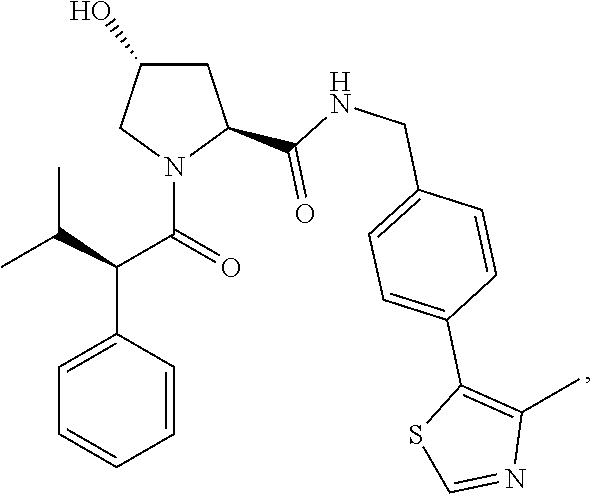


Priority Applications (2)
| Application Number | Priority Date | Filing Date | Title |
|---|---|---|---|
| US17/931,814 US12264157B2 (en) | 2015-03-18 | 2022-09-13 | Compounds and methods for the enhanced degradation of targeted proteins |
| US19/093,901 US20260022117A1 (en) | 2015-03-18 | 2025-03-28 | Compounds and methods for the enhanced degradation of targeted proteins |
Applications Claiming Priority (4)
| Application Number | Priority Date | Filing Date | Title |
|---|---|---|---|
| US201562135125P | 2015-03-18 | 2015-03-18 | |
| US15/074,820 US10730870B2 (en) | 2015-03-18 | 2016-03-18 | Compounds and methods for the enhanced degradation of targeted proteins |
| US16/905,641 US11512083B2 (en) | 2015-03-18 | 2020-06-18 | Compounds and methods for the enhanced degradation of targeted proteins |
| US17/931,814 US12264157B2 (en) | 2015-03-18 | 2022-09-13 | Compounds and methods for the enhanced degradation of targeted proteins |
Related Parent Applications (1)
| Application Number | Title | Priority Date | Filing Date |
|---|---|---|---|
| US16/905,641 Continuation US11512083B2 (en) | 2015-03-18 | 2020-06-18 | Compounds and methods for the enhanced degradation of targeted proteins |
Related Child Applications (1)
| Application Number | Title | Priority Date | Filing Date |
|---|---|---|---|
| US19/093,901 Continuation US20260022117A1 (en) | 2015-03-18 | 2025-03-28 | Compounds and methods for the enhanced degradation of targeted proteins |
Publications (2)
| Publication Number | Publication Date |
|---|---|
| US20230203030A1 US20230203030A1 (en) | 2023-06-29 |
| US12264157B2 true US12264157B2 (en) | 2025-04-01 |
Family
ID=56919612
Family Applications (4)
| Application Number | Title | Priority Date | Filing Date |
|---|---|---|---|
| US15/074,820 Active US10730870B2 (en) | 2015-03-18 | 2016-03-18 | Compounds and methods for the enhanced degradation of targeted proteins |
| US16/905,641 Active US11512083B2 (en) | 2015-03-18 | 2020-06-18 | Compounds and methods for the enhanced degradation of targeted proteins |
| US17/931,814 Active 2036-07-16 US12264157B2 (en) | 2015-03-18 | 2022-09-13 | Compounds and methods for the enhanced degradation of targeted proteins |
| US19/093,901 Pending US20260022117A1 (en) | 2015-03-18 | 2025-03-28 | Compounds and methods for the enhanced degradation of targeted proteins |
Family Applications Before (2)
| Application Number | Title | Priority Date | Filing Date |
|---|---|---|---|
| US15/074,820 Active US10730870B2 (en) | 2015-03-18 | 2016-03-18 | Compounds and methods for the enhanced degradation of targeted proteins |
| US16/905,641 Active US11512083B2 (en) | 2015-03-18 | 2020-06-18 | Compounds and methods for the enhanced degradation of targeted proteins |
Family Applications After (1)
| Application Number | Title | Priority Date | Filing Date |
|---|---|---|---|
| US19/093,901 Pending US20260022117A1 (en) | 2015-03-18 | 2025-03-28 | Compounds and methods for the enhanced degradation of targeted proteins |
Country Status (10)
| Country | Link |
|---|---|
| US (4) | US10730870B2 (en) |
| EP (2) | EP3270917A4 (en) |
| JP (4) | JP7269731B2 (en) |
| KR (2) | KR20230175343A (en) |
| CN (1) | CN108601764A (en) |
| AU (4) | AU2016232705C1 (en) |
| CA (1) | CA2979070A1 (en) |
| HK (1) | HK1249058A1 (en) |
| MX (2) | MX385750B (en) |
| WO (1) | WO2016149668A1 (en) |
Families Citing this family (232)
| Publication number | Priority date | Publication date | Assignee | Title |
|---|---|---|---|---|
| JP2015508414A (en) | 2012-01-12 | 2015-03-19 | イエール ユニバーシティ | Compounds and methods for enhanced degradation of target proteins and other polypeptides by E3 ubiquitin ligase |
| KR20190136125A (en) | 2012-12-21 | 2019-12-09 | 국립연구개발법인 양자과학기술연구개발기구 | Novel compound for imaging tau protein accumulated in the brain |
| GB201311891D0 (en) | 2013-07-03 | 2013-08-14 | Glaxosmithkline Ip Dev Ltd | Novel compound |
| GB201311888D0 (en) | 2013-07-03 | 2013-08-14 | Glaxosmithkline Ip Dev Ltd | Novel compounds |
| EP3099677A4 (en) | 2014-01-31 | 2017-07-26 | Dana-Farber Cancer Institute, Inc. | Diaminopyrimidine benzenesulfone derivatives and uses thereof |
| WO2015117087A1 (en) | 2014-01-31 | 2015-08-06 | Dana-Farber Cancer Institute, Inc. | Uses of diazepane derivatives |
| US20180228907A1 (en) | 2014-04-14 | 2018-08-16 | Arvinas, Inc. | Cereblon ligands and bifunctional compounds comprising the same |
| US10071164B2 (en) | 2014-08-11 | 2018-09-11 | Yale University | Estrogen-related receptor alpha based protac compounds and associated methods of use |
| US12312316B2 (en) | 2015-01-20 | 2025-05-27 | Arvinas Operations, Inc. | Compounds and methods for the targeted degradation of androgen receptor |
| HK1245791A1 (en) | 2015-01-20 | 2018-08-31 | 阿尔维纳斯运营股份有限公司 | Compounds and methods for the targeted degradation of the androgen receptor |
| JP7269731B2 (en) * | 2015-03-18 | 2023-05-09 | アルビナス・オペレーションズ・インコーポレイテッド | Compounds and methods for enhancing target protein degradation |
| KR20240119196A (en) * | 2015-06-04 | 2024-08-06 | 아비나스 오퍼레이션스, 인코포레이티드 | Imide-based modulators of proteolysis and associated methods of use |
| WO2016197114A1 (en) | 2015-06-05 | 2016-12-08 | Arvinas, Inc. | Tank-binding kinase-1 protacs and associated methods of use |
| CN108137507A (en) | 2015-07-10 | 2018-06-08 | 阿尔维纳斯股份有限公司 | Proteolysis conditioning agent and relevant application method based on MDM2 |
| AU2016301196B2 (en) | 2015-08-06 | 2022-09-08 | Dana-Farber Cancer Institute, Inc. | Tunable endogenous protein degradation |
| EP3337476A4 (en) * | 2015-08-19 | 2019-09-04 | Arvinas, Inc. | COMPOUNDS AND METHODS FOR THE TARGETED REMOVAL OF BROMO-DOMAIN-CONTAINING PROTEINS |
| PE20181287A1 (en) | 2015-09-11 | 2018-08-07 | Dana Farber Cancer Inst Inc | CYANE HAS ANOTHRIAZOLPIRAZINES AND USES OF THE SAME |
| UA123946C2 (en) | 2015-09-11 | 2021-06-30 | Дана-Фарбер Кенсер Інстітьют, Інк. | Acetamide thienotriazolodiazepines and uses thereof |
| CA3003288A1 (en) | 2015-11-25 | 2017-06-01 | Dana-Farber Cancer Institute, Inc. | Bivalent bromodomain inhibitors and uses thereof |
| US20170281784A1 (en) | 2016-04-05 | 2017-10-05 | Arvinas, Inc. | Protein-protein interaction inducing technology |
| CN109152933B (en) * | 2016-04-21 | 2022-12-02 | 生物风险投资有限责任公司 | Compounds that induce degradation of anti-apoptotic BCL-2 family proteins and uses thereof |
| EP3892272B1 (en) | 2016-04-22 | 2024-07-24 | Dana-Farber Cancer Institute, Inc. | Bifunctional molecules for degradation of egfr and methods of use |
| CN109562107A (en) | 2016-05-10 | 2019-04-02 | C4医药公司 | Heterocycle degron body for target protein degradation |
| CN109641874A (en) | 2016-05-10 | 2019-04-16 | C4医药公司 | C for target protein degradation3The glutarimide degron body of carbon connection |
| EP3455219A4 (en) | 2016-05-10 | 2019-12-18 | C4 Therapeutics, Inc. | AMINE-LINKED C3-GLUTARIMIDE DEGRONIMERS FOR THE DEGRADATION OF TARGET PROTEINS |
| EP4483875A3 (en) | 2016-05-10 | 2025-04-02 | C4 Therapeutics, Inc. | Spirocyclic degronimers for target protein degradation |
| AU2017313085B2 (en) | 2016-08-19 | 2024-06-20 | Beone Medicines I Gmbh | Use of a combination comprising a Btk inhibitor for treating cancers |
| GB2554071A (en) | 2016-09-14 | 2018-03-28 | Univ Dundee | Small molecules |
| ES2975558T3 (en) | 2016-09-15 | 2024-07-09 | Arvinas Inc | Indole derivatives as estrogen receptor degraders |
| LT3660004T (en) | 2016-10-11 | 2023-06-12 | Arvinas Operations, Inc. | COMPOUNDS AND METHODS FOR TARGETED ANDROGEN RECEPTOR DEGRADATION |
| AU2017348322B8 (en) * | 2016-10-28 | 2021-12-23 | Icahn School Of Medicine At Mount Sinai | Compositions and methods for treating EZH2-mediated cancer |
| EP3535265A4 (en) | 2016-11-01 | 2020-07-08 | Arvinas, Inc. | Tau-protein targeting protacs and associated methods of use |
| AU2017363252B2 (en) * | 2016-11-22 | 2021-08-19 | Dana-Farber Cancer Institute, Inc. | Degradation of Bruton's tyrosine kinase (BTK) by conjugation of BTK inhibitors with E3 ligase ligand and methods of use |
| WO2018098280A1 (en) | 2016-11-22 | 2018-05-31 | Dana-Farber Cancer Institute, Inc. | Degradation of protein kinases by conjugation of protein kinase inhibitors with e3 ligase ligand and methods of use |
| WO2018102725A1 (en) | 2016-12-01 | 2018-06-07 | Arvinas, Inc. | Tetrahydronaphthalene and tetrahydroisoquinoline derivatives as estrogen receptor degraders |
| AU2017370694A1 (en) | 2016-12-08 | 2019-07-25 | Icahn School Of Medicine At Mount Sinai | Compositions and methods for treating CDK4/6-mediated cancer |
| US11173211B2 (en) | 2016-12-23 | 2021-11-16 | Arvinas Operations, Inc. | Compounds and methods for the targeted degradation of rapidly accelerated Fibrosarcoma polypeptides |
| RU2019121527A (en) | 2016-12-23 | 2021-01-15 | Эрвинэс Оперейшнс, Инк. | CHIMERIC MOLECULES TARGETING EGFR PROTEOLYSIS AND RELATED APPLICATIONS |
| EP3559006A4 (en) | 2016-12-23 | 2021-03-03 | Arvinas Operations, Inc. | COMPOUNDS AND METHODS FOR TARGETED DEGRADATION OF FETAL LIVER KINASE POLYPEPTIDES |
| EP3558994A4 (en) * | 2016-12-23 | 2021-05-12 | Arvinas Operations, Inc. | COMPOUNDS AND METHODS FOR TARGETED DEGRADATION OF RAPIDLY ACCELERATED FIBROSARCOMA POLYPEPTIDES |
| US11191741B2 (en) * | 2016-12-24 | 2021-12-07 | Arvinas Operations, Inc. | Compounds and methods for the targeted degradation of enhancer of zeste homolog 2 polypeptide |
| MX2019008934A (en) | 2017-01-26 | 2019-11-05 | Arvinas Operations Inc | Modulators of estrogen receptor proteolysis and associated methods of use. |
| EP3577109A4 (en) | 2017-01-31 | 2020-11-18 | Arvinas Operations, Inc. | CEREBLON LIGANDS AND BIFUNCTIONAL CONNECTIONS THEREOF |
| EP3580212A4 (en) | 2017-02-08 | 2021-03-17 | Dana Farber Cancer Institute, Inc. | REGULATION OF CHIMERIC ANTIGEN RECEPTORS |
| US11261179B2 (en) | 2017-04-14 | 2022-03-01 | University Of Dundee | Small molecules |
| AU2018258581A1 (en) | 2017-04-28 | 2019-11-07 | Quartz Therapeutics, Inc. | RAF-degrading conjugate compounds |
| EP3641762B1 (en) | 2017-06-20 | 2026-02-18 | C4 Therapeutics, Inc. | N/o-linked degrons and degronimers for protein degradation |
| KR102757960B1 (en) | 2017-06-26 | 2025-01-22 | 베이진 엘티디 | Immunotherapy for hepatocellular carcinoma (HCC) |
| EP3679026A1 (en) | 2017-09-04 | 2020-07-15 | C4 Therapeutics, Inc. | Glutarimide |
| EP3679028A1 (en) | 2017-09-04 | 2020-07-15 | C4 Therapeutics, Inc. | Dihydroquinolinones |
| CN111315735B (en) | 2017-09-04 | 2024-03-08 | C4医药公司 | Dihydrobenzimidazolones |
| UY37879A (en) | 2017-09-13 | 2019-03-29 | Amgen Inc | BISAMIDE COMPOUNDS THAT ACTIVATE THE SARCOMERO AND ITS USES |
| WO2019060693A1 (en) | 2017-09-22 | 2019-03-28 | Kymera Therapeutics, Inc. | Crbn ligands and uses thereof |
| JP7366031B2 (en) | 2017-09-22 | 2023-10-20 | カイメラ セラピューティクス, インコーポレイテッド | Proteolytic agents and their use |
| KR102129367B1 (en) * | 2017-10-20 | 2020-07-03 | 한국화학연구원 | Compound for inducing the degradation of cereblon protein, preparation method thereof and pharmaceutical composition for use in preventing or treating cancer containing the same as an active ingredient |
| WO2019094032A1 (en) * | 2017-11-10 | 2019-05-16 | Neuralstem, Inc. | Amelioration of angelman's syndrome deficiencies |
| CN111372585A (en) * | 2017-11-16 | 2020-07-03 | C4医药公司 | Degradants and degrons for target protein degradation |
| US11065231B2 (en) | 2017-11-17 | 2021-07-20 | Arvinas Operations, Inc. | Compounds and methods for the targeted degradation of interleukin-1 receptor- associated kinase 4 polypeptides |
| CN111801334B (en) | 2017-11-29 | 2023-06-09 | 百济神州瑞士有限责任公司 | Treatment of Indolent or Aggressive B-Cell Lymphoma Using Combinations Containing BTK Inhibitors |
| US10519152B2 (en) | 2017-12-21 | 2019-12-31 | Astrazeneca Ab | Compounds and their use in treating cancer |
| IL315310A (en) | 2017-12-26 | 2024-10-01 | Kymera Therapeutics Inc | IRAK joints and used in them |
| US11512080B2 (en) | 2018-01-12 | 2022-11-29 | Kymera Therapeutics, Inc. | CRBN ligands and uses thereof |
| EP3737666A4 (en) | 2018-01-12 | 2022-01-05 | Kymera Therapeutics, Inc. | Protein degraders and uses thereof |
| EP3743069B1 (en) | 2018-01-22 | 2025-08-06 | BioVentures, LLC | Bcl-2 proteins degraders for cancer treatment |
| JP2021512153A (en) | 2018-01-26 | 2021-05-13 | イエール ユニバーシティ | Imide-based modulators of proteolysis and how to use |
| WO2019173516A1 (en) | 2018-03-06 | 2019-09-12 | Icahn School Of Medicine At Mount Sinai | Serine threonine kinase (akt) degradation / disruption compounds and methods of use |
| WO2019170150A1 (en) | 2018-03-09 | 2019-09-12 | 上海科技大学 | Protein degradation targeting bcr-abl compound and antitumor application thereof |
| US11028088B2 (en) | 2018-03-10 | 2021-06-08 | Yale University | Modulators of BTK proteolysis and methods of use |
| US11666661B2 (en) | 2018-03-23 | 2023-06-06 | The Regents Of The University Of California | Methods and compounds for targeted autophagy |
| KR20210018199A (en) | 2018-03-26 | 2021-02-17 | 씨4 테라퓨틱스, 인코포레이티드 | Cerevlon binder for decomposition of Ikaros |
| KR20240130153A (en) | 2018-04-01 | 2024-08-28 | 아비나스 오퍼레이션스, 인코포레이티드 | Brm targeting compounds and associated methods of use |
| US12539292B2 (en) | 2018-04-01 | 2026-02-03 | Arvinas Operations, Inc. | BRM targeting compounds and associated methods of use |
| CN119569702A (en) | 2018-04-04 | 2025-03-07 | 阿尔维纳斯运营股份有限公司 | Proteolysis regulators and related methods of use |
| EP3774772A1 (en) | 2018-04-13 | 2021-02-17 | Arvinas Operations, Inc. | Cereblon ligands and bifunctional compounds comprising the same |
| WO2019204354A1 (en) | 2018-04-16 | 2019-10-24 | C4 Therapeutics, Inc. | Spirocyclic compounds |
| JP7293343B2 (en) | 2018-05-09 | 2023-06-19 | アプリノイア セラピューティクス リミテッド | Heteroaryl compound and use thereof |
| SG11202011135WA (en) | 2018-05-14 | 2020-12-30 | Nuvation Bio Inc | Anti-cancer nuclear hormone receptor-targeting compounds |
| EP3578561A1 (en) | 2018-06-04 | 2019-12-11 | F. Hoffmann-La Roche AG | Spiro compounds |
| CA3104298A1 (en) | 2018-06-21 | 2019-12-26 | Icahn School Of Medicine At Mount Sinai | Wd40 repeat domain protein 5 (wdr5) degradation / disruption compounds and methods of use |
| WO2020009176A1 (en) * | 2018-07-04 | 2020-01-09 | 田辺三菱製薬株式会社 | Amide compound having bet proteolysis-inducing action and medicinal application thereof |
| WO2020010177A1 (en) | 2018-07-06 | 2020-01-09 | Kymera Therapeutics, Inc. | Tricyclic crbn ligands and uses thereof |
| EP3817822A4 (en) | 2018-07-06 | 2022-07-27 | Kymera Therapeutics, Inc. | PROTEIN DEGRADING AGENTS AND THEIR USES |
| WO2020023549A1 (en) * | 2018-07-24 | 2020-01-30 | January Therapeutics, Inc. | Nanoparticle compositions |
| WO2020023851A1 (en) | 2018-07-26 | 2020-01-30 | Yale University | Bifunctional substitued pyrimidines as modulators of fak proteolyse |
| US11707452B2 (en) * | 2018-08-20 | 2023-07-25 | Arvinas Operations, Inc. | Modulators of alpha-synuclein proteolysis and associated methods of use |
| AU2019323446B2 (en) * | 2018-08-22 | 2025-01-30 | Cullgen (Shanghai), Inc. | Tropomyosin receptor kinase (TRK) degradation compounds and methods of use |
| US11969472B2 (en) | 2018-08-22 | 2024-04-30 | Cullgen (Shanghai), Inc. | Tropomyosin receptor kinase (TRK) degradation compounds and methods of use |
| EP3846800A4 (en) | 2018-09-04 | 2022-08-24 | C4 Therapeutics, Inc. | LINKS TO BREAK DOWN BRD9 OR MTH1 |
| IL319737A (en) * | 2018-09-07 | 2025-05-01 | Arvinas Operations Inc | Polycyclic compounds and methods for the targeted degradation of rapidly accelerated fibrosarcoma polypeptides |
| MX2021003999A (en) * | 2018-10-08 | 2021-06-23 | Univ Michigan Regents | Small molecule mdm2 protein degraders. |
| EP3866801A4 (en) * | 2018-10-16 | 2022-11-09 | Dana-Farber Cancer Institute, Inc. | DEGRADING AGENTS OF WILD-TYPE AND MUTANT FORMS OF LRRK2 KINASE |
| ES2973130T3 (en) * | 2018-10-16 | 2024-06-18 | Univ Johns Hopkins | Compositions for the treatment of vascular Ehlers Danlos syndrome |
| WO2020092528A1 (en) | 2018-10-31 | 2020-05-07 | Gilead Sciences, Inc. | Substituted 6-azabenzimidazole compounds having hpk1 inhibitory activity |
| PE20211655A1 (en) | 2018-10-31 | 2021-08-24 | Gilead Sciences Inc | 6-AZABENZIMIDAZOLE COMPOUNDS SUBSTITUTED AS HPK1 INHIBITORS |
| US12186400B2 (en) | 2018-11-09 | 2025-01-07 | Yipeng Wang | Micromolecular compound specifically degrading tau protein, and application thereof |
| JP7623943B2 (en) | 2018-11-30 | 2025-01-29 | カイメラ セラピューティクス, インコーポレイテッド | IRAK degraders and their uses |
| AU2019388940B2 (en) * | 2018-11-30 | 2022-10-13 | Kylonova (Xiamen) Biopharma Co., Ltd. | Drug containing liver targeting specific ligand and thyroid hormone receptor agonist |
| CN119219606A (en) | 2018-12-19 | 2024-12-31 | 细胞基因公司 | Substituted 3-((3-aminophenyl)amino)piperidine-2,6-dione compounds, compositions thereof, and methods of treatment using the same |
| BR112021012186A2 (en) | 2018-12-19 | 2021-08-31 | Celgene Corporation | SUBSTITUTED 3-((3-AMINOPHENYL)AMINO)PIPERIDINE-2,6-DIONE COMPOUNDS, COMPOSITIONS THEREOF AND TREATMENT METHODS THEREOF |
| CN120698983A (en) | 2018-12-20 | 2025-09-26 | C4医药公司 | Targeted protein degradation |
| US20220081435A1 (en) | 2019-01-03 | 2022-03-17 | The Regents Of The University Of Michigan | Androgen receptor protein degraders |
| KR20210136973A (en) * | 2019-01-03 | 2021-11-17 | 더 리젠츠 오브 더 유니버시티 오브 미시간 | estrogen receptor proteolytic agent |
| KR102876423B1 (en) * | 2019-02-07 | 2025-10-24 | 한국화학연구원 | Target protein degradation inducing compound, preparation method thereof and pharmaceutical composition for preventing or treating EED, EZH2, or PRC2 related diseases containing the same as an active ingredient |
| US20220169628A1 (en) * | 2019-02-08 | 2022-06-02 | University Of Florida Research Foundation, Incorporated | Therapeutic agents and methods of treatment |
| ES2995214T3 (en) | 2019-03-06 | 2025-02-07 | C4 Therapeutics Inc | Heterocyclic compounds for medical treatment |
| CA3133314A1 (en) | 2019-03-21 | 2020-09-24 | Codiak Biosciences, Inc. | Extracellular vesicle conjugates and uses thereof |
| US12233356B2 (en) | 2019-03-21 | 2025-02-25 | Lonza Sales Ag | Process for preparing extracellular vesicles |
| US11485750B1 (en) | 2019-04-05 | 2022-11-01 | Kymera Therapeutics, Inc. | STAT degraders and uses thereof |
| MA55628A (en) | 2019-04-12 | 2022-02-16 | C4 Therapeutics Inc | TRICYCLIC DEGRADING AGENTS OF IKAROS AND AIOLOS |
| US12414995B2 (en) | 2019-04-16 | 2025-09-16 | Northwestern University | Bifunctional compounds comprising Apcin-A and their use in the treatment of cancer |
| KR20220004100A (en) * | 2019-04-18 | 2022-01-11 | 하이노바 파마슈티컬스 인코포레이티드 | Bifunctional chimeric heterocyclic compound that targets androgen receptor degradation and uses thereof |
| US12465648B2 (en) | 2019-05-06 | 2025-11-11 | Icahn School Of Medicine At Mount Sinai | Heterobifunctional compounds as degraders of HPK1 |
| US11826430B2 (en) | 2019-05-14 | 2023-11-28 | Nuvation Bio Inc. | Anti-cancer nuclear hormone receptor-targeting compounds |
| JP2022533147A (en) * | 2019-05-17 | 2022-07-21 | ヒノバ ファーマシューティカルズ インコーポレイテッド | Proteolytic chimeric compounds and uses targeting AR and BET of aromatic amines |
| TWI826690B (en) | 2019-05-23 | 2023-12-21 | 美商基利科學股份有限公司 | Substituted eneoxindoles and uses thereof |
| US12577278B2 (en) | 2019-06-07 | 2026-03-17 | Emory University | KRAS G12V mutant binds to JAK1, inhibitors, pharmaceutical compositions, and methods related thereto |
| WO2020251972A1 (en) | 2019-06-10 | 2020-12-17 | Kymera Therapeutics, Inc. | Smarca degraders and uses thereof |
| WO2020251971A1 (en) | 2019-06-10 | 2020-12-17 | Kymera Therapeutics, Inc. | Smarca degraders and uses thereof |
| BR112021026517A2 (en) | 2019-06-28 | 2022-05-10 | Kymera Therapeutics Inc | Irak degraders and uses thereof |
| WO2021011868A1 (en) | 2019-07-17 | 2021-01-21 | Kymera Therapeutics, Inc. | Irak degraders and uses thereof |
| WO2021011913A1 (en) | 2019-07-17 | 2021-01-21 | Arvinas Operations, Inc. | Tau-protein targeting compounds and associated methods of use |
| CN114174299B (en) * | 2019-07-26 | 2024-10-25 | 百济神州有限公司 | Degradation of Bruton's tyrosine kinase (BTK) by conjugating BTK inhibitors to E3 ligase ligands and methods of use |
| CN112294817B (en) * | 2019-08-02 | 2022-08-16 | 薪火炙药(北京)科技有限公司 | Use of dormitotinib for treating diseases related to high uric acid |
| US12491251B2 (en) * | 2019-08-05 | 2025-12-09 | Dana-Farber Cancer Institute, Inc. | Degraders of cyclin-dependent kinase 7 (CDK7) and uses thereof |
| CN112390852B (en) * | 2019-08-14 | 2022-10-18 | 上海济煜医药科技有限公司 | Compound as protein degradation agent and preparation method and application thereof |
| ES3061133T3 (en) | 2019-08-26 | 2026-03-31 | Arvinas Operations Inc | Methods of treating breast cancer with tetrahydronaphthalene derivatives as estrogen receptor degraders |
| CN118930604A (en) * | 2019-09-29 | 2024-11-12 | 江西济民可信集团有限公司 | Heterocyclic compounds as protein degradation agents and pharmaceutical compositions and applications thereof |
| WO2021067606A1 (en) | 2019-10-01 | 2021-04-08 | Arvinas Operations, Inc. | Brm targeting compounds and associated methods of use |
| US12310975B2 (en) | 2019-10-17 | 2025-05-27 | Arvinas Operations, Inc. | Modulators of BCL6 proteolysis and associated methods of use |
| CN110713480B (en) * | 2019-10-28 | 2021-02-26 | 浙江省医学科学院 | AChE protein degradation product and preparation method and application thereof |
| CA3161455A1 (en) | 2019-11-13 | 2021-05-20 | Aprinoia Therapeutics Limited | Compounds for degrading tau protein aggregates and uses thereof |
| US11952349B2 (en) | 2019-11-13 | 2024-04-09 | Nuvation Bio Inc. | Anti-cancer nuclear hormone receptor-targeting compounds |
| CN110885332B (en) * | 2019-12-06 | 2022-03-18 | 中国人民解放军第二军医大学 | A kind of PDEδ protein degradation targeting chimera and preparation method and application thereof |
| EP4072591A4 (en) | 2019-12-10 | 2024-06-05 | Kymera Therapeutics, Inc. | IRAQ DEGRADATION AGENTS AND THEIR USES |
| CN112979747A (en) * | 2019-12-16 | 2021-06-18 | 江苏恒瑞医药股份有限公司 | Hydroxyproline derivative for preparing protein degradation targeting chimera |
| WO2021127283A2 (en) | 2019-12-17 | 2021-06-24 | Kymera Therapeutics, Inc. | Irak degraders and uses thereof |
| JP2023509366A (en) | 2019-12-17 | 2023-03-08 | カイメラ セラピューティクス, インコーポレイテッド | IRAK dissolving agents and their uses |
| EP4077309A1 (en) | 2019-12-19 | 2022-10-26 | Arvinas Operations, Inc. | Compounds and methods for the targeted degradation of androgen receptor |
| EP4681715A3 (en) | 2019-12-20 | 2026-01-28 | C4 Therapeutics, Inc. | Isoindolinone and indazole compounds for the degradation of egfr |
| CN115297931A (en) | 2019-12-23 | 2022-11-04 | 凯麦拉医疗公司 | SMARCA degrading agents and uses thereof |
| EP4090658A4 (en) | 2020-01-15 | 2024-03-13 | University Of Florida Research Foundation, Incorporated | Therapeutic agents and methods of treatment |
| EP4096715A1 (en) * | 2020-01-29 | 2022-12-07 | Flagship Pioneering Innovations VI, LLC | Compositions comprising linear polyribonucleotides for protein modulation and uses thereof |
| WO2023205701A1 (en) | 2022-04-20 | 2023-10-26 | Kumquat Biosciences Inc. | Macrocyclic heterocycles and uses thereof |
| JP7692924B2 (en) * | 2020-02-26 | 2025-06-16 | クルゲン(シャンハイ),インク. | Tropomyosin receptor kinase (TRK) degrading compounds and methods of use thereof |
| CN115210227A (en) * | 2020-03-04 | 2022-10-18 | 基因泰克公司 | Heterobifunctional molecules as TEAD inhibitors |
| IL295709A (en) | 2020-03-05 | 2022-10-01 | C4 Therapeutics Inc | Compounds for targeted knockdown of brd9 |
| IL296451B2 (en) | 2020-03-19 | 2026-05-01 | Kymera Therapeutics Inc | Mdm2 degraders and uses thereof |
| KR20210122164A (en) | 2020-03-27 | 2021-10-08 | (주) 업테라 | Benzimidazole thiophene derivative compounds inducing selective degradation of PLK1 |
| EP4132655A1 (en) | 2020-04-06 | 2023-02-15 | Arvinas Operations, Inc. | Compounds and methods for targeted degradation of kras |
| WO2021219077A1 (en) * | 2020-04-29 | 2021-11-04 | 泰比棣医药科技(石家庄)有限公司 | Proteolysis targeting compound having tissue targeting capability and use thereof |
| EP4146642A1 (en) | 2020-05-09 | 2023-03-15 | Arvinas Operations, Inc. | Methods of manufacturing a bifunctional compound, ultrapure forms of the bifunctional compound, and dosage forms comprising the same |
| CN111606969B (en) * | 2020-05-13 | 2023-02-03 | 四川大学 | PARP1 protein degradation agent and application thereof in tumor resistance |
| WO2021237100A1 (en) | 2020-05-21 | 2021-11-25 | Codiak Biosciences, Inc. | Methods of targeting extracellular vesicles to lung |
| US12103924B2 (en) | 2020-06-01 | 2024-10-01 | Icahn School Of Medicine At Mount Sinai | Mitogen-activated protein kinase kinase (MEK) degradation compounds and methods of use |
| TW202210483A (en) | 2020-06-03 | 2022-03-16 | 美商凱麥拉醫療公司 | Crystalline forms of irak degraders |
| CA3173629A1 (en) | 2020-06-19 | 2021-12-13 | Cosimo Dolente | Braf degraders |
| CN115697992B (en) * | 2020-07-09 | 2025-09-19 | 西藏海思科制药有限公司 | Compound capable of inhibiting and reducing Jie Xiong hormone receptor, pharmaceutical composition and pharmaceutical application thereof |
| US20230233690A1 (en) | 2020-07-10 | 2023-07-27 | The Regents Of The University Of Michigan | Androgen receptor protein degraders |
| US20230257365A1 (en) | 2020-07-10 | 2023-08-17 | The Regents Of The University Of Michigan | Small molecule androgen receptor protein degraders |
| WO2022017442A1 (en) * | 2020-07-24 | 2022-01-27 | 恩瑞生物医药科技(上海)有限公司 | Bifunctional protein degradation-targeted chimera compound, preparation method therefor and medicinal use thereof |
| EP4192458A4 (en) | 2020-08-05 | 2024-09-04 | C4 Therapeutics, Inc. | COMPOUNDS FOR TARGETED RET DEGRADATION |
| EP4204418A1 (en) | 2020-08-28 | 2023-07-05 | Arvinas Operations, Inc. | Rapidly accelerating fibrosarcoma protein degrading compounds and associated methods of use |
| AU2021342287A1 (en) | 2020-09-14 | 2023-04-13 | Arvinas Operations, Inc. | Crystalline forms of a compound for the targeted degradation of estrogen receptor |
| US20240241020A1 (en) | 2020-09-23 | 2024-07-18 | Lonza Sales Ag | Process for preparing extracellular vesicles |
| AU2021361044A1 (en) * | 2020-10-14 | 2023-06-08 | C4 Therapeutics, Inc. | Tricyclic heterobifunctional compounds for degradation of targeted proteins |
| WO2022120355A1 (en) | 2020-12-02 | 2022-06-09 | Ikena Oncology, Inc. | Tead degraders and uses thereof |
| EP4259144A4 (en) * | 2020-12-09 | 2025-08-20 | Kymera Therapeutics Inc | SMARCA DECORATORS AND USES THEREOF |
| EP4023649A1 (en) | 2020-12-30 | 2022-07-06 | Industrial Technology Research Institute | Androgen receptor binding bifunctional molecules |
| WO2022147465A1 (en) | 2020-12-30 | 2022-07-07 | Kymera Therapeutics, Inc. | Irak degraders and uses thereof |
| US20240299557A1 (en) * | 2021-01-22 | 2024-09-12 | Taibidi Pharmaceutical Technology (Shijiazhuang) Co., Ltd. | Compound for degrading deoxyribonucleic acid (dna) polymerase, and use thereof |
| KR20230170644A (en) | 2021-02-02 | 2023-12-19 | 르 라보레또레 쎄르비에르 | Selective BCL-XL PROTAC Compounds and Methods of Use |
| EP4291193A4 (en) | 2021-02-10 | 2025-05-07 | BeiGene Switzerland GmbH | EGFR DEGRADING AGENTS AND METHODS OF USE |
| TW202245788A (en) | 2021-02-15 | 2022-12-01 | 美商凱麥拉醫療公司 | Irak4 degraders and uses thereof |
| US20240190874A1 (en) | 2021-03-03 | 2024-06-13 | The Regents Of The University Of Michigan | Small molecule degraders of androgen receptor |
| WO2022187650A1 (en) * | 2021-03-04 | 2022-09-09 | The Scripps Research Institute | Heterobifunctional compositions for targeted protein degradation and methods for their use |
| CN115043817A (en) * | 2021-03-09 | 2022-09-13 | 苏州泽璟生物制药股份有限公司 | SOS1 proteolysis regulator and preparation method and application thereof |
| WO2022198196A1 (en) | 2021-03-15 | 2022-09-22 | Maze Therapeutics, Inc. | Inhibitors of glycogen synthase 1 (gys1) and methods of use thereof |
| KR20230160299A (en) | 2021-03-23 | 2023-11-23 | 누베이션 바이오 인크. | Anticancer nuclear hormone receptor targeting compounds |
| EP4319820A1 (en) | 2021-04-10 | 2024-02-14 | Profoundbio Us Co. | Folr1 binding agents, conjugates thereof and methods of using the same |
| CA3214806A1 (en) | 2021-04-16 | 2022-10-20 | Arvinas Operations, Inc. | Modulators of bcl6 proteolysis and associated methods of use |
| JP7742892B2 (en) | 2021-04-23 | 2025-09-22 | ジェンマブ エー/エス | Anti-CD70 antibodies, conjugates thereof and methods of using same |
| WO2022223034A1 (en) | 2021-04-23 | 2022-10-27 | 上海领泰生物医药科技有限公司 | Sos1 degradation agent and preparation method therefor and application thereof |
| US12006314B2 (en) | 2021-05-03 | 2024-06-11 | Nuvation Bio Inc. | Anti-cancer nuclear hormone receptor-targeting compounds |
| BR112023023065A2 (en) | 2021-05-05 | 2024-01-30 | Biogen Ma Inc | COMPOUNDS TO TARGETING THE DEGRADATION OF BRUTON'S TYROSINE KINASE |
| AU2022271290A1 (en) | 2021-05-07 | 2023-11-23 | Kymera Therapeutics, Inc. | Cdk2 degraders and uses thereof |
| JP2024523839A (en) | 2021-06-08 | 2024-07-02 | シーフォー セラピューティクス, インコーポレイテッド | Therapeutic Agents That Degrade Mutant BRAF |
| US20250129047A1 (en) | 2021-07-04 | 2025-04-24 | Newave Pharmaceutical Inc. | Isoquinoline derivatives as mutant egfr modulators and uses thereof |
| TW202320857A (en) | 2021-07-06 | 2023-06-01 | 美商普方生物製藥美國公司 | Linkers, drug linkers and conjugates thereof and methods of using the same |
| KR20240035526A (en) | 2021-07-07 | 2024-03-15 | 바이오젠 엠에이 인코포레이티드 | Compounds that target degradation of the IRAK4 protein |
| JP2024525580A (en) | 2021-07-07 | 2024-07-12 | バイオジェン・エムエイ・インコーポレイテッド | Compounds for targeting the degradation of IRAK4 protein |
| CN113278023B (en) * | 2021-07-22 | 2021-10-15 | 上海睿跃生物科技有限公司 | Nitrogen-containing heterocyclic compound and preparation method and application thereof |
| WO2023016518A1 (en) * | 2021-08-11 | 2023-02-16 | 四川海思科制药有限公司 | Heterocyclic derivative, and composition and pharmaceutical use thereof |
| WO2023034411A1 (en) | 2021-09-01 | 2023-03-09 | Oerth Bio Llc | Compositions and methods for targeted degradation of proteins in a plant cell |
| CA3235698A1 (en) * | 2021-10-22 | 2023-04-27 | Yao Li | Parp-1 degradation agent and use thereof |
| EP4423086A1 (en) | 2021-10-25 | 2024-09-04 | Kymera Therapeutics, Inc. | Tyk2 degraders and uses thereof |
| EP4422635A4 (en) | 2021-10-29 | 2025-11-26 | Kymera Therapeutics Inc | IRAQ-4 DEGRADER AND SYNTHESIS OF IT |
| CN118679160A (en) | 2021-11-24 | 2024-09-20 | 阿维纳斯运营公司 | BRM targeting compounds and related methods of use |
| US20250064945A1 (en) | 2021-11-24 | 2025-02-27 | Arvinas Operations, Inc. | Brm targeting compounds and associated methods of use |
| MX2024008060A (en) | 2021-12-30 | 2024-07-10 | Beigene Switzerland Gmbh | Degradation of bruton's tyrosine kinase (btk) by conjugation of btk inhibitors with e3 ligase ligand and methods of use. |
| IL314437A (en) | 2022-01-31 | 2024-09-01 | Kymera Therapeutics Inc | Irak degraders and uses thereof |
| CN114907386B (en) * | 2022-03-11 | 2023-03-31 | 山东大学 | HEMTAC small molecule degradation agent and application thereof |
| CN114560908B (en) * | 2022-03-11 | 2024-10-25 | 国家纳米科学中心 | A polypeptide PROTAC molecule and its preparation method and application |
| CA3249074A1 (en) | 2022-06-06 | 2023-12-14 | C4 Therapeutics, Inc. | Bicyclic-substituted glutarimide cereblon binders |
| AU2023298115A1 (en) | 2022-06-27 | 2025-01-16 | Relay Therapeutics, Inc. | Estrogen receptor alpha degraders and use thereof |
| WO2024006776A1 (en) | 2022-06-27 | 2024-01-04 | Relay Therapeutics, Inc. | Estrogen receptor alpha degraders and medical use thereof |
| WO2024040080A1 (en) * | 2022-08-19 | 2024-02-22 | Erasca, Inc. | Kras inhibitor conjugates |
| WO2024050016A1 (en) | 2022-08-31 | 2024-03-07 | Oerth Bio Llc | Compositions and methods for targeted inhibition and degradation of proteins in an insect cell |
| EP4584258A1 (en) | 2022-09-07 | 2025-07-16 | Arvinas Operations, Inc. | Rapidly accelerated fibrosarcoma (raf) degrading compounds and associated methods of use |
| WO2024054603A1 (en) * | 2022-09-08 | 2024-03-14 | Halda Therapeutics Opco, Inc. | Heterobifunctional compounds and methods of treating disease |
| WO2024064358A1 (en) | 2022-09-23 | 2024-03-28 | Ifm Due, Inc. | Compounds and compositions for treating conditions associated with sting activity |
| WO2024073507A1 (en) | 2022-09-28 | 2024-04-04 | Theseus Pharmaceuticals, Inc. | Macrocyclic compounds and uses thereof |
| CN115656392B (en) * | 2022-12-14 | 2023-04-07 | 山东大学齐鲁医院 | Application of urine metabolite in preparation of product for identifying endometrial cancer fertility preserving function and treating progestogen resistant patients |
| WO2024148383A1 (en) * | 2023-01-12 | 2024-07-18 | Newsouth Innovations Pty Ltd | Treatment of blood disorders |
| CN121419983A (en) | 2023-01-26 | 2026-01-27 | 阿尔维纳斯运营股份有限公司 | cerebellar protein-based KRAS degradation PROTAC and its related applications |
| EP4720059A1 (en) | 2023-05-24 | 2026-04-08 | Kumquat Biosciences Inc. | Heterocyclic compounds and uses thereof |
| KR20260020383A (en) | 2023-05-31 | 2026-02-11 | 비원 메디슨즈 아이 게엠베하 | Compounds for the degradation of EGFR kinase |
| EP4735438A2 (en) | 2023-06-30 | 2026-05-06 | Merck Patent GmbH | Heterobifunctional compounds for the degradation of kras |
| AU2024310341A1 (en) | 2023-06-30 | 2026-02-12 | Merck Patent Gmbh | Heterobifunctional compounds for the degradation of kras protein |
| WO2025007000A1 (en) | 2023-06-30 | 2025-01-02 | Kumquat Biosciences Inc. | Substituted condensed tricyclic amine compounds and uses thereof as ras inhibitors |
| WO2025049555A1 (en) | 2023-08-31 | 2025-03-06 | Oerth Bio Llc | Compositions and methods for targeted inhibition and degradation of proteins in an insect cell |
| WO2025072406A1 (en) | 2023-09-26 | 2025-04-03 | Profoundbio Us Co. | Ptk7 binding agents, conjugates thereof and methods of using the same |
| WO2025070690A1 (en) | 2023-09-29 | 2025-04-03 | 第一三共株式会社 | 3-phenylpropylamine derivative |
| TW202523291A (en) | 2023-11-02 | 2025-06-16 | 美商金橘生物科技公司 | Degraders and uses thereof |
| CN120000802A (en) * | 2023-11-20 | 2025-05-16 | 北京大学 | Polymer for target protein hydrolysis and preparation method and use thereof |
| WO2025122895A1 (en) | 2023-12-08 | 2025-06-12 | Arvinas Operations, Inc. | Use of androgen receptor degrader for the treatment of spinal and bulbar muscular atrophy |
| WO2025126115A1 (en) | 2023-12-13 | 2025-06-19 | Beigene Switzerland Gmbh | Degradation of irak4 by conjugation of irak4 inhibitors with e3 ligase ligands and methods of use |
| TW202547866A (en) | 2024-01-10 | 2025-12-16 | 丹麥商珍美寶股份有限公司 | Slitrk6 binding agents, conjugates thereof and methods of using the same |
| CN117771376B (en) * | 2024-02-26 | 2024-05-03 | 四川大学华西第二医院 | Application of compounds in attention deficit and hyperactivity disorder and products thereof |
| WO2025181804A1 (en) * | 2024-02-26 | 2025-09-04 | Ramot At Tel-Aviv University Ltd. | Inhibitors of phenylalanine aggregation and uses thereof in the treatment of metabolic disorders |
| US20250381289A1 (en) | 2024-02-29 | 2025-12-18 | Genmab A/S | Egfr and c-met bispecific binding agents, conjugates thereof and methods of using the same |
| US12558428B2 (en) | 2024-03-08 | 2026-02-24 | Halda Therapeutics Opco, Inc. | Heterobifunctional compounds and their use in treating disease |
| WO2025194014A1 (en) | 2024-03-15 | 2025-09-18 | Dem Biopharma, Inc. | Hetero aryl modulators of apmap and uses thereof |
Citations (68)
| Publication number | Priority date | Publication date | Assignee | Title |
|---|---|---|---|---|
| WO2000050445A1 (en) | 1999-02-26 | 2000-08-31 | Oklahoma Medical Research Foundation | Novel component of von hippel-lindau tumor suppressor complex and scf ubiquitin ligase |
| WO2000066119A1 (en) | 1999-05-05 | 2000-11-09 | Merck & Co., Inc. | Novel prolines as antimicrobial agents |
| US6306663B1 (en) | 1999-02-12 | 2001-10-23 | Proteinex, Inc. | Controlling protein levels in eucaryotic organisms |
| WO2002066512A1 (en) | 2001-02-16 | 2002-08-29 | E.I. Dupont De Nemours And Company | Angiogenesis-inhibitory tripeptides, compositions and their methods of use |
| WO2002100845A1 (en) | 2001-06-11 | 2002-12-19 | Agouron Pharmaceuticals, Inc. | Hv protease inhibitors, compositions containing the same, their pharmaceutical uses and materials for their synthesis |
| US6670348B1 (en) | 1997-05-14 | 2003-12-30 | Sloan-Kettering Institute For Cancer Research | Methods and compositions for destruction of selected proteins |
| US20050019813A1 (en) | 1999-02-26 | 2005-01-27 | Oklahoma Medical Research Foundation | Novel component of von Hippel-Lindau tumor suppressor complex and SCF ubiquitin ligase |
| US7030141B2 (en) | 2001-11-29 | 2006-04-18 | Christopher Franklin Bigge | Inhibitors of factor Xa and other serine proteases involved in the coagulation cascade |
| US7041298B2 (en) | 2000-09-08 | 2006-05-09 | California Institute Of Technology | Proteolysis targeting chimeric pharmaceutical |
| WO2006113942A2 (en) | 2005-04-20 | 2006-10-26 | Schering Corporation | Method of inhibiting cathepsin activity |
| US7208157B2 (en) | 2000-09-08 | 2007-04-24 | California Institute Of Technology | Proteolysis targeting chimeric pharmaceutical |
| WO2007106670A2 (en) | 2006-03-03 | 2007-09-20 | Novartis Ag | N-formyl hydroxylamine compounds |
| WO2008011392A2 (en) | 2006-07-20 | 2008-01-24 | Ligand Pharmacueticals Incorporated | Proline urea ccr1 antagonists for the treatment of autoimmune diseases or inflammation |
| US20080214501A1 (en) | 2006-11-03 | 2008-09-04 | Pharmacyclics, Inc. | Bruton's tyrosine kinase activity probe and method of using |
| WO2009015254A1 (en) | 2007-07-25 | 2009-01-29 | Bristol-Myers Squibb Company | Triazine kinase inhibitors |
| US20100286127A1 (en) | 2007-12-28 | 2010-11-11 | Mitsubishi Tanabe Pharma Corporation | Antitumor agent |
| WO2010141805A1 (en) | 2009-06-05 | 2010-12-09 | Janssen Pharmaceutica Nv | Heterocyclic amides as modulators of trpa1 |
| WO2011143669A2 (en) | 2010-05-14 | 2011-11-17 | Dana-Farber Cancer Institute, Inc | Compositions and methods for treating neoplasia, inflammatory disease and other disorders |
| WO2011143660A2 (en) | 2010-05-14 | 2011-11-17 | Dana-Farber Cancer Institute, Inc. | Compositions and methods for treating leukemia |
| WO2012003281A2 (en) | 2010-06-30 | 2012-01-05 | Brandeis University | Small-molecule-targeted protein degradation |
| WO2012040389A2 (en) | 2010-09-22 | 2012-03-29 | Presidio Pharmaceuticals, Inc. | Substituted bicyclic hcv inhibitors |
| WO2012040527A2 (en) | 2010-09-24 | 2012-03-29 | The Regents Of The University Of Michigan | Deubiquitinase inhibitors and methods for use of the same |
| WO2012090104A1 (en) | 2010-12-31 | 2012-07-05 | Kareus Therapeutics, Sa | Methods and compositions for designing novel conjugate therapeutics |
| US20120270800A1 (en) | 2009-07-13 | 2012-10-25 | President And Fellows Of Harvard College | Bifunctional stapled polypeptides and uses thereof |
| WO2013106646A2 (en) | 2012-01-12 | 2013-07-18 | Yale University | Compounds and methods for the inhibition of vcb e3 ubiquitin ligase |
| WO2014001356A1 (en) | 2012-06-25 | 2014-01-03 | Oncoethix Sa | Method of treating lymphoma using thienotriazolodiazepine compounds |
| US20140088143A1 (en) | 2012-09-21 | 2014-03-27 | Arog Pharmaceuticals, Llc | Method of Inhibiting Constitutively Active Phosphorylated FLT3 Kinase |
| WO2014108452A1 (en) | 2013-01-11 | 2014-07-17 | Glaxosmithkline Intellectual Property Development Limited | Proteolysis targeting chimeras (protacs) directed to the modulation of the estrogen receptor |
| WO2014123418A1 (en) | 2013-02-06 | 2014-08-14 | Hq Medical (Netherlands) B.V. | Groundbreaking platform technology for specific binding to necrotic cells |
| WO2014128111A1 (en) | 2013-02-22 | 2014-08-28 | Bayer Pharma Aktiengesellschaft | 4-substituted pyrrolo- and pyrazolo-diazepines |
| US20140256700A1 (en) | 2013-02-27 | 2014-09-11 | Bristol-Myers Squibb Company | Carbazole compounds useful as bromodomain inhibitors |
| US20140356322A1 (en) | 2012-01-12 | 2014-12-04 | Yale University | Compounds & Methods for the Enhanced Degradation of Targeted Proteins & Other Polypeptides by an E3 Ubiquitin Ligase |
| US20140371206A1 (en) | 2010-12-02 | 2014-12-18 | Constellation Pharmaceuticals, Inc. | Bromodomain inhibitors and uses thereof |
| WO2015000868A1 (en) | 2013-07-03 | 2015-01-08 | Glaxosmithkline Intellectual Property Development Limited | Novel compounds |
| WO2015011084A1 (en) | 2013-07-23 | 2015-01-29 | Bayer Pharma Aktiengesellschaft | Substituted dihydropyrido[3,4-b]pyrazinones as dual inhibitors of bet proteins and polo-like kinases |
| WO2015015318A2 (en) | 2013-07-31 | 2015-02-05 | Zenith Epigenetics Corp. | Novel quinazolinones as bromodomain inhibitors |
| WO2015022332A1 (en) | 2013-08-14 | 2015-02-19 | Boehringer Ingelheim International Gmbh | Pyridinones |
| US20150119435A1 (en) | 2012-05-11 | 2015-04-30 | Yale University | Compounds useful for promoting protein degradation and methods using same |
| WO2015067770A1 (en) | 2013-11-07 | 2015-05-14 | Boehringer Ingelheim International Gmbh | Triazolopyrazine derivatives as brd4 inhibitors |
| US20150141470A1 (en) | 2012-05-08 | 2015-05-21 | The Broad Institute, Inc. | Diagnostic and treatment methods in patients having or at risk of developing resistance to cancer therapy |
| WO2015074064A2 (en) | 2013-11-18 | 2015-05-21 | Bair Kenneth W | Tetrahydroquinoline compositions as bet bromodomain inhibitors |
| US20150148342A1 (en) | 2013-11-26 | 2015-05-28 | Incyte Corporation | Bicyclic heterocycles as bet protein inhibitors |
| US20150259288A1 (en) | 2014-03-14 | 2015-09-17 | City Of Hope | 5-bromo-indirubins |
| US20150291562A1 (en) | 2014-04-14 | 2015-10-15 | Arvinas, Inc. | Imide-based modulators of proteolysis and associated methods of use |
| US20150344473A1 (en) | 2014-06-03 | 2015-12-03 | Gilead Sciences, Inc. | Tank-binding kinase inhibitor compounds |
| WO2015195863A1 (en) | 2014-06-20 | 2015-12-23 | Constellation Pharmaceuticals, Inc. | Hydrated 2-((4s)-6-(4-chlorophenyl)-1 -methyl-4h-benzo[c]isoxazolo[4,5-e]azepin-4-yl)acetamide |
| US20160022642A1 (en) | 2014-07-25 | 2016-01-28 | Yale University | Compounds Useful for Promoting Protein Degradation and Methods Using Same |
| US20160045607A1 (en) | 2014-08-11 | 2016-02-18 | Yale University | Estrogen-related receptor alpha based protac compounds and associated methods of use |
| US20160058872A1 (en) | 2014-04-14 | 2016-03-03 | Arvinas, Inc. | Imide-based modulators of proteolysis and associated methods of use |
| WO2016050821A1 (en) | 2014-10-02 | 2016-04-07 | Glaxosmithkline Intellectual Property (No.2) Limited | Compound |
| WO2016069578A1 (en) | 2014-10-27 | 2016-05-06 | Tensha Therapeutics, Inc. | Bromodomain inhibitors |
| US20160176864A1 (en) | 2014-12-23 | 2016-06-23 | Bristol-Myers Squibb Company | Novel tricyclic compounds as anticancer agents |
| WO2016105518A1 (en) | 2014-12-23 | 2016-06-30 | Dana-Farber Cancer Institute, Inc. | Methods to induce targeted protein degradation through bifunctional molecules |
| US20160214972A1 (en) | 2015-01-20 | 2016-07-28 | Arvinas, Inc. | Compounds and methods for the targeted degradation of androgen receptor |
| WO2016146985A1 (en) | 2015-03-13 | 2016-09-22 | University Of Dundee | Derivatives of 1-[(cyclopentyl or 2-pyrrolidinyl)carbonylaminomethyl]-4-(1,3-thiazol-5-yl) benzene which are useful for the treatment of proliferative, autoimmune or inflammatory diseases |
| WO2016172134A2 (en) | 2015-04-22 | 2016-10-27 | Glaxosmithkline Intellectual Property Development Limited | Novel compounds |
| US9500653B2 (en) | 2010-12-07 | 2016-11-22 | Yale University | Small-molecule hydrophobic tagging of fusion proteins and induced degradation of same |
| WO2016197114A1 (en) | 2015-06-05 | 2016-12-08 | Arvinas, Inc. | Tank-binding kinase-1 protacs and associated methods of use |
| US20160368911A1 (en) | 2013-07-03 | 2016-12-22 | Glaxosmithkline Intellectual Property Development Limited | Benzothiophene derivatives as estrogen receptor inhibitors |
| US20170008904A1 (en) | 2015-07-10 | 2017-01-12 | Arvinas, Inc. | Mdm2-based modulators of proteolysis and associated methods of use |
| US20170037004A1 (en) | 2015-07-13 | 2017-02-09 | Arvinas, Inc. | Alanine-based modulators of proteolysis and associated methods of use |
| WO2017030814A1 (en) | 2015-08-19 | 2017-02-23 | Arvinas, Inc. | Compounds and methods for the targeted degradation of bromodomain-containing proteins |
| WO2017046036A1 (en) | 2015-09-14 | 2017-03-23 | Glaxosmithkline Intellectual Property Development Limited | Compounds for the modulation of rip2 kinase activity |
| US20170121321A1 (en) | 2015-11-02 | 2017-05-04 | Yale University | Proteolysis Targeting Chimera Compounds and Methods of Preparing and Using Same |
| US20170281784A1 (en) | 2016-04-05 | 2017-10-05 | Arvinas, Inc. | Protein-protein interaction inducing technology |
| WO2017185036A1 (en) | 2016-04-22 | 2017-10-26 | Dana Farber Cancer Institute, Inc. | Bifunctional molecules for degradation of egfr and methods of use |
| US20170327469A1 (en) | 2015-01-20 | 2017-11-16 | Arvinas, Inc. | Compounds and methods for the targeted degradation of androgen receptor |
| US20180072711A1 (en) | 2016-09-15 | 2018-03-15 | Arvinas, Inc. | Indole derivatives as estrogen receptor degraders |
Family Cites Families (4)
| Publication number | Priority date | Publication date | Assignee | Title |
|---|---|---|---|---|
| US4522A (en) | 1846-05-16 | Stove for btjrnina fine fuel | ||
| PE20020354A1 (en) | 2000-09-01 | 2002-06-12 | Novartis Ag | HYDROXAMATE COMPOUNDS AS HISTONE-DESACETILASE (HDA) INHIBITORS |
| JP2014108452A (en) | 2012-12-04 | 2014-06-12 | Amada Co Ltd | Method and apparatus for alignment of axial center |
| JP7269731B2 (en) | 2015-03-18 | 2023-05-09 | アルビナス・オペレーションズ・インコーポレイテッド | Compounds and methods for enhancing target protein degradation |
-
2016
- 2016-03-18 JP JP2018500278A patent/JP7269731B2/en active Active
- 2016-03-18 CA CA2979070A patent/CA2979070A1/en active Pending
- 2016-03-18 CN CN201680022417.5A patent/CN108601764A/en active Pending
- 2016-03-18 HK HK18108965.4A patent/HK1249058A1/en unknown
- 2016-03-18 EP EP16765865.7A patent/EP3270917A4/en not_active Withdrawn
- 2016-03-18 KR KR1020237043671A patent/KR20230175343A/en active Pending
- 2016-03-18 KR KR1020177030057A patent/KR102616762B1/en active Active
- 2016-03-18 WO PCT/US2016/023258 patent/WO2016149668A1/en not_active Ceased
- 2016-03-18 EP EP24151128.6A patent/EP4414369A3/en active Pending
- 2016-03-18 AU AU2016232705A patent/AU2016232705C1/en active Active
- 2016-03-18 US US15/074,820 patent/US10730870B2/en active Active
- 2016-03-18 MX MX2017011919A patent/MX385750B/en unknown
-
2017
- 2017-09-15 MX MX2021010482A patent/MX2021010482A/en unknown
-
2020
- 2020-06-18 US US16/905,641 patent/US11512083B2/en active Active
- 2020-11-20 AU AU2020273338A patent/AU2020273338B2/en active Active
-
2021
- 2021-01-26 JP JP2021009963A patent/JP7463308B2/en active Active
-
2022
- 2022-09-13 US US17/931,814 patent/US12264157B2/en active Active
- 2022-11-14 AU AU2022271368A patent/AU2022271368B2/en active Active
-
2023
- 2023-05-29 JP JP2023087483A patent/JP2023109967A/en active Pending
-
2024
- 2024-09-09 AU AU2024219536A patent/AU2024219536A1/en active Pending
-
2025
- 2025-03-28 US US19/093,901 patent/US20260022117A1/en active Pending
- 2025-05-26 JP JP2025086844A patent/JP2025128169A/en active Pending
Patent Citations (72)
| Publication number | Priority date | Publication date | Assignee | Title |
|---|---|---|---|---|
| US6670348B1 (en) | 1997-05-14 | 2003-12-30 | Sloan-Kettering Institute For Cancer Research | Methods and compositions for destruction of selected proteins |
| US6306663B1 (en) | 1999-02-12 | 2001-10-23 | Proteinex, Inc. | Controlling protein levels in eucaryotic organisms |
| WO2000050445A1 (en) | 1999-02-26 | 2000-08-31 | Oklahoma Medical Research Foundation | Novel component of von hippel-lindau tumor suppressor complex and scf ubiquitin ligase |
| US20050019813A1 (en) | 1999-02-26 | 2005-01-27 | Oklahoma Medical Research Foundation | Novel component of von Hippel-Lindau tumor suppressor complex and SCF ubiquitin ligase |
| WO2000066119A1 (en) | 1999-05-05 | 2000-11-09 | Merck & Co., Inc. | Novel prolines as antimicrobial agents |
| US7208157B2 (en) | 2000-09-08 | 2007-04-24 | California Institute Of Technology | Proteolysis targeting chimeric pharmaceutical |
| US7041298B2 (en) | 2000-09-08 | 2006-05-09 | California Institute Of Technology | Proteolysis targeting chimeric pharmaceutical |
| WO2002066512A1 (en) | 2001-02-16 | 2002-08-29 | E.I. Dupont De Nemours And Company | Angiogenesis-inhibitory tripeptides, compositions and their methods of use |
| WO2002100845A1 (en) | 2001-06-11 | 2002-12-19 | Agouron Pharmaceuticals, Inc. | Hv protease inhibitors, compositions containing the same, their pharmaceutical uses and materials for their synthesis |
| US7030141B2 (en) | 2001-11-29 | 2006-04-18 | Christopher Franklin Bigge | Inhibitors of factor Xa and other serine proteases involved in the coagulation cascade |
| WO2006113942A2 (en) | 2005-04-20 | 2006-10-26 | Schering Corporation | Method of inhibiting cathepsin activity |
| WO2007106670A2 (en) | 2006-03-03 | 2007-09-20 | Novartis Ag | N-formyl hydroxylamine compounds |
| WO2008011392A2 (en) | 2006-07-20 | 2008-01-24 | Ligand Pharmacueticals Incorporated | Proline urea ccr1 antagonists for the treatment of autoimmune diseases or inflammation |
| US20080214501A1 (en) | 2006-11-03 | 2008-09-04 | Pharmacyclics, Inc. | Bruton's tyrosine kinase activity probe and method of using |
| WO2009015254A1 (en) | 2007-07-25 | 2009-01-29 | Bristol-Myers Squibb Company | Triazine kinase inhibitors |
| US20100286127A1 (en) | 2007-12-28 | 2010-11-11 | Mitsubishi Tanabe Pharma Corporation | Antitumor agent |
| WO2010141805A1 (en) | 2009-06-05 | 2010-12-09 | Janssen Pharmaceutica Nv | Heterocyclic amides as modulators of trpa1 |
| US20120270800A1 (en) | 2009-07-13 | 2012-10-25 | President And Fellows Of Harvard College | Bifunctional stapled polypeptides and uses thereof |
| WO2011143669A2 (en) | 2010-05-14 | 2011-11-17 | Dana-Farber Cancer Institute, Inc | Compositions and methods for treating neoplasia, inflammatory disease and other disorders |
| WO2011143660A2 (en) | 2010-05-14 | 2011-11-17 | Dana-Farber Cancer Institute, Inc. | Compositions and methods for treating leukemia |
| WO2012003281A2 (en) | 2010-06-30 | 2012-01-05 | Brandeis University | Small-molecule-targeted protein degradation |
| WO2012040389A2 (en) | 2010-09-22 | 2012-03-29 | Presidio Pharmaceuticals, Inc. | Substituted bicyclic hcv inhibitors |
| WO2012040527A2 (en) | 2010-09-24 | 2012-03-29 | The Regents Of The University Of Michigan | Deubiquitinase inhibitors and methods for use of the same |
| US20140371206A1 (en) | 2010-12-02 | 2014-12-18 | Constellation Pharmaceuticals, Inc. | Bromodomain inhibitors and uses thereof |
| US9500653B2 (en) | 2010-12-07 | 2016-11-22 | Yale University | Small-molecule hydrophobic tagging of fusion proteins and induced degradation of same |
| WO2012090104A1 (en) | 2010-12-31 | 2012-07-05 | Kareus Therapeutics, Sa | Methods and compositions for designing novel conjugate therapeutics |
| WO2013106646A2 (en) | 2012-01-12 | 2013-07-18 | Yale University | Compounds and methods for the inhibition of vcb e3 ubiquitin ligase |
| US20140356322A1 (en) | 2012-01-12 | 2014-12-04 | Yale University | Compounds & Methods for the Enhanced Degradation of Targeted Proteins & Other Polypeptides by an E3 Ubiquitin Ligase |
| US20150141470A1 (en) | 2012-05-08 | 2015-05-21 | The Broad Institute, Inc. | Diagnostic and treatment methods in patients having or at risk of developing resistance to cancer therapy |
| US20150119435A1 (en) | 2012-05-11 | 2015-04-30 | Yale University | Compounds useful for promoting protein degradation and methods using same |
| WO2014001356A1 (en) | 2012-06-25 | 2014-01-03 | Oncoethix Sa | Method of treating lymphoma using thienotriazolodiazepine compounds |
| US20140088143A1 (en) | 2012-09-21 | 2014-03-27 | Arog Pharmaceuticals, Llc | Method of Inhibiting Constitutively Active Phosphorylated FLT3 Kinase |
| WO2014108452A1 (en) | 2013-01-11 | 2014-07-17 | Glaxosmithkline Intellectual Property Development Limited | Proteolysis targeting chimeras (protacs) directed to the modulation of the estrogen receptor |
| WO2014123418A1 (en) | 2013-02-06 | 2014-08-14 | Hq Medical (Netherlands) B.V. | Groundbreaking platform technology for specific binding to necrotic cells |
| WO2014128111A1 (en) | 2013-02-22 | 2014-08-28 | Bayer Pharma Aktiengesellschaft | 4-substituted pyrrolo- and pyrazolo-diazepines |
| US20140256700A1 (en) | 2013-02-27 | 2014-09-11 | Bristol-Myers Squibb Company | Carbazole compounds useful as bromodomain inhibitors |
| US20160368911A1 (en) | 2013-07-03 | 2016-12-22 | Glaxosmithkline Intellectual Property Development Limited | Benzothiophene derivatives as estrogen receptor inhibitors |
| US20160136230A1 (en) | 2013-07-03 | 2016-05-19 | Glaxosmithkline Intellectual Property Development Limited | Novel compounds |
| WO2015000868A1 (en) | 2013-07-03 | 2015-01-08 | Glaxosmithkline Intellectual Property Development Limited | Novel compounds |
| WO2015011084A1 (en) | 2013-07-23 | 2015-01-29 | Bayer Pharma Aktiengesellschaft | Substituted dihydropyrido[3,4-b]pyrazinones as dual inhibitors of bet proteins and polo-like kinases |
| WO2015015318A2 (en) | 2013-07-31 | 2015-02-05 | Zenith Epigenetics Corp. | Novel quinazolinones as bromodomain inhibitors |
| WO2015022332A1 (en) | 2013-08-14 | 2015-02-19 | Boehringer Ingelheim International Gmbh | Pyridinones |
| WO2015067770A1 (en) | 2013-11-07 | 2015-05-14 | Boehringer Ingelheim International Gmbh | Triazolopyrazine derivatives as brd4 inhibitors |
| WO2015074064A2 (en) | 2013-11-18 | 2015-05-21 | Bair Kenneth W | Tetrahydroquinoline compositions as bet bromodomain inhibitors |
| US20150148342A1 (en) | 2013-11-26 | 2015-05-28 | Incyte Corporation | Bicyclic heterocycles as bet protein inhibitors |
| US20150259288A1 (en) | 2014-03-14 | 2015-09-17 | City Of Hope | 5-bromo-indirubins |
| US20160058872A1 (en) | 2014-04-14 | 2016-03-03 | Arvinas, Inc. | Imide-based modulators of proteolysis and associated methods of use |
| US20150291562A1 (en) | 2014-04-14 | 2015-10-15 | Arvinas, Inc. | Imide-based modulators of proteolysis and associated methods of use |
| WO2015160845A2 (en) | 2014-04-14 | 2015-10-22 | Arvinas, Inc. | Imide-based modulators of proteolysis and associated methods of use |
| US20150344473A1 (en) | 2014-06-03 | 2015-12-03 | Gilead Sciences, Inc. | Tank-binding kinase inhibitor compounds |
| WO2015195863A1 (en) | 2014-06-20 | 2015-12-23 | Constellation Pharmaceuticals, Inc. | Hydrated 2-((4s)-6-(4-chlorophenyl)-1 -methyl-4h-benzo[c]isoxazolo[4,5-e]azepin-4-yl)acetamide |
| US20160022642A1 (en) | 2014-07-25 | 2016-01-28 | Yale University | Compounds Useful for Promoting Protein Degradation and Methods Using Same |
| US20160045607A1 (en) | 2014-08-11 | 2016-02-18 | Yale University | Estrogen-related receptor alpha based protac compounds and associated methods of use |
| WO2016050821A1 (en) | 2014-10-02 | 2016-04-07 | Glaxosmithkline Intellectual Property (No.2) Limited | Compound |
| WO2016069578A1 (en) | 2014-10-27 | 2016-05-06 | Tensha Therapeutics, Inc. | Bromodomain inhibitors |
| US20160176864A1 (en) | 2014-12-23 | 2016-06-23 | Bristol-Myers Squibb Company | Novel tricyclic compounds as anticancer agents |
| WO2016105518A1 (en) | 2014-12-23 | 2016-06-30 | Dana-Farber Cancer Institute, Inc. | Methods to induce targeted protein degradation through bifunctional molecules |
| US20160214972A1 (en) | 2015-01-20 | 2016-07-28 | Arvinas, Inc. | Compounds and methods for the targeted degradation of androgen receptor |
| US20170327469A1 (en) | 2015-01-20 | 2017-11-16 | Arvinas, Inc. | Compounds and methods for the targeted degradation of androgen receptor |
| WO2016118666A1 (en) | 2015-01-20 | 2016-07-28 | Arvinas, Inc. | Compounds and methods for the targeted degradation of the androgen receptor |
| WO2016146985A1 (en) | 2015-03-13 | 2016-09-22 | University Of Dundee | Derivatives of 1-[(cyclopentyl or 2-pyrrolidinyl)carbonylaminomethyl]-4-(1,3-thiazol-5-yl) benzene which are useful for the treatment of proliferative, autoimmune or inflammatory diseases |
| WO2016172134A2 (en) | 2015-04-22 | 2016-10-27 | Glaxosmithkline Intellectual Property Development Limited | Novel compounds |
| WO2016197114A1 (en) | 2015-06-05 | 2016-12-08 | Arvinas, Inc. | Tank-binding kinase-1 protacs and associated methods of use |
| US20170008904A1 (en) | 2015-07-10 | 2017-01-12 | Arvinas, Inc. | Mdm2-based modulators of proteolysis and associated methods of use |
| US20170037004A1 (en) | 2015-07-13 | 2017-02-09 | Arvinas, Inc. | Alanine-based modulators of proteolysis and associated methods of use |
| WO2017030814A1 (en) | 2015-08-19 | 2017-02-23 | Arvinas, Inc. | Compounds and methods for the targeted degradation of bromodomain-containing proteins |
| US20170065719A1 (en) | 2015-08-19 | 2017-03-09 | Arvinas, Inc. | Compounds and methods for the targeted degradation of bromodomain-containing proteins |
| WO2017046036A1 (en) | 2015-09-14 | 2017-03-23 | Glaxosmithkline Intellectual Property Development Limited | Compounds for the modulation of rip2 kinase activity |
| US20170121321A1 (en) | 2015-11-02 | 2017-05-04 | Yale University | Proteolysis Targeting Chimera Compounds and Methods of Preparing and Using Same |
| US20170281784A1 (en) | 2016-04-05 | 2017-10-05 | Arvinas, Inc. | Protein-protein interaction inducing technology |
| WO2017185036A1 (en) | 2016-04-22 | 2017-10-26 | Dana Farber Cancer Institute, Inc. | Bifunctional molecules for degradation of egfr and methods of use |
| US20180072711A1 (en) | 2016-09-15 | 2018-03-15 | Arvinas, Inc. | Indole derivatives as estrogen receptor degraders |
Non-Patent Citations (114)
Also Published As
Similar Documents
| Publication | Publication Date | Title |
|---|---|---|
| US20260022117A1 (en) | Compounds and methods for the enhanced degradation of targeted proteins | |
| US20240317729A1 (en) | Compounds & Methods for the Enhanced Degradation of Targeted Proteins & Other Polypeptides by an E3 Ubiquitin Ligase | |
| US12577255B2 (en) | MDM2-based modulators of proteolysis and associated methods of use | |
| US20240299366A1 (en) | Imide-based modulators of proteolysis and associated methods of use | |
| US20220162163A1 (en) | Alanine-based modulators of proteolysis and associated methods of use | |
| US20220089570A1 (en) | Imide-based modulators of proteolysis and associated methods of use | |
| US20220112211A1 (en) | Imide-based modulators of proteolysis and associated methods of use | |
| HK40107897A (en) | Compounds and methods for the enhanced degradation of targeted proteins | |
| RU2782063C2 (en) | Compounds and methods for improved cleavage of target proteins | |
| HK40023141A (en) | Compounds & methods for the enhanced degradation of targeted proteins & other polypeptides by an e3 ubiquitin ligase | |
| BR112017019751B1 (en) | BIFUNCTIONAL COMPOUND, PHARMACEUTICAL COMPOSITION, AND, USE OF A COMPOUND TO PREPARE A MEDICATION | |
| BR122021002241B1 (en) | BIFUNCTIONAL COMPOUND, COMPOUND, PHARMACEUTICAL COMPOSITION, AND, USE OF A COMPOUND TO PREPARE A MEDICINE |
Legal Events
| Date | Code | Title | Description |
|---|---|---|---|
| FEPP | Fee payment procedure |
Free format text: ENTITY STATUS SET TO UNDISCOUNTED (ORIGINAL EVENT CODE: BIG.); ENTITY STATUS OF PATENT OWNER: LARGE ENTITY |
|
| FEPP | Fee payment procedure |
Free format text: ENTITY STATUS SET TO SMALL (ORIGINAL EVENT CODE: SMAL); ENTITY STATUS OF PATENT OWNER: LARGE ENTITY |
|
| AS | Assignment |
Owner name: YALE UNIVERSITY, CONNECTICUT Free format text: ASSIGNMENT OF ASSIGNORS INTEREST;ASSIGNOR:CREWS, CRAIG;REEL/FRAME:062743/0911 Effective date: 20160802 Owner name: ARVINAS OPERATIONS, INC., CONNECTICUT Free format text: CHANGE OF NAME;ASSIGNOR:ARVINAS, INC.;REEL/FRAME:062812/0725 Effective date: 20180924 Owner name: ARVINAS, INC., CONNECTICUT Free format text: ASSIGNMENT OF ASSIGNORS INTEREST;ASSIGNORS:CREW, ANDREW P.;CHEN, XIN;DONG, HANQING;AND OTHERS;SIGNING DATES FROM 20150507 TO 20170925;REEL/FRAME:062743/0797 |
|
| STPP | Information on status: patent application and granting procedure in general |
Free format text: DOCKETED NEW CASE - READY FOR EXAMINATION |
|
| STPP | Information on status: patent application and granting procedure in general |
Free format text: NON FINAL ACTION MAILED |
|
| STPP | Information on status: patent application and granting procedure in general |
Free format text: RESPONSE TO NON-FINAL OFFICE ACTION ENTERED AND FORWARDED TO EXAMINER |
|
| STPP | Information on status: patent application and granting procedure in general |
Free format text: FINAL REJECTION MAILED |
|
| FEPP | Fee payment procedure |
Free format text: ENTITY STATUS SET TO UNDISCOUNTED (ORIGINAL EVENT CODE: BIG.); ENTITY STATUS OF PATENT OWNER: LARGE ENTITY |
|
| STPP | Information on status: patent application and granting procedure in general |
Free format text: DOCKETED NEW CASE - READY FOR EXAMINATION |
|
| STPP | Information on status: patent application and granting procedure in general |
Free format text: NOTICE OF ALLOWANCE MAILED -- APPLICATION RECEIVED IN OFFICE OF PUBLICATIONS |
|
| STPP | Information on status: patent application and granting procedure in general |
Free format text: PUBLICATIONS -- ISSUE FEE PAYMENT RECEIVED |
|
| STPP | Information on status: patent application and granting procedure in general |
Free format text: PUBLICATIONS -- ISSUE FEE PAYMENT VERIFIED |
|
| STCF | Information on status: patent grant |
Free format text: PATENTED CASE |