US12248261B2 - Thermal fixer, sheet laminator incorporating the thermal fixer, and image forming system incorporating the sheet laminator - Google Patents
Thermal fixer, sheet laminator incorporating the thermal fixer, and image forming system incorporating the sheet laminator Download PDFInfo
- Publication number
- US12248261B2 US12248261B2 US18/211,612 US202318211612A US12248261B2 US 12248261 B2 US12248261 B2 US 12248261B2 US 202318211612 A US202318211612 A US 202318211612A US 12248261 B2 US12248261 B2 US 12248261B2
- Authority
- US
- United States
- Prior art keywords
- sheet
- fixing roller
- thermal fixing
- thermal
- conveyance
- Prior art date
- Legal status (The legal status is an assumption and is not a legal conclusion. Google has not performed a legal analysis and makes no representation as to the accuracy of the status listed.)
- Active
Links
- 239000002184 metal Substances 0.000 claims description 24
- 230000007246 mechanism Effects 0.000 claims description 15
- 230000008859 change Effects 0.000 claims description 12
- 230000004044 response Effects 0.000 claims description 10
- 238000011144 upstream manufacturing Methods 0.000 claims description 10
- 238000003475 lamination Methods 0.000 description 259
- 238000012545 processing Methods 0.000 description 90
- 238000000926 separation method Methods 0.000 description 69
- 238000010586 diagram Methods 0.000 description 52
- 239000010410 layer Substances 0.000 description 41
- 238000004804 winding Methods 0.000 description 37
- 238000003780 insertion Methods 0.000 description 30
- 230000037431 insertion Effects 0.000 description 30
- 238000001514 detection method Methods 0.000 description 23
- 238000012546 transfer Methods 0.000 description 20
- 238000010030 laminating Methods 0.000 description 16
- 230000002159 abnormal effect Effects 0.000 description 12
- 239000000853 adhesive Substances 0.000 description 10
- 230000001070 adhesive effect Effects 0.000 description 10
- 230000006870 function Effects 0.000 description 10
- 230000004048 modification Effects 0.000 description 8
- 238000012986 modification Methods 0.000 description 8
- 230000000694 effects Effects 0.000 description 5
- 238000000034 method Methods 0.000 description 5
- 230000005540 biological transmission Effects 0.000 description 4
- 230000015572 biosynthetic process Effects 0.000 description 4
- 238000012805 post-processing Methods 0.000 description 4
- 238000007639 printing Methods 0.000 description 4
- 238000003860 storage Methods 0.000 description 4
- 239000002344 surface layer Substances 0.000 description 4
- 238000004140 cleaning Methods 0.000 description 3
- 238000007599 discharging Methods 0.000 description 3
- 238000009825 accumulation Methods 0.000 description 2
- 239000011230 binding agent Substances 0.000 description 2
- 238000010438 heat treatment Methods 0.000 description 2
- 230000036544 posture Effects 0.000 description 2
- 238000003825 pressing Methods 0.000 description 2
- 230000008569 process Effects 0.000 description 2
- 241000206607 Porphyra umbilicalis Species 0.000 description 1
- 230000009471 action Effects 0.000 description 1
- 238000005452 bending Methods 0.000 description 1
- 230000006378 damage Effects 0.000 description 1
- 238000005516 engineering process Methods 0.000 description 1
- 239000003292 glue Substances 0.000 description 1
- 230000010365 information processing Effects 0.000 description 1
- 229920000728 polyester Polymers 0.000 description 1
- 239000000779 smoke Substances 0.000 description 1
- 230000003685 thermal hair damage Effects 0.000 description 1
Images




Classifications
-
- B—PERFORMING OPERATIONS; TRANSPORTING
- B32—LAYERED PRODUCTS
- B32B—LAYERED PRODUCTS, i.e. PRODUCTS BUILT-UP OF STRATA OF FLAT OR NON-FLAT, e.g. CELLULAR OR HONEYCOMB, FORM
- B32B37/00—Methods or apparatus for laminating, e.g. by curing or by ultrasonic bonding
- B32B37/0046—Methods or apparatus for laminating, e.g. by curing or by ultrasonic bonding characterised by constructional aspects of the apparatus
- B32B37/0053—Constructional details of laminating machines comprising rollers; Constructional features of the rollers
-
- G—PHYSICS
- G03—PHOTOGRAPHY; CINEMATOGRAPHY; ANALOGOUS TECHNIQUES USING WAVES OTHER THAN OPTICAL WAVES; ELECTROGRAPHY; HOLOGRAPHY
- G03G—ELECTROGRAPHY; ELECTROPHOTOGRAPHY; MAGNETOGRAPHY
- G03G15/00—Apparatus for electrographic processes using a charge pattern
- G03G15/20—Apparatus for electrographic processes using a charge pattern for fixing, e.g. by using heat
- G03G15/2003—Apparatus for electrographic processes using a charge pattern for fixing, e.g. by using heat using heat
- G03G15/2014—Apparatus for electrographic processes using a charge pattern for fixing, e.g. by using heat using heat using contact heat
- G03G15/2039—Apparatus for electrographic processes using a charge pattern for fixing, e.g. by using heat using heat using contact heat with means for controlling the fixing temperature
-
- B—PERFORMING OPERATIONS; TRANSPORTING
- B32—LAYERED PRODUCTS
- B32B—LAYERED PRODUCTS, i.e. PRODUCTS BUILT-UP OF STRATA OF FLAT OR NON-FLAT, e.g. CELLULAR OR HONEYCOMB, FORM
- B32B41/00—Arrangements for controlling or monitoring lamination processes; Safety arrangements
-
- G—PHYSICS
- G03—PHOTOGRAPHY; CINEMATOGRAPHY; ANALOGOUS TECHNIQUES USING WAVES OTHER THAN OPTICAL WAVES; ELECTROGRAPHY; HOLOGRAPHY
- G03G—ELECTROGRAPHY; ELECTROPHOTOGRAPHY; MAGNETOGRAPHY
- G03G15/00—Apparatus for electrographic processes using a charge pattern
- G03G15/20—Apparatus for electrographic processes using a charge pattern for fixing, e.g. by using heat
- G03G15/2003—Apparatus for electrographic processes using a charge pattern for fixing, e.g. by using heat using heat
- G03G15/2014—Apparatus for electrographic processes using a charge pattern for fixing, e.g. by using heat using heat using contact heat
- G03G15/2064—Apparatus for electrographic processes using a charge pattern for fixing, e.g. by using heat using heat using contact heat combined with pressure
-
- G—PHYSICS
- G03—PHOTOGRAPHY; CINEMATOGRAPHY; ANALOGOUS TECHNIQUES USING WAVES OTHER THAN OPTICAL WAVES; ELECTROGRAPHY; HOLOGRAPHY
- G03G—ELECTROGRAPHY; ELECTROPHOTOGRAPHY; MAGNETOGRAPHY
- G03G15/00—Apparatus for electrographic processes using a charge pattern
- G03G15/65—Apparatus which relate to the handling of copy material
- G03G15/6582—Special processing for irreversibly adding or changing the sheet copy material characteristics or its appearance, e.g. stamping, annotation printing, punching
- G03G15/6585—Special processing for irreversibly adding or changing the sheet copy material characteristics or its appearance, e.g. stamping, annotation printing, punching by using non-standard toners, e.g. transparent toner, gloss adding devices
-
- B—PERFORMING OPERATIONS; TRANSPORTING
- B32—LAYERED PRODUCTS
- B32B—LAYERED PRODUCTS, i.e. PRODUCTS BUILT-UP OF STRATA OF FLAT OR NON-FLAT, e.g. CELLULAR OR HONEYCOMB, FORM
- B32B37/00—Methods or apparatus for laminating, e.g. by curing or by ultrasonic bonding
- B32B37/0046—Methods or apparatus for laminating, e.g. by curing or by ultrasonic bonding characterised by constructional aspects of the apparatus
- B32B2037/0061—Methods or apparatus for laminating, e.g. by curing or by ultrasonic bonding characterised by constructional aspects of the apparatus the apparatus being an office laminator
-
- B—PERFORMING OPERATIONS; TRANSPORTING
- B32—LAYERED PRODUCTS
- B32B—LAYERED PRODUCTS, i.e. PRODUCTS BUILT-UP OF STRATA OF FLAT OR NON-FLAT, e.g. CELLULAR OR HONEYCOMB, FORM
- B32B37/00—Methods or apparatus for laminating, e.g. by curing or by ultrasonic bonding
- B32B37/14—Methods or apparatus for laminating, e.g. by curing or by ultrasonic bonding characterised by the properties of the layers
- B32B37/142—Laminating of sheets, panels or inserts, e.g. stiffeners, by wrapping in at least one outer layer, or inserting into a preformed pocket
-
- B—PERFORMING OPERATIONS; TRANSPORTING
- B32—LAYERED PRODUCTS
- B32B—LAYERED PRODUCTS, i.e. PRODUCTS BUILT-UP OF STRATA OF FLAT OR NON-FLAT, e.g. CELLULAR OR HONEYCOMB, FORM
- B32B37/00—Methods or apparatus for laminating, e.g. by curing or by ultrasonic bonding
- B32B37/14—Methods or apparatus for laminating, e.g. by curing or by ultrasonic bonding characterised by the properties of the layers
- B32B37/16—Methods or apparatus for laminating, e.g. by curing or by ultrasonic bonding characterised by the properties of the layers with all layers existing as coherent layers before laminating
- B32B37/18—Methods or apparatus for laminating, e.g. by curing or by ultrasonic bonding characterised by the properties of the layers with all layers existing as coherent layers before laminating involving the assembly of discrete sheets or panels only
- B32B37/182—Methods or apparatus for laminating, e.g. by curing or by ultrasonic bonding characterised by the properties of the layers with all layers existing as coherent layers before laminating involving the assembly of discrete sheets or panels only one or more of the layers being plastic
Definitions
- Embodiments of the present disclosure relate to a thermal fixer, a sheet laminator incorporating the thermal fixer, and an image forming system incorporating the sheet laminator.
- Lamination technologies are known in the art that insert an inner sheet (e.g., paper or photo) between a two-ply lamination sheet or lamination film (e.g., a lamination pouch or lamination folder) and apply heat and pressure to the two-ply lamination sheet to bond the two-ply lamination sheet.
- the two-ply lamination sheet is made of two sheets (plies) bonded (sealed) on one side as if one sheet is folded.
- the sheet laminator that performs a sheet laminating operation includes a thermal fixer that applies heat and pressure to the two-ply sheet.
- the thermal fixer includes a pair of thermal fixing rollers that are heated and rotated to form a nip region through which the two-ply sheet passes.
- the two-ply sheet that nips a sheet medium passes through the nip region, so that the two-ply sheet can be thermally fixed (adhered).
- a fixing device of an image forming apparatus (hereinafter, referred to as a “fixing device”) is known in the technical field of thermal fixing.
- the fixing device typically includes a heat roller for heating an image forming face of a recording medium and conveying the recording medium and a pressure roller for pressing the other face (non-image forming face) of the recording medium and conveying the recording medium. With the heat roller and the pressure roller, the fixing device performs a fixing process by heating and pressing the recording medium.
- a fixing device in the related art has a configuration in which an elastic layer is provided on a core metal portion of a fixing roller and a heat-resistant release layer made of, for example, fluororesin is formed on a surface layer for the purpose of reducing thermal damage to a fixing configuration (member).
- the disclosed fixing device also has a configuration (such as a temperature sensor and a drive device) for switching an abnormal temperature detection level according to the operation state of the fixing device.
- Embodiments of the present disclosure described herein provide a novel thermal fixer including a first thermal fixing roller and a second thermal fixing roller.
- the first thermal fixing roller includes a first heater.
- the second thermal fixing roller is pressed to the first thermal fixing roller.
- the second thermal fixing roller includes a second heater and has a diameter, a rigidity, and a surface releasability substantially identical to the first thermal fixing roller.
- thermo fixer thermally fixes and conveys a two-ply sheet and a sheet medium nipped between two sheets of the two-ply sheet in a sheet conveyance direction.
- embodiments of the present disclosure described herein provide an image forming system including the above-described sheet laminator including the thermal fixer, and an image forming apparatus to form an image on a sheet medium to be supplied to the sheet laminator.
- FIG. 1 is a schematic diagram illustrating an overall configuration of a sheet processing device according to an embodiment of the present disclosure
- FIG. 2 is a diagram illustrating a main part of the sheet processing device of FIG. 1 ;
- FIG. 3 is a diagram illustrating the main part of the sheet processing device in an operation subsequent to the operation illustrated in FIG. 2 ;
- FIG. 4 is a diagram illustrating the main part of the sheet processing device in an operation subsequent to the operation illustrated in FIG. 3 ;
- FIG. 5 is a diagram illustrating the main part of the sheet processing device in an operation subsequent to the operation illustrated in FIG. 4 ;
- FIG. 6 is a diagram illustrating the main part of the sheet processing device in an operation subsequent to the operation illustrated in FIG. 5 ;
- FIG. 7 is a diagram illustrating the main part of the sheet processing device in an operation subsequent to the operation illustrated in FIG. 6 ;
- FIG. 8 is a diagram illustrating the main part of the sheet processing device in an operation subsequent to the operation illustrated in FIG. 7 ;
- FIG. 10 is a diagram illustrating the sheet processing device performing an operation in a single sheet insertion mode
- FIG. 11 is a diagram illustrating the sheet processing device performing an operation in the single sheet insertion mode, subsequent to the operation illustrated in FIG. 10 ;
- FIG. 12 is a diagram illustrating the sheet processing device performing an operation in the single sheet insertion mode, subsequent to the operation illustrated in FIG. 11 ;
- FIG. 13 is a diagram illustrating the sheet processing device performing an operation in a multiple sheet insertion mode
- FIG. 14 is a diagram illustrating the sheet processing device performing an operation in the multiple sheet insertion mode, subsequent to the operation illustrated in FIG. 13 ;
- FIG. 15 is a diagram illustrating the sheet processing device performing an operation in the multiple sheet insertion mode, subsequent to the operation illustrated in FIG. 14 ;
- FIG. 16 is a diagram illustrating the sheet processing device performing an operation in the multiple sheet insertion mode, subsequent to the operation illustrated in FIG. 15 ;
- FIG. 18 is a schematic view of a separation member included in the sheet processing device.
- FIGS. 19 A and 19 B are schematic views, each illustrating an example of a drive configuration of the separation members
- FIG. 21 is a perspective view of the separation members and the lamination sheet in the state illustrated in FIG. 8 ;
- FIGS. 23 A, 23 B, and 23 C are schematic views, each illustrating a sheet guide passage of the two sheets separated from the lamination sheet, according to a modification of the present disclosure
- FIG. 24 is a diagram illustrating an overall configuration of a sheet laminator including the sheet processing device according to an embodiment of the present disclosure
- FIG. 25 is a diagram illustrating an overall configuration of an image forming system including a sheet laminator according to an embodiment of the present disclosure and an image forming apparatus;
- FIG. 26 is a diagram illustrating an overall configuration of an image forming system including a sheet laminator according to a modification of the present disclosure and an image forming apparatus;
- FIG. 27 is a diagram illustrating an overall configuration of an image forming system including the sheet laminator according to an embodiment of the present disclosure, outside the housing of the image forming apparatus;
- FIG. 28 is a diagram illustrating an overall configuration of an image forming system including the sheet laminator according to another embodiment of the present disclosure, outside the housing of the image forming apparatus;
- FIG. 29 is a block diagram illustrating a hardware configuration of a control block of the sheet laminator to control the operation of the sheet laminator;
- FIG. 30 including FIGS. 30 A, 30 B, and 30 C is a flowchart of a series of operations performed by the sheet laminator from feeding a lamination sheet, inserting an inner sheet, and completing lamination of the lamination sheet with the inner sheet being inserted;
- FIG. 31 is a diagram illustrating a configuration of a thermal fixing unit included in the sheet laminator according to an embodiment of the present disclosure
- FIG. 32 is a schematic diagram illustrating a configuration of a thermal fixing roller pair according to an embodiment of the present disclosure
- FIG. 33 is a schematic diagram illustrating a state where a contact type temperature sensor is lifted due to adhesive accumulated on the surface of the roller of a typical thermal fixing roller;
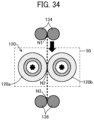
- FIG. 34 is a schematic diagram illustrating configurations of a thermal fixing unit, a first conveyance roller pair, and a second conveyance roller pair, according to an embodiment of the present disclosure
- FIG. 35 A is a diagram illustrating a state where the lamination sheet in which the inner sheet is sandwiched is conveyed between the first conveyance roller pair and the thermal fixing roller pair, according to an embodiment of the present disclosure
- FIG. 35 B is a diagram illustrating a state where the lamination sheet in which the inner sheet is sandwiched is conveyed between the thermal fixing roller pair and the second conveyance roller pair, according to an embodiment of the present disclosure
- FIG. 36 A is a diagram illustrating a schematic configuration of the thermal fixing roller pair in which a distance between the centers of rollers of the thermal fixing roller pair is changeable and the rollers are in contact with each other;
- FIG. 36 B is a diagram illustrating a schematic configuration of the thermal fixing roller pair in which the distance between the centers of the rollers of the thermal fixing roller pair is changeable and the rollers are separated from each other;
- FIGS. 37 A and 37 B are diagrams each illustrating a moving mechanism that contacts the rollers of the thermal fixing roller pair with each other and separates the rollers from each other.
- spatially relative terms such as “beneath,” “below;” “lower,” “above,” “upper” and the like may be used herein for ease of description to describe one element or feature's relationship to another element(s) or feature(s) as illustrated in the figures. It will be understood that the spatially relative terms are intended to encompass different orientations of the device in use or operation in addition to the orientation depicted in the figures. For example, if the device in the figures is turned over, elements describes as “below” or “beneath” other elements or features would then be oriented “above” the other elements or features. Thus, term such as “below” can encompass both an orientation of above and below. The device may be otherwise oriented (rotated 90 degrees or at other orientations) and the spatially relative descriptors herein interpreted accordingly.
- FIG. 1 is a diagram illustrating an overall configuration of a sheet processing device according to an embodiment of the present disclosure.
- a sheet processing device 100 is to separate two sheets (plies) of a two-ply sheet (hereinafter referred to as a lamination sheet S) and to insert and sandwich a sheet-shaped medium (hereinafter referred to as an inner sheet P) between the separated sheets of the two-ply sheet.
- a lamination sheet S a two-ply sheet
- an inner sheet P a sheet-shaped medium
- the lamination sheet S is a two-ply sheet in which two sheets are overlapped and bonded together at a portion (or a side) at the bonded portion r of the two-ply sheet.
- a two-ply sheet has two sheets (two sides).
- a first side of the two-ply sheet serves as a transparent sheet such as a transparent polyester sheet
- a second side of the two-ply sheet serves as a transparent or opaque sheet is disposed facing the first side, and the first and second sides are bonded at one side of the two-ply sheet.
- Examples of the two-ply sheet also include a lamination film.
- the inner sheet P is an example of the sheet medium that is inserted into the two-ply sheet.
- Examples of the sheet medium include thick paper, postcards, envelopes, plain paper, thin paper, coated paper, art paper, tracing paper, and overhead projector (OHP) transparencies.
- the sheet processing device 100 includes a sheet tray 102 , a pickup roller 105 , and a conveyance roller pair 107 .
- the sheet tray 102 serving as a first sheet stacker on which the two-ply sheets S are placed.
- the pickup roller 105 feeds the two-ply sheet S from the sheet tray 102 .
- the sheet processing device 100 further includes a sheet tray 103 as a second sheet stacker on which the inner sheet P is stacked, and a pickup roller 106 that feeds the inner sheet P from the sheet tray 103 .
- the sheet tray 102 includes a sheet size sensor C 6 that serves as a sheet size detector to detect the size of the lamination sheet S, in other words, the length of the lamination sheet S in the sheet conveyance direction.
- the sheet tray 103 includes a sheet size sensor C 7 that serves as a medium size detector to detect the size of the inner sheet P, in other words, the length of the inner sheet P in the sheet conveyance direction.
- Each of the sheet size sensor C 6 and the sheet size sensor C 7 includes a plurality of sensors arranged side by side in the sheet conveyance direction. Since the detection results of the sensors change depending on the size of the stacked lamination sheets S and the inner sheets P, the sheet size sensors C 6 and C 7 can detect the length of the lamination sheet S and the insertion sheet P in the sheet conveyance direction.
- a sheet conveyance sensor C 1 is disposed downstream from the conveyance roller pair 107 in the sheet conveyance direction to detect the sheet conveyance position of the two-ply sheet S.
- a sheet conveyance sensor C 2 is disposed downstream from the pickup roller 106 in the sheet conveyance direction to detect the sheet conveyance position of the inner sheet P.
- the sheet conveyance sensors C 1 and C 2 may be used to detect the length of the lamination sheet S (or the inner sheet P) in the sheet conveyance direction.
- the sheet processing device 100 further includes an entrance roller pair 108 as a first conveyor, a winding roller 109 as a rotary member, an exit roller pair 113 as a second conveyor, and a sheet ejection tray 104 .
- the entrance roller pair 108 , the winding roller 109 , the exit roller pair 113 , and the sheet ejection tray 104 are disposed downstream from the conveyance roller pair 107 and the pickup roller 106 in the sheet conveyance direction.
- the sheet processing device 100 further includes separation members 116 between the winding roller 109 and the exit roller pair 113 . The separation members are movable in the width direction of the two-ply sheet S.
- a sheet conveyance sensor C 3 is disposed downstream from the entrance roller pair 108 in the sheet conveyance direction to detect the sheet conveyance position of the lamination sheet S and the sheet conveyance position of the inner sheet PM.
- An abnormal condition detection sensor C 4 is disposed downstream from the winding roller 109 in the sheet conveyance direction to detect the condition of the lamination sheet S.
- a sheet conveyance sensor C 5 is disposed downstream from the exit roller pair 113 in the sheet conveyance direction to detect the sheet conveyance position of the lamination sheet S.
- Each of the pickup roller 105 , the conveyance roller pair 107 , the entrance roller pair 108 , and the winding roller 109 serves as a first sheet feeder, and each of the pickup roller 106 , the entrance roller pair 108 , and the winding roller 109 serves as a second sheet feeder.
- An operation panel 10 is provided on the exterior of the sheet processing device 100 .
- the operation panel 10 serves as a display-operation device to display information of the sheet processing device 100 and receives input of the operation of the sheet processing device 100 .
- the operation panel 10 also serves as a notification device to output a perceptual signal to a user.
- a notification device other than the operation panel 10 may be separately provided in the sheet processing device 100 .
- the sheet processing device 100 stacks lamination sheets S and inner sheets P on the sheet tray 102 and the sheet tray 103 separately. As a lamination sheet S is conveyed into the sheet processing device 100 , the sheet processing device 100 separates and opens the lamination sheet S into two sheets and inserts the inner sheet P into an opening of the lamination sheet S. The exit roller pair 113 ejects and stacks the lamination sheet S, in which the inner sheet P has been inserted, onto the sheet ejection tray 104 .
- FIG. 2 is a diagram illustrating the main part of the sheet processing device 100 of FIG. 1 .
- each of the entrance roller pair 108 and the exit roller pair 113 is, for example, two rollers paired with each other and driven by a driver such as a motor.
- the entrance roller pair 108 is driven and rotated by an entrance roller pair motor 108 a (see FIG. 29 )
- the exit roller pair 113 is driven and rotated by an exit roller pair motor 113 a (see FIG. 29 ).
- the entrance roller pair 108 rotates in one direction.
- the exit roller pair 113 rotates in forward and reverse directions, thereby nipping and conveying the lamination sheet S and the inner sheet P.
- the entrance roller pair 108 conveys the lamination sheet S and the inner sheet P toward the exit roller pair 113 .
- the sheet conveyance direction indicated by arrow A in FIG. 2 is hereinafter referred to as a “forward conveyance direction” or a sheet conveyance direction A.
- the exit roller pair 113 can switch the direction of rotation between the forward conveyance direction and a direction opposite to the forward conveyance direction.
- the exit roller pair 113 conveys the lamination sheet S nipped by the rollers of the exit roller pair 113 toward the sheet ejection tray 104 (see FIG. 1 ) in the forward conveyance direction and also conveys the lamination sheet S toward the winding roller 109 in the direction opposite the forward conveyance direction (to convey the lamination sheet S in reverse).
- the sheet conveyance direction of the lamination sheet S toward the winding roller 109 (in other words, the direction opposite to the forward conveyance direction) indicated by arrow B in FIG. 2 is hereinafter referred to as a reverse conveyance direction or a sheet conveyance direction B.
- the sheet processing device 100 further includes a sheet separation unit 1 between the entrance roller pair 108 and the exit roller pair 113 .
- the sheet separation unit 1 includes the winding roller 109 serving as a rotary member and the separation members 116 .
- the winding roller 109 is driven by a winding roller motor 109 a (see FIG. 29 ) to rotate in the forward and reverse conveyance directions.
- the direction of rotation of the winding roller 109 is switchable between the forward conveyance direction (clockwise direction) and the reverse conveyance direction (counterclockwise direction).
- the winding roller 109 includes a roller 111 and a sheet gripper 110 movably disposed on the roller 111 to grip the sheet S.
- the sheet gripper 110 is driven by a sheet gripper motor 110 a (see FIG. 29 ) to be rotatable with the roller 111 .
- the sheet gripper 110 is movable and grips the leading end of the lamination sheet S with the roller 111 .
- the sheet gripper 110 and the roller 111 are separate units.
- the sheet gripper 110 may be formed on the outer circumference of the roller 111 as a single unit.
- the series of operations performed by the sheet processing device 100 indicates the operations from separating the lamination sheet S to inserting the inner sheet P into the lamination sheet S.
- FIGS. 3 to 17 elements identical to those illustrated in FIG. 1 or 2 are given identical reference numerals, and the descriptions thereof are omitted.
- FIGS. 3 to 9 are diagrams, each illustrating the main part of the sheet processing device 100 in an operation subsequent to the operation of the previous drawing.
- FIGS. 10 , 11 , and 12 are diagrams, each illustrating the sheet processing device 100 performing an operation in a single sheet insertion mode.
- FIGS. 13 to 16 are diagrams, each illustrating the sheet processing device 100 performing an operation in a multiple sheet insertion mode.
- the entrance roller pair 108 conveys the two-ply sheet S toward the winding roller 109 .
- the entrance roller pair 108 conveys the lamination sheet S with the bonded end, which is one of four sides of the lamination sheet S, as the downstream side in the forward conveyance direction A as indicated by arrow A in FIG. 2 .
- the sheet processing device 100 temporarily stops conveyance of the lamination sheet S when the trailing end of the lamination sheet S in the forward conveyance direction has passed the winding roller 109 .
- These operations are performed by conveying the two-ply sheet S from the sheet conveyance sensor C 3 by a designated amount in response to the timing at which the sheet conveyance sensor C 3 detects the leading end of the two-ply sheet S.
- the sheet processing device 100 causes the sheet gripper 110 to open and the exit roller pair 113 to rotate in the reverse direction to convey the lamination sheet S in the reverse conveyance direction (i.e., the reverse conveyance direction B in FIG. 4 ) toward an opening portion of the sheet gripper 110 .
- the sheet processing device 100 stops conveyance of the lamination sheet S when the trailing end of the lamination sheet S is inserted into the opening portion of the sheet gripper 110 , and causes the sheet gripper 110 to close and grip the trailing end of the lamination sheet S. These operations are performed when the lamination sheet S is conveyed by the designated amount.
- the sheet processing device 100 causes the driver to rotate the winding roller 109 in the counterclockwise direction in FIG. 6 to wind the lamination sheet S around the winding roller 109 .
- the lamination sheet S is wound around the winding roller 109 ) from the side where the two sheets of the lamination sheet S are overlapped but not bonded.
- the separation members 116 are inserted into the space g formed as described above, from opposed sides of the lamination sheet S, the space g between the two sheets is maintained.
- the lamination sheet S is conveyed from the sheet conveyance sensor C 5 by a designated amount to perform these operations.
- FIG. 18 is a schematic view of each separation member 116 included in the sheet processing device 100 .
- FIGS. 19 A and 19 B are schematic views, each illustrating an example of a drive configuration of the separation members 116 .
- FIG. 20 is a perspective view of a state in which the separation members 116 are inserted into the lamination sheet S.
- the size in the height (vertical direction) of the separation member 116 gradually increases from the center in the width direction to the trailing end (right end in FIG. 18 ). Further, when viewed from the vertical direction, the size of the separation member 116 in the sheet conveyance direction gradually increases from the leading end to the center.
- each of the separation members 116 When viewed from the width direction of the lamination sheet S, each of the separation members 116 has a cross shape. Each separation member 116 further has a branching member that functions as a guide to guide the two sheets separated from the lamination sheet S in different directions due to the above-described cross shape.
- the two separation members 116 are disposed facing each other and moved in the approaching direction and the separating direction, for example, by a belt drive mechanism as illustrated in FIG. 19 A and by a rack and pinion mechanism illustrated in FIG. 19 B .
- the belt drive mechanism illustrated in FIG. 19 A includes a belt 32 stretched between a drive pulley 30 a and a driven pulley 30 b and the two separation members 116 a and 116 b are attached to the belt 32 while facing each other.
- the separation member 116 a is attached and connected to the lower part of the belt 32 and the separation member 116 b is attached and connected to the upper part of the belt 32 .
- the drive pulley 30 a is provided with a drive transmission gear 34 .
- the rotational output of a separation member motor 36 is transmitted to the drive transmission gear 34 via a motor output gear 35 .
- the rotational output of the separation member motor 36 is transmitted to the belt 32 .
- the rack and pinion mechanism illustrated in FIG. 19 B includes two racks 42 a and 42 b extending in opposite directions from each other. Each of the racks 42 a and 42 b meshes with a single pinion 40 .
- the separation member 116 a that is attached to the rack 42 a faces the separation member 116 b that is attached to the rack 42 b .
- the pinion 40 is provided with a drive transmission gear 44 .
- the rotational output of a separation member motor 46 is transmitted to the drive transmission gear 44 via a motor output gear 45 .
- the rotational output of the separation member motor 46 is transmitted to the racks 42 a and 42 b , respectively.
- each of the separation members 116 a and 116 b has the above-mentioned shape and is movable in the width direction of the lamination sheet S. Accordingly, the separation members 116 a and 116 b are smoothly inserted into the space g created in the lamination sheet S as illustrated in FIG. 20 .
- the sheet processing device 100 causes the winding roller 109 to rotate in the clockwise direction and shift the space g separating the two sheets of the lamination sheet S to the trailing end of the lamination sheet S in the forward conveyance direction (i.e., the direction indicated by arrow A in FIG. 2 ), as illustrated in FIG. 8 .
- the sheet laminator 200 causes the sheet gripper 110 to open. As a result, the lamination sheet S is separated into the upper and lower sheets at the trailing end.
- the sheet processing device 100 temporarily stops the conveyance of the lamination sheet S and further moves the separation members 116 in the width direction of the lamination sheet S to separate the whole area of the trailing end of the lamination sheet S.
- the lamination sheet S is conveyed from the sheet conveyance sensor C 5 by a designated amount to perform these operations.
- FIG. 21 is a perspective view of the separation members 116 and the lamination sheet S in the state illustrated in FIG. 8 .
- FIG. 22 is another perspective view of each separation member 116 and the lamination sheet S in the state illustrated in FIG. 8 , performing an operation subsequent to the operation in FIG. 21 .
- each of the separation members 116 further has a branching guide that functions as a guide to guide the two sheets separated from the lamination sheet S in different directions due to the above-described shape (see the cross shape illustrated in FIG. 18 ), the two sheets separated from the lamination sheet S may be kept in postures to be conveyed to different sheet conveyance passages.
- the separation members 116 are movable in the width direction of the lamination sheet S (see FIGS. 19 A and 19 B ), the separation members 116 are positioned suitably to support the postures of the two sheets of the lamination sheet S as illustrated in FIG. 22 . Due to such a configuration, even when the size of the lamination sheet S and the rigidity (or retentivity corresponding to the propensity to retain a particular shape once applied, such as curvature of paper) of the lamination sheet S change, the two sheets separated from the lamination sheet S are guided in desired branching directions.
- This configuration eliminates the need for a branching member to branch the lamination sheet S over the whole area of the sheet lamination sheet S in the width direction and a driver to drive the branching member, thereby reducing the cost when compared with the configuration of a typical sheet processing device.
- the sheet processing device 100 causes the driver to rotate the exit roller pair 113 in the counterclockwise direction in FIG. 9 to convey the two-ply sheet S in the reverse conveyance direction (i.e., the reverse conveyance direction B in FIG. 9 ).
- the separation members 116 guide the two sheets separated from the lamination sheet S in the upper and lower directions (vertically), respectively, and thus the two sheets are fully separated.
- the sheet processing device 100 temporarily stops the conveyance of the lamination sheet S, so that a bonded portion r of the lamination sheet S is gripped (nipped) by the exit roller pair 113 . Accordingly, one end of the lamination sheet S is bonded as the bonded side of the lamination sheet S and the other end of the lamination sheet S is opened largely.
- the lamination sheet S is conveyed from the sheet conveyance sensor C 5 by a designated amount to perform these operations.
- the sheet processing device 100 can insert one to a plurality of inner sheets P into a lamination sheet S depending on the size of the lamination sheet S (i.e., the length of the lamination sheet S in the sheet conveyance direction) and the size of the inner sheet P (i.e., the length of the inner sheet P in the sheet conveyance direction).
- the sheet processing device 100 causes the entrance roller pair 108 to rotate to convey the inner sheet P conveyed from the sheet tray 103 (see FIG. 1 ) via a sheet conveyance roller pair 117 toward the exit roller pair 113 in the forward conveyance direction (i.e., the direction indicated by arrow A in FIG. 10 ).
- the sheet processing device 100 causes the exit roller pair 113 to rotate so that the lamination sheet S and the inner sheet P meet to insert the inner sheet P into the lamination sheet S from the open portion (on the other end) of the lamination sheet S.
- the exit roller pair 113 of the sheet processing device 100 conveys the lamination sheet S in which the inner sheet P is inserted, in the forward conveyance direction (i.e., the direction indicated by arrow A in FIG. 12 ).
- the two sheets of the lamination sheet S are overlapped one on another again so as to close the open portion of the lamination sheet S.
- the lamination sheets S with the inner sheet P being inserted are ejected by the exit roller pair 113 or the ejection roller pair 121 (see FIG. 24 ) disposed downstream from the exit roller pair 113 and are stacked on the sheet ejection tray 104 (see FIG. 1 ).
- the multiple sheet insertion mode a plurality of inner sheets P (two sheets in the embodiment) are insertable a single lamination sheet S in the sheet conveyance direction.
- the sheet processing device 100 causes the entrance roller pair 108 to rotate to convey a first inner sheet P (hereinafter, referred to as a first inner sheet P 1 ) conveyed from the sheet tray 103 (see FIG. 1 ) via a sheet conveyance roller pair 117 toward the exit roller pair 113 in the forward conveyance direction (i.e., the direction indicated by arrow A in FIG. 13 ).
- a first inner sheet P 1 hereinafter, referred to as a first inner sheet P 1
- the sheet processing device 100 causes the entrance roller pair 108 to rotate to convey a first inner sheet P (hereinafter, referred to as a first inner sheet P 1 ) conveyed from the sheet tray 103 (see FIG. 1 ) via a sheet conveyance roller pair 117 toward the exit roller pair 113 in the forward conveyance direction (i.e., the direction indicated by arrow A in FIG. 13 ).
- the sheet processing device 100 causes the exit roller pair 113 to rotate so that the lamination sheet S and the first inner sheet P 1 meet. By so doing, the first inner sheet P 1 is inserted into the opening of the lamination sheet S.
- the sheet processing device 100 conveys a second inner sheet P (hereinafter, referred to as a second inner sheet P 2 ) conveyed from the sheet tray 103 (see FIG. 1 ) toward the exit roller pair 113 in the forward conveyance direction (i.e., the direction indicated by arrow A in FIG. 14 ).
- the sheet processing device 100 causes the entrance roller pair 108 to rotate so that the lamination sheet S and the second insertion sheet P 2 meet. By so doing, the second inner sheet P 2 is inserted into the opening of the lamination sheet S.
- the sheet processing device 100 causes the exit roller pair 113 to convey the lamination sheet S, with the first inner sheet P 1 and the second inner sheet P 2 being inserted, in the forward conveyance direction (i.e., the direction indicated by arrow A in FIG. 16 ). By so doing, the two sheets are overlaid one on another again to close the opening.
- the three or more inner sheets P can be inserted in the lamination sheet S by repeating the above-described operations.
- a branching member 118 may change (switch) the sheet conveyance passage of the lamination sheet S to convey the lamination sheet S to the thermal-pressure device, as illustrated in FIG. 17 . Not only in the multiple sheet insertion mode but also in the single sheet insertion mode, the sheet conveyance passage may be changed (switched) with the branching member 118 .
- the sheet processing device 100 can control the driver and other parts to perform the sheet inserting operation of an inner sheet P or inner sheets P to be inserted into a lamination sheet S.
- the sheet processing device 100 acquires the size of the lamination sheet S (i.e., the length in the sheet conveyance direction of the lamination sheet S), the size of the inner sheet P (i.e., the length in the sheet conveyance direction of the inner sheet P), and the number of the inner sheets P to be inserted into the lamination sheet S.
- the sheet processing device 100 includes the sheet size sensor C 6 serving as a sheet size detector and the sheet size sensor C 7 serving as a medium size detector.
- the sheet processing device 100 may use the detection results of the sheet conveyance sensors C 1 and C 2 .
- the sheet processing device 100 can automatically control the sheet inserting operation according to the size of the lamination sheet S and the size of the inner sheet P.
- the sheet processing device 100 can separately stack the lamination sheets S and the inner sheets P on separate trays to be conveyed separately. Accordingly, there is no need to stack the lamination sheets S and the inner sheets P in a predetermined order, and this configuration can enhance the convenience.
- the lamination sheets S are stacked on the sheet tray 102 and the inner sheets P are stacked on the sheet tray 103 .
- the tray on which the lamination sheets S are stacked and the tray on which the inner sheets P are stacked are not limited to the above-described trays.
- the inner sheets P may be stacked on the sheet tray 102 and the lamination sheets S may be loaded on the sheet tray 103 .
- FIGS. 23 A, 23 B, and 23 C are schematic views, each illustrating a sheet guide passage of the two sheets separated from the lamination sheet S, according to a modification of the present disclosure.
- FIG. 23 A illustrates a case where the two separated sheets are guided from the bonded portion r of the lamination sheet S in the direction opposite to the sheet conveyance direction (i.e., the direction indicated by arrow B in FIG. 23 A ) as illustrated in FIG. 9 .
- the upper sheet of the separated lamination sheet S may be guided from the bonded portion r in the sheet conveyance direction (i.e., the direction indicated by arrow A in FIG. 23 B ) and the lower sheet of the separated lamination sheet S may be guided from the bonded portion r in the direction opposite to the sheet conveyance direction.
- FIG. 23 B illustrates a case where the two separated sheets are guided from the bonded portion r of the lamination sheet S in the direction opposite to the sheet conveyance direction (i.e., the direction indicated by arrow B in FIG. 23 A ) as illustrated in FIG. 9 .
- the upper sheet of the separated lamination sheet S may be guided from the bonded portion r in the sheet conveyance direction (i.e., the direction indicated by
- the upper sheet of the separated lamination sheet S may be guided from the bonding portion r in the direction opposite to the sheet conveyance direction and the lower sheet of the separated lamination sheet S may be guided from the bonded portion r in the sheet conveyance direction.
- the two sheets separated from each other from the lamination sheet S are branched by the separation members 116 and then guided in the direction opposite to the sheet conveyance direction.
- the two sheets separated from each other from the lamination sheet S may be branched by the separation members 116 and then guided in the sheet conveyance direction.
- FIG. 24 is a diagram illustrating an overall configuration of a sheet laminator according to an embodiment of the present disclosure, including the sheet processing device.
- a sheet laminator 200 includes the sheet processing device 100 described above, a branching member 118 , a thermal fixing roller pair 120 , and an ejection roller pair 121 .
- the branching member 118 changes (switches) the sheet conveyance passage of the lamination sheet S.
- the thermal fixing roller pair 120 that function as a pair of thermal fixing rollers that can heat and press the lamination sheet S.
- the ejection roller pair 121 is disposed downstream from the thermal fixing roller pair 120 in the sheet conveyance direction.
- the sheet laminator 200 performs a series of operations, in this order, of feeding the lamination sheet S, separating the lamination sheet S, inserting the inner sheet P into the lamination sheet S, and laminating the lamination sheet S with the inner sheet P being inserted, by application of heat and pressure, on a stand-alone basis. This series of operations is carried out automatically without any aid of a user. For this reason, the sheet laminator 200 can enhance and provide the convenience better than a known sheet laminator employing a known technique.
- FIG. 25 is a diagram illustrating an overall configuration of an image forming system according to an embodiment of the present disclosure, including the sheet laminator and an image forming apparatus.
- An image forming system 3001 includes a sheet laminator 200 a in an in-body sheet discharging section of an image forming apparatus 300 .
- the sheet laminator 200 a functions as a device that performs sheet lamination.
- the sheet laminator 200 a includes the sheet tray 102 on which the lamination sheets S or the inner sheets P are stacked.
- the sheet laminator 200 a can receive the lamination sheets S, the inner sheets PM, or both from the image forming apparatus 300 .
- the image forming apparatus 300 e.g., a printer and a copier
- the image forming apparatus 300 can form an image on the lamination sheet S or the inner sheet P by the in-line connection.
- the image forming apparatus 300 includes an intermediate transfer device 150 .
- the intermediate transfer device 150 includes an intermediate transfer belt 152 having an endless loop and being entrained around a plurality of rollers and stretched substantially horizontally.
- the intermediate transfer belt 152 rotates in the counterclockwise direction in FIG. 25 .
- the image forming apparatus 300 further includes image forming units 154 c . 154 m , 154 y , and 154 k for cyan (C), magenta (M), yellow (Y), and black (K), respectively.
- the image forming units 154 c , 154 m , 154 y , and 154 k are disposed below the intermediate transfer device 150 in the housing 300 a .
- the image forming units 154 c , 154 m , 154 y , and 154 k are aligned in a quadruple tandem manner along an extended direction of the intermediate transfer belt 152 .
- Each of the image forming units 154 c , 154 m , 154 y , and 154 k includes a drum-shaped image bearer that rotates in the clockwise direction in FIG. 25 .
- Various image forming components for example, a charging unit, a developing unit, a transfer unit, and a cleaning unit, are disposed around each of the image forming units 154 c , 154 m , 154 y , and 154 k .
- An exposure device 156 is disposed below the image forming units 154 c , 154 m , 154 y , and 154 k included in the image forming apparatus 300 .
- a sheet feeder 158 is disposed below the exposure device 156 in the image forming apparatus 300 .
- the sheet feeder 158 includes a first sheet tray 160 that stores lamination sheets S and a second sheet tray 162 that stores inner sheets P.
- the first sheet tray 160 serves as a third sheet stacker on which a two-ply sheet such as the lamination sheet S is stacked.
- the second sheet tray 162 serves as a fourth sheet stacker on which a sheet medium (e.g., the inner sheet P) is stacked.
- a first feed roller 166 is disposed at a position upper right of the first sheet tray 160 .
- the first feed roller 166 feeds out the lamination sheet S one by one from the first sheet tray 160 to a sheet conveyance passage 164 .
- a second feed roller 168 is disposed at the upper right of the second sheet tray 162 and feeds the inner sheet P from the second sheet tray 162 one by one to the sheet conveyance passage 164 .
- the sheet conveyance passage 164 extends upwardly from the lower side to the upper side on the right side in the image forming apparatus 30 ) and communicates with the sheet laminator 200 a in the image forming apparatus 300 .
- the sheet conveyance passage 164 is provided with, e.g., a conveyance roller pair 170 , a secondary transfer device 174 in contact with the intermediate transfer belt 152 , a fixing device 176 , and a first sheet ejection device 178 including the ejection roller pair, serially.
- the first feed roller 166 , the conveyance roller pair 170 , and the sheet conveyance passage 164 serve as a third sheet feeder to feed the two-ply sheet (i.e., the lamination sheet S) from the first sheet tray 160 (serving as a third sheet stacker).
- the second feed roller 168 , the conveyance roller pair 170 , and the sheet conveyance passage 164 serve as a fourth sheet feeder to feed the sheet medium (i.e., the inner sheet P) from the second sheet tray 162 (serving as a fourth sheet stacker).
- the intermediate transfer device 150 and the fixing device 176 serve as a part of the image forming device that forms an image on a sheet medium (i.e., the inner sheet P).
- a sheet medium i.e., the inner sheet P
- an image reading device 188 reads the image on an original document, and the exposure device 156 then performs writing of the image on the original document.
- the image forming units 154 c , 154 m , 154 y , and 154 k form respective toner images of cyan (C), magenta (M), yellow (Y), and black (K), respectively, on the respective image bearers.
- primary transfer devices 180 c , 180 m , 180 y , and 180 k sequentially transfer the respective toner images onto the intermediate transfer belt 152 , thereby forming a color image on the intermediate transfer belt 152 .
- the image forming apparatus 300 rotates the second feed roller 168 to feed and convey the inner sheet P to the sheet conveyance passage 164 .
- the inner sheet P is conveyed by the conveyance roller pair 170 through the sheet conveyance passage 164 and is sent to the secondary transfer device 174 in synchrony with movement of the color image on the intermediate transfer belt 152 .
- the secondary transfer device 174 transfers the color image formed on the intermediate transfer belt 152 as described above, onto the inner sheet P.
- the fixing device 176 fixes the color image to the inner sheet P, and the first sheet ejection device 178 ejects to convey the inner sheet P to the sheet laminator 200 a.
- the sheet laminator 200 a rotates the pickup roller 105 to pick up the lamination sheet S from the sheet tray 102 on which the lamination sheet S is stacked and conveys the lamination sheet S to the sheet separation unit 1 (including the winding roller 109 and the separation members 116 ).
- the sheet separation unit 1 separates a lamination sheet S into two sheets and conveys an inner sheet P conveyed from the image forming apparatus 300 by the entrance roller pair 108 . By so doing, the inner sheet P is inserted between the separated two sheets of the lamination sheet S. Then, the lamination sheet S with the inner sheet P being inserted is conveyed by the exit roller pair 113 to a thermal fixing unit 50 as a thermal fixer.
- the thermal fixing roller pair 120 of the thermal fixing unit 50 applies heat and pressure to the lamination sheet S in which the inner sheet P is inserted, in other words, the thermal fixing roller pair 120 of the thermal fixing unit 50 performs a sheet laminating operation on the lamination sheet S with the inner sheet P being inserted.
- the lamination sheet S and the inner sheet P on which an on which an image is formed are conveyed to the sheet laminator 200 a to receive the sheet laminating operation performed by the sheet laminator 200 a.
- the lamination sheet S stacked on the first sheet tray 160 of the image forming apparatus 300 is conveyed to the sheet laminator 200 a via the sheet conveyance passage 164 and separate the lamination sheet S into two sheets in the sheet separation unit 1 .
- the image forming apparatus 300 conveys the inner sheet P stacked on the second sheet tray 162 in the sheet conveyance passage 164 , the secondary transfer device 174 , the fixing device 176 , and the first sheet ejection device 178 to form an image on the inner sheet P, and then conveyed the inner sheet P to the sheet laminator 200 a .
- the sheet laminator 200 a may also perform the sheet laminating operation on the lamination sheet S after inserting the inner sheet P on which an image is formed into the lamination sheet S separated into two sheets.
- FIG. 26 is a diagram illustrating an overall configuration of an image forming system according to a modification of the present disclosure, including the sheet laminator and an image forming apparatus.
- an image forming apparatus 400 is basically the same as the image forming apparatus 300 illustrated in FIG. 25 . However, different from the image forming apparatus 300 , the image forming apparatus 400 includes a second sheet ejection device 122 and a sheet ejection tray 123 .
- the image forming apparatus 400 may form an image on the inner sheet P fed from the second sheet tray 162 , and then eject the inner sheet P having the image by the second sheet ejection device 122 including a pair of sheet ejection rollers to the sheet ejection tray 123 . Accordingly, when the sheet laminating operation is not performed, the image forming apparatus 400 does not need to decrease the output speed of image formation. For this reason, the image forming apparatus 400 can maintain the image formation productivity.
- the image forming apparatus 400 may include the sheet laminator 200 a detachably attached to the in-body sheet discharging section. In other words, when the sheet laminating operation is not performed, the sheet laminator 200 a may be detached from the image forming apparatus 400 .
- the sheet laminator 200 a thus detached from the image forming apparatus 400 may include the sheet tray 103 to stack the inner sheets P and the pickup roller 106 to feed the inner sheet P from the sheet tray 103 , so that the sheet laminator 200 a can be used as a single unit such as the sheet laminator 200 illustrated in FIG. 24 .
- the image forming system 3001 illustrated in FIG. 25 and the image forming system 4001 illustrated in FIG. 26 may include the sheet processing device 100 in an in-body sheet discharging section instead of including the sheet laminator 200 a .
- the image forming system 4001 illustrated in FIG. 26 may include the sheet processing device 100 detachably attachable to the image forming system 4001 .
- Each of the image forming system 3001 illustrated in FIG. 25 and the image forming system 4001 illustrated in FIG. 26 may include a large-capacity sheet ejection device (stacker), a post-processing apparatus such as a binder unit, or both.
- stacker large-capacity sheet ejection device
- post-processing apparatus such as a binder unit
- the lamination sheet S that is stacked on the first sheet tray 160 included in the image forming apparatus 300 illustrated in FIG. 25 or the image forming apparatus 400 illustrated in FIG. 26 passes through the fixing device 176 , the lamination sheet S is not bonded at the fixing temperature but is bonded by application of heat higher than the fixing temperature.
- the image forming apparatus 300 illustrated in FIG. 25 and the image forming apparatus 400 illustrated in FIG. 26 employ electrophotography for image formation on the inner sheet P in the description above, the image formation method is not limited to the above-described configuration. For example, inkjet, stencil printing, or other known printing method may be employed to the image forming apparatuses 300 and 400 .
- FIG. 27 is a diagram illustrating an overall configuration of an image forming system including the sheet laminator according to an embodiment of the present disclosure, outside an image forming apparatus.
- FIG. 28 is a diagram illustrating an overall configuration of another image forming system including the sheet laminator according to an embodiment of the present disclosure, outside an image forming apparatus.
- FIGS. 27 and 28 elements identical to the elements illustrated in FIGS. 25 and 26 are given identical reference numerals, and the descriptions these elements are omitted.
- an image forming system 5001 is basically same as the image forming system 3001 illustrated in FIG. 25 and the image forming system 4001 illustrated in FIG. 26 . However, different from the image forming systems 3001 and 4001 , the image forming system 5001 illustrated in FIG. 27 includes a sheet laminator 200 b on the outside of an image forming apparatus 500 .
- the sheet laminator 200 b includes the sheet tray 102 on which the lamination sheets S are stacked and has the configuration in which an inner sheet P can be fed from the image forming apparatus 500 via a relay conveyance device R.
- the sheet laminator 200 b further includes the conveyance sensor C 2 disposed downstream from an entrance roller pair 130 and upstream from an exit roller pair 132 in the sheet conveyance direction.
- the sheet laminator 200 b further includes a first conveyance roller pair 134 disposed upstream from the thermal fixing roller pair 120 and a second conveyance roller pair 136 disposed downstream from the thermal fixing roller pair 120 in the sheet conveyance direction.
- the image forming system 5001 can automatically perform any image forming operation on an inner sheet P with a copier or a printer (i.e., the image forming apparatus 500 ), a sheet separating operation on a lamination sheet S, a sheet inserting operation on the inner sheet P having an image into the separated lamination sheet S. and a sheet laminating operation on the lamination sheet S in which the inner sheet P is inserted.
- the image forming system 5002 illustrated in FIG. 28 has a configuration in which another post-processing apparatus 250 is disposed further downstream from the sheet laminator 200 b in the sheet conveyance direction of the lamination sheet S.
- This post-processing apparatus 250 includes, for example, a large-capacity sheet ejection device (stacker), a post-processing apparatus such as a binder, or both. According to the request of a user, the job performing the sheet laminating operation and the job not performing the sheet laminating operation can be performed in parallel, which can enhance the working efficiency.
- FIG. 29 is a block diagram illustrating a hardware configuration of a control block of the sheet laminator 200 to control the operation performed in the sheet laminator 200 .
- the sheet laminator 200 includes a central processing unit (CPU) 901 , a random access memory (RAM) 902 , a read only memory (ROM) 903 , a hard disk drive (HDD) 904 , and an interface (I/F) 905 .
- the CPU 901 , the RAM 902 , the ROM 903 , the HDD 904 , and the I/F 905 are connected to each other.
- the CPU 90 I is an arithmetic unit and controls the overall operations of the sheet laminator 200 .
- the RAM 902 is a volatile storage medium that allows data to be read and written at high speed.
- the CPU 901 uses the RAM 902 as a work area for data processing.
- the ROM 903 is a read-only non-volatile storage medium that stores programs such as firmware.
- the HDD 904 is a non-volatile storage medium that allows data to be read and written and has a relatively large storage capacity.
- the HDD 904 stores, e.g., an operating system (OS), various control programs, and application programs.
- OS operating system
- various control programs e.g., various control programs, and application programs.
- the sheet laminator 200 processes, by an arithmetic function of the CPU 901 . e.g., a control program stored in the ROM 903 and an information processing program (or application program) loaded into the RAM 902 . Such processing configures a software controller including various functional modules of the sheet laminator 200 .
- the software controller thus configured cooperates with hardware resources of the sheet laminator 200 to construct functional blocks to implement functions of the sheet laminator 200 .
- the CPU 901 , the RAM 902 , the ROM 903 , and the HDD 904 implement a controller 127 to control the operation performed in the sheet laminator 200 .
- the I/F 905 is an interface that connects a pickup roller motor 105 a , a pickup roller motor 106 a , a conveyance roller pair motor 107 a , the entrance roller pair motor 108 a , the exit roller pair motor 113 a , an ejection roller pair motor 121 a , the winding roller motor 109 a , the sheet gripper motor 110 a , the separation member motor 36 ( 46 ), a branching member motor 118 a , a thermal fixing roller motor 129 a , a heater 54 including a first heater 54 a and a second heater 54 b , and a cam drive motor 195 , to the controller 127 .
- the I/F 905 is an interface that connects the size detection sensors C 6 and C 7 , the sheet conveyance sensors C 1 , C 2 , C 3 , and C 5 , the abnormal condition detection sensor C 4 , a first thermistor 56 a , a second thermistor 56 b , and the operation panel 10 , to the controller 127 .
- the controller 127 controls the operations of the pickup roller motors 105 a and 106 a , the conveyance roller pair motor 107 a , the entrance roller pair motor 108 a , the exit roller pair motor 113 a , the ejection roller pair motor 121 a , the winding roller motor 109 a , the sheet gripper motor 110 a , the separation member motor 36 ( 46 ), the branching member motor 118 a , the thermal fixing roller motor 129 a , the heater 54 including the first heater 54 a and the second heater 54 b , and a cam drive motor 195 , via the I/F 905 .
- the controller 127 acquires the detection results from the size detection sensors C 6 and C 7 , the sheet conveyance sensors C 1 , C 2 , C 3 , and C 5 , the abnormal condition detection sensor C 4 , the first thermistor 56 a , and the second thermistor 56 b.
- the winding roller motor 109 a is a driver to drive the winding roller 109 in the forward and reverse directions.
- the sheet gripper motor 110 a is a driver to rotate the sheet gripper 110 .
- the separation member motor 36 ( 46 ) is a driver to move the separation members 116 in the width direction of the lamination sheet S.
- the branching member motor 118 a is a driver to switch the position of the branching member 118 .
- FIG. 30 including FIGS. 30 A, 30 B, and 30 C is a flowchart of a series of operations performed by the image forming system 3001 illustrated in FIG. 25 , from feeding a lamination sheet S, inserting an inner sheet P. and completing lamination of the lamination sheet S with the inner sheet P being inserted.
- step S 01 the image forming system 3001 determines whether a user has selected the multiple sheet insertion mode.
- the image forming system 3001 requests the user inputting the number of inner sheets in step S 02 .
- the number of inner sheets can be set by the user with, for example, the operation panel 10 .
- the image forming system 3001 determines whether the user has selected the single sheet insertion mode with one inner sheet in step S 03 .
- step S 02 or step S 03 the sheet laminator 200 a starts feeding a lamination sheet S (see FIG. 1 ), in step S 11 .
- step S 12 the sheet laminator 200 a determines whether the leading end of the lamination sheet S has reached the sheet conveyance sensor C 3 (see FIG. 2 ).
- step S 13 the sheet laminator 200 a determines whether the lamination sheet S has been conveyed by the specified amount from the sheet conveyance sensor C 3 , and temporarily stops the conveyance (see FIG. 3 ).
- step S 13 is repeated until the lamination sheet S is conveyed by the specified amount from the sheet conveyance sensor C 3 .
- the sheet laminator 200 a causes the sheet gripper motor 110 a to open the sheet gripper 110 in step S 14 , and conveys the lamination sheet S in the reverse conveyance direction (i.e., the direction indicated by arrow B in FIG. 4 ) in step S 15 (see FIG. 4 ).
- the sheet laminator 200 a determines whether the lamination sheet S has been conveyed by the specified amount in step S 16 .
- step S 16 is repeated until the lamination sheet S is conveyed by the specified amount.
- the sheet laminator 200 a temporarily stops the conveyance in step S 17 .
- step S 18 the sheet laminator 200 a causes the sheet gripper motor 110 a to close the sheet gripper 110 to nip the end of the lamination sheet S (see FIG. 5 ).
- step S 19 the sheet laminator 200 a causes the winding roller motor 109 a to rotate the winding roller 109 in the counterclockwise direction, so that the lamination sheet S is would around the winding roller 109 (see FIG. 6 ).
- step S 20 the sheet laminator 200 a determines whether the leading end of the lamination sheet S has reached at the sheet conveyance sensor C 5 . When the leading end of the lamination sheet S has not reached the sheet conveyance sensor C 5 (NO in step S 20 ), step S 20 is repeated until the leading end of the lamination sheet S reaches the sheet conveyance sensor C 5 .
- step S 21 the sheet laminator 200 a determines whether the lamination sheet S has been conveyed by the specified amount from the sheet conveyance sensor C 5 .
- step S 21 is repeated until the lamination sheet S is conveyed by the specified amount from the sheet conveyance sensor C 5 .
- the sheet laminator 200 a detects the condition of the lamination sheet S with the abnormal condition detection sensor C 4 in step S 22 .
- the abnormal condition detection sensor C 4 is an abnormal condition detector that detects whether the dimension of the space g created between the two sheets of the lamination sheet S (the amount of bending of one of the two sheets) exceeds the predetermined threshold.
- the sheet laminator 200 a determines whether the lamination sheet S is in a normal condition, in other words, the size of the space g is equal to or greater than the given threshold, from the detection result of the abnormal condition detection sensor C 4 .
- the sheet laminator 200 a determines that the lamination sheet S is in a normal condition (i.e., the size of the space g is equal to or greater than the given threshold) from the detection result of the abnormal condition detection sensor C 4 (YES in step S 23 ), the sheet laminator 200 a then executes the operation of step S 24 a.
- a normal condition i.e., the size of the space g is equal to or greater than the given threshold
- the sheet laminator 200 a determines that the lamination sheet S is in an abnormal condition (i.e., the size of the space g is smaller than the given threshold) from the detection result of the abnormal condition detection sensor C 4 (NO in step S 23 ), the sheet laminator 200 a notifies the user of the abnormal condition and stops the sheet processing operation in step S 24 b.
- an abnormal condition i.e., the size of the space g is smaller than the given threshold
- step S 24 a the sheet laminator 200 a conveys the lamination sheet S by the specified amount in a direction opposite to the sheet winding direction (i.e., the direction indicated by arrow A in FIG. 2 ), so that the bonded portion r of the lamination sheet S is located downstream from the nip region of the exit roller pair 113 . Accordingly, the space g created between the two sheets of the lamination sheet S can be formed at a position corresponding to the insertion position of the separation members 116 .
- step S 24 a the sheet laminator 200 a executes the operation of step S 24 c .
- step S 24 c the sheet laminator 200 a causes the separation member motor 36 to inserts the separation members 116 from both sides of the lamination sheet S into the space g created between the two sheets of the lamination sheet S (see FIGS. 7 and 20 ).
- step S 25 the sheet laminator 200 a causes the winding roller motor 109 a to rotate the winding roller 109 in the clockwise direction with the separation members 116 inserted from both sides of the lamination sheet S, and convey the lamination sheet S in the forward conveyance direction (i.e., the direction indicated by arrow A in FIG. 2 ).
- step S 26 the sheet laminator 200 a determines whether the leading end of the lamination sheet S has reached the sheet conveyance sensor C 5 .
- step S 26 is repeated until the leading end of the lamination sheet S reaches the sheet conveyance sensor C 5 .
- the sheet laminator 200 a executes the operation of step S 27 .
- step S 27 the sheet laminator 200 a determines whether the lamination sheet S has been conveyed by the specified amount from the sheet conveyance sensor C 5 .
- step S 27 is repeated until the lamination sheet S is conveyed by the specified amount from the sheet conveyance sensor C 5 .
- the sheet laminator 200 a causes the sheet gripper motor 110 a to open the sheet gripper 110 in step S 28 .
- step S 29 the sheet laminator 200 a conveys the lamination sheet S by the specified amount, then temporarily stops the conveyance of the lamination sheet S. Then, in step S 30 , the sheet laminator 200 a causes the separation member motor 36 to further move the separation members 116 in the sheet width direction of the lamination sheet S (see FIGS. 8 and 22 ). As a result, the trailing ends of the two sheets of the lamination sheet S are separated into the upper and lower sheets.
- step S 31 the sheet laminator 200 a conveys the lamination sheet S in the reverse conveyance direction (i.e., the direction indicated by arrow B in FIG. 9 ). Then, in step S 32 , the sheet laminator 200 a determines whether the leading end of the lamination sheet S in the forward conveyance direction has reached the sheet conveyance sensor C 5 . When the leading end of the lamination sheet S has not reached the sheet conveyance sensor C 5 (NO in step S 32 ), step S 32 is repeated until the leading end of the lamination sheet S reaches the sheet conveyance sensor C 5 .
- step S 33 the sheet laminator 200 a determines whether the lamination sheet S has been conveyed by a specified amount from the sheet conveyance sensor C 5 .
- step S 33 is repeated until the lamination sheet S is conveyed by the specified amount from the sheet conveyance sensor C 5 .
- the sheet laminator 200 a temporarily stops the conveyance of the lamination sheet S in step S 34 (see FIG. 9 ). As a result, the separation of the lamination sheet S is completed.
- step S 35 the sheet laminator 200 a determines whether or not to perform the image forming operation (with an inline image forming apparatus) on the inner sheet P to be inserted into the lamination sheet S.
- the sheet laminator 200 a sends a signal to notify the inline image forming apparatus 300 (or the image forming apparatus 400 or the image forming apparatus 500 ) to start the print job (printing operation) to form an image on the inner sheet P in step S 36 .
- the sheet laminator 200 a executes the operation of step S 37 .
- step S 35 when the image forming operation is not performed with an inline image forming apparatus (NO in step S 35 ), the sheet laminator 200 a then executes the operation of step S 37 .
- step S 37 the sheet laminator 200 a conveys the inner sheet P in the forward conveyance direction (i.e., the direction indicated by arrow A in FIG. 10 ), so as to insert the inner sheet P into the opening of the lamination sheet S.
- the sheet laminator 200 a when the single sheet insertion mode is selected, the sheet laminator 200 a performs the operations illustrated in FIGS. 10 to 12 .
- the sheet laminator 200 a performs the operations illustrated in FIGS. 13 to 16 .
- step S 38 the sheet laminator 200 a determines whether the selected number of inner sheets P are inserted into the lamination sheet S. When the selected number of inner sheets P are not inserted into the lamination sheet S (NO in step S 38 ), step S 38 is repeated until the selected number of inner sheets P are inserted into the lamination sheet S. On the other hand, when the selected number of inner sheets P are inserted into the lamination sheet S (YES in step S 38 ), the sheet laminator 200 a then executes the operation of step S 39 .
- step S 39 the sheet laminator 200 a causes the branching member motor 118 a to rotate the branching member 118 to switch (change) the sheet conveyance passage of the lamination sheet S.
- step S 40 the sheet laminator 200 a conveys the lamination sheet S sandwiching the inner sheet P to the thermal fixing unit 50 . By application of heat and pressure to the lamination sheet S, the sheet laminating operation completes (see FIG. 17 ).
- the sheet laminator 200 a sends a signal to notify the inline image forming apparatus 300 (or the image forming apparatus 400 or the image forming apparatus 500 ) to start the print job, then performs the printing operation on the inner sheet P and conveys the inner sheet P.
- the sheet processing device waits until the printed inner sheet P is conveyed and reaches the sheet conveyance sensor C 1 .
- the sheet laminator 200 a may send the image forming apparatus 300 (or the image forming apparatus 400 or the image forming apparatus 500 ) the signal to start the print job in advance based on a time to convey the printed inner sheet P, for example, after the separation members 116 complete the operations illustrated in FIG. 7 . Due to such a configuration, the productivity can be enhanced.
- FIG. 31 is a diagram illustrating a configuration of a thermal fixing unit 50 included in the sheet laminator 200 ( 200 a , 200 b ) according to an embodiment of the present disclosure.
- the thermal fixing unit 50 applies heat and pressure on the lamination sheet S sandwiching the inner sheet P while conveying the lamination sheet S.
- the lamination sheet S sandwiching the inner sheet P is hereinafter referred to as a “sheet SP”.
- the thermal fixing unit 50 includes a thermal fixing roller pair 120 , a heater 54 , and a thermal fixing roller motor 129 a (see FIG. 29 ).
- the thermal fixing roller pair 120 includes a first thermal fixing roller 120 a and a second thermal fixing roller 120 b to convey the sheet SP.
- the heater 54 includes a first heater 54 a and a second heater 54 b to heat the first thermal fixing roller 120 a and the second thermal fixing roller 120 b of the thermal fixing roller pair 120 .
- the thermal fixing roller motor 129 a heats the first thermal fixing roller 120 a and the second thermal fixing roller 120 b of the thermal fixing roller pair 120 (see FIG. 29 ).
- the thermal fixing unit 50 further includes thermistors 56 (i.e., the first thermistor 56 a and the second thermistor 56 b ) each serving as a contact temperature detector.
- the first thermistor 56 a is disposed adjacent to the first thermal fixing roller 120 a to detect the surface temperature of the surface of the first thermal fixing roller 120 a .
- the second thermistor 56 b is disposed adjacent to the second thermal fixing roller 120 b to detect the surface temperature of the surface of the second thermal fixing roller 120 b.
- the first heater 54 a is disposed inside a core metal portion 60 a in the first thermal fixing roller 120 a .
- the second heater 54 b is disposed inside a core metal portion 60 b in the second thermal fixing roller 120 b .
- the first thermistor 56 a is disposed in contact with the surface of the first thermal fixing roller 120 a
- the second thermistor 56 b is disposed in contact with the surface of the second thermal fixing roller 120 b .
- the controller 127 causes the thermal fixing unit 50 to control the first heater 54 a and the second heater 54 b according to respective temperatures detected by the first thermistor 56 a and the second thermistor 56 b.
- FIG. 32 is a schematic diagram illustrating a configuration of the thermal fixing roller pair according to an embodiment of the present disclosure.
- the first thermal fixing roller 120 a of the thermal fixing roller pair 120 includes a core metal portion 60 a at a center portion of the first thermal fixing roller 120 a , an elastic layer 62 a (i.e., a rubber layer) disposed around the core metal portion 60 a , and a fluororesin layer 64 a on the surface of the elastic layer 62 a .
- an elastic layer 62 a i.e., a rubber layer
- the second thermal fixing roller 120 b of the thermal fixing roller pair 120 includes a core metal portion 60 b at a center portion of the second thermal fixing roller 120 b , an elastic layer 62 b (i.e., a rubber layer) disposed around the core metal portion 60 b , and a fluororesin layer 64 b on the surface of the elastic layer 62 b .
- the elastic layers 62 a and 62 b i.e., rubber layers
- the fluororesin layers 64 a and 64 b on the surfaces of the elastic layers 62 a and 62 b , respectively, can make it difficult for the adhesive leaked from the sheet SP to adhere to the surfaces of the first thermal fixing roller 120 a and the second thermal fixing roller 120 b of the thermal fixing roller pair 120 .
- the first thermal fixing roller 120 a and the second thermal fixing roller 120 b have a substantially same diameter, a substantially same rigidity, and a substantially same surface releasability. Due to such a configuration, the adhesive oozed from the sheet SP is dispersed to the first thermal fixing roller 120 a and the second thermal fixing roller 120 b , so that accumulation of the adhesive on only one of the first thermal fixing roller 120 a or the second thermal fixing roller 120 b can be prevented. As a result, the thermal fixing unit 50 can prevent the sheet SP from winding around the first thermal fixing roller 120 a or the second thermal fixing roller 120 b , and save time to pass a cleaning sheet each time the cleaning sheet is used.
- the core metal portions 60 a and 60 b and the elastic layers 62 a and 62 b can store heat. Even if heat is removed from the surface layers due to contact with the sheet SP, a decrease in surface temperature can be reduced.
- first thermistor 56 a is disposed on the surface of the first thermal fixing roller 120 a and is used together with the first heater 54 a to control the first thermal fixing roller 120 a to a target temperature.
- second thermistor 56 b is disposed on the surface of the second thermal fixing roller 120 b and is used together with the second heater 54 b to control the second thermal fixing roller 120 b to a target temperature. According to detection of respective temperatures of the first thermal fixing roller 120 a and the second thermal fixing roller 120 b , the first thermal fixing roller 120 a and the second thermal fixing roller 120 b can control the temperatures equal to each other, and both sides of the sheet SP can be heated at the substantially same temperature.
- the first thermistor 56 a and the second thermistor 56 b may be replaced by a non-contact temperature sensor or sensors.
- thermal fixing roller pair 120 can apply heat and pressure on the sheet SP equally from both sides of the sheet SP, the stable lamination quality with less curling can be obtained.
- FIG. 33 is a schematic diagram illustrating a state where a first thermistor 56 a A is lifted due to adhesive accumulated on the surface of a roller of a thermal fixing roller pair 120 A of a typical thermal fixing unit 50 A.
- the parts and components included in the thermal fixing unit 50 A basically have the same structures and functions as the parts and components included in the thermal fixing unit 50 according to an embodiment of the present disclosure.
- the adhesive oozing from the trailing end of the sheet SP adheres to and accumulates on the surface of a first thermal fixing roller 120 a A of the thermal fixing roller pair 120 A.
- the sheets SP are continuously fed or the lamination sheets (lamination sheets S) having a large amount of glue are used, accumulation of the adhesive is promoted.
- the accumulated adhesive 66 increases, for example, the first thermistor 56 a A is lifted from the surface of the first thermal fixing roller 120 a A, and an accurate surface temperature cannot be detected.
- a first heater 54 a A and a second heater 54 b A are subjected to temperature control (feedback control) based on the surface temperatures of the first thermal fixing roller 120 a A and a second thermal fixing roller 120 b A detected by the first thermistor 56 a A and a second thermistor 56 b A, respectively. For this reason, if the first thermistor 56 a A and the second thermistor 56 b A cannot detect the accurate surface temperatures, the temperatures of the first heater 54 a A and the second heater 54 b A cannot be appropriately controlled, and the qualities of sheet lamination are likely to deteriorate.
- the detected surface temperatures of the first thermal fixing roller 120 a A and the second thermal fixing roller 120 b A remain low.
- the first heater 54 a A and the second heater 54 b A are further heated to excessively increase the surface temperatures of the first heater 54 a A and the second heater 54 b A, which is likely to lead to smoke and fire.
- the thermal fixing roller pair 120 has the configuration illustrated in FIGS. 31 and 32 , the adhesive is less likely to accumulate on the thermal fixing roller pair 120 . Due to such a configuration, the first thermistor 56 a and the second thermistor 56 b successfully contact the surfaces of the first thermal fixing roller 120 a and the second thermal fixing roller 120 b , respectively, and can accurately detect the surface temperatures. As a result, the thermal fixing unit 50 can perform an accurate temperature control over the heaters 54 including the first heater 54 a and the second heater 54 b.
- the thermal fixing roller pair 120 is preferable to include the first thermal fixing roller 120 a having the elastic layer 62 a and the fluororesin layer 64 a with the total thickness equal to or smaller than 3 mm and the second thermal fixing roller 120 b having the elastic layer 62 b and the fluororesin layer 64 b with the total thickness equal to or smaller than 3 mm.
- the elastic layer i.e., the elastic layers 62 a and 62 b
- the fluororesin layer i.e., the fluororesin layer 64 a and 64 b
- a given time difference occurs until heat of the first heater 54 a and the second heater 54 b reach the surface layers of the first thermal fixing roller 120 a and the second thermal fixing roller 120 b of the thermal fixing roller pair 120 , respectively, and the surface temperatures of the first thermal fixing roller 120 a and the second thermal fixing roller 120 b of the thermal fixing roller pair 120 are detected by the first thermistor 56 a and the second thermistor 56 b , respectively.
- providing the elastic layer and the fluororesin layer having a total thickness equal to or smaller than 3 mm can reduce the time difference and enables accurate temperature control.
- FIG. 34 is a diagram illustrating the configurations of the thermal fixing unit 50 , a first conveyance roller pair 134 , and a second conveyance roller pair 136 , according to an embodiment of the present disclosure.
- the sheet laminator 200 ( 200 a , 200 b ) further includes the first conveyance roller pair 134 and the second conveyance roller pair 136 .
- the first conveyance roller pair 134 is disposed upstream from the thermal fixing unit 50 in the sheet conveyance direction and nips the sheet SP and conveys the sheet SP toward the thermal fixing unit 50 .
- the second conveyance roller pair 136 is disposed downstream from the thermal fixing unit 50 in the sheet conveyance direction and nips the sheet SP and conveys the sheet SP outside the sheet laminator.
- the first conveyance roller pair 134 forms a nip region N 1 between the rollers.
- the thermal fixing roller pair 120 forms a nip region N 2 between the first thermal fixing roller 120 a and the second thermal fixing roller 120 b .
- the second conveyance roller pair 136 forms a nip region N 3 between the rollers.
- the nip region N 2 of the thermal fixing roller pair 120 is on a straight line connecting the nip region N 1 of the first conveyance roller pair 134 and the nip region N 3 of the second conveyance roller pair 136 .
- the sheet SP is conveyed by the first conveyance roller pair 134 to the thermal fixing unit 50 (i.e., the thermal fixing roller pair 120 ).
- the thermal fixing unit 50 i.e., the thermal fixing roller pair 120
- the leading end or the downstream portion of the sheet SP reaches the nip region N 2 of the thermal fixing roller pair 120
- the trailing end or the upstream portion of the sheet SP is being conveyed by the first conveyance roller pair 134 .
- the sheet SP is conveyed by the first conveyance roller pair 134 and the thermal fixing roller pair 120 .
- the thermal fixing roller pair 120 pulls the sheet SP from the first conveyance roller pair 134 .
- the sheet conveying speed of the inner sheet P varies the sheet conveying speed of the lamination sheet S while the lamination sheet S sandwiching the inner sheet P is thermally fixed. Due to this action, it is likely to cause the poor quality such as a non-uniform adhesion of the lamination sheet S.
- the sheet conveying speed (V 1 ) of the first conveyance roller pair 134 is faster than the sheet conveying speed (V 2 ) of the thermal fixing roller pair 120 (V 1 >V 2 ), so that the sheet SP is not pulled by the thermal fixing roller pair 120 .
- V 1 >V 2 the sheet conveying speed of the sheet SP
- the conveyance force (F 2 ) of the thermal fixing roller pair 120 may be greater than the conveyance force (F 1 ) of the first conveyance roller pair 134 (F 1 ⁇ F 2 ), and the sheet SP may slip on the first conveyance roller pair 134 .
- the conveying speed of the sheet SP can be constant while the lamination sheet S sandwiching the inner sheet P is thermally fixed.
- the conveyance force (F 1 ) of the first conveyance roller pair 134 is force generated between the nip region N 1 of the first conveyance roller pair 134 and the sheet SP
- the conveyance force (F 2 ) of the thermal fixing roller pair 120 is force generated between the nip region N 2 of the thermal fixing roller pair 120 and the sheet SP.
- the conveyance force (F 1 ) is determined by the contact area of the nip region N 1 of the first conveyance roller pair 134 and the sheet SP, the kinetic coefficient of friction between the contact surfaces, and the pressure force between the rollers of the first conveyance roller pair 134 . The same manner is applied to the conveyance force (F 2 ).
- the sheet SP fixed with the thermal fixing roller pair 120 is conveyed toward the second conveyance roller pair 136 .
- the leading end or the downstream portion of the sheet SP reaches the nip region N 3 of the second conveyance roller pair 136 , the trailing end or the upstream portion of the sheet SP is being conveyed by the thermal fixing roller pair 120 .
- the sheet SP is conveyed by the thermal fixing roller pair 120 and the second conveyance roller pair 136 .
- the conveying speed of the sheet SP is the same or substantially the same as the conveying speed of the thermal fixing roller pair 120 while the second conveyance roller pair 136 pulls the sheet SP from the thermal fixing roller pair 120 .
- the sheet SP can be thermally fixed in synchrony with the conveying speed of the thermal fixing roller pair 120 .
- the sheet conveying speed (i.e., the linear velocity V 3 ) of the second conveyance roller pair 136 is set faster than the sheet conveying speed (i.e., the linear velocity V 2 ) of the thermal fixing roller pair 120 (V 3 >V 2 ) and the conveyance force (F 3 ) of the second conveyance roller pair 136 is the magnitude of force by which the second conveyance roller pair 136 conveys the sheet SP conveyed by the thermal fixing roller pair 120 while causing the sheet SP to slip on the thermal fixing roller pair 120 .
- the conveyance force (F 3 ) of the second conveyance roller pair 136 is set smaller than the conveyance force (F 2 ) of the thermal fixing roller pair 120 (F 3 ⁇ F 2 ), so that the sheet SP is conveyed while slipping on the second conveyance roller pair 136 .
- the sheet SP is nipped and conveyed by the thermal fixing roller pair 120 and the second conveyance roller pair 136 .
- the conveyance can be substantially controlled by the thermal fixing roller pair 120 .
- the sheet SP can be thermally fixed in accordance with the sheet conveying speed of the thermal fixing roller pair 120 .
- FIGS. 36 A and 36 B are diagrams, each illustrating a schematic configuration of the thermal fixing roller pair 120 that can change the distance between the centers of the rollers of the thermal fixing roller pair 120 , according to an embodiment of the present disclosure.
- FIG. 36 A is a diagram illustrating a schematic configuration of the thermal fixing roller pair 120 in a state where the first thermal fixing roller 120 a and the second thermal fixing roller 120 b of the thermal fixing roller pair 120 are in contact with each other
- FIG. 36 B is a diagram illustrating a schematic configuration of the thermal fixing roller pair 120 in a state where the first thermal fixing roller 120 a and the second thermal fixing roller 120 b of the thermal fixing roller pair 120 are separated from each other.
- FIGS. 37 A and 37 B are diagrams each illustrating a moving mechanism that contacts the rollers of the thermal fixing roller pair 120 with each other and separates the rollers of the thermal fixing roller pair 120 from each other.
- FIG. 37 A illustrates a contact state of the thermal fixing roller pair 120
- FIG. 37 B illustrates a separation state of the thermal fixing roller pair 120
- the moving mechanism 190 contacts or separates from the first thermal fixing roller 120 a and the second thermal fixing roller 120 b of the thermal fixing roller pair 120
- the moving mechanism 190 includes a movable bracket 191 , a movable bracket drive cam 193 , and a biasing spring 194 serving as a biasing member.
- the first thermal fixing roller 120 a (on the left in FIGS. 37 A and 37 b ) of the thermal fixing roller pair 120 is fixed and the second thermal fixing roller 120 b (on the right in FIGS.
- the movable bracket 191 has a bent shape.
- the shaft 120 c of the second thermal fixing roller 120 b of the thermal fixing roller pair 120 is fixed to one end the movable bracket 191 .
- the movable bracket 191 is disposed to be movable around a movable bracket rotational support 191 a . Further, the movable bracket 191 is biased by the biasing spring 194 to be rotatable in the counterclockwise direction around the movable bracket rotational support 191 a so that the first thermal fixing roller 120 a and the second thermal fixing roller 120 b of the thermal fixing roller pair 120 contact with each other as illustrated in FIG.
- the movable bracket drive cam 193 is rotatable by the cam drive motor 195 .
- the movable bracket drive cam 193 rotates to the position illustrated in FIG. 37 B
- the movable bracket 191 to which force is applied by the movable bracket drive cam 193 rotates in the clockwise direction around the movable bracket rotational support 191 a against the biasing force of the biasing spring 194 .
- the second thermal fixing roller 120 b that is movable separates from the first thermal fixing roller 120 a that is fixed. As a result, the thermal fixing roller pair 120 is brought into the separation state.
- the distance between the rotational center of the first thermal fixing roller and the rotational center of the second thermal fixing roller are changeable by a moving mechanism 190 . Due to such a configuration, the nip pressure can be changed.
- the second thermal fixing roller 120 b , the second heater 54 b , and the second thermistor 56 b are moved together.
- the second thermal fixing roller 120 b alone may be moved.
- the first thermal fixing roller 120 a , the first heater 54 a , and the first thermistor 56 a may be moved together.
- the distance between the rotational center of the first thermal fixing roller and the rotational center of the second thermal fixing roller are changeable in response to an instruction by a user.
- an instruction can be sent to the sheet laminator 200 ( 200 a , 200 b ) using the operation panel 10 .
- the sheet laminator 200 200 a , 200 b
- the operation panel 10 the operation panel 10 .
- a sheet laminator includes a thermal fixer to thermally fix and convey a two-ply sheet and a sheet medium nipped between two sheets of the two-ply sheet.
- the thermal fixer includes a thermal fixing roller pair, a first heater, a second heater, a first temperature detector, a second temperature detector, and a driver.
- the thermal fixing roller pair includes a first thermal fixing roller and a second thermal fixing roller facing the first thermal fixing roller. The thermal fixing roller pair conveys the two-ply sheet.
- Each of the thermal fixing roller pair includes a core metal portion at a center portion of each of the first thermal fixing roller and the second thermal fixing roller of the thermal fixing roller pair, an elastic layer around the core metal portion, and a fluororesin layer on a surface of the elastic layer.
- the thermal fixing roller pair has a substantially same diameter, a substantially same rigidity, and a substantially same surface releasability.
- the first heater heats the first thermal fixing roller.
- the second heater heats the second thermal fixing roller.
- the first temperature detector is disposed adjacent to the first thermal fixing roller to detect a surface temperature of the first thermal fixing roller.
- the second temperature detector is disposed adjacent to the second thermal fixing roller to detect a surface temperature of the second thermal fixing roller.
- the driver drives the thermal fixing roller pair.
- the first heater is disposed inside the core metal portion in the first thermal fixing roller and the second heater is disposed inside the core metal portion in the second thermal fixing roller.
- the first temperature detector is a contact temperature detector disposed in contact with a surface of the first thermal fixing roller and the second temperature detector is a contact temperature detector disposed in contact with a surface of the second thermal fixing roller.
- the elastic layer and the fluororesin layer of each of the first thermal fixing roller and the second thermal fixing roller of the thermal fixing roller pair have a total thickness equal to or smaller than 3 mm.
- the sheet laminator further includes a first conveyance roller pair and a second conveyance roller pair.
- the first conveyance roller pair is disposed upstream from the thermal fixer in a sheet conveyance direction and nips the two-ply sheet and conveys the two-ply sheet toward the thermal fixer.
- the second conveyance roller pair is disposed downstream from the thermal fixer in the sheet conveyance direction and nips the two-ply sheet and conveys the two-ply sheet outside the sheet laminator.
- a nip of the thermal fixing roller pair is on a line connecting a nip of the first conveyance roller pair and a nip of the second conveyance roller pair.
- the second conveyance roller pair has a linear velocity greater than a linear velocity of the thermal fixing roller pair, and the second conveyance roller pair has a conveyance force equal to the magnitude of force to convey the two-ply sheet being conveyed by the thermal fixing roller pair while the two-ply sheet slips on the thermal fixing roller pair.
- the sheet laminator further includes circuitry to control operations performed in the sheet laminator.
- the circuitry controls the first heater and the second heater according to respective temperatures detected by the first temperature detector and the second temperature detector.
- Aspect 7 of the present disclosure according to any one of Aspects 1 to 6, a distance between a rotational center of the first thermal fixing roller and a rotational center of the second thermal fixing roller are changeable.
- the distance between the rotational center of the first thermal fixing roller and the rotational center of the second thermal fixing roller are changeable in response to an instruction by a user.
- an image forming system includes the sheet laminator according to any one of Aspects 1 to 8, and an image forming apparatus to form an image on a sheet medium to be supplied to the sheet laminator.
- a thermal fixer in Aspect 10 of the present disclosure, includes a first thermal fixing roller and a second thermal fixing roller.
- the first thermal fixing roller includes a first heater.
- the second thermal fixing roller is pressed to the first thermal fixing roller.
- the second thermal fixing roller includes a second heater and has a diameter, a rigidity, and a surface releasability substantially identical to the first thermal fixing roller.
- the thermal fixer according to Aspect 10 further includes a first temperature detector, a second temperature detector, and circuitry.
- the first temperature detector is adjacent to the first thermal fixing roller to detect a first surface temperature of a first surface of the first thermal fixing roller.
- the second temperature detector is adjacent to the second thermal fixing roller to detect a second surface temperature of a second surface of the second thermal fixing roller.
- the circuitry drives the first thermal fixing roller and the second thermal fixing roller.
- Each of the first thermal fixing roller and the second thermal fixing roller includes a core metal portion at a center portion of each of the first thermal fixing roller and the second thermal fixing roller, an elastic layer around the core metal portion, and a fluororesin layer on a surface of the elastic layer.
- the first heater is inside the core metal portion in the first thermal fixing roller
- the second heater is inside the core metal portion in the second thermal fixing roller
- the first temperature detector in contact with the first surface of the first thermal fixing roller
- the second temperature detector in contact with the second surface of the second thermal fixing roller
- a total thickness of the elastic layer and the fluororesin layer of each of the first thermal fixing roller and the second thermal fixing roller is equal to or smaller than 3 mm.
- the circuitry further controls the first heater according to the first surface temperature detected by the first temperature detector, and controls the second heater according to the second surface temperature detected by the second temperature detector.
- the circuitry further changes a distance between a first rotational center of the first thermal fixing roller and a second rotational center of the second thermal fixing roller to change a nip pressure between the first thermal fixing roller and the second thermal fixing roller.
- the circuitry further changes the distance in response to an occurrence of jam between the first thermal fixing roller and the second thermal fixing roller.
- At least one of the first temperature detector or the second temperature detector is moved together with corresponding at least one of the first thermal fixing roller or the second thermal fixing roller.
- a sheet laminator includes the thermal fixer according to any one of Aspects 10 to 17.
- the thermal fixer thermally fixes and conveys a two-ply sheet and a sheet medium nipped between two sheets of the two-ply sheet in a sheet conveyance direction.
- the sheet laminator according to Aspect 18 further includes a first conveyance roller pair and a second conveyance roller pair.
- the first conveyance roller pair is upstream of the thermal fixer in the sheet conveyance direction.
- the first conveyance roller pair has a first nip to nip and convey the two-ply sheet toward the thermal fixer in the sheet conveyance direction.
- the second conveyance roller pair is downstream of the thermal fixer in the sheet conveyance direction.
- the second conveyance roller pair has a second nip to nip and eject the two-ply sheet away from the thermal fixer in the sheet conveyance direction.
- the thermal fixer has a third nip between the first thermal fixing roller and the second thermal fixing roller. The third nip is on a line connecting the first nip and the second nip.
- the first conveyance roller pair conveys the two-ply sheet in a first linear velocity
- the second conveyance roller pair conveys the two-ply sheet in a second linear velocity greater than the first linear velocity
- the thermal fixer conveys the two-ply sheet with a first conveyance force
- the second conveyance roller pair conveys the two-ply sheet with a second conveyance force smaller than the first conveyance force
- an image forming system includes the sheet laminator according to any one of Aspects 18 to 21, and an image forming apparatus to form an image on the sheet medium supplied to the sheet laminator.
- Processing circuitry includes a programmed processor, as a processor includes circuitry.
- a processing circuit also includes devices such as an application specific integrated circuit (ASIC), digital signal processor (DSP), field programmable gate array (FPGA), and conventional circuit components arranged to perform the recited functions.
- ASIC application specific integrated circuit
- DSP digital signal processor
- FPGA field programmable gate array
Landscapes
- Physics & Mathematics (AREA)
- General Physics & Mathematics (AREA)
- Separation, Sorting, Adjustment, Or Bending Of Sheets To Be Conveyed (AREA)
- Fixing For Electrophotography (AREA)
- Combination Of More Than One Step In Electrophotography (AREA)
Abstract
Description
Claims (17)
Applications Claiming Priority (4)
| Application Number | Priority Date | Filing Date | Title |
|---|---|---|---|
| JP2022-098779 | 2022-06-20 | ||
| JP2022098779 | 2022-06-20 | ||
| JP2023-069594 | 2023-04-20 | ||
| JP2023069594 | 2023-04-20 |
Publications (2)
| Publication Number | Publication Date |
|---|---|
| US20230408956A1 US20230408956A1 (en) | 2023-12-21 |
| US12248261B2 true US12248261B2 (en) | 2025-03-11 |
Family
ID=86861745
Family Applications (1)
| Application Number | Title | Priority Date | Filing Date |
|---|---|---|---|
| US18/211,612 Active US12248261B2 (en) | 2022-06-20 | 2023-06-20 | Thermal fixer, sheet laminator incorporating the thermal fixer, and image forming system incorporating the sheet laminator |
Country Status (3)
| Country | Link |
|---|---|
| US (1) | US12248261B2 (en) |
| EP (1) | EP4296058B1 (en) |
| JP (1) | JP2024000541A (en) |
Citations (10)
| Publication number | Priority date | Publication date | Assignee | Title |
|---|---|---|---|---|
| US4639405A (en) * | 1985-09-30 | 1987-01-27 | Eastman Kodak Company | Method and apparatus for fixing toner images |
| JPH09164593A (en) | 1995-12-14 | 1997-06-24 | Ricoh Co Ltd | Image forming device |
| US6463981B1 (en) | 1998-08-13 | 2002-10-15 | Eastman Kodak Company | Laminator assembly having a pressure roller with a deformable layer |
| US20050039859A1 (en) | 2003-08-22 | 2005-02-24 | Kenji Sugaya | Lamination system |
| JP2005141974A (en) | 2003-11-05 | 2005-06-02 | Canon Inc | Heating apparatus and image forming apparatus using the heating apparatus |
| US20070134034A1 (en) * | 2005-12-14 | 2007-06-14 | Sharp Kabushiki Kaisha | Fusing device and image forming apparatus |
| US20160011544A1 (en) * | 2014-07-11 | 2016-01-14 | Canon Kabushiki Kaisha | Image forming apparatus |
| US20200247107A1 (en) * | 2019-01-31 | 2020-08-06 | Ricoh Company, Ltd. | Sheet separation device, laminator, image forming apparatus, and image forming system |
| US20210039904A1 (en) | 2019-08-09 | 2021-02-11 | Ricoh Company, Ltd. | Sheet processing apparatus and image forming system incorporating the sheet processing apparatus |
| US20220169458A1 (en) | 2020-05-07 | 2022-06-02 | Ricoh Company, Ltd. | Sheet processing device, sheet laminator, image forming apparatus, and image forming system |
-
2023
- 2023-06-16 EP EP23179710.1A patent/EP4296058B1/en active Active
- 2023-06-20 US US18/211,612 patent/US12248261B2/en active Active
- 2023-06-20 JP JP2023100517A patent/JP2024000541A/en active Pending
Patent Citations (10)
| Publication number | Priority date | Publication date | Assignee | Title |
|---|---|---|---|---|
| US4639405A (en) * | 1985-09-30 | 1987-01-27 | Eastman Kodak Company | Method and apparatus for fixing toner images |
| JPH09164593A (en) | 1995-12-14 | 1997-06-24 | Ricoh Co Ltd | Image forming device |
| US6463981B1 (en) | 1998-08-13 | 2002-10-15 | Eastman Kodak Company | Laminator assembly having a pressure roller with a deformable layer |
| US20050039859A1 (en) | 2003-08-22 | 2005-02-24 | Kenji Sugaya | Lamination system |
| JP2005141974A (en) | 2003-11-05 | 2005-06-02 | Canon Inc | Heating apparatus and image forming apparatus using the heating apparatus |
| US20070134034A1 (en) * | 2005-12-14 | 2007-06-14 | Sharp Kabushiki Kaisha | Fusing device and image forming apparatus |
| US20160011544A1 (en) * | 2014-07-11 | 2016-01-14 | Canon Kabushiki Kaisha | Image forming apparatus |
| US20200247107A1 (en) * | 2019-01-31 | 2020-08-06 | Ricoh Company, Ltd. | Sheet separation device, laminator, image forming apparatus, and image forming system |
| US20210039904A1 (en) | 2019-08-09 | 2021-02-11 | Ricoh Company, Ltd. | Sheet processing apparatus and image forming system incorporating the sheet processing apparatus |
| US20220169458A1 (en) | 2020-05-07 | 2022-06-02 | Ricoh Company, Ltd. | Sheet processing device, sheet laminator, image forming apparatus, and image forming system |
Non-Patent Citations (5)
| Title |
|---|
| Extended European Search Report issued Nov. 23, 2023, in corresponding European Patent Application No. 23179710.1, 6 pages. |
| U.S. Appl. No. 17/969,148, filed Oct. 19, 2022, Shinya Monma, et al. |
| U.S. Appl. No. 17/974,987, filed Oct. 27, 2022, Sho Asano, et al. |
| U.S. Appl. No. 18/060,256, filed Nov. 30, 2022, Wataru Takahashi, et al. |
| U.S. Appl. No. 18/061,232, filed Dec. 2, 2022, Keisuke Sugiyama, et al. |
Also Published As
| Publication number | Publication date |
|---|---|
| EP4296058A1 (en) | 2023-12-27 |
| JP2024000541A (en) | 2024-01-05 |
| EP4296058B1 (en) | 2025-03-05 |
| US20230408956A1 (en) | 2023-12-21 |
Similar Documents
| Publication | Publication Date | Title |
|---|---|---|
| US10857776B2 (en) | Sheet separation device, laminator, image forming apparatus, and image forming system | |
| US11679582B2 (en) | Sheet processing device, laminating device, image forming apparatus, and image forming system | |
| US11975520B2 (en) | Sheet processing device, sheet laminator, image forming apparatus, and image forming system | |
| US11269273B2 (en) | Image forming apparatus and image forming system incorporating the image forming apparatus | |
| JP7737620B2 (en) | Sheet processing apparatus, image forming apparatus, and image forming system | |
| EP3909769B1 (en) | Sheet processing apparatus, laminator, image forming apparatus, and image forming system | |
| CN115072472A (en) | Sheet processing apparatus, lamination processing apparatus, image forming apparatus, and image forming system | |
| US12084302B2 (en) | Sheet processing apparatus and image forming system | |
| US11886143B2 (en) | Sheet laminator, image forming apparatus, and sheet laminating method | |
| US12566398B2 (en) | Sheet laminator and image forming system incorporating the sheet laminator | |
| US12485660B2 (en) | Sheet separation device, sheet laminator, image forming apparatus, and image forming system | |
| JP7439636B2 (en) | Lamination processing equipment, image forming equipment, and image forming systems | |
| US20230408956A1 (en) | Thermal fixer, sheet laminator incorporating the thermal fixer, and image forming system incorporating the sheet laminator | |
| US12466176B2 (en) | Sheet laminator and image forming system incorporating the sheet laminator | |
| US20240399729A1 (en) | Sheet processing apparatus and image forming system incorporating the sheet processing apparatus | |
| US20240399733A1 (en) | Sheet processing apparatus and image forming system incorporating the sheet processing apparatus | |
| US12570084B2 (en) | Sheet laminator and image forming system incorporating the sheet laminator | |
| US12545020B2 (en) | Sheet processing device, sheet laminator, image forming apparatus, and image forming system | |
| US20250051116A1 (en) | Sheet processing apparatus, sheet laminator, image forming apparatus, and image forming system | |
| US12594754B2 (en) | Sheet laminator and image forming system incorporating the sheet laminator | |
| JP7472647B2 (en) | SHEET PROCESSING APPARATUS, LAMINATING APPARATUS, IMAGE FORMING APPARATUS, AND IMAGE FORMING SYSTEM | |
| US20240393725A1 (en) | Image forming system | |
| CN117261200A (en) | Lamination processing device and image forming system | |
| JP2023184436A (en) | Lamination processing equipment and image forming system |
Legal Events
| Date | Code | Title | Description |
|---|---|---|---|
| AS | Assignment |
Owner name: RICOH COMPANY, LTD., JAPAN Free format text: ASSIGNMENT OF ASSIGNORS INTEREST;ASSIGNORS:KATO, YUICHIRO;SHIMODATE, KAZUKI;YOSHIDA, SHOTA;AND OTHERS;REEL/FRAME:063990/0543 Effective date: 20230615 |
|
| FEPP | Fee payment procedure |
Free format text: ENTITY STATUS SET TO UNDISCOUNTED (ORIGINAL EVENT CODE: BIG.); ENTITY STATUS OF PATENT OWNER: LARGE ENTITY |
|
| STPP | Information on status: patent application and granting procedure in general |
Free format text: DOCKETED NEW CASE - READY FOR EXAMINATION |
|
| STPP | Information on status: patent application and granting procedure in general |
Free format text: NON FINAL ACTION MAILED |
|
| STPP | Information on status: patent application and granting procedure in general |
Free format text: RESPONSE TO NON-FINAL OFFICE ACTION ENTERED AND FORWARDED TO EXAMINER |
|
| STPP | Information on status: patent application and granting procedure in general |
Free format text: FINAL REJECTION MAILED |
|
| STPP | Information on status: patent application and granting procedure in general |
Free format text: RESPONSE AFTER FINAL ACTION FORWARDED TO EXAMINER |
|
| STPP | Information on status: patent application and granting procedure in general |
Free format text: AWAITING TC RESP., ISSUE FEE NOT PAID |
|
| STPP | Information on status: patent application and granting procedure in general |
Free format text: AWAITING TC RESP., ISSUE FEE NOT PAID |
|
| STPP | Information on status: patent application and granting procedure in general |
Free format text: NOTICE OF ALLOWANCE MAILED -- APPLICATION RECEIVED IN OFFICE OF PUBLICATIONS |
|
| STPP | Information on status: patent application and granting procedure in general |
Free format text: PUBLICATIONS -- ISSUE FEE PAYMENT VERIFIED |
|
| STCF | Information on status: patent grant |
Free format text: PATENTED CASE |