US12242552B2 - Feature extraction system and method for enhancing recommendations - Google Patents
Feature extraction system and method for enhancing recommendations Download PDFInfo
- Publication number
- US12242552B2 US12242552B2 US17/800,253 US202217800253A US12242552B2 US 12242552 B2 US12242552 B2 US 12242552B2 US 202217800253 A US202217800253 A US 202217800253A US 12242552 B2 US12242552 B2 US 12242552B2
- Authority
- US
- United States
- Prior art keywords
- event
- recommendation
- user
- candidate events
- metric
- Prior art date
- Legal status (The legal status is an assumption and is not a legal conclusion. Google has not performed a legal analysis and makes no representation as to the accuracy of the status listed.)
- Active, expires
Links
Images




Classifications
-
- G—PHYSICS
- G06—COMPUTING OR CALCULATING; COUNTING
- G06F—ELECTRIC DIGITAL DATA PROCESSING
- G06F11/00—Error detection; Error correction; Monitoring
- G06F11/30—Monitoring
- G06F11/34—Recording or statistical evaluation of computer activity, e.g. of down time, of input/output operation ; Recording or statistical evaluation of user activity, e.g. usability assessment
- G06F11/3438—Recording or statistical evaluation of computer activity, e.g. of down time, of input/output operation ; Recording or statistical evaluation of user activity, e.g. usability assessment monitoring of user actions
-
- G—PHYSICS
- G06—COMPUTING OR CALCULATING; COUNTING
- G06F—ELECTRIC DIGITAL DATA PROCESSING
- G06F16/00—Information retrieval; Database structures therefor; File system structures therefor
- G06F16/90—Details of database functions independent of the retrieved data types
- G06F16/95—Retrieval from the web
- G06F16/953—Querying, e.g. by the use of web search engines
- G06F16/9535—Search customisation based on user profiles and personalisation
-
- G—PHYSICS
- G06—COMPUTING OR CALCULATING; COUNTING
- G06F—ELECTRIC DIGITAL DATA PROCESSING
- G06F2201/00—Indexing scheme relating to error detection, to error correction, and to monitoring
- G06F2201/86—Event-based monitoring
Definitions
- Apparatuses and methods consistent with example embodiments of the present disclosure relate to systems and methods for providing automated recommendations.
- conventional recommendation systems provide to a user a recommendation of an event (e.g., a product, a service, a template, etc.) by collaborative filtering (e.g., determine the most frequently accepted recommendation/most frequently executed event and filter other recommendations/events).
- collaborative filtering e.g., determine the most frequently accepted recommendation/most frequently executed event and filter other recommendations/events.
- Conventional recommendation systems determine a recommendation for a user by collaborative filtering. Specifically, the conventional system will determine the relationship between a user and an event (e.g., a recommendation provided to the user), by determining how many times the user has executed the event (e.g., how many times the user has accepted the recommendation, etc.)
- an event e.g., a recommendation provided to the user
- the event e.g., how many times the user has accepted the recommendation, etc.
- a user may execute an event just because it is a commonly executed event, but not because the user really is interested in the event.
- a user might view movie A via accepting a recommendation of movie A just because movie A is a big hit at that time, but it does not necessarily mean that the user is interested in movie A.
- a method, performed by at least one processor of a computing device, for recommending an event includes determining a frequency of execution of the event by a user among a plurality of users; determining an inverse user frequency of execution of the event based on the plurality of users who have executed the event; generating a recommendation factor by modifying the frequency of execution of the event by the user based on the inverse user frequency of execution of the event; and outputting a recommendation for the event based on the recommendation factor.
- the frequency of execution of the event by the user may be determined based on how often the user executes the event.
- the inverse user frequency of execution of the event may be determined based on how many of the plurality of users execute the event.
- the recommendation factor may be modified according to:
- the method may further include inputting the recommendation factor into a feature vector for input to a recommendation algorithm that determines a possibility of the user executing the event.
- the recommendation algorithm may be any suitable mathematical/machine learning algorithm that determines the possibility of the user executing the event.
- an apparatus for generating a recommendation includes a data storage configured to store an event execution record that includes information concerning a plurality of events executed by a plurality of users; at least one computer readable memory having recorded therein program instructions; and at least one processor configured to execute the program instructions.
- a method is performed that includes determining a frequency of execution of an event, among the plurality of events in the event execution record, by a user among a plurality of users; determining an inverse user frequency of execution of the event based on the plurality of users who have executed the event; generating a recommendation factor by modifying the frequency of execution of the event by the user based on the inverse user frequency of execution of the event; and outputting a recommendation for the event based on the recommendation factor.
- the frequency of execution of the event by the user may be determined based on how often the user executes the event.
- the inverse user frequency of execution of the event may be determined based on how many of the plurality of users execute the event.
- the recommendation factor may be modified according to:
- the recommendation algorithm may be any suitable mathematical/machine learning that determines the possibility of the user executing the event.
- a non-transitory computer-readable medium having stored therein program instructions, that when executed by one or more processors, performs a method including determining a frequency of execution of the event by a user among a plurality of users; determining an inverse user frequency of execution of the event based on the plurality of users who have executed the event; generating a recommendation factor by modifying the frequency of execution of the event by the user based on the inverse user frequency of execution of the event; and outputting a recommendation for the event based on the recommendation factor.
- the frequency of execution of the event by the user may be determined based on how often the user executes the event.
- the inverse user frequency of execution of the event may be determined based on how many of the plurality of users execute the event.
- the recommendation factor may be modified according to:
- the method may further include inputting the recommendation factor into a feature vector for input to a recommendation algorithm that determines a possibility of the user executing the event.
- the recommendation algorithm may be any suitable mathematical/machine learning that determines the possibility of the user executing the event.
- FIG. 1 is a flowchart illustrating a method of generating a recommendation of an event using a recommendation factor according to an embodiment
- FIG. 2 is a diagram of an example environment in which systems and/or methods, described herein, may be implemented;
- FIG. 3 is a diagram of example components of a device according to an embodiment
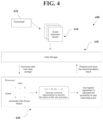
- FIG. 4 is a process flow diagram illustrating a process flow for generating a recommendation of an event using a recommendation factor according to an embodiment
- FIG. 5 A illustrates a user-event matrix according on an embodiment
- FIG. 5 B illustrates a user-event matrix according on another embodiment
- FIG. 6 illustrates a user-event recommendation feature vector according to an embodiment
- FIG. 7 is a flow chart illustrating an algorithm for using a recommendation factor.
- Example embodiments of the present disclosure provide methods and systems to generate and/or use a recommendation factor to adjust a recommendation approach (e.g., a conventional collaborative filtering, etc.).
- the recommendation factor takes into consideration how common the execution of an event is and adjusts, or fine tunes, a recommendation algorithm based on how often users execute the event. This adjustment fine tunes the recommendation by reducing the influence a larger population of users might have on any particular user executing an event, thereby increasing the accuracy of recommendations.
- These embodiments can, although need not, solve the problems with conventional recommendation systems of provisioning inaccurate recommendations due to the influence of commonly recommended events by many users.
- certain embodiments include systems and methods that compute a recommendation factor, described in more detail below, based on a parameter indicating the user's execution frequency of an event (e.g., how many times a target user executes the event) and a parameter indicating a commonality of the event among users, such as a measure of how commonly an event is executed (e.g., how many users executed that event).
- a parameter indicating the user's execution frequency of an event e.g., how many times a target user executes the event
- a parameter indicating a commonality of the event among users such as a measure of how commonly an event is executed (e.g., how many users executed that event).
- the recommendation factor can be computed based on a user's execution frequency of an event and an inverse user frequency of the event.
- the normalization is done by dividing the total times the User i has executed event X j with the total times User i has executed all of the plurality of events X. In some embodiments, the normalization is done by dividing the total times the User i has executed event X j with the total times User i has executed a subset of events of the plurality of events X.
- Inverse user frequency j (IUF j ) reflects how common/distinguishable the execution of X j is among all of the users and can be computed according to equation (2):
- represents the number of users who have executed event X j and wherein the number of users who have executed event X j is greater than zero, j is an integer from 1 to m and m number of events X, and a can be an integer or any suitable constant like Euler's number e.
- the Recommendation Factory ij (RF ij ) reflects a degree of interest the event X j is to User i , and can be computed according to equation (3):
- a recommendation can be generated that is of more interest to a user than a recommendation generated by conventional techniques.
- a computer controlled recommendation system receives and stores event execution records for a plurality of users U who execute a plurality of events X.
- event execution records are received from any suitable resource (e.g., a user terminal, an event execution terminal, etc.) and can be stored in a wide variety of storage arrangements and devices.
- the data that have been received and stored are arranged in a manner to facilitate determining the events each user executes. This operation shown in step S 120 , is an optional operation that may not be performed if the received data is in an arrangement suitable for processing.
- An example of arranging data in S 120 is arranging the data in a matrix format in which events executed by a user, among the plurality of users U, are recorded in the matrix.
- the user-event relations are stored in a relational database in which the database relates each user to each event executed by that user.
- Other techniques for arranging the user-event data also can be used.
- step S 130 the event execution records, or a dataset generated therefrom, are used to determine an execution frequency (EF) of an event by a user and an inverse user frequency (IUF) for the event.
- the EF and IUF may be determined at the same time or one before the other.
- the execution frequency is a relation of the number of times a user executes a particular event to the number of times the user executes all the events X.
- the execution frequency can be determined according to Equation 1.
- the inverse user frequency (IUF) provides an inverse indication of how often the population of users U execute a particular event x.
- the inverse user frequency according to the present embodiment can be determined according to Equation 2.
- a recommendation factor (RF) is calculated.
- a recommendation factor is calculated for each user-event pair.
- a recommendation factor for a portion of the user-event pairs is calculated, such as a single user-event pair.
- the recommendation factor (RF) is calculated according to Equation 3.
- step S 150 a recommendation feature vector is generated, which includes the recommendation factor calculated in step S 140 , and is sent to a processor for generating a recommendation.
- step S 160 the processor generates a recommendation for the user using the recommendation feature vector.
- the recommendation can then be output informing the associated user.
- FIG. 2 is a diagram of an example environment 200 in which systems and/or methods, described herein, may be implemented.
- environment 200 may include a user device 210 , a platform 220 , and a network 230 .
- Devices of environment 200 may interconnect via wired connections, wireless connections, or a combination of wired and wireless connections.
- any of the functions and operations described with reference to FIG. 1 above may be performed by any combination of elements illustrated in FIG. 2 .
- User device 210 includes one or more devices capable of receiving, generating, storing, processing, and/or providing information associated with platform 220 .
- user device 210 may include a computing device (e.g., a desktop computer, a laptop computer, a tablet computer, a handheld computer, a smart speaker, a server, etc.), a mobile phone (e.g., a smart phone, a radiotelephone, etc.), a wearable device (e.g., a pair of smart glasses or a smart watch), or a similar device.
- user device 210 may receive information from and/or transmit information to platform 220 .
- Platform 220 includes one or more devices capable of receiving, generating, storing, processing, and/or providing information.
- platform 220 may include a cloud server or a group of cloud servers.
- platform 220 may be designed to be modular such that certain software components may be swapped in or out depending on a particular need. As such, platform 220 may be easily and/or quickly reconfigured for different uses.
- platform 220 may be hosted in cloud computing environment 222 .
- platform 220 may not be cloud-based (i.e., may be implemented outside of a cloud computing environment) or may be partially cloud-based.
- Cloud computing environment 222 includes an environment that hosts platform 220 .
- Cloud computing environment 222 may provide computation, software, data access, storage, etc. services that do not require end-user (e.g., user device 210 ) knowledge of a physical location and configuration of system(s) and/or device(s) that hosts platform 220 .
- cloud computing environment 222 may include a group of computing resources 224 (referred to collectively as “computing resources 224 ” and individually as “computing resource 224 ”).
- Computing resource 224 includes one or more personal computers, a cluster of computing devices, workstation computers, server devices, or other types of computation and/or communication devices.
- computing resource 224 may host platform 220 .
- the cloud resources may include compute instances executing in computing resource 224 , storage devices provided in computing resource 224 , data transfer devices provided by computing resource 224 , etc.
- computing resource 224 may communicate with other computing resources 224 via wired connections, wireless connections, or a combination of wired and wireless connections.
- computing resource 224 includes a group of cloud resources, such as one or more applications (“APPs”) 224 - 1 , one or more virtual machines (“VMs”) 224 - 2 , virtualized storage (“VSs”) 224 - 3 , one or more hypervisors (“HYPs”) 224 - 4 , or the like.
- APPs applications
- VMs virtual machines
- VSs virtualized storage
- HOPs hypervisors
- Application 224 - 1 includes one or more software applications that may be provided to or accessed by user device 210 .
- Application 224 - 1 may eliminate a need to install and execute the software applications on user device 210 .
- application 224 - 1 may include software associated with platform 220 and/or any other software capable of being provided via cloud computing environment 222 .
- one application 224 - 1 may send/receive information to/from one or more other applications 224 - 1 , via virtual machine 224 - 2 .
- Virtual machine 224 - 2 includes a software implementation of a machine (e.g., a computer) that executes programs like a physical machine.
- Virtual machine 224 - 2 may be either a system virtual machine or a process virtual machine, depending upon use and degree of correspondence to any real machine by virtual machine 224 - 2 .
- a system virtual machine may provide a complete system platform that supports execution of a complete operating system (“OS”).
- a process virtual machine may execute a single program, and may support a single process.
- virtual machine 224 - 2 may execute on behalf of a user (e.g., user device 210 ), and may manage infrastructure of cloud computing environment 222 , such as data management, synchronization, or long-duration data transfers.
- Virtualized storage 224 - 3 includes one or more storage systems and/or one or more devices that use virtualization techniques within the storage systems or devices of computing resource 224 .
- types of virtualizations may include block virtualization and file virtualization.
- Block virtualization may refer to abstraction (or separation) of logical storage from physical storage so that the storage system may be accessed without regard to physical storage or heterogeneous structure. The separation may permit administrators of the storage system flexibility in how the administrators manage storage for end users.
- File virtualization may eliminate dependencies between data accessed at a file level and a location where files are physically stored. This may enable optimization of storage use, server consolidation, and/or performance of non-disruptive file migrations.
- Hypervisor 224 - 4 may provide hardware virtualization techniques that allow multiple operating systems (e.g., “guest operating systems”) to execute concurrently on a host computer, such as computing resource 224 .
- Hypervisor 224 - 4 may present a virtual operating platform to the guest operating systems, and may manage the execution of the guest operating systems. Multiple instances of a variety of operating systems may share virtualized hardware resources.
- Network 230 includes one or more wired and/or wireless networks.
- network 230 may include a cellular network (e.g., a fifth generation (5G) network, a long-term evolution (LTE) network, a third generation (3G) network, a code division multiple access (CDMA) network, etc.), a public land mobile network (PLMN), a local area network (LAN), a wide area network (WAN), a metropolitan area network (MAN), a telephone network (e.g., the Public Switched Telephone Network (PSTN)), a private network, an ad hoc network, an intranet, the Internet, a fiber optic-based network, or the like, and/or a combination of these or other types of networks.
- 5G fifth generation
- LTE long-term evolution
- 3G third generation
- CDMA code division multiple access
- PLMN public land mobile network
- LAN local area network
- WAN wide area network
- MAN metropolitan area network
- PSTN Public Switched Telephone Network
- PSTN Public
- the number and arrangement of devices and networks shown in FIG. 2 are provided as an example. In practice, there may be additional devices and/or networks, fewer devices and/or networks, different devices and/or networks, or differently arranged devices and/or networks than those shown in FIG. 2 . Furthermore, two or more devices shown in FIG. 2 may be implemented within a single device, or a single device shown in FIG. 2 may be implemented as multiple, distributed devices. Additionally, or alternatively, a set of devices (e.g., one or more devices) of environment 200 may perform one or more functions described as being performed by another set of devices of environment 200 .
- FIG. 3 is a diagram of example components of a device 300 .
- Device 300 may correspond to user device 210 and/or platform 220 .
- device 300 may include a bus 310 , a computer processor 320 , a memory 330 , a storage component 340 , an input component 350 , an output component 360 , and a communication interface 370 .
- Bus 310 includes a component that permits communication among the components of device 300 .
- Computer processor 320 may be implemented in hardware, firmware, or a combination of hardware and software.
- Computer processor 320 may be a central processing unit (CPU), a graphics processing unit (GPU), an accelerated processing unit (APU), a microprocessor, a microcontroller, a digital signal processor (DSP), a field-programmable gate array (FPGA), an application-specific integrated circuit (ASIC), or another type of processing component.
- CPU central processing unit
- GPU graphics processing unit
- APU accelerated processing unit
- microprocessor a microcontroller
- DSP digital signal processor
- FPGA field-programmable gate array
- ASIC application-specific integrated circuit
- computer processor 320 includes one or more processors capable of being programmed to perform a function.
- Memory 330 includes a random access memory (RAM), a read only memory (ROM), and/or another type of dynamic or static storage device (e.g., a flash memory, a magnetic memory, and/or an optical memory) that stores information and/or instructions for use by computer processor 320 .
- RAM random access memory
- ROM read only memory
- static storage device e.g., a flash memory, a magnetic memory, and/or an optical memory
- Storage component 340 stores information and/or software related to the operation and use of device 300 .
- storage component 340 may include a hard disk (e.g., a magnetic disk, an optical disk, a magneto-optic disk, and/or a solid state disk), a compact disc (CD), a digital versatile disc (DVD), a floppy disk, a cartridge, a magnetic tape, and/or another type of non-transitory computer-readable medium, along with a corresponding drive.
- Input component 350 includes a component that permits device 300 to receive information, such as via user input (e.g., a touch screen display, a keyboard, a keypad, a mouse, a button, a switch, and/or a microphone).
- input component 350 may include a sensor for sensing information (e.g., a global positioning system (GPS) component, an accelerometer, a gyroscope, and/or an actuator).
- Output component 360 includes a component that provides output information from device 300 (e.g., a display, a speaker, and/or one or more light-emitting diodes (LEDs)).
- a sensor for sensing information e.g., a global positioning system (GPS) component, an accelerometer, a gyroscope, and/or an actuator).
- output component 360 includes a component that provides output information from device 300 (e.g., a display, a speaker, and/or one or more light-emitting diodes (LEDs)).
- LEDs light-emitting diodes
- Communication interface 370 includes a transceiver-like component (e.g., a transceiver and/or a separate receiver and transmitter) that enables device 300 to communicate with other devices, such as via a wired connection, a wireless connection, or a combination of wired and wireless connections.
- Communication interface 370 may permit device 300 to receive information from another device and/or provide information to another device.
- communication interface 370 may include an Ethernet interface, an optical interface, a coaxial interface, an infrared interface, a radio frequency (RF) interface, a universal serial bus (USB) interface, a Wi-Fi interface, a cellular network interface, or the like.
- RF radio frequency
- USB universal serial bus
- Device 300 may perform one or more processes described herein. Device 300 may perform these processes in response to computer processor 320 executing software instructions stored by a non-transitory computer-readable medium, such as memory 330 and/or storage component 340 .
- a computer-readable medium is defined herein as a non-transitory memory device.
- a memory device includes memory space within a single physical storage device or memory space spread across multiple physical storage devices.
- Software instructions may be read into memory 330 and/or storage component 340 from another computer-readable medium or from another device via communication interface 370 .
- software instructions stored in memory 330 and/or storage component 340 may cause computer processor 320 to perform one or more processes described herein.
- the processor 440 will calculate, based on the recommendation feature vector, a possibility of user executing the event. For instance, the processor 440 processes the recommendation feature vector with one or more suitable mathematical/machine learning algorithm (e.g., a logistic regression algorithm, a support vector machine (SVM) algorithm, an Extreme Gradient Boosting (XGBoost) algorithm, etc.) so as to calculate the possibility of the user executing the event.
- a suitable mathematical/machine learning algorithm e.g., a logistic regression algorithm, a support vector machine (SVM) algorithm, an Extreme Gradient Boosting (XGBoost) algorithm, etc.
- step S 720 the processor 440 determines, from the request, a target user of the recommendation.
- step S 750 the possibility of the user executing event X is generated as the output of the recommendation algorithm.
- the processor 440 stores the recommendation result in data storage 430 , which can be retrieved by the user or otherwise presented to the user.
- a computer readable storage medium is not to be construed as being transitory signals per se, such as radio waves or other freely propagating electromagnetic waves, electromagnetic waves propagating through a waveguide or other transmission media (e.g., light pulses passing through a fiber-optic cable), or electrical signals transmitted through a wire.
- Computer readable program instructions described herein can be downloaded to respective computing/processing devices from a computer readable storage medium or to an external computer or external storage device via a network, for example, the Internet, a local area network, a wide area network and/or a wireless network.
- the network may comprise copper transmission cables, optical transmission fibers, wireless transmission, routers, firewalls, switches, gateway computers and/or edge servers.
- a network adapter card or network interface in each computing/processing device receives computer readable program instructions from the network and forwards the computer readable program instructions for storage in a computer readable storage medium within the respective computing/processing device.
- Computer readable program code/instructions for carrying out operations may be assembler instructions, instruction-set-architecture (ISA) instructions, machine instructions, machine dependent instructions, microcode, firmware instructions, state-setting data, configuration data for integrated circuitry, or either source code or object code written in any combination of one or more programming languages, including an object oriented programming language such as Smalltalk, C++, or the like, and procedural programming languages, such as the “C” programming language or similar programming languages.
- the computer readable program instructions may execute entirely on the user's computer, partly on the user's computer, as a stand-alone software package, partly on the user's computer and partly on a remote computer or entirely on the remote computer or server.
- the remote computer may be connected to the user's computer through any type of network, including a local area network (LAN) or a wide area network (WAN), or the connection may be made to an external computer (for example, through the Internet using an Internet Service Provider).
- electronic circuitry including, for example, programmable logic circuitry, field-programmable gate arrays (FPGA), or programmable logic arrays (PLA) may execute the computer readable program instructions by utilizing state information of the computer readable program instructions to personalize the electronic circuitry, in order to perform aspects or operations.
- These computer readable program instructions may be provided to a processor of a general purpose computer, special purpose computer, or other programmable data processing apparatus to produce a machine, such that the instructions, which execute via the processor of the computer or other programmable data processing apparatus, create means for implementing the functions/acts specified in the flowchart and/or block diagram block or blocks.
- These computer readable program instructions may also be stored in a computer readable storage medium that can direct a computer, a programmable data processing apparatus, and/or other devices to function in a particular manner, such that the computer readable storage medium having instructions stored therein comprises an article of manufacture including instructions which implement aspects of the function/act specified in the flowchart and/or block diagram block or blocks.
- the computer readable program instructions may also be loaded onto a computer, other programmable data processing apparatus, or other device to cause a series of operational steps to be performed on the computer, other programmable apparatus or other device to produce a computer implemented process, such that the instructions which execute on the computer, other programmable apparatus, or other device implement the functions/acts specified in the flowchart and/or block diagram block or blocks.
- each block in the flowchart or block diagrams may represent a module, segment, or portion of instructions, which comprises one or more executable instructions for implementing the specified logical function(s).
- the method, computer system, and computer readable medium may include additional blocks, fewer blocks, different blocks, or differently arranged blocks than those depicted in the Figures.
- the functions noted in the blocks may occur out of the order noted in the Figures. For example, two blocks shown in succession may, in fact, be executed concurrently or substantially concurrently, or the blocks may sometimes be executed in the reverse order, depending upon the functionality involved.
Landscapes
- Engineering & Computer Science (AREA)
- Theoretical Computer Science (AREA)
- Databases & Information Systems (AREA)
- General Engineering & Computer Science (AREA)
- Physics & Mathematics (AREA)
- General Physics & Mathematics (AREA)
- Data Mining & Analysis (AREA)
- Computer Hardware Design (AREA)
- Quality & Reliability (AREA)
- Information Retrieval, Db Structures And Fs Structures Therefor (AREA)
Abstract
Description
represents an execution frequencyij and
represents an inverse user frequencyj., where i is an integer from 1 to n and n=a number of users U, where j is an integer from 1 to m and m=a number of events X, and where loga is a logarithm base a where a is a real number.
represents an execution frequencyij and
represents an inverse user frequencyj., where i is an integer from 1 to n and n=a number of users U, where j is an integer from 1 to m and m=a number of events X, and where loga is a logarithm base a where a is a real number.
represents an execution frequencyij and
represents an inverse user frequencyj., where i is an integer from 1 to n and n=a number of users U, where j is an integer from 1 to m and m=a number of events X, and where loga is a logarithm base a where a is a real number.
where tij represents the total times a Useri executes a specific event Xj, where Σk=1 mtik represents the total times Useri has executed all events X and wherein the total times Useri has executed all events X is greater than zero, where i is an integer from 1 to n and n=number of users U, and where j is an integer from 1 to m and m=number of events X.
where |U| represents the total number of users U, |{u∈U:xj∈u}| represents the number of users who have executed event Xj and wherein the number of users who have executed event Xj is greater than zero, j is an integer from 1 to m and m=number of events X, and a can be an integer or any suitable constant like Euler's number e.
represents Execution Frequencyij and
represents Inverse User Frequencyj., and where i is an integer from 1 to n and n=number of users U, where j is an integer from 1 to m and m=number of events X, and where a can be an integer or any suitable constant like Euler's number e.
Claims (9)
Applications Claiming Priority (1)
| Application Number | Priority Date | Filing Date | Title |
|---|---|---|---|
| PCT/US2022/032078 WO2023234947A1 (en) | 2022-06-03 | 2022-06-03 | Feature extraction system and method for enhancing recommendations |
Publications (2)
| Publication Number | Publication Date |
|---|---|
| US20240296191A1 US20240296191A1 (en) | 2024-09-05 |
| US12242552B2 true US12242552B2 (en) | 2025-03-04 |
Family
ID=89025415
Family Applications (1)
| Application Number | Title | Priority Date | Filing Date |
|---|---|---|---|
| US17/800,253 Active 2042-06-03 US12242552B2 (en) | 2022-06-03 | 2022-06-03 | Feature extraction system and method for enhancing recommendations |
Country Status (2)
| Country | Link |
|---|---|
| US (1) | US12242552B2 (en) |
| WO (1) | WO2023234947A1 (en) |
Citations (3)
| Publication number | Priority date | Publication date | Assignee | Title |
|---|---|---|---|---|
| US20080120339A1 (en) | 2006-11-17 | 2008-05-22 | Wei Guan | Collaborative-filtering contextual model optimized for an objective function for recommending items |
| US20180357322A1 (en) * | 2017-06-09 | 2018-12-13 | Sap Se | Database query based recommendation engine |
| US20190347708A1 (en) * | 2018-01-10 | 2019-11-14 | Beijing Sensetime Technology Development Co., Ltd | Methods and apparatuses for deep learning-based recommendation, electronic devices, and media |
Family Cites Families (2)
| Publication number | Priority date | Publication date | Assignee | Title |
|---|---|---|---|---|
| US10930039B2 (en) * | 2019-01-29 | 2021-02-23 | Verizon Media Inc. | Systems and methods for personalized banner generation and display |
| US20220172257A1 (en) * | 2020-12-02 | 2022-06-02 | Aviso, Inc. | System and method for sales forecasting and optimal path to opportunity closure using signals from mailbox activity and conversational data |
-
2022
- 2022-06-03 WO PCT/US2022/032078 patent/WO2023234947A1/en not_active Ceased
- 2022-06-03 US US17/800,253 patent/US12242552B2/en active Active
Patent Citations (3)
| Publication number | Priority date | Publication date | Assignee | Title |
|---|---|---|---|---|
| US20080120339A1 (en) | 2006-11-17 | 2008-05-22 | Wei Guan | Collaborative-filtering contextual model optimized for an objective function for recommending items |
| US20180357322A1 (en) * | 2017-06-09 | 2018-12-13 | Sap Se | Database query based recommendation engine |
| US20190347708A1 (en) * | 2018-01-10 | 2019-11-14 | Beijing Sensetime Technology Development Co., Ltd | Methods and apparatuses for deep learning-based recommendation, electronic devices, and media |
Non-Patent Citations (3)
| Title |
|---|
| Augusto Q. Macedo; Context-Aware Event Recommendation in Event-based Social Networks ;ACM; 2015; pp. 123-130. * |
| International Search Report dated Sep. 2, 2022 in International Application No. PCT/US22/32078. |
| Written Opinion of the International Searching Authority dated Sep. 2, 2022 in International Application No. PCT/US22/32078. |
Also Published As
| Publication number | Publication date |
|---|---|
| WO2023234947A1 (en) | 2023-12-07 |
| US20240296191A1 (en) | 2024-09-05 |
Similar Documents
| Publication | Publication Date | Title |
|---|---|---|
| US10216622B2 (en) | Diagnostic analysis and symptom matching | |
| US11521082B2 (en) | Prediction of a data protection activity time for a backup environment | |
| US20170213139A1 (en) | Processing data for use in a cognitive insights platform | |
| US10956664B2 (en) | Automated form generation and analysis | |
| US20240168948A1 (en) | Learned workload synthesis | |
| US11853941B2 (en) | Systems and methods for identifying available services at a physical address | |
| US11521409B2 (en) | Hybrid clustering and pairwise comparison document matching | |
| US10831797B2 (en) | Query recognition resiliency determination in virtual agent systems | |
| US12347218B2 (en) | Salience-aware cross-attention for abstractive summarization | |
| US12204957B2 (en) | System and method for bulk update of resource data for view parameters | |
| US11347755B2 (en) | Determining causes of events in data | |
| US12387235B2 (en) | Subgroup analysis in A/B testing | |
| US11120339B2 (en) | Automatic claim reliability scorer based on extraction and evidence analysis | |
| US12242552B2 (en) | Feature extraction system and method for enhancing recommendations | |
| US12483902B2 (en) | Systems and methods for geolocation-based polygon analysis for telecommunication networks | |
| US12124793B2 (en) | System and method for auto filling form fields based on natural language processing | |
| US20170329665A1 (en) | Community content identification | |
| US20180095835A1 (en) | Resilient analytics utilizing dark data | |
| US20240242068A1 (en) | System, method, device, and program for enhanced graph-based node classification | |
| CN112860784A (en) | Blood margin analysis method, blood margin analysis device, electronic equipment and computer-readable storage medium | |
| US12141428B2 (en) | System and method for saving history information for view parameter data | |
| US12174818B2 (en) | System and method for saving view data using generic API | |
| US20240273088A1 (en) | System and method for bulk export of resource data for view parameters | |
| US11853750B2 (en) | Subject matter expert identification and code analysis based on a probabilistic filter | |
| US20240028408A1 (en) | Reference implementation of cloud computing resources |
Legal Events
| Date | Code | Title | Description |
|---|---|---|---|
| AS | Assignment |
Owner name: RAKUTEN SYMPHONY SINGAPORE PTE. LTD., SINGAPORE Free format text: ASSIGNMENT OF ASSIGNORS INTEREST;ASSIGNOR:RONG, XIAOHUI;REEL/FRAME:060829/0021 Effective date: 20220810 |
|
| FEPP | Fee payment procedure |
Free format text: ENTITY STATUS SET TO UNDISCOUNTED (ORIGINAL EVENT CODE: BIG.); ENTITY STATUS OF PATENT OWNER: LARGE ENTITY |
|
| AS | Assignment |
Owner name: RAKUTEN SYMPHONY, INC., JAPAN Free format text: ASSIGNMENT OF ASSIGNORS INTEREST;ASSIGNOR:RAKUTEN SYMPHONY SINGAPORE PTE LTD;REEL/FRAME:068466/0598 Effective date: 20240605 |
|
| STPP | Information on status: patent application and granting procedure in general |
Free format text: NON FINAL ACTION MAILED |
|
| STPP | Information on status: patent application and granting procedure in general |
Free format text: AWAITING TC RESP., ISSUE FEE NOT PAID |
|
| STPP | Information on status: patent application and granting procedure in general |
Free format text: NOTICE OF ALLOWANCE MAILED -- APPLICATION RECEIVED IN OFFICE OF PUBLICATIONS |
|
| STPP | Information on status: patent application and granting procedure in general |
Free format text: PUBLICATIONS -- ISSUE FEE PAYMENT VERIFIED |
|
| STCF | Information on status: patent grant |
Free format text: PATENTED CASE |