US12223879B2 - Micro display controlling system - Google Patents

Micro display controlling system Download PDF

Info

Publication number
US12223879B2
US12223879B2 US18/605,873 US202418605873A US12223879B2 US 12223879 B2 US12223879 B2 US 12223879B2 US 202418605873 A US202418605873 A US 202418605873A US 12223879 B2 US12223879 B2 US 12223879B2
Authority
US
United States
Prior art keywords
data
color
display
frame
coupled
Prior art date
Legal status (The legal status is an assumption and is not a legal conclusion. Google has not performed a legal analysis and makes no representation as to the accuracy of the status listed.)
Active
Application number
US18/605,873
Other versions
US20240221591A1 (en
Inventor
Qiming Li
Jing Ju
Hongyun LIU
Chunming LI
Current Assignee (The listed assignees may be inaccurate. Google has not performed a legal analysis and makes no representation or warranty as to the accuracy of the list.)
Jade Bird Display Shanghai Ltd
Original Assignee
Jade Bird Display Shanghai Ltd
Priority date (The priority date is an assumption and is not a legal conclusion. Google has not performed a legal analysis and makes no representation as to the accuracy of the date listed.)
Filing date
Publication date
Application filed by Jade Bird Display Shanghai Ltd filed Critical Jade Bird Display Shanghai Ltd
Assigned to Jade Bird Display (shanghai) Limited reassignment Jade Bird Display (shanghai) Limited ASSIGNMENT OF ASSIGNORS INTEREST (SEE DOCUMENT FOR DETAILS). Assignors: LI, QIMING, JU, Jing, LI, CHUNMING, LIU, HONGYUN
Publication of US20240221591A1 publication Critical patent/US20240221591A1/en
Priority to US19/048,976 priority Critical patent/US20250182669A1/en
Application granted granted Critical
Publication of US12223879B2 publication Critical patent/US12223879B2/en
Active legal-status Critical Current
Anticipated expiration legal-status Critical

Links

Images

Classifications

    • GPHYSICS
    • G09EDUCATION; CRYPTOGRAPHY; DISPLAY; ADVERTISING; SEALS
    • G09GARRANGEMENTS OR CIRCUITS FOR CONTROL OF INDICATING DEVICES USING STATIC MEANS TO PRESENT VARIABLE INFORMATION
    • G09G3/00Control arrangements or circuits, of interest only in connection with visual indicators other than cathode-ray tubes
    • G09G3/20Control arrangements or circuits, of interest only in connection with visual indicators other than cathode-ray tubes for presentation of an assembly of a number of characters, e.g. a page, by composing the assembly by combination of individual elements arranged in a matrix no fixed position being assigned to or needed to be assigned to the individual characters or partial characters
    • G09G3/2092Details of a display terminals using a flat panel, the details relating to the control arrangement of the display terminal and to the interfaces thereto
    • GPHYSICS
    • G06COMPUTING OR CALCULATING; COUNTING
    • G06FELECTRIC DIGITAL DATA PROCESSING
    • G06F3/00Input arrangements for transferring data to be processed into a form capable of being handled by the computer; Output arrangements for transferring data from processing unit to output unit, e.g. interface arrangements
    • G06F3/14Digital output to display device ; Cooperation and interconnection of the display device with other functional units
    • G06F3/1423Digital output to display device ; Cooperation and interconnection of the display device with other functional units controlling a plurality of local displays, e.g. CRT and flat panel display
    • G06F3/1446Digital output to display device ; Cooperation and interconnection of the display device with other functional units controlling a plurality of local displays, e.g. CRT and flat panel display display composed of modules, e.g. video walls
    • GPHYSICS
    • G09EDUCATION; CRYPTOGRAPHY; DISPLAY; ADVERTISING; SEALS
    • G09GARRANGEMENTS OR CIRCUITS FOR CONTROL OF INDICATING DEVICES USING STATIC MEANS TO PRESENT VARIABLE INFORMATION
    • G09G3/00Control arrangements or circuits, of interest only in connection with visual indicators other than cathode-ray tubes
    • G09G3/20Control arrangements or circuits, of interest only in connection with visual indicators other than cathode-ray tubes for presentation of an assembly of a number of characters, e.g. a page, by composing the assembly by combination of individual elements arranged in a matrix no fixed position being assigned to or needed to be assigned to the individual characters or partial characters
    • G09G3/22Control arrangements or circuits, of interest only in connection with visual indicators other than cathode-ray tubes for presentation of an assembly of a number of characters, e.g. a page, by composing the assembly by combination of individual elements arranged in a matrix no fixed position being assigned to or needed to be assigned to the individual characters or partial characters using controlled light sources
    • G09G3/30Control arrangements or circuits, of interest only in connection with visual indicators other than cathode-ray tubes for presentation of an assembly of a number of characters, e.g. a page, by composing the assembly by combination of individual elements arranged in a matrix no fixed position being assigned to or needed to be assigned to the individual characters or partial characters using controlled light sources using electroluminescent panels
    • G09G3/32Control arrangements or circuits, of interest only in connection with visual indicators other than cathode-ray tubes for presentation of an assembly of a number of characters, e.g. a page, by composing the assembly by combination of individual elements arranged in a matrix no fixed position being assigned to or needed to be assigned to the individual characters or partial characters using controlled light sources using electroluminescent panels semiconductive, e.g. using light-emitting diodes [LED]
    • GPHYSICS
    • G09EDUCATION; CRYPTOGRAPHY; DISPLAY; ADVERTISING; SEALS
    • G09GARRANGEMENTS OR CIRCUITS FOR CONTROL OF INDICATING DEVICES USING STATIC MEANS TO PRESENT VARIABLE INFORMATION
    • G09G2310/00Command of the display device
    • G09G2310/02Addressing, scanning or driving the display screen or processing steps related thereto
    • G09G2310/0264Details of driving circuits
    • G09G2310/0286Details of a shift registers arranged for use in a driving circuit
    • GPHYSICS
    • G09EDUCATION; CRYPTOGRAPHY; DISPLAY; ADVERTISING; SEALS
    • G09GARRANGEMENTS OR CIRCUITS FOR CONTROL OF INDICATING DEVICES USING STATIC MEANS TO PRESENT VARIABLE INFORMATION
    • G09G2310/00Command of the display device
    • G09G2310/08Details of timing specific for flat panels, other than clock recovery
    • GPHYSICS
    • G09EDUCATION; CRYPTOGRAPHY; DISPLAY; ADVERTISING; SEALS
    • G09GARRANGEMENTS OR CIRCUITS FOR CONTROL OF INDICATING DEVICES USING STATIC MEANS TO PRESENT VARIABLE INFORMATION
    • G09G2320/00Control of display operating conditions
    • G09G2320/02Improving the quality of display appearance
    • GPHYSICS
    • G09EDUCATION; CRYPTOGRAPHY; DISPLAY; ADVERTISING; SEALS
    • G09GARRANGEMENTS OR CIRCUITS FOR CONTROL OF INDICATING DEVICES USING STATIC MEANS TO PRESENT VARIABLE INFORMATION
    • G09G2320/00Control of display operating conditions
    • G09G2320/06Adjustment of display parameters
    • G09G2320/0626Adjustment of display parameters for control of overall brightness
    • GPHYSICS
    • G09EDUCATION; CRYPTOGRAPHY; DISPLAY; ADVERTISING; SEALS
    • G09GARRANGEMENTS OR CIRCUITS FOR CONTROL OF INDICATING DEVICES USING STATIC MEANS TO PRESENT VARIABLE INFORMATION
    • G09G2320/00Control of display operating conditions
    • G09G2320/06Adjustment of display parameters
    • G09G2320/066Adjustment of display parameters for control of contrast
    • GPHYSICS
    • G09EDUCATION; CRYPTOGRAPHY; DISPLAY; ADVERTISING; SEALS
    • G09GARRANGEMENTS OR CIRCUITS FOR CONTROL OF INDICATING DEVICES USING STATIC MEANS TO PRESENT VARIABLE INFORMATION
    • G09G2320/00Control of display operating conditions
    • G09G2320/06Adjustment of display parameters
    • G09G2320/0666Adjustment of display parameters for control of colour parameters, e.g. colour temperature
    • GPHYSICS
    • G09EDUCATION; CRYPTOGRAPHY; DISPLAY; ADVERTISING; SEALS
    • G09GARRANGEMENTS OR CIRCUITS FOR CONTROL OF INDICATING DEVICES USING STATIC MEANS TO PRESENT VARIABLE INFORMATION
    • G09G2330/00Aspects of power supply; Aspects of display protection and defect management
    • G09G2330/04Display protection
    • G09G2330/045Protection against panel overheating
    • GPHYSICS
    • G09EDUCATION; CRYPTOGRAPHY; DISPLAY; ADVERTISING; SEALS
    • G09GARRANGEMENTS OR CIRCUITS FOR CONTROL OF INDICATING DEVICES USING STATIC MEANS TO PRESENT VARIABLE INFORMATION
    • G09G2340/00Aspects of display data processing
    • G09G2340/04Changes in size, position or resolution of an image
    • G09G2340/0407Resolution change, inclusive of the use of different resolutions for different screen areas
    • G09G2340/0435Change or adaptation of the frame rate of the video stream
    • GPHYSICS
    • G09EDUCATION; CRYPTOGRAPHY; DISPLAY; ADVERTISING; SEALS
    • G09GARRANGEMENTS OR CIRCUITS FOR CONTROL OF INDICATING DEVICES USING STATIC MEANS TO PRESENT VARIABLE INFORMATION
    • G09G2360/00Aspects of the architecture of display systems
    • G09G2360/02Graphics controller able to handle multiple formats, e.g. input or output formats
    • GPHYSICS
    • G09EDUCATION; CRYPTOGRAPHY; DISPLAY; ADVERTISING; SEALS
    • G09GARRANGEMENTS OR CIRCUITS FOR CONTROL OF INDICATING DEVICES USING STATIC MEANS TO PRESENT VARIABLE INFORMATION
    • G09G2360/00Aspects of the architecture of display systems
    • G09G2360/12Frame memory handling
    • GPHYSICS
    • G09EDUCATION; CRYPTOGRAPHY; DISPLAY; ADVERTISING; SEALS
    • G09GARRANGEMENTS OR CIRCUITS FOR CONTROL OF INDICATING DEVICES USING STATIC MEANS TO PRESENT VARIABLE INFORMATION
    • G09G2370/00Aspects of data communication

Definitions

  • the disclosure relates to a micro display controlling system.
  • a light emitting diode which is a kind of semiconductor diode, can convert electrical energy into optical energy, and emit light in a different gray scale depending on a material of a light emitting layer included in the LED.
  • Digital display technology has become one of the largest branches in the field of modern electronics and optoelectronics and generates demands in various applications where an image forming function is needed.
  • a micro-LED display which has the potential of generating an image with better contrast, within shorter response times, with more energy efficiency, and with higher refresh rate is of interest.
  • wearable devices including smart wearable devices
  • these smart wearable devices require the screen to be smaller in size, to respond to a user's control more quickly, to use as little energy as possible, and to provide a higher refresh rate so that the device does not emit excessive heat, can last longer, and can produce better quality images. Therefore, a high-contrast, quick-response, energy-efficient, and higher refresh rate screen for wearable devices is in demand.
  • a back plane and power source combination determines size, brightness and contrast, and energy efficiency of the LED system.
  • the back plane and power source combination is bulky and introduces energy loss into the system, which may cause the LED system to not provide sufficient brightness and contrast or refresh rate.
  • Such a system is not suitable for wearable devices because of these deficiencies.
  • An improved LED system for wearable devices is needed.
  • a micro display controlling system includes a data interface configured to provide image data; a data decoder, coupled to the data interface, to receive and decode the image data as single-color data frame; a memory-write controller configured to receive and restore the frame data from the data decoder; a frame-memory controller, including at least two frame memories, each configured to receive a different one of the single-color data frame from the memory-write controller, wherein a first frame memory configured to receive and store, from the memory-write controller, a first single-color data frame corresponding to a first color, and a second frame memory configured to received and store, from the memory-write controller, a second single-color data frame corresponding to a second color; at least one color-display panel; a data processor, including at least two data formatting processors, each data formatting processor is further configured to process the single-color data frame and provide a panel controlling signal and processed frame data, wherein each panel controlling signal is configured to control the color-display panel;
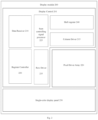
  • FIG. 1 is a schematic block diagram of an exemplary micro display control system for an LED display device, according to an exemplary embodiment of the present disclosure.
  • FIG. 2 is a schematic block diagram of a display module of the micro display control system, according to an exemplary embodiment of the present disclosure.
  • FIG. 3 is a schematic block diagram of an image merger of the micro display control system, according to an exemplary embodiment of the present disclosure.
  • a conventional LED back plane system for wearable devices is bulky and introduces energy loss into LED systems.
  • the conventional LED back plane system is not suitable for wearable devices because a wearable device requires the system to be relatively small in size, to produce sufficient brightness and contrast for a user, to be energy efficient, and to provide a sufficient refresh-rate for the screen.
  • a micro LED back plane system includes an LED array suitable for wearable devices and a combination of a data processor and color display panel that is smaller in size. This ensures the micro LED display system can be smaller in size than a conventional LED display, produce steady light with sufficient brightness and contrast, be energy efficient, and provide a sufficient refresh-rate for the screen.
  • Some embodiments consistent with the present disclosure include a micro display controlling system, including a data interface, a data decoder, a memory-write controller, a frame-memory controller, at least one color-display panels, a data processor, a data output interface, and at least one sensor.
  • a micro display device applying micro display controlling system generates an image with better contrast, within shorter response times, with more energy efficiency, and with a higher refresh-rate.
  • a display module includes a display control, a pixel driver array, and a single-color display panel.
  • the display control includes a data receiver, a scan controlling signal processor, a shift register, a register controller, a row driver, and a column driver.
  • the micro display controlling system consistent with disclosed embodiments is capable of overcoming the drawbacks of conventional micro display controlling systems, including micro LED controlling systems.
  • FIG. 1 is a schematic block diagram of an exemplary micro display controlling system 100 for an LED display device consistent with embodiments of the present disclosure.
  • the micro display controlling system 100 includes a data interface 101 and a data decoder 105 .
  • the data interface 101 and the data decoder 105 can both be provided as information exchange or decoding components such as installed software, internal hardware, or a peripheral device.
  • the micro display controlling system 100 further includes a memory-write controller 130 coupled to the data decoder 105 .
  • the micro display controlling system 100 also includes a register controller 115 and a frame-memory controller 110 .
  • the register controller 115 is coupled between the data decoder 105 and the memory-write controller 130 .
  • the frame-memory controller 110 includes frame memories 111 , 112 , and 113 .
  • the memory-write controller 130 , the register controller 115 , and the frame-memory controller 110 are provided as a portion of a random-access memory (“RAM”) of the micro display controlling system 100 .
  • RAM random-access memory
  • the micro display controlling system 100 further includes a data processor 140 .
  • the data processor 140 includes data processing and formatting modules 141 , 142 , and 143 .
  • the data processor 140 is coupled to the frame-memory controller 110 .
  • the frame memories 111 , 112 , and 113 of the frame-memory controller 110 are coupled to the data processing and formatting modules 141 , 142 , and 143 of the data processor 140 , respectively.
  • the data processor 140 as well as the data processing and formatting modules 141 , 142 , and 143 , are installed with programs capable of conducting image processing.
  • the micro display controlling system 100 also includes a panel timing and synchronization control module 120 coupled between the register controller 115 and the data processor 140 .
  • the panel timing and synchronization control module 120 is provided as a portion of the RAM of the micro display controlling system 100 .
  • the micro display controlling system 100 also includes a data output interface 150 .
  • the data output interface 150 is coupled to the data processor 140 .
  • the data output interface 150 further includes sub-output interfaces 151 , 152 , and 153 .
  • the data output interface 150 as well as the sub-output interfaces 151 , 152 , and 153 , can be provided as an information exchange component such as installed software, internal hardware, or a peripheral device.
  • the micro display controlling system 100 also includes a color-display panel 160 coupled to the data output interface 150 .
  • the color-display panel 160 further includes single-color display modules 161 , 162 , and 163 .
  • the color-display panel 160 , as well as the display modules 161 , 162 , and 163 can be LED display systems provided as sets of integrated LED circuits, chips, microchips, screens, or other electronic components or devices configurable to display graphical and frame data.
  • the micro display controlling system 100 further includes one or more sensors 145 .
  • the one or more sensors 145 include a temperature sensor configured to detect temperature of the micro display controlling system 100 .
  • Each such temperature sensor detects and monitors temperature of the micro display controlling system 100 and provide the detected temperature value to a general purpose computer to which the micro display controlling system 100 is coupled.
  • the general purpose computer can shut down power if the temperature of the micro display controlling system 100 reaches a threshold value, such as 80 degree Celsius, or any temperature that is preset by the user, the manufacture, or that meets industrial standards of LED system manufacture.
  • the data interface 101 is configured to receive and provide data for the micro display controlling system 100 . Specifically, the data interface 101 receives raw image data, converts the raw image data it receives into frame data, and provides the frame data to the data decoder 105 .
  • the data interface 101 receives image data input from an image data providing electronic device inside or outside of the micro display controlling system 100 .
  • the data interface 101 may receive raw image data, pre-processed frame data, or both, from a ROM, a hard drive, or from a peripheral device such as a camera, a video recording device, a portable driver, a USB driver, a touch screen, or other device generating raw image data.
  • the raw image data can be raster graphics data, vector image data, video data, or other forms of image data that are currently, or may become, available.
  • the data interface 101 connects with an external data-providing device through a physical connection, such as through an electronic cable.
  • the data interface 101 connects with the peripheral device wirelessly, such as through a Wi-Fi or a BLUETOOTHTM connection.
  • the data interface 101 processes the received raw image data to produce sets of corresponding frame data.
  • the data interface 101 stores decoding software and includes a processor that executes the software to process the raw image data.
  • the data interface 101 is coupled to the data decoder 105 . More specifically, when the image data is in video format, the data interface 101 provides the image data to data decoder 105 .
  • the data decoder 105 includes decoding software/hardware or other software/hardware that are currently available or may become available, to process the image data and provides the processed image data as frame data.
  • the data decoder 105 samples the video format image data, e.g., using a periodic sampling method, and creates sets of graphic format data and clock signal data corresponding to the video format image data.
  • the sampling interval is equal to or less than 1/24 second.
  • the sampling method can be interpolation, polling, convolution, deconvolution, or other methods of video format image data sampling that are currently, or may become, available. More specifically, when the raw image data is vector graphic data, the data decoder 105 converts the sets of vector graphic data into sets of raster graphic image data, or an LED-display-friendly dot matrix data structure that is currently, or may become, available.
  • the data decoder 105 outputs the processed frame image data in a form suitable for LED display.
  • the data decoder 105 further provides and stores, in decoder 105 , the processed frame data as at least two single-color data frames, each single-color data frame corresponds to a color channel.
  • the single-color data frame is provided as three single-color channels, i.e. a red color channel, a green color channel, and a blue color channel, commonly known as the RGB layers or RGB channels.
  • Each pixel of the processed frame data is provided as a pixel data point that includes three 8-bit color scale values (i.e.
  • each frame of the processed frame data is stored as one multi-dimensional matrix including the pixel data points of each pixel of the processed frame data.
  • the raw image such as a video clip, usually is large in size and cannot be displayed efficiently on a micro LED display on a smart wearable device.
  • the processed frame data is smaller in size and more suitable for micro LED display on a smart wearable device to process and to display.
  • the at least two single-color data frames are captured or provided by the data interface 101 .
  • an image enhancer 125 coupled to the data interface 101 , produces luminance adjustment data by processing the frame data received from data interface 101 pixel by pixel.
  • the image enhancer 125 stores luminance adjustment software and includes a processor that executes the software to process the frame data.
  • the processing by the image enhancer 125 includes brightening or dimming certain pixels by increasing or decreasing luminance of that pixel.
  • the change of pixel luminance is stored as the luminance adjustment data.
  • the image enhancer 125 transmits the luminance adjustment data to a data processor 140 .
  • the at least two single-color data frame is provided as CMY (i.e. cyan, magenta, and yellow) layers/channels, YUV (luminance, chrominance, and chroma) layers/channels, HSV (hue saturation value) layers/channels, or other color layers/channels that are currently available or may become available, to process the frame data and provide the processed frame image data as multiple layers/channels.
  • CMY i.e. cyan, magenta, and yellow
  • YUV luminance, chrominance, and chroma
  • HSV hue saturation value
  • a color channel is also referred to as a raster band.
  • the data decoder 105 further transmits the single-color data frames to the memory-write controller 130 .
  • the memory-write controller 130 receives frame data from the data decoder 105 one frame at a time. In some embodiments, the memory-write controller 130 receives the at least two single-color data frames in chronological order. In some other embodiments, the memory-write controller 130 receives the at least two single-color data frames in the order that the frame data is stored in a storage medium connected to the data decoder 105 . More specifically, the frame data received by the memory-write controller 130 can be frame data converted from raw image data by the data decoder 105 , or image data received by the data decoder 105 in frame data format. In some embodiments, the data interface 101 directly connects to the memory-write controller 130 .
  • the memory-write controller 130 includes an image enhancement component.
  • the image enhancement component is programmed to process the frame data received from the data decoder 105 .
  • the programming causes the image enhancement component to accentuate, or sharpen, image features of the image represented by the raw image data, such as edges of a specific shape in the image, boundaries between different areas in the image, or color contrast, not only to restore lost graphical information and remove graphical noise created during the process of raw data converting to frame data, but also to format the graphic display to be more suitable for LED display.
  • the image enhancement component is a chip, a microprocessor, or a graphic processing unit (“GPU”) that is programmed to perform the image enhancement.
  • memory-write controller 130 receives the at least two single-color data frames, such as the three single-color (red, green, and blue) data frames, from data decoder 105 . In some embodiments, the memory-write controller 130 outputs the single-color data frames to the frame-memory controller 110 , one by one.
  • the frame-memory controller 110 receives the three single-color data frames and provides to each one of the frame memories 111 , 112 , and 113 a different one of the single-color data frames.
  • the data processor 140 coupled to the frame-memory controller 110 , receives the single-color data frames from the frame-memory controller 110 . More specifically, in the embodiment depicted in FIG. 1 , three data formatting processors 141 , 142 , and 143 of the data processor 140 , are coupled to receive from the frame memories 111 , 112 , and 113 of the frame-memory controller 110 , respectively, the single-color data frames.
  • the data processing and formatting modules 141 , 142 , and 143 are each programmed to process the received single-color data frames and create a display panel controlling signal to transmit to the data output interface 150 .
  • the frame-memory controller 110 receives the three single-color data frames and provides the single-color data frames only to the frame memories 111 and 112 .
  • the data formatting processors 141 , 142 , and 143 of the data processor 140 are coupled to receive from the frame memories 111 and 112 of the frame-memory controller 110 , respectively, the three single-color data frames.
  • the data output interface 150 includes three sub-output interface 151 , 152 , and 153 , each coupled to receive the single-color data frames from one of the three data processing and formatting modules 141 , 142 , and 143 , respectively.
  • the data processor 140 outputs the processed single-color data frames so that the single-color data frames can more accurately reflect the chronological order of each frame.
  • the data decoder 105 further provides the clock signal data corresponding to the video format image data to the register controller 115 .
  • the clock signal data is time series data generated by the data decoder 105 according to the time features of each frame in the raw image data.
  • the register controller 115 provides the clock signal data to the panel timing and synchronization controller 120 .
  • the panel timing and synchronization controller 120 coupled to the data processor 140 and to the data output 150 , includes a processor and is configured to synchronize time features, such as chronological order and time interval features among frames, of the processed single-color data frames stored in data processor 140 and the data output interface 150 with the clock signal data.
  • time features such as chronological order and time interval features among frames
  • the panel timing and synchronization control module 120 By comparing the stored frame data to the clock signal data of the raw image data, the panel timing and synchronization control module 120 generates a panel controlling signal to sort the processed and stored image represented by the frame data, so that the frame data can better represent the time features in the raw image data, when displayed on the LED display.
  • the color-display panel 160 coupled to the data output interface 150 , includes three display modules 161 , 162 , and 163 .
  • the display modules 161 , 162 , and 163 of the color-display panel 160 each couple to and receive the single-color data frames from each one of the three sub-output interfaces 151 , 152 , and 153 , respectively.
  • each one of the display modules 161 , 162 , and 163 comprises a display module as, for example, depicted in FIG. 2 and described more fully below.
  • FIG. 2 is a schematic block diagram of an exemplary display module 200 , consistent with embodiments of the present disclosure.
  • the display module 200 includes a display control 201 .
  • the display control 201 is coupled to a pixel driver array 220 and at least one single-color display panel 250 , and is provided as an internal memory chip or circuit.
  • the display control 201 further includes a data receiver 210 , a column driver 215 , a scan controlling signal processor 225 , a register controller 230 , a row driver 235 , and a shift register 240 .
  • the data receiver 210 is coupled to the output interface 150 ( FIG. 1 ) and receives a color layer of the processed single-color data frames from the output interface 150 .
  • the scan controlling signal processor 225 , the shift register 240 , and the register controller 230 are coupled to the data receiver 210 .
  • the row driver 235 and the column driver 215 are both coupled to the scan controlling signal processor 225 and the shift register controller 230 .
  • the pixel driver array 220 can be provided as a circuit, a chip, a microchip, or other electronic components or devices configurable to control pixels of an LED display.
  • the single-color display panel 250 can be provided as sets of integrated LED circuits, chips, microchips, screens, or other optical or electronic components or devices configurable to display graphical and frame data.
  • the display control 201 is configured to receive and provide processed frame data for the display module 200 .
  • the data receiver 210 receives processed frame data from one of the sub-output interfaces 151 , 152 , and 153 of the data output 150 .
  • the data receiver 210 further receives the panel controlling signal, generated by the panel timing and synchronization control module 120 , from the same one of the sub-output interfaces.
  • the scan controlling signal processor 225 receives the processed, single-color data frame from one of the sub-output interfaces 151 , 152 , and 153 of the output interface 150 .
  • the scan controlling signal processor 225 further generates the single-color data frames as a column controlling signal and a row controlling signal.
  • the scan controlling signal processor 225 further provides the column controlling signal to the column driver 215 and provides the row controlling signal to the row driver 235 .
  • the shift register 240 receives single-color data frames from the data receiver 210 .
  • the shift register 240 provides the received single-color data frame to the row driver 235 and the column driver 215 .
  • the register controller 230 coupled to the data receiver 210 , receives both the one-color frame data and the panel controlling data generated by the panel timing and synchronization control module 120 .
  • the register controller 230 is programmed to compare and update the time feature of the single-color data frames, such as the chronological order and the time interval among frames, with the clock signal data collected by the first register controller 115 .
  • the register controller 230 is programmed to compare and update the time feature of the single-color data frames with the panel controlling signal received from the display control 201 .
  • the register controller 230 produces the time-feature updated frame data by processing the frame data pixel by pixel.
  • the processing by the register controller 230 includes adding or subtracting certain values to the specific frame according to the clock signal data or the panel controlling signal.
  • the column driver 215 as well as the row driver 235 , are coupled to both the scan controlling signal processor 225 and the shift register 240 .
  • the column driver 215 receives the column controlling signal from the scan controlling signal processor 225 .
  • the row driver 235 receives the row controlling signal from the scan controlling signal processor 225 .
  • the column driver 215 being coupled to the pixel driver array 220 , controls image display by controlling pixel scanning by column.
  • the row driver 235 being coupled to the pixel driver array 220 , controls the image display by controlling pixel scanning by row.
  • the pixel driver array 220 receives frame data from the column driver 215 and the row driver 235 , together or separately.
  • the pixel driver array 220 is an integrated LED circuit.
  • the pixel driver array 220 is further configured to control the single-color display panel 250 .
  • the single-color display panel 250 is further configured so that multiple single-color display panel 250 can be formed as an LED display device, for example, the color display panel 160 in FIG. 1 .
  • the color-display panel 160 includes an image merger 300 configured to merge the at least two single-color data frames and create multi-color frame data suitable for display on the color-display panel 160 .
  • FIG. 3 is a schematic block diagram of an exemplary image merger 300 , consistent with embodiments of the present disclosure.
  • the image merger is provided as an optical image merger such as a square-shaped light combining prism 305 .
  • Each display modules 161 , 162 , and 163 through the respective single-color display panels 250 , configured to emit single-color LED lights, provides the respective single-color data frames toward the square-shaped light combining prism 305 as three single-color frame images.
  • the light combining prism 305 directs and projects the three single-color images toward the same direction, i.e., toward a screen of the color-display panel 160 , combining the three single-color images as a multi-color image suitable for display.
  • the color-display panel 160 includes an optical magnifier 310 configured to magnify the multi-color images so that the multi-color image is more suitable for display.
  • the image merger is provided as a digital frame data merger configured to receive the at least two single-color data frames from the data output interface 150 and combine the single-color data frames as multi-color frame data.
  • multiple display module 200 depicted in FIG. 2 can be configured to form the color-display panel 160 depicted in FIG. 1 .

Landscapes

  • Engineering & Computer Science (AREA)
  • Theoretical Computer Science (AREA)
  • Physics & Mathematics (AREA)
  • General Physics & Mathematics (AREA)
  • Computer Hardware Design (AREA)
  • Multimedia (AREA)
  • Human Computer Interaction (AREA)
  • General Engineering & Computer Science (AREA)
  • Control Of Indicators Other Than Cathode Ray Tubes (AREA)
  • Control Of El Displays (AREA)
  • Image Processing (AREA)
  • Led Device Packages (AREA)

Abstract

A micro display controlling system includes a data interface, a data decoder, a memory-write controller, a frame-memory controller including at least two frame memories, at least one color-display panel, a data processor including at least two data formatting processors, and a data output interface including at least two sub-output interfaces.

Description

CROSS-REFERENCE TO RELATED APPLICATION
This is a continuation application of International Application No. PCT/CN2021/119347, filed Sep. 18, 2021.
DESCRIPTION Technology Field
The disclosure relates to a micro display controlling system.
Background
A light emitting diode (LED), which is a kind of semiconductor diode, can convert electrical energy into optical energy, and emit light in a different gray scale depending on a material of a light emitting layer included in the LED.
Digital display technology has become one of the largest branches in the field of modern electronics and optoelectronics and generates demands in various applications where an image forming function is needed. Among those applications, a micro-LED display, which has the potential of generating an image with better contrast, within shorter response times, with more energy efficiency, and with higher refresh rate is of interest.
Nowadays, wearable devices, including smart wearable devices, sometimes require a mini display screen on the device. Compared to traditional electronic devices having a screen, these smart wearable devices (such as, a smart watch, a smart phone, an augmented reality headset, etc.) require the screen to be smaller in size, to respond to a user's control more quickly, to use as little energy as possible, and to provide a higher refresh rate so that the device does not emit excessive heat, can last longer, and can produce better quality images. Therefore, a high-contrast, quick-response, energy-efficient, and higher refresh rate screen for wearable devices is in demand.
In an LED system, a back plane and power source combination determines size, brightness and contrast, and energy efficiency of the LED system. In a conventional LED system, the back plane and power source combination is bulky and introduces energy loss into the system, which may cause the LED system to not provide sufficient brightness and contrast or refresh rate. Such a system is not suitable for wearable devices because of these deficiencies. An improved LED system for wearable devices is needed.
SUMMARY
In accordance with present disclosure, there is provided a micro display controlling system. The system includes a data interface configured to provide image data; a data decoder, coupled to the data interface, to receive and decode the image data as single-color data frame; a memory-write controller configured to receive and restore the frame data from the data decoder; a frame-memory controller, including at least two frame memories, each configured to receive a different one of the single-color data frame from the memory-write controller, wherein a first frame memory configured to receive and store, from the memory-write controller, a first single-color data frame corresponding to a first color, and a second frame memory configured to received and store, from the memory-write controller, a second single-color data frame corresponding to a second color; at least one color-display panel; a data processor, including at least two data formatting processors, each data formatting processor is further configured to process the single-color data frame and provide a panel controlling signal and processed frame data, wherein each panel controlling signal is configured to control the color-display panel; and a data output interface, comprising at least two sub-output interfaces, each coupled to one of the data formatting processors, wherein the data formatting processors provides the panel controlling signal and the processed frame data to the output interface, the output interface further providing the panel controlling signal and the processed frame data to the color display panel. In certain embodiment, the number of the data formatting processors is the same as the number of the frame memories.
BRIEF DESCRIPTION OF THE DRAWINGS
FIG. 1 is a schematic block diagram of an exemplary micro display control system for an LED display device, according to an exemplary embodiment of the present disclosure.
FIG. 2 is a schematic block diagram of a display module of the micro display control system, according to an exemplary embodiment of the present disclosure.
FIG. 3 is a schematic block diagram of an image merger of the micro display control system, according to an exemplary embodiment of the present disclosure.
DESCRIPTION OF THE EMBODIMENTS
Hereinafter, embodiments consistent with the disclosure will be described with reference to the drawings. Wherever possible, the same reference numbers will be used throughout the drawings to refer to the same or like parts.
As discussed above, a conventional LED back plane system for wearable devices is bulky and introduces energy loss into LED systems. As a result, the conventional LED back plane system is not suitable for wearable devices because a wearable device requires the system to be relatively small in size, to produce sufficient brightness and contrast for a user, to be energy efficient, and to provide a sufficient refresh-rate for the screen.
Consistent with embodiments of the present disclosure, a micro LED back plane system includes an LED array suitable for wearable devices and a combination of a data processor and color display panel that is smaller in size. This ensures the micro LED display system can be smaller in size than a conventional LED display, produce steady light with sufficient brightness and contrast, be energy efficient, and provide a sufficient refresh-rate for the screen.
Some embodiments consistent with the present disclosure include a micro display controlling system, including a data interface, a data decoder, a memory-write controller, a frame-memory controller, at least one color-display panels, a data processor, a data output interface, and at least one sensor. A micro display device applying micro display controlling system generates an image with better contrast, within shorter response times, with more energy efficiency, and with a higher refresh-rate. A display module includes a display control, a pixel driver array, and a single-color display panel. Consistent with some embodiments, the display control includes a data receiver, a scan controlling signal processor, a shift register, a register controller, a row driver, and a column driver. The micro display controlling system consistent with disclosed embodiments is capable of overcoming the drawbacks of conventional micro display controlling systems, including micro LED controlling systems.
FIG. 1 is a schematic block diagram of an exemplary micro display controlling system 100 for an LED display device consistent with embodiments of the present disclosure. The micro display controlling system 100 includes a data interface 101 and a data decoder 105. In some embodiments, the data interface 101 and the data decoder 105 can both be provided as information exchange or decoding components such as installed software, internal hardware, or a peripheral device. The micro display controlling system 100 further includes a memory-write controller 130 coupled to the data decoder 105. The micro display controlling system 100 also includes a register controller 115 and a frame-memory controller 110. The register controller 115 is coupled between the data decoder 105 and the memory-write controller 130. The frame-memory controller 110 includes frame memories 111, 112, and 113. In some embodiments, the memory-write controller 130, the register controller 115, and the frame-memory controller 110 are provided as a portion of a random-access memory (“RAM”) of the micro display controlling system 100.
The micro display controlling system 100 further includes a data processor 140. The data processor 140 includes data processing and formatting modules 141, 142, and 143. The data processor 140 is coupled to the frame-memory controller 110. The frame memories 111, 112, and 113 of the frame-memory controller 110 are coupled to the data processing and formatting modules 141, 142, and 143 of the data processor 140, respectively. In some embodiment, the data processor 140, as well as the data processing and formatting modules 141, 142, and 143, are installed with programs capable of conducting image processing.
The micro display controlling system 100 also includes a panel timing and synchronization control module 120 coupled between the register controller 115 and the data processor 140. In some embodiments, the panel timing and synchronization control module 120 is provided as a portion of the RAM of the micro display controlling system 100. The micro display controlling system 100 also includes a data output interface 150. The data output interface 150 is coupled to the data processor 140. The data output interface 150 further includes sub-output interfaces 151, 152, and 153. In some embodiments, the data output interface 150, as well as the sub-output interfaces 151, 152, and 153, can be provided as an information exchange component such as installed software, internal hardware, or a peripheral device.
The micro display controlling system 100 also includes a color-display panel 160 coupled to the data output interface 150. The color-display panel 160 further includes single- color display modules 161, 162, and 163. In some embodiments, the color-display panel 160, as well as the display modules 161, 162, and 163 can be LED display systems provided as sets of integrated LED circuits, chips, microchips, screens, or other electronic components or devices configurable to display graphical and frame data.
The micro display controlling system 100 further includes one or more sensors 145. In some embodiments, the one or more sensors 145 include a temperature sensor configured to detect temperature of the micro display controlling system 100. Each such temperature sensor detects and monitors temperature of the micro display controlling system 100 and provide the detected temperature value to a general purpose computer to which the micro display controlling system 100 is coupled. The general purpose computer can shut down power if the temperature of the micro display controlling system 100 reaches a threshold value, such as 80 degree Celsius, or any temperature that is preset by the user, the manufacture, or that meets industrial standards of LED system manufacture.
Consistent with the present disclosure, the data interface 101 is configured to receive and provide data for the micro display controlling system 100. Specifically, the data interface 101 receives raw image data, converts the raw image data it receives into frame data, and provides the frame data to the data decoder 105.
In some embodiments, the data interface 101 receives image data input from an image data providing electronic device inside or outside of the micro display controlling system 100. For example, the data interface 101 may receive raw image data, pre-processed frame data, or both, from a ROM, a hard drive, or from a peripheral device such as a camera, a video recording device, a portable driver, a USB driver, a touch screen, or other device generating raw image data. The raw image data can be raster graphics data, vector image data, video data, or other forms of image data that are currently, or may become, available. In some embodiments, the data interface 101 connects with an external data-providing device through a physical connection, such as through an electronic cable. In some embodiments, the data interface 101 connects with the peripheral device wirelessly, such as through a Wi-Fi or a BLUETOOTH™ connection. In some embodiments, the data interface 101 processes the received raw image data to produce sets of corresponding frame data. In some embodiments, the data interface 101 stores decoding software and includes a processor that executes the software to process the raw image data. In some embodiments, the data interface 101 is coupled to the data decoder 105. More specifically, when the image data is in video format, the data interface 101 provides the image data to data decoder 105. The data decoder 105 includes decoding software/hardware or other software/hardware that are currently available or may become available, to process the image data and provides the processed image data as frame data. In some embodiments, the data decoder 105, samples the video format image data, e.g., using a periodic sampling method, and creates sets of graphic format data and clock signal data corresponding to the video format image data. In some embodiment, the sampling interval is equal to or less than 1/24 second. In some embodiments, the sampling method can be interpolation, polling, convolution, deconvolution, or other methods of video format image data sampling that are currently, or may become, available. More specifically, when the raw image data is vector graphic data, the data decoder 105 converts the sets of vector graphic data into sets of raster graphic image data, or an LED-display-friendly dot matrix data structure that is currently, or may become, available.
In some embodiments, the data decoder 105 outputs the processed frame image data in a form suitable for LED display. For example, in some embodiments, the data decoder 105 further provides and stores, in decoder 105, the processed frame data as at least two single-color data frames, each single-color data frame corresponds to a color channel. In some embodiments, the single-color data frame is provided as three single-color channels, i.e. a red color channel, a green color channel, and a blue color channel, commonly known as the RGB layers or RGB channels. Each pixel of the processed frame data is provided as a pixel data point that includes three 8-bit color scale values (i.e. a red scale value, a green scale value, and a blue scale value) and each value corresponds to the color scale value of the pixel in one of the three (RGB) color channels/layers. In some embodiments, each frame of the processed frame data is stored as one multi-dimensional matrix including the pixel data points of each pixel of the processed frame data. The raw image, such as a video clip, usually is large in size and cannot be displayed efficiently on a micro LED display on a smart wearable device. By providing the raw image data as multi-layer single-color data frame, such as the RGB layers, the processed frame data is smaller in size and more suitable for micro LED display on a smart wearable device to process and to display.
In some embodiments, the at least two single-color data frames are captured or provided by the data interface 101. In some embodiments, an image enhancer 125, coupled to the data interface 101, produces luminance adjustment data by processing the frame data received from data interface 101 pixel by pixel. In some embodiments, the image enhancer 125 stores luminance adjustment software and includes a processor that executes the software to process the frame data. The processing by the image enhancer 125, in some embodiments, includes brightening or dimming certain pixels by increasing or decreasing luminance of that pixel. The change of pixel luminance is stored as the luminance adjustment data. The image enhancer 125 transmits the luminance adjustment data to a data processor 140.
In some embodiments, the at least two single-color data frame is provided as CMY (i.e. cyan, magenta, and yellow) layers/channels, YUV (luminance, chrominance, and chroma) layers/channels, HSV (hue saturation value) layers/channels, or other color layers/channels that are currently available or may become available, to process the frame data and provide the processed frame image data as multiple layers/channels. In some embodiments, a color channel is also referred to as a raster band. In some embodiments, the data decoder 105 further transmits the single-color data frames to the memory-write controller 130.
More particularly, in some embodiments, the memory-write controller 130 receives frame data from the data decoder 105 one frame at a time. In some embodiments, the memory-write controller 130 receives the at least two single-color data frames in chronological order. In some other embodiments, the memory-write controller 130 receives the at least two single-color data frames in the order that the frame data is stored in a storage medium connected to the data decoder 105. More specifically, the frame data received by the memory-write controller 130 can be frame data converted from raw image data by the data decoder 105, or image data received by the data decoder 105 in frame data format. In some embodiments, the data interface 101 directly connects to the memory-write controller 130.
Still with reference to FIG. 1 , in some embodiments, the memory-write controller 130 includes an image enhancement component. The image enhancement component is programmed to process the frame data received from the data decoder 105. In some embodiments, the programming causes the image enhancement component to accentuate, or sharpen, image features of the image represented by the raw image data, such as edges of a specific shape in the image, boundaries between different areas in the image, or color contrast, not only to restore lost graphical information and remove graphical noise created during the process of raw data converting to frame data, but also to format the graphic display to be more suitable for LED display. In some embodiments, the image enhancement component is a chip, a microprocessor, or a graphic processing unit (“GPU”) that is programmed to perform the image enhancement.
In some embodiments, memory-write controller 130 receives the at least two single-color data frames, such as the three single-color (red, green, and blue) data frames, from data decoder 105. In some embodiments, the memory-write controller 130 outputs the single-color data frames to the frame-memory controller 110, one by one.
In the embodiment depicted in FIG. 1 , the frame-memory controller 110 receives the three single-color data frames and provides to each one of the frame memories 111, 112, and 113 a different one of the single-color data frames.
Consistent with the present disclosure, the data processor 140, coupled to the frame-memory controller 110, receives the single-color data frames from the frame-memory controller 110. More specifically, in the embodiment depicted in FIG. 1 , three data formatting processors 141, 142, and 143 of the data processor 140, are coupled to receive from the frame memories 111, 112, and 113 of the frame-memory controller 110, respectively, the single-color data frames. The data processing and formatting modules 141, 142, and 143 are each programmed to process the received single-color data frames and create a display panel controlling signal to transmit to the data output interface 150.
In some embodiments not shown in the figures, the frame-memory controller 110 receives the three single-color data frames and provides the single-color data frames only to the frame memories 111 and 112. The data formatting processors 141, 142, and 143 of the data processor 140, are coupled to receive from the frame memories 111 and 112 of the frame-memory controller 110, respectively, the three single-color data frames.
In the embodiment depicted in FIG. 1 , the data output interface 150 includes three sub-output interface 151, 152, and 153, each coupled to receive the single-color data frames from one of the three data processing and formatting modules 141, 142, and 143, respectively.
In some embodiments, the data processor 140 outputs the processed single-color data frames so that the single-color data frames can more accurately reflect the chronological order of each frame. In some embodiments, the data decoder 105 further provides the clock signal data corresponding to the video format image data to the register controller 115. The clock signal data is time series data generated by the data decoder 105 according to the time features of each frame in the raw image data. When the frame-memory controller 110 and the data processor 140 process and store the single-color data frames, some frames or some features may be lost during the process, such as chronological order and time interval features among frames. The register controller 115 provides the clock signal data to the panel timing and synchronization controller 120. The panel timing and synchronization controller 120, coupled to the data processor 140 and to the data output 150, includes a processor and is configured to synchronize time features, such as chronological order and time interval features among frames, of the processed single-color data frames stored in data processor 140 and the data output interface 150 with the clock signal data. By comparing the stored frame data to the clock signal data of the raw image data, the panel timing and synchronization control module 120 generates a panel controlling signal to sort the processed and stored image represented by the frame data, so that the frame data can better represent the time features in the raw image data, when displayed on the LED display.
In the embodiment depicted in FIG. 1 , the color-display panel 160, coupled to the data output interface 150, includes three display modules 161, 162, and 163. The display modules 161, 162, and 163 of the color-display panel 160 each couple to and receive the single-color data frames from each one of the three sub-output interfaces 151, 152, and 153, respectively. In some embodiment, each one of the display modules 161, 162, and 163 comprises a display module as, for example, depicted in FIG. 2 and described more fully below.
FIG. 2 is a schematic block diagram of an exemplary display module 200, consistent with embodiments of the present disclosure. The display module 200 includes a display control 201. In some embodiments, the display control 201 is coupled to a pixel driver array 220 and at least one single-color display panel 250, and is provided as an internal memory chip or circuit. The display control 201 further includes a data receiver 210, a column driver 215, a scan controlling signal processor 225, a register controller 230, a row driver 235, and a shift register 240. The data receiver 210 is coupled to the output interface 150 (FIG. 1 ) and receives a color layer of the processed single-color data frames from the output interface 150. The scan controlling signal processor 225, the shift register 240, and the register controller 230 are coupled to the data receiver 210. The row driver 235 and the column driver 215 are both coupled to the scan controlling signal processor 225 and the shift register controller 230. The pixel driver array 220 can be provided as a circuit, a chip, a microchip, or other electronic components or devices configurable to control pixels of an LED display. The single-color display panel 250 can be provided as sets of integrated LED circuits, chips, microchips, screens, or other optical or electronic components or devices configurable to display graphical and frame data.
Consistent with the present disclosure, the display control 201 is configured to receive and provide processed frame data for the display module 200. In the embodiment depicted in FIG. 1 , the data receiver 210 receives processed frame data from one of the sub-output interfaces 151, 152, and 153 of the data output 150. In some embodiments, the data receiver 210 further receives the panel controlling signal, generated by the panel timing and synchronization control module 120, from the same one of the sub-output interfaces.
In some embodiments, the scan controlling signal processor 225 receives the processed, single-color data frame from one of the sub-output interfaces 151, 152, and 153 of the output interface 150. The scan controlling signal processor 225 further generates the single-color data frames as a column controlling signal and a row controlling signal. The scan controlling signal processor 225 further provides the column controlling signal to the column driver 215 and provides the row controlling signal to the row driver 235.
In some embodiments, the shift register 240 receives single-color data frames from the data receiver 210. The shift register 240 provides the received single-color data frame to the row driver 235 and the column driver 215. The register controller 230, coupled to the data receiver 210, receives both the one-color frame data and the panel controlling data generated by the panel timing and synchronization control module 120. In some embodiments, the register controller 230 is programmed to compare and update the time feature of the single-color data frames, such as the chronological order and the time interval among frames, with the clock signal data collected by the first register controller 115. In some embodiment, the register controller 230 is programmed to compare and update the time feature of the single-color data frames with the panel controlling signal received from the display control 201. In some embodiments, the register controller 230 produces the time-feature updated frame data by processing the frame data pixel by pixel. The processing by the register controller 230, in some embodiments, includes adding or subtracting certain values to the specific frame according to the clock signal data or the panel controlling signal.
In some embodiments, the column driver 215, as well as the row driver 235, are coupled to both the scan controlling signal processor 225 and the shift register 240. The column driver 215 receives the column controlling signal from the scan controlling signal processor 225. The row driver 235 receives the row controlling signal from the scan controlling signal processor 225.
Consistent with the present disclosure, the column driver 215, being coupled to the pixel driver array 220, controls image display by controlling pixel scanning by column. The row driver 235, being coupled to the pixel driver array 220, controls the image display by controlling pixel scanning by row. The pixel driver array 220 receives frame data from the column driver 215 and the row driver 235, together or separately. In some embodiments, the pixel driver array 220 is an integrated LED circuit.
In some embodiment, the pixel driver array 220 is further configured to control the single-color display panel 250. The single-color display panel 250 is further configured so that multiple single-color display panel 250 can be formed as an LED display device, for example, the color display panel 160 in FIG. 1 . In some embodiments, the color-display panel 160 includes an image merger 300 configured to merge the at least two single-color data frames and create multi-color frame data suitable for display on the color-display panel 160.
FIG. 3 is a schematic block diagram of an exemplary image merger 300, consistent with embodiments of the present disclosure. In some embodiments, the image merger is provided as an optical image merger such as a square-shaped light combining prism 305. Each display modules 161, 162, and 163, through the respective single-color display panels 250, configured to emit single-color LED lights, provides the respective single-color data frames toward the square-shaped light combining prism 305 as three single-color frame images. The light combining prism 305 directs and projects the three single-color images toward the same direction, i.e., toward a screen of the color-display panel 160, combining the three single-color images as a multi-color image suitable for display. In some further embodiments, the color-display panel 160 includes an optical magnifier 310 configured to magnify the multi-color images so that the multi-color image is more suitable for display.
In some embodiments not shown in the figures, the image merger is provided as a digital frame data merger configured to receive the at least two single-color data frames from the data output interface 150 and combine the single-color data frames as multi-color frame data.
In some embodiments, multiple display module 200 depicted in FIG. 2 can be configured to form the color-display panel 160 depicted in FIG. 1 .
Other embodiments of the disclosure will be apparent to those skilled in the art from consideration of the specification and practice of the invention disclosed herein. It is intended that the specification and examples be considered as exemplary only, with a true scope and spirit of the invention being indicated by the following claims.

Claims (10)

What is claimed is:
1. A micro display controlling system, comprising:
a data interface configured to provide image data;
a data decoder, coupled to the data interface, to receive and decode the image data as single-color data frame;
a memory-write controller configured to receive and restore the frame data from the data decoder;
a frame-memory controller, comprising:
at least two frame memories, each configured to receive a different one of the single-color data frames from the memory-write controller, wherein a first frame memory configured to receive and store, from the memory-write controller, a first single-color data frame corresponding to a first color, and a second frame memory configured to received and store, from the memory-write controller, a second single-color data frame corresponding to a second color;
at least one color-display panel;
a data processor, comprising:
at least two data formatting processors, each data formatting processor is further configured to process the single-color data frame and provides a panel controlling signal and processed frame data, wherein each panel controlling signal is configured to control the color-display panel; and
a data output interface, comprising at least two sub-output interfaces, each coupled to one of the data formatting processors, wherein each of the data formatting processors provides the panel controlling signal and the processed frame data to the output interface, the output interface further providing the panel controlling signal and the processed frame data to the color display panel.
2. The micro display controlling system according to claim 1, further comprising a register controller, coupled to the memory-write controller and the data interface and decoder, the register controller configured to receive clock signal data from the processed frame data.
3. The micro display controlling system according to claim 2, further comprising a panel timing and synchronization controller, coupled to receive the clock signal data from the first register controller, the panel timing and synchronization controller being configured to sort the processed frame data according to the clock signal data.
4. The micro display controlling system according to claim 3, wherein the panel timing and synchronization controller is coupled to the data processer and further configured to provide the processed frame data to the data processor in an order corresponding to the clock signal data.
5. The micro display controlling system according to claim 4, wherein the panel timing and synchronization controller is coupled to the at least one color-display panel and further configured to control data transmit timing of the at least one color-display panel.
6. The micro display controlling system according to claim 1, wherein the number of the data formatting processors is the same as the number of the frame-memories.
7. The micro display controlling system according to claim 1, the at least one color-display panel further comprising at least two display modules, the at least two display modules respectively coupled to the at least two sub-output interfaces, wherein, each of the display modules is further configured to receive the panel controlling signal and the processed frame data from the sub-output interface.
8. The micro display controlling system according to claim 7, the display module further comprising,
a display control, coupled to the sub-output interface, configured to receive the panel controlling signal and the processed frame data from the sub-output interface;
a pixel driver array, coupled to the display control, configured to receive the processed frame data corresponding to the panel controlling signal; and
at least one micro light-emitting diode (LED) light,
wherein the pixel driver array is configured to control the at least one micro LED light in the display panel, corresponding to the processed frame data and the panel controlling signal, to turn the at least one micro LED light on or off.
9. The micro display controlling system according to claim 8, wherein the display control comprising,
a data receiver, coupled to the data output interface, to receive processed frame data from the data output interface;
a scan controlling signal processor, coupled to the data receiver, to receive and convert the processed frame data into a column controlling signal and a row controlling signal;
a shift register coupled to the data receiver to receive processed frame data from the data receiver, the shift register configured to provide the processed frame data to the column driver and the row driver;
a second register controller coupled to the data receiver to receive the processed frame data and the data from the data receiver, the second register controller configured to verify a sort of the processed frame data according to the time series data;
a row driver, coupled to both the scan controlling signal processer and the shift register, configured to receive the row controlling signal and provide a corresponding row pixel signal to the pixel driver array; and
a column driver coupled to both the scan controlling signal processer and the shift register, configured to receive the column controlling signal and provide a correspond column pixel signal to the pixel driver array.
10. The micro display controlling system according to claim 1, wherein, the decoded single-color data frame comprises a single color in red, green, or blue.
US18/605,873 2021-09-18 2024-03-15 Micro display controlling system Active US12223879B2 (en)

Priority Applications (1)

Application Number Priority Date Filing Date Title
US19/048,976 US20250182669A1 (en) 2021-09-18 2025-02-10 Micro display controlling system

Applications Claiming Priority (1)

Application Number Priority Date Filing Date Title
PCT/CN2021/119347 WO2023039885A1 (en) 2021-09-18 2021-09-18 Micro display controlling system

Related Parent Applications (1)

Application Number Title Priority Date Filing Date
PCT/CN2021/119347 Continuation WO2023039885A1 (en) 2021-09-18 2021-09-18 Micro display controlling system

Related Child Applications (1)

Application Number Title Priority Date Filing Date
US19/048,976 Continuation US20250182669A1 (en) 2021-09-18 2025-02-10 Micro display controlling system

Publications (2)

Publication Number Publication Date
US20240221591A1 US20240221591A1 (en) 2024-07-04
US12223879B2 true US12223879B2 (en) 2025-02-11

Family

ID=85602342

Family Applications (2)

Application Number Title Priority Date Filing Date
US18/605,873 Active US12223879B2 (en) 2021-09-18 2024-03-15 Micro display controlling system
US19/048,976 Pending US20250182669A1 (en) 2021-09-18 2025-02-10 Micro display controlling system

Family Applications After (1)

Application Number Title Priority Date Filing Date
US19/048,976 Pending US20250182669A1 (en) 2021-09-18 2025-02-10 Micro display controlling system

Country Status (6)

Country Link
US (2) US12223879B2 (en)
EP (1) EP4416719A1 (en)
JP (1) JP2024536761A (en)
KR (1) KR20240056737A (en)
CN (1) CN118119999A (en)
WO (1) WO2023039885A1 (en)

Citations (5)

* Cited by examiner, † Cited by third party
Publication number Priority date Publication date Assignee Title
JP2005055825A (en) 2003-08-07 2005-03-03 Seiko Epson Corp Image display device, image display method, and image display program
CN102446490A (en) 2012-01-16 2012-05-09 上海大学 Active type low-power-consumption display system of organic light emitting diode
CN105825800A (en) 2015-01-23 2016-08-03 三星电子株式会社 Display controller and semiconductor integrated circuit device including the same
CN109036153A (en) 2017-06-09 2018-12-18 上海君万微电子科技有限公司 The display methods of colored micro-display device and preparation method thereof and color image
CN112567329A (en) 2018-05-24 2021-03-26 复合光子美国公司 System and method for driving a display

Family Cites Families (1)

* Cited by examiner, † Cited by third party
Publication number Priority date Publication date Assignee Title
KR100927724B1 (en) * 2008-03-31 2009-11-18 삼성모바일디스플레이주식회사 Projection-type display device and driving method thereof

Patent Citations (5)

* Cited by examiner, † Cited by third party
Publication number Priority date Publication date Assignee Title
JP2005055825A (en) 2003-08-07 2005-03-03 Seiko Epson Corp Image display device, image display method, and image display program
CN102446490A (en) 2012-01-16 2012-05-09 上海大学 Active type low-power-consumption display system of organic light emitting diode
CN105825800A (en) 2015-01-23 2016-08-03 三星电子株式会社 Display controller and semiconductor integrated circuit device including the same
CN109036153A (en) 2017-06-09 2018-12-18 上海君万微电子科技有限公司 The display methods of colored micro-display device and preparation method thereof and color image
CN112567329A (en) 2018-05-24 2021-03-26 复合光子美国公司 System and method for driving a display

Non-Patent Citations (1)

* Cited by examiner, † Cited by third party
Title
International Search Report and Written Opinion in PCT Application No. PCT/CN2021/119347 dated May 20, 2022.

Also Published As

Publication number Publication date
EP4416719A1 (en) 2024-08-21
KR20240056737A (en) 2024-04-30
US20250182669A1 (en) 2025-06-05
JP2024536761A (en) 2024-10-08
US20240221591A1 (en) 2024-07-04
WO2023039885A1 (en) 2023-03-23
CN118119999A (en) 2024-05-31

Similar Documents

Publication Publication Date Title
CN111295688B (en) Image processing device, image processing method, and computer-readable recording medium
KR20110006112A (en) Apparatus and method for controlling backlight of display panel in camera system
KR20170046498A (en) Method for low-light image quality enhancement of image processing devices and method of operating an image processing system for performing the method
US11735104B2 (en) Electronic display board for controlling 4 way dual scanning in which gray scale pixel (GSP) is applied to dynamic image correction technology (DICT)
KR102421443B1 (en) Display device and operation method of the same
US10650784B2 (en) Display device, television receiver, display method, and recording medium
JP2014059563A (en) Device for controlling operation of organic light-emitting diode display
US20240221629A1 (en) Micro display back plane system and pixel driver controller
US12223879B2 (en) Micro display controlling system
CN116386564B (en) A method for correcting input image data and a light-emitting display device for performing the method.
CN110379364B (en) Brightness adjustment method, device and chip based on display drive
US20230239559A1 (en) Activating light sources for output image
US20160267852A1 (en) Display apparatus for changing color distribution of light generated by display and method thereof
US20040046721A1 (en) Method for driving full-color LED display board
TW202418256A (en) Micro display controlling system
KR20210143972A (en) Local dimming system and method of liquid crystal display device
US12361867B2 (en) Micro display pixel driver controller
US20120062710A1 (en) 3d display apparatus and methods with video processing and frame packing based on display format information
TWI893327B (en) Micro display back plane system and pixel drive controller
JP3725391B2 (en) Video decoding system
KR100771618B1 (en) Color adjustment device and method
US20240244156A1 (en) Display control method, display control device, display apparatus and computer readable medium
JP2022180923A (en) Display device
KR20220032848A (en) Thermal image system and method of processing the image

Legal Events

Date Code Title Description
AS Assignment

Owner name: JADE BIRD DISPLAY (SHANGHAI) LIMITED, CHINA

Free format text: ASSIGNMENT OF ASSIGNORS INTEREST;ASSIGNORS:LI, QIMING;JU, JING;LIU, HONGYUN;AND OTHERS;SIGNING DATES FROM 20240226 TO 20240301;REEL/FRAME:066780/0598

Owner name: JADE BIRD DISPLAY (SHANGHAI) LIMITED, CHINA

Free format text: ASSIGNMENT OF ASSIGNOR'S INTEREST;ASSIGNORS:LI, QIMING;JU, JING;LIU, HONGYUN;AND OTHERS;SIGNING DATES FROM 20240226 TO 20240301;REEL/FRAME:066780/0598

FEPP Fee payment procedure

Free format text: ENTITY STATUS SET TO UNDISCOUNTED (ORIGINAL EVENT CODE: BIG.); ENTITY STATUS OF PATENT OWNER: SMALL ENTITY

FEPP Fee payment procedure

Free format text: ENTITY STATUS SET TO SMALL (ORIGINAL EVENT CODE: SMAL); ENTITY STATUS OF PATENT OWNER: SMALL ENTITY

STPP Information on status: patent application and granting procedure in general

Free format text: DOCKETED NEW CASE - READY FOR EXAMINATION

STPP Information on status: patent application and granting procedure in general

Free format text: NOTICE OF ALLOWANCE MAILED -- APPLICATION RECEIVED IN OFFICE OF PUBLICATIONS

STPP Information on status: patent application and granting procedure in general

Free format text: AWAITING TC RESP., ISSUE FEE NOT PAID

STPP Information on status: patent application and granting procedure in general

Free format text: NOTICE OF ALLOWANCE MAILED -- APPLICATION RECEIVED IN OFFICE OF PUBLICATIONS

STPP Information on status: patent application and granting procedure in general

Free format text: PUBLICATIONS -- ISSUE FEE PAYMENT VERIFIED

STCF Information on status: patent grant

Free format text: PATENTED CASE

CC Certificate of correction