US12219869B2 - Composition for organic optoelectronic device, organic optoelectronic device, and display device - Google Patents

Composition for organic optoelectronic device, organic optoelectronic device, and display device Download PDF

Info

Publication number
US12219869B2
US12219869B2 US17/512,856 US202117512856A US12219869B2 US 12219869 B2 US12219869 B2 US 12219869B2 US 202117512856 A US202117512856 A US 202117512856A US 12219869 B2 US12219869 B2 US 12219869B2
Authority
US
United States
Prior art keywords
substituted
group
unsubstituted
chemical formula
compound
Prior art date
Legal status (The legal status is an assumption and is not a legal conclusion. Google has not performed a legal analysis and makes no representation as to the accuracy of the status listed.)
Active, expires
Application number
US17/512,856
Other versions
US20220140253A1 (en
Inventor
Seungjae Lee
Seonyeong GWAK
Jinhyun LUI
Chang Ju SHIN
Jongwoo WON
Youngkyoung Jo
Hyung Sun Kim
Hyungyu LEE
Sung-Hyun Jung
Current Assignee (The listed assignees may be inaccurate. Google has not performed a legal analysis and makes no representation or warranty as to the accuracy of the list.)
Samsung SDI Co Ltd
Original Assignee
Samsung SDI Co Ltd
Priority date (The priority date is an assumption and is not a legal conclusion. Google has not performed a legal analysis and makes no representation as to the accuracy of the date listed.)
Filing date
Publication date
Application filed by Samsung SDI Co Ltd filed Critical Samsung SDI Co Ltd
Assigned to SAMSUNG SDI CO., LTD. reassignment SAMSUNG SDI CO., LTD. ASSIGNMENT OF ASSIGNORS INTEREST (SEE DOCUMENT FOR DETAILS). Assignors: GWAK, SEONYEONG, JO, Youngkyoung, JUNG, SUNG-HYUN, KIM, HYUNG SUN, LEE, HYUNGYU, LEE, SEUNGJAE, LUI, Jinhyun, SHIN, CHANG JU, WON, JONGWOO
Publication of US20220140253A1 publication Critical patent/US20220140253A1/en
Application granted granted Critical
Publication of US12219869B2 publication Critical patent/US12219869B2/en
Active legal-status Critical Current
Adjusted expiration legal-status Critical

Links

Images

Classifications

    • HELECTRICITY
    • H10SEMICONDUCTOR DEVICES; ELECTRIC SOLID-STATE DEVICES NOT OTHERWISE PROVIDED FOR
    • H10KORGANIC ELECTRIC SOLID-STATE DEVICES
    • H10K85/00Organic materials used in the body or electrodes of devices covered by this subclass
    • H10K85/60Organic compounds having low molecular weight
    • H10K85/649Aromatic compounds comprising a hetero atom
    • H10K85/654Aromatic compounds comprising a hetero atom comprising only nitrogen as heteroatom
    • CCHEMISTRY; METALLURGY
    • C07ORGANIC CHEMISTRY
    • C07DHETEROCYCLIC COMPOUNDS
    • C07D491/00Heterocyclic compounds containing in the condensed ring system both one or more rings having oxygen atoms as the only ring hetero atoms and one or more rings having nitrogen atoms as the only ring hetero atoms, not provided for by groups C07D451/00Β -Β C07D459/00, C07D463/00, C07D477/00 or C07D489/00
    • C07D491/02Heterocyclic compounds containing in the condensed ring system both one or more rings having oxygen atoms as the only ring hetero atoms and one or more rings having nitrogen atoms as the only ring hetero atoms, not provided for by groups C07D451/00Β -Β C07D459/00, C07D463/00, C07D477/00 or C07D489/00 in which the condensed system contains two hetero rings
    • C07D491/04Ortho-condensed systems
    • C07D491/044Ortho-condensed systems with only one oxygen atom as ring hetero atom in the oxygen-containing ring
    • C07D491/048Ortho-condensed systems with only one oxygen atom as ring hetero atom in the oxygen-containing ring the oxygen-containing ring being five-membered
    • CCHEMISTRY; METALLURGY
    • C09DYES; PAINTS; POLISHES; NATURAL RESINS; ADHESIVES; COMPOSITIONS NOT OTHERWISE PROVIDED FOR; APPLICATIONS OF MATERIALS NOT OTHERWISE PROVIDED FOR
    • C09KMATERIALS FOR MISCELLANEOUS APPLICATIONS, NOT PROVIDED FOR ELSEWHERE
    • C09K11/00Luminescent, e.g. electroluminescent, chemiluminescent materials
    • C09K11/02Use of particular materials as binders, particle coatings or suspension media therefor
    • CCHEMISTRY; METALLURGY
    • C09DYES; PAINTS; POLISHES; NATURAL RESINS; ADHESIVES; COMPOSITIONS NOT OTHERWISE PROVIDED FOR; APPLICATIONS OF MATERIALS NOT OTHERWISE PROVIDED FOR
    • C09KMATERIALS FOR MISCELLANEOUS APPLICATIONS, NOT PROVIDED FOR ELSEWHERE
    • C09K11/00Luminescent, e.g. electroluminescent, chemiluminescent materials
    • C09K11/06Luminescent, e.g. electroluminescent, chemiluminescent materials containing organic luminescent materials
    • HELECTRICITY
    • H10SEMICONDUCTOR DEVICES; ELECTRIC SOLID-STATE DEVICES NOT OTHERWISE PROVIDED FOR
    • H10KORGANIC ELECTRIC SOLID-STATE DEVICES
    • H10K50/00Organic light-emitting devices
    • H10K50/10OLEDs or polymer light-emitting diodes [PLED]
    • H10K50/11OLEDs or polymer light-emitting diodes [PLED] characterised by the electroluminescent [EL] layers
    • H10K50/12OLEDs or polymer light-emitting diodes [PLED] characterised by the electroluminescent [EL] layers comprising dopants
    • HELECTRICITY
    • H10SEMICONDUCTOR DEVICES; ELECTRIC SOLID-STATE DEVICES NOT OTHERWISE PROVIDED FOR
    • H10KORGANIC ELECTRIC SOLID-STATE DEVICES
    • H10K85/00Organic materials used in the body or electrodes of devices covered by this subclass
    • H10K85/60Organic compounds having low molecular weight
    • H10K85/649Aromatic compounds comprising a hetero atom
    • H10K85/657Polycyclic condensed heteroaromatic hydrocarbons
    • HELECTRICITY
    • H10SEMICONDUCTOR DEVICES; ELECTRIC SOLID-STATE DEVICES NOT OTHERWISE PROVIDED FOR
    • H10KORGANIC ELECTRIC SOLID-STATE DEVICES
    • H10K85/00Organic materials used in the body or electrodes of devices covered by this subclass
    • H10K85/60Organic compounds having low molecular weight
    • H10K85/649Aromatic compounds comprising a hetero atom
    • H10K85/657Polycyclic condensed heteroaromatic hydrocarbons
    • H10K85/6572Polycyclic condensed heteroaromatic hydrocarbons comprising only nitrogen in the heteroaromatic polycondensed ring system, e.g. phenanthroline or carbazole
    • CCHEMISTRY; METALLURGY
    • C09DYES; PAINTS; POLISHES; NATURAL RESINS; ADHESIVES; COMPOSITIONS NOT OTHERWISE PROVIDED FOR; APPLICATIONS OF MATERIALS NOT OTHERWISE PROVIDED FOR
    • C09KMATERIALS FOR MISCELLANEOUS APPLICATIONS, NOT PROVIDED FOR ELSEWHERE
    • C09K2211/00Chemical nature of organic luminescent or tenebrescent compounds
    • C09K2211/10Non-macromolecular compounds
    • C09K2211/1003Carbocyclic compounds
    • C09K2211/1007Non-condensed systems
    • CCHEMISTRY; METALLURGY
    • C09DYES; PAINTS; POLISHES; NATURAL RESINS; ADHESIVES; COMPOSITIONS NOT OTHERWISE PROVIDED FOR; APPLICATIONS OF MATERIALS NOT OTHERWISE PROVIDED FOR
    • C09KMATERIALS FOR MISCELLANEOUS APPLICATIONS, NOT PROVIDED FOR ELSEWHERE
    • C09K2211/00Chemical nature of organic luminescent or tenebrescent compounds
    • C09K2211/10Non-macromolecular compounds
    • C09K2211/1018Heterocyclic compounds
    • C09K2211/1025Heterocyclic compounds characterised by ligands
    • C09K2211/1029Heterocyclic compounds characterised by ligands containing one nitrogen atom as the heteroatom
    • CCHEMISTRY; METALLURGY
    • C09DYES; PAINTS; POLISHES; NATURAL RESINS; ADHESIVES; COMPOSITIONS NOT OTHERWISE PROVIDED FOR; APPLICATIONS OF MATERIALS NOT OTHERWISE PROVIDED FOR
    • C09KMATERIALS FOR MISCELLANEOUS APPLICATIONS, NOT PROVIDED FOR ELSEWHERE
    • C09K2211/00Chemical nature of organic luminescent or tenebrescent compounds
    • C09K2211/10Non-macromolecular compounds
    • C09K2211/1018Heterocyclic compounds
    • C09K2211/1025Heterocyclic compounds characterised by ligands
    • C09K2211/1029Heterocyclic compounds characterised by ligands containing one nitrogen atom as the heteroatom
    • C09K2211/1033Heterocyclic compounds characterised by ligands containing one nitrogen atom as the heteroatom with oxygen
    • CCHEMISTRY; METALLURGY
    • C09DYES; PAINTS; POLISHES; NATURAL RESINS; ADHESIVES; COMPOSITIONS NOT OTHERWISE PROVIDED FOR; APPLICATIONS OF MATERIALS NOT OTHERWISE PROVIDED FOR
    • C09KMATERIALS FOR MISCELLANEOUS APPLICATIONS, NOT PROVIDED FOR ELSEWHERE
    • C09K2211/00Chemical nature of organic luminescent or tenebrescent compounds
    • C09K2211/10Non-macromolecular compounds
    • C09K2211/1018Heterocyclic compounds
    • C09K2211/1025Heterocyclic compounds characterised by ligands
    • C09K2211/1059Heterocyclic compounds characterised by ligands containing three nitrogen atoms as heteroatoms
    • CCHEMISTRY; METALLURGY
    • C09DYES; PAINTS; POLISHES; NATURAL RESINS; ADHESIVES; COMPOSITIONS NOT OTHERWISE PROVIDED FOR; APPLICATIONS OF MATERIALS NOT OTHERWISE PROVIDED FOR
    • C09KMATERIALS FOR MISCELLANEOUS APPLICATIONS, NOT PROVIDED FOR ELSEWHERE
    • C09K2211/00Chemical nature of organic luminescent or tenebrescent compounds
    • C09K2211/18Metal complexes
    • C09K2211/185Metal complexes of the platinum group, i.e. Os, Ir, Pt, Ru, Rh or Pd
    • HELECTRICITY
    • H10SEMICONDUCTOR DEVICES; ELECTRIC SOLID-STATE DEVICES NOT OTHERWISE PROVIDED FOR
    • H10KORGANIC ELECTRIC SOLID-STATE DEVICES
    • H10K2101/00Properties of the organic materials covered by group H10K85/00
    • H10K2101/10Triplet emission
    • HELECTRICITY
    • H10SEMICONDUCTOR DEVICES; ELECTRIC SOLID-STATE DEVICES NOT OTHERWISE PROVIDED FOR
    • H10KORGANIC ELECTRIC SOLID-STATE DEVICES
    • H10K2101/00Properties of the organic materials covered by group H10K85/00
    • H10K2101/90Multiple hosts in the emissive layer
    • HELECTRICITY
    • H10SEMICONDUCTOR DEVICES; ELECTRIC SOLID-STATE DEVICES NOT OTHERWISE PROVIDED FOR
    • H10KORGANIC ELECTRIC SOLID-STATE DEVICES
    • H10K50/00Organic light-emitting devices
    • H10K50/10OLEDs or polymer light-emitting diodes [PLED]
    • H10K50/11OLEDs or polymer light-emitting diodes [PLED] characterised by the electroluminescent [EL] layers

Definitions

  • Embodiments relate to a composition for an organic optoelectronic device, an organic optoelectronic device, and a display device.
  • An organic optoelectronic device e.g., organic optoelectronic diode
  • organic optoelectronic diode is a device capable of converting electrical energy and optical energy to each other.
  • Organic optoelectronic devices may be divided into two types according to a principle of operation.
  • One is a photoelectric device that generates electrical energy by separating excitons formed by light energy into electrons and holes, and transferring the electrons and holes to different electrodes, respectively and another is a light emitting device that generates light energy from electrical energy by supplying voltage or current to the electrodes.
  • Examples of the organic optoelectronic device include an organic photoelectric device, an organic light emitting diode, an organic solar cell, and an organic photoconductor drum.
  • organic light emitting diodes are attracting much attention in recent years due to increasing demands for flat panel display devices.
  • the organic light emitting diode is a device that converts electrical energy into light, and the performance of the organic light emitting diode may be influenced by an organic material between electrodes.
  • the embodiments may be realized by providing a composition for an organic optoelectronic device, the composition including a first compound represented by Chemical Formula 1, and a second compound represented by Chemical Formula 2; or a combination of Chemical Formula 3 and Chemical Formula 4,
  • the embodiments may be realized by providing an organic optoelectronic device including an anode and a cathode facing each other, and at least one organic layer between the anode and the cathode, wherein the at least one organic layer includes the composition for an organic optoelectronic device according to an embodiment.
  • the embodiments may be realized by providing a display device including the organic optoelectronic device according to an embodiment.
  • FIGS. 1 to 4 are cross-sectional views of organic light emitting diodes according to embodiments.
  • substituted refers to replacement of at least one hydrogen of a substituent or a compound by deuterium, a halogen, a hydroxyl group, an amino group, a substituted or unsubstituted C1 to C30 amine group, a nitro group, a substituted or unsubstituted C1 to C40 silyl group, a C1 to C30 alkyl group, a C1 to C10 alkylsilyl group, a C6 to C30 arylsilyl group, a C3 to C30 cycloalkyl group, a C3 to C30 heterocycloalkyl group, a C6 to C30 aryl group, a C2 to C30 heteroaryl group, a C1 to C20 alkoxy group, a C1 to C10 trifluoroalkyl group, a cyano group, or a combination thereof.
  • the β€œsubstituted” refers to replacement of at least one hydrogen of a substituent or a compound by deuterium, a C1 to C30 alkyl group, a C1 to C10 alkylsilyl group, a C6 to C30 arylsilyl group, a C3 to C30 cycloalkyl group, a C3 to C30 heterocycloalkyl group, a C6 to C30 aryl group, a C2 to C30 heteroaryl group, or a cyano group.
  • the β€œsubstituted” refers to replacement of at least one hydrogen of a substituent or a compound by deuterium, a C1 to C20 alkyl group, a C6 to C30 aryl group, or a cyano group. In a specific example, the β€œsubstituted” refers to replacement of at least one hydrogen of a substituent or a compound by deuterium, a C1 to C5 alkyl group, a C6 to C18 aryl group, or a cyano group.
  • the β€œsubstituted” refers to replacement of at least one hydrogen of a substituent or a compound by deuterium, a cyano group, a methyl group, an ethyl group, a propyl group, a butyl group, a phenyl group, a biphenyl group, a terphenyl group, or a naphthyl group.
  • the term β€œor” is not an exclusive term, e.g., β€œA or B” would include A, B, or A and B.
  • hetero refers to one including one to three heteroatoms selected from N, O, S, P, and Si, and remaining carbons in one functional group.
  • an aryl group refers to a group including at least one hydrocarbon aromatic moiety, and all elements of the hydrocarbon aromatic moiety have p-orbitals which form conjugation, for example a phenyl group, a naphthyl group, and the like, two or more hydrocarbon aromatic moieties may be linked by a sigma bond and may be, for example a biphenyl group, a terphenyl group, a quarterphenyl group, and the like, and two or more hydrocarbon aromatic moieties are fused directly or indirectly to provide a non-aromatic fused ring, for example a fluorenyl group.
  • the aryl group may include a monocyclic, polycyclic, or fused ring polycyclic (e.g., rings sharing adjacent pairs of carbon atoms) functional group.
  • a heterocyclic group is a generic concept of a heteroaryl group, and may include at least one heteroatom selected from N, O, S, P, and Si instead of carbon (C) in a cyclic compound such as an aryl group, a cycloalkyl group, a fused ring thereof, or a combination thereof.
  • a cyclic compound such as an aryl group, a cycloalkyl group, a fused ring thereof, or a combination thereof.
  • the heterocyclic group is a fused ring, the entire ring or each ring of the heterocyclic group may include one or more heteroatoms.
  • a heteroaryl group may refer to an aryl group including at least one heteroatom selected from N, O, S, P, and Si. Two or more heteroaryl groups are linked by a sigma bond directly, or when the heteroaryl group includes two or more rings, the two or more rings may be fused. When the heteroaryl group is a fused ring, each ring may include one to three heteroatoms.
  • the substituted or unsubstituted C6 to C30 aryl group may be a substituted or unsubstituted phenyl group, a substituted or unsubstituted naphthyl group, a substituted or unsubstituted anthracenyl group, a substituted or unsubstituted phenanthrenyl group, a substituted or unsubstituted naphthacenyl group, a substituted or unsubstituted pyrenyl group, a substituted or unsubstituted biphenyl group, a substituted or unsubstituted p-terphenyl group, a substituted or unsubstituted m-terphenyl group, a substituted or unsubstituted o-terphenyl group, a substituted or unsubstituted chrysenyl group, a substituted or unsubstituted triphenylene group, a substituted or unsubsti
  • the substituted or unsubstituted C2 to C30 heterocyclic group may be a substituted or unsubstituted thiophenyl group, a substituted or unsubstituted pyrrolyl group, a substituted or unsubstituted pyrazolyl group, a substituted or unsubstituted imidazolyl group, a substituted or unsubstituted triazolyl group, a substituted or unsubstituted oxazolyl group, a substituted or unsubstituted thiazolyl group, a substituted or unsubstituted oxadiazolyl group, a substituted or unsubstituted thiadiazolyl group, a substituted or unsubstituted pyridyl group, a substituted or unsubstituted pyrimidinyl group, a substituted or unsubstituted pyrazinyl group, a substituted or unsubstitute
  • hole characteristics refer to an ability to donate an electron to form a hole when an electric field is applied and that a hole formed in the anode may be easily injected into the light emitting layer and transported in the light emitting layer due to conductive characteristics according to a highest occupied molecular orbital (HOMO) level.
  • HOMO highest occupied molecular orbital
  • electron characteristics refer to an ability to accept an electron when an electric field is applied and that electron formed in the cathode may be easily injected into the light emitting layer and transported in the light emitting layer due to conductive characteristics according to a lowest unoccupied molecular orbital (LUMO) level.
  • LUMO lowest unoccupied molecular orbital
  • the compound for an organic optoelectronic device according to an embodiment may be represented by Chemical Formula 1.
  • Ar 1 to Ar 4 may each independently be or include, e.g., hydrogen, deuterium, or a substituted or unsubstituted C6 to C18 aryl group. In an implementation, at least one of Ar 1 to Ar 4 may be, e.g., a substituted or unsubstituted C6 to C18 aryl group.
  • Ar 5 and Ar 6 may each independently be or include, e.g., a substituted or unsubstituted C6 to C30 aryl group.
  • the compound represented by Chemical Formula 1 may have a structure in which a benzofuran moiety is fused at the 1st and 2nd (1- and 2-) positions of a carbazole moiety.
  • the carbazole moiety is directly substituted with a triazine moiety on the N thereof.
  • the benzofuran moiety may be fused at the 1st and 2nd positions of the carbazole, HOMO/LUMO partition separation may be clearly achieved, and a hole transport region may be expanded through an aryl group of at least one of Ar 1 to Ar 4 , thereby increasing the device life-span and improving a driving voltage and efficiency.
  • Chemical Formula 1 may be represented by, e.g., one of Chemical Formula 1-1 to Chemical Formula 1-12.
  • Ar 1 to Ar 4 may each independently be, e.g., a substituted or unsubstituted C6 to C18 aryl group.
  • Ar 5 and Ar 6 may each independently be, e.g., a substituted or unsubstituted C6 to C30 aryl group.
  • Chemical Formula 1 may be represented by, e.g., Chemical Formula 1-2, Chemical Formula 1-3, Chemical Formula 1-8, or Chemical Formula 1-9.
  • At least one of Ar 1 to Ar 4 may be, e.g., a substituted or unsubstituted C6 to C12 aryl group.
  • At least one of Ar 1 to Ar 4 may be, e.g., a substituted or unsubstituted phenyl group or a substituted or unsubstituted biphenyl group.
  • Ar 5 and Ar 6 may each independently be, e.g., a substituted or unsubstituted phenyl group or a substituted or unsubstituted biphenyl group.
  • Ar 5 and Ar 6 may each independently be, e.g., a substituted or unsubstituted phenyl group, or Ar 5 and Ar 6 may each independently be, e.g., a substituted or unsubstituted phenyl group, or a substituted or unsubstituted biphenyl group. In an implementation, at least one of Ar 5 and Ar 6 may be, e.g., a substituted or unsubstituted biphenyl group.
  • Chemical Formula 1 may be, e.g., a moiety of Group I.
  • * is a linking point (e.g., to N of the carbazole moiety).
  • the compound represented by Chemical Formula 1 may be, e.g., a compound of Group 1.
  • Chemical Formula 1 may be, e.g., represented by Chemical Formula 1-3 or Chemical Formula 1-8.
  • a composition for an organic optoelectronic device may include, e.g., a first compound for an organic optoelectronic device and a second compound for an organic optoelectronic device (e.g., a mixture of the first compound and the second compound).
  • the first compound may be, e.g., the aforementioned compound represented by Chemical Formula 1.
  • the second compound may be, e.g., represented by Chemical Formula 2.
  • the second compound may be, e.g., represented by a combination of Chemical Formula 3 and Chemical Formula 4.
  • Y 1 and Y 2 may each independently be or include, e.g., a substituted or unsubstituted C6 to C20 aryl group or a substituted or unsubstituted C2 to C30 heterocyclic group.
  • L 1 and L 2 may each independently be or include, e.g., a single bond or a substituted or unsubstituted C6 to C20 arylene group,
  • R a and R 1 to R 10 may each independently be or include, e.g., hydrogen, deuterium, a cyano group, a halogen, a substituted or unsubstituted amino group, a substituted or unsubstituted C1 to C30 alkyl group, a substituted or unsubstituted C6 to C30 aryl group, or a substituted or unsubstituted C2 to C30 heterocyclic group.
  • n may be, e.g., an integer of 0 to 2;
  • Y 3 and Y 4 may each independently be or include, e.g., a substituted or unsubstituted C6 to C20 aryl group or a substituted or unsubstituted C2 to C30 heterocyclic group.
  • linking carbon refers to a shared carbon at which fused rings are linked.
  • L a , L 3 and L 4 may each independently be or include, e.g., a single bond or a substituted or unsubstituted C6 to C20 arylene group.
  • R b and R 11 to R 18 may each independently be or include, e.g., hydrogen, deuterium, a cyano group, a halogen, a substituted or unsubstituted amino group, a substituted or unsubstituted C1 to C30 alkyl group, a substituted or unsubstituted C6 to C30 aryl group, or a substituted or unsubstituted C2 to C30 heterocyclic group.
  • the second compound may be used in the light emitting layer together with the first compound for an organic optoelectronic device to help improve the mobility of charges and improve stability, thereby improving luminous efficiency and life-span characteristics.
  • Y 1 and Y 2 of Chemical Formula 2 may each independently be, e.g., a substituted or unsubstituted phenyl group, a substituted or unsubstituted biphenyl group, a substituted or unsubstituted terphenyl group, a substituted or unsubstituted naphthyl group, a substituted or unsubstituted anthracenyl group, a substituted or unsubstituted triphenylenyl group, a substituted or unsubstituted carbazolyl group, a substituted or unsubstituted dibenzothiophenyl group, a substituted or unsubstituted dibenzofuranyl group, a substituted or unsubstituted fluorenyl group, or a substituted or unsubstituted pyridinyl group.
  • L 1 and L 2 of Chemical Formula 2 may each independently be, e.g., a single bond, a substituted or unsubstituted phenylene group, or a substituted or unsubstituted biphenylene group.
  • R 1 to R 10 of Chemical Formula 2 may each independently be, e.g., hydrogen, deuterium, or a substituted or unsubstituted C6 to C12 aryl group.
  • n may be, e.g., 0 or 1.
  • substituted of Chemical Formula 2 refers to replacement of at least one hydrogen with, e.g., deuterium, a C1 to C4 alkyl group, or a C6 to C18 aryl group.
  • Chemical Formula 2 may be represented by, e.g., one of Chemical Formula 2-1 to Chemical Formula 2-15.
  • R 1 to R 10 may each independently be, e.g., hydrogen or a substituted or unsubstituted C6 to C12 aryl group.
  • Moieties *-L 1 -Y 1 and *-L 2 -Y 2 may each independently be, e.g., a moiety of Group II.
  • * is a linking point (e.g., to N of Chemical Formulae 2-1 to 2-15).
  • Chemical Formula 2 may be represented by, e.g., Chemical Formula 2-8.
  • moieties *-L 1 -Y 1 and *-L 2 -Y 2 of Chemical Formula 2-8 may each independently be a moiety of Group II, e.g., C-1, C-2, C-3, or C-23.
  • both moieties *-L 1 -Y 1 and *-L 2 -Y 2 may be, e.g., moieties C-1, C-2, or C-3 of Group II.
  • the second compound represented by the combination of Chemical Formula 3 and Chemical Formula 4 may be represented by, e.g., Chemical Formula Chemical Formula 3A, Chemical Formula 3B, Chemical Formula 3C, Chemical Formula 3D, or Chemical Formula 3E.
  • Y 3 , Y 4 , L 3 , L 4 , and R 11 to R 18 may be defined the same as those described above.
  • L a1 to L a4 may be defined the same as L 3 and L 4 .
  • R b1 to R b4 may be defined the same as R 11 to R 18 .
  • Y 3 and Y 4 of Chemical Formulas 3 and 4 may each independently be, e.g., a substituted or unsubstituted phenyl group, a substituted or unsubstituted biphenyl group, a substituted or unsubstituted pyridinyl group, a substituted or unsubstituted carbazolyl group, a substituted or unsubstituted dibenzofuranyl group, or a substituted or unsubstituted dibenzothiophenyl group.
  • R b1 to R b4 and R 11 to R 18 may each independently be, e.g., hydrogen, deuterium, a cyano group, a substituted or unsubstituted phenyl group, a substituted or unsubstituted biphenyl group, a substituted or unsubstituted pyridinyl group, a substituted or unsubstituted carbazolyl group, a substituted or unsubstituted dibenzofuranyl group, or a substituted or unsubstituted dibenzothiophenyl group.
  • Y 3 and Y 4 of Chemical Formulas 3 and 4 may each independently be, e.g., a moiety of Group II.
  • R b1 to R b4 and R 11 to R 18 may each independently be, e.g., hydrogen, deuterium, a cyano group, a substituted or unsubstituted phenyl group, a substituted or unsubstituted biphenyl group, a substituted or unsubstituted pyridinyl group, a substituted or unsubstituted carbazolyl group, a substituted or unsubstituted dibenzofuranyl group, or a substituted or unsubstituted dibenzothiophenyl group.
  • R b1 to R b4 and R 11 to R 18 may each independently be, e.g., hydrogen, deuterium, a cyano group, or a substituted or unsubstituted phenyl group.
  • each of R b1 to R b4 may be, e.g., hydrogen, and R 11 to R 18 may each independently be, e.g., hydrogen or a phenyl group.
  • the first compound may be represented by, e.g., Chemical Formula 1-3 or Chemical Formula 1-8.
  • Ar 1 and Ar 3 may each independently be, e.g., a substituted or unsubstituted phenyl group.
  • Ar 5 and Ar 6 may each independently be, e.g., a substituted or unsubstituted phenyl group or Ar 5 and Ar 6 may each independently be, e.g., a substituted or unsubstituted phenyl group or a substituted or unsubstituted biphenyl group. In an implementation, at least one of Ar 5 and Ar 6 may be, e.g., a substituted or unsubstituted biphenyl group.
  • the second compound may be represented by, e.g., Chemical Formula 2-8, and Y 1 and Y 2 of Chemical Formula 2-8 may each independently be, e.g., a substituted or unsubstituted phenyl group, a substituted or unsubstituted carbazolyl group, a substituted or unsubstituted dibenzofuranyl group, or a substituted or unsubstituted dibenzothiophenyl group, L 1 and L 2 may each independently be, e.g., a single bond or a substituted or unsubstituted C6 to C20 arylene group, and R 15 to R 24 may each independently be, e.g., hydrogen, deuterium, a cyano group, a substituted or unsubstituted phenyl group, a substituted or unsubstituted biphenyl group, a substituted or unsubstituted carbazolyl group, a substituted or unsubstituted carbazo
  • the second compound may be represented by, e.g., Chemical Formula 3C
  • L a1 and L a2 of Chemical Formula 3C may be, e.g., a single bond
  • L 3 and L 4 may each independently be, e.g., a single bond or a substituted or unsubstituted C6 to C12 arylene group
  • R 11 to R 18 , R b1 and R b2 may each be, e.g., hydrogen
  • Y 3 and Y 4 may each independently be, e.g., a substituted or unsubstituted phenyl group, a substituted or unsubstituted naphthyl group, or a substituted or unsubstituted biphenyl group.
  • the second compound may be, e.g., a compound of Group 2.
  • the first compound and the second compound may be included (e.g., mixed), e.g., in a weight ratio of about 1:99 to about 99:1.
  • an appropriate weight ratio may be adjusted using the electron transport capability of the first compound for the organic optoelectronic device and the hole transport capability of the second compound for an organic optoelectronic device to implement bipolar characteristics and to improve the efficiency and life-span.
  • they may be included in a weight ratio of about 10:90 to about 90:10, about 10:90 to about 80:20, e.g., about 10:90 to about 70:30, about 20:80 to about 70:30, or about 20:80 to about 60:40.
  • they may be included in a weight ratio of, e.g., about 30:70 or about 40:60.
  • one or more additional compounds may be further included.
  • the aforementioned compound for an organic optoelectronic device or composition for an organic optoelectronic device may be a composition further including a dopant.
  • the dopant may be, e.g., a phosphorescent dopant and may be, for example a red, green or blue phosphorescent dopant, for example a red or green phosphorescent dopant.
  • the dopant is a material mixed with the compound or composition for an organic optoelectronic device in a trace amount to cause light emission, and may be a material such as a metal complex that emits light by multiple excitation into a triplet or more.
  • the dopant may be, e.g., an inorganic, organic, or organic-inorganic compound, and one or more types thereof may be used.
  • Examples of the dopant may include a phosphorescent dopant and examples of the phosphorescent dopant may include an organic metal compound including Ir, Pt, Os, Ti, Zr, Hf, Eu, Tb, Tm, Fe, Co, Ni, Ru, Rh, Pd, or a combination thereof.
  • the phosphorescent dopant may include, e.g., a compound represented by Chemical Formula Z. L 5 MX [Chemical Formula Z]
  • M may be, e.g., a metal
  • L 5 and X may each independently be, e.g., a ligand forming a complex with M.
  • M may be, e.g., Ir, Pt, Os, Ti, Zr, Hf, Eu, Tb, Tm, Fe, Co, Ni, Ru, Rh, Pd, or a combination thereof
  • L 5 and X may be, e.g., a bidentate ligand.
  • an organic optoelectronic device including the aforementioned compound for an organic optoelectronic device or composition for an organic optoelectronic device is described.
  • the organic optoelectronic device may be a suitable device to convert electrical energy into photoenergy and vice versa, and may be, e.g., an organic photoelectric device, an organic light emitting diode, an organic solar cell, or an organic photoconductor drum.
  • FIGS. 1 to 4 are cross-sectional views of organic light emitting diodes according to embodiments.
  • an organic light emitting diode 100 may include an anode 120 and a cathode 110 facing each other and an organic layer 105 between the anode 120 and cathode 110 .
  • the anode 120 may be made of a conductor having a large work function to help hole injection, and may be, e.g., a metal, a metal oxide or a conductive polymer.
  • the anode 120 may be, e.g., a metal such as nickel, platinum, vanadium, chromium, copper, zinc, gold, or the like, or an alloy thereof; a metal oxide such as zinc oxide, indium oxide, indium tin oxide (ITO), indium zinc oxide (IZO), or the like; a combination of a metal and an oxide such as ZnO and Al or SnO 2 and Sb; a conductive polymer such as poly(3-methylthiophene), poly(3,4-(ethylene-1,2-dioxy)thiophene) (PEDOT), polypyrrole, or polyaniline.
  • a metal such as nickel, platinum, vanadium, chromium, copper, zinc, gold, or the like, or an alloy thereof
  • a metal oxide such as zinc
  • the cathode 110 may be made of a conductor having a small work function to help electron injection, and may be, e.g., a metal, a metal oxide, and/or a conductive polymer.
  • the cathode 110 may be, e.g., a metal such as magnesium, calcium, sodium, potassium, titanium, indium, yttrium, lithium, gadolinium, aluminum silver, tin, lead, cesium, barium, or the like, or an alloy thereof; or a multi-layer structure material such as LiF/Al, LiO 2 /Al, LiF/Ca, or BaF 2 /Ca.
  • the organic layer 105 may include the aforementioned compound for an organic optoelectronic device or composition for an organic optoelectronic device.
  • the organic layer 105 may include the light emitting layer 130 , and the light emitting layer 130 may include the aforementioned compound for an organic optoelectronic device or composition for an organic optoelectronic device.
  • composition for an organic optoelectronic device further including the dopant may be, e.g., a red light emitting composition.
  • the light emitting layer 130 may include, e.g., the aforementioned first compound and second compound, respectively, as a phosphorescent host.
  • the organic layer may further include a charge transport region in addition to the light emitting layer.
  • the auxiliary layer may be, e.g., the hole auxiliary layer 140 (see FIG. 2 ).
  • an organic light emitting diode 200 may further include a hole transport region 140 in addition to the light emitting layer 130 .
  • the hole transport region 140 may help further increase hole injection and/or hole mobility between the anode 120 and the light emitting layer 130 and block electrons.
  • the hole transport region 140 may include a hole transport layer between the anode 120 and the light emitting layer 130 , and a hole transport auxiliary layer between the light emitting layer 130 and the hole transport layer.
  • a compound of Group E may be included in at least one of the hole transport layer and the hole transport auxiliary layer.
  • the charge transport region may be, e.g., the electron transport region 150 (see FIG. 3 ).
  • the organic light emitting diode 300 may further include an electron transport region 150 in addition to the light emitting layer 130 .
  • the electron transport region 150 may help further increase electron injection and/or electron mobility and block holes between the cathode 110 and the light emitting layer 130 .
  • the electron transport region 150 may include an electron transport layer between the cathode 110 and the light emitting layer 130 , and an electron transport auxiliary layer between the light emitting layer 130 and the electron transport layer.
  • a compound of Group F may be included in at least one of the electron transport layer and the electron transport auxiliary layer.
  • An embodiment may provide an organic light emitting diode including the light emitting layer 130 as the organic layer 105 as shown in FIG. 1 .
  • Another embodiment may provide an organic light emitting diode including a hole transport region 140 in addition to the light emitting layer 130 as the organic layer 105 , as shown in FIG. 2 .
  • Another embodiment may provide an organic light emitting diode including an electron transport region 150 in addition to the light emitting layer 130 as the organic layer 105 as shown in FIG. 3 .
  • Another embodiment may provide an organic light emitting diode including a hole transport region 140 and an electron transport region 150 in addition to the light emitting layer 130 as the organic layer 105 , as shown in FIG. 4 .
  • an organic light emitting diode may further include an electron injection layer, a hole injection layer, or the like, in addition to the light emitting layer 130 as the organic layer 105 in each of FIGS. 1 to 4 .
  • the organic light emitting diodes 100 , 200 , 300 , and 400 may be manufactured by forming an anode or a cathode on a substrate, and then forming an organic layer by a dry film method such as vacuum deposition, sputtering, plasma plating and ion plating, and forming a cathode or an anode thereon.
  • a dry film method such as vacuum deposition, sputtering, plasma plating and ion plating, and forming a cathode or an anode thereon.
  • the aforementioned organic light emitting diode may be applied to an organic light emitting display device.
  • Core-2 was synthesized according to the same method as in Core-1 except that 4-chloro-[1,1β€²-biphenyl]-3-amine was used instead of the 2-chloroaniline.
  • Core-3 was synthesized according to the same method as in Core-1 except that 3-chloro-[1,1β€²-biphenyl]-4-amine was used instead of the 2-chloroaniline.
  • Core-4 was synthesized according to the same method as in Core-1 except that 5β€²-chloro-[1,1β€²:3β€²,1β€²β€²-terphenyl]-4β€²-amine was used instead of the 2-chloroaniline.
  • Core-5 was synthesized according to the same method as in Core-1 except that Int-3 was used instead of the intermediate of 4-bromo-dibenzofuran.
  • Comparative Compound 1 was synthesized according to a method disclosed in KR2014-0067914.
  • Comparative Compound 2 was synthesized according to a method disclosed in KR2014-0067914.
  • Comparative Compound 3 was synthesized according to a method disclosed in KR2014-0067914.
  • Comparative Compound 4 was synthesized according to a method disclosed in KR2020-0002020.
  • Comparative Compound 5 was synthesized in the same method as in Synthesis Example 12, except that Core-1 was used instead of Core-2.
  • Comparative Compound 6 was synthesized according to the same method as in Synthesis Example 12 except that Core-3 was used instead of Core-2, and Int-10 was used instead of Int-4.
  • Compound A-136 was synthesized according to a method described in KR 10-1773363 B1.
  • Compound B-5 was synthesized according to a method described in KR 10-2018-0099436 A.
  • ITO Indium tin oxide
  • the glass substrate was ultrasonically washed with isopropyl alcohol, acetone, or methanol, and dried and then, moved to a plasma cleaner, cleaned by using oxygen plasma for 10 minutes, and moved to a vacuum depositor.
  • This obtained ITO transparent electrode was used as an anode, Compound A was vacuum-deposited on the ITO substrate to form a 700 ⁇ -thick hole injection layer, and Compound B was deposited to be 50 ⁇ -thick on the injection layer, and then Compound C was deposited to be 1,020 ⁇ -thick to form a hole transport layer.
  • 400 ⁇ -thick light emitting layer was formed by using Compound 21 as a host and doping 2 wt % of [Ir(piq) 2 acac] as a dopant by a vacuum deposition. Subsequently, on the light emitting layer, a 300 ⁇ -thick electron transport layer was formed by simultaneously vacuum-depositing Compound D and Liq in a weight ratio of 1:1, and on the electron transport layer, Liq and Al were sequentially vacuum-deposited to be 15 ⁇ -thick and 1,200 ⁇ -thick, manufacturing an organic light emitting diode.
  • the organic light emitting diode had a five-layered organic thin layer, and specifically the following structure.
  • Compound B 1,4,5,8,9,11-hexaazatriphenylene-hexacarbonitrile (HAT-CN),
  • Example 2 Each diode of Example 2 and Comparative Examples 1 and 2 was manufactured in the same manner as in Example 1, except that the host was changed as shown in Tables 2 and 3.
  • Each diode according to Examples 3 to 6 and Comparative Examples 3 to 7 was manufactured according to the same method as in Example 1 except that the first host and the second host were changed as shown in Tables 4 to 7, and the first host and the second host were mixed in a weight ratio of 3:7.
  • Example 7 and Comparative Example 8 were manufactured according to the same method as in Example 1 except that the first host and the second host were changed as shown in Table 8, and the first host and the second host were respectively mixed in a weight ratio of 4:6.
  • the obtained organic light emitting diodes were measured regarding a current value flowing in the unit device, while increasing the voltage from 0 V to 10 V using a current-voltage meter (Keithley 2400), and the measured current value was divided by area to provide the results.
  • Luminance was measured by using a luminance meter (Minolta Cs-1000A), while the voltage of the organic light emitting diodes was increased from 0 V to 10 V.
  • Luminous efficiency (cd/A) at the same current density (10 mA/cm 2 ) were calculated by using the luminance, current density, and voltage from the items (1) and (2).
  • T95 life-spans of the organic light emitting diodes according to Examples 1 to 7, and Comparative Examples 1 to 8 were measured as a time when their luminance decreased down to 95% relative to the initial luminance (cd/m 2 ) after emitting light with 6,000 cd/m 2 as the initial luminance (cd/m 2 ) and measuring their luminance decrease depending on a time with a Polanonix life-span measurement system.
  • a driving voltage of each diode was measured using a current-voltage meter (Keithley 2400) at 15 mA/cm 2 .
  • fused carbazole in which a benzofuran moiety was fused at the 1 st and 2 nd positions of carbazole
  • fused carbazole in which a benzofuran moiety was fused at the 2 nd and 3 rd positions of carbazole
  • fused carbazole in which a benzofuran moiety was fused at the 3 rd and 4 th positions of carbazole
  • HOMO/LUMO partitions were clearly separated, as a hole transport region was expanded, and a device life-span was significantly increased.
  • One or more embodiments may provide a composition for an organic optoelectronic device capable of implementing an organic optoelectronic device having high efficiency and a long life-span.

Landscapes

  • Chemical & Material Sciences (AREA)
  • Engineering & Computer Science (AREA)
  • Materials Engineering (AREA)
  • Physics & Mathematics (AREA)
  • Organic Chemistry (AREA)
  • Spectroscopy & Molecular Physics (AREA)
  • Optics & Photonics (AREA)
  • Electroluminescent Light Sources (AREA)
  • Plural Heterocyclic Compounds (AREA)
  • Heterocyclic Carbon Compounds Containing A Hetero Ring Having Oxygen Or Sulfur (AREA)
  • Light Receiving Elements (AREA)

Abstract

A composition for an organic optoelectronic device, an organic optoelectronic device including the same, and a display device, the composition including a first compound represented by Chemical Formula 1, and a second compound represented by Chemical Formula 2; or a combination of Chemical Formula 3 and Chemical Formula 4,

Description

CROSS-REFERENCE TO RELATED APPLICATION
This application claims priority to and the benefit of Korean Patent Application No. 10-2020-0145349 filed in the Korean Intellectual Property Office on Nov. 3, 2020, the entire contents of which are incorporated herein by reference.
BACKGROUND 1. Field
Embodiments relate to a composition for an organic optoelectronic device, an organic optoelectronic device, and a display device.
2. Description of the Related Art
An organic optoelectronic device (e.g., organic optoelectronic diode) is a device capable of converting electrical energy and optical energy to each other.
Organic optoelectronic devices may be divided into two types according to a principle of operation. One is a photoelectric device that generates electrical energy by separating excitons formed by light energy into electrons and holes, and transferring the electrons and holes to different electrodes, respectively and another is a light emitting device that generates light energy from electrical energy by supplying voltage or current to the electrodes.
Examples of the organic optoelectronic device include an organic photoelectric device, an organic light emitting diode, an organic solar cell, and an organic photoconductor drum.
Among them, organic light emitting diodes (OLEDs) are attracting much attention in recent years due to increasing demands for flat panel display devices. The organic light emitting diode is a device that converts electrical energy into light, and the performance of the organic light emitting diode may be influenced by an organic material between electrodes.
SUMMARY
The embodiments may be realized by providing a composition for an organic optoelectronic device, the composition including a first compound represented by Chemical Formula 1, and a second compound represented by Chemical Formula 2; or a combination of Chemical Formula 3 and Chemical Formula 4,
Figure US12219869-20250204-C00002
    • wherein, in Chemical Formula 1, Ar1 to Ar4 are each independently hydrogen, deuterium, or a substituted or unsubstituted C6 to C18 aryl group, at least one of Ar1 to Ar4 being a substituted or unsubstituted C6 to C18 aryl group, and Ar5 and Ar6 are each independently a substituted or unsubstituted C6 to C30 aryl group;
Figure US12219869-20250204-C00003
    • wherein, in Chemical Formula 2, Y1 and Y2 are each independently a substituted or unsubstituted C6 to C20 aryl group or a substituted or unsubstituted C2 to C30 heterocyclic group, L1 and L2 are each independently a single bond or a substituted or unsubstituted C6 to C20 arylene group, Ra and R1 to R10 are each independently hydrogen, deuterium, a cyano group, a halogen, a substituted or unsubstituted amino group, a substituted or unsubstituted C1 to C30 alkyl group, a substituted or unsubstituted C6 to C30 aryl group, or a substituted or unsubstituted C2 to C30 heterocyclic group, and m is an integer of 0 to 2;
Figure US12219869-20250204-C00004
    • wherein, in Chemical Formulas 3 and 4, Y3 and Y4 are each independently a substituted or unsubstituted C6 to C20 aryl group or a substituted or unsubstituted C2 to C30 heterocyclic group, two adjacent ones of a1* to a4* of Chemical Formula 3 are linking carbons linked at * of Chemical Formula 4, the remaining two of a1* to a4* of Chemical Formula 3, not linked at * of Chemical Formula 4, are C-La-Rb, La, L3 and L4 are each independently a single bond or a substituted or unsubstituted C6 to C20 arylene group, and Rb and R11 to R18 are each independently hydrogen, deuterium, a cyano group, a halogen, a substituted or unsubstituted amino group, a substituted or unsubstituted C1 to C30 alkyl group, a substituted or unsubstituted C6 to C30 aryl group, or a substituted or unsubstituted C2 to C30 heterocyclic group.
The embodiments may be realized by providing an organic optoelectronic device including an anode and a cathode facing each other, and at least one organic layer between the anode and the cathode, wherein the at least one organic layer includes the composition for an organic optoelectronic device according to an embodiment.
The embodiments may be realized by providing a display device including the organic optoelectronic device according to an embodiment.
BRIEF DESCRIPTION OF THE DRAWINGS
Features will be apparent to those of skill in the art by describing in detail exemplary embodiments with reference to the attached drawings in which:
FIGS. 1 to 4 are cross-sectional views of organic light emitting diodes according to embodiments.
DETAILED DESCRIPTION
Example embodiments will now be described more fully hereinafter with reference to the accompanying drawings; however, they may be embodied in different forms and should not be construed as limited to the embodiments set forth herein. Rather, these embodiments are provided so that this disclosure will be thorough and complete, and will fully convey exemplary implementations to those skilled in the art.
In the drawing figures, the dimensions of layers and regions may be exaggerated for clarity of illustration. It will also be understood that when a layer or element is referred to as being β€œon” another layer or element, it can be directly on the other layer or element, or intervening layers may also be present. In addition, it will also be understood that when a layer is referred to as being β€œbetween” two layers, it can be the only layer between the two layers, or one or more intervening layers may also be present. Like reference numerals refer to like elements throughout.
As used herein, when a definition is not otherwise provided, β€œsubstituted” refers to replacement of at least one hydrogen of a substituent or a compound by deuterium, a halogen, a hydroxyl group, an amino group, a substituted or unsubstituted C1 to C30 amine group, a nitro group, a substituted or unsubstituted C1 to C40 silyl group, a C1 to C30 alkyl group, a C1 to C10 alkylsilyl group, a C6 to C30 arylsilyl group, a C3 to C30 cycloalkyl group, a C3 to C30 heterocycloalkyl group, a C6 to C30 aryl group, a C2 to C30 heteroaryl group, a C1 to C20 alkoxy group, a C1 to C10 trifluoroalkyl group, a cyano group, or a combination thereof.
In one example, the β€œsubstituted” refers to replacement of at least one hydrogen of a substituent or a compound by deuterium, a C1 to C30 alkyl group, a C1 to C10 alkylsilyl group, a C6 to C30 arylsilyl group, a C3 to C30 cycloalkyl group, a C3 to C30 heterocycloalkyl group, a C6 to C30 aryl group, a C2 to C30 heteroaryl group, or a cyano group. In a specific example, the β€œsubstituted” refers to replacement of at least one hydrogen of a substituent or a compound by deuterium, a C1 to C20 alkyl group, a C6 to C30 aryl group, or a cyano group. In a specific example, the β€œsubstituted” refers to replacement of at least one hydrogen of a substituent or a compound by deuterium, a C1 to C5 alkyl group, a C6 to C18 aryl group, or a cyano group. In a specific example, the β€œsubstituted” refers to replacement of at least one hydrogen of a substituent or a compound by deuterium, a cyano group, a methyl group, an ethyl group, a propyl group, a butyl group, a phenyl group, a biphenyl group, a terphenyl group, or a naphthyl group. As used herein, the term β€œor” is not an exclusive term, e.g., β€œA or B” would include A, B, or A and B.
As used herein, when a definition is not otherwise provided, β€œhetero” refers to one including one to three heteroatoms selected from N, O, S, P, and Si, and remaining carbons in one functional group.
As used herein, β€œan aryl group” refers to a group including at least one hydrocarbon aromatic moiety, and all elements of the hydrocarbon aromatic moiety have p-orbitals which form conjugation, for example a phenyl group, a naphthyl group, and the like, two or more hydrocarbon aromatic moieties may be linked by a sigma bond and may be, for example a biphenyl group, a terphenyl group, a quarterphenyl group, and the like, and two or more hydrocarbon aromatic moieties are fused directly or indirectly to provide a non-aromatic fused ring, for example a fluorenyl group.
The aryl group may include a monocyclic, polycyclic, or fused ring polycyclic (e.g., rings sharing adjacent pairs of carbon atoms) functional group.
As used herein, β€œa heterocyclic group” is a generic concept of a heteroaryl group, and may include at least one heteroatom selected from N, O, S, P, and Si instead of carbon (C) in a cyclic compound such as an aryl group, a cycloalkyl group, a fused ring thereof, or a combination thereof. When the heterocyclic group is a fused ring, the entire ring or each ring of the heterocyclic group may include one or more heteroatoms.
For example, β€œa heteroaryl group” may refer to an aryl group including at least one heteroatom selected from N, O, S, P, and Si. Two or more heteroaryl groups are linked by a sigma bond directly, or when the heteroaryl group includes two or more rings, the two or more rings may be fused. When the heteroaryl group is a fused ring, each ring may include one to three heteroatoms.
More specifically, the substituted or unsubstituted C6 to C30 aryl group may be a substituted or unsubstituted phenyl group, a substituted or unsubstituted naphthyl group, a substituted or unsubstituted anthracenyl group, a substituted or unsubstituted phenanthrenyl group, a substituted or unsubstituted naphthacenyl group, a substituted or unsubstituted pyrenyl group, a substituted or unsubstituted biphenyl group, a substituted or unsubstituted p-terphenyl group, a substituted or unsubstituted m-terphenyl group, a substituted or unsubstituted o-terphenyl group, a substituted or unsubstituted chrysenyl group, a substituted or unsubstituted triphenylene group, a substituted or unsubstituted perylenyl group, a substituted or unsubstituted fluorenyl group, a substituted or unsubstituted indenyl group, a substituted or unsubstituted furanyl group, or a combination thereof, but is not limited thereto.
More specifically, the substituted or unsubstituted C2 to C30 heterocyclic group may be a substituted or unsubstituted thiophenyl group, a substituted or unsubstituted pyrrolyl group, a substituted or unsubstituted pyrazolyl group, a substituted or unsubstituted imidazolyl group, a substituted or unsubstituted triazolyl group, a substituted or unsubstituted oxazolyl group, a substituted or unsubstituted thiazolyl group, a substituted or unsubstituted oxadiazolyl group, a substituted or unsubstituted thiadiazolyl group, a substituted or unsubstituted pyridyl group, a substituted or unsubstituted pyrimidinyl group, a substituted or unsubstituted pyrazinyl group, a substituted or unsubstituted triazinyl group, a substituted or unsubstituted benzofuranyl group, a substituted or unsubstituted benzothiophenyl group, a substituted or unsubstituted benzimidazolyl group, a substituted or unsubstituted indolyl group, a substituted or unsubstituted quinolinyl group, a substituted or unsubstituted isoquinolinyl group, a substituted or unsubstituted quinazolinyl group, a substituted or unsubstituted quinoxalinyl group, a substituted or unsubstituted naphthyridinyl group, a substituted or unsubstituted benzoxazinyl group, a substituted or unsubstituted benzthiazinyl group, a substituted or unsubstituted acridinyl group, a substituted or unsubstituted phenazinyl group, a substituted or unsubstituted phenothiazinyl group, a substituted or unsubstituted phenoxazinyl group, a substituted or unsubstituted carbazolyl group, a substituted or unsubstituted dibenzofuranyl group, or a substituted or unsubstituted dibenzothiophenyl group, or a combination thereof, but is not limited thereto.
As used herein, hole characteristics refer to an ability to donate an electron to form a hole when an electric field is applied and that a hole formed in the anode may be easily injected into the light emitting layer and transported in the light emitting layer due to conductive characteristics according to a highest occupied molecular orbital (HOMO) level.
In addition, electron characteristics refer to an ability to accept an electron when an electric field is applied and that electron formed in the cathode may be easily injected into the light emitting layer and transported in the light emitting layer due to conductive characteristics according to a lowest unoccupied molecular orbital (LUMO) level.
Hereinafter, a compound for an organic optoelectronic device according to an embodiment is described.
The compound for an organic optoelectronic device according to an embodiment may be represented by Chemical Formula 1.
Figure US12219869-20250204-C00005
In Chemical Formula 1, Ar1 to Ar4 may each independently be or include, e.g., hydrogen, deuterium, or a substituted or unsubstituted C6 to C18 aryl group. In an implementation, at least one of Ar1 to Ar4 may be, e.g., a substituted or unsubstituted C6 to C18 aryl group.
Ar5 and Ar6 may each independently be or include, e.g., a substituted or unsubstituted C6 to C30 aryl group.
The compound represented by Chemical Formula 1 may have a structure in which a benzofuran moiety is fused at the 1st and 2nd (1- and 2-) positions of a carbazole moiety. In addition, the carbazole moiety is directly substituted with a triazine moiety on the N thereof.
In the compound represented by Chemical Formula 1, the benzofuran moiety may be fused at the 1st and 2nd positions of the carbazole, HOMO/LUMO partition separation may be clearly achieved, and a hole transport region may be expanded through an aryl group of at least one of Ar1 to Ar4, thereby increasing the device life-span and improving a driving voltage and efficiency.
In an implementation, Chemical Formula 1 may be represented by, e.g., one of Chemical Formula 1-1 to Chemical Formula 1-12.
Figure US12219869-20250204-C00006
Figure US12219869-20250204-C00007
Figure US12219869-20250204-C00008
In Chemical Formula 1-1 to Chemical Formula 1-12, Ar1 to Ar4 may each independently be, e.g., a substituted or unsubstituted C6 to C18 aryl group. Ar5 and Ar6 may each independently be, e.g., a substituted or unsubstituted C6 to C30 aryl group.
In an implementation, Chemical Formula 1 may be represented by, e.g., Chemical Formula 1-2, Chemical Formula 1-3, Chemical Formula 1-8, or Chemical Formula 1-9.
In an implementation, at least one of Ar1 to Ar4 may be, e.g., a substituted or unsubstituted C6 to C12 aryl group.
In an implementation, at least one of Ar1 to Ar4 may be, e.g., a substituted or unsubstituted phenyl group or a substituted or unsubstituted biphenyl group.
In an implementation, Ar5 and Ar6 may each independently be, e.g., a substituted or unsubstituted phenyl group or a substituted or unsubstituted biphenyl group.
In an implementation, Ar5 and Ar6 may each independently be, e.g., a substituted or unsubstituted phenyl group, or Ar5 and Ar6 may each independently be, e.g., a substituted or unsubstituted phenyl group, or a substituted or unsubstituted biphenyl group. In an implementation, at least one of Ar5 and Ar6 may be, e.g., a substituted or unsubstituted biphenyl group.
In an implementation, moiety
Figure US12219869-20250204-C00009

of Chemical Formula 1 may be, e.g., a moiety of Group I.
Figure US12219869-20250204-C00010
In Group I, * is a linking point (e.g., to N of the carbazole moiety).
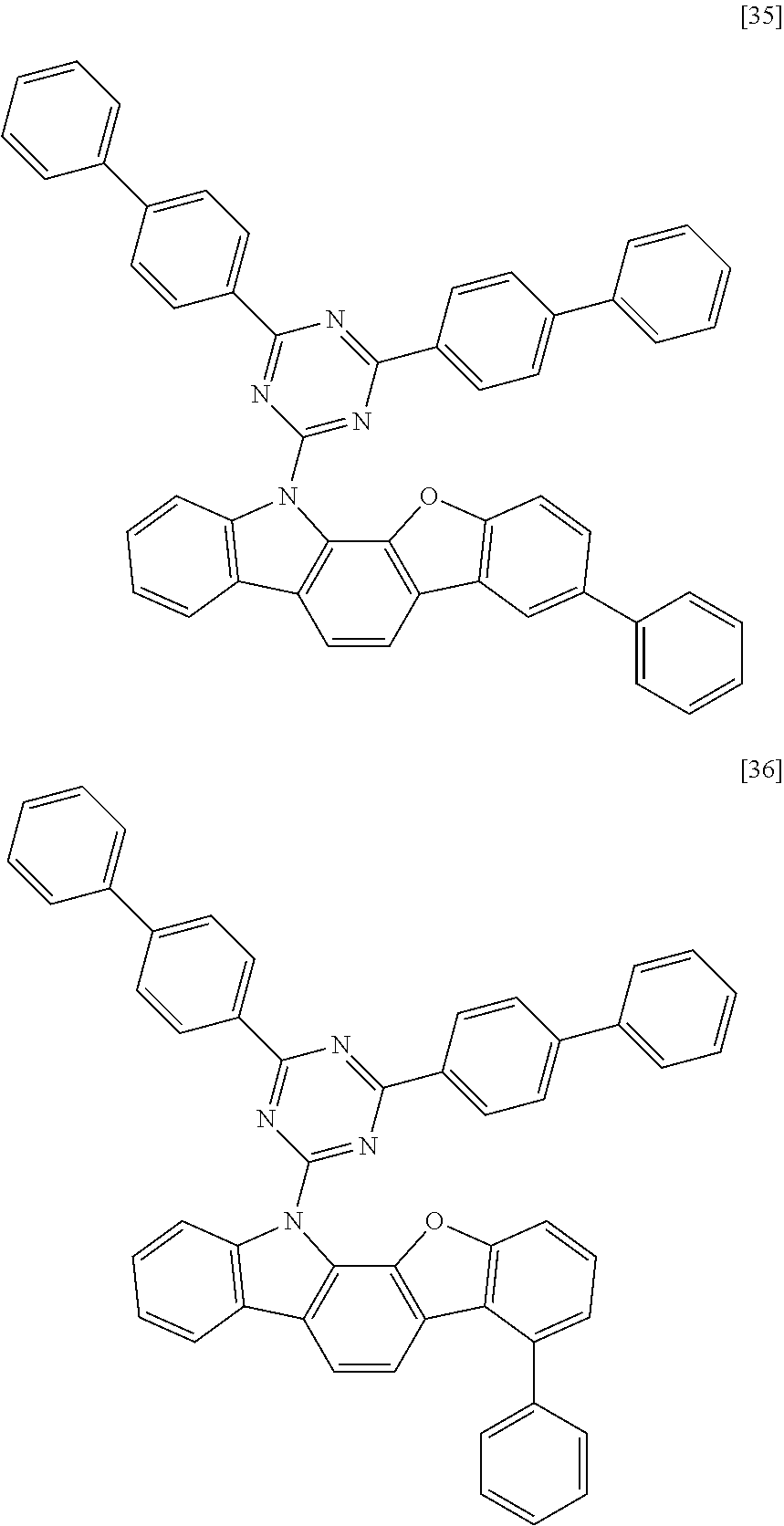
In an implementation, the compound represented by Chemical Formula 1 may be, e.g., a compound of Group 1.
Figure US12219869-20250204-C00011
Figure US12219869-20250204-C00012
Figure US12219869-20250204-C00013
Figure US12219869-20250204-C00014
Figure US12219869-20250204-C00015
Figure US12219869-20250204-C00016
Figure US12219869-20250204-C00017
Figure US12219869-20250204-C00018
Figure US12219869-20250204-C00019
Figure US12219869-20250204-C00020
Figure US12219869-20250204-C00021
Figure US12219869-20250204-C00022
Figure US12219869-20250204-C00023
Figure US12219869-20250204-C00024
Figure US12219869-20250204-C00025
Figure US12219869-20250204-C00026
Figure US12219869-20250204-C00027
Figure US12219869-20250204-C00028
Figure US12219869-20250204-C00029
Figure US12219869-20250204-C00030
Figure US12219869-20250204-C00031
Figure US12219869-20250204-C00032
Figure US12219869-20250204-C00033
Figure US12219869-20250204-C00034
Figure US12219869-20250204-C00035
Figure US12219869-20250204-C00036
Figure US12219869-20250204-C00037
Figure US12219869-20250204-C00038
Figure US12219869-20250204-C00039
Figure US12219869-20250204-C00040
Figure US12219869-20250204-C00041
Figure US12219869-20250204-C00042
In an implementation, Chemical Formula 1 may be, e.g., represented by Chemical Formula 1-3 or Chemical Formula 1-8.
A composition for an organic optoelectronic device according to another embodiment may include, e.g., a first compound for an organic optoelectronic device and a second compound for an organic optoelectronic device (e.g., a mixture of the first compound and the second compound). In an implementation, the first compound may be, e.g., the aforementioned compound represented by Chemical Formula 1. In an implementation, the second compound may be, e.g., represented by Chemical Formula 2. In an implementation, the second compound may be, e.g., represented by a combination of Chemical Formula 3 and Chemical Formula 4.
Figure US12219869-20250204-C00043
In Chemical Formula 2, Y1 and Y2 may each independently be or include, e.g., a substituted or unsubstituted C6 to C20 aryl group or a substituted or unsubstituted C2 to C30 heterocyclic group.
L1 and L2 may each independently be or include, e.g., a single bond or a substituted or unsubstituted C6 to C20 arylene group,
Ra and R1 to R10 may each independently be or include, e.g., hydrogen, deuterium, a cyano group, a halogen, a substituted or unsubstituted amino group, a substituted or unsubstituted C1 to C30 alkyl group, a substituted or unsubstituted C6 to C30 aryl group, or a substituted or unsubstituted C2 to C30 heterocyclic group.
m may be, e.g., an integer of 0 to 2;
Figure US12219869-20250204-C00044
In Chemical Formulas 3 and 4, Y3 and Y4 may each independently be or include, e.g., a substituted or unsubstituted C6 to C20 aryl group or a substituted or unsubstituted C2 to C30 heterocyclic group.
Two adjacent ones of a1* to a4* of Chemical Formula 3 are linking carbons linked at * of Chemical Formula 4. The remaining two of a1* to a4* of Chemical Formula 3, not linked at * of Chemical Formula 4, may be C-La-Rb. As used herein, the term β€œlinking carbon” refers to a shared carbon at which fused rings are linked.
La, L3 and L4 may each independently be or include, e.g., a single bond or a substituted or unsubstituted C6 to C20 arylene group.
Rb and R11 to R18 may each independently be or include, e.g., hydrogen, deuterium, a cyano group, a halogen, a substituted or unsubstituted amino group, a substituted or unsubstituted C1 to C30 alkyl group, a substituted or unsubstituted C6 to C30 aryl group, or a substituted or unsubstituted C2 to C30 heterocyclic group.
The second compound may be used in the light emitting layer together with the first compound for an organic optoelectronic device to help improve the mobility of charges and improve stability, thereby improving luminous efficiency and life-span characteristics.
In an implementation, Y1 and Y2 of Chemical Formula 2 may each independently be, e.g., a substituted or unsubstituted phenyl group, a substituted or unsubstituted biphenyl group, a substituted or unsubstituted terphenyl group, a substituted or unsubstituted naphthyl group, a substituted or unsubstituted anthracenyl group, a substituted or unsubstituted triphenylenyl group, a substituted or unsubstituted carbazolyl group, a substituted or unsubstituted dibenzothiophenyl group, a substituted or unsubstituted dibenzofuranyl group, a substituted or unsubstituted fluorenyl group, or a substituted or unsubstituted pyridinyl group.
In an implementation, L1 and L2 of Chemical Formula 2 may each independently be, e.g., a single bond, a substituted or unsubstituted phenylene group, or a substituted or unsubstituted biphenylene group.
In an implementation, R1 to R10 of Chemical Formula 2 may each independently be, e.g., hydrogen, deuterium, or a substituted or unsubstituted C6 to C12 aryl group.
m may be, e.g., 0 or 1.
In an implementation, β€œsubstituted” of Chemical Formula 2 refers to replacement of at least one hydrogen with, e.g., deuterium, a C1 to C4 alkyl group, or a C6 to C18 aryl group.
In an implementation, Chemical Formula 2 may be represented by, e.g., one of Chemical Formula 2-1 to Chemical Formula 2-15.
Figure US12219869-20250204-C00045
Figure US12219869-20250204-C00046
Figure US12219869-20250204-C00047
Figure US12219869-20250204-C00048
Figure US12219869-20250204-C00049
In Chemical Formula 2-1 to Chemical Formula 2-15, R1 to R10 may each independently be, e.g., hydrogen or a substituted or unsubstituted C6 to C12 aryl group. Moieties *-L1-Y1 and *-L2-Y2 may each independently be, e.g., a moiety of Group II.
Figure US12219869-20250204-C00050
Figure US12219869-20250204-C00051
Figure US12219869-20250204-C00052
Figure US12219869-20250204-C00053
In Group II, * is a linking point (e.g., to N of Chemical Formulae 2-1 to 2-15).
In an implementation, Chemical Formula 2 may be represented by, e.g., Chemical Formula 2-8.
In an implementation, moieties *-L1-Y1 and *-L2-Y2 of Chemical Formula 2-8 may each independently be a moiety of Group II, e.g., C-1, C-2, C-3, or C-23.
In an implementation, both moieties *-L1-Y1 and *-L2-Y2 may be, e.g., moieties C-1, C-2, or C-3 of Group II.
In an implementation, the second compound represented by the combination of Chemical Formula 3 and Chemical Formula 4 may be represented by, e.g., Chemical Formula Chemical Formula 3A, Chemical Formula 3B, Chemical Formula 3C, Chemical Formula 3D, or Chemical Formula 3E.
Figure US12219869-20250204-C00054
In Chemical Formula 3A to Chemical Formula 3E, Y3, Y4, L3, L4, and R11 to R18 may be defined the same as those described above.
La1 to La4 may be defined the same as L3 and L4.
Rb1 to Rb4 may be defined the same as R11 to R18.
In an implementation, Y3 and Y4 of Chemical Formulas 3 and 4 may each independently be, e.g., a substituted or unsubstituted phenyl group, a substituted or unsubstituted biphenyl group, a substituted or unsubstituted pyridinyl group, a substituted or unsubstituted carbazolyl group, a substituted or unsubstituted dibenzofuranyl group, or a substituted or unsubstituted dibenzothiophenyl group.
In an implementation, Rb1 to Rb4 and R11 to R18 may each independently be, e.g., hydrogen, deuterium, a cyano group, a substituted or unsubstituted phenyl group, a substituted or unsubstituted biphenyl group, a substituted or unsubstituted pyridinyl group, a substituted or unsubstituted carbazolyl group, a substituted or unsubstituted dibenzofuranyl group, or a substituted or unsubstituted dibenzothiophenyl group.
In an implementation, Y3 and Y4 of Chemical Formulas 3 and 4 may each independently be, e.g., a moiety of Group II.
In an implementation, Rb1 to Rb4 and R11 to R18 may each independently be, e.g., hydrogen, deuterium, a cyano group, a substituted or unsubstituted phenyl group, a substituted or unsubstituted biphenyl group, a substituted or unsubstituted pyridinyl group, a substituted or unsubstituted carbazolyl group, a substituted or unsubstituted dibenzofuranyl group, or a substituted or unsubstituted dibenzothiophenyl group.
In an implementation, Rb1 to Rb4 and R11 to R18 may each independently be, e.g., hydrogen, deuterium, a cyano group, or a substituted or unsubstituted phenyl group.
In an implementation, each of Rb1 to Rb4 may be, e.g., hydrogen, and R11 to R18 may each independently be, e.g., hydrogen or a phenyl group.
In an implementation, the first compound may be represented by, e.g., Chemical Formula 1-3 or Chemical Formula 1-8.
In an implementation, Ar1 and Ar3 may each independently be, e.g., a substituted or unsubstituted phenyl group.
In an implementation, Ar5 and Ar6 may each independently be, e.g., a substituted or unsubstituted phenyl group or Ar5 and Ar6 may each independently be, e.g., a substituted or unsubstituted phenyl group or a substituted or unsubstituted biphenyl group. In an implementation, at least one of Ar5 and Ar6 may be, e.g., a substituted or unsubstituted biphenyl group.
In an implementation, the second compound may be represented by, e.g., Chemical Formula 2-8, and Y1 and Y2 of Chemical Formula 2-8 may each independently be, e.g., a substituted or unsubstituted phenyl group, a substituted or unsubstituted carbazolyl group, a substituted or unsubstituted dibenzofuranyl group, or a substituted or unsubstituted dibenzothiophenyl group, L1 and L2 may each independently be, e.g., a single bond or a substituted or unsubstituted C6 to C20 arylene group, and R15 to R24 may each independently be, e.g., hydrogen, deuterium, a cyano group, a substituted or unsubstituted phenyl group, a substituted or unsubstituted biphenyl group, a substituted or unsubstituted carbazolyl group, a substituted or unsubstituted dibenzofuranyl group, or a substituted or unsubstituted dibenzothiophenyl group.
In an implementation, the second compound may be represented by, e.g., Chemical Formula 3C, and La1 and La2 of Chemical Formula 3C may be, e.g., a single bond, L3 and L4 may each independently be, e.g., a single bond or a substituted or unsubstituted C6 to C12 arylene group, R11 to R18, Rb1 and Rb2 may each be, e.g., hydrogen, and Y3 and Y4 may each independently be, e.g., a substituted or unsubstituted phenyl group, a substituted or unsubstituted naphthyl group, or a substituted or unsubstituted biphenyl group.
In an implementation, the second compound may be, e.g., a compound of Group 2.
Figure US12219869-20250204-C00055
Figure US12219869-20250204-C00056
Figure US12219869-20250204-C00057
Figure US12219869-20250204-C00058
Figure US12219869-20250204-C00059
Figure US12219869-20250204-C00060
Figure US12219869-20250204-C00061
Figure US12219869-20250204-C00062
Figure US12219869-20250204-C00063
Figure US12219869-20250204-C00064
Figure US12219869-20250204-C00065
Figure US12219869-20250204-C00066
Figure US12219869-20250204-C00067
Figure US12219869-20250204-C00068
Figure US12219869-20250204-C00069
Figure US12219869-20250204-C00070
Figure US12219869-20250204-C00071
Figure US12219869-20250204-C00072
Figure US12219869-20250204-C00073
Figure US12219869-20250204-C00074
Figure US12219869-20250204-C00075
Figure US12219869-20250204-C00076
Figure US12219869-20250204-C00077
Figure US12219869-20250204-C00078
Figure US12219869-20250204-C00079
Figure US12219869-20250204-C00080
Figure US12219869-20250204-C00081
Figure US12219869-20250204-C00082
Figure US12219869-20250204-C00083
Figure US12219869-20250204-C00084
Figure US12219869-20250204-C00085
Figure US12219869-20250204-C00086
Figure US12219869-20250204-C00087
Figure US12219869-20250204-C00088
Figure US12219869-20250204-C00089
Figure US12219869-20250204-C00090
Figure US12219869-20250204-C00091
Figure US12219869-20250204-C00092
Figure US12219869-20250204-C00093
Figure US12219869-20250204-C00094
Figure US12219869-20250204-C00095
Figure US12219869-20250204-C00096
Figure US12219869-20250204-C00097
Figure US12219869-20250204-C00098
Figure US12219869-20250204-C00099
Figure US12219869-20250204-C00100
Figure US12219869-20250204-C00101
Figure US12219869-20250204-C00102
Figure US12219869-20250204-C00103
Figure US12219869-20250204-C00104
Figure US12219869-20250204-C00105
Figure US12219869-20250204-C00106
Figure US12219869-20250204-C00107
Figure US12219869-20250204-C00108
Figure US12219869-20250204-C00109
Figure US12219869-20250204-C00110
Figure US12219869-20250204-C00111
Figure US12219869-20250204-C00112
Figure US12219869-20250204-C00113
Figure US12219869-20250204-C00114
Figure US12219869-20250204-C00115
Figure US12219869-20250204-C00116
Figure US12219869-20250204-C00117
Figure US12219869-20250204-C00118
Figure US12219869-20250204-C00119
Figure US12219869-20250204-C00120
Figure US12219869-20250204-C00121
Figure US12219869-20250204-C00122
Figure US12219869-20250204-C00123
Figure US12219869-20250204-C00124
Figure US12219869-20250204-C00125
Figure US12219869-20250204-C00126
The first compound and the second compound may be included (e.g., mixed), e.g., in a weight ratio of about 1:99 to about 99:1. Within the above range, an appropriate weight ratio may be adjusted using the electron transport capability of the first compound for the organic optoelectronic device and the hole transport capability of the second compound for an organic optoelectronic device to implement bipolar characteristics and to improve the efficiency and life-span. Within the above range, e.g., they may be included in a weight ratio of about 10:90 to about 90:10, about 10:90 to about 80:20, e.g., about 10:90 to about 70:30, about 20:80 to about 70:30, or about 20:80 to about 60:40. In an implementation, they may be included in a weight ratio of, e.g., about 30:70 or about 40:60.
In addition to the aforementioned first compound and second compound, one or more additional compounds may be further included.
The aforementioned compound for an organic optoelectronic device or composition for an organic optoelectronic device may be a composition further including a dopant.
The dopant may be, e.g., a phosphorescent dopant and may be, for example a red, green or blue phosphorescent dopant, for example a red or green phosphorescent dopant.
The dopant is a material mixed with the compound or composition for an organic optoelectronic device in a trace amount to cause light emission, and may be a material such as a metal complex that emits light by multiple excitation into a triplet or more. The dopant may be, e.g., an inorganic, organic, or organic-inorganic compound, and one or more types thereof may be used.
Examples of the dopant may include a phosphorescent dopant and examples of the phosphorescent dopant may include an organic metal compound including Ir, Pt, Os, Ti, Zr, Hf, Eu, Tb, Tm, Fe, Co, Ni, Ru, Rh, Pd, or a combination thereof. In an implementation, the phosphorescent dopant may include, e.g., a compound represented by Chemical Formula Z.
L5MX  [Chemical Formula Z]
In Chemical Formula Z, M may be, e.g., a metal, and L5 and X may each independently be, e.g., a ligand forming a complex with M.
M may be, e.g., Ir, Pt, Os, Ti, Zr, Hf, Eu, Tb, Tm, Fe, Co, Ni, Ru, Rh, Pd, or a combination thereof, and L5 and X may be, e.g., a bidentate ligand.
Hereinafter, an organic optoelectronic device including the aforementioned compound for an organic optoelectronic device or composition for an organic optoelectronic device is described.
The organic optoelectronic device may be a suitable device to convert electrical energy into photoenergy and vice versa, and may be, e.g., an organic photoelectric device, an organic light emitting diode, an organic solar cell, or an organic photoconductor drum.
Herein, an organic light emitting diode as one example of an organic optoelectronic device is described referring to drawings.
FIGS. 1 to 4 are cross-sectional views of organic light emitting diodes according to embodiments.
Referring to FIG. 1 , an organic light emitting diode 100 according to an embodiment may include an anode 120 and a cathode 110 facing each other and an organic layer 105 between the anode 120 and cathode 110.
The anode 120 may be made of a conductor having a large work function to help hole injection, and may be, e.g., a metal, a metal oxide or a conductive polymer. The anode 120 may be, e.g., a metal such as nickel, platinum, vanadium, chromium, copper, zinc, gold, or the like, or an alloy thereof; a metal oxide such as zinc oxide, indium oxide, indium tin oxide (ITO), indium zinc oxide (IZO), or the like; a combination of a metal and an oxide such as ZnO and Al or SnO2 and Sb; a conductive polymer such as poly(3-methylthiophene), poly(3,4-(ethylene-1,2-dioxy)thiophene) (PEDOT), polypyrrole, or polyaniline.
The cathode 110 may be made of a conductor having a small work function to help electron injection, and may be, e.g., a metal, a metal oxide, and/or a conductive polymer. The cathode 110 may be, e.g., a metal such as magnesium, calcium, sodium, potassium, titanium, indium, yttrium, lithium, gadolinium, aluminum silver, tin, lead, cesium, barium, or the like, or an alloy thereof; or a multi-layer structure material such as LiF/Al, LiO2/Al, LiF/Ca, or BaF2/Ca.
The organic layer 105 may include the aforementioned compound for an organic optoelectronic device or composition for an organic optoelectronic device.
The organic layer 105 may include the light emitting layer 130, and the light emitting layer 130 may include the aforementioned compound for an organic optoelectronic device or composition for an organic optoelectronic device.
The composition for an organic optoelectronic device further including the dopant may be, e.g., a red light emitting composition.
The light emitting layer 130 may include, e.g., the aforementioned first compound and second compound, respectively, as a phosphorescent host.
The organic layer may further include a charge transport region in addition to the light emitting layer.
The auxiliary layer may be, e.g., the hole auxiliary layer 140 (see FIG. 2 ).
Referring to FIG. 2 , an organic light emitting diode 200 may further include a hole transport region 140 in addition to the light emitting layer 130. The hole transport region 140 may help further increase hole injection and/or hole mobility between the anode 120 and the light emitting layer 130 and block electrons. In an implementation, the hole transport region 140 may include a hole transport layer between the anode 120 and the light emitting layer 130, and a hole transport auxiliary layer between the light emitting layer 130 and the hole transport layer. In an implementation, a compound of Group E may be included in at least one of the hole transport layer and the hole transport auxiliary layer.
Figure US12219869-20250204-C00127
Figure US12219869-20250204-C00128
Figure US12219869-20250204-C00129
Figure US12219869-20250204-C00130
Figure US12219869-20250204-C00131
Figure US12219869-20250204-C00132
Figure US12219869-20250204-C00133
Figure US12219869-20250204-C00134
Figure US12219869-20250204-C00135
Figure US12219869-20250204-C00136
Figure US12219869-20250204-C00137
Figure US12219869-20250204-C00138
Figure US12219869-20250204-C00139
Figure US12219869-20250204-C00140
Figure US12219869-20250204-C00141
Figure US12219869-20250204-C00142
Figure US12219869-20250204-C00143
Figure US12219869-20250204-C00144
Figure US12219869-20250204-C00145
Figure US12219869-20250204-C00146
Figure US12219869-20250204-C00147
Figure US12219869-20250204-C00148
Figure US12219869-20250204-C00149
Figure US12219869-20250204-C00150
Figure US12219869-20250204-C00151
Figure US12219869-20250204-C00152
Figure US12219869-20250204-C00153
Figure US12219869-20250204-C00154
Figure US12219869-20250204-C00155
Figure US12219869-20250204-C00156
Figure US12219869-20250204-C00157
Figure US12219869-20250204-C00158
Figure US12219869-20250204-C00159
Figure US12219869-20250204-C00160
Figure US12219869-20250204-C00161
Figure US12219869-20250204-C00162
Figure US12219869-20250204-C00163
Figure US12219869-20250204-C00164
Figure US12219869-20250204-C00165
Figure US12219869-20250204-C00166
In the hole transport region, in addition to the compounds described above, other suitable compounds may also be used.
In an implementation, the charge transport region may be, e.g., the electron transport region 150 (see FIG. 3 ).
Referring to FIG. 3 , the organic light emitting diode 300 may further include an electron transport region 150 in addition to the light emitting layer 130. The electron transport region 150 may help further increase electron injection and/or electron mobility and block holes between the cathode 110 and the light emitting layer 130.
In an implementation, the electron transport region 150 may include an electron transport layer between the cathode 110 and the light emitting layer 130, and an electron transport auxiliary layer between the light emitting layer 130 and the electron transport layer. In an implementation, a compound of Group F may be included in at least one of the electron transport layer and the electron transport auxiliary layer.
Figure US12219869-20250204-C00167
Figure US12219869-20250204-C00168
Figure US12219869-20250204-C00169
Figure US12219869-20250204-C00170
Figure US12219869-20250204-C00171
Figure US12219869-20250204-C00172
Figure US12219869-20250204-C00173
Figure US12219869-20250204-C00174
Figure US12219869-20250204-C00175
An embodiment may provide an organic light emitting diode including the light emitting layer 130 as the organic layer 105 as shown in FIG. 1 .
Another embodiment may provide an organic light emitting diode including a hole transport region 140 in addition to the light emitting layer 130 as the organic layer 105, as shown in FIG. 2 .
Another embodiment may provide an organic light emitting diode including an electron transport region 150 in addition to the light emitting layer 130 as the organic layer 105 as shown in FIG. 3 .
Another embodiment may provide an organic light emitting diode including a hole transport region 140 and an electron transport region 150 in addition to the light emitting layer 130 as the organic layer 105, as shown in FIG. 4 .
In another embodiment, an organic light emitting diode may further include an electron injection layer, a hole injection layer, or the like, in addition to the light emitting layer 130 as the organic layer 105 in each of FIGS. 1 to 4 .
The organic light emitting diodes 100, 200, 300, and 400 may be manufactured by forming an anode or a cathode on a substrate, and then forming an organic layer by a dry film method such as vacuum deposition, sputtering, plasma plating and ion plating, and forming a cathode or an anode thereon.
The aforementioned organic light emitting diode may be applied to an organic light emitting display device.
The following Examples and Comparative Examples are provided in order to highlight characteristics of one or more embodiments, but it will be understood that the Examples and Comparative Examples are not to be construed as limiting the scope of the embodiments, nor are the Comparative Examples to be construed as being outside the scope of the embodiments. Further, it will be understood that the embodiments are not limited to the particular details described in the Examples and Comparative Examples.
Hereinafter, starting materials and reactants used in examples and synthesis examples were purchased from Sigma-Aldrich Co. Ltd., TCI Inc., Tokyo chemical industry or P&H tech as far as there is no particular comment or were synthesized by suitable methods.
(Preparation of Compound for Organic Optoelectronic Device)
Compounds were synthesized through the following steps.
<Synthesis of Core-1>
Figure US12219869-20250204-C00176
Synthesis Example 1: Synthesis of Int-1
Figure US12219869-20250204-C00177
4-bromo-dibenzofuran (25 g, 101.18 mmol), 2-chloroaniline (19.36 g, 151.77 mmol), Pd2(dba)3 (4.63 g, 5.06 mmol), P(t-Bu)3 (3.7 ml, 15.18 mmol), and NaO(t-Bu) (11.67 g, 121.41 mmol) were put in a round-bottomed flask and then, stirred under reflux in a toluene (350 ml) solvent at 130Β° C. for 12 hours. When a reaction was completed, the resultant was treated through column chromatography, obtaining 15 g (50%) of Intermediate (Int-1).
Synthesis Example 2: Synthesis of Core-1
Figure US12219869-20250204-C00178
Int-1 (20 g, 68.09 mmol), Pd2(dba)3 (3.12 g, 3.4 mmol), Cs2CO3 (44.34 g, 136.17 mmol), PCy3Β·HBF4 (3.7 ml, 15.18 mmol), and NaO(t-Bu) (11.67 g, 121.41 mmol) were put in a round-bottomed flask and then, stirred under reflux in a DMAc (220 ml) solvent at 160Β° C. for 12 hours. When a reaction was completed, the resultant was treated through column chromatography, obtaining 8.1 g (46%) of Intermediate Core-1.
<Synthesis of Core-2>
Figure US12219869-20250204-C00179
Core-2 was synthesized according to the same method as in Core-1 except that 4-chloro-[1,1β€²-biphenyl]-3-amine was used instead of the 2-chloroaniline.
<Synthesis of Core-3>
Figure US12219869-20250204-C00180
Core-3 was synthesized according to the same method as in Core-1 except that 3-chloro-[1,1β€²-biphenyl]-4-amine was used instead of the 2-chloroaniline.
<Synthesis of Core-4>
Figure US12219869-20250204-C00181
Core-4 was synthesized according to the same method as in Core-1 except that 5β€²-chloro-[1,1β€²:3β€²,1β€³-terphenyl]-4β€²-amine was used instead of the 2-chloroaniline.
<Synthesis of Core-5>
Figure US12219869-20250204-C00182
Synthesis Example 3: Synthesis of Int-2
Figure US12219869-20250204-C00183
4-bromo-dibenzofuran (80 g, 509.41 mmol), phenylboronic acid (90 g, 424.51 mmol), K2CO3 (117.34 g, 849.02 mmol), and Pd(PPh3)4(24.53 g, 21.23 mmol) were put in a round-bottomed flask, and THE (1,000 ml) and distilled water (500 ml) were added thereto and then, the resultant was stirred under reflux at 80Β° C. for 12 hours. When a reaction was completed, after removing an aqueous layer therefrom, 93 g (91%) of Intermediate Int-2 was obtained using column chromatography.
Synthesis Example 4: Synthesis of Int-3
Figure US12219869-20250204-C00184
Int-2 (93 g, 380.70 mmol) was dissolved in THE (300 ml) and then, cooled down to βˆ’78Β° C., and N-BuLi (243.64 ml, 609.11 mmol) was slowly added thereto and then, the resultant was stirred for 6 hours, while the temperature was increased up to ambient temperature. When the stirring was completed, the resultant was cooled down to βˆ’78Β° C., and I2 (111.12 g, 437.80 mmol) dissolved in THE (300 ml) was slowly added thereto and then, the resultant was stirred at ambient temperature for 12 hours. When a reaction was completed, after quenched by adding water thereto and then, removing an aqueous layer therefrom, 120 g (85%) of Intermediate Int-3 was obtained using column chromatography.
Synthesis Example 5: Synthesis of Core-5
Figure US12219869-20250204-C00185
Core-5 was synthesized according to the same method as in Core-1 except that Int-3 was used instead of the intermediate of 4-bromo-dibenzofuran.
Synthesis Example 6: Synthesis of Int-4
Figure US12219869-20250204-C00186
2,4-dichloro-6-phenyl-1,3,5-triazine (17.12 g, 75.75 mmol), [1,1β€²-biphenyl]-4-ylboronic acid (10 g, 50.50 mmol), K2CO3 (13.96 g, 138.21 mmol), and Pd(PPh3)4(2.92 g, 2.52 mmol) were put in a round-bottomed flask, and THE (100 ml) and distilled water (50 ml) were added thereto and then, the resultant was stirred under reflux at 80Β° C. for 12 hours.
When a reaction was completed, the mixture was added to 300 mL of methanol, and a solid crystallized therein was filtered, dissolved in monochlorobenzene, and filtered with silica gel/Celite, and after removing an appropriate amount of an organic solvent, recrystallized with methanol, obtaining 11.3 g (65%) of Intermediate Int-4.
Synthesis Example 7: Synthesis of Int-5
Figure US12219869-20250204-C00187
Intermediate Int-5 was synthesized according to the same method as in Synthesis Example 6 except that [1,1β€²-biphenyl]-3-ylboronic acid was used instead of the intermediate of [1,1β€²-biphenyl]-4-ylboronic acid.
Synthesis Example 8: Synthesis of Int-6
Figure US12219869-20250204-C00188
Intermediate Int-6 was synthesized according to the same method as in Synthesis Example 7 except that 2,4-dichloro-6-(biphenyl-4-yl)-1,3,5-triazine was used instead of the intermediate of 2,4-dichloro-6-phenyl-1,3,5-triazine.
Synthesis Example 9: Synthesis of Int-7
Figure US12219869-20250204-C00189
Intermediate Int-7 was synthesized according to the same method as in Synthesis Example 6 except that 2,4-dichloro-6-(biphenyl-4-yl)-1,3,5-triazine was used instead of the intermediate of 2,4-dichloro-6-phenyl-1,3,5-triazine.
Synthesis Example 10: Synthesis of Int-8
Figure US12219869-20250204-C00190
Intermediate Int-8 was synthesized according to the same method as in Synthesis Example 7 except that an intermediate of 2,4-dichloro-6-(biphenyl-3-yl)-1,3,5-triazine was used instead of the intermediate of 2,4-dichloro-6-phenyl-1,3,5-triazine.
Synthesis Example 11: Synthesis of Int-9
Figure US12219869-20250204-C00191
Intermediate Int-9 was synthesized according to the same method as in Synthesis Example 6 except that phenylboronic acid was used instead of the intermediate of [1,1β€²-biphenyl]-4-ylboronic acid.
Synthesis Example 12: Synthesis of Compound 6
Figure US12219869-20250204-C00192
Core-2 (10 g, 30.0 mmol), Int-4 (10.83 g, 31.5 mmol), and NaH (1.58 g, 65.99 mmol) were put in a round-bottomed flask, and DMF (100 ml) was added thereto and then, the resultant was stirred at ambient temperature for 12 hours. When a reaction was completed, 300 mL of water was added to the mixture, and a solid crystallized therein was filtered, dissolved in monochlorobenzene, filtered with silica gel/Celite, and after removing an appropriate amount of an organic solvent, recrystallized with methanol, obtaining 17.1 g (88%) of Compound 6.
Compounds were synthesized according to the same method as in Synthesis Example 12 except that the intermediates were changed as shown in Table 1.
TABLE 1
Synthesis
Example Core Intermediate Compound Yield
13 Core-2 Int-4 6 17.1 g (88%)
14 Core-2 Int-5 42 15 g (70.1%)
15 Core-2 Int-6 10 11.6 g (77.4%)
16 Core-2 Int-7 14 13.6 g (80.1%)
17 Core-2 Int-8 46 14.6 g (78.9%)
18 Core-3 Int-4 7 15.6 g (77.4%)
19 Core-3 Int-5 43 11.2 g (90%)
20 Core-3 Int-6 11 10.7 g (87.3%)
21 Core-3 Int-7 15 13.4 g (72.3%)
22 Core-3 Int-8 47 18.5 g (85.6%)
23 Core-4 Int-4 18 12.6 g (79.9%)
24 Core-4 Int-6 19 13.1 g (78.6%)
25 Core-4 Int-7 20 14.6 g (84.7%)
26 Core-5 Int-4 25 16.3 g (80.7%)
27 Core-5 Int-5 49 18 g (84.3%)
28 Core-5 Int-6 29 16.1 g (82.1%)
29 Core-5 Int-7 33 21.1 g (91.2%)
30 Core-5 Int-8 53 10.1 g (87.8%)
31 Core-2 Int-9 2 17.1 g (80%)
32 Core-3 Int-9 3 15.0 g (71.4%)
33 Core-5 Int-9 21 10.9 g (89.8%)
Comparative Synthesis Example 1: Synthesis of Comparative Compound 1
Figure US12219869-20250204-C00193

Comparative Compound 1
Comparative Compound 1 was synthesized according to a method disclosed in KR2014-0067914.
Comparative Synthesis Example 2: Synthesis of Comparative Compound 2
Figure US12219869-20250204-C00194

Comparative Compound 2
Comparative Compound 2 was synthesized according to a method disclosed in KR2014-0067914.
Comparative Synthesis Example 3: Synthesis of Comparative Compound 3
Figure US12219869-20250204-C00195

Comparative Compound 3
Comparative Compound 3 was synthesized according to a method disclosed in KR2014-0067914.
Comparative Synthesis Example 4: Synthesis of Comparative Compound 4
Figure US12219869-20250204-C00196

Comparative Compound 4
Comparative Compound 4 was synthesized according to a method disclosed in KR2020-0002020.
Comparative Synthesis Example 5: Synthesis of Comparative Compound 5
Figure US12219869-20250204-C00197

Comparative Compound 5
Comparative Compound 5 was synthesized in the same method as in Synthesis Example 12, except that Core-1 was used instead of Core-2.
Comparative Synthesis Example 6: Synthesis of Comparative Compound 6
Figure US12219869-20250204-C00198
Intermediate Int-10 was synthesized according to the same method as in Synthesis Example 6 except that Int-4 was used instead of the 2,4-dichloro-6-phenyl-1,3,5-triazine, and 3-chloro-phenylboronic acid was used instead of the intermediate of [1,1β€²-biphenyl]-4-ylboronic acid.
Figure US12219869-20250204-C00199

Comparative Compound 6
Comparative Compound 6 was synthesized according to the same method as in Synthesis Example 12 except that Core-3 was used instead of Core-2, and Int-10 was used instead of Int-4.
(Synthesis of Second Compound for Organic Optoelectronic Device)
Compound A-136 was synthesized according to a method described in KR 10-1773363 B1.
Compound B-5 was synthesized according to a method described in KR 10-2018-0099436 A.
Manufacture of Organic Light Emitting Diode Example 1
A glass substrate coated with 1,500 β„«-thick ITO (Indium tin oxide) was washed with distilled water and ultrasonic waves. After washing with the distilled water, the glass substrate was ultrasonically washed with isopropyl alcohol, acetone, or methanol, and dried and then, moved to a plasma cleaner, cleaned by using oxygen plasma for 10 minutes, and moved to a vacuum depositor. This obtained ITO transparent electrode was used as an anode, Compound A was vacuum-deposited on the ITO substrate to form a 700 β„«-thick hole injection layer, and Compound B was deposited to be 50 β„«-thick on the injection layer, and then Compound C was deposited to be 1,020 β„«-thick to form a hole transport layer. On the hole transport layer, 400 β„«-thick light emitting layer was formed by using Compound 21 as a host and doping 2 wt % of [Ir(piq)2acac] as a dopant by a vacuum deposition. Subsequently, on the light emitting layer, a 300 β„«-thick electron transport layer was formed by simultaneously vacuum-depositing Compound D and Liq in a weight ratio of 1:1, and on the electron transport layer, Liq and Al were sequentially vacuum-deposited to be 15 β„«-thick and 1,200 β„«-thick, manufacturing an organic light emitting diode.
The organic light emitting diode had a five-layered organic thin layer, and specifically the following structure.
ITO/Compound A (700 β„«)/Compound B (50 β„«)/Compound C (1,020 β„«)/EML [Compound 21: [Ir(piq)2acac] (2 wt %)] (400 β„«)/Compound D:Liq (300 β„«)/Liq (15 β„«)/Al (1,200 β„«).
Compound A: N4,N4β€²-diphenyl-N4,N4β€²-bis(9-phenyl-9H-carbazol-3-yl)biphenyl-4,4β€²-diamine
Compound B: 1,4,5,8,9,11-hexaazatriphenylene-hexacarbonitrile (HAT-CN),
Compound C: N-(biphenyl-4-yl)-9,9-dimethyl-N-(4-(9-phenyl-9H-carbazol-3-yl)phenyl)-9H-fluoren-2-amine
Compound D: 8-(4-(4,6-di(naphthalen-2-yl)-1,3,5-triazin-2-yl)phenyl)quinoline
Example 2 and Comparative Examples 1 and 2
Each diode of Example 2 and Comparative Examples 1 and 2 was manufactured in the same manner as in Example 1, except that the host was changed as shown in Tables 2 and 3.
Examples 3 to 6 and Comparative Examples 3 to 7
Each diode according to Examples 3 to 6 and Comparative Examples 3 to 7 was manufactured according to the same method as in Example 1 except that the first host and the second host were changed as shown in Tables 4 to 7, and the first host and the second host were mixed in a weight ratio of 3:7.
Example 7 and Comparative Example 8
Each diode according to Example 7 and Comparative Example 8 was manufactured according to the same method as in Example 1 except that the first host and the second host were changed as shown in Table 8, and the first host and the second host were respectively mixed in a weight ratio of 4:6.
Evaluation: Confirmation of Life-Span Increase Effect
The luminous efficiency and life-span characteristics of the organic light emitting diodes according to Examples 1 to 7 and Comparative Examples 1 to 8 were evaluated. Specific measurement methods are as follows, and the results are shown in Tables 2 to 8.
(1) Measurement of Current Density Change Depending on Voltage Change
The obtained organic light emitting diodes were measured regarding a current value flowing in the unit device, while increasing the voltage from 0 V to 10 V using a current-voltage meter (Keithley 2400), and the measured current value was divided by area to provide the results.
(2) Measurement of Luminance Change Depending on Voltage Change
Luminance was measured by using a luminance meter (Minolta Cs-1000A), while the voltage of the organic light emitting diodes was increased from 0 V to 10 V.
(3) Measurement of Luminous Efficiency
Luminous efficiency (cd/A) at the same current density (10 mA/cm2) were calculated by using the luminance, current density, and voltage from the items (1) and (2).
(4) Measurement of Life-Span
T95 life-spans of the organic light emitting diodes according to Examples 1 to 7, and Comparative Examples 1 to 8 were measured as a time when their luminance decreased down to 95% relative to the initial luminance (cd/m2) after emitting light with 6,000 cd/m2 as the initial luminance (cd/m2) and measuring their luminance decrease depending on a time with a Polanonix life-span measurement system.
(5) Measurement of Driving Voltage
A driving voltage of each diode was measured using a current-voltage meter (Keithley 2400) at 15 mA/cm2.
Relative evaluation values based on each measurement value of Comparative Examples 1 to 5, Example 6, and Comparative Example 8 are shown in Tables 2 to 8.
TABLE 2
Driving
Single host T95 (%) Efficiency (%) voltage (%)
Example 1 Compound 21 195% 118%  94%
Comparative Comparative
100% 100% 100%
Example 1 Compound 1
TABLE 3
Driving
Single host T95 (%) Efficiency (%) voltage (%)
Example 2 Compound 7 141% 104%  98%
Comparative Comparative
100% 100% 100%
Example 2 Compound 6
TABLE 4
Driving
Hosts T95 Efficiency voltage
First host Second host (%) (%) (%)
Example 3 Compound 21 A-136 155% 124%  96%
Comparative Comparative A-136 100% 100% 100%
Example 3 Compound 1
TABLE 5
Driving
Hosts T95 Efficiency voltage
First host Second host (%) (%) (%)
Example 4 Compound 25 A-136 121% 108% 100%
Comparative Comparative A-136 100% 100% 100%
Example 4 Compound 5
TABLE 6
Driving
Hosts T95 Efficiency voltage
First host Second host (%) (%) (%)
Example 5 Compound 7 A-136 138% 111%  96%
Comparative Comparative A-136 100% 100% 100%
Example 5 Compound 6
TABLE 7
Hosts
First host Second host T95 (%)
Example 6 Compound 21 A-136 100% 
Comparative Comparative Compound 3 A-136 69%
Example 6
Comparative Comparative Compound 4 A-136 78%
Example 7
TABLE 8
Driving
Hosts T95 Efficiency voltage
First host Second host (%) (%) (%)
Example 7 Compound 25 B-5 130% 110% 100%
Comparative Comparative B-5 100% 100% 100%
Example 8 Compound 5
Referring to Tables 2 and 4, when a dibenzofuran moiety was fused, devices with improved life-span characteristics, efficiency, and driving voltage due to excellent hole characteristics were realized, compared with when a dibenzothiophene moiety was fused.
In addition, referring to Tables 3 and 6, when a linker was present, the devices lost a balance due to expansion of electron characteristics through the linker, and accordingly, the life-span characteristics, efficiency, and driving voltage thereof were deteriorated, compared with when no linker was present.
In addition, referring to Table 7, fused carbazole (in which a benzofuran moiety was fused at the 1st and 2nd positions of carbazole), compared with a fused carbazole (in which a benzofuran moiety was fused at the 2nd and 3rd positions of carbazole) and a fused carbazole (in which a benzofuran moiety was fused at the 3rd and 4th positions of carbazole), exhibited that HOMO/LUMO partitions were clearly separated, as a hole transport region was expanded, and a device life-span was significantly increased.
In addition, referring to Tables 5 and 8, when the fused carbazole was substituted with an aryl group, the hole transport region was expanded and thus improved the life-span characteristics and the efficiency, compared with when a fused carbazole was not substituted with an aryl group.
One or more embodiments may provide a composition for an organic optoelectronic device capable of implementing an organic optoelectronic device having high efficiency and a long life-span.
Example embodiments have been disclosed herein, and although specific terms are employed, they are used and are to be interpreted in a generic and descriptive sense only and not for purpose of limitation. In some instances, as would be apparent to one of ordinary skill in the art as of the filing of the present application, features, characteristics, and/or elements described in connection with a particular embodiment may be used singly or in combination with features, characteristics, and/or elements described in connection with other embodiments unless otherwise specifically indicated. Accordingly, it will be understood by those of skill in the art that various changes in form and details may be made without departing from the spirit and scope of the present invention as set forth in the following claims.

Claims (11)

What is claimed is:
1. A composition for an organic optoelectronic device, the composition comprising:
a first compound represented by Chemical Formula 1, and
a second compound represented by:
Chemical Formula 2; or
a combination of Chemical Formula 3 and Chemical Formula 4,
Figure US12219869-20250204-C00200
wherein, in Chemical Formula 1,
Ar1 to Ar4 are each independently hydrogen, deuterium, or a substituted or unsubstituted C6 to C18 aryl group, at least one of Ar1 to Ar4 being a substituted or unsubstituted C6 to C18 aryl group, and
Ar5 and Ar6 are each independently a substituted or unsubstituted C6 to C30 aryl group;
Figure US12219869-20250204-C00201
wherein, in Chemical Formula 2,
Y1 and Y2 are each independently a substituted or unsubstituted C6 to C20 aryl group or a substituted or unsubstituted C2 to C30 heterocyclic group,
L1 and L2 are each independently a single bond or a substituted or unsubstituted C6 to C20 arylene group,
Ra and R1 to R10 are each independently hydrogen, deuterium, a cyano group, a halogen, a substituted or unsubstituted amino group, a substituted or unsubstituted C1 to C30 alkyl group, a substituted or unsubstituted C6 to C30 aryl group, or a substituted or unsubstituted C2 to C30 heterocyclic group, and
m is an integer of 0 to 2;
Figure US12219869-20250204-C00202
wherein, in Chemical Formulas 3 and 4,
Y3 and Y4 are each independently a substituted or unsubstituted C6 to C20 aryl group or a substituted or unsubstituted C2 to C30 heterocyclic group,
two adjacent ones of a1* to a4* of Chemical Formula 3 are linking carbons linked at * of Chemical Formula 4, the remaining two of a1* to a4* of Chemical Formula 3, not linked at * of Chemical Formula 4, are C-La-Rb,
La, L3 and L4 are each independently a single bond or a substituted or unsubstituted C6 to C20 arylene group, and
Rb and R11 to R18 are each independently hydrogen, deuterium, a cyano group, a halogen, a substituted or unsubstituted amino group, a substituted or unsubstituted C1 to C30 alkyl group, a substituted or unsubstituted C6 to C30 aryl group, or a substituted or unsubstituted C2 to C30 heterocyclic group.
2. The composition as claimed in claim 1, wherein:
Chemical Formula 1 is represented by one of Chemical Formula 1-1 to Chemical Formula 1-12:
Figure US12219869-20250204-C00203
Figure US12219869-20250204-C00204
Figure US12219869-20250204-C00205
in Chemical Formula 1-1 to Chemical Formula 1-12,
Ar1 to Ar4 are each independently a substituted or unsubstituted C6 to C18 aryl group, and
Ar5 and Ar6 are each independently a substituted or unsubstituted C6 to C30 aryl group.
3. The composition as claimed in claim 2, wherein Chemical Formula 1 is represented by Chemical Formula 1-2, Chemical Formula 1-3, Chemical Formula 1-6, Chemical Formula 1-7, Chemical Formula 1-8, or Chemical Formula 1-9.
4. The composition as claimed in claim 1, wherein at least one of Ar1 to Ar4 of above Chemical Formula 1 is a substituted or unsubstituted C6 to C12 aryl group.
5. The composition as claimed in claim 1, wherein:
moiety
Figure US12219869-20250204-C00206
of Chemical Formula 1 is a moiety of Group I:
Figure US12219869-20250204-C00207
in Group I, * is a linking point.
6. The composition as claimed in claim 1, wherein the first compound represented by Chemical Formula 1 is a compound of Group 1:
Figure US12219869-20250204-C00208
Figure US12219869-20250204-C00209
Figure US12219869-20250204-C00210
Figure US12219869-20250204-C00211
Figure US12219869-20250204-C00212
Figure US12219869-20250204-C00213
Figure US12219869-20250204-C00214
Figure US12219869-20250204-C00215
Figure US12219869-20250204-C00216
Figure US12219869-20250204-C00217
Figure US12219869-20250204-C00218
Figure US12219869-20250204-C00219
Figure US12219869-20250204-C00220
Figure US12219869-20250204-C00221
Figure US12219869-20250204-C00222
Figure US12219869-20250204-C00223
Figure US12219869-20250204-C00224
Figure US12219869-20250204-C00225
Figure US12219869-20250204-C00226
Figure US12219869-20250204-C00227
Figure US12219869-20250204-C00228
Figure US12219869-20250204-C00229
Figure US12219869-20250204-C00230
Figure US12219869-20250204-C00231
Figure US12219869-20250204-C00232
Figure US12219869-20250204-C00233
Figure US12219869-20250204-C00234
Figure US12219869-20250204-C00235
Figure US12219869-20250204-C00236
Figure US12219869-20250204-C00237
Figure US12219869-20250204-C00238
7. The composition as claimed in claim 1, wherein:
the second compound is represented by Chemical Formula 2,
Chemical Formula 2 is represented by Chemical Formula 2-8:
Figure US12219869-20250204-C00239
in Chemical Formula 2-8,
R1 to R10 are each independently hydrogen or a substituted or unsubstituted C6 to C12 aryl group, and
moieties *-L1-Y1 and *-L2-Y2 are each independently a moiety of Group II,
Figure US12219869-20250204-C00240
Figure US12219869-20250204-C00241
Figure US12219869-20250204-C00242
Figure US12219869-20250204-C00243
in Group II, * is a linking point.
8. The composition as claimed in claim 1, wherein:
the second compound is represented by the combination of Chemical Formula 3 and Chemical Formula 4,
the combination of Chemical Formula 3 and Chemical Formula 4 is represented by Chemical Formula 3C:
Figure US12219869-20250204-C00244
in Chemical Formula 3C,
La3 and La4 are each a single bond,
L3 and L4 are each independently a single bond or a substituted or unsubstituted C6 to C12 arylene group,
R11 to R18, Rb3, and Rb4 are each hydrogen, and
Y3 and Y4 are each independently a substituted or unsubstituted phenyl group, a substituted or unsubstituted naphthyl group, or a substituted or unsubstituted biphenyl group.
9. An organic optoelectronic device, comprising:
an anode and a cathode facing each other, and
at least one organic layer between the anode and the cathode,
wherein the at least one organic layer includes the composition for an organic optoelectronic device as claimed in claim 1.
10. The organic optoelectronic device as claimed in claim 9, wherein:
the organic layer includes a light emitting layer, and
the light emitting layer includes the composition for an organic optoelectronic device.
11. A display device comprising the organic optoelectronic device as claimed in claim 9.
US17/512,856 2020-11-03 2021-10-28 Composition for organic optoelectronic device, organic optoelectronic device, and display device Active 2043-11-01 US12219869B2 (en)

Applications Claiming Priority (2)

Application Number Priority Date Filing Date Title
KR1020200145349A KR102830321B1 (en) 2020-11-03 2020-11-03 Compound for organic optoelectronic device, composition for organic optoelectronic device, organic optoelectronic device and display device
KR10-2020-0145349 2020-11-03

Publications (2)

Publication Number Publication Date
US20220140253A1 US20220140253A1 (en) 2022-05-05
US12219869B2 true US12219869B2 (en) 2025-02-04

Family

ID=81362278

Family Applications (1)

Application Number Title Priority Date Filing Date
US17/512,856 Active 2043-11-01 US12219869B2 (en) 2020-11-03 2021-10-28 Composition for organic optoelectronic device, organic optoelectronic device, and display device

Country Status (4)

Country Link
US (1) US12219869B2 (en)
KR (2) KR102830321B1 (en)
CN (2) CN118703200A (en)
TW (1) TWI816209B (en)

Citations (37)

* Cited by examiner, † Cited by third party
Publication number Priority date Publication date Assignee Title
US5061569A (en) 1990-07-26 1991-10-29 Eastman Kodak Company Electroluminescent device with organic electroluminescent medium
JPH059471A (en) 1991-07-03 1993-01-19 Mitsui Toatsu Chem Inc Organic electroluminescent device
WO1995009147A1 (en) 1993-09-29 1995-04-06 Idemitsu Kosan Co., Ltd. Organic electroluminescent element and arylenediamine derivative
JPH07126615A (en) 1993-11-01 1995-05-16 Matsushita Electric Ind Co Ltd Electroluminescent device
JPH1095973A (en) 1996-07-24 1998-04-14 Mitsui Petrochem Ind Ltd Luminescent compound for traveling control and traveling control method using the compound
KR20110021487A (en) 2009-08-26 2011-03-04 μ£Όμ‹νšŒμ‚¬ 두산 Novel organic compound and organic light emitting device using same
US20120126208A1 (en) 2010-11-22 2012-05-24 Idemitsu Kosan Co., Ltd. Organic electroluminescence device
JP2013026529A (en) 2011-07-22 2013-02-04 Idemitsu Kosan Co Ltd Organic electroluminescence material and organic electroluminescence element using the same
KR20130084963A (en) 2012-01-18 2013-07-26 λ•μ‚°ν•˜μ΄λ©”νƒˆ(μ£Ό) Compound for organic electronic element, organic electronic element using the same, and a electronic device thereof
KR20140067914A (en) 2012-11-27 2014-06-05 μœ λ‹ˆλ²„μ…œ λ””μŠ€ν”Œλ ˆμ΄ μ½”ν¬λ ˆμ΄μ…˜ Organic electroluminescent device with delayed fluorescence
US20150053938A1 (en) 2013-08-20 2015-02-26 Universal Display Corporation Organic electroluminescent materials and devices
KR101502316B1 (en) 2014-04-18 2015-03-13 λ‘¬μ—”λ“œν•˜μŠ€μ „μžμž¬λ£Œμ½”λ¦¬μ•„μœ ν•œνšŒμ‚¬ Multi-component host material and an organic electroluminescence device comprising the same
KR20150116776A (en) 2014-04-08 2015-10-16 λ‘¬μ—”λ“œν•˜μŠ€μ „μžμž¬λ£Œμ½”λ¦¬μ•„μœ ν•œνšŒμ‚¬ Multi-component host material and organic electroluminescence device comprising the same
KR20160061292A (en) 2012-01-13 2016-05-31 λ•μ‚°λ„€μ˜€λ£©μŠ€ μ£Όμ‹νšŒμ‚¬ Compound for organic electronic element, organic electronic element using the same, and a electronic device thereof
CN106068261A (en) 2014-03-17 2016-11-02 η½—ι—¨ε“ˆζ–―η”΅ε­ζζ–™ιŸ©ε›½ζœ‰ι™ε…¬εΈ Electronics padded coaming and Organnic electroluminescent device
US20160351822A1 (en) 2014-04-09 2016-12-01 Samsung Sdi Co., Ltd. Organic compound, composition, organic optoelectronic diode, and display device
CN106232772A (en) 2014-05-14 2016-12-14 η½—ι—¨ε“ˆζ–―η”΅ε­ζζ–™ιŸ©ε›½ζœ‰ι™ε…¬εΈ Multi-component host material and organic electroluminescent device comprising same
WO2017034303A1 (en) 2015-08-27 2017-03-02 μ£Όμ‹νšŒμ‚¬ μ—˜μ§€ν™”ν•™ Heterocyclic compound and organic light emitting element comprising same
CN106661041A (en) 2014-07-17 2017-05-10 η½—ι—¨ε“ˆζ–―η”΅ε­ζζ–™ιŸ©ε›½ζœ‰ι™ε…¬εΈ Electron transport material and organic electroluminescent device comprising the same
US20170141323A1 (en) 2015-11-16 2017-05-18 Samsung Electronics Co., Ltd. Organic light-emitting device
KR20180099436A (en) 2017-02-28 2018-09-05 μ‚Όμ„±μ—μŠ€λ””μ•„μ΄ μ£Όμ‹νšŒμ‚¬ Composition for organic optoelectric device and organic optoelectric device and display device
KR20190064251A (en) 2017-11-30 2019-06-10 μ†”λΈŒλ ˆμΈ μ£Όμ‹νšŒμ‚¬ Compound and organic light emitting device comprising the same
CN110016059A (en) 2019-04-29 2019-07-16 εŒ—δΊ¬θ―šεΏ—ζ°ΈεŽζ˜Ύη€Ίη§‘ζŠ€ζœ‰ι™ε…¬εΈ Metal complex, electroluminescent organic material, organic electroluminescence device, electronic equipment
KR20190110775A (en) 2018-03-21 2019-10-01 μ‚Όμ„±μ—μŠ€λ””μ•„μ΄ μ£Όμ‹νšŒμ‚¬ Composition for organic optoelectric device and organic optoelectric device and display device
CN110364632A (en) 2018-04-10 2019-10-22 δΈ‰ζ˜ŸSdiζ ͺ式会瀾 Composition and organic photoelectric device and display device
KR20190134301A (en) 2018-05-25 2019-12-04 λ•μ‚°λ„€μ˜€λ£©μŠ€ μ£Όμ‹νšŒμ‚¬ Compound for organic electronic element, organic electronic element using the same, and an electronic device thereof
CN110713482A (en) 2018-07-13 2020-01-21 ηŽ―ηƒε±•θ§ˆε…¬εΈ Organic Electroluminescent Materials and Devices
WO2020032424A1 (en) 2018-08-09 2020-02-13 λ•μ‚°λ„€μ˜€λ£©μŠ€ μ£Όμ‹νšŒμ‚¬ Organic electronic element comprising, as host material, mixture of different kinds of compounds, and electronic device thereof
WO2020032447A1 (en) 2018-08-09 2020-02-13 λ•μ‚°λ„€μ˜€λ£©μŠ€ μ£Όμ‹νšŒμ‚¬ Organic electronic element comprising, as host material, mixture of different kinds of compounds, and electronic device thereof
US20200144512A1 (en) 2018-07-13 2020-05-07 Universal Display Corporation Organic electroluminescent materials and devices
WO2020130392A1 (en) 2018-12-17 2020-06-25 λ•μ‚°λ„€μ˜€λ£©μŠ€ μ£Όμ‹νšŒμ‚¬ Compound for organic electric element, organic electric element using same, and electronic device comprising organic electric element
CN111377931A (en) 2018-12-29 2020-07-07 εŒ—δΊ¬ιΌŽζη§‘ζŠ€ζœ‰ι™ε…¬εΈ An organic compound and its application
TW202026290A (en) 2018-12-21 2020-07-16 ε—ιŸ“ε•†δΈ‰ζ˜ŸοΌ³ο½„ο½‰θ‚‘δ»½ζœ‰ι™ε…¬εΈ Compound for organic optoelectronic device, composition for organic optoelectronic device and organic optoelectronic device and display device
KR20200088772A (en) 2019-01-15 2020-07-23 μ£Όμ‹νšŒμ‚¬ μ—˜μ§€ν™”ν•™ Novel compound and organic light emitting device comprising the same
CN113429413A (en) 2021-06-28 2021-09-24 ε—δΊ¬ι«˜ε…‰εŠε―Όδ½“ζζ–™ζœ‰ι™ε…¬εΈ Compound and device containing benzofuran carbazole derivative and dibenzofuran
KR20220005388A (en) 2020-07-06 2022-01-13 λ‘¬μ—”λ“œν•˜μŠ€μ „μžμž¬λ£Œμ½”λ¦¬μ•„μœ ν•œνšŒμ‚¬ Organic electroluminescent compound, a plurality of host materials and organic electroluminescent device comprising the same
CN115244724A (en) 2020-03-06 2022-10-25 δΈ‰ζ˜ŸSdiζ ͺ式会瀾 Composition for organic optoelectronic element, organic optoelectronic element and display device

Family Cites Families (2)

* Cited by examiner, † Cited by third party
Publication number Priority date Publication date Assignee Title
KR101820865B1 (en) * 2013-01-17 2018-01-22 μ‚Όμ„±μ „μžμ£Όμ‹νšŒμ‚¬ MATERIAL FOR ORGANIC OPTOELECTRONIC DEVICE, ORGANIC LiGHT EMITTING DIODE INCLUDING THE SAME AND DISPLAY INCLUDING THE ORGANIC LiGHT EMITTING DIODE
KR102158000B1 (en) * 2013-09-26 2020-09-22 λ‘¬μ—”λ“œν•˜μŠ€μ „μžμž¬λ£Œμ½”λ¦¬μ•„μœ ν•œνšŒμ‚¬ Organic electroluminescent device

Patent Citations (46)

* Cited by examiner, † Cited by third party
Publication number Priority date Publication date Assignee Title
US5061569A (en) 1990-07-26 1991-10-29 Eastman Kodak Company Electroluminescent device with organic electroluminescent medium
JPH059471A (en) 1991-07-03 1993-01-19 Mitsui Toatsu Chem Inc Organic electroluminescent device
WO1995009147A1 (en) 1993-09-29 1995-04-06 Idemitsu Kosan Co., Ltd. Organic electroluminescent element and arylenediamine derivative
JPH07126615A (en) 1993-11-01 1995-05-16 Matsushita Electric Ind Co Ltd Electroluminescent device
JPH1095973A (en) 1996-07-24 1998-04-14 Mitsui Petrochem Ind Ltd Luminescent compound for traveling control and traveling control method using the compound
KR20110021487A (en) 2009-08-26 2011-03-04 μ£Όμ‹νšŒμ‚¬ 두산 Novel organic compound and organic light emitting device using same
US20120126208A1 (en) 2010-11-22 2012-05-24 Idemitsu Kosan Co., Ltd. Organic electroluminescence device
JP2013026529A (en) 2011-07-22 2013-02-04 Idemitsu Kosan Co Ltd Organic electroluminescence material and organic electroluminescence element using the same
KR20160061292A (en) 2012-01-13 2016-05-31 λ•μ‚°λ„€μ˜€λ£©μŠ€ μ£Όμ‹νšŒμ‚¬ Compound for organic electronic element, organic electronic element using the same, and a electronic device thereof
KR20200002020A (en) 2012-01-13 2020-01-07 λ•μ‚°λ„€μ˜€λ£©μŠ€ μ£Όμ‹νšŒμ‚¬ Compound for organic electronic element, organic electronic element using the same, and a electronic device thereof
KR101498278B1 (en) 2012-01-18 2015-03-06 λ•μ‚°λ„€μ˜€λ£©μŠ€ μ£Όμ‹νšŒμ‚¬ Compound for organic electronic element, organic electronic element using the same, and an electronic device thereof
KR20130084963A (en) 2012-01-18 2013-07-26 λ•μ‚°ν•˜μ΄λ©”νƒˆ(μ£Ό) Compound for organic electronic element, organic electronic element using the same, and a electronic device thereof
US20140332793A1 (en) 2012-01-18 2014-11-13 Duksan High Metal Co., Ltd. Compound for organic electric element, organic electric element comprising the same and electronic device thereof
KR20140067914A (en) 2012-11-27 2014-06-05 μœ λ‹ˆλ²„μ…œ λ””μŠ€ν”Œλ ˆμ΄ μ½”ν¬λ ˆμ΄μ…˜ Organic electroluminescent device with delayed fluorescence
US20150053938A1 (en) 2013-08-20 2015-02-26 Universal Display Corporation Organic electroluminescent materials and devices
CN106068261A (en) 2014-03-17 2016-11-02 η½—ι—¨ε“ˆζ–―η”΅ε­ζζ–™ιŸ©ε›½ζœ‰ι™ε…¬εΈ Electronics padded coaming and Organnic electroluminescent device
KR20150116776A (en) 2014-04-08 2015-10-16 λ‘¬μ—”λ“œν•˜μŠ€μ „μžμž¬λ£Œμ½”λ¦¬μ•„μœ ν•œνšŒμ‚¬ Multi-component host material and organic electroluminescence device comprising the same
CN106133113A (en) 2014-04-08 2016-11-16 η½—ι—¨ε“ˆζ–―η”΅ε­ζζ–™ιŸ©ε›½ζœ‰ι™ε…¬εΈ Multicomponent host material and organic electroluminescent device comprising same
US20170117488A1 (en) 2014-04-08 2017-04-27 Rohm And Haas Electronic Materials Korea Ltd. Multi-component host material and organic electroluminescent device comprising the same
KR101754715B1 (en) 2014-04-08 2017-07-10 λ‘¬μ—”λ“œν•˜μŠ€μ „μžμž¬λ£Œμ½”λ¦¬μ•„μœ ν•œνšŒμ‚¬ Multi-component host material and organic electroluminescence device comprising the same
US20160351822A1 (en) 2014-04-09 2016-12-01 Samsung Sdi Co., Ltd. Organic compound, composition, organic optoelectronic diode, and display device
KR101773363B1 (en) 2014-04-09 2017-08-31 제일λͺ¨μ§ μ£Όμ‹νšŒμ‚¬ Organic compound and composition and organic optoelectric device and display device
KR101502316B1 (en) 2014-04-18 2015-03-13 λ‘¬μ—”λ“œν•˜μŠ€μ „μžμž¬λ£Œμ½”λ¦¬μ•„μœ ν•œνšŒμ‚¬ Multi-component host material and an organic electroluminescence device comprising the same
CN106232772A (en) 2014-05-14 2016-12-14 η½—ι—¨ε“ˆζ–―η”΅ε­ζζ–™ιŸ©ε›½ζœ‰ι™ε…¬εΈ Multi-component host material and organic electroluminescent device comprising same
CN106661041A (en) 2014-07-17 2017-05-10 η½—ι—¨ε“ˆζ–―η”΅ε­ζζ–™ιŸ©ε›½ζœ‰ι™ε…¬εΈ Electron transport material and organic electroluminescent device comprising the same
WO2017034303A1 (en) 2015-08-27 2017-03-02 μ£Όμ‹νšŒμ‚¬ μ—˜μ§€ν™”ν•™ Heterocyclic compound and organic light emitting element comprising same
CN107428769A (en) 2015-08-27 2017-12-01 ζ ͺ式会瀾LgεŒ–ε­¦ Heterocyclic compound and organic light-emitting device containing same
US20180047914A1 (en) * 2015-08-27 2018-02-15 Lg Chem, Ltd. Heterocyclic compound and organic light emitting element comprising same
US20170141323A1 (en) 2015-11-16 2017-05-18 Samsung Electronics Co., Ltd. Organic light-emitting device
KR20180099436A (en) 2017-02-28 2018-09-05 μ‚Όμ„±μ—μŠ€λ””μ•„μ΄ μ£Όμ‹νšŒμ‚¬ Composition for organic optoelectric device and organic optoelectric device and display device
KR20190064251A (en) 2017-11-30 2019-06-10 μ†”λΈŒλ ˆμΈ μ£Όμ‹νšŒμ‚¬ Compound and organic light emitting device comprising the same
KR20190110775A (en) 2018-03-21 2019-10-01 μ‚Όμ„±μ—μŠ€λ””μ•„μ΄ μ£Όμ‹νšŒμ‚¬ Composition for organic optoelectric device and organic optoelectric device and display device
CN110364632A (en) 2018-04-10 2019-10-22 δΈ‰ζ˜ŸSdiζ ͺ式会瀾 Composition and organic photoelectric device and display device
KR20190134301A (en) 2018-05-25 2019-12-04 λ•μ‚°λ„€μ˜€λ£©μŠ€ μ£Όμ‹νšŒμ‚¬ Compound for organic electronic element, organic electronic element using the same, and an electronic device thereof
CN110713482A (en) 2018-07-13 2020-01-21 ηŽ―ηƒε±•θ§ˆε…¬εΈ Organic Electroluminescent Materials and Devices
US20200144512A1 (en) 2018-07-13 2020-05-07 Universal Display Corporation Organic electroluminescent materials and devices
WO2020032424A1 (en) 2018-08-09 2020-02-13 λ•μ‚°λ„€μ˜€λ£©μŠ€ μ£Όμ‹νšŒμ‚¬ Organic electronic element comprising, as host material, mixture of different kinds of compounds, and electronic device thereof
WO2020032447A1 (en) 2018-08-09 2020-02-13 λ•μ‚°λ„€μ˜€λ£©μŠ€ μ£Όμ‹νšŒμ‚¬ Organic electronic element comprising, as host material, mixture of different kinds of compounds, and electronic device thereof
WO2020130392A1 (en) 2018-12-17 2020-06-25 λ•μ‚°λ„€μ˜€λ£©μŠ€ μ£Όμ‹νšŒμ‚¬ Compound for organic electric element, organic electric element using same, and electronic device comprising organic electric element
TW202026290A (en) 2018-12-21 2020-07-16 ε—ιŸ“ε•†δΈ‰ζ˜ŸοΌ³ο½„ο½‰θ‚‘δ»½ζœ‰ι™ε…¬εΈ Compound for organic optoelectronic device, composition for organic optoelectronic device and organic optoelectronic device and display device
CN111377931A (en) 2018-12-29 2020-07-07 εŒ—δΊ¬ιΌŽζη§‘ζŠ€ζœ‰ι™ε…¬εΈ An organic compound and its application
KR20200088772A (en) 2019-01-15 2020-07-23 μ£Όμ‹νšŒμ‚¬ μ—˜μ§€ν™”ν•™ Novel compound and organic light emitting device comprising the same
CN110016059A (en) 2019-04-29 2019-07-16 εŒ—δΊ¬θ―šεΏ—ζ°ΈεŽζ˜Ύη€Ίη§‘ζŠ€ζœ‰ι™ε…¬εΈ Metal complex, electroluminescent organic material, organic electroluminescence device, electronic equipment
CN115244724A (en) 2020-03-06 2022-10-25 δΈ‰ζ˜ŸSdiζ ͺ式会瀾 Composition for organic optoelectronic element, organic optoelectronic element and display device
KR20220005388A (en) 2020-07-06 2022-01-13 λ‘¬μ—”λ“œν•˜μŠ€μ „μžμž¬λ£Œμ½”λ¦¬μ•„μœ ν•œνšŒμ‚¬ Organic electroluminescent compound, a plurality of host materials and organic electroluminescent device comprising the same
CN113429413A (en) 2021-06-28 2021-09-24 ε—δΊ¬ι«˜ε…‰εŠε―Όδ½“ζζ–™ζœ‰ι™ε…¬εΈ Compound and device containing benzofuran carbazole derivative and dibenzofuran

Non-Patent Citations (3)

* Cited by examiner, † Cited by third party
Title
Chinese Office Action (including a search report) dated May 23, 2023, of the corresponding Chinese Patent Application No. 202111289394.3.
Korean Office Action dated Jan. 18, 2024, of the corresponding Korean Patent Application No. 10-2020-0145349.
Taiwanese Search Report dated Dec. 27, 2022.

Also Published As

Publication number Publication date
US20220140253A1 (en) 2022-05-05
KR20250067109A (en) 2025-05-14
KR20220059767A (en) 2022-05-10
KR102830321B1 (en) 2025-07-03
CN118703200A (en) 2024-09-27
TW202219036A (en) 2022-05-16
TWI816209B (en) 2023-09-21
CN114437090A (en) 2022-05-06

Similar Documents

Publication Publication Date Title
US20230255109A1 (en) Compound, composition and organic optoelectronic device and display device
US11223019B2 (en) Compound for organic optoelectronic device, composition for organic optoelectronic device and organic optoelectronic device and display device
US11217756B2 (en) Compound for organic optoelectronic device, composition for organic optoelectronic device and organic optoelectronic device and display device
US20220069229A1 (en) Compound for organic optoelectronic device, composition for organic optoelectronic device and organic optoelectronic device and display device
US20250120311A1 (en) Compound for organic optoelectronic device, composition for organic optoelectronic device, organic optoelectronic device, and display device
US20220267344A1 (en) Compound for organic optoelectronic device, composition for organic optoelectronic device and organic optoelectronic device and display device
US20220140251A1 (en) Compound for organic optoelectronic device and composition for organic optoelectronic device
US20230212173A1 (en) Compound for organic optoelectronic element, composition for organic optoelectronic element, organic optoelectronic element, and display device
US20230140483A1 (en) Compound for organic optoelectronic device, composition for organic optoelectronic device, organic optoelectronic device, and display device
US12096684B2 (en) Composition for organic optoelectronic device, organic optoelectronic device and display device
US20240251578A1 (en) Compound for organic optoelectronic device, composition for organic optoelectronic device, organic optoelectronic device, and display device
US20230345831A1 (en) Composition for organic optoelectronic element, organic optoelectronic element, and display device
US12213378B2 (en) Compound for organic optoelectronic device, organic optoelectronic device, and display device
US12492216B2 (en) Compound for organic optoelectronic device, composition for organic optoelectronic device, organic optoelectronic device and display device
US12030894B2 (en) Composition for organic optoelectronic device, organic optoelectronic device and display device
US12144249B2 (en) Compound for organic optoelectronic device, composition for organic optoelectronic device, organic optoelectronic device and display device
US12048239B2 (en) Composition for organic optoelectronic device, organic optoelectronic device and display device
US12133460B2 (en) Compound for organic optoelectronic device, composition for organic optoelectronic device, organic optoelectronic device and display device
US12410200B2 (en) Composition for organic optoelectronic device, organic optoelectronic device, and display device
US20220024927A1 (en) Compound for organic optoelectronic device, composition for organic optoelectronic device, organic optoelectronic device, and display device
US20220149295A1 (en) Composition for organic optoelectronic device, organic optoelectronic device, and display device
US11932661B2 (en) Composition for organic optoelectronic device, organic optoelectronic device, and display device
US12219869B2 (en) Composition for organic optoelectronic device, organic optoelectronic device, and display device
US20230371370A1 (en) Compound for organic optoelectronic device and composition for organic optoelectronic device
US12096688B2 (en) Composition for organic optoelectronic device, organic optoelectronic device and display device

Legal Events

Date Code Title Description
AS Assignment

Owner name: SAMSUNG SDI CO., LTD., KOREA, REPUBLIC OF

Free format text: ASSIGNMENT OF ASSIGNORS INTEREST;ASSIGNORS:LEE, SEUNGJAE;GWAK, SEONYEONG;LUI, JINHYUN;AND OTHERS;REEL/FRAME:057944/0792

Effective date: 20211027

FEPP Fee payment procedure

Free format text: ENTITY STATUS SET TO UNDISCOUNTED (ORIGINAL EVENT CODE: BIG.); ENTITY STATUS OF PATENT OWNER: LARGE ENTITY

STPP Information on status: patent application and granting procedure in general

Free format text: DOCKETED NEW CASE - READY FOR EXAMINATION

STPP Information on status: patent application and granting procedure in general

Free format text: NOTICE OF ALLOWANCE MAILED -- APPLICATION RECEIVED IN OFFICE OF PUBLICATIONS

STPP Information on status: patent application and granting procedure in general

Free format text: PUBLICATIONS -- ISSUE FEE PAYMENT VERIFIED

STCF Information on status: patent grant

Free format text: PATENTED CASE