US12217455B2 - Method for providing content using marker and electronic device supporting the same - Google Patents
Method for providing content using marker and electronic device supporting the same Download PDFInfo
- Publication number
- US12217455B2 US12217455B2 US17/720,946 US202217720946A US12217455B2 US 12217455 B2 US12217455 B2 US 12217455B2 US 202217720946 A US202217720946 A US 202217720946A US 12217455 B2 US12217455 B2 US 12217455B2
- Authority
- US
- United States
- Prior art keywords
- marker
- content
- electronic device
- image
- processor
- Prior art date
- Legal status (The legal status is an assumption and is not a legal conclusion. Google has not performed a legal analysis and makes no representation as to the accuracy of the status listed.)
- Active, expires
Links
Images


Classifications
-
- G—PHYSICS
- G06—COMPUTING OR CALCULATING; COUNTING
- G06T—IMAGE DATA PROCESSING OR GENERATION, IN GENERAL
- G06T7/00—Image analysis
- G06T7/70—Determining position or orientation of objects or cameras
- G06T7/73—Determining position or orientation of objects or cameras using feature-based methods
-
- A—HUMAN NECESSITIES
- A63—SPORTS; GAMES; AMUSEMENTS
- A63F—CARD, BOARD, OR ROULETTE GAMES; INDOOR GAMES USING SMALL MOVING PLAYING BODIES; VIDEO GAMES; GAMES NOT OTHERWISE PROVIDED FOR
- A63F13/00—Video games, i.e. games using an electronically generated display having two or more dimensions
- A63F13/20—Input arrangements for video game devices
- A63F13/21—Input arrangements for video game devices characterised by their sensors, purposes or types
- A63F13/213—Input arrangements for video game devices characterised by their sensors, purposes or types comprising photodetecting means, e.g. cameras, photodiodes or infrared cells
-
- A—HUMAN NECESSITIES
- A63—SPORTS; GAMES; AMUSEMENTS
- A63F—CARD, BOARD, OR ROULETTE GAMES; INDOOR GAMES USING SMALL MOVING PLAYING BODIES; VIDEO GAMES; GAMES NOT OTHERWISE PROVIDED FOR
- A63F13/00—Video games, i.e. games using an electronically generated display having two or more dimensions
- A63F13/60—Generating or modifying game content before or while executing the game program, e.g. authoring tools specially adapted for game development or game-integrated level editor
- A63F13/65—Generating or modifying game content before or while executing the game program, e.g. authoring tools specially adapted for game development or game-integrated level editor automatically by game devices or servers from real world data, e.g. measurement in live racing competition
-
- G06T11/203—
-
- G—PHYSICS
- G06—COMPUTING OR CALCULATING; COUNTING
- G06T—IMAGE DATA PROCESSING OR GENERATION, IN GENERAL
- G06T11/00—Two-dimensional [2D] image generation
- G06T11/20—Drawing from basic elements
- G06T11/23—Drawing from basic elements using straight lines or curves
-
- G—PHYSICS
- G06—COMPUTING OR CALCULATING; COUNTING
- G06T—IMAGE DATA PROCESSING OR GENERATION, IN GENERAL
- G06T19/00—Manipulating three-dimensional [3D] models or images for computer graphics
- G06T19/006—Mixed reality
-
- G—PHYSICS
- G06—COMPUTING OR CALCULATING; COUNTING
- G06T—IMAGE DATA PROCESSING OR GENERATION, IN GENERAL
- G06T2207/00—Indexing scheme for image analysis or image enhancement
- G06T2207/30—Subject of image; Context of image processing
- G06T2207/30204—Marker
Definitions
- the disclosure was made by or on behalf of the below listed parties to a joint research agreement.
- the joint research agreement was in effect on or before the date the disclosure was made and the disclosure was made as a result of activities undertaken within the scope of the joint research agreement.
- the parties to the joint research agreement are 1) WOONGJIN THINKBIG CO., LTD. and 2) ARTYGENSPACE CO., LTD..
- the disclosure relates to a method for providing content using a marker in a metaverse and an electronic device supporting the same.
- a metaverse may refer to a space (e.g., a virtual environment) in which virtual worlds and the real world interact.
- a space e.g., a virtual environment
- metaverse technology is being implemented in various industries for purposes of politics, administration, business operation, marketing, advertisement, and education.
- a metaverse technology for providing content using an avatar corresponding to the user is being implemented.
- a metaverse technology that provides an augmented image by synthesizing an image of a real object and an image of a virtual object obtained through a camera is being implemented.
- An electronic device may obtain an image for a marker through the camera and may obtain content (or object) corresponding to the marker based on the obtained image.
- the electronic device may display the obtained content through a display.
- An aspect of the disclosure is to provide a method for providing content using a marker, for providing various contents in a metaverse, based on information about markers respectively obtained by a plurality of electronic devices, and an electronic supporting the same.
- a method for providing content using a marker by an electronic device comprises obtaining an image for a first marker through a camera, obtaining a first content corresponding to the first marker and a position of the first marker, based on the image, obtaining a second content corresponding to a second marker and a position of the second marker, based on information received from an external electronic device, and obtaining a third content by combining the first content and the second content based on the position of the first marker and the position of the second marker.
- a non-transitory computer-readable medium storing one or more programs.
- the one or more programs comprises instructions configured to, when executed by at least one processor of an electronic device, enable the electronic device to obtain an image for a first marker through a camera, obtain a first content corresponding to the first marker and a position of the first marker, based on the image, obtain a second content corresponding to a second marker and a position of the second marker, based on information received from an external electronic device, and obtain a third content by combining the first content and the second content based on the position of the first marker and the position of the second marker.
- a method for providing content using a marker by an electronic device comprises obtaining an image for a first marker through a camera while the content is provided, obtaining a first object corresponding to the first marker and a position of the first marker, based on the image, obtain a second object corresponding to a second marker and a position of the second marker, based on information received from an external electronic device, and obtain a third object by combining the first object and the second object based on the position of the first marker and the position of the second marker.
- the method for providing content using a marker and electronic device supporting the same provides game-related content (e.g., a map used in a puzzle game) based on information about markers (e.g., puzzle markers) respectively obtained by a plurality of electronic devices.
- game-related content e.g., a map used in a puzzle game
- markers e.g., puzzle markers
- FIG. 1 is a view illustrating a method for providing content using a marker according to various embodiments
- FIG. 2 is a block diagram illustrating an electronic device according to various embodiments
- FIG. 3 is a flowchart illustrating a method for providing content using a marker according to various embodiments
- FIG. 4 is a view illustrating a method for providing a game map using a marker according to various embodiments
- FIG. 5 is a view illustrating a method for providing a game map using a marker according to various embodiments
- FIGS. 6 A and 6 B are views illustrating a method for providing a game map using a marker according to various embodiments
- FIG. 7 is a flowchart illustrating a method for providing content using a marker according to various embodiments.
- FIG. 8 is a view illustrating a method for providing content using a marker according to various embodiments.
- FIG. 9 is a flowchart illustrating a method for providing content using a marker according to various embodiments.
- FIG. 10 is a view illustrating a method for providing content using a marker according to various embodiments.
- FIG. 11 is a view illustrating a method for providing an augmented reality effect using a marker according to various embodiments.
- FIG. 12 is a view illustrating a method for providing an augmented reality effect using a marker according to various embodiments.
- each of such phrases as “A or B,” “at least one of A and B,” “at least one of A or B,” “A, B, or C,” “at least one of A, B, and C,” and “at least one of A, B, or C,” may include all possible combinations of the items enumerated together in a corresponding one of the phrases.
- such terms as “1st” and “2nd,” or “first” and “second” may be used to simply distinguish a corresponding component from another, and does not limit the components in other aspect (e.g., importance or order).
- an element e.g., a first element
- the element may be coupled with the other element directly (e.g., wiredly), wirelessly, or via a third element.
- module may include a unit implemented in hardware, software, or firmware, and may interchangeably be used with other terms, for example, “logic,” “logic block,” “part,” or “circuitry”.
- a module may be a single integral component, or a minimum unit or part thereof, adapted to perform one or more functions.
- a module may be implemented in the form of an application-specific integrated circuit (ASIC).
- ASIC application-specific integrated circuit
- the one or more instructions may include a code generated by a complier or a code executable by an interpreter.
- the machine-readable storage medium may be provided in the form of a non-transitory storage medium.
- the term “non-transitory” simply means that the storage medium is a tangible device, and does not include a signal (e.g., an electromagnetic wave), but this term does not differentiate between where data is semi-permanently stored in the storage medium and where the data is temporarily stored in the storage medium.
- an electronic device 110 may include a communication module 210 , a display module 220 , a camera module 230 , a memory 240 , and/or a processor 250 .
- the communication module 210 may include a wireless communication module (e.g., a cellular communication module, a short-range wireless communication module, or a global navigation satellite system (GNSS) communication module) or a wired communication module (e.g., a local area network (LAN) communication module or a power line communication (PLC) module).
- a wireless communication module e.g., a cellular communication module, a short-range wireless communication module, or a global navigation satellite system (GNSS) communication module
- GNSS global navigation satellite system
- wired communication module e.g., a local area network (LAN) communication module or a power line communication (PLC) module.
- LAN local area network
- PLC power line communication
- the memory 240 may store various data used by at least one component (e.g., the processor 250 ) of the electronic device 110 .
- the memory 240 may store information for performing the operation of providing content using a marker. According to an embodiment, the memory 240 may store one or more programs including instructions for performing the operation of providing content using a marker.
- the processor 250 may execute, for example, software (e.g., a program) to control at least one other component (e.g., a hardware or software component) of the electronic device 110 coupled with the processor 250 , and may perform various data processing or computation.
- software e.g., a program
- at least one other component e.g., a hardware or software component
- the processor 250 may control the overall operation for providing content using a marker.
- the processor 250 may include one or more processors for performing the operation of providing content using a marker. The operation of providing content using a marker by the processor 250 is described below with reference to FIG. 3 .
- the electronic device 110 includes the communication module 210 , the display module 220 , the camera module 230 , the memory 240 , and/or the processor 250 , the electronic device 110 may add other components than those shown in FIG. 2 or may exclude some of the components shown in FIG. 2 .
- the electronic device 110 may further include an input module (e.g., a microphone, a mouse, a keyboard, a key (e.g., a button), or a digital pen (e.g., a stylus pen)) capable of receiving, from the outside (e.g., the user) of the electronic device 110 , instructions or data to be used by a component (e.g., the processor 250 ) and a sound output module capable of outputting sound signals to the outside of the electronic device 110 .
- a component e.g., the processor 250
- the camera module 230 may not be included.
- the external electronic device 130 may include the same components as those of the electronic device 110 .
- FIG. 3 is a flowchart 300 illustrating a method for providing content using a marker according to various embodiments.
- FIG. 4 is a view 400 illustrating a method for providing a game map using a marker according to various embodiments.
- FIG. 5 is a view 500 illustrating a method for providing a game map using a marker according to various embodiments.
- FIGS. 6 A and 6 B are views 601 and 602 illustrating a method for providing a game map using a marker according to various embodiments.
- the processor 250 may obtain an image for a first marker through a camera (e.g., the first camera 121 or the second camera 111 ).
- a camera e.g., the first camera 121 or the second camera 111 .
- the processor 250 may execute an application based on a user input.
- the processor 250 may execute a puzzle game application that may be performed by a plurality of electronic devices of a plurality of users based on a user input.
- the application executed by the processor 250 is not limited to the puzzle game application.
- the processor 250 may split the screen of the display module 220 to display at least one content corresponding to at least one marker. For example, as shown in FIG. 4 , when the application is executed, the processor 250 may split the screen of the display module 220 into a plurality of screen areas 411 , 412 , 413 , and 414 respectively corresponding to the positions of the plurality of markers to display a plurality of contents corresponding to the plurality of markers.
- the processor 250 may split the screen of the display module 220 into a plurality of screen areas 411 , 412 , 413 , and 414 respectively corresponding to the positions of the plurality of markers to display a plurality of contents corresponding to the plurality of markers.
- four screen areas 411 , 412 , 413 , and 414 are exemplified, but the embodiments are not limited thereto.
- the processor 250 may split the screen of the display module 220 into a plurality of screen areas (e.g., two screen areas horizontally and one screen area vertically), fewer than four, or a plurality of screen areas (e.g., four screen areas horizontally and four screen areas vertically), more than four, depending on the number of markers recognized by the images obtained by each of the electronic device 110 and/or the external electronic device 130 .
- the screen areas 415 , 416 , 417 , and 418 may represent screen areas that may be further split.
- the processor 250 may determine (or adjust) the number of the plurality of split screen areas based on the number of markers (and positions of markers) obtained from the information received from the external electronic device 130 and/or the number of markers (and positions of markers) included in the image obtained through the camera (e.g., the first camera 121 or the second camera 111 ).
- the processor 250 may obtain an image for a first marker through the camera (e.g., the first camera 121 or the second camera 111 ).
- the processor 250 may obtain the image for the first marker by receiving the image for the first marker obtained using the first camera 121 of the camera device 120 , through the communication module 210 .
- the processor 250 may obtain the image for the first marker through the second camera 111 .
- the marker which is the target to be captured by the first camera 121 and/or the second camera 111 is denoted as a “first marker.”
- the first marker may denote a marker used for the user of the electronic device 110 to obtain (e.g., generate) a map of the puzzle game.
- the first marker may be an object recognizable by the electronic device 110 .
- the first marker may include a three-dimension (3D) object (e.g., a puzzle marker) including at least one surface printed with an image and/or text recognizable by the electronic device 110 .
- the first marker may be a flat plate-shaped card (e.g., a puzzle card) printed with an image and/or text recognizable by the electronic device 110 .
- the processor 250 may obtain an image for the first marker 150 - 1 and the guide 160 through the camera. For example, in a state in which the first marker 150 - 1 is placed on the guide 160 , the processor 250 may obtain an image for at least a portion of the contour of the guide 160 (or the area of the guide) together with the first marker 150 - 1 through the camera (e.g., the first camera 121 or the second camera 111 ).
- the guide 160 (e.g., a rectangular piece of paper) may be used to obtain the position of the first marker 150 - 1 and be omitted according to an embodiment.
- the processor 250 may obtain the position of the first marker and first content corresponding to the first marker based on the image obtained through the camera (hereinafter, denoted as a “first image”).
- the processor 250 may obtain the first content corresponding to (e.g., mapped to) the first marker based on the first image. For example, the processor 250 may recognize the image (and/or text) printed on at least one surface of the first marker in the first image. The processor 250 may identify the content mapped to the recognized image and stored in the memory 240 (hereinafter, denoted as a “first content”) (or object).
- first content the content mapped to the recognized image and stored in the memory 240 (hereinafter, denoted as a “first content”) (or object).
- the first content may be part of the puzzle map corresponding to the first marker.
- the processor 250 may obtain the position of the first marker based on the first image. For example, the processor 250 may identify the position of the area of the guide in the first image (e.g., the area indicating the guide in the first image) and the position of the area of the first marker (e.g., the image area indicating the first marker in the first image). The processor 250 may determine that the position of the area of the first marker in the area of the guide is the position of the first marker. As another example, the processor 250 may identify that the first image does not include the area of the guide. In this case, the processor 250 may identify the position of the area of the first marker in the first image (e.g., the first image corresponding to the field-of-view of the camera). The processor 250 may determine that the identified position of the first marker in the first image is the position of the first marker.
- the processor 250 may identify the position of the area of the guide in the first image (e.g., the area indicating the guide in the first image) and the position of the area of the first marker (e.g
- the processor 250 may obtain the second content corresponding to the second marker and the position of the second marker, based on information received from the external electronic device 130 through the communication module 210 .
- the marker which is the target to be captured by the camera module 121 - 1 included in the external electronic device 130 or the camera device 120 - 1 obtaining an image and transmitting the obtained image to the external electronic device 130 is denoted as a “second marker.”
- the second marker may denote a marker used for the user of the external electronic device 130 to obtain (e.g., generate) a map of the puzzle game.
- the processor 250 may receive information including the second content corresponding to the second marker (hereinafter, denoted as a “second content”) and the position of the second marker, from the external electronic device 130 (or server) through the communication module 120 .
- the external electronic device 130 may perform substantially the same operations as operations 301 and 303 described above.
- the external electronic device 130 may obtain the image for the second marker through a camera related to the external electronic device 130 (e.g., the camera device obtaining the image and transmitting the obtained image to the external electronic device 130 or the camera module included in the external electronic device 130 ).
- the external electronic device 130 may obtain the second content corresponding to the second marker and the position of the second marker based on the obtained image.
- the external electronic device 130 may transmit information including the obtained second content and position of the second marker to the electronic device 110 .
- the electronic device 110 may receive the information including the second content and the position of the second marker, transmitted by the external electronic device 130 .
- the processor 250 may receive information including the image for the second marker (hereinafter, denoted as a “second image”) from the external electronic device 130 (or server 140 ) through the communication module 210 .
- the processor 250 may obtain the second content corresponding to the second marker and the position of the second marker based on the second image.
- the processor 250 may obtain the second content corresponding to the second marker, based on the second image.
- the processor 250 may recognize the image (and/or text) printed on at least one surface of the second marker in the second image.
- the processor 250 may identify the second content mapped to the recognized image and stored in the memory 240 .
- the processor 250 may obtain the position of the second marker based on the second image.
- the processor 250 may identify the position of the area of the guide in the second image (e.g., the area indicating the guide in the second image) and the position of the area of the second marker (e.g., the image area indicating the second marker in the second image). The processor 250 may determine that the position of the area of the second marker in the area of the guide is the position of the second marker. As another example, the processor 250 may determine that the identified position of the second marker in the second image is the position of the second marker.
- the processor 250 may obtain the third content by combining the first content and the second content based on the position of the first marker and the position of the second marker.
- the processor 250 may obtain the third content by synthesizing the first content and the second content based on the position of the first marker and the position of the second marker.
- the processor 250 may obtain the third content, which is obtained by synthesizing the first content and the second content, so that the first content is displayed in the screen area corresponding to the position of the first marker, and the second content is displayed in the screen area corresponding to the position of the second marker.
- the processor 250 may obtain the third content by changing part of the first content and/or part of the second content based on the position of the first marker and the position of the second marker. For example, the processor 250 may obtain (e.g., generate) a path in which the game pieces respectively corresponding to the users of the electronic device 110 and the external electronic device 130 move, while the puzzle game is played, based on the position of the first marker, the position of the second marker, the part of the puzzle map included in the first content 151 - 1 , and the part of the puzzle map included in the second content 151 - 2 .
- the processor 250 may obtain the third content (a puzzle map in which the puzzle map part corresponding to the first marker and the puzzle map part corresponding to the second marker are combined) by combining the first content corresponding to the first marker (e.g., the puzzle map part corresponding to the first marker) and the second content corresponding to the second marker (e.g., the puzzle map part corresponding to the second marker) based on the position of the first marker and the position of the second marker.
- the processor 250 may identify the first screen area and the second screen area of the display module 220 , respectively corresponding to the position of the first marker and the position of the second marker, for the third content.
- the processor 250 may display the third content through the identified first screen area and second screen area.
- the processor 250 may identify the first screen area and second screen area of the display module 220 respectively corresponding to the position of the first marker and the position of the second marker.
- the processor 250 may display the first content corresponding to the first marker (e.g., the puzzle map part corresponding to the first marker) and the second content corresponding to the second marker (e.g., the puzzle map part corresponding to the second marker) in the identified first screen area and second screen area, respectively.
- the processor 250 may display the third content obtained by combining the first content and the second content (the puzzle map obtained by combining the puzzle map part corresponding to the first marker and the puzzle map part corresponding to the second marker) by displaying the first content and the second content in the first screen area and the second screen area, respectively.
- FIG. 5 exemplifies that the processor 250 obtains the third content based on two markers (e.g., the first marker 150 - 1 and the second marker 150 - 2 ), the embodiments are not limited thereto. According to an embodiment, when at least one additional marker is placed on the guide 160 (or the guide 160 - 1 ) after the third content is obtained based on the first marker 150 - 1 and the second marker 150 - 2 , the processor 250 may obtain content based on the at least one additional marker along with the first marker 150 - 1 and the second marker 150 - 2 .
- the processor 250 may obtain an image for the additional marker through the camera.
- the processor 250 may obtain content corresponding to the additional marker and the position of the additional marker based on the obtained image.
- the processor 250 may obtain the extended content (e.g., the combined content of the first content, the second content, and the content corresponding to the additional marker) of the third content by the content corresponding to the additional marker by combining the first content, the second content, and the content corresponding to the additional marker, based on the position of the first marker, the position of the second marker, and the position of the additional marker.
- the processor 250 may transmit information related to the third content to the external electronic device 130 through the communication module 210 to allow the external electronic device 130 (e.g., the display module 220 - 1 ) to display the third content as does the electronic device 110 (e.g., for the external electronic device 130 and the electronic device 110 to display the same content).
- the external electronic device 130 e.g., the display module 220 - 1
- the electronic device 110 e.g., for the external electronic device 130 and the electronic device 110 to display the same content.
- the processor 250 may obtain content using a connection marker other than the first marker and the second marker.
- the connection marker may be a marker for displaying, in a screen area where content corresponding to a marker (e.g., the puzzle marker) is not displayed on the screen of the display module 220 , content related to the content displayed in a screen area adjacent to the screen area.
- the connection marker may have a designated shape (e.g., an L shape) or may be implemented in a form printed with a designated image. For example, as shown in FIG.
- content obtained based on at least one first marker and at least one second marker may be displayed in a first screen area 611 , a second screen area 612 , a third screen area 613 , a fourth screen area 614 , and a fifth screen area 615 .
- the processor 250 may obtain content using the connection marker 621 .
- the processor 250 may obtain an image for the connection marker 621 disposed on the guide 160 through the camera.
- the processor 250 may identify the position of the connection marker 621 based on the obtained image.
- the processor 250 may identify the content displayed in the screen area 612 , the screen area 613 , and the screen area 615 adjacent to the screen area 616 .
- the processor 250 may display content 650 matching the identified content displayed in the screen area 612 , the screen area 613 , and the screen area 615 , in the screen area 616 corresponding to the position of the connection marker 621 . For example, in FIG.
- the processor 250 may obtain content using an item marker (e.g., a marker having at least one surface printed with an image indicating the item), other than the puzzle marker and the connection marker.
- an item marker e.g., a marker having at least one surface printed with an image indicating the item
- the processor 250 may obtain objects 641 , 642 , 643 , 644 , and 645 respectively corresponding to item markers 631 , 632 , 633 , 634 , and 635 using the item markers 631 , 632 , 633 , 634 , and 635 .
- an item marker e.g., a marker having at least one surface printed with an image indicating the item
- the processor 250 may obtain objects 641 , 642 , 643 , 644 , and 645 respectively corresponding to item markers 631 , 632 , 633 , 634 , and 635 using the item markers 631 , 632 , 633 , 634 , and 635 .
- the processor 250 may display the objects 641 , 642 , 643 , 644 , and 645 respectively corresponding to the item markers 631 , 632 , 633 , 634 , and 635 in the position on the content 660 corresponding to the positions of the item markers 631 , 632 , 633 , 634 , and 635 , through the display module 220 .
- the trapezoidal objects 641 , 642 , 643 , and 644 may be objects mapped with the function for the game pieces to jump the position while the puzzle game is played.
- an uninhabited island-shaped object 645 may be an object mapped with the function of skipping the user's turn a designated number of times (e.g., three times) while the puzzle game is played.
- the puzzle game may be a game which is won by the user of the game piece which first reaches the second position 672 , as the target position, starting with the first position 671 as the starting position, among the game pieces, on the content representing the puzzle map of FIG. 6 B .
- the electronic device 110 and the external electronic device 130 ) may move the game piece along the path on the content 660 (e.g., the puzzle map) based on the image for the dice obtained through the camera.
- the user of the electronic device 110 and the user of the external electronic device 130 may place the first marker 150 - 1 and the second marker 150 - 2 so that the position of the content corresponding to the position of the first marker 150 - 1 (e.g., the screen area corresponding to the position of the first marker 150 - 1 ) and the position of the content corresponding to the position of the second marker 150 - 2 (e.g., the screen area corresponding to the position of the second marker 150 - 2 ) are identical (e.g., overlap).
- the processor 250 may assign a higher priority to the marker (or content corresponding to the marker) in the position first obtained of the position of the first marker 150 - 1 and the position of the second marker 150 - 2 .
- the processor 250 may assign a higher priority to the marker in the position first obtained of the position of the first marker 150 - 1 and the position of the second marker 150 - 2 while assigning a lower priority to the marker in the position later obtained.
- the processor 250 may assign (or display) content corresponding to the marker assigned the higher priority to a corresponding screen area (e.g., the screen area 614 ).
- the processor may display the content assigned the higher priority in the corresponding screen area and may not display the content corresponding to the marker assigned the lower priority, through the display module 220 .
- the processor 250 may provide various puzzle maps desired by the user of the electronic device 110 and the user of the external electronic device 130 by obtaining a puzzle map in which parts of the puzzle map are configured in the positions respectively corresponding to the positions of the puzzle markers, using the puzzle markers.
- the processor 250 may obtain different puzzle maps depending on the positions of the puzzle markers disposed by the user of the electronic device 110 and the user of the external electronic device 130 .
- FIG. 7 is a flowchart 700 illustrating a method for providing content using a marker according to various embodiments.
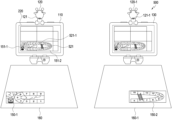
- FIG. 8 is a view 801 and 802 illustrating a method for providing content using a marker according to various embodiments.
- the processor 250 may obtain an image for a marker through the camera (e.g., the first camera 121 or the second camera 111 ) while content is provided.
- the camera e.g., the first camera 121 or the second camera 111
- the processor 250 may obtain an image for a marker 150 related to the hockey game through the camera.
- the processor 250 may obtain the content 811 (e.g., an image portion representing the hockey arena in the hockey game) corresponding to the marker 150 and the position of the marker 150 .
- the processor 250 may obtain content 812 related to the hockey game and corresponding to a marker (not shown) different from the marker 150 and the position of the different marker, based on information obtained from the external electronic device 130 .
- the processor 250 may obtain content (e.g., the image representing the hockey arena where the hockey game is played) based on the content corresponding to the marker 150 and the position of the marker 150 and the content 812 corresponding to the different marker and the position of the different marker and display the obtained content through the display module 220 .
- content e.g., the image representing the hockey arena where the hockey game is played
- the processor 250 may obtain the image for the marker (e.g., an item marker) through the camera while content (e.g., the image representing the hockey arena where the hockey game is played) is provided.
- the processor 250 may obtain an image for an item marker 151 movable on the guide 160 , through the camera.
- the processor 250 may obtain the object corresponding to the marker and the position of the marker based on the image obtained through the camera (e.g., the first camera 121 or the second camera 111 ).
- the processor 250 may obtain the object 151 - 3 corresponding to the item marker 151 and the position of the item marker 151 , based on the image for the item marker 151 obtained through the camera (e.g., the first camera 121 ). For example, the processor 250 may obtain the object 151 - 3 corresponding to the image and/or text printed on the item marker 151 , from the memory 240 . The processor 250 may obtain the position of the item marker 151 by identifying the area of the item marker 151 in the area (or the image obtained through the camera) indicating the guide included in the image obtained through the camera (e.g., the first camera 121 ).
- the processor 250 may obtain the object (e.g., the object 152 ) corresponding to an item marker different from the item marker 151 and the position of the different item marker, based on information obtained from the external electronic device 130 through the communication module 210 .
- the processor 250 may provide content based on the position of the marker.
- the processor 250 may provide content including the object 151 - 1 corresponding to the item marker 151 and the object 152 corresponding to the different item marker, based on the position of the item marker 151 and the position of the different item marker.
- the object 151 - 1 corresponding to the item marker 151 may represent the game piece of the electronic device 110
- the oobject 152 corresponding to the different item marker may represent the game piece of the external electronic device 130 .
- the processor 250 may move and display the object 151 - 1 corresponding to the item marker 151 in the position of the display module 220 corresponding to the moved position of the item marker 151 .
- the processor 250 may move and display the object 152 corresponding to the different item marker in the position of the display module 220 corresponding to the moved position of the different item marker.
- the object 153 may correspond to the puck (e.g., a virtual puck) of the hockey game. When the object 153 contacts the object 151 - 1 corresponding to the item marker 151 or the object 152 corresponding to the different item marker, the object 153 may be moved from the current position to another position on the display module 220 .
- the processor 250 may play the content (e.g., hockey game) using the marker 151 (e.g., item marker) even without the marker 150 and the different marker used for obtaining the content, after obtaining (e.g., generating) the content (e.g., the combined content of the content 811 and the content 812 ).
- the content e.g., hockey game
- the marker 151 e.g., item marker
- the processor 250 may play the content (e.g., hockey game) using the marker 151 (e.g., item marker) even without the marker 150 and the different marker used for obtaining the content, after obtaining (e.g., generating) the content (e.g., the combined content of the content 811 and the content 812 ).
- the user of the electronic device 110 may move the marker 150 (and different marker) out of the field-of-view of the camera (e.g., the first camera 121 ) and move the marker 151 within the field-of-view of the camera.
- the processor 250 may provide the content using the marker 151 while the content (e.g., the combined content of the content 811 and the content 812 ) is provided.
- embodiments are not limited thereto.
- the processor 250 may provide the content (e.g., hockey game) based on the position of the marker 151 (and different marker).
- FIG. 9 is a flowchart 900 illustrating a method for providing content using a marker according to various embodiments.
- FIG. 10 is a view 1000 illustrating a method for providing content using a marker according to various embodiments.
- FIG. 11 is a view 1101 and 1102 illustrating a method for providing an augmented reality effect using a marker according to various embodiments.
- FIG. 12 is a view 1201 , 1202 , and 1203 illustrating a method for providing an augmented reality effect using a marker according to various embodiments.
- the processor 250 may provide content using a marker.
- the processor 250 may obtain an image for the marker through a camera (e.g., the first camera 121 or the second camera 111 ).
- the processor 250 may obtain content corresponding to the marker based on the obtained image.
- the processor 250 may identify an area indicating the image and/or text printed on the marker, in the image obtained through the camera.
- the processor 250 may obtain content (e.g., a game execution screen) corresponding to the identified area.
- the processor 250 may obtain an image for a marker 1011 (and guide 160 ) printed with a sea-related image through the first camera 121 .
- the processor 250 may identify the area indicating the sea-related image in the obtained image.
- the processor 250 may display an execution screen 1012 of a fishing game, as content corresponding to the sea-related image, through the display module 220 .
- the processor 250 may obtain content corresponding to the marker, based on information received from the external electronic device 130 through the communication module 210 .
- the processor 250 may receive the image for the marker from the external electronic device 130 through the communication module 210 .
- the processor 250 may obtain content corresponding to the marker based on the received image.
- the processor 250 may receive the content corresponding to the marker from the external electronic device 130 through the communication module 210 .
- the processor 250 may assign priorities to the plurality of contents in the order in which the plurality of contents are obtained. For example, when content 1 corresponding to marker 1 is obtained based on an image for marker 1 obtained through the camera (e.g., the first camera 121 or the second camera 111 ), and content 2 corresponding to marker 2 (e.g., a marker as a target to be captured by the camera related to the external electronic device 130 of another user playing game together with the user of the electronic device 110 ) is obtained based on information received from the external electronic device 130 , the processor 250 may assign a higher priority to content 1 obtained earlier than content 2 .
- the processor 250 may assign a higher priority to content 1 obtained earlier than content 2 .
- the content corresponding to the marker may be first obtained.
- the processor 250 may provide the content with the highest priority among the plurality of contents respectively corresponding to the plurality of markers.
- the processor 250 may display, through the display module 220 , only the content with the highest priority among the plurality of contents respectively corresponding to the plurality of markers.
- the processor 250 may provide the content with the next highest priority. For example, after the fishing game corresponding to marker 1 , as the content with the highest priority, is terminated, the processor 250 may provide a desert exploration game corresponding to marker 2 as the content with the second highest priority.
- the processor 250 may obtain an image (hereinafter, referred to as a “first image”) for the first marker through the camera.
- the processor 250 may obtain the first image for the first marker through the camera (e.g., the first camera 121 or the second camera 111 ) while content is provided.
- the camera e.g., the first camera 121 or the second camera 111
- the first marker may include a marker having at least one surface printed with an image and/or text related to the item.
- the first marker may be a marker having at least one surface printed with a character-related image.
- the first marker may be a marker having at least one surface printed with an image related to equipment and/or clothes that may be put on the character.
- the first marker is not limited to those described above.
- the processor 250 may obtain a first object corresponding to the first marker and the position of the first marker.
- the processor 250 may obtain the first object corresponding to (e.g., mapped to) the first marker (hereinafter, denoted as a “first object”) based on the first image for the first marker. For example, the processor 250 may recognize the image (and/or text) e.g., a character-related image) printed on at least one surface of the first marker in the first image. The processor 250 may identify the object (e.g., the object representing the character) mapped to the recognized image and stored in the memory 240 .
- the processor 250 may obtain the position of the first marker based on the first image. For example, the processor 250 may identify the position of the area of the guide in the first image (e.g., the area indicating the guide in the first image) and the position of the area of the first marker (e.g., the image area indicating the first marker in the first image). The processor 250 may determine that the position of the area of the first marker in the area of the guide is the position of the first marker. As another example, the processor 250 may identify that the first image does not include the area of the guide. In this case, the processor 250 may identify the position of the area of the first marker in the first image (e.g., the first image corresponding to the field-of-view of the camera). The processor 250 may determine that the identified position of the first marker in the first image is the position of the first marker.
- the processor 250 may identify the position of the area of the guide in the first image (e.g., the area indicating the guide in the first image) and the position of the area of the first marker (e.g
- the processor may obtain the second object corresponding to the second marker and the position of the second marker, based on information received from the external electronic device 130 through the communication module.
- the second marker may be a marker that is a target to be captured by the camera device 121 - 1 obtaining an image and transmitting the obtained image to the external electronic device 130 or the camera module included in the external electronic device 130 .
- the second marker may include a marker having at least one surface printed with an image and/or text related to the item.
- the processor 250 may receive information including the second object corresponding to the second marker (hereinafter, denoted as a “second object”) and the position of the second marker, from the external electronic device 130 (or server) through the communication module 210 .
- the external electronic device 130 may perform substantially the same operations as operations 901 and 905 described above.
- the external electronic device 130 may obtain the image for the second marker through a camera related to the external electronic device 130 (e.g., the camera device obtaining the image and transmitting the obtained image to the external electronic device 130 or the camera module included in the external electronic device 130 ).
- the external electronic device 130 may obtain the second object corresponding to the second marker and the position of the second marker based on the obtained image.
- the external electronic device 130 may transmit information including the obtained second object and position of the second marker to the electronic device 110 .
- the electronic device 110 may receive, through the communication module 210 , the information including the second object and the position of the second marker, transmitted by the external electronic device 130 .
- the processor 250 may receive information including the image for the second marker (hereinafter, denoted as a “second image”) from the external electronic device 130 (or server) through the communication module 210 .
- the processor 250 may obtain the second object corresponding to the second marker and the position of the second marker based on the second image.
- the processor 250 may obtain the second object corresponding to the second marker, based on the second image.
- the processor 250 may recognize the image (and/or text) printed on at least one surface of the second marker in the second image.
- the processor 250 may identify the second object mapped to the recognized image and stored in the memory 210 .
- the processor 250 may obtain the position of the second marker based on the second image.
- the processor 250 may identify the position of the area of the guide in the second image (e.g., the area indicating the guide in the second image) and the position of the area of the second marker (e.g., the image area indicating the second marker in the second image). The processor 250 may determine that the position of the area of the second marker in the area of the guide is the position of the second marker. As another example, the processor 250 may determine that the identified position of the second marker in the second image is the position of the second marker.
- the processor 250 may obtain the third object by combining the first object and the second object based on the position of the first marker and the position of the second marker.
- the processor 250 may identify that at least part of the first object and at least part of the second object overlap on the screen displayed through the display module 220 , based on the position of the first marker and the position of the second marker. When at least part of the first object and at least part of the second object overlap, the processor 250 may obtain a third object in which the first object and the second object are combined together.
- the processor 250 may identify that the first object 1121 corresponding to the first marker 1111 (e.g., the marker printed with an image representing a character) and the second object 1122 corresponding to the second marker 1114 (e.g., the marker printed with an image representing a fishing rod) overlap on the screen 1112 (e.g., the screen displaying the content provided through operation 901 ) displayed through the display module 220 .
- the processor 250 may obtain the third object in which the first object 1121 and the second object 1122 are combined (e.g., an object representing an image in which the fishing rod represented by the second object 1122 is mounted on the character represented by the first object 1121 ).
- the processor 250 may provide content to allow the user of the electronic device 110 and/or the user of the external electronic device 130 to play game using the third object.
- the processor 250 may provide a game in which the character with the fishing rod is fishing using the fishing rod in the sea-related content to the user of the electronic device 101 and/or the user of the external electronic device 130 .
- the processor 250 may transmit, to the external electronic device 130 through the communication module, information related to the third object to allow the external electronic device 130 to display the screen 1113 (e.g., a screen including the same object 1131 as the first object 1121 and the same object 1132 as the second object 1122 ) identical to the screen 1112 displayed on the electronic device 110 .
- the screen 1113 e.g., a screen including the same object 1131 as the first object 1121 and the same object 1132 as the second object 1122 .
- the processor 250 may obtain objects using various markers.
- the processor 250 may obtain an object 1215 which is augmented with an item 1215 representing an umbrella on the character 1214 and in which the object corresponding to the marker 1211 and the object corresponding to the marker 1213 are combined (e.g., generated based on the object corresponding to the marker 1211 and the object corresponding to the marker 1213 ), using the marker 1211 printed with an image representing the character and the marker 1213 printed with an image representing a water droplet.
- the processor 250 may obtain an object resultant from changing at least part of the obtained object, based on the provided content. For example, when the object 1121 representing the character and corresponding to the first marker 1111 printed with the character-related image is obtained while the sea-related content is provided, the processor 250 may obtain an object in which the sea-related swimsuit is augmented with the character of the object 1121 .
- the processor 250 may obtain an object in which a jungle-related exploration suit is augmented with the character of the object 1121 .
- the processor 250 may apply an augmented reality effect (e.g., an animation effect) to the content provided through the display module 220 , using various markers. For example, when the third object is obtained based on the first object and the second object, the processor 250 may apply an augmented reality effect corresponding to the combination of the first object and the second object to the content being provided.
- an augmented reality effect e.g., an animation effect
- the processor 250 may display such an augmented reality effect as if the surroundings of the character brighten along with the object representing an image in which the flame is augmented with the character in the content related to the cave, through the display module 220 .
- the processor 250 may display such an augmented reality effect as if the ice melts into water in the ice-related content, through the display module 220 .
- the operation in which the electronic device provides content using markers is exemplified, but the embodiments are not limited thereto.
- some of the operations performed by the electronic device may be performed by the server 140 .
- a method for providing content using a marker by an electronic device may comprise obtaining an image for a first marker through a camera, obtaining a first content corresponding to the first marker and a position of the first marker, based on the image, obtaining a second content corresponding to a second marker and a position of the second marker, based on information received from an external electronic device, and obtaining a third content by combining the first content and the second content based on the position of the first marker and the position of the second marker.
- obtaining the image may comprise obtaining the image for the first marker through a camera of a camera device communicatively connected with the electronic device or a camera of the electronic device.
- the position of the first marker may be a position within a first guide on which the first marker is disposed or a position within a field-of-view of the camera
- the position of the second marker may be a position within a second guide on which the second marker is disposed or a position within a field-of-view of a camera related to the external electronic device.
- obtaining the third content may comprise obtaining the third content by combining the first content to be displayed in a first screen area corresponding to the position of the first marker among a plurality of screen areas of a display module of the electronic device and the second content to be displayed in a second screen area corresponding to the position of the second marker among the plurality of screen areas.
- the method may further comprise obtaining a position of a connection marker obtained through the camera, based on an image for the connection marker and obtaining a content to be displayed in a third screen area, based on the first content and the second content, when the position of the connection marker corresponds to the third screen area adjacent to the first screen area and/or the second screen area, wherein obtaining the third content may comprises obtaining the third content by combining the first content, the second content, and the content to be displayed in the third screen area.
- the first marker and the second marker may include puzzle markers.
- the first content and the second content may include parts of a puzzle map.
- the third content may include the puzzle map.
- the method may further comprise, when a position of the first content is identical to a position of the second content, assigning a higher priority to a marker in a position obtained earlier of the position of the first marker and the position of the second marker and displaying only a content corresponding to the marker assigned the higher priority, on a display module of the electronic device.
- the method may further comprise obtaining an image for a third marker through the camera while the third content is provided, obtaining an object corresponding to the third marker and a position of the third marker, based on the image for the third marker, and providing the third content using the third marker, based on the position of the third marker.
- a non-transitory computer-readable medium storing one or more programs may comprise instructions configured to, when executed by at least one processor of an electronic device, enable the electronic device to obtain an image for a first marker through a camera, obtain a first content corresponding to the first marker and a position of the first marker, based on the image, obtain a second content corresponding to a second marker and a position of the second marker, based on information received from an external electronic device, and obtain a third content by combining the first content and the second content based on the position of the first marker and the position of the second marker.
- the instructions may be configured to, when executed by the at least one processor, enable the electronic device to obtain the image for the first marker through a camera of a camera device communicatively connected with the electronic device or a camera of the electronic device.
- the position of the first marker may be a position within a first guide on which the first marker is disposed or a position within a field-of-view of the camera
- the position of the second marker may be a position within a second guide on which the second marker is disposed or a position within a field-of-view of a camera related to the external electronic device.
- the instructions may be configured to, when executed by the at least one processor, enable the electronic device to obtain the third content by combining the first content to be displayed in a first screen area corresponding to the position of the first marker among a plurality of screen areas of a display module of the electronic device and the second content to be displayed in a second screen area corresponding to the position of the second marker among the plurality of screen areas.
- the instructions may be configured to, when executed by the at least one processor, enable the electronic device to obtain a position of a connection marker obtained through the camera, based on an image for the connection marker, obtain a content to be displayed in a third screen area, based on the first content and the second content, when the position of the connection marker corresponds to the third screen area adjacent to the first screen area and/or the second screen area, and obtain the third content by combining the first content, the second content, and the content to be displayed in the third screen area.
- the first marker and the second marker may include puzzle markers.
- the first content and the second content may include parts of a puzzle map.
- the third content may include the puzzle map.
- the instructions may be configured to, when executed by the at least one processor, enable the electronic device to, when a position of the first content is identical to a position of the second content, assign a higher priority to a marker in a position obtained earlier of the position of the first marker and the position of the second marker and display only a content corresponding to the marker assigned the higher priority, on a display module of the electronic device.
- the instructions may be configured to, when executed by the at least one processor, enable the electronic device to obtain an image for a third marker through the camera while the third content is provided, obtain an object corresponding to the third marker and a position of the third marker, based on the image for the third marker, and provide the third content using the third marker, based on the position of the third marker.
- a method for providing content using a marker by an electronic device may comprise obtaining an image for a first marker through a camera while the content is provided, obtaining a first object corresponding to the first marker and a position of the first marker, based on the image, obtain a second object corresponding to a second marker and a position of the second marker, based on information received from an external electronic device, and obtain a third object by combining the first object and the second object based on the position of the first marker and the position of the second marker.
- obtaining the third object may comprise obtaining the third object in which the first object and the second object are combined, when at least part of the first object and at least part of the second object overlap each other.
- the method may further comprise obtaining an object in which at least part of the first object and/or the second object is changed, based on the content when the first object and/or the second object is obtained while the content is provided.
- the method may further comprise applying an augmented reality effect corresponding to the combination of the first object and the second object to the content when the third object is obtained.
- the structure of the data used in embodiments may be recorded in a computer-readable recording medium via various means.
- the computer-readable recording medium includes a storage medium, such as a magnetic storage medium (e.g., a ROM, a floppy disc, or a hard disc) or an optical reading medium (e.g., a CD-ROM or a DVD).
Landscapes
- Engineering & Computer Science (AREA)
- Multimedia (AREA)
- General Physics & Mathematics (AREA)
- Theoretical Computer Science (AREA)
- Physics & Mathematics (AREA)
- Human Computer Interaction (AREA)
- Computer Graphics (AREA)
- Software Systems (AREA)
- General Engineering & Computer Science (AREA)
- Computer Hardware Design (AREA)
- Computer Vision & Pattern Recognition (AREA)
- Business, Economics & Management (AREA)
- Tourism & Hospitality (AREA)
- Processing Or Creating Images (AREA)
- Marketing (AREA)
- Primary Health Care (AREA)
- Strategic Management (AREA)
- General Business, Economics & Management (AREA)
- Human Resources & Organizations (AREA)
- General Health & Medical Sciences (AREA)
- Economics (AREA)
- Health & Medical Sciences (AREA)
- Educational Technology (AREA)
- User Interface Of Digital Computer (AREA)
Abstract
Description
Claims (10)
Applications Claiming Priority (4)
| Application Number | Priority Date | Filing Date | Title |
|---|---|---|---|
| KR20210193201 | 2021-12-30 | ||
| KR10-2021-0193201 | 2021-12-30 | ||
| KR10-2022-0035089 | 2022-03-22 | ||
| KR1020220035089A KR102526634B1 (en) | 2021-12-30 | 2022-03-22 | Method for providing content using marker and electronic device supporting the same |
Publications (2)
| Publication Number | Publication Date |
|---|---|
| US20230215037A1 US20230215037A1 (en) | 2023-07-06 |
| US12217455B2 true US12217455B2 (en) | 2025-02-04 |
Family
ID=86143485
Family Applications (1)
| Application Number | Title | Priority Date | Filing Date |
|---|---|---|---|
| US17/720,946 Active 2043-05-27 US12217455B2 (en) | 2021-12-30 | 2022-04-14 | Method for providing content using marker and electronic device supporting the same |
Country Status (2)
| Country | Link |
|---|---|
| US (1) | US12217455B2 (en) |
| KR (1) | KR102526634B1 (en) |
Families Citing this family (1)
| Publication number | Priority date | Publication date | Assignee | Title |
|---|---|---|---|---|
| KR102526634B1 (en) * | 2021-12-30 | 2023-04-28 | (주)웅진씽크빅 | Method for providing content using marker and electronic device supporting the same |
Citations (17)
| Publication number | Priority date | Publication date | Assignee | Title |
|---|---|---|---|---|
| JPH08211926A (en) * | 1995-02-07 | 1996-08-20 | Toshiba Corp | Plant monitoring equipment |
| US6954728B1 (en) | 2000-05-15 | 2005-10-11 | Avatizing, Llc | System and method for consumer-selected advertising and branding in interactive media |
| US20090077161A1 (en) | 2007-09-17 | 2009-03-19 | International Business Machines Corporation | Modifying time progression rates in a virtual universe |
| KR100912264B1 (en) | 2008-02-12 | 2009-08-17 | 광주과학기술원 | User responsive augmented image generation method and system |
| US7882222B2 (en) | 2008-07-31 | 2011-02-01 | International Business Machines Corporation | Virtual environment module bundle |
| US20120198021A1 (en) * | 2011-01-27 | 2012-08-02 | Pantech Co., Ltd. | System and method for sharing marker in augmented reality |
| US20120218299A1 (en) * | 2011-02-25 | 2012-08-30 | Nintendo Co., Ltd. | Information processing system, information processing method, information processing device and tangible recoding medium recording information processing program |
| KR101271421B1 (en) | 2012-04-03 | 2013-06-05 | 이성노 | Contents providing apparatus using auto puzzle recognition |
| KR20170086201A (en) | 2016-01-18 | 2017-07-26 | 이상곤 | The method for providing user with mobile game based on augmented reality |
| KR20180010724A (en) | 2016-07-22 | 2018-01-31 | 주식회사 엠코코아 | Apparatus and method for object creation augmented reality |
| WO2019071378A1 (en) * | 2017-10-09 | 2019-04-18 | 深圳传音通讯有限公司 | Position identification method and terminal |
| KR20200057196A (en) | 2018-11-16 | 2020-05-26 | 주식회사 아토이 | Language education method using field scanning technology |
| US20200192963A1 (en) * | 2018-12-13 | 2020-06-18 | Samsung Electronics Co., Ltd. | Electronic device and method for displaying web content in augmented reality mode |
| US10857450B1 (en) * | 2018-05-09 | 2020-12-08 | James Aman | Physical-virtual game board and content delivery platform |
| US20230215037A1 (en) * | 2021-12-30 | 2023-07-06 | Woongjin Thinkbig Co., Ltd. | Method for providing content using marker and electronic device supporting the same |
| US20230215218A1 (en) * | 2021-12-30 | 2023-07-06 | Woongjin Thinkbig Co., Ltd. | Method of detecting user interaction and electronic device supporting the same |
| US20230215127A1 (en) * | 2021-12-30 | 2023-07-06 | Woongjin Thinkbig Co., Ltd. | Electronic device for implementing metaverse environment using drawing motion and method for operating the same |
Family Cites Families (1)
| Publication number | Priority date | Publication date | Assignee | Title |
|---|---|---|---|---|
| JP6954728B2 (en) | 2016-09-13 | 2021-10-27 | 株式会社77Kc | Cryopreservation container |
-
2022
- 2022-03-22 KR KR1020220035089A patent/KR102526634B1/en active Active
- 2022-04-14 US US17/720,946 patent/US12217455B2/en active Active
Patent Citations (19)
| Publication number | Priority date | Publication date | Assignee | Title |
|---|---|---|---|---|
| JPH08211926A (en) * | 1995-02-07 | 1996-08-20 | Toshiba Corp | Plant monitoring equipment |
| US6954728B1 (en) | 2000-05-15 | 2005-10-11 | Avatizing, Llc | System and method for consumer-selected advertising and branding in interactive media |
| US20090077161A1 (en) | 2007-09-17 | 2009-03-19 | International Business Machines Corporation | Modifying time progression rates in a virtual universe |
| KR101221169B1 (en) | 2007-09-17 | 2013-01-10 | 인터내셔널 비지네스 머신즈 코포레이션 | Modifying rates of action in a virtual universe |
| US20100321540A1 (en) | 2008-02-12 | 2010-12-23 | Gwangju Institute Of Science And Technology | User-responsive, enhanced-image generation method and system |
| KR100912264B1 (en) | 2008-02-12 | 2009-08-17 | 광주과학기술원 | User responsive augmented image generation method and system |
| US7882222B2 (en) | 2008-07-31 | 2011-02-01 | International Business Machines Corporation | Virtual environment module bundle |
| US20120198021A1 (en) * | 2011-01-27 | 2012-08-02 | Pantech Co., Ltd. | System and method for sharing marker in augmented reality |
| US20120218299A1 (en) * | 2011-02-25 | 2012-08-30 | Nintendo Co., Ltd. | Information processing system, information processing method, information processing device and tangible recoding medium recording information processing program |
| KR101271421B1 (en) | 2012-04-03 | 2013-06-05 | 이성노 | Contents providing apparatus using auto puzzle recognition |
| KR20170086201A (en) | 2016-01-18 | 2017-07-26 | 이상곤 | The method for providing user with mobile game based on augmented reality |
| KR20180010724A (en) | 2016-07-22 | 2018-01-31 | 주식회사 엠코코아 | Apparatus and method for object creation augmented reality |
| WO2019071378A1 (en) * | 2017-10-09 | 2019-04-18 | 深圳传音通讯有限公司 | Position identification method and terminal |
| US10857450B1 (en) * | 2018-05-09 | 2020-12-08 | James Aman | Physical-virtual game board and content delivery platform |
| KR20200057196A (en) | 2018-11-16 | 2020-05-26 | 주식회사 아토이 | Language education method using field scanning technology |
| US20200192963A1 (en) * | 2018-12-13 | 2020-06-18 | Samsung Electronics Co., Ltd. | Electronic device and method for displaying web content in augmented reality mode |
| US20230215037A1 (en) * | 2021-12-30 | 2023-07-06 | Woongjin Thinkbig Co., Ltd. | Method for providing content using marker and electronic device supporting the same |
| US20230215218A1 (en) * | 2021-12-30 | 2023-07-06 | Woongjin Thinkbig Co., Ltd. | Method of detecting user interaction and electronic device supporting the same |
| US20230215127A1 (en) * | 2021-12-30 | 2023-07-06 | Woongjin Thinkbig Co., Ltd. | Electronic device for implementing metaverse environment using drawing motion and method for operating the same |
Non-Patent Citations (2)
| Title |
|---|
| Korean Office Action dated Jan. 4, 2023, issued in Korean Patent Application No. 10-2022-0035089. |
| Translation of KR-20180010724-A (foreign document provided by applicant) (Year: 2018). * |
Also Published As
| Publication number | Publication date |
|---|---|
| KR102526634B1 (en) | 2023-04-28 |
| US20230215037A1 (en) | 2023-07-06 |
Similar Documents
| Publication | Publication Date | Title |
|---|---|---|
| Oufqir et al. | ARKit and ARCore in serve to augmented reality | |
| US12266134B2 (en) | Data processing method and electronic device | |
| Gervautz et al. | Anywhere interfaces using handheld augmented reality | |
| KR101692335B1 (en) | System for augmented reality image display and method for augmented reality image display | |
| CN104243952B (en) | Image processing equipment, image processing method, program, printed medium and printed medium external member | |
| US20150379777A1 (en) | Augmented reality providing system, recording medium, and augmented reality providing method | |
| CN112691372B (en) | Display method, device, equipment and readable storage medium of virtual props | |
| Youm et al. | Design and development methodologies of Kkongalmon, a location-based augmented reality game using mobile geographic information | |
| JP2003256876A (en) | Mixed reality display device and method, storage medium, and computer program | |
| JP5791434B2 (en) | Information processing program, information processing system, information processing apparatus, and information processing method | |
| US20170053449A1 (en) | Apparatus for providing virtual contents to augment usability of real object and method using the same | |
| CN113242440A (en) | Live broadcast method, client, system, computer equipment and storage medium | |
| JP7403967B2 (en) | Information processing device, video generation device, image processing system, control method and program thereof | |
| JP2013050883A (en) | Information processing program, information processing system, information processor, and information processing method | |
| EP3141991A1 (en) | Information processing device, information processing method, and program | |
| CN111915737A (en) | Human-object interaction system based on augmented reality | |
| US20230215037A1 (en) | Method for providing content using marker and electronic device supporting the same | |
| Yadav et al. | Augmented reality and its science | |
| Loijens et al. | 1. What is augmented reality? | |
| US10984599B1 (en) | Augmented reality system with display of object with real world dimensions | |
| Al-Ali et al. | MyVision AIR: An augmented interactive reality book mobile application | |
| JP7576511B2 (en) | PROGRAM, INFORMATION PROCESSING METHOD, INFORMATION PROCESSING APPARATUS, AND SYSTEM | |
| CN111783504A (en) | Method and apparatus for displaying information | |
| KR102175519B1 (en) | Apparatus for providing virtual contents to augment usability of real object and method using the same | |
| Yonov | School atlas with augmented reality |
Legal Events
| Date | Code | Title | Description |
|---|---|---|---|
| AS | Assignment |
Owner name: ARTYGENSPACE CO., LTD., KOREA, REPUBLIC OF Free format text: ASSIGNMENT OF ASSIGNORS INTEREST;ASSIGNORS:PARK, JEONGWOOK;CHOI, HWANSEOK;KIM, HYOJIN;AND OTHERS;REEL/FRAME:059603/0271 Effective date: 20220411 Owner name: WOONGJIN THINKBIG CO., LTD., KOREA, REPUBLIC OF Free format text: ASSIGNMENT OF ASSIGNORS INTEREST;ASSIGNORS:PARK, JEONGWOOK;CHOI, HWANSEOK;KIM, HYOJIN;AND OTHERS;REEL/FRAME:059603/0271 Effective date: 20220411 |
|
| FEPP | Fee payment procedure |
Free format text: ENTITY STATUS SET TO UNDISCOUNTED (ORIGINAL EVENT CODE: BIG.); ENTITY STATUS OF PATENT OWNER: LARGE ENTITY |
|
| STPP | Information on status: patent application and granting procedure in general |
Free format text: DOCKETED NEW CASE - READY FOR EXAMINATION |
|
| STPP | Information on status: patent application and granting procedure in general |
Free format text: NON FINAL ACTION MAILED |
|
| STPP | Information on status: patent application and granting procedure in general |
Free format text: RESPONSE TO NON-FINAL OFFICE ACTION ENTERED AND FORWARDED TO EXAMINER |
|
| STPP | Information on status: patent application and granting procedure in general |
Free format text: NOTICE OF ALLOWANCE MAILED -- APPLICATION RECEIVED IN OFFICE OF PUBLICATIONS |
|
| ZAAB | Notice of allowance mailed |
Free format text: ORIGINAL CODE: MN/=. |
|
| STPP | Information on status: patent application and granting procedure in general |
Free format text: PUBLICATIONS -- ISSUE FEE PAYMENT RECEIVED |
|
| STPP | Information on status: patent application and granting procedure in general |
Free format text: PUBLICATIONS -- ISSUE FEE PAYMENT VERIFIED |
|
| STCF | Information on status: patent grant |
Free format text: PATENTED CASE |