US12211760B2 - Integrated circuit devices including a parameter measuring structure and methods of forming the same - Google Patents

Integrated circuit devices including a parameter measuring structure and methods of forming the same Download PDF

Info

Publication number
US12211760B2
US12211760B2 US17/837,453 US202217837453A US12211760B2 US 12211760 B2 US12211760 B2 US 12211760B2 US 202217837453 A US202217837453 A US 202217837453A US 12211760 B2 US12211760 B2 US 12211760B2
Authority
US
United States
Prior art keywords
source
contact
resistance measuring
electrically connected
transistor
Prior art date
Legal status (The legal status is an assumption and is not a legal conclusion. Google has not performed a legal analysis and makes no representation as to the accuracy of the status listed.)
Active, expires
Application number
US17/837,453
Other versions
US20230326813A1 (en
Inventor
Byounghak HONG
WookHyun Kwon
Hyoeun Park
Kangill Seo
Current Assignee (The listed assignees may be inaccurate. Google has not performed a legal analysis and makes no representation or warranty as to the accuracy of the list.)
Samsung Electronics Co Ltd
Original Assignee
Samsung Electronics Co Ltd
Priority date (The priority date is an assumption and is not a legal conclusion. Google has not performed a legal analysis and makes no representation as to the accuracy of the date listed.)
Filing date
Publication date
Application filed by Samsung Electronics Co Ltd filed Critical Samsung Electronics Co Ltd
Priority to US17/837,453 priority Critical patent/US12211760B2/en
Priority to KR1020230025105A priority patent/KR20230144937A/en
Assigned to SAMSUNG ELECTRONICS CO., LTD. reassignment SAMSUNG ELECTRONICS CO., LTD. ASSIGNMENT OF ASSIGNORS INTEREST (SEE DOCUMENT FOR DETAILS). Assignors: KWON, WOOKHYUN, HONG, BYOUNGHAK, PARK, HYOEUN, SEO, KANGILL
Publication of US20230326813A1 publication Critical patent/US20230326813A1/en
Application granted granted Critical
Publication of US12211760B2 publication Critical patent/US12211760B2/en
Active legal-status Critical Current
Adjusted expiration legal-status Critical

Links

Images

Classifications

    • HELECTRICITY
    • H01ELECTRIC ELEMENTS
    • H01LSEMICONDUCTOR DEVICES NOT COVERED BY CLASS H10
    • H01L22/00Testing or measuring during manufacture or treatment; Reliability measurements, i.e. testing of parts without further processing to modify the parts as such; Structural arrangements therefor
    • H01L22/30Structural arrangements specially adapted for testing or measuring during manufacture or treatment, or specially adapted for reliability measurements
    • H01L22/34Circuits for electrically characterising or monitoring manufacturing processes, e. g. whole test die, wafers filled with test structures, on-board-devices incorporated on each die, process control monitors or pad structures thereof, devices in scribe line
    • H10P74/277
    • HELECTRICITY
    • H10SEMICONDUCTOR DEVICES; ELECTRIC SOLID-STATE DEVICES NOT OTHERWISE PROVIDED FOR
    • H10DINORGANIC ELECTRIC SEMICONDUCTOR DEVICES
    • H10D84/00Integrated devices formed in or on semiconductor substrates that comprise only semiconducting layers, e.g. on Si wafers or on GaAs-on-Si wafers
    • H10D84/80Integrated devices formed in or on semiconductor substrates that comprise only semiconducting layers, e.g. on Si wafers or on GaAs-on-Si wafers characterised by the integration of at least one component covered by groups H10D12/00 or H10D30/00, e.g. integration of IGFETs
    • H10D84/82Integrated devices formed in or on semiconductor substrates that comprise only semiconducting layers, e.g. on Si wafers or on GaAs-on-Si wafers characterised by the integration of at least one component covered by groups H10D12/00 or H10D30/00, e.g. integration of IGFETs of only field-effect components
    • H10D84/83Integrated devices formed in or on semiconductor substrates that comprise only semiconducting layers, e.g. on Si wafers or on GaAs-on-Si wafers characterised by the integration of at least one component covered by groups H10D12/00 or H10D30/00, e.g. integration of IGFETs of only field-effect components of only insulated-gate FETs [IGFET]
    • GPHYSICS
    • G01MEASURING; TESTING
    • G01RMEASURING ELECTRIC VARIABLES; MEASURING MAGNETIC VARIABLES
    • G01R27/00Arrangements for measuring resistance, reactance, impedance, or electric characteristics derived therefrom
    • G01R27/02Measuring real or complex resistance, reactance, impedance, or other two-pole characteristics derived therefrom, e.g. time constant
    • HELECTRICITY
    • H10SEMICONDUCTOR DEVICES; ELECTRIC SOLID-STATE DEVICES NOT OTHERWISE PROVIDED FOR
    • H10DINORGANIC ELECTRIC SEMICONDUCTOR DEVICES
    • H10D30/00Field-effect transistors [FET]
    • H10D30/01Manufacture or treatment
    • H10D30/014Manufacture or treatment of FETs having zero-dimensional [0D] or one-dimensional [1D] channels, e.g. quantum wire FETs, single-electron transistors [SET] or Coulomb blockade transistors
    • HELECTRICITY
    • H10SEMICONDUCTOR DEVICES; ELECTRIC SOLID-STATE DEVICES NOT OTHERWISE PROVIDED FOR
    • H10DINORGANIC ELECTRIC SEMICONDUCTOR DEVICES
    • H10D30/00Field-effect transistors [FET]
    • H10D30/40FETs having zero-dimensional [0D], one-dimensional [1D] or two-dimensional [2D] charge carrier gas channels
    • H10D30/43FETs having zero-dimensional [0D], one-dimensional [1D] or two-dimensional [2D] charge carrier gas channels having 1D charge carrier gas channels, e.g. quantum wire FETs or transistors having 1D quantum-confined channels
    • HELECTRICITY
    • H10SEMICONDUCTOR DEVICES; ELECTRIC SOLID-STATE DEVICES NOT OTHERWISE PROVIDED FOR
    • H10DINORGANIC ELECTRIC SEMICONDUCTOR DEVICES
    • H10D62/00Semiconductor bodies, or regions thereof, of devices having potential barriers
    • H10D62/10Shapes, relative sizes or dispositions of the regions of the semiconductor bodies; Shapes of the semiconductor bodies
    • H10D62/117Shapes of semiconductor bodies
    • H10D62/118Nanostructure semiconductor bodies
    • H10D62/119Nanowire, nanosheet or nanotube semiconductor bodies
    • H10D62/121Nanowire, nanosheet or nanotube semiconductor bodies oriented parallel to substrates
    • HELECTRICITY
    • H10SEMICONDUCTOR DEVICES; ELECTRIC SOLID-STATE DEVICES NOT OTHERWISE PROVIDED FOR
    • H10DINORGANIC ELECTRIC SEMICONDUCTOR DEVICES
    • H10D64/00Electrodes of devices having potential barriers
    • H10D64/20Electrodes characterised by their shapes, relative sizes or dispositions 
    • H10D64/23Electrodes carrying the current to be rectified, amplified, oscillated or switched, e.g. sources, drains, anodes or cathodes
    • H10D64/251Source or drain electrodes for field-effect devices
    • H10D64/254Source or drain electrodes for field-effect devices for lateral devices wherein the source or drain electrodes extend entirely through the semiconductor bodies, e.g. via-holes for back side contacts
    • H10W20/20
    • H10W20/42
    • H10W20/427
    • H10W20/481
    • BPERFORMING OPERATIONS; TRANSPORTING
    • B82NANOTECHNOLOGY
    • B82YSPECIFIC USES OR APPLICATIONS OF NANOSTRUCTURES; MEASUREMENT OR ANALYSIS OF NANOSTRUCTURES; MANUFACTURE OR TREATMENT OF NANOSTRUCTURES
    • B82Y10/00Nanotechnology for information processing, storage or transmission, e.g. quantum computing or single electron logic
    • HELECTRICITY
    • H10SEMICONDUCTOR DEVICES; ELECTRIC SOLID-STATE DEVICES NOT OTHERWISE PROVIDED FOR
    • H10DINORGANIC ELECTRIC SEMICONDUCTOR DEVICES
    • H10D30/00Field-effect transistors [FET]
    • H10D30/60Insulated-gate field-effect transistors [IGFET]
    • H10D30/67Thin-film transistors [TFT]
    • H10D30/6729Thin-film transistors [TFT] characterised by the electrodes
    • H10D30/673Thin-film transistors [TFT] characterised by the electrodes characterised by the shapes, relative sizes or dispositions of the gate electrodes
    • H10D30/6735Thin-film transistors [TFT] characterised by the electrodes characterised by the shapes, relative sizes or dispositions of the gate electrodes having gates fully surrounding the channels, e.g. gate-all-around
    • HELECTRICITY
    • H10SEMICONDUCTOR DEVICES; ELECTRIC SOLID-STATE DEVICES NOT OTHERWISE PROVIDED FOR
    • H10DINORGANIC ELECTRIC SEMICONDUCTOR DEVICES
    • H10D30/00Field-effect transistors [FET]
    • H10D30/60Insulated-gate field-effect transistors [IGFET]
    • H10D30/67Thin-film transistors [TFT]
    • H10D30/6757Thin-film transistors [TFT] characterised by the structure of the channel, e.g. transverse or longitudinal shape or doping profile
    • HELECTRICITY
    • H10SEMICONDUCTOR DEVICES; ELECTRIC SOLID-STATE DEVICES NOT OTHERWISE PROVIDED FOR
    • H10DINORGANIC ELECTRIC SEMICONDUCTOR DEVICES
    • H10D64/00Electrodes of devices having potential barriers
    • H10D64/20Electrodes characterised by their shapes, relative sizes or dispositions 
    • H10D64/23Electrodes carrying the current to be rectified, amplified, oscillated or switched, e.g. sources, drains, anodes or cathodes
    • H10D64/251Source or drain electrodes for field-effect devices

Definitions

  • the present disclosure generally relates to the field of electronics and, more particularly, to integrated circuit devices including a parameter measuring structure.
  • Performance of integrated circuit devices may depend on resistances of conductive elements (e.g., conductive elements formed through the middle-of-line (MOL) portion of device fabrication steps), and thus measuring those resistances may be beneficial to evaluate or improve performance of the integrated circuit devices.
  • MOL middle-of-line
  • resistance measuring structures may include a first transistor and a second transistor on a substrate structure.
  • the first transistor may include a first source/drain region and a first gate electrode
  • the second transistor may include a second source/drain region and a second gate electrode that is electrically connected to the first gate electrode.
  • the resistance measuring structures may also include a source/drain connection on the first and second source/drain regions and a contact structure extending between the first and second source/drain regions and extending through the substrate structure.
  • the first source/drain region may be electrically connected to the second source/drain region through the source/drain connection.
  • resistance measuring structures may include a first transistor and a second transistor on a substrate structure.
  • the first transistor may include a first source/drain region
  • the second transistor may include a second source/drain region that is electrically connected to the first source/drain region
  • the first transistor may further include a third source/drain region.
  • the resistance measuring structures may also include a first conductive pad and a second conductive pad in the substrate structure.
  • the first conductive pad may be electrically connected to the first and second source/drain regions, and the second conductive pad may be electrically connected to the third source/drain region.
  • the substrate structure may include a first surface facing the first and second source/drain regions and a second surface opposite the first surface, and the second surface of the substrate structure may expose respective portions of the first and second conductive pads.
  • integrated circuit devices may include a cell transistor that is on a substrate structure and including a cell gate electrode, an insulating layer on the substrate structure, the cell gate electrode being in the insulating layer, and a parameter measuring structure comprising first and second contact structures that extend through the substrate structure and the insulating layer.
  • the substrate structure may include a first surface facing the insulating layer and a second surface opposite the first surface, and the second surface of the substrate structure may expose respective portions of the first and second contact structures.
  • FIG. 1 is a layout of the first region including cell transistors according to some embodiments of the present invention.
  • FIGS. 2 , 3 and 4 illustrate cross-sectional views of the first region taken along the lines A-A′, B-B′ and C-C′ in FIG. 1 , respectively, according to some embodiments of the present invention.
  • FIG. 5 is a circuit diagram of a resistance measuring structure of the second region of the integrated circuit device according to some embodiments of the present invention.
  • FIG. 6 is a layout of the resistance measuring structure in FIG. 5 according to some embodiments of the present invention.
  • FIGS. 7 , 8 , 9 and 10 illustrate cross-sectional views taken along the lines D-D′, E-E′, F-F′ and G-G′ in FIG. 6 , respectively, according to some embodiments of the present invention.
  • FIG. 11 is a layout of the resistance measuring structure in FIG. 5 according to some embodiments of the present invention.
  • FIG. 12 illustrates a cross-sectional view taken along the line J-J′ in FIG. 11
  • FIG. 13 illustrates cross-sectional views taken along the lines K-K′, L-L′ and M-M′ in FIG. 11 according to some embodiments of the present invention.
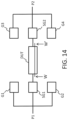
  • FIG. 14 illustrates the ground-signal-ground (GSG) configuration used for two-port s-parameter measurements for RF and microwave characterization of integrated circuit devices according to some embodiments of the present invention.
  • GSG ground-signal-ground
  • FIG. 15 illustrates a cross-sectional view of the device under test taken along the line W-W′ in FIG. 14 according to some embodiments of the present invention.
  • an integrated circuit device may include a first region including cell transistors and a second region including a parameter measuring structure (e.g., a resistance measuring structure or a scattering parameter (s-parameter) measuring structure).
  • the parameter measuring structure may include conductive pads that are exposed by a back side of a substrate structure. Those conductive pads may be electrically connected to elements (e.g., a source/drain region or a gate electrode) formed on a front side of the substrate structure through contact structures extending through the substrate structure.
  • FIG. 1 is a layout of the first region including cell transistors according to some example embodiments
  • FIGS. 2 , 3 and 4 illustrate cross-sectional views of the first region taken along the lines A-A′, B-B′ and C-C′ in FIG. 1 , respectively, according to some embodiments.
  • the cell transistors may be transistors of a standard cell (SC) or transistors of a memory device.
  • the standard cells may be, for example, an inverter, a 2-input NAND gate, a 3-input NAND gate, a 2-input NOR gate, a 3-input NOR gate, an And-Or inverter (AOI), an Or-And inverter (OAI), an XNOR gate, an XOR gate, a multiplexer (MUX), a latch, or a D-flip-flop.
  • the first region of the integrated circuit device may include cell transistors provided on a substrate structure 100 .
  • Each of the cell transistors may include a cell gate structure 20 c and cell source/drain regions 26 c that are adjacent opposing side surfaces of the cell gate structure 20 c , respectively, and are spaced apart from each other in a first horizontal direction (e.g., a first direction D 1 ).
  • Each of the cell gate structures 20 c may extend longitudinally in a second horizontal direction (e.g., a second direction D 2 ) as illustrated in FIG. 1 .
  • the cell gate structure 20 c may include a cell channel region 23 c connected to the cell source/drain regions 26 c , a cell gate electrode 24 c and a cell gate spacer 25 c that separates the cell gate electrode 24 c from the cell source/drain regions 26 c to electrically isolate the cell gate electrode 24 c from the cell source/drain regions 26 c .
  • the cell channel region 23 c may be a nanosheet or a nanowire having a thickness in a range of, for example, from 1 nm to 100 nm in a vertical direction (e.g., a third direction D 3 ).
  • the cell channel region 23 c may include semiconductor material(s) (e.g., silicon, germanium, silicon-germanium, and/or a group III-V semiconductor compound).
  • the third direction D 3 may be perpendicular to the first and second directions D 1 and D 2 .
  • each of the cell gate structures 20 c includes three channel regions 23 c stacked in the vertical direction, the present invention is not limited thereto.
  • each of the cell gate structure 20 c may include a single channel region 23 c .
  • FIGS. 2 and 4 illustrate each of the cell transistors as a gate-all-around field-effect transistor (GAA FET), each of the cell transistors may be implemented using various types of transistors (e.g., a fin field-effect transistor (FinFET), a recessed channel array transistor (RCAT) or a planar transistor).
  • GAA FET gate-all-around field-effect transistor
  • each of the cell transistors includes source/drain regions spaced apart from each other in the first horizontal direction
  • the present invention is not limited thereto.
  • each of the cell transistors may be a vertical field effect transistor (VFET) including cell source/drain regions spaced apart from each other in the vertical direction, and one of the cell source/drain regions may be provided in the substrate structure 100 .
  • VFET vertical field effect transistor
  • the cell source/drain regions 26 c may include a semiconductor material (e.g., Si or SiGe) and may further include impurities (e.g., B, P or As).
  • the cell gate electrode 24 c is illustrated as a single layer, the cell gate electrode 24 c may include multiple layers.
  • the cell gate electrode 24 c may include a semiconductor layer (e.g., a poly silicon layer), a work function layer (e.g., TiC layer, TiAl layer, TiAlC layer or TiN layer) and/or a metal layer (e.g., a tungsten layer, an aluminum layer or a copper layer).
  • a gate insulator and/or an interfacial layer are provided between the cell channel region 23 c and the cell gate electrode 24 c.
  • the cell gate spacer 25 c may include an insulating material (e.g., silicon oxide, silicon nitride, silicon oxynitride, silicon carbide or low-k material).
  • the low k material may include, for example, fluorine-doped silicon dioxide, organosilicate glass, carbon-doped oxide, porous silicon dioxide porous organosilicate glass, a spin-on organic polymeric dielectric, or a spin-on silicon based polymeric dielectric.
  • a first insulating layer 22 may be provided on the substrate structure 100 , and the cell source/drain regions 26 c may be provided in the first insulating layer 22 .
  • the cell gate structure 20 c and the first insulating layer 22 may be formed by the front-end-of-line (FEOL) portion of device fabrication steps.
  • a second insulating layer 32 may be provided on the first insulating layer 22 , and a source/drain contact 34 and cell gate contacts 36 may be provided in the second insulating layer 32 .
  • the second insulating layer 32 , the source/drain contact 34 and the cell gate contacts 36 may be formed by the middle-of-line (MOL) portion of device fabrication steps.
  • Each of the cell source/drain regions 26 c may include a lower surface facing the substrate structure 100 and an upper surface opposite the lower surface thereof.
  • the source/drain contact 34 may contact the upper surface of one of the cell source/drain regions 26 c .
  • Each of the cell gate electrodes 24 c may include a lower surface facing the substrate structure 100 and an upper surface opposite the lower surface thereof.
  • the cell gate contacts 36 may contact the upper surfaces of the cell gate electrodes 24 c , respectively.
  • a third insulating layer 42 may be provided on the second insulating layer 32 , and cell gate wires 44 (e.g., metal wires) may be provided in the third insulating layer 42 .
  • the cell gate wires 44 and the third insulating layer 42 may be formed by the back-end-of-line (BEOL) portion of device fabrication steps.
  • the cell gate wires 44 may contact upper surfaces of the cell gate contacts 36 , respectively, as illustrated in FIG. 4 .
  • the substrate structure 100 may include a first surface S 1 facing the cell source/drain regions 26 c and a second surface S 2 that is opposite the first surface S 1 .
  • the first surface S 1 and the second surface S 2 of the substrate structure 100 may be parallel to each other.
  • the first direction D 1 and the second direction D 2 may be parallel to the first surface S 1 and/or the second surface S 2 of the substrate structure 100 .
  • the substrate structure 100 may include a semiconductor substrate 10 that includes isolation regions 12 .
  • the substrate structure 100 may also include a fourth insulating layer 52 and a fifth insulating layer 62 .
  • the fourth insulating layer 52 may extend between the semiconductor substrate 10 and the fifth insulating layer 62 .
  • the semiconductor substrate 10 may include one or more semiconductor materials, for example, Si, Ge, SiGe, GaP, GaAs, SiC, SiGeC and/or InP.
  • the substrate 10 may be a silicon layer that may be a portion of a silicon wafer.
  • a cell contact plug 28 may be provided in the first insulating layer 22 and one of the isolation regions 12 . In some embodiments, the cell contact plug 28 may extend through the first insulating layer 22 and one of the isolation regions 12 as illustrated in FIG. 3 .
  • a cell power rail 54 may be provided in the fourth insulating layer 52 .
  • the cell contact plug 28 may contact the source/drain contact 34 (e.g., a lower surface of the source/drain contact 34 ) and the cell power rail 54 (e.g., an upper surface of the cell power rail 54 ) as illustrated in FIG. 3 .
  • the fourth insulating layer 52 and the cell power rail 54 may be formed after the BEOL portion of device fabrication steps. Therefore, metal elements of the cell power rail 54 may not contaminate the cell transistors, and the cell power rail 54 may not go through high temperature processes of the FEOL portion of device fabrication steps.
  • the semiconductor substrate 10 may include a front side facing the cell source/drain regions 26 c and a back side opposite the front side.
  • the fourth insulating layer 52 and the cell power rail 54 may be provided on the back side of the semiconductor substrate 10 as illustrated in FIG. 3 , and thus the cell power rail 54 may be referred to as a back side power rail.
  • the fourth insulating layer 52 and the cell power rail 54 may be formed by processes performed on the back side of the semiconductor substrate 10 .
  • a cell power via 64 and a cell power wire 66 may be provided in the fifth insulating layer 62 .
  • the fifth insulating layer 62 , the power via 64 and the cell power wire 66 may be elements of a power delivery network (PDN) structure.
  • the cell power rail 54 may contact the cell contact plug 28 (e.g., a lower surface of the cell contact plug 28 ) and the cell power via 64 (e.g., an upper surface of the cell power via 64 ).
  • FIG. 3 illustrates one cell power via 64 and one cell power wire 66
  • the integrated circuit device may include multiple cell power vias 64 and multiple cell power wires 66 .
  • the cell contact plug 28 , the cell power rail 54 , the cell power via 64 and the cell power wire 66 collectively may be a cell contact structure 110 c .
  • the cell contact structure 110 c may extend through the first insulating layer 22 and the substrate structure 100 .
  • the second surface S 2 of the substrate structure 100 may expose a portion of the cell contact structure 110 c (e.g., a portion of the cell power wire 66 ) as illustrated in FIG. 3 .
  • the exposed portion of the cell contact structure 110 c may be a power pad.
  • the exposed portion of the cell contact structure 110 c may be electrically connected to a power source (e.g., a power source having a positive volage, zero voltage or ground voltage), and the cell source/drain region 26 c may be electrically connected to the power source through the source/drain contact 34 and the cell contact structure 110 c .
  • the substrate structure 100 may not cover at least a portion of the cell contact structure 110 c (e.g., at least a portion of the cell power wire 66 ) as illustrated in FIG. 3 .
  • Each of the first, second, third, fourth and fifth insulating layers 22 , 32 , 42 , 52 and 62 may include, for example, silicon oxide, silicon nitride, silicon carbide and/or low-k material.
  • Each of the cell contact plug 28 , the source/drain contact 34 , the cell gate contacts 36 , the cell gate wires 44 , the cell power rail 54 , the cell power via 64 and the cell power wire 66 may include, for example, W, Al, Cu, Ru and/or Co.
  • the low k material may include, for example, fluorine-doped silicon dioxide, organosilicate glass, carbon-doped oxide, porous silicon dioxide, porous organosilicate glass, a spin-on organic polymeric dielectric, or a spin-on silicon based polymeric dielectric.
  • FIG. 5 is a circuit diagram of a resistance measuring structure of the second region of the integrated circuit device according to some embodiments.
  • the resistance measuring structure may be used to measure resistance Rcnt of a first contact structure (e.g., a first contact structure 110 _ 1 in FIG. 8 ), which is the same as resistance of the cell contact structure 110 c .
  • FIG. 6 is a layout of the resistance measuring structure in FIG. 5 according to some embodiments, and FIGS. 7 , 8 , 9 and 10 illustrate cross-sectional views taken along the lines D-D′, E-E′, F-F′ and G-G′ in FIG. 6 , respectively, according to some embodiments.
  • the resistance measuring structure may include a first transistor TR 1 and a second transistor TR 2 .
  • a first one of source/drain regions (e.g., a first source/drain region 26 _ 1 in FIG. 8 ) of the first transistor TR 1 and a first one of source/drain regions (e.g., a second source/drain region 26 _ 2 in FIG. 8 ) of the second transistor TR 2 may be electrically connected to each other, and gate electrodes (e.g., first and second gate electrodes 24 _ 1 and 24 _ 2 in FIG. 9 ) of the first and second transistors TR 1 and TR 2 may be electrically connected to each other.
  • the first and second transistors TR 1 and TR 2 may be turned on by applying an appropriate gate voltage thereto, the first one of the source/drain regions of the first transistor TR 1 and the first one of the source/drain regions of the second transistor TR 2 may be electrically connected to a current source for current forcing and may be also electrically connected to a first probe of a voltage meter, a second one of the source/drain regions (e.g., a third source/drain region 26 _ 3 in FIG.
  • V 1 -V 2 is a voltage measured by the voltage meter.
  • the first transistor TR 1 may include a first gate structure 20 _ 1 and the first and third source/drain regions 26 _ 1 and 26 _ 3 adjacent opposing side surfaces of the first gate structure 20 _ 1 , respectively.
  • the first gate structure 20 _ 1 may include a first channel region 23 _ 1 , a first gate electrode 24 _ 1 and a first gate spacer 25 _ 1 .
  • the second transistor TR 2 may include a second gate structure 20 _ 2 and the second and fourth source/drain regions 26 _ 2 and 26 _ 4 adjacent opposing side surfaces of the second gate structure 20 _ 2 , respectively.
  • the second gate structure 20 _ 2 may include a second channel region 23 _ 2 , a second gate electrode 24 _ 2 and a second gate spacer 25 _ 2 .
  • the resistance measuring structure may also include a first source/drain connection 35 _ 1 .
  • the first source/drain connection 35 _ 1 may contact an upper surface of the first insulating layer 22 .
  • the first source/drain region 26 _ 1 may be electrically connected to the second source/drain region 26 _ 2 through the first source/drain connection 35 _ 1 .
  • the first source/drain connection 35 _ 1 may overlap the first and second source/drain regions 26 _ 1 and 26 _ 2 in the vertical direction and may contact upper surfaces of the first and second source/drain regions 26 _ 1 and 26 _ 2 as illustrated in FIG. 8 .
  • the first source/drain connection 35 _ 1 may extend between the first and second source/drain regions 26 _ 1 and 26 _ 2 as illustrated in FIG. 8 .
  • the first source/drain connection 35 _ 1 may be electrically connected to a first contact structure 110 _ 1 that may include a first contact plug 29 _ 1 , a first power rail 55 _ 1 , a first power via 65 _ 1 and a first power wire 67 _ 1 .
  • the first source/drain connection 35 _ 1 may contact the first contact plug 29 _ 1 (e.g., an upper surface of the first contact plug 29 _ 1 ) as illustrated in FIG. 8 .
  • the first contact structure 110 _ 1 may extend through the first insulating layer 22 and the substrate structure 100 .
  • the second surface S 2 of the substrate structure 100 may expose a portion of the first contact structure 110 _ 1 (e.g., a portion of the first power wire 67 _ 1 ).
  • the exposed portion of the first contact structure 110 _ 1 may be a first conductive pad that may be electrically connected to a current source and may be also electrically connected to a first probe of a voltage meter.
  • the substrate structure 100 may not cover at least a portion of the first contact structure 110 _ 1 (e.g., at least a portion of the first power wire 67 _ 1 ) as illustrated in FIG. 8 .
  • the resistance measuring structure may include a second source/drain connection 35 _ 2 electrically connected to the third source/drain region 26 _ 3 and a third source/drain connection 35 _ 3 electrically connected to the fourth source/drain region 26 _ 4 .
  • the second source/drain connection 35 _ 2 may contact an upper surface of the third source/drain region 26 _ 3 and the upper surface of the first insulating layer 22
  • the third source/drain connection 35 _ 3 may contact an upper surface of the fourth source/drain region 26 _ 4 and the upper surface of the first insulating layer 22 .
  • the second source/drain connection 35 _ 2 may be electrically connected to a second contact structure 110 _ 2 that may include a second contact plug 29 _ 2 , a second power rail 55 _ 2 , a second power via 65 _ 2 and a second power wire 67 _ 2 .
  • the second source/drain connection 35 _ 2 may contact the second contact plug 29 _ 2 (e.g., an upper surface of the second contact plug 29 _ 2 ) as illustrated in FIG. 10 .
  • the second contact structure 110 _ 2 may extend through the first insulating layer 22 and the substrate structure 100 .
  • the second surface S 2 of the substrate structure 100 may expose a portion of the second contact structure 110 _ 2 (e.g., a portion of the second power wire 67 _ 2 ).
  • the exposed portion of the second contact structure 110 _ 2 may be a second conductive pad that may be electrically connected to a second probe of the voltage meter.
  • the substrate structure 100 may not cover at least a portion of the second contact structure 110 _ 2 (e.g., at least a portion of the second power wire 67 _ 2 ) as illustrated in FIG. 10 .
  • the third source/drain connection 35 _ 3 may be electrically connected to a third contact structure 110 _ 3 that may include a third contact plug 29 _ 3 , a third power rail 55 _ 3 , a third power via 65 _ 3 and a third power wire 67 _ 3 .
  • the third source/drain connection 35 _ 3 may contact the third contact plug 29 _ 3 (e.g., an upper surface of the third contact plug 29 _ 3 ) as illustrated in FIG. 10 .
  • the third contact structure 110 _ 3 may extend through the first insulating layer 22 and the substrate structure 100 .
  • the second surface S 2 of the substrate structure 100 may expose a portion of the third contact structure 110 _ 3 (e.g., a portion of the third power wire 67 _ 3 ).
  • the exposed portion of the third contact structure 110 _ 3 may be a third conductive pad that may be electrically connected to a current sensing circuit.
  • the substrate structure 100 may not cover at least a portion of the third contact structure 110 _ 3 (e.g., at least a portion of the third power wire 67 _ 3 ) as illustrated in FIG. 10 .
  • Gate contacts 37 may be provided in the second insulating layer 32 .
  • the gate contacts 37 may be electrically connected to the first and second gate electrodes 24 _ 1 and 24 _ 2 , respectively. In some embodiments, the gate contacts 37 may contact upper surfaces of the first and second gate electrodes 24 _ 1 and 24 _ 2 , respectively.
  • a gate wire 45 may be provided in the third insulating layer 42 . In some embodiments, the gate wire 45 may contact upper surfaces of the gate contacts 37 and an upper surface of the second insulating layer 32 . The gate wire 45 may overlap the gate contacts 37 and the first and second gate electrodes 24 _ 1 and 24 _ 2 in the vertical direction.
  • the gate wire 45 may be electrically connected to a fourth contact structure 110 _ 4 that may include a fourth contact plug 29 _ 4 , a fourth power rail 55 _ 4 , a fourth power via 65 _ 4 and a fourth power wire 67 _ 4 .
  • the gate wire 45 may be electrically connected to the fourth contact structure 110 _ 4 through a wire contact 38 provided in the second insulating layer 32 .
  • the gate wire 45 may contact the wire contact 38 (e.g., an upper surface of the wire contact 38 ), and the wire contact 38 may contact the fourth contact plug 29 _ 4 (e.g., an upper surface of the fourth contact plug 29 _ 4 ) as illustrated in FIG. 9 .
  • the fourth contact structure 110 _ 4 may extend through the first insulating layer 22 and the substrate structure 100 .
  • the second surface S 2 of the substrate structure 100 may expose a portion of the fourth contact structure 110 _ 4 (e.g., a portion of the fourth power wire 67 _ 4 ).
  • the exposed portion of the fourth contact structure 110 _ 4 may be a fourth conductive pad through which a gate voltage is applied.
  • the substrate structure 100 may not cover at least a portion of the fourth contact structure 110 _ 4 (e.g., at least a portion of the fourth power wire 67 _ 4 ) as illustrated in FIG. 9 .
  • FIG. 11 is a layout of the resistance measuring structure in FIG. 5 according to some embodiments
  • FIG. 12 illustrates a cross-sectional view taken along the line J-J′ in FIG. 11
  • FIG. 13 illustrates cross-sectional views taken along the lines K-K′, L-L′ and M-M′ in FIG. 11 according to some embodiments.
  • the resistance measuring structure illustrated in FIGS. 11 to 13 may be similar to the resistance measuring structure illustrated in FIGS. 6 to 10 with a primary difference that the first gate structure 20 _ 1 and the second gate structure 20 _ 2 are spaced apart from each other in the first direction D 1 in FIG. 11 .
  • An element of the first region of the integrated circuit device illustrated in FIGS. 2 to 4 and its corresponding element of the second region of the integrated circuit device illustrated in FIGS. 7 to 10 and FIGS. 12 and 13 may be formed by the same process and/or may include the same material.
  • the cell channel region 23 c may correspond to the first and second channel regions 23 _ 1 and 23 _ 2 .
  • the cell gate electrode 24 c , the cell gate spacer 25 c , the cell gate contacts 36 , the cell gate wires 44 , the contact plug 28 , the cell power rail 54 , the power via 64 and the power wire 66 may correspond to the first and second gate electrodes 24 _ 1 and 24 _ 2 , the first and second gate spacers 25 _ 1 and 25 _ 2 , the gate contacts 37 , the gate wire 45 , the first to fourth contact plugs 29 _ 1 to 29 _ 4 , the first to fourth power rails 55 _ 1 to 55 _ 4 , the first to fourth power vias 65 _ 1 to 65 _ 4 and the first to fourth power wires 67 _ 1 to 67 _ 4 , respectively.
  • FIG. 14 illustrates the ground-signal-ground (GSG) configuration used for two-port s-parameter measurements for RF and microwave characterization of integrated circuit devices according to some embodiments.
  • the ground-signal-ground (GSG) configuration may include six pads (i.e., first to fourth ground pads G 1 , G 2 , G 3 and G 4 and first and second signal pads SG 1 and SG 2 ) that are electrically connected to a device under test DUT.
  • the first signal pad SG 1 may be provided between the first and second ground pads G 1 and G 2
  • the first signal pad SG 1 and the first and second ground pads G 1 and G 2 may be electrically connected to a first set P 1 of RF probes.
  • the second signal pad SG 2 may be provided between the third and fourth ground pads G 3 and G 4 , and the second signal pad SG 2 and the third and fourth ground pads G 3 and G 4 may be electrically connected to a second set P 2 of RF probes.
  • the RF probes of the first and second sets may be, for example, coaxial connections or microprobes that may be based on a micro-coaxial cable with the centre conductor.
  • FIG. 15 illustrates a cross-sectional view of the device under test DUT taken along the line W-W′ in FIG. 14 according to some embodiments.
  • the device under test DUT may include a fifth contact structure 110 _ 5 electrically connected to the first signal pad SG 1 and a sixth contact structure 110 _ 6 electrically connected to the second signal pad SG 2 .
  • the fifth contact structure 110 _ 5 may include a fifth contact plug 29 _ 5 , a fifth power rail 55 _ 5 , a fifth power via 65 _ 5 and a fifth power wire 67 _ 5 .
  • the fifth contact structure 110 _ 5 may extend through the first insulating layer 22 and the substrate structure 100 , and the second surface S 2 of the substrate structure 100 may expose a portion of the fifth contact structure 110 _ 5 (e.g., a portion of the fifth power wire 67 _ 5 ) as illustrated in FIG. 15 .
  • the fifth contact plug 29 _ 5 may extend through one of the isolation regions 12 .
  • the exposed portion of the fifth contact structure 110 _ 5 may contact the first signal pad SG 1 or may be a portion of the first signal pad SG 1 .
  • the substrate structure 100 may not cover at least a portion of the fifth contact structure 110 _ 5 (e.g., at least a portion of the fifth power wire 67 _ 5 ) as illustrated in FIG. 15 .
  • the sixth contact structure 110 _ 6 may include a sixth contact plug 29 _ 6 , a sixth power rail 55 _ 6 , a sixth power via 65 _ 6 and a sixth power wire 67 _ 6 .
  • the sixth contact structure 110 _ 6 may extend through the first insulating layer 22 and the substrate structure 100 , and the second surface S 2 of the substrate structure 100 may expose a portion of the sixth contact structure 110 _ 6 (e.g., a portion of the sixth power wire 67 _ 6 ) as illustrated in FIG. 15 .
  • the sixth contact plug 29 _ 6 may extend through one of the isolation regions 12 .
  • the exposed portion of the sixth contact structure 110 _ 6 may contact the second signal pad SG 2 or may be a portion of the second signal pad SG 2 .
  • the substrate structure 100 may not cover at least a portion of the sixth contact structure 110 _ 6 (e.g., at least a portion of the sixth power wire 67 _ 6 ) as illustrated in FIG. 15 .
  • the device under test DUT may also include a contact connection 35 _ 4 that may be on and may be electrically connected to the fifth contact structure 110 _ 5 and the sixth contact structure 110 _ 6 .
  • the contact connection 35 _ 4 may overlap the fifth contact structure 110 _ 5 and the sixth contact structure 110 _ 6 in the vertical direction and may contact fifth contact structure 110 _ 5 and the sixth contact structure 110 _ 6 (e.g., upper surfaces of the fifth contact structure 110 _ 5 and the sixth contact structure 110 _ 6 ).
  • the contact connection 35 _ 4 may contact the fifth contact plug 29 _ 5 and the sixth contact plug 29 _ 6 (e.g., upper surfaces of the fifth and sixth contact plugs 29 _ 5 and 29 _ 6 ).
  • the contact connection 35 _ 4 may also contact the first insulating layer 22 (e.g., the upper surface of the first insulating layer 22 ).
  • An element of the device under test DUT illustrated in FIG. 15 and its corresponding element of the first region of the integrated circuit device illustrated in FIGS. 2 to 4 may be formed by the same process and/or may include the same material.
  • the contact connection 35 _ 4 , the fifth and sixth contact plugs 29 _ 5 and 29 _ 6 , the fifth and sixth power rails 55 _ 5 and 55 _ 6 , the fifth and sixth power vias 65 _ 5 and 65 _ 6 , and the fifth and sixth power wires 67 _ 5 and 67 _ 6 may correspond to the source/drain contact 34 , the contact plug 28 , the cell power rail 54 , the power via 64 and the power wire 66 .
  • Example embodiments are described herein with reference to cross-sectional views that are schematic illustrations of idealized embodiments and intermediate structures of example embodiments. As such, variations from the shapes of the illustrations as a result, for example, of manufacturing techniques and/or tolerances, are to be expected. Thus, example embodiments should not be construed as limited to the particular shapes illustrated herein but include deviations in shapes that result, for example, from manufacturing, unless the context clearly indicates otherwise.

Landscapes

  • Engineering & Computer Science (AREA)
  • Physics & Mathematics (AREA)
  • General Physics & Mathematics (AREA)
  • Manufacturing & Machinery (AREA)
  • Computer Hardware Design (AREA)
  • Microelectronics & Electronic Packaging (AREA)
  • Power Engineering (AREA)
  • Semiconductor Integrated Circuits (AREA)
  • Condensed Matter Physics & Semiconductors (AREA)
  • Automation & Control Theory (AREA)
  • Geometry (AREA)

Abstract

Integrated circuit devices may include a cell transistor and a parameter measuring structure (e.g., a resistance measuring structure). The cell transistor may be on a first surface of a substrate structure, which is opposite a second surface thereof. The parameter measuring structure may include first and second contact structures that extend through the substrate structure. The second surface of the substrate structure may expose respective portions of the first and second contact structures.

Description

CROSS-REFERENCE TO RELATED APPLICATION
This application claims priority to U.S. Provisional Application Ser. No. 63/328,814, entitled RESISTANCE MEASURING STRUCTURES OF INTEGRATED CIRCUIT DEVICES, filed in the USPTO on Apr. 8, 2022, the disclosure of which is hereby incorporated by reference herein in its entirety.
FIELD
The present disclosure generally relates to the field of electronics and, more particularly, to integrated circuit devices including a parameter measuring structure.
BACKGROUND
Various structures of integrated circuit devices and methods of forming the same have been proposed to increase the integration density thereof. Performance of integrated circuit devices may depend on resistances of conductive elements (e.g., conductive elements formed through the middle-of-line (MOL) portion of device fabrication steps), and thus measuring those resistances may be beneficial to evaluate or improve performance of the integrated circuit devices.
SUMMARY
According to some embodiments of the present invention, resistance measuring structures may include a first transistor and a second transistor on a substrate structure. The first transistor may include a first source/drain region and a first gate electrode, and the second transistor may include a second source/drain region and a second gate electrode that is electrically connected to the first gate electrode. The resistance measuring structures may also include a source/drain connection on the first and second source/drain regions and a contact structure extending between the first and second source/drain regions and extending through the substrate structure. The first source/drain region may be electrically connected to the second source/drain region through the source/drain connection.
According to some embodiments of the present invention, resistance measuring structures may include a first transistor and a second transistor on a substrate structure. The first transistor may include a first source/drain region, and the second transistor may include a second source/drain region that is electrically connected to the first source/drain region, and the first transistor may further include a third source/drain region. The resistance measuring structures may also include a first conductive pad and a second conductive pad in the substrate structure. The first conductive pad may be electrically connected to the first and second source/drain regions, and the second conductive pad may be electrically connected to the third source/drain region. The substrate structure may include a first surface facing the first and second source/drain regions and a second surface opposite the first surface, and the second surface of the substrate structure may expose respective portions of the first and second conductive pads.
According to some embodiments of the present invention, integrated circuit devices may include a cell transistor that is on a substrate structure and including a cell gate electrode, an insulating layer on the substrate structure, the cell gate electrode being in the insulating layer, and a parameter measuring structure comprising first and second contact structures that extend through the substrate structure and the insulating layer. The substrate structure may include a first surface facing the insulating layer and a second surface opposite the first surface, and the second surface of the substrate structure may expose respective portions of the first and second contact structures.
BRIEF DESCRIPTION OF THE DRAWINGS
FIG. 1 is a layout of the first region including cell transistors according to some embodiments of the present invention.
FIGS. 2, 3 and 4 illustrate cross-sectional views of the first region taken along the lines A-A′, B-B′ and C-C′ in FIG. 1 , respectively, according to some embodiments of the present invention.
FIG. 5 is a circuit diagram of a resistance measuring structure of the second region of the integrated circuit device according to some embodiments of the present invention.
FIG. 6 is a layout of the resistance measuring structure in FIG. 5 according to some embodiments of the present invention.
FIGS. 7, 8, 9 and 10 illustrate cross-sectional views taken along the lines D-D′, E-E′, F-F′ and G-G′ in FIG. 6 , respectively, according to some embodiments of the present invention.
FIG. 11 is a layout of the resistance measuring structure in FIG. 5 according to some embodiments of the present invention.
FIG. 12 illustrates a cross-sectional view taken along the line J-J′ in FIG. 11 , and FIG. 13 illustrates cross-sectional views taken along the lines K-K′, L-L′ and M-M′ in FIG. 11 according to some embodiments of the present invention.
FIG. 14 illustrates the ground-signal-ground (GSG) configuration used for two-port s-parameter measurements for RF and microwave characterization of integrated circuit devices according to some embodiments of the present invention.
FIG. 15 illustrates a cross-sectional view of the device under test taken along the line W-W′ in FIG. 14 according to some embodiments of the present invention.
DETAILED DESCRIPTION
According to some presented embodiments, an integrated circuit device may include a first region including cell transistors and a second region including a parameter measuring structure (e.g., a resistance measuring structure or a scattering parameter (s-parameter) measuring structure). The parameter measuring structure may include conductive pads that are exposed by a back side of a substrate structure. Those conductive pads may be electrically connected to elements (e.g., a source/drain region or a gate electrode) formed on a front side of the substrate structure through contact structures extending through the substrate structure.
FIG. 1 is a layout of the first region including cell transistors according to some example embodiments, FIGS. 2, 3 and 4 illustrate cross-sectional views of the first region taken along the lines A-A′, B-B′ and C-C′ in FIG. 1 , respectively, according to some embodiments.
In some embodiments, the cell transistors may be transistors of a standard cell (SC) or transistors of a memory device. The standard cells may be, for example, an inverter, a 2-input NAND gate, a 3-input NAND gate, a 2-input NOR gate, a 3-input NOR gate, an And-Or inverter (AOI), an Or-And inverter (OAI), an XNOR gate, an XOR gate, a multiplexer (MUX), a latch, or a D-flip-flop.
Referring to FIGS. 1 through 4 , the first region of the integrated circuit device may include cell transistors provided on a substrate structure 100. Each of the cell transistors may include a cell gate structure 20 c and cell source/drain regions 26 c that are adjacent opposing side surfaces of the cell gate structure 20 c, respectively, and are spaced apart from each other in a first horizontal direction (e.g., a first direction D1). Each of the cell gate structures 20 c may extend longitudinally in a second horizontal direction (e.g., a second direction D2) as illustrated in FIG. 1 . The cell gate structure 20 c may include a cell channel region 23 c connected to the cell source/drain regions 26 c, a cell gate electrode 24 c and a cell gate spacer 25 c that separates the cell gate electrode 24 c from the cell source/drain regions 26 c to electrically isolate the cell gate electrode 24 c from the cell source/drain regions 26 c. The cell channel region 23 c may be a nanosheet or a nanowire having a thickness in a range of, for example, from 1 nm to 100 nm in a vertical direction (e.g., a third direction D3). The cell channel region 23 c may include semiconductor material(s) (e.g., silicon, germanium, silicon-germanium, and/or a group III-V semiconductor compound). The third direction D3 may be perpendicular to the first and second directions D1 and D2.
Although FIGS. 2 and 4 illustrate that each of the cell gate structures 20 c includes three channel regions 23 c stacked in the vertical direction, the present invention is not limited thereto. In some embodiments, each of the cell gate structure 20 c may include a single channel region 23 c. Further, although FIGS. 2 and 4 illustrate each of the cell transistors as a gate-all-around field-effect transistor (GAA FET), each of the cell transistors may be implemented using various types of transistors (e.g., a fin field-effect transistor (FinFET), a recessed channel array transistor (RCAT) or a planar transistor).
Still further, although FIGS. 1 and 2 illustrate that each of the cell transistors includes source/drain regions spaced apart from each other in the first horizontal direction, the present invention is not limited thereto. For example, in other embodiments, each of the cell transistors may be a vertical field effect transistor (VFET) including cell source/drain regions spaced apart from each other in the vertical direction, and one of the cell source/drain regions may be provided in the substrate structure 100.
The cell source/drain regions 26 c may include a semiconductor material (e.g., Si or SiGe) and may further include impurities (e.g., B, P or As). Although the cell gate electrode 24 c is illustrated as a single layer, the cell gate electrode 24 c may include multiple layers. For example, the cell gate electrode 24 c may include a semiconductor layer (e.g., a poly silicon layer), a work function layer (e.g., TiC layer, TiAl layer, TiAlC layer or TiN layer) and/or a metal layer (e.g., a tungsten layer, an aluminum layer or a copper layer). Further, although not illustrated in FIGS. 2 and 4, a gate insulator and/or an interfacial layer are provided between the cell channel region 23 c and the cell gate electrode 24 c.
For example, the cell gate spacer 25 c may include an insulating material (e.g., silicon oxide, silicon nitride, silicon oxynitride, silicon carbide or low-k material). The low k material may include, for example, fluorine-doped silicon dioxide, organosilicate glass, carbon-doped oxide, porous silicon dioxide porous organosilicate glass, a spin-on organic polymeric dielectric, or a spin-on silicon based polymeric dielectric.
A first insulating layer 22 may be provided on the substrate structure 100, and the cell source/drain regions 26 c may be provided in the first insulating layer 22. The cell gate structure 20 c and the first insulating layer 22 may be formed by the front-end-of-line (FEOL) portion of device fabrication steps.
A second insulating layer 32 may be provided on the first insulating layer 22, and a source/drain contact 34 and cell gate contacts 36 may be provided in the second insulating layer 32. The second insulating layer 32, the source/drain contact 34 and the cell gate contacts 36 may be formed by the middle-of-line (MOL) portion of device fabrication steps. Each of the cell source/drain regions 26 c may include a lower surface facing the substrate structure 100 and an upper surface opposite the lower surface thereof. The source/drain contact 34 may contact the upper surface of one of the cell source/drain regions 26 c. Each of the cell gate electrodes 24 c may include a lower surface facing the substrate structure 100 and an upper surface opposite the lower surface thereof. The cell gate contacts 36 may contact the upper surfaces of the cell gate electrodes 24 c, respectively.
A third insulating layer 42 may be provided on the second insulating layer 32, and cell gate wires 44 (e.g., metal wires) may be provided in the third insulating layer 42. The cell gate wires 44 and the third insulating layer 42 may be formed by the back-end-of-line (BEOL) portion of device fabrication steps. The cell gate wires 44 may contact upper surfaces of the cell gate contacts 36, respectively, as illustrated in FIG. 4 .
The substrate structure 100 may include a first surface S1 facing the cell source/drain regions 26 c and a second surface S2 that is opposite the first surface S1. The first surface S1 and the second surface S2 of the substrate structure 100 may be parallel to each other. The first direction D1 and the second direction D2 may be parallel to the first surface S1 and/or the second surface S2 of the substrate structure 100.
The substrate structure 100 may include a semiconductor substrate 10 that includes isolation regions 12. The substrate structure 100 may also include a fourth insulating layer 52 and a fifth insulating layer 62. The fourth insulating layer 52 may extend between the semiconductor substrate 10 and the fifth insulating layer 62.
The semiconductor substrate 10 may include one or more semiconductor materials, for example, Si, Ge, SiGe, GaP, GaAs, SiC, SiGeC and/or InP. For example, the substrate 10 may be a silicon layer that may be a portion of a silicon wafer.
A cell contact plug 28 may be provided in the first insulating layer 22 and one of the isolation regions 12. In some embodiments, the cell contact plug 28 may extend through the first insulating layer 22 and one of the isolation regions 12 as illustrated in FIG. 3 .
A cell power rail 54 may be provided in the fourth insulating layer 52. In some embodiments, the cell contact plug 28 may contact the source/drain contact 34 (e.g., a lower surface of the source/drain contact 34) and the cell power rail 54 (e.g., an upper surface of the cell power rail 54) as illustrated in FIG. 3 . In some embodiments, the fourth insulating layer 52 and the cell power rail 54 may be formed after the BEOL portion of device fabrication steps. Therefore, metal elements of the cell power rail 54 may not contaminate the cell transistors, and the cell power rail 54 may not go through high temperature processes of the FEOL portion of device fabrication steps.
The semiconductor substrate 10 may include a front side facing the cell source/drain regions 26 c and a back side opposite the front side. In some embodiments, the fourth insulating layer 52 and the cell power rail 54 may be provided on the back side of the semiconductor substrate 10 as illustrated in FIG. 3 , and thus the cell power rail 54 may be referred to as a back side power rail. The fourth insulating layer 52 and the cell power rail 54 may be formed by processes performed on the back side of the semiconductor substrate 10.
A cell power via 64 and a cell power wire 66 may be provided in the fifth insulating layer 62. The fifth insulating layer 62, the power via 64 and the cell power wire 66 may be elements of a power delivery network (PDN) structure. In some embodiments, the cell power rail 54 may contact the cell contact plug 28 (e.g., a lower surface of the cell contact plug 28) and the cell power via 64 (e.g., an upper surface of the cell power via 64). Although FIG. 3 illustrates one cell power via 64 and one cell power wire 66, the integrated circuit device may include multiple cell power vias 64 and multiple cell power wires 66.
The cell contact plug 28, the cell power rail 54, the cell power via 64 and the cell power wire 66 collectively may be a cell contact structure 110 c. The cell contact structure 110 c may extend through the first insulating layer 22 and the substrate structure 100. In some embodiments, the second surface S2 of the substrate structure 100 may expose a portion of the cell contact structure 110 c (e.g., a portion of the cell power wire 66) as illustrated in FIG. 3 . The exposed portion of the cell contact structure 110 c may be a power pad. The exposed portion of the cell contact structure 110 c may be electrically connected to a power source (e.g., a power source having a positive volage, zero voltage or ground voltage), and the cell source/drain region 26 c may be electrically connected to the power source through the source/drain contact 34 and the cell contact structure 110 c. In some embodiments, the substrate structure 100 may not cover at least a portion of the cell contact structure 110 c (e.g., at least a portion of the cell power wire 66) as illustrated in FIG. 3 .
Each of the first, second, third, fourth and fifth insulating layers 22, 32, 42, 52 and 62 may include, for example, silicon oxide, silicon nitride, silicon carbide and/or low-k material. Each of the cell contact plug 28, the source/drain contact 34, the cell gate contacts 36, the cell gate wires 44, the cell power rail 54, the cell power via 64 and the cell power wire 66 may include, for example, W, Al, Cu, Ru and/or Co. The low k material may include, for example, fluorine-doped silicon dioxide, organosilicate glass, carbon-doped oxide, porous silicon dioxide, porous organosilicate glass, a spin-on organic polymeric dielectric, or a spin-on silicon based polymeric dielectric.
FIG. 5 is a circuit diagram of a resistance measuring structure of the second region of the integrated circuit device according to some embodiments. The resistance measuring structure may be used to measure resistance Rcnt of a first contact structure (e.g., a first contact structure 110_1 in FIG. 8 ), which is the same as resistance of the cell contact structure 110 c. FIG. 6 is a layout of the resistance measuring structure in FIG. 5 according to some embodiments, and FIGS. 7, 8, 9 and 10 illustrate cross-sectional views taken along the lines D-D′, E-E′, F-F′ and G-G′ in FIG. 6 , respectively, according to some embodiments.
Referring to FIG. 5 , the resistance measuring structure may include a first transistor TR1 and a second transistor TR2. A first one of source/drain regions (e.g., a first source/drain region 26_1 in FIG. 8 ) of the first transistor TR1 and a first one of source/drain regions (e.g., a second source/drain region 26_2 in FIG. 8 ) of the second transistor TR2 may be electrically connected to each other, and gate electrodes (e.g., first and second gate electrodes 24_1 and 24_2 in FIG. 9 ) of the first and second transistors TR1 and TR2 may be electrically connected to each other. To obtain resistance Rcnt of the first contact structure 110_1, the first and second transistors TR1 and TR2 may be turned on by applying an appropriate gate voltage thereto, the first one of the source/drain regions of the first transistor TR1 and the first one of the source/drain regions of the second transistor TR2 may be electrically connected to a current source for current forcing and may be also electrically connected to a first probe of a voltage meter, a second one of the source/drain regions (e.g., a third source/drain region 26_3 in FIG. 10 ) of the first transistor TR1 may be electrically connected to a second probe of the voltage meter, and a second one of the source/drain regions (e.g., a fourth source/drain region 26_4 in FIG. 10 ) of the second transistor TR2 may be electrically connected to a current sensing circuit to measure a current I. The resistance Rcnt of the first contact structure 110_1 can be calculated by Equation 1.
Rcnt=(V1−V2)/I  Equation 1:
V1-V2 is a voltage measured by the voltage meter.
Referring to FIGS. 7, 8, 9 and 10 , the first transistor TR1 may include a first gate structure 20_1 and the first and third source/drain regions 26_1 and 26_3 adjacent opposing side surfaces of the first gate structure 20_1, respectively. The first gate structure 20_1 may include a first channel region 23_1, a first gate electrode 24_1 and a first gate spacer 25_1. The second transistor TR2 may include a second gate structure 20_2 and the second and fourth source/drain regions 26_2 and 26_4 adjacent opposing side surfaces of the second gate structure 20_2, respectively. The second gate structure 20_2 may include a second channel region 23_2, a second gate electrode 24_2 and a second gate spacer 25_2.
The resistance measuring structure may also include a first source/drain connection 35_1. In some embodiments, the first source/drain connection 35_1 may contact an upper surface of the first insulating layer 22. The first source/drain region 26_1 may be electrically connected to the second source/drain region 26_2 through the first source/drain connection 35_1. In some embodiments, the first source/drain connection 35_1 may overlap the first and second source/drain regions 26_1 and 26_2 in the vertical direction and may contact upper surfaces of the first and second source/drain regions 26_1 and 26_2 as illustrated in FIG. 8 . Further, in some embodiments, the first source/drain connection 35_1 may extend between the first and second source/drain regions 26_1 and 26_2 as illustrated in FIG. 8 .
The first source/drain connection 35_1 may be electrically connected to a first contact structure 110_1 that may include a first contact plug 29_1, a first power rail 55_1, a first power via 65_1 and a first power wire 67_1. In some embodiments, the first source/drain connection 35_1 may contact the first contact plug 29_1 (e.g., an upper surface of the first contact plug 29_1) as illustrated in FIG. 8 . The first contact structure 110_1 may extend through the first insulating layer 22 and the substrate structure 100. The second surface S2 of the substrate structure 100 may expose a portion of the first contact structure 110_1 (e.g., a portion of the first power wire 67_1). The exposed portion of the first contact structure 110_1 may be a first conductive pad that may be electrically connected to a current source and may be also electrically connected to a first probe of a voltage meter. In some embodiments, the substrate structure 100 may not cover at least a portion of the first contact structure 110_1 (e.g., at least a portion of the first power wire 67_1) as illustrated in FIG. 8 .
Further, the resistance measuring structure may include a second source/drain connection 35_2 electrically connected to the third source/drain region 26_3 and a third source/drain connection 35_3 electrically connected to the fourth source/drain region 26_4. In some embodiments, the second source/drain connection 35_2 may contact an upper surface of the third source/drain region 26_3 and the upper surface of the first insulating layer 22, and the third source/drain connection 35_3 may contact an upper surface of the fourth source/drain region 26_4 and the upper surface of the first insulating layer 22.
The second source/drain connection 35_2 may be electrically connected to a second contact structure 110_2 that may include a second contact plug 29_2, a second power rail 55_2, a second power via 65_2 and a second power wire 67_2. In some embodiments, the second source/drain connection 35_2 may contact the second contact plug 29_2 (e.g., an upper surface of the second contact plug 29_2) as illustrated in FIG. 10 . The second contact structure 110_2 may extend through the first insulating layer 22 and the substrate structure 100. The second surface S2 of the substrate structure 100 may expose a portion of the second contact structure 110_2 (e.g., a portion of the second power wire 67_2). The exposed portion of the second contact structure 110_2 may be a second conductive pad that may be electrically connected to a second probe of the voltage meter. In some embodiments, the substrate structure 100 may not cover at least a portion of the second contact structure 110_2 (e.g., at least a portion of the second power wire 67_2) as illustrated in FIG. 10 .
The third source/drain connection 35_3 may be electrically connected to a third contact structure 110_3 that may include a third contact plug 29_3, a third power rail 55_3, a third power via 65_3 and a third power wire 67_3. In some embodiments, the third source/drain connection 35_3 may contact the third contact plug 29_3 (e.g., an upper surface of the third contact plug 29_3) as illustrated in FIG. 10 . The third contact structure 110_3 may extend through the first insulating layer 22 and the substrate structure 100. The second surface S2 of the substrate structure 100 may expose a portion of the third contact structure 110_3 (e.g., a portion of the third power wire 67_3). The exposed portion of the third contact structure 110_3 may be a third conductive pad that may be electrically connected to a current sensing circuit. In some embodiments, the substrate structure 100 may not cover at least a portion of the third contact structure 110_3 (e.g., at least a portion of the third power wire 67_3) as illustrated in FIG. 10 .
Gate contacts 37 may be provided in the second insulating layer 32. The gate contacts 37 may be electrically connected to the first and second gate electrodes 24_1 and 24_2, respectively. In some embodiments, the gate contacts 37 may contact upper surfaces of the first and second gate electrodes 24_1 and 24_2, respectively. A gate wire 45 may be provided in the third insulating layer 42. In some embodiments, the gate wire 45 may contact upper surfaces of the gate contacts 37 and an upper surface of the second insulating layer 32. The gate wire 45 may overlap the gate contacts 37 and the first and second gate electrodes 24_1 and 24_2 in the vertical direction.
The gate wire 45 may be electrically connected to a fourth contact structure 110_4 that may include a fourth contact plug 29_4, a fourth power rail 55_4, a fourth power via 65_4 and a fourth power wire 67_4. The gate wire 45 may be electrically connected to the fourth contact structure 110_4 through a wire contact 38 provided in the second insulating layer 32. In some embodiments, the gate wire 45 may contact the wire contact 38 (e.g., an upper surface of the wire contact 38), and the wire contact 38 may contact the fourth contact plug 29_4 (e.g., an upper surface of the fourth contact plug 29_4) as illustrated in FIG. 9 .
The fourth contact structure 110_4 may extend through the first insulating layer 22 and the substrate structure 100. The second surface S2 of the substrate structure 100 may expose a portion of the fourth contact structure 110_4 (e.g., a portion of the fourth power wire 67_4). The exposed portion of the fourth contact structure 110_4 may be a fourth conductive pad through which a gate voltage is applied. In some embodiments, the substrate structure 100 may not cover at least a portion of the fourth contact structure 110_4 (e.g., at least a portion of the fourth power wire 67_4) as illustrated in FIG. 9 .
FIG. 11 is a layout of the resistance measuring structure in FIG. 5 according to some embodiments, FIG. 12 illustrates a cross-sectional view taken along the line J-J′ in FIG. 11 , and FIG. 13 illustrates cross-sectional views taken along the lines K-K′, L-L′ and M-M′ in FIG. 11 according to some embodiments. The resistance measuring structure illustrated in FIGS. 11 to 13 may be similar to the resistance measuring structure illustrated in FIGS. 6 to 10 with a primary difference that the first gate structure 20_1 and the second gate structure 20_2 are spaced apart from each other in the first direction D1 in FIG. 11 .
An element of the first region of the integrated circuit device illustrated in FIGS. 2 to 4 and its corresponding element of the second region of the integrated circuit device illustrated in FIGS. 7 to 10 and FIGS. 12 and 13 may be formed by the same process and/or may include the same material. The cell channel region 23 c may correspond to the first and second channel regions 23_1 and 23_2. Further, the cell gate electrode 24 c, the cell gate spacer 25 c, the cell gate contacts 36, the cell gate wires 44, the contact plug 28, the cell power rail 54, the power via 64 and the power wire 66 may correspond to the first and second gate electrodes 24_1 and 24_2, the first and second gate spacers 25_1 and 25_2, the gate contacts 37, the gate wire 45, the first to fourth contact plugs 29_1 to 29_4, the first to fourth power rails 55_1 to 55_4, the first to fourth power vias 65_1 to 65_4 and the first to fourth power wires 67_1 to 67_4, respectively.
FIG. 14 illustrates the ground-signal-ground (GSG) configuration used for two-port s-parameter measurements for RF and microwave characterization of integrated circuit devices according to some embodiments. The ground-signal-ground (GSG) configuration may include six pads (i.e., first to fourth ground pads G1, G2, G3 and G4 and first and second signal pads SG1 and SG2) that are electrically connected to a device under test DUT. In some embodiments, the first signal pad SG1 may be provided between the first and second ground pads G1 and G2, and the first signal pad SG1 and the first and second ground pads G1 and G2 may be electrically connected to a first set P1 of RF probes. Similarly, in some embodiments, the second signal pad SG2 may be provided between the third and fourth ground pads G3 and G4, and the second signal pad SG2 and the third and fourth ground pads G3 and G4 may be electrically connected to a second set P2 of RF probes. The RF probes of the first and second sets may be, for example, coaxial connections or microprobes that may be based on a micro-coaxial cable with the centre conductor.
Procedures for extracting two-port s-parameter are described in various documents (e.g., Goldberg et al., “Accurate Experimental Characterization of Three-Ports,” IEEE MTT-S International Microwave Symposium Digest, Boston, M A, 1991, pp. 241-244, and Goldberg et al., “Experimental electrical characterization of interconnects and discontinuities in high-speed digital systems,” IEEE Transactions on Components, Hybrids, and Manufacturing Technology, vol. 14, no. 4, pp. 761-765, December 1991).
FIG. 15 illustrates a cross-sectional view of the device under test DUT taken along the line W-W′ in FIG. 14 according to some embodiments. The device under test DUT may include a fifth contact structure 110_5 electrically connected to the first signal pad SG1 and a sixth contact structure 110_6 electrically connected to the second signal pad SG2. The fifth contact structure 110_5 may include a fifth contact plug 29_5, a fifth power rail 55_5, a fifth power via 65_5 and a fifth power wire 67_5. In some embodiments, the fifth contact structure 110_5 may extend through the first insulating layer 22 and the substrate structure 100, and the second surface S2 of the substrate structure 100 may expose a portion of the fifth contact structure 110_5 (e.g., a portion of the fifth power wire 67_5) as illustrated in FIG. 15 . The fifth contact plug 29_5 may extend through one of the isolation regions 12. In some embodiments, the exposed portion of the fifth contact structure 110_5 may contact the first signal pad SG1 or may be a portion of the first signal pad SG1. In some embodiments, the substrate structure 100 may not cover at least a portion of the fifth contact structure 110_5 (e.g., at least a portion of the fifth power wire 67_5) as illustrated in FIG. 15 .
The sixth contact structure 110_6 may include a sixth contact plug 29_6, a sixth power rail 55_6, a sixth power via 65_6 and a sixth power wire 67_6. In some embodiments, the sixth contact structure 110_6 may extend through the first insulating layer 22 and the substrate structure 100, and the second surface S2 of the substrate structure 100 may expose a portion of the sixth contact structure 110_6 (e.g., a portion of the sixth power wire 67_6) as illustrated in FIG. 15 . The sixth contact plug 29_6 may extend through one of the isolation regions 12. In some embodiments, the exposed portion of the sixth contact structure 110_6 may contact the second signal pad SG2 or may be a portion of the second signal pad SG2. In some embodiments, the substrate structure 100 may not cover at least a portion of the sixth contact structure 110_6 (e.g., at least a portion of the sixth power wire 67_6) as illustrated in FIG. 15 .
The device under test DUT may also include a contact connection 35_4 that may be on and may be electrically connected to the fifth contact structure 110_5 and the sixth contact structure 110_6. In some embodiments, the contact connection 35_4 may overlap the fifth contact structure 110_5 and the sixth contact structure 110_6 in the vertical direction and may contact fifth contact structure 110_5 and the sixth contact structure 110_6 (e.g., upper surfaces of the fifth contact structure 110_5 and the sixth contact structure 110_6). In some embodiments, the contact connection 35_4 may contact the fifth contact plug 29_5 and the sixth contact plug 29_6 (e.g., upper surfaces of the fifth and sixth contact plugs 29_5 and 29_6). The contact connection 35_4 may also contact the first insulating layer 22 (e.g., the upper surface of the first insulating layer 22).
An element of the device under test DUT illustrated in FIG. 15 and its corresponding element of the first region of the integrated circuit device illustrated in FIGS. 2 to 4 may be formed by the same process and/or may include the same material. The contact connection 35_4, the fifth and sixth contact plugs 29_5 and 29_6, the fifth and sixth power rails 55_5 and 55_6, the fifth and sixth power vias 65_5 and 65_6, and the fifth and sixth power wires 67_5 and 67_6 may correspond to the source/drain contact 34, the contact plug 28, the cell power rail 54, the power via 64 and the power wire 66.
Example embodiments are described herein with reference to the accompanying drawings. Many different forms and embodiments are possible without deviating from the scope of the present invention. Accordingly, the present invention should not be construed as limited to the example embodiments set forth herein. Rather, these example embodiments are provided so that this disclosure will be thorough and complete and will convey the scope of the present invention to those skilled in the art. In the drawings, the sizes and relative sizes of layers and regions may be exaggerated for clarity. Like reference numbers refer to like elements throughout.
Example embodiments are described herein with reference to cross-sectional views that are schematic illustrations of idealized embodiments and intermediate structures of example embodiments. As such, variations from the shapes of the illustrations as a result, for example, of manufacturing techniques and/or tolerances, are to be expected. Thus, example embodiments should not be construed as limited to the particular shapes illustrated herein but include deviations in shapes that result, for example, from manufacturing, unless the context clearly indicates otherwise.
Unless otherwise defined, all terms (including technical and scientific terms) used herein have the same meaning as commonly understood by one of ordinary skill in the art. It will be further understood that terms, such as those defined in commonly used dictionaries, should be interpreted as having a meaning that is consistent with their meaning in the context of the relevant art and will not be interpreted in an idealized or overly formal sense unless expressly so defined herein.
The terminology used herein is for the purpose of describing particular embodiments only and is not intended to be limiting. As used herein, the singular forms “a,” “an” and “the” are intended to include the plural forms as well, unless the context clearly indicates otherwise. It will be further understood that the terms “comprises,” “comprising,” “includes” and/or “including,” when used in this specification, specify the presence of the stated features, steps, operations, elements and/or components, but do not preclude the presence or addition of one or more other features, steps, operations, elements, components and/or groups thereof. As used herein the term “and/or” includes any and all combinations of one or more of the associated listed items.
It will be understood that although the terms first, second, etc. may be used herein to describe various elements, these elements should not be limited by these terms. These terms are only used to distinguish one element from another. Thus, a first element could be termed a second element without departing from the scope of the ideas presented.
The above-disclosed subject matter is to be considered illustrative, and not restrictive, and the appended claims are intended to cover all such modifications, enhancements, and other embodiments, which fall within the scope of the invention. Thus, to the maximum extent allowed by law, the scope is to be determined by the broadest permissible interpretation of the following claims and their equivalents and shall not be restricted or limited by the foregoing detailed description.

Claims (20)

What is claimed is:
1. A resistance measuring structure comprising:
a first transistor and a second transistor on a substrate structure, wherein the first transistor comprises a first source/drain region and a first gate electrode, and the second transistor comprises a second source/drain region and a second gate electrode that is electrically connected to the first gate electrode;
a source/drain connection on the first and second source/drain regions, wherein the first source/drain region is electrically connected to the second source/drain region through the source/drain connection; and
a contact structure extending between the first and second source/drain regions and extending through the substrate structure.
2. The resistance measuring structure of claim 1, wherein the first transistor further comprises a third source/drain region, and the contact structure is a first contact structure, and
wherein the resistance measuring structure further comprises a second contact structure that extends through the substrate structure and is electrically connected to the third source/drain region.
3. The resistance measuring structure of claim 2, wherein the second transistor further comprises a fourth source/drain region, and
wherein the resistance measuring structure further comprises a third contact structure that extends through the substrate structure and is electrically connected to the fourth source/drain region.
4. The resistance measuring structure of claim 1, wherein the first and second source/drain regions are spaced apart from each other in a horizontal direction, and
the source/drain connection overlaps the first and second source/drain regions in a vertical direction.
5. The resistance measuring structure of claim 1, wherein the contact structure is a first contact structure, and the resistance measuring structure further comprises a fourth contact structure that extends through the substrate structure and is electrically connected to the first and second gate electrodes.
6. The resistance measuring structure of claim 5, wherein the first and second gate electrodes are spaced apart from each other in a horizontal direction, and
the resistance measuring structure further comprises a gate connection that overlaps the first and second gate electrodes in a vertical direction.
7. The resistance measuring structure of claim 1, wherein the substrate structure comprises:
an insulating layer; and
a semiconductor substrate that comprises an isolation region and extends between the first and second transistors and the insulating layer,
wherein the contact structure extends through the isolation region.
8. The resistance measuring structure of claim 1, wherein the contact structure is configured to be electrically connected to a first probe of a voltage meter, and
wherein the first transistor further comprises a third source/drain region that is configured to be electrically connected to a second probe of the voltage meter.
9. The resistance measuring structure of claim 8, wherein the contact structure is further configured to be electrically connected to a current source while measuring resistance.
10. A resistance measuring structure comprising:
a first transistor and a second transistor on a substrate structure, wherein the first transistor comprises a first source/drain region, and the second transistor comprises a second source/drain region that is electrically connected to the first source/drain region, and wherein the first transistor further comprises a third source/drain region; and
a first conductive pad and a second conductive pad in the substrate structure, wherein the first conductive pad is electrically connected to the first and second source/drain regions, and the second conductive pad is electrically connected to the third source/drain region,
wherein the substrate structure comprises a first surface facing the first and second source/drain regions and a second surface opposite the first surface, and
the second surface of the substrate structure exposes respective portions of the first and second conductive pads.
11. The resistance measuring structure of claim 10, wherein the first conductive pad is configured to be electrically connected to a first probe of a voltage meter, and the second conductive pad is configured to be electrically connected to a second probe of the voltage meter.
12. The resistance measuring structure of claim 10, wherein the first transistor further comprises a first gate electrode,
the resistance measuring structure further comprises a third conductive pad that is in the substrate structure and is electrically connected to the first gate electrode, and
the second surface of the substrate structure exposes a portion of the third conductive pad.
13. The resistance measuring structure of claim 12, wherein the second transistor further comprises a second gate electrode that is electrically connected to the first gate electrode.
14. The resistance measuring structure of claim 10, wherein the second transistor further comprises a fourth source/drain region,
the resistance measuring structure further comprises a fourth conductive pad that is in the substrate structure and is electrically connected to the fourth source/drain region, and
the second surface of the substrate structure exposes a portion of the fourth conductive pad.
15. The resistance measuring structure of claim 10, wherein the first conductive pad is a portion of a contact structure that extends through the substrate structure.
16. The resistance measuring structure of claim 15, wherein the contact structure extends between the first and second source/drain regions.
17. The resistance measuring structure of claim 15, further comprising a source/drain connection that is on and is electrically connected to the first and second source/drain regions,
wherein the source/drain connection comprises a surface facing the substrate structure, and the contact structure contacts the surface of the source/drain connection.
18. An integrated circuit device comprising:
a cell transistor that is on a substrate structure and comprises a cell gate electrode;
an insulating layer on the substrate structure, wherein the cell gate electrode is in the insulating layer; and
a parameter measuring structure comprising first and second contact structures that extend through the substrate structure and the insulating layer,
wherein the substrate structure comprises a first surface facing the insulating layer and a second surface opposite the first surface, and
the second surface of the substrate structure expose respective portions of the first and second contact structures.
19. The integrated circuit device of claim 18, wherein the first and second contact structures are spaced apart from each other in a horizontal direction,
the integrated circuit device further comprises a metal wire that extends longitudinally in the horizontal direction and contacts the first and second contact structures, and
the insulating layer is between the substrate structure and the metal wire.
20. The integrated circuit device of claim 18, wherein the insulating layer is a first insulating layer, and the substrate structure comprises a second insulating layer and a semiconductor substrate that comprises a plurality of isolation regions and extends between the second insulating layer and the cell gate electrode, and
wherein the first contact structure extends through one of the plurality of isolation regions.
US17/837,453 2022-04-08 2022-06-10 Integrated circuit devices including a parameter measuring structure and methods of forming the same Active 2043-08-01 US12211760B2 (en)

Priority Applications (2)

Application Number Priority Date Filing Date Title
US17/837,453 US12211760B2 (en) 2022-04-08 2022-06-10 Integrated circuit devices including a parameter measuring structure and methods of forming the same
KR1020230025105A KR20230144937A (en) 2022-04-08 2023-02-24 Integrated circuit devices including a parameter measuring structure and methods of forming the same

Applications Claiming Priority (2)

Application Number Priority Date Filing Date Title
US202263328814P 2022-04-08 2022-04-08
US17/837,453 US12211760B2 (en) 2022-04-08 2022-06-10 Integrated circuit devices including a parameter measuring structure and methods of forming the same

Publications (2)

Publication Number Publication Date
US20230326813A1 US20230326813A1 (en) 2023-10-12
US12211760B2 true US12211760B2 (en) 2025-01-28

Family

ID=88239812

Family Applications (1)

Application Number Title Priority Date Filing Date
US17/837,453 Active 2043-08-01 US12211760B2 (en) 2022-04-08 2022-06-10 Integrated circuit devices including a parameter measuring structure and methods of forming the same

Country Status (2)

Country Link
US (1) US12211760B2 (en)
KR (1) KR20230144937A (en)

Families Citing this family (1)

* Cited by examiner, † Cited by third party
Publication number Priority date Publication date Assignee Title
US12538553B2 (en) * 2022-12-14 2026-01-27 International Business Machines Corporation Contact structure for power delivery on semiconductor device

Citations (15)

* Cited by examiner, † Cited by third party
Publication number Priority date Publication date Assignee Title
US6878964B1 (en) 2003-09-26 2005-04-12 Taiwan Semiconductor Manufacturing Company, Ltd. Ground-signal-ground pad layout for device tester structure
US7954080B2 (en) 2008-03-05 2011-05-31 Taiwan Semiconductor Manufacturing Company, Ltd. Method and apparatus for de-embedding on-wafer devices
US8350586B2 (en) 2009-07-02 2013-01-08 Taiwan Semiconductor Manufacturing Company, Ltd. Method and apparatus of deembedding
US8436626B2 (en) 2009-12-17 2013-05-07 Taiwan Semiconductor Manfacturing Company, Ltd. Cascaded-based de-embedding methodology
US8598579B2 (en) 2010-07-30 2013-12-03 Globalfoundries Inc. Test structure for ILD void testing and contact resistance measurement in a semiconductor device
US8809073B2 (en) 2011-08-03 2014-08-19 Taiwan Semiconductor Manufacturing Company, Ltd. Apparatus and methods for de-embedding through substrate vias
US8922230B2 (en) 2011-05-11 2014-12-30 Taiwan Semiconductor Manufacturing Company, Ltd. 3D IC testing apparatus
US9530705B2 (en) 2013-03-14 2016-12-27 Taiwan Semiconductor Manufacturing Co., Ltd. 4 port L-2L de-embedding method
US9568543B2 (en) 2013-10-25 2017-02-14 Taiwan Semiconductor Manufacturing Co., Ltd. Structure and method for testing stacked CMOS structure
US9841458B2 (en) 2011-10-14 2017-12-12 Taiwan Semiconductor Manufacturing Company, Ltd. Method for de-embedding a device-under-test
US20200020601A1 (en) * 2017-09-20 2020-01-16 Taiwan Semiconductor Manufacturing Co., Ltd. Cell-like floating-gate test structure
US10622257B2 (en) 2017-12-15 2020-04-14 International Business Machines Corporation VFET device design for top contact resistance measurement
CN111679171A (en) 2020-05-19 2020-09-18 东南大学 Circuit topology structure based on interconnecting line unit and de-embedding method of interconnecting line unit cascading
US11164770B1 (en) 2010-11-18 2021-11-02 Monolithic 3D Inc. Method for producing a 3D semiconductor memory device and structure
US20220115270A1 (en) * 2020-10-14 2022-04-14 Renesas Electronics Corporation Method of manufacturing semiconductor device

Patent Citations (15)

* Cited by examiner, † Cited by third party
Publication number Priority date Publication date Assignee Title
US6878964B1 (en) 2003-09-26 2005-04-12 Taiwan Semiconductor Manufacturing Company, Ltd. Ground-signal-ground pad layout for device tester structure
US7954080B2 (en) 2008-03-05 2011-05-31 Taiwan Semiconductor Manufacturing Company, Ltd. Method and apparatus for de-embedding on-wafer devices
US8350586B2 (en) 2009-07-02 2013-01-08 Taiwan Semiconductor Manufacturing Company, Ltd. Method and apparatus of deembedding
US8436626B2 (en) 2009-12-17 2013-05-07 Taiwan Semiconductor Manfacturing Company, Ltd. Cascaded-based de-embedding methodology
US8598579B2 (en) 2010-07-30 2013-12-03 Globalfoundries Inc. Test structure for ILD void testing and contact resistance measurement in a semiconductor device
US11164770B1 (en) 2010-11-18 2021-11-02 Monolithic 3D Inc. Method for producing a 3D semiconductor memory device and structure
US8922230B2 (en) 2011-05-11 2014-12-30 Taiwan Semiconductor Manufacturing Company, Ltd. 3D IC testing apparatus
US8809073B2 (en) 2011-08-03 2014-08-19 Taiwan Semiconductor Manufacturing Company, Ltd. Apparatus and methods for de-embedding through substrate vias
US9841458B2 (en) 2011-10-14 2017-12-12 Taiwan Semiconductor Manufacturing Company, Ltd. Method for de-embedding a device-under-test
US9530705B2 (en) 2013-03-14 2016-12-27 Taiwan Semiconductor Manufacturing Co., Ltd. 4 port L-2L de-embedding method
US9568543B2 (en) 2013-10-25 2017-02-14 Taiwan Semiconductor Manufacturing Co., Ltd. Structure and method for testing stacked CMOS structure
US20200020601A1 (en) * 2017-09-20 2020-01-16 Taiwan Semiconductor Manufacturing Co., Ltd. Cell-like floating-gate test structure
US10622257B2 (en) 2017-12-15 2020-04-14 International Business Machines Corporation VFET device design for top contact resistance measurement
CN111679171A (en) 2020-05-19 2020-09-18 东南大学 Circuit topology structure based on interconnecting line unit and de-embedding method of interconnecting line unit cascading
US20220115270A1 (en) * 2020-10-14 2022-04-14 Renesas Electronics Corporation Method of manufacturing semiconductor device

Also Published As

Publication number Publication date
KR20230144937A (en) 2023-10-17
US20230326813A1 (en) 2023-10-12

Similar Documents

Publication Publication Date Title
US11056489B2 (en) Integrated circuit devices including vertical field-effect transistors (VFETs)
US11664433B2 (en) Integrated circuit devices including stacked transistors
US20200321355A1 (en) Integrated circuits and semiconductor device including standard cell
US11688737B2 (en) Integrated circuit devices including vertical field-effect transistors
US12211760B2 (en) Integrated circuit devices including a parameter measuring structure and methods of forming the same
US12199089B2 (en) Semiconductor device
US12230571B2 (en) Integrated circuit devices including a power rail and methods of forming the same
US8610451B2 (en) Post silicide testing for replacement high-k metal gate technologies
US12274092B2 (en) Resistance measuring structures of stacked devices
US11043564B2 (en) Integrated circuit devices including transistors having variable channel pitches
US11295995B2 (en) Testing SRAM structures
US20230275021A1 (en) Integrated circuit devices including stacked elements and methods of forming the same
US20230047840A1 (en) Integrated circuit devices including a cross-coupled structure
CN109727956B (en) A test structure, semiconductor device
CN115084098B (en) Test structure and test method
US20230016770A1 (en) Method for measuring resistance value of contact plug and testing structure
WO2023283991A1 (en) Method for measuring resistance value of contact plug, and test structure
KR102921940B1 (en) Resistance measuring structures of stacked devices
US20240112962A1 (en) Design of voltage contrast process monitor
CN119495680B (en) Test structure and test method
US12520580B2 (en) Macro device-under-test structure for measuring contact resistance of semiconductor device
KR102881885B1 (en) Semiconductor device with improved integration through vertical array and its manufacturing method
US12494410B2 (en) Integrated circuit device comprising tunable transmission line using buried power rail technology
US12334436B2 (en) Metal interconnect structure having serpent metal line
US20240213251A1 (en) Apparatus and test element group

Legal Events

Date Code Title Description
FEPP Fee payment procedure

Free format text: ENTITY STATUS SET TO UNDISCOUNTED (ORIGINAL EVENT CODE: BIG.); ENTITY STATUS OF PATENT OWNER: LARGE ENTITY

STPP Information on status: patent application and granting procedure in general

Free format text: DOCKETED NEW CASE - READY FOR EXAMINATION

AS Assignment

Owner name: SAMSUNG ELECTRONICS CO., LTD., KOREA, REPUBLIC OF

Free format text: ASSIGNMENT OF ASSIGNORS INTEREST;ASSIGNORS:HONG, BYOUNGHAK;KWON, WOOKHYUN;PARK, HYOEUN;AND OTHERS;SIGNING DATES FROM 20220607 TO 20230220;REEL/FRAME:062866/0528

STPP Information on status: patent application and granting procedure in general

Free format text: NOTICE OF ALLOWANCE MAILED -- APPLICATION RECEIVED IN OFFICE OF PUBLICATIONS

STPP Information on status: patent application and granting procedure in general

Free format text: PUBLICATIONS -- ISSUE FEE PAYMENT VERIFIED

STCF Information on status: patent grant

Free format text: PATENTED CASE