US12205193B2 - Device and method of implementing subpass interleaving of tiled image rendering - Google Patents
Device and method of implementing subpass interleaving of tiled image rendering Download PDFInfo
- Publication number
- US12205193B2 US12205193B2 US17/955,499 US202217955499A US12205193B2 US 12205193 B2 US12205193 B2 US 12205193B2 US 202217955499 A US202217955499 A US 202217955499A US 12205193 B2 US12205193 B2 US 12205193B2
- Authority
- US
- United States
- Prior art keywords
- tiles
- subpasses
- traversal
- subpass
- tile
- Prior art date
- Legal status (The legal status is an assumption and is not a legal conclusion. Google has not performed a legal analysis and makes no representation as to the accuracy of the status listed.)
- Active, expires
Links
Images




Classifications
-
- G—PHYSICS
- G06—COMPUTING OR CALCULATING; COUNTING
- G06T—IMAGE DATA PROCESSING OR GENERATION, IN GENERAL
- G06T1/00—General purpose image data processing
- G06T1/60—Memory management
-
- G—PHYSICS
- G06—COMPUTING OR CALCULATING; COUNTING
- G06T—IMAGE DATA PROCESSING OR GENERATION, IN GENERAL
- G06T1/00—General purpose image data processing
- G06T1/20—Processor architectures; Processor configuration, e.g. pipelining
-
- G—PHYSICS
- G06—COMPUTING OR CALCULATING; COUNTING
- G06T—IMAGE DATA PROCESSING OR GENERATION, IN GENERAL
- G06T11/00—Two-dimensional [2D] image generation
- G06T11/40—Filling planar surfaces by adding surface attributes, e.g. adding colours or textures
-
- G—PHYSICS
- G06—COMPUTING OR CALCULATING; COUNTING
- G06T—IMAGE DATA PROCESSING OR GENERATION, IN GENERAL
- G06T15/00—Three-dimensional [3D] image rendering
-
- G—PHYSICS
- G06—COMPUTING OR CALCULATING; COUNTING
- G06T—IMAGE DATA PROCESSING OR GENERATION, IN GENERAL
- G06T17/00—Three-dimensional [3D] modelling for computer graphics
- G06T17/10—Constructive solid geometry [CSG] using solid primitives, e.g. cylinders, cubes
Definitions
- Graphics processing includes the rendering of a three dimensional (3D) scene onto a two dimensional (2D) screen.
- the 3D scene is rendered on a display screen, via a graphics pipeline, which includes different stages of processing.
- Graphics processing commands of a command stream are received (e.g., from an application) and computation tasks are provided (e.g., to an accelerated processing device, such as a GPU) for execution of the tasks.
- Graphics are rendered on a display screen using primitives (e.g., triangles, quadrilaterals or other geometric shapes).
- the graphics processing commands include, for example, the number of primitives, the location of each primitive and attributes of each primitive to be rendered on the display screen.
- FIG. 1 is a block diagram of an example device in which one or more features of the disclosure can be implemented
- FIG. 2 is a block diagram of the device of FIG. 1 , illustrating additional detail
- FIG. 3 is a block diagram illustrating a graphics processing pipeline, according to an example
- FIG. 4 is a block diagram illustrating example components of an accelerated processing device in which one or more features of the disclosure can be implemented;
- FIG. 5 is a diagram of a portion a graphics processing pipeline illustrating the ordering of different rendering subpasses according to an example
- FIG. 6 shows timing diagrams illustrating the performance benefits of implementing an example of interleaving subpasses of consecutive bins
- FIG. 7 is a timing diagrams illustrating the example shown in FIG. 6 for 3 bins
- FIG. 8 is a diagram illustrating a first example mode of interleaving subpasses of consecutive bins
- FIG. 9 is a diagram illustrating a second example mode of interleaving subpasses of consecutive bins
- FIG. 10 is a timing diagram illustrating the second example mode shown in FIG. 9 ;
- FIG. 11 is a flow diagram illustrating an example method of tiled image rendering according to features of the disclosure.
- FIG. 12 is a diagram illustrating the storing of visibility data of tiles at memory addresses allocated for adjacent tiles in a forward direction of traversal according to features of the present disclosure.
- FIG. 13 is a diagram illustrating the storing of rendered data of tiles at memory addresses allocated for corresponding adjacent tiles in a backward direction according to features of the present disclosure.
- tile The terms “tile,” “bin,” “tiled,” “binned,” “tiling” and binning are used interchangeably herein.
- the graphics pipleline can be simplified to include a front end geometry portion and a back end portion.
- the front end geometry portion of the pipeline includes several shader stages (e.g., vertex shader stage, hull shader stage, tesselator stage, domain shader stage and geometry shader stage).
- the primitives are received as 3D objects and transformed to 2D objects to be rendered onto a 2D screen.
- the back end portion includes a rasterizer stage and pixel shader stage. During the rasterizer stage, an on-screen location of each primitive to be projected onto the 2D screen is determined.
- an accelerated processing device determines, for each primitive, which pixels (or sub-pixel samples) correspond to each primitive to be rendered onto the 2D screen.
- values e.g., brightness and color
- Rendering a frame includes performing different tasks in a particular order.
- frame rendering includes shadow rendering, a render pass and post processing.
- the render pass includes various subpasses (e.g., visibility subpasses) performed in a particular order.
- a subpass is a sequence of draw commands that render to the same render target.
- the commands (i.e., instructions) for subpasses are stored (e.g., in a command buffer) in a particular order and issued to the processor (e.g., scheduler of a GPU) in the particular order in the buffer because, in some cases, subsequent subpasses depend on the output data from a previous subpass before executing.
- the data resulting from the execution of each subpass is typically stored in a cache (e.g., a render backend (RB) cache).
- RB render backend
- Execution of a subsequent task relies on reading the data from another portion of memory (i.e., not from the RB cache). Therefore, the data from the RB cache is flushed and stored in another portion of memory, such as a lower level cache (e.g., level 2 (L2) cache or other lower level cache) or main memory so that the data can be read to execute the subsequent task.
- a lower level cache e.g., level 2 (L2) cache or other lower level cache
- main memory so that
- a subsequently ordered subpass in the command buffer depends on the data resulting from a previously ordered subpass Before a subsequently ordered subpass in the command buffer can begin executing (i.e., before any work can begin by the subsequently ordered subpass), the previously ordered subpass in the command buffer must finish executing (i.e., the output data is flushed from the cache and the data is stored in another portion of memory). Accordingly, in this case, when a subsequently ordered subpass has to wait for a previously ordered subpass to complete, overhead (e.g., latency) is introduced in the processing pipeline. In addition, during this waiting period, the processor is idle until the previously ordered subpass completes, resulting in inefficiencies in the pipeline and increased frame latency.
- overhead e.g., latency
- Tiling is a technique which splits a frame into sections (e.g., tiles or bins) and renders one tile of a frame before rendering another tile of the frame. For example, if a frame (or image) is split into four equal tiles (i.e., top left quadrant, top right quadrant, bottom left quadrant and bottom right quadrant), a first tile (e.g., top left quadrant) is rendered before proceeding to render one of the next tiles. Then, one of the other tiles (e.g., top right quadrant) is rendered before proceeding to render one of the last two tiles, and so on, until each of the tiles of the frame are rendered.
- a first tile e.g., top left quadrant
- the other tiles e.g., top right quadrant
- each of the bins are rendered independent of each other.
- different subpasses of the same tile (or bin) must execute in the order specified in the command buffer so that a subsequently ordered subpass of the same tile can read the data resulting from the execution of the previously ordered subpass. Accordingly, because a subsequently ordered subpass of a tile must wait for the previously ordered subpass of the same tile to complete, the latency is introduced in the processing pipeline.
- the present application discloses apparatuses and methods which exploit these attributes of tiled (binned) rendering and provide a more efficient processing pipeline by interleaving same subpasses of multiple bins (e.g., a first lighting subpass of bin 1 and a same first lighting subpass of bin 2).
- Features of the present application interleave the execution of a same subpass (i.e., same subpass type) of a different tile during the time period when a subsequently ordered subpass (different from a previously ordered subpass) of a same tile is waiting for the previously ordered subpass of the same tile to complete.
- features of the present application also utilize the ability to process subpasses in parallel, via an accelerated processing device (e.g., GPU), by overlapping (in time) the execution of same subpasses of different bins to further reduce the latency.
- an accelerated processing device e.g., GPU
- subpasses of consecutive bins are interleaved by executing the subpasses in an order different from the order in which the subpass commands are stored (e.g., in a command buffer) and issued to the processor (e.g., scheduler of a GPU).
- subpasses of consecutive bins are interleaved by executing subpasses as skip operations such that the subpasses are executed in the same order in which the subpass commands are stored and issued to the processor.
- the interleaving mode to be implemented and the number of interleaved same subpasses of multiple bins are determined on a per frame basis or multiple frame basis prior to rendering a frame.
- a processor will execute subsequently ordered subpasses of some tiles by using (e.g., reading) the data resulting from the execution of a previously ordered subpasses of different corresponding tiles (i.e., wrong tiles).
- features of the present disclosure provide devices and methods of efficiently performing subpass interleaving for tiled image rendering by skipping execution of subpasses such that the execution order is the same as the command order, while executing subsequently ordered subpasses of the tiles by using (e.g., reading) the data resulting from the execution of previously ordered subpasses of same corresponding tiles.
- the data of tiles is stored at memory addresses according to a subpass identifier (ID) which identifies a particular subpass.
- ID subpass identifier
- the visibility data of the tiles for subsequently ordered subpasses is stored at the memory addresses allocated for data of corresponding adjacent tiles (i.e., immediate subsequent tile or immediately preceding tile depending on a direction of traversal) and the data of one or more tiles which are pushed out is stored at additional memory addresses reserved for the pushed out tiles.
- the tiles for subsequently ordered subpasses are rendered using the data stored at the memory addresses allocated for corresponding adjacent tiles in the opposite direction (i.e., opposite direction of traversal).
- the visibility data of the tiles for subsequently ordered subpasses is stored at the memory addresses allocated for data of the corresponding immediate subsequent tiles (i.e., the corresponding next tile in the forward order of traversal) and the data of one or more tiles which are pushed out (i.e., one or more tiles at the end of the frame) of memory is stored at additional memory addresses reserved for the pushed out tiles.
- the tiles for subsequently ordered subpasses are rendered using the data stored at the memory addresses allocated for the corresponding immediately preceding tiles (i.e., the corresponding previous tile in the backward order of traversal).
- the visibility data of the tiles for subsequently ordered subpasses is stored at the memory addresses allocated for data of the corresponding immediately preceding tiles (i.e., the corresponding previous tile in the forward order of traversal) and the data of one or more tiles which are pushed out (i.e., one or more tiles at the end of the frame) is stored at additional memory addresses reserved for the pushed out tiles.
- the tiles for subsequently ordered subpasses are rendered using the data stored at the memory addresses allocated for the corresponding immediately subsequent tiles (i.e., the corresponding next tile in the forward order of traversal).
- a method of tiled image rendering comprises dividing a frame to be rendered, into a plurality of tiles, receiving commands to execute a plurality of subpasses of the tiles, interleaving execution of same subpasses of multiple tiles of the frame by executing one or more subpasses as skip operations, storing visibility data, for subsequently ordered subpasses of the tiles, at memory addresses allocated for data of corresponding adjacent tiles in a first direction of traversal and rendering the tiles for the subsequently ordered subpasses using the visibility data stored at the memory addresses allocated for corresponding adjacent tiles in a second direction of traversal, opposite the first direction of traversal.
- a processing device used for tiled image rendering comprises memory and a processor.
- the processor is configured to divide a frame to be rendered, into a plurality of tiles receive commands to execute a plurality of subpasses of the tiles, interleave execution of same subpasses of multiple tiles of the frame by executing one or more subpasses as skip operations, store visibility data, for subsequently ordered subpasses of the tiles, at memory addresses allocated for data of corresponding adjacent tiles in a first direction of traversal and render the tiles for the subsequently ordered subpasses using the visibility data stored at the memory addresses allocated for corresponding adjacent tiles in a second direction of traversal, opposite the first direction of traversal.
- a non-transitory computer readable medium which comprises instructions for causing a computer to execute a method of tiled image rendering.
- the instructions comprise dividing a frame to be rendered, into a plurality of tiles, receiving commands to execute a plurality of subpasses of the tiles; interleaving execution of same subpasses of multiple tiles of the frame by executing one or more subpasses as skip operations, storing visibility data, for subsequently ordered subpasses of the tiles, at memory addresses allocated for data of corresponding adjacent tiles in a first direction of traversal and rendering the tiles for the subsequently ordered subpasses using the visibility data stored at the memory addresses allocated for corresponding adjacent tiles in a second direction of traversal, opposite the first direction of traversal.
- FIG. 1 is a block diagram of an example device 100 in which one or more features of the disclosure can be implemented.
- the device 100 can include, for example, a computer, a gaming device, a handheld device, a set-top box, a television, a mobile phone, or a tablet computer.
- the device 100 includes a processor 102 , a memory 104 , a storage 106 , one or more input devices 108 , and one or more output devices 110 .
- the device 100 can also optionally include an input driver 112 and an output driver 114 . It is understood that the device 100 can include additional components not shown in FIG. 1 .
- the processor 102 includes a central processing unit (CPU), a graphics processing unit (GPU), a CPU and GPU located on the same die, or one or more processor cores, wherein each processor core can be a CPU or a GPU.
- the memory 104 is located on the same die as the processor 102 , or is located separately from the processor 102 .
- the memory 104 includes a volatile or non-volatile memory, for example, random access memory (RAM), dynamic RAM, or a cache.
- the storage 106 includes a fixed or removable storage, for example, a hard disk drive, a solid state drive, an optical disk, or a flash drive.
- the input devices 108 include, without limitation, a keyboard, a keypad, a touch screen, a touch pad, a detector, a microphone, an accelerometer, a gyroscope, a biometric scanner, or a network connection (e.g., a wireless local area network card for transmission and/or reception of wireless IEEE 802 signals).
- the output devices 110 include, without limitation, a display, a speaker, a printer, a haptic feedback device, one or more lights, an antenna, or a network connection (e.g., a wireless local area network card for transmission and/or reception of wireless IEEE 802 signals).
- the input driver 112 communicates with the processor 102 and the input devices 108 , and permits the processor 102 to receive input from the input devices 108 .
- the output driver 114 communicates with the processor 102 and the output devices 110 , and permits the processor 102 to send output to the output devices 110 . It is noted that the input driver 112 and the output driver 114 are optional components, and that the device 100 will operate in the same manner if the input driver 112 and the output driver 114 are not present.
- the output driver 116 includes an accelerated processing device (“APD”) 116 which is coupled to a display device 118 .
- the APD accepts compute commands and graphics rendering commands from processor 102 , processes those compute and graphics rendering commands, and provides pixel output to display device 118 for display.
- the APD 116 includes one or more parallel processing units to perform computations in accordance with a single-instruction-multiple-data (“SIMD”) paradigm.
- SIMD single-instruction-multiple-data
- the functionality described as being performed by the APD 116 is additionally or alternatively performed by other computing devices having similar capabilities that are not driven by a host processor (e.g., processor 102 ) and provides graphical output to a display device 118 .
- a host processor e.g., processor 102
- any processing system that performs processing tasks in accordance with a SIMD paradigm may perform the functionality described herein.
- computing systems that do not perform processing tasks in accordance with a SIMD paradigm performs the functionality described herein.
- FIG. 2 is a block diagram of the device 100 , illustrating additional details related to execution of processing tasks on the APD 116 .
- the processor 102 maintains, in system memory 104 , one or more control logic modules for execution by the processor 102 .
- the control logic modules include an operating system 120 , a kernel mode driver 122 , and applications 126 . These control logic modules control various features of the operation of the processor 102 and the APD 116 .
- the operating system 120 directly communicates with hardware and provides an interface to the hardware for other software executing on the processor 102 .
- the kernel mode driver 122 controls operation of the APD 116 by, for example, providing an application programming interface (“API”) to software (e.g., applications 126 ) executing on the processor 102 to access various functionality of the APD 116 .
- the kernel mode driver 122 also includes a just-in-time compiler that compiles programs for execution by processing components (such as the SIMD units 138 discussed in further detail below) of the APD 116 .
- the APD 116 executes commands and programs for selected functions, such as graphics operations and non-graphics operations that may be suited for parallel processing.
- the APD 116 can be used for executing graphics pipeline operations such as pixel operations, geometric computations, and rendering an image to display device 118 based on commands received from the processor 102 .
- the APD 116 also executes compute processing operations that are not directly related to graphics operations, such as operations related to video, physics simulations, computational fluid dynamics, or other tasks, based on commands received from the processor 102 .
- the APD 116 includes compute units 132 that include one or more SIMD units 138 that perform operations at the request of the processor 102 in a parallel manner according to a SIMD paradigm.
- the SIMD paradigm is one in which multiple processing elements share a single program control flow unit and program counter and thus execute the same program but are able to execute that program with different data.
- each SIMD unit 138 includes sixteen lanes, where each lane executes the same instruction at the same time as the other lanes in the SIMD unit 138 but can execute that instruction with different data. Lanes can be switched off with predication if not all lanes need to execute a given instruction. Predication can also be used to execute programs with divergent control flow. More specifically, for programs with conditional branches or other instructions where control flow is based on calculations performed by an individual lane, predication of lanes corresponding to control flow paths not currently being executed, and serial execution of different control flow paths allows for arbitrary control flow.
- the basic unit of execution in compute units 132 is a work-item.
- Each work-item represents a single instantiation of a program that is to be executed in parallel in a particular lane.
- Work-items can be executed simultaneously as a “wavefront” on a single SIMD processing unit 138 .
- One or more wavefronts are included in a “work group,” which includes a collection of work-items designated to execute the same program.
- a work group can be executed by executing each of the wavefronts that make up the work group.
- the wavefronts are executed sequentially on a single SIMD unit 138 or partially or fully in parallel on different SIMD units 138 .
- Wavefronts can be thought of as the largest collection of work-items that can be executed simultaneously on a single SIMD unit 138 .
- commands received from the processor 102 indicate that a particular program is to be parallelized to such a degree that the program cannot execute on a single SIMD unit 138 simultaneously, then that program is broken up into wavefronts which are parallelized on two or more SIMD units 138 or serialized on the same SIMD unit 138 (or both parallelized and serialized as needed).
- a scheduler 136 performs operations related to scheduling various wavefronts on different compute units 132 and SIMD units 138 .
- the parallelism afforded by the compute units 132 is suitable for graphics related operations such as pixel value calculations, vertex transformations, and other graphics operations.
- a graphics pipeline 134 which accepts graphics processing commands from the processor 102 , provides computation tasks to the compute units 132 for execution in parallel.
- the compute units 132 are also used to perform computation tasks not related to graphics or not performed as part of the “normal” operation of a graphics pipeline 134 (e.g., custom operations performed to supplement processing performed for operation of the graphics pipeline 134 ).
- An application 126 or other software executing on the processor 102 transmits programs that define such computation tasks to the APD 116 for execution.
- the APD 116 is configured to implement features of the present disclosure by executing a plurality of functions.
- the APD 116 is configured to receive images (i.e., frames), divide images into a plurality of tiles, receive subpass commands, via user mode driver 200 , interleave same subpasses of multiple bins according to a first example mode by executing the subpasses in an order different from the order in which the subpass commands are stored and issued to the processor, interleave same subpasses of multiple bins according to a second example mode by skipping execution of subpasses such that the subpasses are executed in the same order in which the subpass commands are stored and issued to the processor, determining an interleaving mode and a number of interleaved same subpasses of multiple bins on a per frame basis or multiple frame basis prior to rendering a frame.
- APD 116 is configured to perform various tasks to implement the second example mode, including interleaving execution of same subpasses of multiple tiles of the frame by executing one or more subpasses as skip operations, storing visibility data, for subsequently ordered subpasses of the tiles, at memory addresses allocated for data of corresponding adjacent tiles in a first direction of traversal and rendering the tiles for the subsequently ordered subpasses using the visibility data stored at the memory addresses allocated for corresponding adjacent tiles in a second direction of traversal, opposite the first direction.
- FIG. 3 is a block diagram showing additional details of the graphics processing pipeline 134 illustrated in FIG. 2 .
- the graphics processing pipeline 134 includes stages that each performs specific functionality. The stages represent subdivisions of functionality of the graphics processing pipeline 134 . Each stage is implemented partially or fully as shader programs executing in the programmable processing units 202 , or partially or fully as fixed-function, non-programmable hardware external to the programmable processing units 202 .
- Stages 302 to 313 represent the front end geometry processing portion of the graphics processing pipeline 134 .
- Stages 314 to 318 represent the back end pixel processing portion of the graphics processing pipeline 134 .
- the input assembler stage 302 reads primitive data from user-filled buffers (e.g., buffers filled at the request of software executed by the processor 102 , such as an application 126 ) and assembles the data into primitives for use by the remainder of the pipeline.
- the input assembler stage 302 can generate different types of primitives based on the primitive data included in the user-filled buffers.
- the input assembler stage 302 formats the assembled primitives for use by the rest of the pipeline.
- the vertex shader stage 304 processes vertexes of the primitives assembled by the input assembler stage 302 .
- the vertex shader stage 304 performs various per-vertex operations such as transformations, skinning, morphing, and per-vertex lighting. Transformation operations include various operations to transform the coordinates of the vertices. These operations include one or more of modeling transformations, viewing transformations, projection transformations, perspective division, and viewport transformations. Herein, such transformations are considered to modify the coordinates or “position” of the vertices on which the transforms are performed. Other operations of the vertex shader stage 304 modify attributes other than the coordinates.
- the vertex shader stage 304 is implemented partially or fully as vertex shader programs to be executed on one or more compute units 132 .
- the vertex shader programs are provided by the processor 102 and are based on programs that are pre-written by a computer programmer.
- the driver 122 compiles such computer programs to generate the vertex shader programs having a format suitable for execution within the compute units 132 .
- the hull shader stage 306 , tessellator stage 308 , and domain shader stage 310 work together to implement tessellation, which converts simple primitives into more complex primitives by subdividing the primitives.
- the hull shader stage 306 generates a patch for the tessellation based on an input primitive.
- the tessellator stage 308 generates a set of samples for the patch.
- the domain shader stage 310 calculates vertex positions for the vertices corresponding to the samples for the patch.
- the hull shader stage 306 and domain shader stage 310 can be implemented as shader programs to be executed on the programmable processing units 202 .
- the geometry shader stage 312 performs vertex operations on a primitive-by-primitive basis.
- operations such as point sprint expansion, dynamic particle system operations, fur-fin generation, shadow volume generation, single pass render-to-cube map, per-primitive material swapping, and per-primitive material setup.
- a shader program that executes on the programmable processing units 202 perform operations for the geometry shader stage 312 .
- the binner stage 313 is the last stage of the front end processing.
- the binner stage performs a coarse rasterization to determine if a tile (or bin) of the frame (or image) overlaps with primitives.
- the binner stage includes visibility checking (i.e., a visibility pass) and tile walking for the primitives determined to be in each tile.
- the binner stage 313 is performed by fixed function hardware.
- stages 314 - 318 represent the back end processing of the graphics processing pipeline 134 .
- the rasterizer stage 314 accepts and rasterizes simple primitives and generated upstream. Rasterization includes determining which screen pixels (or sub-pixel samples) are covered by a particular primitive. For example, the rasterizer stage 314 converts the primitive (e.g., a triangle) to screen space pixels, testing which pixel is covered by the primitive. Rasterization is performed by fixed function hardware.
- the pixel shader stage 316 calculates output values for screen pixels based on the primitives generated upstream and the results of rasterization.
- the pixel shader stage 316 may apply textures from texture memory. Operations for the pixel shader stage 316 are performed by a shader program that executes on the programmable processing units 202 .
- the output merger stage 318 accepts output from the pixel shader stage 316 and merges those outputs, performing operations such as z-testing and alpha blending to determine the final color for a screen pixel.
- Texture data which defines textures, are stored and/or accessed by the texture unit 320 .
- Textures are bitmap images that are used at various points in the graphics processing pipeline 134 .
- the pixel shader stage 316 applies textures to pixels to improve apparent rendering complexity (e.g., to provide a more “photorealistic” look) without increasing the number of vertices to be rendered.
- the vertex shader stage 304 uses texture data from the texture unit 320 to modify primitives to increase complexity, by, for example, creating or modifying vertices for improved aesthetics.
- the vertex shader stage 304 uses a height map stored in the texture unit 320 to modify displacement of vertices. This type of technique can be used, for example, to generate more realistic looking water as compared with textures only being used in the pixel shader stage 316 , by modifying the position and number of vertices used to render the water.
- the geometry shader stage 312 accesses texture data from the texture unit 320 .
- FIG. 4 is a block diagram illustrating example components of the APD 116 shown in FIG. 2 in which one or more features of the disclosure can be implemented.
- the APD 116 includes compute units 132 , each having an L1 cache.
- Each compute unit communicates with rendering back end (RB) which is implemented via fixed function hardware.
- RB rendering back end
- the output data resulting from the execution of subpasses (e.g., subpass 0, subpass 1 and subpass 2 shown in FIG. 5 ) is stored in the RB cache.
- the output data from a previously ordered subpass is flushed from the RB cache and provided to another portion of memory, such as L2 cache 406 shown in FIG. 4 , and the data is read by the subsequently ordered subpass for execution.
- FIG. 5 is a diagram of a portion a graphics processing pipeline illustrating the ordering of different rendering subpasses according to an example.
- the frame rendering includes shadow rendering 502 , a render pass 504 and post processing 506 .
- the render pass 504 in the example shown in FIG. 5 includes three subpasses, namely a geometry buffer (GBuffer) rendering subpass (i.e., subpass 0), a first lighting (light 1) subpass (i.e., subpass 1) and a second lighting subpass (i.e., subpass 2).
- the number of subpasses and the types of subpasses shown in FIG. 5 is merely an example.
- Features of the disclosure can be implemented using different numbers of subpasses and different types of subpasses different from those shown in FIG. 5 .
- a subsequently ordered subpass e.g., subpass 1 in FIG. 5
- a previously ordered subpass e.g., subpass 0 in FIG. 5
- the output data is flushed from the cache and the data is stored in another portion of memory.
- overhead e.g., latency
- the processor is idle until subpass 0 completes, resulting in inefficiencies in the pipeline and increased frame latency.
- FIG. 6 shows timing diagrams illustrating the performance benefits of implementing an example of interleaving subpasses of consecutive bins.
- FIG. 6 illustrates the performance benefits (e.g., decreased latency) between the execution of two different subpasses of consecutive bins without interleaving and execution by interleaving the two different subpasses of the consecutive bins.
- Two subpasses and two bins are illustrated in FIG. 6 for simplified explanation.
- Features of the disclosure can be implemented using more than two subpasses and more than two bins.
- the timing diagram at the top portion of FIG. 6 illustrates execution of two different subpasses (i.e., Pass 1 and Pass 2) of two consecutive bins (i.e., bin 1 and bin 2) without interleaving.
- the timing diagram at the bottom portion of FIG. 6 illustrates interleaving the two different subpasses (i.e., Pass 1 and Pass 2) of bins 1 and 2 according to features of the present disclosure.
- each of the example subpasses shown in FIG. 6 include 3 stages (i.e., a vertex shader (VS) stage, a pixel shader (PS) stage and an RB stage of a processing pipeline.
- Pipelines can, however, include additional or other stages, such as for example, the stages shown in pipeline 134 shown in FIG. 3 .
- a first subpass Pass 1 i.e., a subpass of a first type, such as geometry buffer rendering subpass 0 in FIG. 5
- a second subpass Pass 2 i.e., a subpass of a different second type, such as first lighting subpass 1 in FIG. 5
- the first subpass Pass 1 is executed for bin 2, followed by execution of the second subpass Pass 2 for bin 2.
- the curved arrows extending from RB stages of Pass 1 to PS stages of Pass 2 in FIG. 6 , indicate that the execution of the PS stage of a subsequently ordered subpass is dependent on the data resulting from the RB stage in a previously ordered subpass and a cache (e.g., the RB cache) being flushed (i.e., invalidated (INV)). That is, as shown at the top portion of FIG. 6 , the subsequently ordered subpass (Pass 2) must wait for the previously ordered subpass (Pass 1) to complete execution, creating a latency in the pipeline. In addition, during this waiting period, the processor is idle which is a waste of resources.
- a cache e.g., the RB cache
- execution of the previously ordered subpass (i.e., Pass 1) of bin 2 is interleaved between the execution of the same previously ordered subpass (i.e., Pass 1) of bin 1 and the execution of the subsequently ordered subpass (Pass 2) of bin 1. Accordingly, the time period in which no subpass is executed and the processor is idle in the top portion of FIG. 6 is utilized by execution of the previously ordered subpass (i.e., Pass 1) of bin 2, decreasing the latency and improving the overall performance.
- latency is further reduced by overlapping (in time) a portion of the execution of the previously ordered subpass (i.e., Pass 1) of bin 1 and portion of the execution of the previously ordered subpass (i.e., Pass 1) of bin 2.
- FIG. 7 is a timing diagram illustrating the same procedure shown in the bottom portion of FIG. 6 , but implemented using 3 passes for 3 bins.
- the number of bins and subpasses (shown as passes in FIGS. 6 and 7 ) are merely examples for simplified explanation purposes.
- Features of the present application can be implemented for any number of bins and any number of subpasses.
- each of the first subpass (Pass 1), the second subpass (Pass 2) and the third subpass (Pass 3) are different from each other.
- Pass 1 corresponds to a geometry buffer rendering subpass
- Pass 2 corresponds to a first lighting subpass
- Pass 3 corresponds to a second lighting subpass.
- features of the present disclosure including those described with regard to FIG. 7 , can be implemented for additional subpasses (i.e., more than three subpasses).
- execution of the previously ordered first subpass (i.e., Pass 1) of bin 2 is interleaved between the execution of the same previously ordered first subpass (i.e., Pass 1) of bin 1 and the execution of the subsequently ordered second subpass (i.e., Pass 2) of bin 1.
- execution of the subsequently ordered second subpass (i.e., Pass 2) of bin 2 is interleaved between the execution of the same subsequently ordered second subpass (i.e., Pass 2) of bin 1 and the execution of a next subsequently ordered third subpass (Pass 3) of bin 1.
- a time period in which the processor would otherwise be idle if interleaving was not used, is utilized to execute Pass 2 of bin 2 and further decrease the latency and improve the overall performance.
- latency is further reduced by overlapping (in time) a portion of the execution of Pass 2 of bin 1 and a portion of the execution of Pass 2 of bin 2.
- additional latency is decreased for each additional passes of a frame and for a plurality of frames, significantly improving the overall performance.
- FIGS. 8 - 11 illustrate examples of different interleaving modes which can be implemented according to features of the present application.
- the number of bins, subpasses (shown as passes in FIGS. 8 - 10 and subpasses in FIG. 11 ) and commands shown in FIGS. 8 - 11 are merely examples for simplified explanation purposes.
- Features of the present application can be implemented for any number of bins and any number of subpasses using any number of commands.
- FIG. 8 is a diagram illustrating a first example mode of interleaving subpasses of consecutive bins.
- commands i.e., command for pass 1, command for pass 2 and command for pass 3
- APD 115 e.g., GPU
- user mode driver 200 e.g., user mode driver 200
- rendering a tile (or bin) different subpasses of the same tile (or bin) are executed in the order specified in the command buffer 802 so that a subsequently ordered subpass of the same tile can read the data resulting from the execution of the previously ordered subpass.
- subpass 1 of bin 2 is interleaved between the execution of subpass 1 of bin 1 and subpass 2 of bin 1, during the time period when subpass 2 of bin 1 is waiting for subpass 1 of bin 1 to complete execution.
- execution of subpass 2 of bin 2 is interleaved between the execution of subpass 2 of bin 1 and subpass 3 of bin 1, during the time period when subpass 3 of bin 1 is waiting for subpass 2 of bin 1 to complete execution.
- this process can be continued for additional passes and bins (not shown in FIG. 8 ).
- the execution order of the subpasses are different from the order specified in the command buffer 802 . That is, the order specified in the command buffer 802 is subpass 1 (Pass 1), subpass 2 (Pass 2) and then subpass 3 (Pass 3), but the interleaving described above causes the execution of the subpasses 1-3 to be different from the order specified in the command buffer 802 (e.g., subpass 1 for Bin 1, followed by subpass 1 for Bin 2 and then subpass 2 for Bin 1).
- FIGS. 9 and 10 are diagrams used to illustrate a second example mode of interleaving subpasses of consecutive bins.
- subpasses of consecutive bins are interleaved by executing subpasses as skip operations such that the subpasses are executed in the same order specified in the command buffer 802 .
- FIG. 9 illustrates the differences between the execution order of consecutive subpasses of bins without interleaving and the execution order of consecutive subpasses of bins by interleaving the subpasses according to the second example mode.
- Three subpasses i.e., pass 1, pass 2 and pass 3
- 4 bins Bo 1, Bin 2, Bin 3 and Bin 4
- FIGS. 9 and 10 Three subpasses (i.e., pass 1, pass 2 and pass 3) and 4 bins (Bin 1, Bin 2, Bin 3 and Bin 4) are illustrated in FIGS. 9 and 10 for simplified explanation.
- Features of the disclosure can be implemented using different numbers of subpasses and different numbers of bins than those shown in FIGS. 9 and 10 .
- each subpass i.e., pass1, pass2 and pass3
- the order of execution of each subpass is shown in matrix form (and aligned vertically with the commands in the command buffers 802 at the top of each diagram in FIG. 9 ) to better illustrate that the subpasses are executed in the same order specified in the command buffer 802 .
- the diagram on the left side of FIG. 9 illustrates the execution order of consecutive subpasses of bins without interleaving.
- the order in which the subpasses are executed are indicated by corresponding numbers 1 - 12 .
- the first 4 operations are executed in the order of subpass 1 (pass1) of Bin 1, then subpass 2 (pass2) of Bin 1, then subpass 3 (pass3) of Bin 1 and then subpass 1 of Bin 2.
- the diagram on the right side of FIG. 9 illustrates the execution order of consecutive subpasses of bins by interleaving the subpasses according to the second example mode.
- the order in which the operations i.e., the subpasses and skip execution operations (Skip)) are executed are indicated by corresponding numbers 1 - 12 .
- subpass 1 (pass1) of Bin 1 is executed
- subpass 2 (pass2) and subpass 3 (pass3) of Bin 1 are executed as skip execution operations (Skip) and then subpass 1 of Bin 2 is executed.
- each subpass i.e., subpass 1, subpass 2 and subpass 3
- the order of execution of each subpass is shown horizontally, over time, to better illustrate the interleaving of the subpasses.
- the number of skips decreases over time to no skips.
- a processor will execute subsequently ordered subpasses of some tiles by using (e.g., reading) the data resulting from the execution of a previously ordered subpasses of different corresponding tiles (i.e., wrong tiles).
- features of the present disclosure provide a unique and efficient technique of subpass interleaving by skipping execution of one or more subpasses such that the execution order is the same as the command order while executing subsequently ordered subpasses of the tiles by using (e.g., reading) the data resulting from the execution of a previously ordered subpasses of same corresponding tiles.
- FIG. 11 is a flow diagram illustrating an example method 1100 of tiled image rendering according to features of the disclosure.
- the method 1100 subpass interleaving is performed by skipping execution of one or more subpasses such that the execution order is the same as the command order while executing subsequently ordered subpasses of the tiles using the data resulting from the execution of a previously ordered subpasses of same corresponding tiles.
- the terms “tile” and “bin” are used interchangeably. That is, Bin N also refers to Tile N (e.g., Bin1 also refers to Tile1).
- the terms “subpass” and “pass” are used interchangeably. That is, pass N also refers to subpass N (e.g., pass 1 also refers to subpass 1).
- the method 1100 includes dividing a frame to be rendered, into a plurality of tiles (i.e., bins). A frame to be rendered can be split into any number of tiles. Each tile of the frame is rendered before rendering another tile of the frame.
- a “direction of traversal” refers to a direction in which the tiles (i.e., bins) of the frames are traversed to generate visibility data of the bins during a visibility data generation phase and to render the data during a rendering phase of the rendering. For example, if a frame is split into four equal sized tiles, tile 1 (bin 1) is at a top left quadrant (row 1, column 1), tile 2 (bin 2) is at a top right quadrant (row 1, column 2), tile 3 (bin 3) is at a bottom left quadrant (row 2, column 1) and tile 4 (bin 4) is at a bottom right quadrant (row 2, column 2).
- the tiles are traversed in a forward direction
- the tiles are traversed in the order of tile1, tile2, tile3 and tile4.
- the tiles are traversed in a backward direction (i.e., opposite the forward direction)
- the tiles are traversed in the order bin 4, bin 3, bin 2 and bin 1.
- the method 1100 includes receiving commands to execute a plurality of subpasses of the tiles.
- commands to execute a plurality of subpasses i.e., Pass 1, Pass 2 and Pass 3 shown in FIGS. 9 and 10
- command buffer 802 are issued to and received by the scheduler 136 of APD 115 (e.g., GPU) via user mode driver 200 .
- the commands are stored in command buffer 802 in a particular order to be executed.
- different subpasses of the same tile (or bin) are executed in the order specified in the command buffer 802 so that a subsequently ordered subpass of the same tile can read the data resulting from the execution of the previously ordered subpass.
- the method 1100 includes interleaving execution of same subpasses of multiple tiles (e.g., a subpass of a first tile and a same subpass of a second tile) of the frame.
- the execution of same subpasses of multiple tiles is interleaved by skipping execution (i.e., skip operations) of one or more subpasses such that the plurality of subpasses are executed in the same order in which the commands to execute the plurality of subpasses are stored and issued.
- skipping execution i.e., skip operations
- the execution of same subpasses of multiple tiles is interleaved by skipping execution (i.e., skip operations) of one or more subpasses such that the plurality of subpasses are executed in the same order in which the commands to execute the plurality of subpasses are stored and issued.
- the processor e.g., APD 116
- the processor will read the data for a subsequently ordered subpass of a tile as the data resulting from the execution of a previously ordered subpass of a different tile.
- Blocks 1108 and 1110 describe the storing of data during a visibility phase and rendering phase, respectively, of the frame processing.
- the method 1100 includes storing visibility data at memory addresses allocated for adjacent tiles in a first direction of traversal.
- FIG. 12 is a diagram illustrating an example of storing visibility data of tiles (i.e., bins), during a visibility data generating phase, at memory addresses allocated for adjacent tiles.
- the visibility data of the tiles for subsequently ordered subpasses is stored at the memory addresses allocated for data of corresponding adjacent tiles (i.e., immediate subsequent tile or immediately preceding tile depending on a direction of traversal) and the data of one or more tiles which are pushed out is stored at additional memory addresses reserved for the pushed out tiles.
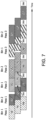
- FIG. 12 illustrates the storing of visibility data at memory addresses allocated for adjacent tiles in a forward direction of traversal. That is, for a current tile for which visibility data is being generated, the data is stored at a memory address allocated for a tile adjacent to the current tile in a forward direction of traversal.
- FIG. 12 also includes the same number of bins, same number of subpasses and the same execution order of consecutive subpasses of bins as the diagram on the right side of FIG. 9 .
- the visibility data of tiles is stored at memory addresses according to a subpass ID, which is used to identify a particular subpass and a bin ID which is used to identify a particular bin.
- a subpass ID which is used to identify a particular subpass
- a bin ID which is used to identify a particular bin.
- the first subpass (pass1) is identified by subpass ID 0
- the second subpass (pass2) is identified by subpass ID 1
- the third subpass (pass3) is identified by subpass ID 2
- the first bin is identified as Bin1
- the second bin (in a forward direction of traversal) is identified as Bin2
- the third bin is identified as Bin3
- the fourth bin is identified as Bin4.
- the visibility data of the bins i.e., tiles
- the visibility data is stored at the memory addresses allocated for data of the corresponding immediate subsequent bins (i.e., the corresponding next bin in the forward order of traversal).
- the visibility data is stored at the memory address allocated for bin x+y.
- additional memory portions are reserved for data of one or more bins which are pushed out (i.e., one or more bins at the end of the frame when using forward traversal) and the data for the one or more pushed out tiles are stored at the memory addresses of the additional reserved memory.
- additional memory portions 1202 are reserved to store data for the second subpass (Pass 2) of pushed out Bin 4, data for the third subpass (Pass 3) of pushed out Bin 3, and data for the third subpass (Pass 3) of pushed out Bin 4. Then, in the same manner as described above, for each subpass y of Bin x, the visibility data is stored at the memory address allocated for Bin x+y, but at the additional reserved memory portions 1202 .
- Block 1110 is described with reference to FIG. 13 .
- the method 1100 includes storing, during a rendering stage, rendered data of tiles at memory addresses allocated for adjacent tiles in a second direction of traversal opposite the first direction of traversal.
- bins are rendered, during the rendering phase, based on the address locations of adjacent bins in the opposite direction of traversal (e.g., backward or forward depending on the direction of traversal).
- FIG. 13 is a diagram illustrating the rendering of data of the tiles (i.e., bins) following the visibility data generating phase described above with regard to FIG. 12 .
- Tiles are rendered using the data stored at memory addresses allocated for corresponding adjacent tiles in the backward direction of traversal. That is, a tile is rendered using the data stored at a memory address allocated for a tile that is adjacent to the tile being rendered in a backward direction of traversal (i.e., the immediately preceding tile).
- Bin 1 is rendered using the data stored at the memory address allocated to Bin 2 as further indicated by the dashed arrows and ovals in FIG. 13 .
- the visibility data of the tiles for subsequently ordered subpasses is stored at the memory addresses allocated for data of either the corresponding immediate subsequent tile (i.e., adjacent tile) or the corresponding immediately preceding tile and the data of one or more tiles which are pushed out is stored at additional memory addresses reserved for the pushed out tiles.
- FIG. 12 illustrates the storing of visibility data at memory addresses allocated for adjacent tiles in a forward direction of traversal
- FIG. 13 illustrates rendering tiles using data at memory addresses allocated for adjacent tiles in a backward direction of traversal.
- the visibility data of the bins i.e., tiles
- the data of one or more bins which are pushed out i.e., one or more bins at the end of the frame
- the visibility data is stored at the memory addresses allocated for Bin x-y.
- the bins i.e., tiles
- the bins for subsequently ordered subpasses are rendered using data stored at the memory addresses allocated for data of the corresponding immediate subsequent bins (i.e., the corresponding next bin in the forward order of traversal).
- the various functional units illustrated in the figures and/or described herein may be implemented as a general purpose computer, a processor, or a processor core, or as a program, software, or firmware, stored in a non-transitory computer readable medium or in another medium, executable by a general purpose computer, a processor, or a processor core.
- the methods provided can be implemented in a general purpose computer, a processor, or a processor core.
- Suitable processors include, by way of example, a general purpose processor, a special purpose processor, a conventional processor, a digital signal processor (DSP), a plurality of microprocessors, one or more microprocessors in association with a DSP core, a controller, a microcontroller, Application Specific Integrated Circuits (ASICs), Field Programmable Gate Arrays (FPGAs) circuits, any other type of integrated circuit (IC), and/or a state machine.
- DSP digital signal processor
- ASICs Application Specific Integrated Circuits
- FPGAs Field Programmable Gate Arrays
- Such processors can be manufactured by configuring a manufacturing process using the results of processed hardware description language (HDL) instructions and other intermediary data including netlists (such instructions capable of being stored on a computer readable media). The results of such processing can be maskworks that are then used in a semiconductor manufacturing process to manufacture a processor which implements features of the disclosure.
- HDL hardware description language
- non-transitory computer-readable storage mediums include a read only memory (ROM), a random access memory (RAM), a register, cache memory, semiconductor memory devices, magnetic media such as internal hard disks and removable disks, magneto-optical media, and optical media such as CD-ROM disks, and digital versatile disks (DVDs).
- ROM read only memory
- RAM random access memory
- register cache memory
- semiconductor memory devices magnetic media such as internal hard disks and removable disks, magneto-optical media, and optical media such as CD-ROM disks, and digital versatile disks (DVDs).
Landscapes
- Engineering & Computer Science (AREA)
- Physics & Mathematics (AREA)
- General Physics & Mathematics (AREA)
- Theoretical Computer Science (AREA)
- Computer Graphics (AREA)
- Geometry (AREA)
- Software Systems (AREA)
- Image Generation (AREA)
Abstract
Description
Claims (20)
Priority Applications (1)
| Application Number | Priority Date | Filing Date | Title |
|---|---|---|---|
| US17/955,499 US12205193B2 (en) | 2022-09-28 | 2022-09-28 | Device and method of implementing subpass interleaving of tiled image rendering |
Applications Claiming Priority (1)
| Application Number | Priority Date | Filing Date | Title |
|---|---|---|---|
| US17/955,499 US12205193B2 (en) | 2022-09-28 | 2022-09-28 | Device and method of implementing subpass interleaving of tiled image rendering |
Publications (2)
| Publication Number | Publication Date |
|---|---|
| US20240104685A1 US20240104685A1 (en) | 2024-03-28 |
| US12205193B2 true US12205193B2 (en) | 2025-01-21 |
Family
ID=90359500
Family Applications (1)
| Application Number | Title | Priority Date | Filing Date |
|---|---|---|---|
| US17/955,499 Active 2042-11-09 US12205193B2 (en) | 2022-09-28 | 2022-09-28 | Device and method of implementing subpass interleaving of tiled image rendering |
Country Status (1)
| Country | Link |
|---|---|
| US (1) | US12205193B2 (en) |
Families Citing this family (1)
| Publication number | Priority date | Publication date | Assignee | Title |
|---|---|---|---|---|
| US20250308131A1 (en) * | 2024-03-29 | 2025-10-02 | Advanced Micro Devices, Inc. | Tile-based immediate mode renderer graphics pipeline |
Citations (2)
| Publication number | Priority date | Publication date | Assignee | Title |
|---|---|---|---|---|
| US20170053375A1 (en) * | 2015-08-18 | 2017-02-23 | Nvidia Corporation | Controlling multi-pass rendering sequences in a cache tiling architecture |
| US20220036632A1 (en) * | 2020-08-03 | 2022-02-03 | Samsung Electronics Co., Ltd. | Post-processing in a memory-system efficient manner |
-
2022
- 2022-09-28 US US17/955,499 patent/US12205193B2/en active Active
Patent Citations (2)
| Publication number | Priority date | Publication date | Assignee | Title |
|---|---|---|---|---|
| US20170053375A1 (en) * | 2015-08-18 | 2017-02-23 | Nvidia Corporation | Controlling multi-pass rendering sequences in a cache tiling architecture |
| US20220036632A1 (en) * | 2020-08-03 | 2022-02-03 | Samsung Electronics Co., Ltd. | Post-processing in a memory-system efficient manner |
Also Published As
| Publication number | Publication date |
|---|---|
| US20240104685A1 (en) | 2024-03-28 |
Similar Documents
| Publication | Publication Date | Title |
|---|---|---|
| US12505604B2 (en) | Hybrid binning | |
| US12154224B2 (en) | Fine grained replay control in binning hardware | |
| US11741653B2 (en) | Overlapping visibility and render passes for same frame | |
| US20240087078A1 (en) | Two-level primitive batch binning with hardware state compression | |
| KR102266962B1 (en) | Compiler-assisted technologies to reduce memory usage in the graphics pipeline | |
| KR20210095914A (en) | Integration of variable rate shading and super sample shading | |
| CN112085658A (en) | Apparatus and method for non-uniform frame buffer rasterization | |
| US12067649B2 (en) | Per-pixel variable rate shading controls using stencil data | |
| US20220319091A1 (en) | Post-depth visibility collection with two level binning | |
| US20240104685A1 (en) | Device and method of implementing subpass interleaving of tiled image rendering | |
| US10832465B2 (en) | Use of workgroups in pixel shader | |
| US11880924B2 (en) | Synchronization free cross pass binning through subpass interleaving | |
| US11900499B2 (en) | Iterative indirect command buffers | |
| US12106418B2 (en) | Sampling for partially resident textures |
Legal Events
| Date | Code | Title | Description |
|---|---|---|---|
| FEPP | Fee payment procedure |
Free format text: ENTITY STATUS SET TO UNDISCOUNTED (ORIGINAL EVENT CODE: BIG.); ENTITY STATUS OF PATENT OWNER: LARGE ENTITY |
|
| STPP | Information on status: patent application and granting procedure in general |
Free format text: NON FINAL ACTION MAILED |
|
| STPP | Information on status: patent application and granting procedure in general |
Free format text: RESPONSE TO NON-FINAL OFFICE ACTION ENTERED AND FORWARDED TO EXAMINER |
|
| STPP | Information on status: patent application and granting procedure in general |
Free format text: FINAL REJECTION MAILED |
|
| STPP | Information on status: patent application and granting procedure in general |
Free format text: ADVISORY ACTION MAILED |
|
| STPP | Information on status: patent application and granting procedure in general |
Free format text: DOCKETED NEW CASE - READY FOR EXAMINATION |
|
| STPP | Information on status: patent application and granting procedure in general |
Free format text: NOTICE OF ALLOWANCE MAILED -- APPLICATION RECEIVED IN OFFICE OF PUBLICATIONS |
|
| ZAAB | Notice of allowance mailed |
Free format text: ORIGINAL CODE: MN/=. |
|
| STPP | Information on status: patent application and granting procedure in general |
Free format text: PUBLICATIONS -- ISSUE FEE PAYMENT RECEIVED |
|
| STPP | Information on status: patent application and granting procedure in general |
Free format text: PUBLICATIONS -- ISSUE FEE PAYMENT VERIFIED |
|
| STCF | Information on status: patent grant |
Free format text: PATENTED CASE |