US12202812B2 - Glycosyl donor, preparation method therefor, and use thereof - Google Patents
Glycosyl donor, preparation method therefor, and use thereof Download PDFInfo
- Publication number
- US12202812B2 US12202812B2 US17/428,562 US202017428562A US12202812B2 US 12202812 B2 US12202812 B2 US 12202812B2 US 202017428562 A US202017428562 A US 202017428562A US 12202812 B2 US12202812 B2 US 12202812B2
- Authority
- US
- United States
- Prior art keywords
- alkyl
- compound
- reaction
- aryl
- heteroaryl
- Prior art date
- Legal status (The legal status is an assumption and is not a legal conclusion. Google has not performed a legal analysis and makes no representation as to the accuracy of the status listed.)
- Active, expires
Links
- 239000000348 glycosyl donor Substances 0.000 title claims abstract description 49
- 238000002360 preparation method Methods 0.000 title claims abstract description 12
- 150000001875 compounds Chemical class 0.000 claims abstract description 87
- -1 O-glycoside compound Chemical class 0.000 claims abstract description 47
- YMWUJEATGCHHMB-UHFFFAOYSA-N Dichloromethane Chemical compound ClCCl YMWUJEATGCHHMB-UHFFFAOYSA-N 0.000 claims description 111
- 238000006243 chemical reaction Methods 0.000 claims description 67
- 238000000034 method Methods 0.000 claims description 39
- 125000003118 aryl group Chemical group 0.000 claims description 32
- WEVYAHXRMPXWCK-UHFFFAOYSA-N Acetonitrile Chemical compound CC#N WEVYAHXRMPXWCK-UHFFFAOYSA-N 0.000 claims description 31
- 125000001072 heteroaryl group Chemical group 0.000 claims description 30
- ZMANZCXQSJIPKH-UHFFFAOYSA-N Triethylamine Chemical compound CCN(CC)CC ZMANZCXQSJIPKH-UHFFFAOYSA-N 0.000 claims description 27
- 239000000203 mixture Substances 0.000 claims description 19
- 229910052739 hydrogen Inorganic materials 0.000 claims description 18
- UMGDCJDMYOKAJW-UHFFFAOYSA-N thiourea Chemical compound NC(N)=S UMGDCJDMYOKAJW-UHFFFAOYSA-N 0.000 claims description 18
- 125000000753 cycloalkyl group Chemical group 0.000 claims description 17
- 239000007858 starting material Substances 0.000 claims description 17
- WFDIJRYMOXRFFG-UHFFFAOYSA-N Acetic anhydride Chemical compound CC(=O)OC(C)=O WFDIJRYMOXRFFG-UHFFFAOYSA-N 0.000 claims description 15
- 229910052736 halogen Inorganic materials 0.000 claims description 15
- 150000002367 halogens Chemical class 0.000 claims description 15
- 125000004169 (C1-C6) alkyl group Chemical group 0.000 claims description 14
- 150000003839 salts Chemical class 0.000 claims description 14
- KZMGYPLQYOPHEL-UHFFFAOYSA-N Boron trifluoride etherate Chemical compound FB(F)F.CCOCC KZMGYPLQYOPHEL-UHFFFAOYSA-N 0.000 claims description 12
- 125000003545 alkoxy group Chemical group 0.000 claims description 12
- 125000000623 heterocyclic group Chemical group 0.000 claims description 11
- 125000001424 substituent group Chemical group 0.000 claims description 10
- 125000004648 C2-C8 alkenyl group Chemical group 0.000 claims description 9
- 125000004649 C2-C8 alkynyl group Chemical group 0.000 claims description 9
- XSQUKJJJFZCRTK-UHFFFAOYSA-N Urea Natural products NC(N)=O XSQUKJJJFZCRTK-UHFFFAOYSA-N 0.000 claims description 9
- 125000004185 ester group Chemical group 0.000 claims description 9
- 229940086542 triethylamine Drugs 0.000 claims description 9
- 125000004400 (C1-C12) alkyl group Chemical group 0.000 claims description 8
- 125000004191 (C1-C6) alkoxy group Chemical group 0.000 claims description 8
- 125000000325 methylidene group Chemical group [H]C([H])=* 0.000 claims description 8
- 230000003287 optical effect Effects 0.000 claims description 8
- 239000002904 solvent Substances 0.000 claims description 7
- 125000004209 (C1-C8) alkyl group Chemical group 0.000 claims description 6
- VHYFNPMBLIVWCW-UHFFFAOYSA-N 4-Dimethylaminopyridine Chemical compound CN(C)C1=CC=NC=C1 VHYFNPMBLIVWCW-UHFFFAOYSA-N 0.000 claims description 6
- 238000010992 reflux Methods 0.000 claims description 6
- 229910013990 M1NH2 Inorganic materials 0.000 claims description 5
- 125000002887 hydroxy group Chemical group [H]O* 0.000 claims description 5
- 125000004642 (C1-C12) alkoxy group Chemical group 0.000 claims description 3
- 229960000549 4-dimethylaminophenol Drugs 0.000 claims description 3
- 229910052805 deuterium Inorganic materials 0.000 claims description 3
- 125000000008 (C1-C10) alkyl group Chemical group 0.000 claims description 2
- 125000000882 C2-C6 alkenyl group Chemical group 0.000 claims description 2
- 125000003601 C2-C6 alkynyl group Chemical group 0.000 claims description 2
- 125000004093 cyano group Chemical group *C#N 0.000 claims description 2
- 239000011541 reaction mixture Substances 0.000 claims 3
- 229930182475 S-glycoside Natural products 0.000 abstract description 20
- 229930182473 O-glycoside Natural products 0.000 abstract description 15
- 229930182476 C-glycoside Natural products 0.000 abstract description 14
- 239000002994 raw material Substances 0.000 abstract description 9
- 150000008444 O-glycosides Chemical class 0.000 abstract description 4
- 238000007348 radical reaction Methods 0.000 abstract description 3
- 150000003254 radicals Chemical class 0.000 abstract description 3
- HEDRZPFGACZZDS-MICDWDOJSA-N Trichloro(2H)methane Chemical compound [2H]C(Cl)(Cl)Cl HEDRZPFGACZZDS-MICDWDOJSA-N 0.000 description 73
- 238000005160 1H NMR spectroscopy Methods 0.000 description 71
- 239000000243 solution Substances 0.000 description 43
- 125000002496 methyl group Chemical group [H]C([H])([H])* 0.000 description 24
- PMZURENOXWZQFD-UHFFFAOYSA-L Sodium Sulfate Chemical compound [Na+].[Na+].[O-]S([O-])(=O)=O PMZURENOXWZQFD-UHFFFAOYSA-L 0.000 description 19
- 239000000937 glycosyl acceptor Substances 0.000 description 19
- 239000004201 L-cysteine Substances 0.000 description 18
- 230000015572 biosynthetic process Effects 0.000 description 18
- 238000012512 characterization method Methods 0.000 description 18
- 239000000706 filtrate Substances 0.000 description 18
- 238000003786 synthesis reaction Methods 0.000 description 18
- 239000000047 product Substances 0.000 description 17
- 238000004440 column chromatography Methods 0.000 description 15
- HPALAKNZSZLMCH-UHFFFAOYSA-M sodium;chloride;hydrate Chemical class O.[Na+].[Cl-] HPALAKNZSZLMCH-UHFFFAOYSA-M 0.000 description 15
- OKKJLVBELUTLKV-UHFFFAOYSA-N Methanol Chemical compound OC OKKJLVBELUTLKV-UHFFFAOYSA-N 0.000 description 12
- 229920006395 saturated elastomer Polymers 0.000 description 11
- UIIMBOGNXHQVGW-UHFFFAOYSA-M Sodium bicarbonate Chemical compound [Na+].OC([O-])=O UIIMBOGNXHQVGW-UHFFFAOYSA-M 0.000 description 10
- 239000012074 organic phase Substances 0.000 description 10
- CSCPPACGZOOCGX-UHFFFAOYSA-N Acetone Chemical compound CC(C)=O CSCPPACGZOOCGX-UHFFFAOYSA-N 0.000 description 9
- 239000012299 nitrogen atmosphere Substances 0.000 description 9
- 239000003504 photosensitizing agent Substances 0.000 description 9
- 230000035484 reaction time Effects 0.000 description 9
- XLYOFNOQVPJJNP-UHFFFAOYSA-N water Substances O XLYOFNOQVPJJNP-UHFFFAOYSA-N 0.000 description 9
- XEKOWRVHYACXOJ-UHFFFAOYSA-N Ethyl acetate Chemical compound CCOC(C)=O XEKOWRVHYACXOJ-UHFFFAOYSA-N 0.000 description 8
- 229930182470 glycoside Natural products 0.000 description 8
- 239000007787 solid Substances 0.000 description 8
- NHQDETIJWKXCTC-UHFFFAOYSA-N 3-chloroperbenzoic acid Chemical compound OOC(=O)C1=CC=CC(Cl)=C1 NHQDETIJWKXCTC-UHFFFAOYSA-N 0.000 description 7
- NZEDMAWEJPYWCD-UHFFFAOYSA-N 3-prop-2-enylsulfonylprop-1-ene Chemical compound C=CCS(=O)(=O)CC=C NZEDMAWEJPYWCD-UHFFFAOYSA-N 0.000 description 7
- TXNLQUKVUJITMX-UHFFFAOYSA-N 4-tert-butyl-2-(4-tert-butylpyridin-2-yl)pyridine Chemical compound CC(C)(C)C1=CC=NC(C=2N=CC=C(C=2)C(C)(C)C)=C1 TXNLQUKVUJITMX-UHFFFAOYSA-N 0.000 description 7
- 239000007864 aqueous solution Substances 0.000 description 7
- 239000005457 ice water Substances 0.000 description 7
- 125000006273 (C1-C3) alkyl group Chemical group 0.000 description 6
- USEGQJLHQSTGHW-UHFFFAOYSA-N 3-bromo-2-methylprop-1-ene Chemical group CC(=C)CBr USEGQJLHQSTGHW-UHFFFAOYSA-N 0.000 description 6
- IAZDPXIOMUYVGZ-UHFFFAOYSA-N Dimethylsulphoxide Chemical compound CS(C)=O IAZDPXIOMUYVGZ-UHFFFAOYSA-N 0.000 description 6
- WMFOQBRAJBCJND-UHFFFAOYSA-M Lithium hydroxide Chemical compound [Li+].[OH-] WMFOQBRAJBCJND-UHFFFAOYSA-M 0.000 description 6
- VYPSYNLAJGMNEJ-UHFFFAOYSA-N Silicium dioxide Chemical compound O=[Si]=O VYPSYNLAJGMNEJ-UHFFFAOYSA-N 0.000 description 6
- 125000000217 alkyl group Chemical group 0.000 description 6
- 229910052799 carbon Inorganic materials 0.000 description 6
- 238000006555 catalytic reaction Methods 0.000 description 6
- 125000001997 phenyl group Chemical group [H]C1=C([H])C([H])=C(*)C([H])=C1[H] 0.000 description 6
- BWHMMNNQKKPAPP-UHFFFAOYSA-L potassium carbonate Chemical compound [K+].[K+].[O-]C([O-])=O BWHMMNNQKKPAPP-UHFFFAOYSA-L 0.000 description 6
- 239000000741 silica gel Substances 0.000 description 6
- 229910002027 silica gel Inorganic materials 0.000 description 6
- 150000003568 thioethers Chemical class 0.000 description 6
- ZMXDDKWLCZADIW-UHFFFAOYSA-N N,N-Dimethylformamide Chemical compound CN(C)C=O ZMXDDKWLCZADIW-UHFFFAOYSA-N 0.000 description 5
- 230000009471 action Effects 0.000 description 5
- 239000007810 chemical reaction solvent Substances 0.000 description 5
- 239000003999 initiator Substances 0.000 description 5
- 229910052760 oxygen Inorganic materials 0.000 description 5
- 235000000346 sugar Nutrition 0.000 description 5
- 238000001644 13C nuclear magnetic resonance spectroscopy Methods 0.000 description 4
- XLYOFNOQVPJJNP-ZSJDYOACSA-N Heavy water Chemical compound [2H]O[2H] XLYOFNOQVPJJNP-ZSJDYOACSA-N 0.000 description 4
- 239000007832 Na2SO4 Substances 0.000 description 4
- CDBYLPFSWZWCQE-UHFFFAOYSA-L Sodium Carbonate Chemical class [Na+].[Na+].[O-]C([O-])=O CDBYLPFSWZWCQE-UHFFFAOYSA-L 0.000 description 4
- 125000002947 alkylene group Chemical group 0.000 description 4
- 239000012043 crude product Substances 0.000 description 4
- 125000005842 heteroatom Chemical group 0.000 description 4
- CTSLXHKWHWQRSH-UHFFFAOYSA-N oxalyl chloride Chemical compound ClC(=O)C(Cl)=O CTSLXHKWHWQRSH-UHFFFAOYSA-N 0.000 description 4
- 238000000746 purification Methods 0.000 description 4
- 229910000030 sodium bicarbonate Inorganic materials 0.000 description 4
- 229910052938 sodium sulfate Inorganic materials 0.000 description 4
- AKHNMLFCWUSKQB-UHFFFAOYSA-L sodium thiosulfate Chemical class [Na+].[Na+].[O-]S([O-])(=O)=S AKHNMLFCWUSKQB-UHFFFAOYSA-L 0.000 description 4
- 239000000758 substrate Substances 0.000 description 4
- PGRFXXCKHGIFSV-UHFFFAOYSA-N 1,1,1,2,2,3,3,4,4-nonafluoro-4-iodobutane Chemical compound FC(F)(F)C(F)(F)C(F)(F)C(F)(F)I PGRFXXCKHGIFSV-UHFFFAOYSA-N 0.000 description 3
- QTBSBXVTEAMEQO-UHFFFAOYSA-N Acetic acid Chemical compound CC(O)=O QTBSBXVTEAMEQO-UHFFFAOYSA-N 0.000 description 3
- 150000001721 carbon Chemical group 0.000 description 3
- 125000004432 carbon atom Chemical group C* 0.000 description 3
- KRKNYBCHXYNGOX-UHFFFAOYSA-N citric acid Chemical compound OC(=O)CC(O)(C(O)=O)CC(O)=O KRKNYBCHXYNGOX-UHFFFAOYSA-N 0.000 description 3
- 238000001514 detection method Methods 0.000 description 3
- MNNHAPBLZZVQHP-UHFFFAOYSA-N diammonium hydrogen phosphate Chemical compound [NH4+].[NH4+].OP([O-])([O-])=O MNNHAPBLZZVQHP-UHFFFAOYSA-N 0.000 description 3
- 229910000388 diammonium phosphate Inorganic materials 0.000 description 3
- 235000019838 diammonium phosphate Nutrition 0.000 description 3
- 235000019439 ethyl acetate Nutrition 0.000 description 3
- 150000002338 glycosides Chemical class 0.000 description 3
- 125000003147 glycosyl group Chemical group 0.000 description 3
- 239000012044 organic layer Substances 0.000 description 3
- 229910000027 potassium carbonate Inorganic materials 0.000 description 3
- 108090000765 processed proteins & peptides Proteins 0.000 description 3
- 229910052717 sulfur Inorganic materials 0.000 description 3
- FIQMHBFVRAXMOP-UHFFFAOYSA-N triphenylphosphane oxide Chemical compound C=1C=CC=CC=1P(C=1C=CC=CC=1)(=O)C1=CC=CC=C1 FIQMHBFVRAXMOP-UHFFFAOYSA-N 0.000 description 3
- 125000006592 (C2-C3) alkenyl group Chemical group 0.000 description 2
- 125000006593 (C2-C3) alkynyl group Chemical group 0.000 description 2
- IJGRMHOSHXDMSA-UHFFFAOYSA-N Atomic nitrogen Chemical compound N#N IJGRMHOSHXDMSA-UHFFFAOYSA-N 0.000 description 2
- OKTJSMMVPCPJKN-UHFFFAOYSA-N Carbon Chemical compound [C] OKTJSMMVPCPJKN-UHFFFAOYSA-N 0.000 description 2
- BWGNESOTFCXPMA-UHFFFAOYSA-N Dihydrogen disulfide Chemical compound SS BWGNESOTFCXPMA-UHFFFAOYSA-N 0.000 description 2
- UFHFLCQGNIYNRP-UHFFFAOYSA-N Hydrogen Chemical compound [H][H] UFHFLCQGNIYNRP-UHFFFAOYSA-N 0.000 description 2
- MCYHPZGUONZRGO-VKHMYHEASA-N L-cysteine methyl ester hydrochloride Natural products COC(=O)[C@@H](N)CS MCYHPZGUONZRGO-VKHMYHEASA-N 0.000 description 2
- WHOHXJZQBJXAKL-DFWYDOINSA-N Mecysteine hydrochloride Chemical compound Cl.COC(=O)[C@@H](N)CS WHOHXJZQBJXAKL-DFWYDOINSA-N 0.000 description 2
- BZLVMXJERCGZMT-UHFFFAOYSA-N Methyl tert-butyl ether Chemical group COC(C)(C)C BZLVMXJERCGZMT-UHFFFAOYSA-N 0.000 description 2
- 229930182474 N-glycoside Chemical class 0.000 description 2
- WYURNTSHIVDZCO-UHFFFAOYSA-N Tetrahydrofuran Chemical compound C1CCOC1 WYURNTSHIVDZCO-UHFFFAOYSA-N 0.000 description 2
- 125000000738 acetamido group Chemical group [H]C([H])([H])C(=O)N([H])[*] 0.000 description 2
- 239000002253 acid Substances 0.000 description 2
- 235000014633 carbohydrates Nutrition 0.000 description 2
- 125000001188 haloalkyl group Chemical group 0.000 description 2
- 238000010438 heat treatment Methods 0.000 description 2
- 239000001257 hydrogen Substances 0.000 description 2
- 125000002950 monocyclic group Chemical group 0.000 description 2
- 229910052757 nitrogen Inorganic materials 0.000 description 2
- 125000003367 polycyclic group Chemical group 0.000 description 2
- 230000008569 process Effects 0.000 description 2
- KOUKXHPPRFNWPP-UHFFFAOYSA-N pyrazine-2,5-dicarboxylic acid;hydrate Chemical compound O.OC(=O)C1=CN=C(C(O)=O)C=N1 KOUKXHPPRFNWPP-UHFFFAOYSA-N 0.000 description 2
- KAVUKAXLXGRUCD-UHFFFAOYSA-M sodium trifluoromethanesulfinate Chemical group [Na+].[O-]S(=O)C(F)(F)F KAVUKAXLXGRUCD-UHFFFAOYSA-M 0.000 description 2
- KDYFGRWQOYBRFD-UHFFFAOYSA-L succinate(2-) Chemical compound [O-]C(=O)CCC([O-])=O KDYFGRWQOYBRFD-UHFFFAOYSA-L 0.000 description 2
- 230000002194 synthesizing effect Effects 0.000 description 2
- DKVBOUDTNWVDEP-NJCHZNEYSA-N teicoplanin aglycone Chemical compound N([C@H](C(N[C@@H](C1=CC(O)=CC(O)=C1C=1C(O)=CC=C2C=1)C(O)=O)=O)[C@H](O)C1=CC=C(C(=C1)Cl)OC=1C=C3C=C(C=1O)OC1=CC=C(C=C1Cl)C[C@H](C(=O)N1)NC([C@H](N)C=4C=C(O5)C(O)=CC=4)=O)C(=O)[C@@H]2NC(=O)[C@@H]3NC(=O)[C@@H]1C1=CC5=CC(O)=C1 DKVBOUDTNWVDEP-NJCHZNEYSA-N 0.000 description 2
- VZCYOOQTPOCHFL-UHFFFAOYSA-N trans-butenedioic acid Natural products OC(=O)C=CC(O)=O VZCYOOQTPOCHFL-UHFFFAOYSA-N 0.000 description 2
- OGOMAWHSXRDAKZ-RUOAZZEASA-N (2s,3r,4s,5r,6r)-3,4,5-tris(phenylmethoxy)-6-(phenylmethoxymethyl)oxan-2-ol Chemical compound C([C@H]1O[C@@H]([C@@H]([C@@H](OCC=2C=CC=CC=2)[C@@H]1OCC=1C=CC=CC=1)OCC=1C=CC=CC=1)O)OCC1=CC=CC=C1 OGOMAWHSXRDAKZ-RUOAZZEASA-N 0.000 description 1
- 125000004178 (C1-C4) alkyl group Chemical group 0.000 description 1
- 125000000229 (C1-C4)alkoxy group Chemical group 0.000 description 1
- WSLDOOZREJYCGB-UHFFFAOYSA-N 1,2-Dichloroethane Chemical compound ClCCCl WSLDOOZREJYCGB-UHFFFAOYSA-N 0.000 description 1
- RYHBNJHYFVUHQT-UHFFFAOYSA-N 1,4-Dioxane Chemical compound C1COCCO1 RYHBNJHYFVUHQT-UHFFFAOYSA-N 0.000 description 1
- OWEGMIWEEQEYGQ-UHFFFAOYSA-N 100676-05-9 Natural products OC1C(O)C(O)C(CO)OC1OCC1C(O)C(O)C(O)C(OC2C(OC(O)C(O)C2O)CO)O1 OWEGMIWEEQEYGQ-UHFFFAOYSA-N 0.000 description 1
- MSWZFWKMSRAUBD-IVMDWMLBSA-N 2-amino-2-deoxy-D-glucopyranose Chemical compound N[C@H]1C(O)O[C@H](CO)[C@@H](O)[C@@H]1O MSWZFWKMSRAUBD-IVMDWMLBSA-N 0.000 description 1
- UFJYVTQALAAQEQ-UHFFFAOYSA-N 2-methylprop-2-ene-1-thiol Chemical group CC(=C)CS UFJYVTQALAAQEQ-UHFFFAOYSA-N 0.000 description 1
- MROVZCRMXJZHCN-UHFFFAOYSA-N 3-[4-(aminomethyl)-6-(trifluoromethyl)pyridin-2-yl]oxy-N-(2-hydroxyethyl)benzamide Chemical compound NCC1=CC(=NC(=C1)C(F)(F)F)OC=1C=C(C(=O)NCCO)C=CC=1 MROVZCRMXJZHCN-UHFFFAOYSA-N 0.000 description 1
- ZMCQQCBOZIGNRV-UHFFFAOYSA-N 3-[4-(aminomethyl)-6-(trifluoromethyl)pyridin-2-yl]oxy-N-[2-(1,2,4-triazol-1-yl)ethyl]benzamide Chemical compound NCC1=CC(OC2=CC=CC(=C2)C(=O)NCCN2C=NC=N2)=NC(=C1)C(F)(F)F ZMCQQCBOZIGNRV-UHFFFAOYSA-N 0.000 description 1
- BMYNFMYTOJXKLE-UHFFFAOYSA-N 3-azaniumyl-2-hydroxypropanoate Chemical compound NCC(O)C(O)=O BMYNFMYTOJXKLE-UHFFFAOYSA-N 0.000 description 1
- RMMHOFFPGKSRDI-UHFFFAOYSA-N 3-bromoprop-1-en-2-ylbenzene Chemical group BrCC(=C)C1=CC=CC=C1 RMMHOFFPGKSRDI-UHFFFAOYSA-N 0.000 description 1
- QTBSBXVTEAMEQO-UHFFFAOYSA-M Acetate Chemical compound CC([O-])=O QTBSBXVTEAMEQO-UHFFFAOYSA-M 0.000 description 1
- 150000000700 C-glycosides Chemical class 0.000 description 1
- MNZQTHUOJZXYQV-SLHNCBLASA-N CC(=O)OC[C@@H]1[C@@H]([C@@H]([C@H]([C@H](O1)C2=NC=CC(=C2)C#N)OC(=O)C)OC(=O)C)OC(=O)C Chemical compound CC(=O)OC[C@@H]1[C@@H]([C@@H]([C@H]([C@H](O1)C2=NC=CC(=C2)C#N)OC(=O)C)OC(=O)C)OC(=O)C MNZQTHUOJZXYQV-SLHNCBLASA-N 0.000 description 1
- NIDCZVXZGLIZBA-QQXKLLMISA-N CC(=O)OC[C@@H]1[C@H]([C@@H]([C@H]([C@H](O1)C2=CC=CC=N2)OC(=O)C)OC(=O)C)OC(=O)C Chemical compound CC(=O)OC[C@@H]1[C@H]([C@@H]([C@H]([C@H](O1)C2=CC=CC=N2)OC(=O)C)OC(=O)C)OC(=O)C NIDCZVXZGLIZBA-QQXKLLMISA-N 0.000 description 1
- MNZQTHUOJZXYQV-UEDWAMCQSA-N CC(=O)OC[C@@H]1[C@H]([C@@H]([C@H]([C@H](O1)C2=NC=CC(=C2)C#N)OC(=O)C)OC(=O)C)OC(=O)C Chemical compound CC(=O)OC[C@@H]1[C@H]([C@@H]([C@H]([C@H](O1)C2=NC=CC(=C2)C#N)OC(=O)C)OC(=O)C)OC(=O)C MNZQTHUOJZXYQV-UEDWAMCQSA-N 0.000 description 1
- FXFCRLURUHGPCG-GMPWGMMTSA-N CC(OC[C@H]([C@H]([C@@H]([C@H]1OC(C)=O)OC(C)=O)O[C@H]([C@@H]([C@H]2OC(C)=O)OC(C)=O)O[C@H](COC(C)=O)[C@H]2OC(C)=O)O[C@@H]1C1=NC=CC(C#N)=C1)=O Chemical compound CC(OC[C@H]([C@H]([C@@H]([C@H]1OC(C)=O)OC(C)=O)O[C@H]([C@@H]([C@H]2OC(C)=O)OC(C)=O)O[C@H](COC(C)=O)[C@H]2OC(C)=O)O[C@@H]1C1=NC=CC(C#N)=C1)=O FXFCRLURUHGPCG-GMPWGMMTSA-N 0.000 description 1
- KRKNYBCHXYNGOX-UHFFFAOYSA-K Citrate Chemical compound [O-]C(=O)CC(O)(CC([O-])=O)C([O-])=O KRKNYBCHXYNGOX-UHFFFAOYSA-K 0.000 description 1
- OKKJLVBELUTLKV-MZCSYVLQSA-N Deuterated methanol Chemical compound [2H]OC([2H])([2H])[2H] OKKJLVBELUTLKV-MZCSYVLQSA-N 0.000 description 1
- FEWJPZIEWOKRBE-JCYAYHJZSA-N Dextrotartaric acid Chemical compound OC(=O)[C@H](O)[C@@H](O)C(O)=O FEWJPZIEWOKRBE-JCYAYHJZSA-N 0.000 description 1
- XTHFKEDIFFGKHM-UHFFFAOYSA-N Dimethoxyethane Chemical compound COCCOC XTHFKEDIFFGKHM-UHFFFAOYSA-N 0.000 description 1
- 241000196324 Embryophyta Species 0.000 description 1
- KRHYYFGTRYWZRS-UHFFFAOYSA-N Fluorane Chemical compound F KRHYYFGTRYWZRS-UHFFFAOYSA-N 0.000 description 1
- VZCYOOQTPOCHFL-OWOJBTEDSA-N Fumaric acid Chemical compound OC(=O)\C=C\C(O)=O VZCYOOQTPOCHFL-OWOJBTEDSA-N 0.000 description 1
- 102000005744 Glycoside Hydrolases Human genes 0.000 description 1
- 108010031186 Glycoside Hydrolases Proteins 0.000 description 1
- VEXZGXHMUGYJMC-UHFFFAOYSA-N Hydrochloric acid Chemical compound Cl VEXZGXHMUGYJMC-UHFFFAOYSA-N 0.000 description 1
- CPELXLSAUQHCOX-UHFFFAOYSA-N Hydrogen bromide Chemical compound Br CPELXLSAUQHCOX-UHFFFAOYSA-N 0.000 description 1
- GUBGYTABKSRVRQ-PICCSMPSSA-N Maltose Natural products O[C@@H]1[C@@H](O)[C@H](O)[C@@H](CO)O[C@@H]1O[C@@H]1[C@@H](CO)OC(O)[C@H](O)[C@H]1O GUBGYTABKSRVRQ-PICCSMPSSA-N 0.000 description 1
- 241001465754 Metazoa Species 0.000 description 1
- MUBZPKHOEPUJKR-UHFFFAOYSA-N Oxalic acid Chemical compound OC(=O)C(O)=O MUBZPKHOEPUJKR-UHFFFAOYSA-N 0.000 description 1
- 229910019142 PO4 Inorganic materials 0.000 description 1
- QPFYXYFORQJZEC-FOCLMDBBSA-N Phenazopyridine Chemical compound NC1=NC(N)=CC=C1\N=N\C1=CC=CC=C1 QPFYXYFORQJZEC-FOCLMDBBSA-N 0.000 description 1
- XBDQKXXYIPTUBI-UHFFFAOYSA-M Propionate Chemical compound CCC([O-])=O XBDQKXXYIPTUBI-UHFFFAOYSA-M 0.000 description 1
- QAOWNCQODCNURD-UHFFFAOYSA-L Sulfate Chemical compound [O-]S([O-])(=O)=O QAOWNCQODCNURD-UHFFFAOYSA-L 0.000 description 1
- NINIDFKCEFEMDL-UHFFFAOYSA-N Sulfur Chemical compound [S] NINIDFKCEFEMDL-UHFFFAOYSA-N 0.000 description 1
- DTQVDTLACAAQTR-UHFFFAOYSA-M Trifluoroacetate Chemical compound [O-]C(=O)C(F)(F)F DTQVDTLACAAQTR-UHFFFAOYSA-M 0.000 description 1
- GORZRLXIUDOXEP-BIFUOPDKSA-N [(2R,3R,4S,5R)-3,4,5-triacetyloxy-6-(2-methylidenedecylsulfonyl)oxan-2-yl]methyl acetate Chemical compound C(C)(=O)O[C@@H]1[C@H](OC([C@@H]([C@H]1OC(C)=O)OC(C)=O)S(=O)(=O)CC(CCCCCCCC)=C)COC(C)=O GORZRLXIUDOXEP-BIFUOPDKSA-N 0.000 description 1
- 125000002777 acetyl group Chemical group [H]C([H])([H])C(*)=O 0.000 description 1
- 150000008043 acidic salts Chemical class 0.000 description 1
- 230000032683 aging Effects 0.000 description 1
- 150000001447 alkali salts Chemical class 0.000 description 1
- 125000005210 alkyl ammonium group Chemical group 0.000 description 1
- BHELZAPQIKSEDF-UHFFFAOYSA-N allyl bromide Chemical group BrCC=C BHELZAPQIKSEDF-UHFFFAOYSA-N 0.000 description 1
- 235000001014 amino acid Nutrition 0.000 description 1
- 150000001413 amino acids Chemical class 0.000 description 1
- 230000000844 anti-bacterial effect Effects 0.000 description 1
- 230000000259 anti-tumor effect Effects 0.000 description 1
- 230000000840 anti-viral effect Effects 0.000 description 1
- 239000012736 aqueous medium Substances 0.000 description 1
- 125000004429 atom Chemical group 0.000 description 1
- QVGXLLKOCUKJST-UHFFFAOYSA-N atomic oxygen Chemical compound [O] QVGXLLKOCUKJST-UHFFFAOYSA-N 0.000 description 1
- 150000001555 benzenes Chemical group 0.000 description 1
- SRSXLGNVWSONIS-UHFFFAOYSA-M benzenesulfonate Chemical compound [O-]S(=O)(=O)C1=CC=CC=C1 SRSXLGNVWSONIS-UHFFFAOYSA-M 0.000 description 1
- 229940077388 benzenesulfonate Drugs 0.000 description 1
- PASDCCFISLVPSO-UHFFFAOYSA-N benzoyl chloride Chemical compound ClC(=O)C1=CC=CC=C1 PASDCCFISLVPSO-UHFFFAOYSA-N 0.000 description 1
- 125000003236 benzoyl group Chemical group [H]C1=C([H])C([H])=C(C([H])=C1[H])C(*)=O 0.000 description 1
- AGEZXYOZHKGVCM-UHFFFAOYSA-N benzyl bromide Chemical compound BrCC1=CC=CC=C1 AGEZXYOZHKGVCM-UHFFFAOYSA-N 0.000 description 1
- 230000004071 biological effect Effects 0.000 description 1
- 230000008827 biological function Effects 0.000 description 1
- 239000008280 blood Substances 0.000 description 1
- 210000004369 blood Anatomy 0.000 description 1
- GDTBXPJZTBHREO-UHFFFAOYSA-N bromine Substances BrBr GDTBXPJZTBHREO-UHFFFAOYSA-N 0.000 description 1
- 229910052794 bromium Inorganic materials 0.000 description 1
- 125000001246 bromo group Chemical group Br* 0.000 description 1
- 150000001720 carbohydrates Chemical class 0.000 description 1
- 230000024245 cell differentiation Effects 0.000 description 1
- 238000009833 condensation Methods 0.000 description 1
- 230000005494 condensation Effects 0.000 description 1
- 238000001816 cooling Methods 0.000 description 1
- 125000004122 cyclic group Chemical group 0.000 description 1
- 230000008034 disappearance Effects 0.000 description 1
- 230000013020 embryo development Effects 0.000 description 1
- SEACYXSIPDVVMV-UHFFFAOYSA-L eosin Y Chemical group [Na+].[Na+].[O-]C(=O)C1=CC=CC=C1C1=C2C=C(Br)C(=O)C(Br)=C2OC2=C(Br)C([O-])=C(Br)C=C21 SEACYXSIPDVVMV-UHFFFAOYSA-L 0.000 description 1
- 150000002148 esters Chemical class 0.000 description 1
- 238000001704 evaporation Methods 0.000 description 1
- 230000008020 evaporation Effects 0.000 description 1
- 238000002474 experimental method Methods 0.000 description 1
- 230000004720 fertilization Effects 0.000 description 1
- 238000001914 filtration Methods 0.000 description 1
- 238000004108 freeze drying Methods 0.000 description 1
- 230000006870 function Effects 0.000 description 1
- 125000000524 functional group Chemical group 0.000 description 1
- 125000002541 furyl group Chemical group 0.000 description 1
- 239000007789 gas Substances 0.000 description 1
- 150000004676 glycans Chemical class 0.000 description 1
- 125000001183 hydrocarbyl group Chemical group 0.000 description 1
- 125000002883 imidazolyl group Chemical group 0.000 description 1
- 230000003832 immune regulation Effects 0.000 description 1
- 208000015181 infectious disease Diseases 0.000 description 1
- 230000002401 inhibitory effect Effects 0.000 description 1
- 238000002955 isolation Methods 0.000 description 1
- 239000003446 ligand Substances 0.000 description 1
- 229940049920 malate Drugs 0.000 description 1
- VZCYOOQTPOCHFL-UPHRSURJSA-N maleic acid Chemical compound OC(=O)\C=C/C(O)=O VZCYOOQTPOCHFL-UPHRSURJSA-N 0.000 description 1
- BJEPYKJPYRNKOW-UHFFFAOYSA-N malic acid Chemical compound OC(=O)C(O)CC(O)=O BJEPYKJPYRNKOW-UHFFFAOYSA-N 0.000 description 1
- GRVDJDISBSALJP-UHFFFAOYSA-N methyloxidanyl Chemical group [O]C GRVDJDISBSALJP-UHFFFAOYSA-N 0.000 description 1
- 244000005700 microbiome Species 0.000 description 1
- 150000007522 mineralic acids Chemical class 0.000 description 1
- 239000011259 mixed solution Substances 0.000 description 1
- 238000002156 mixing Methods 0.000 description 1
- 238000012986 modification Methods 0.000 description 1
- 230000004048 modification Effects 0.000 description 1
- 125000001624 naphthyl group Chemical group 0.000 description 1
- 229920001542 oligosaccharide Polymers 0.000 description 1
- 150000002482 oligosaccharides Chemical class 0.000 description 1
- 150000007524 organic acids Chemical class 0.000 description 1
- 235000005985 organic acids Nutrition 0.000 description 1
- 239000003960 organic solvent Substances 0.000 description 1
- 239000001301 oxygen Substances 0.000 description 1
- NBIIXXVUZAFLBC-UHFFFAOYSA-K phosphate Chemical compound [O-]P([O-])([O-])=O NBIIXXVUZAFLBC-UHFFFAOYSA-K 0.000 description 1
- 239000010452 phosphate Substances 0.000 description 1
- 230000001766 physiological effect Effects 0.000 description 1
- 230000035790 physiological processes and functions Effects 0.000 description 1
- 229920001282 polysaccharide Polymers 0.000 description 1
- 239000005017 polysaccharide Substances 0.000 description 1
- 239000002244 precipitate Substances 0.000 description 1
- 235000018102 proteins Nutrition 0.000 description 1
- 108090000623 proteins and genes Proteins 0.000 description 1
- 102000004169 proteins and genes Human genes 0.000 description 1
- 125000003373 pyrazinyl group Chemical group 0.000 description 1
- 125000003226 pyrazolyl group Chemical group 0.000 description 1
- 229940070891 pyridium Drugs 0.000 description 1
- 125000004076 pyridyl group Chemical group 0.000 description 1
- 125000000714 pyrimidinyl group Chemical group 0.000 description 1
- 125000000168 pyrrolyl group Chemical group 0.000 description 1
- 150000003242 quaternary ammonium salts Chemical class 0.000 description 1
- 238000010791 quenching Methods 0.000 description 1
- 238000011160 research Methods 0.000 description 1
- 150000003384 small molecules Chemical class 0.000 description 1
- 235000015096 spirit Nutrition 0.000 description 1
- 125000003003 spiro group Chemical group 0.000 description 1
- 238000003756 stirring Methods 0.000 description 1
- 238000000967 suction filtration Methods 0.000 description 1
- 150000008163 sugars Chemical class 0.000 description 1
- 239000011593 sulfur Substances 0.000 description 1
- 229940095064 tartrate Drugs 0.000 description 1
- 125000003831 tetrazolyl group Chemical group 0.000 description 1
- 125000001544 thienyl group Chemical group 0.000 description 1
- ILJSQTXMGCGYMG-UHFFFAOYSA-N triacetic acid Chemical compound CC(=O)CC(=O)CC(O)=O ILJSQTXMGCGYMG-UHFFFAOYSA-N 0.000 description 1
Classifications
-
- C—CHEMISTRY; METALLURGY
- C07—ORGANIC CHEMISTRY
- C07D—HETEROCYCLIC COMPOUNDS
- C07D307/00—Heterocyclic compounds containing five-membered rings having one oxygen atom as the only ring hetero atom
- C07D307/02—Heterocyclic compounds containing five-membered rings having one oxygen atom as the only ring hetero atom not condensed with other rings
- C07D307/04—Heterocyclic compounds containing five-membered rings having one oxygen atom as the only ring hetero atom not condensed with other rings having no double bonds between ring members or between ring members and non-ring members
- C07D307/18—Heterocyclic compounds containing five-membered rings having one oxygen atom as the only ring hetero atom not condensed with other rings having no double bonds between ring members or between ring members and non-ring members with hetero atoms or with carbon atoms having three bonds to hetero atoms with at the most one bond to halogen, e.g. ester or nitrile radicals, directly attached to ring carbon atoms
-
- C—CHEMISTRY; METALLURGY
- C07—ORGANIC CHEMISTRY
- C07D—HETEROCYCLIC COMPOUNDS
- C07D307/00—Heterocyclic compounds containing five-membered rings having one oxygen atom as the only ring hetero atom
- C07D307/02—Heterocyclic compounds containing five-membered rings having one oxygen atom as the only ring hetero atom not condensed with other rings
- C07D307/04—Heterocyclic compounds containing five-membered rings having one oxygen atom as the only ring hetero atom not condensed with other rings having no double bonds between ring members or between ring members and non-ring members
- C07D307/18—Heterocyclic compounds containing five-membered rings having one oxygen atom as the only ring hetero atom not condensed with other rings having no double bonds between ring members or between ring members and non-ring members with hetero atoms or with carbon atoms having three bonds to hetero atoms with at the most one bond to halogen, e.g. ester or nitrile radicals, directly attached to ring carbon atoms
- C07D307/20—Oxygen atoms
-
- C—CHEMISTRY; METALLURGY
- C07—ORGANIC CHEMISTRY
- C07D—HETEROCYCLIC COMPOUNDS
- C07D309/00—Heterocyclic compounds containing six-membered rings having one oxygen atom as the only ring hetero atom, not condensed with other rings
- C07D309/02—Heterocyclic compounds containing six-membered rings having one oxygen atom as the only ring hetero atom, not condensed with other rings having no double bonds between ring members or between ring members and non-ring members
- C07D309/08—Heterocyclic compounds containing six-membered rings having one oxygen atom as the only ring hetero atom, not condensed with other rings having no double bonds between ring members or between ring members and non-ring members with hetero atoms or with carbon atoms having three bonds to hetero atoms with at the most one bond to halogen, e.g. ester or nitrile radicals, directly attached to ring carbon atoms
-
- C—CHEMISTRY; METALLURGY
- C07—ORGANIC CHEMISTRY
- C07D—HETEROCYCLIC COMPOUNDS
- C07D309/00—Heterocyclic compounds containing six-membered rings having one oxygen atom as the only ring hetero atom, not condensed with other rings
- C07D309/02—Heterocyclic compounds containing six-membered rings having one oxygen atom as the only ring hetero atom, not condensed with other rings having no double bonds between ring members or between ring members and non-ring members
- C07D309/08—Heterocyclic compounds containing six-membered rings having one oxygen atom as the only ring hetero atom, not condensed with other rings having no double bonds between ring members or between ring members and non-ring members with hetero atoms or with carbon atoms having three bonds to hetero atoms with at the most one bond to halogen, e.g. ester or nitrile radicals, directly attached to ring carbon atoms
- C07D309/10—Oxygen atoms
-
- C—CHEMISTRY; METALLURGY
- C07—ORGANIC CHEMISTRY
- C07D—HETEROCYCLIC COMPOUNDS
- C07D405/00—Heterocyclic compounds containing both one or more hetero rings having oxygen atoms as the only ring hetero atoms, and one or more rings having nitrogen as the only ring hetero atom
- C07D405/02—Heterocyclic compounds containing both one or more hetero rings having oxygen atoms as the only ring hetero atoms, and one or more rings having nitrogen as the only ring hetero atom containing two hetero rings
- C07D405/12—Heterocyclic compounds containing both one or more hetero rings having oxygen atoms as the only ring hetero atoms, and one or more rings having nitrogen as the only ring hetero atom containing two hetero rings linked by a chain containing hetero atoms as chain links
-
- C—CHEMISTRY; METALLURGY
- C07—ORGANIC CHEMISTRY
- C07D—HETEROCYCLIC COMPOUNDS
- C07D405/00—Heterocyclic compounds containing both one or more hetero rings having oxygen atoms as the only ring hetero atoms, and one or more rings having nitrogen as the only ring hetero atom
- C07D405/14—Heterocyclic compounds containing both one or more hetero rings having oxygen atoms as the only ring hetero atoms, and one or more rings having nitrogen as the only ring hetero atom containing three or more hetero rings
-
- C—CHEMISTRY; METALLURGY
- C07—ORGANIC CHEMISTRY
- C07D—HETEROCYCLIC COMPOUNDS
- C07D407/00—Heterocyclic compounds containing two or more hetero rings, at least one ring having oxygen atoms as the only ring hetero atoms, not provided for by group C07D405/00
- C07D407/02—Heterocyclic compounds containing two or more hetero rings, at least one ring having oxygen atoms as the only ring hetero atoms, not provided for by group C07D405/00 containing two hetero rings
- C07D407/12—Heterocyclic compounds containing two or more hetero rings, at least one ring having oxygen atoms as the only ring hetero atoms, not provided for by group C07D405/00 containing two hetero rings linked by a chain containing hetero atoms as chain links
-
- C—CHEMISTRY; METALLURGY
- C07—ORGANIC CHEMISTRY
- C07D—HETEROCYCLIC COMPOUNDS
- C07D493/00—Heterocyclic compounds containing oxygen atoms as the only ring hetero atoms in the condensed system
- C07D493/02—Heterocyclic compounds containing oxygen atoms as the only ring hetero atoms in the condensed system in which the condensed system contains two hetero rings
- C07D493/06—Peri-condensed systems
-
- C—CHEMISTRY; METALLURGY
- C07—ORGANIC CHEMISTRY
- C07D—HETEROCYCLIC COMPOUNDS
- C07D493/00—Heterocyclic compounds containing oxygen atoms as the only ring hetero atoms in the condensed system
- C07D493/02—Heterocyclic compounds containing oxygen atoms as the only ring hetero atoms in the condensed system in which the condensed system contains two hetero rings
- C07D493/10—Spiro-condensed systems
-
- C—CHEMISTRY; METALLURGY
- C07—ORGANIC CHEMISTRY
- C07H—SUGARS; DERIVATIVES THEREOF; NUCLEOSIDES; NUCLEOTIDES; NUCLEIC ACIDS
- C07H1/00—Processes for the preparation of sugar derivatives
-
- C—CHEMISTRY; METALLURGY
- C07—ORGANIC CHEMISTRY
- C07H—SUGARS; DERIVATIVES THEREOF; NUCLEOSIDES; NUCLEOTIDES; NUCLEIC ACIDS
- C07H13/00—Compounds containing saccharide radicals esterified by carbonic acid or derivatives thereof, or by organic acids, e.g. phosphonic acids
- C07H13/02—Compounds containing saccharide radicals esterified by carbonic acid or derivatives thereof, or by organic acids, e.g. phosphonic acids by carboxylic acids
- C07H13/04—Compounds containing saccharide radicals esterified by carbonic acid or derivatives thereof, or by organic acids, e.g. phosphonic acids by carboxylic acids having the esterifying carboxyl radicals attached to acyclic carbon atoms
-
- C—CHEMISTRY; METALLURGY
- C07—ORGANIC CHEMISTRY
- C07H—SUGARS; DERIVATIVES THEREOF; NUCLEOSIDES; NUCLEOTIDES; NUCLEIC ACIDS
- C07H15/00—Compounds containing hydrocarbon or substituted hydrocarbon radicals directly attached to hetero atoms of saccharide radicals
- C07H15/02—Acyclic radicals, not substituted by cyclic structures
- C07H15/14—Acyclic radicals, not substituted by cyclic structures attached to a sulfur, selenium or tellurium atom of a saccharide radical
-
- C—CHEMISTRY; METALLURGY
- C07—ORGANIC CHEMISTRY
- C07H—SUGARS; DERIVATIVES THEREOF; NUCLEOSIDES; NUCLEOTIDES; NUCLEIC ACIDS
- C07H15/00—Compounds containing hydrocarbon or substituted hydrocarbon radicals directly attached to hetero atoms of saccharide radicals
- C07H15/20—Carbocyclic rings
- C07H15/203—Monocyclic carbocyclic rings other than cyclohexane rings; Bicyclic carbocyclic ring systems
-
- C—CHEMISTRY; METALLURGY
- C07—ORGANIC CHEMISTRY
- C07H—SUGARS; DERIVATIVES THEREOF; NUCLEOSIDES; NUCLEOTIDES; NUCLEIC ACIDS
- C07H15/00—Compounds containing hydrocarbon or substituted hydrocarbon radicals directly attached to hetero atoms of saccharide radicals
- C07H15/26—Acyclic or carbocyclic radicals, substituted by hetero rings
-
- C—CHEMISTRY; METALLURGY
- C07—ORGANIC CHEMISTRY
- C07H—SUGARS; DERIVATIVES THEREOF; NUCLEOSIDES; NUCLEOTIDES; NUCLEIC ACIDS
- C07H17/00—Compounds containing heterocyclic radicals directly attached to hetero atoms of saccharide radicals
- C07H17/02—Heterocyclic radicals containing only nitrogen as ring hetero atoms
-
- C—CHEMISTRY; METALLURGY
- C07—ORGANIC CHEMISTRY
- C07H—SUGARS; DERIVATIVES THEREOF; NUCLEOSIDES; NUCLEOTIDES; NUCLEIC ACIDS
- C07H17/00—Compounds containing heterocyclic radicals directly attached to hetero atoms of saccharide radicals
- C07H17/04—Heterocyclic radicals containing only oxygen as ring hetero atoms
-
- C—CHEMISTRY; METALLURGY
- C07—ORGANIC CHEMISTRY
- C07K—PEPTIDES
- C07K5/00—Peptides containing up to four amino acids in a fully defined sequence; Derivatives thereof
- C07K5/04—Peptides containing up to four amino acids in a fully defined sequence; Derivatives thereof containing only normal peptide links
- C07K5/06—Dipeptides
- C07K5/06008—Dipeptides with the first amino acid being neutral
- C07K5/06017—Dipeptides with the first amino acid being neutral and aliphatic
- C07K5/06034—Dipeptides with the first amino acid being neutral and aliphatic the side chain containing 2 to 4 carbon atoms
- C07K5/06052—Val-amino acid
-
- C—CHEMISTRY; METALLURGY
- C07—ORGANIC CHEMISTRY
- C07K—PEPTIDES
- C07K5/00—Peptides containing up to four amino acids in a fully defined sequence; Derivatives thereof
- C07K5/04—Peptides containing up to four amino acids in a fully defined sequence; Derivatives thereof containing only normal peptide links
- C07K5/06—Dipeptides
- C07K5/06008—Dipeptides with the first amino acid being neutral
- C07K5/06017—Dipeptides with the first amino acid being neutral and aliphatic
- C07K5/0606—Dipeptides with the first amino acid being neutral and aliphatic the side chain containing heteroatoms not provided for by C07K5/06086 - C07K5/06139, e.g. Ser, Met, Cys, Thr
-
- C—CHEMISTRY; METALLURGY
- C07—ORGANIC CHEMISTRY
- C07K—PEPTIDES
- C07K5/00—Peptides containing up to four amino acids in a fully defined sequence; Derivatives thereof
- C07K5/04—Peptides containing up to four amino acids in a fully defined sequence; Derivatives thereof containing only normal peptide links
- C07K5/06—Dipeptides
- C07K5/06008—Dipeptides with the first amino acid being neutral
- C07K5/06078—Dipeptides with the first amino acid being neutral and aromatic or cycloaliphatic
-
- C—CHEMISTRY; METALLURGY
- C07—ORGANIC CHEMISTRY
- C07K—PEPTIDES
- C07K5/00—Peptides containing up to four amino acids in a fully defined sequence; Derivatives thereof
- C07K5/04—Peptides containing up to four amino acids in a fully defined sequence; Derivatives thereof containing only normal peptide links
- C07K5/06—Dipeptides
- C07K5/06139—Dipeptides with the first amino acid being heterocyclic
- C07K5/06156—Dipeptides with the first amino acid being heterocyclic and Trp-amino acid; Derivatives thereof
-
- C—CHEMISTRY; METALLURGY
- C07—ORGANIC CHEMISTRY
- C07B—GENERAL METHODS OF ORGANIC CHEMISTRY; APPARATUS THEREFOR
- C07B2200/00—Indexing scheme relating to specific properties of organic compounds
- C07B2200/07—Optical isomers
-
- Y—GENERAL TAGGING OF NEW TECHNOLOGICAL DEVELOPMENTS; GENERAL TAGGING OF CROSS-SECTIONAL TECHNOLOGIES SPANNING OVER SEVERAL SECTIONS OF THE IPC; TECHNICAL SUBJECTS COVERED BY FORMER USPC CROSS-REFERENCE ART COLLECTIONS [XRACs] AND DIGESTS
- Y02—TECHNOLOGIES OR APPLICATIONS FOR MITIGATION OR ADAPTATION AGAINST CLIMATE CHANGE
- Y02P—CLIMATE CHANGE MITIGATION TECHNOLOGIES IN THE PRODUCTION OR PROCESSING OF GOODS
- Y02P20/00—Technologies relating to chemical industry
- Y02P20/50—Improvements relating to the production of bulk chemicals
- Y02P20/55—Design of synthesis routes, e.g. reducing the use of auxiliary or protecting groups
Definitions
- the present invention relates to the technical fields of synthetic chemistry and medicinal chemistry, and in particular to a new glycosyl donor, as well as the preparative method and the use thereof.
- Glycosides are the important form for sugar to exist in nature, which is widely present in organisms, has special biological activities, and is responsible for important physiological functions. Glycosides are a very important class of compounds formed by the condensation of the hemiacetal hydroxyl groups in sugars and ligands by losing a molecule of water or other small molecule of compounds, in which the sugar moiety is called glycosyl and the non-sugar moiety is called aglycon.
- glycoside compounds there are many methods for constructing glycoside compounds, but the conditions of these methods are not mild enough, and the compatibility of functional groups is poor. At the same time, most of the existing methods are difficult to prepare glycoside compounds in a configuration with high stereoselectivity.
- the present invention provides an allylsulfone-type of glycosyl donor with a novel structure, that is used as a starting material to prepare S-glycoside compounds, O-glycoside compounds, and C-glycoside compounds.
- the present invention provides a glycosyl donor, or a salt thereof, or a stereoisomer thereof, or an optical isomer thereof, and the glycosyl donor has a structure of formula I:
- each of R 1 , R 2 , R 3 , and R 4 is independently selected from the group consisting of H, C 1-6 alkyl, aryl or heteroaryl substituted C 1-12 alkyl, C 1-12 alkoxyl, C 2-8 alkynyl, C 2-8 alkenyl, aryl, heteroaryl, cycloalkyl, M 1 OH, M 1 NH 2 , M 1 NHAc, M 1 OAc, M 1 OBz, M 1 OBn, M 1 N 3 , M 1 OTMS, M 1 OTBS,
- M 1 is selected from 0-3 methylene
- M 2 , M 3 , M 4 are selected from the group consisting of H, C 1-6 alkyl, aryl or heteroaryl substituted C 1-12 alkyl, C 2-8 alkynyl, C 2-8 alkenyl, aryl, heteroaryl; or M 3 and M 4 are linked to form a ring;
- glycosyl donor has a structure of formula II-1 or II-2:
- R 1 , R 2 , R 3 , R 4 are linked to form a substituted or unsubstituted ring, and each of the substituents in the ring is independently selected from one or more of H, D, C 1-8 alkyl, C 1-8 alkoxyl, C 2-8 alkynyl, C 2-8 alkenyl, aryl, heteroaryl, halogen, cyano, carboxy or ester group;
- R 1 , R 2 , R 3 , R 4 are linked to form a ring, and each of the substituents in the ring is independently selected from one or more of H, D, C 1-4 alkyl, C 1-4 alkoxyl, C 2-3 alkynyl, C 2-3 alkenyl, phenyl, heteroaryl, halogen, cyano, carboxy or ester group; M 1 is selected from 0-1 methylene;
- glycosyl donor is selected from:
- glycosyl donor is selected from:
- the present invention further provides a S-glycoside compound, or a salt thereof, or a stereoisomer thereof, or an optical isomer thereof, and the S-glycoside compound has a structure of formula III:
- each of m 1 and m 2 is independently selected from an integer of 0-5;
- R a1 is selected from substituted or unsubstituted C 1-6 alkyl; said substituent is selected from halogen and hydroxyl;
- R a3 is selected from substituted or unsubstituted C 1-6 alkyl, aryl, heteroaryl; said substituent is selected from halogen and hydroxyl;
- S-glycoside compound has the structures of formulae III-1, III-2, III-3 or III-4:
- R 2a is selected from Boc
- said substituent is selected from halogen, haloalkyl
- S-glycoside compound is selected from:
- S-glycoside compound is selected from:
- the present invention further provides a O-glycoside compound, or a salt thereof, or a stereoisomer thereof, or an optical isomer thereof, and the O-glycoside compound has a structure of formula IV:
- R 1 , R 2 , R 3 , and R 4 are as described above.
- O-glycoside compound has a structure of formulae IV-1, IV-2, IV-3, IV-4, IV-5, and IV-6:
- O-glycoside compound is selected from:
- the present invention further provides a C-glycoside compound, or a salt thereof, or a stereoisomer thereof, or an optical isomer thereof, and said C-glycoside compound has a structure of formula V:
- ring B is saturated or unsaturated ring, and preferably is benzene ring;
- said C-glycoside compound has a structure of formulae V-1, V-2, V-3, and V-4:
- C-glycoside compound is selected from:
- the present invention further provides the use of the glycosyl donor mentioned above in the preparation of S-glycoside compound, O-glycoside compound, and C-glycoside compound; preferably, said S-glycoside compound is as described above, and/or said O-glycoside compound is as described above, and/or said C-glycoside compound is as described above.
- the present invention further provides a method for preparation of the glycosyl donor mentioned above, and the method comprises the following steps:
- the present invention further provides a method for preparing the S-glycosyl compound mentioned above, and the method includes:
- R 5s is selected from
- R 10 is as described above.
- Ir[dF(CF 3 )(ppy) 2 ](dtbbpy)PF 6 and more preferably is Ir[dF(CF 3 )(ppy) 2 ](dtbbpy)PF 6 ;
- the present invention further provides a method for preparing the O-glycosyl compound mentioned above, and the method includes:
- glycosyl donor mentioned above reacts with a glycosyl acceptor, to obtain C-glycosyl compound
- R 16 is selected from C 1-3 alkyl, and preferably is methyl
- ring B is saturated or unsaturated ring, and preferably is benzene ring;
- R 14 is selected from H, CN, halogenated or unhalogenated C 1-3 alkyl, halogenated or unhalogenated C 1-3 alkoxyl, COOR 15 ;
- R 15 is selected from C 1-3 alkyl;
- Glycosyl donor denotes the starting material containing glycosidic bonds or the anomeric carbon that participates in the reaction when synthesizing glycosides; while the other starting material reacting with glycosyl donor is called glycosyl acceptor.
- the glycosyl donor of the present invention can be prepared by any one of routes 1-4 in the synthetic examples of the glycosyl donor, or can also be prepared by other methods.
- glycosyl donor provided by the present invention has a novel structure including a special substructure of allylsulfone, and can be prepared by a simple method.
- the present invention further uses the above-mentioned glycosyl donor as a starting material, and by a free radical reaction, O-glycoside, S-glycoside, and C-glycoside compounds are prepared, most of which have a special ⁇ configuration.
- the preparative method is simple, the reaction conditions are mild, and the reaction has a high yield, that all indicate promising application prospects.
- Ac represents an acetyl group
- the structure is
- Ph represents phenyl
- Boc represents t-butoxycarbonyl
- Me represents methyl
- a peptide chain denotes a chain structure containing multiple peptide bonds formed by multiple amino acids linked to each other.
- aryl means an aromatic group; Ar represents aryl.
- Aryls denote all-carbon monocyclic or fused polycyclic (i.e. ring sharing adjacent carbon atom pairs) groups with conjugated ⁇ electron system, such as phenyl and naphthyl. Said aromatic ring can be fused to other cyclic groups (including saturated and unsaturated rings), but can not contain hetero atoms such as nitrogen, oxygen, or sulfur. At the same time, the point connecting with the parent must be on the carbon in the ring having the conjugated n electron system. Aryls can be substituted or unsubstituted.
- Heteroaryls denote the heteroaromatic group containing one or more heteroatoms, and said heteroatom includes O, S, or N.
- heteroatom includes O, S, or N.
- the heteroaromatic ring can be fused to aryls, heterocyclic group or cycloalkyl ring, in which the ring connected with the parent structure is heteroaromatic ring.
- Heteroaryls can be optionally substituted or unsubstituted.
- Cycloalkyls denote saturated or unsaturated cyclic hydrocarbon substituents; cyclic hydrocarbon can have one or more rings. “Saturated cycloalkyls” denote saturated cyclic alkyls.
- Heterocyclic group denotes a saturated or unsaturated cyclic hydrocarbon substituent; the cyclic hydrocarbon may be monocyclic or polycyclic, and carry at least one heteroatom in the ring (including but not limited to O, S or N). “Saturated heterocyclyl” refers to a saturated heterocyclic group.
- Salts are acid and/or basic salts formed by compounds with inorganic and/or organic acids and/or bases, also including amphoteric salts (inner salts), and quaternary ammonium salts, such as alkylammonium salts. These salts can be directly obtained in the final isolation and purification of the compound, and can also be obtained by appropriately mixing the compound with a certain amount of acid or base (e.g., equivalent). These salts may form a precipitate in the solution and be collected by filtration, or recovered after evaporation of the solvent, or prepared by freeze-drying after reacting in an aqueous medium.
- the salt in the present invention may be hydrochloride, sulfate, citrate, benzenesulfonate, hydrobromide, hydrofluoride, phosphate, acetate, propionate, succinate, oxalate, malate, succinate, fumarate, maleate, tartrate or trifluoroacetate of the compound.
- the starting materials and equipment used in the specific examples of the present invention are all known products, which are obtained by purchasing commercially available products.
- the characterization data were as follows.
- the allylsulfone glycosyl donor prepared above was used as raw material to react with the glycosyl acceptor, to synthesize S-glycosyl compound of the present invention.
- the synthetic route was as follows:
- R 2 is selected from Bz, H,
- Ar represents aryl
- Alkyl represents alkyl
- the above synthetic route of the present invention was not limited to using compound 3-1 as a raw material. Using the same method, replacing the raw material compound 3-1 with any allylsulfone glycosyl donor prepared above in the present invention could obtain the corresponding S-glycosyl compounds.
- S-glycosyl compound S18 of the present invention was prepared by the same method as the above route 1, and the route was as follows:
- allylsulfone glycosyl donor prepared above was used as raw material to react with the glycosyl acceptor, to synthesize O-glycosyl compound of the present invention.
- Specific examples were as follows:
- Example 22 Synthesis of O-glycosyl compound O-1 according to the present invention Under nitrogen atmosphere, allylsulfone glycosyl donor (compound 16-1, 1.5 equiv) and glycosyl acceptor (1.0 equiv) were added to the flask for catalytic reaction, to which were added initiator perfluorobutyl iodide (5.0 equiv), diammonium hydrogen phosphate (5.0 equiv), triphenylphosphine oxide (0.3 equiv), and methyl t-butyl ether (0.5 mL), and then the reaction was stirred at room temperature for 24 h under the irradiation of Blue LED, to obtain the O-glycosyl compound 0-1, with a purity of >90%.
- initiator perfluorobutyl iodide 5.0 equiv
- diammonium hydrogen phosphate 5.0 equiv
- triphenylphosphine oxide 0.3 equiv
- the allylsulfone glycosyl donor prepared above was used as raw material to react with the glycosyl acceptor, to synthesize C-glycosyl compound of the present invention.
- the synthetic route was as follows:
- glycosyl donor 3-1 (1.0 equiv)
- glycosyl acceptor pyridium tetrafluoroborate (2.0 equiv)
- photosensitizer EosinY (0.025 equiv)
- initiator sodium trifluoromethylsulfinate (0.2 equiv.)
Landscapes
- Chemical & Material Sciences (AREA)
- Organic Chemistry (AREA)
- Molecular Biology (AREA)
- Life Sciences & Earth Sciences (AREA)
- Biochemistry (AREA)
- Health & Medical Sciences (AREA)
- General Health & Medical Sciences (AREA)
- Genetics & Genomics (AREA)
- Biotechnology (AREA)
- Engineering & Computer Science (AREA)
- Proteomics, Peptides & Aminoacids (AREA)
- Medicinal Chemistry (AREA)
- Biophysics (AREA)
- Crystallography & Structural Chemistry (AREA)
- Saccharide Compounds (AREA)
- Pharmaceuticals Containing Other Organic And Inorganic Compounds (AREA)
Abstract
Description

-
- Wherein, ring A is selected from

each of R1, R2, R3, and R4 is independently selected from the group consisting of H, C1-6 alkyl, aryl or heteroaryl substituted C1-12 alkyl, C1-12 alkoxyl, C2-8 alkynyl, C2-8 alkenyl, aryl, heteroaryl, cycloalkyl, M1OH, M1NH2, M1NHAc, M1OAc, M1OBz, M1OBn, M1N3, M1OTMS, M1OTBS,

or any two of R1, R2, R3, and R4 are linked to form a ring, M1 is selected from 0-3 methylene; M2, M3, M4 are selected from the group consisting of H, C1-6 alkyl, aryl or heteroaryl substituted C1-12 alkyl, C2-8 alkynyl, C2-8 alkenyl, aryl, heteroaryl; or M3 and M4 are linked to form a ring;
-
- R5 is selected from the group consisting of C1-10 alkyl, saturated cycloalkyl, saturated heterocyclyl, H, aryl, heteroaryl, C1-10 alkoxyl, halogen, cyano, carboxyl, ester group;
- Each of R6, R7, R8, and R9 is independently selected from the group consisting of H, halogen, C1-6 alkyl, C1-6 alkoxyl, M1OH, C2-8 alkynyl, C2-8 alkenyl, saturated cycloalkyl, saturated heterocyclyl, H, aryl, heteroaryl, cyano, ester group; M1 is selected from 0-3 methylene.

-
- Wherein, each of R1, R2, R3, and R4 is selected from the group consisting of H, C1-6 alkyl, C1-6 alkoxyl, C2-6 alkynyl, C2-6 alkenyl, aryl, heteroaryl, cycloalkyl, M1OH, M1NH2, M1NHAc, M1OAc, M1OBz, M1OBn, M1N3, M1OTMS, M1OTBS,

or any two of R1, R2, R3, R4 are linked to form a substituted or unsubstituted ring, and each of the substituents in the ring is independently selected from one or more of H, D, C1-8 alkyl, C1-8 alkoxyl, C2-8 alkynyl, C2-8 alkenyl, aryl, heteroaryl, halogen, cyano, carboxy or ester group;
-
- M1 is selected from 0-3 methylene;
- R5 is selected from the group consisting of C1-8 alkyl, saturated cycloalkyl, saturated heterocyclyl, H, aryl, heteroaryl, C1-8 alkoxyl, halogen, cyano, carboxyl, ester group;
- Preferably, each of said R1, R2, R3, R4 is independently selected from the group consisting of H, C1-6 alkyl, C1-6 alkoxyl, C2-3 alkynyl, C2-3 alkenyl, aryl, heteroaryl, cycloalkyl, M1OH, M1NHAc, M1OAc, M1OBz,

or any two of R1, R2, R3, R4 are linked to form a ring, and each of the substituents in the ring is independently selected from one or more of H, D, C1-4 alkyl, C1-4 alkoxyl, C2-3 alkynyl, C2-3 alkenyl, phenyl, heteroaryl, halogen, cyano, carboxy or ester group; M1 is selected from 0-1 methylene;
-
- R5 is selected from H, phenyl, C1-8 alkyl.


represents

or a mixture of the two in any ratio.

-
- Wherein, R10 is selected from

substituted or unsubstituted aryl, substituted or unsubstituted heteroaryl, substituted or unsubstituted alkyl,

the group obtained by removing a hydrogen from the peptide chain; said substituent is selected from halogen, haloalkyl; m denotes an integer of 1-5;
-
- Y is selected from none, NH or O; each of R1a and R2a is independently selected from the group consisting of H, Boc, Bz, C1-6 alkyl, C1-6 alkoxyl, aryl, heteroaryl, the group obtained by removing a hydrogen from the peptide chain,

wherein each of m1 and m2 is independently selected from an integer of 0-5; Ra1 is selected from substituted or unsubstituted C1-6 alkyl; said substituent is selected from halogen and hydroxyl; Ra3 is selected from substituted or unsubstituted C1-6 alkyl, aryl, heteroaryl; said substituent is selected from halogen and hydroxyl;
-
- Ring A is selected from

-
- R1, R2, R3, and R4 are as described above.


-
- when Y is selected from NH, R1a is selected from

R2a is selected from Boc;
-
- when Y is selected from none, R1a is selected from methoxyl, R2a is selected from Bz;
- In Formula III-2 and Formula III-4: R10 is selected from substituted or unsubstituted benzene ring, substituted or unsubstituted aza-aromatic ring, methyl,

said substituent is selected from halogen, haloalkyl;
-
- In Formulae III-1, III-2, III-3, and III-4: R1, R2, R3, and R4 are as described above.


-
- Wherein, R11 is selected from L0R12 or COL0R2; L0 is selected from 0-3 alkylene, R12 is selected from substituted or unsubstituted C1-6 alkyl, substituted or unsubstituted ring; said substituent is one or more, and each of said substituents is independently selected from CN, C1-6 alkoxyl, C1-6 alkoxyl, L1(COOEt)NHBz, OH, NH2, NHAc, OAc, OBz, OBn; L1 is selected from 0-3 alkylene; ring A is selected from

R1, R2, R3, and R4 are as described above.

-
- Wherein, R1, R2, R3, and R4 are as described above; L0 is selected from 0-2 alkylene; R12 is selected from substituted or unsubstituted C1-3 alkyl, substituted or unsubstituted saturated monocyclic carbocyclic ring, saturated monocyclic heterocyclic ring, bridged ring, spiro ring, fused ring; for said substituents, each of R13 is independently selected from CN, C1-3 alkoxyl, C1-3 alkoxyl, L1(COOEt)NHBz, OH, NH2, NHAc, OAc, OBz, OBn; L1 is selected from 0-1 alkylene.


-
- Wherein, ring A is selected from

R1, R2, R3, and R4 are as described above;

ring B is saturated or unsaturated ring, and preferably is benzene ring;
-
- R14 is selected from H, CN, halogenated or unhalogenated C1-3 alkyl, halogenated or unhalogenated C1-3 alkoxyl, COOR15; R15 is selected from C1-3 alkyl.

-
- Wherein, R1, R2, R3, R4, and R14 are as described above.


-
- (1) The starting material Y1 is reacted with acetic anhydride, to obtain compound Y2;
- (2) Compound Y2 is first reacted with thiourea, and then compound Y3 is added for further reaction, to obtain compound Y4;
- (3) Compound Y4 reacts with mCPBA to obtain glycosyl donor;
- Wherein, the structure of starting material Y1 is

the structure of compound Y2 is

the structure of compound Y3 is

the structure of compound Y4 is

-
- X is selected from halogen, and preferably is bromine;
- R1, R2, R3, R4, R5, R6, R7, R8, and R9 are as described above.
-
- In step (2), the molar ratio of compound Y2, thiourea, and compound Y3 is 1:(1.5-4.5):(1.2-2); the reaction temperature before adding compound Y3 is heating reflux, and the reaction time is (2-6) hours; the reaction before adding Y3 is carried out under the action of boron trifluoride diethyl etherate; the reaction temperature after adding Y3 is heating reflux, and the reaction time is (4-8) hours; the reaction after adding Y3 is carried out under the action of triethyl amine; the reaction solvent is acetonitrile;
- In step (3), the molar ratio of compound Y4 to mCPBA is 1:(1.5-4.5); the reaction time is 1-3 hours; the reaction solvent is dichloromethane;
- Preferably,
- In step (1), the molar ratio of the acetic anhydride to the hydroxyl group in the starting material Y1 is 1.2:1;
- In step (2), the molar ratio of compound Y2, thiourea, and compound Y3 is 1:3:1.5; the reaction time before adding compound Y3 is 4 h; the reaction time after adding Y3 is 6 h;
- In step (3), the molar ratio of compound Y4 to mCPBA is 1:2.5; the reaction temperature is room temperature, and the reaction time is 2 h.
-
- The glycosyl donor mentioned above reacts with a glycosyl acceptor, to obtain S-glycosyl compound;
- Wherein, the structure of said glycosyl acceptor is

-
- R5s is selected from

-
- R10 is as described above.

R10 is as described above.
-
- The reaction is carried out under the irradiation of a blue LED in a nitrogen atmosphere;
- The temperature of the reaction is 20-45° C., preferably from room temperature to 45° C.; the reaction time is 1.5-5 h, preferably 2-4 h;
- The reaction is carried out under the action of a photosensitizer, which is selected from

Ir[dF(CF3)(ppy)2](dtbbpy)PF6, and preferably is

Ir[dF(CF3)(ppy)2](dtbbpy)PF6, and more preferably is Ir[dF(CF3)(ppy)2](dtbbpy)PF6;
-
- The reaction solvent is selected from water or the mixed solution of water with one or more of 1,2-DCE, DMSO, EtOAc, glyme, 1,4-dioxane, THF, MeOH, DMF, MeCN in any ratio.
-
- The glycosyl donor mentioned above reacts with a glycosyl acceptor, to obtain O-glycosyl compound; wherein, the structure of said glycosyl acceptor is HO—R11, and R11 is as described above;
- Preferably, the molar ratio of the glycosyl donor to the glycosyl acceptor is (1.2-2.0):1.0, and preferably is 1.5:1.0; and/or, the reaction is performed in the presence of perfluorobutyl iodide, diammonium hydrogen phosphate, and triphenylphosphine oxide, and the molar ratio of the glycosyl acceptor to perfluorobutyl iodide, diammonium hydrogen phosphate, triphenylphosphine oxide is 1.0:(3-7):(3-7):(0.1-0.5), and preferably is 1.0:5.0:5.0:0.3; and/or the reaction solvent is an organic solvent, and preferably is methyl t-butyl ether; and/or, the reaction is carried out under the irradiation of a blue LED in a nitrogen atmosphere; and/or, the reaction temperature is 20-45° C., and preferably is room temperature; the reaction time is 12-36 h, and preferably is 24 h.
-
- Wherein, the structure of said glycosyl acceptor is

R16 is selected from C1-3 alkyl, and preferably is methyl;

is

ring B is saturated or unsaturated ring, and preferably is benzene ring; R14 is selected from H, CN, halogenated or unhalogenated C1-3 alkyl, halogenated or unhalogenated C1-3 alkoxyl, COOR15; R15 is selected from C1-3 alkyl;
-
- Preferably, the molar ratio of the glycosyl donor to the glycosyl acceptor is 1:(1.5-3.0), and preferably is 1:2.0; the reaction is performed under the action of a photosensitizer and an initiator, and said photosensitizer is preferably Eosin Y, while said initiator is preferably sodium trifluoromethylsulfinate; the molar ratio of the glycosyl donor and the photosensitizer and the initiator is 1:(0.01-0.03):(0.1-0.3), and preferably is 1:0.025:0.2; the reaction is performed under the irradiation of a blue LED in a nitrogen atmosphere; and/or, the reaction temperature is 20-45° C., and preferably is room temperature; the reaction time is 5-12 h, and preferably is 8 h.

Ph represents phenyl, and the structure is

Bz represents benzoyl, and the structure is

Boc represents t-butoxycarbonyl, and the structure is

Me represents methyl.


2) Details of Synthetic Procedures (Taking Compound 3-1 as an Example)

-
- a) Peracetyl-protected substrate 1-1 (10 mmol) was dissolved in acetonitrile (40 mL) at room temperature, to which were added thiourea (1.5 equiv.) and boron trifluoride diethyl etherate (3 equiv.), and the reaction solution was refluxed for 4 h, then cooled to room temperature. 3-Bromo-2-methylpropylene (1.5 equiv.) and triethylamine (3 equiv.) were added, and the resultant solution was refluxed for 6 h, followed by cooling to room temperature. Acetonitrile was rotatory evaporated under reduced pressure, and the residue was dissolved in dichloromethane. The solution was washed with saturated brine, extracted with dichloromethane, dried over anhydrous Na2SO4, filtered, concentrated, and separated by column chromatography (silica gel, 300-400 meshes) to obtain the corresponding thioether intermediate 2-1.
- b) Compound 2-1 obtained in the previous step was dissolved in dichloromethane in an ice bath, to which was slowly added m-CPBA (2.5 equiv.), and then the mixture was warmed to room temperature and reacted for 2 h. The reaction solution was filtered, and the solid was washed with dichloromethane. The filtrate was washed once with saturated Na2S2O3 solution, and washed twice with saturated Na2CO3 solution. The resultant solution was extracted with dichloromethane, dried over anhydrous Na2SO4, filtered, concentrated, and separated by column chromatography (300-400 mesh silica gel), to obtain the corresponding product, i.e. compound 3-1, with a purity of greater than 90% and a total yield of 75%.


2) Details of Synthetic Procedures (Taking Compound 3-12 as an Example)

-
- a) At 0° C., peracetyl-protected 2-aminoglucose substrate 1-12 (10 mmol) was dissolved in DCM (30 mL), to which was slowly added the solution of hydrobromic acid in acetic acid (33%, 30 mL) dropwise, and the mixture was stirred for 5 h. Once the starting materials disappeared, the reaction was quenched with ice water, and then the reaction solution was neutralized with the saturated aqueous solution of K2CO3 in an ice-water bath. The resultant solution was extracted with dichloromethane, and then successively washed with the ice-cold saturated aqueous solution of NaHCO3 and ice-cold saturated brine. The organic phase was dried over anhydrous sodium sulfate, filtered, and the filtrate was rotatory evaporated, to obtain the crude product 1-12-1, that was directly used in the next step without purification;
- b) The crude product 1-12-1 and thiourea (1.5 equiv.) were dissolved in acetone (20 mL) and stirred under reflux at 60° C. for 10 min. A large amount of solid was precipitated. After the reaction solution was cooled to room temperature, the solid was collected by suction filtration, which was the intermediate 1-12-2.
- c) Intermediate 1-12-2 and anhydrous potassium carbonate (2.0 equiv.) were dissolved in acetone/water (2:1, 20 mL), and then 3-bromo-2-methylpropylene (1.5 equiv.) was added dropwise. The mixture was stirred overnight at room temperature, and the solvent was rotatory evaporated. The reaction solution was extracted with dichloromethane, successively washed with water and saturated brine. The organic phase was dried over anhydrous Na2SO4 and filtered. The filtrate was rotatory evaporated, and purified by column chromatography to obtain the thioether intermediate 2-12.
- d) Compound 2-12 obtained in the previous step was dissolved in dichloromethane in an ice bath, to which was slowly added m-CPBA (2.5 equiv.), and the mixture was warmed to room temperature and reacted for 2 h. The reaction solution was filtered, and the solid was washed with dichloromethane. The filtrate was successively washed once with saturated Na2S2O3 solution, and twice with saturated Na2CO3 solution. The solution was extracted with dichloromethane, dried over anhydrous sodium sulfate, filtered, concentrated, and separated by column chromatography (300-400 mesh silica gel), to obtain the corresponding product compound 3-12, with a purity of greater than 90% and a total yield of 31%.


2) Details of Synthetic Procedures (Taking Compound 3-14 as an Example)

-
- a) At 0° C., compound 1-14 (10 mmol) was dissolved in DCM (30 mL), to which were slowly added thioacetic acid (24 mmol) and boron trifluoride diethyl etherate (30 mmol), and then the mixture was warmed to room temperature and stirred overnight. Once the starting materials disappeared, the reaction was quenched with ice water. The reaction solution was extracted with dichloromethane, and then successively washed with the saturated aqueous solution of NaHCO3 and saturated brine. The organic phase was dried over anhydrous sodium sulfate, and filtered. The filtrate was rotatory evaporated, to obtain the crude product 1-14-1.
- b) Intermediate 1-14-1 and cysteine methyl ester hydrochloride (2.05 g, 12 mmol) were dissolved in DMF (10 mL), to which was added triethylamine (1.7 mL, 12 mmol), and the mixture was stirred at room temperature for 8 h. After the disappearance of intermediate 1-14-1 was detected by TLC, the reaction solution was extracted with ethyl acetate, and washed with half-saturated brine. The organic phase was dried with anhydrous sodium sulfate and filtered. The filtrate was rotatory evaporated, and purified by column chromatography to obtain the product Intermediate 1-14-2.
- c) Product intermediate 1-14-2 and anhydrous potassium carbonate (2.5 equiv.) were dissolved in acetone/water (2:1, 20 mL), and then 3-bromo-2-methylpropylene (2.5 equiv.) was added dropwise. The mixture was stirred overnight at room temperature, and the solvent was rotatory evaporated. The reaction solution was extracted with dichloromethane, successively washed with water and saturated brine. The organic phase was dried over anhydrous Na2SO4 and filtered. The filtrate was rotatory evaporated, and purified by column chromatography to obtain the thioether intermediate 2-14.
- d) Compound 3-12 obtained in the previous step was dissolved in dichloromethane in an ice bath, to which was slowly added m-CPBA (2.5 equiv.), and the mixture was warmed to room temperature and reacted for 2 h. The reaction solution was filtered, and the solid was washed with dichloromethane. The filtrate was successively washed once with saturated Na2S2O3 solution, and twice with saturated Na2CO3 solution. The solution was extracted with dichloromethane, dried over anhydrous sodium sulfate, filtered, concentrated, and separated by column chromatography (300-400 mesh silica gel), to obtain the corresponding product compound 3-14, with a purity of greater than 90% and a total yield of 48%.


2) Details of Synthetic Procedures (Taking Compound 3-16 as an Example)

-
- a) At 0° C., compound 1-16 (10 mmol) was dissolved in DCM (30 mL), to which were slowly added 3-mercapto-2-methylpropylene (2.5 equiv.) and boron trifluoride diethyl etherate (30 mmol), and then the mixture was stirred 8 h at 0° C. Once the starting materials disappeared, the reaction was quenched with ice water. The reaction solution was extracted with dichloromethane, and then successively washed with the saturated aqueous solution of NaHCO3 and saturated brine. The organic phase was dried over anhydrous sodium sulfate and filtered. The filtrate was rotatory evaporated, to obtain the thioether intermediate 2-16.
- b) Compound 2-16 obtained in the previous step was dissolved in dichloromethane in an ice bath, to which was slowly added m-CPBA (2.5 equiv.), and the mixture was warmed to room temperature and reacted for 2 h. The reaction solution was filtered, and the solid was washed with dichloromethane. The filtrate was successively washed once with saturated Na2S2O3 solution, and twice with saturated Na2CO3 solution. The solution was extracted with dichloromethane, dried over anhydrous sodium sulfate, filtered, concentrated, and separated by column chromatography (300-400 mesh silica gel), to obtain the corresponding product compound 3-16, with a purity of greater than 90% and a total yield of 48%.


-
- (1) 2,3,4,6-Tetra-O-benzyl-D-glucopyranose (i.e. 1-21, 5.4 g, 10 mmol) was dissolved in 50 mL dichloromethane, and oxalyl chloride (1.7 mL, 20 mmol) was slowly drop added to the reaction solution at 0° C., then the reaction was warmed to room temperature and stirred for 18 h. Ice water was added to quench oxalyl chloride until no gas was released. The reaction solution was extracted with dichloromethane. The organic layers were combined, washed with saturated brine, dried over anhydrous sodium sulfate, and then filtered. The filtrate was rotatory evaporated, to obtain intermediate 1-21-1, that was directly used in the next step without purification.
- (2) Intermediate 1-21-1 and thiourea (1.2 g, 15 mmol) were dissolved in acetonitrile (30 mL), and the reaction solution was refluxed for 2 h, cooled to room temperature, to which were then added triethylamine (15 mmol), 3-bromo-2-methylpropylene (15 mmol). After refluxing for 4 h, the reaction solution was cooled to room temperature. Acetonitrile was rotatory evaporated under reduced pressure, and to the residue were added dichloromethane and water. The resultant solution was extracted with dichloromethane, washed with saturated brine, dried over anhydrous sodium sulfate, and then filtered. The filtrate was concentrated, to obtain corresponding intermediate 2-21, that was directly used in the next step without purification.
- (3) At 0° C., crude intermediate 2-21 obtained in the previous step was dissolved in dichloromethane (10 mL), to which was slowly added m-CPBA (2.5 equiv.), and the reaction was further stirred for 2 h. After intermediate 2-21 disappeared by TLC detection, the reaction solution was filtered, and the filtrate was successively washed with saturated NaHCO3 aqueous solution and saturated brine. The organic phase was dried over anhydrous sodium sulfate and filtered. The filtrate was rotatory evaporated and purified by column chromatography, to obtain the product 3-21 (4.5 g, with a purity of >90% and a three-step total yield of 70%) (i.e. compound 3-21).


-
- a) At room temperature, the peracetyl-protected thioether substrates synthesized by above 1-4 routes were dissolved in 10 mL methanol, and then the reaction solution was cooled to 0° C., to which was slowly added the solid of lithium hydroxide (0.5 equiv.). After addition, the temperature was still kept at 0° C., and the mixture was allowed to react 1 h. After completion of the reaction, the reaction solution was rotatory evaporated, and the crude product was dissolved in DMF (10 mL). 60% NaH (—OH/1.5 equiv.) was slowly added in batches at 0° C., and the mixture was stirred for 30 min, to which was then added benzyl bromide (—OH/1.5 equiv.). The reaction was further stirred for 30 min, and then warmed to room temperature, followed by stirring for additional 12 h. After completion of the reaction, ice water was added, and the resultant solution was extracted with dichloromethane. The organic layers were combined, successively washed with water and saturated brine, dried with anhydrous sodium sulfate, filtered, concentrated, and purified by column chromatography, to obtain a perbenzyl-protected thioether intermediate.
- b) At 0° C., the intermediate obtained in the previous step was dissolved in dichloromethane (10 mL), to which was slowly added m-CPBA (2.5 equiv.), and the reaction was further stirred for 2 h. After the starting material disappeared by TLC detection, the reaction solution was filtered, and the filtrate was successively washed with saturated NaHCO3 aqueous solution and saturated brine. The organic phase was dried over anhydrous sodium sulfate and filtered. The filtrate was rotatory evaporated and purified by column chromatography, to obtain the products 3-22-3-38.


-
- Route 1: Under nitrogen atmosphere, compound 3-1 (1.0 equiv), glycosyl acceptor a (1.2 equiv), and photosensitizer Ir[dF(CF3)(ppy)2](dtbbpy)PF6 (0.01 equiv) were added to the flask for catalytic reaction, to which was added acetonitrile (making the concentration of compound 3-1 be 0.1 mol/L), and the reaction was stirred at room temperature for 4 h under the irradiation of Blue LED, to obtain the S-glycosyl compound S-a.


R2 is selected from Bz, H,

and Boc.
-
- Route 2: Under nitrogen atmosphere, compound 3-1 (1.0 equiv), disulfide compound b (2.0 equiv), and photosensitizer Ir[dF(CF3)(ppy)2](dtbbpy)PF6 (0.01 equiv) were added to the flask for catalytic reaction, to which was added acetonitrile (making the concentration of compound 3-1 be 0.1 mol/L), and the reaction was stirred at 45° C. for 2 h under the irradiation of Blue LED, to obtain the S-glycosyl compound S-b.

-
- Route 3: Under nitrogen atmosphere, compound 3-1 (1.0 equiv.), disulfide compound c (2.0 equiv.), and photosensitizer Ir[dF(CF3)(ppy)2](dtbbpy)PF6 (0.01 equiv.) were added to the flask for catalytic reaction, to which was added acetonitrile (0.1 mol/L), and the reaction was stirred at room temperature for 2 h under the irradiation of Blue LED, to obtain the S-glycosyl compound S-c.

-
- Route 4: Under nitrogen atmosphere, compound 3-x (1.0 equiv), glycosyl disulfide receptor d (1.2 equiv), and photosensitizer Ir[dF(CF3)(ppy)2](dtbbpy)PF6 (0.01 equiv) were added to the flask for catalytic reaction, to which was added acetonitrile (making the concentration of compound 3-1 to be 0.1 mol/L), and the reaction was stirred at room temperature for 4 h under the irradiation of Blue LED, to obtain the S-glycosyl compound S-d.


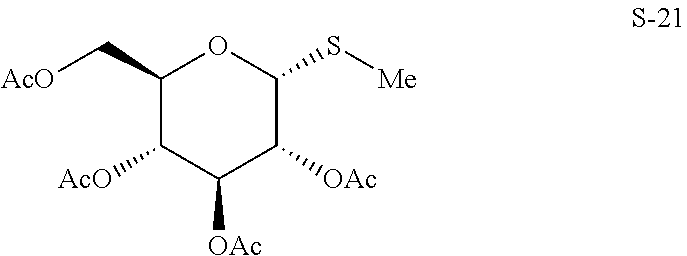


was substituted with

to prepare O-glycosyl compound O-4 of the present invention, with a purity of >90%. The structural characterization was as follows:


was substituted with

to prepare O-glycosyl compound 0-10 of the present invention, with a purity of >90%. The structural characterization was as follows: 1H NMR (400 MHz, chloroform-d) δ 7.62 (d, J=1.7 Hz, 1H), 7.55 (d, J=8.5 Hz, 1H), 7.45 (d, J=8.8 Hz, 1H), 7.34 (dd, J=8.5, 1.9 Hz, 1H), 7.32-7.22 (m, 13H), 7.20 (d, J=6.4 Hz, 2H), 7.13 (ddd, J=11.5, 6.9, 2.0 Hz, 4H), 7.07 (dd, J=6.7, 2.9 Hz, 2H), 7.06-7.00 (m, 2H), 6.43 (d, J=3.2 Hz, 1H), 4.73 (d, J=10.8 Hz, 1H), 4.57 (t, J=11.9 Hz, 2H), 4.48-4.38 (m, 4H), 4.31 (d, J=11.1 Hz, 1H), 3.91 (q, I=7.1 Hz, 1H), 3.83 (s, 3H), 3.79 (ddd, J=9.9, 3.6, 2.1 Hz, 1H), 3.68-3.61 (m, 1H), 3.60 (d, J=2.2 Hz, 1H), 3.59-3.53 (m, 2H), 3.48 (t, J=9.2 Hz, 1H), 1.59 (d, J=7.1 Hz, 3H); 13C NMR (100 MHz, chloroform-d) δ 172.81, 157.58, 138.63, 138.12, 137.86, 137.72, 135.36, 133.69, 129.35, 128.90, 128.41, 128.38, 128.28, 128.27, 128.16, 127.95, 127.80, 127.75, 127.49, 126.96, 126.74, 126.26, 118.82, 105.54, 90.45, 81.22, 79.47, 76.70, 75.36, 75.07, 73.52, 73.19, 72.98, 68.22, 55.26, 55.24, 45.51, 18.03.
Synthesis of C-Glycosyl Compound:


Claims (6)


Applications Claiming Priority (3)
| Application Number | Priority Date | Filing Date | Title |
|---|---|---|---|
| CN201910668449.8 | 2019-07-23 | ||
| CN201910668449.8A CN112279880A (en) | 2019-07-23 | 2019-07-23 | A kind of new glycosyl donor, glucosinolate compound and preparation method thereof |
| PCT/CN2020/103340 WO2021013155A1 (en) | 2019-07-23 | 2020-07-21 | Novel glycosyl donor, preparation method therefor, and use thereof |
Related Parent Applications (1)
| Application Number | Title | Priority Date | Filing Date |
|---|---|---|---|
| PCT/CN2020/103340 A-371-Of-International WO2021013155A1 (en) | 2019-07-23 | 2020-07-21 | Novel glycosyl donor, preparation method therefor, and use thereof |
Related Child Applications (1)
| Application Number | Title | Priority Date | Filing Date |
|---|---|---|---|
| US19/021,834 Division US20250154119A1 (en) | 2019-07-23 | 2025-01-15 | Glycosyl donor, preparation method therefor, and use thereof |
Publications (2)
| Publication Number | Publication Date |
|---|---|
| US20220127239A1 US20220127239A1 (en) | 2022-04-28 |
| US12202812B2 true US12202812B2 (en) | 2025-01-21 |
Family
ID=74192826
Family Applications (2)
| Application Number | Title | Priority Date | Filing Date |
|---|---|---|---|
| US17/428,562 Active 2041-03-11 US12202812B2 (en) | 2019-07-23 | 2020-07-21 | Glycosyl donor, preparation method therefor, and use thereof |
| US19/021,834 Pending US20250154119A1 (en) | 2019-07-23 | 2025-01-15 | Glycosyl donor, preparation method therefor, and use thereof |
Family Applications After (1)
| Application Number | Title | Priority Date | Filing Date |
|---|---|---|---|
| US19/021,834 Pending US20250154119A1 (en) | 2019-07-23 | 2025-01-15 | Glycosyl donor, preparation method therefor, and use thereof |
Country Status (3)
| Country | Link |
|---|---|
| US (2) | US12202812B2 (en) |
| CN (5) | CN112279880A (en) |
| WO (1) | WO2021013155A1 (en) |
Families Citing this family (7)
| Publication number | Priority date | Publication date | Assignee | Title |
|---|---|---|---|---|
| CN112279880A (en) * | 2019-07-23 | 2021-01-29 | 四川大学 | A kind of new glycosyl donor, glucosinolate compound and preparation method thereof |
| CN113105446B (en) * | 2021-04-06 | 2022-11-11 | 南京方生和医药科技有限公司 | Preparation method of carbon-nucleoside compound |
| CN116730998B (en) * | 2022-03-04 | 2026-04-21 | 四川大学华西医院 | A process for preparing aryl C-glycoside compounds |
| CN114736248B (en) * | 2022-05-06 | 2023-08-15 | 四川大学华西医院 | Sulfinate glycosyl donor and preparation method and application thereof |
| CN117986219A (en) * | 2022-08-22 | 2024-05-07 | 三峡大学 | A method for preparing thioglycosides from 6-aryl/alkylthio-2H-pyran-3-one compounds |
| WO2024050809A1 (en) * | 2022-09-09 | 2024-03-14 | 四川大学 | Method for glycosylation modification of proteins and/or polypeptides |
| CN115433243B (en) * | 2022-09-29 | 2025-03-25 | 江西师范大学 | A method for synthesizing 1,1'-thiodisaccharides with high stereoselectivity using organic catalysis |
Citations (2)
| Publication number | Priority date | Publication date | Assignee | Title |
|---|---|---|---|---|
| EP0290203A1 (en) | 1987-04-29 | 1988-11-09 | Schering Corporation | 3-O-glycosyl 16-membered macrolide antibacterials and related derivatives |
| CN105593163A (en) | 2013-10-02 | 2016-05-18 | 大金工业株式会社 | Method for purifying phosphorus pentafluoride |
Family Cites Families (4)
| Publication number | Priority date | Publication date | Assignee | Title |
|---|---|---|---|---|
| CN105646612B (en) * | 2016-03-04 | 2018-06-22 | 浙江师范大学 | A kind of method for synthesizing alpha-aromatic sulphur glycosides |
| CN108070011A (en) * | 2018-01-05 | 2018-05-25 | 河南科技大学 | A kind of galactolipin sugar ester base compound donator and preparation method thereof |
| CN109232331B (en) * | 2018-09-27 | 2020-06-09 | 江苏大学 | Method for preparing β-ketosulfone or β-hydroxysulfone by reacting substituted alkene and sulfonylhydrazide derivative |
| CN112279880A (en) * | 2019-07-23 | 2021-01-29 | 四川大学 | A kind of new glycosyl donor, glucosinolate compound and preparation method thereof |
-
2019
- 2019-07-23 CN CN201910668449.8A patent/CN112279880A/en active Pending
-
2020
- 2020-07-21 CN CN202410443231.3A patent/CN118271376A/en active Pending
- 2020-07-21 CN CN202410443230.9A patent/CN118165048A/en active Pending
- 2020-07-21 CN CN202410443233.2A patent/CN118164971A/en active Pending
- 2020-07-21 WO PCT/CN2020/103340 patent/WO2021013155A1/en not_active Ceased
- 2020-07-21 US US17/428,562 patent/US12202812B2/en active Active
- 2020-07-21 CN CN202080048873.3A patent/CN114375295B/en active Active
-
2025
- 2025-01-15 US US19/021,834 patent/US20250154119A1/en active Pending
Patent Citations (2)
| Publication number | Priority date | Publication date | Assignee | Title |
|---|---|---|---|---|
| EP0290203A1 (en) | 1987-04-29 | 1988-11-09 | Schering Corporation | 3-O-glycosyl 16-membered macrolide antibacterials and related derivatives |
| CN105593163A (en) | 2013-10-02 | 2016-05-18 | 大金工业株式会社 | Method for purifying phosphorus pentafluoride |
Non-Patent Citations (7)
| Title |
|---|
| Adak, Laksmikanta et al. "Synthesis of Aryl C-Glycosides via Iron-Catalyzed Cross Coupling of Halosugars: Stereoselective Anomeric Arylation of Glycosyl Radicals" Journal of the American Chemical Society, vol. 139, No. 31., Aug. 1, 2017, ISSN: 0002-7863, p. 10693-10701, p. 10696, table 5. |
| Ferrier et al., registry database compound, 1978. * |
| Ferrier. Robert Jet al. "Observations on the Possible Application of Glycosyl Disulfides. Sulfenic Esters. and Sulfones in the Synthesis of Glycosides" Carbohydrate Research, vol. 58,, No. 2, 1977-12-31, Issn: 1873-426X, p. 399 lines 9-11. |
| Konradsson, Peter et al. "Iodonium Promoted Reactions of Disarmed Thioglycosides" Tetrahedron Letters, vol. 31., No. 30, Mar. 9, 2001, ISSN: 0040-4039, p. 4314, table 1. |
| Krumb, Matthias et al. "Visible Light Enables Aerobic Iodine Catalyzed Glycosylation" European Journal of Organic Chemistry, vol. 2019, No. 28, Feb. 22, 2019, ISSN: 1099-0690, p. 4519, Scheme 2. |
| Lockhoff, Oswald. "An Access to Glycoconjugate Libraries through Multicomponent Reactions" Angewandte Chemie International Edition, vol. 37., No. 24, Jan. 18, 1999, ISSN: 1433-7851, p. 3437, Scheme 3. |
| Sakata. Masakatsu et al. "Thiosugars. VI. Reaction Products of Potassium Alkyl- and Benzylxanthates with Acetylated Glucosyl Halides" Chemical & Pharmaceutical Bulletin, vol. 12, No. 6, Dec. 31, 1964, ISSN: 0009-2363, pp. 652-656, p. 655 line 12. |
Also Published As
| Publication number | Publication date |
|---|---|
| US20220127239A1 (en) | 2022-04-28 |
| CN118271376A (en) | 2024-07-02 |
| US20250154119A1 (en) | 2025-05-15 |
| CN112279880A (en) | 2021-01-29 |
| CN118164971A (en) | 2024-06-11 |
| CN114375295A (en) | 2022-04-19 |
| WO2021013155A1 (en) | 2021-01-28 |
| CN114375295B (en) | 2024-04-12 |
| CN118165048A (en) | 2024-06-11 |
Similar Documents
| Publication | Publication Date | Title |
|---|---|---|
| US12202812B2 (en) | Glycosyl donor, preparation method therefor, and use thereof | |
| EP0587364B1 (en) | A process for anomerizing nucleosides | |
| Neilson et al. | Oligoribonucleotide Synthesis. II. Preparation of 2′-O-tetrahydropyranyl Derivatives of Adenosine and Cytidine Necessary for Insertion in Stepwise Synthesis | |
| US20250059226A1 (en) | Sulfinate glycosyl donor, method for preparing same, and use thereof | |
| ES2582794T3 (en) | New macrolides and their use | |
| BG107737A (en) | Phase transfer catalyzed glycosidation of an indolocarbazole | |
| Chu et al. | N-Indolylglycosides bearing modifications at the glucose C6-position as sodium-dependent glucose co-transporter 2 inhibitors | |
| WO2017186110A1 (en) | Vancomycin derivative, preparation method, pharmaceutical composition and use thereof | |
| Wrodnigg et al. | The Amadori rearrangement as key reaction for the synthesis of neoglycoconjugates | |
| SU1054352A1 (en) | N-glycosyl derivatives of daunorubicine having antibiotic effect | |
| Ōmura et al. | Structure of prumycin | |
| CN114075255B (en) | Glycosyl donor and application thereof in preparing glycoside | |
| US20250346620A1 (en) | Methods for synthesis of peracetylgalactosamine-1-pentanoic acid | |
| EP0297594A2 (en) | Novel 3',4'-dinitrogen substituted epipodophyllotoxin glucoside derivatives | |
| Ogawa et al. | Synthesis of Ether‐and Imino‐Linked Octyl N‐Acetyl‐5a′‐carba‐β‐lactosaminides and‐isolactosaminides: Acceptor Substrates for α‐(1→ 3/4)‐Fucosyltransferase, and Enzymatic Synthesis of 5a′‐Carbatrisaccharides | |
| CN118027007A (en) | A 3-indole or pyrrolyl-2-nitroalkene sugar compound and its preparation method and application | |
| JP4621588B2 (en) | New compound caprazene and caprazene derivatives, and new compound caprazol and caprazol derivatives | |
| CN117126215A (en) | A method for synthesizing thioester compounds through alkynamide-mediated cross-coupling of amino acids and glycosylthiols | |
| Elgemeie et al. | Convenient Synthesis of 2 (1H)-Pyridinethione Glycosides. | |
| RU2368662C1 (en) | METHOD OF OBTAINING 9-(β-D-ARABINOFURANOSYL)-2-FLUOROADENINE | |
| Sasaki et al. | Convenient synthesis of 2, 3'-imino-1-(. beta.-D-lyxofuranosyl) uracil and its derivatives using azide ion | |
| Nagy et al. | Synthesis of three new bifunctional glucose-thiourea organocatalysts and their application in asymmetric Michael addition | |
| CA2725842C (en) | Process for the glycosidation of colchicine and thiocolchicine | |
| JP4115066B2 (en) | Carbohydrate amidine derivatives | |
| US3300477A (en) | Isolation of 5'-guanylic acid by formation of 5'-guanylic acid dioxanate |
Legal Events
| Date | Code | Title | Description |
|---|---|---|---|
| AS | Assignment |
Owner name: SICHUAN UNIVERSITY, CHINA Free format text: ASSIGNMENT OF ASSIGNORS INTEREST;ASSIGNORS:NIU, DAWEN;ZHANG, XIA;WAN, LIQIANG;AND OTHERS;REEL/FRAME:057082/0869 Effective date: 20210420 |
|
| FEPP | Fee payment procedure |
Free format text: ENTITY STATUS SET TO UNDISCOUNTED (ORIGINAL EVENT CODE: BIG.); ENTITY STATUS OF PATENT OWNER: SMALL ENTITY |
|
| FEPP | Fee payment procedure |
Free format text: ENTITY STATUS SET TO SMALL (ORIGINAL EVENT CODE: SMAL); ENTITY STATUS OF PATENT OWNER: SMALL ENTITY |
|
| STPP | Information on status: patent application and granting procedure in general |
Free format text: DOCKETED NEW CASE - READY FOR EXAMINATION |
|
| STPP | Information on status: patent application and granting procedure in general |
Free format text: NON FINAL ACTION MAILED |
|
| STPP | Information on status: patent application and granting procedure in general |
Free format text: NON FINAL ACTION MAILED |
|
| STPP | Information on status: patent application and granting procedure in general |
Free format text: RESPONSE TO NON-FINAL OFFICE ACTION ENTERED AND FORWARDED TO EXAMINER |
|
| STPP | Information on status: patent application and granting procedure in general |
Free format text: FINAL REJECTION MAILED |
|
| STPP | Information on status: patent application and granting procedure in general |
Free format text: RESPONSE AFTER FINAL ACTION FORWARDED TO EXAMINER |
|
| STPP | Information on status: patent application and granting procedure in general |
Free format text: ADVISORY ACTION MAILED |
|
| STPP | Information on status: patent application and granting procedure in general |
Free format text: DOCKETED NEW CASE - READY FOR EXAMINATION |
|
| STPP | Information on status: patent application and granting procedure in general |
Free format text: EX PARTE QUAYLE ACTION MAILED |
|
| STPP | Information on status: patent application and granting procedure in general |
Free format text: RESPONSE TO EX PARTE QUAYLE ACTION ENTERED AND FORWARDED TO EXAMINER |
|
| STPP | Information on status: patent application and granting procedure in general |
Free format text: NOTICE OF ALLOWANCE MAILED -- APPLICATION RECEIVED IN OFFICE OF PUBLICATIONS |
|
| ZAAB | Notice of allowance mailed |
Free format text: ORIGINAL CODE: MN/=. |
|
| STPP | Information on status: patent application and granting procedure in general |
Free format text: PUBLICATIONS -- ISSUE FEE PAYMENT VERIFIED |
|
| STCF | Information on status: patent grant |
Free format text: PATENTED CASE |